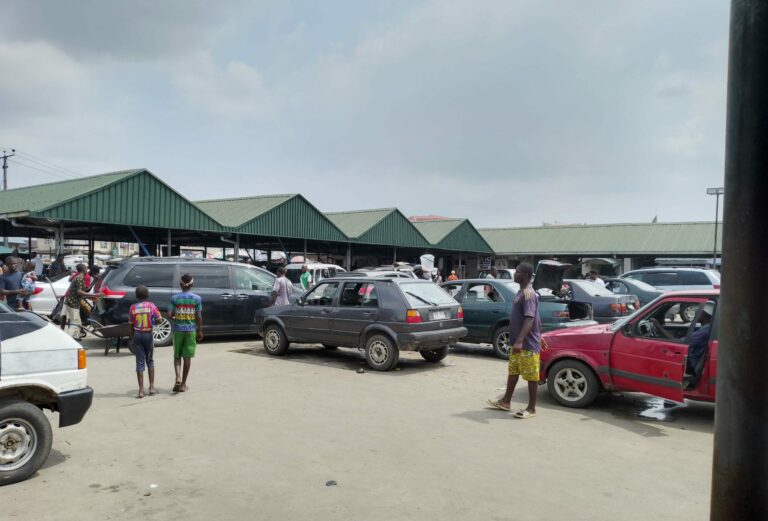
THE Rivers State Signage and Advertisement Agency (RISAA) has dissolved all revenue collection agents and task force teams in the state following an investigation by The ICIR.
The investigation, published on Thursday, February 29, revealed how billions being generated as road tax in the state were being pocketed by private individuals.
The RISAA Managing Director, Aye Pepple, announced the dissolution, which took effect immediately, in a statement on Friday, March 15.
“The Rivers State Signage and Advertisement Agency (RISAA) hereby announces the dissolution of all task force, revenue agents, consultants, contractors and representatives doing business on behalf of the agency with immediate effect.
“Furthermore, there will be a revalidation exercise, which commencement date will be communicated to all affected parties, and until this exercise is concluded, the public is advised not to engage in any dealings with anyone on behalf of the agency,” the statement read.
The ICIR reported that at least N55.2 billion was being generated from 62,418 commercial vehicles, 24,432 tricycles and 10, 892 motorcycles in road taxes within the state yearly.
The report also revealed that only 0.41 per cent of this sum got into government coffers, with the rest pocketed by members of a transport union and community touts.
Based on the sum being generated by the transport union, Rivers State Inland Revenue Service (RIRS) was expected to generate at least N2.2 billion from commercial vehicles annually. However, it only reported N223.93 million in road tax throughout 2022.
According to the report, several groups are responsible for the diversion of these funds, including the National Union of Road Transport Workers (NURTW), which reported only a fraction of the taxes collected.
Drivers who refused to pay these taxes were usually beaten or had their vehicles, tricycles or motorcycles confiscated.
Charges imposed on drivers by these groups contributed to the rising cost of transportation in the state.
A FEDERAL High Court in Abuja has ordered Binance, a cryptocurrency exchange platform, to provide data of its Nigerian users to the Economic and Financial Crimes Commission (EFCC).
The judge, Emeka Nwite, gave the interim order after ruling on the ex-parte motion moved by the EFCC’s lawyer, Ekele Iheanacho.
“That an order of this honourable court is hereby made directing the operators of Binance to provide the commission with comprehensive data/information relating to all persons from Nigeria trading on its platform,” the judge declared.
According to the News Agency of Nigeria (NAN), a certified true copy of the ruling delivered on February 29 was sighted on Monday, March 18, and the interim order was issued to help the EFCC investigate money laundering claims and terrorism financing against the platform.
An EFCC agent, Hamma Bello, stated in the affidavit supporting the motion that he was a member of the commission’s Special Investigation Team (SIT) based in the Office of the National Security Adviser (ONSA).
Bello said that the SIT was notified of the illicit activities (money laundering and financing of terrorism) of Binance after the ONSA established the Technical Committee on Currency Stability and Forex Manipulation.
“The team uncovered users who have been using the platform for price discovery, confirmation and market manipulation, which has caused tremendous distortions in the market, resulting in the naira losing its value against other currencies.
“The damage the platform has caused was clearly explained to the operators of the platform, and they were requested to delist the naira and avail the ONSA on the activities of Nigerians on their platform.
“That from the information afforded to the team by Binance shows that the total trading volume from Nigeria in 2023 alone stood at $21.6 billion,” Bello said in the ex-parte motion marked: FHC/ABJ/CS/259/2024.
He also stated that the group discovered some individuals whose actions on Binance caused the nation’s currency to depreciate, compared with ther currencies.
Bello argued that the information would help the panel complete its inquiry and that the issue was of public interest.
He said granting the application was in the best interest of justice and doing otherwise would impede the commission’s investigations.
The ICIR reportedon March 5 that Binance has pulled its services out of Nigeria.
The platform asked Nigerians trading on it to remove all their naira assets, indicating that it is terminating its services in the country.
The Federal Government has been taking harsh measures against Binance management recently.
In response to the severe actions taken against it by the Nigerian government, Binance, on Tuesday, March 5, deleted all assets linked to the naira.
Binance’s CEO, Changpeng Zhao, was threatened with an arrest order on Monday, March 4, by the House of Representatives.
This was after the ONSA had arrested two executives from Binance in Nigeria in the preceding week while responding to an invitation from the Nigerian government.
The company’s representatives were summonedto testify before the House committee but did not respond.
The committee’s chairperson, Ginger Onwusibe, stated that the members had decided not to receive any representation from anyone other than the Binance executives.
The government has asked the cryptocurrency platform to pay $10 billion to settle claims that it manipulated foreign exchange rates and depreciated the value of the naira relative to the dollar.
TERRORISTS have reportedly whisked away 87 people in the Kajuru Local Government Area (LGA) of Kaduna State.
The attack occurred between the night of Sunday, March 17 and the morning of Monday, March 18, after the terrorists allegedly launched onslaughts on two communities of Gangere and Aguna under the Kufana District of the Kajuru LGA.
Attempts by The ICIR to get the details of the attack from the Kaduna State Police Command spokesperson, Mansir Hassan, were unsuccessful as he neither picked up calls nor responded to messages sent to his mobile line.
However, confirming the incident, one of the communities’ youths, Harisu Dari, told the Punch hours after the attack that the terrorists broke into several shops, stole food supplies and other valuables, and whisked away 87 residents.
According to Harisu, there has been no communication with the kidnapped residents and their captors.
“As of the time I visited the community this morning, security operatives have not been drafted to help restore the confidence of the villagers.
“The villagers are traumatised by the sad development. The government needs to re-strategise in tackling these terrorists,” he said.
The ICIR reports that the attack is the latest incident of insecurity in Nigeria. On March 16, this organisation reported that despite promises of security, 703 persons were abducted within eight days under President Bola Tinubu.
On Sunday, March 3, some women were abducted by terrorists on their way to the bush to get firewood in Borno State.
They were reportedly swooped upon by gunmen in the Bula Kunte Bush, in Ngala Town, where the bandits freed older people among them and went away with the younger women.
Amnesty International (AI) claimed that more than 400 displaced people were abducted in Borno State in the first week of March.
On Thursday, March 7, a school teacher, Sani Abdullahi, said atleast 287 students and a principal, Abubakar Isah, were abducted when bandits invaded the Local Education Authority (LEA) Primary and Junior Secondary School, Kuriga, in Chikun Local Government Area of Kaduna State.
Abdullahi said this when the state Governor Uba Sani and some other state officials visited the school hours after the abduction.
He said 187 students were abducted from the secondary school section and 125 from the primary school section of the school, totalling 312 students.
Similarly, the Police in Sokoto confirmed to The ICIR on March 10 that bandits abducted 15 students and a woman in the state.
According to the police, the students were taken from the Gidan Bakuso area of Gada Local Government Area in the state.
THE New Humanitarian (TNH) has opened applications for its 2024 Humanitarian Reporting Fellowship for journalists based in the Middle East, Asia, Latin America, or Africa.
The fellowship offers applicants the opportunity to gain skills in reporting, framing, and presenting local stories for global audiences as part of The New Humanitarian’s global newsroom.
It will also run for six months, from May to November and fellows will experiment with multimedia reporting techniques and develop innovative reporting skills.
The TNH says the fellowship is part of its commitment to journalism that authentically represents the communities it serves while providing insight for policymakers, practitioners, government officials, and others interested in improving the lives of people in crises.
The New Humanitarian, for almost three decades, has put quality independent journalism at the service of the millions of people affected by humanitarian crises around the world.
A monthly stipend of US$2,500 will be provided to successful fellows. The deadline for application is March 31. Interested persons can apply here.
THE Federal Government has commenced a N40 billion mass metering programme to end the era of estimated billing in the Nigerian Army formations nationwide.
Speaking during the flag-off of the metering exercise at the weekend, the Minister of Power, Adebayo Adelabu, said that the exercise would be in phases, with the Ikeja Cantonment in Lagos State being the first phase of the exercise.
He said the current exercise would last for six weeks.
Adelabu, in a statement issued on Sunday, March 17, explained that for the current exercise, the sum of N12.7 billion had been released out of a total of N40 billion for the project.
“The mass metering in Army formations nationwide will enable to us know what is consumed every month to ensure appropriate billings and ease of collections. The overall intention is to eliminate and make estimated billing a thing of the past.
“This is one of Mr. President’s objectives as contained in the renewed hope agenda to ensure that electricity supply to the Armed Forces is prioritised and they do not suffer especially in the enjoyment of public utilities,” he said.
Adelabu said the smart meters being installed were tamper-proof and would eliminate energy theft.
Speaking further, the minister said that part of the energy blueprint by the government was to build off-grid power sources such as solar energy for military barracks located in remote areas without grid supply, adding that the meters being installed allow interconnectivity between grid and off-grid solar power supply.
Adelabu said the metering project would be extended to all military formations in the country to provide a 24-hour power supply to the barracks.
In his remarks, the chief executive officer of De Haryor Global Service and engineer in charge of the metering project, Ashade Olatunbosun, said the second phase of the project would begin in Abuja and Enugu, simultaneously, adding that military formations across the 11 distribution companies (DisCos) would benefit from the exercise.
Welcoming the minister to the Army Headquarters during the launch, A.M Adetuyi, a major-general, said the metering initiative was timely as the brigade headquarters had been facing an epileptic power supply over time.
He said “When I investigated, I found out that we were only being given three hours of electricity daily, and on some days, we do not even get supplied. We have tried to resolve this and we have even involved the state government without any result.
“We also discovered that we were always being given estimated bills, though we would not have minded if the power supply had been regular. However, this commendable metering project has gladdened our hearts.”
On February 20, The ICIRreported the Abuja Electricity Distribution Company (AEDC) threatening to disconnect electricity in the Presidential Villa, military formations across Nigeria, the Federal Inland Revenue Service (FIRS), and other Federal Government ministries, departments and agencies over their refusal to pay over N47 billion outstanding debts as of December 2023.
In the debtors’ list were the Chief of Defence Staff – Barracks and Military Formations owing N12 billion, Ministry of Finance, Ministry of State Petroleum, Ministry of Health, Ministry of Information, Ministry of Education and Ministry of Agriculture.
The list also contained the Ministry of Education, CBN governor’s office, Ministry of Foreign Affairs, Ministry of Budget and Planning, Ministry of Culture and Tourism, Ministry of Interior, and Ministry of Transport.
Two days after the threat, power to barracks and other military formations was severed, leading to the decomposition of corpses at the Army mortuaries.
THE Senior Staff Association of Nigerian Universities (SSANU) and the Non-Academic Staff Union of Educational and Associated Institutions (NASU) have begun a seven-day warning strike over their withheld salaries.
The strike was declared by the unions’ Joint Action Committee (JAC), according to a memo dated Friday, March 15, which directed members to withdraw their services across the nation’s public universities.
Co-signed by the National President of SSANU, Mohammed Ibrahim, and the General Secretary of NASU, Peters Adeyemi, the memo urged the unions’ branch leaders to ensure total compliance with the directive.
The ICIRreported that the committee had on March 1, threatened to embark on strike over the withheld salaries.
It raised concerns about the Federal Government’s decision to release four months of similar withheld salaries to members of the Academic Staff Union of Universities (ASUU) while refusing to release those of the non-academic staff.
The committee said the reactions from the members of the two unions indicated that they would no longer guarantee industrial peace in the nation’s public universities.
The ICIR reports that strike of this nature, whether by academic or non-academic staff, often disrupts teachings in the universities.
Part of the memo reads: “The Joint Action Committee (JAC) of NASU and SSANU has inundated the Federal Government with the need to pay the withheld four months’ salaries of our members in the federal universities and inter-university centres as done for our academic counterparts to no avail.
“As a matter of fact, the attention of Rt. Hon. Femi Gbajabiamila, Chief of Staff to the President, and Prof. Tahir Mamman, SAN, OON, the Honourable Minister of Education, were called to this injustice and unfair treatment of our members in our letter referenced JAC/NS/VOL.II/277 dated 13th February, 2024 and to also inform them to resolve the issue positively before it leads to unnecessary upheaval in our university sector.
“In a similar vein, a press release was issued on 1st March 2024 and the Federal Government was given a seven-day ultimatum to do the needful in respect of the payment of the withheld four months’ salaries but nothing was done on same.”
The committee consequently directed SSANU and NASU members in the universities and inter-university centres throughout the country to commence a seven-day warning strike effective Monday, March 18, in the first instance.
It urged the unions’ members to adhere strictly to the directive, noting that the developments during the seven days would shape the next call of action.
The ICIR reports that the administration of former President Muhammadu Buhari withheld ASUU members’ salaries when it invoked a ‘no work, no pay’ policy during an industrial action by the lecturers that lasted eight months, from February 14 to October 14, 2022.
The lecturers subsequently suspended the strike following a court order initiated by the Nigerian government at the time.
Similarly, SSANU and NASU embarked on strike for five months between April and July 2022, to compel the Nigerian government to meet its demands as ASUU.
The Buhari government also invoked the ‘no work, no pay’ policy on the striking non-teaching university workers as their ASUU counterparts.
However, in October 2023, President Bola Tinubu pledged to pay four of ASUU’s withheld eight months’ salaries, with the union confirming the commencement of the payment in February.
The Tinubu government has been mum on the SSANU and NASU’s fate, prompting the unions to suspend work for the initial period of seven days.
THIS report looks at the increasing trend of rape in Kano state, the plight and challenges of the rape victims and their plea for rescue to the Kano State Government while also looking at the efforts of state and non-state actors, Civil Society Organisations (CSOs), in the fight against rape and other forms of sexual abuse in Kano State and what needs to be done to curtail the menace in the State.
Despite the establishment of the Violence Against Persons Prohibition Act (VAPP) on May 25, 2015, in Nigeria to prevent and criminalise various forms of violence against persons, rape continues to be a prevalent human rights violation in Nigeria, living the victims in a very difficult situation and yet, not much has been done about it.
Apart from rape, VAPP is also intended to deal with acts such as sexual abuse, domestic violence and harmful traditional practices such as female genital mutilation/cutting (FGM/C), and forced marriage.
In a recent stakeholder’s forum during the ’16 days of Activism’, an official of the Kano State Sexual Referral Centre, Halima B. Faruq, announced that Kano State has the highest rate of Gender-Based Violence (GBV).
The law provisions on rape
Section 283 of the Penal Code Act, a law applicable in the Northern States of Nigeria, provides that “Rape is said to occur where a man has sexual intercourse with a woman in any of the following circumstances:
Against her will,
Without her consent,
With her consent, when her consent has been obtained by putting her in fear of death or hurt,
With her consent when the man knows that he is not her husband and that her consent is given because she believes that he is another man to whom she is or believes herself to be lawfully married.
With or without her consent, when she is under fourteen years of age or of unsound mind.”
The law further states further that if any of the above circumstances occur, then it is said to be a rape and it provides imprisonment for life or for any less term and or a fine as a punishment for the crime of rape.
Significantly, the Penal Code does not recognised men or boys as victims of rape and does not recognise marital rape where the woman has attained the age of puberty.
But the Child Rights Act (CRA), is a Federal Law which was enacted to protect the rights of children, established in 2003. It has been fully domesticated in 34 States in Nigeria and only Kano and Zamfara States are yet to do that. This is according to the update given by the Former Minister of Women Affairs, Pauline Tallen on behalf of the Federal Government during the 59th edition of the Ministerial Media Briefing organised by the Presidential Communications Team at the Presidential Villa in Abuja, last year.
Section 31 (1) & (2) of the CRA provides that any person who has sexual intercourse with a child commits an offence of rape and is liable on conviction to imprisonment for life. The CRA provides that it is immaterial that- (a) the offender believed the person to be of or above the age of eighteen years; or (b) the sexual intercourse was with the consent of the child.
Also, the CRA does not restrict victims of rape to the female gender. It also recognises that the offence of rape could be committed either male or female. Therefore, according to what the above two laws stated, female and males can be victims of rape.
In Kano state, female and young boys have been reported raped and this issue has become so prevalent and continues to increase day by day in the state.
According to the Director of Research, Planning and Statistics of the Kano Ministry of Women, Children and Disabled, Yakubu Muhammad Salihi, Kano currently has 300 cases of rape issues, and the victims/survivors include of teenage and young girls and boys.
Salihi said in the interview conducted by BUK FM, Kano, that the incidents mostly happened in their homes, neighborhood, communities, on their way to school and are mostly perpetrated by their loved ones, relatives or strangers.
Investigations further shows that the issue of rape keeps occurring because of lack of working laws, especially the VAPP Act, that will ensure the prosecution of the offenders in the state.
Sexual referral centre, Waraka
The Protocol Officer at the Kano State Sexual Referral Centre (SARC), Waraka, that tackles issues of sexual assault, Aminu Usman, said that compare to last year, the incidence of rape is on the increased and it is becoming worst as the Centre now receives up to 100 cases in a month.
“The issue of rape is becoming out of hand and is getting worse. In a month we can receive 95-100 cases of rape. Currently, from the beginning of this month so far, we received over 50 cases. Just last week, (as at the interview time) 17 cases of rape were brought to us on a single day from one community that I cannot disclosed because of confidentiality.”
Usman further stated that the issue is increasing because the perpetrators do not receive proper punishment, adding that 60 per cent of the offenders escape proper punishment after being reported to the authorities and will go back to the community and continue their atrocities because there is no law to deal with them.
He added that this is why the Centre is fighting tirelessly, advocating for the VAPP Act to be domesticated in the State as the only way to mitigate the issue of SGBV in Kano.
Health implications…
Investigation indicates that many health complications that occur after rape, which is a traumatic experience that affects the victim physically, psychologically and sociologically.
A medical expert, Hassan Abubakar, who is a theatre nurse at the Sexual Referral Centre, Waraka, highlighted the health complications that mostly occurs during and after rape.
“Medical, surgical and psychological conditions are mostly the three complications rape victims always experience during and after the incidence.”
“Medical complications and conditions are the worst that we don’t pray for it to happen because they are diseases that can be transmitted through sexual intercourse such as sexually transmitted diseases, STDs, HIV/Aids, Hepatitis, Gonorrhea, and Syphilis. These kinds of diseases can cause a lot of problems and even death if care is not taken. The scary part is that the victim might not know if she contacted any of these diseases unless she is taken to a hospital on time for a test, until the victim starts to exhibit signs and symptoms. A victim may become pregnant too, which brings a whole lot of different repercussions.”
“For surgical conditions, it may warrant carrying out a surgery for the victims.
The incident may result in the victim having complications such as fistula, vascular vaginal fistula, a slit/vaginal cut or abnormal communication between urinary bladder and the vagina, that is abnormal leakage of urine, and this may lead her to get severe infection unless if the condition is treated immediately.
Some victims may also lose their lives. And for victims that were assaulted through anal sex, they may experience complications such as feces leakage and this need surgical intervention to be treated.
She stated that the psychological complications experienced by the victims of rape may include “depression, trauma and worry over whether she might get someone that will marry her and issues like that.”
Abubakar further stated that, so far, they have treated cases of bruises, vaginal cut, sexually transmitted diseases and pregnancy in the Sexual Referral Centre.
He said these might not only be the only diseases some of the victims they treated contacted after the rape because some parent of the victims because of fear and stigma, do not give them cooperation to do their work properly, which he attributed to the lack of working laws in the state to find justice for the victims.
He urges the state government to domesticate the VAPP Act so as to curtail the menace of sexual assault and ensure justice for the victims.
The plight and challenges of Rape victims in Kano
Through interviews conducted with some of the rape victims within the age range of 4, 6, 9, 13, 15 and 17 (who want to be kept anonymous) in, Nassarawa, Tarauni and Dawakin Tofa Local Government Areas (LGAs), our reporter discovered sorry tales or anguish, human right violations, suppression and depression. In some cases, sadly, tales of death.
Four-year-old Khadija was raped by a young man that owns a provision shop on the street on which her parents live.
“It was one man that sells sweets and biscuits in my street that called me and gave me sweets and took me to one place, removed my pants and put something in my vagina. It was very painful and up to now my vagina is itching and paining me,” the child told our reporter in the presence of her mother.
Khadija’s mother explained how she knew that her daughter was been raped after noticing a non-stop white discharge coming out from the little girl’s vagina.
“Initially, I noticed how she was scratching her vagina non-stop and any time I ask her, she will start crying, so I now decided to check the place and find out why she was scratching the place like that and, to my surprised, I saw some white water coming out from her vagina and the vagina was red and wide opened so I became curious and started asking her questions. That was when she told me what happened. So, I called my sister, and we took her to a hospital but they said they will not admit us because the case has to be recorded and handled by the Sexual Referral Centre first and checked if she had injuries or complications before referring her here, so they told us to go to the Sexual Referral Centre and when we went there, they called the Police before conducting a test on the girl and the result said, it is a severe infection.”
The Mother added that, when they found out that it was an infection, no further damage and the Police did not act on the matter after the release of the result, she and her sister decided not to arrest the perpetrator because of stigma and fear that the shop owner might hurt or kill the girl when reported.
However, efforts were made to trace and speak with the shop owner but he was nowhere to be found at the time of the investigation and Khadijah’s Mother said since the time of the incident, he stopped coming to open the shop and they have not seen him anywhere in the community.
The mother further said her little daughter of just four years is battling with severe infection and was put under medication and prays for the law to find justice for the girl.
She also urged the government to ensure punishment of the perpetrators so as to reduce the menace.
Nine-year-old Asiya revealed that it was a 2o year young man, Kamilu that frequently comes to her parents’ house that raped her and threatened to kill her if she exposed him.
“I know him and he used to come and collect food from my mummy. He always calls me to give me sweets and money and one day, he took me to one uncompleted building and removed my clothes and started fingering me and inserted his Penis in my vagina. He ordered me not to say a word to anyone about it, that if I do, he is going to kill me,” she narrated.
Asiya’s mother said they found the girl helpless after the incident and took her to a hospital with the help of the Police where she was admitted and when they conducted a test on her, the result showed that she had contacted a sexually transmitted disease.
She said she first informed her husband about the incident who later informed some of their community members in Nassarawa Local Government Area and called the nearby Police to arrest Kamilu and the case was further taken to the Kano State Human Right Commission by the parents.
She added that after the Commission conducted a thorough investigation following the Police report, they were sent to court for prosecution but the court ruled that Asiya’s case was said to be sexual assault and not rape.
Meanwhile, efforts was made to speak with Kamilu one-on-one but access were denied to see him by his family members; Musa Yau and Shamsiyya who are Kamilu’s cousin brother and grandmother in Unguwan Nassarwa because they do not want him to be exposed on the Media, saying “we can’t allow him to be seen or heard on the media on an allegation that the Court has already passed judgment.”
On the side of Adamu, who is 6 years old, he was sexually assaulted by a 17-year-old boy in the neighborhood where he lives.
The victim’s mother said Abubakar developed a severe stomach ache after the incident, which made them take the case to court. The court passed on its judgment but said unfortunately the offender was later released after spending the 6 Months without paying for her son’s medication.
“After the incident, Abubakar started experiencing severe stomach ache, so they took him to a hospital and from there Human Right Commission and to court. After the prosecution, the perpetrator was found guilty and sentenced to just six months of imprisonment with a fine of N25, 000. He was also asked to pay N25, 000 for the victim’s medication but the young man was later released after completing his months in Prison without paying for Abubakar’s treatment.”
However, when we conducted further investigation on the issue, Abubakar’s uncle, Nazifi Sani revealed that the Culprit was released after spending his 6 months in the prison on a condition that he is going pay the fine or any of his family members within 6 Months.
A 15-year-old teenage girl who spoke to our reporter only on the condition of strict anonymity said it was her biological father that raped her in her room when was sleeping in their house and she is now battling with a severe infection.
She added that he threatened to kill her if she tells anyone, but she later managed to inform her aunt about it because her mother is no more, but the aunt pleaded with her to bury the issue since he is her biological father, and it is going to tarnish his image if the issue comes. After this, she kept quiet about it.
Looking at her situation, she said she has given up as she cannot fight for her rights because family and close allies will not allow her, but prayed for a law that will prevent rape and other sexual assault from happening.
In the case of 13-year-old Zahara’u, she was raped and impregnated by a young man (whose name was not allowed to mention here by the Lawyer handling the case for anonymity) in her in her village in Dawakin Tofa. Zahra’u has finally put to bed, but she is currently suffering from a body shock and went into unconsciousness after she gave birth.
Picture of Zahra’u and her baby
According to Barrister Badamasi Suleiman, the lawyer handing the case, after the rape incident, her family tried to bury the case because of shame and stigma but after she put to bed and became unconscious, a family member reached out to him, they decided to take the case to the Police and from there to court.
He added that the court has ordered the State Criminal Investigation Department at the Bompai Police Headquarters in Kano to investigate the matter.
While all the previous victims are living with the consequences of their traumatic experience, there is the really harrowing tale of 17-year-old Saratu, who was killed after being raped and impregnated.
It was found that the deceased was drugged before she was raped in her uncle’s house but she did not find out that she was pregnant until after five months.
However, Saratu’s sister, Hadiza, before Saratu’s death, she informed her family that the only person she suspected at that time was Auwal, an adopted son in her Uncle House that shown interest in her, “saying he likes her and want to marry her” but she told him that she had a boyfriend and turned his request down. But Auwal didn’t stop, he continued to disturbed her and always bought her gifts even though she never accepted any of the gifts. She said he was the one that bought her a drink that night and she drank it not knowing that it was drugged and after drinking it, she did not remember what happened.
When they approached Auwal, he denied it, saying he does not know anything about it and therefore, the Saratu’s family took the case to the Human Right Commission and the Commission sent them to court.
It was gathered that the court ordered a DNA test and adjourned the case until after Saratu put to bed. Since the court adjourned the case, investigations reveal Saratu before her death received messages from an unknown number threatening her if she did not drop the case. But Saratu and her family were resolute that they would see the case to its conclusion.
In a twist of events, after Saratu was put to bed and the DNA was conducted along with the suspect, Auwal before the result could come out, she went missing and her corpse was found inside a pond on their street.
The baby is now with Saratu’s sister and the family are in a terrible situation, pleading to the government to come to their aid and ensure justice for Saratu’s, saying that their lives are no longer safe because the suspect is now free, and the uncle is becoming suspicious.
A community head in Nassarawa LGA, Malam Bala Shehu, said the issue of rape has now become common as they always frequently receive cases in the community.
Shehu pointed out that it is not that community leaders do not do anything about the issue but that there are no working laws to deal with the issue. According to him, new laws must be enacted so that offenders will start serving proper punishment.
“I believe if the new law ensures punishment of the perpetrators, most of them will stop doing it.”
Amidst all these, how does the Kano Police, others handle the trend of rape cases?
According to the Kano State Police Coom and’sPolice Public Relation Officer (PPRO), Abdullahi Haruna Kiyawa, the Head Quarters has a Gender Desk and they handle SGBV cases including rape, professionally.
“Yes, we do have a Gender Desk at the Police headquarters and we treat such cases diligently and professionally by taking the victims statements, carry out our investigations and taking the victims and culprits to court for prosecution.
Kiyawa noted that the Police is not experiencing any increasing trends though he could not provide the number of the rape cases handled by the command.
The Human Right Commission is saddled with the responsibility of promotion, protection, and enforcement of the rights of the citizens.
Picture of Mr. Abdullahi Shehu, Coordinator of Kano State Human Rights Commission
According to the State Coordinator of Human Right Commission, Abdullahi Shehu, the agency is working hard in responding to rape cases and other cases of sexual assault.
“We do responds to cases of rape and other cases of sexual offences, and we work diligently alongside relevant stakeholders including the law enforcement agencies, particularly the Nigerian Police. Anytime we receive such call on rape case, especially if it is in a rural area, we would tell them to go to the nearest police station to report the case and then we will call and speak to the officer on desk and tell him about the situation and will take the report. The reason we do this is to ensure that all evidence is intact so that the offender will not have a reason to lie or deny what he did.
“After the Police report, we take an appropriate step in bringing justice to the victims by arranging the suspects. Investigation will be conducted and the case will go to the court of jurisdiction for prosecution.”
He said the Commission employs a pragmatic approach in dealing with rape cases, adding that they also follow the cases diligently from the point of investigation to prosecution and up to the point of ruling to ensure that justice is done. However, he noted that dealing with rape case is sometimes difficult because of lack of working laws regarding rape and other sexual assault in the state.
Shehu pointed out that their only challenge now is the issue of the VAPP Act not being domesticated.
“We put a lot of effort in such cases but our challenge now is the issue of not domesticating the VAPP Act. You know when there is a legal framework, it will definitely assist in the promotion of Justice.
On the part of the International Federation of Women Lawyers (FIDA), Kano State chapter, the Non-Profit Organisation (NGO) says it is putting more efforts in fighting against SGBV through advocacy programs and ensuring the offenders face the consequence of their crimes.
Hajara Safiyo Hamza FFIS, a Senior Magistrate at the Kano State Judiciary and also the Vice Chairperson of FIDA, said issue of rape is worrisome as there is currently an increasing incidence of cases in Kano State.
She highlighted that the minimum punishment for rape is 14 years imprisonment with or without fine, adding that an offender can also bag a life sentence.
Safiyo said they are putting more efforts to see that offenders serve the punishment they deserve but noted that the existing laws do not directly render significant help to rape victims because there is a gap in the legal framework.
She posited that the VAPP Act is the only law that contains all the necessary provisions for the punishment of the offenders, adding that it is the only way to eliminate or mitigate incidence of rape cases and other sexual assault.
Efforts of Kano State government towards mitigating SGBV
The Kano Ministry of Women, Children and Disabled said that it has been working towards dealing with the issue of SGBV and creating a safer environment for both girls and boys.
According to Yakubu Muhammad Salihu, the Director of Planning Research and Statistics in the ministry, who spoke for the Commissioner, the state government is aware of the increasing incidence of rape and it is already working on it.
“We do receive cases of GBV incidents from SARC and the report includes all forms of abuses from different local governments. Currently, we have recorded 300 rape case, and it is because of the increasing incidence that the government is making more effort to establish additional sexual referral Centres across the three Emirate Councils and the Rano LGA is awaiting equipping.”
He said further: “We have put a multi-sectoral responsive and preventive mechanism in place. We also advocated to the Kano Ministry of Justice to revisit the draft copy of the harmonized state VAPP Bill with the review of Kano Penal Code. The review of the referral mechanism is awaiting validation soon.”
When asked the kind of help the ministry renders to the rape victims, Salihi said they offer psycho-social support and empowerment services to the victims.
He further said the government has drafted a gender equity, social inclusion, child protection law, a safeguarding policy as well as a Persons with Disabilities policy as part of the efforts to curtail acts of gender violence and human rights abuses in the state.
However, Salihi said passing the VAPP Act has been the major challenge and attributed a lack of political will as the reason preventing the domestication of the law.
Is Kano State Government effort enough to mitigate rape and other forms of sexual assault?
Various organisations that have been working towards eliminating SGBV in Kano pointed out that the efforts put in place by the state government are not enough to do away with rape cases and other forms of sexual abuse.
The Centre for Awareness on Justice and Accountability (CAJA), an NGO working around public awareness on the dangers of SGBV, highlighted that the Centre has done a lot of advocacy and enlightenment programs to educate the public and young girls on the dangers of the menace and how to go about it.
The Programme Officer of CAJA, Akibu Hamisu, said they have done a series of advocacies, sensitization programs for girls and the general public on the issue, but that alone is not enough unless relevant laws are put in place.
He said that the government needs to put in more effort by domesticating and implementing the VAPP Act and Child Protection Act in the state, adding that “only that can solve the problem and reduce the menace, thereby creating a safe environment for our wards and sons.”
On the part of the Centre for Information Technology and Development, it advocates leveraging the use of technological innovations to reduce the incidence of SGBV in Kano.
According to the Centre’s Gender Technical Officer, Mrs. Zainab Aminu, the organization sees technology as a tool for development and believes that leveraging technological innovations in eliminating the issue of SGBV is important.
“As part of our initiatives to eliminate SGBV in Kano, we created, designed and deployed a Gender Based Violence Mobile Application (GBV App) in 2021, which is available on Google Play Store, to be monitoring and reporting cases of SGBV with the aim to connect survivors with the support they need and also yield an extensive database on SGBV cases across Kano state, particularly in public schools, so that Kano citizens especially, women and girls can plan safer education for themselves and their loved ones.”
She said that the GBV App monitored and recorded 171 SGBV cases between November 2022, and February 2023, mainly cases of rape and other sexual abuses.
Zainab also revealed that CITAD has put a lot of effort into dealing with the problem but expected impacts are not seen because of no legal frameworks to complement such efforts.
She said it is on this note that the Centre has been advocating and writing to the Kano State government to domesticate the VAPP Act.
Also, Dr. Zubaida Nagee of Baobab for Women’s Human Rights, an organization working towards eradicating SGBV through advocacy campaigns, sensitization programs and psycho-social supports to rape victims, stressed on the need to have the VAPP Act in Kano State as the way forward to end the menace.
“The issue of increasing rape incidence in Kano is quite alarming and it is a high time to take a bold step to curtail the menace as it has left so many unforgettable scars on our young girls and boys, leaving them shattered and some even lost their lives in the process,” she observed.
SPORTING Lagos supporters living on the mainland areas in Lagos state spend an average between the range of N5,000 to N6,000 to watch the Nigerian Premier Football League (NPFL) side’s home matches weekly.
The ICIR affirmed this figure using the current hike price in transport fares of commercial buses in major areas on the mainland areas in Lagos, coupled with the narration of the club’s supporters who shared their plights.
The Lagos state is majorly classified into two comprising the Island and the mainland. The former is used to illustrate areas close to the lagoon, while the latter is used to refer to areas not situated within the sea.
Many people residing in Lagos visit the mainland island using either the Third Mainland Bridge or the Eko Bridge.
Before the promotion of Sporting Lagos into the top-flight league, there was only one Lagos-based club, the Mountain of Fire Ministries Football Club (MFM FC) before they were relegated in the 2021/2022 season. Most of the MFM home matches were played at the Agege Township stadium.
After the promotion of Sporting Lagos in 2023/2024, the venue for their home matches was shifted to the Mobolaji Johnson Arena stadium in Onikan, a major area in Lagos Island.
The ICIR gathered that since the increase in the cost of transport fare, a fan transporting from places in the exterior like Iyana-Ipaja, Abule-Egba in Alimosho Local Government will spend N300-N400 to Oshodi.
From Oshodi, the fan will enter the bus going to CMS or Obalende, the cost is N1000. After alighting at CMS or Obalende, the fan will enter a tricycle and pay N100 to Onikan stadium, for an average sum of N1400-N1500. This amount does not include the inner roads from the house, which may cost N400-N500.
The above scenario captures what Shola Kayode, a sporting Lagos fan, spends on transport fares to watch the team’s home matches.
Living outside the bustling Lagos, Kayode resides in Redemption Camp axis in Ogun state, but his love for football artists in the local league has met stiff resistance due to the high cost of transport fare.
“I reside around Redemption City in Mowe. In all sincerity coming to see Sporting Lagos home games usually cost more. If I am not exaggerating, my to and fro transport should cost 4,000 if I want to come and consider the purchase of a ticket of N500, N1,500 and N5,000.
“Although it is just because of the passion and the love for the club that is why we are coming and since MFM has been disbanded, this is the only team in Lagos that plays NPFL and we just need to see a couple of good games,” he said.
Enthused by his darling Lagos club’s improved performance since the resumption of the second stanza of the league, he urged the club’s management to improvise by making arrangements for buses at designated areas in the mainland to ease fans’ burden on transportation.
“Anyway, thank God that their games have improved in this second stanza more than the first stanza, and at least we can see a good game now compared to when they were not doing better.
“I just think the club should do something for the teeming fans who are coming from the mainland. I think if they can make transportation arrangements for people who are coming from the mainland, I think it will still go a long way because I think they have a lot of teeming fans on the mainland who can not come and see their games,” he said.
Collaborating with Kayode’s submission, Nosa Ojo, who resides inside Gowon Estate in Alimosho Local Government, does not go alone to the stadium, he often goes with his three other neighborhood friends.
The cost for the four of them sums up to over N10,000 weekly to watch Sporting Lagos matches.
“I pay 10,000 on transport fees and I buy my ticket separately. I purchased the N5000 ticket. For fans on the mainland, if we can have buses at designated places like Ikeja where fans will pay discounted prices, that will help,” he said.
For a non-Lagos resident who identified himself as Nudei. His love for the local league has not faded despite the economic hardship that has affected the increase of transport fares.
The Enyimba-first-club supporter who is on a work voyage at Victoria Island engages the service of a rider weekly to visit the stadium during his leisure periods which costs him N4,000 to and fro.
“I have only been to watch sporting Lagos a few times, the experience is not bad, the ambience. From Victoria Island to the stadium I paid N2,100 using Uber ride,” he added.
However, for Olumo Adeshina, who resides close to the stadium, his transport fare to watch Sporting Lagos home matches cost him less than N500.
“I stay in Isale Eko, in Adeniji bus-stop. I spend N400 to and fro. I have watched five matches of Sporting Lagos, and I pay N1,000 for the ticket,” he said.
In a previous interview with The ICIR, the chairman of Sporting Lagos, Godwin Enakhena said understanding that football is entertainment as such a business and not corporate social responsibilities help them in attracting and retaining their fanbase.
“You know football is about entertainment but, sadly, in Nigeria’s football league, most of the clubs are run by governors for CSR, and sometimes publicity,’ he said.
“So, government, we all know is not in the business of making a profit. It is in the business to render services. We have some young people who have come together to say they want to do business with football and to engage in the business of football, so you must think of what can bring the fans to the stadium, what can make them choose you ahead of every other thing.
“So, each time fans come to watch Sporting Lagos, they do not know who is going to be the musician or performer, and there is also the kick about. Different things that will put money into your pocket.
“Imagine a fan coming to the stadium to watch football, and he or she goes home with N100,000; that is a big deal. So, you come to the stadium, and you are going back with a vuvuzela and flag for free.
“Also, when Sporting Lagos plays, there are no areas for thugs because security is top-notch. Football is big business, and it is about competition. You must give something to the fans. Nigerians want to watch football. You have to give them a reason to come to the stadium; a value for money and their time.”
PRESIDENT Bola Tinubu has condemned the killing of the Nigerian military personnel by some youths during a rescue mission in Okuama Community in Ughelli South Local Government Area of Delta State.
Tinubu in a statement on Sunday, March 17, described the killings as ‘needless’ and vowed that the offenders responsible for the crime will not go unpunished.
The ICIR had on Saturday reported how 15 military personnel, consisting of two Majors, one Captain, and 12 soldiers were said to have been killed by some youths in Okuoma community in Bomadi Local Government Area (LGA).
The incident occurred on Thursday, March 14, 2024, when the troops responding to a crisis between Okuama and Okoloba communities in Delta State, were ambushed.
The attacks has, however, generated public outrage as many Nigerians demand that the perpetrators are brought to justice.
They also appealed to the military against launching an attack on the entire family, emphasising on the need to of punishing only the perpetrators.
There were, however, reports speculating that the military in the aftermath of the report have set Okuoma community ablaze.
Reacting to the attack, Tinubu said the incidence demonstrated the dangers faced by our servicemen and women in the line of duty, applauding their ‘heroism, courage, and uncommon grit and patriotism.’
“As a nation, we must constantly remember and honour all those who have paid the ultimate price to keep our nation safe, strong, and united. The officers and men who died in Okuama community have joined the pantheon of great men and women who gave their all, with honour, in the service of our fatherland.
“Members of our armed forces are at the heart and core of our nationhood. Any attack on them is a direct attack on our nation. We will not accept this wicked act.
The Defence Headquarters and Chief of Defence Staff have been granted full authority to bring to justice anybody found to have been responsible for this unconscionable crime against the Nigerian people,” the president said.
He, therefore, reassured that his administration will not relent until peace and tranquillity are restored in every part of Nigeria.
Ojike said Kamba is a strategic border with a major share in Kebbi State revenue generation.
“The border reopening was aimed at paving the way for legitimate trade that would impact positively on nation building, not permission for the importation of prohibited items that would threaten the economy and compromise national security,” the statement reads.
“Men of the command are ever ready to facilitate legitimate trade and act within the ambit of the law to simplify trade across the Kamba border seamlessly as long as stakeholders import what is permitted by Customs extant laws, make a proper declaration, and pay appropriate duties to the Federal Government coffers,” it added.
He stressed that food grains are still prohibited for exportation out of the country, considering the scarcity of food in the country.
Recall that President Bola Tinubu ordered the reopening of Nigeria’s land and air borders with Niger Republic in compliance with the directive by the Economic Community of West African States (ECOWAS).
According to him, other sanctions imposed on the West African countries such as the suspension of all commercial and financial transactions between Nigeria and Niger, as well as the freezing of all service transactions, including utility services and electricity were also lifted.