Home Blog Page 642

Okuama: Soldiers’ killers not from Niger Delta – Akpabio

0

SENATE President Godswill Akpabio has expressed doubt that the killers of soldiers on a peace mission in Okuama community, Bomadi Local Government Area of Delta, are from the Niger Delta region.

He has also vowed that the Senate would constitute a committee to ascertain whether the killers were mercenaries.

Akpabio stated these during a debate on the killings at the plenary session on Tuesday, March 20.

He emphasised that no community would resort to killing such a large number of its nation’s soldiers.

The ICIR  reported how 15 military personnel, consisting of two majors, one captain, and 12 soldiers were murdered allegedly by some youths in the Okuoma community.

The incident occurred on Thursday, March 14, when the deceased were responding to a crisis between Okuama and Okoloba communities in Delta State.

The attack has, however, generated public outrage as many Nigerians are demanding that the perpetrators be brought to justice.

They are also appealing to the military against launching an attack on the entire community, as the community has been burnt down and its residents fleeing.

Reports as of Tuesday, March 19 indicated that 20 suspected had been arrested over the killings.

Addressing other senators during the plenary session on Tuesday, Akpabio announced that a panel would be set up to ensure those responsible for the killings were brought to justice.

“I don’t want to conclude that these people are from Niger Delta, because we respect men and women in uniform. That is why I am saying that your additional prayer should be to carry out a thorough investigation to know whether they were mercenaries outside Nigeria, who came in to commit this crime because I don’t think these people are from Niger Delta.

“We are not at war. Even in the field of war, to lose such a number of personnel, no community will go to the extent of doing that kind of thing; I don’t think they are from Niger Delta. So I think the first point should be that we should establish the culprits who committed this crime,” said Akpabio, a former governor of Akwa-Ibom State, one of the oil-rich Niger Delta states. 

The Senate President’s statement came after Senators Abdullaziz Yar’adua of Katsina and Ede Dafinone of Delta State moved a motion to investigate the attacks.

While moving the motion, Yar’adua, urged the Federal Government to recruit more policemen to take charge of internal security, while the military should be allowed to perform the key function of protecting the country from external aggression.

On his part, the Deputy Senate President, Barau Jibrin, described the killing of the soldiers as despicable and inhuman, stressing that no stone should be left unturned to bring the perpetrators to book.

“What happened is despicable. It is inhuman and it is something that cannot be accepted. We need to commiserate with the Nigerian Armed Forces and indeed the entire nation, to condole the immediate families of the fallen heroes and the Nigerian military for what happened.

“These were men that were trained by the Nigerian government and huge resources spent on them to defend the territorial integrity of this country and keep us safe as a nation. Now, they were killed for no reason; not at a time of conflict, not at the war front, they were just murdered in the worst fashion that you can think about,” Jibrin said.

Paris 2024: D’Tigress to face Canada, France, Australia in group stage 

0

NIGERIA’S national women’s basketball team, D’Tigress, will begin their quest for Olympics honour as they play against Canada, Australia and host France in the group stage of the women’s basketball event of the Paris 2024 Olympic Games.

The D’Tigress who has qualified three times, in 2004, 2020 and 2024, were pitted against the three countries in Group B.

The draw ceremony held on Tuesday, March 19, was hosted by two basketball legends; three-time Women’s National Basketball Association (WNBA) champion, Penny Taylor, and former National Basketball Association (NBA) superstar, Carmelo Anthony, at the Patrick Baumann House of Basketball.

Read Also:

D’Tigress grab 2024 Olympic ticket over Senegal 

D’Tigress win 4th Afrobasket title consecutively 

Basketball: D’Tigers scramble for spot in World Cup qualifiers as FG reverses ban

The D’Tigress ended their first two campaigns in 2004 and 2020 in the group stage without progressing into the next round.

During the team’s maiden appearance at the Olympics in 2004, hosted in Greece, it failed to progress to advance to the next round after winning only one match out of five matches.

Likewise, in the 2020 event hosted in Japan, D’Tigress were unable to reach the next round after losing all three matches in the group.

Other groups in Paris 2024

Group A has Serbia, China, Puerto Rico and Spain while the defending champion USA has been pitched against Germany, Japan and Belgium in Group C.

Format for qualification to the next round

The first stage of the competition is played in a round-robin format, with each team playing all other teams in its group.

The teams placed first and second in each group and the two best third-placed teams in the group phase qualify for the final phase while the remaining four teams take no further part in the competition.

For the final phase, a draw will take place following the conclusion of the group phase to determine the pairings of the quarter-finals.

Teams from the same group in the group phase cannot be drawn against each other in the quarter-finals. The four winners of the quarter-finals will qualify for the semi-finals

Winners of the quarter-finals played by the teams from Pot D cannot play each other in the semi-final games.

The four teams eliminated in the quarter-finals shall take no further part in the competition. The classification of teams from 5th to 8th place shall be established according to the FIBA Official Basketball Rules.

The women’s Olympic event begins July 28 in Lille, France, at Pierre Mauroy Stadium and concludes with the gold-medal and bronze-medal games on August 11 in Paris at Bercy Arena.


Nollywood producer, Andy Best, passes away

TRAGEDY has struck the Nollywood industry once more in 2024 as a veteran movie producer, Ikechukwu Nnadi, also known as Andy Best, passed away at a private facility in Owerri, Imo State, on Tuesday, March 19.

The news of his death was confirmed in an Instagram post by the convener of the Best of Nollywood Awards (BON) Seun Oloketuyi.

“Andy Best Top Nollywood producer and Marketer is dead. He died in an Owerri hospital today,” he said in his post.

Read Also:

Nollywood actor, Mr Ibu, dies at 62

Again, Nollywood mourns as Sisi Quadri passes on

Ailing Nollywood stars who sought public support in recent time

Andy Best hailed from Umunkwo, Isiala Mbano Local Government Area, Imo State.

He was a famous Nollywood producer and marketer with decades of experience in the industry.

He was the chief executive officer of Andy Best Production. He produced several movies including, Lion of Africa, White Poison, My Father’s Cup, among others.

Andy Best died nearly three weeks after the death of veteran actor, John Okafor, also known as Mr Ibu, who according to Emeka Rollas, president of the Action Guild of Nigeria (AGN), died as a result of cardiac arrest.

Months after inauguration, NASS fails to update website with over 150 lawmakers’ names

NINE months after the inauguration of Nigeria’s 10th National Assembly (NASS), more than 150 lawmakers’ names are still missing on the NASS’ website, findings by The ICIR have shown. 

The 10th NASS, comprising 109 Senate and 360 House of Representatives members, was inaugurated on June 13, 2023. 

The inauguration followed Godwill Akpabio and Ibrahim Jibrin’s emergence as the Senate President and Deputy Senate President respectively, while Abbas Tajudeen and Benjamin Kalu were elected as the Speaker and Deputy Speaker of the House of Representatives.


Read Also:


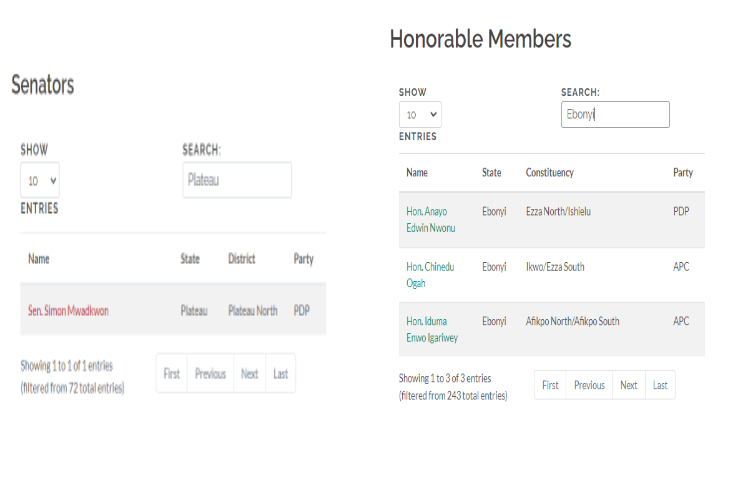
Filtering the data on the NASS website, The ICIR could not find the names of 40 senators and 134 Reps on the website. 

Although, after the inauguration, some of the lawmakers were sacked by the court. As of the time of filing this report, all court proceedings over any lawmaker’s election have been resolved. 

For instance, none of the three senators in Plateau State has their names on the NASS website.

The ICIR finding shows that the name on the website has been sacked by the court.

Another example is Ebonyi state with six House of Representative members, where only three names could be found on the website.

Snapshot of NASS website

Additional findings also showed that four senators who have been sacked by the court still have their images on the website. These senators are Darlington Nwokeocha (Abia Central), Ishaku Abbo (Adamawa North), Ohere Abubakar (Kogi Central) and Mwaskwon Davou (Plateau North).

Aside from this, lawmakers’ names in the Senate like Edo and Ebonyi were not captured on the website. Also, some names of lawmakers in the House of Representatives were repeated twice. 

The implication of this would mean that the Nigerian public might not be able to interact with the proceedings of the assembly, especially bills proposed by the lawmakers who are missing from the website. 

In the 2024 budget, N344.85 billion was earmarked for the National Assembly. Although there is no breakdown of the budget, the expenditure takes care of the personnel and overhead costs of the Assembly.

The budget on Overhead takes care of bills and other utilities, including payment to IT officials or programmers to manage the website.

Find the sheet for the analysis here and a snapshot to all states on the NASS website here).

FG, States, LGs shared N10.143 trillion in 2023 – NEITI

THE three tiers of government in Nigeria – Federal, States and Local Government Areas (LGAs) – shared N10.143 trillion from the Federation Account as statutory revenue allocations in 2023.

The data were contained in the latest report by the Nigeria Extractive Industries Transparency Initiative (NEITI) on the Federation Account revenue allocations for the year 2023.

The Executive Secretary of NEITI, Orji Ogbonnaya Orji, who announced the release of the report on Tuesday, March 19, in Abuja, said the agency embarked on the Federation Allocation Account Committee (FAAC) Quarterly review to enhance public understanding of Federation Account allocations and disbursements as published by the government.


Read Also:


He said, “The ultimate objective of this disclosure is to strengthen knowledge, awareness and promote public accountability of all institutions in public finance management”.

A breakdown of the revenue receipts showed that the Federal Government received N3.99 trillion, representing 39.37 per cent of the total allocation.

The 36 states got N3.585 trillion, representing 35.34 per cent, while the 774 LGAs shared 2.56 trillion equivalent to 25.28 per cent.

Further analysis of the N10.143 trillion disbursements in 2023 showed an increase of N1.934 trillion or 23.56per cent when compared with the disbursement of N8.209 trillion shared in the corresponding year 2022.

The review attributed the increase to improved revenue remittances to the Federation Account due to the removal of the petrol subsidy and the floating of the exchange rate by the President Bola Tinubu-led government.

The report highlighted that though the total revenues distributed from the Federation Account recorded an overall increase of 23.56 per cent in 2023, the increase that accrued to each tier of government varied, largely due to the type of revenue streams contributing to the inflows into the Federation Account.

Accordingly, NEITI Quarterly Review of 2023 FAAC allocations disclosed that the Federal, State, and LGAs cumulatively received N1.934 trillion more than the amount shared in 2022.

The first quarter of 2023 increased by N579.71 billion (33.19 per cent) when compared to the first quarter of 2022. The second quarter increased by 10.32 per cent, the third quarter by 27.49 per cent and the fourth quarter had an increase of 23.42 per cent respectively.

The Federal Government’s share increased by N574.21 billion (16.79 cent) from the N3.42 trillion it received in 2022 to N3.99 trillion in 2023. The state governments’ share rose to N3.59 trillion in 2023 compared to the N2.76 trillion they got in 2022, showing an increase of 29.99 per cent.

Similarly, the LGAs’ share of federation allocation was N2.57 trillion in 2023 compared to N2.032 trillion in 2023 which amounts to 26.22 per cent leap.

In the same period in 2023, states and LGAs recorded increases in their allocations of 29.99 per cent and 26.22 per cent respectively. The increase in allocation to the Federal Government, however, was 16.79 per cent.

State-by-state share of the allocations showed that Delta State received the largest share of N402.26 billion (gross).

The figure is inclusive of the state’s share of oil and gas derivation revenue. Delta was followed by Rivers State which got N398.53 billion. Akwa-Ibom State took the third largest allocation of N293.58 billion.

Nasarawa State received the least amount of N73.32 billion while Ebonyi and Ekiti states received N73.91 billion and N74.04 billion respectively.

The review observed that the first five states that topped the allocation during the period under review are amongst the major oil-producing states in the country.

On the share of 13 per cent derivation revenue, nine states received the 13 per cent allocated to mineral-producing states from the proceeds from mineral revenue. The derivation revenue remains a significant portion of revenue for states like Delta, Akwa Ibom, Anambra, and Rivers states.


Edo Assembly orders chief judge to set up probe panel against Shaibu

THE Edo State House of Assembly has ordered the state Chief Judge, Daniel Okungbowa, to set up a seven-man probe panel to investigate the allegations against the state deputy governor, Philip Shaibu.

 The House reportedly passed the resolution during the plenary on Tuesday, March 19.

The Assembly is accusing the deputy governor of infraction, including exposing public records.


Read Also:

The probe panel is expected to investigate the accusations and make recommendations.

The Speaker, Blessing Agbebaku, led the brief meeting.

Agbebaku had earlier informed the House that the deputy governor’s seven-day window for responding to the impeachment notice had passed.

Agbebaku stated that although the deputy governor received the impeachment notice on March 6, 2024, the House mandated that he be served by alternative methods because of suspected service evasion.

He claimed that on March 12, 2024, the replaced service was published in The Vanguard Newspaper and The Observer, a state-owned newspaper.

He claimed that the notification expired on March 19.

The majority leader, Charity Aiguobarueghan, led a motion directing the Chief Judge to constitute a seven-member committee to probe the petition against Shaibu.

According to Aiguobarueghan, the motion is in accordance with Section 188, Sub-sections Three and Four of the Nigerian Constitution.

Nineteen of the 24 members voted in favour of the motion.

The ICIR reported that the Edo State House of Assembly on Wednesday, March 6, commenced the move to impeach Shaibu.

He is being accused of perjury and revealing government secrets.

The majority leader (Aiguobarueghian) who issued the impeachment notice during plenary, stated that the petition, dated March 5, was signed by 21 of the 24 members against the Shaibu.

Aiguobarueghian further noted that the number of members who signed the petition was more than the two-thirds requirement stipulated in Section 188 (2a) of the Constitution.

The Speaker, who acknowledged the receipt of the petition, said it was based on two grounds and directed the house Clerk, Yahaya Omogbai, to serve the impeachment notice on the deputy governor. 

Shaibu, a former member of the House of Representatives and the former Majority Leader of the Edo State House of Assembly was given seven days to respond to the allegations.

His impeachment notice might not be unconnected to his face-off with the state Governor, Godwin Obaseki.

The move came a few days after Shaibu said he had been receiving impeachment threats over his involvement in the governorship primary of the Peoples Democratic Party (PDP).

He had vowed that nothing would deter him from contesting the Edo governorship election, which he described as his constitutional right.

The ICIR reports that Shaibu was declared a factional governorship primary election winner on February 22.

However, Asue Ighodalo emerged as the winner of another primary held by the party at the Samuel Ogbemudia Stadium in Benin, where he officially became the flagbearer endorsed by the PDP national leadership and the preferred candidate of the state governor.

Energy costs, borrowing funds challenged cement production in Nigeria – Economist

0

HIGH energy costs, cost of borrowing, naira depreciation, and logistics were some of the challenges that manufacturing companies face in Nigeria’s harsh operating environment, says Muda Yusuf, a renowned economist.

Yusuf underscored the challenges while commenting on the House of Representatives’ recent determination to summon Dangote Cement, BUA Cement and another major cement manufacturer over the skyrocketing price of the product.

A 50-kilogram bag of cement has surged to over N10,000 in recent times, and according to the latest World Bank annual ratings, Nigeria is ranked 131 among 190 economies in the ease of doing business.


Read Also:


In a statement on Sunday, March 17, Yusuf, the chief executive officer of the Centre for the Promotion of Private Enterprise (CPPE), said the business of manufacturing was perhaps the most challenging enterprise in the contemporary Nigerian economy, noting that many foreign firms in the sector have either exited the country or downsized their operations.

“Cement production is highly energy intensive, with gas being the major energy source. Gas is priced in dollars for manufacturers in the country, and they sell their products in naira.

“The logistics cost of cement distribution is humongous, given the escalating cost of diesel and the state of the roads. Exchange rate depreciation is taking a huge toll on the cost of imported components of production inputs, including spare parts and machineries.

“Cost of fund is mounting as the CBN continues its aggressive monetary policy tightening. Latest headline inflation for February was 31.7 per cent,” Yusuf said.

He stressed that all these variables were not within the manufacturers’ control and profoundly impact production and operating costs.

Rep members had on Wednesday, March 13, resolved to summon cement manufacturers, alleging exploitative and arbitrary price fixing against them.

Describing it as “unpatriotic”, Yusuf said their remarks could put the cement manufacturers in a bad light against investors and the public, urging the lower chamber to be moderate in the use of language.

He also criticised the remarks as “troubling” since the members have yet to listen to the manufacturers before rushing to criticism.

“For an economy seeking to industrialise, attract investors and create jobs, such commentaries represent negative signalling.

“It is important to stress that matters of this nature requires painstaking and thorough investigation to determine the pricing dynamics and the ramifications of the factors driving prices. This is critical to avoid hasty and emotional conclusions,” he said.

Not ruling out the risk of profiteering increases with monopoly powers in any sector, Yusuf said the risk existed in the Nigeria cement industry as there are few dominant players.

“But this is a regulatory issue that could be addressed within the framework of the Federal Protection and Competition Act of 2018,” he said.

He maintained that the Federal Competition and Consumer Protection Commission (FCCPC) is responsible for ensuring compliance with the Act to protect the interests of the consumers and the public and should be held accountable for any proven lapses.

“Meanwhile, the current ex-factory price of cement by the major players is less than N7,000 per bag. It follows that pricing issues and the culprits could also be within the cement distribution chain over which the manufacturers have limited control,” the CPPE boss said.

He noted that the private sector plays a critical role in the economy, accounting for over 80 per cent of the country’s gross domestic product, providing about 90 per cent of the employment and over 70 per cent of government revenue.

He also pointed out that the cement industry was dominated mainly by indigenous companies paying billions in taxes, creating thousands of jobs, and carrying out corporate social responsibility initiatives.

Okuama: Army denies reprisal attack as troops arrest suspects

0

THE Nigerian Army has denied a reprisal attack on the Okuama community in the Ughelli South Local Government Area of Delta State after nearly a score of soldiers were killed in the community.

The Army in a statement by the Director of Army Public Relations, Onyema Nwachukwu, a Major General, lamented that rather than provide information that could lead to the arrest of the killers, the Okuama community was dishing out propaganda.


Read Also:

According to the spokesperson, using propaganda demonstrated that killing soldiers was a “communally orchestrated attack against legitimate forces.”

The statement noted that the killing of troops of 181 Amphibious Battalion of the Nigerian Army while on a peaceful and mediatory mission, after a reported case of communal clash between Okuama and Okoloba communities in Ughelli South and Bomadi LGAs of Delta State respectively, was not only despicable but should be unreservedly condemned by all.

Onyema stated that the people responsible for the personnel’s deaths would be held accountable regardless of how much deception they chose to spread.

However, he assured law-abiding citizens that there would be no retaliatory attacks in the neighbourhood and advised them to carry out their lawful businesses without fear. 

Reports indicate that about 20 suspects involved in the killings have been arrested.

On Monday, March 18, the Defence Headquarters (DHQ) released the names of the Army personnel who were killed on Thursday, March 14, during a peace mission to Okuama.

The officers among the 17 soldiers killed are:

  • A.H Ali, a Lietenant Colonel 
  • S.D Shafa, a major 
  • D.E Obi, a major
  • U Zakari, a captain

The soldiers include:

  • Yahaya Saidu (#3NA/36/2974)
  • Yahaya Danbaba (1ONA/65/7274)
  • Kabiru Bashir (11NA/66/9853)
  • Bulus Haruna (16NA/TS/5844)
  • Sola Opeyemi (17NA/760719)
  • Bello Anas (17NA/76/290)
  • Hamman Peter (NA/T82653)
  • Ibrahim Abdullahi (18NA/77/1191) 
  • Alhaji Isah (17NA/76/6079) 
  • Clement Francis (19NA/78/0911)
  • Abubakar Ali (19NA/78/2162)
  • Ibrahim Adamu (19NA/78/6079) 
  • Adamu Ibrahim (21NA/80/4795)

The ICIR reported On Sunday, March 17, that the Okuama community had been razed.

Residents of the state, including former governor James Ibori, who confirmed this development, shared the video of the arson on Saturday, March 16. 

No group has taken responsibility for the arson. 

Dangote earns over 50% profit from every ₦1 cement sales

DANGOTE Cement Plc earns over 50 per cent profit from every ₦1 sales on its product, The ICIR can report.

An analysis of the company’s five-year financial statements, relative to BUA Cement Plc and Lafarge Africa Plc, revealed that Dangote Cement had consistently earned over 50 per cent profit from every ₦1 sold.

Nigerians are already suffering from the increasing cost of cement, which has skyrocketed recently and is fuelling the rise in rentals and the cost of construction in the building industry.

Dangote Cement is owned by Africa’s richest person, Aliko Dangote; Abdulsamad Rabiu owns BUA Cement; and Holcim Group, a Swiss multinational company, controls Lafarge Africa.

The price of a 50-kilogram bag of cement has risen above ₦10,000 and is getting towards ₦15,000, raising severe concern as most building projects suffer setbacks and landlords gradually increase rents.

In analysing the cement giants’ audited financial statements for 2019 to 2023, The ICIR discovered that Dangote earned more revenue than it spent on production costs as its gross profit margins stayed above 50 per cent.

A gross profit margin is a percentage of a company’s revenue that it retains after subtracting direct expenses, such as labour and materials. It is a vital profitability measure that looks at a company’s gross profit compared to its revenue.

In 2019 and 2020, Dangote Cement earned over ₦0.57 from every ₦1 sales, ₦0.60 in 2021, ₦0.59 in 2022, and ₦0.54 in 2023.

Simply, at a ratio of 60 per cent in 2021, it means for every ₦1 generated, Dangote Cement retained ₦0.60 and attributed ₦0.40 to its cost of sales.

The cost of sales includes all the expenses directly related to producing the goods.

Over the review years, Lafarge Africa increased its gross profit margins to above 50 per cent. In 2019, the company earned ₦0.26 in revenue from every ₦1 sales; it rose to ₦0.47 in 2020, ₦0.49 in 2021, ₦0.53 in 2022, and down to ₦0.51 in 2023.

BUA Cement had not only stayed below 50 per cent in revenue from every ₦1 sales but had also reported relatively steep gross profit margins. It moved from ₦0.47 in 2019 to ₦0.46 in 2020, ₦0.47 in 2021, ₦0.45 in 2022 and ₦0.399 in 2023.

Late last year, BUA Cement initiated a price slash in the bag of cement from about ₦5,500 to ₦3,500.

Experts have told The ICIR that the much-anticipated reduction in the price of a bag of cement to N3,500 by BUA Cement, effective October 1, 2023, would have had immediate and far-reaching benefits. However, the reverse had been the case, as the company’s cement price had increased significantly.

The group head of corporation communications at Dangote Industries Limited, Anthony Chiejina, did not pick up calls and has yet to respond to an enquiry about the company’s cement product hike.

The head of corporate communications at Lafarge Africa, Ginikanwa Frank-Durugbor, responded, “While limestone which is part of our raw materials is locally sourced, we do have significant exposure on other raw materials that are imported or impacted by FX (foreign exchange) including gypsum, gas, spare parts and other ancilliary input costs and services necessary for our operations in Nigeria.

“At Lafarge Africa Plc, we remain committed to ensuring our products are available for our customers at the right price. We maintain our promise of ensuring the consistent quality of all our products and solutions.”

The ICIR could not reach BUA Cement for comment on the continous price hike despite the company’s announcement of price slash.

The table below shows the three cement companies’ revenues, cost of sales, gross profit and calculation of the gross profit margins for the review years.

Dangote Cement Plc (figure in N’m)
2023 2022 2021 2020 2019
Revenue 2,208,090 1,618,323 1,383,637 1,034,196 891,671
Cost of Sales 1,006,278 662,890 551,019 437,970 379,989
Gross Profit 1,201,812 955,433 832,618 596,226 511,682
Margin 0.54427673 0.59038461 0.60176043 0.57651161 0.57384618
Lafarge Africa Plc (figure in N’000)
2023 2022 2021 2020 2019
Revenue 405,502,712 373,244,938 293,086,183 230,572,922 212,999,066
Cost of Sales 198,786,889 177,023,232 150,505,605 121,716,515 157,046,768
Gross Profit 206,715,823 196,221,706 142,580,578 108,856,407 55,952,298
Margin 0.50977667 0.52571833 0.48648004 0.47211271 0.262688
BUA Cement Plc (figure in N’000)
2023 2022 2021 2020 2019
Revenue 459,998,999 360,989,105 257,327,091 209,443,487 175,518,326
Cost of Sales 276,043,486 198,379,891 136,402,954 113,964,695 93,075,293
Gross Profit 183,955,513 162,609,214 120,924,137 95,478,792 82,443,033
Margin 0.39990416 0.45045463 0.46992385 0.455869 0.46971182
Data source: Dangote, BUA and Lafarge Africa’s financial statements, 2019-2023

Reps summons Dangote, BUA

On Wednesday, March 13, the House of Representatives raised a motion to summon the major cement manufacturers before its committee to deliberate on ways out of the hardship arising from the high cost of cement.

The lawmakers are concerned that despite all the raw materials and other factors of cement production being sourced locally, the price keeps rising, questioning the rationale for the arbitrarily increasing costs.

The motion, ‘Arbitrary increase in cement price by cement manufacturers in Nigeria,’ was moved by Gaza Gbefwi from Nasarawa State and Ademorin Kuye from Lagos State.

Gbefwi argued that cement manufacturers have increased the price of their products by up to 50 per cent, leading to sharp hikes in building blocks, the cost of building, and consequently, the price of rent across the country.

The raw materials for the manufacturing of cement, including lime, silica, alumina, iron oxide, and gypsum, are all sourced locally and could not have been affected by exchange rate volatility, The ICIR reports.

Gbefwi continued that factors and elements of cement production were sourced locally and have not changed significantly year-on-year, stressing that cement manufacturers are capitalising on exchange volatility to arbitrarily increase the product’s price while the production cost has stayed the same since last year.

(See the table for the relative changes in cost of production, otherwise known as cost of sales).

He alleged that a small but powerful “cement cabal” was unconsciously inflicting hardship on Nigerians as rent prices and associated services increased.

After other members’ contributions, the Lower Chamber mandated its Committees on Solid Minerals Development, Commerce, Industry and Special Duties to investigate the arbitrary increase in the price of cement by manufacturers in the country like Dangote Cement and BUA Cement.

‘Hike in cement price has started to impact on rentals’

A real estate expert and facility manager, Stephen Jagun, told The ICIR that the surging price of cement is already forcing landlords to increase their rentals.

He lamented that the cement price hike negatively impacts rentals even in the short run.

“As we speak, more people are graduating, getting married, getting jobs, and needing accommodations. Demand for accommodation is rising, but supply has been inadequate. Supply will now be pressured by demand, and in that situation, rent will increase, which is already occurring.

“Rent is becoming outrageous, particularly in the lower sector. If you increase my rent in Ikoyi, I will go to the next neighbourhood closer to Ikoyi if I can’t afford it.”

Jagun explained that demand for accommodation would continue to push rentals for people living in places like Ikorodu, Agege, Egbeda and other lowbrow areas in Lagos State.

“In most of those places, the landlords take the rule to their hands. If you don’t pay quickly, they quit you because somebody would even be waiting to occupy the place and pay more.

“On the rich axis, it is either you remain there if you can still afford it, but if you don’t want to be embarrassed, you quickly leave for cheaper accommodation elsewhere.”

The Lagos State Government plans for one-month rentals, but Jagun said the initiative might fail. “You (Lagos State) are not supplying, and you want to dictate the rent; that plan will create a black market.”

He noted that cement prices have spiked, and every building material cost has risen equally.

He asserted that most construction works have been put on hold due to increasing building materials costs.

“What most contractors do now is to request the owner of the job to provide the materials and pay them for their labour,” adding that others have resulted in using old stocks that could be remodelled.

We got no formal notice of SSANU/NASU’s strike – FG

0

THE Federal Government has expressed displeasure over the seven-day warning strike by the Senior Staff Association of Nigerian Universities (SSANU) and the Non-Academic Staff Union of Educational and Associated Institutions (NASU).

The government through a statement issued on Monday, March 18,  in Abuja, by the Minister of State for Labour and Employment, Nkeiruka Onyejeocha, said it received no formal notice on the strike and appealed to the unions to call off the strike and give room for dialogue.

The statement, signed by the Director of Press and Public Relations in the ministry, Olajide Oshundun, quoted the minister describing the strike as a total disregard for the Federal Government’s concerted effort to address their concern.

The ICIR reported that the Joint Action Committee of SSANU and NASU on Friday, March 15, directed its members to embark on a seven-day warning strike over their withheld salaries.

It urged the unions’ members to adhere strictly to the directive, noting that the developments during the seven days would determine the next call of action.

Read Also: 

Withheld salaries: SSANU, NASU begin nationwide strike today

SSANU, NASU threaten strike over withheld salaries

SSANU, NASU suspend strike, ASUU adamant

The committee had on March 1, threatened to embark on strike over the withheld salaries, raising concerns about the Federal Government’s decision to release four months of similar withheld salaries to members of the Academic Staff Union of Universities (ASUU) while refusing to release those of the non-academic staff.

The ICIR reports that the administration of former President Muhammadu Buhari withheld ASUU members’ salaries when it invoked a ‘no work, no pay’ policy during an industrial action by the lecturers that lasted eight months, from February 14 to October 14, 2022.

The lecturers subsequently suspended the strike following a court order initiated by the Nigerian government.

Similarly, SSANU and NASU embarked on strike for five months between April and July 2022, to compel the Nigerian government to meet its demands as ASUU.

The Buhari government also invoked the ‘no work, no pay’ policy on the striking non-teaching university workers as their ASUU counterparts.

However, in October 2023, President Bola Tinubu pledged to pay four of ASUU’s withheld eight months’ salaries, with the union confirming the commencement of the payment in February.

The Tinubu government has been mum on the SSANU and NASU’s fate, prompting the unions to begin a seven-day warning strike on Monday, March 18.

Reacting to the strike in a statement, the Minister of State for Labour and Employment, Nkeiruka Onyejeocha called on the leadership of the two unions to shelve the action.

According to her, the ministry was not officially notified by the unions of their intention to proceed on the warning strike.

“This is contrary to the provisions of section 18 of the Trade Dispute Act. The ministry got wind of the intended warning strike and it reached out to the leadership of the unions for an emergency meeting in order to avert the strike.

“Unfortunately, a physical meeting could not be arranged between the unions and the Federal Government, but a tele-discussion took place between their leadership and the ministry,” she said.

Onyejeocha also said that the ministry consequently suggested another date – Monday, March 18 – for a proper conciliation meeting, adding that she had hoped that the intended strike would be put on hold pending the outcome of the meeting but the date was rejected by the unions.

The minister, however, maintained that the strike did not serve any useful purpose and should only be resorted to as a last option after exhausting every conciliation effort.