Home Blog Page 641

Tinubu urges Senate to consider bill to review judges’ salaries

0

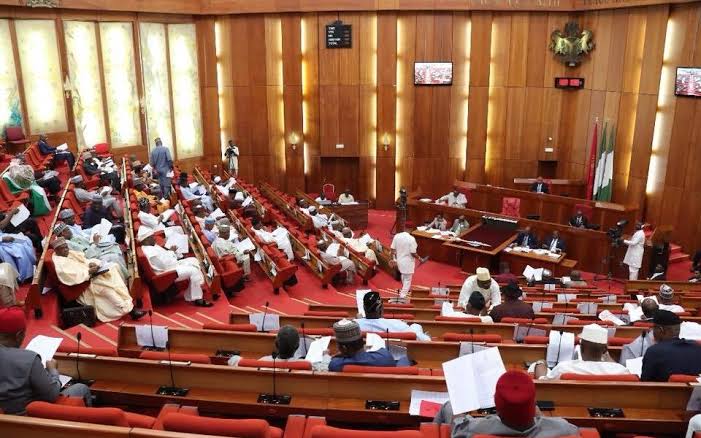
PRESIDENT Bola Tinubu has transmitted a letter to the Senate to approve a new bill seeking to provide new salaries and allowances for judicial officers in Nigeria.

The Senate President, Godswill Akpabio, read the president’s request during the plenary on Wednesday,  March 20.

The proposed law seeks to prescribe salaries, allowances, and other fringe benefits for judicial officers.

Read Also:

Tinubu signs bill increasing judges’ retirement age to 70

Supreme Court judges who may decide Nigeria’s next president

Reps call for review of judicial workers’ salaries

In November 2022, former president Muhammadu Buhari directed the Revenue Mobilization Allocation and Fiscal Commission (RMAFC) to take measures for the immediate implementation of an enhanced salary and welfare package for judicial officers.

Buhari’s directive followed the National Industrial Court order in Abuja on the Revenue Mobilisation Allocation and Fiscal Commission (RMAFC) to increase the salaries and allowances of judges in the country.

In the judgement delivered by Osatohanmwen Obaseki-Osagie, the court noted that judges’ and justices’ salaries have stagnated for over 14 years.

Obaseki-Osagie also ordered that the Chief Justice of Nigeria (CJN) be paid N10 million monthly, while Supreme Court Justices would receive N9 million monthly.

Meanwhile, Tinubu, in the letter, said when approved, the bill titled “Judicial office holders, salaries and allowances, etc, bill 2024,” would generate a new legal framework for the remuneration of judicial officers to improve their welfare.

He also said the bill would promote the welfare capacity and independence of the Nigerian judiciary system.

“The judicial office holders, salaries and allowances, etc, bill 2024 seeks to prescribe salaries, allowances, and benefits for judicial officers to end the prolonged stagnation in their remuneration and to reflect contemporary social economic realities.

“The bill which establishes a new legal framework for the remuneration of judicial officers will also ensure significant improvement in the welfare capacity and independence of the judiciary,” Tinubu said in the letter.

He, therefore, urged the lawmakers to consider and approve the bill expeditiously.

Sexual harassment: Court reserves ruling on motion to release Ndifon’s phones

0

THE Federal High Court in Abuja has reserved a ruling on the motion to release mobile phones belonging to the suspended Dean of Law at the University of Calabar (UNICAL), Cyril Ndifon.

According to a statement by the Independent Corrupt Practices and Other Related Offences Commission (ICPC) on Wednesday, March 20, Ndifon and his lawyer Sunny Anyanwu, who is a co-defendant, had prayed the court to release their phones to “a purported National Computer Forensic Laboratory.”

The motion was filed on March 8, 2024, by counsel to the defendants, Joe Agi, a senior advocate.

Read Also:

ICPC opposes motion to release Ndifon’s phones in UniCal sexual harrasment case

Sexual harassment: Court grants suspended UNICAL dean bail

UniCal replaces Ndifon, sets up panel to investigate allegations

However, the prosecution opposed the motion, stating that the laboratory was non-existent. The trial was, therefore, adjourned to April 15, 2024, for a ruling on the motion.

Ndifon and Anyanwu are being prosecuted by the ICPC before High Court Justice James Omotosho over allegations of sexual misconduct and an attempt to perverse the cause of justice.

While Ndifon was accused of sexual harassment during a protest by female Law students of UNICAL on August 15, 2023, Anyanwu called and threatened the star witness in the case.

Both men had earlier been remanded in prison and granted bail in February.

Following the protest by the Law students, the university suspended Ndifon, and a panel was set up to investigate the allegations against him.

Although Ndifon denied the allegations and described them as lies, it was the second time he was suspended for similar reasons. The first time was in 2015 when a final-year student accused him of raping her in his office.

On March 7, 2024, the court ruled that evidence presented by the prosecution revealed that the lecturer demanded nude photos of the second prosecution witness.

The presiding judge, James Omotosho, stated that Ndifon needed to explain the intent behind such a request.


AEDC, Niger target steady power with new initiative

THE Abuja Electricity Distribution Company (AEDC) and the Niger State government have commenced a partnership initiative targeting a steady power supply for residents of the state.

The initiative is codenamed “Light Up Niger 2024”.

The state Governor, Mohammed Umaru Bago, confirmed the partnership while receiving the AEDC delegation led by its chief operations officer, Chijioke Okwuokenye, at the Government House, Minna, on Tuesday, March 19.

Read Also:

He said the state was ready to host four hydro dams that would contribute significantly to electricity in Nigeria.

He further observed that power supply was key to development, especially as the state was growing into an industrial and food processing zone.

The governor said the “Light Up Niger” project would also proffer solutions to the metering challenge in the state.

Commenting further on the project, the governor said the Electricity Act had been domesticated in the state, while the Niger State Electricity Regulatory Commission had been created.

He further stated that the necessary paperwork for the Regulatory Commission would soon be completed so that the state could start generating and distributing its power.

In his remarks, the chief operating officer of AEDC, Chijioke Okwuokenye, explained that the “Light Up Niger” project would improve the state and ensure stable electricity when it kicked off.

He lauded the support of the Bago-led administration through the supply of transformers to communities, adding that the private sector needed such support for survival.

He also assured that his company was willing to continue to partner with the state government for the desired result.

Recently the state government described as unacceptable the continuous erratic and epileptic power supply in the state. The situation improved immediately and has led to the “Light Up Niger” initiative.

Senate passes amended student loan bill

0

THE Nigerian Senate passed the Student Loan (Access to Higher Education) Act (Repeal and Re-Enactment Bill) on Wednesday, March 20.

The resolution came after the chairman of the Senate’s committee on tertiary institutions and TETFUND, Muntari Dandutse, presented a report on the bill on Wednesday.

The bill was first signed into law by President Bola Tinubu in June 2023 to enable students in need to access interest-free loans to pursue their education in any tertiary institution in the country.

However, its implementation was postponed for a period. During the postponement, Executive Secretary of the Nigerian Education Loan Fund (NELFund), Akintunde Sawyer, said he could not give a specific date for the commencement of the programme.

However, Tinubu wrote to the Senate on March 14, seeking a repeal of the Students Loans Act 2023 and a re-enactment of the Students Loan Bill 2024.

In the letter, he also sought the Senate’s expeditious consideration of the process.

“Pursuant to Section 58 (2) of the Constitution of the Federal Republic of Nigeria, 1999 (as amended), I forward, herewith, the Student Loan (Access to Higher Education) (Repeal and Re-enactment) Bill, 2024 for the kind consideration of the House,” the President’s letter reads.

“The Student Loan (Access to Higher Education) (Repeal and Re-enactment) Bill, 2024 seeks to enhance the implementation of the Higher Education Student Loan Scheme by addressing challenges related to the management structure of the Nigerian Education Loan Fund (NELF), applicant eligibility requirements, loan purpose, funding sources, and disbursement and repayment procedures,” Tinubu noted in the letter.

Although the bill is touted to ease access to tertiary education for Nigerian students, it attracted criticism from some Nigerians, including members of the Academic Staff Union of Universities (ASUU), who described the bill as an attempt by the government to abandon funding of education in public universities.

Military kills Zamfara notorious bandits’ leader, Kachalla Damina

0

THE Nigerian Air Force (NAF) said its operatives had killed the most notorious bandits leader in Zamfara State, Kachallah Damina, with scores of his fighters.

The NAF said in a statement that its airstrikes were responsible for killing Damina.

Damina, based in the Gusau Local Government Area of Zamfara State, was notorious for his reign of terror, organising hundreds of fighters for abductions, livestock rustling, and assaults on military installations.


Read Also:

According to the military, the air raid was conducted in response to information about several bandits attempting to attack Corner Village in the Bungudu Local Government Area on March 10.

The statement claims that Damina, who was already suffering from injuries sustained during battles with Operation Hadarin Dajia forces in Dansadau, was killed with other bandits riding motorcycles.

A security expert, Zagazola Makama, confirmed on his X handle that Damina and scores of his fighters have been killed.

“The Nigerian Air Force has successfully eliminated the most notorious bandit leader in Zamfara State, Kachallah Damina, including scores of his fighters.

“More than 50 bandits were neutralised with several motorcycles destroyed. This attack was the biggest and one of the most devastating against the bandit groups,” he tweeted.

In an investigation published by The ICIR on March 1, residents of Mutunji, a community in the Dansadau district of Maru Local Government Area (LGA) of Zamfara state, said they lived in constant fear that Damina could swoop on them and abduct them, just like he did to their relations he whisked into the forest but never returned home.

In late 2022, Nigerian security forces allegedly killed Damina’s men in the community in a reprisal attack that followed the bandits’ onslaught on the military base in the village, during which the bandits killed 12 soldiers and burnt four operational vehicles.

Because of Damina’s activities, Mutunji has become a shadow of itself. Its schools and clinics have been shut down. Businesses and farming activities that once kept the community alive have collapsed.

In recent months, it has lost dozens of its residents to bandits led by Damina, who has claimed responsibility for the abduction of 48 people from Mutunji and the killing of 17 of them.

A youth leader of the community, Umar Khalid Mutunji, said bandits loyal to the terrorist stormed the village at about 7:30 p.m. on Friday, November 24 2023 and descended on worshippers in a mosque and other people at a night market (Yar Kasuwa) where they abducted 178 people, including children and adults. 

In the message he sent to the village, Damina suggested that since the community could not pay the levy he placed on them, each family having someone in captivity should pay ransom for the release of their relatives, or else he would kill them.

Findings by The ICIR showed that over 1,500 children in the village are out of school as the two public primary schools in the community have been shut down for two years.

Mutunji shares its border with Niger State in the south. In its western part is Bena town in the Danko-Wasagu Local Government Area in Kebbi State, all blessed with vast and fertile arable land.

Nurses sue Nigerian government over new verification guidelines

0

SOME nurses in Nigeria have sued the Federal Government over the new certificate verification guidelines recently introduced by the government.  

The defendants include the Minister of Health, Muhammad Ali Pate, the Attorney General of the Federation (AGF), Lateef Fagbemi, and the Nursing and Midwifery Council of Nigeria (NMCN).

On February 7, 2024, the NMCN published a circular updating the procedures for certificate verification for midwives and nurses.


Read Also:


According to the council, applicants seeking verification of certificates from foreign nursing boards and councils must have two years of post-qualification experience from the date of the permanent practising licence issuance.

The revised regulations came into effect on March 1, 2024.

In the suit marked NICN/ABJ/ 76/2024 before the National Industrial Court in Abuja, the plaintiffs – Kelvin Ossai, Catherine Olatunji-Kuyoro, Desmond Aigbe, Tamunoibi Berry, Olumide Olurankinse, Osemwengie Osagie, Idowu Olabode and Abiola Olaniyan – are pleading with the court to prevent the defendants or their representatives from enforcing the NMCN circular.

At the mention of the suit on Wednesday, March 20, the plaintiffs’ lawyer, Ode Evans, informed the court that he had just received the first and second defendants’ preliminary objections.

He pleaded with the judge to adjourn the case so he could respond to their requests.

The judge, Osatohanmwen Obaseki-Osaghae, adjourned the case till May 20 for a hearing.

Obaseki-Osaghae ordered that the AGF and the Federal Ministry of Health, not represented by counsel in court, be notified of the hearing.

Addressing reporters outside the court, the plaintiffs’ lawyer, Ode, said the nurses were in court because they were uncomfortable with the new verification guidelines.

“Now, the matter today was coming up for the first time, and when matters come up for the first time, it is for mention. 

“The essence of the mention is to give a background to the court on whether parties have been served. We told the court we wanted to look at those applications because we had been served in court. So the court adjourned this matter to May 20 to enable us to react to those issues raised,” he stated.

According to Ode, the nurses are seeking the complete removal of the guidelines because they feel it violates their rights. 

Also speaking at the court premises, a representative of the nurses, Fawole Israel, described the policy as flawed and an infringement of the fundamental human rights of nurses.

“We are asking the court to, by default, return the verification process to the status quo so that nurses in Nigeria can seek opportunities, especially to expand the scope of practice”, Israel stated.

The ICIR reported on February 12 that nurses protested in Abuja and Lagos against the new guidelines.

The Abuja protest took place at the headquarters of the NMCN in Abuja.

In a video shared on social media, the nurses and midwives were seen chanting and carrying placards with inscriptions frowning at the policy.

Ondo 2024: 16 parties to participate in off-cycle election – INEC

0

CHAIRMAN of the Independent National Electoral Commission (INEC) Mahmood Yakubu has said 16 political parties would participate in the forthcoming off-cycle governorship election in Ondo state.

He disclosed this during a meeting with members of Civil Society Organisations (CSOs) in Abuja on Wednesday, March 20.

“Turning to Ondo State, political parties will commence their primaries for the governorship election in the next two weeks. Sixteen political parties have indicated interest in participating in the election.

“I urge civil society organisations (CSOs) to engage with political parties and observe their primaries just as you engage with INEC and deploy observers to the main election conducted by the commission. By doing so, you will strengthen your advocacy for inclusivity for groups such as women, youths, and persons with disability (PwDs) under-represented in national and state-level elective offices,” he said.

Yakubu urged the CSOs to always submit reports on their observations of previous elections, as certain reforms by the electoral body are a result of recommendations by CSOs.

He warned that there would no longer be accreditation for CSOs that fail to submit reports on the observation process.

“While many of you have submitted your reports, some accredited observers are yet to do so for the general election, supplementary elections, off-cycle elections, bye-elections and re-run elections.

“May I, therefore, seize this opportunity to remind those who are yet to submit their observation reports that it is mandatory to do so, being one of the conditions for eligibility to observe future elections. Going forward, the Commission will operate strictly on the policy of “no observation report, no accreditation,” Yakubu said.

Ondo State is set to hold governorship elections by November 2024.

While party primaries have yet to be held, the incumbent governor, Lucky Aiyedatiwa, declared his interest in contesting the elections and continuing as governor, a position he has occupied for about three months.

Aiyedatiwa became governor in December 2022 after his predecessor, Rotimi Akeredolu, died of a protracted illness.

He is a member of the All Progressives Congress (APC).

With Adaora at Zenith, women now lead 11 of Nigeria’s 24 banks

ZENITH Bank Plc has announced the appointment of Adaora Umeoji as its Group Managing Director/Chief Executive (GMD/CEO), effective June 1, 2024.

Umeoji’s appointment reflects the growing influence of the female gender in Nigeria’s banking sector.

With the appointment, she will be the 11th female chief executive officer heading Nigeria’s 24 deposit money banks if the Central Bank of Nigeria (CBN) ratifies her appointment.

In percentage, 45 per cent of Nigeria’s 24 deposit money banks will be headed by women if her appointment scales through at the CBN.

They are Bolaji Agbede, Access Holdings; Miriam Olusanya, GT Bank; Yemisi Edun, FCMB; Halima Buba, SunTrust Bank; Ireti Samuel-Ogbu, Citibank Nigeria; Nneka Onyeali-Ikpe, Fidelity Bank; Tomi Somefun, Unity Bank; Kafilat Araoye, Lotus Bank; Bukola Smith, FSDH Merchant Bank; and Yetunde Oni, Union Bank.


Read Also:


In a notice to the investing public on Tuesday, March 19, Zenith Bank stated, “We write to inform you all of the appointment, by the Board of Directors, of Dr. Adaora Umeoji, CON, as Group Managing Director/Chief Executive of Zenith Bank Plc with effect from June 1, 2024 subject to the approval of the Central bank of Nigeria (CBN). She takes over from Dr. Ebenezer Onyeagwu, whose tenure expires on May 31, 2024.

“The appointment is consistent with the bank’s executive transition tradition, succession plan, and strategy of grooming leaders from within.”

Umeoji will take over from Ebenezer Onyeagwu, who has served in that capacity for a five-year term, expiring May 31, 2024.

She will be the first female GMD/CEO the bank has had since its inception in 1990, when Jim Ovia founded it.

Before her appointment, Umeoji had been the bank’s Deputy Managing Director since October 28, 2016, and has close to 30 years of cognate banking experience, of which 26 years have been with Zenith Bank.


Court dismisses suit seeking to stop voting, exams on Saturdays

0

THE Federal High Court in Abuja has dismissed a suit to stop the Independent National Electoral Commission (INEC) and educational institutions from conducting elections and exams on Saturdays in Nigeria.

A member of the Seventh-day Adventist Church, Ugochukwu Uchenwa, filed the suit.


Read Also:

He asked the court to rule that scheduling examinations and elections for Saturdays was unlawful.

One of the reliefs the plaintiff sought was an order “restraining the 5th to 8th respondents from scheduling and conducting compulsory public examinations on Saturdays, without making an option for the members of the Seventh-day Adventist Church to write their exams on days other than Saturdays.”

The plaintiff also requested that the defendants grant him and other churchgoers permission to vote or take exams on any other day of the week, including Sundays.

He asked the court to issue an injunction prohibiting INEC from continuing to infringe on the rights of Seventh-day Adventist Church members by scheduling elections on Saturdays.

Alternatively, if the INEC cannot hold the polls or conduct exams on a day other than Saturdays, Uchenwa wanted “an order for the INEC to mark out a different day for his church members to participate in their own election.”

Included as defendants in the lawsuit are President Bola Tinubu, the Attorney General of the Federation, INEC, and the Minister of Internal Affairs.

The list also contained the National Business and Technical Examination Board (NABTEB), the National Examination Council (NECO), the West African Examination Council (WAEC), and the Joint Admission and Matriculation Examinations (JAMB), among others.

The judge, James Omotosho, ruled that the lawsuit was frivolous and that the plaintiff had not shown sufficient justification for any of the reliefs he requested from the court.

Omotosho stated that the plaintiff could not provide the court with a plausible basis for action in the case.

He had set March 20 for ruling on the case two months ago after hearing arguments from both sides.

At the sitting in January, the plaintiff’s lawyer, Benjamin Amaefule, told the court that his client was only seeking to enforce his fundamental right to freedom of education and participation in elections.

Responding on behalf of the President and the AGF, Maimuna Shiru told the court that her clients had filed a 17-paragraph statement opposing the claims.

After confirming they had received proper notice of the hearing, Omotosho listened to the case and set a judgment date of March 20.

FUOYE links student death to SSANU, NASU strike

0

THE management of the Federal University, Oye Ekiti (FUOYE), has linked the death of a student who was asthmatic in the school to the ongoing industrial action by the Senior Staff Association of Nigeria Universities (SSANU) and the Non-Academic Staff Union of Educational and Associated Institutions (NASU).

The university vice-chancellor, Abayomi Fasina, represented by the Deputy Vice-Chancellor (Administration) Tajudeen Opoola,  alongside other top officials of the university, disclosed this at a press conference in Oye Ekiti on Tuesday, March 19.

The management explained that the student with asthma passed away due to the inability to promptly receive medical attention, as the university was inaccessible after it was allegedly locked down by the unions.

“We lost a student who had asthma this morning because he could not be taken to our clinic. The facility is under lock and key. It is true that students are on holiday, but not all of them live on campus. It would have been easier for the student to be rushed to our clinic for urgent treatment, but even our university gate was locked.

“Just this morning, I was at the Ekiti State University (EKSU), and the administrative block was open. People are going about their normal duties. You may go there to confirm. I am using EKSU as an example because it is the closest as far as this environment is concerned. In EKSU today, the clinic is functioning. A total or comprehensive strike is not going on there,” the vice chancellor said.

The ICIR on Monday, March 18, reported that SSANU and the NASU began a seven-day warning strike over their withheld salaries.

The unions’ Joint Action Committee (JAC) declared the strike, according to a memo dated Friday, March 15, which directed members to withdraw their services across the nation’s public universities.

Meanwhile, Fasina accused the FUOYE SSANU chairman, Oluwaseun Faleye, of providing inaccurate information about the university to the union’s national leadership, prompting the national leadership to instruct the union branches in Ondo, Osun, and Kwara states to proceed to the university and shut it down on Monday, March 18.

“But the same leadership of EKSU SSANU went on air yesterday to incite the public, and even led some hoodlums to invade and occupy our institution based on a false narrative they were fed with by the chairman, SSANU, FUOYE chapter.

“Our own chairman was the one who gave false information to the national president. Since he gave the impression that he had been beaten and harassed, the national president allegedly directed the leadership of their unions in Ondo, Osun and Kwara to proceed to FUOYE to rescue the chairman and occupy and enforce the total shutdown,” he said.


Read Also:


He warned that the management would not fold its arms and allow the breakdown of law and order under the guise of strike action, adding that the law would deal with the situation appropriately.

However, reacting to the allegations in a statement on Tuesday, March 19, the chairman of SSANU, FUOYE chapter, Oluwaseun Faleye, said the union duly notified the university of the seven-day warning strike.

He also accused the vice chancellor, Sunday Fasina, a professor, of intimidating the union’s leadership.

According to him, the management sent a written letter soliciting concessions to exempt the health centre and other facilities, but Faleye added that the requests were declined, citing a warning from the national leadership of the union against granting such concessions.

“Following the decline of the management’s requests, we got information that the vice chancellor made moves to use security operatives to intimidate our members.

“Between Wednesday and Friday last week, the DSS Director and the Commissioner of Police invited us, and we felt that those moves were acts of intimidation just because we were going to fully comply with a national strike. We felt we were not safe.

“Interestingly, on getting to the school gate, we met armed civil defence officers, and I was assaulted. So, we want to put it on record that it is the management that is using the security agencies to intimidate us for complying with a national directive on industrial action,” Fasina claimed.