THE Cross River State Government has denied allegations that supporters of the All-Progressives Congress (APC) attacked the motorcade of Peter Obi, presidential candidate of the Nigeria Democratic Congress (NDC), during his visit to Calabar on Wednesday.
The Commissioner for Information and Orientation, Ekpenyong Cobham, stated this in Calabar on Thursday, describing the allegation as false and misleading. He argued that the incident resulted from an internal disagreement among some NDC supporters rather than a politically motivated attack by APC members.
Cobham claimed that some of those involved were allegedly dissatisfied with the party because they felt used and abandoned, adding that the individuals involved were seen openly displaying NDC flags.
“That is not APC. That is not our character. That is not our conduct,” he said. He challenged those making the allegations to provide credible evidence to substantiate their claims, while urging security agencies to investigate the incident and identify those responsible.
The commissioner also called on political actors to avoid exploiting the development to create tension in the state, adding that the administration of Governor Bassey Otu remained committed to peace, political tolerance and issue-based campaigns.
The ICIR reports that the Obi’s motorcade was attacked on Wednesday during his visit to the state for a townhall meeting. In a video circulating online, Obi said the attackers began throwing stones at his convoy after sighting NDC supporters.
He said the incident forced his team to consider taking another route, stressing that he wanted to come down and meet the people, but the attackers eventually fled after seeing what was happening.
He described the incident as an indication of the political intolerance Nigerians must reject ahead of the 2027 general election.
Despite the incident, Obi was present at the NDC presidential town hall meeting in the state.
The engagement was part of his political consultations and interactions with residents and stakeholders ahead of the 2027 general election.
Responding to the attack, the Cross River State Police Command said a group of suspected hoodlums armed with machetes and sticks emerged from the Calabar Road and Clerks Alley axis and attacked vehicles in Obi’s convoy.
The police said that the attackers smashed the windscreens of some vehicles, and exact number of vehicles damaged had yet to be established.
The police confirmed that officers deployed around Watt Market intervened and fired tear gas to disperse the attackers but one suspect, identified as Victor Edet Duke, 27, was arrested.
Duke was transferred to the State Police Headquarters by operatives of the Violent Crime Response Unit for investigation.
The Commissioner of Police, Ajo Geoffrey Ordue, directed a comprehensive investigation to identify other suspects and establish the circumstances surrounding the attack.
CRISTIANO Ronaldo, one of the world’s most celebrated footballers, has announced his retirement from international football, bringing an end to a remarkable 23-year career during which he became Portugal’s all-time leading goalscorer and one of the most decorated players in international football.
The 41-year-old forward announced his decision on Thursday, November 5, 2026, in an emotional message to Portuguese supporters, reflecting on his journey, achievements and sacrifices while representing his country.
In his farewell message, Ronaldo said he was leaving the national team with pride, satisfied that he had given everything for his country.
“Today, I finish my walk on the pitch with the national team. I leave with my head held high, with pride in the path I took, and with the awareness that I gave everything I had for Portugal,” he said.
He added that although goals, trophies and records would eventually be surpassed, the memories and emotional connections built with supporters would endure.
“Thank you for these 23 years. Thank you for having belief in me. Portugal will always be in me. Forever,” he said.
Ronaldo bows out as men’s international football’s all-time leading goalscorer, with 146 goals in 234 appearances for Portugal, according to available career statistics. He also holds the record for the most international appearances in men’s football.
The announcement comes weeks after tensions reportedly emerged between Ronaldo and Portugal head coach Jorge Jesus during the September international break.
The disagreement followed Ronaldo’s omission from the starting line-up against Norway, after which the forward left the national team’s training camp ahead of another fixture. He subsequently addressed the controversy, insisting at the time that he had no intention of retiring and remained available for selection.
Ronaldo made his senior international debut on August 20, 2003, against Kazakhstan, aged 18, and went on to become the defining figure of Portugal’s national team for more than two decades.
His greatest achievement with the country came in 2016, when he captained Portugal to its first European Championship title, defeating hosts France 1-0 in the final.
Although an injury forced him off in the first half of the final, Ronaldo remained on the sidelines encouraging his teammates as Portugal secured the historic victory.
He subsequently helped Portugal win the UEFA Nations League in 2019 and again in 2025, becoming central to the country’s most successful period in international football.
Beyond his trophies, Ronaldo leaves behind several remarkable records, including becoming the first male footballer to feature in six FIFA World Cups, having represented his country at the tournaments from 2006 to 2026.
A FEDERAL High Court in Abuja has nullified the leadership of the African Democratic Congress (ADC) led by former Senate President David Mark, declaring the caretaker committee illegal.
The court also invalidated all actions taken by the committee, including the nomination of former Vice-President Atiku Abubakar as the party’s presidential candidate for the 2027 general election.
Delivering judgment on Thursday, November 5, the presiding judge, Peter Lifu upheld a suit filed by Nafiu Bala Gombe, a former National Deputy Chairman (North-East) of the party, who challenged the process through which Mark and other members of the caretaker committee assumed control of the party.
The court granted the reliefs sought by Gombe, effectively invalidating the actions taken by the Mark-led leadership.
Gombe had argued that following the resignation of the party’s former National Chairman, Ralph Nwosu, he was entitled to assume the party’s leadership in his capacity as the former deputy national chairman.
He consequently asked the court to restrain Mark and former Osun State Governor Rauf Aregbesola from parading themselves as the party’s National Chairman and National Secretary, respectively.
The plaintiff also sought the nullification of decisions taken by the Mark-led leadership, arguing that its emergence violated the ADC constitution and provisions of the Electoral Act.
In the suit, marked FHC/ABJ/CS/1819/2025, the ADC, the Independent National Electoral Commission (INEC), Mark, Aregbesola and Nwosu were listed as defendants.
The ruling invalidates the process through which the ADC conducted its presidential primary that produced Atiku as its flag bearer for the 2027 election.
Abubakar had subsequently selected former Rivers State Governor Rotimi Amaechi as his running mate ahead of the presidential election scheduled for January 16, 2027.
Background
Thursday’s judgment is the latest development in the prolonged leadership crisis within the ADC, which began after the party’s former National Chairman, Nwosu, handed over its leadership to Mark and Aregbesola in July 2025.
The handover took place during a stakeholders’ meeting at the Shehu Musa Yar’Adua Centre in Abuja on July 2, 2025. It was followed by a National Executive Committee (NEC) meeting on July 29, 2025, where Mark and Aregbesola formally emerged as the party’s National Chairman and National Secretary, respectively.
The party maintained that the process complied with its constitution and was monitored by INEC. However, the transition triggered opposition from members of the party, resulting in multiple legal challenges over who should control its leadership ahead of the 2027 general election.
One of the challengers was Nafiu Bala Gombe, a former National Deputy Chairman (North-East) of the party, who approached the Federal High Court in Abuja in a suit marked FHC/ABJ/CS/1819/2025. He argued that following Nwosu’s resignation, he was entitled to assume the party’s leadership and challenged the process through which Mark and Aregbesola emerged.
The dispute subsequently went through the Court of Appeal, which issued an order directing the parties to maintain the status quo ante bellum pending the determination of the substantive case.
Relying on the appellate court’s directive, INEC removed Mark and Aregbesola’s names from its official portal, effectively withdrawing recognition of the Mark-led leadership.
The matter eventually reached the Supreme Court, which, on April 30, 2026, set aside the Court of Appeal’s order. The apex court described the directive as “unnecessary, improper and unwarranted” and returned the substantive leadership dispute to the Federal High Court for determination.
Following the Supreme Court’s decision, INEC restored Mark and Aregbesola’s names to its official portal as the ADC’s National Chairman and National Secretary, respectively, pending the determination of the substantive suit.
Meanwhile, a separate challenge to the Mark-led leadership was brought by Leke Abejide, a member of the House of Representatives, in a suit marked FHC/ABJ/CS/1637/2025.
On July 2, 2026, the Federal High Court in Abuja dismissed Abejide’s suit and upheld the Mark-led leadership.
Delivering judgment, the judge, Musa Liman, held that the dispute concerned the internal affairs of a political party and was non-justiciable.
For more than three years, residents of Bani in the Kaiama Local Government Area of Kwara State endured the consequences of illegal lithium mining. According to community members, these operations have destroyed farmlands, disrupted livelihoods, and heightened fears of violence.
As these environmental and social impacts deepened, residents faced another obstacle: they struggled to reach their elected representatives in the State House of Assembly to raise their concerns and seek urgent government intervention.
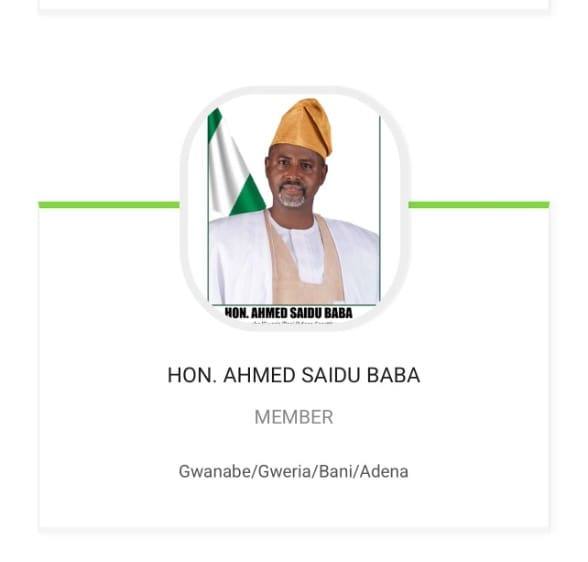
Community members told DUBAWA that they repeatedly sought intervention from Ahmed Saidu Baba, who represents Gwanabe/Gweria/Bani/Adena constituency in the Kwara State House of Assembly, but could not reach him.
Official portrait of Hon. Ahmed Saidu Baba — Source: Kwara State House of Assembly
They said they submitted petitions to his constituency office and made several attempts to reach him through an official digital channel provided by the Kwara State House of Assembly to draw his attention to the worsening situation, but failed.
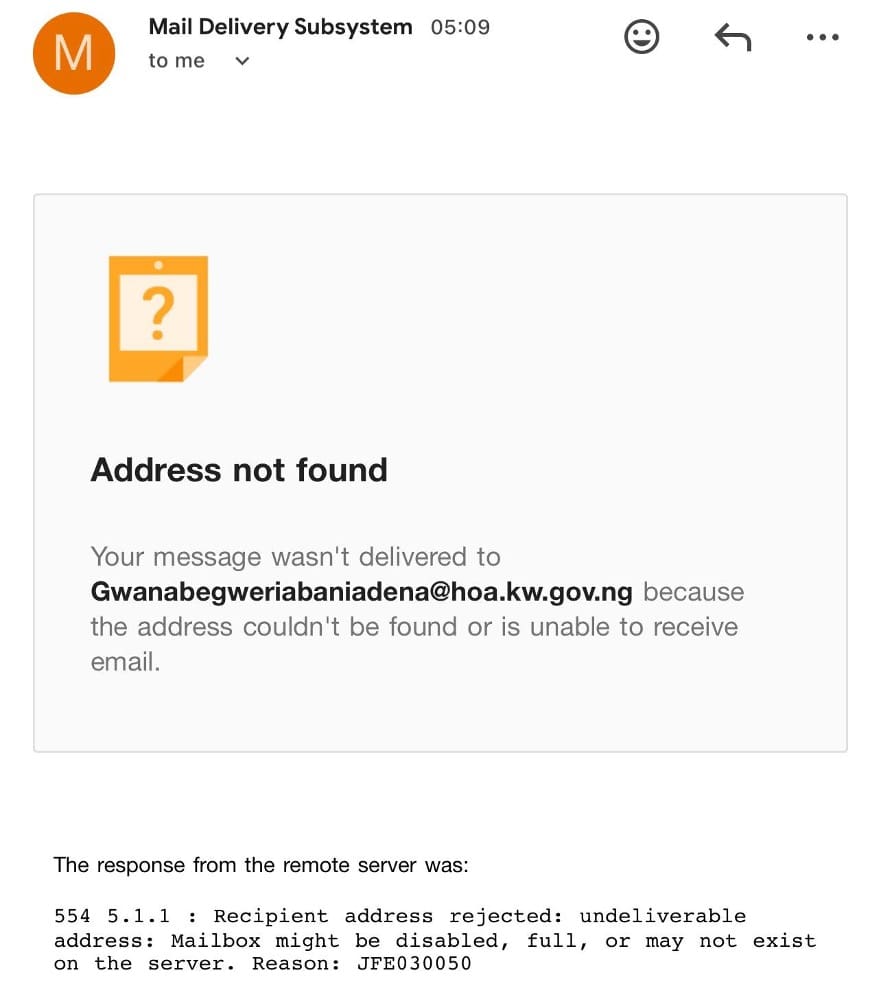
The official email address listed for Baba on the Assembly’s portal, gwanabegweriabaniadena@hoa.kw.gov.ng, was non-functional when residents attempted to use it.
Jamal Olamilekan, a resident, said, “Illegal lithium mining has destroyed our farmlands, brought armed violence into our town and nearby villages, and left us living in constant fear.”
He said residents had repeatedly tried to draw the government’s attention to the problem, but their efforts had yielded little response.
“We have tried to speak to the government about this problem, but they seem not to be bothered about it, and this is making this illegal business continue to grow,” he said.
“Our honourable (Ahmed Saidu Baba) is the only person who can take this issue up for us and present it as a motion in the House of Assembly, but he cannot be reached. Only his political loyalists can reach him,” he added.
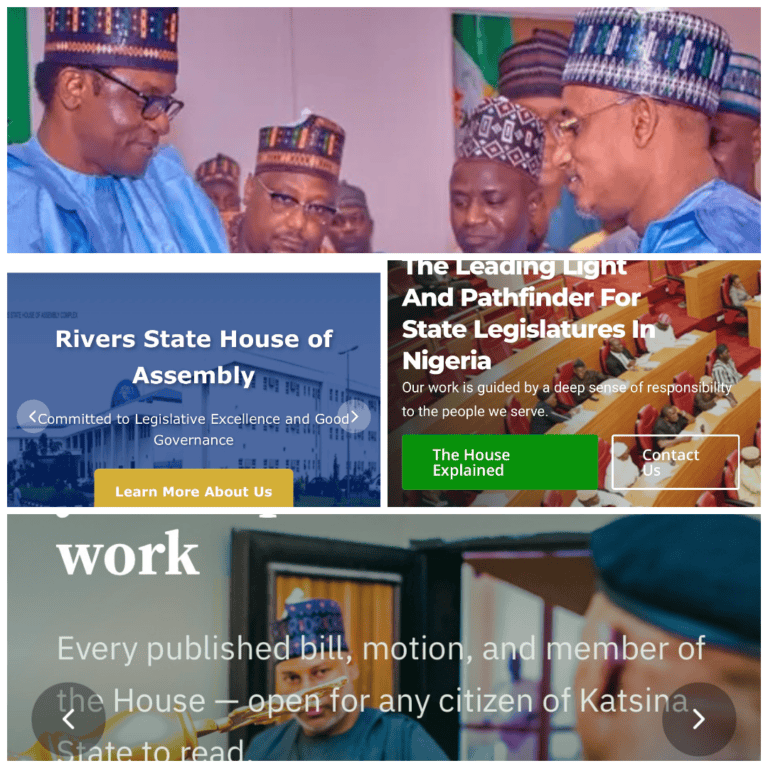
DUBAWA’s experience attempting to contact Saidu Baba corroborated his constituents’ claims. The only contact information provided on the State House of Assembly’s website was an email address that returned an error saying it could not be found or could not receive messages.
Screenshot showing Hon. Ahmed’s official email address not working
‘A community struggles to reach its lawmaker’
What happened in Bani is far from isolated.
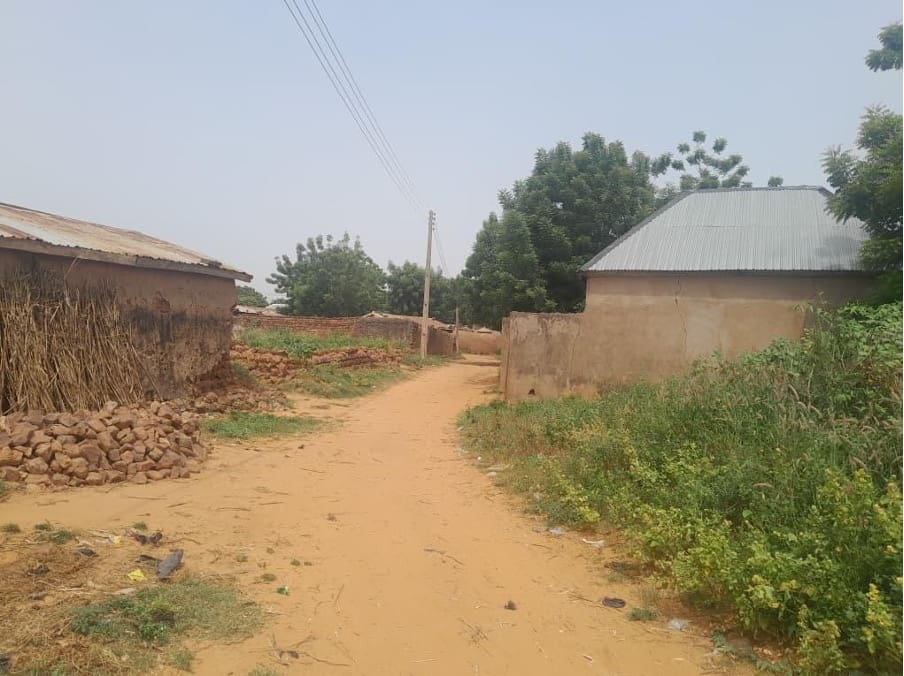
In Gidan Yaro, a community in Wamakko Local Government Area of Sokoto State, residents are struggling with poor school facilities and say they have been unable to reach their elected representative for help.
Machido Abubakar, a local youth leader, described the condition of the community’s only primary school as poor. “The school has just one block of two classrooms, with no desks or chairs for the pupils,” he told DUBAWA.
He said the poor conditions had affected school enrolment, while repeated appeals for government intervention had yielded little response.
Gidan Yaro Community — Credit: Abdulwasiu Olokooba
The community’s hopes for intervention grew in 2025, when residents heard that the Sokoto State Government was identifying underserved communities for educational support.
“After Eid-il-Fitr in 2025, word was going around town that the governor wanted a comprehensive list of communities in serious need of educational investment,” Abubakar said.
He explained that residents wanted to contact their lawmaker, Lamido Abubakar, who represents Wamakko constituency at the State House of Assembly, to ensure their community was considered, but they could not find a phone number or email address through which to reach him.
Abubakar said the community consequently missed out on a state government N8.3billion intervention announced in August 2025.
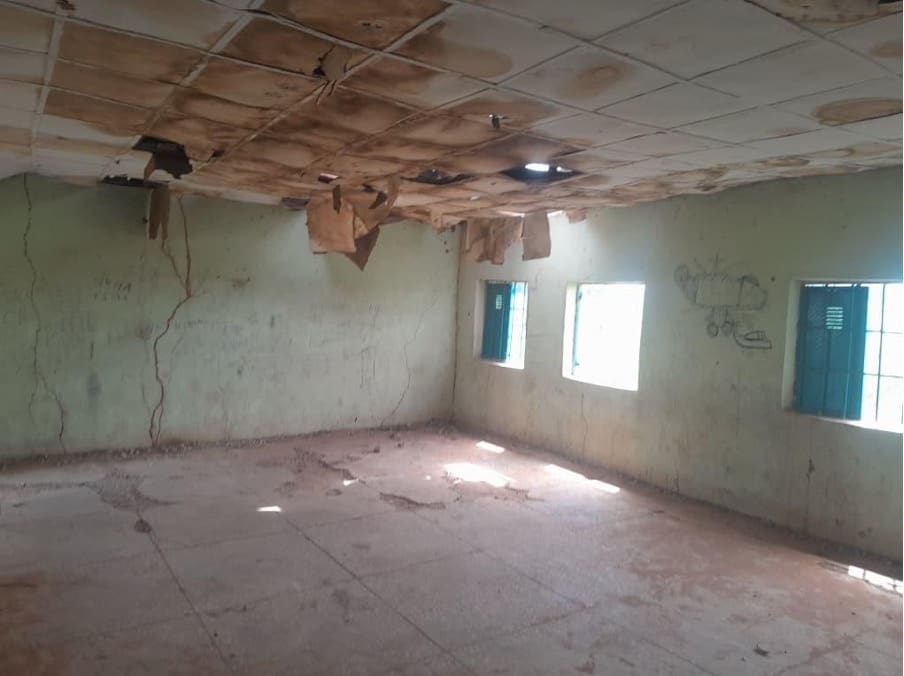
Fallen ceiling at Gidan Yaro Primary — Credit: Abdulwasiu Olokooba
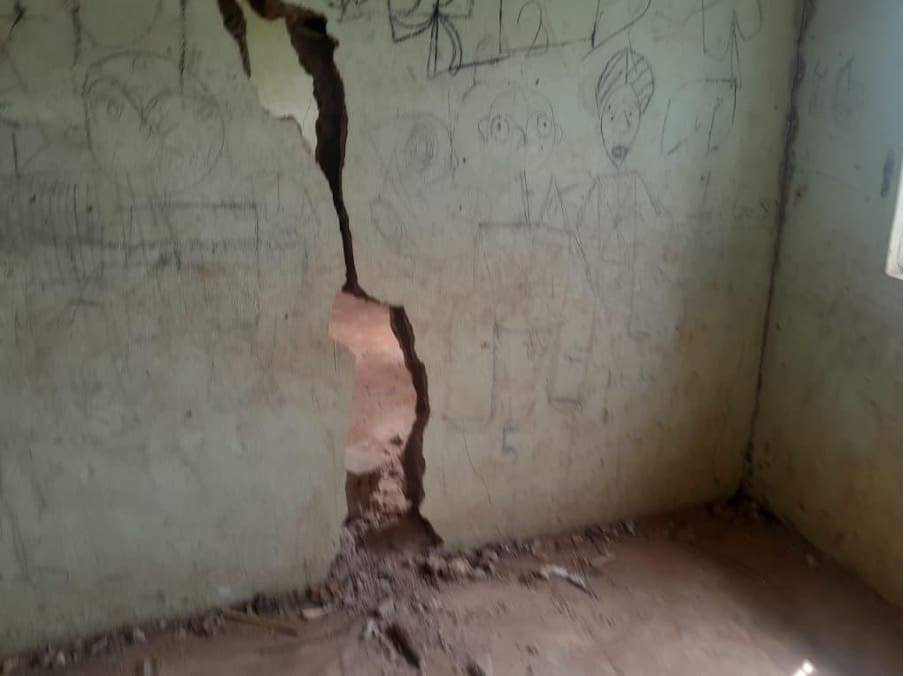
When DUBAWA visited Gidan Yaro on Wednesday, Oct. 7, 2026, to examine the school’s condition, the facilities remained in disrepair. During the visit, between 9 a.m. and 10 a.m., the two-classroom block had no desks or chairs, and no students or teachers were present. The classrooms had cracked walls and collapsing ceilings.
For residents of the G/Bubu/G/Yaro electoral ward, the situation reflected more than inadequate school facilities. It also raised questions about whether communities could reach the lawmakers elected to represent their interests and help them seek government intervention.
“We just want a school where our kids can sit and learn,” Abubakar said. “When a community suffers, its people need a direct line to their representative. Without that, our problems never reach those who can truly fix them.”
A nationwide investigation by DUBAWA between May and September 2026 revealed widespread failures in digital accessibility and public responsiveness across Nigeria’s 36 State Houses of Assembly. To test how easy it is for citizens to access lawmakers, DUBAWA emailed every state assembly requesting official contact channels and guidelines for constituent reporting.
Beyond the digital realm, DUBAWA submitted physical Freedom of Information (FOI) petitions to seven state legislatures to benchmark offline responsiveness and adherence to legal disclosure mandates.
Cracked Wall at Gidan Yaro Primary — Credit: Abdulwasiu Olokooba
17 state assemblies have no official emails
For four months, DUBAWA examined the official digital presence of all 36 State Houses of Assembly to determine whether citizens could find publicly accessible institutional email addresses to contact their lawmakers and the assemblies.
The investigation reviewed the state legislatures’ official websites and their social media presence, particularly on Facebook, to assess how the institutions use digital channels to communicate with citizens and provide avenues for public engagement.
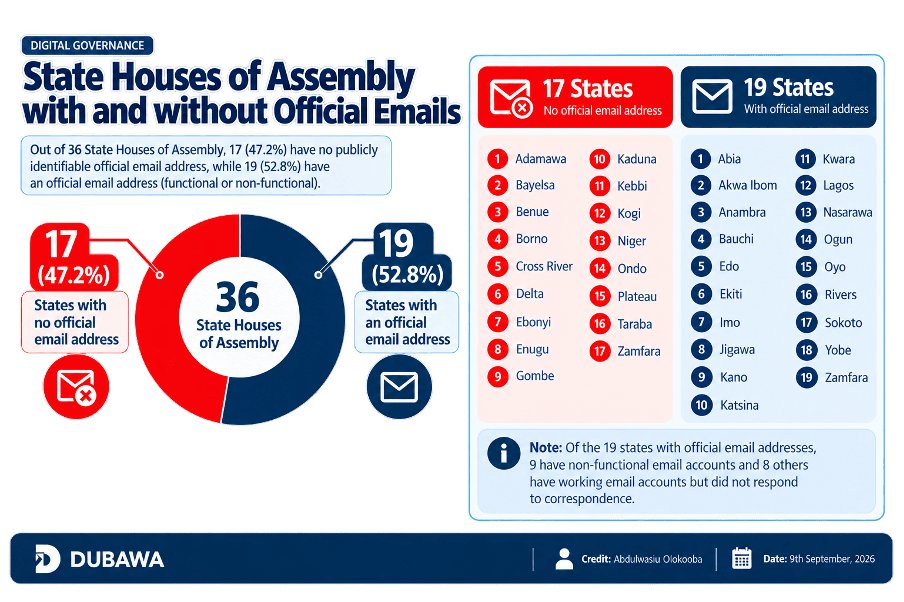
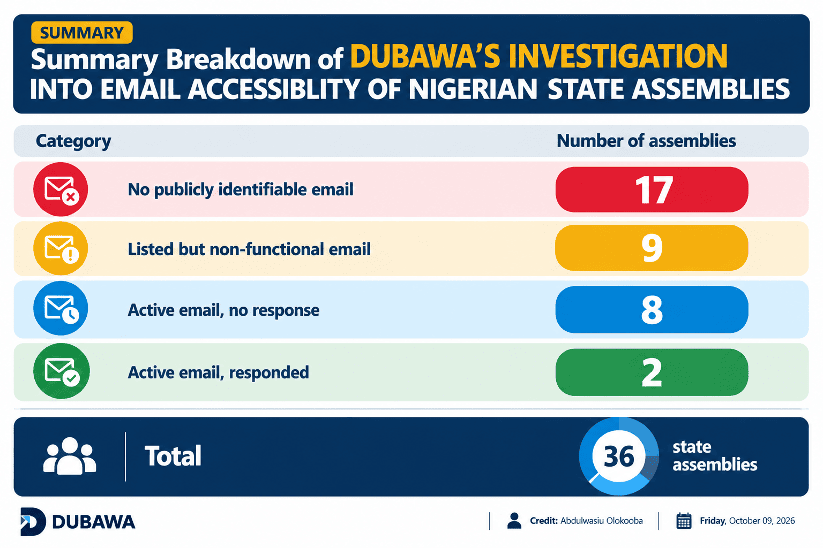
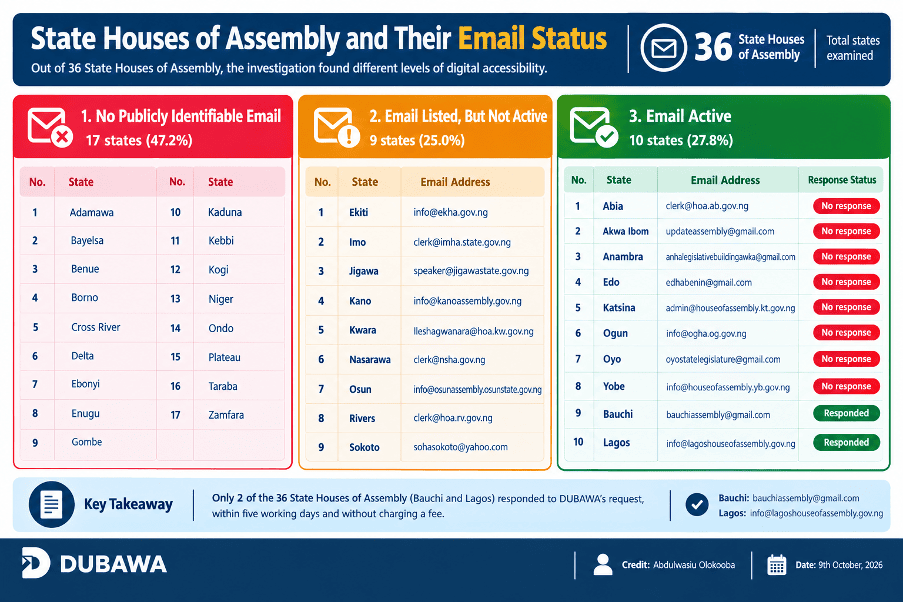
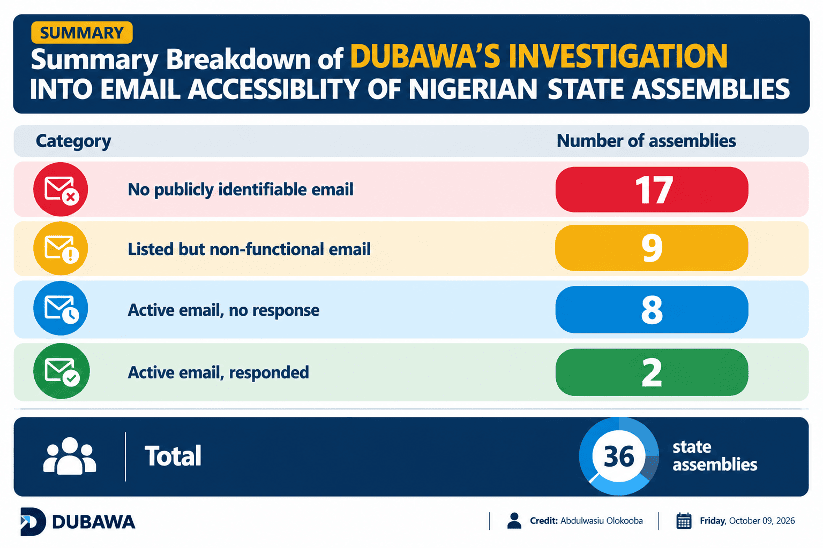
The findings show a significant gap in digital accessibility. Of the 36 State Houses of Assembly examined, 17 (47.2%) had no publicly identifiable official email address through which citizens could directly contact the institution on the platforms reviewed.
The affected states are Adamawa, Bayelsa, Benue, Borno, Cross River, Delta, Ebonyi, Enugu, Gombe, Kaduna, Kebbi, Kogi, Niger, Ondo, Plateau, Taraba and Zamfara.
Nine state assemblies have non-functional email addresses
A publicly listed email address does not necessarily mean you can reach a State House of Assembly.
DUBAWA found that nine of the 19 State Houses of Assembly with publicly identifiable email addresses had non-functional accounts during the investigation. Emails sent to the addresses were returned as undeliverable, with error messages indicating that the addresses or their associated domains could not be found.
For example, an email sent to Ekiti State House of Assembly’s listed address, info@ekha.gov.ng, was returned with the message: “Address not found. Your message wasn’t delivered to info@ekha.gov.ng because the domain ekha.gov.ng couldn’t be found. Check for typos or unnecessary spaces and try again.”
The nine affected assemblies were Ekiti, Imo, Jigawa, Kano, Kwara, Nasarawa, Osun, Rivers and Sokoto.
The investigation identified the following email addresses for the affected institutions: info@ekha.gov.ng for Ekiti; clerk@imha.state.gov.ng for Imo; speaker@jigawastate.gov.ng for Jigawa; info@kanoassembly.gov.ng for Kano; Ileshagwanara@hoa.kw.gov.ng for Kwara; clerk@nsha.gov.ng for Nasarawa; info@osunassembly.osunstate.gov.ng for Osun; clerk@hoa.rv.gov.ng for Rivers; and sohasokoto@yahoo.com for Sokoto.
DUBAWA obtained the email addresses from sources including official legislative websites, state government websites, and Facebook pages.
Working emails, but 8 assemblies fail to respond
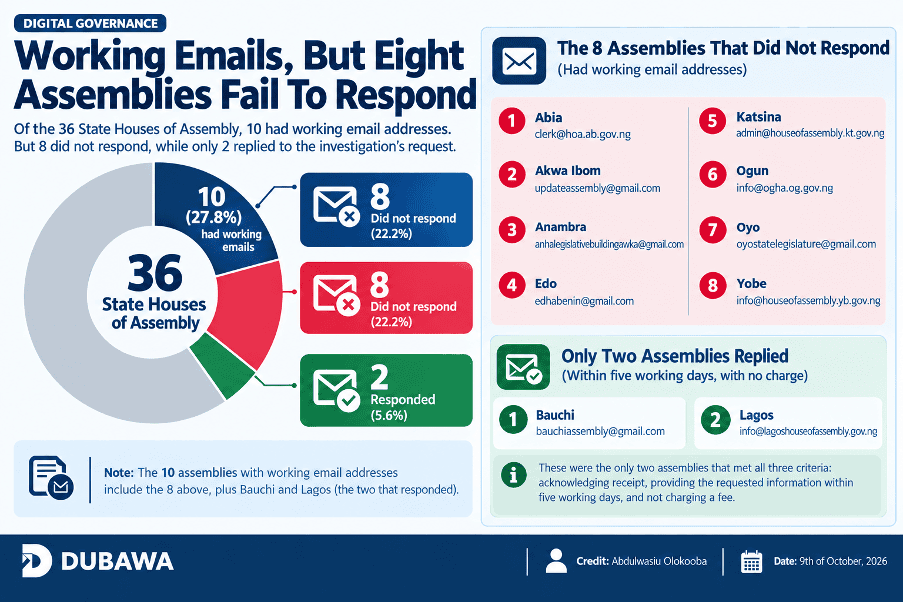
Beyond the nine assemblies with non-functional email accounts, eight others had working email addresses but did not respond to correspondence recorded in the investigation’s tracking exercise.
The email sought information on how members of the public could access and engage with their state assemblies, including the assemblies’ official websites and public contact addresses, procedures for submitting petitions or complaints, and how citizens could obtain bills and resolutions.
It also asked whether the assemblies provided online platforms to follow plenary sessions or track bills, as well as their official social media accounts.
The eight assemblies are Abia, Akwa Ibom, Anambra, Edo, Katsina, Ogun, Oyo, and Yobe.
The identified addresses included clerk@hoa.ab.gov.ng for Abia, updateassembly@gmail.com for Akwa Ibom, anhalegislativebuildingawka@gmail.com for Anambra, edhabenin@gmail.com for Edo, admin@houseofassembly.kt.gov.ng for Katsina, info@ogha.og.gov.ng for Ogun, oyostatelegislature@gmail.com for Oyo, and info@houseofassembly.yb.gov.ng for Yobe.
‘Only 2 assemblies replied to emails’
Of the 36 State Houses of Assembly DUBAWA contacted, only two, Bauchi and Lagos, provided all requested information within five working days of receiving the correspondence, without charging the requester.
The two assemblies were the only ones that met all three criteria used in the investigation: acknowledging receipt of DUBAWA’s request, providing the requested information within five working days, and doing so without charging a fee.
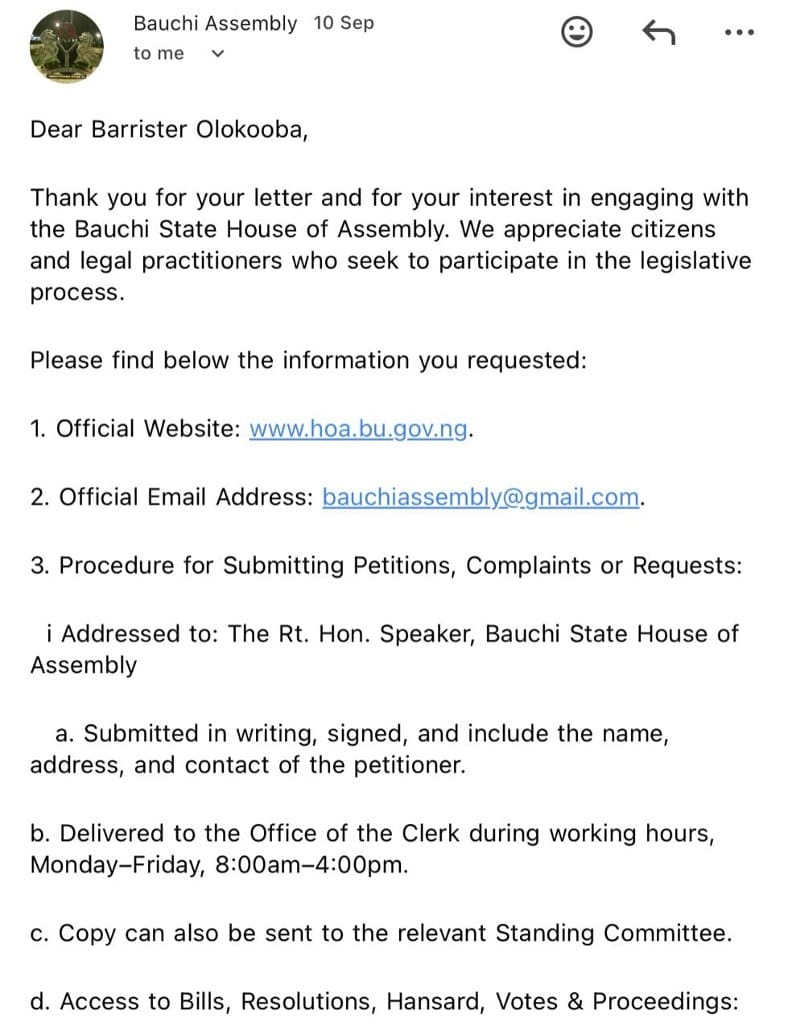
Bauchi State House of Assembly responded through its publicly listed email address, bauchiassembly@gmail.com, which was functional during the investigation. It acknowledged DUBAWA’s Sept. 9, 2026, email and provided the requested information the following day, within 48 hours of the initial enquiry.
Screenshot showing Bauchi State House of Assembly’s Response
The Lagos State House of Assembly also responded promptly. It acknowledged DUBAWA’s request through info@lagoshouseofassembly.gov.ng on Sept. 12, 2026, the day it was sent, and provided the requested information on Sept. 14, 2026, without requesting payment.
Their responses contrasted with those of the other assemblies contacted, where requests were either not acknowledged, went unanswered within the investigation’s five-working-day benchmark, or did not yield all the information sought.
24 of Nigeria’s 36 State assemblies lack active Facebook presence
DUBAWA examined the Facebook presence of all 36 State Houses of Assembly to assess how regularly they used the platform to communicate with citizens and share information about their activities.
Facebook was selected for its substantial reach in Nigeria and its public-facing features, which let citizens view updates from public pages without necessarily joining a group or following an account. According to DataReportal’s Digital 2025 report on Nigeria, Meta’s advertising tools estimated Facebook’s potential audience in the country at 38.7 million users in January 2025.
DUBAWA assessed the pages based on three criteria: when the most recent post was published, how regularly the page posted, and whether its content related to the activities of the State House of Assembly. To be classified as active, a Facebook page’s most recent post must have been published in August 2026 or later, and the page must post regularly and share content relevant to the State House of Assembly’s legislative activities.
A recent post alone did not automatically qualify a page as active. DUBAWA also considered update frequency and whether the content informed the public about the assembly’s proceedings, decisions, or other activities. Pages that did not satisfy these criteria were classified as inactive.
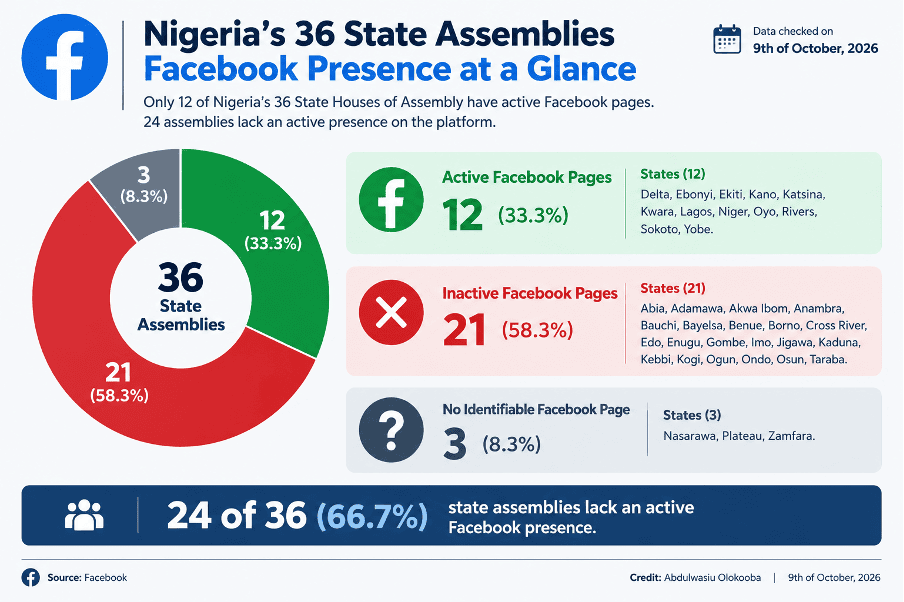
As of Oct. 9, 2026, only 12 assemblies had Facebook pages with recent activity. Twenty-one had identifiable but inactive pages, while three had no identifiable pages.
This means that 24 of Nigeria’s 36 state assemblies, or 66.7%, lacked an active Facebook presence at the time of the review. Only 33.3% had active pages.
Some of the pages had gone years without new posts. Bayelsa’s last post was published in Jan. 2016, while Kogi’s was from Oct. 2015.
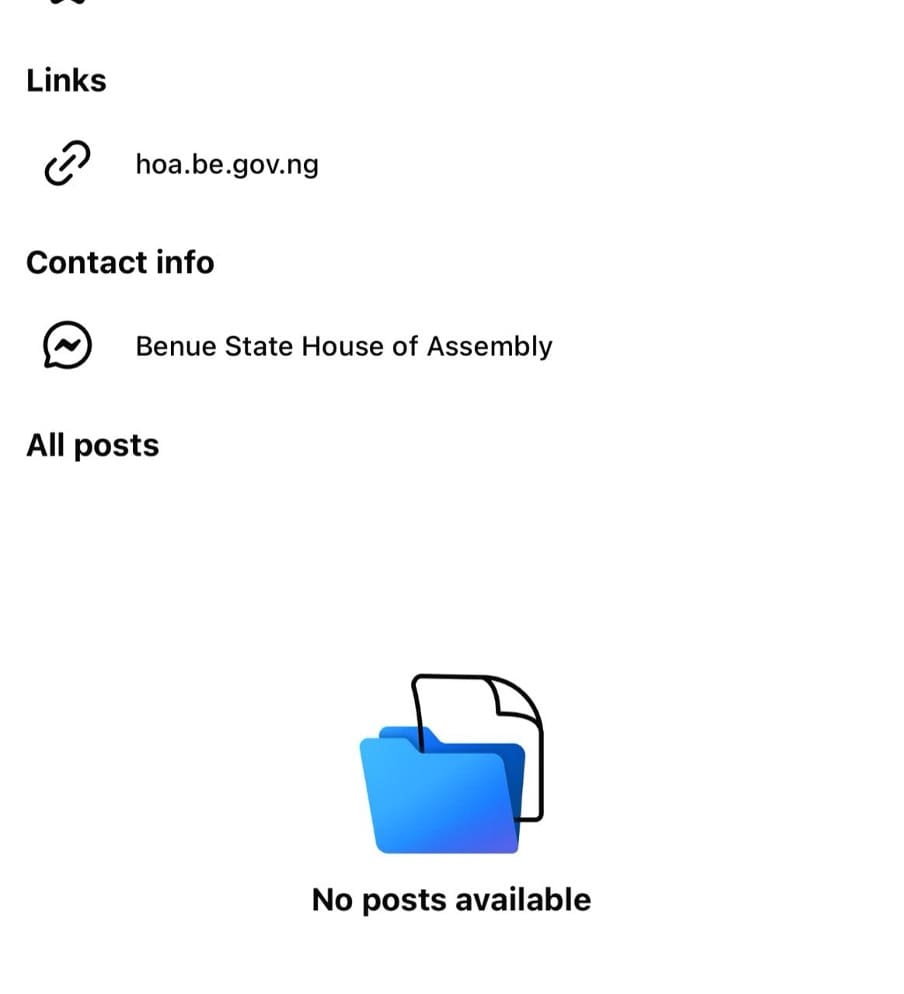
Screenshot of Benue’s Facebook page showing ‘No posts available’
Other pages also showed prolonged gaps in activity. Abia last posted in Sept. 2019, while Borno’s most recent post was from Sept. 2021. Bauchi last posted in Sept. 2022, and Imo in Jan. 2025. Ondo’s most recent post was from May 2023, while Akwa Ibom last posted in October that year. Gombe’s last post was dated Dec. 2023, and Osun’s was published in May 2024.
More recent posts did not necessarily indicate regular activity. Jigawa’s last post was in May 2025, Edo’s in Sept. 2025, and Anambra’s in Nov. 2025. Taraba last posted in Oct. 2023, while Ogun’s most recent post was from Sept. 2021.
Kaduna’s page was considered inactive because it did not meet all three assessment criteria. Although the page shared a post in Oct. 2026 announcing Governor Uba Sani’s signing of an executive bill establishing a specialist nursing college in Rigasa, it had no posts between Oct. 2025 and July 2026. Its posting activity was also largely ceremonial, rather than consistently updating the public on legislative activities and engaging citizens throughout the year.
The review also found limited content on some pages. Cross River’s page, created in April 2026, had only four posts, the latest published in July 2026. Kebbi’s page had just one post, published in April 2020.
Three assemblies had no identifiable Facebook pages
DUBAWA could not identify official Facebook pages for the State Houses of Assembly in Nasarawa, Plateau and Zamfara after searching Facebook’s public search feature using relevant keywords and conducting additional Google searches. The searches focused on identifying pages dedicated to the legislatures, rather than accounts belonging to state governments, political offices, educational institutions or other organisations. Together, the three states account for 8.3% of Nigeria’s 36 state legislatures.
For Nasarawa, Facebook searches returned pages associated with institutions such as the Nasarawa College of Health, Keffi, and Nasarawa State University, Keffi. However, DUBAWA could not identify a page dedicated to the State House of Assembly among the results. Additional Google searches also failed to identify an officially verified Facebook page for the legislature.
For Plateau, Facebook searches returned results associated with the Plateau State Government, which represents the state’s executive arm, and Plateau United, a football club. Neither was dedicated to the State House of Assembly. Additional Google searches also failed to identify an officially verified Facebook page managed centrally by the legislature.
The most recent posts varied across August and October 2026. Kano and Sokoto last posted in August, while Ebonyi’s latest post was on Sept. 23, 2026. Kwara, Lagos and Rivers last posted on Oct. 1, 2026, followed by Oyo on Oct. 6, 2026. Yobe’s latest post was published on Oct. 21, 2026, while Delta, Niger, Katsina and Ekiti posted most recently on October 26, 2026.
DUBAWA also found that none of the Facebook pages identified in the review had a verification badge, including those classified as active.
23 of Nigeria’s 36 State assemblies lack active, dedicated websites
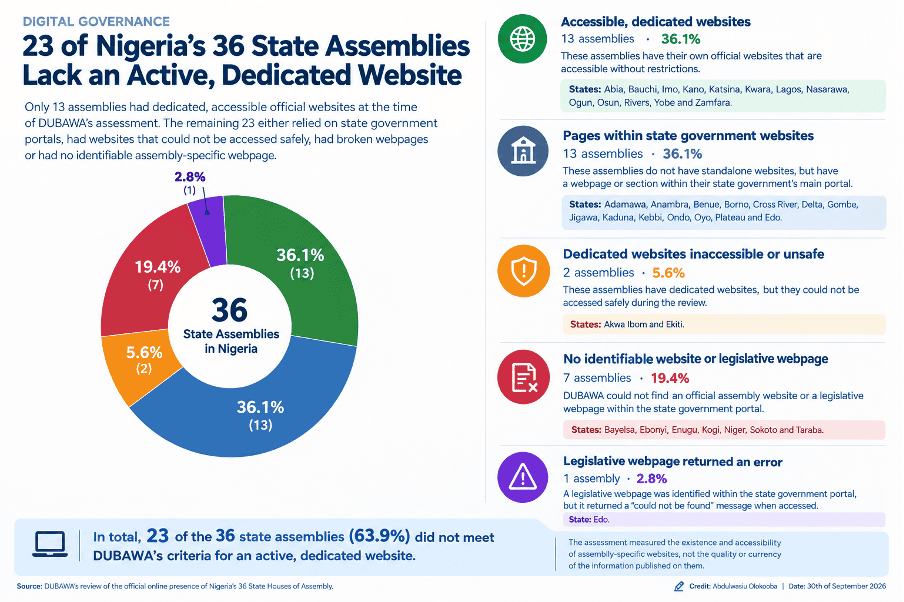
Only 13 of Nigeria’s 36 State Houses of Assembly had dedicated, accessible official websites during DUBAWA’s assessment. The remaining 23 did not meet the criteria for an active, dedicated website: some relied on pages within broader state government portals, two had websites that could not be accessed safely, seven had no identifiable assembly-specific webpage, and one state’s legislative webpage could not be found.
DUBAWA assessed the online presence of all 36 assemblies between May and September 2026. A website qualified as active only if it was dedicated to the State House of Assembly and accessible without restrictions during the review. A page within a general state government website did not qualify, even if it contained information about the legislature.
DUBAWA equally identified no standalone assembly website for 13 states but found a legislative webpage or section within their broader state government portals. These were Adamawa, Anambra, Benue, Borno, Cross River, Delta, Gombe, Jigawa, Kaduna, Kebbi, Ondo, Oyo and Plateau.
While such pages provide some online visibility, they are not equivalent to dedicated institutional websites. The extent to which they provide detailed legislative information varies and cannot be determined by website-accessibility classification alone.
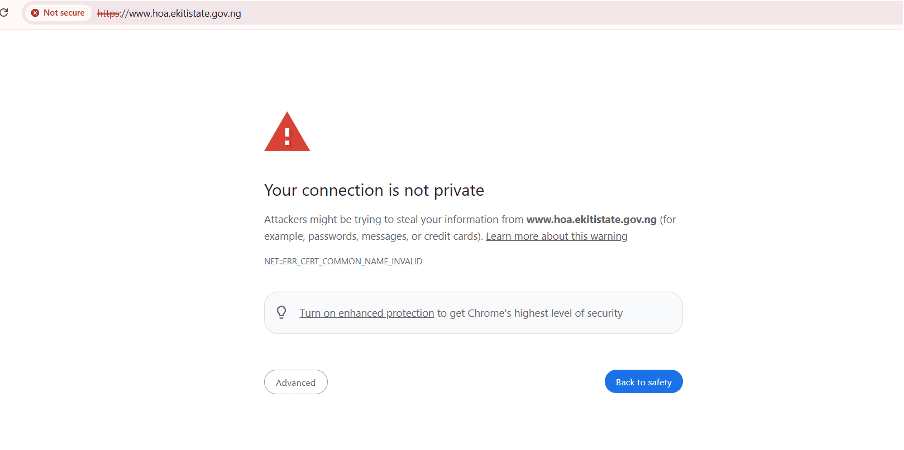
Screenshot of Ekiti State House of Assembly Website Triggering Browser Security Warning Over Possible Data Theft
Neither website met DUBAWA’s accessibility requirements, and the assessment classified both as inactive. This classification reflects their status at the time of checking; it does not mean either website was permanently unavailable or that a cyberattack occurred.
The findings underscore that having a website is not enough: citizens must also be able to access it safely for it to serve as a reliable channel for public information.
DUBAWA could not identify either an official assembly website or a legislative webpage within the state government portal for Bayelsa, Ebonyi, Enugu, Kogi, Niger, Sokoto and Taraba. These seven states account for 19.4 per cent of Nigeria’s 36 state legislatures.
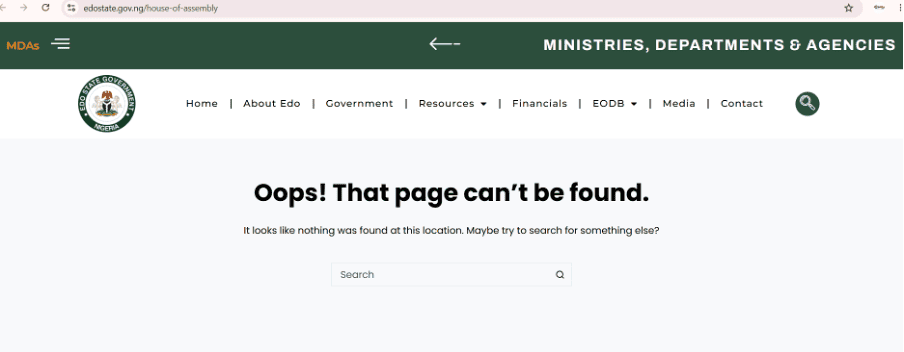
Edo did not fit neatly into the other categories. Although a legislative webpage appeared in the state government portal, it returned a “could not be found” message when accessed. It therefore did not meet the criteria for an accessible, dedicated assembly website.
Screenshot of a webpage created for the Edo State House of Assembly that is no longer accessible
Overall, 23 of the 36 assemblies (63.9 per cent) did not meet DUBAWA’s criteria for an active, dedicated website.
What Nigeria’s state assemblies spend on ICT
To determine how much Nigeria’s 36 State Houses of Assembly spent on information and communication technology (ICT) and related projects between 2023 and 2025, DUBAWA reviewed state budget performance reports from January 2023 to December 2025, focusing on funds released for projects specifically related to legislative digital infrastructure and development.
The review found that most of the budget performance reports examined did not provide clear, comprehensive details that would allow citizens to track funds released to state legislatures for ICT and digital development.
DUBAWA could not clearly identify itemised ICT projects specifically dedicated to the operations of most State Houses of Assembly in the records reviewed.
The lack of detailed information makes it difficult for citizens to establish how much their legislatures have spent on digital infrastructure, what the funds were intended to deliver and how such investments could improve access to legislative information and communication between lawmakers and their constituents.
However, the review identified specific ICT-related releases for the Lagos and Anambra State Houses of Assembly.
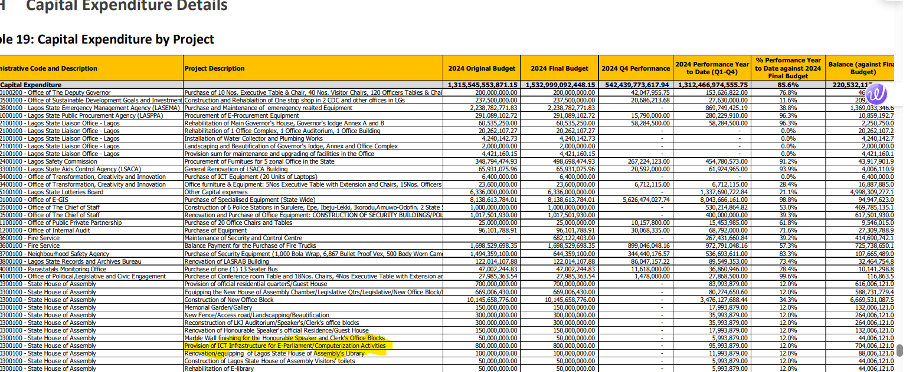
In Lagos, the House of Assembly received ₦719.2 million in 2023 and ₦96 million in 2024 for the “Provision of ICT Infrastructure for E-Parliament/Computerization Activities.”
Screenshot showing the Lagos State House of Assembly spent N96 million on ICT infrastructure in 2024. Source: Budget Performance reports 2024
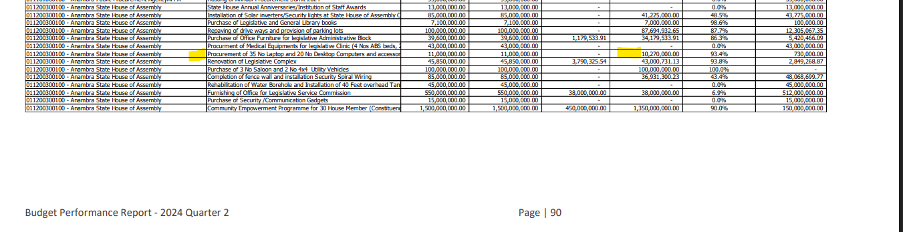
In Anambra, the government released ₦10.27 million in 2024 to procure 30 laptops, 20 desktop computers, and accessories.
A screenshot shows that the Anambra State House of Assembly spent ₦10 million on ICT infrastructure in 2024. Source: Budget Performance reports 2024
FOI test: 7 state assemblies fail to provide requested information
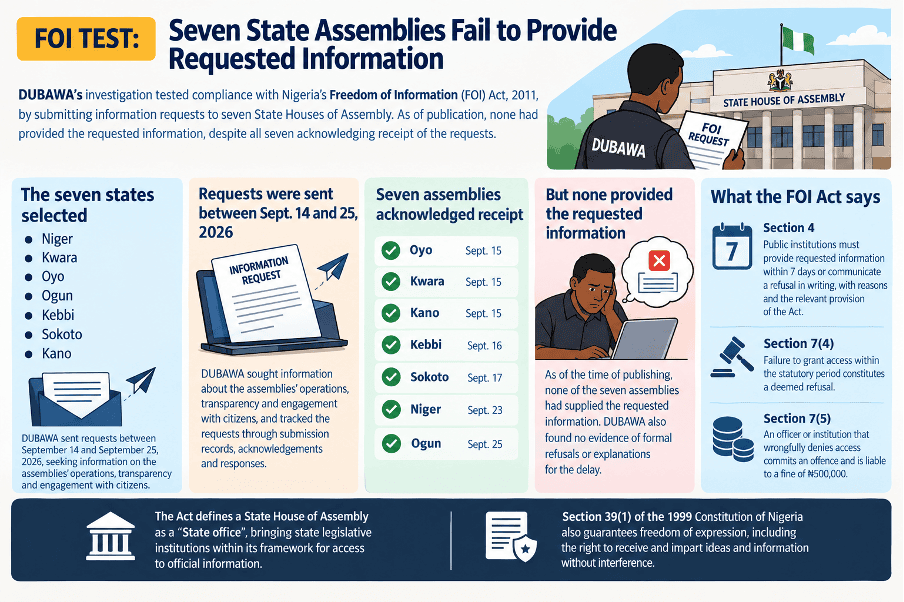
DUBAWA’s investigation also tested compliance with Nigeria’s Freedom of Information (FOI) Act, 2011, by submitting information requests to at least seven (7) State Houses of Assembly. As of publication, none had provided the requested information, even though all seven acknowledged receipt.
The investigation selected Niger, Kwara, Oyo, Ogun, Kebbi, Sokoto and Kano states. Between Sept. 14 and Sept. 25, 2026, DUBAWA sent requests seeking information about the assemblies’ operations, transparency and engagement with citizens. DUBAWA tracked the requests through submission records, acknowledgements, and subsequent responses.
Oyo, Kwara, and Kano acknowledged their requests on Sept. 15; Kebbi on Sept. 16; Sokoto on Sept. 17; Niger on Sept. 23; and Ogun on Sept. 25.
However, none of the seven assemblies had supplied the requested information as of the time of publication. They also did not justify their failure to respond appropriately, as required by law.
Under Section 4 of the FOI Act, public institutions must make requested information available within seven days of receiving an application or communicate a refusal in writing, stating the reasons and the relevant provision of the Act.
Section 7(4) provides that failure to grant access within the statutory period constitutes a deemed refusal. Section 7(5) provides that an officer or institution that wrongfully denies access commits an offence and, upon conviction, is liable to a fine of ₦500,000.
Section 31 of Nigeria’s Freedom of Information Act, 2011, defines a “public institution” to include legislative bodies of government. This provides a legal basis to treat State Houses of Assembly as institutions covered by the Act’s public access provisions.
Stakeholders weigh in
Simbiat Alaro, a legal practitioner specialising in Freedom of Information matters, said the failure to respond raises a fundamental question about citizens’ ability to exercise their legal right to seek information from public institutions.
“The Freedom of Information Act gives citizens a legal mechanism to seek information from public institutions. When an institution receives a request and fails to provide the information or give a lawful refusal within the prescribed period, it undermines the practical enjoyment of that right.”
She said the situation was particularly concerning when the institutions involved were lawmakers.
“It is troubling when an institution whose primary responsibility is to make laws is itself seen as failing to comply with a statutory obligation. Legislatures should set the standard for respect for the law and accountability, because citizens look to them to ensure that public institutions operate within the law.”
Adekunle Adeyemi Toafeeq, Lagos State Coordinator of the Take It Back Movement, a pro-democracy group, said the findings raise broader concerns about democratic accountability.
“A legislature cannot claim to represent the people effectively if citizens cannot obtain basic information from it. The issue here is not just unanswered emails; it is whether citizens can meaningfully scrutinise the institutions exercising power in their name.”
He said repeated failure to respond to formal requests could discourage citizens from using lawful accountability mechanisms.
“When citizens use a channel provided by law and still receive no substantive response, it sends the message that formal accountability mechanisms may not work. That weakens public participation and creates a system where access to information can depend on personal connections rather than citizens’ rights,” he said.
Assemblies respond to findings
To allow the affected State Houses of Assembly to respond to the findings, DUBAWA spoke with officials from Oyo and Ogun states to understand the communication challenges identified during the investigation and the steps being taken to address them.
Aderonke Ogundeji, Deputy Clerk of the Oyo State House of Assembly, acknowledged that the assembly’s email system was not functioning properly, raising concerns about its ability to receive and process citizens’ correspondence.
“I know the email is not active as we speak. And even if your message drops, I am not sure it’s been processed. Before, we had a functioning email and a website that anyone could access anywhere in the world. But all these stopped working at a time, and [I] agree this may limit how people engage, interact and access us,” she told DUBAWA.
Ogundeji said the assembly recognised the importance of restoring its digital communication channels and pledged to work internally to make them accessible again.
“Due to its importance, as you stated, we are going to work internally and ensure they continue to work so that citizens can reach us from any part of the world. It is something we have to bring back to align with the contemporary,” she said.
She also said the assembly was working on its response to DUBAWA’s Freedom of Information (FOI) request.
However, as of Oct. 10, 2026, the assembly had not yet provided the information requested in DUBAWA’s Sept. 15, 2026 letter.
Adedigba David, a senior research officer at the Ogun State House of Assembly, said the assembly had noted the communication gaps identified in DUBAWA’s investigation, including issues with its official email channel and how it handled the investigation’s Freedom of Information (FOI) request. He said the assembly would work internally to address these issues and improve access to its communication channels for citizens.
This reporting was completed with the support of the Centre for Journalism Innovation and Development (CJID) under the SAIL+ Programme Fellowship.
This second part of the ICIR consolidated report reveals more of the findings on how federal and state governments used phone interception tools, call records, CCTV networks, and other monitoring technologies to track, trail, arrest, and detain journalists, activists, political critics, and ordinary citizens.
Accountability and legal gaps
This section includes two investigations: “Without warrants: Illegal surveillance chokes Nigeria’s civic space” and “Inside Enugu’s multi-billion-naira surveillance centre with no oversight law.”
The first report documented cases involving civil society organisations, activists, advocacy groups, and media organisations that faced cyberattacks, monitoring, and harassment after engaging in government accountability campaigns or publishing reports that criticised public institutions and officeholders.
The investigation examined links between digital threats and attempts to discourage civic engagement, suggesting that organisations working on transparency, democracy, and human-rights issues are increasingly vulnerable to technologically enabled pressure.
It highlighted allegations that the International Society for Civil Liberties and Rule of Law (Intersociety) was attacked online after it criticised electoral processes and governance issues.
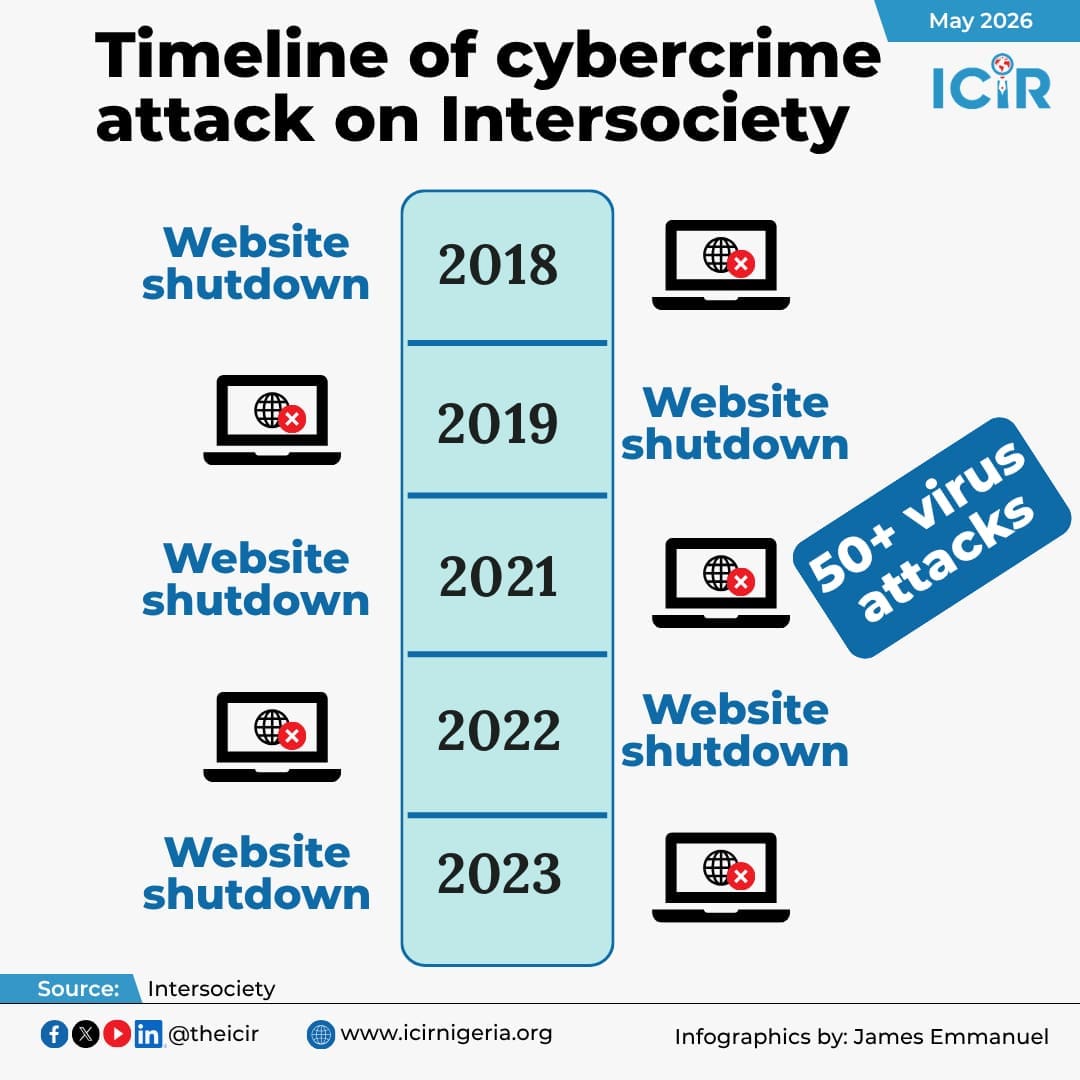
Timeline of cybercrime attacks on Intersociety
Before the 2023 election, Intersociety had criticised Nigeria’s electoral umpire, the Independent National Electoral Commission (INEC). Soon after the election, Intersociety said its website was attacked and rendered inaccessible. The NGO’s Executive Director, Emeka Umeagbalasi, told The ICIR that the domain host informed them that the website’s hosting was suspended after numerous complaints and petitions originating from Nigeria.
Websites belonging to media organisations such as WikkiTimes and Foundation for Investigative Journalism (FIJ) also experienced takedowns, malware infections, coordinated cyberattacks, and suspected digital tracking after the publication of reports critical of government institutions or powerful individuals.
The ICIR investigation wove patterns of how digital attacks, surveillance activities, and online intimidation contribute to Nigeria’s shrinking civic space and ultimately pose a significant threat to civil society, transparency efforts, and democratic governance. Read the full report here.
The second investigation, “Inside Enugu’s multi-billion-naira surveillance centre with no oversight law,” provides an inside look at Enugu State’s Safe City project, a technologically advanced surveillance architecture designed to monitor public spaces, support security operations, and enable rapid incident response.
The project includes a command-and-control centre, extensive CCTV coverage, drones, facial-recognition capabilities, and real-time monitoring systems spanning the state.
Although government officials present the initiative as a major security innovation, the investigation identified a significant legal gap: there is no dedicated law governing its operations, oversight or accountability of the system.
The ICIR found that though the project possessed the capability to track vehicles, monitor individuals, and collect substantial amounts of data, critical questions remained about who controls access, how information is stored, and what safeguards exist against misuse. The investigation emphasised the need for comprehensive legislation, independent oversight mechanisms, and transparent data governance practices to balance security objectives with the protection of citizens’ rights.
Together, these two reports highlighted concerns raised by legal experts, civil society organisations, journalists, and opposition figures regarding transparency and civil liberties. They also highlighted concerns over the lack of independent oversight and transparency. They call for comprehensive surveillance legislation, independent oversight bodies, transparency on data use and retention, as well as stronger protections for journalists, activists, and civil society organisations.
Surveillance infrastructure and public expenditure
The two investigations under this category focused oninvestments in surveillance technology, procurement, maintenance, and transparency. The two reports, “Pay to track: Nigerians forced to fund police investigations despite billions on surveillance,” and “Edo’s ‘state-of-the-art’ command centre goes dark amid secrecy over cost,” examined the gap between Nigeria’s significant investment in surveillance infrastructure and the experiences of citizens seeking police assistance, as well as the decline of Edo State’s Solomon Arase Command-and-Control Centre.
In “Pay to track: Nigerians forced to fund police investigations despite billions on surveillance,” the ICIR investigation examined the gap between Nigeria’s significant investment in surveillance infrastructure and the experiences of citizens seeking police assistance.
Despite billions of naira spent on surveillance systems, tracking technologies, and intelligence tools, the ICIR found that victims of theft, fraud, and other crimes are frequently required to pay unofficial fees before police commence investigations or track suspects.
Through interviews with complainants in Kano and the Federal Capital Territory, the report documented cases of individuals asked to fund phone tracking, transportation, fuel, and other operational and logistical costs.
Now these experiences stand in contrast to the official position repeatedly presented by the Nigeria Police Force, especially since Section 4 of the 2020 Police Act mandates the police to prevent and detect crimes, protect lives and property, preserve law and order, and enforce all laws and regulations with which they are directly charged.
The Act places the responsibility for preventing and detecting crimes on the Nigeria Police Force as part of its statutory responsibilities. It does not make crime investigation contingent on victims paying police officers or privately engaged trackers before official investigative steps are taken.
The second report in this category, “Edo’s ‘state-of-the-art’ command centre goes dark amid secrecy over cost,” examined the decline of Edo State’s flagship security project, launched with considerable public attention and promoted as a model for technology-driven policing.
The facility, designed to integrate multiple agencies, provide real-time monitoring, coordinate emergency responses, and improve crime prevention through data-driven operations, was unfortunately abandoned after a new administration came into power.
Inside the inter-agency coordination floor of the Edo command-and-control centre, comprising representatives of various security agencies.
Although certain budgetary allocations were traceable, there was no comprehensive record of the project’s development and operational expenditure. Therefore, the report made its central focus the lack of procurement transparency, operational sustainability, and public accountability.
The investigation argues that the deterioration of a highly publicised surveillance and security initiative raises broader questions about governance, maintenance planning, and value for public funds. Read the full report here.
The findings of these two reports raised concerns about systemic weaknesses in accountability, transparency, and the potential misuse of surveillance resources.
Nigeria’s huge surveillance spending
The analysis of the 12 investigations highlights a stark reality. Growing expenditure on government surveillance technology. Over the years, federal and state governments have justified these budgetary expenditures as necessary measures to combat terrorism, banditry and other forms of organised crime in the country. However, the ICIR reports raised concerns about the scale of spending, lack of transparency, and implications for citizens’ privacy.
For instance, findings of a report by the Institute for Development Studies, titled “Mapping the supply of surveillance technologies to Africa,” revealed that Nigeria is Africa’s largest customer for surveillance technologies, spending at least $2.7bn on surveillance technologies from 2013 to 2022. Much of this equipment was either produced or shipped from Israel, the UK, the US, China, and the European Union.
Among them are multibillion-naira allocations splurged on the Nigerian Police Force between 2020 and 2025 to procure intelligence equipment, tracking technologies and upgrade a strategic surveillance platform codenamed COBWEB.
In 2023 alone, the police budgeted ₦7.5 billion as a Special Intervention Fund to procure the Cyber Intelligence Tracking System (CITS), and another ₦4 billion to activate and upgrade the COBWEB strategic surveillance platform. The system was allocated an additional ₦2.9 billion in 2024 and another ₦2.9 billion in 2025 for further activation and upgrades under the Technical Intelligence Unit.
Other security agencies have also received substantial funding. The 2026 budget shows an allocation of N213.2 million to the State Security Services (SSS) for surveillance equipment and N11 billion for “security equipment.”
Previous spending includes a 2017 budgetary allocation of N648 million to acquire the Athena Forensic Solution and a 2021 National Assembly approval of N4.87 billion to intercept Thuraya calls and WhatsApp messages. Within the same period, the Defence Intelligence Agency (DIA) received an allocation of N7.46 billion for an “independent lawful interception platform.”
State governments were not left behind. For instance, one of the reports revealed that the Kaduna State government, under its immediate past Governor, Nasir El-Rufai, spent at least N4 billion on the procurement of GSM/UMTS systems and installation of CCTV Cameras for monitoring and surveillance between 2016 and 2019. Journalists interviewed during the investigation linked this period to increased harassment and intimidation of journalists by government officials.
In Kogi State, despite vague security-related budget allocations, the investigation exposed large appropriations for broadly described security gadgets, ICT installations, and surveillance equipment with limited public accountability.
PRESIDENT Bola Tinubu has asked the Senate to approve a fresh external borrowing of $7.7 billion, approximately N10.79 trillion to finance part of the Federal Government’s 2026 budget deficit.
The request came barely a week after he sought a similar approval for a supplementary external borrowing plan involving $20.52 billion and €1.05 billion to finance infrastructure and development projects across Nigeria.
The latest request was contained in a letter dated October 26, 2026, which Senate President Godswill Akpabio read during plenary on Wednesday.
Tinubu sought legislative approval to raise N10,790,366,835,481 (nearly N11 trillion), based on the 2026 budget exchange rate of N1,409 to the dollar.
Reacting to the correspondence, Akpabio said the latest request effectively replaces an earlier proposal seeking approval for $20.3 billion in external borrowing, describing the new submission as more specific about the amount and financing arrangements.
“I believe this letter effectively supersedes the earlier request for 20.3 billion US dollars because the present request is more explicit,” Akpabio said.
He explained that the government would not necessarily obtain the entire amount from a single source but would explore different financing options to secure favourable borrowing terms.
The ICIR reports that the request is coming less than three months to the 2027 election, in which Tinubu is seeking a re-election for another four-year term.
The president in his latest letter recalled that the 2026 Appropriation Act provided for N29.2 trillion in new borrowing to finance a budget deficit estimated at N31.4 trillion, and under the borrowing plan, N18.4 trillion is expected to come from domestic sources, while N10.79 trillion is to be raised externally.
Tinubu said the government intended to raise the $7.7 billion through a combination of concessional and commercial loans from multilateral and bilateral institutions, the International Monetary Fund (IMF), bridge financing facilities, direct borrowing from international financial institutions and Eurobond issuance.
He explained that the different financing options would be pursued simultaneously, taking into account their costs, benefits and the time required to access the funds.
However, the president said priority would be given to Eurobond issuance because of its relatively faster completion and capacity to raise substantial funds at competitive rates.
On the cost of the proposed borrowing, Tinubu said the interest rates, repayment periods and other conditions would depend on prevailing market conditions when the funds are raised.
He added that the Federal Ministry of Finance and the Debt Management Office would work together to negotiate favourable terms for the country.
According to the president, the proposed loan would support the implementation of projects and programmes captured in the 2026 budget, particularly in defence and security, transportation, agriculture, power, education and healthcare.
Tinubu also argued that the borrowing could strengthen Nigeria’s external reserves and support the stability of the naira.
He said the funds would be received by the Central Bank of Nigeria on behalf of the Federal Government, thereby contributing to the country’s foreign reserves.
The president made the request pursuant to Sections 21(1) and 27(1) of the Debt Management Office (Establishment, etc.) Act, 2003, which require external borrowing arrangements to be submitted to the National Assembly for approval.
He also sought authorisation for the Minister of Finance and Coordinating Minister of the Economy, in collaboration with the Debt Management Office, to take the necessary steps to secure and implement the borrowing.
Following the presentation, Akpabio referred the request to the Senate Committee on Local and Foreign Debt for further consideration and directed it to report back to the chamber as soon as practicable.
The Senate is expected to consider the committee’s recommendations before deciding whether to approve the proposed $7.7 billion loan.
The ICIRreported on Tuesday, October 27, that Tinubu asked the Senate to approve a supplementary external borrowing plan involving $20.52 billion and €1.05 billion to finance infrastructure and development projects across Nigeria.
The request was presented to the Senate during plenary by Akpabio, who said the proposal would be referred to the Senate Committee on Local and Foreign Debts for consideration.
The proposed financing comprises $20,517,755,901 and €1,045,083,643 under the Federal Government’s 2026–2027 Supplementary External Borrowing Plan.
In a letter, Tinubu urged the National Assembly to consider and approve the plan promptly to facilitate the implementation of the proposed projects, noting that the financing would support investments in infrastructure, agriculture, healthcare, education, water supply, security, employment generation and financial management reforms.
The request comes as Nigeria’s public debt continues to rise.
According to the Debt Management Office (DMO), the country’s total public debt stood at N166.79 trillion as of June 30, 2026, comprising domestic and external obligations owed by the Federal Government, state governments and the Federal Capital Territory.
The figure represented an increase of N7.44 trillion from N159.35 trillion recorded at the end of March 2026. It was also N14.39 trillion higher than the N152.40 trillion recorded in June 2025.
The DMO’s breakdown showed that domestic debt accounted for N91.59 trillion, while external debt stood at N75.20 trillion.
The Federal Government accounted for N152.77 trillion of the total, while state governments and the FCT accounted for the remaining N14.01 trillion.
THE Federal High Court in Abuja has fixed December 8 for judgment in a N10 billion rights suit filed by former Kaduna State Governor Nasir El-Rufai against the Independent Corrupt Practices and Other Related Offences Commission (ICPC).
The News Agency of Nigeria (NAN) reports that El-Rufai also joined the ICPC Chairman, Musa Aliyu, a senior advocate, the Attorney-General of the Federation (AGF), Lateef Fagbemi, also a senior advocate, in the suit.
He alleged that they prevented him from having access to his wife, Aichatou Asabe; and son, Abba while in custody.
The judge handling the case, Chigozie Onah, fixed the date after the former govenor’s counsel, Ubong Akpan; the ICPC’s lawyer, Yetunde Mosunmola, and Maimuna Lami-Shiru, who appeared for the AGF, adopted their processes and presented their arguments for and against the case.
Earlier, when the case was called, the judge ordered that the footage of the closed-circuit television (CCTV) cameras at the ICPC’s office be played for 20 minutes each by parties to prove their arguments.
The commission, led by its lawyer, demonstrated some parts of the video clip in the open court.
Parts of the footage played include the incident of July 7 where Asabe, escorted by an officer, came to deliver food to the ex-governor at about 2:37pm.
Mosunmola urged the court to disregard El-Rufai’s claim.
On his part, Akpan, who asked that some parts of the footage of the CCTV earlier demonstrated be replayed, argued that neither Abba (El-Rufai’s son) nor Asabe had breached any security protocol from the video evidence to warrant their denial.
After the video recording was played, the parties adopted their processes.
Adopting his court documents, Akpan said their originating process was dated and filed on August 13.
He said it was supported by an originating motion, an affidavit and an exhibit attached to the eight-paragraph affidavit with a written address.
The lawyer said four additional affidavits were filed in support of their arguments, urging the court to grant all their reliefs.
Akpan, who raised a sole question for determination, prayed the court to determine whether the respondents had been able to place any material fact before the court to prove their decision to bar El-Rufai’s wife access.
He argued that if there must be a denial of access to the detained ex-govenor, there must be justification which must be verifiable.
“I, therefore, submit that none of the materials before my lord shows a verifiability and justification,” he said.
He said for the purpose of the case, the denial of access of his relatives would constitute a breach of the law, including the Nelson Mandela Rules.
When the judge asked him if Mandela Rules are enforceable in Nigeria, Akpan responded that it is a standard in which all law enforcement agencies in the world operate.
Mosunmola, however, disagreed with Akpan’s submissions.
She said on behalf of the ICPC and its chairman, they filed three processes in opposing the suit.
She said a 27-paragraph counter affidavit with four exhibits and a written address were filed on August 31.
The lawyer said a further counter affidavit was also filed on September 28, among others.
Mosunmola said they relied on all the paragraphs of the counter affidavits, including the exhibits, in urging the court to dismiss the suit in its entirety.
The lawyer, who stated that El-Rufai was in a lawful custody, submitted that access to him must be guided by security protocol within the facility.
She argued that it was glaring from the CCTV footage demonstrated in court that Asabe (El-Rufai’s wife) breached the security protocol on two occasions.
She maintained that irrespective of how close a relative is to a person in custody, such person cannot be given an unrestricted access to the facility where there are rules that guide custodial access.
“Access is regulated by rules for security reasons my lord,” she added.
She said following Asabe’s alleged security breach, the anti-corruption commission reviewed its security setup.
Mosunmola, who asked if the measures adopted in restricting Asabe was really necessary, answered that the records showed that it was only Asabe that was not allowed access due to her conduct which had been demonstrated in the footage before the court.
She stated that Asabe was smuggled into the premises with the connivance of their officers on duty on July 4.
She said the officers were subjected to disciplinary action and one of them had been dismissed.
“My lord will see that the other wife and other members of his family were allowed in from the footage displayed,” she said.
Mosunmola, therefore, urged the court to hold that El-Rufai’s rights had not been unlawfully interfered with.
In her submission, the Director of Civil Litigation and Public Law, Lami-Shiru, said the AGF, in his opposition to the suit, filed a seven-paragraph affidavit on September 11.
She said they equally filed a written address and a reply on points of law, urging the court to dismiss the suit.
The director submitted that their argument was predicated on the facts that the ICPC and its chairman acted within the confines of the law and that El-Rufai’s wife actually breached the commission’s protocol.
After listening to the parties, the judge adjourned the matter until December 8 for judgment.
NAN reports that the detained former governor had instituted the suit against the ICPC, its Chairman, Aliyu, and the AGF as 1st to 3rd respondents respectively.
El-Rufai, in the originating motion, marked: FHC/ABJ/CS/1852/2026 and filed by Akpan on August 13, sought a N10 billion in damages for allegedly preventing him from having access to his wife, Asabe; and son, Abba, while in custody.
The former governor, who alleged that his wife and son were denied to see him, sought nine reliefs.
He prayed the court to declare that his fundamental human rights guaranteed under Part IV of the 1999 Constitution (as amended} remain inviolable and in force notwithstanding his detention by the commission and should be honoured.
THE Imo State Police Command has confirmed the death of a 17-year-old girl who was allegedly pushed from a two-storey building along Mbonu Ejike Street, Owerri, by a 26-year-old man, Ifeanyi Chukwu Joseph.
The victim, who sustained severe injuries from the fall on Sunday, November 1, 2026, died on the evening of Tuesday, November 3, 2026, while receiving treatment in the hospital.
The Police Public Relations Officer, Henry Okoye, a deputy superintendent of police, had earlier told The ICIR that the victim was in critical condition and required specialist care.
“She is currently in a critical condition, it affected her brain and is something that requires a neurosurgeon,” Okoye had said.
In a statement issued on Wednesday, November 4, Okoye confirmed that following the victim’s death, the suspect now faces a murder charge.
“He remains in police custody as investigations continue to establish the full circumstances surrounding the incident and ensure that justice is served,” the statement read.
The ICIRreported that the police revealed that Joseph was cohabiting with his girlfriend and the victim, his girlfriend’s niece, in an apartment he rented. The suspect was alone in the building with the teenager after his girlfriend travelled to Lagos.
Joseph claimed an argument ensued after he accused the 17-year-old of bringing men into the house, leading him to flog her before the incident happened. However, Okoye stated that his account was fishy and inconclusive.
The state Commissioner of Police, Audu Bosso, commiserated with the family of the deceased and assured the public of a thorough, professional investigation to ensure justice is served.
The command also urged members of the public to remain calm and refrain from spreading unverified information as legal proceedings against the suspect commence.
FORMER United States President Barack Obama, former House Speaker Nancy Pelosi and other prominent Democratic leaders have welcomed the party’s victory in the November 3 midterm elections, following its takeover of both chambers of Congress.
Democrats won control of the House of Representatives and the Senate, ending the Republican Party’s control of Congress and giving them a majority in both chambers for the final two years of President Donald Trump’s current and final term.
Obama, in a post on social media, said the election results showed that Americans wanted a political system that brought people together rather than divided them.
“Tonight, the American people sent a clear message — they want a politics that brings people together rather than divides them, and leaders who offer concrete solutions to the challenges they face,” he said.
The former president urged Democrats to use the remaining two years of Trump’s administration to organise, pursue changes where they have political power, and prepare for the future.
“While this administration has another two years in office, our job now is to roll up our sleeves, make changes wherever we have the power to do so, prevent further damage, and lay the groundwork for the future,” Obama added.
Former House Speaker Pelosi also congratulated Democrats, describing the party’s victory in the House as a restoration of a constitutional check on the Presidency.
In a statement published on her official website, Pelosi said voters had demanded lower living costs, better healthcare and a government that prioritised working families.
She also congratulated House Democratic Leader Hakeem Jeffries, who is expected to become the next Speaker of the House when the new Congress takes office in January 2027.
Pelosi said Jeffries would make history as the first Black person to occupy the position.
She urged Democrats to use their new majority to lower costs, defend Social Security and Medicare, protect freedoms and hold the Trump administration accountable.
Schumer, Jeffries promise action
Senate Democratic Leader Chuck Schumer described the party’s victory in the Senate as a major achievement, saying voters had rejected high living costs, political instability and corruption in Washington.
In a joint statement with Senator Kirsten Gillibrand, chair of the Democratic Senatorial Campaign Committee, Schumer said the party had overcome difficult electoral odds to secure the Senate majority.
“Today is a great day for America. The American people have spoken and made clear that they want to see an end to the high costs, endless chaos, and constant corruption from Republicans in Washington,” the statement said.
Schumer and Gillibrand said the party’s candidates had expanded the electoral map by contesting and winning seats in states that had supported Trump in the 2024 presidential poll.
They added that Senate Democrats were ready to begin work with their new majority.
Jeffries also celebrated the results, saying voters had rejected what he described as extremism and corruption.
Speaking at the Democrats’ election-night gathering in Washington, Jeffries said the party would focus on addressing the cost of living and delivering policies that improve the lives of Americans.
“We will fight hard to lower the high cost of housing and groceries and gas,” he said.
He also pledged to work towards reversing cuts to Medicaid and ensuring Americans could afford healthcare.
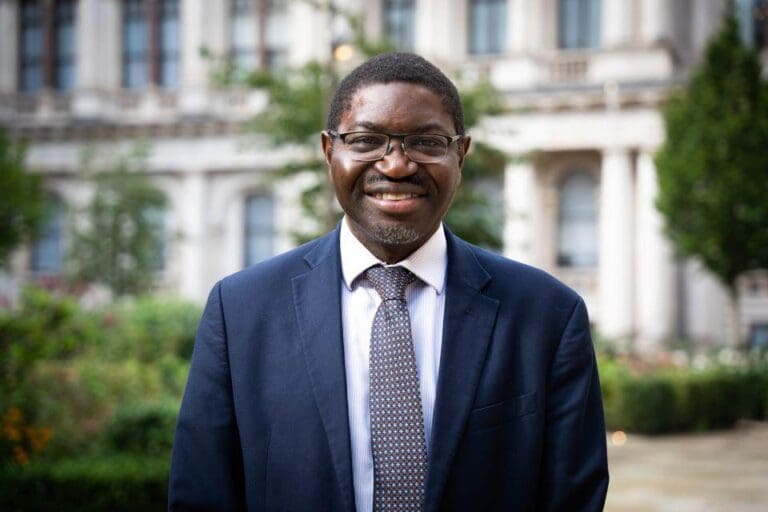
NIGERIAN-born international law scholar, Dapo Akande, a professor , has secured election as a judge of the International Court of Justice (ICJ), the United Nations’ principal judicial organ.
Akande was elected on Tuesday during concurrent voting by the UN General Assembly and Security Council at UN Headquarters, New York.
He contested as the United Kingdom’s candidate, having been nominated by its national group and supported by the British Government.
The UK Foreign, Commonwealth and Development Office confirmed his election, describing it as an important development for international justice.
“A new UK judge, Prof. Dapo Akande, has today been elected as a judge to the International Court of Justice (ICJ),” the department stated.
Akande was among four candidates who secured the required majorities in both UN organs during the first round of voting.
He reportedly received 11 votes in the 15-member Security Council, exceeding the eight votes required for election.
Nigeria’s Permanent Representative to the UN, Jimoh Ibrahim, congratulated President Bola Tinubu on Akande’s emergence.
Ibrahim described the development as another significant achievement for Nigeria’s international standing.
In a statement issued in New York, Ibrahim said securing Security Council membership remained Nigeria’s major outstanding ambition within the UN system.
He maintained that Akande’s election reinforced Nigeria’s growing diplomatic and professional influence, particularly in international law and justice.
However, ICJ judges exercise independent judicial responsibilities and do not represent their countries’ governments.
Akande will begin his nine-year tenure on February 6, 2027, joining the 15-member court headquartered in The Hague, Netherlands.
He is the Chichele Professor of Public International Law at the University of Oxford, a Fellow of All Souls College and an International Law Commission member.
Akande obtained his law degree from the then University of Ife, now Obafemi Awolowo University, in 1992 and qualified as a Nigerian barrister and solicitor in 1993.
His international career includes advising governments and organisations on international law and participating in proceedings before international courts and tribunals.
The UK Government campaigned extensively for his election, with his candidature attracting 43 nominations from national groups across UN regions.
During the General Assembly’s October 29 debate, British Justice Secretary, Alex Norris, praised Akande’s professional qualifications and independence.
“He would make a formidable contribution to its work,” Norris said while presenting Britain’s case for his election. (NAN)