Chinese-affiliated miners operating under the licences of Eso Terra Investment Limited and Majelo Global Resources Limited, plundered the country’s natural resources at Kurebe and other surrounding villages while bribing armed bandits faction of Dogo Gide. For WikkiTimes, YAKUBU MOHAMMED unearthed the dark world of terrorism funding fueling insecurity in Niger State.
Despite the presence of terror groups — Islamic State of West Africa Province (ISWAP) and the bandits’ faction of Dogo Gide — illegal mining activities continued in Kurebe and other surrounding villages, even after many residents deserted the axis following double-edged attacks from the military and terrorists.
Claiming to have acted upon intelligence, the Nigerian Air Force killed at least 14 villagers in Kurebe, including minor girls and a woman. The operations in April and August last year mistargeted the unharmed locals, leaving the terrorists unhurt.
The survivors of the military attacks fled to Udawa, a neighbouring community in Kaduna, and other places in Niger State. But the terrorists stayed back, making money from the illegal mining activities and demanding little from farmers who fell prey to them at times.
A local miner, *Yeri, believes the terrorists demanded less from their victims because they get more money from the mining activities. Two other local miners corroborated him but were afraid of speaking [in detail] about it.
Into the dark world of terrorism funding
Local miners who worked with the companies explained that there are three mining sites in the axis — one at Maikanwa, another at Santali and the other at Dagbace. One of the mined stones, Konzites, would be packaged in cement sacks and transported to Udawa, later to Lagos and finally, to China. The transportation chain was confirmed in a video obtained by Wikki Times.
On many occasions, the terrorists had seized the mined stones and stalled operations until they were bribed with millions of naira and motorcycles, the local miners revealed.
“When we finished excavating, the terrorists would not allow us to take the stones out until they were given money amounting to N5 million or more,” *Yeri disclosed.
*Yeri / Yakubu Mohammed
“The owners of the companies would be notified, and the money would be gathered for the terrorists,” he added. “It’s a recurring event; even motorcycles were taken to them. That’s the truth, but they don’t want it to be exposed, and they don’t want it to end.”
Miners dialogued with Dogo Gide’s mother
Yeri revealed how delegates were sent to dialogue with Dogo Gide’s mother at Palalli, a village where she gave birth to the kingpin about thirty years ago, WikkiTimes gathered.
“They visited Dogo Gide’s mother, and they discussed with her to talk to her son to allow people to do their work…,” he recalled. “At first, we were afraid of them, but now it has become part of us. We are no longer afraid of them. As I am talking to you now, I swear to God, even if it’s a hundred of them on the road, I will go.”
This was not the first time the terror kingpin’s mother would intercede between civilians and her terror son. She had done that many times, locals, including community leaders said. For instance, she took part in the negotiation for the release of students kidnapped from Federal Government College, Yauri in Kebbi state.
In an audio clip exclusively obtained by WikkiTimes, Ibrahim Usman Adam, one of the leading actors involved in coordinating illegal mining in the axis, confessed the dialogue with the terror kingpin’s mother before operations could begin at the sites.
Ibrahim, according to local miners, doubles as site manager for Eso Terra.
The mining company, trying to exonerate itself, stopped paying from its pocket; forcing local miners into hard labour to extract stones that would be sold to grease the terrorists’ palms.
“So the bandits were paid N3 million every week,” one of the local miners said.
When confronted with our findings on September 9, Ibrahim declined to comment. Initially, he denied affiliation with Eso Terra and Kurebe community. He would later open up when our reporter told him about the hard evidence at our disposal.
Bags of mined stones transported to Udawa, Kaduna State / Yakubu Mohammed
“I am not working with Eso Terra now. It was then,” he said, briskly, advising that further questions be channelled to government authorities.
“You can go to Shiroro and meet the chairman to ask questions about the communities. Even though my company works in Kurebe, you can not ask me,” Ibrahim yelled.
Also, Metteden Abba Abdulrahman, a director at the company, denied ever operating at Kurebe. Although the director did not deny knowing Ibrahim, he said he had never worked with him.
“I know Ibrahim as a normal person. He’s not my site manager,” Abdulrahman said over the phone.
He explained that the “self-acclaimed” site manager came to him, about three years ago, alongside one Ali Arzuka and “their Chinese” investors.
“They wanted us to partner with them, but I realised their style of mining was not up to standard,” he told WikkiTimes. “So Eso Terra has no business with bandits or the community.”
He claimed Ibrahim and the “his Chinese” used his title to gain access to the community.
“At the time, my title was about to expire, and we could not go ahead with the partnership,” he clarified.
Abdulrahman noted that there are laws guiding mining activities, and his company would not do anything at the expense of any community.
Research conducted by SBM Intelligence, a Lagos-based analytical group, revealed how Chinese companies bribed terrorist groups in some parts of the country to access mining sites.
SMB Intelligence shared its findings with The Times, a British newspaper, revealing videos of militant leaders boasting how powerful they had become that Chinese miners working in their strongholds had to pay “rent”.
“These guys are perfectly willing to pay off whoever needs to be paid off and have no qualms about it…,” Ikemesit Effiong, SBM’s head of research, had said.
A former commissioner among the syndicate?
Samaila Ibrahim Kuta, a former commissioner of youths and sports in Niger State, has been into local mining for a while, some local miners who had worked with him said.
The former commissioner, popularly known as Datti Majelo, owns Majelo Global Resources Limited, WikkiTimes can report. He had some time, last year, partnered with the other company to further plunder the resources in the community.
Samaila Ibrahim Kuta, CEO Majelo Global Resources Limited / Facebook
Unlike Eso Terra, Kuta, the local miners said, doesn’t have an excavator. “His company used dynamite to blast the rock,” said a local miner. “And that is why he joined hands with them [Eso Terra].
The partnership, according to our source, had fetched him N125 million between last year to now.
Kuta also feigned innocence when contacted. “I don’t have a licence or mining operation in Kurebe area,” he said via WhatsApp on September 10. “I can grant you an interview on this.”
When contacted a day after, he said “there is no evidence” concerning his operation in the area “because I am not working in that area and there is no evidence.”
The former commissioner admitted he had once operated in the area. “The last time we went there was before this insecurity — that was like 10 years ago,” he claimed.
Datti told WikkiTimes Eso Terra’s Ibrahim and Arzuka “were the ones operating in the area.”
Asked about his partnership with the duo, he said there was nothing like such.
“We don’t have partnership per se. What happened was that they encroached into my licence before it expired,” claimed Datti. “So I got information that they were working in my area under my licence.”
He continued: “I reported the matter to the Federal Mines Officer last year, and that was the first time I saw Ibrahim and Aruka. We met with Mine Officers in Minna and the district head of Allawa.
“The mining officer said there was no way he could confirm my claim that they were working under my license until he visited the area and he said the area is not accessible. I said it is not a place I can also go, but I remembered vividly, Ibrahim said they can visit the place.”
Kuta, however, declined to comment when further grilled about how the allegedly fetched him millions of naira within a year.
Companies defied govt order
Kurebe-Udawa border, a road leading to the mining sites/ Yakubu Mohammed
Last year, the immediate past administration of Abubakar Sani Bello suspended mining activities in three local councils — Shiroro, Munya and Kagara — prone to bandits’ attacks. But mining continues unchecked in the unsafe sites.
The suspension was in reaction to an attack on a mining site at Ajata Aboki, Gurmana ward, Shiroro LGA, where scores [including security operatives] were killed. The primed terrorists also kidnapped four Chinese workers and some civilians.
The incumbent government of Mohammed Umaru Bago reiterated the suspension, vowing to end illegal mining activities exacerbating insecurity in the state.
However, the governor and some of his cabinet members had a meeting with some of the actors including Ibrahim, Arzuka and some Chinese investors on Tuesday, September 5. While pictures from the meeting were exclusively obtained, WikkiTimes could not gather details of what was discussed.
Mohammed Umaru Bago, Niger State Governor and Ibrahim Usman Adam, one of the leading actors in the illegal mining industry
The governor and his cabinet members with some Chinese investors led by Ibrahim and Ali Arzuka
Arzuka also denied working with Eso Terra and in Kurebe. “We have a licence to go the place but it is not safe for us,” he claimed. But he confirmed his affiliation with a Chinese mining company: Ming Xin Mineral Separation Nigeria Ltdincorporated in Jos South LGA, Plateau State.
But his words were not true, WikkiTimes understands. Sometime in July last year, Arzuka represented Eso Terra in a meeting attended by youths and community leaders from Kurebe village.
In the centre: The governor and Arzuka shaking hands
The meeting, according to youth and community leaders, was held at Aske Hotel along Neteco Road, Tunga in Minna, Niger State. At the meeting, issues of signing a community development agreement were discussed. But the things agreed upon — construction of school, road and borehole — were frustrated by worsening insecurity, Shehu Yahaya, a Kurebe monarch whose jurisdiction covers the mining sites, said.
State ministry worried
Adamu Garba Musa, Director of Mining in the Niger State Ministry of Solid and Mineral Resources, said the ministry is baffled by the fact that mining activities thrive in such an unsafe setting.
“We heard of Eso Terra through the chairman of Kurebe youth association,” he told WikkiTimes by phone. He believes the company seemed to have obtained a title from the federal government and refused to show its presence to the state ministry.
“We forwarded the petition [written by the youth association] to the Federal Mining office in Minna [Niger State capital] to give us information about those companies. Up to now, they haven’t told us anything,” he explained.
The director said his ministry had invited the mining companies three weeks ago, but they “refused to show up.”
“We don’t even know they have an agreement with bandits,” Musa said in reaction to our findings. “We also ask that question: If bandits are disturbing people, how come the company is working successfully?”
Asked what action the ministry will take regarding what we unearthed, Musa said: “We will just make a recommendation to the necessary authority… to tell them this is what is happening. That the mining company they gave a title is working hand in hand with bandits.”
Further checks show that Eso Terra and Majelo Global Resources Limited Global Services were accredited by the federal government, data pulled from the Nigeria Mining Cadastre Office (NMCO), revealed.
The data confirmed the presence of the companies in Shiroro LGA. NMCO is a body responsible for the administration and management of mineral titles under the Federal Ministry of Mines and Steel Development.
Daniel Garba Gadzama, the Federal Mines Officer (FMO) at the Federal Ministry of Mineral Resources in Niger State explained he knows the companies but did not know they were operating.
“They came to me about two years ago with a licence and I gave them a commencement letter, but I don’t know the way they were operating as you told me now,” Gadzama explained, adding the area the miners were operating is “not secure.”
The FMO said he would share our findings with his director in Abuja.
A staffer at the Federal Ministry of Mineral Resources who spoke to WikkiTimes in confidence said Eso Terra did not have even a file in the office.
Yahaya, the monarch, said he was not aware the mining company was bribing terrorists. Yet, he confirmed its presence in the banditry-torn community.
The monarch begged the government to end the insecurity ravaging his community.
Umar Ango, the Chairman of Kurebe Youth Development Association (KUYUDA) corroborated the monarch. “I don’t know whether the company bribes the terrorists, but we know they are illegally operating in our community and we are not benefitting anything,” he said, noting the youth association has reported and petitioned the companies.
In a WhatsApp chat with WikkiTimes, the governor said his administration would investigate our findings.
“Thank you very much, we’ll investigate this report accordingly,” he wrote. “We’re already ahead in combating all mining activities in the state. In a short time from now, you’ll feel our impact, Insha Allah.”
Names with asterisks were altered and concealed for security reasons.
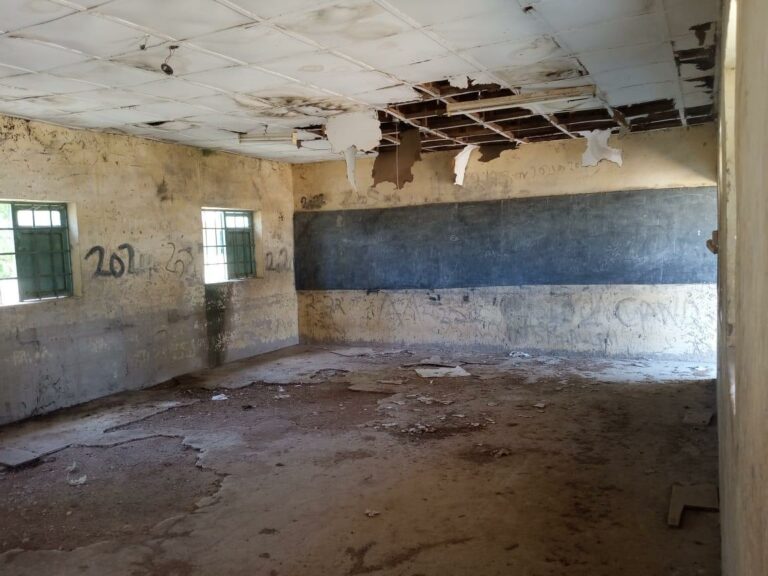
MANY rural schools in Kano state face dire conditions, with crumbling structures and inadequate furniture. However, this is not the only concern. The lives of the students are equally at risk due to the absence of perimeter fencing. Added to these concerns are the risk of kidnapping and a spike in the incidence of sexual assault, particularly on female students.
In dealing with these challenges, the state government initiated projects to build sturdy fencing and renovate classrooms and other measures in schools in the state. Among these projects, through the ministries of education and works and infrastructure, the government approved the construction of new classroom blocks and renovation of existing classrooms in Dawakin Tofa, Dambatta, Albasu, Nasarawa, Dawakin Kudu and Warawa local government areas in the 2020, 2021 and 2022 budget.
Contract award information obtained from the Kano state public procurement website revealed that these projects have been awarded and funds released. All the projects have been tagged as 100 per cent completed.
However, investigations revealed that some contractors have not fulfilled their tasks, leaving students in unsafe conditions, Hafsah Bello Bahara reports.
As the car came to a screeching halt, the driver barely managed to stop hitting the 10-year-old girl who dashed in front of him with no warning. She shut her eyes, frozen in fright, in the middle of the road as the driver corrected his course and sped away, spewing insults at her for being so careless. The girl was in tears as her friends led her away from the road and back into the classroom.
This time, by sheer luck, an accident was avoided but the pupils of Ganduje Nomadic Primary School will always be in danger of being in a similar situation as long as there is no fence surrounding their school.
Fatima Muhammad, a Basic 5 pupil, the worried sister of Aisha who almost got hit on the road, expressed her fears: “Aisha is my only sister. My parents will never forgive me if something happens to her. I try to keep her away from the road, but she doesn’t listen at all,” she said.
Fatima tearfully revealed that her mother was against sending young Aisha to school because of the road, but their father was convinced that, at 16, Fatima would be able to keep Aisha out of trouble. Unfortunately, her best efforts are proving inadequate.
Ganduje Nomadic primary school with no perimeter fencing and just by the roadside: Pix by Hafsat Bello Bahara
Ganduje Nomadic Primary School lies next to the highway that connects Dawakin Tofa Local Government Area, LGA, with the Metropolis. It is a fairly new, well-equipped structure in Ganduje village, a small farming community. Residents of Ganduje rely heavily on farming and cattle rearing.
The school was established to give children in the community access to quality education. However, the absence of a fence despite the school has caused parents with young children a lot of concern, thereby restricting their young children who should be enrolled in primary school from attending the school.
According to information from the 2022 Open Contract Data Standard (OCDS) of the Kano State Public Procurement site, the Ministry of Education awarded N15,660,965.17 to AD2 Integrated Technical Nigeria Limited for the construction of a perimeter wall fence around the school.
However, a spot check revealed the project has not been done. During a visit on June 13, the reporter observed the pupils playing close to the road despite the teachers’ best efforts to keep them off the road. Some members of the community rode their noisy motorcycles through the school on their way to their destination while the pupils were playing.
Ganduje Nomadic primary school with no perimeter fencing and just by the roadside: Pix by Hafsat Bello Bahara
A teacher in the school, who does not want to be named, is greatly concerned about how the lack of fencing affects the education of his young pupils.
“The children don’t pay attention while lessons are going on, they like looking at all the cars passing on the road. And that is not the only concern. Without a fence the safety of the students is at risk, they run onto the road while playing. Thank God there has never been a casualty but, still, with the state of insecurity we live in, we don’t have control over the students’ movement. Once the bell rings, some of them sneak out without permission.”
“The contractor came to measure the place and even brought some equipment. We were so happy the wall would finally be constructed but he never came back again. We don’t know what went wrong but we are still hopeful the wall will be completed someday”.
Malam Bello is a Nomad whose only child, Garba, used to be enrolled in Primary 3 at Ganduje Nomadic Primary School, but his father revealed to this reporter why he pulled him out of school.
“They came and convinced us to let our children attend school but they don’t teach them anything, I have over 50 heads of cattle to take care of and Garba is my only male child so he needs to learn the family business, but I let him go to school and then people kept telling me they saw him with his friends running around in the bush or at the motor park causing mischief. That is why I removed him from the school, if he is going to sneak around anyway, it’s better to run after the cattle”
Bello is not the only parent that expressed concern. Habibu Tukur has a tire patching business a stone’s throw away from the school. He had this to say.
“The cars and bikes that pass by are always speeding and the children are always running around by the road. I have to keep chasing them away. Just a month back, one boy was almost hit by a bus I was the one that rescued him. They really need to fence the school because children don’t listen no matter how many times you tell them not to go near the road.”
The contract award information published on the Kano public procurement site indicates the job included the construction of a perimeter wall fence, gate and gatehouse. The bill of quantity specifies that the contractor is supposed to construct a 439.60M × 300 M perimeter wall fence, an entrance gate and a gatehouse as well as fix barbed wire across the fence.
The reporter went around the entire school premises, but there was no sign of work being done; the foundation has not even been dug.
Who is the contractor responsible for the project?
A quick search on the Corporate Affairs Commission (CAC) portal and NGcheck revealed that AD2 Integrated Technical Nig Ltd was registered in November 2015, with an address at 127 Sabuwar Tukur, Opp Fatima Private School, Dutse, Jigawa state. The reporter reached out to a colleague who resides in Dutse to help locate the company at the given address, but it could not be found.
Furthermore, this reporter sent an email to the company’s email address as provided in the Kano OCDS contract award information, but the email bounced back, showing “Address not found, your message wasn’t delivered to binalinig@gmail.com, because the address couldn’t be found, or is unable to receive mail.”
Email address not found.
The company was not found at the address gotten from the CAC record.
The search revealed the directors of the company are Adamu Dalha and Dalha Abubakar. Online searches for “Engineer Adamu Dalha”, revealed a LinkedIn profile of one “Engr Adamu Dalha” as an employee of the Jigawa State Ministry of Works and Transport.
Further research online showed that there is a previous corruption allegation against the director of AD2 integrated technical services for procurement fraud and direct breach of the civil service law.
It was established that “Engr Adamu Dalha” of AD2 Integrated Technical Services is the same man employed by the Jigawa State Ministry of Works and Transport. Therefore, he is in direct breach of the Fifth Schedule, Section 2 (b) of the 1999 Constitution of the Federal Republic of Nigeria which provides that “without prejudice to the generality of the foregoing paragraph, a public officer shall not, except where he is NOT employed on full-time basis engage or participate in the management or running of any private business, profession or trade, but nothing in this sub-paragraph shall prevent a public officer from engaging in farming.”
The reporter secured Dalha’s phone number from the registration information provided by the National Institution of Civil Engineers. Dalha eventually reached out to the reporter following a series of phone calls and message seeking information. He affirmed he is, indeed, the director of AD2 Integrated Technical Services and when asked about why the contract awarded to his company by the Kano State Ministry of Works, Housing and Transport was not executed, he said he could not help the reporter.
“I am not in the best position to speak on this issue, one of my staff handled the contract directly and he will give you all the information you need,” Dalha said.
He later sent the contact information of one Muhammad Tahir, who explained that the school had called him after the reporter visited to inform him that questions were being asked about the contract. He claimed that work subsequently started on the project and sent pictures to the reporter as proof. When asked why the project was delayed, he said the government did not release the funds for the project on time. The reporter requested evidence of payment, but he has failed to provide it as of the time of filing this report.
Apparently, the contractor had rushed to the site to commence work on the project after being told that a journalist had come around asking questions.
How contract was awarded to non-existent contractor:
A similar situation presented itself in Government Secondary School, GSS, Dambatta, where the Kano State government in 2022 awarded a contract for the renovation of classrooms, construction of additional blocks and supply of students’ furniture to Madatai Enterprises at the sum of N32,062,835.42. However, the project was not executed.
GSS Dambatta serves over 3,000 students for both day and boarding sessions. As such, the non-execution of this project affects the education and well-being of a vast student body.
Based on the bill of quantity obtained from the Kano state public procurement site, the project involved “renovation of Block A&B, renovation of 4 classrooms and library, complete admin block, construction of 6-seater toilet, renovation of a 2-seater toilet, as well as supply of 120 pieces of 3-seater student furniture. All ceilings are to be changed, fix all doors and windows and add all necessary fittings, fix tile floors, replace damaged hardwood, fix all electric fixtures and paint the blocks.”
Jabiru Muhammad Lawan is a product of this school and currently teaches at his alma mater, and he expressed concern about the deplorable condition of the school.
“We have a serious shortage of benches in this school, most of them are broken, and our ceiling is in a tatter, you will be teaching in class and birds will burst out and start flying over your head. How can you expect students to learn in this condition,” he said.
When asked if any renovation has been done recently, Jabiru Muhammad said, “the last renovation done in this school was in 2018. The furniture and painting you see today was done by our old students’ association, they always help us out when we need it.”
He appealed to the government to ensure this project is completed so the students can learn comfortably like their peers who attend private schools.
The reporter observed that the doors and windows in most of the classrooms are broken, and the walls are crumbling. However, for the students of GSS Dambatta, this is not the only concern.
GSS Dambatta PC; Hafsat Bello Bahara
Shu’aibu Hussaini, a SS2 student, spoke of other concerns.
“When it rains, water leaks from the ceiling and drenches us. Our lab equipment is outdated, and we need our hostel to be renovated but what worries me the most is some part of the wall has crumbled, and some people use it to enter the school at will. I don’t feel safe staying here anymore.”
Shu’aibu’s concern about safety is not unfounded, as the insecurity bedevilling this country has affected a lot of students. Some have been kidnapped, while others became casualties of the cruelty of insurgents. At a point, the Kano State government had to close down some of the schools in the outlining areas to ensure student safety.
A search of the CAC showed that Madatai Enterprises is not a registered entity and is ineligible for contract awards under the law.
Matadai Enterprise not found on CAC record
The award of a contract to Madatai Enterprises, a non-existent contracting company, contravenes Sections 417–424 of the Companies and Allied Matters Act, 2020, which state that “every company must make and deliver their annual returns to the CAC every year”.
It also contravenes Section 16 of the Public Procurement Act 2007. Section 16 Subsection 6(d) states: “All bidders, in addition to requirements contained in any solicitation documents, shall have fulfilled all their obligations to pay taxes, pensions, and social security contributions.
Also, the contract awarding agency contravened Section 31 (4d), of the Kano Public Procurement Law, KPPL, which stipulates that a tender would be rejected if “the bidder is in arrears regarding payment of due taxes, charges, pensions, or social insurance contributions, unless such bidder has obtained a lawful permit with respect to the allowance or difference of such outstanding payments in instalments.”
The sordid tale continues in GGSS Yar gaya
The Government Girls Secondary School, GGSS, Yar gaya, Dawakin Kudu Local Government Area, which was established 30 years ago, serves over 2,000 students. Yet they grapple with inadequate classrooms.
The school had to be divided into morning and afternoon sessions to accommodate the needs of the students as some classrooms are uninhabitable.
The Kano State government awarded the renovation of the other classes to Brixcom Engineering and Consultancy Services in 2019. The date of completion of the project was set at March 30, 2020, yet, more than three years later, the renovation is yet to be completed. A check on the June 21, 2023 revealed the classes in disrepair, with broken windows and a dilapidated ceilings.
During a visit to the school, this reporter observed an abandoned and incomplete structure. The two-classroom block have not reached the lintel level, so the students are not able to use it for learning. The construction of the classrooms was part of a constituency project that started in 2008 during the Ibrahim Shekarau administration that was abandoned, leaving the structure at the mercy of the elements.
Only a single block of classrooms seemed to be in good condition, while the rest were in disrepair, exposing students to poor learning conditions.
The blocks of classrooms abandoned. Photo: Hafsat Bello Bahara
GSS Yar gaya; PC Hafsat Bello Bahara
Danjuma Ishaq, a product of GSS Yar Gaya decided to come back and teach after he earned his degree but he laments how the quality of education is declining in the school due to an inadequate number of classrooms.
“We had to divide the school into batches because we don’t have enough classes, the ones we are managing are getting worse by the day, but these learning hours are not enough for our students to get the proper education they deserve.”
“There hasn’t been a government project done in this school in all the years I’ve worked here. In 2022 Agile Project helped us renovate three blocks and the principal office but the other blocks are in deplorable condition. The roof is about to cave in, and I fear for the safety of the students.”
The newly renovated classes gleamed with a fresh coat of paint in the early morning sun, a sad contrast to the dilapidated block of classrooms next to it. Many students expressed an interest in studying in the newly renovated classes but sadly not all of them were opportune to learn in the fresh-smelling fully furnished classroom.
The lack of a conducive environment has caused some of the students to stop coming to school. Some of the students this reporter interacted with said that their number keeps dwindling, especially during the afternoon sessions as some of their classmates choose to use their time playing football on the streets rather than come to school, while others cited the time clashes with Islamiyya (Islamic education school) that predominantly holds in the evenings in Kano state as the reason they do not come to school regularly.
Ahmad Jamilu is one of the students whose attendance has worsened ever since the two-shift system was initiated. He told this reporter, “My Islamiyya operates Monday to Wednesday and my parents will never let me miss it. So, I only come to school on Thursday and Friday. I copy notes from my friends, and I do the homework I miss but I am always left behind. I used to be one of the first twenty after exams but in my last results I was the 36th position.”
The situation is even worse in Government Girls Arabic Secondary School (GGASS), Albasu, where there were over 2,000 students but due to the closure of some boarding schools by the Kano State government in 2021 as a result of insecurity, only about 200 students were in attendance when the reporter visited.
This reporter observed that the classrooms are crumbling, there are cracks on the walls, the roof has caved in, and the floor is in tatters.
The state of classroom at Government Girls Arabic Secondary School (GGASS), Albasu: Photo Hafsat Bello Bahara.
Yusuf Idris Muhammad, the Vice Principal of the school, said that no renovation has been done in the school other than a single block of classrooms that was renovated by AGILE Project. He said the school fell into further disrepair when it was shut down due to insecurity but when the school was reopened for the use of the students who are indigenes of Albasu local government, they found it difficult to cope because no repairs were done to make this school habitable.
“We are not able to use some of the classrooms because they are uninhabitable and infested by birds and rodents, there are no benches for the students to sit on, and all our lab material for practical have gone bad and we can’t use them anymore.“
Currently, only SS2 and SS3 classes run in the school, which is a critical stage in the secondary school system because of WAEC and JAMB examinations. But with no proper lab equipment and poor condition of infrastructure, the students are not getting the education they deserve.
Muhammad appealed to the government to reopen the school completely so students in the community could get back to school.
“Right now, students in the junior section have to travel far to the neighbouring communities to study, but if the government renovates and reopens the school, we can save their future because with the economic hardship some parents can’t afford to give their children transport for the long journey to Panda to attend school.
The renovation of this school was awarded to Brixcom Engineering and Consultancy services in 2019; however, the project was not done.
How contractor abandoned project halfway
It is not only in GGASS Albasu that Brixcom Engineering and Consultancy services failed to deliver a project. The same fate has been suffered by GSS Kawaji in Nasarawa Local Government. The school is in one of the urban local governments in the state, serving students from Kawaji, Dakata and Bridget.
The renovation of a block of classrooms in GSS Kawaji was captured by the Kano state government in 2019 through the Ministry of Education. However, a spot check revealed the project has been abandoned halfway.
The principal and teachers at the school refused to speak to the reporter regarding the project. However, the principal who refused to give his name, revealed that the renovation began during his tenure in 2020, but it abruptly stopped due to the COVID-19 lockdown and was never resumed.
This reporter observed that the renovations done already need an update three years later, the aluminium roofing sheets fixed on the classes are contorted due to heavy wind and the ceilings in the classrooms have holes in them.
Maryam Lawal is a building and contracting expert. When shown pictures of the current state of the classrooms she said she could not “determine if the contractor did a shoddy job or not without seeing the bill of quantity.”
She continued, “However, I can say there is clear evidence of poor workmanship in this renovation. It looks to me like the contractor just painted the ceilings without changing them and, that is why there are holes already but to be fair this might be due to lack of enough funds. Most contractors, especially those that do government contracts, find it hard to access the funds to do the quality work needed, so they end up having to hire inexperienced labour and use substandard materials.”
GSS Kawaji in Nasarawa Local Government.GSS Kawaji; PC Hafsat Bello Bahara
The classrooms also lacked benches, so the students have to sit on the cold, hard floor to learn. With the current rainy season, they are sometimes soaked to the bone from sitting on the wet floor which can impact on their health.
Idris Rogo, a renowned educationist from the Department of Education, Bayero University,Kano, said that “lack of proper infrastructure and conducive learning environment has a direct bearing on the performance of a child, this is why we see the mass failure of this children from rural areas in government-sanctioned exams.”
“A child will learn more when he is in a safe environment and has all the facilities he needs to succeed. If the funds dispensed by the government to fix these schools were prudently managed and the project well executed, the renovated schools would provide a conducive learning environment for thousands of pupils in these schools but the deplorable conditions of most public in the state is truly disheartening”
Status of Contractor:
The repair and renovation of GSS Yar Gaya, GSS Kawaji and GGASS Albasu was awarded to Brixcom Engineering and Consultancy services for the sum of 22,834,673.74 on 27/12/2019. The renovation was supposed to be completed in 12 weeks. According to the open contracting document obtained from the Kano state Public Procurement site, 8,474,667.94 was initially paid to the contractor at the beginning of the project out of the 22,834,673.74 budgeted for the project.
A status on the CAC portal revealed the status of the company as inactive. An inactive CAC status could mean a number of things. It could be as a result of the agency not updating a company’s status due to administrative bottlenecks. In that case, that would not be the company’s fault. But it could also mean that it has not been filing returns to CAC, which would be a breach of the law.
Awards of contracts to an inactive company contravenes the Public Procurement Law of 2007, which states that: “A bidder may have its bid or tender excluded if the bidder is in arrears regarding payment of due tax, charges, pensions or social insurance contributions unless such bidders obtain a lawful permit in respect to allowance, the difference of such outstanding payments or payment thereof in installments.”
A search revealed that Brixcom Engineering and Consultancy became a registered entity on 14th April 2016 and the shareholders are Yunusa Adamu Dangwani, a known personality who served as the chief of staff to the Kano state governor in 2011-2012 and also as the commissioner of water resources 2012-2015. Other shareholders include Sani lawan Atana and Hilal Bashir.
The secretary of Brixcom Engineering and Consultancy, Hilal Bashir, in an interview with the reporter claimed to have completed the renovations in GGASS Albasu and GSS Yar gaya, adding that the only project not completed is the renovation of GSS Kawaji, which was halted because the government refused to pay their fees.
Bashir said the current state of the schools despite completing their renovation is due to government oversight.
“When we went to do the renovation, we had specific classes we were supposed to focus on, our contract was not for the entire school so all those dilapidated classrooms you saw in the school were not done by us. The classrooms the government gave us to renovate we did it successfully as per the specifications on the bill of quantity; the main issue we had was the non-completion of payment which is why we stopped without finishing GSS Kawaji, ” he stated.
”The ministry officials came to inspect the projects when we finished and marked it completed, so I don’t know why the people at the school are claiming we didn’t do the projects.”
He speculates that since they did the project during COVID-19 lockdown period, the school was not in session so the teachers and students were not aware of when the renovation was ongoing.
Hilal showed the reporter pictures taken while the company’s staff was carrying out the renovation but when the reporter requested the bill of quantity for the projects, he claimed that years have passed and he no longer has a copy readily available.
Madari, Kano lawmaker awarded contract, claims it’s his donation
In 2019 the Kano state government under the Ministry of Works and Infrastructure awarded the contract for the construction of one block Islamiyya classroom type E in Katarkawa, Warawa LGA to Kwore Nig Ltd at the sum of N6,700,792.56.
A visit to the small village of Katarkawa revealed over 100 students crammed into two small classrooms that were constructed.
The furniture in the classes were engraved “donated by Hon Labaran Abdul Madari.”
A search for the contractor on CAC portal unearthed the beneficial owner of Kwore Nig Ltd was Labaran Abdul Madari, serving law marker representing Warawa LGA in the Kano State House of Assembly since 2007.
Madari claims to have donated the chairs despite using government funds to execute it.
Screenshot of CAC portal, Katarkawa islamiyya primary school PC; Hafsat Bello Bahara
An indigene of Warawa, Labaran Abdul Madari has held many principal positions in the State House of Assembly. He served as Chief Whip for three years. His primary responsibility was to ensure due process is followed by members of the House.
The contract was awarded to his company in 2019 when Labaran Abdul Madari was serving as the Majority Leader in the State House of Assembly, a clear violation of the Nigerian constitution that prohibits public officials from engaging in business other than farming.
There is a clear influence by the lawmaker to be awarded this contract by the Ministry of Works and Infrastructure as investigation revealed that his company Kwore Nig Ltd was awarded almost all the contracts for constituency projects carried out in Warawa LGA in 2019.
Screenshot of 2019 constituency project for Warawa LGA under ministry of works.
Clearly, both the contractor and the procuring entity’s actions contravene sections of the law; furthermore, Section 87(1) of the law provides that “any natural person who contravenes any provision of this law commits an offence and is liable on conviction to a term of imprisonment of one to five years or an option of fine from a minimum of N100,000 to N500,000 or both
When our reporter spoke to Madari on the phone, he said that he executed the project and he has no comment regarding breaching the procurement law. He would answer no further questions.
Ministry ignores FOI
A Freedom of Information Act, FOIA, request was written and sent to the ministries of Education and works and Infrastructure on June 26, 2023, seeking an explanation on the non-execution of the projects despite tagging them as completed on official documents and also to get a clear picture of how the contract was awarded to a lawmaker as well as a non-existent company.
FOI request sent out
FOI request sent out
The request was acknowledged, but the ministry claimed the FOIA 2011 is a federal law and has not been domesticated in Kano, therefore, they are not liable to comply with the request.
The 1999 Constitution quotes the right to education as a cardinal fundamental human right. However, according to UNICEF, Kano has over 1.5 million out-of-school children; this is a result of lack of access to quality education, especially in rural areas.
There are over 1,000 students in these schools whose future is in jeopardy due to the inability of these companies to complete these projects and the lack of proper oversight by the supervising ministries.
This report republished from Premier Radio is supported by the John D. and Catherine T. MacArthur Foundation and the International Centre for Investigative Reporting (ICIR).
THE World Medical Association’s President, Osahon Enabulele, has bemoaned inadequate doctors in Nigeria, which arises from brain drain.
Speaking as a guest speaker at a public lecture organised by the Federated Chapel of the Edo Council of the Nigeria Union of Journalists (NUJ) in Benin City, Edo state capital, on Thursday, September 28, the former president of the Nigeria Medical Association (NMA) said Nigeria had fewer than 100,000 registered doctors, out of which he said 50,000 practised in Nigeria.
He noted that for Nigeria to meet the World Health Organisation’s standard of doctors to patients ratio, the country must employ not less than 250,000 medical doctors.
“The present situation, by international standards, a doctor should be assigned to less than 600 patients, but in Nigeria’s case, a doctor attends to over 3,000. So Nigeria needs over 250,000 doctors to cope with the current reality.”
“There are less than 100,000 registered doctors in Nigeria. Let’s say it is 98,000 doctors. According to the last update, out of these 98,000, only 50,000 are practising in Nigeria.”
According to him, the remaining doctors have migrated to practise outside the nation due to the poor remuneration, adding that some left the profession.
Enabulele further listed various challenges confronting Nigeria’s health system, including insufficient funding, inadequate infrastructure, unemployment, workplace conditions, compensation, brain drain, economic issues, inflation, and inefficiencies in healthcare.
“Because of these problems, senior doctors (consultants) are moving out of Nigeria in drove because of greater remuneration,” he added.
He explained that achieving a robust healthcare system in Nigeria lies in a strong political commitment from Nigerian leaders to fulfil the Abuja Declaration, which advocates dedicating 15 per cent of the national budget to healthcare.
He therefore advocated for improved political will, empowerment of healthcare workers, enhanced working environments, acknowledgement of the value and professionalism of medical practitioners, and ensuring competitive wages to transform the health sector’s narrative.
“There is a need to establish a Health Service Commission that would better administer the health system and drive medical manpower, training, best human resource, develop plan among others,” he submitted.
The ICIR, in October 2022, reported that hundreds of health workers, including doctors and nurses, left Nigeria for greener pastures and that the country lost nearly 9,000 doctors to the United Kingdom (UK) and other countries in three years.
The Chairman of the Presidential Fiscal Policy and Tax Reforms Committee, Taiwo Oyedele, has explained why his team received N5 billion from the Federal Inland Revenue Service (FIRS).
Oyedele’s explanation was contained in a statement titled, ‘Clarification regarding the money provided by the FIRS to the Joint Tax Board to fund the activities of the Presidential Fiscal Policy and Tax Reforms Committee,’ shared on his X social media handle on Friday, September 29.
He said his committee was aware of a recent report regarding the funds transferred by the FIRS to the Joint Tax Board (JTB) for his team.
“All the expenses of the Committee are properly documented and available for audit. We collect receipts for fuel, stationeries, and virtually every Naira that we spend to the extent possible. Over N4 billion of the said funds transferred by the FIRS to the JTB for the Committee’s work is yet to be spent and very much intact in the JTB account.”
Oyedele revelation came following the statement made by the immediate past executive chairman of FIRS, Muhammad Nami, on his X handle to counter a report by TheCable, alleging that he approved N11 billion “suspicious” payments after his exit from office.
President Bola Tinubu sacked Nami and replaced him with Zacch Adedeji, who currently leads the organisation in an acting capacity.
In a series of tweets on September 28, Nami faulted the report, explaining that the FIRS indeed paid N5 billion to the Joint Tax Board to fund the activities of the presidential tax committee two months before he left office.
“For clarity, the items listed in the Cable Newspaper Report were part of the N16 billion outstanding commitments contained in our handover note,” he explained.
According to the report, Nami, after his disengagement, approved N6 billion as payments to several contractors and consultants and moved N5 billion to the account of the JTB.
Further shedding light on the N5 billion received, Oyedele assured that the Committee would be responsive, prudent and accountable with every Naira of public funds entrusted to his members.
He hinted that the Committee’s budget includes provisions for a national “Data for Tax” project, which he said the JTB had been championing for over two years.
“The project was presented to the National Economic Council in 2022 and was meant to be funded by the Federal Government and the 36 states. However, it stalled due to lack of funds. Given the importance of the project to the effective reform of our tax system, it was included in the Committee’s budget.
“Other expenses included in the Committee’s budget, which has the approval of the National Assembly, include setting up of offices for the Committee in Lagos and Abuja, payment of salaries for the full-time staff engaged by the Committee, travels and other logistics for over 70 members representing more than 40 institutions and stakeholder groups mapped to six different sub-committees, more than 30 secretariat personnel and over 40 students across the country,” Oyedele stated.
He added that the Committee’s budget covered planned stakeholder engagements with various sectors and interest groups, international engagements and the understudy of some leading tax regimes around the world for one year, being the lifespan of the Committee.
FRAUD and forgery incidents incurred by Access Holdings Plc stood at N5.46 billion, the company’s interim consolidated and separate financial statements for June 30, 2023, have shown.
Findings by The ICIR revealed that the bank’s loss to fraudsters rose by 354.22 per cent, relative to N1.20 billion loss in the corresponding period of last year.
Analysis of the report showed that an N5.459 billion loss resulted from fraudulent transfers/withdrawals/reactivation of customers’ accounts compared to an N4.53 million loss from cash theft/suppression/pilferage/dry posting.
A summation of attempted fraud and forgeries was worth N6.44 billion in incidents as the bank narrowly foiled N975.89 million in unsuccessful attempts.
At the same time, the frequency of the cracks and successful losses resulted in about 3,061 times.
Access Holdings, one of the tier-one banks with the biggest asset of N20.85 trillion as of June 2023, stated, “This report represents the fraud and forgery incidents that occurred during the period. It is a summation of attempted and successful fraud incidents.
“The actual loss that was incurred by the bank for the period is N5.46 billion (June 2022: N1.2 billion). The rest of the loss amount represents the losses incurred by other third parties.”
Compared to the first half of 2022, Access Holdings lost N1.20 billion and recorded fraud cases worth N10.199 billion, of which 7,104 were successful while 3,602 were unsuccessful attempts.
The ICIR reports that the safety of customers’ funds in the banks is becoming a concern as the Central Bank craves financial inclusion and a cashless policy.
The Financial Institutions Training Centre (FITC), an innovation-led and technology-driven organisation, in its latest data, ‘Reports on Frauds and Forgeries in Nigerian Banks,’ revealed a significant increase in the total amount involved in fraud cases during the second quarter (Q2) of this year compared to the previous quarter.
The data indicated that the total amount involved in fraud cases rose from N2.59 billion in Q1 2023 to N9.75 billion in Q2, representing a 276.98 per cent increase.
While there was a 6.40 per cent decrease in outsider involvement in fraud cases to 11,561 cases, banks’ staff involvement in fraud increased by 22.22 per cent, rising from 72 cases in Q1 to 88 cases in Q2.
Considering the rise in the total amount involved in fraud cases and the amount lost, FITC recommended that Nigerian banks strengthen their security protocols and systems to prevent unauthorised access to customers’ accounts and sensitive information.
“This may involve incorporating measures such as multi-factor authentication, implementing strong encryption techniques, and ensuring regular security updates are in place.
“Also ensuring that there is stability in the cybersecurity units while also equipping the unit members with relevant cybersecurity trainings that helps to mitigate, control and reduce fraud cases,” it advised.
THE FactCheckHub – the International Centre for Investigative Reporting (ICIR) verification platform calls for applications from suitable and highly creative software developers and web designers.
The opportunity requires them to design, develop and deploy a modern, user-friendly interactive website in addition to a Google Play store and Apple Store-ready mobile app.
This is a consultancy role, not a full-time job offer.
The website and mobile app aim to provide a platform for fact-checking articles, geo-location verification, forum discussions, claim submissions, a learning management system, etc.
Also, the FactCheckHub Website and Mobile application will cater to registered and non-registered users, offering different functionalities.
The deadline for the submission of application is October 12, 2023. Interested individuals can apply here
THE Sports Minister, John Enoh, is intervening in the crisis involving Nigerian International striker Victor Oshimen who plays for Italian Serie A champions Napoli.
Apart from the player, the minister also promised to look into the challenges of other Nigerian athletes plying their trades locally and internationally.
The minister made this known via his ‘X’ account against the backdrop of the trials faced by Osimhen and Tobi Amusan.
Oshimen has been in the eye of the storm at his club after expressing displeasure at being taken off by coach Rudy Garcia in the 0-0 draw with Bologna last weekend.
After the match, a video mocking the striker for missing a penalty in that game was published on the club’s TikTok account, which sparked outrage on social media.
On Tuesday, the striker’s agent threatened Napoli with legal action for publishing such a video. But despite the controversy, Oshimen scored his fourth goal of the season during their last match on Wednesday.
Before the Wednesday match, the striker had deleted all pictures linking him with the club on his Instagram page.
The Sports Minister said on his X account in a statement titled: A Rally for Victor Osimhen and All Nigerian Athletes, assured to wield power through his office to avoid injustice to the player and others.
“Over the past weekend, the news coming out of Napoli concerning Super Eagles player -Victor Osimhen saddened me greatly. The travails of Tobi Amusan have been no less so—the reason I made efforts to reach her directly last week.
“My office is trying to reach Victor Osimhen directly as well to understand first-hand the issues. We are committed to establishing the facts of the matter. Under the present administration of President Bola Ahmed Tinubu, we are committed to ensuring our sportsmen and women are accorded the respect they deserve and are not exposed to any injustice,” he tweeted.
Meanwhile, the club in a statement, had earlier noted that the now-deleted TikTok post was not meant to make fun of Osimhen.
Napoli reacts to the video
The statement reads, “To avoid any potential exploitation of the matter, SSC Napoli would like to explicitly state that the club never intended to offend or make fun of Victor Osimhen, who is an asset to the club.
“Over the course of the summer, Napoli rejected all offers to sign the striker – firm proof of the club’s appreciation of him.
“On social media and TikTok particularly, expressive language is used in a light-hearted and playful manner. In this case, involving Victor. There was no intention of mockery or derision.”
THE Association of Bureaux de Change Operators of Nigeria (ABCON) is seeking friendly policies to guarantee its members’ operation in the foreign exchange market, as the Federal government wants Bureaux de Change (BDC) trimmed to 200.
The request followed the call on the Central Bank of Nigeria (CBN) to trim down the number of BDC operators in the country from over 5,000 to about 200, thereby reducing their number by 96 per cent.
“As a self-regulatory organisation, we urge the regulators to use friendly policies that will ensure the inclusion of our operators in the sector.
“The present operators over time have acquired the necessary skills and knowledge on the operations of bureau de change and therefore have an effective pass through effect of the apex bank foreign exchange policies in the economy,” Gwadabe told The ICIR on Thursday, September 28.
At an economic policy event organised by the Abuja Chamber of Commerce and Industry on Tuesday, September 26, the special adviser to President Bola Tinubu on Economic Affairs, Tope Fasua, urged the CBN to consider reducing the number of BDC operators.
Fasua asserted that the high number of BDC operators made it difficult for the CBN to supervise the operators, leading to irregularities in the foreign exchange market.
He stressed that the BDCs needed to be structurally reformed to strengthen the sector, noting that it was not normal for the regulators to manage over 5,000 BDCs selling money on the streets.
“We cannot manage 5,000 BDCs. Maybe we should be looking at 100 or 200. In the United Kingdom, as a tourism destination, they had 145 BDCs the last time I checked. In the UAE, they have 130.
“So what are we doing with 5,000 BDCs? You will never be able to supervise them. How many staff would you need to look at their returns and check them? Therefore, you need large and well-established BDCs, as well as banks, to be able to fulfil the needs of the people. And then the government can be able to incentivise that market,” Fasua said.
He maintained that the foreign exchange market should be defined to achieve stability in the official market.
The naira has been depreciating sharply against the United States dollar in recent months, creating arbitrage as the gap between the official and black (parallel) market widens.
For instance, the exchange rate, which was about N462 to $1 in June, has risen to N775.31/$1 and N1,000/$1 at the official and black market rates, respectively, as of Thursday, September 28.
In a statement on September 10, the ABCON president said there was no doubt the exchange rate volatility had continued to underpin the slow economic growth of Nigeria in the past years.
He had requested the apex bank to grant BDC operators autonomy to be digitalised in line with CBN’s recent reforms.
In a later statement on Thursday, September 14, Gwadabe sought the merger of several BDC operators rather than recapitalisation of the industry.
He asserted that the recommendation was to effectively help its corporate governance and rules of engagement with the apex bank.
He pointed out that the merger option was adopted for class ‘A’ BDCs in 2007/2008, which entitled the operators to a $1 million weekly allocation with a N500 million capital base.
Gwadabe further called for a similar business model through mergers and consolidation rather than an outright review of the capital base of each operator.
He noted that each of the CBN-licensed BDCs was capitalised to the tune of N35 million and should be allowed to consolidate willingly, maintaining that the group never asked for upward review of the mandatory regulatory capital base, but a merger of at least 10 BDCs to form new capital of N350m.
Gwadabe referenced the merger of commercial banks in the 2004 consolidation exercise as an example the apex bank could adopt for the BDCs to streamline their numbers and present easily manageable operators for maximum impact in the foreign exchange market.
“ABCON rejects reports calling for BDCs recapitalisation by a section of the media. The media quoted us out of context, and we are working to put a proper narrative,” he stated.
Meanwhile, the newly confirmed CBN governor, Olayemi Cardoso and his-led team of deputy governors have promised to immediately prioritise clearing the about $10 billion foreign exchange backlog CBN CBN-owned banks.
“We need to promptly find a way to take care of that. It would be naive for us to expect that we’ll be making too much progress if we’re not able to handle that side of the foreign exchange market.
“Right now, we have a situation where we are aware that there are unsettled obligations by the CBN. Whether it is $4 billion, $5 billion or $7 billion, I don’t know, but definitely, the immediate priority will be to verify the authenticity and extent of what is owed,” he said on Tuesday, September 26, during the screening session of the governors by the Senate.
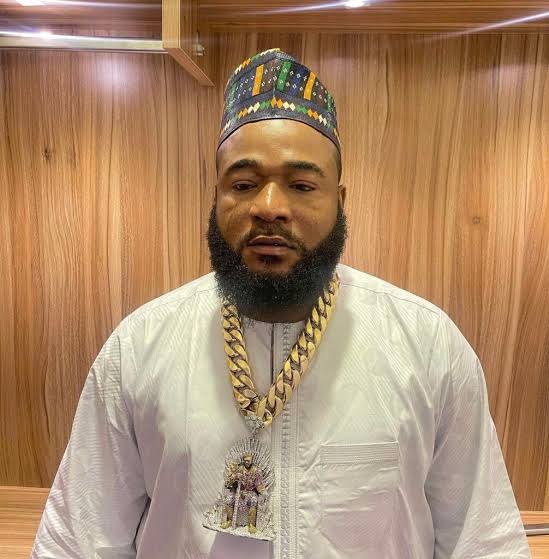
THE Lagos State Police Command has arrested a music promoter, Balogun Olamilekan Eletu known as Sam Larry, over the death of Nigerian singer Ilerioluwa Aloba (Mohbad).
This was disclosed by the State Command Police public relations officer Benjamin Hundeyin on his X (formerly Twitter) page.
“Balogun Olamilekan Eletu aka Sam Larry is now in our custody. He is currently assisting with the ongoing investigation,” he wrote.
According to reports, Sam Larry was immediately arrested after he arrived in Nigeria from Nairobi, Kenya at about 10 p.m. Nigerian time.
He was picked up at the Murtala Muhammad Airport by some officers at the command headquarters.
Sam Larry arrived at the headquarters around 10:30 p.m. and was subsequently taken to meet the commissioner of Police. After being questioned, he was handed over to DC Panti.
The arrest by the police came a few days after the Police had invited him and his ally, Azeez Fashola, popularly known as Naira Marley.
The late Mohbad was formerly affiliated with Naira Marley’s record label, Marlian Music, from which he departed in October 2022.
The death of MohBad has sparked public outrage, with many Nigerians pointing hands at Naira Marley and Sam Larry. Beyond that, there were several videos where the late singer was assaulted by people allegedly associated with Marley’s record label.
In another viral video, the deceased also claimed that Naira Marley should be held accountable should he die.
Naira Marley has consistently denied this. In a video posted on Reno Omokri’s Instagram page, Naira Marley converses with the late Mohbad in the Yoruba language.
“You said you are not feeling so anymore, but one hour ago, you felt like killing yourself, and you still surround yourself with the things stressing you. The last time you made a video saying if anything happens to you, Naira Marley and the Marlian team should be held responsible, but now you want to kill yourself,” Naira Marley said in the video.
Replying to his former boss, Mohbad was heard saying: “I don’t feel like that again. I don’t even know how to explain to you right now.”
Naira Marley continued, “But one hour ago, you said you felt like killing yourself. If you kill yourself, what do you think people will say after you’ve made such videos, saying they should hold me responsible for your death?”
Mohbad concluded with, “Please don’t be angry.”
Also, the embattled singer, in an interview with Reno Omokri, reiterated that he played no part in Mohnad’s death, adding that the deceased had been dealing with some issues for a long time.
He also explained that he provided professional assistance to Mohbad after being aware of his mental condition and paid for his scans.
He said: “I have been abroad since August, and I’m willing to return to Nigeria if only the government can guarantee my safety, as a lot of Nigerians are currently furious at me.”
THE African Centre for Media and Information Literacy (AFRICMIL) has urged the Nigerian anti-graft agencies to thoroughly investigate the allegations by the impeached chairman of Ijebu East Local Government Area, Adewale Adebayo against Ogun State Governor Dapo Abiodun.
The Centre also asked the governor to stop ‘persecuting’ the embattled former chairman.
In a statement signed by its project manager, Godwin Onyeacholem, on Wednesday, September 27, AFRICMIL urged the Economic and Financial Crimes Commission (EFCC) and the Independent Corrupt Practices and Other Related Offences Commission (ICPC) to investigate Adebayo’s allegations.
Adedayo was impeached on September 15 by his council councillors over allegations of financial misappropriation and diversion of council funds, among others levelled against him.
Announcing his impeachment, the LGA’s legislative council leader, Fasheyi Akindele, said the “suspended chairman owned up before the full House of 11 councillors that he diverted federal allocations sent to the council by the state government and used them for purposes other than what the state government approved.
“Adedayo also agreed that he spent the council funds till August 2023, even when the budget was yet to be approved, whereas the law only allows him to spend till March 2023.”
He also listed a few other infractions against the embattled chairman.
The councillors had first suspended the chairman for three months, citing alleged maladministration and financial malpractices. The suspension followed the chairman’s letter to a former governor, accusing the current governor of misappropriating N10.8 billion for local development and lodging a petition with anti-graft agencies.
Meanwhile, the embattled council chair has since been arraigned before an Ogun State Magistrates’ Court in Isabo, Abeokuta.
He was arraigned on two counts bordering on false allegations and willful intent to damage Abiodun’s reputation.
Although he had pleaded not guilty, the police told the court that Adedayo acted in violation of sections 59(1) and 375 of the Criminal Code Laws of Ogun State, 2006.
AFRICMIL’s coordinator, Chido Onumah, said it was inappropriate for the governor to punish Adedayo merely for demanding transparency and accountability in local government funds.
Onumah emphasized that the sacked council chairman should not face current penalties, arguing further that he committed no offence other than exercising his freedom of expression.
“AFRICMIL, which is in the forefront of promoting whistleblowing as a vital tool for addressing corrupt practices and other forms of wrongdoing, described Adedayo’s action as legitimate whistleblowing which Nigeria sorely needs at this time. The organization observed that it was ‘immoral and unlawful’ for the governor to deploy a strategy of intimidation to stop the whistleblower from speaking out against wrongdoing at the top level of governance.
“Following the furore that trailed the whistleblower’s allegations, he was first suspended for three months as chairman of Ijebu East Local Government Area and then impeached even when the suspension had barely kicked off. Days after vowing that Adedayo would pay for ‘making false allegations’ against him, the governor made good his threat by getting the police to arraign the whistleblower. “We are not unmindful of the fact that all of this is part of the intimidation to completely silence the whistleblower,” the statement added.
The organisation, however, urged the governor to stop any additional ‘retaliation’ against the whistleblower promptly.
It also called for his immediate reinstatement as the LGA chairman and the withdrawal of the court case filed against him.
The organisation reiterated its commitment to demand justice for all whistleblowers facing adverse actions for exposing wrongdoing in the country, adding that “whistleblowing is freedom of expression that must be protected.”