Home Blog Page 807

Celebrating culture and couture: Highlights from African bridal fashion week

0

THE climax maiden edition of the African  Bridal Fashion Week (ABFW), was held on Sunday, August 27, in Abuja.

The three-day event started Friday, August 25 and had the theme ‘Afrocentric Edition’, which focused on exploring and promoting African bridal fashion cultures and brands.  

During the fashion runway show on the last day, Sunday, August 27, the convener, Famous Isaacs, said, “as an Afrocentric bridal fashion, this maiden edition featured designers who understood contemporary fashion and how it translates and relates to African bridal lifestyle. So, it’s a blend of the cultural and the contemporary.”

The first two days of the programme featured a masterclass and panel sessions around the bridal fashion industry. The masterclass centred around “the business law of fashion” while featuring fashion industry experts discussing various topics such as Modeling as a Business, Personal Branding, Marketing and Sales as Tools for Success.

It also had an African bridal exhibition, which saw different vendors display an array of African cultural and bridal attires. This is in addition to a bridal styling competition.

The panel discussion revolved around wedding events navigating the challenges of meeting clients’ needs the role of the media in the advancement of the African Fashion industry.

African Bridal Fashion Show

Speaking with The ICIR, the event’s convener Isaacs explained that the purpose of the event was to promote African culture through bridal fashion.

He said, “The inspiration behind ABFW is actually a desire to cause a change in the way fashion shows are organised and run. African Bridal Fashion Week was started to serve as a platform for the global promotion of African bridal fashion cultures, the people and brands behind it”.

“African culture is mostly not documented even in 2023. ABFW is that platform that people turn to when they want to learn more about African culture-particularly African bridal fashion cultures because fashion is quite the go-to way to understand people’s cultures.

He added that “African Bridal Fashion has come a long way, based on the collections displayed and will gain global acceptance to the level in that other cultures will adopt the designs, styling, and even fabrics used in the making of the fashion pieces”. 

One of the designers, Mendie Funmilayo of Sparkle by Cahmen Couture told The ICIR when creating bridal pieces, she starts by gathering inspiration from historical research, ethnicity, fabric choices, body shapes and the preferences of the clients so as to strike a balance between tradition and innovation in her designs.

“Ethnicity plays a big role in determining the creative process to adopt and this informs what concept to infuse into our wedding attires. Even our creative process involves different stages. After getting the right inspiration, we balance detailing, sophistication, elegance and budget in showcasing culture and contemporary representation”, she noted.
Senate pledges to enact laws to lessen Nigeria’s rising debt burden

0

NIGERIA’S upper legislative chamber – the Senate – has pledged to make laws to reduce Nigeria’s huge rising debt burden.

This decision follows concerns of overwhelming rising debt and insufficient revenue and its corresponding negative impact on Nigeria’s economy.

The Senate further said it would come up with policies that would increase the revenue of Ministries, Departments and Agencies (MDAs) and prescribe sanctions for defaulting ministries in accordance with the Fiscal Responsibility Act.

Chairman of the Senate Committee on Finance, Sani Musa, gave the assurances in a statement he signed on August 27, 2023.

“The country is faced with dual challenges of rising debt and insufficient revenue, which demand our immediate attention. The Senate Finance Committee, under my leadership commitment, will embark on a mission to amplify our revenue streams, driving economic growth that is not only robust but also resilient through legislative means, manage our debt judiciously, exploring avenues for favourable terms and sustainable repayment simultaneously,” he said.

“The President of the Senate, His Excellency Senator Godswill Akpabio, has given the committee a marching order to, as a matter of national concern and interest, embark on serious legislative oversight of all Revenue Generating Agencies with a view to making sure all revenue incomes are deposited in the federation account, identify defaulting agencies and prescribing sanctions where necessary in line with extant legislation and also in accordance with the Fiscal Responsibility act,” he said.

Musa, the senator representing Niger East, also assured that the committee will look into increasing revenue from the mining sector and other informal sectors.

“Also, of importance, the Senate Finance Committee will seriously look at the informal sector, which constitutes about 80 per cent of the Nigerian Economy. The committee will look into empowering the informal sector with a spotlight on mining.


READ ALSO:


“The informal sector, particularly the mining industry, is a hidden gem in our revenue potential. This was corroborated by the Ministry of Mines and Steel Development (MMSD) that the solid minerals have the capacity to generate about 2-3 billion US dollars annually. We will dedicate our efforts to understanding and nurturing this sector with appropriate legislation with an emphasis on formalising artisanal and medium-scale mining activities.

“This strategic move will bring economic benefits while promoting safer and more responsible practices. We will harness and raise revenue sources from both the Blue Marine and the Creative Economies by setting targets. The committee will legislate to encourage regulations of consumption and production, facilitate enabling the environment through legislation for domestic Industries to develop and stimulate economic growth through direct foreign investments inflow,” he said.

The ICIR has earlier reported how each Nigerian owed N384,864 at the end of former President Muhammadu Buhari’s tenure as a result of lending by the Central Bank of Nigeria (CBN) to the Federal Government beyond the prescribed threshold as recommended by section 38 of the CBN Act.


Court bars ICPC, CCB, EFCC from probing chairman of Kano anti-graft agency

0

A KANO high court has barred the Independent Corrupt Practices Commission (ICPC), Economic and Financial Crimes Commission (EFCC) and Code of Conduct Bureau (CCB) from interrogating the chairman of the Kano Public Complaints and Anti-Corruption Commission (PCACC) Muhyi Rimingado.

This resulted from the anti-fraud agencies inviting the PCACC and its officials to respond to inquiries on the commission’s operations from 2011 to date.

The federal government was brought before the court by the Kano state government for what it claimed to be harassment and intimidation of the PCACC by three federal agencies.

In an ex parte order, the sitting judge, Farouk Adamu, instructed the federal agencies and their officers to stop interviewing or looking into the Kano state anti-graft agency.

The agencies were also told by the court to stop interfering with the operations of the Kano anti-graft organisation.

All parties to the case were further urged to maintain the status quo by the order with suit number N0 K/M1128/2023.

“And after hearing Mr H. I. Dederi Esq (Attorney General of Kano State) of Counsel for the Applicant, it is hereby ordered that all parties maintain status quo antebellum.

“Order is hereby included by way of Interim Injunction restraining the defendants/respondents from meddling or delving into the affairs or taking any step on, related to or in connection with the functions, duties and affairs of the plaintiffs/applicants,” the order reads.

Similarly, the judge, Adamu shortened the window of time in which the Defendants might submit and serve their separate court documents to expedite the case’s hearing.

The Kano State Attorney General, the Kano State Public Complaints and Anti-Corruption Commission, and its Chairman, Muhuyi Magaji Rimingado, are the plaintiffs in the lawsuit. At the same time, the respondents are the ICPC, CCB, and EFCC.

However, the judge postponed the case until the originating motion hearing on September 25, 2023.

Following the court’s directive, Rimingado asserted that the commission would not be deterred from carrying out its legitimate responsibilities by any amount of intimidation or smear campaign.

The ICIR reported that the PCACC summoned former governor Abdullahi Ganduje for interrogation over a contentious video where the former governor was seen accepting dollars from a contractor in 2017.

Chairman of the Commission, Rimingado, had on Wednesday, June 5, declared that, contrary to Ganduje’s claims, the video was not doctored.

Rimingado spoke at a ‘One Day Public Dialogue on Anti-Corruption Crusade’ in Kano.

In a video that went viral in 2017, Ganduje was seen receiving bundles of dollar notes offered as bribe from a contractor and stuffing them in his dress.

Rimingado claimed that since the video’s release, he has come under pressure from all sides to establish the governor’s guilt or innocence.

He explained that because Ganduje was immune from prosecution during his time in office, it had been hard to establish his guilt or innocence since the committee started looking into the issue in 2018.

Election tribunal: ‘All Eyes on the Judiciary’ The story so far…

0

THE February 25 presidential election results saw the emergence of Bola Ahmed Tinubu of the All Progressive Congress (APC) as the nation’s president.

However, the results were immediately met with scepticism and allegations of irregularities, which eventually led aggrieved parties to the Presidential Election Tribunal (PEPT) in a bid to investigate and rule on the legitimacy of the results.

The APC have maintained their stance that the election was free and fair and that the victory of Tinubu is legitimate. The Labour Party (LP) Peter Obi and People’s Democratic Party (PDP) Abubakar Atiku have expressed their doubts regarding the election’s transparency and have since sought redress through the tribunal.

Obi, refused to yield, insisting he won and vowing to reclaim his ‘mandate’. So also Atiku who rejected the results.

The months that followed the election saw a flurry of legal activities, claims, and counterclaims, which were filed on March 21, 2023. The Labour Party and the PDP approached the tribunal with their reservations about the results and requested a thorough scrutiny.

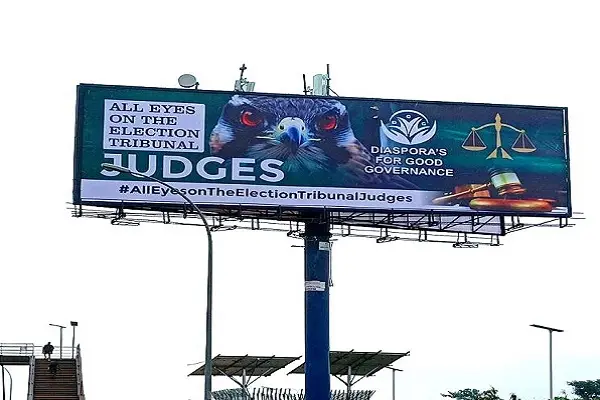
Amidst the ongoing tribunal activities, surmounted with anxiety and expectations, an online campaign which also done offline titled “All Eyes on the Judiciary” gained momentum.The slogan resonated with many citizens who believed that the judiciary’s decision in this matter would be a testament to the nation’s democratic principles.

The hashtag #AllEyesOnTheJudicairy and its different variations – All Eyes on election tribunal judges, All eyes on judiciary etc – gained momentum when the PEPT were concluding the hearing and also when it announced it would be giving the final verdict in the coming days of September.

A variation of the All eyes on the judiciary billboard.

In support of this movement is former minister Obiageli Ezekwesili, In a tweet said “I absolutely have my eyes on the Nigerian Judiciary and delighted to see many other citizens do too.

#AllEyesOnTheJudiciary is one of the best things that has happened to our Judiciary, the 3rd Arm of Government, in recent times.

“The Judiciary has a Message from Citizens, who understand the importance of their country joining the league of countries that have through uncompromising adherence to Democratic Processes, built lasting institutions required for Development.”

While the campaign was going online, people were AllEyesOnTheJudiciary erecting billboards across Nigeria. This did not go well in some quarters.

There were reports that the government was clamping down on the campaign. Advertising Standard Panel (ASP) was dissolved for approving the trending ‘All Eyes on The Judiciary’ billboards.

These billboards, titled “All Eyes on The Judiciary,” allegedly breached the ASP’s ethical guidelines” Olalekan Fadolapo, the head of the Advertising Regulatory Council of Nigeria (ARCON) stated in the statement disbanding ASP.

The statement noted that “The Advertising Standards Panel of the Council also erred in the approval of one of the concepts as the advertisement failed to vet guidelines on the following grounds.

“The advertisement is controversial and capable of instigating public unrest and breach of public peace.”

Furthermore, “The advertisement is considered blackmail against the Nigerian Judiciary, the Presidential Election Petition Tribunal, and particularly the Honourable Justices of the Tribunal who are expected to discharge their judicial functions without fear or favour over a matter that is currently jus pendis.”

ARCON also ordered the destruction of several billboards across the country with the slogan.

A variation of the All eyes on the judiciary billboard.

A Twitter – now X – user , Oladiran Alabi, agreed with ARCON and tweeted “It is nothing but pure intimidation, harassment and an attempt to stampede the judiciary.”

He added, “The judiciary cannot be blackmailed, they are men and women of integrity who will dispense justice based on fact and evidence before them.”

On their part, Intercontinental Marketing & Communication Consortium Limited – the agency that ran the campaign on behalf of their clients said they followed all the processes and got approvals before they went ahead with it.

However, more recently, the agency apologised to ARCON “We sincerely apologise for this and state that our action was not intentional,” the Managing Director, Stephen Ogboko said.

“The truth is that immediately after we received the brief for the said campaign, we sent the artwork to Mr Markus Inji Lukman, an ARCON liaison officer who has helped us vet campaign materials in the past,” he added.

However, ARCON insists that despite the apology the company will face disciplinary action the Punch reports.

ARCON boss Fodolapo also stated that president Tinubu did not order them to clampdown on the campaign.

How NBS revised unemployment figures will affect Nigeria

THE National Bureau of Statistics (NBS) has received lots of knocks from its recently released figures on unemployment, which revealed that the unemployment rate slid to 4.1 per cent in Q1 of 2023 from the previous 33.3 per cent.

The Statistician-General, Adeyemi Adeniran, who admitted changing the methodology for the report, however, said the report would likely not reflect the ‘realistic’ picture of the unemployment market in Nigeria.

There has been heightened concerns on how the methodology enabled a sharp drop in Nigeria’s unemployment figures, which some informed analysts argued enabled a huge disconnect from released figures, Nigeria’s inflation and what a living wage should represent.

“Gross domestic product GDP growth is not strong, and you have rising inflation. I say again, this number does not reflect the true picture of our present realities. We have rising inflation and slow GDP growth and unemployment rate is on the decline. It is contradictory,” said Uche Uwaleke, a professor of Capital Market at Nasarawa State University.

“The numbers would not help in making policies at the macro level. In our own case, if we use this figure to make policy decisions, we would be wrong. We need an unemployment number from the NBS that more or less approximates the situation that the government can use to make decisions.

According to Uwaleke, “If you check the National Development Plan, the government intends to reduce the unemployed rate to 19.6 per cent from 33.3 per cent by 2025. This kind of report encourages complacency for policy planners. The NBS should get another report to enable the National Assembly plan for the macroeconomic base of the economy,” he said.

He observed, however, that aligning Nigeria’s methodologies with international best practices is good, but working out a homegrown solution would create a more realistic solution to our problems.

He said,” We need to develop country-specific thresholds that help to plan with specific variables.”

A professor and research fellow with Nnamdi Azikiwe, Okey Okechukwu, expressed similar concerns and said, “It is not as if the government has done anything spectacular to reduce the number of the unemployed, rather, what you have is a new methodology. The figures are what they are today because of the change of methodology.”

A unionist and former Trade Union Congress (TUC) president, Peter Esele raised concerns with the methodology, noting that it did not reflect the country’s current situation.

“If you have an employment rate of four per cent ,it means those looking for work has the opportunity of determining how much they want to be paid.

According to Esele,”What we have in the country right now does not in any way reflect 4.1 per cent.”

He suggested to the policymakers to ensure the report is used to support 93 per cent of the large pool of informal economic entrepreneurs.

What the report says

Nigeria’s unemployment rate witnessed a dramatic drop from 33.1 cent reported in March 2021 to 4.1 per cent for the first quarter of 2023 and 5.3 per cent in the 4th quarter of 2022.

The NBS released its employment data for the first quarter of 2023, indicating a substantial improvement in the job market.

As per the newly-revised Nigeria Labour Force Survey (NLFS), which now aligns with International Labour Organisation (ILO) guidelines, the unemployment rate in the country has been reported at a promising 4.1 per cent.

The NBS methodology

New Methodology – The NBS restructuered its data collection process for the NLFS by sampling 35,520 households across Nigeria.

The new approach provides for ongoing data collection throughout the year, delivering national-level results on a quarterly basis, and state-level results annually.

While the NBS’s Q1 2023 unemployment report paints an optimistic picture of Nigeria’s job market, there are important caveats that warrant attention.

First and foremost, the new methodology—although in line with international standards—may not accurately reflect the lived experiences of many Nigerians.

The revised NLFS categorizes people engaged in menial jobs as “employed,” even if they are earning well below the minimum wage and operating under poor working conditions.

This raises questions about the quality and sustainability of such employment, and whether this truly represents an improving job market or merely a shift in classification.

BusinessDay Newspaper in its editorial of August 28, 2023 disagreed with the report, stressing that it failed to resonate with Nigeria’s current economic realities.

“But the reality of Nigeria today does not support this. Even as the NBS has now suggested unemployment in Nigeria is now comparable with developed economies like the United States, with an unemployment rate of 3.4 per cent and the United Kingdom (4.2 per cent), poverty in Nigeria plagues over 60 per cent of the population.

“The Nigeria Labour Force Survey (NLFS) puts Nigeria’s unemployment rate at 4.1 per cent in the first quarter of 2023 and 5.3 per cent in Q4 2022. This is odd for many reasons, and one of these is that the first quarter of 2023 was a chaotic period for the Nigerian economy. The cashless policy, with its unintended consequences, saw businesses shutting down and the accompanying job losses that followed.

“Economic activity slowed down in what is a largely cash-driven economy, yet the NBS suggests more jobs were created as unemployment declined in that quarter,” the editorial said.

Radio Workshop calls for podcast series pitches

RADIO Workshop, a documentary-style podcast with a youth-centric approach, is now open to receiving pitches.

The podcast seeks to present immersive, on-location audio narratives that offer listeners a firsthand perspective on the experiences of LGBTQIA+ individuals in Africa.

Pitches sought for the podcast should be compelling and personal accounts from young people, intimate stories from those with direct LGBTQIA+ experiences, or narratives that shed light on broader societal, continental, or global issues.

The opportunity is open to applicants across Africa, particularly encouraging audio producers from countries including Uganda, Senegal, Botswana, Mozambique, Nigeria, Tanzania, Ghana, Côte d’Ivoire, and Liberia.

The deadline for pitch submissions is September 15, 2023. Interested individuals can apply here

Faith lifts gold: from walking to school to setting world athletics alight

0
By Wycliffe W. Njororai Simiyu, Stephen F. Austin State University

ALL eyes were on Faith Kipyegon at the 2023 World Athletics Championships in Budapest, Hungary. That’s because the Kenyan 1,500 metre and 5,000 metre star broke three world records in less than two months on her way to Hungary, where lifted gold in the 1,500m for the third year in a row as well as winning the 5,000m event. She becomes the first woman in history to win gold over both distances at the championships.

As expected, Ethiopia, Uganda and Kenya spearheaded Africa’s hopes for medals, continuing their dominance in middle and distance running events.

Over time, Africa is earning fewer gold medals at the event, even from Kenya’s famous male distance athletes. Kipyegon, however, bucked the trend. Considered by many as the greatest female 1,500m runner in history, she is the one athlete who has been consistent for the last eight years.

As a sport scientist with a research focus on Kenyan athletics, I have followed Kipyegon’s career with interest. But who is she, what drives her and how did she manage to achieve this level of success despite taking a break from competing to start a family?

World record spree

Of the last six World Athletics Championships or Olympics dating back to 2016, the 29-year-old Kipyegon has only missed out on 1,500m gold once. That was in 2019 when the championships took place 15 months after she gave birth to her daughter.

She has comfortably won Olympic gold medals in 2016 and 2021 as well as her multiple world championship titles. She broke the 1,500m world record in June 2023 and just a week later stunned the stadium – and herself – by smashing the 5,000m world record. It was only her third race over the distance. Her season has simply been outstanding – also breaking the world record for the mile.

The 2023 World Athletics Championships cemented her legacy and single season success – which compares to other historic feats such as US stars Usain Bolt’s 2009 and Florence Griffith-Joyner’s 1988 performances.

Who is Faith Kipyegon?

The eighth of nine children, Kipyegon grew up on a farm in Ndabibit, a village in the Rift Valley province of Kenya. Like many kids educated in rural areas, she walked and jogged many miles to and from school. Little did she know that this would instil the fundamental locomotion and physical skills that would form the foundation of her athletics career. This walking is enhanced by the physical education and sports activities that children engage in while in school.

By 14, Kipyegon had tried her hand at football when, during a physical education class, she took part in her first 1km race. She finished far ahead of everyone else in class.

In the words of Kipyegon, winning that race created an awareness that she could “run fast and be a good athlete”. Just two years later, she came fourth in the World Cross Country Championships under-19 event. At 16 she was the youngest finisher in the cross country top 21. Running barefoot, she started her winning trend at a cross country event the following year and achieved 1,500m Olympic gold in 2016.

After world 1,500m titles in 2016 and 2017, Kipyegon took a break to give birth to her daughter, Alyn. She faced the conflict of many women athletes, between family and career. “I was so afraid, maybe I will not come back, I will just disappear,” she said. “I thought it was the end of my career, but it was the beginning.”

It took great mental strength to take a year off and gradually rebuild her stamina, strength and speed. In a vibrant comeback, she seems stronger than ever. Winning gold at the Tokyo Olympics and last year’s world championships made her the first woman to claim four global outdoor titles in the 1,500m, thus the greatest female mile runner ever.

Kipyegon spends five days a week training, separated from Alyn and her husband Timothy Kitum, the 2012 Olympic 800m bronze medallist, who serves in the army in Kenya. For all three of her world records, she wore a bracelet adorned with her daughter’s name and the colours of the Kenyan flag. Alyn wears a matching bracelet while doing schoolwork back home.

Well deserved victories

Her successes on the track have brought riches to her and her family. The Kenyan government has rewarded her excellent performances with cash and a house.

During a recent speech she broke into tears, saying:

Now I can buy my father a car. I promised him when I was going to break a world record that I’m going to buy a car for him. So now I can fulfil my promise.

Kipyegon’s humble background meant that her parents couldn’t watch her win gold at the 2016 Olympic Games because they didn’t even have electricity in their rural home. It is inspirational to see what her vision, focus and application have yielded over time. Her training environment at Kaptagat in Kenya also reveals her humility. She’s part of a group of 30 or so athletes who largely live together and share chores, along with marathon world record holder Eliud Kipchoge.

Kipyegon’s story is worth telling. She stands as an inspiration to countless girls back home and, indeed, a continent.

This article was updated to reflect Kipyegon’s wins at the 2023 World Athletics ChampionshipsThe Conversation

Wycliffe W. Njororai Simiyu, Professor and Chair of Kinesiology and Health Science, Stephen F. Austin State University

This article is republished from The Conversation under a Creative Commons license. Read the original article.

Four sectors slide into recession as Nigeria’s economy drops by 2.51% 

FOUR critical sectors of the Nigerian economy slid into recession as the gross domestic product (GDP) fell by 2.5 per cent year-on-year in the second quarter of the year compared to 3.54 per cent in the corresponding period in 2022.

The National Bureau of Statistics (NBS) disclosed this in its ‘Nigerian Gross Domestic Report Q2 2023’ released on Friday, August 25.

The ICIR analysis of the report showed that oil refining, crude petroleum and gas, textile and livestock sectors contracted in the first two quarters of the year (Q1 and Q2) in real terms. 

Oil refining contracted by 35.56 per cent in Q2 from 35.84 per cent in Q1; crude petroleum and gas by 13.43 per cent from 4.21 per cent; textile by 4.38 per cent from 3.68 per cent; and livestock by 2.30 from 30.57 per cent. 

The sectors have been struggling because of macroeconomic, structural and policy issues, an economist, Muda Yusuf, pointed out.  

“Growth in these sectors continued to be subdued by heightened inflationary pressures, exchange rate volatility, spiking energy cost, insecurity and the political economy of the oil and gas sector,” he further explained. 

Yusuf, the director/chief executive officer of the Centre for the Promotion of Private Enterprise (CPPE), said Nigeria’s economy was going through corrective reforms to remove some fundamental distortions and restore the economy back to the path of recovery and growth.

He said the implementation of the reforms were an arduous task.  

“The trade offs are profound and the social impact has been devastating. Given the inevitability of the reforms, the implementation calls for a delicate balancing act and strategic sequencing to ensure an inclusive economic transition. 

“Dealing with the issues of insecurity, spending priorities, corruption, productivity and competitiveness, regulatory environment and macroeconomic stability are paramount to rebuilding the momentum of economic growth and development,” Yusuf stressed.

While GDP growth improved marginally by 20 basis points compared to previous quarter, however, the economy slowed amid shocks from current economic reforms which impacted energy prices and the naira exchange rate. 

The adverse impacts of the reforms were disproportionately higher than expected, however, a rebound of the economy was expected in the medium to long term as current distortions in the economy are corrected.  

“There is an immediate positive outcome which is the marked improvement in the fiscal space of governments at all levels,” the CPPE boss asserted. 

Other sectors: road transport, coal mining, motor vehicle and assembly, music and motion pictures recorded negative growth compared to positive growth in previous quarter.

The output in the sectors contracted because of the prevailing economic and investment climate conditions, Yusuf explained. 

The report also revealed that the telecommunications and information services, air transport, crop product, wood and wood products, paper and publishing, and water transport sectors recorded lower positive growth when compared to the previous quarter.

On a positive run, quarry and minerals, financial institutions, rail transport, insurance, trade, construction, manufacturing, education, agriculture and other sectors recorded better growth performance than in previous quarter. 

A further analysis of the NBS report showed that the non-oil sector contributed 94.7 per cent to the GDP while the oil sector recorded a paltry 5.3 per cent.

In overall growth performance, the service sector continues to dominate the economy with a contribution of 58.4 per cent of GDP.

Yusuf further maintained that the structure of the Nigerian economy has continued to reflect its vulnerabilities, especially the challenges of productivity and competitiveness of the real economy.

Moreover, the Nigerian GDP fell short of the sub-Sahara projected average of 3.1 per cent for 2023; but better than projections for the Euro Zone of one per cent and the United States of 1.8 per cent. 

PSC compulsorily retires four DIGs, approves replacement

0

THE Police Service Commission (PSC) has compulsorily retired four Deputy Inspectors General of Police (DIGs), Moses Jitiboh, Dan-Mallam Mohammed, Adeyinka Adeleke, and Hafiz Inuwa.

The PSC spokesman, Ikechukwu Ani, disclosed this in a statement on Monday, August 28.

In the statement, the PSC said the retiring DIGs are seniors of the incumbent Inspector General of Police, IGP, Kayode Egbetokun.

According to Ani, the Commission had awaited retirement applications from the officers. However, it was not forthcoming, hence the need to wield the big stick.

“The Police Service Commission in the exercise of its statutory powers, pursuant to the Third Schedule, Part 1 M, para A&B of the 1999 Constitution, reinforced with Section 6 of the Commissions (Establishment) Act 2001, para a, c, d, e, &f, has compulsorily retired four Deputy Inspectors General of Police.

“The affected DIGs are Dan-Mallam Mohammed, Moses Ambakina Jitiboh, Hafiz Mohammed Inuwa and Adeleke Adeyinka Bode.

The PSC said in the wake of the appointment of the acting IGP Kayode Egbetokun on June 19 by President Tinubu, the Commission expected, in accordance with the revered tradition of discipline and regimented culture of the NPF that those DIGs who were seniors in rank before his elevation will voluntarily apply for retirement or elect to leave the Force.

But the Commission, having waited for ample time with no such application from any of them, decided to retire them compulsorily.

“Accordingly, the former DIGs have been mandated to immediately proceed on compulsory retirement with effect from Friday, 25th August 2023. The Commission appreciates their immense contributions and efforts towards the peace and security of our country and also wishes them well in their future endeavours in retirement,” the Commission added.

Similarly, the Commission also approved the appointment of four Assistant Inspectors General of Police (AIGs) to the rank of DIG, which would be subject to ratification by the Board of the Commission to replace the retired DIGs.

The Commission listed the newly appointed DIGs as Ibrahim Sani Ka’oje, Daniel Sokari–Pedro, Ayuba Ekpeji, and Usman Nagogo.

The PSC said it hopes their appointment will add value and greater vigour to the efforts of the NPF.

Warehouse invasion: Bayelsa residents cart away flood palliatives ‘unfit for consumption’

0

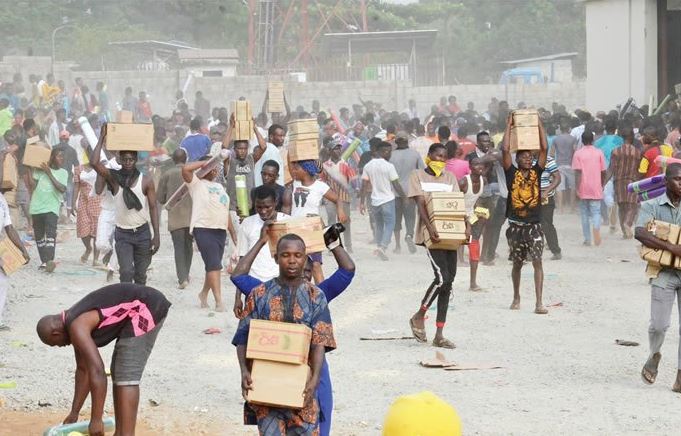
RESIDENTS of Bayelsa on Sunday night broke into a warehouse in Yenagoa, the state capital, to cart away food and materials meant for flood victims.

 The warehouse, used to store flood palliatives since 2022, was reportedly raided by residents who made off with some food items that had deteriorated over time.

The theft resulted from mounting frustration stemming from the economic challenges exacerbated by the removal of subsidy on Premium Motor Spirit (PMS), commonly known as petrol, by the Federal Government. This removal resulted in a significant surge in petrol prices from approximately N190 to a staggering N620 per litre. 

Similarly, In Adamawa state, The ICIR reported about the looting of warehouses by the residents. It showed hoodlums chanting “Enough of Hunger” stormed warehouses in the state. 

The cascading effect has increased the cost of goods, services, and transportation fares.

Bayelsa State Emergency Management Agency (BYSEMA) officials revealed that the looted food items were no longer suitable for human consumption. 

These items had been stockpiled during the 2022 flood crisis in the state. 

It remains to be seen if the warehouse in Yenagoa contained food items that were part of the N5 billion palliative and grant programme announced by the Federal Government, led by the administration of President Bola Tinubu.

Responding to the incident during an inspection of the warehouse on Monday, August 28, the Director-General of BYSEMA, Walamam Sam Igrubia, stated that the Agency had been preparing for the upcoming flood season. 

During his inspection, remnants of food items, including rice and garri, which had deteriorated beyond consumption, were cleared from the warehouse and placed outside for disposal the following day.

He said: “The Bayelsa State Emergency Management Agency (BYSEMA) notes with surprise and concern the unwarranted invasion of the premises of a privately-owned warehouse in the Kpansia area of Yenagoa, the state capital.”

“Importantly, these items are unfit for human consumption, and a responsible, caring government like ours will not give Bayelsans such items as palliatives”.

“In essence, there were no food items to loot. So, those who carted away the unfit things are advised in their interest not to consume them”.

Furthermore, the Agency refuted any claims of hoarding or political manipulation. It urged those who had taken the unfit things not to consume them for their well-being.

Igrubia criticised opposition elements in the state for attempting to politicize the incident and exploit it for political gain. 

The Agency assured the state’s residents of its readiness to facilitate the distribution of legitimate palliatives provided by the Federal Government to mitigate the impact of the fuel subsidy removal policy.