Home Blog Page 811

Failed multi-million naira constituency water projects litter Sokoto communities

0

By Abdulwaheed Sofiullahi

Many rural communities in Sokoto state are at risk of an outbreak of diarrhoea and other diseases due to an acute shortage of potable water. This is in spite of multi-million naira constituency borehole projects purportedly facilitated by federal lawmakers representing the people. ABDULWAHEED SOFIULLAHI, who visited a number of communities, reports that the 2020/2021 projects benefited the people for just a short time. Two years after the execution, he found none of the boreholes was functional.


OVER the past three weeks, Ibrahim Shuaibu, 35, finds himself in agony, often writhing on the dusty floor, desperately seeking relief from the relentless pain torturing his body.

Unlike others who hide their sufferings, Ibrahim is unable to conceal his pain, as he witnesses a distressing transformation in his body. Every time he drinks the tainted rainwater collected from an open-dug land, his private part swells, causing ominous consequences.

In Kyadawa Community, in the Gada LGA of Sokoto State, water, a crucial necessity for life, has become more valuable than petroleum. Last year, when scarcity hit the community, leaving residents thirsty and desperate, they came up with a bold plan to dig the land and collect rainwater to create a reservoir for their needs.
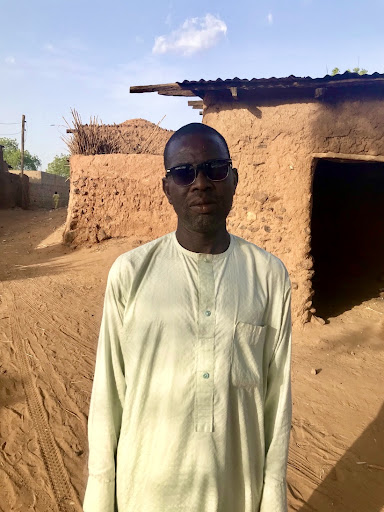
brahim Shuaibu Photo credit: Abdulwaheed Sofiullahi

However, as time went by and the contaminated water flowed through their bodies, a sinister sickness gripped the entire community. People suffered from unfamiliar illnesses, primarily marked by painful diarrhoea and persistent typhoid fever. Tragically, due to inadequate care, many lives were lost. For Ibrahim, the cause of his suffering remained a mystery to everyone.

“It was only a year ago that I first noticed the swelling in my private area,” Ibrahim recalls, his words filled with raw agony.

Seeking relief, he travelled to Sokoto town and shared his troubles with a sympathetic doctor. The doctor, moved by Ibrahim’s plight, offered a glimmer of hope through medication but also warned him to avoid the deadly water.

“Stop drinking this contaminated water,” the doctor cautioned, emphasizing the seriousness of the situation.

Yet, Ibrahim felt trapped, with no alternatives. Giving up this water meant giving up sustenance itself. He faced a heartbreaking dilemma: endure the swelling and torment or cut ties with the water entirely. As a result, his private area continued to swell, and Ibrahim’s tears flowed freely, reflecting his unending anguish.
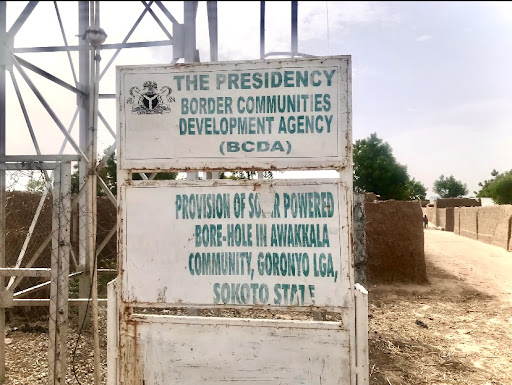
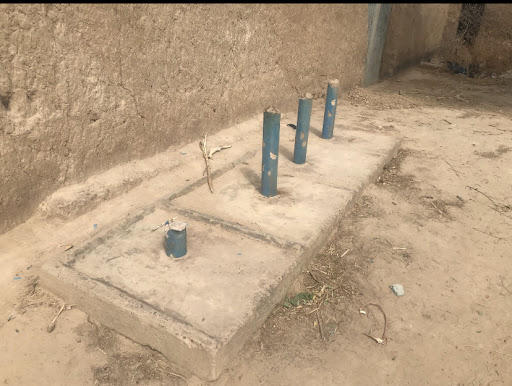
Damaged borehole at Awakkala Village, Goronyo. Photo: Abdulwaheed Sofiullahi

In the village of Awakkala, located in Goronyo Local Government Area, Sheu Malami, a man in his mid-50s, shares a heartfelt story of water scarcity. It affects his community, located approximately 78 kilometers away from Shuaibu’s home in Gada LGA. Malami vividly describes how this dire situation has impacted their lives. In 2021, a borehole brought them hope and relief as clean water flowed freely, bringing back their smiles.

Sadly, their joy was short-lived when the borehole abruptly stopped working just five months later. Since then, they have been forced to rely on a contaminated well, which has caused harm to Malami’s health and that of his fellow villagers.
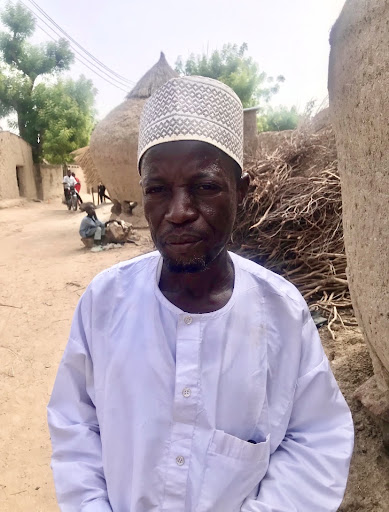
Shehu Mallami. Photo credit: Abdulwaheed Sofiullahi

“We’ve been plagued by infections, particularly water-borne diseases,” he laments.

The impoverished community struggles to gather funds for the borehole’s repair, reaching out to politicians for help, but their pleas have been ignored.

The tale of water scarcity unfolds further in the Tartakoi Community, also situated within the Gada LGA, where Aishatu Umar resides. Aishatu, a mother of five children, endures an ongoing battle with an unexplained fever. Little does she know that the root cause of her ailment lies in the very water she drinks from – the water from the nearby stream.

In 2021, the community had the privilege of drinking from a newly constructed source of clean water. Unfortunately, this precious lifeline ceased to function merely three months after its installation. Since then, the villagers have been left with no choice but to rely on the stream water as their sole source of sustenance.
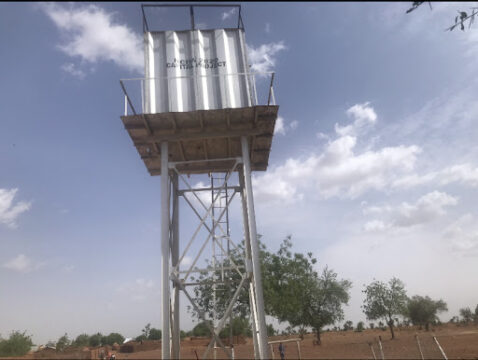
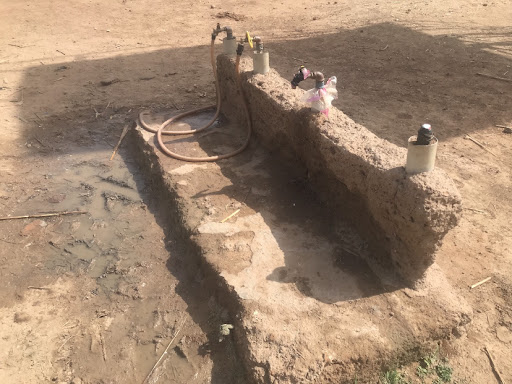
Damaged borehole at Tartakoi Community
Damaged borehole at Tartakoi Community, Gada LGA Photo credit: Abdulwaheed Sofiullahi

This stream water, used for washing clothes, cooking meals, and even consumed by their cows, has become a necessity borne out of desperation. Aishatu yearns for an alternative, knowing the toll it takes on her health. Yet, she finds herself trapped, with no other viable option but to continue consuming it.

According to a 2022 World Bank assessment, 114 million Nigerians lacked access to basic sanitation facilities in 2021, and another 70 million lacked access to clean drinking water. Research conducted by the Africa Water Development Project (RAWDP), confirmed that Sokoto is the only state in Nigeria with the lowest level of access to clean water.

UNICEF reports that in Nigeria, diseases like diarrhoea caused by contaminated water claim the lives of over 70,000 children under the age of five each year. Additionally, WHO data reveals that more than 45,000 children under five die annually due to diseases resulting from inadequate access to water, sanitation, and hygiene.

Rural residents once smiled, drinking from the poorly executed constituency boreholes

In the rolling countryside of Sokoto state, a tale of water woes has haunted the rural communities for years. The hardships faced by these residents, deprived of clean, drinkable water, seemed endless. However, a glimmer of hope emerged in the form of Honorable Musa Sarkin-Adar, the former lawmaker representing the Gada/Goronyo federal constituency. In 2020, as part of the Zonal Intervention Project (ZIP), he championed a noble cause—the provision of three solar-powered boreholes, two for Gada and one for Goronyo LGA.

With a budget of N30 million allocated for this ambitious endeavour, the project found its place under the watchful eye of the Border Communities Development Agency (BCDA), facilitated by the Office of the Secretary to the Government of the Federation (SGF). Cee-dor Nigeria Limited, entrusted with executing the project, received a payment of N29,838,481.81.
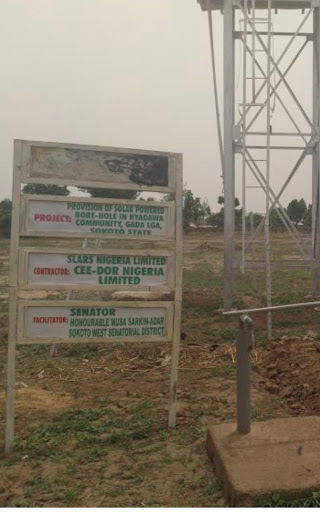
Damaged borehole billboard at Kyadawa community, Gada LGA.

Fortune smiled upon the community of Gada, as the two boreholes designated for the area found their homes in Shuaibu’s community at Kyadawa and Mallami’s community at Awakalla while one borehole was drilled at Aishatu’s community at Tartakoi.

In the heart of Awakkala village, the community leader Ibrahim Marafa witnessed the fulfilment of a long-awaited dream in 2021 when the borehole was finally completed. The residents rejoiced as the thirst for clean, potable water was finally quenched after two decades of denial.
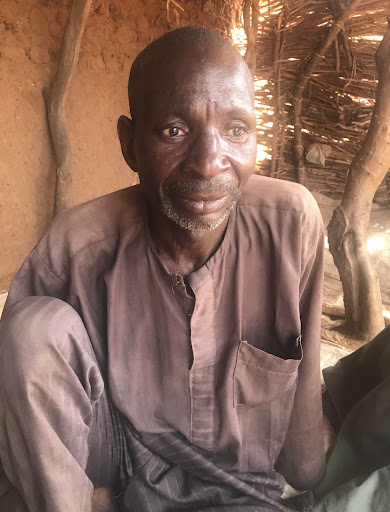
Awakkala village leader, Ibrahim Marafa
Photo credit: Abdulwaheed Sofiullahi
Awakkala village leader, Ibrahim Marafa Photo credit: Abdulwaheed Sofiullahi

However, this newfound oasis was short-lived. Barely nine months after its commissioning, the borehole suffered catastrophic damage, plunging the community back into the depths of drinking dirty stream water.

Disheartened, Marafa lamented, “We have been enduring the hard journey of obtaining potable water since the borehole was damaged nearly two years ago. Our relentless efforts to restore it have been in vain. We appealed to the local government chairman, who promised repairs, but nothing has been done. Our people suffer from water-borne diseases, vomiting, and diarrhoea. We remain trapped, longing for relief, but uncertain of when it will come.”

Tartakoi, under the leadership of Hashimu Abubakar, faced a similar tale of despair. The borehole that was installed with hope in early 2021 worked for only six weeks before failing, leaving residents in dire need. They rallied their resources, some even selling their belongings, while others borrowed generators, all to revive the source of clean water.
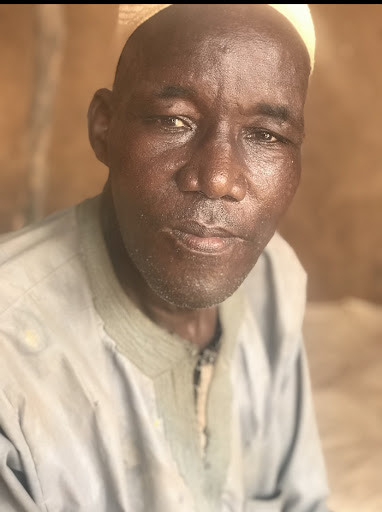
Tarkoi Community Leader, Hashimu Abubakar. Photo credit: Abdulwaheed Sofiullahi

Abubakar expressed their plight, saying, “We were excited when Honorable Musa facilitated this borehole, giving us access to clean water. But when it stopped working, we went back to consuming dirty water, causing diseases. We pleaded with the government for help. If the solar system can’t be fixed, we ask for a larger generator to power the borehole.”

Adamu Shuaibu, a resilient leader of Kydawa, shared a heartbreaking tale that moved hearts. For over a year, the whole community had laboured tirelessly, digging the earth in search of life-sustaining water. Sadly, their efforts yielded only two gallons of contaminated water. Undeterred, they turned their efforts to a patch of land beside the road, hoping for a different outcome. However, after a week, the water dried up.

The agony on Shuaibu’s face, at 53 years old, reflected the experience of his people.

“See the magnitude of our water-related suffering,” he sighed, recounting their plight. “We endure unimaginable hardships, digging tirelessly, seeking solace in every shovel’s turn.” His voice faltered, revealing the depths of his pain.

Next to the road, where individuals pedal bicycles or ride donkeys, there is another excavation—an emblem of hope amidst their challenges. This reservoir is created by carving the land, patiently anticipating the rainfall’s touch and when it falls, it transforms into a reservoir that saves water for the community’s necessities. Unfortunately, the stream that was once dependable now contains dirty water, satisfying the thirst of both humans and animals. Consequently, the community experiences health issues, fevers, and other perplexing illnesses, affecting both people and animals alike.

More poorly executed boreholes fuel water scarcity

Yahuza Umaru, 43, starts his day at the crack of dawn, rousing his family from their slumber at 6.00 a.m. to embark on a relentless search for water. Their home, located in Kantaore Community in the Gada Local Government Area, is no stranger to the merciless attacks by bandits. And if the constant trauma of insecurity weren’t enough, a devastating water scarcity looms over their heads, casting a shadow of sorrow upon their lives.

“We used to have a borehole in our community that quenches our thirst and keeps our lives running smoothly,” Yahuza recalls with sadness. “But everything changed in 2021 when the borehole suffered a serious problem. Since that day, we have been in a constant struggle for water.”
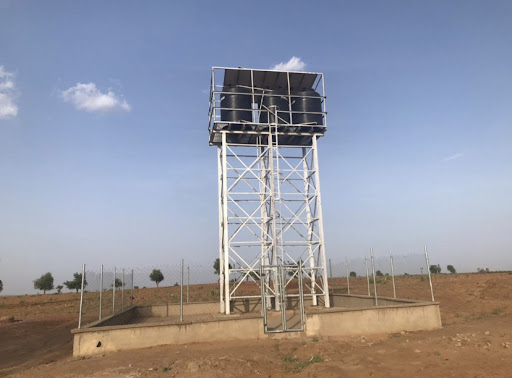
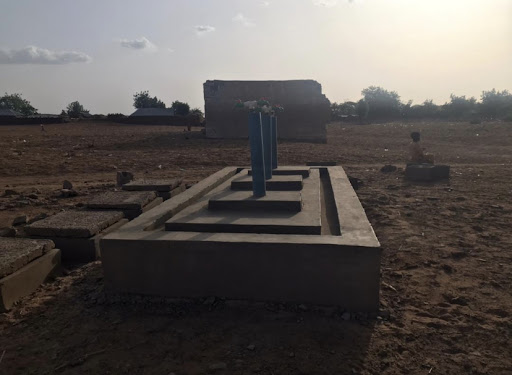
Damaged borehole at Kantaore Community, Gada LGA. Photo credit/Abdulwaheed Sofiullahi

The entire community shares Yahuza’s sorrow, waking up each morning with tired eyes, desperately searching for murky water, hoping to survive. They say that their collective hardships have not only led to innocent residents being kidnapped but also resulted in the loss of precious lives.

“I can’t find words to express how this water scarcity has caused us endless troubles and taken the lives of dear friends,” Yahuza adds, his voice filled with grief.

In 2020, the lawmaker representing Gada/Goronyo sought to alleviate the community’s suffering by facilitating the provision of motorized boreholes with fournos plastic tanks and generators at the Gada/Goronyo federal constituency, complete with four plastic tanks and generators. Among the fortunate recipients was the Kantaore community, where Yahuza resides. In early 2021, a sum of N6.5 million was allocated to Real Concrete Nigeria Limited to undertake the project, under the watchful supervision of the Sokoto Rima River Basin Development Authority.

Several attempts to speak with the SRRBDA weren’t successful, as the agency didn’t have a public relations officer, and after several visits to the agency’s location, the reporter was not able to speak with any staff as they said it violated their working rules to speak or release information to outsiders.

However, the community’s dreams were short-lived as the borehole suddenly stopped providing water in December 2021, just a few months after it was built. This has had serious consequences, with the community now facing a water crisis and desperation.

Aminu Abdullahi,43, shares the struggles of his neighbours. “When the borehole was working, it gave us hope as water flowed abundantly,” Aminu recalls. “But when it broke down, we sought help from people claiming to know how to fix it, but their attempts made things worse, pushing us deeper into despair. We had to go back to using our old well, which unfortunately, is not very clean. We faced many diseases and fought hard to keep our loved ones alive,” he explains. “We ask the government to help us and fix the borehole, so we can have water again.”

The Takakume community, located in the Goronyo Local Government Area, faces a similar situation as their neighbors in Kantore. They also received a borehole as part of the same project and from the same contractor. However, like in Kantore, their hopes for a reliable water source were shattered when the borehole in Takakume stopped working just five months after its construction, leaving the residents with a serious water shortage.

Hudu Mohammed, 58, recounts the bitter truth of their predicament

“We waited patiently for nearly three years for the construction of this so-called borehole, only to witness its demise within a year of operation. Each time it faltered, we sought the aid of technicians to fix it, only to find that their repairs were short-lived. We poured substantial amounts of money into these repairs, once even shelling out a hefty sum of N103,000, only to have it malfunction again after a mere two days,” he laments.

“The longest period of respite we had was when it worked for a week, but even then, the technicians constantly babbled about bushings and other mysterious issues. Frustrated by the persistent problems, we eventually resorted to selling our solar panels and pooling our resources to purchase a generator. As you can see, we are willing to adapt and make do with whatever means necessary. Prior to the borehole’s arrival, we relied on a well for our water needs, specifically one powered by a diesel engine,” he explains. “During that time, many fell victim to infections caused by fetching water from the open well. Thankfully, they received proper care and have since recovered. You see, we villagers possess a remarkable ability to adapt to whatever challenges life throws our way.”

The community’s request to the government, while knowing that wishes do not always come true, is for a stronger engine to power the borehole. The solar panels they relied on before have proven to be unreliable and short-lived. The residents want a solution that will last and provide them with a consistent water source.

The struggles of the Takakume community show their resilience in the face of adversity. They remain steadfast and resourceful despite the water crisis. They hope that their plea will reach those in power and prompt them to take action. In tough times, the collective voice of a community can bring about change and improve lives.

BCDA awarded contract to an inactive food-processing company

The construction of boreholes, a vital component of the 2020 ZIP project, was allocated to Cee-dor Nigeria Limited by the BDCA. Regrettably, upon investigation through the Corporate Affairs Commission portal, it was discovered that the company was inactive due to the absence of updated annual returns filing. Meaning, the firm has not fulfilled its legal obligations by paying necessary taxes and fees to the government within the stipulated time frame.
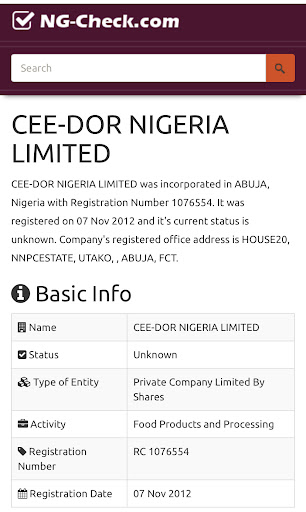
Image of cee-dor from ChechNG.

A thorough examination of online procurement portals Check NG and Nigeria 24 confirmed that Cee-Dor Nigeria Limited was initially incorporated in Abuja on Nov 7, 2012. However, the current status of the company remains unclear and the company’s operation is identified as food product and processing. Surprisingly, the company’s registered address, House 20, NNPC Estate, Utako, Abuja, FCT, could not be located.

Nigeria 24 provided the names of the company’s directors as Odufa Osatohanwen Ebalu, Omoathefe Osadebamwen Ebalu, Sandra Oghoreye Ebalu, and Francis Omoathefe Ebalu.

Unfortunately, conducting searches online yielded no results for any of these individuals as the contractor’s company has no online website or social media presence.

Adedeji Adegboyega, Assistant Chief Engineer of Project Development and Implementation at BDCA, addressed the issue of Cee-dor Nigeria LTD being identified as a food products and processing company. He said that the company’s Memorandum of Understanding includes real estate as part of its business scope, which inherently involves construction activities. Although the project dates back to 2020, specific details may not be immediately available, but decisions likely relied on the parties involved.

Habila Bonet, the BCDA’s head of Project Development and Implementation, highlighted that a company with real estate as part of its Memorandum of Understanding would have engineering capabilities. The selection process for contracts is comprehensive and goes beyond mere bidding, various factors are considered, he asserted.

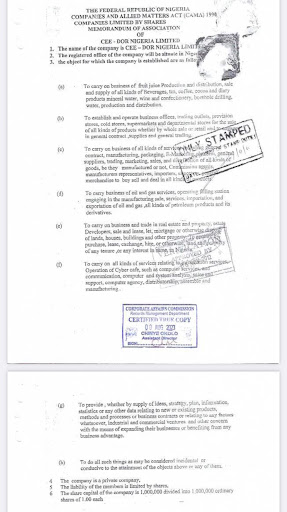
Cee-dor documents received from the CAC. Photo credit: Abdulwaheed Sofiullahi

However, document received from the CAC on Cee-Dor Nig Ltd is contrary to the BDCA’s Engineer’s claim as the company’s MoU doesn’t cover construction. It confirms that the company’s business focus is fruit juice production and distribution. The BDCA Engineer, initially said that the MoU states that the company would engage in real estate, which he interprets to include construction.

His claim is contrary to article 3 (e) under the company’s MoU, which states: “To carry on business and trade in real estate and property, estate developers, sealed lease, let mortgage or otherwise dispose of lands, houses, buildings and other property to acquire by purchase, lease, exchange, hire, or otherwise, land and property of any tenure, or any interest in Nigeria.”

Despite several attempts to reach out to Musa Sarkin-Adar, the former lawmaker representing Gada/Goronyo who nominated the project, all efforts have been in vain. Numerous calls made to his phone line went unanswered, and text messages sent to his contact and verified email address were unattended.

Another poorly executed borehole at Tambuwal LGA

The issue of water scarcity in Sokoto State extends beyond Gada and Goronyo. The residents of Dogondaji Community in Tambuwal LGA experienced a brief respite when a zonal intervention project borehole was constructed in 2021. However, the borehole abruptly stopped working, leaving the community in dire conditions.

Back in 2020, Kakoni Balla, the former lawmaker representing Tambuwal/Kebe Federal Constituency, facilitated the construction of a solar-powered borehole in Shiyar Gandu Community, Dogondaji, Tambuwal LGA. The project, which cost N11.9 million naira, was supervised by the Border Communities Development Agency (BCDA), and H.H.F and Sons was listed as the contractor in the project documents. However, the billboard at the project site displayed the name of Gams & Abell Nig Ltd as the contractor. The latter is not registered with the CAC though there are companies with similar names such as Gams & Abell Oil & Gas Ltd, Gams & Abell Investment Ltd, Gams Abell and Co.

HHF and Sons Ltd document provided by the BDCA

Christian Anasili, the BDCA director of procurement, tried to address the issue of the discrepancy in the name of the contractor that got the contract (H.H.F and Sons) and the firm that executed (Gams & Abell Nig Ltd) thus:

“If another contractor executed the project through sub-contracting and the work was done, it is not our concern as the agency. HHF and Sons Nigeria Limited is the company that secured the contract from us, not the one that actually executed the project.”

However, sub-contracting a project violates Section 25 of the 2007 Public Procurement ct 2007, which explicitly prohibits a procuring entity from mandating or specifying a particular sub-contractor as a condition for participating in any procurement proceedings.

The bid document released by the agency confirms that HHF and Sons is the designated contractor for the project, not Gams and Abell Nigeria Limited, which is not registered with the CAC. To shed light on the matter, the reporter managed to obtain the contact information of Hassan H. Fawaz, the managing director of HHF.

In a phone conversation with Mr. Fawaz, he seemed hesitant to provide details and directed the reporter to speak with his secretary for further information about the project. Eventually, he shared the contact of a person named Abdulrahman, who claimed to be the company’s accountant or secretary, as per Mr. Fawaz’s statement.
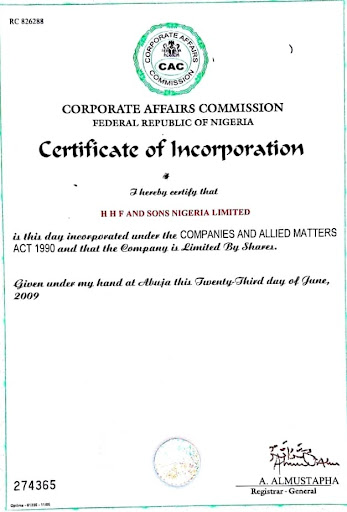
CAC certificate provided by Abdulrahman

During the conversation with Abdulrahman via WhatsApp, he initially said that their company is involved in buying and selling. However, when questioned about the sub-contracted borehole project in Sokoto State, he altered his response.

Abdulrahman then stated, “I am an accountant of HHF and Sons Nigeria Limited, and we are a registered civil construction company with the CAC.” He did not address the question of subcontracting which their company did without any answers.

Faruq Jibo, 32, shares the hardships faced by the community since the borehole stopped working. He vividly describes the impact it had on their lives, saying,

“When the borehole was functioning, it provided us with approximately 600 liters of water per day. That’s equivalent to around 15 wheelbarrows filled with 10 30-liter gallons of water. We used to pay N10 per gallon, but since the borehole stopped working, the price has skyrocketed to N40. Some people fell ill, but fortunately, we managed to take care of them, and now everyone is healthy. We’ve tried various solutions to get the borehole working again, but nothing has worked so far. We plead with the relevant authorities in our community to come to our aid.”

Abubakar Hassan Dongondaji, 38, talks about the water scarcity they face. He explains, “Since we have the option to buy water, the water scarcity issue is not as severe in our community, especially on my street. However, we need more boreholes in our newly developed area. The borehole built by the Border Communities Development Agency was an excellent source of water until it stopped working five months ago. We are considering purchasing a new borehole. Fortunately, the other water sources we rely on, such as commercial boreholes, provide good-quality water because our community is known for having clean water. Anywhere we dig, we find good water.”

Rufai Maccido Sallah, the representative of the village head, sheds light on the maintenance challenges faced by solar-powered boreholes.

“The non-functioning borehole has brought significant suffering to the people in that vicinity. Solar-powered boreholes are difficult to maintain and manage, and they tend to break down faster than anticipated. It was a distressing experience for the community when the borehole suddenly became faulty, ending the supply of water. During the project execution, we faced some problems, mainly due to conflicting interests among our people regarding the location of the boreholes. However, a committee has been formed to address water-related issues, including the repair of the borehole.”
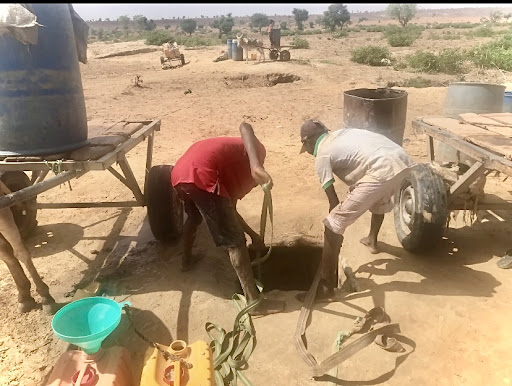
Local residents digging land for water at Kyadawa Village. Credit: Abdulwaheed Sofiullahi

BCDA responds to borehole projects with short lifespans

Sadiq Abdullahi Isa, Director of Planning Intergovernmental and Community Relations at the BCDA, addressed concerns regarding certain zonal intervention projects in Sokoto State from the year 2020, which experienced a disappointingly short operational lifespan after completion.

Isa suggested that the problem might be relatively minor, suggesting that when the boreholes stopped working, the affected communities should have promptly contacted their respective House of Assembly members who represent them. He also pointed out that at the project sites, the signboards displaying information about the agency’s involvement are visible, and the rural residents could have easily found the agency’s address there to report any issues. Isa emphasized that the BCDA would be responsive if they were made aware of such problems.

He explained that some of the boreholes may have encountered mechanical issues, leading to their malfunction. However, he expressed concern that the agency is not being informed about these matters, which hinders its ability to take timely action.

Isa shared that there have been instances in the past where rural areas experienced theft of machines from the boreholes, adversely affecting their functionality. Despite encouraging the communities to safeguard the projects upon handover, incidents of theft still occur, he noted.

To address these challenges, the BCDA actively encourages individuals to report instances where the projects have stopped working. Once notified, he said the agency promptly dispatches its engineers to assess the situation.

He said further that if the problem is attributed to vandalism, the BCDA takes appropriate measures to address the issue. On the other hand, if the boreholes require minor repairs, the agency promptly attends to the maintenance to ensure they are back in operation, he stated.

* This report republished from Ripples is supported by the John D. and Catherine T. MacArthur Foundation and the International Centre for Investigative Reporting (ICIR)

Q2’2023: Agriculture, trade, ICT increase Nigeria’s GDP to 2.51%

0

CROP production, trade, and information and communication services contributed over 50 per cent to increase Nigeria’s gross domestic product (GDP) to 2.51 per cent in the second quarter of 2023.

This is according to the Nigerian Gross Domestic Product Report for Q2, 2023, released by the National Bureau of Statistics (NBS).

Crop production, trade and ICT had a combined contribution of 53.52 per cent to the real GDP in the second quarter.

According to the report, the GDP grew by 0.20 per cent, higher than 2.31 per cent recorded in the first quarter of 2023. This translates to N52.10 trillion in nominal GDP and N17.72 trillion in Real GDP.

However, The ICIR findings showed that this is the slowest growth reported in the last two years.

The NBS said that the GDP performance was driven by the service sector, which recorded a growth of 4.42 per cent and contributed 58.42 per cent to the aggregate GDP. 

Also, the agriculture sector grew by 1.50 per cent, an improvement from the growth of 1.20 per cent recorded in the second quarter of 2022. 

“The growth of the industry sector was -1.94 per cent relative to -2.30 per cent recorded in the second quarter of 2022. In terms of share to the GDP, agriculture and the industry sectors contributed less to the aggregate GDP in the second quarter of 2023 compared to the second quarter of 2022,” the NBS report said.

This development is coming weeks after President Bola Tinubu inaugurated a presidential committee on fiscal policy and tax reform with a mandate to achieve an 18 per cent tax-to-GDP ratio within three years.

A financial expert, David Adonri, had told The ICIR that the reforms proposed by the government should adequately address the welfare of the average Nigerian to engender trust.

The ICIR also reported the promise of the president, while giving his inaugural speech on May 29, to increase Nigeria’s GDP by six per cent annually.

According to the NBS report, Nigeria’s GDP for the first half of 2023 is 2.41 per cent. To keep the promise of a six per cent annual GDP, the president has six months to get 3.59 per cent.

SSS or DSS: What does the law say?

IS it the State Security Service (SSS) or the Department of State Services (DSS)? This is a question many people ask.

Many public organisations are named and established by law. Nigeria’s primary domestic intelligence agency the State Security Service (SSS), known as the Department of State Services (DSS), is one such agency.

Its primary responsibilities include obtaining national intelligence and safeguarding the security of significant political persons.

It functions as a department within the executive branch of government.

The law that created the SSS

The law creating “State Security Service” is known as the National Security Agencies Act 1986.

Section One of the Act says: “There shall, for the effective conduct of national security, be established the following National Security Agencies, that is to say-(a) the Defence Intelligence Agency; (b) the National Intelligence Agency; and (c) the State Security Service”.

According to the National Security Agencies Act 1986, “State Security Services” is created to detect and prevent crimes within Nigeria that may threaten the national security of Nigeria.

DSS Nigeria kidnapping
Operatives of State Security Service /File Copy

However, in recent years, the SSS has portrayed itself as the Department of State Services (DSS) in official statements and all its official social media accounts.

Nigerians and the media have also frequently referred to the agency as DSS rather than SSS, which has generated a lot of debate in the country.

Lawyers’ view on the use of the name DSS 

According to some lawyers who spoke to The ICIR, the name “State Security Services” and the National Security Agencies Act 1986 have not been amended or altered since 1986. 

They agreed that the use of the name Department of State Services (DSS) by the State Security Service (SSS) is illegal and a violation of Nigeria’s National Security Agencies Act.

Hence, the statutory, legal and known name remains “State Security Services” and not DSS.

A Lagos-based lawyer, Adefisoye Okunade, said the name change is unknown to the law and a violation of the law.

“The use of “DSS” is a violation of the law. Section 1(c) of the National Security Agencies Act, Cap. N74, LFN, 2010. 

According to Okunade, the referenced statutory authority provides that:

“There shall, for the effective conduct of national security, be established the following

National Security Agencies, that is to say-

       (a)       the Defence Intelligence Agency;

       (b)       the National Intelligence Agency; and

       (c)        the State Security Service.”

“National Security Agencies Act, Cap. N74, LFN, 2010.

He went further to say the position of the law is that the express mention of one thing is an exclusion of the other.

“Expressio unius exclusio ulterious. That is to say – the express mention of ‘SSS’ in section 1(c) of the NSA Act is an exclusion of any other name such as ‘DSS,’ meaning that the use of self-styled “DSS” is an executive recklessness,” the lawyer added.

In his view, another lawyer, Festus Ogun, told The ICIR that SSS is known to the law and not DSS.

“It is a secret outfit created by law. State Security Service is the secret outfit created by statute. Department of State Security is unknown to law.,” Ogun said.

According to Ogun, the use of DSS is in breach of law.

He blamed the security agency for unilaterally changing its name from the State Security Service. 

He added that the organisation cannot change its name unless the National Assembly amends that law to reflect it. 

“Even from its name, the DSS is not committed to the tenets of the rule of law. Looking at the antecedents of SSS. They’ve been quite lawlessly and recklessly, and you know, they abuse the fundamental rights of our people with reckless abandon.

“So the issue of it unilaterally changing its name without a cause to law is not only illegal but unconstitutional,” Ogun stated.

He added that the National Security Agencies Act created the State Security Service, and since the act has not been amended, it’s a gross violation of the National Security Agencies Act to refer to it as DSS.

Another lawyer, Inibehe Effiong, in a post on X (Formerly Twitter) on July 26, faulted the use of the name DSS by the SSS and called it an act of illegality.

“Part of the lawlessness is the use of the name “Department of State Services”. It is an illegality. It is unknown to law.

“What is established by law by the National Security Agencies Act is State Security Service (SSS),” Inibehe submitted.

 DSS reacts

When asked about the legality of the continuous use of the name DSS by his organisation, the spokesperson of the agency, Peter Afunanya, in a text message, said it is not illegal but a creation of law.

SSS account on X with the inscription DSS

When probed further to state the law that changed the name from SSS to DSS, Afunanya said, “Your source is not well informed on the subject matter and may wish to expand his/her research.

“You are an investigative reporter. Find out for yourself. By the way, DSS Is not Illegal. It is a creation of the law,” Afunanya stated.

Curbing contract variation: Every road project can be within 2-year budget cycle – Umahi

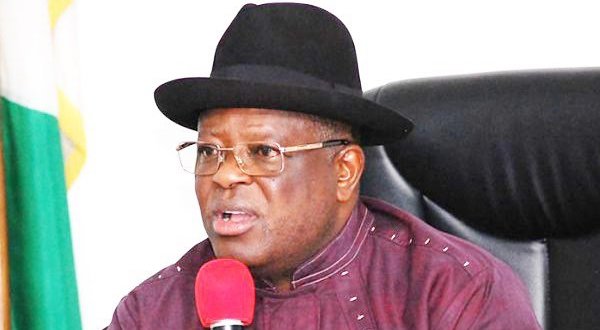
THE Minister of Works and the immediate past Governor of Ebonyi State, Dave Umahi, said contract variations and 20 years tenure for a single road construction are key factors that drag construction business in a developing economy.

Umahi, who spoke in Abuja on August 24, 2023, in a monitored broadcast at Channels Television programme, said his tenure would not tolerate longer tenure for road constructions, as they serve as a foundation for contract variations and price inflation.

According to ‘pocketlaw’ , a contract variation agreement is an agreement used to amend or vary the terms of a existing contract by mutual consent of all parties to the original agreement.

“Some roads have been ongoing for the past 20 years, some 12 years and the minimum of what I saw while taking brief from respective departments and agencies of the government. This is not a good development.

“In taking a brief about the Ministry, I discovered that some projects still undergoing construction have gone bad. This is a big problem for us, especially when we don’t have funds for road construction, “he said.

He suggested ‘project phasing’ as a way of averting the incidence of contract variations and delays.

“Every road project can be within a budget cycle of two years. It is a win-win situation for both the contractor and the federal government. We must not award 130 kilometres of roads in one fell swoop when we are not sure of the funds availability.”

Umahi, in seeking for a long-lasting panacea for road construction, advocated for concrete-constructed solutions, which, according to him, has a 50-year life span, unlike asphalt-constructed roads with seven years life span.

“In Ebonyi, I did 3500 Kilometers of roads in the state with the concrete technology. We signed undertakings with the African Development Bank and the World Bank, who supported us on the life-span of the roads.

Commenting on the need to engage direct labour and use local Engineers, the Minister said he has directed the Federal Road Maintenance Agency (FERMA) to engage local engineers and build their capacity.

“The young Engineers we shall engage will pay tax to the government and would help the country be a construction hub,” he said.

Available reports estimated that there are 56,000 abandoned projects in Nigeria.

According to research by the Nigeria Society of Engineers, since 1960, two-thirds of very large projects have been abandoned.

A total of 11,886 federal government projects have been abandoned in the past 40 years.

REA connects over 40,000 MSMEs to 103 mini-grids

THE Rural Electrification Agency (REA) said the electrification of 46,661 Micro, Small and Medium Enterprises (MSMEs) will foster ease of doing business growth and provide opportunities for wealth creation.

The agency also said households and public facilities are also being electrified with a total of 103 mini-grids geared toward providing an enabling business and economic environment for them.

The Agency, in a statement issued on August 24, 2023, said 103 mini-grids were also being deployed across the country under the Performance Based Grant subcomponent of the Nigeria Electrification Project, funded by the World Bank.

This, it said, signalled a crucial advancement in enhancing electricity access for households, MSMEs, as well as public facilities in rural and underserved regions of Nigeria.

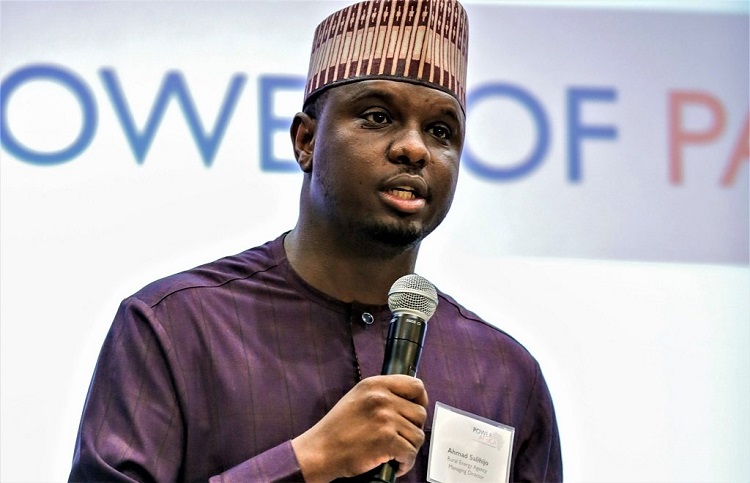
Speaking at a recent 10th Mini-Grid Roundtable discussion, which was held virtually, the Managing Director/Chief Executive, REA, Ahmad Salihijo, said the agency was dedicated to bridging the energy access gap in Nigeria.

“The REA was established with the mandate to increase access to electricity by bridging the energy access deficit in Nigeria. Since inception, we have made significant progress in achieving this goal.

“The agency is implementing various electrification programmes – like the Nigeria Electrification Project, targeted at creating lasting impacts by fostering economic growth, improving education, and enhancing the overall quality of life of Nigerians,” he stated.

Highlighting the key strategy, he said, “One of the key strategies that we are using to achieve this goal is the Performance Based Grant sub-component. The PBG is a financing mechanism that provides grants to qualified developers to construct and operate mini-grids in rural communities.

“So far, the PBG has been very successful in attracting private sector investments in mini-grids. Through the NEP, over 80 mini-grids have been completed and commissioned, connecting about 32,000 households, MSMEs, and public facilities, and providing clean and reliable electricity.”

Salihijo said the solar hybrid mini-grid component had witnessed remarkable success, “with a total of 46,661 verified connections made to households, MSMEs, and public facilities.”

He added, “Each connection is a step towards bridging the energy gap and fostering economic development.”

The REA boss stated that an additional 281,578 connections were in progress, as the agency was poised to further expand the project’s impact and reach.

The head of the REA Project Management Unit of the NEP, Abba Aliyu, while applauding the project said, “We are thrilled to announce that we have successfully completed and commissioned 103 mini-grids as part of the NEP initiative.

“This achievement underscores our commitment to providing reliable and sustainable energy solutions to communities that have long been underserved.

“Our goal has always been to empower communities with the power of electricity. These 103 mini-grids represent brighter futures, improved livelihoods, and opportunities for growth.”

He explained that the initiative had positively impacted over 230,000 people across the country, leading to meaningful changes in their daily routines, economic activities, and overall quality of life.

Aliyu said the installation of 5.8 megawatts of photovoltaic capacity underscored REA’s commitment to harnessing renewable energy sources for sustainable power solutions.

Meanwhile, Salihijo stated that as the REA continued its efforts, the successful deployment of 103 mini-grids stood as a testament to the project’s dedication to creating a brighter and more electrified future for communities throughout Nigeria.

“We’re not stopping here. Our vision is to keep expanding, keep innovating, and keep bringing light to every corner of this nation,” he stated.

Nigeria other countries can benefit more from reforming fossil fuel subsidies – IMF

0

THE International Monetary Fund (IMF) says reforming fossil fuel subsidies is in countries’ interest, even when excluding climate benefits.

It stated this in a report, ‘IMF Fossil Fuel Subsidies Data: 2023 Update’, released on Wednesday, August 23.

A fossil fuel subsidy is any government action that lowers the cost of fossil fuel energy production, raises the price received by energy producers, or reduces the price paid by energy consumers.

The Fund explained that in the average country, reforming fuel subsidies to the extent that the government reduces CO2 (carbon dioxide) by about 25 per cent below baseline levels in 2030 would raise net welfare before even counting global climate benefits.

This could result in local environmental benefits and remove price distortions.

“Fuel price reform would avert about 1.6 million premature deaths yearly from local air pollution by 2030.

“Globally, full price reform would generate net welfare benefits of about 3.6 per cent of GDP,” the international financial institution said.

Though Nigeria’s CO2 emissions fluctuated substantially in recent years, it tended to increase from 1972 – 2021, ending at 127 million tonnes in 2021.

Research showed that about 80 per cent of carbon emissions in Nigeria are direct consequences of fossil fuel combustion.

Put, CO2 is a colourless, odourless gas in the atmosphere and is formed when any fuel containing carbon is burned.

Nigeria has the highest number of overall air pollution-related pneumonia deaths of children under five worldwide.

The country also has the highest number of household air pollution-related pneumonia deaths among children under five, according to a United Nations International Children’s Emergency Fund (UNICEF) report.

It showed that the deaths of Nigerian children under five due to overall air pollution-related pneumonia were 67,416 in 2019, while deaths of those under five due to household-specific air pollution-related pneumonia were 49,591 during the same year.

A member of the Britton Wood institutions, IMF said fully reforming fossil fuel prices by removing explicit fuel subsidies and imposing corrective taxes such as a carbon tax would reduce global CO2 emissions by 43 per cent below ‘business as usual’ levels in 2030 (34 per cent below 2019 levels).

Explicit subsidies occur when the retail price is below a fuel’s supply cost.

IMF said, “Full fuel price reform would also raise substantial revenues, worth about 3.6 per cent of global GDP.

“These revenues could be used to cut more burdensome taxes such as on those labour, help with debt sustainability, or fund productive investments.

“Indeed, for developing countries as a whole, revenue gains from full price reform exceed the estimated extra spending needed to achieve the Sustainable Development Goals,” IMF said.

The ICIR reported that Nigeria’s debt currently stood above N46 trillion, and with the central bank’s ways and means to the federal government, it is approximately N70 trillion.

The latest Debt Sustainability Analysis (DSA) report has highlighted the need for more revenues to keep Nigeria’s public debt sustainable.

The recently released DSA Report, which is for the year 2022, also emphasised the need for the government to grow revenues.

Continuing, the IMF report showed that underpricing for local air pollution and global warming account for nearly 60 per cent of global fossil fuel subsidies and underpricing for supply costs and transportation externalities (such as congestion) explains another 35 per cent. In contrast, the remainder is accounted for by forgone consumption tax revenue.

It estimated that global total fossil fuel subsidies amounted to $7 trillion in 2022, equivalent to nearly 7.1 per cent of global gross domestic product (GDP).

“By fuel product, undercharging for oil products accounts for nearly half the subsidy, coal another 30 per cent, and natural gas nearly 20 per cent (underpricing for electricity accounts for the remainder).

“By region, East Asia and the Pacific account for nearly half of the global subsidy. By country, in absolute terms, China remains the biggest subsidiser of fuels, followed by the US, Russia, EU, and India,” the IMF added in the report.

Brics expansion: six more nations are set to join – what they’re buying into

0
By Bhaso Ndzendze, University of Johannesburg

One key outcome of the 15th Brics summit, hosted by South Africa, is the decision to invite six more countries to join the group with effect from January 2024. They are Argentina, Ethiopia, Iran, Saudi Arabia, Egypt and the United Arab Emirates. All six had applied for membership. The enlargement will grow the association’s membership to 11, and increase its envisaged role as a geopolitical alternative to global institutions dominated by the west.

The five current member countries – Brazil, Russia, India, China and South Africa – have argued that their size, in economic and population terms, was not represented in the world’s institutions, particularly the World Bank and the International Monetary Fund (IMF).

The Brics five represent about 42% of the world’s population and more than 23% of world GDP.

The enlarged grouping will account for 46.5% of the world population. Using the IMF’s 2022 GDP data, we can deduce that it will account for about 30% of global GDP.

The disparate nature of the six new members is bound to spark debate about the real nature of Brics.

In his welcoming remarks at the summit (22-24 August), the host, South African president Cyril Ramaphosa, stated:

Brics stands for solidarity and for progress. Brics stands for inclusivity and a more just, equitable order. Brics stands for sustainable development.

The group has been remarkably consistent on these values and aspirations.

Understanding the nature of Brics

One of the first questions about Brics is often “what is it?”. This is telling. This question does not come up, for example, about the European Union or even the G20.

Brics is not an organisation (it has no headquarters, secretariat or treaty). But it does have a formal institution that is jointly owned – the New Development Bank. Confusion about Brics’ precise nature is understandable.

At various points it has referred to itself as a forum, a platform, a mechanism, a partnership, or a strategic partnership, to name a few. Others have called it an alliance or a bloc. It is neither.

In international relations, both terms are strictly defined. The term “alliance” refers to a mutual defence pact and implies military cooperation. A “bloc” refers to ideological consistency (political bloc) or a free trade agreement (trade bloc). Brics has none of these characteristics.

The members also disagree on some key issues. China and Russia are noncommittal (at best) on the aspirations of India, Brazil and South Africa to become members of the UN Security Council. Their declarations have over the years reiterated the same phrase:

China and Russia understand and support the aspirations of India, Brazil and South Africa to play a greater role in the United Nations.

This shows there is some serious disagreement within the group.

As a political scientist interested in global politics, I have written about Brics and its potential for changing the status quo. With hindsight, I can assert that certain principles have informed it since its establishment and first summit in 2009. In my view, at a material level, the 15 years of summit declarations point to four fundamental values:

  • mutual development

  • multilateralism

  • global governance reform

  • solidarity.

The association self-reportedly seeks secure sustainable development for itself and the global south, to safeguard and advance multilateralism, to institute reform for the goal of representative institutions, and to achieve solidarity among members.

Economic development

Economics comes first in the group; at its root, it is a collective of emerging economies eager to sustain and improve their economic trajectory. Their insistence on reform is, after all, based on their perceived disproportionate under-representation in global financial institutions.

The group’s first, and so far only, notable establishment is the New Development Bank, primarily to finance infrastructure development. There’s also a contingent reserve that members can draw from in emergencies. It is valued at US$100 billion.

Multilateralism

The second value refers to the group’s concern about the use of entities outside the UN to pursue global objectives. Most notable is the use of the North Atlantic Treaty Organisation (Nato) to invade Afghanistan in 2001 following the 9/11 attacks in the US, and the invasion of Iraq in 2003 by the US and the UK, circumventing the UN Security Council.

Russian president Vladimir Putin expressed this concern in his speech to the 2007 Munich Conference on Security:

The use of force can only be considered legitimate if the decision is sanctioned by the UN. And we do not need to substitute NATO or the EU for the UN.

Global governance reform

Thirdly, the Brics countries have long pushed for leaders of global institutions to be elected in a transparent and democratic way. For example, the president of the World Bank has always been an American, and the managing director of the IMF a European. The World Bank has 189 member states and the IMF 190.

The idea of the New Development Bank was not to substitute the World Bank but to “supplement” existing international financial institutions. Brics still envisions a World Bank in which its members have voting rights proportional to their economic weight, and with staff drawn from across the world in a geographically balanced way.

Solidarity

Finally, the members have articulated solidarity with one another in a number of declarations, beginning in 2010. It comes down to mutual assistance in times of humanitarian disasters, respecting one another’s sovereignty and territorial integrity.

In light of criticism and sanctions plans against China, for its alleged suppression of the Uyghur-Muslim population, and Russia, for invading Ukraine, solidarity has come to mean silence or nonalignment.

A blank slate

Brics is a nebulous entity. This has proved beneficial for member countries hosting Brics summits. They get to set the agenda and use it for their ends – without upsetting the consensus. One common pattern has been the use of summits to set overarching themes that are favourable to the host country’s domestic policy and regional leadership or foreign policy stance.

Thus, for example, all Brics summits hosted by South Africa foregrounded Africa in their names: “Brics and Africa: Partnership for mutually accelerated growth, sustainable development and inclusive multilateralism” in 2023. Brazil and Russia have inserted issues that are important to their region, and often invited leaders of neighbouring countries to retreats.

This shows how much clout they enjoy, as they get to funnel access to a now-renowned association that is simultaneously well established but also evades easy definition. With the addition of the six new members, such evasiveness is set to only continue.The Conversation

Bhaso Ndzendze, Associate Professor (International Relations), University of Johannesburg

This article is republished from The Conversation under a Creative Commons license. Read the original article.

NFF To Reps: We have no money to clear Super Falcons 2019 backlog

0

*We have cleared 2023 bonus – NFF

THE Nigeria Football Federation (NFF) has distanced itself from owing the country’s senior women’s football team, Super Falcons, their bonuses from the just concluded FIFA Women’s World Cup hosted in Australia and New Zealand.

The country’s apex football administration president, Ibrahim Gusau, made this known on Thursday in Abuja while appearing before the House of Representatives ad-hoc committee after being summoned.

The NFF told the committee that the Super Falcons had been paid their match bonuses and allowances owed them last Friday.

Asked regarding the unpaid allowances of the Super Falcons in the 2019 FIFA Women’s World Cup, Gusau explained that no funding was released for their participation.

He noted that $960,000 was given to all 32 countries that qualified for the 2023 FIFA Women’s World Cup.

Giving an explanation of the $960,000, the NFF president explained that it was preparation money provided by FIFA to be used by the participating countries to prepare the teams for the World Cup.

“We can’t use this money to pay outstanding allowances for the 2019 FIFA Women’s World Cup,” he said.

Rattled by the unpaid 2019 bonuses, the chairman of the ad hoc committee, Blessing Oni, questioned how the NFF was able to fund the Super Falcons campaign at the 2019 FIFA Women’s World Cup hosted by France.

Unsatisfied by NFF’s response, Onu ordered that the documents of how the Super Falcons were funded in the 2019 FIFA Women’s World Cup, including match bonus payments for the 23 players and the coaching crew, should be provided by the NFF before August 30, 2023.

Gusau, in response to a question about their funding he told the ad hoc committee’s that they usually get funded by the Confederation of African Football (CAF) and FIFA.

On funding, the NFF stressed that the Federal Government does not provide funds for its staff and officials; rather, the federation gets its operational cost from FIFA.

He said: “The Confederation of African Football provides $250,000 per annum as a subvention fund.”

Chicago State University responds to Atiku’s request to release Tinubu’s academic record

THE Chicago State University (CSU) has responded to a request by the candidate of the Peoples Democratic Party (PDP) in the 2023 presidential election, Atiku Abubakar, seeking to obtain academic records of President Bola Tinubu at the institution.

Abubakar went to a US Court to force the institution to release an acceptance letter, attendance and other related document of Tinubu’s undergraduate days in the school.

Atiku, through his lawyer, Angela M. Liu, is requesting documents that include records of his enrollment and admittance to the University, dates of attendance, as well as any degrees, honours, and honours Tinubu may have received at the institution.

Atiku informed the Court that the subpoena was issued to investigate the accuracy and truth of Tinubu’s claims, adding that Tinubu is currently the president of Nigeria and is involved in numerous legal battles over his election and the validity of documents proving his enrollment at Chicago State University.

In its response, the CSU restated that President Tinubu is a graduate of the institution.

In a document shared by the PDP on its official Twitter account on Thursday, August 24, the CSU said it needs to understand why Tinubu’s academic records could have any bearing on a 2023 election challenge in a foreign country.

However, it stated that Tinubu’s academic record would be made public whenever an order is issued by a court in the United States (US).

“Bola Tinubu, the President of Nigeria, graduated from the University in 1979.

“One of his political opponents, Abubakar, seeks discovery from the University of Tinubu’s student records and information about the dates and circumstances certain diplomas were issued by the University, asserting such discovery is pertinent to a Nigerian proceeding challenging Tinubu’s election earlier this year.

“The student records Abubakar seeks from the University via a documents subpoena (Doc.1-1) and the information Abubakar seeks the University to provide pursuant to a deposition subpoena (Dec. 1-2) concem Tinubu’s private educational records. But since Tinubu has intervened to oppose this discovery, the University defers to Tinubu on the privacy issues implicated by Abubakar’s Application,” the statement reads.

The University said it struggles to understand how-given that Tinubu did, in fact, graduate from the University in 1979-Tinubu’s grades and other student records from the 1970s and date and signatory information on subsequently issued ceremonial diplomas could have any bearing on a 2023 election challenge in a foreign country.

The University admitted that it is not familiar with the issues in the Nigerian proceeding or the evidentiary and other legal principles applicable therein.

Accordingly, the CSU said it defers to Tinubu, who is involved in that foreign proceeding, to move objections to the Atiku’s application.

“The University respectfully requests that this Court, in ruling on the application, scrutinize both the actual status of the Nigerian proceeding and the likelihood that any discovery information provided by the University would, in fact, be considered in the Nigerian proceeding.

“The University Reserves Objections to the Scope of the Discovery Sought by Abubakar. Finally, in the event the Court determines to allow any discovery to proceed here, the University urges the Court to direct only limited, targeted discovery on the University.

The CSU added that without limiting further objections, the University notes that the scope and relevancy of Abubakar’s requests are inappropriate.

In conclusion, the institution stated that following the Court’s ruling on the request, should any discovery be permitted, it will meet and confer promptly and in good faith with Abubakar’s counsel to attempt to address all the University’s concerns.

On Tuesday, August 1, the Presidential Election Tribunal reserved judgment on the petitions filed by Abubakar and Peter Obi of the Labour Party (LP) against the outcome of the February 25 presidential election.

In different suits, Atiku and Obi are challenging President Tinubu’s declaration as the winner of the election by the Independent National Electoral Commission (INEC).

In Atiku’s case, the respondents in the suit are the Independent National Electoral Commission (INEC) Tinubu and the All Progressives Party (APC).

After adopting the parties’ final written addresses, the Tribunal reserved judgment on the petition.

The Chairman of the Tribunal, Simon Haruna Tsammani, announced that the verdict would be given at a later time that would be made known to all parties.

Jamaica’s Danielle Willams denies Tobi Amusan’s World women 100m hurdles title defence

0

JAMIACA’S Danielle Willams has emerged as the winner of the 2023 world women’s 100m hurdles champion at the ongoing World Athletics Championships in Budapest.

Williams who finished in the top position of the race ended with 12.43 seconds to deny Nigeria’s medal hopeful Amusan, who finished 6th with 12.62.

Puerto Jasmine Camacho-Quinn and USA Kendra Harrison ended at the second and third positions with 12.44 and 12.46, respectively.

Amusan’s sixth position also denied her a podium finish.

The Nigerian road to the final saw her begin her campaign from the heat 5 qualification, where she emerged at the top with 12.48 seconds to progress to the Semis, where she finished as winner with 12.56 seconds.

Last year, Amusan emerged as the World Champion in Oregon in the women’s 100m Hurdles.