Home Blog Page 84

Again, Dangote Refinery cuts petrol price to N774 per litre

0

DANGOTE Petroleum Refinery & Petrochemical has again reduced its Premium Motor Spirit (PMS) gantry price by N25 per litre, lowering its ex-depot rate from N799 to N774 per litre.

Industry analysts describe this development as influenced by global energy market dynamics and price adjustments influenced by the Petroleum Industry Act (PIA).

The refinery communicated the price adjustment to marketers on Tuesday, February 10, noting that the new rate takes immediate effect.

In a notice issued by its Group Commercial Operations Department, Dangote Petroleum Refinery and Petrochemicals stated, “This is to notify you of a change in our PMS gantry price from N799 per litre to N774 per litre.”

The $20 billion refinery also informed marketers that the PMS lifting incentive had ended.

“Additionally, please note that the PMS lifting bonus ended at 12:00 a.m. on 10th February 2026. The corresponding credit for volumes loaded from 2nd to 10th February 2026, within the stipulated volume thresholds earlier communicated, will be posted to your account statement,” the notice read.

The closure of the bonus window, alongside the price cut, signals a transition from volume-driven incentives to a more stable pricing regime as the refinery consolidates its domestic market presence

The latest reduction comes against the backdrop of volatile PMS pricing in 2025, following the full deregulation of the downstream sector and the removal of petrol subsidies.

Throughout much of 2025, PMS ex-depot prices fluctuated sharply, driven by exchange rate pressures, global crude oil movements and reliance on imported fuel.

Ex-depot prices at various points ranged between N700 and over N800 per litre, while pump prices climbed even higher in several parts of the country.

The commencement of large-scale domestic supply from the Dangote Refinery late in the year helped moderate prices, particularly along coastal and southern supply corridors, easing pressure on import parity pricing.

In early 2026, Dangote’s PMS gantry price increased to N799 per litre after selling to Nigerians at N699 during the festive period.

The latest N25 cut to N774 per litre suggests easing cost pressures and improving operational efficiency, as well as growing competition from alternative supply channels, including imported cargoes and expected output from modular refineries.

Dangote Petroleum Refinery, with a capacity of 650,000 barrels per day, is Africa’s largest single-train refinery and a cornerstone of Nigeria’s drive to reduce fuel imports and conserve foreign exchange.

Since commencing PMS supply to the domestic market, the refinery has increasingly shaped downstream pricing dynamics, often acting as a reference point for ex-depot rates.

NERC seeks judiciary support for electricity market reforms

0

THE Nigerian Electricity Regulatory Commission (NERC) is seeking vital regulatory and legal support from the judiciary to grow the country’s electricity market as states gradually take more responsibility in the ongoing power sector reforms.  

The partnership is on the heels of the growing electricity market supported by the Electricity Act 2023, which has gradually handed over regulatory responsibilities and sectoral investments to states across the federation.

The regulator requested the collaboration on Tuesday, February 10, in Abuja at the ongoing sixth Seminar on the Nigerian Electricity Supply Industry (NESI) for judicial officers.

Speaking on the theme titled: “Nigeria’s Electricity Market in Transition: Law, Regulation and the Courts,” the NERC Chairman Musiliu Oseni said the event provided a strong platform for meaningful engagement with the judiciary on the progress and challenges within the Nigerian power sector.

“The seminar aims to stimulate discourse on emerging legal issues relevant to the Nigerian Electricity Supply Industry (NESI),” he said.

Commenting on key sector reforms in 2025, Oseni listed the creation of the Nigerian Independent System Operator (NISO) Limited from the Transmission Company of Nigeria (TCN) to ensure transparency in grid management and operations. With this, he said Nigeria achieved a successful test synchronisation of the national grid with other West African countries through the West African Power Pool (WAPP).

“I am glad to report that the free distribution of prepaid meters to unmetered customers has fully commenced, in fulfilment of the promise made by Mr. President,” Oseni added.

Providing an update on the ongoing transition to a multi-tier electricity market, the NERC boss noted that his commission had issued transfer orders to 16 states, noting that, “we are moving from a regime where my lords only deal with matters involving utilities and NERC as the sole regulator, to matters involving multiple regulators.

“Without doubt, effective adjudication on such matters will require the familiarisation of my lords with not only the federal laws and NERC regulations but also different states’ laws and regulatory instruments.”

Oseni thanked the Chief Justice of Nigeria (CJN), President of the Court of Appeal, Chief Judge of the Federal High Court, and the Attorney General of the Federation for the recently approved practice direction for the NESI, adding that “it will provide essential legal clarity for resolving industry matters.”

The Minister of Justice and Attorney General of the Federation, Lateef Fagbemi, at the event, disclosed that the judiciary was strategic in the electricity reforms journey, as a guardian of the law.

According to the Attorney-General, the decentralisation of electricity regulation has introduced new areas of adjudication in electricity sector jurisprudence.

The Chairman, Senate Committee on Power, Enyinnaya Abaribe, delivered a goodwill message, disclosing that lawmakers had a mandate to foster reforms through legislative interventions, such as the recent constitutional amendments, the enactment of the Electricity Act, 2023, and the proposed amendments to the Act.

“These specific sector reforms will boost our electricity supply, integrate renewable energy, promote competition, increase access to affordable electricity, and mitigate disputes between state, federal, and private entities in the electricity sector,” he said.

The Minister of Power, Adebayo Adelabu, represented by the Director, Distribution Services at the Federal Ministry of Power, Baba Umara Mustapha, said, “This seminar is a potent platform for constructive engagement between the judiciary and power-sector officials to discuss the legal, commercial, and regulatory dynamics of the power sector.”

He further noted that with a clear understanding of the judiciary’s role, reforms in the electricity sector would be more successful.

In her keynote address, the Chief Justice of Nigeria, Kudirat Kekere-Ekun, commended the NERC-NJI collaboration, noting that through programmes such as this seminar, the NJI continued to reaffirm its commitment to strengthening judicial capacity, promoting professional excellence, and enhancing public confidence in the courts.

“I am confident that the deliberations and insights generated during this seminar will have a lasting and positive impact on judicial practice and the development of sound electricity-sector jurisprudence,” said the CJN.


Nigeria’s oil production drops, exposes budget funding risks

0

NIGERIA’s budget funding is exposed to higher risks as the Organisation of Petroleum Exporting Countries (OPEC) oil output fell in January due to the lower supply from Nigeria and Libya.

The Nigerian government has been struggling to fund the 2025 national budget as the Appropriation Act rely highly on proceeds from oil sales but could resort to borrowing if production falls short.

On Monday, February 9, a Reuters survey found that this offset increases among OPEC members, including Venezuela, after the United States (US) capture of Nicolas Maduro and the end of an oil blockade.

OPEC pumped 28.34 million barrels per day (bpd) in January, down 60,000 bpd from December’s total, the survey showed, with Nigeria posting the largest decline.

Nigeria’s crude oil production fell 8.3 per cent year‑on‑year to 1.544 million bpd in December 2025, missing its OPEC quota and budget benchmark. The decline, attributed to insecurity, investment gaps, and policy uncertainty, underscores persistent challenges in the oil sector.

OPEC+, comprising OPEC and allies including Russia, in January began a first-quarter pause of its monthly output increases amid concerns of a supply glut.

Many members are running close to capacity limits, and some are tasked with extra cuts to compensate for earlier overproduction, which has limited the impact of the increases.

Under an agreement by eight OPEC+ members covering January output, the five of them that are OPEC members – Algeria, Iraq, Kuwait, Saudi Arabia and the UAE – were to keep output unchanged before the effect of compensation cuts totaling 130,000 bpd for Iraq and the UAE.

The survey shows that they increased output by 60,000 bpd month on month, but total output remained below their targets.

Nigeria had OPEC’s largest output decline, and Libyan supply also fell as bad weather impacted loadings, the survey found.

Iranian crude supply fell further. Iran is subject to US sanctions that seek to curb its oil exports over its nuclear work, and new measures were announced in January over Tehran’s crackdown on protesters.

Among countries with higher output, Iraq exported more from its southern terminals. Venezuelan crude output increased slightly, and exports jumped.

Venezuelan production has risen close to 1 million bpd, Reuters reported on Monday, having earlier reported that Venezuelan exports of crude and refined products rose to some 800,000 bpd in January.

The Reuters survey is based on flow data from financial group LSEG, information from other companies that track flows, such as Kpler, and information provided by sources at oil companies, OPEC and consultants.


Senate appoints 12 members to reconcile Electoral Amendment Bill with Reps after stormy session

1

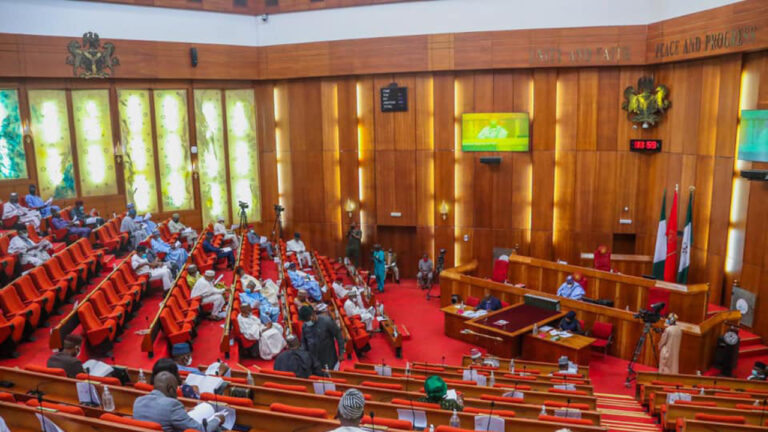
THE Senate has appointed 12 members to serve on a conference committee with the House of Representatives to harmonise differences on the Electoral Act Amendment Bill 2026, following heated plenary debates over provisions on electronic transmission of election results.

The Senate President, Godswill Akpabio, reached the decision after senators adopted the Votes and Proceedings of Wednesday, February 4, paving the way for the expansion of the Senate’s earlier nine-member conference committee to match the 12-member delegation already constituted by the House.

“The information we have is that our counterparts in the House of Representatives are 12 in number. While we have nine here, so we just have to move our number to 12, so that we can have 12-12,” Akpabio said.

He subsequently named Simon Lalong as chairman of the Senate conference committee, alongside other members

Tense plenary over voting procedure

A central flashpoint in the debate was a provision on the electronic transmission of election results.

The House of Representatives had passed a version of the bill mandating real-time electronic transmission of polling unit results to the Independent National Electoral Commission’s (INEC) Results Viewing Portal (IREV), a reform backed by civil society and opposition figures who say it would strengthen transparency.

However, during Senate consideration, lawmakers rejected a proposal to make real-time transmission mandatory. They instead adopting the existing legal provision that result transmission be done “in a manner as prescribed by the Commission.” Critics immediately condemned the move as weakening electoral transparency.

The debate on Tuesday began when the Senate Chief Whip, Mohammed Tahir Monguno, moved an amended proposal, effectively introducing a different motion.

He claimed to have seconded the motion, but when asked to clarify its content, he was unable to explain, worsening the uproar in the chamber.

Monguno insisted that he had seconded the earlier motion, which had already been passed but later rescinded, specifically regarding Section 60, Subsection 3 of the bill, part of which stipulates that the presiding officer should uphold results on the IREV portal after Form ECHA has been signed, in cases where electronic transmission fails and it becomes impossible to transmit results. The provision essentially designates Form ECHA as the primary source for election results in such circumstances.

A subsequent vote was conducted, and members voted unanimously.

However, Abia South senator, Enyinnaya Abaribe invoked Order 72, which allows any lawmaker to challenge the opinion of the Senate President or presiding chairman by requesting a division, effectively calling for a motion to be voted on individually. The move sparked some confusion and debate on the floor, with colleagues questioning why he had taken that action. 

After a brief pause while senators reviewed the relevant pages of the bill, Abaribe withdrew the order he had invoked.

The ICIR reported that this emergency plenary followed growing criticisms and protests that trailed the Senate’s position.

Ahead of the emergency sitting, some lawmakers acknowledged flaws in how the Senate handled the debate. The lawmaker representing Bauchi Central, Abdul Ningi, said on Channels TV on Monday that the Senate could make the voting process and individual stances on the electronic transmission provision transparent.

Meanwhile, Nigerians have continued to stage a peaceful demonstration at the gate of the National Assembly since last week Friday, demanding that the Senate include a compulsory provision for real-time electronic transmission of election results in the Electoral Act (Amendment) Bill, warning that Nigeria’s democracy would not survive without credible polls and real-time electronic result transmission.

They said failure to include the clause amounted to “setting the country on fire” over a minimum transparency requirement.

The ICIR reports that Nigeria’s elections have been flawed, with many election outcomes addressed by courts. Many citizens have accused the court of miscarrying justice, with judgement allegedly bought by moneybags.

In 2007, after winning litigation against his victory at the Supreme Court, the late former President Yar’Adua admitted that the election that brought him into office was flawed. He promised electoral reforms, but the nation has yet to get it right almost two decades later, as successive leaders failed to deliver legal document for achieving it.


Nigeria is 37th most corrupt nation – Report

0

NIGERIA has been ranked as the 37th most corrupt country in the world in 2025, slipping slightly in the Corruption Perceptions Index (CPI)

It moved from 140th in 2024 to 142nd in 2025, out of 182 countries, according to the latest report by Transparency International.

The number one nation on the list represents the country with the least corruption and 182 is the most corrupt.

Nigeria scored 26 points, sharing the position with Cameroon, Guatemala, Guinea, Kyrgyzstan, and Papua New Guinea.

The CPI measures perceived corruption in the public sector across 182 countries and territories.

Denmark topped the list as the least corrupt nation with 89 points, followed by Finland (88), Singapore (84), and New Zealand (81).

No African country made the top 10 least corrupt nations, though Seychelles, Cabo Verde, and Botswana were the continent’s least corrupt, scoring 68, 62, and 58.

At the bottom of the list are South Sudan, Somalia, and Venezuela, emerging as the world’s most corrupt countries.

Commenting on the CPI, TI CEO Maíra Martini said: “The 2025 Corruption Perceptions Index ranks 182 countries and territories worldwide by their perceived levels of public-sector corruption. The results are given on a scale of 0 (highly corrupt) to 100 (very clean).

“While 31 countries have significantly reduced their corruption levels since 2012, the rest are failing to tackle the problem — they have stayed stagnant or got worse during the same period. The global average has fallen to a new low of 42, while more than two-thirds of countries score below 50. And people are paying the price, as corruption leads to under-funded hospitals, unbuilt flood defences, and blights the hopes and dreams of young people.”

She added: “We’re seeing a concerning picture of long-term decline in leadership to tackle corruption. Even established democracies, like the US, UK and New Zealand, are experiencing a drop in performance. The absence of bold leadership is leading to weaker standards and enforcement, lowering ambition on anti-corruption efforts around the world.”

Marini said many states were increasing restrictions on civic space, stressing that by making it hard or dangerous for citizens, non-governmental organisations and journalists to challenge abuses of power, they are reducing transparency and accountability. This, she said, allowed corruption to flourish.

The official urged leaders to act fast and tackle abuses of power and the wider factors driving corruption, including the roll-back of democratic checks and balances, and attacks on independent civil society.

He further explained that anti-government protests in many parts of the world showed that people were fed up with unaccountable leadership and were demanding reform.

THE ICIR reported that Nigeria had crawled to 140 spot in TI global corruption ranking in 2024, with 26 scores from its 25th position in 2023.

Full list of rankings and scores (2025 CPI)

89 — Denmark — 1
88 — Finland — 2
84 — Singapore — 3
81 — New Zealand — 4
81 — Norway — 4
80 — Sweden — 6
80 — Switzerland — 6
78 — Luxembourg — 8
78 — Netherlands — 8
77 — Germany — 10
77 — Iceland — 10
76 — Australia — 12
76 — Estonia — 12
76 — Hong Kong — 12
76 — Ireland — 12
75 — Canada — 16
73 — Uruguay — 17
71 — Bhutan — 18
71 — Japan — 18
70 — United Kingdom — 20
69 — Austria — 21
69 — Belgium — 21
69 — United Arab Emirates — 21
68 — Barbados — 24
68 — Seychelles — 24
68 — Taiwan — 24
66 — France — 27
65 — Lithuania — 28
64 — Bahamas — 29
64 — United States of America — 29
63 — Brunei Darussalam — 31
63 — Chile — 31
63 — Saint Vincent and the Grenadines — 31
63 — South Korea — 31
62 — Cabo Verde — 35
62 — Israel — 35
60 — Dominica — 37
60 — Latvia — 37
59 — Czechia — 39
59 — Saint Lucia — 39
58 — Botswana — 41
58 — Qatar — 41
58 — Rwanda — 41
58 — Slovenia — 41
57 — Saudi Arabia — 45
56 — Costa Rica — 46
56 — Grenada — 46
56 — Portugal — 46
55 — Cyprus — 49
55 — Fiji — 49
55 — Spain — 49
53 — Italy — 52
53 — Poland — 52
52 — Malaysia — 54
52 — Oman — 54
50 — Bahrain — 56
50 — Georgia — 56
50 — Greece — 56
50 — Jordan — 56
49 — Malta — 60
48 — Mauritius — 61
48 — Slovakia — 61
47 — Croatia — 63
47 — Vanuatu — 63
46 — Armenia — 65
46 — Kuwait — 65
46 — Montenegro — 65
46 — Namibia — 65
46 — Senegal — 65
45 — Benin — 70
45 — Romania — 70
45 — Sao Tome and Principe — 70
44 — Jamaica — 73
44 — Solomon Islands — 73
44 — Timor-Leste — 73
43 — China — 76
43 — Côte d’Ivoire — 76
43 — Ghana — 76
43 — Kosovo — 76
42 — Moldova — 80
41 — South Africa — 81
41 — Trinidad and Tobago — 81
41 — Vietnam — 81
40 — Bulgaria — 84
40 — Burkina Faso — 84
40 — Cuba — 84
40 — Guyana — 84
40 — Hungary — 84
40 — North Macedonia — 84
40 — Tanzania — 84
39 — Albania — 91
39 — India — 91
39 — Maldives — 91
39 — Morocco — 91
39 — Tunisia — 91
38 — Ethiopia — 96
38 — Kazakhstan — 96
38 — Suriname — 96
37 — Colombia — 99
37 — Dominican Republic — 99
37 — Gambia — 99
37 — Lesotho — 99
37 — Zambia — 99
36 — Argentina — 104
36 — Belize — 104
36 — Ukraine — 104
35 — Brazil — 107
35 — Sri Lanka — 107
34 — Algeria — 109
34 — Bosnia and Herzegovina — 109
34 — Indonesia — 109
34 — Laos — 109
34 — Malawi — 109
34 — Nepal — 109
34 — Sierra Leone — 109
33 — Ecuador — 116
33 — Panama — 116
33 — Serbia — 116
33 — Thailand — 116
32 — Angola — 120
32 — El Salvador — 120
32 — Philippines — 120
32 — Togo — 120
31 — Belarus — 124
31 — Djibouti — 124
31 — Mongolia — 124
31 — Niger — 124
31 — Turkey — 124
31 — Uzbekistan — 124
30 — Azerbaijan — 130
30 — Egypt — 130
30 — Kenya — 130
30 — Mauritania — 130
30 — Peru — 130
29 — Gabon — 135
28 — Bolivia — 136
28 — Iraq — 136
28 — Liberia — 136
28 — Mali — 136
28 — Pakistan — 136
27 — Mexico — 141
26 — Cameroon — 142
26 — Guatemala — 142
26 — Guinea — 142
26 — Kyrgyzstan — 142
26 — Nigeria — 142
26 — Papua New Guinea — 142
25 — Madagascar — 148
25 — Uganda — 148
24 — Bangladesh — 150
24 — Central African Republic — 150
24 — Paraguay — 150
23 — Congo — 153
23 — Eswatini — 153
23 — Iran — 153
23 — Lebanon — 153
22 — Chad — 157
22 — Honduras — 157
22 — Russia — 157
22 — Zimbabwe — 157
21 — Guinea-Bissau — 161
21 — Mozambique — 161
20 — Cambodia — 163
20 — Comoros — 163
20 — Democratic Republic of the Congo — 163
19 — Tajikistan — 166
17 — Burundi — 167
17 — Turkmenistan — 167
16 — Afghanistan — 169
16 — Haiti — 169
16 — Myanmar — 169
15 — Equatorial Guinea — 172
15 — North Korea — 172
15 — Syria — 172
14 — Nicaragua — 175
14 — Sudan — 175
13 — Eritrea — 177
13 — Libya — 177
13 — Yemen — 177
10 — Venezuela — 180
9 — Somalia — 181
9 — South Sudan — 181

US to deport additional 18 Nigerian ‘criminals’, list jumps to 97

THE United States (US) Department of Homeland Security (DHS) has announced plans to deport another batch of 18 Nigerians listed on its “worst-of-the-worst” criminal register, raising the total number of the West Africa nation’s citizens scheduled for expulsion from the US to 97.

This comes barely one week after the ICIR reported that 79 Nigerians convicted of various offences had been marked for deportation by US authorities.

An update by the DHS on Monday revealed that 18 more names had been added to the list, signaling an expansion of the ongoing enforcement exercise.

“The US Department of Homeland Security is highlighting the worst of the worst criminal aliens arrested by the US Immigration and Customs Enforcement. Under Secretary Noem’s leadership, the hardworking men and women of DHS and ICE are fulfilling President Trump’s promise and carrying out mass deportations, starting with the worst of the worst, including the illegal aliens you see here,” the statement on the website read.

The DHS website shows that the Nigerians newly listed for deportation include Oluwaseyanu Akinola Afolabi, Olugbeminiyi Aderibigbe, Benjamin Ifebajo, Obinwanne Okeke, Kolawole Aminu, Oluwadamilola Olufunsho Ojo and Franklin Ibeabuchi.

Others are Alex Afolabi Ogunshakin, Joshua Ineh, Stephen Oseghale, Eghosa Obaretin, Adesina Surajudeen Lasisi, Ibrahim Ijaoba, Azeez Yinusa, Charles Akabuogu, Kelechi Umeh, Lotenna Chisom Umeadi, Donald Ehie, and Chukwudi Kingsley Kalu.

The security outfit noted that the arrests were part of a nationwide crackdown on criminal immigrants, whose most common offences included wire fraud, mail fraud and identity theft.

The latest figures highlight the Trump administration’s sustained hardline approach to illegal and criminal immigration, with several foreign nationals affected, including Nigerians.

The ICIR reported last week that the US listed 79 Nigerian nationals among worst of the worst criminal non-citizens arrested by the US Immigration and Customs Enforcement (ICE).

According to DHS Secretary Kristi Noem, the arrests form part of recent enforcement operations across several American states, noting that they were focused on removing undocumented immigrants with serious criminal convictions from the US.

While DHS has not provided a specific timeline for deportation, individuals listed are expected to face removal proceedings following their arrests, in line with US immigration laws.

The development adds to growing concerns among Nigerians in the US, particularly over the reputational impact of high-profile crime-related immigration enforcement actions.

Nigerians have been among those affected by the US deportation policy since Trump assumed power in January 2024.

Many Nigerians have either voluntarily returned home or were deported over offences ranging from immigration violations to criminal convictions.

Nigerians bear the brunt as Tinubu’s health budget suffers capital shortfall

0

NIGERIA’S fragile healthcare system continues to face renewed strain as the Coordinating Minister of Health and Social Welfare, Muhammad Ali Pate, disclosed that only ₦36 million was released from the ₦218 billion approved for the ministry’s 2025 capital projects.

Pate made the revelation on Monday, February 9,in Abuja during the ministry’s 2026 budget defence before the House of Representatives Committee on Healthcare Services, explaining that the severe funding shortfall stalled the implementation of critical health projects nationwide.

“Out of the N218 billion appropriated to the health sector by the parliament for the execution of capital projects in the 2025 fiscal year, only N36 million was released,” Pate said.

According to the minister, while the personnel allocation for 2025 was fully released and utilised, the capital component was unavailable.

He said this was due to the federal government’s bottom-up cash planning system, which constrained access to project funds.

He further noted that delays in releasing Nigeria’s counterpart contributions prevented the ministry from drawing down donor-supported financing tied to key health interventions, compounding the inability to execute planned projects.

Pate said the sector’s programmes were guided by national development frameworks such as Vision 20:2020, the National Development Plan 2021–2025, and the National Strategic Health Development Plan II.

He added that the frameworks were aimed at strengthening healthcare delivery and expanding access, particularly through primary healthcare and universal health coverage.

“The principles of universal health coverage are central to the national health policy objective of strengthening Nigeria’s health system, particularly the primary health care subsystem, to deliver quality, effective, efficient, equitable, accessible, affordable, acceptable and comprehensive health services to all Nigerians,” he said.

The ICIR reports that despite these policy commitments, the near absence of capital releases in 2025 reflected how millions of Nigerians have continued to face limited access to health infrastructure and essential services.

This also raised fresh questions about the government’s ability to translate health budgets into meeting citizens’ needs.

This was despite the very low budget five per cent allocation of the national budget to the sector in the 2025 appropriation act, which fell short of the Abuja declaration.

Long history of weak capital spending

The latest shortfall reflects a long-standing structural pattern in Nigeria’s health financing, where most public spending goes to salaries and other overhead costs rather than building, refurbishing hospitals and equipping them.

The ICIR investigation had in 2022 shown that government budget data showed that between 2011 and 2021, Nigeria spent about 72 percent of its health budgets on recurrent expenditure – paying salaries, training workers and running offices – leaving only a small fraction for capital projects such as building and equipping health facilities.

Within the same period, although roughly ₦640 billion was earmarked for capital investment, less than 80 percent of that amount was released, further weakening infrastructure development across the sector.

This imbalance has persisted for years with health allocations also remaining far below the 15 per cent benchmark that African leaders agreed to provide in what is widely known as Abuja Declaration, with Nigeria often committing below eight per cent of its national budget to health since the declaration.

Recall that in January 2025, Pate also disclosed that only 15.06 per cent of the 2024 ministry’s capital allocation was released, despite billions earmarked for infrastructure and services.

Sector under severe strain

Nigeria, with a population nearing 250 million, continues to face deep structural challenges in healthcare delivery despite modest progress in recent years.

Out-of-pocket spending accounts for about 74.68 per cent of total health financing, placing a heavy burden on households and limiting access to essential services. Neonatal mortality remains high at 41 deaths per 1,000 live births as of 2023, while the maternal mortality rate of 576 deaths per 100,000 live births ranks among the worst globally.

The system is also critically understaffed, with about 55,000 licensed doctors serving the population as of March 2024.

The ICIR reports that inequitable distribution of services, weak infrastructure, persistent brain drain and widening socioeconomic inequalities, particularly in rural and underserved communities, have continued to deepen health disparities.

Many facilities lack basic equipment, medicines and essential amenities, while poor remuneration and working conditions drive the continued emigration of skilled health professionals, further weakening service delivery.

At different times, recurring strikes have crippled services in public hospitals because of workers-government face-offs over pay and other demands.

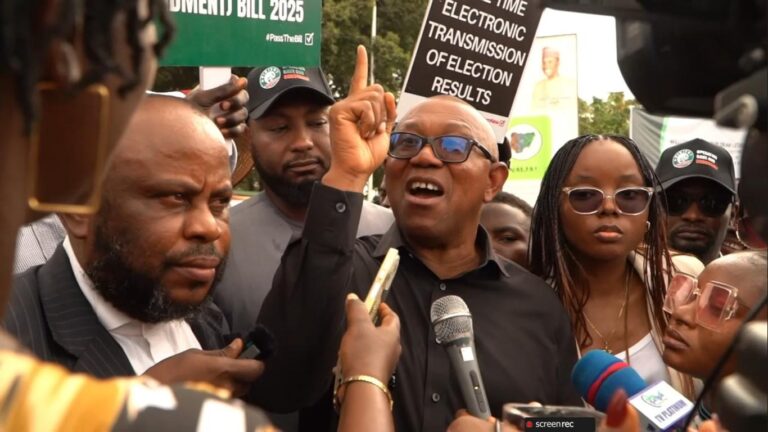
Obi, Fayose, Yesufu, others protest in Abuja, demand mandatory electronic transmission of election results

2

THE 2023 presidential candidate of the Labour Party, Peter Obi, has joined the coalition of civil society organisations to demand the inclusion of a compulsory provision for real-time electronic transmission of election results in the Electoral Act (Amendment) Bill, warning that Nigeria’s democracy would not survive without credible polls.

Obi made the demand during a peaceful protest organised by a civil society group, “Enough is Enough”, at the National Assembly on Monday in Abuja.

“Election must take its process from the beginning of qualification to the campaigns, to the debates. Everything must be done in a manner that we will show we are exemplary as giants of Africa. This giant must now rise and be giant. We cannot continue to be giants in doing the wrong thing. We want to be giants in doing the right thing now. We must dismantle our criminality and show that we are not a nation that should lie to Africa,” Obi said.

The ICIR reported that the Senate on Wednesday, February 4, approved the Electoral Act (Amendment) Bill which introduced several changes but failed to include real time transmission of results from polling units to INEC’s Result Viewing Portal (IREV), as advocated by most Nigerians.

Some senators in the minority caucus told journalists on Thursday that the approved Electoral Bill did not accommodate real time electronic transmission of election results.

However, the Senate President, Godswill Akpabio, speaking at a book launch on Saturday, acknowledged that the Senate removed the provision for mandatory real-time electronic transmission of results during the clause-by-clause consideration of the amendment.

He said the decision was informed by concerns that enforcing real-time transmission could lead to legal disputes in the event of network failures during polls.

However, during Monday protest, the representative of Lawyers in Defence of Democracy, Okere Kingdom, said in the Electoral Act, there must be provision for transmitting election results from the polling booths to online, in real time, for Nigerians to view on IReV. He insisted that anything short of mandatory electronic transmission would leave room for votes manipulation.

He accused the former INEC chairman, Mahmood Yakubu, of what he called “wrongful exercise of discretion” during previous elections, alleging that objections raised by stakeholders were ignored, leading to disputed outcomes.

“The description that Yakubu Mahmoud exercised when he leveraged on the current Electoral Act, how did he exercise it? Objection was raised at the International Conference Centre. He ignored his own regulation. The regulation said if an objection is raised, you will suspend everything and resolve it. 

“When objection was raised, he ignored it and continued and delivered a wrong result, a fraudulent result. So, we are saying no wrongful exercise of description. The Senate must know that Nigerians are saying no and will resist wrongful exercise of description,” he added.

Similarly, an activist, Aisha Yusufu, said that Nigerians were no longer interested in “press conferences, media rounds or Twitter spaces” by senators, but concrete legislative action, noting that the National Assembly had the constitutional authority to ensure that electronic transmission of results is clearly provided for in the law.    

“The Senate President is saying that there are places where there are no networks. If they don’t have, which is a shame by the way, Nigeria would provide that network. If either can register everywhere, they can also provide those networks,” she said.

The activist countered Akpabio’s position, noting that telecommunications companies provided network coverage across the country and that the same infrastructure used by INEC for voter registration could support result transmission.

Also speaking at the protest ground, Isaac Fayose, younger brother of former Ekiti State Governor Ayo Fayose, dismissed claims that poor network coverage would make electronic transmission of results impossible, describing such arguments as excuses meant to justify electoral fraud.

He questioned how Nigeria could justify spending hundreds of billions, and in some cases trillions of naira, on elections and technology, only to abandon a system designed to guarantee transparency.

“How do we explain something that we spend close to a billion, a trillion, and you just want to throw it away like that? It’s like carrying our money, throwing it like that. No, it’s not possible,” he said.

The ICIR reported that threatened by criticisms that trailed the Senate’s position, Akpabio directed his colleagues to reconvene for an emergency plenary session on Tuesday, February 10.

The Upper Chamber had adjourned for a two-week recess after approving the bill, to enable senators to engage heads of ministries, departments and agencies (MDAs) on the defence of their 2026 budget proposals.

Under Clause 60 of the bill, the Senate retained the provision in the Electoral Act which permits the transmission of results to collation centres.

On voter identification, Clause 47 was amended as lawmakers rejected a proposal to allow alternative forms of identification other than the Permanent Voter Card (PVC). While “smart card readers” were replaced with the Bimodal Voter Accreditation System (BVAS) for accreditation and voting, the Senate retained the PVC as the sole mandatory means of voter identification at polling units.

Earlier, the bill had proposed that because BVAS would not read the microchip embedded in PVCs, the card should no longer be compulsory, allowing voters to use the National Identification Number (NIN), international passport or birth certificate. However, the Senate disagreed and upheld the PVC as the primary mode of identification.

On Clause 22, which deals with PVC-related offences, lawmakers rejected a proposed 10-year jail term for buying and selling PVCs. They instead retained a two-year imprisonment term and increased the fine from N2 million to N5 million.

Regarding proof of non-compliance, the Senate deleted Clause 142, which would have allowed political parties to establish non-compliance solely through original or certified documentary evidence without oral testimony. Lawmakers argued during clause-by-clause consideration that the provision would amount to a “waste of time in court.”

On ballot paper inspection, Clause 44 was retained, maintaining the existing procedure that gives political parties two days to submit written approval or disapproval of their representations on sample ballot papers. INEC is also required to invite parties to inspect sample electoral materials at least 20 days before an election.

Under Clause 29, the deadline for political parties to submit candidate lists was reduced from 120 days to 90 days before an election.

To curb vote buying, lawmakers also amended Clause 22 to impose stiffer penalties, increasing the fine for offenders from N500,000 to N5 million.

On post-election disputes, the Senate amended Clause 136 by removing the power of election tribunals to declare winners outright in certain situations. The amendment provides that where a candidate is found not to have been validly elected for failing to score the majority of lawful votes, a rerun election shall be conducted, and the disqualified candidate and sponsoring party will be barred from participating.

This provision differs from the 2022 Electoral Act, which allows a tribunal to declare the candidate with the second-highest number of valid votes the winner where the candidate with the highest votes is found to be unqualified.

SEDC will need protection from political extortion

0

By Chidi Anselm ODNKALU

When he presented his budget proposals for 2024 to Nigeria’s National Assembly, the first full year of appropriations under his presidency, President Bola Ahmed Tinubu identified as his priorities, human asset development, poverty reduction and fighting insecurity.  Last week, his official spokesperson, Bayo Onanuga, appeared to forget or renounce that policy direction, when he acknowledged that 133 million Nigerians were multi-dimensionally poor but claimed that had nothing to do with the Federal Government. According to Onanuga, the states and local governments were responsible for that.

On the same day, 450 kilometres away, Vice-President, Kashim Shettima, provided a full rebuttal of Onanuga’s escape into sovereign abdication. The occasion was the launch of the stakeholder consultation of the Southeast Development Commission, SEDC for its regional development plan called Southeast Vision 2050 (SEV2050). At the event, the Vice-President went beyond merely reaffirming the leadership and responsibility of the Federal Government in eliminating poverty. He also underscored that this had to be “inclusive, sustainable, and anchored on peace and productivity.”

This was not an unveiling of the SEV2050. Rather it kicked off the process to evolve one. It was also the coming out promenade of the SEDC.

The Commission is one of the four regional development bodies established by President Tinubu under the Ministry of Regional Development. The others are in the north-central, north-west, south-west. Preceding these, the Niger Delta Development Commission, NDDC, has been in existence since 2000; and the North-East Development Commission, NEDC, since 2017.

The Stakeholder consultation in Enugu was a credit to the Board of the SEDC chaired by Emega Wogu and the management led by the Managing Director, Mark Okoye. It was clearly a pitch for political support and constituency building for the Commission. The SEDC achieved the significant feat of lining up the public support of the governors of all five states of the south-east. By contrast, when its counterpart for the north-west organised similar event last month, none of the seven governors of the zone attended.

Imo State Governor, Hope Uzodinma, coincidentally the chair of the South-East Governors Forum, was the only one of the five who did not attend in person. He sent the Speaker of the State House of Assembly in his stead. It appears the Commission will not be short of goodwill as it sets out on its mission. Quite clearly also, it will not be short of human obstacles in its path.

As its primary mission, the SEDC Act of 2024 charges the Commission with responsibility to “receive and manage funds from allocations of the Federation Account for the reconstruction and rehabilitation of roads, houses and other infrastructural damages suffered by the region as a result of the effect of the Civil War….” The SEDC is the only regional development commission with an explicit mission of post-war reconstruction. One question that the consultation put before the Commission was: reconstruction from which war?

Anambra State Governor, Chukwuma Soludo, addressed this question in his remarks arguing that the region was in recovery from not one war but “two major wars”. One was the Nigeria-Biafra war, which was supposed to have officially ended on 15 January 1970. The second was what he called “an internal war of self-destruction that has been on since 2021.” Some people may argue that his dating of this second conflict to 2021 is either artificial or unrealistically recent.

It was notable that Governor Soludo failed to say who the parties were to this second war. Pointedly, however, he noted that “after the (first) civil war, there was a promise of rehabilitation and reconstruction; and…. this is yet to happen.” What he left unsaid was that the failure to fulfill that promise made what he described as the second war all but inevitable. Whether that was deliberate or inadvertent is immaterial.

Even as it sought to project an ambition over the next quarter century, the SEV2050 consultation could not escape the enduring backdrop of reconstruction that frames its search for a mission. The mistake will be to focus on brick and mortar and forget to prioritise a reconstruction of minds, memories, and mentalities.

Vice-President Shettima acknowledged as much with some deftness in his opening remarks when he paid tribute to “a region defined not only by memory, but by motion.” Like Governor Soludo, what he left unsaid was even more eloquent. It was impossible to miss that he felt unable to say that this motion led to movement or progress.

How to transform motion into movement and ultimately to regional progress more than half a century after the end of the conflict that continues to define independent Nigeria is what the SEDC seeks.

On show were early signs of constructive competition among the states of the south-east. It begs to be harnessed.

Abia State offers a vision for energy transition to inspire value-added processing and industry.

Anambra State is willing to lead in enterprise and innovation. Ebonyi State’s value offer is in food security and agriculture value chain.Enugu State offers a secure home for a shared mission of co-ordination for regional prosperity.

These reassure. But the event equally advertised the daunting challenges that confront the Commission along its path. Three were evident.

One is a crisis of mismatched expectation. This was best illustrated by Governor Soludo. Having advised the Commission to be realistic in its ambitions, he nevertheless asked it to lead the delivery of a “Marshall Plan” for the south-east, a reference to the US-led plan for Europe’s reconstruction after World War II. According to Governor Soludo, this regional Marshall Plan should include a regional security framework, and “super inter-state infrastructure” such as regional railways and regional highways. The problem, however, is that an SEDC that purports to lead on the former is likely to antagonise the state governors and a Commission that claims to lead on the latter will be on a fool’s errand.

Two is the problem of evolving a viable business model for the SEDC. For long, the NDDC has defined the business model of the regional development commissions. Under this model, these commissions operate largely as front offices for extortion which holds the fate of citizens of the concerned region(s) hostage in carve ups by political insiders sharing development funds as private loot. By 2022, according to one report on the NDDC, “12,000 out of 13,377 projects were abandoned after paying trillions of naira for them.” As development agents, they have been largely ineffectual. The SEDC can’t afford this.

Therefore, SEDC will face pushback from the usual species of greedy political grubbiness. The event in Enugu had in attendance the Vice-President, the Governors of all the south-east States, and the Speaker of the House of Representatives who was represented by Majority Leader, Professor Julius Ihonvbere.

But it was impossible not to notice the absence of the Chairman of the SEDC Committee in the Senate and former Governor of Abia State, Orji Uzor Kalu; his counterpart in the House of Representatives, Chris Nkwonta; and the man who refers to himself as “Number Six Citizen”, Deputy Speaker, Benjamin Kalu. Senator Orji Kalu reportedly sent one of his daughters to represent him. She holds no relevant public office. Anyone who thinks the near collective absence of the National Assembly caucus of the region was a coincidence misunderstands how the place works.

As a convening, the SEV2050 event in Enugu has been arguably as successful as its planners could have hoped. In terms of its symbolisms and optics, it may indeed have exceeded expectations. The Commission will not be short of ideas as it goes forward; nor will it be short of determined antagonists.

Post-war reconstruction is an existential undertaking. The SEDC has neither the budgets nor the latitude for the errors that have become the habits of the NDDC. If the Commission can confine its mission and secure protection against baleful political extortion from predictable sources, it may lay durable foundations under its current leadership for a business model suited to its unique and historic mission.

A lawyer and a teacher, Odinkalu can be reached at chidi.odinkalu@tufts.edu

Things to know as FCT holds area council poll on February 21

0

LESS than two weeks to the February 21 Federal Capital Territory (FCT) Area Council elections, political parties across the six councils namely Abaji, Abuja Municipal Area Council (AMAC), Bwari, Gwagwalada, Kuje and Kwali are revving their campaigns.

The contest is expected to shape grassroots governance in the nation’s capital, where the Peoples’ Democratic Party (PDP) and the All Progressives Congress (APC) shared the councils in previous election.

The Independent National Electoral Commission (INEC) fixed February 21, 2026, for the poll, with campaigns running until February 19 after publication of the final candidates list in September 2025.

The INEC had cleared more than 1.6 million registered voters to participate in electing six chairmen and 62 councillors across the councils.

According to the figure released by the Resident Electoral Commissioner (REC) for the FCT, Aminu Idris, the number of voters for the poll stands at 1,680,315.

Idris also said INEC had approved the decongestion of large Registration Area Centres to enhance efficiency and ease the movement of personnel and election materials on polling day. This, he explained, led to the establishment of sub-RACs in Dutse Alhaji and Kubwa wards in Bwari Area Council, as well as in Gwarinpa and Kabusa wards within the Abuja Municipal Area Council.

The REC further disclosed that elections would not be conducted in four polling units across the FCT because no voters registered there during the last voter registration and revalidation exercise. 

Three of the affected polling units are located in Garki Ward, while the remaining one is in Jiwa Ward.

The election will hold in 2,822 polling units of the 62 wards in the FCT.

However, the build-up to the exercise has been shaped by court rulings and intra-party conflicts. 

A Federal High Court in Abuja on January 20, ordered INEC to recognise candidate lists from some parties, including the African Democratic Congress (ADC), while disputes over nomination processes and candidate eligibility have also trailed the Labour Party (LP) and the PDP. 

Meanwhile, below are the major contenders across the six area councils as listed on INEC portal as of September 2025.

Abaji Area Council

Sokodabo Musa Bilyaminu emerged as the PDP’s consensus chairmanship candidate during the party’s primaries in June 2025, securing all delegate votes. He was the only contestant according to the Electoral Committee Chairman.

His emergence positions him as the party’s frontline challenger in what is expected to be a fierce competition among the three leading parties – the PDP, APC, and ADC. The APC won the seat in 2022.

Umar Abdullahi is the APC flagbearer as the party seeks to retain the seat. Mohammed Ibrahim picked the ADC ticket and will be seeking to cause a major upset for his rivals. It is, however, unclear if INEC has delisted him to entertain the court-ordered names from the David Mark-led national executives of the party.

Abuja Municipal Area Council (AMAC)

AMAC, being the home to Nigeria’s seat of power and major national institutions, is widely regarded as the most developed council in the FCT. It will see 16 political parties vying for its chairmanship seat.

Danlani Zadna clinched the PDP ticket after Michael Jigu withdrew from the race. This left Danlami as the lone contestant and winner with all 30 delegates votes at the primary. 

Zakka Christopher flies the APC flag in AMAC, seeking to retain the seat for his party. The PDP won the poll in previous election (in 2022), but the chairman, Christopher Maikalangu, defected to the APC in 2025, citing loss of federal jobs by his constituents. 

Similarly, Paul Moses Ogidi is the ADC flagbearer in the election.

Bwari Area Council   

Adamu Julius secured the PDP ticket after winning the party’s primary with 19 votes against Elimelech Jebida, who garnered six votes. Others namely Abdullahi Abuja Zakanbonton, Haruna Muhammed, and Ephraim Dauda got one vote each.

Julius candidacy followed the PDP’s electoral success in Bwari, where the party previously won the chairmanship seat. 

Haruna Shekwoloaudi leads the APC’s bid to win the area council’s chairmanship, while Musa Josiah Abinto picked the ADC ticket, according to INEC list of registered candidates.

Gwagwalada Area Council

For Gwagwalada Area Council, Mohammed Kasim emerged the winner of the PDP primary, securing 19 votes to defeat Rabiu Adamu, who polled 11 votes.  His candidacy aims to reclaim a council previously won by the APC. He will be contesting against Yahaya Usman Shehu of the APC and Danjuma Iko Afanyibada of ADC.

Kuje Area Council

Zakwoyi Danlami, the PDP candidate in the forthcoming exercise is contesting against Danjuma Samuel Shekwolo of the APC, and ADC’s Knabayi Stephen Adalo.

The area council is currently led by the PDP.

The party will seek to hold its grip on an area council that has recorded landmark transformation from both its current chairman’s efforts and President Bola Tinubu-led government.

Both the PDP and APC-led governments have been widely commended for executing internal road projects across the town, with the two Federal Government-funded dual highways planned to connect Kuje to Gwagwalada and the main city.

Kwali Area Council

Haruna Pai Muhammed secured the PDP ticket in a three-way primary contest, emerging with the highest delegate votes. Daniel Nuhu Kwali (APC) leads his party’s campaign to regain the council it previously controlled.

Meanwhile, Bandoj Jeremiah won ADC ticket in the area council, defeating other major contender.

The ICIR reports that beyond the PDP, APC and ADC, other parties are fielding candidates in the election, with up to 16 parties in AMAC and between nine and 11 in others.