Home Blog Page 868

From Tafa to Egbetokun usual rhetoric: IGPs who ordered withdrawal of police from VIPs

OVER the past decade,  order for the withdrawal of police escorts from private individuals organisations and VIPS has become a trend for successive Inspector General of Police (IGP), however, these orders have proven abortive and or unimplemented.


The Acting IGP Olukayode Egbetokun, ordered that personnel of the Police Mobile Force (PMF) would be withdrawn from VIPs escort and guard duties.

Speaking on Monday, June 26, in Abuja Egbetokun said, “Specifically, we shall effect the withdrawal of PMF personnel from VIP escort and guard duties.”

The Police Chief noted that it was imperative that the force realign its priorities to address the escalating security challenges faced by the nation.

“By relieving the PMF of VIP escort and guard duties, we can redirect their focus and efforts toward addressing critical security concerns that affect our communities at large,” he stated. 

The move by Egbetokun generated reactions, some of which state that such pronouncement is the ‘norm‘  or ‘rite of passage’ for new IGPS. Egbetokun was appointed as IGP in June – barely two weeks before making the pronouncement. 

Findings by The ICIR show that the order to withdraw police from private individuals and organisations has been a ritual for successive police chiefs over the years.

Tafa Balogun, 2003

In 2003, IGP Mustafa Adebayo Balogun ordered the withdrawal of police orderlies from judicial officers and politicians across the country.

Tafa Balogun, as he is popularly known, noted that ordered security details attached to some categories of dignitaries, including judges, be withdrawn from them.

Reacting to the withdrawal, the then-governor of Lagos,  Bola Tinubu, expressed the need to re-evaluate the move.

On October 13, 2003,  the Police authorities made a U-turn. Balogun ordered the return of police orderlies to judges in the country.

The next year,  2004, he ordered the immediate withdrawal of police orderlies from private individuals like chiefs Chris Uba, Emeka Offor and others.
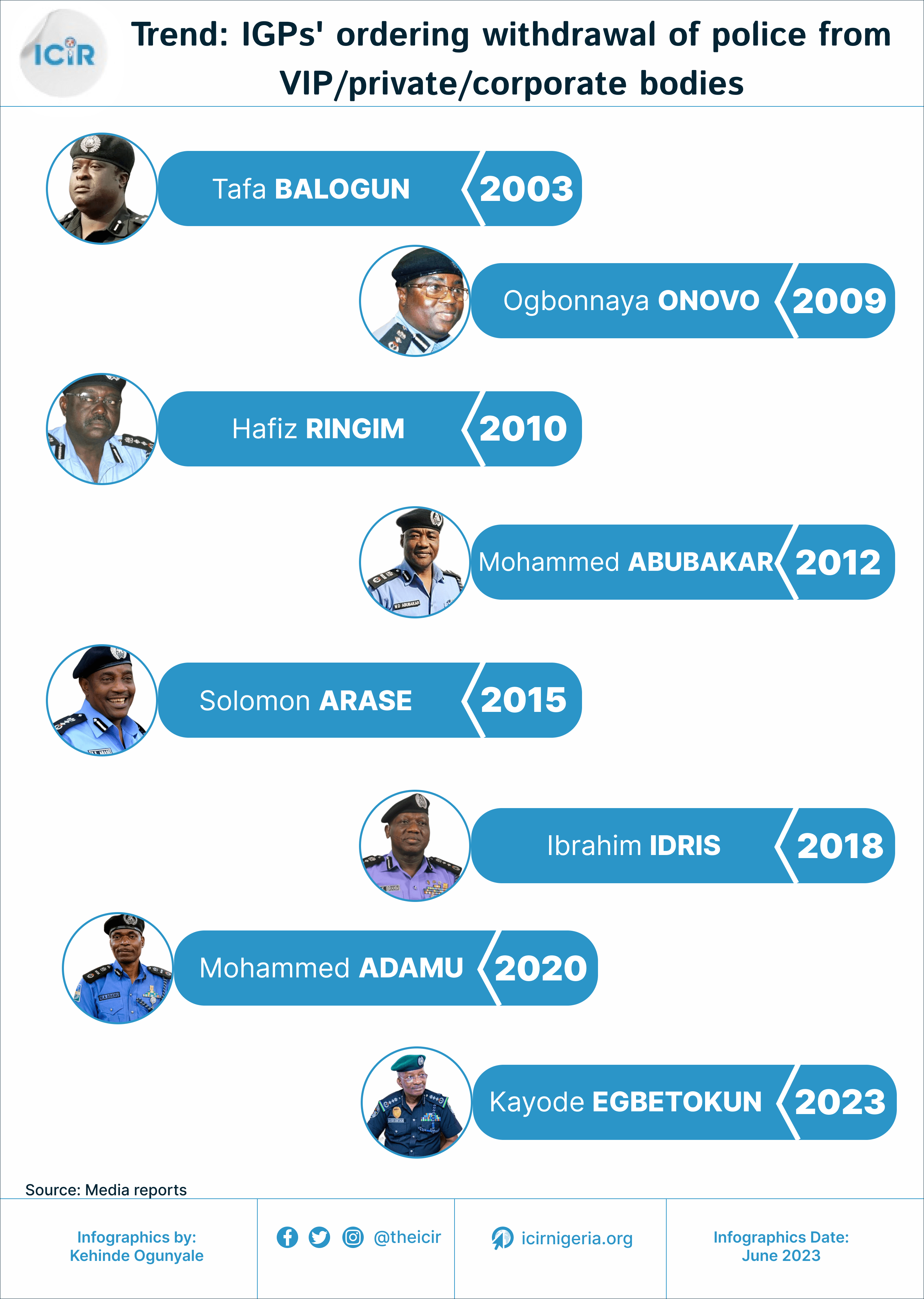
Infographic of past Inspectors General of Police who ordered withdrawal of police escorts from private individuals

Ogbonnaya Onovo, 2009

During his maiden press conference in August, 2009 as IGP, Ogbonnaya Onovo ordered all police personnel attached as private orderlies to private individuals to return to their bases.

The ICIR reported that Onovo’s audacious order included policemen attached to former heads of state, ministers, legislators and state governors.

Onovo explained that such security privileges were not approved by the Federal Executive Council(FEC).

He noted that the Federal Executive Council (FEC) had in earlier released the list of political and public office holders entitled to police aides.

According to Onovo, “the 22 political and public offices holders covered in the list are: “President of the Federal Republic of Nigeria, Vice President of the Federal Republic of Nigeria, Chief Justice of Nigeria, State Governors, Deputy Governors, Secretary to the Government of the Federation, (SGF), Head of Service of the Federation (HOSF), Ministers of the Government of the Federation, President of the court of Appeal and Justices of the Supreme Court.

Others include “Judges of the Court of Appeal, Chief Judge and Grand Khadi of a state, President, Customary Court of Appeal, Chairman of a Local Government Area Council, Vice Chairman of a Local Government Area Council, Chairman Independent Corrupt Practices and Other Related Offences Commission (ICPC)”

According to Onovo, offices of former Presidents, Vice -Presidents, Governors, deputy governors, wives of serving Presidents, vice presidents, governors, local government chairmen and their deputies as well as the chairman of EFCC, were not entitled to police personnel as private orderlies.

Giving a seven-day ultimatum to those having police aides illegally to send them back to their various commands, he noted that the function of police had been ridiculed by the roles bestowed upon them by those who make them aides.

“We had, under the past administration, made efforts to withdraw policemen from those who were not eligible. In our analysis, we found out that over 100,000 policemen were attached to individuals either as escorts, security or whatever.

“Some of these were legal because they were with those legible to have them, but most of them were illegal that is why you saw policemen carrying handbags at the airport, policemen escorting nonentities, policemen opening doors and windows in private rooms and so on and so forth thus undermining the integrity and respect that this uniform offers,” he declared.

Hafiz Ringim, 2010

Hafiz Ringim, who succeeded Onovo as IGP, issued a directive cautioning officers who guard unauthorised individuals to return to their bases as refusal would lead to arrest, delisting and prosecution 

According to the police spokesman at the time, Emmanuel Ojukwu,  Ringim constituted a special monitoring unit to ensure compliance to his directives.

Mohammed Abubakar, 2012

With an ambitious objective to deliver Nigeria the best policing service, Mohammed Abubakar rolled out a number of directives to restore the professionalism, integrity and lost glory of the police profession.

Among them was the cancellation and withdrawal of all approved police guards for private individuals and corporate bodies.

He noted that the withdrawal would ensure service delivery to the people while reiterating his plan to build a strong and vibrant police force to give the country “the best policing service”.

Solomon Arase,  2016

Speaking on March 12, 2016 to a  cross-sectional audience in Niger, the IGP Solomon Arase lamented that Nigeria was “grossly under-policed”, adding that there were just about 8,000 police personnel in Niger state.

He noted that he had directed that policemen on postings as orderlies to individuals, including politicians, be withdrawn immediately and redeployed to other more sensitive posts in order to provide the needed security across the country.

 “I have given a directive that policemen on postings as orderlies to individuals, including politicians, be withdrawn immediately and redeployed to other more sensitive posts in order to provide the needed security across the country,” Arase said.

Ibrahim Idris, 2018

In March 2018, the IGP Ibrahim Idris ordered the immediate withdrawal of police officers attached to VIPs, political and public officers across the country.

Idris stated that a memo would be sent to the President, Muhammadu Buhari, for approval.

The ICIR reported that the IG instructed the commissioners to return to their states and withdraw the police officers from private individuals and companies.

He said,  “In view of the current security challenges in the country, it has become expedient for the Nigeria Police Force to streamline the deployment of its personnel attached to political and public office holders, aimed at enhancing effective and efficient policing in the country.

“To this effect, a memo will be forwarded to the President for approval which will serve as a template for deployment to VIPs and public office holders in the country.“Accordingly, directive for withdrawal of all police officers deployed to VIPs, political and public office holders, with immediate effect, is hereby given.”

The Police Chief further frowned at the illegal use of sirens and police plate numbers.

Idris also directed holders of all police plate numbers to return them to the Force Transport Officer (FTO) at the headquarters, and they are expected to apply for re-validation.

Mohammed Adamu, 2020

Following the disbanding of the Special Anti-Robbery Squad (SARS) due to protest against the squad for high handedness and extrajudicial killings, the IGP Mohammed Adamu ordered the withdrawal of all police officers attached to VIPs across the country, with immediate effect.

He exempted those attached to Government Houses, the Senate President and the Speaker House of Representatives, from the order.

According to the statement issued to all state commissioners dated October 21, 2020, “any commander who violates this order will bear the consequences.”

The signal, which was signed by the AIPOL, Protect, Force Headquarters, Abuja, reads in part: “Any protect personnel found escorting or guarding any VIP with or without a firearm is deemed to be deployed by the commander, and the commander will be sanctioned.

Olukayode Egbetokun, 2023

The newly appointed IGP, Olukayode Egbetokun also toed the line. He ordered that personnel of the Police Mobile Force (PMF) would be withdrawn from VIPs escort and guard duties.

Environmental Photographer of the Year contest calls for entries

PHOTOGRAPHERS and photojournalists around the globe who have captured photos of the environment are invited to submit their materials.

The annual Environmental Photographer of the Year contest will recognise work that showcases the environment and the way humans interact with the natural habitat.

Entries should help judges think about humanity’s impact and the need for sustainability.

The competition is free for all ages. Categories include environmental photographer of the year, vision of the future, recovering nature, keeping 1.5 alive, adapting for tomorrow and young environmental photographer of the year.

Winners will be awarded cash prizes or gifts, which include Nikon photography equipment.

The deadline is August 30, 2023. Interested applicants can apply here.

NAFDAC warns of contaminated 50cl Sprite bottles in circulation

0

THERE’S an unknown quantity of contaminated Sprite, 50cl glass bottles, circulating across the country, according to the National Agency for Food and Drug Administration and Control (NAFDAC).

NAFDAC disclosed this in a statement released on Wednesday, June 28.

The Agency has urged distributors, retailers and consumers to be cautious and avoid consumption.

According to NAFDAC, the contaminated product was discovered after its post-marketing surveillance unit investigated consumer complaints.

NAFDAC said it had directed all its zonal directors nationwide to look out for the bottles.

“The affected batch of the unwholesome product has been sampled for laboratory analysis in the NAFDAC laboratory. The Agency has directed all zonal directors and state coordinators to carry out surveillance and mop up the implicated batch of the unwholesome product.

“Similarly, a comprehensive current Good Manufacturing Practice Inspection of the manufacturing site is to be carried out by the Agency; this is to find the root cause of the contamination and ensure compliance to marketing authorisation.”

The Agency further disclosed that the affected contaminated 50cl glass bottles came from the Nigerian Bottling Company Limited’s Abuja plant, with batch number AZ6 22:32.

Traders and consumers who have the contaminated drink in their possession have been instructed to submit the stock to the nearest NAFDAC office.

“NAFDAC implores distributors, retailers, and consumers to exercise caution and vigilance to avoid the consumption, sale, or distribution of the unwholesome product. The products’ authenticity and physical condition should be carefully checked.

“Anyone in possession of the above-mentioned batch of Sprite 50cl glass bottles is advised to submit stock to the nearest NAFDAC office. If you, or someone you know, have consumed this product or suffered any adverse reaction/event after consumption, you are advised to seek immediate medical advice from a qualified healthcare professional,” the Agency added.

Trafficking: 40 Nigerian migrants freed from Libyan detention

0

THE Nigerian Mission in Libya has facilitated the release of 40 Nigerian irregular migrants from the Bir Al-Ghanam detention facility in Libya.

The charge D’Affaires En Titre of the Nigerian Mission in Libya, Kabiru Musa, disclosed this in a statement issued on Wednesday, June 29.

He said the inmates, mostly women, were released on Tuesday, June 28.

“On Tuesday, June 27, 2023, the mission, in its continuous consular assistance to Nigerians in Libya, secured the release of forty irregular migrants who were arrested for immigration offences and detained by Libyan immigration authorities for almost two months,” he said.

The charge D’Affaires En Titre of the Mission said 34 inmates in the group are women who are victims of trafficking gangs. The six others are men.

There have been many cases of trafficking of Nigerians, often involving women and children, to other African countries, according to the United Nations Children’s Fund (UNICEF).

The global non-profit said the situation is driven by poverty, conflict, discrimination and injustice in Nigeria.

Speaking on the latest incident, Musa said the women were lured from Nigeria to Libya by traffickers who used them for manual labour.

“Among the arrested Nigerians are 34 females and six males who were detained at Bir Al-Ghanam detention facility that is about 150 miles away from Tripoli, the capital city.

“It was discovered that most of them were lured into travelling to Libya for greener pasture by their would-be traffickers, but they ended up under exploitation and enforced labour.

“On arrival at the embassy, we received them and admonished them on the need to return home with a promise never to embark on such a deadly journey through the desert again.”

The envoy urged the inmates to provide information about their traffickers in Nigeria and Libya

He said the Nigerians released will continue to be catered for by the Mission until they are repatriated.

“I also encouraged them to feel at home and be willing to give information about their traffickers and agents in Nigeria and Libya so that they can be arrested and punished for their crimes against humanity.

“In the meantime, the Mission will continue to cater for their needs, including feeding, accommodation, clothing and medicals until they can be repatriated home through the International Organisation for Migration (IOM),” Musa said.

Thousands of Nigerians have fallen prey to sophisticated trafficking gangs, living and too often dying in harsh conditions far from home.

25,000 Nigerian women and girls are trapped in Mali 

More than 25,000 trafficked Nigerian women and girls are currently trapped in Mali, according to the National Agency for the Prohibition of Trafficking in Persons (NAPTIP).

NAPTIP said its investigation into this “category of victims revealed that they were attracted to Malian men because they spend more money on women compared to Nigerian men”.

“The second major reason is that Malian men are proud of sleeping with women from Nigeria, the giant of Africa,” NAPTIP added.

Hospital withholds ex-Nigerian boxer Okorodudu’s corpse over unpaid bills

0

A PRIVATE hospital in Lagos has reportedly refused to release the corpse of former Nigerian boxer Jeremiah ‘Jerry’ Okorodudu, who died on Wednesday, June 28. 

He was 64.

Okorodudu died after battling foot ulcer and stroke.

Before his demise, there were reports that Okorodudu was not able to meet up with medical bills, which affected his treatment.

On Thursday, June 22, the ex-boxer’s wife, Atinuke, told The ICIR that Okorodudu was owing the hospital. She said the hospital demanded the immediate payment of N1 million medical bill, failing which the patient would be thrown out before weekend.

However, Atinuke did not disclose the name of the hospital, saying the proprietor had warned her not to give out the information.

Confirming Okorodudu’s death, a Nigerian sports journalist, Raymond Akparhuere of Eagle 7 Sports Radio, who is close to the ailing ex-boxer, told The ICIR, that the retired pugilist passed away on Wednesday afternoon.

“He died this afternoon, they could not pay the money for his medical bill,” he told The ICIR’s reporter on Wednesday.

Asked if he had heard from Atinuke, he said: “It is still fresh, I can’t call her.”

The ICIR sent a message to the late boxer’s wife to confirm his death but she has not responded as of the time of filing this report.

On a popular sports WhatsApp group, NSM, a source who pleaded anonymity  also disclosed the death of the ex-boxer.

According to him, the hospital withheld the corpse of the deceased due to debt owed during his stay in the hospital.

“I just got this now! Good evening sir. Jeremiah is gone and they said we can’t take his body away because we haven’t paid the balance of the hospital,” he posted.

The boxer’s wife later confirmed the development in a interview with The PUNCH.

She said the hospital was not willing to release her husband’s corpse until an outstanding N600,000 medical bill is paid.

“He is dead now but we still need to pay N600,000 to get his body out of the hospital,” she told The PUNCH.

Okorodudu represented Nigeria at the Los Angeles 1984 Olympic Games, where he competed in the middleweight category.

He was a gold medallist at the Oluyole ’79 National Sports Festival in Ibadan.

His medical predicament began in 2020 with a boil that affected his mobility. He then had a successful surgery at Dans Hospital, Irawo, Ikorodu, Lagos.

But his health condition relapsed after he was diagnosed of foot ulcer and suffered a stroke.

World Bank, IMF laud Tinubu’s economic reforms, urge timely palliatives

THE World Bank and the International Monetary Fund (IMF) have lauded President Bola Tinubu’s decision to effect key economic reforms as “bold choices.”

The World Bank estimates that Nigeria will save N3.9 trillion in 2023, equivalent to 1.6 per cent of the country’s gross domestic product (GDP), following petrol subsidy removal and foreign exchange unification move.

The Tinubu administration is riding on two key reforms of foreign exchange unification and fuel subsidy removal to reset the economy.

“The recently undertaken fuel subsidy removal and foreign exchange reforms are historic. N3.9 trillion in savings in 2023 alone stops Nigeria from going over a fiscal cliff and sets the stage for a new, upward investment, growth, and development trajectory,” the chief economist at World Bank Nigeria, Alex Sienaert, said on Tuesday, June 27 in Abuja at the launch of the Nigeria Development Update for June 2023.

“Headline inflation is expected to rise from 18.8 per cent in 2022 to 25 per cent in 2023. However, by Q1 (first quarter) of 2024, the subsidy removal will start to have a disinflationary effect, meaning that it will alleviate inflationary pressures despite higher petrol prices,” the Update stated.

Speaking about GDP performance in the first quarter of 2023, Sienaert said that increased poverty, accelerated inflation, severe forex distortions characterised the period.

He noted that the naira redesign caused a cash crunch, intensifying the drag caused by external conditions and other domestic policies.

He added that in contrast to the global trend, Nigeria’s inflation surged in the first half of 2023 as policy rate increases were ineffective in controlling inflation because the overall policy stance stayed loose.

“The naira demonetisation reduced GDP growth in manufacturing and services and did not improve either inflation or the forex parallel market rate premium. Inflation pushed an estimated four million more Nigerians into poverty in the first five months of 2023 as average prices of locally produced staples increased faster than average inflation,” he said.

Sienaert said that Nigeria’s debt-to- GDP ratio is estimated to hit 46 per cent, saying the Federal government would be paying off subsidy arrears to the Nigerian National Petroleum Company Limited (NNPC), in addition to other debts that must be serviced.

He expected public external debts to increase, though on a stable path,  following the recent reforms.

He added that if there were no buffers to cushion the impact of the reforms, over 7.1 million Nigerians would be further thrown into the poverty net on the back of the reforms and rising inflation.

He advised the Tinubu administration to leverage on the reforms to bend the economic development path upwards and also optimise its full potential, while highlighting the need to provide some timely, temporary and targeted assistance.

He said the subsidy removal was preventing further deterioration, adding that savings from the subsidy can also be used for other pro-poor service delivery such as health, education and infrastructure.

“The current coverage of social protection programmes is low at 19 per cent of the population. Nigeria will continue to spend less than $20 per person monthly,” he said.

The special adviser to President Tinubu on monetary policies, Wale Edun, said that other than the $800 million loan from the World Bank, there may be a need for additional loans to ensure sustainability of the bold reforms. He admitted  that the Federal government did not have enough money to spend.

Wale disclosed there were discussions between the chief of staff to the president, Femi Gbajabiamila, and stakeholders including unions, on interventions that would ameliorate reform effects, especially for the poor and most vulnerable people.

“And that involves using the World Bank’s financial muscle to have a loan that will be used as direct cash transfers for the poor. There are other elements in the medium and long term that will be put in place to deal with the immediate spike in inflation and ameliorate the initial pain,” he said.

He explained that the  direct cash transfers option was adopted because research had shown that it can actually reduce poverty.

Some other options considered included using compressed natural gas for cheaper energy source, mass transit options, housing and education. According to Edun, there is a fiscal dividend by which state governors are beneficiaries to the tune of about N4 trillion cash dividend.

“What has been identified right now and is being processed is one source of funding. However, like Oliver Twist, we are pointing out that it is not enough and there should be additional sources of funding, which the government is exploring.

“We have identified some sources of funding, but we are going after many more because having taken bold reforms, the rewards should come. The free markets, the financial markets and international investors around the world have rewarded both steps taken by Nigeria,” he added.

Speaking about loans from the Central Bank of Nigeria, Edun said there are regulations that stipulate how much the government can get from the financial regulator, which he promised the administration would abide by, while maintaining the central bank’s independence.

The Country Director for the World Bank for Nigeria, Shubham Chaudhuri, said the bold reforms required some form of buffers to cushion the impact of its consequences over the next few months to rebuild the trust of Nigerians.

“There’s also need to restore the confidence of investors, which will be challenging. The World Bank is here to provide whatever support in terms of ideas, potential solutions, and additional concessional financing,” he said.

Chaudhuri revealed that the Bank’s board approved the $800 million loan in December 2021 as there was a sense that Nigeria was ready to embark on bold reforms.

The Resident Representative of the International Monetary Fund (IMF) in Nigeria, Ari Aisen, considered reforms being done in the country as long overdue.

“It is natural that these policies have some side effects. We have seen inflation already high and it is likely to increase further. In our view, it will be difficult to tailor macroeconomic policies to reduce inflation and achieve durable macro stability. The central bank has a key role in stabilising the economy and it will require much tighter monetary position and stance than we currently see,” Aisen said.

He promised continued IMF support in terms of capacity building, policy advice, and financing, as needed.

Commenting on the option of direct cash transfers as a buffer, Alex Otti, the governor of Abia state, said there should be a sustainable way of ensuring that the targeted people are the ones who benefit from palliatives to avoid a repetition of what happened during the COVID-19 pandemic.

FG will stop funding WAEC, MDCN, others by 2026 – Budget office

THE West African Examination Council (WAEC) and National Automotive Design and Development Council (NADDC) are some of the notable government agencies that will stop getting budgetary allocations from 2026,The ICIR can confirm.

The Federal government has decided to stop funding some agencies, many of them professional bodies and councils.

The Director-General of the Budget Office, Ben Akabueze, disclosed this in a circular, DG/BDT/GEN.CORR/2016/XII/3067 dated June 26, 2023, addressed to the Nigerian Council of Food, Science & Technology, and the Federal Ministry of Science, Technology & Innovation.

According to Akabueze, the move was in line with the decision of the Presidential Committee on Salaries (PCS).

He noted that the implementation would be effected from December 31, 2026.

The memo read, “I wish to inform you that the Presidential Committee on Salaries (PCS) at its 13th meeting approved the discontinuation of budgetary allocation to Professional Bodies/Councils effective 2026.

“The purpose of this letter, therefore, is to inform you that in compliance with the PCS’s directive, this Office will no longer make budgetary provisions to your institution with effect from the above-stated date, and you will be regarded as a self-funded organisation.”

The official letter from the Budget office of the Federation on the directive

The affected agencies include the Teachers Registration Council of Nigeria, the Computer Registration Council, the Librarians Registration Council, the National Education Research and Development Council, the Mass Literacy Council, the National Examination Council and the West African Examination Council (Local and International) under the Ministry of Education.

Under the Ministry of Health, the Nursing and Midwifery Council, the Pharmacist Council of Nigeria, the Medical and Dental Council of Nigeria (MDCN), and the Medical Laboratory Science Council of Nigeria will be affected.

Others include the Environmental Health Council of Nigeria, the Nigeria Press Council, the Council for the Regulation of Freight Forwarding in Nigeria, the Council of Nigerian Mining Engineers and Geosciences, the Veterinary Council of Nigeria, the Council for the Regulation of Engineering in Nigeria, the Survey Council of Nigeria, the Legal Aid Council, the Council of Legal Education, the National Automotive Design and Development Council, the Nigeria Export Promotion Council, the Financial Reporting Council of Nigeria, the Nigeria Investment Promotion Council, and the Nigerian Council of Food Science and Technology.

NERC yet to give go-ahead on 40% electricity tariff hike

THE Nigerian Electricity Regulatory Commission (NERC) is yet to give official approval to a projected 40 per cent electricity tariff increment by the electricity distribution companies (DisCos).

Several news media had been awash with unconfirmed reports that the 11 DisCos would be effecting the increment from Saturday, July 1.

Although the NERC multi-year-tariff-order (MYTO) allows tariff review every six months while considering key variables like exchange rate, inflation and gas pricing, the regulator has not officially issued any directive on any tariff hike.

The projected tariff for July 2023 was expected to remove subsidy and increase the previously frozen tariff bands D and E, increasing the bands from N54.59/kilowatt to N62.16 for band D, and N48.37/kilowatt to N61.16 on average, with an average increase across the bands moving to N67/kilowatt.

Energy experts projected that inflation induced by the floating of the naira and fuel subsidy removal would spike the new average tariff to about N88/kilowatt for the energy sector to recover operational costs.

Over the past week, several media outlets had published the expected 40 per cent rise in tariff, following the MYTO order, in line with the half-yearly review.

Considering Nigeria’s fluctuating exchange rate occasioned by Federal government’s rates unification and double-digit inflation at 22.22 per cent, some analysts say it may be difficult not to hike the tariff in the next July 1 review window.

When contacted, a spokesperson of NERC, Mike Faloseyi, confirmed: “there is no official statement from NERC on the increment.”

The viral rumour about the tariff hike generated condemnations, with the organised private sector, particularly manufacturers, raising concerns on its effects on ease of doing business.

For instance, the Director-General of MAN, Segun Ajayi-Kadir, said in a statement that manufacturers spent, at least N144.5 billion on sourcing alternative energy in 2022, up from N77.22 billion in 2021, which translated to about 87 per cent increase in the cost of access to alternative energy sources by manufacturers within a year.

According to Ajayi-Kadir, electricity tariff had been increased in the last eight years by 186 per cent, which had posed a huge burden to manufacturing.

The statement noted that the fact that the government itself was owed N75 billion in unpaid electricity bills was indicative of how burdensome the cost of electricity had become.

The MAN chief mentioned that the absence of stable, effective and fairly priced electricity supply in Nigeria had been a long-standing challenge for manufacturers, adding that the worrisome development had compelled many manufacturing companies to supplement the unreliable electricity supply with alternative energy sources.

Amid the worries trailing the proposed tariff hike rumour, the Abuja Electricity Distribution Company (AEDC) yesterday, Monday, 26, announced to its franchise customers to disregard the communication circulating in the media regarding the review of the electricity tariff.

“Be informed that no approval for such increment has been received,” the AEDC stated in a statement signed by the management.

Similarly, the Ikeja DisCo has also called on its customers to disregard the tariff increment report.

Assuring its customers of no such plan, the DisCo described the report as “fake news.”

The statement on the Ikeja DisCo’s website read, “Public Notice: Avoid Fake News. Dear Esteemed Customer, if the information is not from, or is not on any of our social media handles, then it is not true.”

Why Nigeria’s forex unification must be effected with caution – Finance professor

A professor of Finance and Capital Market at the Nasarawa State University, Uche Uwaleke, has called for “cautious optimism” on the Federal government’s new foreign exchange unification policy. 

Uwaleke, who spoke in a monitored broadcast on Tuesday, June 27, on the Arise Television programme Business Morning, said the government must intensify efforts at improving the supply side of the dollar into the economy to prevent the policy from backfiring.

President Bola Ahmed Tinubu has made foreign exchange unification and fuel subsidy removal key policy directions of his administration, but Uwaleke has asserted certain conditions must be fulfilled to enable success.

“You have seen how the market has reacted to the forex situation already. A country must have sufficient reserves before pegging its currency to the dollar to sustain that. Another precondition is to diversify your export base.

“You can have a managed float system like Nigeria is doing, but transitioning will be done with caution. Our external reserves have dropped to about $1 billion since we commenced this forex unification project. This is why the Federal government and sub-nationals must intensify efforts to ensure increased supply and enable the convergence of the rates,” Uwaleke said.

He posited that the Central Bank of Nigeria (CBN) might need to increase interest rates above 18.5 per cent to enable expected capital inflows.

“Central banks all over the world face a dilemma, and that is why the interest rates need to go up to attract capital inflows from foreign investors. Egypt did a similar policy and have not recovered from it till today. The International Monetary Fund is even telling them that they have not done enough,” he said.

He stressed the importance of Nigeria diversifying its export base to attract more foreign exchange into the economy.

Notably, the exchange rate between the naira and the dollar at the investor and exporter window went for as high as N840/$1 on June 26, 2023, sending jitters to currency watchers.


READ ALSO:


This is the highest rate traded for the dollar on the official market since the I&E window was launched. The last highest intra-day high was N815/$1.

Nigeria had adopted a market-driven exchange rate policy two weeks ago, leading to an immediate depreciation of the exchange rate from about N471.67/$1 to an average of N765/$1.

In terms of turnover, the I&E window recorded a volume of $198.13 million on Monday, June 26, 2023. Total turnover since the revised I&E window was launched is about $1.4 billion.

How Nigerian government’s policies pushed more citizens into poverty – World Bank

THE World Bank has asserted that some policies of the Nigerian Federal government pushed more citizens into different categories of poverty.

The Bank cited, in its latest report in its Nigeria Development Update (NDU) 2023, the country’s inflation rate as one of the highest globally, a situation it said pushed an estimated four million people into poverty between January and May 2023.

The report was launched on Tuesday, June 27 in Abuja.

The ICIR had reported how CBN’s lending to the Federal government over the stipulated limits was negatively impacting inflation and consequently compounding poverty levels.

In the NDU 2023 document, the global lender warned that about 7.1 million poor Nigerians would become poorer if the Federal government failed to compensate or provide palliatives for them, following the removal of fuel subsidy.

According to World Bank data, 89.8 million Nigerians were poor as of the beginning of this year, but the number rose to 93.8 million with the additional four million that became poor between January and May this year.

The latest projection is that the number will further rise to 100.9 million if the government failed to compensate vulnerable citizens for fuel subsidy removal.

The report read in part, “Consumer price inflation has surged and is currently one of the highest globally, which is related to Nigeria’s fiscal imbalance and points to the urgency of reform efforts. Inflation in Nigeria has been high for many years due to structural factors, but it escalated in 2022 to the point where consumer prices increased at their fastest pace for 17 years.”

The report also noted that consumer price index further accelerated in 2023 through May by 22.4 per cent year-on-year. Inflation was also driven by the monetisation of the fiscal deficit by the CBN, multiple exchange rates and exchange rate depreciation in the parallel market, and intensified trade restrictions, exacerbated by the spike in global food and energy prices.

“The CBN implemented measures to control rising inflation, including raising the monetary policy rate by 700 basis points, but these proved ineffective, and monetary policy remained loose overall in the first half of the year. The loss of purchasing power from high inflation has increased poverty in the short-term, pushing an estimated four million Nigerians into poverty between January and May 2023.”

The National Bureau of Statistics (NBS) recently disclosed that inflation in the country rose to 22.41 per cent in May, which is the highest in about 19 years.

Also, the NBS, in its National Multidimensional Poverty Index (MPI) report, disclosed that 133 million Nigerians were multi-dimensionally poor.

The NBS said 63 per cent of Nigerians were poor due to a lack of access to health, education, living standards, employment, and security.

In its new report, the World Bank noted that the loss of purchasing power increased the poverty headcount rate by an estimated 2 percentage points, or the four million people.

The World Bank added that the number of poor people in rural areas increased by an estimated four per cent, while in urban settings, there was an estimated increase of 11 per cent.

The report read, “In the immediate term, the removal of the petrol subsidy has caused an increase in prices, adversely affecting poor and economically insecure Nigerian households. Petrol prices appear to have almost tripled following the subsidy removal.

“The poor and economically insecure households, who directly purchase and use petrol, as well as those that indirectly consume petrol, are adversely affected by the price increase. Among the poor and economically insecure, 38 per cent own a motorcycle and 23 per cent own a generator that depends on petrol. Many more use petrol- dependent transportation.

“The poor and economically insecure households will face an equivalent income loss of N5,700 per month, and, without compensation, an additional 7.1 million people will be pushed into poverty.”

The World Bank warned that many newly poor and economically insecure households would likely resort to consequential coping mechanisms, such as “not sending children to school, or not going to the health facilities to seek preventive healthcare, or cutting back on nutritious dietary choices.”

The Bank stressed the need for adequate compensation, noting that compensating transfers would be essential in helping to shield Nigerian households from the initial price impacts of the subsidy reform.

The lending institution further applauded the removal of the subsidy and foreign exchange management reforms, which it maintained were crucial measures in rebuilding fiscal space and restore macroeconomic stability.