PRESIDENT Muhammadu Buhari has asked the Senate to confirm the appointment of 12 nominees as members of the Governing Board of the North East Development Commission (NEDC).
According to the statement released by the presidential spokesperson Garba Shehu on Friday, May 5, the President’s request is contained in a letter addressed to the President of the Senate Ahmed Lawan.
The letter dated May 3, 2023, read: “In accordance with the provision of Part 1, section 2(5)(b) of the North-East Development Commission Establishment Act, 2017, I am pleased to present for confirmation by the Senate, the appointment of twelve (12) nominees as tabulated below, in the Governing Board of the North East Development Commission.
‘‘The Senate is invited to note that the tenure of the current Governing Board of the North-East Development Commission will end on May 7, 2023.’’
The nominees include: Bashir Baale, Chairman, (North-East, Yobe), Suwaiba Baba, Executive Director, Humanitarian Affairs, (North-East, Taraba), Musa Yashi, Executive Director, Administration and Finance, (North-East, Bauchi), Ismaila Maksha, Executive Director, Operations (North-East, Adamawa) and Umar Hashidu, MD/CEO, (North-East, Gombe).
Others are Grema Ali, member, (North-East, Borno), Onyeka Gospel-Tony, member, (South-East), Hailmary Aipoh, member, (South-South), Babatunde Akanbi (retd), member, (South-West), Mustapha Ibrahim, member, (North-West), Hadiza Maina, member, (North-Central) and a representative from the Federal Ministry of Finance, Budget and National Planning.
The President expressed hope that his request ‘‘will receive the usual expeditious consideration and confirmation of the Senate”.
THE National Population Commission (NPC) says the data that will be generated from the 2023 population census will be used to address Nigeria’s problems.
NPC commissioner, Abdulmalik Durunguwa, while briefing the Southern Kaduna Journalists Forum in Abuja on Friday, May 5, said most of the country’s challenges would be addressed when the census is conducted in a thorough manner.
According to the commissioner, the exercise would show the government where the problems are.
“The data that is required is more about where you reside and not your village or state because the essence of the data is to solve people’s problems wherever you are.
“The country needs to know the composition and the dynamics of its population and as such, people should be counted wherever they are,” he said.
The national population census had been postponed twice. It had been earlier slated for March 29.
But due to the postponement of the gubernatorial and state assembly elections, it was rescheduled to May 3 and was later postponed indefinitely.
However, the commissioner hinted that the exercise would be conducted as soon as the new administration is inaugurated.
He also said the census will provide the government with a working document that will be used to respond to peculiar challenges affecting people residing in different parts of the country.
“Most of the population data currently in use in Nigeria is estimated. We need to know the actual number of poor among us, the number of out-of-school children, the poverty level and other indices.
“The last census was conducted in 2006 and children born that year are already 17 years old. You can see the huge gap,” he said.
The 2023 national census will be the first census in over a decade and the first digital census ever.
The Federal Executive Council (FEC) approved N2.8 billion for the NPC to procure software to be used for the conduct of the exercise.
The Commission has assured that the census would meet global standards.
A VIDEO has shown soldiers of the Nigerian Army manhandling and beating staff members of a cleaning services company in Kaduna state.
It was gathered that the incident took place at the 2 Seasons Resort and Conference Center, where the company was engaged to provide services.
A staff of the company, @ayopaintedit, who shared the video on Twitter in a series of tweets seen by The ICIR on Saturday, May 6, said that the soldiers were called to the hotel by the managers after the cleaning company requested payment of outstanding fees.
Instead of resolving the matter amicably, he said the soldiers resorted to brutal force, assaulting the staff members and seizing their phones.
He added that the beaten and brutalised staff are students of an unnamed institution in the state.
“This is a video of the @HQNigerianArmy soldiers abusing powers, beating and manhandling staffs of a cleaning agency just because they cleaned a hotel and weren’t paid completely, they requested for balance,” he said.
“The mangers of the hotel called soldiers to beat them mercilessly, put them in gutters, seized their phones and threatened them… These are Nigerian students for God sake!! I’m calling on everyone to please tag the @HQNigerianArmy on this one.
“The soldiers know what they are doing is wrong, if anything is wrong can’t you call the police or solve it amicably? Why are you calling soldiers!
“The government have failed and we decided to provide food by ourselves for ourselves…@2seasonshotelaandresort, you’ve done this one oo.”
He said the incident has left several staff members injured, with one suffering a broken head, another almost losing his eyesight, and another fainting from the brutality.
In another footage, he said one of the soldiers called later, threatening to deal further with staff of the cleaning company if the Twitter post they made on the incident was not pulled down.
“Beta hues limited’s beta glitters cleaning services have thrived for years!!! You have no idea how rough it have been for we the students of Nigeria and look at the army, dealing with our staffs like criminals.
“Currently we have a staff with a broken head, one almost left blinded staff and also another staff that fainted due to this brutality.
“This is another soldier threatening our staffs that they’ll deal with them if they don’t take the video down.”
The ICIR made several unsuccessful efforts by to get reactions of concerned authorities, including the Nigerian Army, the Kaduna State Police Command, and officials of the Kaduna State government.
Phone calls to the Nigerian Army spokesperson, Clement Nwachukwu, did not go through. He did not respond to an SMS and a WhatsApp message sent to him.
The Commissioner for Internal Security and Home Affairs, Samuel Aruwan, was not available for enquiries, while several phone calls to the Kaduna State Police spokesperson, Mohammed Jalige, went unanswered.
This incident has sparked outrage amongst Nigerians, who have taken to social media to demand justice for the victims.
FORMER Lagos State deputy governor, Sinatu Ojikutu, has rescinded her vow to renounce her Nigerian citizenship over Bola Tinubu’s victory in the 2023 presidential election.
Ojikutu had, shortly after Tinubu, candidate of the All Progressives Congress (APC), was declared winner of the presidential election, announced that she will renounce her Nigerian citizenship and relocate abroad.
She said the decision was as a result of the outcome of the presidential poll.
However Ojikutu has changed her mind, saying she was convinced by friends and members of her religious group to reverse the decision.
Speaking in an interview published by The Punch on Saturday, May 6, the former deputy governor said her problems with the President-elect started after former President Olusegun Obasanjo acknowledged her at a government function.
Ojikutu alleged that the problem with Tinubu led to the death of her husband.
“My husband was poisoned by the food he took at a club. I warned him when he was relating with people who were Tinubu’s beneficiaries and he was always saying Lagos deserved better in terms of the management of the office (of the governor).”
Ojikutu lamented that she was denied her entitlements as a former deputy governor and her close associates are being witch-hunted.
She noted that her erstwhile decision to renounce her citizens was to avoid being victimised.
“If it is not a threat to my life, I will still suffer because I know that everything that has a beginning must have an end, but it should not end with my life. What did I do that must end with my life?”
Ojikutu further alleged that the result of the presidential election was compromised in favour of Tinubu, adding that Tinubu’s legitimacy will be questioned.
The ICIR earlier reported that Ojikutu announced that she was in the process of renouncing her Nigerian citizenship and relocating from the country following Bola Tinubu’s victory in the 2023 presidential election.
She made the disclosure while addressing a press conference in Lagos on April 12.
She declared that she would not hold a Nigerian passport with Tinubu as President and wants to find a new home where she can live peacefully.
According to her, she had contacted lawyers to help her identify a country where she can obtain citizenship.
Ojikutu also said she does not intend to travel to the United States or the United Kingdom, but instead prefers a simpler country to live in.
“I will not hold a Nigerian passport with Bola Tinubu as President,” she said.
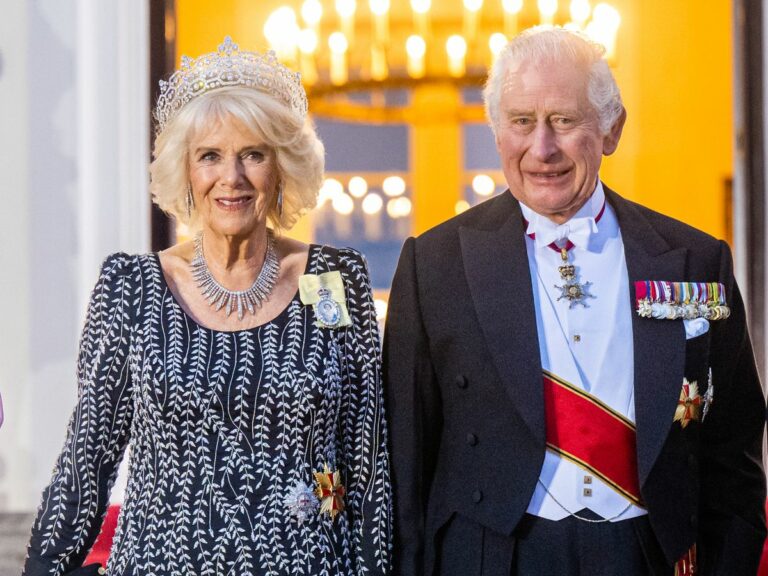
LARGE crowds are gathered at Westminster Abbey Central London Saturday morning to watch the crowning of King Charles III and the Queen Consort Camilla.
The coronation ceremony will begin at 10:00 GMT with a lavish displays of royal pageantry and processions.
Some 2,200 guests are expected at Westminster Abbey, fewer than the 8,000 who attended Queen Elizabeth II’s coronation in 1953.
Nigeria’s President Muhammadu Buhari is among several world leaders in London to witness the ceremony which will be led by the Archbishop of Canterbury.
A weekend of planned special events also includes street parties and a concert at Windsor Castle tomorrow, as well as a nationwide volunteering drive on Monday
Anti-monarchy protests are also expected, spearheaded by the group Republic – which is coordinating rallies in Trafalgar Square and around the UK
He has also worked closely with many organisations, publicly supporting a wide variety of causes relating to the environment, rural communities, the built environment, the arts, healthcare and education.
SIXTY-SIX Nigerian journalists and three media houses suffered diverse forms of attacks in 2022, according to the International Press Centre (IPC).
The Programme Officer of the International Press Centre, Melody Akinjiyan, disclosed this on Friday, May 5, while presenting a report on attacks on journalists in 2022 at the World Press Freedom Day (WPFD) media roundtable in Ibadan, Oyo State.
The event was organised by the IPC in partnership with the Nigeria Union of Journalists, Oyo State Council, and sponsored by the Open Society Foundation.
Akinjiyan said the 66 reported attacks on journalists in 2022 was a worrisome rise compared to the 40 cases recorded in 2021.
She listed the types of attacks as: physical assault (24); abduction (7); gun attack (1); threats to life (2); threat to disclose source/intimidation (2); invasion (1); media shutdown (1) and robbery (1).
Others were denial of access to information (1), harassment (2), unlawful arrest and detention (21), hacking of account (1) and threat to sanction/payment of fine (2).
According to her, out of the 66 journalists attacked, 56 were males and 10 were females.
She noted that 13 of them were print journalists, 26 were in broadcasting, 24 were online media practitioners and three others.
“Twenty-six of the journalists are from the South-West, 16 from North-Central, 10 from South-South, six from North-East, four from North-West and 10 from South-East.
“The states where the incident happened are Zamfara, Jigawa, Kaduna, Kwara, Gombe, Taraba, Adamawa, Bauchi, Lagos, Ondo, Osun, Ogun, Oyo, Enugu, Bayelsa, Delta, Edo, Cross River and FCT Abuja,” she said.
Akinjiyan said the various attacks, as reported, were allegedly carried out by security agencies, political thugs, armed robbers and militant groups like the Islamic State’s of West Africa Province (ISWAP).
She however, called on journalists to demonstrate greater sense of solidarity in dealing with attacks on media and abuses on rights of colleagues in the profession.
She further urged journalists to always bring issues of journalists’ attack, safety, freedom and welfare to the front burner, adding that the figures compiled were the only reported of the several unreported cases.
On May 3, The ICIR reported that the Nigerian Guild of Editors (NGE) decried what it described as attempts to criminalise journalism practice in the country.
The body of Editors said the freedom of the media is needed for the protection of all other human rights.
“We share the popular notion that freedom of the media is indispensable for protecting all other human rights. Instances abound where inhuman treatment, torture, corruption, misuse of power, impunity and nepotism were exposed because of the reports by the media.
“Disturbing signs of repression, violations of media freedom and several cautious attempts to criminalise journalism practice have been observed in the past few years in our country. There have been different forms of control, censorship, and pressure over the content of mass media in Nigeria, especially the broadcast stations, which have hindered their independence and pluralism,” NGE said in a statement.
The NGE also called on the incoming administration the responsibility to launch purposeful, long-lasting policies and initiatives that support journalists’ safety, media freedom, and freedom of expression.
Similarly, Committee to Protect Journalists (CPJ) in a report on Monday, February 27 said at least 14 journalists and media workers were harassed, attacked or detained while covering the Presidential and National Assembly elections across Nigeria.
Some of the journalists harassed during the election are: Executive Director of the International Centre for Investigative Reporting (ICIR) Dayo Aiyetan, reporter with The Cable Bolanle Olabimtan, Punch newspaper reporter Gbenga Oloniniran, a reporter of the Peoples Gazette Ajayi Adebola and Daily Post reporter, Akam James.
Princewill Sede and Jeany Metta, Publisher and Managing Editor of the Upfront News magazine, were also attacked in Bayelsa, while Joe Kunde and Miebi Bina, reporter and camera operator for the TVC were harassed in the same state.
The ICIR reported that political thugs attacked its Executive Director, Aiyetan at the Angwan Fulani Town Hall area of Gwagwalada in the Federal Capital Territory (FCT) while he was covering the Presidential and National Assembly elections.
Aiyetan was attacked while recording a man attempting to disrupt the voting process at a polling unit around the town hall.
A LEGAL practitioner, Kayode Ajulo, has said the coronation of King Charles III on Saturday, May 6, is a good avenue to seek for pardon on behalf of the embattled former Deputy Senate President, Ike Ekweremadu.
The ICIRreported that Ekweremadu and his wife, Beatrice, who were found guilty of organ trafficking in March had been sentenced in what became a landmark judgment in the United Kingdom (UK).
This is the first time anyone would be convicted under the UK Modern Slavery Act for an organ harvesting conspiracy.
Ekweremadu would be jailed for nine years and eight months.
His wife Beatrice was sentenced to four years and six months imprisonment, while the family doctor Obinna Obeta received a 10-year prison term.
Speaking on Channels TV on Friday, May 5, Ajulo noted that the correspondences written to plead for the release of Ekweremadu were attempts to truncate the legal process.
He noted that the letters were not the best solution.
“Now that Ekweremadu has been sentenced, this is the time to do that (ask for pardon). Tomorrow King Charles III will be coronated as the King of England, as the Head of State.”
The legal practitioner stressed that King Charles’ coronation could be used as an opportunity to solicit for royal prerogative.
“There is what is called royal prerogative for pardon, I believe anybody that wants to write a letter, anybody that wants to make a plea for Ekweremadu, this is the best time to ask the sovereignty of the United Kingdom. That is His Majesty King Charles III to pardon Ekweremadu.
“The precedent has been there since as far back as 1717, King George did the same. In 2003 and even as close as 2021, the same thing happened. Sovereigns can do that and I believe that is the plea we need to do for Ekweremadu, not to be writing and interfering with the conduct of the court.”
Former President Olusegun Obasanjo, the House of Representatives and the Senate all wrote to the UK court to plead for leniency for Ekweremadu.
ABOUT a decade ago, the Bauchi state Galambi Cattle Ranch was a green woodland with thick vegetation and ample forest resources providing cool shade with a sense of tranquility to the communities around it.
The existence of different species of trees with varied shapes and sizes made it a comforting abode for the residents, farmers, and herders alike.
Established about 50 years ago, the 7,000-hectare Galambi Cattle Ranch was reserved specifically for grazing livestock owned and controlled by the government, the managing director of the ranch, Nasiru Sani said.
However, the Bauchi State government failed to continue with the ranch years after, hence, its purpose of establishment could not sustain; only herders and farmers occupy the forest in the recent time.
The ranch was among the six Bauchi state-owned assets proposed for leasing in 2022 for 25 years, and H&Y Global Ventures acquired Galambi Cattle Ranch for N150 million.
The ICIR confirmed that farmers pay N5,000 per hectare in every farming season.
Despite being owned and controlled by the state government, brash timber producers and charcoal makers gradually began to invade the ranch cutting down trees, leading to monumental devastations with rapid desertification of the area that formerly housed and protected several communities against climatic catastrophes.
This was done even with the establishment of the Bauchi State Galambi Cattle Ranch Board, which among other responsibilities, was to oversee and monitor the activities in the ranch against intruders on behalf of the state government.
As the years passed, the trees that embellished the ranch began to vanish; one by one, the former agrarian land is now a desert of scorching sun and grievous seasonal windstorms.
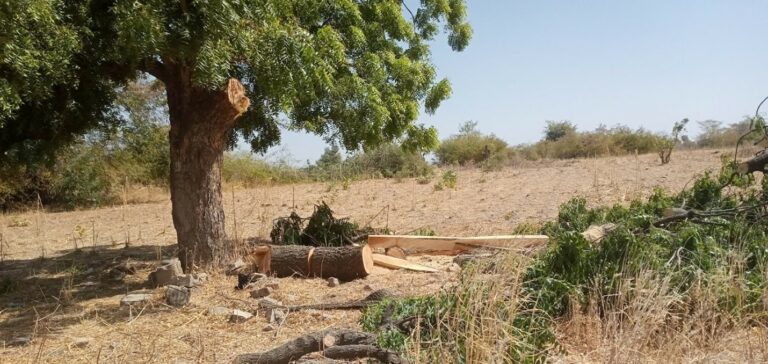
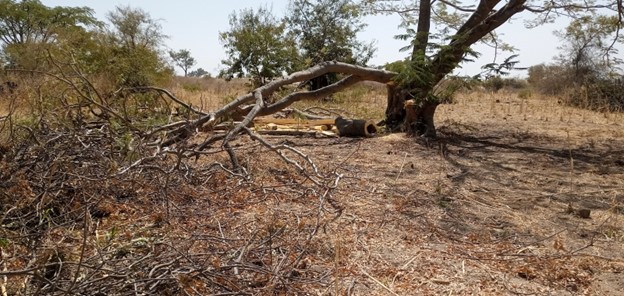
Destroyed trees at Galambi Cattle Ranch. Photo by Babaji Usman Babaji/The ICIR 2023
The trees that formed the vegetation were destroyed to shambles, and the vast land turned into a desert – the remaining few desolate saplings are toiling to survive in the presence of the board’s staff that receive their monthly salaries from taxpayers who suffer it in turn.
The persistent and indiscriminate destruction of trees in the recent past exposed neighbouring communities to deadly windstorms and other disasters associated with deforestation.
Its negative impact on coomunities could be traced by everyone; diminishing grazing grasses and fertile land, streams serving thousands of animals (wild and domestic) are rapidly shrinking, hence, posing a threat to the existence of the communities.
As the cutting of trees was nonselective, even trees bearing fruits are also not exempted, hence, the communities are not only exposed to myriad environmental degradation but also to socio-economic bruises, thereby making life more miserable.
With eroded farmlands and diminished grazing lands, – due to the desertification of the land that runs deep every year – the competition between the herders and farmers in the area intensified and become blatant.
It is not only the indiscriminate cutting down of trees that worries the defenseless locals but its devastating effect on the environment and human lives.
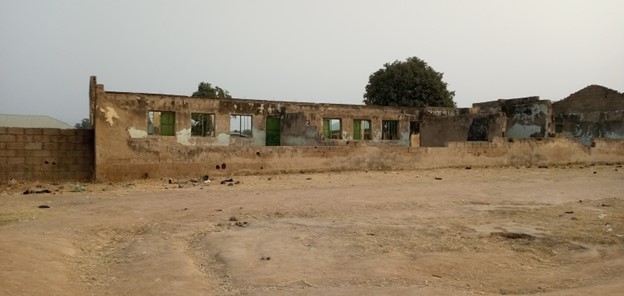
Over one hundred buildings – public and residential – were shattered down by the windstorm accompanied by dust in a terrible manner.
For instance, in June 2022, a windstorm, believed to be unprecedented, wreaked havoc on the communities neighbouring the ranch.
Over one hundred buildings – public and residential – were shattered down by the windstorm accompanied by dust the villagers said.
Residential apartment destroyed by storm in Zungur community, Bauchi State. Photo Babaji Usman Babaji/The ICIR 2023
How illegal logging is affecting host communities
The dark windstorm could not be forgotten by the villagers soon, only if more dreadful one strikes, “its devastating effect remained unabridged, the village head of Nasarawa, Zungur District, Ibrahim Usman, said.
Amina Abubakar, 50, a resident of Dajin community of Tafawa Balewa local government, a community about 8 km away from the ranch, recalled when she was amassing her clothes against being doused by rainwater. Unknown to her, it was not a usual thunderstorm – but a combination of horrible wind and dark dust that would leave several locals in agony.
Amina argued that the residents have never seen the like of such a deadly windstorm in the history of the area, “The storm was full of sand with terrible sounds. It was on Friday”, she recalled.
She told The ICIR that the wind wreaked havoc and left many people with different degrees of injuries and several buildings in tatters.
Her daughter Zainab Abubakar, 18, sustained a leg fracture while two others sustained injuries on that ‘black Friday’, “and everyone ran for his dear life”, she said.
“It was totally bizarre weather. We were coming back from a stream close to our house when the storm started blowing hard and we missed our path occasionally. It was frightening, and we thought it was the end of the world.”
Amina explained that the wind surge hit several residential houses in areas like Liman Katagum, Jamda, Mararaban L/Katagum, Galambi, Zungur, Luda, Baram, etc in Bauchi and some parts of Tafawa Balewa Local Governments.
Hassan Musa, the Chiroman Jamda bemoaned the excessive water inflow to their homes in the rainy season.
He explained that the land degradation in Jamda community causes intermittent flooding into their residential apartments giving the residents sleepless nights.
“Last year, we complained about the trenches to be filled by sand, it was futile, and they are still advancing and wreaking havoc on locals”, he said.
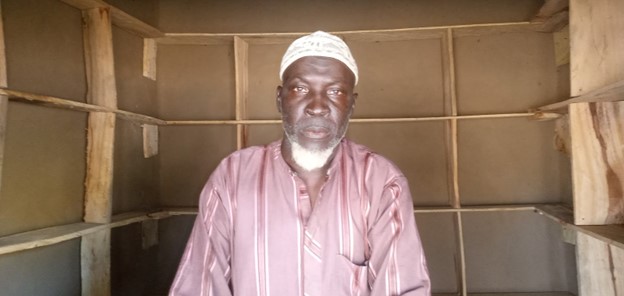
Hassan Musa (Chiroman Jamda) Photo BabajI Usman Babaji/The ICIR 2023
The new road constructed that passed through the community created excitement on residents’ faces, Chiroma held that the marauding waters spewing into the houses during the rainy season dashed their smiles.
“We pleaded with them (road constructors) to help make some culverts and drainages or to fill the trenches, they finished the road and left,” he told TheICIR, but they did not.
He grieved that the trenches have advanced to the village and increased every year, “We have a lot of problems, but the most pressing one is these trenches and troughs throughout these places.”
For Bala Musa, another victim, the brazen windstorm was the repercussion of the persistent cutting down of trees in the area for timber production and charcoal making.
With two trees grown at his house, Musa said they could not resist windstorms “because all other trees in the area were cut down and few ones left uprooted by the windstorm.”
“When there were trees here just about five years ago, you can’t stare at those places. But the timber and charcoal makers continued cutting the trees unchallenged; the trees are no more now”, he stressed.
Musa explained that he lost his two residential houses, his five livestock in 2022, and one other alongside his house furniture a couple of years earlier due to the seasonal windstorms, “I remained for several months without a house,” he stated.
Musa who is currently renting a house in Bayara, a suburb of Bauchi town, recounted that he has never seen such a dreaded windstorm with house roofs flying over people.
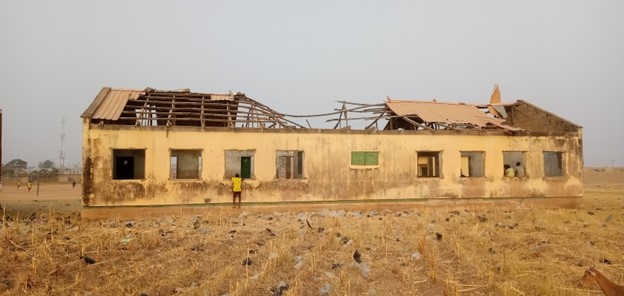
A primary school in Liman Katagum, Bauchi state ravaged by a windstorm, Photo Babaji Usman Babaji / The ICIR 2023.
He noted that he gets terrified whenever he sees thunder because it reminds him of the last year’s devastating June incident.
Musa held that the changes in the weather in the area started in the last five years, arguing that the alterations and consequences of deforestation increase yearly.
He explained that he used to think that the storms were inevitably natural disasters, he later learned that trees play a pivotal role in wind protection, absorbing and slowing down the flow of water, as well as regulating the local climate.
He alleged that the horrors are being done under the nose of the staff of the Galambi Cattle Ranch, “they get permission from the guards even before starting their work”, Musa said. “While others preferred working during the night on some occasions.”
Farmers pain…
In Mararan Katagum, a community about 20 km from Bauchi, the capital of Bauchi state, and about 4km away from Galambi ranch, Aliyu Mohammed, 37, a peasant farmer, stands on a bank of a stream close to his farmland, staring at the deforested landscape.
With the presence of some shrubs and a few saplings, the encroaching desert is obvious and could be defined by everyone.
He said about a decade ago, Galambi ranch was a forest with decent vegetation good for the ecosystem and pride for people who had lived there for generations.
Shades and leaves from the varied trees adorned the ranch with fertile soil, a haven for farmers and herders, and even a tourist centre for local visitors.
He argued that deforestation of the area for timber production, charcoal, firewood, and farming has consumed a larger portion of the ranch, thereby exposing the land to “land degradation.”
“Today, besides these trees, you can see, one here and the other there, all others were cut down for timber production, charcoal, and domestic activities.
He said the wanton destruction of the forest resources was intensified just a few years ago. “This place you see over there, you could not see it six years back – the vegetation was thick”, he said.
Mohammed noted that their harvests are significantly declining on a yearly basis. “Despite cultivating larger farmland, the harvest is very poor. In the last seven years, I was generating tremendous farm produce, but now, is moving backward every year.”
Herders groan…
Further, into the bushes of the ranch, a 23-year-old herder Musa Ja’oji, recounts a similar ordeal. “Nothing is left in this bush now,” he lamented.
He said edible grasses parch up sooner than required – the herders and shepherds rely on stored fodders and feeds, as the straws do not last long, forcing them to sell their skeletal cows at extremely low prices.
“By March you can’t see anything here for animals to feed on; they will all finish and no foliage or even dried grass for them. Animals are hardly managed here in these years; we will soon move southward for greener pasture”.
“It’s December now. The stalks of the crops are still remaining in farmlands, that’s the reason you can see them (cows) strong and healthy so far”, Ja’oji stated.
Ja’oji, while bemoaning the illegal cutting down of the trees, corroborated that it is the levity of the government officials. “How can someone enter here with a cutting machine without their (staff) knowledge?”
During The ICIR’s visit to the faraway part of the ranch, only some of the areas had some big trees that could help thwart windstorms and, sadly were also under destruction.
Some trees presumably planted for environmental protection purposes, such as Neem trees (Azadirachta indica) and Gmelina Arborea were also bladed to the ground apparently for timber production as shown in this video clip.
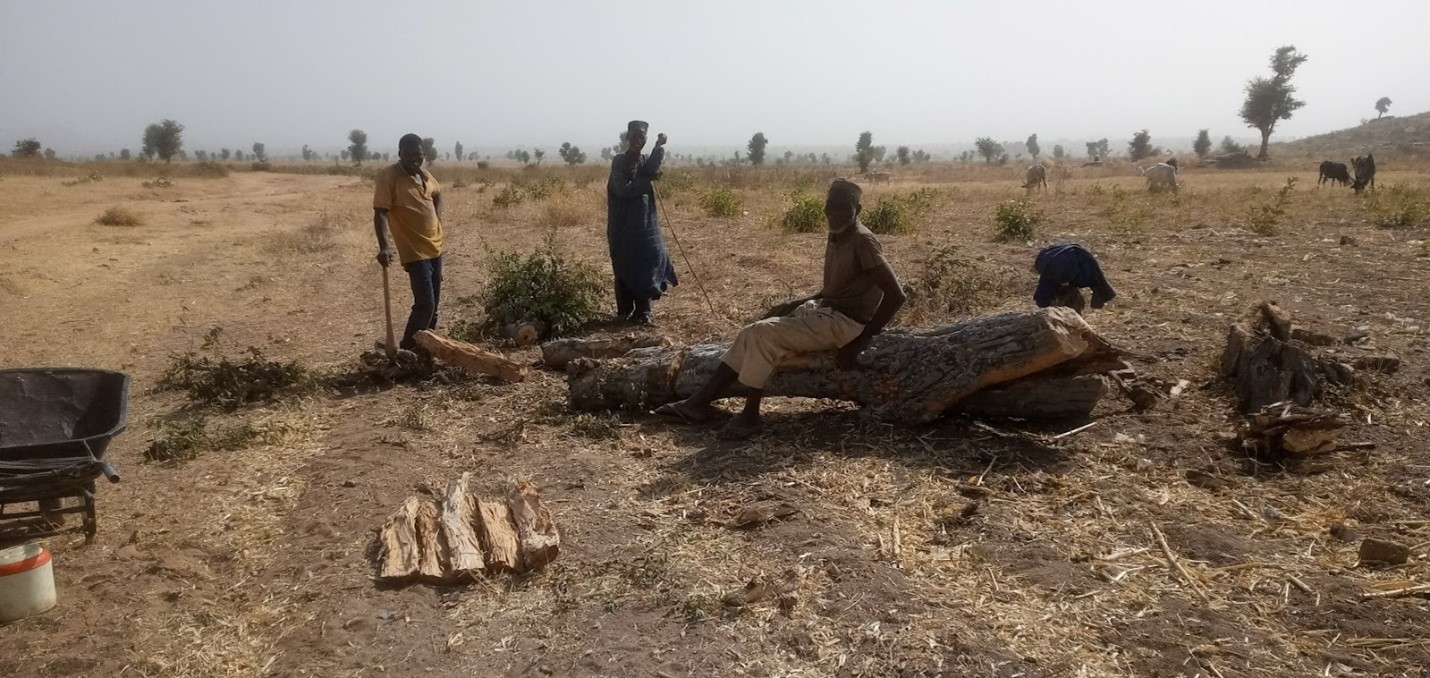
At the aged structures of the ranch deep inside the area, seven trees were cut down for timber just a day before the visit, and another nine semi-dried ones were axed down for charcoal and other domestic reasons.
Neem tree (Azadirachta indica) felled by loggers at Galambi Cattle Ranch Bauchi State. Photo Babaji Usman Babaji / The ICIR 2023
The findings suggested that the entire ranch would be stripped of trees in a couple of years, including the toiling saplings, unless the destruction is halted.
Timber producers claim professionalism
Amadu Salisu, a timber producer, claimed that he selects trees for timber production meticulously and professionally, “I consider the trees I cut. There are some of us that cut trees indiscriminately, but the majority of us are professionals and diligent in selection.”
He insisted that there is no relationship between the trees destroyed and the abnormal windstorms in the communities.
Amadu Salisu revealed that there are several other timber producers who get trees from the ranch, noting that some of them are doing so with the knowledge of the ranch staff.
Salisu declined to comment on whether they present incentives or tokens to the staff for their business.
Ali Abdullahi, a charcoal maker and wood fetcher, said the business is his source of income, “do you think I am doing this willingly? This is a tedious job, and I am doing it with no alternative. It has become my source of income.”
The 68-year-old man argued that if he had better work, he would not go to the bush for wood or charcoal making.
He attributed the windstorm ravaging communities as a natural phenomenon while the changes as “universal and inevitable.”
Abdullahi asserted that the Galambi ranch’s staff have never sent him out of the area for his business, and he doesn’t know them personally.
About two-thirds of the expansion of desertification can be attributed to changes in natural climate cycles, while the remaining third is likely “due to human-driven shifts”, according to a study in 2018.
Deforestation and other human activities are some of the factors exacerbating desertification every year. Some of these issues perists depite funds allocated for ecological projects by the federal government.
Government reacts…
The managing director of Galambi Cattle Ranch, Sani, said the management of the ranch and the Bauchi State government are doing the needful to protect the ranch from deforestation. “We don’t allow them to cut trees from the ranch”, he claims.
Sani stated that they have prosecuted an offender in 2021 at Bauchi State Environmental Mobile Court, which prosecutes culprits in line with environmental laws in the state.
According to him, in the last couple of months, they have not received a report of tree cutting in the ranch, and they don’t “officially” allow the destruction of trees for whatever reason.
Sani debunked the claim that some of the staff are abating the menace by conniving with culprits for a token, though he could not deny the broad defacement of the vegetation in the ranch.
Galambi Cattle Ranch in view. Babaji Usman Babaji/The ICIR 2023
He said the cutting of the trees in the ranch is intermittent and they are doing their best to halt it, “so anyone that tells you that we are not trying is lying. We have an official vehicle that whenever we receive a report of such acts, we would swiftly rush to the scene and apprehend the offender.”
“As far as Galambi Cattle Ranch is concerned, we don’t allow it, and our staff working there inform us if there is any intrusion,” he argued.
Responding to why the ranch is stripped of vegetation and proven evidence of destruction of the trees based on The ICIR’s visit to the area, he said “You know the ranch is a big land. It’s about 7,000 hectares of land, we can’t cover everywhere at a time.”
With the continuous defacement of trees in Bauchi State Galambi Cattle Ranch amid the authority’s nonchalant attitude, the area would completely be stripped of vegetation, and this would expose villagers’ livelihoods to more environmental hazards.
NIGERIANS in Sudan who indicated interest in leaving have all been successfully evacuated from the country’s capital, Khartoum, according to the Federal Government.
The Permanent Secretary in the Federal Ministry of Humanitarian Affairs, Sani Gwarz, disclosed this on Friday, May 5, while receiving the second batch of 130 evacuees at the Nnamdi Azikiwe International Airport, Abuja.
The second batch of evacuees arrived at the Pilgrims Terminal of the airport at precisely 3:10 pm local time on board TARCO aircraft B373-300 from Port Sudan.
According to Gwarz, Nigerians stranded in the North African country due to the unrest have all been conveyed to the safe zones where they will be airlifted.
“I’m happy to announce that we have successfully removed everybody. Everybody that needs to be removed, has been taken out of Khartoum. None of your colleagues today are in Khartoum; all of them have moved.
“You were the first batch to move out of Khartoum and sent to the Egyptian border. We still have a few of them, while some have already arrived in Nigeria.
“Though, the majority of them will be arriving in the next eight hours or more, So by that time, no Nigerian would have been left at the Egyptian border,” he said.
According to him, almost 1,700 people are waiting to be flown to Nigeria from Egypt and Port Sudan and adequate arrangements have been made for their flight.
He also noted that the N100,000 stipend given to the evacuees was life-saving support for those coming from a distressing situation.
“Some of you may have encountered difficulties or all of you, but it will soon be over and you will be reunited with your families and the trauma will be over.
“So, we welcome you back home and look forward to peace returning not only in Sudan but in the whole of Africa and the world at large,” he said.
The ICIR reported that the stranded Nigerians had to be transported by road to Egyptian and Ethiopian border because of the risk of evacuating from Sudan airport.
The Ministry of Foreign Affairs disclosed that flight operations in Sudan were difficult and unsafe due to the tension in the country.
As disclosed by the ministry, citizens are to be first evacuated by road to the Egyptian or Ethiopian border before they are flown to Nigeria.
The ICIR also reported that the first batch of Nigerians fleeing the crisis arrived in Abuja late on Wednesday, May 3.
The batch comprised a total of 376 persons and each of them received N100,000 cash for transportation to their various homes.
THE Lagos State Police Command has taken responsibility for the fire outbreak at the Alaba International Market.
The ICIR had earlier reported that fire razed parts of the market on Friday, May 5.
The director of the Lagos State Fire and Rescue Services Margaret Adeseye, who confirmed the incident to newsmen, said the fire impacted makeshift stalls within the market, commonly referred to as shanties.
Adeseye said efforts by firefighters to contain the inferno were resisted by some irate youths around the market.
She also disclosed that shops in the market were not affected by the fire outbreak.
However, in a series of tweets hours later, the state police spokesperson, Benjamin Hundeyin, said it was police officers from the Ojo division that the shanties on fire.
While dismissing earlier reports on the incident, Hundeyin said the officers recovered some weapons from suspected criminals at the shanties.
“This is a false narrative! Acting on credible information, police officers from Ojo division raided shanties around the market, arrested suspected criminals, and recovered some weapons,” he said.
“The shanties were thereafter set on fire. Alaba Int’l Market is NOT on fire!”
Lagos, a densely populated city, has experienced many fire outbreaks that resulted in loss of lives and property.
In 2019, a fire outbreak occurred at the popular Balogun market on Lagos Island, which is known for huge volumes of sale of textile and fashion items. The inferno destroyed many shops and goods worth millions of naira.
Similarly, in 2020, a fire outbreak was recorded at the popular Abule-Egba pipeline area of Lagos, which led to the loss of lives and property.
In March, fire gutted a spare parts market in the Ajegunle area of Lagos state, destroying items worth millions on naira.
The cause of these fire incidents has often been attributed to factors like power surge, poor safety measures, inadequate fire-fighting equipment, and poor infrastructure.
Last month, a fire incident was reported at Queens College, in the Onike area of the state.
No casualty was recorded in the incident as men of the state fire service quickly put out the fire.