Home Blog Page 946

Police arraign five over lynching of Uber driver in Akure

FIVE suspects have been arraigned before a Chief Magistrates’ Court in Akure the Ondo State capital over the lynching of an Uber driver, Temitope Olorunfemi.

Olorunfemi was lynched in the Ijoka area of Akure after his Toyota Camry car killed one person and injured several others on Easter Monday.

The vehicle was set ablaze by the mob who claimed to have discovered some fetish items in the car, leading to suspicions that Olorunfemi was an internet fraudster, also known as a ‘Yahoo boy.’


READ ALSO:
Family of man lynched in Akure says he’s not ‘Yahoo boy’, calls for justice

Reckless driving claims two lives in Akure, suspect stoned to death

FEC okays N95.8 billion for Akure-Ado road

Violent protests erupt in Abeokuta, Akure over scarcity of cash, fuel


After the incident, the Ondo State Police Command arrested the suspects for their involvement in the incident.

The suspects include Victor Amos, Ismaila, Pelumi Farotimi, Nurudeen Kumuyi and Samuel Olatunji.

The were arraigned on three counts bordering on felony, unlawful murder and arson.

The prosecutor, Inspector Nelson Akintimehin, told the court that the defendants and others who are still at large committed the offences on April 10, 2023, opposite Odopo Town Hall along Ijoka Road, Akure.

Akintimehin alleged that the accused killed Olurunfemi with sticks, stones, and other weapons, noting that they also maliciously damaged his Toyota Camry car by setting it ablaze.

He said the crime contravenes sections 324, 316(1), and 451(6)(J) of the Criminal Code, Cap 37 Vol. 2 Laws of Ondo State.

The prosecutor urged the court to remand the defendants at the Olokuta Correctional Centre while awaiting advice from the Office of the State Director of Public Prosecutions.

The defence counsel, O. Agbede, requested an adjournment to enable each defendant to file counter-affidavits in response to the prosecution’s application.

In his ruling, Chief Magistrate Musa Al-Yunus granted the defence lawyers’ requests but ordered that the defendants should still be remanded in police custody.

The case has been adjourned until April 27, 2023, for further hearing.

Olurunfemi’s brutal murder sparked outrage on social media with many Nigerians calling for an end to mob violence and a more effective justice system.

His family had since debunked reports that the 35 year old father of one was an internet fraudster.

In an interview with newsmen on Wednesday, April 12, Mojisola Olorunfemi, the mother of the deceased, said that contrary to the rumours, her son was an Uber driver.

According to her, the deceased Olurunfemi was never involved in any fraudulent activities.

She recounted how her son moved to Lagos after completing his education, where he registered as an Uber driver to make a living, adding that it was his father that bought him the vehicle he was using for the business.

Flooding is likely to reoccur in 2023 — here is what govt and residents should do

RESIDENTS of riverine and flood-prone communities across the country should relocate to higher grounds before flooding starts this year, the National Emergency Management Agency (NEMA) has advised.

Speaking during a Twitter Space organised by The ICIR on Wednesday, April 27, NEMA spokesperson Manzo Ezekiel said relocation will protect residents of flood-prone areas from the impact of another flood disaster which is most likely to reoccur based on the prediction of the Nigeria Metrological Agency (NiMET).

The Twitter Space was themed, ‘Flooding: Analysing Nigerian government preparedness’.

“The NiMET weather prediction is almost hundred per cent accurate,” he said before asking those residing on low-lying grounds to move to higher grounds for safety.

Farmers were also warned to plant and harvest their crops before the floods set in.

“NiMET predicted an early onset of rain, and we have seen the early onset of rain. There would be flooding unless there are changes by God or any other factor. The forecast should be taken seriously, and those residing in prone areas should begin to relocate to high grounds.

“Farmers in these areas have to farm early, to harvest their crops before the floods.”

Nigeria experienced intense flooding in 2022, which caused loss of life, displacement of people and extensive destruction of houses, farmlands and infrastructures. The disaster affected over 2.8 million people across 34 states, leading to the death of about 603 people and the displacement of more than 1 million. 

Why people suffer flooding annually

Ezekiel said Ignorance has made some victims unwilling to look out and protect themselves from flood disasters. 

“They are often unwilling to leave prone areas for safe zones.”

He noted that others have gotten used to the experience and are willing to endure the impact. 

“They believe the high water level will only last for two weeks or at most a month. So why leave? These people are used to the experience and it shouldn’t be so. One should not get used to suffering,” he said.

Some others are unwilling to relocate due to an attachment to their ancestral homes. Such attachment makes relocation a difficult decision to make, according to the NEMA spokesperson.

Speaking further on why some residents of flood-prone areas are unwilling to relocate, he said: “Most people have an ancestral attachment to their communities, so no matter what you tell them, they will tell you that their ancient fathers died here, and so, they cannot just leave.

“Apart from the negative impact of the flood, it also brings along nutrients that help the soil, and they know this. 

“When the flood is gone, the nutrients remain deposited on the ground, and in the following year, when you plant there, the crops planted there will grow very well. 

“These are some of the reasons people believe they cannot leave.”

What state govts can do

To prevent the recurrence of floods and attendant devastating losses, the NEMA spokesperson said state governments must create awareness among people about the impending floods, especially those living in flood-prone communities. 

He said five states have been predicted to experience heavy rainfall in 2023, which puts coastal communities at high risk of flooding. Rivers, Akwa Ibom, Cross Rivers, Bayelsa and Delta are the states. 

Ezekiel said the states’ governments should sensitize the people and begin to think of ways to manage the flood. 

He urged state governments to act urgently: “The expected rainfall in these areas is as high as 2700mm or above. This is the amount of rainfall that some parts of the country record over three years.

“This is a flash point that the people living in the coastal areas of these states must be aware of. We ask the government to raise awareness and that they themselves be aware of this threat so that they can begin to prepare ahead.”

He said the government should also remove houses built on waterways immediately.

As ways to manage the disaster, Ezekiel also suggested the creation of disaster management committees at the local government level. 

“These committees should be well funded and equipped,” he said. The role of the committees will be to carry out mitigation strategies outlined by NEMA in its 2023 Climate-Related Disaster Preparedness And Mitigation Report.

According to Ezekiel, state governments can effectively manage the impending flood by adopting NEMA’s recommendations. 


How FG can manage flooding — Environmentalist

AN environmental activist, Olumide Idowu, has asked the Federal Government to collaborate with civil society organisations (CSOs) to sensitise Nigerians at the grassroots on climate change and how it affects environmental disasters such as flooding.

Idowu, who heads the International Climate Change Development Initiative (ICCDI) urged the government to intensify efforts to enlighten the people, noting that every government body has a role in flood disaster management.

He said this on Wednesday, April 26, while speaking during a Twitter Space organised by The ICIR.

Idowu asked the Federal Government to prioritise coherence across all its agencies and ensure that existing rules and regulations align with its goal to control flooding and reduce the impact of climate change in the country.

“Government should build collaborative efforts with civil society organisations so that awareness can reach the grassroots,” he said.

“They can also collaborate with other government agencies like the National Orientation Agency (NOA) to sensitise the people on how to prevent and mitigate flooding.”

Idowu said there should be rules against human actions that contribute to flooding in the country and anyone found flouting these rules must be punished.

“There should also be a policy that will ensure that government officials can penalise anyone caught contributing to the environmental issues responsible for the flooding.”

According to him, the government is not doing enough to control the recurrence of flooding and to protect the citizens.

“You want to engage communities to understand this problem; you need to make sure that you build a collaborative effort in reaching out to these people. Most residents of flood-prone communities lack knowledge of climate and its impact.

“The government must prioritise policy coherence and align existing rules and regulations towards achieving the goals of a sustainable climate. The goals should be inter-linked across ministries because every government ministry must play a role. The actions must be sustainable and continual.”

He urged the government to stick to its international agreements and frameworks on climate change issues while establishing a disaster risk governance.

In 2022, Nigeria experienced the worst flood disaster since 2012.

The flooding damaged homes, infrastructure and large farmland areas across the country. Over 600 people died, and an estimated 2.8 million others were affected, including those displaced from their communities.

However, the Nigeria Meteorological Agency (NIMET) has predicted that the 2023 rainfall will be heavy and intense, with flooding expected in several states.

NiMET forecasted that 2023 will witness an early onset of rainfall accompanied by flooding,

The rainfall will begin in March among coastal areas in the South-South. According to the agency, Bayelsa, Akwa Ibom, and Rivers states will experience downpours while Southern Inland cities will see precipitation.

NNPCLtd spent $1.1bn on AKK gas pipeline project – Kyari

0

THE Nigerian National Petroleum Company Limited (NNPCL) says it has so far spent over $1.1 billion on the ongoing construction of the Ajaokuta-Kaduna-Kano (AKK) gas pipeline and station project.

The NNPCL Group Chief Executive Officer, Mele Kyari, said this on Monday April 24 while touring some of the project sites in Kogi state with newsmen and some stakeholders.

Kyari was accompanied on the tour by some top officials of the NNPC Limited and Oilserv Limited, (Pipelines and Facilities), the contractor of the project.

He disclosed that the company would continue to fund the project, which it was delivering in phases, though it did not have third party finance for the project.

He said, “So far, NNPC Ltd has spent over $1.1 billion on the project. To date, none of the project activities is abandoned as reported, and we reassure all stakeholders that we have a line of sight to project delivery on schedule.

“NNPC Limited remains highly committed to the delivery of strategic national infrastructure projects through responsive project delivery, active collaboration with government security agencies and communities, as well as deployment of technology for delivering the project.”

Kyari asserted that the project was one of the key ones that deliver proportional value to the country’s economic growth.

“It is a must-deliver project and we have continued to fund. In spite of not having third party finance support, we will deliver this project.

“We do not owe a dollar to our contractors. There are over 30 sites that are active today in this project, and we are very hopeful and optimistic to deliver this project,” he assured.

The GCEO lamented that the company had lost some site workers due to insecurity. He consoled the families of such families, whose grief he said the company shared.

He disclosed that 70 per cent of the welding work of the project had been completed, adding that once welding was completed, gas could actually flow through the pipeline.

According to Kyari, the completion of the pipeline would deliver two billion cubic feet of gas, powering industries and power plants, and creating gas- based industries.

He said the entire welding work would be completed by the third quarter of 2023, and the pipeline would then be energised.

Kyari further said that the AKK gas pipeline was projected to support power plants with a total of 3,645 megawatts, adding that the NNPCLtd would soon begin constrution of the Abuja- Kaduna power plants in ernest.

Earlier, the Project Manager, Oilserv Ltd, Steve Nnorom, that there were three phases of the pipeline project and station installations. These are the Alpha, Bravo and Chalie segments, on which Nnorom said there had been progress.

He said the company had completed 73 per cent of the mainland welding works of the project and had done 222 kilometres of it, leaving only 27 kilometres of welding work to be done.

“We are crossing rivers, railways, existing pipelines. We have other sites where various work activities are ongoing. Our target is that concurrently, all works will be going on at different spread,” he said.

Nnorom, while noting that the project had been active and fully financed, said that it had purely 100 per cent Nigerian workers.

He assured the NNPCLtd team that the entire welding work would be completed by the third quarter of 2023.

Why World Bank loan is good for Nigeria-DMO

THE Debt Management Office (DMO) says Nigeria’s indebtedness to the World Bank, which grew from 6.29 billion dollars in 2015 to 13.46 billion dollars in 2022 is a positive development.

In a clarification statement issued Wednesday, the office argued that the loans are issued at concessionary rates with long-term repayments plan.

Prior to this DMO’s clarification statement, there are concerns over controversy about World Bank loans to the country in recent times, as Nigeria prepares for a post-petroleum subsidy era.

For instance, at the just concluded Spring meetings held at Washington DC-United States, some Civil Liberty Organisations-CLO urged the World Bank to stop loan issuance to the Federal Government.This was in particular reference to the proposed $800 million facility that focused on palliatives for vulnerable Nigerians in a post subsidy era.

The palliatives are meant for over 50 million Nigerians ahead of June 2023.

The DMO stressed that loans from the World Bank come from the International Development Association (IDA) and the International Bank for Reconstruction and Development (IBRD) are issued at concessionary repayment rates.

“IDA loans are concessional, that is, they allow low charges and are for very long tenors in some cases, exceeding 30 years.

“These are the types of loans required to fund development in countries such as Nigeria.

“By accessing IDA funding, the government is actively reducing debt service costs, since non-concessional funding are usually more expensive.
“Indeed, it will be inefficient for Nigeria to borrow from commercial sources when concessional funding sources such as ODA is available,” the DMO said.

It said that Medium-Term Debt Management Strategy (MTDS 2020-2023) outlined effective debt management models for the country.

“The MTDS actually states that we will maximise funds available to Nigeria from multilateral and bilateral sources in order to access cheaper and longer tenor funds.

“Therefore, borrowing from IDA is actually an implementation of this strategy.

Contrary to DMO’s stance, the World Bank, in its latest report says Nigeria spent 96.3 percent of its 2022 revenue on servicing its debts.

This was contained in the Macro Poverty Outlook for Nigeria: April 2023 brief released by the Global lending financial institution.

The report notes that Nigeria’s fiscal position deteriorated in 2022, leaving the cost of the petrol subsidy to increase from 0.7 percent to 2.3 percent of gross domestic product (GDP).

“This has kept the public debt stock at over 38 percent of GDP and pushed the debt service to revenue ratio from 83.2 percent in 2021 to 96.3 percent in 2022,” it read.

FCMB reports 1,368% rise in fraud cases in Q1

FCMB Group Plc posted a 1,368.47 per cent rise in fraud and forgery related matters in the first quarter (Q1) of this year, the bank’s financial statement for the period ended March 31 has shown.

According to the report, fraud and forgery expenses amounted to N329.16 million in Q1, compared to N22.42 million posted in Q1 of 2022.

Findings by The ICIR showed that fraud and forgery expense in the review period was much higher than the N123.08 million the bank reported for the full year ended December 31, 2022, which rose from N89.86 million in December 31, 2021.

“Existing controls have been strengthened to address the identified lapses and the Group continues to collaborate with other stakeholders, including regulators to curb the spate of fraud, including cyber risk exposures, which has escalated in recent times across the industry because of remote operations, increased automation and migration of customers to alternate channels,” FCMB Group stated.

A public affairs commentator and finance expert, Bala Zakka, told The ICIR that fraud and forgery expense is a term used by banks in their financial statement to report cases already confirmed and yet to be ascertained.

“Once it is a fraud case, it has already been confirmed and the loss must have happened. But forgery is a case of probability until forensic investigation is conducted to ascertain its truth. But once it is true, it is then transferred completely to fraud cases,” Zakka said.

He explained that in a forgery situation where investigation is conducted and it was discovered that it was not real that the expense income can be returned.

He said, “Generally, when you put fraud and forgery in a financial statement, you make provisions for their recording, and at that the items are already regarded as losses.

“Companies make provision for all their expenses before arriving at profit before tax (PBT), whether real fraud or not because whatever is reported as PBT is what they must pay compulsory tax on.

“Every other thing the company needs to take care of is put under expenses,” Zakka further explained.

He, however, noted that fraud and forgery are issues inherent within a company’s system, which are most likely perpetrated by outsiders with the connivance of insiders.

A lecturer at the University of Lagos, Abi Noruwa, said fraud and forgery cases can be like corruption or concealment of information.

Noruwa said, “Forgery is a term that accountants used to express misplacement of funds, not well utilised or anything that is outside of bad debt.”

He added that fraud and forgery are misappropriation by staff of the banks with the involvement of outsiders.

In its latest report on fraud and forgeries in the Nigerian banking industry, Fitc Nigeria Limited, a technology-driven firm, revealed that a total of 19,314 cases of fraud were reported in the third quarter of 2022, which amounted to N9.62 billion.

Banks ought to improve their internal control measures to proactively prevent fraud, Fitc recommended.

‘Nigerians indirectly paying for CBN’s unregulated lending to FG through high inflation’

NIGERIAN’S are indirectly paying for the Central Bank of Nigeria’s (CBN’s) unregulated over-lending to the Federal Government through raging inflation, says an economist,  Adetilewa Adebajo.

The CBN has through the lending window, officially called Ways and Means Advances, lent the Federal government the sum of N23.7 trillion, which the borrower is struggling to repay.

Adebajo, the chief executive officer of CFG Advisory, said the lending had been pushing up Nigeria’s inflation rate and making cost of lending to banks go higher.

The economist, discussing the economic challenges before the incoming administration of Bola Tinubu Wednesday on Arise Television, stressed the importance of institutional reforms of the CBN, Ministry of Finance and the Ministry of Industry, Trade and Investment to drive economic growth.

He said, “There has to be alignment of monetary and fiscal policies. Lack of it was the greatest undoing of the current administration.

“Right now, the economy is not attracting enough capital inflow because of how poorly it has been managed. There is an underperformancce of capacity even when Nigeria remains Africa’s largest economy.”

On the danger the Federal government’s massive borrowings from the CBN constituted to the economy, Adebajo maintained that the inability to repay was responsible for rising inflation, rising cost of borrowing, and crowding out of the private sector from business.

The Federal government had at some point sought to securitise the debts, but economic experts condemned the move as unwise economically.

Adebajo advised the Federal government to adopt options within the Debt Management Office (DMO) Act to refinance N23.7 trillion of Nigeria’s total debts, instead of securitising it.

He proposed a resolution trust, a special purpose vehicle (SPV) backed by legislation within the current DMO Act and framework for refinancing of the nation’s burgeoning debts, as against securitising the ways and means debt financing on the CBN balance sheet.

He suggested that the Federal government should, as a matter of urgency, stop financing the country’s debts through ways and means, which he described as “illegal.”

The economist advised the President-elect to ensure proper coordination of the economic team, saying Tinubu himself should, in fact, take charge of the process.

He expressed concern that the CBN had, as an institution, become weak, pointing out that its Governor violated the CBN Act without any consequences.

“The institution has been weakened, and its integrity needs to be restored,” he asserted.

Adebajo said Nigeria was a $1 trillion economy underperforming because of productivity and human capacity not impacting the economy. “Once the economy is growing at 7.5 per cent annually, it would solve job creation problems,” he posited.

He said the next President’s focus should be structural reforms, concessioning, and opening up of different aspects of the economy.

“For instance, the government does not need to be running airports and too many other things,” he said.

The ICIR had reported how the apex bank had been violating Section 38 of the Act governing it by overlending the sum of $49.2 billion to the Federal government through Ways and Means.

Section 38(2)of the CBN Act 2007 provides that lending to the government should not exceed five per cent of the previous year’s actual revenue.

The ICIR checks showed that with respect to revenue accruals, lending to the Federal government should not have exceeded $450 million, but had spiked to $49.2 billion, through CBN’s Ways and Means.

Flooding: Climate expert highlights worrisome trends in Nigeria

A CLIMATE expert, Olumide Idowu, has highlighted some factors responsible for flooding in Nigeria.

Idowu, who’s the founder/CEO International Climate Change Development Initiative said a lot of communities and citizens are facing the impact of climate change and flood risk in the country as a result of negligence on the part of government and residents.

He disclosed this on Wednesday, April 26, during a Twitter Space on the theme: ‘Flooding: Analysing Nigerian Government Preparedness’, organised by The ICIR.

“The issue of climate change is just a statement that helps us to understand that the weather or the climate is changing, then the flood aspect of it is the impact climate change is causing . And if you look critically, the only trend notable remains the amount of precipitation, changing rainfall patterns – which leads to more intense and frequent flooding.

“This actually depends on the duration, intensity, frequency, fluctuations and rainfall but the bottom line here is where there’s conversation on climate change then we start talking about what are the impacts and the effects.

“Another attribute that we need to look at is the trend in the global rise of temperature which has also led to sea level rise which we see in the South-West of Nigeria.”

Idowu attributed the causes of flooding to urbanisation, water engineering, improper waste disposal and unauthorised construction of waterways in the country.

According to him, roads and major cities lack the right drainage, a situation which he blamed on government negligence.

He added: “It’s also very important that we also talk about an uncoordinated town planning outlook because when you look at the risk impacts and look at how people are preparing, there’s a need for planning. So the major thing among them is the drainage system. And many roads in major cities lack the right drainage capacity because of citizen impact or the government impact which has resorted to a lot of overflow and that’s why you see a lot of overflow from the sea level through the community that’s closer to the seaport.”

Idowu also noted that Nigeria needs to build capacity to contain the flow of water, adding that the kind of drainages in some flood probe areas are not adequate.

“It’s also very important to note that no matter how you push those water, they will find a way back. In some parts of Nigeria the drainage channels remain waterlogged because a lot of land has been used to build houses even the normal pathway for drainage systems has been taken away and this tells us a story of collective negligence from the people and from the government.”

Speaking on indiscriminate disposal of waste, he explained that it is one of the activities that contributes to blocked drainage systems in the country .

He also said that the government’s failure to pay attention to some activities in many communities is another major factor that contributes to flooding.

“When people see that rain is coming, they put their waste into the drainage system and that’s why you see a blockage of drainage system and you see all these developers building houses everywhere and in small places causing a lot of havoc to the people,” he added.

Lagdo Dam not entirely responsible for 2022 flooding — NEMA

THE National Emergency Management Agency (NEMA) has said the Lagbo Dam in Cameroon was not entirely responsible for the flooding that ravaged many parts of Nigeria in 2022.

He said most of the water that caused flooding was not from the Lagbo Dam, adding that the contribution from the dam to Nigeria was only in some parts where the water from the river passed.

NEMA spokesman Manzo Ezekiel disclosed this on Wednesday, April 26, during a Twitter Space on the theme: ‘Flooding: Analysing Nigerian Government Preparedness’, organised by The ICIR.

Ezekiel said there was serious flooding in Lagos and Jigawa where Lagdo water didn’t flow through, adding that the heavy rainfall in 2022 was the major cause.

He said: “The flood that happened last year didn’t happen only along the River Benue belt. We have a flood that happened somewhere in Jigawa which is not lying along the Benue. So we can’t blame the flood of last year entirely on the release of water from Lagdo Dam.

“By the way, in the past, almost every year the Lagdo Dam authority has been releasing excess water and it’s in our interest that they release the excess water because if the dam in Lagdo should break the devastating effect down the river will be worse than the thing we have witnessed. We also have floods that happened in parts of the country like Lagos too and not because of Lagdo.,,

Ezekiel added that NEMA is currently working to mitigate the risk effect of flood this year based on the predictions that were released by the Nigeria Meteorological Agency (NiMet) and Nigeria Hydrological Services Agency (NHSA).

“To manage the flood, it has to be on a continual basis because certain things that you do this year to avert or mitigate the occurrence of flood this year if done next year, it may aggravate the occurrence of flood next year.

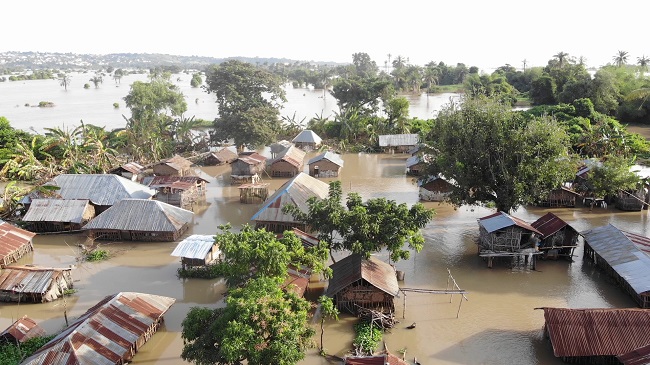
Flooded area
Flooded area

“So the forecasts that we are working with this year are based on the predictions that were released by NiMet and the annual flood outlook that was issued by the Nigeria Hydrological Services Agency. These are the two agencies of government with the mandate of forecasting releasing vital information concerning the rain pattern and the water content of the soil for the year.”

He also reiterated that Nigeria could witness a worse incident of flood in some parts of of the country this year as NiMet already forecasted average and above rainfall in some states.

“So what we witnessed last year could be worse because in some parts of the country, it has been forecasted that they will witness average and above average rainfall. I am talking about places like coastal areas particularly around rivers, Bayelsa, Akwa ibom, Delta and Cross River.

“The amount of expected rainfall on this side of the country is going to be as high as 2,700mm or even above and this is the amount of rainfall that some parts of the country record over a period of three years. Now we are expecting this amount of rainfall in just one year along these coastal areas.”

Ezekiel added that people living around places where high rainfall has been forecasted must be aware and begin to plan ahead to avoid trouble.

He added that: “We have other parts of the country that have been forecasted to have average and below rainfall. I am talking about states like Yobe, Jigawa, Kano, Bauchi, Kaduna and the FCT.”

The ICIR reported that in 2022, Nigeria experienced the worst flooding in over a decade.

The country has been recording seasonal flooding, which occurs during the rainy season that starts in April and runs till October, but in some years, continues until the end of November.

Apart from the reported deaths, more than 3.3 million persons are estimated to have been affected nationwide, and 1,427,370 persons displaced.

According to the National Emergency Management Agency (NEMA), floods impacted 35 states in Nigeria. The highest number of affected individuals were recorded in Anambra, Jigawa, and Bayelsa states.

In Bayelsa State specifically, the government reported that approximately 700,000 individuals were displaced from 300 communities and villages across five out of eight local government areas due to flooding caused by heavy rainfall.


PSC dismisses three officers, demotes five others

0

THE Police Service Commission (PSC) approved the dismissal of three police officers and demotion of five others on Wednesday, April 26.

A statement released by Head, Press and Public Relations of the PSC, Okechukwu Ani, said the approval was given during the 20th Plenary Meeting of the Commission, in Abuja.

The three officers dismissed were Assistant Superintendents of Police (ASPs) while the five others demoted were an Assistant Commissioner of Police, Chief Superintendent, two Superintendents and one Assistant Superintendent .

“The Commission also approved the punishment of severe reprimand to an Assistant Commissioner of Police, a Chief Superintendent of Police, four Superintendents, two Deputy Superintendents and 12 Assistant Superintendents,” the statement noted.

One superintendent and five assistant superintendents were also reprimanded.

The Plenary also approved the promotion of 109 senior staff.


READ ALSO:


The statement added that disciplinary matters in the Police Force will be given urgent attention.

“The Chairman also called on the Police to ensure that they work within the established laws guiding their operations. He assured them that henceforth disciplinary matters will be handled with dispatch so that Officers who are found wanting will serve their punishments while those who are exonerated are cleared to continue with their career progression without hindrance,” the statement said.

In October 2022 the PSC approved the dismissal of seven senior officers, and reduced the ranks of 10 others for gross misconduct.