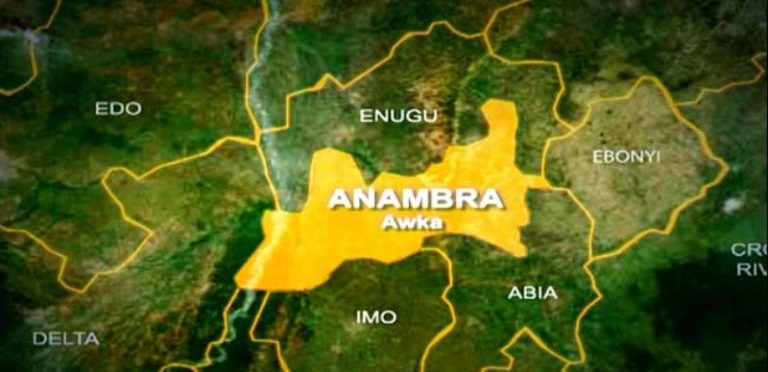
ANAMBRA State has the highest number of cases of Childhood tuberculosis (TB) in Nigeria, according to the Programme Manager of the Anambra State Tuberculosis, Leprosy and Buruli Ulcer Management, Ugochukwu Chukwulobelu.
Chukwulobelu disclosed this on Thursday, April 20, at a stakeholders’ engagement organised by the Federal Ministry of Health, in partnership with the KNCV Tuberculosis Foundation and Breakthrough Action Nigeria, in Awka.
According to Chukwulobelu, Nigeria ranks number six in the world and number one in Africa, with every local government having tuberculosis cases.
He described tuberculosis as an airborne disease caused by a bacteria called “Mycobacterium tuberculosis”, which usually attacks the lungs and could also damage other parts of the body.
“Anambra has the highest burden of TB drug resistance cases and childhood TB contribution in the South-East and Nigeria. This is not a good thing for the state,” the programme manager said.
He noted that the government is planning to set up 14 laboratories with gene Xpert machines for diagnoses to reduce the rate of the disease in the state.
The planned project will be carried out in collaboration with the National Tuberculosis and Leprosy Control Programme (NTBLCP)
“We have about 800 Directly Observed Treatments (DOTS) Centres for TB, but the major problem is lack of awareness among residents about TB, its diagnosis and treatment,” he said.
Persistent cough for two weeks or more, fever, unexplainable weight loss and drenching night sweats are signs used to screen patients.
“Residents should report suspected cases of TB within their communities. TB patients should also adhere to their treatments to prevent drug resistance TB cases which are even more dangerous.
“Everyone has a role to play to reduce the burden of the disease.”
Findings have shown that tuberculosis is a prevalent disease in Nigeria.
The country is among the 30 high TB burden countries globally and has the highest number of cases in Africa, according to a report by the World Health Organization (WHO).
The problem of TB in Nigeria has been made worse by drug-resistant TB and the HIV/AIDS epidemic.
The report suggests that TB kills 18 Nigerians every hour.
THE Nigeria Police Force (NPF) has said it will review its election duty guidelines to ensure protection of journalists during elections.
The Force Public Relations Officer (PRO) Olumuyiwa Adejobi disclosed this while speaking during a Twitter Space organised by the Wole Soyinka Centre on the topic, ‘How safe were journalists during 2023 elections?’
Speaking on attacks on journalists during the polls, Adejobi said the police will review its guidelines to ensure that journalists and observers are given more protection in future elections.
“There was a pocket book we published on election duty guidelines for officers, I think we are going to make an amendment to that. For other elections we want to have, we are going to review these guidelines to include protection of journalists and observers that will be moving up and down on election duty.”
He assured that the NPF is working on cases of attacks on journalists recorded during the election and also called on journalists to bring forward cases that have not been attended to.
“So cases recorded so far, I think some of our commands are on it and they are working on these cases and all I can say is to urge our people (journalists), we always believe that it’s when we publish (reports) that we are fighting it. I don’t want to believe that it’s every case that you must publish even when you publish you need to follow up so that you can have justice in that matter.
“I think we need to learn more. I think in the next election there will be constant training and retraining for all of us. There will be at least a forum for all of us where journalists, security agencies will have a joint forum to be coordinated by INEC itself so that all of us will be on the same page.”
However, he said journalists need to be abreast of relevant laws to avoid running into problems while discharging their responsibilities.
“If you don’t know the law you are going to run foul of the law and there’s no sentiment in law,” he said.
Adejobi also warned against cybercrimes, noting that the Cybercrime Act of 2015 should guide Nigerians, including journalists, on what to post on the social media.
“I think Nigerians are now aware of the existence of the Cybercrime Act of 2015 and sincerely when you read it you will know that copy and paste can lead you to jail if you are not careful. So I want to urge us to please read this law very well. All these laws are there for us so as to be guided whenever we are discharging our duties as journalists.”
The Force PRO explained that many people pick on journalists when they see them discharging their duties during elections.
“I think the electoral process is a very complex process that’s always very difficult to police or secure. As you know democracy itself is a very difficult thing to police. I want to say that every body including security operatives was a victim one way or the other during the election. Don’t forget that security operatives were attacked one way or the other, not only the journalists.
“But I think the fear of the unknown in Nigeria makes many of us see journalists as our enemies. I don’t know why you decide to just attack a journalist. By mere looking at a journalist people pick offense and say these people have come,” he observed.
He also stressed that the police worked with the International Press Centre to resolve many issues relating to attacks on journalists.
“Over time we can continue to do lectures, training for security operatives and those that come in contact with journalists, not only the security operatives this time around, everybody particularly government people who see journalists as their enemies and it is not supposed to be so.”
The Force PRO equally called for the support of journalists and other Nigerians in the campaign against political thuggery in the country.
Stressing that journalists were not the only ones attacked during the general elections, he noted that police officers and other security operatives as well as ordinary citizens were also brutalised by political thugs.
“Let me say that we need to see how we want to address political thuggery. Journalists are not the only ones that were attacked, security operatives were also attacked, people were attacked but despite the fact that we have armed men to follow people, they were still being attacked because these political thugs are there.
“We need to address political thuggery in this country. It is a collective responsibility,” the police spokesperson said.
THE Federal Government has commenced moves to evacuate Nigerians trapped in Sudan.
This follows reports of unrest in the country as a result of violent clashes between the Sudanese Army and a paramilitary group, Rapid Support Forces.
The plan to evacuate Nigerians trapped in the country is in response to a request by Nigerian students in Sudan for immediate evacuation from the country.
A statement released by Gabriel Odu for the Media, Public Relations and Protocols Unit of the Nigerians in Diaspora Commission (NiDCOM) on Thursday, April 20, said various Federal Government agencies are working out an arrangement for the evacuation of Nigerians in Sudan.
The agencies involved are NiDCOM, National Emergency Management Agency (NEMA) and the Nigerian mission in Sudan.
“The Commission has received the letter of solicitation by the National Association of Nigerian Students in Sudan for possible evacuation of students, especially those in Khartoum, the Sudanese capital,” the statement said.
NIDCOM, in the same vein, urged “all Nigerian students in Sudan and Nigerians living in Sudan to be security conscious and calm”.
Background of the crisis
The Sudanese Armed Forces (SAF) and the paramilitary Rapid Support Forces (RSF) have been fighting for control of the government since February 15. As a result, at least 180 people have been killed.
The crisis, which began in Khartoum, is spreading to residential areas in the capital, which could increase the number of casualties.
Thousands of Nigerian students are trapped as a result of the conflict.
The National Association of Nigerian Students in Sudan (NANSS) wrote to the Federal Government, appealing for the evacuation of its members.
The students said they are stranded, living in fear with no access to basic amenities and are facing dangerous threats.
“We hereby write soliciting and yearning for the Nigerian Government’s intercession to rescue and send for an immediate evacuation of the Nigerian students that are stuck in the centre of the ongoing war,” the group said in a letter.
Nigeria and Sudan have had a close relationship since 1960. According to student organisations, about 10,000 Nigerian students are studying in the country.
Also, thousands of other Nigerians are engaged in businesses in Sudan.
African countries are estimated to lose US$17 billion each year to illegal logging. High-value timber species are in global demand.
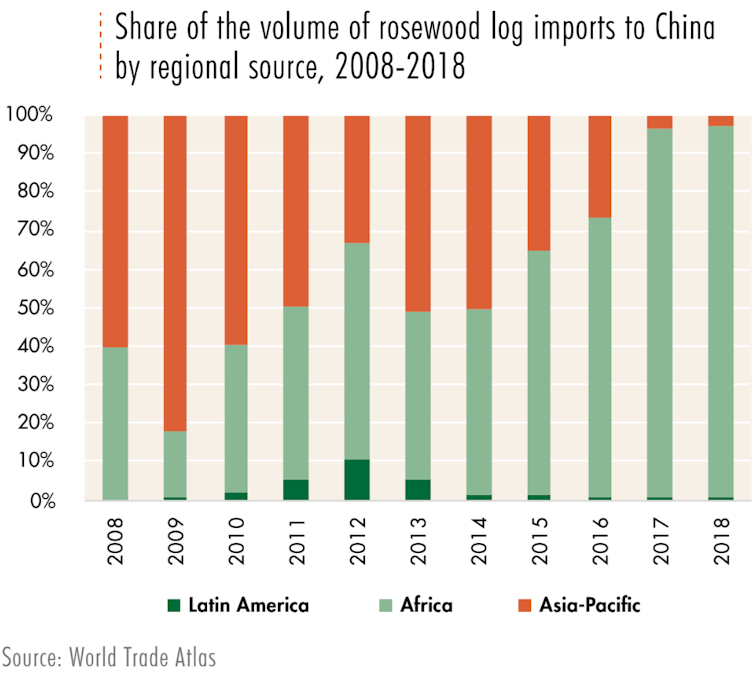
Illegal logging is most prevalent in the continent’s tropical rainforests. Foreign demand for rare hardwoods from these forests has dramatically increased. A significant driver is Chinese demand for teak, redwood and mahogany. According to the United Nations Office on Drugs and Crime, Africa’s share of rosewood exports to China rose from 40% in 2008 to 90% in 2018.
UNODC World Wildlife Crime Report 2020
Illegal logging has negative environmental effects that weaken human security. Deforestation in the world’s second largest carbon sink, the Congo Basin, is an urgent example.
Beyond environmental degradation, timber trafficking also affects national security. Drawing from our recent report, which is based on our recent research and programmatic work at the Africa Center for Strategic Studies, we have analysed three ways that illegal logging affects national security and what that means for current measures to counter it.
Firstly, illegal logging amplifies threats posed by organised criminal groups and violent extremist organisations. Secondly, illegal logging amplifies governance problems. This is because it facilitates collusion between senior corrupt officials and criminal networks. Thirdly, such collusion weakens accountable governance of natural resources in African countries. That’s a key ingredient of peace and security and a source of resilience to national security challenges.
Countering illegal logging requires two things. One is dismantling the high-level criminal networks driving it. The other is stopping the government-embedded actors who facilitate it. Oversight and accountability are therefore vital. Here, civil society can play a role.
The ENACT Organised Crime Index is a well-known measurement tool for assessing criminality and resilience. It identifies and tracks criminal networks, state-embedded actors, foreign actors and “mafia-style” armed groups that are locally well known and that control territory.
The work of these groups has several knock-on effects.
Violent extremism and insurgency: The illicit timber trade fuels conflict and instability by providing resources for violent actors. For instance, trafficking networks in Tanzania and the Democratic Republic of Congo linked to Ahlu-Sunnah Wa-Jama and related militant groups in Mozambique made an estimated US$2 million per month from illegal logging in 2019.
Collusion and corruption: Illegal logging often relies on government corruption and elite collusion with criminal networks. This subverts the rule of law and accountable governance.
Elites colluding in this trade then use the international financial system to move the profits into private bank accounts. This contributes to the estimated $88 billion in illicit financial flows leaving Africa yearly.
In Equatorial Guinea, Teodoro Nguema Obiang Mangue, son of President Obiang, profited immensely from the transport and export of rare hardwoods. As minister of agriculture and forestry, he sold some national forests to private companies and used a shell company linked to the ministry to charge fees for processing, loading, and transporting timber.
In 2021, the Zambian Anti-Corruption Commission seized 47 trucks illegally laden with rosewood bound for Namibia and Zimbabwe. The operation was allegedly facilitated by certain ministers and family members of former Zambian president Edgar Lungu.
In 2019, Gabon’s vice-president and minister of forestry were part of a rosewood trafficking scandal. Since then, the government has sought to increase transparency in natural resource governance.
Solutions
Many African states have tried to halt logging – with limited success.
Guinea-Bissau, the DRC and Kenya have controversially ended moratoria on logging. Mozambique lacks the capacity to enforce existing bans.
It’s easy to get around a moratorium when state security and justice systems do not operate transparently. A moratorium can even harden criminal networks without addressing the corruption and livelihood challenges that facilitate illegal logging.
Several other approaches to forest monitoring are being tried at smaller scale. These include using satellites or genetic markers of protected trees.
The Kenya Forestry Service is pioneering an app for officers to use satellite data in community-based initiatives.
Regional responses have potential. In 2008, the Central African Forests Commission established an agreement involving the environment and forestry ministries of eight countries to help coordinate law enforcement.
The agreement emphasises cross-border and interagency coordination between security, justice, and forestry officials. These harmonised forest management practices are also promising in southern Africa.
Agreements like these are valuable but politically difficult to implement.
Nonbinding instruments like the Zanzibar Declaration on the Illegal Trade in Timber and Forest Products and the Accra Declaration on Combating Illegal Trade in Rosewoods, Timber, and Forest Products also signal countries’ intent to honour commitments.
But doing so requires credible enforcement mechanisms.
Bridging gaps
Stronger oversight of actors involved in natural resource governance can help. Civil society has a role here.
For example, in Gabon, civil society has pressured the government for greater transparency in logging contracts. In Cameroon, it has facilitated independent monitoring of forest regulations.
In Ghana, legal cases have been filed that aim to preserve forests. And independent journalism has pressured officials to curtail illegal transport of rosewood.
Civil society also builds economic resilience to illegal logging. In Tanzania and the DRC, civil society has enhanced community control over land management and made legal livelihoods in the logging sector more feasible.
External oversight is a key part of countering illegal logging. It works best where civil society is strong.
Internal oversight is also important. Inspectors general, specialised prosecutors and independent anti-corruption bodies can help expose the kingpins organising illegal operations.
International cooperation between security, justice, and forestry officials should accompany oversight, so that these actors can share intelligence and facilitate the arrest, investigation, and prosecution of those engaged in illegal logging.
Regional and international agreements are working in the right direction. What they need is better implementation.
Caden Browne, a Political Science PhD student at Boston University, contributed to this report while on internship at the Africa Center for Strategic Studies, National Defense University.
THE Nigeria Content Development and Monitoring Board (NCDMB) has restated its commitment to meeting 70 per cent capacity development in oil and gas in 2027, with a focus on local capacity in engineering and procurement.
The Executive Secretary of the NCDMB, Simbi Wabote, told journalists at a press conference in Abuja on Wednesday, April 19 that the Board had been monitoring the progress of local capacity development in Nigeria’s oil and gas industry.
Wabote said, “In 2017, we launched a 10-year strategic programme, which we said would take Nigerian content to 70 per cent in 2027. We have focused on that goal and we have not deviated. We also have parameters which we used in measuring the trajectory.
“We did our last review of how much progress we have made in terms of how much the Nigerian oil and gas industry has grown in capacity, and how much we have participated in the oil and gas business focusing on engineering, fabrication, procurement and construction. All these parameters were used in measuring how far we have come.”
He said that out of the $5 billion investment in liquified natural gas had 50 per cent of local content involvement of the country’s local engineers, fabricators and construction workers.
He also said the NCDMB was committed to growing local capacity in neighbouring African countries under the African Continental Free Trade Area Agreement.
Wabote informed that the forthcoming Nigeria Oil and Gas Fair next month in Bayelsa state would expand the linkage of industries to grow local capacity and development of in-house capacity.
He said the Fair would also provide opportunities for investors, operators and government officials.
THE President of Ukraine Volodymyr Zelenskyy has congratulated Nigeria’s President-elect Bola Tinubu, 51 days after he was declared winner of the February 25 Presidential Election.
Tinubu, who contested under the platform of the ruling All Progressives Congress (APC), polled 8,794,726 votes to win the election. His closest rival, Atiku Abubakar of the Peoples Democratic Party (PDP), got 6,984,520 votes.
Zelensky also invited Tinubu to Ukraine for a state visit, according to a statement released by Tinubu’s spokesperson Tunde Rahman, on Thursday, April 20.
The Ukraine leader, according to the statement, said his country was ready to further strengthen cooperation with Nigeria at the bilateral level, despite its ongoing war with Russia.
Zelensky was quoted as saying that the proposed visit would contribute to consolidating joint efforts of the international community towards food security.
“I invite you to pay an official visit to Ukraine at a time convenient for you. I am confident that your visit will strengthen the dialogue between our countries and contribute to the further consolidation of joint efforts of the international community aimed at solving the urgent challenges of today, in particular the crisis situation caused by Russia regarding the guarantee of world food security,” Zelensky said.
He also appreciated Nigeria’s support for the Resolution of the General Assembly of the United Nations Organisation ‘Principles of the UN Charter’ underlying a comprehensive, just and sustainable peace in Ukraine.
“I count on the active participation of Nigeria in its practical implementation. We see the further provision of global food security, of which Ukraine was and remains a reliable guarantor at the global level, as an important direction of cooperation,” Zelensky added.
Highlights of the manifesto of the incoming government dubbed “Renewed Hope 2023 – Action Plan for a Better Nigeria” include an enlightened agricultural policy that promotes productivity and assures decent incomes for citizens, especially those in rural communities.
A report published by The ICIR in May 22 noted that the invasion of Ukraine by Russia was a threat to food security in Nigeria.
The report identified the sharp increase in the cost of a loaf of bread as one of the effects of the Russia/Ukraine war on the Nigerian economy.
The ICIR equally reported that European Union (EU) Economic Commissioner Paolo Gentiloni said the impact of Russia’s invasion of Ukraine on food security will potentially have “dramatic consequences” for African countries that rely on grain imports.
Speaking during an official visit to Bucharest, Romania, Gentiloni said food security would not be an issue in Europe, which is struggling with high inflation rather than low food supplies.
According to the EU commissioner, many parts of Africa, particularly the Horn of Africa, are expected to feel the tremors of the intensifying crisis in Ukraine, especially as the prices of food, oils and fertiliser rise.
THE Hubert H. Humphrey is inviting applications to its Fellowship Program which provides a year of non-degree graduate-level study, leadership development, and professional collaboration with United States counterparts.
Participants from the following regions are eligible: Sub-Saharan Africa, Europe, Middle East and North Africa, East Asia and Pacific, South and Central Asia, and the Western Hemisphere. For a full list of participating countries, click here.
During the program, fellows pursue both their individual program goals and work closely with their Humphrey colleagues in workshops and seminars. Unlike a typical American graduate school experience, the program encourages fellows to travel away from their host campus to learn more about American culture and to network with their American peers.
Applicants are required to have at least an undergraduate degree, a minimum of five years of full-time, professional experience, demonstrated leadership qualities, a commitment to public service in their community, and fluent English.
Journalism and communication mid-career professionals with limited experience in the United States can apply for this program.
There are rolling deadlines for different regions, ranging typically from April to September. Interested applicants can apply here.
SWITCH Perspective is seeking applications for a 10-day workshop on migration slated for September 4, 2023, to September 15, 2023.
The workshop will be divided into two parts. The first week will include sessions, discussions, and an analysis of media reporting on migration and refugees. For the second week, participants will get a chance to work on a topic of their own based on the work done during the first week.
The workshop is open to journalists, photographers, filmmakers, writers, academics, NGO workers and civil society activists working on documenting, analysing, or telling stories about migration in its various forms.
The working language of the workshop is English, with some sessions translated from Arabic to English.
Journalists and researchers who are interested in migration and refugees can attend a workshop in Beirut, Lebanon.
The deadline for the submission of applications is May 5, 2023. Interested applicants can apply here.
ABOUT 1,266 persons were killed by bandits in Kaduna State in the last 15 months, according to records released by the state government.
Also, 746 persons were kidnapped in the state between January and March 2023.
Kaduna State Commissioner for Internal Security and Home Affairs, Samuel Aruwan, released the figures on Wednesday, April 19, at the Sir Kashim Ibrahim Government House, Kaduna.
According to Aruwan, 1,052 deaths were recorded as a result of banditry and other attacks in the state in 2022, while another 214 persons were killed in similar incidents between January and March 2023.
“Between January to December 2022, 641 deaths were recorded in Kaduna Central Senatorial Zone, while 349 deaths were recorded in Southern Kaduna Senatorial Zone and 62 deaths in the Northern Senatorial Zone bringing the total to 1,052 deaths as a result of banditry and other attacks.
“214 persons were killed between January and March 2023 in attacks by bandits/terrorists, communal clashes, violent attacks, and reprisals.”
Giving a breakdown of cases of kidnapping in the state in 2023, Aruwan said, “A total of 746 people were kidnapped in the first quarter, with Kaduna Central Senatorial District accounting for 492 deaths, Southern Kaduna Senatorial District recorded 221 kidnapped persons, and the Northern Senatorial District recorded 33 kidnapped persons.
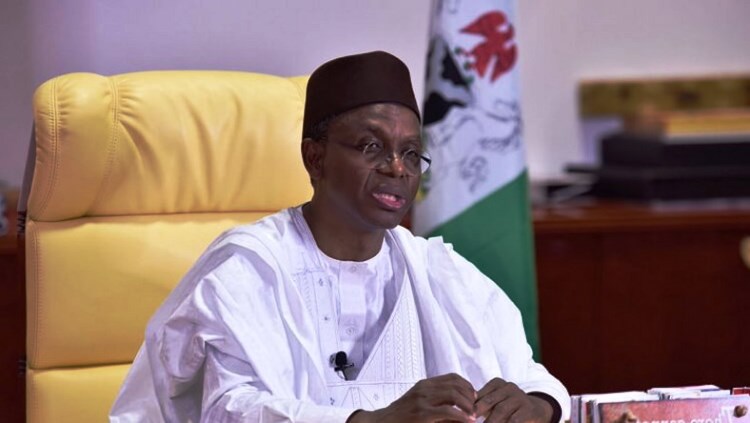
Kaduna State Governor Mallam Nasir El Rufai Photo Credit: Pulse
“A total of 746 people were kidnapped in the first quarter, with Kaduna Central Senatorial District accounting for 492 (about 66% of the total). All of these occurred in Birnin Gwari, Giwa, Igabi, Chikun and Kajuru LGAs. One hundred and thirty-seven people were kidnapped from Birnin Gwari LGA and 131 from Igabi LGA. Giwa LGA recorded 100 kidnapped persons, Chikun LGA 83, and Kajuru LGA 41.
“Twelve persons were reported to have been raped by bandits across the state from January to March this year. Ten (10) of these were minors.”
However, he added that although there were many more unreported cases of rape by armed bandits, only reported cases were highlighted in the security report.
Speaking on cases of cattle rustling during the period under review, the commissioner noted that a total of 3,247 animals were rustled in the state in the first quarter of 2023, with 2,353 stolen from the Kaduna Central Senatorial District, accounting for around 73 per cent of the total number.
Among the local government areas in the state, Kajuru had the highest figure of rustled animals in the first quarter, with 1,000, he noted.
Speaking during the presentation, the state governor, Nasir El-Rufai, warned that bandits would use the time of transition to carry out gruesome crimes across the nation.
The governor urged security agencies to step up operations against bandits throughout the remaining months of the current administration and beyond.
El Rufai observed that the reports on the security situation in the state provided detailed data on the enormity of the challenge.
“Just as they have a right to updates on the progress in investments, revenue generation and other happy events, citizens have legitimate expectations to be provided with consistently accurate accounts of what is going on and on measures being taken to address security challenges.
“The two reports just presented by Samuel Aruwan, our Commissioner for Internal Security and Home Affairs, indicate the persistence of security challenges, including terrorism, banditry, and the unfortunate toll in killings, kidnappings, injuries and threats to the livelihoods of our people.
“We regret the pain and losses, pray for the repose of the souls of those killed, pay tribute to the victims of various crimes and reiterate our solidarity with them,” he said.
El-Rufai said the statistics presented showed that there has been some slight improvement in fatalities and other incidences of criminality across the state between 2021 and 2022.
“The Kaduna State Government does its level best to prevent these sad events through institutional measures and pragmatic actions on the ground.
“These measures include persistent pressures on the Federal Government to launch comprehensive and sustained military operations against the terrorists and criminal elements that are menacing our people and their lives, liberty and livelihoods.”
He thanked the Federal Government for finally authorising the launch of combined military and police offensives against bandits and also commended the military and security forces for their efforts and sacrifices in the fight against insecurity.
The governor said the state government will continue to do everything within it’s powers to enhance security.
There have been an upsurge in attacks by suspected terrorists and bandits in Kaduna and across the country after the general elections.
In April, bandits attackedthe Atak’Njei hamlet in Kaduna State’s Zango Kataf Local Government Area, killing at least eight people.
The attack occurred a few weeks after a similar tragedy in the same local government area’s Langson village that took eleven lives.
The President of Atyap Community Development Association, Sam Timbuwak, told Channels Television that the gunmen invaded the neighbourhood on Wednesday, April 12 at around 9:00 pm and began firing intermittently at residents’ homes.
The ICIR also reported the killing of about 28 residents in Kaduna on December 18, 2022.
In the December 18, 2022 attack, the bandits also razed houses at Malagum and Kagoro communities in the Kaura Local Government Area of Kaduna State.
An inter-denominational burial service was held for the victims of the attack on Thursday, December 22.
Many Nigerians condemned the unending killings in Southern Kaduna following the attack.
Also, in June 2022, the National President of the Adara Development Association, Awemi Maisamari, said terrorists allegedly deployed a helicopter and killed over 30 persons during an attack on the Adara community in Southern Kaduna.
Maisamari, who addressed journalists, said the attackers razed buildings, including the area’s Evangelical Church Winning All (ECWA) parish.
On April 3, bandits abducted eight female students in the Kachia Local Government Area of Kaduna State.
The students later escaped from their captors a few days later.
The Nigerian security forces have killed hundreds of criminals whose operations continue to endanger Kaduna state and its environs.
ON WEDNESDAY, April 19, the United Nations Children Fund (UNICEF) and the United States Agency for International Development (USAID) presented models for boosting child literacy and numeracy in Nigeria after piloting the models for five years.
While piloting the intervention, UNICEF documented key data on primary school education in the country.
Below are some of the statistics.
Foundational Literacy and Numeracy
Seventy per cent of children in Nigeria cannot read with meaning or solve simple math problems.
Only 49 per cent and 55 per cent of children in the school achieve basic proficiency in literacy and numeracy, respectively.
Literacy rates are as low as 38 per cent in the North-West and 42 per cent in the North-East for young women compared to 57 per cent in the North-West and 53 per cent in the North-East for young men.
Only 14 per cent of young women from the poorest quintile are literate. Fewer than six per cent of children under age five have three or more children’s books at home.
According to the agencies, 27 per cent of teaching staff in Nigeria are unqualified, and 175,000 qualified teachers are needed to fill capacity gaps.
Education opportunities for girls
As of June 2022, 7.8 million girls are out of school in Nigeria: 3.9 million at the primary and 3.7 million at the junior secondary level.
More than 50 per cent of girls were not attending school at the basic education level.
Forty-eight per cent of out-of-school girls were in the North-West and North-East.
Education Opportunities for Out-of-School Children
One in three children is out of school in Nigeria:
10.2 million at the primary level and 8.1 million at the junior secondary school level.
12.4 million children never attended school, and 5.9 million left schools early.
Nigeria’s out-of-school population accounts for 15 per cent of the global total.
Only one in three children aged 36-59 months can access the ECCDE programme.
Only one in three adolescents eligible for senior secondary school are attending.
More than 50 per cent of girls are not attending school at the basic education level.
Sixty-six of all out-of-school children are in the North-East and North-West. Eighty-six are from rural areas, and 65 per cent are from the poorest quintile.
Data on Early Childhood Education
Only one in three children (36 per cent) ages 36-59 months attend Early Child Care Development Education (ECCDE). At least 10 million children are not in ECCDE in Nigeria.
Two out of three children aged three to five are engaged in early learning activities at home. This is lower in the North-East (49 per cent), North-West (55 per cent) and for the poorest children (46 per cent)
Consequently, two in five children between the ages of three and five are not developmentally on track.
The poor data are a violation of children’s right to education. They also increase children’s risk of mental ill-health, delayed entry to primary school, and lower learning outcomes.
Attacks on schools
25 schools were attacked in Nigeria as of February 2022.
1,470 learners were abducted, of which 200 were still missing.
Over one million children were afraid to return to school in 2021.
In 2020, 11,500 schools were closed due to attacks.
North-West accounts for 76 per cent of attacks.
Educational opportunities for Almajiris
Almajiri children in Nigeria are approximately two million, and they’re considered out-of-school.
Most Almajiris are in the North.
Public Financing of Education
Between 2001 and 2017, Nigeria allocated on average 1.97 per cent of its gross domestic product (GDP) to education.
At 1.2 per cent of GDP in 2021, the country’s allocation to education is lower than other Sub-Saharan African countries.
Only 7.2 per cent of public expenditures was allocated to education at the federal level and 10.1 per cent of the national budget (federal and state levels).
Nigeria’s allocations to education within the federal budget have decreased since 2015, despite the growing child population and increased demand for education.
36 per cent or N792.4 billion of the education budget was underspent between 2018 and 2020.
Between 2005 and 2021, over N48 billion in Universal Basic Education Commission (UBEC) funds were not accessed to improve basic education.
Nigeria’s spending on education is regressive and misaligned with international benchmarks that recommend the greatest spending at pre- and primary levels.
Aids to education in Nigeria is less than three per cent of the country’s domestic expenditure on primary education.
Meanwhile, The ICIR published reports on how the Education Ministry got its lowest budget size in six years under President Muhammadu Buhari.
Another report showed how the ministry tackled Universal Basic Education Commission (UBEC) and UNICEF over data on out-of-school children, and yet another publication on how an initiative helped internally-displaced children (whose parents ran from the insurgency in the North-East to Abuja) to enrol in school.