NIGERIA continued their dominant run at the 2025 Africa Cup of Nations (AFCON), defeating Algeria 2-0 in a quarterfinal clash at the Marrakesh Stadium on Friday, January 10, to advance to the semifinals against hosts Morocco.
The Super Eagles, who had crushed Mozambique 4-0 in the round of 16, maintained their momentum after their dominant display.
Victor Osimhen opened the scoring in the 47th minute with a spectacular jumping header reminiscent of Cristiano Ronaldo, following a precise cross from Bruno.
Ten minutes later, Akor Adams doubled Nigeria’s lead after Osimhen set him up with a perfectly timed pass, aided by Alex Iwobi’s penetrating pass.
Nigeria dominated possession and counterattacks throughout the match, keeping Algeria at bay and showing the attacking prowess that has marked their tournament so far.
The win sets up a semifinal showdown with Morocco.
Earlier in the round 16, Nigeria had showcased a clinical performance against Mozambique, winning 4-0 at the Stade de Fès.
Ade and and Osimhen both on the scoreline, with Alex Iwobi and Lookman providing crucial assists.
The match further highlighted Nigeria’s growing confidence and tactical cohesion under coach Eric Chelle.
Algeria, despite being a heavyweight in African football, struggled to penetrate the Super Eagles’ organized defense, failing to generate clear-cut chances throughout the 90 minutes.
THE United States spent more than $30 million on missiles used in its Christmas Day military strike on suspected terrorists in Nigeria, according to an investigation by The Washington Post.
The investigation revealed that the US military fired 16 Tomahawk cruise missiles, each costing about $2 million, from a Navy ship in the Gulf of Guinea during the operation ordered by President Donald Trump.
The Tomahawk cruise missile is a precision-guided weapon launched from ships and submarines, capable of hitting targets up to 1,000 miles away, including in heavily defended airspace.
The report added that “Each Tomahawk missile is around 3,000 pounds, with warheads inside weighing around 1,000 pounds, according to the Pentagon. They come equipped with onboard cameras that send images of the target to military operators, giving them visibility during flight.
“An individual Tomahawk costs around $2 million, according to estimates from the Defence Department, which means the strike on Nigeria used more than $30 million in weaponry.”
The strike was carried out in parts of northwestern Nigeria, with the US government claiming it targeted Islamic State-linked militants.
However, the Washington Post found that at least four of the 16 missiles failed to explode, raising questions about the effectiveness and cost-efficiency of the operation.
The unexploded warheads were reportedly recovered in communities across Offa and Oro in Kwara, Zugurma in Niger and Jabo in Sokoto states.
The US and Nigerian officials confirmed that the missiles were part of the same operation, suggesting a failure rate of about 25 per cent.
“The 16 missiles U.S. and Nigerian officials said were fired on Christmas night came from a Navy ship in the Gulf of Guinea. If four did not explode, as the evidence suggests, that would place the failure rate at 25 per cent — a surprisingly elevated figure for a missile that reported a 90 per cent success rate more than two decades ago, according to the U.S. Naval Institute,” part of the report read.
Analysts quoted by the newspaper said the failures could have resulted from mechanical faults, navigational errors or deliberate diversion by the war commanders after targets changed.
This was, however, in contrast with the federal government’s claims that debris from the operation was responsible for the incidents reported in Offa and parts of Sokoto.
“During the course of the operation, debris from expended munitions fell in Jabo, Tambuwal Local Government Area of Sokoto State, and in Offa, Kwara State, near the premises of a hotel. No civilian casualties were recorded in either location, and relevant authorities promptly secured the affected areas,” a statement by the Minister of Information and National Orientation, Mohammed Idris, said.
The investigation further noted that while the US government claimed the strikes killed “multiple ISIS terrorists,” both Nigerian and Western analysts questioned whether the operation hit high-value targets.
Analysts who also spoke with the newspaper suggested the missiles may have targeted members of Lakurawa, a relatively small militant group in northwest Nigeria whose links to the Islamic State remain disputed.
Residents in affected Nigerian communities told The Washington Post that the unexploded missiles caused damage to homes and farmland, leaving civilians fearful and demanding greater transparency from both the Nigerian and US governments over the strike and its consequences.
The ICIR reported that although no deaths were recorded in Offa, victims reported collapsed walls, blown-off roofs and destroyed shops, while security agencies cordoned off the affected areas.
Reacting to the latest confirmation, residents renewed calls for support and compensation for victims whose properties were destroyed during the incident.
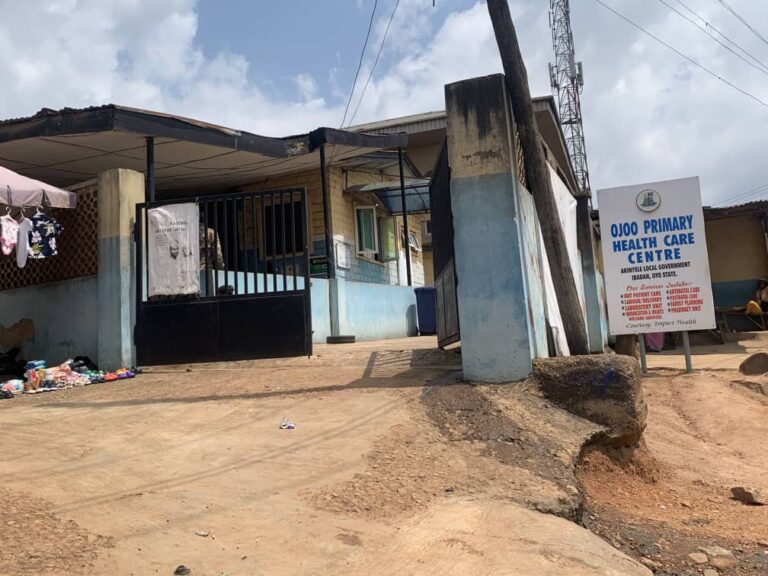
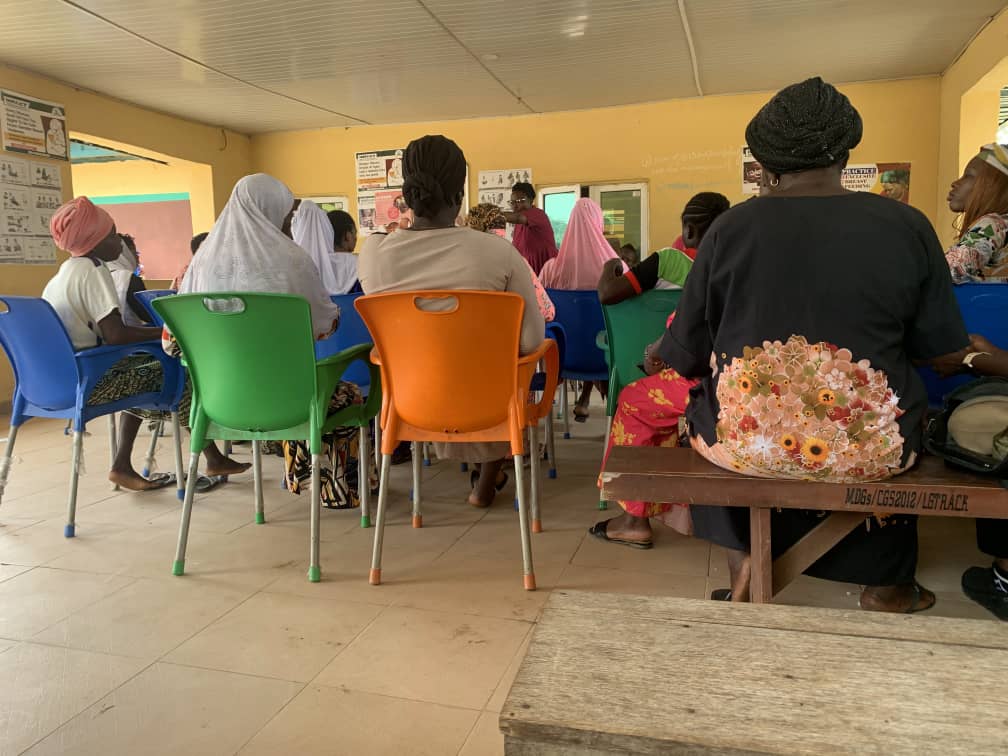
It was a little past midday at the Ojoo Primary Healthcare Centre (PHC) in Akinyele LGA in Oyo state. Periodically, the loud cry of a woman in labour rose above the hum of voices in the crowded waiting area, where patients sat patiently for their turns to be attended to.
Catherine Adebola, the officer-in-charge (OIC) of the facility, excused herself from the reporter. “We’re managing a woman in labour. She is having a challenge, and I need to step in,” she said.
About ten minutes later, the woman’s cry waned and was replaced by that of a baby. Adebola returned to her office after washing up. “We have a baby boy. Mother and child are doing fine,” she announced.
She said courtesy of the Basic Healthcare Provision Fund (BHCPF), the centre now has the essential equipment it needs to deliver services — especially antenatal and childbirth care for women.
She explained that when she was deployed to the PHC in 2023, the situation was quite different, adding that power supply was poor, and during night deliveries, they often had to depend on rechargeable lamps.
“It was terrible,” Adebola recalled.
However, funding from the Basic Health Care Provision Fund (BHCPF) has since altered that reality. The facility now has a 1kVA solar system that powers key areas, including the labour room, she enthused.
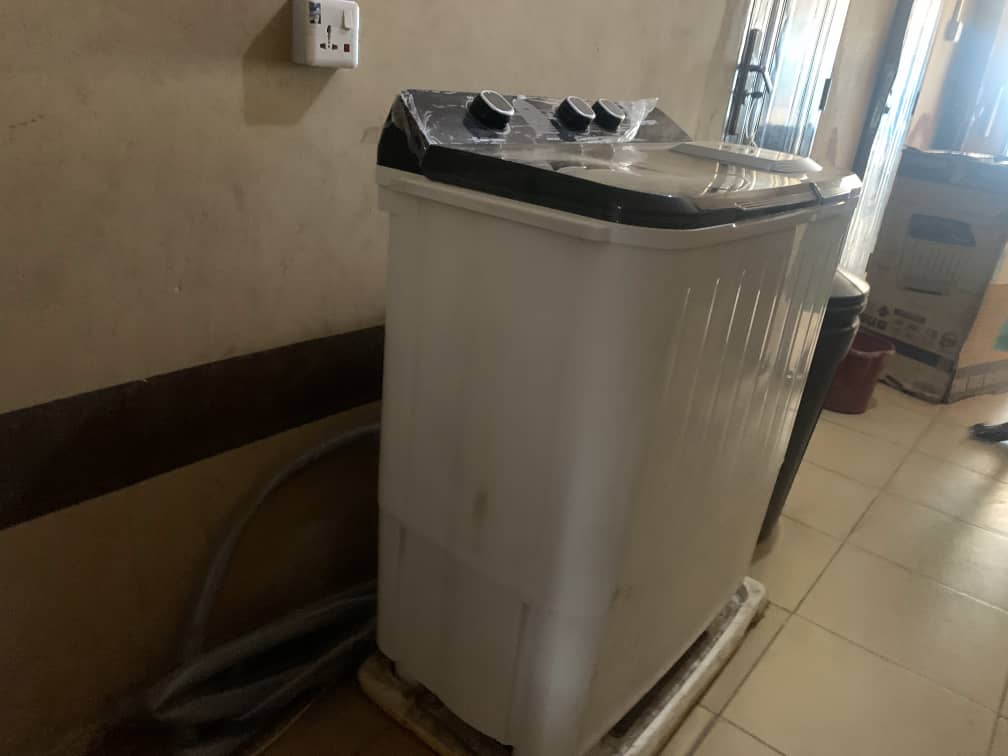
With an average of 3,000 patients monthly, Ojoo PHC receives ₦300,750 every quarter as Direct Facility Funding (DFF). From this, it has purchased a washing machine for infection control, new chairs, sphygmomanometers, a weighing scale, delivery instruments, laboratory reagents, and registration materials. The facility’s broken borehole, which had been abandoned for two years, was also repaired.
Adebola further said the fund is also expended on power costs, fuel, and other repairs. All these expenses are documented inside the business plan and approved by the state’s healthcare board, she noted.
The washing machine purchased by the PHC
“The fund has really helped us because in times past, you would not even want to come to this PHC, not because of the staff, but because of the tools to work with. We have now procured a weighing scale, delivery instruments, laboratory reagents and registration cards,” Adebola said.
“I met the borehole faulty when I was deployed here in 2023, but we fixed it in the third quarter of this year from our BHCPF allocation. Before fixing it, we used to buy water from water tanks.
“Now with the BHCPF, we can do some things on our own once we put it inside our business plan. We procure essential drugs like antimalarials and hematinics, and antibiotics and patients under the scheme get the drugs for free.”
As of September, the facility had 1,611 BHCPF enrollees, with 47 treated that month.
At Ayegun PHC, women come back because ‘things have changed’
Twenty-three kilometres away, the Ayegun PHC in Akinyele LGA — renovated under the IMPACT Project — tells a similar story of transformation.
For 21-year-old Sakinah Ariyayo, the change is personal. When she delivered her first child at the facility in April 2023, the labour room was lit with candles.
Sakinah had her child at 3.00 am.
“There were only two nurses on duty that night. Even though they had a small solar, it was dim, so we had to light up candles for the delivery,” she said.
“But now, there is light everywhere. I felt encouraged to return for my second pregnancy. I feel very happy. It is a good development. See, now everywhere is well ventilated, we have a lab, good restrooms and drugs.”
The facility now runs basic laboratory tests such as malaria, ANC tests, HIV, hepatitis, syphilis, and PCV. Staffing has also improved, with ten workers, including two CHEWs funded under the BHCPF and a newly recruited night guard.
Although still below the minimum required staffing standard of 24 health workers per PHC, the OIC, simply identified as Oluwagbemiga, said it has eased workload and reduced waiting time.
Ayegun PHC also receives ₦300,750 quarterly DFF, used for essential drugs, patient records, and utility costs. A solar power system has been installed — critical in a community where electricity barely lasts three hours daily.
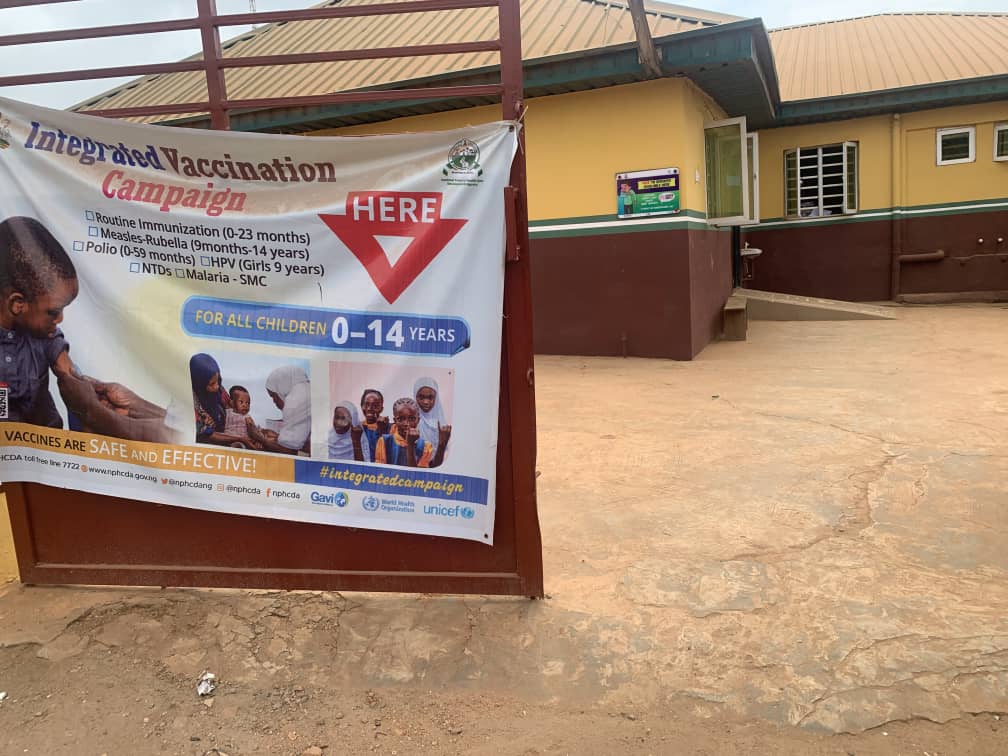
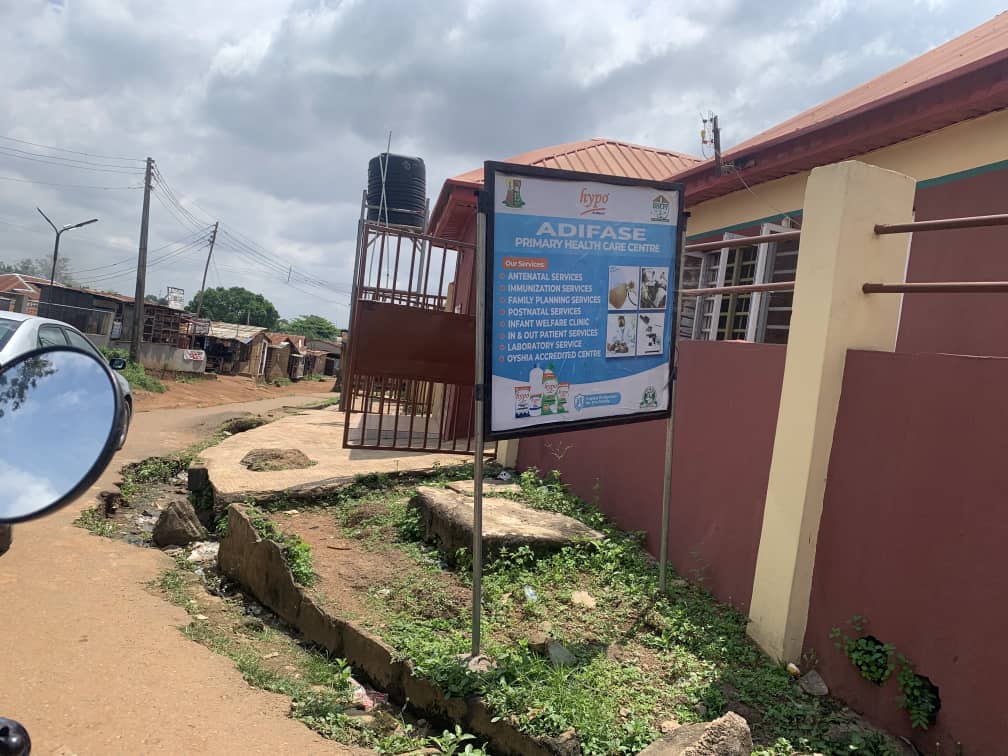
A banner indicating some services rendered at the PHC
What the BHCPF aims to achieve
The Basic Health Care Provision Fund (BHCPF), established in Section 11 of the National Health Act 2014 and rolled out in 2019, is Nigeria’s most ambitious primary healthcare reform in decades. Its goal is to finance basic healthcare for the most vulnerable and accelerate the journey towards universal health coverage (UHC).
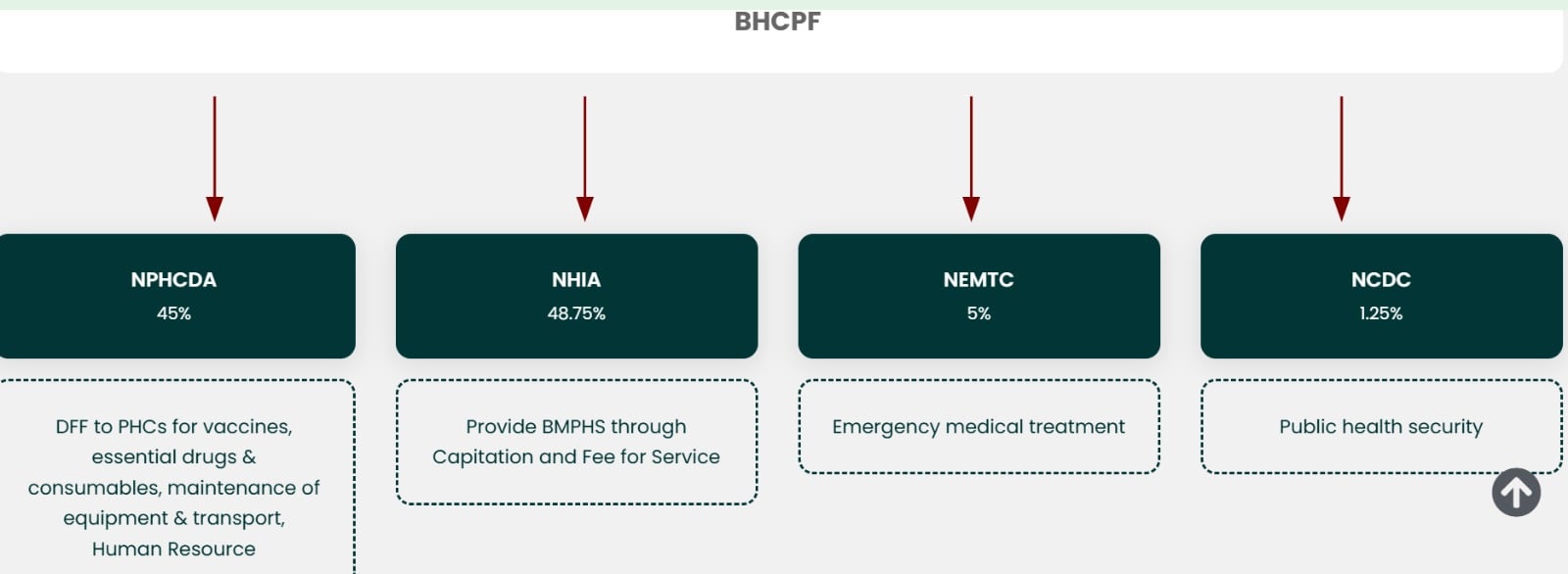
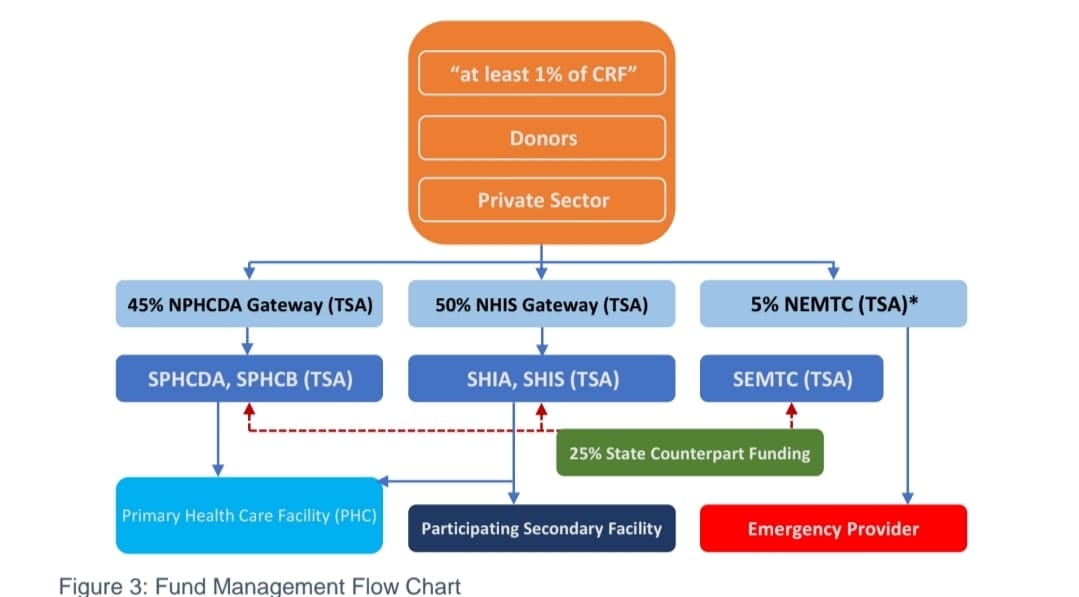
It is implemented through four gateways — NPHCDA, NHIA, NEMT, and NCDC — and is intended to strengthen PHCs, support emergency services, improve access to essential drugs, and expand health insurance coverage.
The BHCPF gateways
By 2027, the federal government aims for 17,600 fully functional PHCs, with at least one in every political ward, and one secondary health facility per LGA benefiting from the fund.
The BHCPF is managed by three key agencies at the national level: the National Primary Health Care Development Agency (NPHCDA), the Federal Ministry of Health, and the National Health Insurance Authority (NHIA).
Every year, the federal government is required to contribute at least 1 percent of its Consolidated Revenue Fund (CRF) to the BHCPF. In addition, individual state governments are required to provide 25 percent of the total funds expected from the BHCPF in counterpart funding as stipulated by section 11 subsections 5a and b of the NHAct 2014. Development partners and international donors also contribute to the fund.
Source: FMoH
Oyo PHCs once in crisis now shows signs of recovery
According to the Oyo State Primary Healthcare Board (OYOPHCB), there are over 760 PHCs in the state, out of which 351, through the one facility per ward policy, receive funding from the BHCPF.
In March 2023, the Oyo state government announced that over 200 PHCs in the state will be renovated and upgraded by 2025. Seyi Makinde, the governor, promised that each of the 351 wards in the state would have at least one Grade 3 PHC.
The IMPACT Project was then launched, and at least, 264 PHCs have since been renovated/revitalised across the 33 LGAs in the state.
Subsequently, Makinde, on March 7, 2023, presented a symbolic cheque of N4.5 million to Ward Development Committee (WDC) members for equipping 264 primary healthcare centres across the state.
Eight PHCs per LGA in all 33 LGAs were equipped with medical, laboratory and clinical equipment.
The funding for equipping the PHCs was from the Oyo state government, OYOPHCB, IMPACT Project, and BHCPF.
According to the state government, OYSHIA increased enrollees from 69,996 in September 2019 to 180,048 in September 2023 and 255,140 in May 2025.
Some of the revitalised and equipped PHCs were visited to ascertain their levels of functionality and service delivery.
A 2024 report documented severe understaffing at Adifase PHC in Ibadan South-West LGA, where one heavily pregnant health worker managed the facility serving over 700 patients monthly.
Adifase PHC
During a follow-up visit on October 17, 2025, the situation had significantly improved. TheCable observed the facility had at least four nurses on duty.
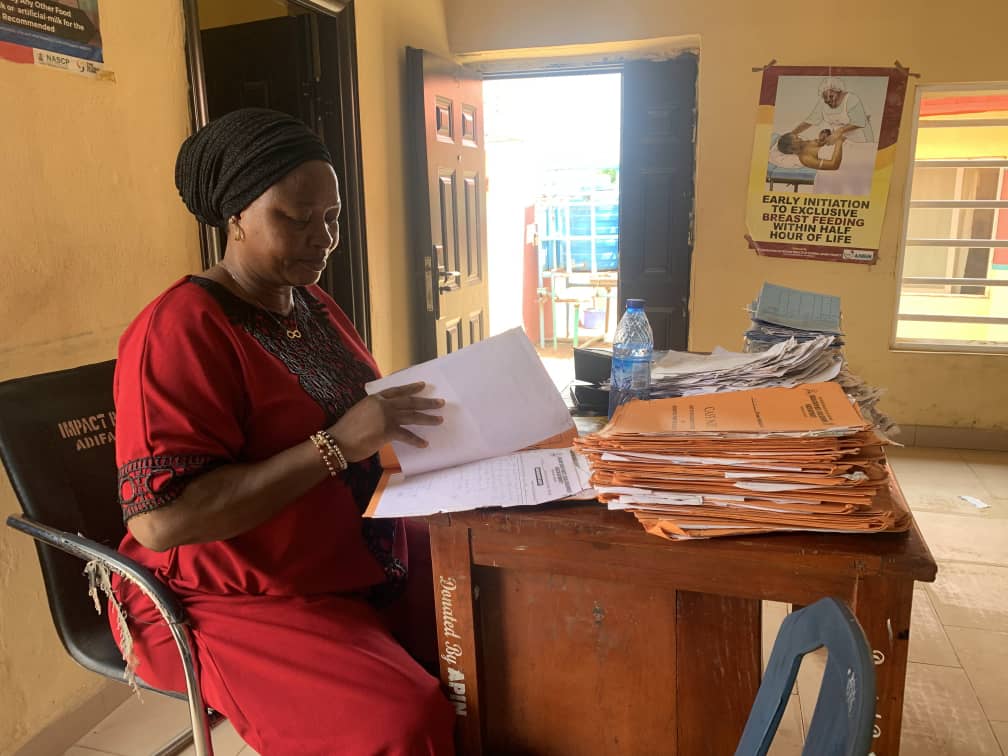
The OIC, Adeyemo H.O., confirmed the positive turnaround since she was posted to the facility in December 2024. She acknowledged that before the improved staffing levels, workers at the facility were severely overstretched, such that they ran a 12-hour shift instead of 8 hours.
“We used to run two shifts — 7 am to 7 pm — instead of the standard three. Staff would break down, but now that challenge is gone,” the OIC explained.
Adeyemo, OIC of Adifase PHC
“More hands were employed in May,” Adeyemo said, adding that “we now have enough CHEWs, nurses, and community health workers”.
Adeyemo declined to disclose the exact number of health workers at the facility, saying she is not permitted to disclose such details under civil service rules.
The facility also gets the same N300,750 in DFF and over N600,000 in capitation funds from the BHCPF.
“We can see the changes in service delivery, getting drugs for the patients. It has helped us to deliver quality healthcare services to our patients,” she said.
At the Ido PHC in Ido LGA, Oladosu Vincent, the technical coordinator, said the revitalised facility now attracts even “elite” residents because the improvements are visible.
He noted that the PHC is now better positioned to handle the growing number of patients, adding that the improved condition of the facility has restored public confidence.
Antenatal session at Ido PHC
“Even the elite now use this facility. If it wasn’t in good shape, they wouldn’t come; they would prefer to return to town. But what they’re looking for in town is already here,” Vincent said.
According to Vincent, funding through the BHCPF has further boosted both service delivery and staff welfare.
“The fund has increased both input and output. It has made our staff very comfortable. Before now, it was like working under duress. Before, you would find only three staff in a clinic like this. Now, we have enough personnel to run the facility round the clock,” he noted.
“Today is our immunisation day, and the nursing mothers who came for routine immunisation are not less than 200.”
Babatunde Sekinat, a 43-year-old mother of three, said that when she first gave birth seven years ago, the facility had no running water, only one building, and a few nurses.
“But now, everything has changed. Now, there are many nurses, and I enjoy the experience better; that is why I’m back, Sekinat said.
Sekinat
Community involvement through WDC
The Ward Development Committee (WDC) was holding a meeting at 11 am when TheCable arrived at Adaramagbo PHC in Oluyole LGA on November 3.
BHCPF-affiliated facilities are mandated to have functional WDCs and submit business and quality improvement plans.
Emiade Olabisi, the technical coordinator, took TheCable on a tour of the facility and introduced some members of the WDC who were seated in a meeting room.
“We’re having a meeting with the WDC to inform them of the activities at this health facility. You can see we are running an inclusive and transparent system,” Olabisi said.
Present at the meeting were the supervisory council for health, Oluyole LGA; education secretary for the LGA; Sanusi Adeola, Oyo state internal auditor for IMPACT; and the WDC chairman. Others were representatives from the youth, religious leaders and traders.
“The people you are seeing here are the community, where you have the religious and traditional leaders, youths, and market women. We are all stakeholders,” Adeola said.
“Impact Project came to reduce infant mortality and to extend the scope of health services, and we have done a lot. We have quarterly meetings to get feedback from the people – where are we, where are we going to, are we actually getting there?”
Gaps, delays and the realities inside PHCs
Despite the renewed energy flowing into Oyo state’s primary healthcare system, not every facility reflects the basic standards set by the NPHCDA. Across several LGAs, Pockets of decline were noticed– healthcare centres where the promise of the BHCPF is slowed by low awareness, weak infrastructure, and delayed enrolment.
At Oke Bola PHC in October, Ogunsowo, a matron who doubles as the OIC, refused to speak on the state of activities at the facility, asking the reporter to get approval from the state government.
However, in the waiting area, TheCable observed an elderly man who had come to get his blood sugar level tested. One of the health workers told the patient that the glucometer was not functioning at the time.
“The last time it got spoilt, I was the one who fixed it,” she said, adding that the device frequently breaks down and needs to be replaced.
At Ayegun PHC, for instance, many beneficiaries still do not fully understand the scheme or the services they are entitled to. Some residents continue to patronise traditional birth attendants, unsure of what the BHCPF offers.
The facility’s OIC said that some enrollees have never returned to the PHC after registering, preferring to self-medicate rather than spend money on transportation.
“During the registration of new BHCPF enrollees, many thought it was a political initiative and expected money to be shared. People even travelled long distances to enrol,” she said.
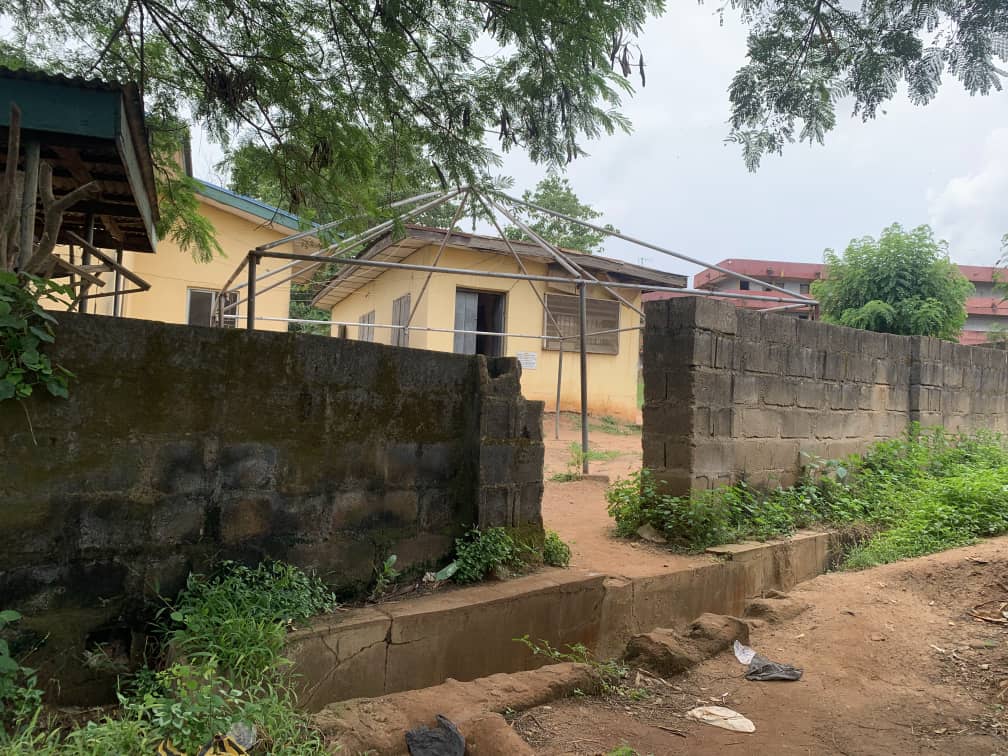
Other centres face more structural challenges. At Akinyele PHC in Moniya, the facility began receiving BHCPF in the first quarter of 2025. However, the absence of registered beneficiaries means the money goes strictly into repairs and equipment — yet the surroundings remain harsh and unfriendly for patients. A bushy walkway and an exposed waiting area leave expectant mothers at the mercy of the weather.
A bushy path leading to the health facility
Amos Ademola, the WDC chairman for Moniya PHC, stated that the committee had engaged the OYOPHCB on the issues but received no response.
“We have been expecting them to do that. In fact, the MOH has an office here with us, but we don’t know what is happening. I have written to the executive secretary, and even the governor, but I have not seen anything for three months now,” Ademola said.
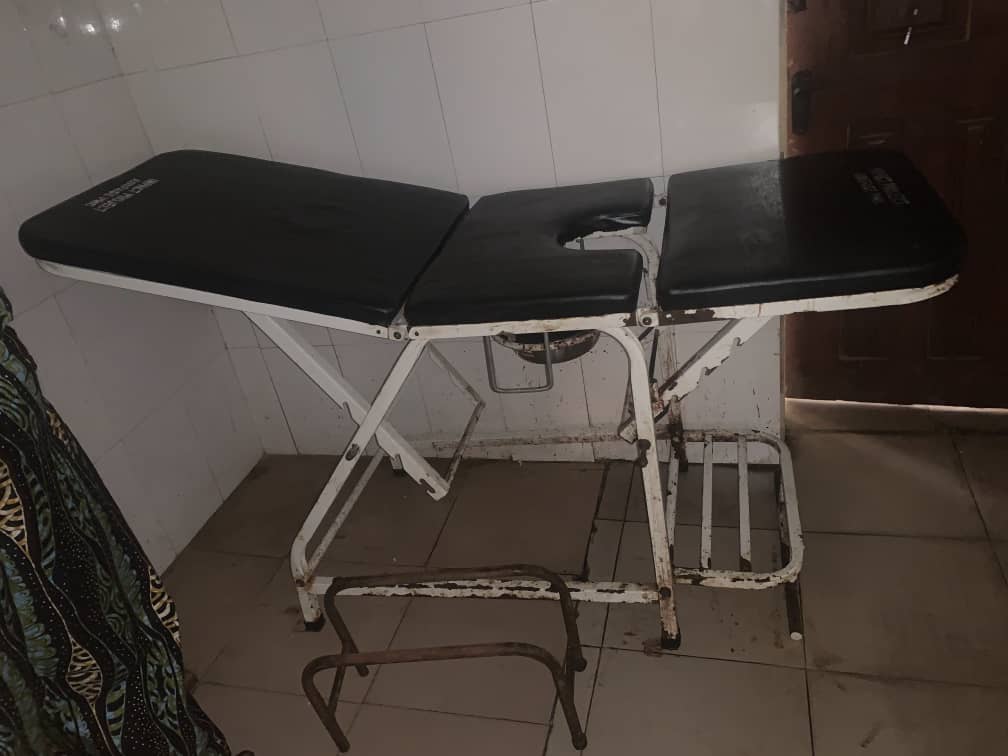
TheCable also discovered equipment shortages that undermine service delivery. At Adifase PHC, the labour couch is barely functional.
he faulty delivery bed at Adifase PHC
“We’re just managing it,” Adeyemo said, adding that a request to purchase a new one has been added to the facility’s business plan for the last quarter of the year.
She also said the facility needs cleaners and health attendants, and urgently needs additional delivery instruments to prevent cross-contamination between patients, especially those living with HIV or hepatitis B.
“For now, when they come in, we use our discretion and sometimes improvise with a blade to separate the placenta from the mother and child instead of scissors because we don’t want to spread the infection,” she explained.
With poor power supply and no solar alternative, laboratory services are often delayed, leaving staff to rely on inconsistent generator use.
Across several PHCs visited, the complaints were consistent: the absence of ultrasound machines, insufficient medical officers, and slow approval processes that delay essential purchases. The gaps reveal the unevenness of BHCPF implementation — a system that works impressively in some wards but struggles to take root in others.
Oyo State government responds
When TheCable presented its findings to the Oyo State Primary Healthcare Board (OYOPHCB), Biodun Akande, the director of special duties, who spoke on behalf of Muideen Olatunji, the executive secretary, said the state has made “significant improvements” since it began receiving BHCPF allocations in 2020.
According to Akande, Oyo state has received over N3 billion (₦3,072,422,452) from the federal government, while the state government has contributed ₦100 million in counterpart funding within the same period. He said the state is using the fund to close critical gaps — strengthening the drug revolving fund (DRF), improving 24/7 service delivery at primary healthcare centres (PHCs), and reducing out-of-pocket healthcare expenses for vulnerable residents.
“How do I know we’re moving forward? I compared the 2020 scorecard with what we have now,” he said.
“Most of the health indices that were in red have shifted to yellow, and some to green. So, I can say categorically that we have recorded improvements.”
Akande explained that 109,156 people have so far been enrolled under the BHCPF in Oyo, almost double the original target of 60,000 set at the launch of BHCPF 1.0. With BHCPF 2.0 underway, the state plans to expand further, adding 137 more facilities over the next four to five years.
On accountability, he said the state monitors how PHCs use their facility financing through WDCs, regular integrated supportive supervision visits, and routine meetings with health workers. The state has also launched a whistleblower policy to strengthen transparency.
He described the flow of funds as tightly regulated: “If we don’t get approval from the federal government, we cannot disburse. Every year, we prepare a plan with the national authorities. When approval comes, funds go into a CBN domiciliary account, then into Oyo’s Treasury Single Account (TSA). We wait for approval to spend before disbursing to facilities. PHCs would have prepared their business plans and submitted them for approval as well.”
On the scarcity of scanning machines and the low number of doctors, Akande said the government is making gradual progress.
“We plan for each LGA to run scan services. We’ve started in three LGAs but haven’t completed the rollout. Some LGAs even have machines that are yet to be activated,” he said.
Asked whether the government is considering portable scanning machines to bridge the gap, Akande said the option “will be considered and test-run in some PHCs”.
As for medical personnel, he said the state has increased its doctor workforce, and that between 2024 and 2025, the state government recruited 3,980 health workers, with the process beginning in 2024.
“The first batch was recruited in March 2025, and the exercise was completed in June,” he said.
“We recruited 44 new doctors in addition to the 17 we had. So now, each LGA has about two doctors who rotate across facilities rather than being stationed in one centre.”
This report was made possible with support from the International Centre for Investigative Reporting (ICIR) under its Strengthening Public Accountability For Results and Knowledge (SPARK 2.2) project.
THE State Security Service (SSS) has arrested one of its staff members, Ifeanyi Onyewuenyi, for allegedly abducting and defiling a 16-year-old girl WalidaAbdulhadi, and forcing her to convert to Christianity in Abuja.
This was revealed in a statement issued on Friday, January 9, by the SSS Director of Public Relations and Strategic Communications, Favour Dozie, who confirmed the arrest of SSS officer named Ifeanyi Onyewuenyi in connection with Walida’s ordeal.
“The attention of the State Security Service has been drawn to reports alleging involvement of a staff member of DSS, one Ifeanyi Festus, in a case of abduction, defilement of a minor, and abuse of office, among other offences. For clarity, the Service has no record of the above-named in its employment,” he said.
According to Dozie, the officer is being investigated over the alleged forceful conversion and marriage of Walida, and the investigation is currently in progress.
“However, it is hereby confirmed that an active staff, Ifeanyi Onyewuenyi, who is suspected to have forcefully converted and married one Walida Abdulhadi ‘f’, has been arrested and is currently being investigated,” the statement said.
The SSS spokesperson disclosed that the alleged actions are contrary to the agency’s regulations and code of conduct, and confirmed that the investigation’s findings would be disclosed publicly.
According to media reports, the development followed a petition dated January 4, written by an Abuja-based law firm, Gamji Lawchain and addressed to the SSS Director-General on behalf of the girl’s father, Alhaji Abdulhadi Ibrahim, and his family. The law firm, in the petition, accused the SSS officer of abducting the teenager from the Hadejia area of Jigawa State when she was allegedly just 16 years old.
“The anxiety, fear, and emotional devastation of losing their underage daughter slowly destroyed the mother, who eventually died as a direct consequence of the psychological trauma,” it read.
The law firm argued that because Walida was a minor at the time of her disappearance, Nigerian law deems her legally incapable of consenting to any sexual relationship.
The petition explained that the family’s unsuccessful search for more than two years subjected them to prolonged emotional trauma, which reportedly contributed to the death of Walida’s mother.
According to the petition, the case took a dramatic turn on January 1 after the SSS officer reportedly called the girl’s father to say she had been living with him, had given birth to his child, and that he was “ready to marry her.”
The petition said that due to age and ill health, the father sent Muhammad Badamasi Ibrahim to a SSS facility in Abuja, where he was allegedly informed that Walida had been living in a SSS residence throughout the time she was missing and demanded the girl’s release. The request had reportedly been refused.
The counsel alleged that while under the suspect’s custody, Walida was converted from Islam to Christianity without her parents’ consent and subjected to sexual exploitation that resulted in pregnancy and childbirth, while she was still a minor.
Calling the allegations “moral bankruptcy in uniform,” the law firm warned that failure to act could undermine public confidence in state institutions and demanded the SSS officer’s immediate suspension, arrest, and prosecution, as well as an independent investigation into the Karmajiji SSS facility.
The firm also sought the release and protection of Walida and her child, alongside disciplinary action against any SSS personnel found to have been complicit.
THE National Association of Resident Doctors (NARD) has insisted it will proceed with its planned nationwide strike despite a court injunction restraining the action.
They cited the Federal Government’s failure to fully address its demands, including the non-payment of salary arrears owed to thousands of doctors, as a key reason for the proposed industrial action.
The association said more than 2,000 of its members have yet to receive arrears from the 25–35 per cent adjustment to the Consolidated Medical Salary Structure (CONMESS), dismissing claims by the federal government that the outstanding payments have been settled.
NARD’s National President, Mohammad Suleman, stated this late Friday, January 9, during an interview on Politics Today on Channels Television, insisting that unresolved welfare issues informed the decision to embark on the strike.
Reacting to the government’s assertion that seven out of the association’s 19 demands had been statutorily addressed, including the payment of seven months’ CONMESS arrears, Suleman said the claims did not reflect the reality faced by resident doctors across the country.
“On the seven months’ arrears of 25–35 per cent, we still have over 2,000, almost 3,000 of our members who are yet to be paid those arrears,” he said
Suleman attributed the persistent delays to the government’s reliance on service-wide vote provisions, arguing that doctors should not have to wait for special interventions before their entitlements are captured in the budget.
“In 2023, it was said to be put inside the service-wide vote if it wasn’t paid. In 2024, it was put in the service-wide vote; in 2025, it was again put there.
“The President had to make special provision when doctors agitated for that money to be paid.
“Are we saying these arrears have to go through that route of waiting for service-wide vote after service-wide vote and waiting for the President of the country to specifically intervene before they are captured in the budget?” Suleman said.
He confirmed that discussions were ongoing with the federal government and the Ministry of Health, but stressed that talks alone would not stop the strike unless concrete actions were taken.
Suleman maintained that the association’s resolve remained firm despite the court order restraining the industrial action, noting that the injunction did not address the underlying issues confronting doctors.
“I am making it very clear that the resolve of our members is not shaken by all these. All these were factored into the decision to embark on this strike,” he said.
When asked about whether the strike scheduled to begin on Monday would still hold, Suleman said the final decision rested with the union’s National Executive Council.
“Unless the National Executive Council of the Nigerian Association of Resident Doctors says otherwise,” he said.
He also questioned whether the court injunction should take precedence over the conditions under which doctors work and patients receive care.
“Are we ignoring the sufferings that doctors are going through in this country? Are we ignoring the suffering that patients go through because doctors are exhausted, frustrated and have difficulties executing their jobs?” he asked.
Recall, the National Industrial Court of Nigeria in Abuja had on Thursday, January 8, ordered NARD and its members not to proceed with the strike scheduled for January 12. The order, granted by Justice Emmanuel Subilim, followed a motion filed by the federal government through the Attorney General of the Federation.
Despite the injunction, the association said the strike would only be suspended after all its demands are met, dismissing claims that the action is politically motivated.
AT the start of every planting season in Ringim Local Government Area (LGA), Jigawa State, hope rises with the rains. But for the women farmers who depend on government fertiliser for good farm yields, that hope fades quickly.
By Sani Maisara
The fertiliser they expect from the state government ends up as nothing more than a promise proclaimed in public announcements, discussed at meetings and radio programmes, but missing on the farms where it is needed most. Each year they wait, only to realise that the promised support never came in time and, in many cases, it never arrived at all.
Women like Hajiya Hadiza Adamu, 48, know this frustration too well. She has farmed in Yan Dutse in Ringim LGA for more than 20 years and leads a group of smallholder women farmers who depend on fertiliser to keep their farmland productive. She says the state’s agro support and intervention programmes do not reach her community despite its long history of farming.
“We hear the announcements every season, but we never see the fertiliser,” she said.
“We register our names and attend every meeting, yet nothing comes to us. It is painful because we do all the work on our farms without any support. Every year, we buy fertiliser on credit, and we still struggle to pay back.”
Her farming business, which is her major source of livelihood, now struggles as the support she plans her farming activities around remains trapped in speeches and paperwork instead of reaching the people who actually till the soil.
This experience is not isolated. A visit to villages in Ringim and Taura LGAs revealed that many women farmers who rely on government support often struggle to earn a living due to unmet government promises and shrinking harvests. Many of them now rely on compost pits, borrowed labour and old soil restoring methods simply to keep their crops alive.
Agricultural experts say this dependence on fertiliser is linked to the condition of the land in the area as well as most parts of the state. Aminu Sulaiman, an agricultural extension agent in Taura, explained that years of continuous cultivation without adequate crop rotation or resting periods have steadily depleted soil nutrients across these communities.
According to Sulaiman, farmland that once produced reasonable yields now requires more seeds, labour and water just to sustain crops. He added that organic methods alone are no longer sufficient for many farmers, making fertiliser essential to restore soil productivity. As a result, rural women farmers are forced to rely on fertiliser which is now beyond their reach due to rising costs and limited access.
Jigawa Agricultural Support and Fertiliser Subsidy/Intervention
The scenario in these communities contradicts Jigawa’s multi-billion-naira agricultural allocations and official claims of successful fertiliser distribution. In 2025, Jigawa State government had an approved budget of ₦698.3bn which was later revised to ₦756.3bn after a supplementary appropriation. The government itself describes 2025 as a year of “agricultural transformation,” with new programmes and agencies created to push food production and support farmers across the state.
Within this broader spending, several specific initiatives were launched that should, in principle, improve access to fertiliser and other inputs in the state. In August 2025, the Jigawa State Executive Council (SEC) approved ₦7bn for the 2025 dry season rice cultivation programme, to pay agro-input dealers and service providers under the Dry Season Rice Input Voucher System.
The Commissioner for Information Youth, Sports and Culture, Sagir Musa Ahmed, said the intervention is meant to deepen the state’s commitment to agricultural transformation by providing high quality seeds, fertilisers and chemicals to thousands of farmers and to make Jigawa a leading hub for rice production.
In the same vein, the state also approved ₦365.7m for the construction of 4,600 tube wellsin key farming communities. Tube wells are shallow boreholes fitted with pumping systems that provide water for irrigation, especially during the dry season. They are designed to help farmers cultivate crops year-round, reduce dependence on rainfall and increase overall productivity in dry season farming.
Beyond rice production, the state has rolled out targeted agricultural support for civil servants, alongside loan schemes and other interventions aimed at expanding participation in farming and improving access to inputs. In August 2025, the government launched the second phase of its Workers Agricultural Support Programme, spending more than ₦1.2bn to assist 5,750 civil servants with farming inputs for the 2025 rainy season.
This is a scheme aimed at encouraging farmers to engage in agricultural production. Each beneficiary receives a package of fertiliser, improved seeds and pesticides, valued at either ₦250,000 or ₦500,000 depending on grade level, to be repaid through salary deductions. The first phase in 2024 reportedly cost over ₦3.3billion, bringing the total commitment for civil servants to more than ₦4.5billion in two years.
The state is also benefitting from federal agricultural interventions. In September 2025, the Jigawa State government approved ₦396m to pay for 20 trucks of NPK (Nitrogen, Phosphorus, and Potassium) fertiliser allocated by the federal government at a subsidised rate of ₦33,000 per bag, a total of 12,000 bags. The government said the fertiliser was meant to support smallholder farmers and complement the 2025–2026 Dry Season Agricultural Programme of the state.
A separate federal support package, announced in October 2025, provided fertiliser valued at over ₦450m to be sold to Jigawa farmers at subsidised prices, with Governor Umar Namadi describing it as part of a wider push to enhance food production and modernise farming.
Women speak on being denied fertiliser support
Despite the scale of these investments, farmers say the benefits are not reaching them. Previous interventions in the state have followed the same pattern, and there are already concerns that this year’s funds are drifting in that direction.
Habibu Shitu, Village Head of Malamawa community in Taura LGA
Many women farmers in Ringim and Taura LGAs said they have not received any fertiliser or input support in their communities. They hear announcements about vouchers, truck deliveries and subsidised prices, but claim their names are never on the lists and no records are displayed to show who received the inputs.
In Malamawa community in Taura LGA, Amina Musa, 38, said she joined every registration exercise announced by local officials. She supports her household through smallholder rice farming but has never received a single bag of government subsidised fertiliser since she started farming. According to her, officials told her to expect allocation during planting season, yet nothing ever reached her village. Her crops suffer each year because she relies on borrowed inputs and whatever organic manure she can gather.
To cope, women in these communities employ stopgap measures including relying on organic manure, reducing the size of their farms or pool labour through traditional arrangements such as ‘Gayya’ a rotational communal farming system where women work on one another’s farms in turns. Some farmers supplement their income through petty trading or craftwork. While these efforts help them survive, farmers said they (the efforts) cannot replace fertiliser on land that has been cultivated for decades.
In Zangon Kanya community, Ringim LGA, Hadiza Garba, 42, shares a similar account. She leads a group of women rice growers and said they have submitted their names for years without success. She said men in the village are usually selected first and women are told to wait even when they are also do farm work daily.
“We farm every day but they do not count us when they share fertilizer,” she said, adding, “We register every year, but our names never appear on the list.”
These accounts point to the same experience in different communities visited. Leaders of women farmer groups explain how they submitted their names, attended meetings and followed every guideline, only to watch fertiliser allocations pass them by.
“We present our list every season but nothing changes,” said Hassana Tuara, a women’s group leader in Taura LGA. “They take our names, but the fertiliser goes to other people.”
Others recount how trucks arrive at distribution points only for officials to hand out the inputs to a select few, leaving most women to walk home with nothing and forcing them to improvise through organic manure and shared labour.
“We were told to come to the local government council hall but when the trucks came, they shared everything among their loyalists. We stood there with our slips and they asked us to come back the next day. When we returned there was nothing left,” Raliya Musa from Taura said.
‘Fertiliser does not reach the remote villages’
Community leaders and district heads in the places visited confirm that allocations do not reach the villages despite government reports that claim otherwise.
In Zangon Kanya in Ringim LGA, the District Head, Ibrahim Mai Unguwa lamented that the community has never received fertiliser under the state subsidy programme.
“The only thing we hear is radio announcements that say fertiliser has been shared. Fertiliser has never knocked our farmers’ door.”
Mansur Na’Ibi, Village Head of yan dutse
In Yan Dutse, Ringim LGA, Village Head Mansur Naibi explained that distribution often favours male household heads and elderly men while women farmers are excluded. He also said there are no notices, no receipts and no community registration check at the community levels.
“The fertiliser often goes to men and a few senior farmers. Women are often not prioritised even when they farm often.”
In Malamawa, Taura LGA, the Village Head Habibu Shitu, said that fertiliser distribution is politicised and diverted to political party supporters.
“Women receive no information and no representation,” he said.
“When it finally comes it goes to those close to the officials.”
The traditional leader of Sabon Garin Taura, Taura LGA, Alhaji Usman Adamu, said that some lists displayed in the village contain names of people who no longer live in the community.
“Some of the lists displayed in the village contain names of people who have long abandoned the community, yet their names are still being used to collect government’s support meant for the most vulnerable. This is unacceptable and a clear case of corruption and exploitation. We urge the authorities to investigate and ensure that the rightful beneficiaries receive the support intended for them,” Alhaji Usman added.
Despite the size of Jigawa State’s agricultural budget, many farmers say the system that should deliver fertiliser to communities is weakened by politics and poor transparency. In both Ringim and Taura LGAs, community leaders and farmer groups said the farm inputs distribution process is shaped by influence, loyalty and selective access.
Malamawa community’s Village Head, Habibu Shitu explains that women farmers are consistently left behind because the process is controlled by male dominated networks. He said scarce inputs often end up with political supporters rather than those who need them most.
“Women are often excluded because distribution channels are controlled by male networks. Politicians allocate inputs to their supporters who can give loyalty or offer some kind of incentives during elections.”Shittu pointed out that women’s low participation in politics also affects their access to official registries, which makes it harder for them to qualify.
Asked to describe how fertiliser gets into the hands of politicians, he replied, “Who knows. That is how the system flows. I cannot call names and be summoned by the authorities.”
He said the lack of transparency allows favouritism and corruption to thrive, leaving women without the support needed to boost productivity.
As these challenges persist, the weight falls on women who must keep their farms running despite the absence of support. However, the failure of fertiliser to reach smallholders women farmers has pushed many deeper into hardship.
In Taura LGA, Amina Musa explained how borrowing money has become a yearly struggle. She cultivates rice on a two-hectare rice farm with the help of her children but loses a large part of her harvest to loan repayment.
“When the rice matures, I must surrender a large share of the paddy as repayment,” she said. “After paying for seed, fertilizer and labour I often make no profit and sometimes I even face a deficit.” She said each season ends in another loan, trapping her family in a cycle that strains their finances and hopes for a better future.
Several women across Taura and Ringim now rely on low yielding crops and improvised inputs as a result of these challenges. Sadiya Bala, smallholder farmer in Malamawa, said poor access to inputs has kept many families in the community trapped in poverty.
“We have been struggling to survive, relying on low-yield crops like millet and sorghum,” she said. “The yields are poor, and we can barely feed our families, let alone sell anything. Our farmlands are tired, and we have no access to improved seeds or fertiliser.
“We need support to adopt better farming methods so we can increase our harvests and improve our income. We want to send our children to school, access healthcare and live with dignity, but it is hard when all we think about is where the next meal will come from.”
The Village Head of Yan Dutse, Mansur Naibi, said women farmers are carrying the heaviest burden.
“Our women work hard, but they still rely on low-yield crops like millet and sorghum,” he said,adding “They need improved seeds, fertiliser and better farming methods. Without support, they cannot feed their families or earn enough to live decently.”
In Zangon Kanya, Ibrahim Mai Unguwa, a farmer and Village Head, shared a similar concern.
“It is painful to watch our women struggle from morning till night and still harvest so little,” he said. “If they had access to modern tools and quality inputs, their lives would be different. They deserve that chance.”
The risk to food security and gender equality
Women farmers form a major part of Jigawa’s food supply chain, yet their exclusion from fertiliser distribution now threatens production levels across several communities. In Ringim and Taura LGAs, women who once harvested enough to feed their families and sell in local markets say their output has dropped sharply. With little or no access to inputs, they struggle to maintain the soil, manage pests or plant at the right time.
Agricultural experts warn that this decline could affect food availability in a state where many households depend on local production. The shortage of fertiliser pushes women into low yielding farming, weakening their ability to support their families. As income falls, many households become more vulnerable to hunger through the farming season.
The impact is also visible in gender relations. Aminu Sulaiman, an agricultural extension specialist in Taura LGA, said women already face barriers in land ownership, access to credit and extension services, and the fertiliser gap makes these inequalities worse.
“For many women, farming is their only source of income. When they lack fertiliser, they lose the ability to improve their harvests, support their children’s education or meet basic household needs,” he said.
Requests For Comments Met with Silence
Government officials declined to provide clear answers to questions about fertiliser distribution and transparency in Jigawa State. Repeated attempts to obtain official explanations through phone calls, text messages and physical visits to the Jigawa State Ministry of Agriculture yielded no response.
On November 4, 2025, this newspaper formally submitted a Freedom of Information (FOIA) request to the Jigawa State Ministry of Agriculture, addressed to the Commissioner, Alhaji Muttaka Namadi. The request sought detailed records on fertiliser procurement, allocations, beneficiary lists and distribution in Ringim and Taura LGAs for the 2023, 2024 and 2025 farming seasons. The request was acknowledged as received by Salisu Buba, an official of the ministry on the same day.
FOI request that was not responded to
Under the FOI Act of 2011, public institutions are required to respond to such requests within seven working days. That statutory period elapsed on November 12, 2025, without any response from the ministry. A reminder letter was subsequently sent to the commissioner, drawing attention to the lack of response and granting an additional three working days for compliance, as stipulated under the law. Despite this follow-up, the ministry neither released the requested records nor offered any explanation for its silence.
A similar experience played out at the Jigawa Agricultural and Rural Development Agency (JARDA), the state agency responsible for coordinating agricultural development programmes, including fertiliser distribution, extension services and farmer support initiatives. The agency’s Managing Director, Muhammad Imam, initially agreed to grant an interview after being contacted on October 11 and 12, 2025. However, after the purpose of the inquiry was explained and a meeting date proposed, he became unavailable and stopped responding to further calls and messages.
On December 10, 2025, this newspaper submitted a separate FOIA request to JARDA, seeking certified records of fertiliser procurement, allocations, beneficiary lists and gender-disaggregated data on women farmers’ access to fertiliser in Ringim and Taura LGAs between 2023 and 2025. The request also asked for copies of monitoring reports used during distribution. As of the time of publication, no response had been received from the agency.
Some local government officials who agreed to speak offered a different account. Sani Nabirni, a councillor in Taura LGA, said the state government was working to reform fertiliser distribution and improve transparency. He maintained that the governor and council leadership were committed to addressing supply chain challenges and curbing corruption. However, he was unable to provide documents or records to substantiate these claims.
An accountability expert, Muhammad Nasiru, said officials often avoid scrutiny because they cannot explain how public resources are utilised. According to him, fertiliser and other inputs are sometimes distributed selectively, particularly during election periods.
He alleged that access to farm inputs is, in some cases, tied to political loyalty, with resources handed to individuals who either possess Permanent Voter Cards (PVCs) or pledge support to politicians. Such practices, he said, deepen inequality, exclude vulnerable farmers and erode trust in public institutions.
“They simply cannot account for it. Some officials release information only when they want to look good or when they need support for elections.”
This report was made possible with support from the International Centre for Investigative Reporting, (ICIR) under its Strengthening Public Accountability For Results and Knowledge (SPARK 2.2) project.
THE Federal Government has banned graduation ceremonies for nursery, kindergarten and other pre-primary pupils nationwide.
The ban was announced on Thursday, January 9, alongside a new policy that mandates the use of ‘high-quality’ textbooks designed to last between four and six years.
Under the policy, schools are prohibited from bundling disposable workbooks with textbooks, a practice the government said forced parents to buy new books every academic session.
The statement, jointly issued by the Minister of Education, Maruf Tunji Alausa, and the Minister of State for Education, Suwaiba Sa’id, noted that the framework sought to cut education costs, improve learning outcomes, and promote sustainability in both public and private schools.
According to the statement, only pupils and students completing Primary 6, Junior Secondary School 3 (JSS3), and Senior Secondary School 3 (SSS 3) classes will be allowed to hold graduation ceremonies.
The government said the restriction was meant to halt the growing trend of graduation events at non-terminal levels, which often attract compulsory levies and additional charges.
The government noted that it had also introduced a uniform academic calendar nationwide to ensure consistency in teaching, learning, and school planning across states.
“The policy strengthens the assessment, selection, and quality assurance of instructional materials, addressing concerns over frequent cosmetic textbook revisions and practices that compel parents to purchase new books annually without improved content. Structured revision cycles now require substantive content improvements, while limits on the number of approved textbooks per subject and grade align with international best practices.
“The Nigerian Educational Research and Development Council (NERDC) will continue to lead textbook quality assurance. The Federal Ministry of Education reaffirmed its commitment to education reform, equity, and access to high-quality instructional materials nationwide,” the statement added.
The ICIR reports that the new directive mirrors moves by several states over the past year.
In September 2025, Osun State banned graduation ceremonies for nursery and kindergarten pupils, citing the high cost of uniforms, souvenirs, and entertainment, while introducing a requirement that approved textbooks be used for at least three years.
Other states in the South-East and South-West, including Ondo, Imo, and Ekiti, have implemented similar policies to curb extravagant ceremonies and enforce textbook reuse, easing financial pressures on families.
THE family of Princess Nwamaka Mediatrix Chigbo, an Abuja-based lawyer brutally killed by suspected kidnappers in the Federal Capital Territory, has recounted its last moments with the deceased.
In a publication by Realnews Magazine, the family explained that the young lawyer was abducted on Monday, January 5, after she went missing while on a phone call with her younger sister, Anthonia.
“Before her abduction, Barrister Nwamaka was on the phone with her sister Anthonia, who briefly interrupted the call to attend to a client. When she reverted, the barrister’s phone was still live, and Anthonia could hear her sister’s distress cry before the phone suddenly went dead and unreachable. Anthonia alerted her elder sister, Maureen Chigbo, and other family members, who called the lawyer’s number repeatedly to reach her or her abductors to no avail,” the family said.
It noted that when a call eventually went through, a male voice, speaking in English and Hausa, allegedly rained curses: “Thunder fire you there, send three million naira or else we will kill her,” the man said before terminating the call.
“Barrister Nwamaka’s family later tried to contact the Police Force Public Relations Officer and left a text message on her phone. They were referred to two police complaint numbers. The family equally sent a distress text and WhatsApp message to the Inspector General of Police (IGP), and also contacted the FCT Police Commissioner, who immediately linked them up to the Commander of the Scorpion Squad, in charge of kidnapping in Abuja.
“The commander later called to inform the family that the police were tracking the kidnappers, who were said to be in motion and would likely drop the lawyer off once they might have collected the ransom,’ it added.
The family explained that the abductors never made further demands. When the family attempted to call back for details on payment, the abductors reportedly heard Chigbo screaming in pain, pleading, “I am dying… save me, please send the money,” before the line went permanently silent.
The family maintained contact with the Police Commander throughout Monday night to follow up on the rescue operation.
At 4 am on Tuesday, January 6, when Maureen called the Commander, he expressed surprise that the lawyer had not called or returned home. He then promised to escalate the rescue operation.
“The commander later called to inform the family that ‘a lady had been found in a critical condition’ and taken to an Abuja specialist hospital. He requested that Nwamaka’s picture be sent for identification purposes. The family said it maintained contact with the police throughout the night. At about 4 a.m. on Tuesday, January 6, the commander expressed surprise that the lawyer had not been released and said the operation would be escalated.
“Hours later, police informed the family that a woman had been found in critical condition and taken to a specialist hospital in Abuja. Chigbo’s photograph was requested for identification. Her elder sister, Maureen Chigbo, who flew from Lagos to Abuja, later identified her sister’s body at the hospital mortuary,” it added.
The family said the police assured that the case was under investigation and that the culprits would be apprehended.
Nwamaka was an active member and former treasurer of the Nigerian Bar Association, Abuja, member of the International Federation of Women Lawyers, (IFWL), FIDA and Global Association of Female Lawyers (GAFA). She was a former President of Catholic Lawyers Association, Abuja.
An ardent Catholic, Nwamaka authored a book on Infant Jesus, and until death was the vice president of the Infant Jesus Association, member of the Mother of Perpetual Help Catholic Group among other religious groups.
Her story adds to the list of victims of attacks like one chance and kidnapping in the FCT.
The ICIRreported on Monday that two women were found dead in separate locations in the FCT in incidents suspected to be linked to the activities of notorious one chance criminal gangs operating within Nigeria’s capital.
One of the victims, Chinemerem Pascalina Chuwumeziem, was a nurse with the Federal Medical Centre (FMC), Jabi, whose killing subsequently drew condemnation from the National Association of Nigerian Nurses and Midwives (NANNM), FCT Council.
The second victim, lawyer Ochigbo, was found lying lifeless by the roadside.
These new year attacks echo the multiple cases of insecurity in Nigeria’s capital, published by The ICIR.
AGRICULTURAL insurance was designed to protect farmers from risk. But in Niger State, it has become another risk on its own. Many women farmers say they’ve lost more money chasing claims than to floods, pests, or drought. Tired of endless paperwork and silence from insurance officers, these women farmers now depend on faith, not policy, to survive.
By Justina ASHISHANA
When termites invaded her soya beans farm in Paikoro Local Government Area (LGA) of Niger State, Jummai Makama thought help would come from the state government. She had registered for insurance through the state’s Agricultural Development Project (ADP), now called the Niger State Agricultural and Mechanization Development Agency (NAMDA) and paid the required premium. But when she called her extension officer to report the loss, the response shocked her: “You didn’t report within 24 hours,” she was told.
Jummai in her soya bean farm
“In my farm, for soya beans, you plant and they come up with good flowers but termites enter into them and you won’t know until you harvest. At the end of the day, the seeds do not come out fine. When I complained to the insurance company so that I will be assisted, they did not answer and I just got tired and left them. One day when they finally answered, the insurance company said I did not report within 24 hours, so I did not get any benefit.
“How can I know my farm will fail within 24 hours?” she asked, her voice cracking in disbelief.
“By the time I saw that the crops were not producing, it was already too late. It is only when the seedlings start coming out that I would know that it did not produce fine. But as at that time, they said the insurance had expired.”
Jummai says herself and many other women farmers in Niger State have resigned to their fate and concluded is that, “God is our insurance.”
Across Niger State, hundreds of women farmers say they have lost faith in the state government’s agricultural insurance scheme meant to protect them from crop failure, drought or pest invasion; while others have not even heard of the agricultural insurance scheme and what it is meant for. Many say they either never heard back from insurance officers or were denied claims for technical reasons they barely understood.
Distance, paperwork, and mistrust
For many rural farmers, the idea of insurance feels like another government promise that ends at the city. Some say they are asked to take photos or fill forms in English and majority of them cannot read, write or speak English. They always need someone who would interpret to them in any situation where English is needed. Others do not even have phones that can capture images, a key requirement for evidence of damage.
Jummai complained of inadequate sensitisation about what is expected of them when disaster struck on their farms, adding that even the extension officers from NAMDA come to their farms and get them registered but do not respond to distress calls when they have challenges in their farms.
“The extension officers are the ones, when you plant, they come and survey and advice on what they do. Our problem with them is that when you have issues in the farm, they will say you have paid for insurance so you should go to the insurance office which is far away in Minna and does not assist.
“We feel maybe we do not know the right channel to follow. When it is time to pay the premium or to assist you in registration of the insurance, you will see the extension officer and the insurance company. But when you need them, you won’t see them.
“Since that time of my soya beans, I did not register with them again because they will collect the money, but they will not assist you when you have challenges in your farm. My farm is along Lapai Road, which is about 20 kilometres from my house. I don’t go there every day and when you plant your crops and it comes out with green leaves, you have the belief that it will produce well.
“Then, later, you go to your farm and see the leaves of the crops change colour . When you call on them to come and see, they will say you did not report the farm on time within 24 to 48 hours. What can you say?
“There was no training on what to do when something like this happens, that you have to report within 24 or 48 hours. No sensitisation or training at all, all they want is the registration fee and payment of premium”, she said.
Comfort Joseph, a maize and rice farmer in Dikko community in Gurara local government said the process of registering for insurance is tiring. Distance is also an issue for many of the farmers who have to travel long distances from their villages to town for the registration.
“As a farmer, we don’t like what will waste our time. The procedure of going to insure your farms is what discourages us. You cannot leave a village and go to the town that you want to insure your farm and they will waste your time. The conditions they give are not one you will be able to meet. The transport cost alone is enough to discourage anyone.”
“So, we have decided to trust in God as our insurance. Insurance is for a year. I do not think I can insure my farm for a year without anything happening and next year. I will do the same again, paying them money that I need to do other things. That is why we get discouraged.
“In Agaie, during meetings of smallholder women farmers of Nigeria, we have discussed insurance several times,” said Halima Mohammed, SWOFON Coordinator in the area.
“But most of our women are not used to the process. The registration process is long, and many of them cannot even read. If the insurance wants us to join, they should come to us, not wait for us to go to them.”
The few who tried to benefit from the Anchor Borrowers’ Programme say the experience made them wary of any formal financial scheme. “They gave us seedlings that didn’t germinate,” said Martha Baba, a rice farmer in Katcha local government area, “When we complained, they said it was insured, but we never saw a dime till today.”
A system that forget its users
Agricultural insurance was created to protect farmers from risk, but its design was made for urban bureaucrats, not rural women who cannot read and write or afford to travel far from their farms. In addition to these, the perceived 24-hour loss-reporting rule, complex documentation, and absence of field officers have left most farmers excluded.
Call for decentralisation
Women farmers say until insurance companies decentralise their operations, build local trust, and simplify claims, the scheme will remain a paper promise.
“In my village, most of them do not know how to make the complaints or document losses, and as such, they lose out of the insurance benefit. In this case, nothing is usually done. So, we no longer go for it. What we do is contribute small money in our cooperative so that if anything happens, we help one another. But as for government insurance, it has failed us. It is only God that has not failed.”
“When we face any problem, we pray,” said Comfort, adding: “We are used to depending on God because government people always disappoint us.”
While some are sceptical about the agricultural insurance, the women in Agaie LGA, whose farms have been ravaged by herders who lead their cattle to eat up their crops causing them tremendous losses are optimistic that getting insured can help them back to their feet after their crops have been eaten up by the cattle.
Halima, the SWOFON Coordinator in Agaie expressed optimism that if they had registered for the agricultural insurance, they would have been able to recoup some of the money they invested.
“We have raised the issue of insurance in our various meetings but our people are not used to the process of registration for this insurance. I believe that if I had insurance, I would not have lost it all when those herders allowed their cows to enter my farm. It would not have affected me much. I believe that the insurance would have helped me cover some of the loss.
“The insurance registration takes time and as I have learnt from the insurance registration, as soon as the incident happens, you will take the picture and send it to them. You can’t give them an ordinary letter, you have to show proof of evidence but what about those of our women who do not have phones that can take pictures? In Agaie, we, the women farmers are not used to insurance, but we are working to see how we can register for it very soon.”
Same bottlenecks in accessing bank loans
The challenges the women farmers face towards agricultural insurance is the same they encounter in approaching commercial banks for loans. Several of them said that the banks have not been understanding to their plight whenever they experience loss in their farms. They said that they have to pay heavy interests even when they experienced loss.
To this end, the women farmers now rely on their community cooperatives or associations while others have vowed never to collect loans either from the bank or their various cooperatives.
Agnes Aynadanyi, a farmer in Gurara, said: “I collect loan from my community cooperative, because it is when you have it that you will return it. I never go to the bank to collect money because their interest is too much, and you must pay at the time they ask you to pay back.”
Talma Baba, also in Gurara, said: “I have never collected loan from cooperative or bank. I sell my product, from which I get the money to use for my farm. As regards insurance, I don’t know about it, it is only God that is my insurance.”
Comfort Joseph who is the SWOFON Treasurer in Gurara said they had a cooperative meeting with about 25 women where they save money weekly and from the savings, anyone who needs money is given from the purse.
“We pay it back. It is given for a minimum of three to six months and with low interest. I don’t go to bank because their interests are very high and if you do not pay at the given time, you will regret. I have tried them before and the conditions they gave include payment of interest every month and they do not wait. If you don’t meet up, they go for the collateral and with this, I can’t collect their loan for farming because it is seasonal as you cannot get the money immediately and use it to pay for loan.”
For Halima, failure to pay back the loan collected from the cooperative would limit the chances of the defaulter from accessing any other loan
“In our cooperative, we do weekly contributions and when you have need, you can borrow money and pay with interest. Whoever did not pay on time will not be given any loan again and the person will forfeit any money she has contributed so far.
“There is a duration of loan. The cooperative is helping us. What we give out is determined by what we have in our purse. For banks, the procedure is long and if you take a loan from the bank, and refuse to pay, the interest will keep increasing. That is why in Agaie, we do not buy the idea of a loan from the bank.”
Why farmers are not accessing agricultural insurance despite benefits – NAIC
The Nigerian Agricultural Insurance Corporation (NAIC) is the primary agency of the Federal Government of Nigeria, under the Federal Ministry of Agriculture, responsible for providing insurance coverage to farmers.
NAIC’s main goal is to implement and manage the federal government’s official Agricultural Insurance Scheme which is designed to protect farmers from the financial losses caused by natural disasters and other hazards. The Corporation helps stabilise farm incomes and encourages farmers to continue investing in their operations. This coverage includes subsidised insurance which is for major crops and livestock whereby the government (federal and state) subsidises the insurance premium by 50 per cent. This makes it affordable for small-scale farmers.
It covers staple crops like maize, rice, yam, cassava, sorghum, cotton, including livestock like poultry, cattle, sheep, goats, and piggery. It covers also losses due to fire, drought, floods, pests, diseases, windstorms, and other natural hazards.
There is also the commercial insurance where NAIC offers commercially priced insurance for large-scale agricultural investments and other related assets. By insuring a farmer’s project, NAIC reduces the risk for banks and other financial institutions. This makes lenders more willing to provide credit and loans to farmers, as the loan is protected even if the farm fails due to a covered disaster.
NAIC also functions as a general insurance company, offering policies for farm buildings and machinery, motor Insurance for tractors, vehicles, fire & special perils, burglary and housebreaking, livestock and crop policies outside the subsidised scheme.
The NAIC Manager in Niger State, Mohammed Al-Amin, Al-Amin explained that for the standard subsidized scheme, a farmer typically pays 2 per cent to 2.5 per cent of the total value of their investment which is the sum insured adding that this is possible because the Federal and State Governments pay a 50 per cent subsidy on the premium for approved crops and livestock.
“For instance, if you invest ₦1,000,000 to plant maize, the total insurance premium is ₦40,000 (4 per cent). You pay ₦20,000 (2 per cent) while government pays ₦20,000 (the remaining 2 per cent).
He admitted that most women farmers do not know much about the agricultural insurance and how to access its policies which is why the majority of them are not covered. He added that several women farmers and others generally find it difficult to part with the meagre premium required for the registration of the insurance policy as they will not offer them anything and would affect their incomes.
“Whenever we go and talk about agricultural insurance to women (farmers), the first thing they ask is what is their gain, when we try to tell them the gain, they say it will not benefit them. Most women farmers are usually small-scale farmers who feel it is not important for them to come for insurance.”
Speaking about the claim process, which the women farmers complained about, he said these are paid after full documentation which include loss notification, loss assessment and final report. He faulted the 24-hour report claim by the women, explaining that it is within 72 hours that they will need to report their loss.
“If there is loss, the clients have been told to inform NAIC office either through phone call, email or text message within 72 hours. Failure to do that would result to non-compliance. The farm should not be tampered with until our physical verification of the damage. Some of these farmers do not inform us about the loss they have until after two or three months or after harvest where there would be no evidence to substantiate such claim. Therefore, such claim cannot be compensated. This is what usually happens with our farmers in the rural areas.
A group of women farmers in Katcha, Niger State
“There are different types of claims in agricultural insurance. Once they inform us within the stipulated time, we go to the farm and assess. If it is a pest, we try to identify what type of pest and if it is a flood, a picture is taken when the flood happens and after it recedes. We assess it to determine the type of damage that occurred. After full documentation, we send our final report to the claims department and the claim is processed within 30 days.”
Al-Amin highlighted the importance of insurance, stating that it is a transfer of risks that gives the farmer peace of mind and takes the farmer back to prosperity after they have suffered any loss in their farms.
He disclosed that in 2025, NAIC registered 9,325 farmers across Niger State pointing that the majority of those who signed up are large scale and livestock farmers, who take insurance very seriously.
Why agricultural insurance is important – Niger government
The Permanent Secretary of the Niger State Ministry of Agriculture, Mathew Ahmed, explained that farming is a business and insurance is essential to protect farmers from losses, pointing that the state government has been sensitising farmers across the 25 LGAs through radio and media campaigns on the importance of farm insurance, while some development partners also support this initiative by paying insurance premiums for some farmers.
“Insurance is part of business, and farming is business. We have encouraged all our farmers across the state to ensure all their farm across the 25 local governments. In fact, we have gone to radio houses to sensitize our farmers on the importance of insuring their farms. Now, some of our development partners have demonstrated the importance of insurance by paying insurance for our farmers.
“Agricultural insurance is to help our farmers to get back to business when they have any challenges, if there is any endemic, if there are floods, if there are droughts, if there are fire incidents. If a farmer has spent, for example, N1 million, the insurance company may not be able to pay him that N1 million, but they can pay the farmer up to N400,000 to N500,000 so that he can use that money to go back to the field to reinvest. So, the insurance helps the farmer to adjust his shocks so that he doesn’t lose everything that he has invested.”
Ahmed said that the ministry continues to emphasise insurance awareness during training and community engagements to ensure farmers understand its value and benefits.
The Managing Director of NAMDA), Muhammad Ali Baba, said that the extension officers of the agency assist women farmers in registering for agricultural insurance but because it is not free, the women farmers do not take advantage of it.
“You know, insurance is not free and the average farmer, because they have resource constraints, they might be looking at payment for the insurance premium as if they are throwing precious money down the drain. But it is an idea that is gaining ground. We continue to spread the message across.”
He also noted that several farmers do not know the importance of agricultural insurance because sensitisation is low especially in rural communities. He said that if there are sensitisation, one of the key messages by the officials would be explaining why they need to go for insurance, the premium they need to pay. Another key message, he said, would be explaining that it is the premium that validates the insurance as if they do not pay premium, there would be no cover for their farm or livestock.
“Most of our farmers, because they have limited resources, they would rather focus on buying physical inputs, either fertilizer or chemicals. So, they will see expenditure on insurance as throwing away good money. But we continue to sensitise them. But they have to pay. That is just the crux of the matter.”
Across Niger State, the message from women farmers is clear: government insurance schemes have failed them. They are not asking for miracles, only fairness, proximity, and a system that listens when their crops die. Until then, their faith will remain rooted not in paperwork, but in prayer.
When the next planting season comes, Jummai will still return to her farm. She will pray against pests, drought, and loss, not because insurance protects her, but because her faith does. For her and many others, survival in the field has become a matter of belief, not bureaucracy.
This report was made possible with support from the International Centre for Investigative Reporting, (ICIR) under its Strengthening Public Accountability for Results and Knowledge (SPARK 2.2) project.
A COALITION of civil society groups under the aegis of Nigerian Civil Society Economy Action and the Budget Office of the Federation have disagreed over constitutional violations in the 2024 and 2025 appropriations.
While the CSOs argued that there was a constitutional breach in the repeal and re-enactment of the 2024 and 2025 Appropriation Acts, the Budget Office of the Federation insisted that President Bola Tinubu and the National Assembly did not err in their actions.
In a statement obtained by The ICIR on Thursday, January 8, and signed by Centre for Social Justice (CSJ), Civil Society Legislative Advocacy Centre (CISLAC), PLSI, BudgiT and PRIMORG, the CSOs posited that the re-enacted and repealed appropriation acts lacked transparency and were opaque in their execution, thereby creating room for constitutional violation.
“These breaches raise fundamental questions about the management of public revenues and expenditure and the responsiveness of the executive and the legislature to the fiscal stipulations of the constitution of the Federal Republic of Nigeria, as amended and the Fiscal Responsibility Act.
“We recall that section 81 of the Constitution explicitly provides for the submission of expenditure proposals by the president to NASS and prior approval of the NASS before public expenditure is incurred. This is further buttressed by section 80(2),3 and (4) of the constitution,” the CSOs said.
They observed that the process stated by the constitution was not followed by both the Presidency and the legislature.
They also disclosed that expenditure must be based on prior legislative approval and not legislative endorsement of already incurred expenditure, which was the case in the 2024 and 2025 appropriation acts.
According to the CSOs, the 2024 appropriation Act should have expired on December 31, 2024. However, the legislature proposed to extend the life span to June 2025 and later to December 2025 without following relevant extant provisions of the law.
“Even in its extended lifespan, the executive failed to implement the 2024 budget in accordance with its tenure, and now that the extended life has ended, the president sought to repeal and re-enact the Act, increasing the total budget size from N35.05 trillion to N43.56 trillion.
They described the actions as a legal and constitutional impossibility, which could only be possible in a country where the rule of law is continuously desecrated.
The pressure group noted that it would be an affront to the fiscal provisions of the constitution for the president to spend an extra N8 trillion in public funds without prior legislative approval, as Nigeria was not operating under any declared state of emergency.
They further expressed worry that the president only sought endorsement after expenditures, stressing that “it’s a violation of constitutional breach on fiscal transparency.”
Responding to the concerns raised by the CSOs, the Director-General of the Budget Office, Tamimi Yakubu, in a statement, said the constitution did not prohibit the National Assembly from repealing and re-enacting an appropriation act where fiscal circumstances, implementation realities or reconciliation of fiscal instruments make such legislative action necessary in the public interest.
The Budget Office further clarified that when the National Assembly passes a repeal and re-enactment bill, and the president assents, the resulting act becomes a valid law.
“It is therefore incorrect to describe a duly enacted repeal and re-enactment as a ‘constitutional impossibility,” it stated.
According to the Budget Office, where the National Assembly, in exercise of its legislative powers, extends the operational window of an appropriation act, such extension is an expression of legislative authority, not an illegality.
“The repeal and re-enactment process serves, among other things, to consolidate and regularise fiscal authority through an act of the National Assembly, thereby reinforcing – not undermining constitutional control of public,” it added.
Reacting to the Budget Office’s position, the CSOs stressed that legislative endorsement after expenditure questioned fiscal discipline and gave room for arbitrariness and careless spending of public fund.
“We recognise that the National Assembly has constitutional powers to legislate on fiscal matters; however, frequent or ad-hoc extension of budget lifespans – especially through resolutions rather than formal amendment acts – risks introducing uncertainty into fiscal management,” the CSOs added.
It would be noted that the Tinubu administration has carried over most of the capital components of the Federal Government’s budget, which the CSOs said did not follow due process in most cases and created room for fiscal recklessness.
There have been cases of the government’s increased borrowing, which is not directly tied to a particular project, and which is often used to fund the ostentatious lifestyle of political elites who continuously call on the populace to make sacrifices.