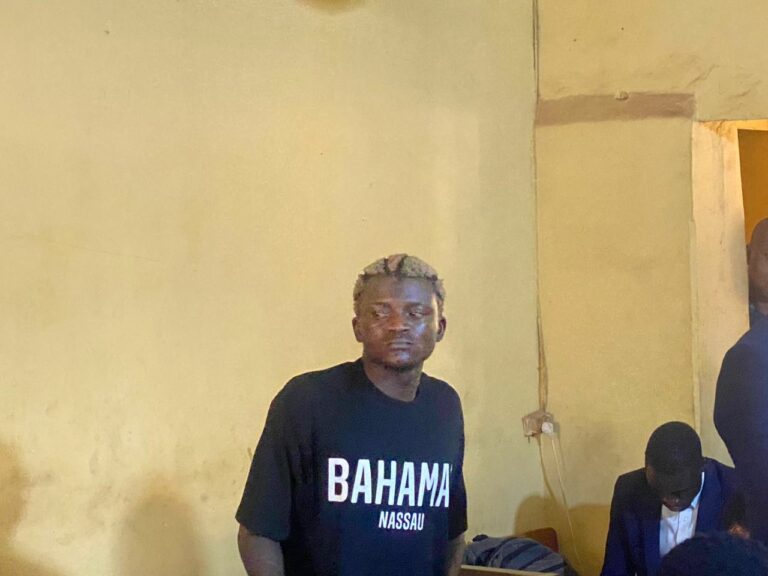
A FEDERAL High Court in Ogun State has granted singer Habeeb Okikiola (Portable) bail in the sum of N 300,000.
The ICIR had reported how Portable resisted arrest and hurled insults on the men of the Nigeria Police Force.
The incident led to the Police vowing to arrest and prosecute the musician.
Portable was subsequently arrested on Friday, March 31, by the Ogun State Police Command.
The Police, however, charged him to court today, Monday, April 3.
The charges against portable read, “That you, Badmus Habeebat Okikiola, M, A.KA Portable, and others now at large on the 28th day of March, 2023 at 11am at Odogwu Bar, Oke-Osa, Ilogbo, Ifo in the Ifo Magisterial District did willfully cause or inflict physical injury on one Inspector Hammed Moshood ‘m’ with your elbow on his nose which caused blood to gush out from his nose and thereby committed an offence contrary to and punishable under Section 4 (1) of the Violence against persons & Prohibition Laws of Ogun State of Nigeria, 2017.
“That you, Badmus Okikiola A.KA Portable on the same date, time and place in the aforementioned Magisterial District did resist to be arrested by Inspector Hammed Moshood ‘m’, ASP Gregory Iyoha ‘m’, ASP Kunle Badmus ‘m’ after serving you with Police Invitation Letter on the 20 day of January, 2023 for the offences you committed when they were about to discharge their duty with warrant of arrest on you thereby committed an offence and punishable under Section 197 of the Criminal Code Laws of Ogun State of Nigeria, 2006.”
The singer’s counsel Adodo Destiny prayed the court to grant the defendant bail.
Delivering his ruling on the prayer, Magistrate A.S Shoneye explained that the offences were bailable.
She, therefore, granted Portable bail with bail bond of N300,000 and two sureties who must reside within the jurisdiction of theke court.
Shoneye instructed that the defendant be transferred to the Ilaro correctional centre, pending the time his bail requirements were met.
The court adjourned the case till April 26 for the commencement of trial.
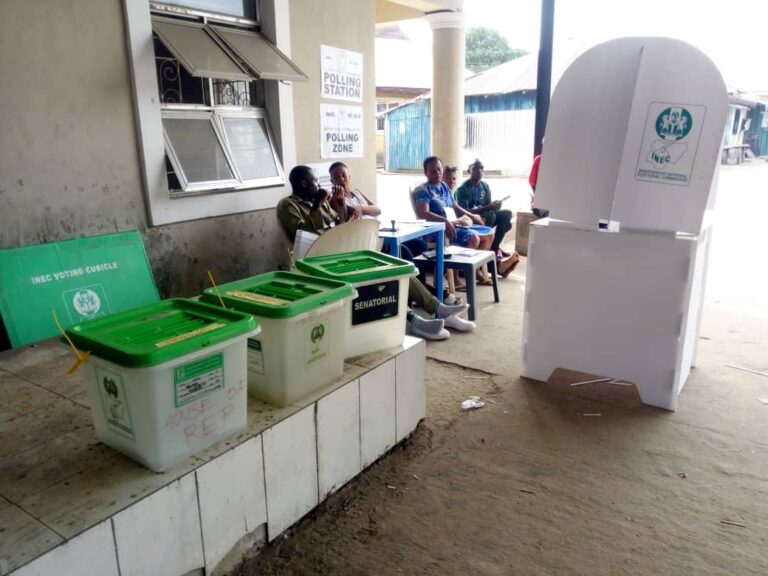
THE 2023 elections fell short of the promises and expectations of Nigerians, in spite of the deployment of world-class and highly expensive technology. The irregularities could put Yakubu Mahmood in the bracket of past electoral chairmen who failed the integrity test.
The Chairman of the Independent National Electoral Commission (INEC), Yakubu Mahmood, has come under criticisms for the controversial conduct of the 2023 elections, which fell far short of ‘the best election ever’ in Nigeria.
In the presidential election, the electoral umpire’s failure to upload results from polling units granted fraudsters the opportunity to intimidate electoral officials and subsequently announce doubtful results resisted by opposition parties. The governorship elections, promised to be an improvement on the presidential election, was also totally disappointing.
First, there was low voters turnout, explained as a manifestation of the lack of confidence in the electoral process, but worse still, there was naked violence, voter suppression, carting away of ballot boxes, and declaration of questionable results. As it stands, the professor of history is likely going to end his career on this note, as another intellectual who presided over an electoral process that failed the people. Below are the stories of previous electoral chairmen who have disappointed Nigerians:
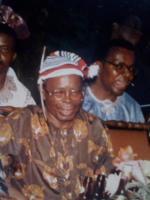
Eyo Esua: ‘We can’t deliver free and fair elections’
Eyo Esua
Perhaps, the most awkward but shocking episode in Nigeria’s electoral drama occurred in the 1964/1965 fire and blood elections, causing the chairman of the Federal Electoral Commission (FEC), Eyo Ita Esua (1901-1973), to throw in the towel in an unNigerian manner. Unconfirmed accounts said Esua actually wrote his resignation letter, dropped it on his table, and flew back to his base in Calabar, an odd style of dumping a national assignment. Instead of formally submitting the letter to Tafawa Balewa-led federal government, Esua was said to have run away from the job, as if he was being chased away by mysterious, deadly forces.
In the smoky confusion, Esua told a beleaguered nation that the FEC could not deliver free and fair elections under the chaotic political atmosphere, a confusion deliberately orchestrated by mischief-making politicians.
As it is the practice today, governments sought for credible Nigerians, especially, those with track-record of resisting corrupt practices and impartiality, to appoint as head of electoral umpire. In the case of Esua, the Balewa-led government plugged him from labour activism; he was a founding member of the Nigerian Union of Teachers and its National Secretary from 1943 to 1964. Being a schoolmaster who led a spartan lifestyle, and from the Efik minority ethnic group in Calabar, Esua was fit for umpire in elections involving rival candidates from Hausa-Fulani, Yoruba, and Igbo-dominating ethnic communities in Nigeria.
As the first indigenous head of the electoral body (the 1959 elections were conducted by the British colonial government), Esua was confused at the power struggle between the Northern, Western and Eastern regions, as mutual suspicion along ethnic and religious lines took the front seat instead of political and economic ideologies for the growth and prosperity of Nigeria.
In the December 1964 federal elections, there was so much electoral dispute that two electoral commission members dumped the job. The election in the Western region did not hold until 1965 due to a political crisis. But with widespread electoral malpractices and violence, Esua admitted that the Commission could not deliver a free and fair election and led the job. The electoral crisis in the Western Region dovetailed into the 1966 coup d’etat and the unfortunate three-year Nigerian Civil War.
Michael Ani: Mathematical electoral chairman
After the Nigerian Civil War and about a decade of military rule, an accomplished and retired civil servant, who was found worthy of crucial tasks by the military governments, Michael Ani (1917-1985), got the plum job as Chairman of the Federal Electoral Commission (FEDECO) in 1976. The military Head of State, General Olusegun Obasanjo, appointed him to that position on the basis of his experience and credibility.
Michael Ani’s electoral commission conducted the highly contested 1979 general elections. Like the 2023 elections, the voting pattern was along regional and religious lines.
Shehu Shagari’s National Party of Nigeria (NPN) was dominant in the North; Obafemi Awolowo’s Unity Party of Nigeria (UPN) received more votes in the West, while Nnamdi Azikiwe’s Nigerian Peoples Party (NPP) got more votes in the East.
In the election, Shagari polled (5.6 million); Awolowo (4.9 million), and Azikiwe (2.8 million). With this polarisation, Ani’s electoral umpire, made up of 24 electoral commissioners, needed to interpret a clumsy section of the electoral law, which said, “a candidate must obtain one-quarter of votes cast in at least two-thirds of the states of the federation.”
Ani declared Shagari as president-elect on this basis. Not many people believed the electoral commission got the answer of the arithmetic correct; it was perceived that the formula Ani used to decide the winner was influenced by the Obasanjo military government’s design to shift political power to the North, by using the electoral body to anoint Shagari as the winner.
There were 19 States. Two-thirds meant the winner must produce a minimum of 25 per cent in 12.66 states. Shagari met the threshold in 12 states and 19.9 per cent of votes in Kano State, which was short of 12.66 states. Awolowo argued that the winner must secure 25 percent of votes in 13 states, approximating .66 per cent to a whole number. The case went up to the Supreme Court, which affirmed Shagari as the winner of the election. However, on his part, the perception that Ani’s arithmetic was biased did not erase until his death in 1985.
Justice Victor Ovie-Whisky: Tenure marred by unlikely NPN victory in Ondo State
Justice Victor Ovie-Whisky
In 1980, shortly after assuming office as president, Shagari appointed a justice, Victor Ovie-Whisky (1923-2012) as FEDECO chairman.
A former Chief Judge of the defunct Bendel State, Ovie-Whisky was perceived as non-political and upright. However, many irregularities marred the election conducted under his watch in 1983, and electoral officials were accused of malpractices in favour of the ruling NPN, to the point that journalists suspected water passed under the bridge in the electoral process.
Like the 1965 election, where an alliance between a section of the West and a dominant political party in the North caused serious violence, the 1983 electoral crisis was caused by the unlikely NPN victory in Ondo State, a traditional stronghold of the Unity Party of Nigeria (UPN).
In that election, FEDECO, headed by Ovie-Whisky was accused of using ‘federal might’ to rig the election in favour of Omoboriowo, a former deputy governor under UPN, who abandoned a governor, -Michael Ajasin, to grab the NPN governorship ticket.
The people could not endure that an NPN candidate would win a governorship election in the West, a stronghold of Awolowo – an arch-political rival to Shagari.
The turbulence generated by the election did not settle before the military sacked the Shagari government about five months after, on December 31, 1983. Ovie-Whisky said about the 1983 elections: “We did not expect to be perfect”.
The professor’s first major challenge was the conduct of local government elections which was marred by poor planning and malpractices. There were unmanageable crowds at many polling units and irregular voter registers, making it difficult for voters to locate their polling units.
Awa resigned from the position two years after, purportedly due to disagreements with IBB, but it was not clear what that disagreement was all about. In his memoir, published posthumously, Awa claimed some members of the Armed Forces Ruling Council (AFRC) ganged up against him over the outcome of the local government elections, discrediting the process due to the chaos in some three hundred out of over 5,000 polling stations across the country, and forced him to resign as NEC chairman.
The tone of his memoir, entitled ‘My Journey to Nigeria,’ echoed the bitter experience he had with the military and political class during his tenure as FEDECO chairman.
Humphrey Nwosu: June 12 and Option A4 electoral chairman
To his credit, Nwosu implemented the now famous Option A4 and Open Ballot system, which were meant to test the popularity of contestants in elections, from ward to national level. Then, to ensure transparency, voters were meant to queue on rows assigned to the party or candidate of their choice before they cast their vote.
It was, therefore, possible to predict winners in an election through the number of voters who lined up behind their party’s logos. Incidentally, it was Nwosu who conducted one of the freest and fairest elections in Nigeria – the June 12, 1993 presidential election that the late Moshood Abiola of the Social Democratic Party (SDP) was acclaimed to have won. But, the process was aborted as legal intrigues set in and the election was annulled, though Nwosu had announced the results from many states in Nigeria. The reason for the annulment of the election is still not clear, 30 years after it was cut short.
Okon Edet Uya: Electoral chairman who didn’t conduct an election:
However, the 1993 political crisis created serious confusion and an atmosphere that made it impossible for the conduct of fresh elections. Sani Abacha, a general, later swept away the interim government of Ernest Shonekan.
The new military government sacked Uya as chairman of the electoral body. He returned to the University of Calabar as Deputy Vice-Chancellor and later Acting Vice-Chancellor.
Karibi Dagogo-Jack: Umpire during infamous ‘Abacha-for-president’ era
Under General Sani Abacha, Summer Karibi Dagogo-Jack held sway as the powerful chairman of NECON. He was not a stranger to the electoral body because Dagogo-Jack was a member of the Humphrey Nwosu-led team.
The parties included the United Nigeria Congress Party (UNCP); Congress for National Consensus (CNC); Democratic Party of Nigeria (DPN); National Centre Party of Nigeria (NCPN); and Grassroots Democratic Movement (GDM). Though the parties adopted Abacha as their presidential candidate, Dagogo-Jack did not conduct the election before Abacha’s demise in 1998. However, he conducted local council and National Assembly elections. The fact that Dagogo-Jack was part of the infamous Abacha regime affected his image.
Ephraim Akpata: Conducted elections questioned by former US President Carter
Ephraim Omorose Ibikun Akpata (1927-2000), a Justice of the Supreme Court, was the first chairman of the INEC, appointed in 1998 by then Head of State Abdulsalami Abubakar, to conduct elections that ushered in the Fourth Republic.
In an election keenly contested by the Peoples Democratic Party (PDP), which fielded Olusegun Obasanjo, on the one hand, and the joint ticket Alliance for Democracy (AD) and All Peoples Party (APP), that had Olu Falae as the presidential candidate, Obasanjo won the votes by over 60 per cent.
Reports on later elections were more critical, describing irregularities including inflated vote returns, ballot box stuffing, altered results, and disenfranchisement of voters.
A former United States President Jimmy Carter wrote a letter to Justice Akpata, saying, “There was a wide disparity between the number of voters observed at the polling stations and the final results that have been reported from several states. Regrettably, therefore, it is not possible for us to make an accurate judgment about the outcome of the presidential election.” To his glory, Nigeria successfully conducted a democratic election which produced a president after about 15 years of military rule. But Akpata may not have been very proud of the process that produced the Obasanjo presidency.
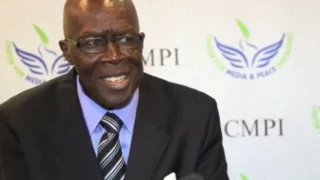
Abel Guobadia: Caught up in do-or-die power struggle
Abel Guobadia
After the death of Akpata in 2000, Dr Abel Guobadia (1932-2011) was appointed in his place in May 2000. Sir Guobadia conducted the 2003 election that returned the PDP’s candidate Obasanjo as president until 2007, another four-year period. The election was passed by the government and Nigeria’s foreign allies as free and fair, ignoring malpractices. In that election, General Muhammadu Buhari of the APP, in his first attempt at returning to the top job in Nigeria, lost to Obasanjo.
It was the Human Rights Watch that provided an alternative report in its June 1, 2004 edition. It said, “In April and May 2003, at least one hundred people were killed and many more injured during federal and state elections in Nigeria.
The majority of serious abuses were perpetrated by members or supporters of the ruling party, the People’s Democratic Party (PDP). In a number of locations, elections simply did not take place as groups of armed thugs linked to political parties and candidates intimidated and threatened voters in order to falsify results.
The violence and climate of intimidation facilitated widespread fraud, invalidating the results of the elections in many areas. Nevertheless, the elections were hailed as peaceful by Nigeria’s President Olusegun Obasanjo, who was re-elected, and were widely praised by foreign governments, including Nigeria’s key foreign allies. The 2003 elections were significant for Nigeria as the country’s first sustained transition from one civilian government to another.”
After completing his five-year tenure in May 2005, Guobadia retired from his position as Chairman of INEC, the first to do so in the history of electoral commission in Nigeria.”
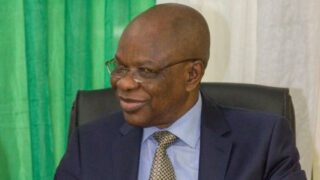
Maurice Iwu: Conducted elections faulted by winner
Maurice Iwu
If any Nigerian who is politically active is asked to mention the names of electoral chairmen Nigeria has had, it is most likely that Maurice Iwu would be mentioned among the first three of them.
Appointed as INEC commissioner from Imo State in 2003, Maurice Mmaduakolam Iwu, a professor, succeeded Guobadia as chairman of the commission in 2005. The tenure of the professor of Pharmacognosy was, however, very controversial.
First, Iwu drew the ire of civil society organisations when he told the world that international monitors would not be permitted during the country’s elections. His rancorous tenure made him an unforgettable INEC chairman. He was head of INEC during the 2007 elections, said to be so contaminated with a lot of irregularities that politicians demanded Iwu’s resignation.
As a way of repairing the electoral mess, Yar’Adua had to set up the Mohammed Lawal Uwais electoral reform panel in 2007, shortly after he was sworn in as president. Though the reform panel was a subtle indictment on Iwu, a sign that the government had lost confidence in him, he failed to resign from his position as INEC chairman, until 2010 when President Goodluck Jonathan sent him packing. Unfortunately, Iwu became an epitome of whatever could go wrong in an election in Nigeria.
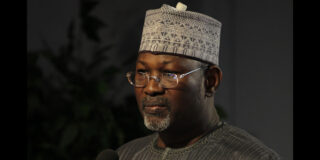
Attahiru Jega: Introduced electronic accreditation through card reader
Attahiru Jega
Another professor, Attahiru Muhammadu Jega, who was a member of the Uwais Electoral Reform panel, succeeded Iwu as INEC chairman. President Goodluck Jonathan appointed Jega to that position in June 2010, barely a year to the 2011 general elections. Jonathan claimed that he appointed Jega based on recommendations that the professor of political science was fair-minded, upright and could not be manipulated.
The issue of power rotation between North and South became a heated debate in Nigeria, challenging Jonathan’s decision to contest in the 2011 election, when the North felt it should produce the next president as Yar’Adua did not complete his term before his demise.
Ahead of the next election in 2015, Jega’s INEC introduced electronic card reader, a technology used to accredit voters before they were given ballot papers to vote. The device significantly reduced ballot box stuffing, a constant fraud that tainted previous elections.
In the 2015 election, Muhammadu Buhari of the All Progressives Congress (APC) challenged Goodluck Jonathan of the PDP. Though keenly contested, Jonathan took a step unprecedented in Nigeria’s political history, to congratulate Buhari when it was obvious the former head of state had won. The 2015 elections were acclaimed to be credible, though not without some flaws. While the ovation was still high, on June 30, 2015, Jega retired from his position as chairman, and handed over the Commission to the next most senior Electoral Commission.
Dr Abbah, a Fellow of the Chartered Institute of Forensic Investigation and Fraud Examiners of Nigeria, lives in Abuja. Follow him @theophilusa
KADUNA State government Mallam Nasir El Rufai has imposed a 24-hour curfew on the Sabon Garin Nassarawa area of the Chikun Local Government Area (LGA) of the state.
The state’s commissioner for internal security and home affairs, Samuel Aruwan, said the decision was taken as a result of the breakdown in law and order that resulted in the deaths of two individuals in the area.
“The Kaduna State Government hereby announces the immediate imposition of a 24-hour curfew on Sabon Garin Nassarawa-Tirkaniya area of Chikun LGA.
“This decision was reached following a breakdown of law and order, which led to the killing of two citizens in an incident of urban gang violence.
“Security agencies have been directed to enforce the curfew in the said location to restore order as investigations proceed. Citizens are therefore urged to strictly observe the curfew in this location, which takes effect immediately. Further updates will be communicated accordingly,” Aruwan said In a terse statement.
Many Nigerians have condemned the unending killings in Southern Kaduna.
The WIA Young Leaders initiative aims to encourage and spotlight young African female leaders who will play a significant part in the African revolution.
The organiser says that this year ten leaders will benefit from a customised training program focusing on women’s leadership and future abilities. Students will be guided by famous mentors and will have the opportunity to immerse themselves in a business trip to a world economic hub.
The trip will provide them with access to a high-level professional network, training, opportunities to meet specialists in their fields, and increased visibility at international events.
The WIA Young Leaders program will be an opportunity to:
. Connect with high-level personalities and mentors such as CEOs, ministers, journalists, business or public figures, and serial entrepreneurs.
. Be trained on boards, media training, career coaching and other customized training.
. Benefit from international media visibility.
All young African women who contribute to building a dynamic, innovative and inclusive Africa are invited to apply for the programme.
The deadline for the submission of application is April 21, 2023. Interested applicants can apply here.
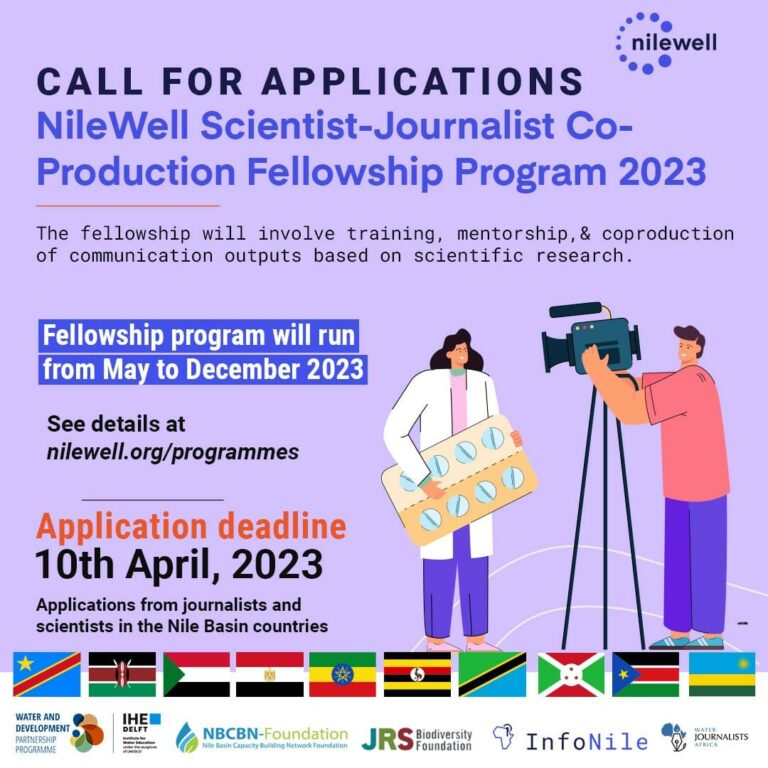
INFONILE, through its NileWell platform, is accepting applications for the NileWell Scientist-Journalist Co-Production Fellowship Program.
The program aims to facilitate collaboration between scientists and journalists working in or around water-related fields to enhance the media understanding of science and research.
Eight journalists and eight scientists will be selected to participate in the fellowship. They will be trained on biodiversity reporting, transboundary water resources reporting, science journalism, science communication and data journalism.
Journalists and scientists from the following Nile Basin countries can apply: Uganda, Kenya, Burundi, Tanzania, Egypt, Sudan, South Sudan, DRC, Ethiopia and Rwanda.
Journalists and scientists in the Nile Basin countries can apply for a fellowship.
The deadline for the submission of application is April 10, 2023. Interested applicants can apply here.
THE World Bank has expressed concern about some of the loans China has been giving to developing economies in Africa, calling for more transparent “terms and conditions”.
The World Bank’s concern follows the inability of some countries, including Ghana and Zambia, to repay their debts to Beijing owing to steep increases in interest rates since most of the borrowing is done in foreign currencies such as United States (US) dollars or euros.
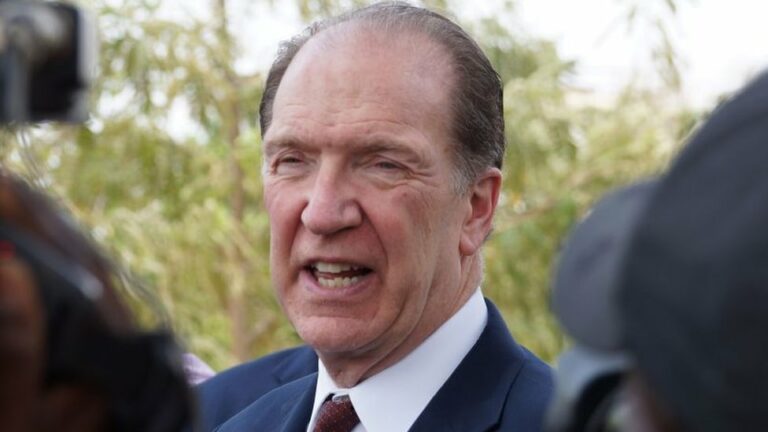
“It is a double whammy and it means that [economic] growth is going to be slower,” Bank President David Malpass said.
He also warned African governments against offering collateral as an inducement to make a loan because it locks it up for generations.
“That’s been happening with China,” the World Bank chief argued.
However, China’s Foreign Ministry Spokesperson Mao Ning, said during a recent press interview that Beijing “respects the will of relevant countries and has never forced any party to borrow money”.
“China has focused our outbound investment and financing cooperation on infrastructure and production to help developing countries enhance their capacity for self-generated and sustainable development.
“This has contributed to these countries’ economies and people’s livelihoods and delivered tangible benefits to the local communities.
“China has always carried out investment and financing cooperation with developing countries based on the principle of openness and transparency,” she said.
Ning added that China will not attach any political conditions to loan agreements, and does not seek any political self-interest.
A new study led by the Kiel Institute for the World Economy showed that globally China lent $185 billion in bailouts to 22 developing countries between 2016 and 2021.
As U.S.-China competition for Africa intensifies, President Joe Biden has ramped up efforts to reengage with African countries after last year’s US-Africa summit.
US Vice-President Kamala Harris visited three African countries last week, pledging financial commitments to the continent and Biden has also said he intends to visit Africa this year as well.
“My visit has convinced me more than ever, that we must all around the globe appreciate and understand the importance of investing in African ingenuity and creativity,” Harris said.
President Biden has pledged to work with the United States Congress to invest $350 million in various African initiatives and facilitate nearly half a billion dollars in development financing, to make sure that people across the continent can participate in the digital and global economy.
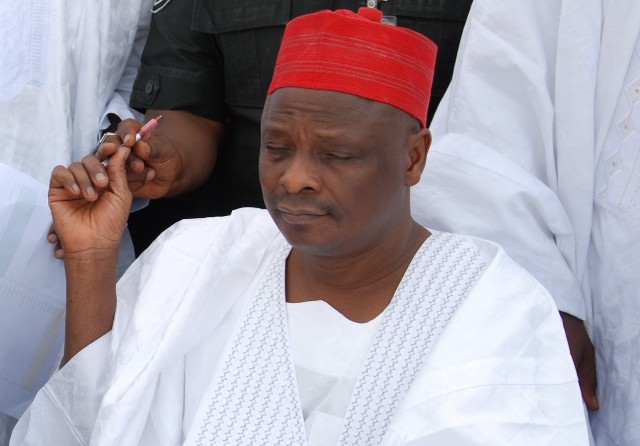
THE difficulty of voters in identifying party logos on the ballot paper caused the poor performance of the New Nigeria People’s Party (NNPP) in the general elections, according to the party’s candidate in the February 25 presidential election, Rabiu Kwankwaso.
Kwankwaso attributed the party’s unimpressive performance to the poor printing of the party’s logo by the Independent National Electoral Commission (INEC).
He said INEC mixed up the party’s logo in the ballot papers, making it hard for NNPP supporters to identify.
Kwankwaso said at the party’s National Executive Committee meeting on Thursday in Abuja, “One of the problems with our logo is the printing quality, and I want to appeal to INEC that now that we are going for elections in about three states, we don’t want to be in a hurry to go to court on some of these issues.
“I believe that under normal circumstances, what INEC presented as our logo is good enough in a civilised society to cancel the national elections because we were disenfranchised and not properly represented on the ballot, and that created so much difficulty for our candidates and our party.
“We were expecting to see what we presented, a basket of fruits with colours so that people would know. Anything short of that in the coming elections will only be repeating the challenges we faced before.”
The candidate of the All Progressives Congress (APC), Bola Tinubu, won the presidential election on February 25, with 8,794,726 votes.
He also had over 25 per cent of the votes cast in 30 states, more than the 24 states constitutionally required.
Atiku Abubakar, the Peoples Democratic Party (PDP) candidate, came second with 6,984,520 votes, while Peter Obi of the Labour Party came third with 6,101,533 votes.
Kwankwaso came fourth in the election, having pulled 1,496,687 votes.
VALENTINE Obienyem, a media aide to the Labour Party candidate in the February 25 presidential election, Peter Obi, has identified the suspected mastermind of his principal’s leaked conversation with David Oyedepo, founder of Winners Chapel.
A Nigerian media platform, Peoples Gazette, had published an exclusive report and audio conversation alleging that Obi solicited the support of Oyedepo to get votes from Christians in the South-West ahead of the February 25 presidential election.
The leaked audio has stirred heated debate among Nigerians on social media.
The ICIR had reported how the spokespersons of Obi’s team had been expressing conflicting positions regarding the issue.
Reacting to the report today in a Facebook post, Obienyem said the video was released by someone he identified as an “Nnewi prodigal brother.”
He said, “I heard they set up a Committee made up of some communications experts, headed by our prodigal brother from Nnewi. They are reviewing all calls Obi made in the last three years, and especially now to see if he mentioned Interim Government or anything that will make them prosecute him for treason when and if they take over.
“Till now, they are yet to see any. The badly doctored conservation with Bishop Oyedepo released by our Nnewi prodigal brother is the much they have discovered so far. They edited out the Muslim-Muslim ticket that led to the discussion, where Obi said that in a society like ours, religious balancing was a necessary consideration and that their recklessness had made Christians to assume it was a religious war.”
FORMER governor of Enugu state, Chimaroke Nnamani, has faulted the presidential candidate of the Labour Party (LP), Peter Obi, describing his style of politics as “dangerous” for the unity of the country.
Nnamani, accusing Obi of reigniting religious and ethnic politics in Nigeria, feared the country might never be the same again following the tension that preceded and has followed the February 25 presidential election.
Taking stock of the activities of the just concluded elections, Nnamani, in a statement he issued today in Abuja, said, ”Obi has deflowered the virgin innocence of political patriotism and nationalism in Nigeria.”
Nnamani added, ”He served a poisoned chalice of tribalism to Nigeria’s ethnic nationalities. The Roman Catholic holy family symbol was now ecumenically explained to my people as Joseph, Mary, and Jesus, thus replacing the Labour Party logo of father, mother, and child. Dual indoctrination or religion and tribalism. Nigerians voting without knowing the candidates nor caring.”
Obi had in a letter he recently issued asked Nnamani to stop bigotry allegations aimed at denting his image.
He stated that throughout his campaign across the country, he was never involved in religious or ethnic politics.
However, a leaked audio conversation allegedly between Peter Obi and the founder of Living Faith Church (Winners Chapel), David Oyedepo, has been trending online, where Obi was heard allegedly telling Oyedepo to help him get votes from Christians in the South West for the presidential election.
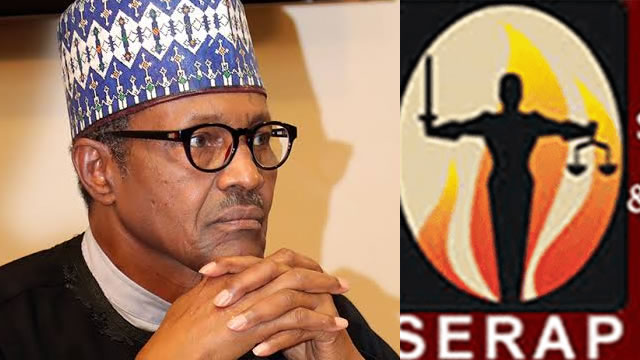
THE Socio-Economic Rights and Accountability Project (SERAP) has urged President Muhammadu Buhari to implement the ECOWAS Court of Justice judgment which opposes the prosecution of Nigerians on the grounds of ‘insulting’ or ‘stalking’ of public officials online.
SERAP explained its call was to ensure that the federal government enforces the ECOWAS court judgment to protect and promote freedom of expression and access to information.
In a statement released on Saturday, April 1 by the SERAP Deputy Director, Kolawole Oluwadare, the body cautioned Buhari against reducing the civic space with the usage of the Cybercrime Act and other “repressive” laws.
The Project lamented the increasing number of crackdown on media houses and freedom of speech.
It stated, “Many Nigerians and media houses continue to face threats simply for speaking out and seeking to peacefully exercise their human rights and carry out their professional duties. This situation is contrary to the Nigerian Constitution 1999 [as amended] and the judgments by the ECOWAS Court.”
SERAP believed that Buhari’s immediate enforcement of the ECOWAS court judgment would enhance freedom of the press, and of speech.
“By implementing the judgment, your government will be demonstrating Nigeria’s leadership within the ECOWAS sub-region, and sending a powerful message to other countries to embrace the rule of law and human rights.
“The processes for the sanctions are provided for under the 2015 Supplementary Protocol, the 2012 Supplementary Act on Sanctions, and the 1993 ECOWAS Revised Treaties. The sanctions may include judicial, economic and political sanctions,” it said.
SERAP further advised the need for the Attorney-General of the Federation and Minister of Justice to withdraw all charges of “insulting or stalking public officials online” against activists, critics and journalists, and release those in “illegal” detention.
According to the statement, “SERAP notes that Article 15(4) of the ECOWAS Treaty makes the Judgment of the Court binding on Member States, including Nigeria. Also, Article 19(2) of the 1991 Protocol provides that the decisions of the Court shall be final and immediately enforceable.”
It, however, added that non-compliance with the judgment of the Court can be sanctioned under Article 24 of the Supplementary Protocol of the ECOWAS Court, and Article 77 of the ECOWAS Treaty.
SERAP used the opportunity to urge President Buhari to reverse the N5 million fine the National Broadcasting Commission (NBC) imposed on Channels Television over an interview the television station had with the vice-presidential candidate of the Labour Party, Datti Baba-Ahmed.
The ICIR had reported that SERAP condemned the Federal government and the NBC over the fine.