
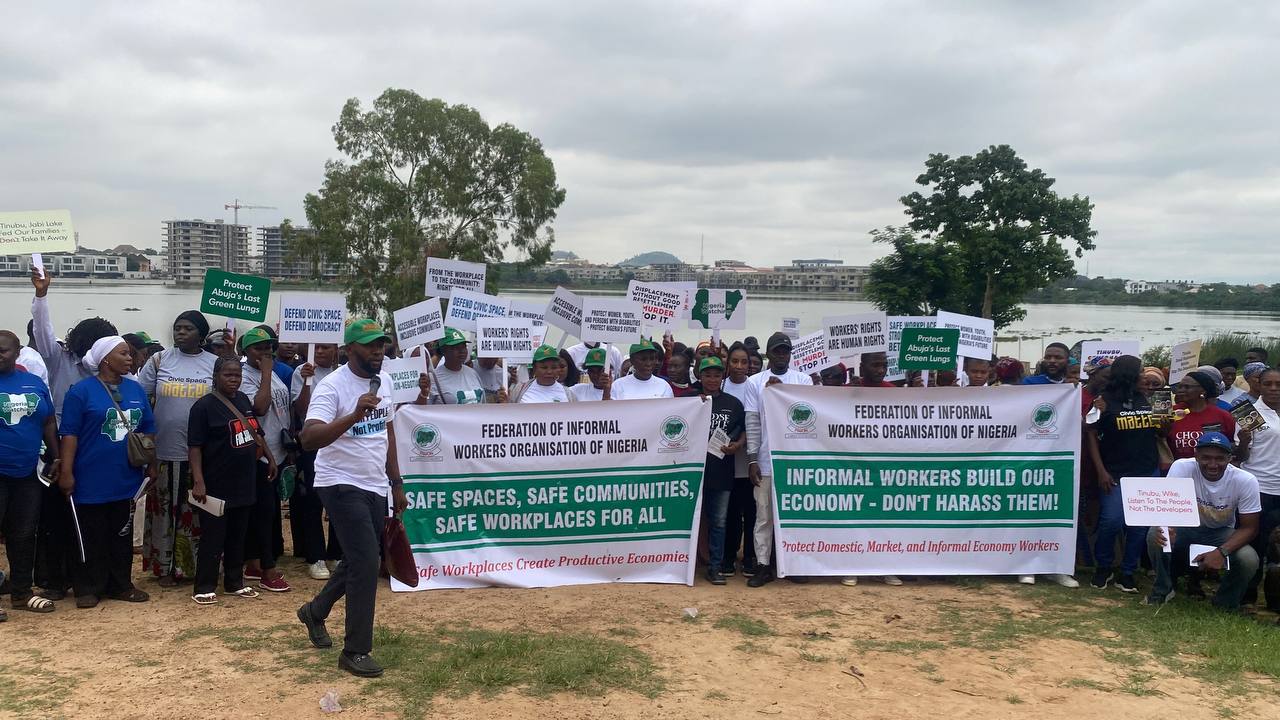
INFORMAL workers, residents and civil society prganisations on Tuesday, June 30, staged a peaceful protest at the Jabi Lake Recreational Park in Abuja, demanding that the Federal Capital Territory (FCT) Administration halt the proposed redevelopment and privatisation of the park until the full details of the project are made public and affected communities are consulted.
The protesters, led by the Federation of Informal Workers Organisation of Nigeria (FIWON) and Accountability Lab, among others, marched through the park carrying placards with inscriptions such as “Displacement Without Good Resettlement Is Murder. Stop It,” “Protect Abuja’s Last Green Lungs,” “Tinubu, Governance by Fiat Is Not Democracy,” “Tinubu, Small Businesses Matter. Stop Demolition,” and “Jabi Lake Fed Our Families—Don’t Take It Away.”
They called on President Bola Tinubu and the FCT Minister, Nyesom Wike, to protect women, youths, children and informal workers from displacement, insisting that any redevelopment of the park should be preceded by transparency, meaningful public consultation and adequate protection for those whose livelihoods depend on the facility.
Background
The protest came months after the FCTA signed development agreements with Suburban Broadband Limited and Akida Hills Limited to transform the Jabi Lake waterfront into what officials describe as a world-class recreational and tourism hub.
The agreements, signed in February 2026 at the office of the FCT Minister, reportedly form part of the administration’s urban renewal agenda aimed at redeveloping the lake into a major destination for recreation and tourism.
According to the FCTA, the project will include waterfront commercial developments, tourism and leisure facilities, modern recreational infrastructure, environmental clean-up, urban renewal around the lake, and the removal of illegal settlements and abandoned structures.
The administration argued that the redevelopment would beautify Abuja, attract investment, boost tourism and create employment opportunities.
During the signing ceremony, Wike said the initiative would reposition the nation’s capital while addressing land speculation, warning that allocated lands left undeveloped would be revoked.
The redevelopment, however, attracted widespread criticism from residents, traders, religious leaders and advocacy groups, who fear the concession could limit public access to one of Abuja’s few remaining public recreational spaces and threaten the livelihoods of hundreds of informal workers operating around the lake.
Earlier in June, Daily Trust reported that preparatory work had commenced at the site, with sections of the park barricaded, perimeter fencing installed, and construction equipment moved into the area despite public opposition.
Commissioned in 2007, Jabi Lake Recreational Park spans about 1,300 hectares in Abuja’s Jabi District and has become one of the city’s most popular public leisure destinations. Besides providing free recreational access to residents, the park supports dozens of small businesses, including food vendors, artisans, boat operators and other informal workers who depend on daily patronage for their survival.
Rights group demands transparency
Addressing journalists during Tuesday’s protest, Accountability Lab Nigeria Country Director, Friday Odey, said the groups were not opposed to development but insisted that the process must be transparent, inclusive and accountable.
According to him, although the FCTA entered into an agreement with two private companies in February, the details of the Memorandum of Understanding (MoU) were not made public.
“We are not against development,” Odeh said, adding, “What we are saying is that the MoU has not been published. Under the Open Government principles, citizens have the right to know what agreements have been entered into concerning public assets.”
He said Nigerians also deserve to know whether the government conducted any assessment of the social and economic consequences of the project before allocating the park to private companies.
Odeh further argued that informal workers whose livelihoods depend on activities around the park were neither informed nor consulted before the decision was taken.
“These workers have not been communicated with or consulted. Civic space matters, people’s voices matter, and those who will be directly affected deserve to be heard,” he said.
He also urged the FCTA to publicly disclose any relocation or resettlement plans for people who may be displaced by the redevelopment.
The Chairperson of FIWON, Blessing Yusuf, also condemned what she described as the privatisation of one of Abuja’s last major public recreational spaces.
She argued that Jabi Lake serves not only as a business hub for informal workers but also as a public space where residents exercise, socialise and interact freely.
Residents who use the park for recreation also expressed concern that unrestricted private control of the facility could reduce public access.
“This is where people come to exercise, socialise and do business. Many people earn their living here while residents also come to relax and relieve stress. The government should allow the public to continue using this place while ensuring there is proper planning and engagement before any redevelopment takes place,” Akpotu Mobo, a resident said.

Mustapha Usman is an investigative journalist with the International Centre for Investigative Reporting. You can easily reach him via: musman@icirnigeria.com. He tweets @UsmanMustapha_M
The government must not give in to the tantrum of the streets urchins protesting the beautication and upgrading of Jabi park into a world glass recreational place. The lake is not a place for informal market or a place to build churches. Most of us the residents of Abuja are in total support of the developmental efforts of the FCT minister.