
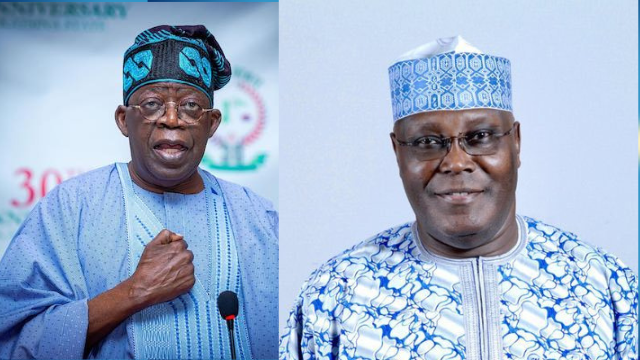
FORMER Vice President Atiku Abubakar has berated the professionalism of the State Security Services (SSS) and other screening agencies of the Federal Government over what he described as ‘failed due diligence’ following the resignation of the Minister of Innovation, Science, and Technology, Uche Nnaji, over allegations of certificate forgery.
The former Vice President argued that the situation raises questions about the integrity of government appointees and the effectiveness of Nigeria’s vetting institutions, including the State Security Services (SSS). He added that the agency, which screened the minister, failed in its duty of due diligence.
He has also called for a comprehensive investigation into the credentials of all members of the Federal Executive Council (FEC)
In a statement personally signed by him and released on Wednesday, October 8, Atiku said the development reflects what he described as a moral crisis within the current administration. He said the minister’s exit should not have been treated as a voluntary resignation but as a serious breach that warranted dismissal and prosecution.
“The resignation of the Minister of Science and Technology has once again brought to light the deep moral crisis at the heart of the administration. What should ordinarily be a matter of national shame is now being disguised as a voluntary resignation,” Atiku said.
Atiku said the incident is part of a wider pattern of falsehood in governance, calling for a transparent review of the credentials of all cabinet members. “When a man of questionable identity leads a country, deception becomes the standard of governance,” he said.
He urged anti-corruption and security agencies to conduct a thorough verification of the academic and professional records of public officials to restore integrity in the government.
“Nigerians deserve to know the truth about those who preside over their lives and resources,” he added.
Atiku said the country must now use this moment to strengthen institutional accountability and ensure that public office is reserved for individuals of proven integrity
Recent reports by the Premium Times revealed that the former minister allegedly forged both his university and National Youth Service Corps certificates.
The University of Nigeria, Nsukka, had earlier disowned the certificate, stating that there were no records showing he graduated in 1985 as claimed. The Federal High Court in Abuja has since adjourned a related case between the university and the minister to November 10 for hearing.
Earlier reports by The ICIR have shown that the Senate and the State Security Service often fail to uncover discrepancies during ministerial screening, largely due to political compromises and the long-standing “bow and go” practice.
The ICIR reports that the case adds to Nigeria’s shameful list of forged credential cases among public officials, as individuals with questionable qualifications or integrity slip through vetting processes put in place to uphold transparency and competence in public office.
Recall that then-Minister of Finance Kemi Adeosun brought the Muhammadu Buhari administration into national disrepute in 2018 after a Premium Times report revealed that she presented a forged NYSC exemption certificate as part of her credentials.
The purported NYSC certificate was said to have been signed by a former director-general of the NYSC, Yusuf Bomoi, in 2009.
However, Maharazu Tsiga, former NYSC DG, who took over from Bomoi, said Adeosun’s certificate could not have been issued by the NYSC.
Although former President Buhari had referred Kemi Adeosun and other ministerial nominees to the SSS for security screening in September 2015, it was unclear how her forged NYSC exemption certificate slipped through the agency’s scrutiny.
The minister consequently resigned from office after public backlash.
The ICIR reports that Forgery is a criminal offence under Section 465 of the Nigerian Criminal Code Act, which defines it as the making of a false document or alteration of a genuine one with the intent to deceive.
The offence is punishable under Section 467 of the Criminal Code Act.

A reporter with the ICIR
A Journalist with a niche for quality and a promoter of good governance