
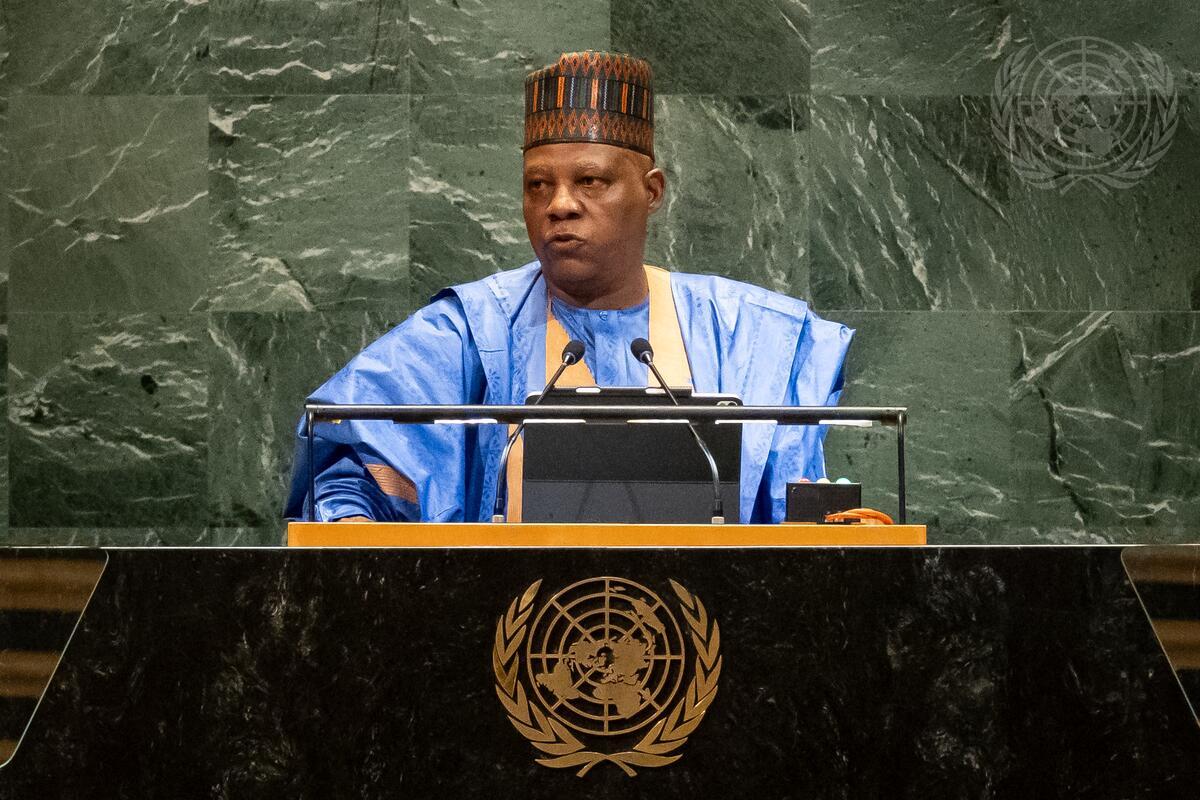
THE Nigeria government has demanded for a permanent seat on the United Nations Security Council, warning that the credibility of the world body depends on its ability to reflect current global realities rather than the post-Second World War order.
Vice-President Kashim Shettima, who delivered President Bola Tinubu’s address at the 80th UN General Assembly on Tuesday, September 25, urged member states to embrace sweeping reforms that would give Africa’s most populous country a stronger voice in international decision-making.
The vice-president warned that the slow pace of progress on key global issues had allowed scepticism about multilateralism to grow.
He argued that the UN must demonstrate that its structures were not fixed and could adapt to today’s challenges, from climate change and migration to technological disruption, and the proliferation of small arms.
“The United Nations will recover its relevance only when it reflects the world as it is, not as it was. Nigeria’s journey tells this story with clarity: when the UN was founded, we were a colony of 20 million people, absent from the tables where decisions about our fate were taken. Today, we are a sovereign nation of over 236 million, projected to be the third most populous country in the world, with one of the youngest and most dynamic populations on earth.
“A stabilising force in regional security and a consistent partner in global peacekeeping, our case for permanent seat at the Security Council is a demand for fairness, for representation, and for reform that restores credibility to the very institution upon which the hope of multilateralism rests,” Shettima said.
The vice-president noted Nigeria’s economic reforms, including the removal of fuel subsidies and currency controls, as difficult but necessary steps to attract investment and create jobs.
He called for climate funds to be channelled into education, resilient housing and technology to help vulnerable communities adapt to environmental changes that threaten global security.
He further called for the creation of a binding international mechanism to manage sovereign debt, describing it as “a sort of International Court of Justice for money.”
Such a system, he explained, would enable emerging economies to break free from the cycle of borrowing and dependency and would support growth that benefits all nations, not just the wealthy.
He stressed that debt relief should be viewed as a path to shared prosperity rather than an act of charity.
“It has been over four decades since the Lagos Action Plan outlined a route away from debt and dependence that highlighted opportunities. That today should still be explored for local added value for processing and manufacturing in everything from agriculture to solid minerals and petrochemicals. The African Continental Free Trade Area is a remarkable achievement of co-operation. We remain fully committed to the achievement of SDGs – and are convinced this can be best delivered by focusing principally on our primary mission of growth and prosperity,” Shettima added.
On technology, the vice-president pressed for global action to bridge the digital divide, cautioning that a generation growing up in a world of misinformation and distrust could become increasingly cynical unless access to innovation and digital opportunities is expanded.
“As technology shakes up public administration, law, finance, conflict and so much of the human condition, I am calling for a new dialogue, to ensure we promote the best of the opportunities that are arising – and promote the level of access that allows emerging economies more quickly, to close a wealth and knowledge gap that is in no one’s interest,” the vice president added.

Mustapha Usman is an investigative journalist with the International Centre for Investigative Reporting. You can easily reach him via: musman@icirnigeria.com. He tweets @UsmanMustapha_M