
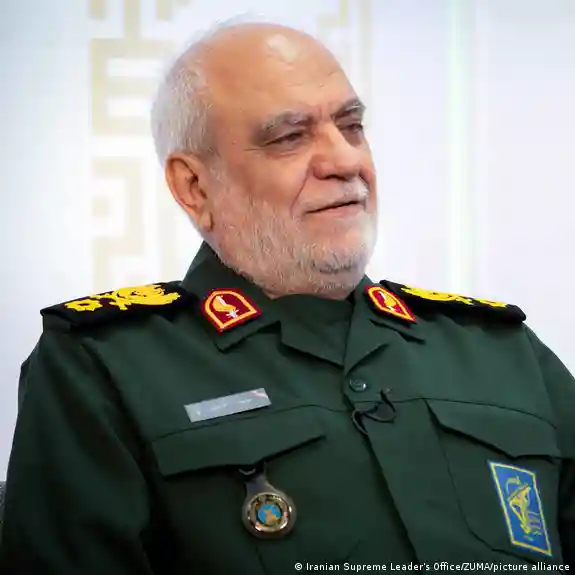
IRAN has threatened retaliation after a top commander of the Islamic Revolutionary Guard Corps (IRGC), Majid Khademi, was killed in a United States-Israeli strike.
State media, quoting the Guards, said Khademi, head of the IRGC intelligence arm, died in a dawn attack described as a “criminal terrorist” operation by the “American-Zionist enemy.”
Khademi, appointed in 2025, is the latest senior Iranian figure eliminated in a string of strikes. He previously led the Guards’ Intelligence Protection Organisation and spent decades in intelligence and counter-espionage roles.
His killing is seen as a major hit to Iran’s security architecture.
The IRGC intelligence unit plays a central role in surveillance, counterintelligence and internal security, reporting directly to the country’s leadership.
Also confirming his death, Israel Defense Forces, in a statement on Monday, April 6, said Khademi was a key operative involved in external operations and internal crackdowns.
“Khademi was one of the IRGC’s most senior commanders and had accumulated extensive experience over many years.
“Khademi worked to advance terrorist attacks worldwide, and was responsible for monitoring Iranian civilians as part of the regime’s suppression of internal protests,” the statement read.
Meanwhile, Tehran has warned of “more devastating” retaliation if further strikes hit its territory or civilian infrastructure.
“Major General Majid Khademi, the powerful and educated head of the Intelligence Organisation of the Islamic Revolutionary Guard Corps, was martyred in the criminal terrorist attack by the American-Zionist enemy… at dawn today,” said the Guards in a post on their Telegram channel.”
The strike came amid continued tensions across the region, with Iran, Israel and the United States exchanging threats and attacks.
Over the weekend, US President Donald Trump threatened to launch attacks on Iranian infrastructure, including power plants and bridges, if Tehran fails to reopen the Strait of Hormuz, a critical global oil route.
The warning followed Iran’s seizure of the waterway, through which about a fifth of the world’s oil supply typically passes, consequently disrupting global energy supply.

Mustapha Usman is an investigative journalist with the International Centre for Investigative Reporting. You can easily reach him via: musman@icirnigeria.com. He tweets @UsmanMustapha_M