

RECENT school attacks in Borno and Oyo states have left Nigerians grappling with the troubling pattern and spread of insecurity in the country.
In Borno state, gunmen stormed Government Day Junior Secondary School in Askira-Uba Local Government Area, abducting dozens of pupils on May 15, 2026. On the same day, three schools in Orire LGA, of Oyo State were attacked with dozens of pupils and teachers abducted, spreading fear to the South-West.
These incidents revive memories of past mass abductions such as the Chibok and Dapchi kidnappings in the North East that plunged Nigeria’s security challenges into global consciousness and drew international outrage.
Occurring a few days before the National Day of Mourning and Remembrance, these incidents highlight a surge in mass atrocities committed against Nigerians. Data mined by the ICIR, reveal that these atrocities have persisted for six years, shrinking safety in communities, markets, schools and other public spaces.
32,667 killed, 23,187 kidnapped in six years
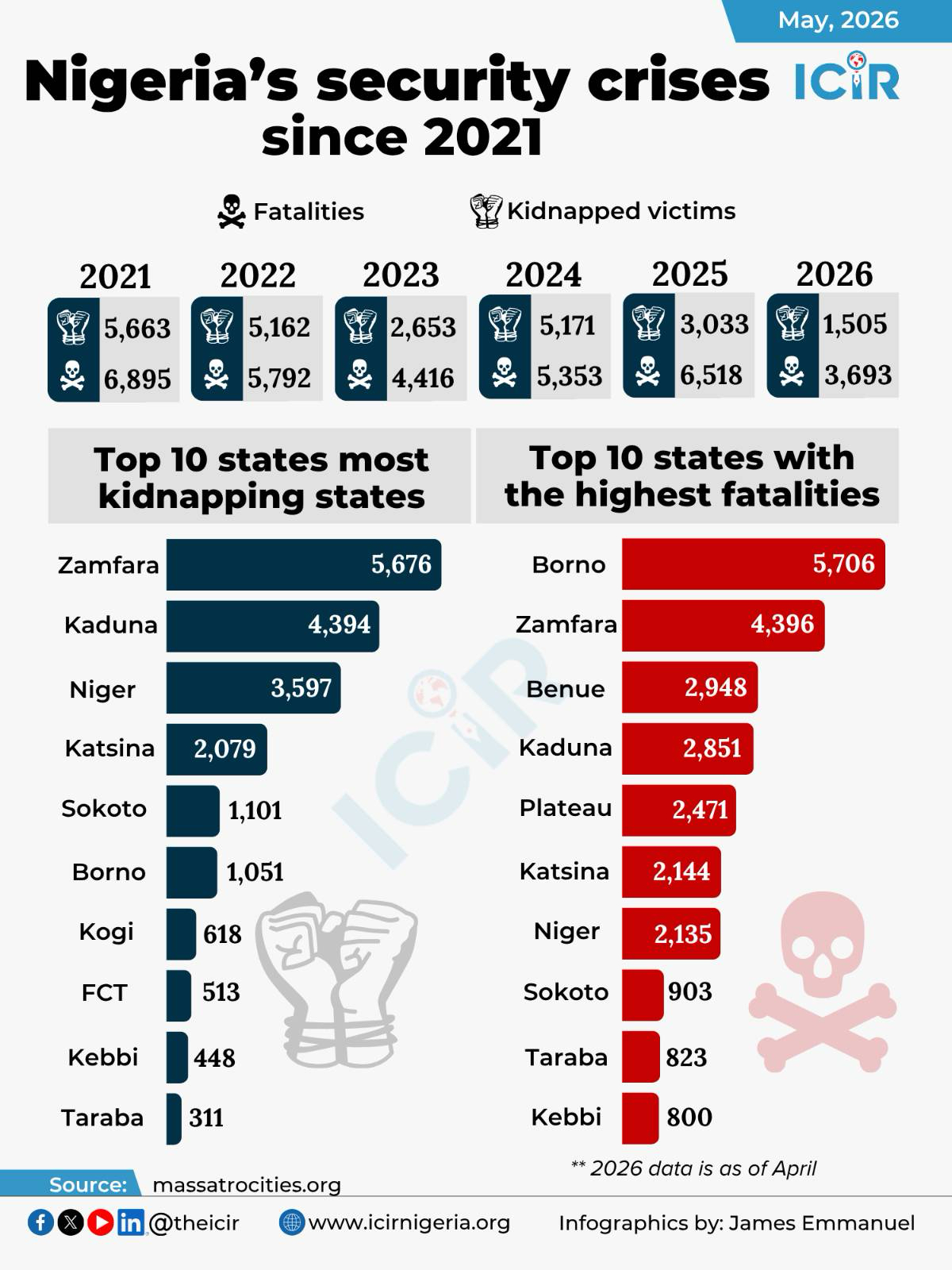
According to figures obtained from Mass Atrocities Tracker, no fewer than 32,667 people were killed across Nigeria between 2021 and 2026. This translates to an average of about 15 deaths per day over the six-year period.
The figures, compiled from incidents linked to insurgency, banditry, activities of the Indigenous People of Biafra (IPOB) and communal violence, show the spread in killings and abductions across different parts of the country despite repeated military operations and government assurances.
Based on the data, 6,895 were killed in 2021, at a time when several communities in Zamfara and Kaduna faced repeated mass raids by armed groups, with entire villages ransacked and residents either killed or forced to flee.
In 2022, about 5,792 deaths were recorded. The ICIR gathered that during this period, bandit attacks and communal clashes intensified across parts of the North-West and North-Central, with communities in Plateau and Benue continuing to report killings in farming settlements.
Further breakdown of the data shows that at least 4,416 people were killed in 2023 while, in 2024, deaths rose again to 5,353, with renewed attacks in Borno and continued violence in the North-West. School attacks, village raids and highway ambushes again became more frequent.
In 2025, at least 6,518 people were killed. The year saw renewed insurgent attacks in the North-East and sustained bandit violence in Zamfara, where entire communities were again forced to abandon their homes after repeated assaults. The latest data shows that between January-April, 2026, at least 3,693 people have been killed.
Top 5 states with highest killings
Further breakdown shows that Borno recorded the highest number of deaths with 5,706 victims between 2021 and 2026. This is followed by Zamfara which recorded 4,396 deaths within the same period. Benue recorded 2,948 deaths making it the third most hit state. It was closely followed by Kaduna which 2,851 deaths and Plateau with 2,471 deaths within the period under review.
Other states in the ranking include Katsina with 2,144 deaths, Niger with 2,135 deaths and Sokoto with 903 killed. Tarawa recorded 823, and Kebbi, 800 killed in the last six years.
Why Borno leads as epicentre of killings
In Borno, the state’s long-running insurgency crisis has made it the main theatre of operations for Boko Haram and its breakaway faction, ISWAP (Islamic State West Africa Province). Boko Haram emerged around 2009 as an armed Islamist insurgent group in north-eastern Nigeria, launching attacks on police stations, military bases, schools, places of worship and civilian communities. The group’s campaign of violence escalated sharply after 2011, leading to mass displacement and the destruction of entire towns.
In 2016, the group split, leading to the emergence of ISWAP, which aligned itself with the Islamic State network. Since then, both groups have operated in different parts of the Lake Chad basin, with ISWAP becoming more dominant in some areas due to its more structured operations and control over territories around the Lake Chad axis.
Over the years, both groups have carried out repeated raids on rural communities, often targeting farming villages, highways, military outposts and internally displaced persons’ routes. These attacks have forced many residents in Borno to flee their homes, with thousands still living in camps or host communities years after displacement.
Banditry pushes Zamfara to the brink
The crisis in Zamfara is largely driven by armed bandit groups operating across forested areas that stretch into neighbouring Katsina, Sokoto, Kaduna and Niger states. These groups have evolved over the years from loosely organised criminal gangs into more structured networks carrying out coordinated attacks on rural communities.
Communities across Zamfara have also reported a disturbing system of imposed levies, where residents are forced to pay “taxes” or risk renewed attacks. In some areas, bandits have taken over mining fields and entire villages have been emptied after repeated raids, with survivors fleeing into nearby towns or internally displaced camps.
At different points in the crisis, some local communities entered negotiated peace deals with armed groups, but these arrangements have often collapsed, leading to fresh waves of violence. Many rural settlements remain deserted, with farms abandoned and livelihoods disrupted, as residents live with the fear of returning to areas where attacks often happen without warning.
Benue, Kaduna, Plateau hit hard
Benue was the third most hit state with much of the killings linked to recurring clashes between farming communities and armed herders, as well as wider communal violence in rural areas. For years, villages in the state have face attacks during farming seasons and entire communities displaced. In 2025, The ICIR reported how several villages in Benue were caught in a deadly cycle of violence.
Kaduna, with a long history of sectarian violence follows closely behind Benue recording high fatalities in the last six years. The state has within this period faced multiple security challenges that include bandit raids, to farmer herder crisis and communal conflicts.
The death toll from Plateau State is largely driven by long-standing tensions between farming and herding communities that have repeatedly escalated into deadly attacks on villages, often leaving dozens dead in single incidents. Plateau is also confronted by ethno-religious tensions in Jos and some major cities that often lead to road blocade and killings.
Kidnappings spread across states
The data shows that kidnapping remains one of the most widespread crimes across Nigeria. At least 23,187 people were kidnapped in the last six years. The data shows that in 2021, at least 5,663 people were abducted and 5,162 abducted the following year. In 2023, the crime dropped to 2,653 but picked up to 5,171 in 2024. In 2025, records on kidnapping dropped again to 3,033. However, data records from January to April reveal at least 1,505 abduction cases. Many of the victims include farmers, traders and schoolchildren. In states like Zamfara, Kaduna and Niger, abductions often occur in waves, with entire communities negotiating ransoms to secure the release of captives.
Zamfara, Kaduna top kidnapping list
The North west remains the focal point of Nigeria’s banditry and records more kidnapping incidents than any other region. Zamfara leads with 5,676 kidnapped victims between 2021 and 2026. The ICIR reports that the state has become one of the main corridors of abduction in the North-West, where armed groups popularly called bandits routinely raid villages, block rural roads and seize residents for ransom.
Kaduna follows with 4,394 kidnapping cases. Many of the victims are schoolchildren, commuters and farmers taken during attacks on villages or ambushes along highways.
Niger recorded 3,597 kidnappings within the period, with attacks concentrated in rural communities and travel routes linking the North-West to the Federal Capital Territory and Kwara state.
Similarly, Katsina recorded 2,079 kidnappings, making it the fourth on the list of states with the highest kidnapping incidents.
Other affected states include Sokoto, Borno, Kebbi and Taraba, where similar patterns of rural attacks and ransom-driven abductions have persisted over the years.
Expert query government on rising killings
The Co-Chair of the Community of Practice Against Mass Atrocities in Nigeria, Ken Henshaw, while speaking at a conflict-specific dialogue marking the 2026 National Day of Mourning, said the continued rise in mass killings and abductions reflects a clear failure of government to meet its constitutional responsibility of protecting lives and property.
Henshaw said Nigeria’s insecurity crises, which has persisted across multiple administrations, shows that security institutions have consistently performed below expectation despite repeated promises and military operations aimed at curbing violence.
According to him, data tracking mass atrocities in the country indicates sustained levels of killings and kidnappings over the past several years, arguing that the figures point to systemic failure rather than isolated security lapses.
Henshaw said the persistence of attacks across different regions, coupled with rising casualty figures, suggests that existing security strategies have not been effective in addressing the scale and spread of violence.
“The violence continues to be driven by multiple armed actors operating across different regions of the country, including insurgent groups, armed bandits, separatist militias and communal armed groups, resulting in widespread displacement, destruction of livelihoods and growing civilian vulnerability,” he said.
The activist also criticised the increasing resort to amnesty programmes for armed groups, arguing that such measures weaken law enforcement and reduce pressure on authorities to prosecute offenders.
He further noted that the security architecture remains overstretched and under-resourced, saying that police deployment priorities, including the diversion of personnel to VIP protection, have affected public safety outcomes.

Mustapha Usman is an investigative journalist with the International Centre for Investigative Reporting. You can easily reach him via: musman@icirnigeria.com. He tweets @UsmanMustapha_M