Home Blog Page 108

US approves $2.1bn grant to strengthen faith-based healthcare in Nigeria

2

THE United States has entered into a five-year health partnership with Nigeria.

The project is designed to reinforce Nigeria’s healthcare system, with particular emphasis on faith-based health services.

A statement from the US Department of State said the memorandum of understanding, signed on Saturday, December 20, provides for about $2.1 billion in US support for programmes targeting HIV, tuberculosis, malaria, polio, as well as maternal and child health.

Under the agreement, Nigeria is expected to significantly scale up its health financing, committing close to $3 billion over the duration of the partnership.

The deal, announced by Principal Deputy Spokesperson Thomas Pigott, falls under the framework of the America First Global Health Strategy.

In the statement, the State Department said Nigeria’s funding pledge marked the largest co-investment made so far by any country under the America First Global Health Strategy.

“Today, the United States Department of State signed a five-year bilateral health Memorandum of Understanding with the Federal Republic of Nigeria to strengthen Nigeria’s health system, with a strong emphasis on promoting Christian faith-based health care providers.

“Under this MOU, the Department of State, working with Congress, intends to commit nearly $2.1 billion to expand essential preventative and curative services for HIV, TB, malaria, maternal and child health, and polio.

According to the department, the agreement is linked to recent reforms by the Nigerian government aimed at safeguarding Christian communities from violence. As part of the deal, specific funding will be directed to Christian health facilities, particularly those providing integrated care for infectious diseases as well as maternal and child health.

The department noted that the MOU was negotiated in the context of Nigeria’s efforts to prioritise the protection of Christian populations and includes substantial funding to support Christian healthcare institutions, with a focus on expanding access to combined HIV, tuberculosis, malaria, and maternal and child health services.

The State Department said Nigeria had about 900 faith-based clinics and hospitals, which currently serve more than 30 per cent of the population. The US officials explained that investing in these facilities was meant to complement government-run health services and strengthen the country’s overall healthcare system while stressing that US support under the agreement remained conditional.

They noted that all foreign assistance was subject to review, and that the US President Donald Trump and the Secretary of State reserved the right to suspend or end any programme that did not serve US national interests.

The MOU was signed at a time of increased US scrutiny of Nigeria, following recent travel restrictions introduced by the Trump administration over national security concerns and visa overstays.

Unveiled in September 2025, the America First Global Health Strategy applies to countries receiving US health funding and marks a shift toward bilateral partnerships, greater financial commitments from partner governments, and intensified efforts to tackle HIV, tuberculosis, malaria and other priority diseases, alongside broader health system strengthening.
Tinubu renames varsity after late Sheikh Dahiru Bauchi

0

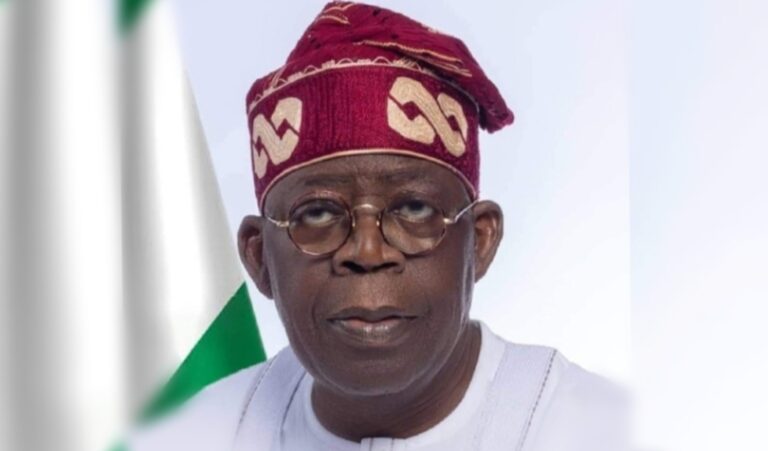
PRESIDENT Bola Tinubu has renamed the Federal University of Medical Sciences, Azare, Bauchi State, in honour of the late Islamic scholar, Sheikh Dahiru Usman Bauchi.

The President announced the decision on Saturday during a condolence visit to the cleric’s family at his residence in Bauchi.

He said the move was to immortalise the late cleric and recognise his lifelong contributions to humanity and Islamic scholarship.

“From today onward, I announce this change of name to immortalise him. The Federal University of Medical Sciences, Azare, Bauchi State, will from today be known as Sheikh Dahiru Usman Bauchi University. May God bless his memory,” Tinubu said.

Describing the cleric’s death as a great national loss, the president said Sheikh Bauchi was known for his humility, selfless service, and unwavering commitment to the propagation of Islam and peaceful co-existence.

He prayed for Allah’s mercy upon the late scholar and for his admission into Jannatul Firdaus.

Tinubu also prayed for strength for the family, as well as the government and people of Bauchi State, to bear the loss, while calling on Nigerians to continue to pray for peace and unity in the country.

Responding on behalf of the family, the eldest son of the late cleric, Ibrahim Usman Bauchi, thanked the president for the visit, prayers, and the honour accorded to their father. He also expressed gratitude to Bauchi State Governor, Bala Mohammed, for his continued support.

In his remarks, Governor Mohammed thanked the president for honouring the family and Bauchi State, describing the renaming of the institution as a fitting recognition of Sheikh Bauchi’s enduring legacy.

Tinubu was accompanied on the visit by the Speaker of the House of Representatives, Tajudeen Abbas; the Governor of Yobe State, Mai Mala Buni, among other senior government officials.

The president arrived at the Sir Abubakar Tafawa Balewa International Airport, Bauchi, at about 4:09 p.m., where he was received with a guard of honour by the Nigerian Air Force.

He was welcomed by Governor Mohammed; Plateau State Governor, Caleb Mutfwang; the Coordinating Minister of Health and Social Welfare, Prof. Ali Pate; the Minister of Foreign Affairs, Yusuf Tuggar; and the Senator representing Bauchi South, Shehu Buba.

The condolence visit formed part of the president’s engagements to commiserate with the family and followers of the late scholar, whose influence and contributions to Islamic learning spanned decades within and beyond Nigeria.

The renaming of the Federal University of Medical Sciences, Azare, adds to a growing list of tertiary institutions whose identities have been altered under Tinubu’s administration, often to honour prominent Nigerians or reflect historical and regional significance.

One of the earliest was the renaming of the University of Maiduguri to Muhammadu Buhari University, in honour of the late former president.

The Federal University of Education, Kano, was also renamed Yusuf Maitama Sule University of Education, after the late diplomat and elder statesman.

Similarly, the Federal University of Technology, Minna, was renamed Abubakar Tafawa Balewa University of Technology, Minna, to recognise the legacy of Nigeria’s first prime minister.

World Bank approves $500m to boost MSME financing in Nigeria

THE World Bank has approved a $500 million financing package to expand access to finance micro, small, and medium enterprises (MSMEs) in Nigeria under the Fostering Inclusive Finance for MSMEs in Nigeria project.

In a statement issued on Saturday, December 20, the World Bank announced the approval, which included a $400 million loan from the International Bank for Reconstruction and Development and a $100 million credit from the International Development Association (IDA) for Nigeria.

According to the statement, the project, known as FINCLUDE, will be implemented by the Development Bank of Nigeria. At the same time, credit guarantees will be delivered through its subsidiary, Impact Credit Guarantee Limited.

“The World Bank today approved the Fostering Inclusive Finance for MSMEs in Nigeria project, a $500 million financing package to the Federal Republic of Nigeria.

“The operation comprises a $400 million International Bank for Reconstruction and Development loan and a $100 million International Development Association credit, which will be implemented by the Development Bank of Nigeria, with credit guarantees delivered through DBN’s subsidiary, Impact Credit Guarantee Limited,” the statement read.

The World Bank noted that MSMEs accounted for the majority of businesses in Nigeria, contributing nearly half of the country’s gross domestic product, and providing a large share of jobs, but persistently facing barriers to access formal finance.

It said less than one in 20 MSMEs had access to bank credit, while available loans were often short-term, costly, and dependent on collateral requirements that excluded many viable businesses. Women-led enterprises, which make up a significant share of MSMEs, were said to be disproportionately affected by higher rejection rates and limited access to tailored financial products.

Similarly, agribusinesses, which play a critical role in food security and rural livelihoods, were identified as facing challenges in securing longer-term financing for equipment, processing, storage, and logistics.

The World Bank explained that FINCLUDE was designed to address these constraints by expanding affordable, longer-term finance and tailored solutions for segments with the greatest development impact, particularly women-led businesses and agribusinesses.

Commenting on the approval, the World Bank Country Director for Nigeria, Mathew Verghis, said the project was centred on jobs, opportunity, and inclusion.

“FINCLUDE is about jobs, opportunity, and inclusion. By opening finance for viable MSMEs -particularly women-led firms and agribusinesses – Nigeria can accelerate growth and deliver tangible benefits in communities nationwide.

“The project will make it easier for deserving small businesses to get the finance they need to grow and hire workers. With better support for lenders that practise inclusive finance and fairer, longer-term loans for entrepreneurs, we are backing the people who power Nigeria’s economy – especially women and those in agriculture,” Verghis was quoted as saying.

The World Bank added that the project would help mobilise private investment and expand access to inclusive and innovative financial products for MSMEs across the country.

Through the Development Bank of Nigeria, it said the operation would strengthen the capacity of banks, including microfinance banks and non-bank financial institutions such as financial technology firms, to provide larger loans with more reasonable repayment periods.

Through Impact Credit Guarantee Limited, the project will also scale partial credit guarantees to enable lenders to extend credit to businesses they might otherwise consider too risky.

The statement further said targeted technical assistance would be provided to modernise loan appraisal through AI-enabled digital platforms to speed up credit decisions, improve data use, strengthen impact measurement, and build capacity for both MSMEs and participating financial institutions.

The Task Team Leader for FINCLUDE, Hadija Kamayo, said the project is expected to mobilise about $1.89 billion in private capital and expand debt financing to 250,000 MSMEs, including at least 150,000 women-led businesses and 100,000 agribusinesses.

The approval adds to Nigeria’s growing portfolio of World Bank-supported programmes. As of June 30, 2025, Nigeria’s external debt stood at $46.98 billion, according to the Debt Management Office.

The World Bank Group remains Nigeria’s largest single creditor, accounting for $19.39 billion of the total external debt, comprising $18.04 billion from the IDA and $1.35 billion from the IBRD. This represents 41.3 per cent of Nigeria’s external debt.

Bauchi shuts major roads ahead of Tinubu’s condolence visit

0

THE Bauchi State Government has announced the temporary closure and diversion of major roads in the metropolis ahead of President Bola Tinubu’s condolence visit to the state.

Tinubu is expected in Bauchi on Saturday, December  20, to commiserate with the family and followers of the late Islamic scholar, Sheikh Dahiru Usman Bauchi.

The development was disclosed in a statement issued late Friday by the Special Adviser on Media and Publicity to the Governor, Mukhtar Gidado.

According to the statement, major routes leading to the late cleric’s mosque and other strategic locations will be closed or diverted between 1 pm and 6 pm for security and traffic control.

Gidado said the measures were put in place to ensure public safety and the smooth conduct of the president’s visit, urging residents to plan their movements, obey traffic directives and avoid restricted areas.

The government also appealed to residents to remain peaceful and cooperate with security agencies, expressing regret over any inconvenience caused.

“The Bauchi State Government appreciates the understanding and cooperation of the public,” the statement added.

Meanwhile, the Special Adviser to the President on Information and Strategy, Bayo Onanuga, had earlier announced that Tinubu would embark on a three-state visit to Borno, Bauchi and Lagos on Saturday.

How emotion drives misinformation online

0

ACROSS the digital spaces, from WhatsApp closed groups to Facebook pages, false content often spreads not because it looks believable, but because it feels plausible.

Whether it’s fear about insecurity, anger at political leaders, or religious solidarity, misinformation thrives when emotions take the driver’s seat.

For instance, messages framed around threats, betrayal, or moral outrage are carefully designed to feel urgent and personal. Once that emotional spark is lit, misinformation spreads quickly.

A study published in the National Library of Medicine found that people who rely on emotions are more likely to believe fake news. Across experiments involving 3,884 participants, researchers showed that heightened emotional responses increased susceptibility to false stories, while reliance on reason reduced it. The findings highlight how emotional processing makes individuals particularly vulnerable to misinformation.

The American Psychological Association (APA) also highlighted that one of the three main reasons why misinformation spreads is ’emotions’, the others being Illusory truth and Social engineering.

Emotional manipulation in misinformation often follows familiar patterns. Some of the most common as observed by FactCheckHub include:

Fear and panic: Claims about insecurity, health crises, or impending attacks often appeal to survival instincts. For example, during disease outbreaks, false cures and warnings spread faster than official health updates.

Religious solidarity: Nigeria’s deeply religious society makes it easy for misinformation to exploit faith. Posts claiming persecution of a religious group often go viral because they appeal to empathy and shared identity.

Anger and outrage: Emotionally charged posts targeting political leaders or ethnic groups frequently go viral on X and Facebook. Anger motivates engagement even when the information is false.

Hope and curiosity: Fake miracle discoveries, job opportunities, or financial giveaways also use emotional triggers, preying on people’s optimism and need for relief.

Trigger phrases to watch out for

Many false posts use repetitive language to heighten urgency or secrecy. Phrases such as: “Forward quickly before it’s deleted!” “They don’t want you to know this truth.” “Only the wise will understand.” “Share with 10 people and save a life.”

These expressions aren’t just dramatic, they are strategic. They appeal to fear of missing out (FOMO) and the desire to belong to an informed group.

How to resist emotional manipulation

Recognising emotional manipulation is the first step to resisting it. Here’s how to stay grounded:

Pause before reacting: When a post makes you feel angry, scared, or shocked, take a moment to pause. That emotional rush is often intentional. Misinformation and manipulative content are designed to trigger strong reactions so you share without thinking. Taking a moment to breathe, re-read, and assess the claim helps you avoid being pulled into false or exaggerated narratives.

Cross-check the claim: Before sharing, run a quick verification. Search reputable fact-checking platforms like The FactCheckHub to see if the claim has already been investigated. If nothing comes up, try different keywords or reverse-image search any attached photos. Always confirm that the fact-check matches the exact claim and check the date, evidence, and sources used. If you still can’t verify it, treat the claim as unconfirmed and avoid amplifying it.

Search key phrases online: Copy a unique part of the message, a name, a location, a quote, or a statistic, and search it on Google or X. This helps you see if the claim has appeared before. Many false stories recycle old rumours, old photos, or previously debunked narratives. If your search brings up earlier fact-checks, news reports, or warnings from credible sources, that’s a strong sign the message may be misleading. Even if you don’t get an exact match, scanning related results can help you understand the context and spot red flags.

Verify visuals: Misinformation often relies on old or unrelated photos and videos to create a false impression. Before believing or sharing any visual, use tools like Google Lens, TinEye, or InVID to trace where the image or video first appeared. These tools can show you older versions, different captions, or previous incidents the content was taken from. If the visual predates the claim, comes from another country, or appears with conflicting information, that’s a strong sign the post is misleading.

Ask critical questions: Before engaging, pause and interrogate the post. Who benefits from this message being shared? Is there a clear, credible source or official confirmation? Why is it trying to provoke an immediate reaction? And remember, don’t reshare unverified posts “just to ask.” Every share, even well-intentioned, helps misinformation spread.

Every repost increases the reach and credibility of misinformation, even when shared with doubts or disclaimers. Instead of amplifying it, verify first, consult fact-checkers, or privately ask someone knowledgeable. Reducing the spread is one of the most effective ways to slow down misinformation.

This report is republished from the FactCheckHub

Coalition raises alarm over Christmas Day attacks, urges protection for displaced communities

AS communities across Nigeria prepare for Christmas, a coalition of civil society organisations and human rights advocates has warned that the festive season has repeatedly been marked by deadly attacks in parts of the North, leaving thousands killed, while others have been displaced and traumatised over the past decade.

In a statement on Friday, December 19, jointly signed by the members, the coalition said attacks during Christmas celebrations since 2010 had left a trail of deaths, destroyed communities and forced thousands from their homes, particularly in Plateau, Kaduna, Benue and Kogi states.

The group recalled that the trend dates back to the Christmas Day bombings of Ungwan Rukuba and Gada Biyu in Jos, Plateau State, in 2010, and the 2011 attack on St. Theresa Catholic Church in Madalla, Niger State.

According to the group, these incidents marked the beginning of what it described as “grief-mapped mass displacement” linked to Christmas-related terror attacks in northern Nigeria and, more recently, the Middle Belt.

It cited several major incidents over the years, including the December 24, 2016 attack on Goska community in Jema’a Local Government Area of Southern Kaduna, where about 20 people were killed and hundreds fled.

The coalition also referenced the 2023 Christmas attacks in Bokkos and Barkin Ladi local government areas of Plateau State, where more than 212 people were reportedly killed and over 10,000 displaced.

According to the statement, violence during the 2024 Christmas period claimed the lives of about 46 worshippers in Anwase, Gboko Local Government Area of Benue State, forcing an additional 6,800 people into displacement and swelling the number of displaced persons in the state to over 150,000.

The coalition further noted that insecurity had persisted into the current festive season, pointing to the abduction of 20 worshippers in an ECWA church in Ayetorokiri, Bunu-Kabba, Kogi State, in the days leading up to 2025 Christmas.

Describing the attacks as a dangerous intersection of faith-based insecurity and domestic terrorism, the coalition warned that the recurring pattern required urgent and coordinated action to prevent further atrocities and displacement.

Consequently, the group called on the Federal Government to immediately strengthen security around communities, churches and travel routes during the Yuletide period, while prioritising the protection and welfare of internally displaced persons and displaced communities across the Middle Belt and other parts of the country.

Among its demands, the coalition urged authorities to address the long-term challenges faced by displaced persons, including loss of livelihoods, lack of documentation and exposure to further violence, and to deploy emergency agencies to provide food, water, shelter and security during the festive season.

It also called for stronger collaboration between statutory security agencies and local vigilante groups to improve intelligence gathering and community policing, as well as proactive action on security reports to prevent future attacks.

The coalition specifically urged President Bola Tinubu to assent to the African Union Convention for the Protection and Assistance of Internally Displaced Persons in Africa, also known as the Kampala Convention Domestication Bill, to ensure a coordinated, rights-based national response to displacement.

Security gets N9.3% as Tinubu presents N58.18trn 2026 budget proposal

0

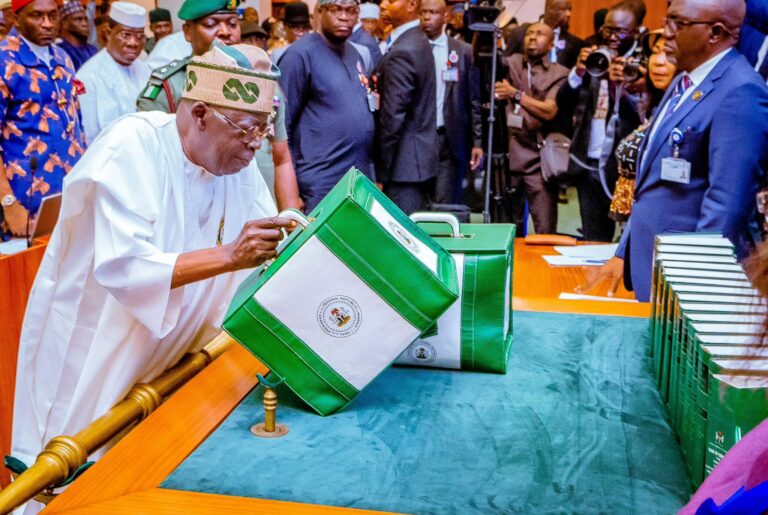
SECURITY will gulp N5.41 trillion of the N58.18 trillion 2026 budget proposal submitted before the National Assembly on Friday, December 19.

The amount is more than the allocations for education, infrastructure and health.

Tinubu told the lawmakers that national security remained the foundation of economic growth, investment and social stability, adding that without security, other sectors of the economy would struggle to thrive.

In the proposal, defence and security will receive N5.41trillion, ahead of N3.56 trillion for infrastructure, N3.52 trillion for education, and N2.48trillion for health. This is a pattern that has been established in Nigeria’s annual budgets since the nation began to face security threats.

Earlier, the Federal Executive Council had approved the 2026 budget framework at an emergency meeting presided over by Vice President Kashim Shettima.

The council pegged total expenditure at N58.47 trillion, with heavy spending pressures from debt service, wages and security obligations.

Breaking down the budget proposal, Tinubu said the security vote would be deployed to modernise the armed forces, strengthen intelligence-driven policing, enhance border surveillance and support joint operations among security agencies.

“We will invest in security with clear accountability for outcomes because security spending must deliver security results,” he said.

He also announced a major reset of Nigeria’s national security architecture, including the establishment of a new national counter-terrorism doctrine anchored on unified command, intelligence coordination and community stability.

Under the proposed framework, the president declared that all armed groups operating outside state authority – including bandits, militias, kidnappers, armed gangs and violent cult groups – would henceforth be classified as terrorists, along with their financiers, informants and political or community enablers.

He argued that the tougher classification was necessary to close legal and operational gaps that had allowed violent groups to thrive for years.

The president acknowledged the pressure on public finances but insisted that prioritising security was unavoidable.

“Without security, investment will not thrive. Without educated and healthy citizens, productivity will not rise. Without infrastructure, jobs and enterprise will not scale,” he said, linking the heavy security allocation to broader development goals.

Tinubu urged lawmakers to support the proposal, arguing that the budget was designed to consolidate recent economic gains while restoring public confidence in the state’s ability to protect lives and property.

No more budget rolling over, Tinubu says

Tinubu stated that there would no longer be rolling over of budgets from March 2026.

The president acknowledged that operating multiple budgets in a single year is a problem and pledged that his administration would terminate the operation of multiple budgets.

He assured that all existing budgets running concurrently would be concluded by March 2026.

Present at the budget presentation are the vice president; Chief of Staff, Femi Gbajabiamila; Secretary General of the Federation, George Akume; state governors, among others.

NASS to Tinubu: Police escorts withdrawal may stop us from visiting our communities

0

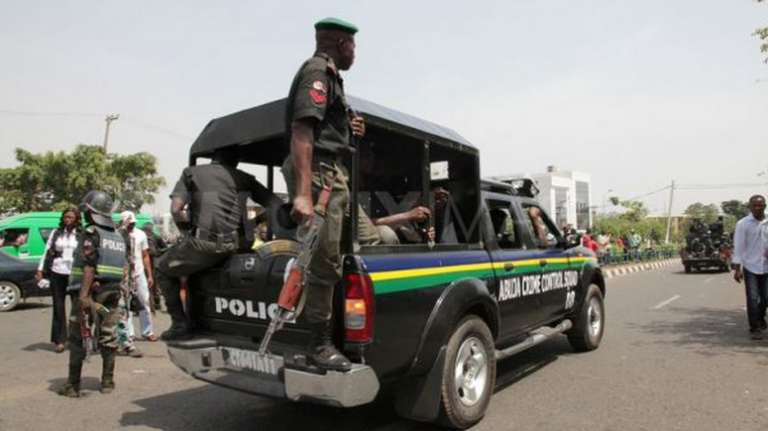
THE National Assembly has expressed fears that President Bola Tinubu’s recent withdrawal of police escorts from VIPs might not allow its members to return to their homes and constituencies. 

Senate President, Godswill Akpabio, disclosed this at the presentation of 2026 Appropriation Bill by Tinubu on Friday, December 19.

Akpabio said many of his colleagues had expressed dissatisfaction with the president’s directive to the police authorities to withdraw all the officers protecting VIPs to core policing duties, following worsening insecurity in the nation.

Tinubu had on November 23 ordered the Inspector-General of Police, Kayode Egbetokun, to executive the directive. He subsequently told his cabinet members to get clearance from him before they could enjoy police protection.

The president advised anyone seeking police escort to request well-armed personnel from the Nigeria Security and Civil Defence Corps (NSCDC)

The president gave the directive on Sunday, November 23, during a security meeting he held with the Police, Air Force, and Army chiefs, as well as the Director-General of the Department of State Services, DSS, in Abuja, according to a statement from the Presidency.
“In view of the current security challenges facing the country, President Tinubu is desirous of boosting police presence in all communities. Already, President Tinubu has approved the recruitment of 30,000 additional police officers. The Federal Government is also collaborating with the states to upgrade police training facilities nationwide,” part of the statement stated.
The order came on the heels of ballooning insecurity in Nigeria. On November 18, two people were confirmed dead and an unspecified number of residents abducted after terrorists attacked Eruku town, in the Ekiti Local Government Area of Kwara State.

The Kwara State Police Command in a statement on Tuesday, November 18, said the attack left two men fatally shot and several others missing.

Subsequently reports showed that 38 worshippers were whisked away by the gunmen. Tinubu announced their released days later, after the abductors allegedly slashed their ransom to N20 million per head.

Earlier on Monday, November 17, gunmen stormed Government Girls’ Comprehensive Secondary School, Maga, in Danko/Wasagu Local Government Area of Kebbi State and abducted several students. They killed the school vice principal.

Similarly, in the early hours of Friday, November 21, terrorists stormed St. Mary’s Papiri Private Catholic Secondary School in the Papiri community of Agwara Local Government Area, Niger State, and abducted dozens of students and teachers.

These incidents are just a few of rampant abductions, killings and other crimes by terrorists, bandits and other criminals who operate brazenly across Nigeria.


FEC approves ₦58.47tn 2026 budget, revises exchange rate to ₦1,400/$

THE Federal Executive Council (FEC) has approved a ₦58.47 trillion 2026 appropriation bill and an amendment to the Medium-Term Expenditure Framework (MTEF), clearing the way for President Bola Tinubu to transmit the budget to the National Assembly.

The meeting held earlier on Friday, December 19, was chaired by Vice President Kashim Shettima.

The Minister of Information and National Orientation, Mohammed Idris, who addressed newsmen after the meeting, said the budget consideration and approval for onward transmission to the legislature topped the agenda for the meeting.

The Minister of Budget and Economic Planning, Atiku Bagudu, also informed that the Council approved a downward revision of the exchange rate assumption in the MTEF from ₦1,512/$ to ₦1,400/$, with consequential adjustments to the overall budget size.

According to him, the proposals were earlier presented by the Ministry of Budget and the Budget Office and reviewed by members of the Federal Executive Council before approval.

Providing further details, the Director-General of the Budget Office, Tanimu Yakubu, said aggregate expenditure for 2026 was projected at ₦58.47 trillion, representing a six per cent increase over the 2025 budget estimate.

He explained that the figure includes ₦4.98 trillion in projected spending by government-owned enterprises (GOEs) and ₦1.37 trillion for grant- and donor-funded projects.

A breakdown of the spending plan shows statutory transfers of ₦4.1 trillion and debt service of ₦15.52 trillion, which includes ₦3.188 trillion for the sinking fund to retire maturing bonds issued to local contractors and creditors. Personnel costs, including pensions, are estimated at ₦10.75 trillion, incorporating ₦1.02 trillion for GOEs and reflecting a seven per cent increase over the 2025 provision.

Overhead costs are projected at ₦2.22 trillion, while capital expenditure stands at ₦25.68 trillion, about 1.8 per cent lower than the 2025 capital allocation and reflecting what officials described as a more conservative approach focused on completing ongoing projects.

Capital allocation priorities include ₦11.3 trillion for ministries, departments and agencies (MDAs), ₦2.052 trillion for multilateral and bilateral loans, and ₦1.8 trillion as the capital component of the Development Levy.

Yakubu said the 2026 budget was designed to balance macroeconomic stabilisation with the development objectives of the current administration.

He noted that budget assumptions were conservative and realistic, particularly on oil price, exchange rate and GOE dividends.

While revenues are projected to decline year-on-year, he said non-oil revenues would account for about two-thirds of total receipts, underscoring a structural shift away from oil dependence. Corporate income tax, value-added tax, customs duties and independent revenues are expected to remain the main fiscal anchors.

According to the Budget Office, expenditure growth is driven largely by debt service, wages and pensions rather than discretionary expansion, while the larger deficit reflects legacy fiscal rigidities rather than policy loosening. Financing of the deficit will rely mainly on domestic borrowing, complemented by concessional multilateral loans.

An earlier report by The ICIR revealed that there were doubts over 2026 budget projections after the Federal Government admitted that it realised just ₦10 trillion out of the ₦40 trillion revenue targeted for the 2025 fiscal year.

AI-generated misinformation we debunked in 2025

0

As of 2023, most deepfake videos had red flags like blurred ears, odd lip-syncing, and glitchy shadows that made them detectable.

By 2025, these flaws had all but disappeared. Advancements in AI image generation and real-time face-swapping tools have made manipulated videos almost indistinguishable from real footage, turning simple smartphone clips into powerful misinformation weapons.

Read also: Watch out for these disinformation trends in 2025!

This year, AI-created images and deepfake videos blended so seamlessly into political debates, celebrity scandals, and even breaking news events that spotting what was fake often required forensic analysis, not intuition.

What used to be the domain of specialised creators suddenly became mainstream. Political actors, scammers, and propagandists quickly took advantage.

Here are some of the major deepfake videos and AI-generated videos that we fact-checked in 2025

AI-generated R. Kelly song

In January, a viral video claimed that jailed singer R. Kelly had released a new song titled My Soul Cries Out. The clip showed a man resembling R. Kelly performing in a prison jumpsuit and quickly spread on social media.

Upon fact-checking, we found the claim to be false. The video showed signs of AI generation, including unnatural movements, inconsistent facial features, poor lip and hand synchronisation, and even spelling changes on the prison uniform. Audio checks also failed to link the song to any official release.

The original video was traced to a YouTube user who disclosed that both the song and visuals were created using AI tools. The creator had a history of producing AI-generated music attributed to R. Kelly.

Image depicting Wole Soyinka as a hunter

In February, a viral image shared on X claimed to show a Nobel Laureate, Wole Soyinka dressed as a local hunter in Ogun State. The image resurfaced amid growing concerns about digitally altered visuals online.

Findings by The FactCheckHub showed the claim was misleading. Reverse image searches traced the photo back to 2014, when it first appeared on internet forums as a “funny” image. Visual analysis revealed blurring around the neck area, indicating digital manipulation. Further checks using TinEye confirmed that the original image does not depict Soyinka.

Video showing Kwankwaso and Ganduje in a fight

A viral Facebook video claimed to show former Kano State governors Rabiu Musa Kwankwaso and Abdullahi Ganduje exchanging punches after a photoshoot. The clip, widely shared in early 2025, appeared dramatic and resembled a Kung Fu-style fight, further fuelling existing political tensions between supporters of both men.

When we analysed the video, it was evident that it was AI-generated. A reverse image search traced the original image used to create the clip to a 2012 photo of Ganduje presenting an award plaque to Kwankwaso in Abuja. Further analysis revealed watermarks linked to an AI tool commonly used to animate still images into fake fight scenes. The claim was therefore misleading, with the viral video identified as a deepfake created from an old photograph.

Salah quitting Liverpool

A viral TikTok video posted in March claimed that Egyptian football star Mohamed Salah announced he would leave Liverpool at the end of the season, blaming teammates Darwin Núñez and Diogo Jota. The clip, shared in March 2025, quickly gained traction with hundreds of thousands of engagements and was framed as a post-match reaction after Liverpool’s Champions League exit.

Checks showed the claim was false. The video’s visuals were traced to a genuine January 2025 post-match interview with Salah after Liverpool’s win over Lille, where he spoke only about his goal record and the team’s performance. The TikTok version was digitally altered: it was mirrored, had manipulated audio, and carried a disclaimer admitting it was edited using an AI tool. The misleading clip highlighted how AI-generated and doctored videos increasingly fuel sports misinformation in 2025.

Wizkid’s ‘free school’

A Facebook post that circulated in early 2025 claimed that Afrobeats star Wizkid built and owns a “Wizkid FC School” offering free education as part of a philanthropic initiative. The image of the building, widely shared across Facebook pages and blogs, was presented as evidence of the project.

The FactCheckHub found the claim to be false. The image was AI-generated, bearing a Meta AI watermark and scoring 98 per cent AI-generated on detection tools. Visual errors, including misspellings on the building signage, further raised red flags. Searches across news reports, public records, and Wizkid’s official channels found no evidence that the singer owns or operates any school.

Burkina Faso tax-free under Traoré

In April, a video circulating on TikTok claimed that Burkina Faso’s military leader, Ibrahim Traoré, had declared the country tax-free, lifting all taxes on salaries, businesses, and foreign investments. The video featured a scripted newscast-style voiceover over unrelated footage, and gained over 150,000 likes and 14,000 shares.

Fact-check by The FactCheckHub found the claim to be false. The video was partially AI-generated, with visual and audio inconsistencies such as staccato movements and out-of-sync speech. A key clip of Traoré was traced to his speech at the 2024 Academic Excellence Day, not an announcement of a tax-free policy.

Official records and credible media sources show no such tax-free regime exists. In fact, Burkina Faso’s 2025 Finance Act, passed in December 2024, expanded the country’s tax base, including e-commerce taxation.

Rihanna’s tribute to Diogo Jota

In July, A viral video claimed that Barbadian singer Rihanna released a tribute song for the late Liverpool footballer Diogo Jota. The 3-minute, 48-second clip showed a woman purported to be Rihanna in gardens, fields, and churches, with fast, staccato movements and inconsistent hand gestures.

The FactCheckHub confirmed the claim is false. The video and audio were digitally manipulated and AI-generated. Rihanna’s last solo release was Lift Me Up in October 2022, and the viral video does not appear on her verified channels. A nearly identical version on YouTube included a disclaimer noting it was created with synthetic media.

Nasarawa flyover collapse

A viral collage claimed that a newly constructed N10 billion flyover in Lafia, Nasarawa State, collapsed barely three weeks after commissioning. Checks by The FactCheckHub show the claim is misleading. The images were traced to an AI-generated video posted by a Facebook page known for its synthetic content, featuring clear visual distortions typical of generative AI.

The false claim gained traction following a real but separate incident in Keffi, Nasarawa State, where part of a flyover was damaged on July 18, 2025, after an overloaded truck struck a beam. No credible media report or official statement confirms a flyover collapse in Lafia.

Lekki flooding and Herbert Wigwe ‘s home

In August, a hyper-realistic AI-generated video shared by X user @classy_jesters sparked wide attention after appearing to show luxury cars being ferried through floodwaters in Lekki, Lagos. The 19-second clip was labelled as AI-generated satire but still amassed nearly one million views within days.

Despite the disclosure, the video’s realism led some viewers to believe it showed a real flooding incident—an assumption made more plausible by Lekki’s history of severe flooding. Comments revealed a split audience: while many recognised the satire, others took it at face value, raising concerns about how easily AI visuals can mislead.

The episode highlights a broader issue: older and less digitally literate audiences often struggle to interpret AI labels or may not understand what “AI-generated” means.

Later the same month, A viral video showing an abandoned house was claimed to depict the late Access Bank CEO Herbert Wigwe’s home. Findings by The FactCheckHub show the claim is misleading. Reverse image searches traced the video to a Facebook post by a comedian, Classy Jesters, who shared it as a generic, philosophical skit with no reference to Wigwe.

The video also carries a “Jester AI” watermark, confirming it was generated using an AI tool commonly used for hyper-realistic content. Archived footage of Wigwe’s actual residence, published after he died in 2024, shows a completely different property, confirming the viral video does not represent his house or assets.

What were some of the AI-generated, and deep fake videos you encountered in 2025?, let us know in the comment section.

This report is republished from The FactCheckHub.