Home Blog Page 1112

Italy’s most wanted mafia boss arrested after 30 years on the run

ITALIAN police have arrested one of the bosses of the Cosa Nostra Mafia in Sicily and Italy’s most wanted man Matteo Messina Denaro.

Denaro has been on the run since 1993, making him the country’s longest-hiding fugitive.

He was arrested by armed police on Monday, January 16, at the “La Maddalena” hospital in Sicily, where he was being treated for cancer under a false name and bundled into a waiting black minivan. He was wearing a brown fur-lined jacket, glasses and a brown and white woolly hat.

A second man who had driven him to the hospital was arrested at the scene on suspicion of aiding a fugitive.

Denaro is thought to have ordered dozens of Mafia-related murders and was given several life sentences in absentia for his many crimes, most notably in 1992 for his involvement in the separate murders of anti-Mafia prosecutors Giovanni Falcone and Paolo Borsellino.

His most recent life sentence came in 2020 for fatal bombings in Milan, Florence and Rome in the late 1990s, and for the murder and torture of the 11-year-old son of an enemy who gave evidence against the Sicilian Cosa Nostra.

Italian Prime Minister Giorgia Meloni travelled to Sicily to congratulate police chiefs after the arrest.

“We have not won the war, we have not defeated the mafia but this battle was a key battle to win, and it is a heavy blow to organised crime,” she said.

Palermo prosecutor Maurizio de Lucia said the police had received intel which it followed through leading to Denaro’s arrest.

Messina Denaro comes from the town of Castelvetrano near Trapani in western Sicily, and is the son of a mafia boss.

He was notable for driving expensive cars and his taste for wearing finely tailored suits and Rolex watches before going into hiding.

Images on social media showed locals applauding and shaking hands with police in balaclavas as the minivan carrying Messina Denaro was driven away from the suburban hospital to a secret location.

Despite the euphoria, Italy still faces a struggle to rein in organised crime groups whose tentacles stretch far and wide.
December inflation declines to 21.34% – NBS

THE National Bureau of Statistics (NBS) says Nigeria’s headline inflation rate eased to 21.34 per cent, compared to the November 2022 headline rate, which was 21.47 per cent. 

The development showed a marginal decline of 0.13 per cent when compared to the November 2022 inflation rate.

On a month-on-month basis, that was the first time the inflation rate  decreased over 11 months.

The latest figure, however, was still high when compared to the December 2021 figure, when the rate stood at 15.63 per cent before dropping to 15.60 per cent in January 2022.

“However, on a year-on-year basis, the headline inflation rate was 5.72 per cent points higher compared to the rate recorded in December 2021, which was (15.63 per cent). This shows that the headline inflation rate increased in the month of December 2022 when compared to the same month in the preceding year (i.e., December 2021),” the NBS report read.

It added that on a month-on-month basis, the percentage change in the ‘all items index’ in December 2022 was 1.71 per cent, which was 0.32 per cent higher than the rate recorded in November 2022 (1.39 per cent). This means that in the month of December 2022, the general price level was 0.32 per cent higher relative to November 2022.

“The percentage change in the average CPI for the twelve months ending December 2022 over the average of the CPI for the previous twelve months period was 18.85 per cent, showing 1.89 per cent increase, compared to the 16.95 per cent recorded in December 2021,” the NBS stated.

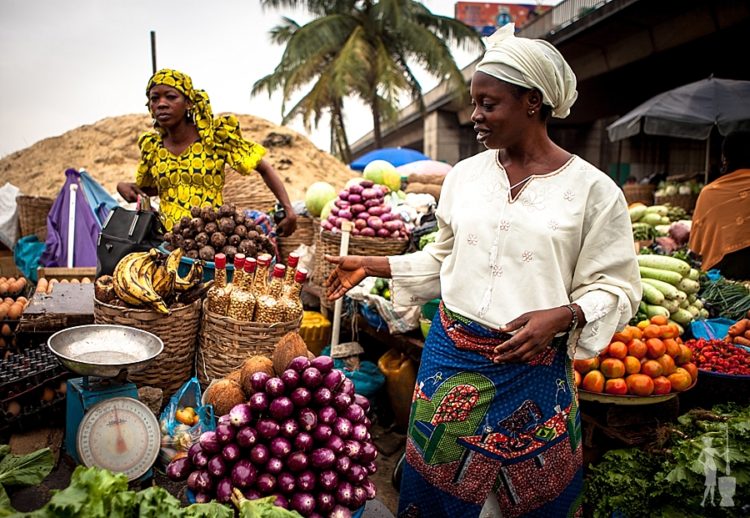
The Bureau also said food inflation eased to 23.75 per cent in the month under review, a decrease compared to the 24.13 per cent recorded in the preceding month.

But on a year-on-year basis, the figure was 6.38 per cent higher in relation to December, 2021.

“The food inflation rate in December 2022 was 23.75 per cent on a year-on-year basis, which was 6.38 per cent higher compared to the rate recorded in December 2021 (17.37 per cent).

“The rise in the food inflation was caused by increases in prices of bread and cereals, oil and fat, potatoes, yam and other tubers, fish, food product, etc.

“On a month-on-month basis, the food inflation rate in December was 1.89 per cent. This was 0.49 per cent higher compared to the rate recorded in November 2022 (1.40 per cent). This increase was attributed to increase in prices of some food items like oil and fat, fish, potatoes & tubers, bread and cereals, and fruits etc,” the statistics body stated.

The report added that the average annual rate of food inflation for the 12 months ending December 2022 over the previous 12-month average was 20.94 per cent, which was a 0.53 per cent points increase from the average annual rate of change recorded in December 2021 (20.40 per cent).


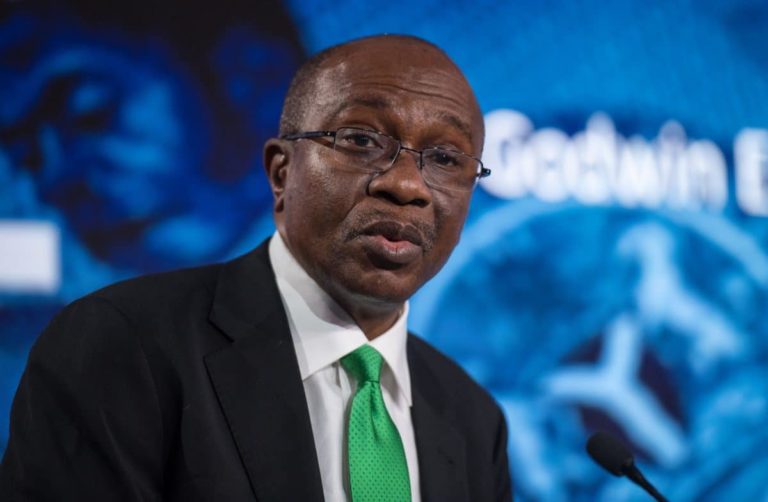
DSS counters reported invasion of Emefiele’s office, as he resumes duty

THE Department of State Services (DSS) has debunked reports that its operatives today invaded the headquarters of the Central Bank of Nigeria (CBN) in Abuja to arrest its governor, Godwin Emefiele.

Some online media publications (not The ICIR) had reported today that DSS operatives invaded Emefiele’s office, cordoned it off and prevented all CBN’s staff members from gaining access.

But a clarification statement issued by the DSS Public Relations Officer, Peter Afunanya, described the reports of the invasion as “fake and misleading.”


READ ALSO:

Fiscal rascality, not Emefiele, responsible for Nigeria’s monetary problems – Peter Obi

Newly redesigned Naira notes now in banks, ready for issuance – Emefiele

Reps summon Emefiele, kick against cash withdrawal limit

Nigeria is targeting $200 billion from non-oil exports – Emefiele


Afunanya stated, “The attention of the Department of State Services (DSS) has been drawn to the false news making the round that its operatives invaded the Central Bank of Nigeria and arrested its Governor, today 16/1/23. This is fake news and quite misleading.”

Meanwhile, Emefiele has resumed duty today from his annual leave, amid the invasion rumour.

The apex bank’s Director of Communications, Osita Nwanisiobi, did not respond to messages sent to him by The ICIR seeking clarification on the reported invasion.

Nwanisiobi, however, issued an official press statement, which was posted on the apex bank’s twitter account, about the Governor resuming duty after his annual leave.

The statement read, “The Governor resumed with renewed vigour to perform his duty ahead of the first Monetary Policy Committee meeting scheduled for January 23 to 24, 2023.”

The statement noted that Emefiele remained committed to performing his duties in line with his oath of office and the policy direction of President Muhammadu Buhari.

“While thanking the public for keeping faith with the bank, we urge Nigerians to continue to support policies of the Bank aimed at ensuring a stable financial syatem and the Nigerian economy in Nigeria,” he stated.

Currently, the Nigerian government is caught in the web of taking decisions on debt restructuring as a result of the Central Bank of Nigeria’s lending beyond threshold to the Federal Government to the tune of N22. 7 trillion.

The Buhari administration will be leaving behind a massive debt of N77 trillion by  May 29, with a large chunk of that arising from overlending to the Federal government by the CBN.

Also, Nigeria’s naira redesign is still faced with various forms of difficulties, with the redesigned currency of N200, N500, and N1000 poorly circulating despite the January 31, 2023 deadline.

There are also concerns of exchange rate problems with the business community and multilateral lending agencies – World Bank and the African Development Bank –  complaining of the wide gap between the official and the parralel market rates.

Emefiele was last year reported to have picked the N100 million APC presidential primary nomination form, with various media outlets alleging he was a card-carrying member of the ruling party.

PVC: Hitches caused by INEC will disenfranchise Nigerians – Global Rights

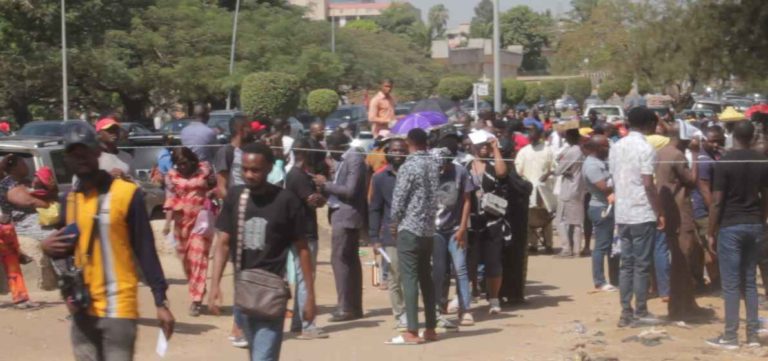
A sizeable number of Nigerians will not get their permanent voter card (PVC) to enable them to participate in the forthcoming elections because of hitches in the card distribution by the Independent National Electoral Commission (INEC), according to Global Rights, a civil society organisation (CSO).

In a statement mailed to The ICIR on Monday, January 16, Global Rights listed myriads of challenges both INEC and Nigerians seeking to collect their PVC face in the distribution process.

Global Rights’ observations on the card distribution by INEC are similar to those of The ICIR in Lagos, Akwa-Ibom, Enugu, FCT, Nasarawa, Gombe and Nasawara.

The civil society organisation monitored the distribution in Abuja, Lagos and Nasarawa states. 

It applauded the patriotic enthusiasm displayed by citizens in collecting their PVCs, which it described as an indication of their willingness to be active at the polls. 

However, it noted that it would be an unacceptable disservice to Nigeria’s fledgling democracy for INEC to disenfranchise willing and eligible voters due to a flawed collection process.

According to the organisation, the continued frustration of those seeking to get the card may trigger prospective voters’ resignation and deepen their distrust of the electoral process. 

It noted that its concerns were imperative to addressing the recurrent voter apathy that characterized elections in Nigeria.

However, the institution commended INEC for extending the dates for the PVC collection both at the ward and local government secretariat levels.

“While the collection process has been smooth in some locations, the situation in other locations, serving larger populations, leaves much to be desired,” the CSO said.

Global Rights said its findings showed that prospective voters in the Utako Ward of the Abuja Municipal Area Council (AMAC) complained of sluggish PVC distribution due to understaffing, adding that several voters in the Orozo Ward in the Council reported visiting their wards upwards of three times and were repeatedly told that their PVC was not ready.

It explained that at the Lugbe Primary School (the collection centre for the Kabusa Ward), there were complaints about the sorting process because new voters were not separated from those with cases of lost or transferred cards.

“This has significantly slowed the process, leading to massive crowds, daily queue waits of more than 700 persons, reports of raucous behaviour, stampedes, and people fainting due to exhaustion from long hours of standing in the queue. There have also been reported cases of unprinted and missing PVCs.”

Besides, despite INEC’s declaration that official collection hours are 9 a.m. to 3 p.m., Global Rights said there were reports of INEC officials resuming at about 11 a.m. each day at some of the collection centres, resulting in people having to wait in line for several hours.

“Several people also complained of inaccuracies in the SMSs and emails sent by INEC to some registered voters, instructing them to pick up their card in a particular ward, but were then redirected to another after spending hours in long queues.”

INEC had announced that registered voters could pick up their PVCs between December 12th, 2022, and January 22nd, 2023, and subsequently at the 8,809 Registration Areas/Wards from the 6th of January to the 15th of January 2023 between the hours of 9 a.m. and 3 p.m. every day, including Saturdays and Sundays. 

The Commission had, on January 4, 2023, revealed that no fewer than 6.7 million Nigerians were yet to collect their PVCs across 17 states. As of December 20th, 2022, 231,900 registered voters were yet to pick up their PVCs in Gombe state. As of 2022, 1,693,963 PVCs were yet to be collected in Lagos State and 661,783 in Edo state. 

Other states with a sizeable catalogue of uncollected voters cards included Oyo (700,000), Ogun (400,000), Imo (300,000), Kogi (160,966), Kwara (120,602), and Borno (80,117).

In the FCT, 460,643 PVCs had not been collected as of December 24th, 2022. INEC also revealed that AMAC had the highest number of uncollected PVCs in the FCT.

Sit-at-home: South-East micro businesses lost estimated N4.6trn in 52 weeks – investigation

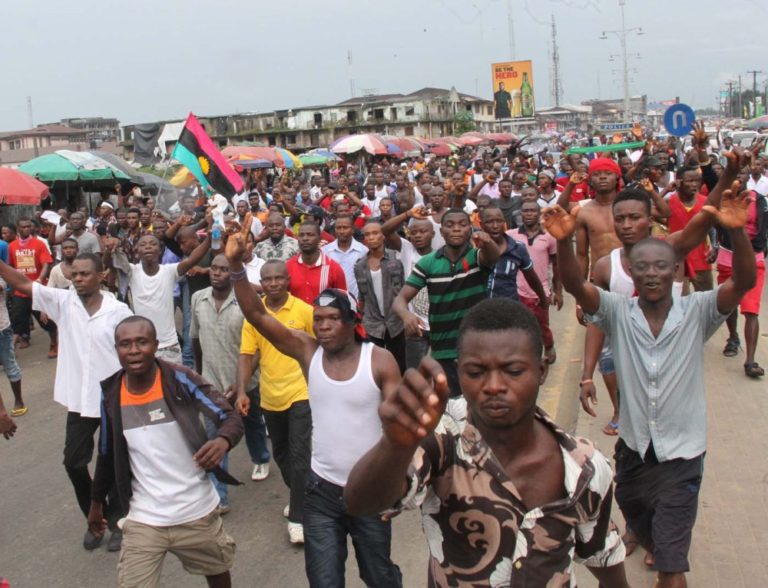
MICRO businesses in Nigeria’s Southeastern states lost an average of N4.618 trillion ($10.495 billion) in one year to the sit-at-home order that the Indigenous People of Biafra (IPOB) imposed on the region, an ICIR investigation has shown.

The southeastern states comprise Anambra, Enugu, Ebonyi, Imo and Abia.

The enforcement of the sit-at-home order every Monday was an approach IPOB adopted to protest the Federal government’s continuous detention of its leader, Nnamdi Kanu.


READ ALSO:

South-East Nigeria: The cost of Monday sit-at-home exercise (Part 1)

When Hunters Become Hunted: How attacks on Police Stations in the Southeast leave Officers at risk and communities vulnerable

15 officers killed, 21 police stations attacked in seven months in Southeast


By the investigation, the total estimated revenues of micro-businesses in the five Southeastern states were summed up and multiplied by 52 to arrive at the N4.618 trillion.

The 52 weeks represented the number of the sit-at-home Mondays in a year.

The investigation relied on figures from the National Bureau of Statistics (NBS), Nigeria’s data agency, and the Small and Medium Enterprise Development Agency of Nigeria (SMEDAN) 2021 survey reports.

The survey classified Nigerian businesses into four categories: nano, micro, small and medium enterprises.

The ICIR investigation concentrated on nano and micro businesses, which made up 96.9 per cent (38.413 million) of the 39.654 million MSMEs in Nigeria. In line with the survey, those interviewed were businesses in trade, agriculture and minor services. The majority of those interviewed were in the informal (untaxed and unregulated) sector.

According to the SMEDAN/NBS report, there were 1.297 million micro/nano enterprises in Anambra State and 764, 844 in Abia State.

Enugu State was estimated to have 1.154 million micro/nano enterprises, while Ebonyi had 561,287 businesses in the category. Also, Imo State had 1.231 million micro/nano businesses.

From the computations, the Southeast lost an estimated N75.704 billion every Monday on nano and micro businesses. This was disaggregated as follows: Anambra, N38.140b billion, Enugu N9.334 billion, Imo N13.739 billion, Ebonyi N4.079 billion, and Abia N10.412 billion.

The loss sum did not, however, represent the entire economic cost of the sit-at-home order, as the report focused only on the price paid by the smallest businesses for sitting at home, while their counterparts in other regions were busy.

Few observed exceptions

The investigation observed that not all businesses were shut down every Monday in the region.

In Ebonyi State, many businesses were open on Mondays, over the period the investigation covered.

Even in the other four states in the region, some nano and micro businesses operated on Mondays, but were always on the lookout for the IPOB enforcers, who disrupted such trading.

Whenever such disruptions happened, the traders would scamper for safety, leaving their wares – if they were unable to quickly save them – to the caprices of the enforcers.

For example, on December 14, 2022, gunmen, enforcing the sit-at-home order, attacked businesses in Imo and Ebonyi states.

Fiscal rascality, not Emefiele, responsible for Nigeria’s monetary problems – Peter Obi

PRESIDENTIAL candidate of the Labour Party (LP) Peter Obi has said fiscal rascality, rather than Central Bank of Nigeria (CBN) governor Godwin Emefiele, is responsible for Nigeria’s monetary problems.

He disclosed this while fielding questions on the leadership and independence of the CBN governor at Chatham House in the United Kingdom on Monday, January 16.

Obi was asked if he would sack or retain Emefiele if elected President in the 2023 general elections.


READ ALSO:

DSS counters reported invasion of Emefiele’s office, as he resumes duty

Godwin Emefiele: CBN governor in the eye of the storm

Newly redesigned Naira notes now in banks, ready for issuance – Emefiele

Reps summon Emefiele, kick against cash withdrawal limit


Responding, he said, “Let me assure you, the Central Bank of Nigeria will maintain its independence. It will be respected. Again, it is not the problem of the person there. The cause is a weak governance structure.

“Replacing Godwin Emefiele and putting somebody with that level of fiscal rascality, which is what is fueling our inflation and our rate of exchange today. As long as the government continues on that fiscal rascality, that situation will occur.”

He also noted that fiscal rascality was reflected in payment of unsustainable subsidy on petrol, a situation which he described as criminal.

“Nigeria is today the only oil nation apart from Venezuela, because of sanctions, that is not meeting up its quota because over the years of oil theft, the multinationals have not been investing. Coupled with the theft and everything we are not realising what we are supposed to.

“Every other nation that is in the same condition was able to bring down their rates and inflation within this period of Ukraine war. But we couldn’t take that advantage because of poor management of our own fiscal space, which will change with Datti and I,” he said.

2023: Obi assures Nigerians of 25,000mw of electricity if elected

THE presidential candidate of the Labour Party (LP) Peter Obi has assured Nigerians of 25,000 megawatts of electricity before the end of 2025 if elected President.

Obi made the promise at the Chatham House in London on Monday, January 16.

He said that his administration would see to the provision of stable electricity to improve production in the country.

“Our solution to the power problem in Nigeria is comprehensive and is well covered by our manifesto. We will ensure that we deal with the issue of transmission distribution.

“We will achieve a stable 7000 megawatts by the end of this year, provide 11,000 megawatts by 2024 and  25,000 megawatts by 2025,” he said.

He stressed that energy is important for local manufacturing and creation of employment opportunities.

“We will support local manufacturing capacities and expand local random factories around the universities, training centres and workshops.”

Obi also promised to improve the educational sector.

IPOB, other secessionist agitators evidence of bad leadership – Obi

THE Presidential candidate of the Labour Party (LP), Peter Obi, has described the Indigenous People of Biafra (IPOB) and other secessionist groups in the country as evidence of bad leadership.

Obi stated this when he appeared at the Chatham House, United Kingdom, on Monday, January 16.

The former governor of Anambra State said he would dialogue with IPOB and other secessionist agitators.

“IPOB and other agitations in the country are a culmination of years of bad leadership,” Obi said. “All those things will start reversing themselves when the leadership problem is sorted. I and Datti will talk with all agitators.”

Addressing the issue of youth unemployment, he said he would turn the situation into a dividend for the country.

“It is not to be doubted at the global scene that Nigeria is blessed with some of the most entrepreneurial youths in the world of science and in business, in art and entertainment. We believe that what remains is the changing of the leadership class.

“We will turn our youth bunch to a democratic dividend rather than today’s harvest of time bomb violence,” he said.

On foreign direct investment in the country, he stated that foreign capital is afraid of corruption, and he will do everything in his power to reduce corruption to the barest minimum so that even Nigerians who have migrated due to a lack of opportunities will return home.

Chatham House is a policy institut whose aim is to help governments and societies build a safe, prosperous, and fair world that will last.

2023: Atiku warns against returning APC to power

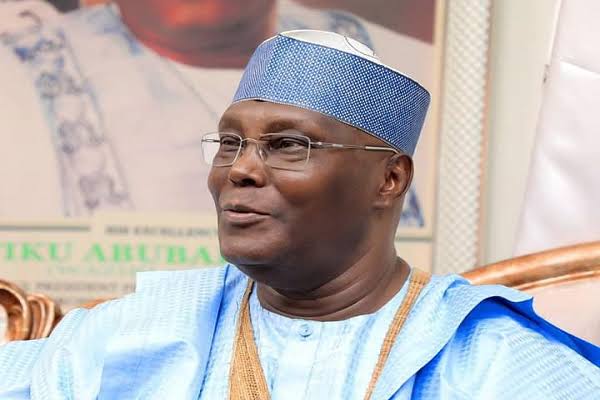
THE presidential candidate of the Peoples Democratic Party (PDP) Atiku Abubakar has warned Nigerians against returning the All Progressives Congress (APC) to power in the 2023 general elections.

Atiku also warned that it will be dangerous to elect a ‘greenhorn’.

He gave the warning in a series of tweets posted on his official Twitter handle on Monday, January 16.

The PDP presidential candidate noted that the APC was responsible for Nigeria’s problems.

The former Vice President said, “Capital has taken a flight alongside policy incoherence which continues to cause an impediment to economic growth. The failure of the APC-led government is staring every Nigerian in the face.

“It will be dangerous for Nigeria to relinquish their future to a greenhorn or the national leader of the same party that brought us to this very sorry situation.”

In the same vein, he noted that partnership with the private sector is necessary for the success of any economic policy.

Atiku assured of a strong partnership with the private sector if elected. The partnership, according to him, will provide jobs, economic and infrastructural growth, and alleviate poverty.

“No one should downplay the enormity of the task ahead. I have a good knowledge of the challenges facing Nigeria. I will come prepared and experienced.

“Our government will tackle the deficit in infrastructure financing and fast-track infrastructure development in the country.

“We will create a strong partnership with the private sector to create jobs, grow our infrastructure, and fight poverty.

“We will support the private sector to drive growth. We have done it before, and you know we can do it again,” he said.

Bolanle: Suspected killer cop pleads not guilty, witness narrates how lawyer was killed

0

A SUSPENDED Assistant Superintendent of Police (ASP) Drambi Vandi has pleaded not guilty while being arraigned for the murder of Lagos female lawyer Bolanle Raheem.

Vandi was arraigned on a one-count charge bordering on murder before the Lagos State High Court, Tafawa Balewa Square, on Monday, January 16.

He pleaded not guilty after the charge was read to him.

However, the first witness called by the prosecution in the trial, Matthew Ahmen, an Inspector of Police, who is also Vandi’s colleague, narrated how the suspect killed the victim.

Ahmed told the court that they were conducting a stop and search when the incident happened.

According to him, Vandi, who was the leader of their team, was behind while he was in the middle, and another colleague, Inspector Dimini, was in the front.

Ahmen said when Dimini saw a car coming, he flagged it down but the car didn’t stop. He added that when the car got to where he was standing, he also flagged the car down but it didn’t stop.

“The next thing I heard was a gunshot and I looked back to see what was happening and I saw that a windscreen was falling.

“The next thing I saw again was a dark woman who jumped down from the vehicle and I heard her saying that ‘oga you have killed my sister.’ The woman held him (Vandi) and before I and Dimini could get to them, they had entered the car, locked it, and left.”

The ICIR reported that Raheem was allegedly shot dead by Vandi in the Ajah area of Lagos on Christmas Day, December 25, 2022.

She was returning home with her family when she met her death.

Vandi was arrested and appeared before Chief Magistrate C.A. Adedayo on December 30, 2022, a day after the Police Service Commission approved his suspension.

The killing of Raheem towards the end of 2022 generated outrage as Police officers allegedly killed two persons within three weeks.

Raheem and a young man, Gafaru Buraimoh, were allegedly killed by police officers attached to the same station.