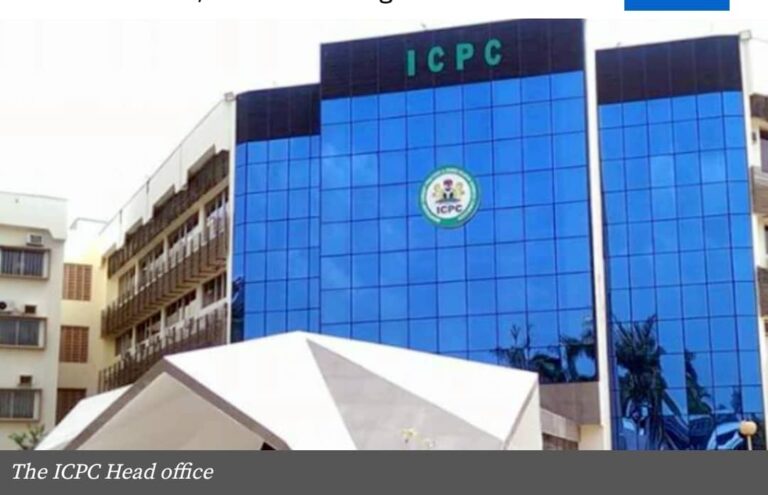
THE Independent Corrupt Practices and Other Related Offences Commission (ICPC) recovered ₦37.44 billion and $2.353 million in 2025, while recording a 55.74 per cent conviction rate in its prosecutions, the agency has announced.
The Commission’s Chairman, Musa Aliyu (SAN), disclosed the figures during the ICPC’s End-of-Year Engagement, send-off for retiring staff, and Annual Merit Awards ceremony, according to a statement by the commission on Sunday, December 14.
Aliyu mentioned that the recoveries rank among the Commission’s largest ever.
“2025 is a pivotal year marked by substantial progress across enforcement, prevention and public enlightenment.
“This year, the ICPC investigated 263 cases, exceeding its target of 250, and filed 61 cases in court, achieving a 55.74 per cent conviction rate. ₦37.44 billion and $2.353 million were recovered in 2025 through asset seizures and forfeitures,” the statement read.
Aliyu highlighted some of the year’s high-profile convictions, including that of Cyril Ndifon, a professor of the University of Calabar, who was sentenced to five years’ imprisonment for sexual harassment and cyberbullying.
On preventive measures, he added that the ICPC assessed 344 Ministries, Departments and Agencies (MDAs) using its Ethics and Integrity Compliance Scorecard.
According to him, the agency also conducted 66 corruption-monitoring exercises and tracked 1,490 projects nationwide, while completing Systems Study and Corruption Risk Assessments in 12 MDAs to reduce structural loopholes for graft.
Aliyu said the Commission initiated 15 collaborative projects with partners, while civil society organisations carried out 57 complementary engagements.
The ICPC chairman called on staff to maintain integrity and professionalism as the agency prepares for 2026.
Insecurity in Nigeria remains one of the country’s most persistent and troubling challenges, one that successive governments have failed to decisively address. It is easy to conclude that the crisis is an outcome of entrenched bad governance and corruption, or a political tool wielded by desperate political actors. It could also be both. Whatever interpretation one adopts, one fact is undeniable – insecurity affects every Nigerian, regardless of age, sex, origin, political affiliation, religion, ethnicity, or social status.
The gravity of the situation was once again highlighted in the wake of President Trump’s re-designation of Nigeria as a Country of Particular Concern. In response, President Bola Tinubu, on 6 November 2025, reassured citizens that his administration would defeat terrorism and secure every part of the country. Yet, barely a week after this assurance, Nigerians awoke to the tragic news of another mass abduction of about 25 schoolgirls from Maga Comprehensive Girls’ Secondary School in Danko Wasagu Local Government Area, LGA, of Kebbi State. While citizens were still calling on the government to ensure the safe return of the school girls, there was another abduction of over 300 pupils, students, and teachers at St. Mary’s Catholic School, Papiri, Niger state on 21 November, 2025. This incident adds to the growing list of assaults that continue to undermine public confidence in government promises.
Yet, in a democracy, power should originate from and belong to the people. Through elections, citizens confer legitimacy on the government. That mandate comes with clear responsibilities for the protection of lives and property. The 1999 Constitution captures this succinctly when it describes the safety and security of the people as the “primary” responsibility of government. Whenever anyone in Nigeria is killed, abducted, disappeared or endangered – especially vulnerable groups like schoolchildren – it raises fundamental questions about governance, accountability, and the state’s commitment to its obligations.
Nightfall in many Nigeria’s communities living with or on the frontiers of this insecurity is redolent of Oswald M. Mtshali’s “Nightfall in Soweto”, where he depicts night as “a dreaded disease seeping through the pores of a healthy body, and ravaging it beyond repair.” Students in both secondary and tertiary institutions have suffered severe trauma as a result of encounters with terrorists euphemistically branded bandits by government. Tragically, some lost their lives. It is important to recall some of these horrific yet avoidable incidents as a reminder that insecurity remains pervasive, robbing us of the peace we desire.
In 2003, Nigeria adopted the Child Rights Act (CRA), which enacted into domestic law the United Nations Convention on the Rights of the Child (UNCRC) previously ratified by the country in 1991. Article 28 of the UNCRC guarantees the Right to Education – free and compulsory primary education, and accessible secondary and higher education. The Universal Basic Education Commission (UBEC) Act, enacted the following year in 2004 established the UBEC to ensure that every Nigerian child enjoys free, universal, compulsory, and basic education. Basic education under the UBEC Act is a minimum of nine years schooling, that is; six years of primary school and at least three years in junior secondary school.
Yet, in today’s Nigeria, students who simply yearn for knowledge are increasingly becoming victims of abduction. How do we explain this tragic reality to young minds?
From the attack on Government Secondary School, Mamudo, Yobe State, on July 6, 2013 where 42 people, including students and staff, were killed to the abduction of over 270 schoolgirls on April 14, 2014 at Government Girls Secondary School, Chibok, Borno St ate, the pattern remains deeply disturbing. The Chibok abduction inspired the #BringBackOurGirls campaign, a movement for school safety led by prominent activists and amplified globally by politicians and diplomats demanding the safe return of the schoolgirls.
On February 19, 2018, bandits stormed Government Girls Science and Technical College, Dapchi, in Bursari Local Government Area of Yobe State, abducting 110 schoolgirls. In February 2021, another 279 students were abducted from Government Girls Secondary School, Jangebe, Zamfara State.
The data and trend clearly show that there is an overwhelming feminization of the phenomenon of mass school abduction in northern Nigeria but boys are sometimes not spared too. Two years after the Dapchi schoolgirls abduction, over 300 schoolboys were kidnapped on December 11, 2020, from Government Science Secondary School, Kankara, Katsina State.
In response to this rising incidents of school insecurity, the Federal Government has shut down 47 Federal Government (Girls) Colleges. The governors of Katsina, Plateau, Kebbi, and Niger have similarly ordered the immediate shutdown of primary, secondary, and tertiary institutions in vulnerable communities. In Taraba State, the Governor adopted a different approach, directing the immediate de-boarding of all students in both private and public secondary schools and enhanced security measures across all school premises reinforced by community monitoring assets.
According to the United Nations Children’s Fund (UNICEF), an estimated 18.3 million Nigerian children between the ages of five and fourteen were out of school in 2024. With the alarming rise in school attacks, how can we keep students safe and ensure they remain in school long enough to transition to higher levels of learning? Has the pursuit of formal education become a crime? If not, why are students repeatedly targeted?
In response to the destruction of school facilities and the killings and abductions of teachers and students, the Nigerian government, in partnership with the United Nations Envoy for Global Education, launched the Safe Schools Initiative (SSI) in 2014 to improve the protection and safety of students, teachers, and family members. In 2019, former President Muhammadu Buhari signed the Safe Schools Declaration (SSD) ratification document, signalling Nigeria’s commitment to uphold its principles. The record of implementation has been non-existent or abysmal. In a recent report, The Punch newspaper reports that 30 states have yet to implement the SSI. Writing more recently, former British Prime Minister, Gordon Brown, advised that the best practices of the SSI must be reintroduced, reinvigorated, and supercharged at the federal, state, and local levels in Nigeria.
Nigeria’s insecurity crisis is not just a threat to national stability; it is a test of leadership, political will, and the government’s ability to uphold its constitutional obligations. Every Nigerian – except those perpetrating or benefitting from – should be concerned about the crisis of insecurity that has emptied schools and threatening enlightenment in the country. Nigeria’s political elites should not play politics with the lives of Nigerians and the vulnerable groups. The response of government appears to have focused on recovering the abducted without the perpetrators being accounted for. This has fuelled credible speculation that the government has rewarded them with ransom payments, guaranteeing that there will be more abductions not less.
I am a product of a boarding school in North-West Nigeria and this issue is deeply personal to me. How is it possible for over 300 students to be abducted and no one is held accountable? An effective response must begin with a policy of zero-tolerance for school abductions around three issues.
First, security institutions must be required to perform better. The abduction and transportation of hundreds of school children from one place to another without minimal resistance or interference by Nigeria’s security agencies is an awful blot on the security management system in the country. Officers or sector commanders in areas where these abductions occur have to be held accountable.
Second, government must stop encouraging the impression that it can buy its way out of this crisis of school abductions. The money spent on ransom payments can be used instead on smart digital surveillance and reporting which can help with proactive and preventive action to identify and rout the perpetrators before they are able to strike.
Finally, state governors and local government must take their roles a lot more seriously in complementing the capabilities of the Federal Government by mobilizing local assets in their respective areas to identity and disable the perpetrators of the abductions. When these occur, Nigeria’s international partners will have the confidence to believe that they have a credible partner to work with in returning safety to learning in Nigeria and making the right to education a meaningful entitlement for every Nigerian child.
Dr. Adaobi Obiabunmuo is Programs Manager at PRIMORG
MY BROTHER, Professor Chidi Odinkalu, offers a critique of President Bola Ahmed Tinubu’s nationwide security emergency announcement on November 26, 2025. He expresses significant concerns regarding the proposal for state police, suggesting that it could potentially lead to challenges that resemble a form of ‘decentralised despotism’. Odinkalu invokes ghosts of colonial-era Native Authority abuses, Sharia-era missteps in Zamfara, and vigilante fiascos in Benue and Anambra to argue that state-level security is a Pandora’s box of impunity and ethnic strife. This criticism is not just path-dependent nostalgia; it is a dangerously narrow refusal to confront the undeniable limitations of Nigeria’s current centralised policing structure, an overburdened institution struggling to meet the demands of a rapidly evolving security landscape.
Despite the dedication of countless officers, the Nigeria Police Force (NPF) is patently constrained by a structure that no longer aligns with the size, diversity, and complexity of the federation. The result has been persistent security gaps that have allowed abductions and violent crimes to escalate. From July 2023 to June 2024 alone, Nigeria recorded 7,568 abductions, a grim reminder that reforms cannot remain theoretical.
In the face of this reality, state police is not a fad or sleight of hand; it is an existential necessity for a federation suffocating under a one-size-fits-all approach. And nowhere does this truth shine brighter than in the quiet but powerful example of the South-West Security Network, Operation Amotekun, South-West Nigeria’s home-grown innovation that demonstrates how decentralised policing can function; equally, transparently, and effectively.
Let us dispense with the historical red herrings Odinkalu trots out. The Native Authority Police of the 1940s-1960s were not federalism’s progeny but colonial relics, weaponised by local potentates in an era bereft of democratic guardrails or judicial oversight. Zamfara’s Sharia experiment in 1999 was no policing innovation but a theocratic gamble that conflated religious zeal with security, breeding chaos not through decentralisation but through ideological overreach.
Benue’s vigilantes and Anambra’s Bakassi Boys? These were ad-hoc unregulated militias improvised in the early Fourth Republic security vacuum, products of political desperation, not structured police forces with constitutional legitimacy. To extrapolate from those anomalies to a modern state-police framework is intellectual overreach. It overlooks Nigeria’s 2025 democratic ecosystem, which includes independent judiciaries, civil society oversight, human rights commissions, and legal guardrails that did not exist two decades ago.
The NPF’s structural challenge is not rooted in a lack of effort or patriotism; it stems from a centralisation model that restricts responsiveness to local threats. With an overstretched command system, underfunding, and the diversion of officers to duties far removed from core policing, the Force’s capacity is routinely tested. This is why multiple reform committees, including the Parry Osayande Committee in 2012, have consistently recommended decentralisation to improve efficiency and local intelligence gathering.
Enter Operation Amotekun: Established in January 2020 and codified into our laws, the South-West Security Network stands as a distinguished example of how decentralised policing can function effectively within a framework of constitutional and democratic oversight. As the Attorney-General of Ondo State, I can affirm that Amotekun operates in full compliance with state law. My office has provided effective supervision of the Agency in Ondo State as prescribed.
In contrast to Professor Odinkalu’s concerns, Amotekun has successfully enhanced community-centred security while upholding principles of fairness and inclusivity. In 2025 alone, its border surge operations created a security “firewall” across the South-west, disrupting infiltration by criminal cells through community-based intelligence that the centralised structure struggles to access at the same speed. These results are rooted not in brute force but in cultural fluency, localised intelligence, and accountability.
The United Nations’ September 2025 romance of Amotekun as a “clear signal” of innovative subnational security architecture for insecurity’s defeat underscores its global acclaim: in five years, it has curtailed daredevil attacks, rescued hostages, and restored night-time normalcy in forests once bandit havens, all while operating under strict gubernatorial oversight tempered by inter-state coordination and civil society audits.
Amotekun‘s playbook is emphatic. The data is undeniable: by mid-2025, reported kidnappings in Ondo and Osun dropped by nearly 70%, despite Amotekun operating without the full access to arms and resources available to conventional federal agencies. No ethnic pogroms. No governor-driven repression. Just measurable wins.
The December 1, 2025, commissioning of Ondo Amotekun’s state-of-the-art Command Centre by Governor Lucky Orimisan Aiyedatiwa, featuring drones, surveillance systems, intelligent mapping, and real-time citizen security reporting, demonstrates both scalability and modernisation. But this milestone is only one strand in a broader system of deliberate reforms and investments that have repositioned Ondo State as the pacesetter of subnational security governance in Nigeria.
Governor Aiyedatiwa has provided what critics like Odinkalu conveniently ignore: a living demonstration of how state-level security can thrive under constitutional discipline, democratic oversight, and responsible leadership. His recent approval of 500 new Amotekun recruits, the largest single expansion since the corps was created, reflects not just manpower strengthening but strategic foresight, ensuring that intelligence gathering, border patrols, forest surveillance, and rural rapid-response capabilities are scaled proportionately to modern threats. This recruitment drive sits alongside continuous training programmes, expanded operatives’ welfare, new patrol vehicles, digital communication systems, and the restructuring of operational zones across senatorial districts.
Indeed, Governor Aiyedatiwa’s approach embodies the very model of “decentralised accountability” that scholars insist is needed for state police to flourish: clear operational mandates, legislative transparency, inter-agency intelligence fusion, and unwavering gubernatorial backing untainted by political interference. His firm public defence of Amotekun’s leadership, refusing to bow to unfounded media pressures or politicised agitation, demonstrates the maturity and continuity required to stabilise security institutions. Far from Odinkalu’s phantom of “local despots,” Governor Aiyedatiwa has shown that decentralised security powers can be exercised as instruments of protection, not tools of oppression.
Under his stewardship, Ondo has become the South-west’s most consistent case study in measurable security returns: reduced kidnapping hotspots, fortified forest corridors, proactive anti-banditry operations, and operational synergy with traditional rulers, hunters, farmers, and community networks. What emerges is not repression, but participatory security built on trust and shared intelligence the very ethic that centralised policing cannot replicate with equal speed or cultural fluency.
Aiyedatiwa’s interventions expose the hollowness of the anti–state police argument. If Amotekun can achieve these outcomes with limited arms and without constitutional police powers, then imagine what can be accomplished when legal authority, resources, and federal oversight converge in a fully domesticated state-police system. Ondo State today stands as empirical evidence, not theory, that responsible subnational leadership can enhance national security, deepen public confidence, and strengthen the federation.
In every sense, Governor Aiyedatiwa has shown that when a state chief executive embraces decentralised security not as a political ornament but as a governance obligation, safety becomes a demonstrable reality, not a rhetorical promise. His administration’s commitment proves that Nigeria’s future security architecture must be bottom-up, not top-down; community-driven, not command-chain congested. And that is precisely why Amotekun, under leaders like Aiyedatiwa, is the brightest beam pointing Nigeria toward the inevitability of state police.
Critics like Odinkalu argue that 37 subnational police units would fragment the country. But the Amotekun model proves the opposite: with federal oversight standards (training, vetting by the National Police Service Commission, uniform guidelines, and transparent budgeting through state assemblies), decentralised security becomes a force multiplier, not a threat. These sub-national police units will immensely amplify, not erode, national cohesion. This is true of federalism, not the “variable geometry” Odinkalu sneers at, but a pragmatic mosaic that decentralises risk while centralising accountability.
Nigeria’s challenges differ across regions: herder–farmer conflicts in the North, cultism in the South, kidnapping in the Middle Belt and oil theft in the Niger Delta. A centralised force cannot effectively tailor solutions to all. State police can.
President Tinubu’s “innocuous insertion” inviting National Assembly review of state police laws is no artifice, it’s an overdue gauntlet thrown to lawmakers to codify Amotekun’s virtues nationwide. It is pragmatic. It is constitutional. And it is a call to respond to a nation in distress.
Olukayode Ajulo is the Attorney-General and Commissioner for Justice, Ondo State.
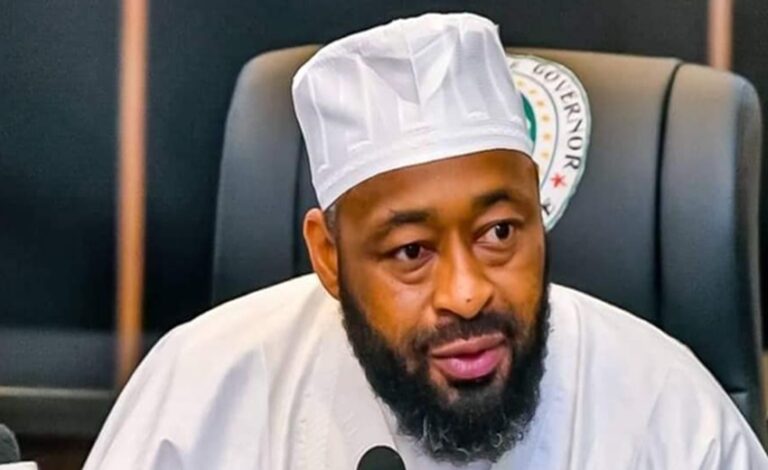
BAYELSA State Governor, Douye Diri, has ordered an autopsy to determine the cause of death of the state’s Deputy Governor, Lawrence Oborawharievwo Ewhrudjakpo, amid growing public speculation surrounding his passing.
The directive was contained in a statement issued on Sunday, December 14, by the governor’s spokesman, Daniel Alabrah.
Diri appealed to residents to refrain from politicising the death and allow the state to grieve.
“I want to make an appeal. I have seen people politicising his death. In Ijaw land, there is no enmity in death. Let nobody politicise the passing of our dearly beloved deputy governor. If anyone loves him, this is the time to show it,” Diri said.
He explained that the decision to conduct an autopsy followed what he described as misleading narratives circulating on social media.
“I have directed that an autopsy be carried out to reveal the cause of his death. There is a lot of nonsense going on on social media. If anyone is issuing a statement to eulogise him, let it end there and allow us to mourn him because the state is in a mourning mood,” the governor added.
Diri also noted that the state government had declared three working days of mourning in honour of the late deputy governor.
“That is why we have declared three working days of mourning, and we expect everyone in the state to do what the former president has done today.
“Let us love one another to the point of death, because all of us will answer this call one day,” he added.
The ICIR had reported that Ewhrudjakpo collapsed on Thursday afternoon while performing official duties at the Government House in Yenagoa.
He was rushed out of his office by security aides for urgent medical attention and later transferred to the Intensive Care Unit of the Federal Medical Centre (FMC), Yenagoa, after being received at the emergency unit. He was pronounced dead later the same day.
Born on September 5, 1965, in Ofoni, Sagbama Local Government Area of Bayelsa State, Ewhrudjakpo rose to national political prominence in 2018 after winning the PDP’s Bayelsa West senatorial primary.
He was elected senator in 2019, defeating APC candidate Mathew Karimo.
Later in 2019, he emerged as the running mate to Douye Diri in the Bayelsa governorship election. Although the APC’s David Lyon was initially declared winner, the Supreme Court overturned the result in February 2020 over certificate irregularities involving Lyon’s running mate, paving the way for Diri and Ewhrudjakpo to assume office as governor and deputy governor.
Until his sudden death on December 11, 2025, Ewhrudjakpo served as Bayelsa State’s deputy governor for nearly six years. He was 60 years old.
THE Code of Conduct Bureau (CCB) has placed local government council chairpersons across Nigeria under close watch, warning that the era of unfettered access to public funds at the grassroots level has ended.
The Chairman of the bureau, Abubakar Bello, issued the warning in an interview with the News Agency of Nigeria (NAN) on Sunday, December 14, in Abuja, saying local government chairpersons have been classified as high-risk officials in the anti-corruption drive.
According to him, the designation follows the increased flow of funds directly to local councils under the local government autonomy framework, raising concerns about potential abuse.
The CCB boss said intelligence reports available to the bureau indicated that some local government officials were already diverting public resources for personal use, insisting that every kobo must be accounted for from the first day in office to the last.
“My message to local government chairmen and officials is simple. CCB is here, and we are watching. Once you assume office, you will declare your assets at the beginning of your tenure and at the end.
“You will also account for the difference. If you cannot explain it, we will take it,” he said.
Bello explained that unlike other law enforcement agencies that must prove beyond reasonable doubt that funds were stolen, the CCB operates a different asset accountability framework.
“Unlike other law enforcement agencies that must prove beyond doubt that money was stolen, the CCB operates a simpler but potent system.
“Our own question is straightforward: can you explain the source of this money?” he said.
“The onus is on you, not on us. If you declared ₦10 million at the beginning of your tenure and ₦100 million at the end, you must explain the ₦90 million difference.
“We know your salary and allowances. If you cannot explain it, we can forfeit the money. We don’t need to prove you stole it.”
He noted that the bureau’s mandate is largely preventive, aimed at discouraging corruption before it happens through strict asset declaration and monitoring.
“What is the essence of stealing money when you know you will not enjoy it?
“If you know you will be tracked, you will think twice before taking public funds,” he added.
Bello warned that undeclared or unexplained assets would ultimately be confiscated by the government through court processes.
He also appealed to Nigerians to support the bureau by providing credible intelligence, noting that corruption often involves networks that cut across different levels of government.
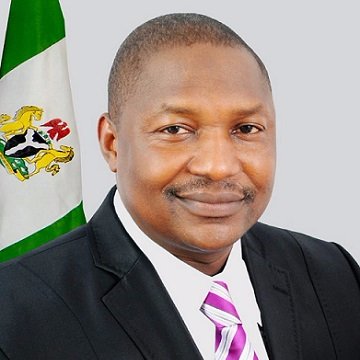
THE Economic and Financial Crimes Commission (EFCC) has dismissed claims by former Attorney-General of the Federation and Minister of Justice, Abubakar Malami (SAN), that his bail was revoked because he attended a political event in Kebbi State.
In a statement issued on Saturday, the EFCC’s spokesman, Dele Oyewale, said Malami’s bail was provisional and tied to five conditions, none of which he has fulfilled.
“Administrative bail is a discretionary temporary reprieve that allows a suspect to be released on stated conditions pending conclusion of the investigation and arraignment in court. To this effect, after his brief interrogation on November 28, 2025, Malami was offered provisional bail hinged on five requirements. He has neither met any of the requirements nor shown readiness to keep faith with them,” Oyewale said.
The EFCC said Malami was granted administrative bail following a brief interrogation on November 28, 2025, pending the completion of investigations and a possible court arraignment.
“He was due back for further interrogation on December 1, 2025, but in a curious twist, the former Minister pleaded with his investigators through a letter written to the Commission on December 4, 2025, to allow him to attend to his “ill-health”. The Commission compassionately granted his plea even while his bail conditions had not been met, ” Oyewale said.
He said the commission approved the request even, advising the former minister to comply with the bail conditions he acknowledged and signed on November 28, 2025, and to cooperate with investigators but the bail conditions had not been met.
“The EFCC cannot allow the latitude granted the former Minister on his health stand in the way of investigations. On this score, he was invited again on December 8, 2025, for further interrogation and detained until the pending bail conditions are met,” the spokesperson added.
The anti-graft agency said the former minister failed to submit a medical report or any credible evidence of ill-health to back his request, noting that his reporting date was shifted from December 1 to December 4 to accommodate him.
According to the EFCC’s spokesman, Malami was invited again on December 8, 2025, for further interrogation and was detained pending compliance with the outstanding bail conditions.
“Evidently, the former minister’s claims of revocation of bail by the EFCC are untenable. It is equally ridiculous to insinuate that the Commission barred him “ from granting media interviews and from participating in political activities in Kebbi State”. Such bogus claims from a former chief law officer of the nation are strange, as the EFCC has no interest in the political affiliation of its suspects,” he said.
Malami has remained in custody since Monday after failing to comply with the bail conditions imposed by the anti-graft agency.
The ICIR had reported earlier reported that he is being investigated for 18 offences, including alleged abuse of office and terrorism financing.
THE Minister of Communications, Innovation and Digital Economy, Bosun Tijani, has revealed that bandits operating across the country are using advanced technology to make phone calls and evade security surveillance.
Tijani made the disclosure during an interview on Channels Television’s Politics Today.
“The reason why the President actually pushed us to invest in towers in those areas is that we realised that there was a special kind of technology that they were using to communicate,” Tijani said.
According to the minister, monitoring the communications of criminal groups is more complex than many people realise, as bandits use sophisticated techniques to evade detection by security agencies.
“They are not using the normal towers; they bounce calls off multiple towers. That is why they enjoy living in areas that are unconnected.”
He explained that the criminals route their calls through multiple telecommunications towers, a strategy intended to mislead monitoring systems and hinder security operatives from tracing their locations.
“Because if our towers are not working, our satellites will work. If you go to China, they have over four million 5G towers. The total number of towers we have in Nigeria is just about 40,000,” he said.
The minister stressed that the situation underscores the urgent need for substantial investment in telecommunications infrastructure nationwide, noting that Nigeria’s capacity remains limited when measured against global standards.
He added that the Federal Government is addressing the challenge by strengthening the nation’s digital and surveillance infrastructure, including plans to upgrade Nigeria’s satellites to improve security monitoring.
The ICIR reports that Nigeria has experienced a series of security challenges in recent weeks, from schoolchildren being abducted by bandits in Niger and Kebbi states, to attacks on churches and communities in Kogi and Kwara states, days after United States President Donald Trump added Nigeria to countries on watchlist for Christian genocide.
Since then, the US House Appropriations Committee has been leading a joint congressional briefing addressing allegations of Christian genocide in Nigeria.
NIGER State Governor, Mohammed Bago, has confirmed that 315 pupils were abducted from a Catholic school in the state.
The governor disclosed this on Friday during the inauguration of commissioners, as well as elected local government chairmen and their deputies, where he observed a minute of silence in honour of two parents of the abducted pupils who reportedly died from shock.
“Oh God we beseech you to rescue Niger state, rescue our children and restore unto us lasting peace. Those who chose the wrong path, God please redirect them,” he said.
Bago had earlier denied the news of the abduction of school children at St Mary’s Catholic School while speaking on TVC where he said that the bandits only came to the school but did not abduct anyone.
He said that bandits only shot sporadically into the air to scare the children before taking their leave, while the children fled and hid in the bush, but later admitted the abduction without specifying how many students and teachers were abducted.
The ICIRreported that terrorists invaded St Mary’s Private Catholic Primary and Secondary Schools, Papiri, in Agwara Local Government Area on November 21 2025, whisking 315 pupils, students and a teacher to an unknown destination in the forest.
An in-depth report on the attack by the ICIR revealed that a parent died of a heart attack following the news of the abduction.
Anthony Musa did not live long enough to see whether his children would regain freedom before he slumped and took his last breath.
For days, the father of three, each of them among the pupils kidnapped from St. Mary’s Catholic Primary and Secondary School in Papiri, had been shuttling between phone calls, community meetings and sleepless nights, clinging to the hope that some news, any news, would break the silence around the abduction. But the weight of uncertainty proved heavier than his already fragile body could bear and later died at the New Bussa General Hospital.
The State Government later announced that fifty of the students escaped from the terrorists after two days, and the Federal Government announced the rescue of 100 after nearly two weeks.
President Bola Tinubu, while welcoming the return of the 100 students, immediately renewed efforts to secure the release of the remaining 115 pupils and their teachers, directing security agencies to intensify operations and ensure.
The governor in his latest remark prayed for the safe return of the remaining 115 abductees and promised to compensate the indigenes of Papiri with political appointments to ensure that residents of the communities were carried along in the political scheme of the state.
“Three weeks ago, we woke up with the terrifying news of the abduction of our children and teachers, thank God we have rescued 100 and we hope that the remaining are rescued and reunited with their families soon,” he said.
The governor appreciated God that Niger State was still united after the incident.
“Let us put the old aside and embrace a new Niger. We want a new Niger where the son of a nobody can become somebody. It is time to retract our steps.
Media reports indicate that Bago had earlier denied the news of the abduction of school children at St Mary’s Catholic School while speaking on TVC where he said that the bandits only came to the school but did not abduct anyone.
He said that bandits only shot sporadically into the air to scare the children before taking their leave, while the children fled and hid in the bush.
NIGERIA has long been a hotbed of football talent, producing icons from Jay-Jay Okocha to Victor Osimhen. Today, a new wave of teenage Nigerian footballers is making headlines across Europe – and sparking excitement back home.
From local viewing centres and bet shops to conversations on betting sites in Nigeria, fans are buzzing about these prodigies. The hype even spills into virtual realms: some devotees simulate matchups involving these youngsters in Surebet247’s simulated reality league, dreaming of future glory. It’s an electric moment for Nigerian football, as these teens carry on the tradition of excellence while offering a glimpse of a bright future for the Super Eagles.
Ethan Nwaneri: Arsenal’s record-breaking prodigy
At just 15 years old, Ethan Nwaneri etched his name into Premier League history as its youngest-ever player. In September 2022, Arsenal’s midfield starlet stepped onto the pitch against Brentford at 15 years and 181 days old, shattering records and signalling his immense potential.
Now 17 and a fixture in Arsenal’s academy-to-first-team pipeline, Nwaneri is widely seen as one of London’s brightest prospects. He has already debuted in senior matches and signed his first professional contract, reflecting Arsenal’s faith in his talent. Internationally, the England-born Nwaneri (of Nigerian parentage) has represented England at youth level, including scoring at the 2023 U-17 World Cup, yet remains eligible for Nigeria. In fact, the Nigeria Football Federation has been actively courting Nwaneri to switch allegiance from the Three Lions to the Super Eagles. With both nations watching closely, Nwaneri finds himself at the center of a friendly tug-of-war – a testament to his soaring reputation.
George Ilenikhena: From Lagos to Champions League hero
George Ilenikhena took an unlikely path from the streets of Lagos to Europe’s grandest stages. Born in Nigeria but raised in France, the 19-year-old striker first turned heads at Amiens in Ligue 2, reportedly becoming the league’s youngest-ever goalscorer as a 16-year-old.
In 2023, Ilenikhena truly announced himself on the continent: playing for Royal Antwerp, the teenager came off the bench and scored a 92nd-minute winner against FC Barcelona in the UEFA Champions League. That goal – which secured Antwerp’s first-ever win in Europe’s top competition – instantly put the left-footed forward on the map.
A move to AS Monaco swiftly followed in 2024, where Ilenikhena now dons the number 19 shirt in Ligue 1. Tall and quick, he’s been likened to a young Erling Haaland for his direct style and confident finishing. Internationally, Ilenikhena is another dual-nationality prize: he featured for France’s U16 side but, as a Nigerian-born talent, is someone Nigeria would love to cap in the coming years. If his trajectory continues upward, this Nigerian-French starlet could spearhead the Super Eagles’ attack by the 2026 World Cup.
Hafiz Ibrahim: From Kano markets to Reims rising star
Not all of Nigeria’s wonder-kids honed their skills abroad. Some, like Hafi Ibrahim, exploded out of the local scene. Ibrahim grew up in Kano State, where he famously sold watermelons in the market to support his family while nurturing big football dream.
Those dreams took flight in 2024 when the lanky 6’3″ striker earned a move from semi-pro Ojodu City FC in Lagos to Stade de Reims in France.
After impressing (including a trial at Chelsea that yielded a youth-team hat-trick), the 19-year-old signed for Reims and quickly made an impact. In just his first season, Ibrahim helped Reims reach their first French Cup final in decades – a Cinderella run capped by his heroics in the semifinal. Handed a start in that Coupe de France semi, the teenage forward scored a goal and set up another to secure a 2-1 win, sending Reims to a first final since the 1970s.
He even tasted Ligue 1 action, debuting against Rennes (albeit with a late red card to learn from). Powerful in the air and fearless in the box, Ibrahim embodies the raw talent Nigeria’s domestic setup can produce. As Reims rebuild (now in Ligue 2), he’s poised to play a bigger role – and perhaps catch the eye of Nigeria’s U23 or senior selectors soon.
Daniel Daga: Midfield dynamo eyeing Super Eagles future
In midfield, Daniel Daga represents the next wave of homegrown Nigerian excellence. At just 18, Daga already has an impressive resume: standout performances for Nigeria’s U20 team and a move to reigning Norwegian champions Molde FK.
Daga first garnered attention in early 2023 when he bossed games for the Flying Eagles (Nigeria U20s) as a 16-year-old. He was the youngest player in Nigeria’s squad at the 2023 FIFA U-20 World Cup and started every match until the quarterfinal exit, earning praise as a “star in the making” for his mature displays. A tenacious defensive midfielder from Benue State, Daga combines ball-winning grit with surprising composure for his age.
Those qualities prompted Molde to sign him from NPFL side Enyimba in 2025, and he’s wasted no time adapting in Europe. In fact, Daga made his European debut in a UEFA Conference League tie just weeks after arriving – coming on against Shamrock Rovers and calmly converting a penalty in the shootout.
He has since notched his first league appearances and goals for Molde, continuing to justify the hype. With Daga’s development on track, Nigerian fans are already pencilling him into future Super Eagles midfields. The challenge will be managing expectations and ensuring steady growth, but if anyone seems mentally equipped to handle it, it’s this grounded teenager.
Chido Obi: Manchester’s teen sensation with a big decision
Chidozie “Chido” Obi-Martin, 18, might be wearing the red of Manchester United, but Nigeria hopes he’ll don green and white sooner than later. Born in Denmark to Nigerian parents, raised in England, and now thriving in United’s academy, Obi is the very definition of a cosmopolitan talent – and a potential international tug-of-war.
The 6’2″ forward was prolific in Arsenal’s youth ranks before a high-profile switch to Manchester United in 2024. Since arriving in Manchester, Obi’s rise has been rapid. In February 2025 he made his senior debut for United, and by May he was in the starting lineup, becoming the youngest player ever to start a Premier League game for the club at 17 years and 156 days. That debut start broke a record previously held by Mason Greenwood, underlining the faith United have in his potential.
Obi has already tasted goal-scoring success as well, netting a hat-trick at the U18 level and even bagging a brace in a post-season friendly on tour. Internationally, however, his loyalties are still up in the air. Eligible for Denmark, England, and Nigeria, he represented Denmark’s youth teams (and even briefly England U16) but has not yet committed at senior level. Nigeria’s coaches and scouts are surely monitoring the striker closely – his blend of pace and power has even drawn Victor Osimhen comparisons in Danish media.
If the Super Eagles can persuade Obi to choose his parents’ homeland, it would be a major coup, adding another top prospect to Nigeria’s attacking arsenal.
A New Golden Generation for Nigeria?
Collectively, these five teenagers highlight a generational influx of talent that could define Nigerian football from 2026 through 2032. It’s no coincidence that Europe’s biggest clubs and leagues are embracing Nigerian youngsters – the raw ability, athleticism, and flair honed on Nigeria’s streets and academies translate beautifully onto global pitches. For Nigeria’s national team, the implications are huge.
By the time the 2026 World Cup arrives, players like Nwaneri, Ilenikhena, Ibrahim, Daga, and Obi could be pushing for senior squad places (Nwaneri and Daga will be barely 19, Ilenikhena 20).
Look a bit further to the 2028 AFCON or 2030 World Cup qualifying, and this core might form the backbone of a Super Eagles side reaching new heights. Diaspora recruitment will be key – the NFF’s recent success convincing English-born youngsters (like Ademola Lookman and others) to switch to Nigeria shows what’s possible.
Securing talents such as Nwaneri, Obi, and Ilenikhena in Nigerian colors would bolster the squad’s quality and depth significantly. That said, turning prodigies into world-beaters isn’t automatic. Nigeria still faces challenges in player retention and development infrastructure. Dual-nationality stars sometimes opt for the security and facilities of European nations, a trend Nigeria knows too well from past cases.
To reverse that, the NFF must present a compelling vision and improved support system. On the home front, investing in youth academies and domestic clubs is crucial so that the “next Nwaneri” might emerge locally and stay longer. The exodus of promising teenagers to foreign academies – while beneficial for individual development – highlights gaps in Nigeria’s football setup that local authorities and private stakeholders need to fill. Yet, even as these structural issues persist, the enthusiasm of Nigerian fans remains unmatched.
Whether at a neighborhood viewing center or via a mobile betshop app on matchday, supporters passionately follow each step of their starlets abroad.
It’s not just about patriotism – there’s also a cultural pride seeing Nigerian names shine on global scoreboards. From lively debates in Lagos over who will be the next Jay-Jay, to diaspora fans cheering in London pubs, the consensus is that this crop of teenagers could herald a new golden generation.
In the meantime, the exploits of Nwaneri, Ilenikhena, Ibrahim, Daga, and Obi are fueling optimism and plenty of entertainment. Their journeys are still in early chapters – full of highs, a few lows, and lessons along the way – but they embody Nigeria’s uncanny knack for unearthing gems. As these youngsters continue to mature, expect the Super Eagles to swoop in and lock them down.
And for the fans, each young star’s success is a win for Nigeria. It’s the kind of excitement that keeps football lovers glued to screens, swapping predictions at local betshops, and yes, even dreaming up scenarios in a simulated reality league. Today these players are teenage prospects in Arsenal, Monaco, Reims, Molde, and Manchester; tomorrow they just might be the heroes leading Nigeria to glory on the world stage. The future is bright, and it’s wearing green and white.
FOR many women with disabilities in Nasarawa State, traditional farming is almost impossible because of mobility challenges, limited access to land, and weak government support. In this report, the ICIR writes on how a farming initiative is helping the women grow food at home, and rebuild independence where the formal system has fallen short.
It was around noon, and the sun scorched the dusty road. Each turn of a passing vehicle lifted a cloud of red dust into the air as Asaba Aversion, a 42-year-old farmer with physical disability, manoeuvred her handcycle, carrying this reporter through the uneven path leading to her home in Gidi Gidi, Lafia Local Government Area (LGA) of Nasarawa State.
Earlier that day, Asaba and her husband, Gambo Anzaku, also physically challenged, had eaten wheat with vegetables and tomatoes from crops they planted in sacks within their compound. They did not have to go to the market. They did not have to beg anyone for help.
A few years ago, life was far more difficult for the couple. They often struggled to reach the market to buy food. Some areas were inaccessible to her handcycle, forcing Asaba to crawl along rough paths. On other days, they relied on neighbours for help, and when no one showed up, they went hungry.
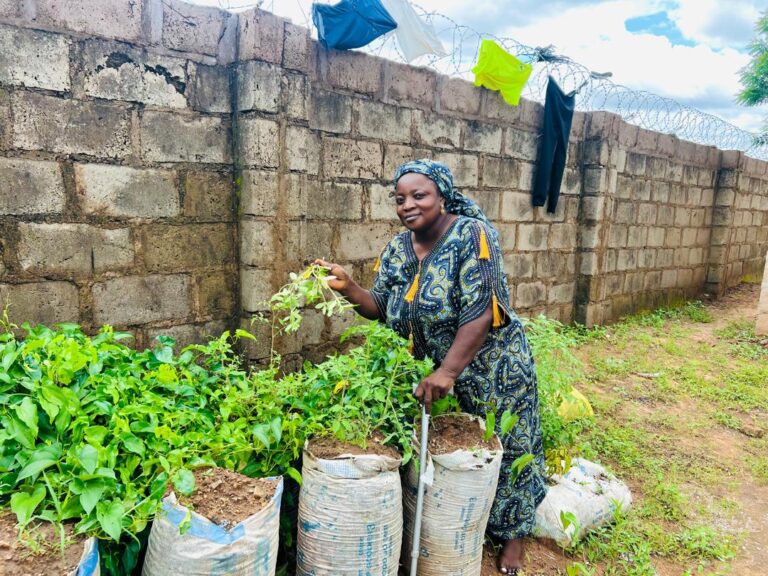
That hardship has now eased. After learning sack farming, Asaba began planting crops such as yams, tomatoes, and vegetables within the comfort of her home. Today, she and her husband grow much of what they eat.
Asaba Aversion: “Sack farming allows me to grow food at home and feed my family without depending on anyone.” The ICIR/2025
Sitting in front of rows of sacks neatly lined across her yard, she explained how the process works.“First, I mix the soil and sand before putting them into sacks, using the right amount depending on what I want to plant,” she said. “If it’s tomatoes, we use a specific ratio. For sweet potatoes or yams, it’s different. They taught us how to measure everything properly.”
For her, sack farming solves a fundamental problem. Many women farmers with disabilities struggle with the mobility required for traditional farm work. Sack farming brings cultivation to their doorsteps and solves land access challenges. Even when the government provides farm inputs, many smallholder women farmers with disabilities cannot benefit due to a lack of land.
With sack farming, however, “you can plant right in your home,” she explained. “You can place the sack near your doorstep, water it in the morning and go about your day. Anytime you need vegetables, you simply pluck them.”
In Lafia, where she lives, many women in her community are into farming. They plant crops like yams, melons, and potatoes. But even though she possesses the skills and knowledge, Asaba’s condition has always served as a barrier. She had to pay labourers as high as N3,000 per ridge due to lack of government support for disability-friendly farm inputs.
She is one of the hundreds of women trained by Global Initiative for Food Security and Ecosystem Preservation (GIFSEP), a non-profit organisation under the urban farming initiative. Launched in 2024, the sack farming initiative under the project empowers persons with disabilities, especially mobility impairments, by providing them with the skills and resources to cultivate staple crops within their homes.
The training, which targets mostly women, equips participants with practical knowledge to grow their own food and cushion the impact of the worsening food crisis. More than 400 women have been trained under the project, across Nasarawa, Adamawa, Benue States and the FCT under the initiative.
The team lead for the initiative, Michael David, spoke about the emotional and psychological impact of the project, saying it is a way of releasing emotions and depression. “Just because they are physically challenged does not mean they cannot add value to society,” David said. “They can grow food not only to feed themselves but also to feed the nation, especially at this time when the country is grappling with insecurity crises.”
Bridging inequality gap
Sack farming is not a new practice. It is a simple method adopted by many households across Nigeria. However, it requires some practical knowledge on how to plant, nurture and protect the crops from pests. In Nasarawa, it has become a lifeline for smallholder farmers living with disabilities, a group often excluded from access to land, farm inputs, and agricultural support.
Asaba Aversion sack farm
The process is straightforward. Farmers fill sacks, usually used rice or fertiliser bags, with a mixture of soil, sand, and organic manure. The sacks are then arranged in small spaces around their homes or compounds, where they can plant a variety of crops such as tomatoes, peppers, yams, and leafy vegetables. With regular watering and minimal maintenance, the crops thrive just as they would in open farmlands.
In Nasarawa State, home to approximately 14,000 smallholder women farmers and 1,217 cooperative groups under the Small-Scale Women Farmers Organisation in Nigeria (SWOFON), women farmers face greater inequalities than their male counterparts, largely due to the government’s agricultural input distribution system, which does not provide equitable access to inputs.
The 2019 National Gender Policy in Agriculture was introduced to bridge this gap by ensuring gender-sensitive planning and equal access to productive resources. But in Nasarawa, implementation has been almost non-existent. Women farmers are often not prioritised in policy and barely represented in input distribution committees, and there is no dedicated budget line for them.
A budget analysis by the SWOFON and the Centre for Social Justice (CSJ) shows that of the ₦5.6 billion expended on agricultural capital expenditure in Nasarawa State in 2024, not a single project was targeted at the specific needs of women, let alone women with disabilities.
Instead, the funds went to the large-scale procurement of tractors, mills, herbicides, and other infrastructure that small-scale women farmers, who typically cultivate less than two hectares and rely heavily on manual labour, cannot access meaningfully.
The Permanent Secretary of the Nasarawa State Ministry of Agriculture, Abdullahi Umar, had acknowledged the inequality in access to agricultural support between male and female farmers.
“What they say is true,” he admitted, adding, “The percentage of men who benefit from farm inputs in the state is higher than that of women.” Umar, however, explained that smallholder women farmers are typically supported through a standing committee at the local government and development area levels.
The committee, he said, is made up of chairmen of LGAs and overseers of development areas, paramount rulers, Divisional Police Officers (DPOs), agriculture coordinators, councillors for agriculture, and heads of security agencies. According to him, women also benefit from intervention programmes such as Fadama III and NG-CARES, and were recently reached directly through ward-level distribution across the state.
He also added that women are usually represented within the existing structures that coordinate farm input distribution in Nasarawa. He, however, did not provide data to back this up.
The coordinator of the Smallholder Women Farmers Association in Nasarawa, Jumai Yohanna, however, disproved this, stating that they are not included in the distribution of inputs.
Tanko Tunga, the Commissioner for Agriculture in Nasarawa State, told The ICIR that the government supports women farmers in various ways, including through cooperative initiatives. He said there is no difference in how the government supports men and women farmers.
“Gender equality is important to us, and we will ensure they are carried along. We are doing our best, and we will continue to do that,” he said.
Despite these assurances, implementation tells a different story. While officials highlight committees and cooperative structures, many women farmers say the support rarely reaches them in any meaningful way.
The situation is even worse for women farmers with disabilities, who face multiple layers of exclusion, including physical, financial, and institutional. Many are unable to access farmland due to mobility challenges, are often left out of farmers’ cooperatives where support is distributed and are rarely considered in official data or empowerment schemes.
For instance, Asaba pointed out that in most cases, out of 100 people, maybe three or four with disabilities are considered for farm inputs, sometimes none are women.
Globally, about 1.3 billion people live with a significant disability, according to the World Health Organisation (WHO). Many of them reside in low and middle-income countries.
Available data from the National Commission for Persons with Disabilities (NCPWD) indicates that 35.1 million Nigerians live with disabilities, representing about 15% of the nation’s population estimated at 237.5 million according to Worldometer.
Nigeria took a major policy step toward inclusion when former president Muhammadu Buhari signed the Discrimination Against Persons with Disabilities (Prohibition) Act into law on January 23, 2019. The Act guarantees the full integration of persons with disabilities into all sectors of society, including agriculture, on an equal basis with others.
Nasarawa is one of the states that domesticated the Disability Rights Law, prohibiting discrimination against persons with disabilities in all forms and circumstances. However, implementation remains weak, leaving many people with disabilities without meaningful support.
Against this backdrop, sack farming has emerged as a practical alternative for excluded farmers. For people with disabilities, the method removes one of their biggest barriers, which is the need for large farmland and long-distance mobility.
A lifeline for physically challenged women farmers
Several smallholder farmers with disabilities who spoke to The ICIR in various communities in Nasarawa State said the initiative has provided them with an easy way to grow food locally within their households to feed their families and save for other necessities
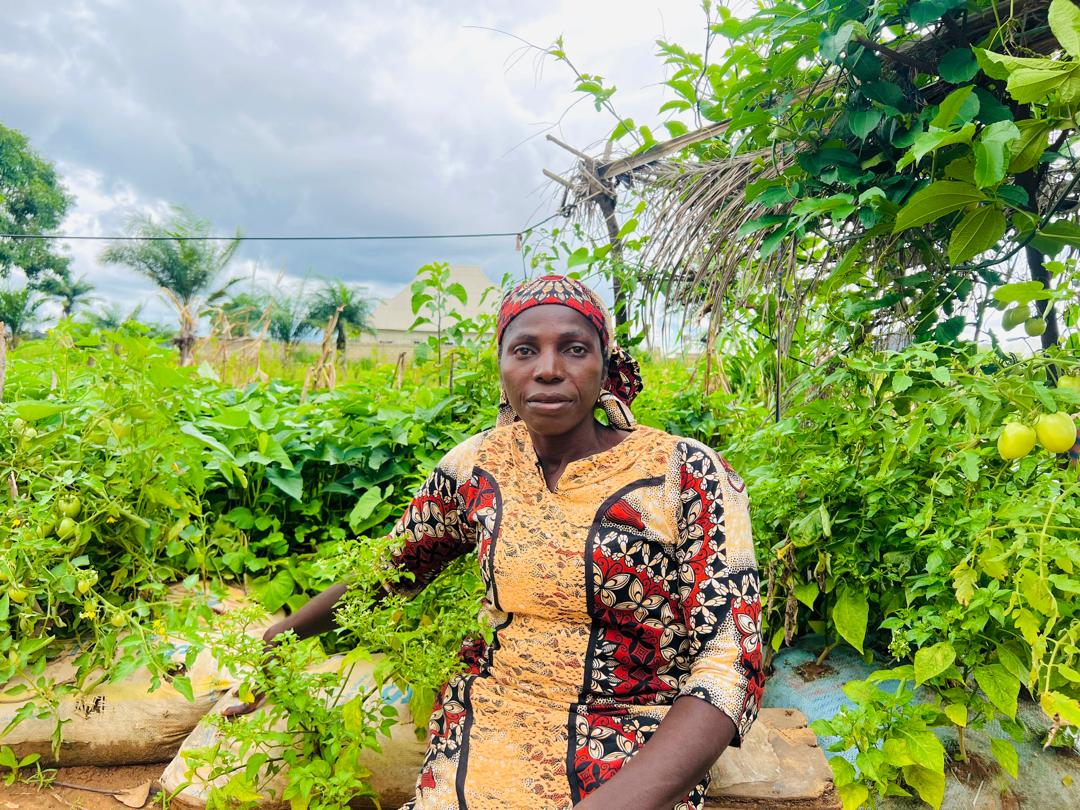
One of them, Constance Agidi, a woman with physical disability, was seen moving between rows of sacks in her small compound at 500 Estate, Lafia, inspecting the green shoots of tomatoes, sweet potatoes, and yams when The ICIR visited in October. Some of the plants were ready for harvest; others were still sprouting.
The 40-year-old mother of four has witnessed firsthand the struggles many farmers with disabilities face in Lafia.
After showing the sacks, she led this reporter to a corner of her compound where she keeps seedlings in small containers before transplanting them. Her home and the garden have become inseparable. Farming used to be exhausting. She relied on others to dig ridges, prepare the soil, and harvest crops. Most of her income went into paying labourers, and on some days, she returned home with nothing.
Constance Agidi: “With sack farming, I no longer spend money on labour or market vegetables; I harvest what I need at home.” The ICIR/2025
“With sack farming, I can plant right in my home,” she said, brushing her hand over a row of leafy greens. “I water them in the morning, and I can harvest anytime I need vegetables. I no longer have to go to the market or depend on anyone.”
Sack farming, she explained, has become a way to claim independence in a system where persons with disabilities are often excluded from government agricultural support.
“Out of 100 people, maybe three or four with disabilities are considered for farm inputs, sometimes none are women. Most of the rest go to able-bodied people,” she said. “They think we can’t manage or will sell the inputs. That perception is wrong.”
Before the sack farming initiative reached her community, Habiba Yahaya, another smallholder woman farmer living with a physical disability, spent years struggling to survive. Being unable to walk meant she could not participate in the traditional farming that sustains most households in her community in Obi Local Government, Nasarawa State.
The labour, such as digging ridges, clearing bush, carrying fertiliser, trekking long distances, was simply impossible.
“Traditional farming requires extensive manual labour,” she said. “As a person with a disability, I can’t do that myself.”
Because she could not farm and had no steady source of income, feeding herself was a daily battle. She often depended on relatives or neighbours to bring food, and she and her family frequently went hungry.
She had never received any form of government agricultural support, despite applying through various channels. She believes people with disabilities are excluded because of a combination of low awareness, inaccessible infrastructure and long-standing stigma.
When she began sack farming, it transformed her routine almost overnight. Today, she grows tomatoes, peppers, bananas, and henna (lele)—a crop that has unexpectedly become her biggest source of income.
With the sacks arranged around her house, she no longer needs to travel anywhere to farm. She waters her crops each morning and harvests them as needed. This has helped her meet up to 70% of her household food needs, cutting food expenses dramatically.
Her income has also improved. She earns from selling henna leaves and occasional harvests of pepper and tomatoes. With this money, she buys basic household items such as soap, salt, kerosene and supports her family with greater confidence.
“Before, even ₦100 could become a problem,” she said. “Now, I can take care of myself and contribute to the family. I feel more respected and valued in my community,” she said.
Another farmer, Joyce Oble, a 49-year-old mother of two from Sabon Pegi in Agwan Tiv, who lives with a mobility-related disability, said she used to depend almost entirely on hired labour for her traditional farm. She paid a minimum of ₦3,000 for planting, ₦4,000 for weeding, and ₦5,000 for harvesting for labourers.
“The money I pay workers is too much,” she said. “But with sack farming, I save that money.”
The savings help her stretch her limited income further.
Joyce Oble: “Sack farming has reduced my expenses and made it easier to provide for my children.” The ICIR/2025
Joyce noted that during the school term, even a small reduction in food expenses makes it easier to put money aside for her children’s needs. “At least when school starts, I don’t beg anybody,” she said. “Feeding too is easier now.”
Her first attempt at sack farming failed last year. The open space where she planted the sacks was not secure.
“Children used to break them,” she said. “So, everything spoiled.”
This year, she tried again—this time within her compound. It worked. She has already harvested okra and beans, and she plans to expand.
For Joyce, sack farming has restored her dignity and reduced her dependence on labourers. It also gives her the ability to contribute to her household without feeling like a burden.
“With this sack farm, I can do things by myself,” she said. “I don’t need anything heavy. I remove weeds with my hand. I water it from home. It is very simple.”
Her children also spend less time helping her manage long-distance farming, allowing them more time for school and chores.
Joyce believes that targeted support would go a long way.
Asabe Assoloko narrated how sack farming has helped her feed and care for her three children. The 37-year-old, who lives in the Lafia Nugu area, said life was extremely difficult before she learned about sack farming.
“Before the training, it was hard to feed,” she said. “Sometimes my children and I would go hungry because there was no money to buy food, and I have never received any farming support from the government.”
Asabe Assoloko, brimming with a smile in front of her farm
After being trained, Asabe began mixing sand, animal waste, and manure into sacks to plant crops like sweet potatoes and cocoyam.
“Some got spoiled,” she said, “but many survived, and that was enough for us to eat.”
She explained that sack farming has helped her save money and feed her family without depending on others.
“Before, I used to buy vegetables and cocoyam leaves,” she said. “Now I use what I grow. The little I would have spent at the market, I use it to buy soap, salt, or small foodstuffs for my children.”
Challenges with sack farming
However, sack farming also comes with its own challenges.
“If you are doing sack farming and you don’t have water around you, as a person with a disability, it’s a challenge,” Asaba Aversion said.
She explained that without water, it is a problem. She often has to think about going to the stream or finding another source, such as a nearby well.
According to her, lack of water is the biggest challenge. The second, she added, is dealing with pests. She, however, said they had been taught how to use nitrate when the plants are affected by pests and how to apply it properly.
For Asabe Assoloko, she said she struggles with limited space, a lack of fencing, and animals often eating her crops.
“Sometimes, fetching water is the hardest part,” she added. “If I have money, I will fence this area because animals sometimes disturb the plants in this open space. We need government support to expand because I want to continue.”
“If the government can help us with funds to get more space, fence it, and buy water containers, it will make things better,” she added. “We are trying our best, but with a little support, we can do more.”
Constance Agidi also shared the challenges she faces, including water scarcity, pest attacks, and poor fertilisers. Even after applying nitrate, she said, her crops sometimes still suffer.
Despite the challenges, she, however, said she will continue.
“It has given me a means of livelihood. I can grow yams, sweet potatoes, and vegetables. Now, money that would have gone into buying foodstuffs goes to paying our children’s school fees and meeting other necessities.”
SWOFON asks government to learn from the initiative
The Smallholder Women Farmers Organisation in Nigeria (SWOFON) called on the Nasarawa State government to learn from the ongoing sack farming initiative and extend similar support to women farmers in Nasarawa, especially for many other women living with disabilities.
The coordinator of the organisation in Nasarawa state, Jumai Yohanna, said many of the women, including those who are blind or physically disabled, face immense barriers to accessing government support.
State Coordinator of smallholder women farmers, Jumai Yohanna
“Some can’t see, some can’t walk, and most don’t even have money to move from one office to another to complain about what they are going through,” she said.
“Even when opportunities come, they are not included. The government sometimes give the impression that they prefer people to come to their offices and lobby, which is impossible for many of them.”
She noted that initiatives like the one introduced by GIFSEP, which trained women with disabilities in sack farming, have made a huge difference.
“With the help of God, they now find it easier to plant maize, melon, and sweet potatoes, which they use to feed their families,” she explained.
Jumai urged the government to adopt similar approaches and provide mobility aids such as bicycles to help women with disabilities access farmland. She said most of them have nothing to do, and many cannot move around without help.
“We’ve complained to the Ministry of Agriculture to support and train them so they can do things on their own.”
“This year, the prices of things have increased, but the price of farm produce like rice and maize keeps falling,” she said.
“A bag of rice is ₦50,000, manure is ₦52,000, and even hiring labourers has doubled. We are suffering, and the government knows but has not done anything,” she said.
“We need land. If they can give us a place where we all have our own portion, it will help us. We need seeds too. This type of farming does not need chemicals—only support.”