Home Blog Page 126

Perpetual flame of revolution: remembering Comrade Bene Madunagu

0

By Chido ONUMAH

ON Wednesday, November 26, family, friends, associates and comrades will gather at the headquarters of Girls’ Power Initiative (GPI)—an organisation Bene Madunagu co-founded in 1993—in Calabar, Cross River State, to pay tribute and remember the life and times of one of the leading lights of the radical feminist and socialist movement in Nigeria: Comrade Professor Benedicta “Bene” Madunagu, nee Afangide.

Comrade Bene or Mumsy B, as her mentees and admirers called her, was a trailblazer in many ways, a towering figure whose courage, ideological depth, passion for gender rights and humanism shaped generations of activists, scholars, women’s rights defenders, and community organisers. She had a life-long commitment to challenging the deep-seated structures of patriarchy, inequality, and injustice.

The remembrance symposium will bring together mentees, students, gender rights activists and leading voices in the progressive and socialist movement to reflect on her legacy and the impact of her ideas. The occasion will also provide an opportunity to launch an endowment fund to support two key initiatives that she championed: The Gender Development Institute (GDI), and a Livelihood Skills Training Hub, designed to “sustain and expand her lifelong commitment to gender justice, transformative education, community development, and the empowerment of women and girls.”

The Socialist Library and Archives (SOLAR), an institution of the Nigerian Left aimed at archiving revolutionary and progressive literature and documenting the struggles of the Nigerian Left, one of the many initiatives that Comrade Bene was instrumental in creating will be fully represented at her memorial.

For SOLAR, in the words of its representative, Ikenna Edwin Madunagu, Bene’s first year memorial is more than a mere commemoration. It is a rededication—a collective and unyielding commitment to remember, celebrate, and propel forward the monumental legacy of our dear Comrade Professor Bene Madunagu. SOLAR will pay tribute to her in the following words:

In the grand tapestry of the Nigerian Left, Bene and her comrade and husband, Edwin Madunagu, were not just weavers; they were the dyers of the thread, the designers of the pattern. In 2021, when they transferred their vast, meticulously curated collection of literature and archives, they did something that transcends a simple act of charity. They didn’t just donate books; they endowed a future. They forged SOLAR into a living testament to lives wholly dedicated to the indivisibility of intellectual rigor and revolutionary action. This archive is a beacon—a physical manifestation of the vital, pulsating idea that theory and practice are one. It is a sanctuary for all who seek knowledge, not for its own sake, but as a weapon to change the world.

Today, as we gather under the banner of her memory, we stand at a critical juncture in our struggle. We remember not just a scholar, but a force of nature—a woman who was a self-described “absolutely confirmed feminist, with no ‘ifs’ or ‘buts'”. In a world constantly seeking compromise and dilution, her clarity was constant.

Bene’s life was a testament to the core tenets of our shared socialist vision. She stood for:

  • The revolutionary transformation of society on the platform of workers’ power and socialism—a society where the means of production serve the many, not the few.
  • Gender justice and the dismantling of every conceivable patriarchal structure that confines and dehumanises.
  • The fierce empowerment of women and girls to boldly claim their sexual and reproductive health rights—rights that are foundational to bodily autonomy and liberation.
  • Unwavering academic freedom—the right to seek and speak the truth without fear—and the tireless defense of workers’ rights, the very bedrock of our movement.

Her achievements were not abstract. They are concrete, impactful, and life-changing. She was a distinguished professor of botany, grounding her science in the material world. She was a pioneering co-founder of Women in Nigeria (WIN), a movement that redefined women’s activism in our nation. She was the driving force behind the life-changing Girls’ Power Initiative (GPI), an organisation that has nurtured generations of young female leaders.

Through these initiatives and her pivotal leadership role in global networks like DAWN (Development Alternatives with Women for a New Era), she didn’t just impact Nigeria; she impacted the world. She was our mentor, our leader, and a fierce, unwavering advocate for the marginalised, the silenced, and the oppressed.

Now, we come to a new chapter—a moment of collective responsibility. We are launching an Endowment Fund in support of her ideas. Let us be clear: this fund is not an end in itself. It is not about building monuments of stone; it is about sustaining movements of flesh and blood. It is the necessary means to ensure the continuity of the institutions she built and the struggles she so brilliantly led.

The charge for continuity is clear, and it is a revolutionary mandate:

  • Support the GPI: We must ensure that adolescent girls continue to find a safe, empowering space to learn their rights, assert their agency, and become the next wave of feminist and socialist leaders. You can find more information about their transformative work on the Girls’ Power Initiative website.
  • Bolster SOLAR: The Socialist Library and Archives must remain a vibrant, accessible hub for research, activism, and organising. We are the custodians of our history, and we must ensure our struggles are preserved for future generations of comrades.
  • Embody Her Principles: The most important continuity of all is not a donation, but a daily commitment in our own lives—to remain steadfast, unyielding, and utterly uncompromising in the fight for a just, equitable, and socialist Nigeria, a nation wholly free from all forms of oppression and exploitation.

Let this memorial and endowment fund be a testament to our collective resolve, our refusal to let the flame flicker, much less extinguish. The Mother of the Nigerian Left has passed the torch. Let us ensure the flames of her revolutionary spirit continue to burn brightly, illuminating the path forward for us all.

On November 26, 2024, the world lost one of its greatest champions for social justice. One year later, as we remember her, we are comforted by her admonition: “We must never stop fighting for the future we deserve.”

Chido Onumah, PhD, is the Coordinator of the Socialist Library and Archives (SOLAR).

Police confirm abduction of farmers in Niger as insecurity worsens nationwide

THE Niger State Police Command has confirmed the abduction of at least 10 farmers in Shiroro Local Government Area by bandits.

In a statement on Thursday, November 27, the police said the attack occurred on Wednesday, November 26, around Angwan-Kawo and Kuchipa villages in Erena Ward.

“On November 26, 2025 at about 8pm, report received indicated that suspected armed men abducted about ten persons from Angwan-Kawo & Kuchipa villages of Shiroro Local govt area. Effort is being emplaced to rescue the victims,” the statement read.

The police confirmation followed earlier accounts by residents who told Daily Trust that about 20 farmers were taken around 4 p.m. while harvesting rice in the same village.

Locals said the victims included four pregnant women and several children, and that the farm lies less than 500 metres from Erena town, where a military camp is located.

The ICIR reports that the abduction came barely six days after gunmen kidnapped more than 200 pupils and staff of St. Mary Secondary and Primary School in Papiri, Agwara LGA.

The development, The ICIR reported, triggered nationwide outrage and renewed calls for stronger responses from security agencies.

Across Nigeria, attacks on schools, farming communities, and highways have intensified despite ongoing military operations. In states such as Kebbi, Kano, Niger, Zamfara, Katsina, and Kwara, residents continue to face recurring raids, forced displacements, and mass kidnappings. 

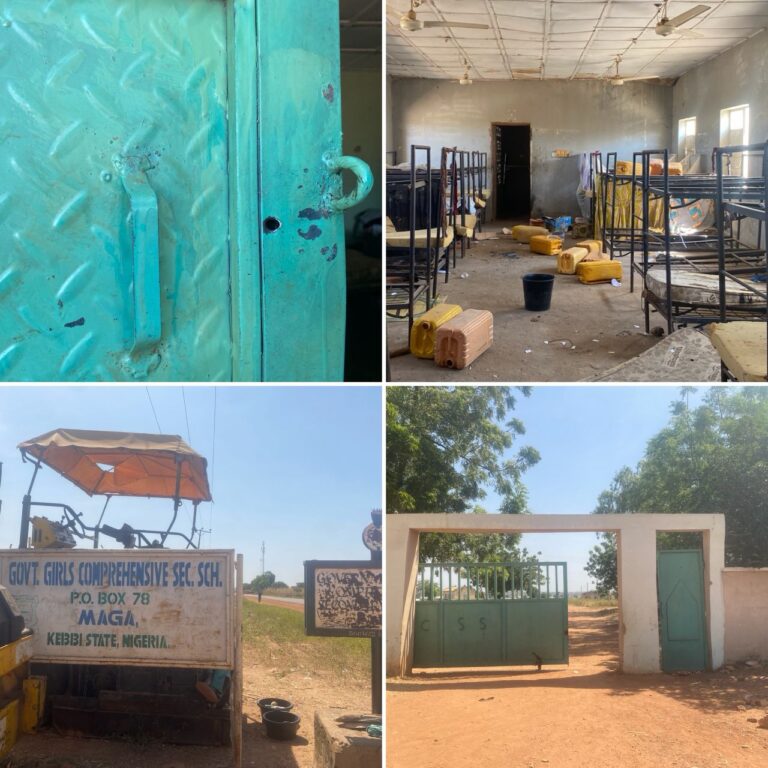
The ICIR reported that on November 17, 2025, armed men breached the fence of Government Girls Comprehensive Secondary School in Maga, Kebbi State, killed the vice principal, and abducted 25 schoolgirls, a chilling echo of the Chibok, Dapchi, and other mass kidnappings of young girls in Nigeria.

Also, last week, some armed men invaded the Eruku Church during a programme, shot sporadically and took worshippers into the forest. Three people were confirmed dead, while one person remains hospitalised. 

However, all 38 worshippers abducted during the attack regained freedom on Sunday, November 24. The release followed a combined operation involving federal and state security agencies, with Governor AbdulRahman AbdulRazaq confirming that President Bola Tinubu personally oversaw the efforts.

Amid the growing anxiety, President Bola Tinubu on Wednesday, November 27, declared a nationwide state of emergency on security. He directed the military, police, and intelligence agencies to expand recruitment and strengthen rapid-response capability.

The president also announced federal backing for states that have set up their security outfits. He also called on the National Assembly to begin work on laws that would allow states willing to establish state police to do so.

Fixing the feed: how algorithmic accountability can combat misinformation, digital inequality in Nigeria

0

By Odeh FRIDAY

ALGORITHMIC systems on social media platforms increasingly shape the information Nigerians consume, determining what content is visible, how quickly spread rumours, and which voices gain prominence.

Misinformation landscape in Nigeria

These algorithms prioritise engagement and advertising revenue, often amplifying polarising and sensational content at the expense of credible information. This dynamic fuels rapid misinformation, distorts public debate, and erodes institutional trust at a time when Nigeria needs reliable information to navigate complex challenges, including economic pressures, elections, security concerns, and social cohesion.

Recent studies reveal that approximately 75 per cent of fake news in Nigeria originates from social media platforms such as Facebook, Twitter, and WhatsApp, compared to 15 per cent from traditional media sources like television, radio, and newspapers.

Exposure to such misinformation strongly correlates with heightened perceptions of national security threats, pointing to the seriousness of this issue for Nigeria’s stability.

Emerging AI solutions to misinformation

Nigeria is actively exploring AI-powered methods to counter misinformation. Deep learning and machine learning models are being developed to distinguish trustworthy sources from untrustworthy ones, while fact-checking bots cross-reference claims with verified datasets to slow the spread of false narratives. Behavioural analytics further help identify coordinated misinformation networks and bot-driven amplification.

Another study has demonstrated how AI tools can detect emotional tones and content patterns within Nigerian social media ecosystems, enabling early intervention before harmful narratives escalate.

These innovations highlight the potential for technology to empower timely verification and fact-checking. However, these efforts operate within a broader ecosystem shaped by external actors and systemic power imbalances.

AI colonialism and digital sovereignty

One of the most critical challenges facing Nigeria’s digital ecosystem is AI colonialism. Renowned Nigerian scholar a professor, Toyin Falola warns that Africa is subject to a new form of domination through data extraction, where global technology corporations harvest local data, process and monetise it abroad, and return limited value to African nations.

Further research reveals that foreign control over digital infrastructure and the dominance of multinational platforms enable external influence over Nigeria’s political, economic, and social domains.

Strangely, less than 20 per cent of Nigerian data is hosted on local data centre’s; the majority resides abroad in Europe and North America, exposing Nigeria to cybersecurity vulnerabilities, privacy risks, and economic value loss. Data localisation emerges as a vital strategy for safeguarding Nigeria’s digital sovereignty and must be central to any reform agenda.

Nigeria’s dependence on externally built AI systems not only erodes sovereignty but also entrenches structural inequalities, as many systems fail to reflect local languages, cultural contexts, and civic needs, thereby compromising fairness and inclusivity in algorithmic decision-making.

Algorithmic decision-making and Its societal impact

Algorithmic ranking models shape what content Nigerians see, influencing political education, civic engagement, and public dialogue. These systems tend to amplify sensational narratives and create echo chambers that limit exposure to diverse perspectives, thereby undermining democratic deliberation. According to a 2025 report, 34 per cent of Nigerian internet users have encountered negative online experiences, including cyberbullying and misinformation, illustrating the widespread social harm caused by algorithmic dynamics.

Women, youth, children, and first-time voters are especially vulnerable to these harms, facing disproportionate exposure to digital manipulation and targeted misinformation. Compounding these risks are significant digital literacy gaps: while Nigeria aims to achieve 70 per cent digital literacy by 2027, only about 63.1 per cent of adults currently possess basic literacy skills. Over 50 per cent lack essential digital competencies, with just 68 per cent able to use smartphones at a basic level and 39 per cent proficient with laptops or tablets. Gender disparities persist, with 45 per cent of women versus 62 per cent of men aware of mobile internet access. These gaps highlight the urgent need for inclusive digital education alongside technological interventions.

Regulatory and ethical frameworks: progress and challenges

Nigeria has begun addressing these challenges through emerging regulatory and ethical frameworks. The AI Bill of 2023, presently under national assembly consideration, proposes the establishment of a National Artificial Intelligence Council tasked with overseeing AI governance, enforcing ethical standards, registering and licensing AI systems and developers, and authorising restrictions or bans on non-compliant platforms based on national security or public interest concerns.

This bill emphasises consent, privacy, transparency, and risk-based oversight, including provisions for algorithmic impact assessments for high-risk AI systems. Experts advocate for human rights impact assessments prior to deployment of AI tools by both government and private entities, alongside transparency and accountability standards tailored to Nigeria’s linguistic and institutional realities. These frameworks will be essential for predictable, equitable, and context-aware digital governance.

Civic monitoring and digital accountability

Digital platforms in Nigeria have also become powerful tools for promoting transparency and accountability. Campaigns such as #OpenNASS and #EndSARS exemplify how citizens leverage social media to demand accountability from public officials and institutions. Civil society organisations (CSOs) increasingly combine platform analytics with grassroots reporting to monitor electoral misinformation and identify emerging threats.

Notably, TikTok removed over 7.5 million Nigerian videos in the first half of 2025 under Nigeria’s mandated Code of Practice for Interactive Computer Service Platforms, reflecting active yet challenged regulatory enforcement efforts. However, the very algorithms enabling mobilisation often simultaneously amplify misleading narratives. This paradox fuels demands by Nigerian advocates for transparency reports addressing localized risks, regulatory measures to uphold data sovereignty, and independent audits of algorithmic systems used by governments and big technology companies alike.

Social media algorithms have been implicated in intensifying polarising political content and misinformation campaigns during elections, reinforcing calls for independent audits and transparency tailored specifically to Nigeria’s context.

Recommendations and the way forward

Nigeria is poised to take decisive steps toward algorithmic accountability. Public institutions should mandate comprehensive algorithmic impact assessments for systems with civic implications, require disclosure of algorithmic operations from digital platforms, and establish procurement policies that prioritise data sovereignty and independent auditing.

Moreover, collaboration among CSOs, academia, and media can support community-based monitoring networks that blend digital analysis with local reporting, providing early-warning systems for misinformation and harmful algorithmic patterns.

Platforms operating in Nigeria must align with transparency and accountability standards reflective of local realities, rather than limiting disclosures to global benchmarks.

Conclusion

Now is the moment to embed algorithmic accountability within Nigeria’s broader ambitions for digital inclusion, innovation, economic transformation, and civic safety. Thoughtful regulation, contextual oversight, and civic monitoring can build digital ecosystems that reinforce public trust, build power for citizens with information integrity, and support democratic participation grounded in inclusive governance that works.

Odeh Friday is the Country Director for Accountability Lab Nigeria and can be reached via  odeh@accountabilitylab.org

Poor oversight, regulatory failure expose Nigerians to slow death from battery recycling [Part-2]

0

By Oladeinde Olawoyin & Folashade Ogunrinde

THE residents who tested positive for lead poisoning live between 100 and 500 metres from True Metals Nigeria Limited and Everest Metal Nigeria Ltd, two of the most prominent companies engaged in Used Lead-Acid Batteries (ULABs) in Ogijo

The lead found in the blood of residents and in the soil of Ewu Oloye, Ipetoro, and Ewu Eruku communities in Ogijo, a border town in Ogun State, pointed to a clear source: the cluster of battery-recycling factories that powers Ogijo’s small economy while slowly poisoning the people and their environment.

Residents who tested positive for lead poisoning live within 100 to 500 metres of True Metals Nigeria Limited and Everest Metal Nigeria Ltd, two of the most prominent Used Lead-Acid Batteries (ULAB) recyclers in Ogijo.

True Metal Nigeria Limited is a recycling facility located at Km-16, Ikorodu-Sagamu Road, Ogijo, Ogun State. According to its website, the company specialises in the export of non-ferrous metals, including lead alloys, lead ingots, and copper products.

Front view of True Metals Nigeria LTD. 

True Metals is one of Nigeria’s leading exporters of lead products. In 2022, the company shipped recycled lead to Spain, South Korea, and India. Between 2023 and May 2025, it also exported recycled lead to the United States, according to multiple trade records reviewed by The Examination and PREMIUM TIMES.

Records show that between 2022 and 2024, several companies received recycled lead from True Metals, including Trafigura Trading LLC, C. Steinweg Baltimore Inc., Wilebat SL, Hankook Bicheol Co. Ltd., and Montorretas SA.

Further analysis of two separate trade record sources found that, from April 2023 to December 2024, True Metals Nigeria Ltd. made at least 29 shipments of recycled lead to Trafigura, destined for the United States.

According to a 2020 report by UNICEF and Pure Earth, the global demand for lead has surged in recent decades, driven largely by the rapid growth of vehicle ownership in low- and middle-income countries. Lead prices doubled between 2005 and 2019, while the number of new vehicles sold in these countries more than tripled between 2000 and 2018.

Global Dynamics

In the auto industry, recycled lead is extensively used in automotive batteries, forming the core of new batteries through a recycling system. The lead from spent batteries is recovered, refined, and returned to the supply chain to create new ones, with recycled materials making up over 80 per cent of new car batteries in the US. Experts claim that the approach conserves resources, reduces the need for mining, and makes lead-acid batteries one of the most recycled products.

Men and women known as pickers salvage dead batteries from the streets of Lagos and sell them to companies that recycle the lead inside 

While the United States and Europe recycle more than 95 per cent of their used lead-acid batteries under strict environmental controls, many low- and middle-income countries lack comparable regulations and enforcement. As a result, countless batteries are processed in informal and unregulated settings.

“These informal recycling operations are often in backyards, where unprotected workers break open batteries with hand tools and remove the lead plates that are smelted in open-air pits that spread lead-laden fumes and particulate. It is estimated that in Africa alone, more than 1.2 million tonnes of used lead-acid batteries enter the recycling economy each year, and much of that goes to informal operators,” the 2020 report stated.

Labourers load old vehicle batteries onto a truck that will deliver them to battery recycling facilities, which melt the lead inside for new batteries.

Africa alone generates an estimated 1.2 million tonnes of used lead-acid batteries each year, much of which ends up in informal recycling operations that serve as a primary source of income for many poor households.

A battery breaker in Lagos, Nigeria, uses a machete to hack open the plastic casing of a car battery

According to United Nations data, Nigeria led Africa in recycled lead exports between 2019 and 2023. The same data show that the United States imported the largest net weight of recycled lead from Nigeria during this period.

A laborer pours battery acid into a drum 

US Census records indicate that imports from Nigeria increased from under 1,000 tonnes in 2019 to 34,300 tonnes in 2020.

Source: U.S. Census Bureau, “USA Trade Online,” accessed on September 17, 2025. HS code:7801

Workers’ recount ordeals

True Metals said it aims to be “a well-organised, fully upgraded, mechanical and efficient plant that sustains development to business through class value-added products,” and by being “Eco-friendly”.

However, multiple residents and workers within the organisation told PREMIUM TIMES that the company’s promises to be eco-friendly only exist on paper, as the indiscriminate discharge of lead waste into the soil, air, and water of Ogijo falls short of international safety standards.

Workers report handling batteries with their bare hands, smashing them with axes, wearing torn gloves, and handling molten lead with minimal protection, while fumes drift freely into the air.

Video evidence obtained by PREMIUM TIMES showed that factory floors are cracked and cluttered, slag piles sit exposed to wind and rain, and rainwater and battery effluents flow untreated into the surroundings. Lead dust left out in the open spreads into nearby homes, classrooms, and gardens.

In one small-scale farm that shares a fence with True Metals, PREMIUM TIMES reporters observed blackened leaves, a sign of prolonged exposure to dust and fumes drifting from the recycling plant. The surfaces of houses and rooftops have been blackened over the years from the lead dust emitted by the company.

Blackened leaves from lead dust

Blackened walls from lead dust 

Every step of the operation flagrantly violates international safety standards and the National Environmental (Battery Control) Regulations 2024, exposing both workers and communities to toxic lead.

Cracked and cluttered floors at True Metals 

“Nobody ensures that workers have protective gear; if anything happens to you, you are on your own,” a True Metals worker, who sought anonymity for fear of victimisation, told PREMIUM TIMES. Section 49 of the National Environmental (Battery Control) Regulations 2024 states that workers handling used batteries must wear appropriate Personal Protective Equipment (PPE) as prescribed in the regulations.

Piles of used battery litter the factory floor 

Speaking to PREMIUM TIMES in the first week of November, a worker at True Metals, who asked not to be named for fear of reprisals, had just finished his shift. His face looked worn, the long hours clearly taking a toll on him. The harsh working conditions have aged him, he said, but his need to earn an honest living, even at the risk of his health, keeps him there.

Smoke from the surface rise into the atmosphere, poisoning Ogijo residents

As the late-afternoon sun fell on his face, he recalled the many accidents he had witnessed over the years, incidents that had cost some of his colleagues an eye, an arm, and even a life.

Just like his colleagues, this worker tested high for lead poisoning.

“I am worried, I am not okay with the result,” he said, in response to PREMIUM TIMES’ enquiry on how he felt about the test result. “But how can I find a solution?” he asked aloud, confusion and helplessness written on his face.

“It is to quit the job,” he quipped, amid hesitation, adding that “I am just managing for now because I don’t have any other one yet.”

Many Nigerians struggle with unemployment. Figures from the National Bureau of Statistics indicate that the country’s unemployment rate stood at 4.3 per cent in the second quarter of 2024, approximately two years after the methodology was revised and the rate adjusted from 33 per cent.

The worker reported experiencing itching and internal heat. When a blood test was conducted by True Metals in 2023, he alleged that the results were not provided to them. The company informed them that they were fine, and it was the only test he had been subjected to since joining the company nearly a decade ago, in clear contravention of existing laws and regulations.

According to Section 48(j) of the National Environmental (Battery Control) Regulations 2024, battery recycling plants are expected to “carry out blood lead test on the facility workers at least twice every year.”

The blood and soil test commissioned by The Examination and partners and prepared by the Sustainable Research and Action for Environmental Development (STRADev) documented cases of headaches, stomach pain, anaemia, fatigue, and seizures among affected individuals.

Apart from True Metals, workers and residents living near other recycling plants in Ogijo—notably Everest Metal Nigeria Ltd and African Non-Ferrous Industries Ltd—were also tested. Results showed that all 16 workers tested from the three recycling companies have lead poisoning. Their BLL ranged from 10 to 38.1234 µg/Dl. The workers held roles such as cleaning, sorting, smelting, storekeeping, and battery transportation.

The situation is not any different at Everest Metal Nigeria Ltd. The company is situated on the premises of a former iron rolling plant and has been engaged in the recycling of used lead-acid batteries (ULABs) for approximately five years.

Among the workers tested, Steven (Not real name*), a furnace operator, recorded a blood-lead level of 21.7 microgrammes per decilitre, more than five times the World Health Organisation’s safety limit.

“I feel bad. I didn’t even know that I have this level of lead inside my system. I would have left this work a long time ago,” Steven said when he received his result.

For three years, he worked at the plant. Each day, he and his co-workers feed used batteries into red-hot furnaces that burn for hours, releasing thick fumes that sting the eyes and throat. They mix the acid and molten lead by hand, often without adequate protection.

“We get gloves once a week,” he said. “But the acid burns through them, and sometimes I buy new ones with my own money.”

Steven said his body had started sending warnings.

“Two weeks ago, I began to feel sharp pains in my chest. Sometimes my eyes hurt, like dust is inside them. Other times, I can’t see clearly. Before I eat at night, my stomach hurts. Even when I try to urinate, I feel pain all over,” he said.

When he coughs, the sputum that comes out is black, the same colour as the smoke that rises from the furnace. Mr Steven said inspectors from government agencies visit only to take photographs or collect “settlements” before leaving.

“They don’t ask how we feel. If anything happens, you’re on your own,” he said.

Last year, one of his friends died after suffering severe swelling, symptoms that doctors linked to chemical poisoning. The company paid the family N1.5 million in compensation, he told PREMIUM TIMES.

“He stopped eating, and his body started swelling. His family rushed him to the hospital, but he died the same day. It was the chemicals that killed him,” Steven said.

‘Lodging’

At Everest Metal, used lead-acid batteries are collected, broken, and fed into furnaces. Workers refer to the production area as “the lodging.” There are four such lodgings, each operating its own furnace.

The process begins with the arrival of old batteries, already cracked open to remove the plastic casings. The metal and residue are mixed with chemicals and loaded into the furnace, where they are heated for four to five hours.

When the molten mixture cools, it solidifies into crude lead. The lead is then transferred to the refinery section, where it is purified and prepared for export. Throughout the process, workers are exposed to heat, fumes, and acid residue, often without adequate protective gear.

The traditional ruler of Ogijo, Oba Kazeem Gbadamosi, stated that his community has spent years advocating for battery recycling companies to operate safely.

The Ologijo of Ogijo, Oba Kazeem Gbadamosi, sits on a carved wooden throne 

He said that despite workshops and repeated engagements, many factories continue to operate as they did years ago, with dangerous consequences. According to him, past tests revealed “a great amount of lead… in the blood, on the ground, and in the environment where these factories are located.”

He recalled reports of severe health problems among residents, including birth deformities, persistent cough, miscarriages and even a cluster of sudden deaths of five workers within a single week.

“Some have been reported, some have not been reported, but they can be attributed to the issue of lead being emitted in the community,” he said.

He stressed that residents were not calling for the factories to shut down, but rather for them to stop polluting, adding that local leaders had worked with NGOs and the National Environmental Standards and Regulations Enforcement Agency (NESREA) for six years to pressure operators to adopt safer practices.

Regulatory provisions

In August 2024, the Federal Government of Nigeria unveiled the National Environmental (Battery Control) Regulations 2024 to prevent and minimise pollution and waste emanating from batteries in Nigeria. This is based on the National Environmental Standards and Regulations Enforcement Agency (NESREA) Act, 2007, a Nigerian law that established the National Environmental Standards and Regulations Enforcement Agency to protect and develop the environment.

Speaking at the time, Nigeria’s Minister of Environment, Balarabe Lawal, stated that the document was part of the government’s efforts to promote the practice of battery waste disposal in an internationally standardised manner and facilitate an enabling environment for deploying renewable energy projects.

“Batteries contain hazardous materials such as lead, mercury, cadmium, and lithium, amongst others. When improperly disposed of, these materials can lead to severe health conditions, including cancer, kidney damage and neurological disorders,” he said.

In essence, the regulations aim to ensure the environmentally sound management of all types of batteries throughout their life cycle, encompassing production, use, collection, transportation, storage, recycling, and disposal. This will not only encourage best practices among recyclers but also ensure that the people and their environments are safe.

However, for workers and residents who have endured years of relentless pollution from the battery lead recycling companies in Ogijo, their realities mirror cases of regulatory failures. They told PREMIUM TIMES that they can no longer bear the toll it has taken on their health and daily lives.

In 2018, a BusinessDay report revealed that companies recycling lead-acid batteries were contaminating air, soil, and water sources in Ogun and Lagos states, resulting in high lead levels in the blood of workers and residents. Seven years later, the situation has only worsened.

Omoh Ifalanki, an executive of the Ikeoluwa Community Development Area (CDA), told PREMIUM TIMES that every attempt to stop the toxic emissions over the years has been unsuccessful. He said letters to government agencies, including the Ogun State Ministry of Environment, have gone unanswered.

A resident of Ogijo for over two decades, Ifalanki explained that community members, most of whom are poor, often pool their own money to submit formal complaints about the pollution from the lead-recycling factories.

“These companies pay tax, so the government knows them well,” he said, alleging that corruption has allowed the violations to continue unchecked.

Light at the end of the tunnel?

On 17 September, NESREA announced that it had sealed nine recycling facilities in Ogijo, including True Metals, for environmental pollution.

In a statement on its website, NESREA’s Director-General, Innocent Barikor, said the “improper disposal of hazardous slag from battery recycling threatens environmental degradation and public health risks from toxic lead content. Tests have revealed the presence of lead in residents, resulting in illnesses and deaths.”

According to NESREA, the facilities were shut down for violating the National Environmental (Battery Control) Regulations, 2024. Offences cited include operating without the required environmental documents, lacking a fume treatment system, discharging black oil, failing to conduct blood-lead tests on workers, poor slag management, manual battery breaking, and non-compliance with the Extended Producer Responsibility (EPR) programme.

But before the announcement, The Examination, PREMIUM TIMES, and partners had conducted an independent scientific study to measure lead levels in Ogijo’s soil and in the blood of 70 workers and residents. The results were relayed to NESREA for official reaction.

The results were alarming. Of the 70 people tested, 50 had Blood Lead Levels (BLLs) above 5 µg/dL, the World Health Organisation’s threshold for lead poisoning. Every worker sampled, 14 in total, tested positive, including one employee at Everest Metal whose BLL reached 38 µg/dL, a level associated with severe neurological and organ damage.

Children and women also showed widespread exposure. Eight of the 14 children tested had BLLs above the five µg/dL benchmark, while 15 of the 24 women sampled exceeded the same threshold. One woman recorded an exceptionally high BLL of 31.06 µg/d.

Blood test infographics 

These violations mirror what residents working in the facilities have long reported.

Meanwhile, NESREA had received a copy of the soil and blood test result commissioned by The Examination and prepared by STRADev before it sealed the recycling companies.

But while speaking to The New York Times/The Examination in an interview, the NESREA DG, Barikor, claimed that the STRADev report was “additional information” and NESREA had done its own report “over a period of time.”

Multiple residents and workers in recycling plants in Ogijo expressed doubts about such a “coincidence” but were delighted that action was being taken anyway. Many of them told PREMIUM TIMES that the draft blood and soil report NESREA received between late August and early September seems to have finally spurred the agency into action in Ogijo, steps it should have taken earlier.

Yet, despite the seal orders, True Metals and Everest Metal resumed operations within weeks, reopening as though nothing had happened. When asked why the companies reopened, Barikor said a meeting held in Abuja between the agency and the battery lead recycling companies prompted the re-opening of the facilities. He said part of the issues discussed were the technological challenges the companies struggle with, and a protocol to be implemented within a time frame.

“The first thing we are going to do is to now collectively ensure that the legacy slags are removed. The first open action that will be cited by the public community will be the removal of the slag. That cannot take place until there is an identification of a dump site that is certified by the government. We need to work with the state to do that,” he said.

He further stated that some companies have begun to “take measures” to address this protocol on how to deal with their environmental concerns.

For workers who are put in harm’s way because the government failed to implement the safety laws and for Ogijo residents whose health slowly ebbs away, the assurances mean little.

In multiple interviews with PREMIUM TIMES in the first week of November, workers who sought anonymity for fear of victimisation said after production resumed at the factories, nothing really changed.

“After shutting down for two weeks, we came back to work, but they gave only a few of us boots. I buy my safety boots to protect myself,” a resident who works for Everest Metal said. Workers at True Metals shared similar experiences.

In an interview with The New York Times and The Examination, Chris Pruitt, executive chairman of the board of East Penn Manufacturing, a major US battery maker with ties to Nigerian companies, stated that “under five per cent” of the lead came from Nigeria. After receiving questions from The Examination and partner newsrooms, Pruitt said, East Penn stopped buying lead from Nigeria and began to tighten its supplier code of conduct.

Lead-recycling companies speak

The Examination and PREMIUM TIMES wrote to True Metals and Everest Metals. We sought to know what information Hankook, its South Korean trading partner, and Trafigura, a US-based trader that purchases recycled lead from Nigerian recycling companies, requested from True Metals about pollution controls, worker safety, and environmental practices before purchasing its recycled lead.

We also asked True Metals to respond to inspection findings, reports of unsafe dust levels, allegations of weak safety practices, community pollution complaints, sourcing practices from informal collectors, and evidence of soil and blood contamination, among other issues.

The two companies did not respond to letters seeking clarification on the matter.

We also contacted BPL Nigeria Ltd., one of the companies assessed in the 2024 ProBaMet project, with questions about its safety practices. We asked what information Trafigura requested from BPL regarding pollution controls and worker protection, and whether BPL agreed with the ProBaMet findings that described “severe weaknesses,” significant emissions, and unsafe exposure to lead.

The 2024 ProBaMet project was a multi-level intervention led by six NGOs, among them STRADev, in partnership with the German Cooperation. On the government side, the effort brought together NESREA, the Ogun State Environmental Protection Agency (OGEPA), and other regulatory agencies.

We also requested clarification on specific inspection observations, including the lack of controlled acid collection, poor dust handling, and a large dust heap located near the furnace.

Additionally, we inquired whether BPL disputed NESREA’s September 2024 allegations that the company had violated the new Battery Recycling Regulation in areas such as the absence of environmental documents, unsafe manual breaking, improper slag management, and failure to conduct worker blood-lead tests.

In its response, BPL did not address our specific questions but instead issued a broad statement about its role in Nigeria’s evolving recycling industry. The company stated that it collaborates with international partners, including Trafigura, to meet environmental and safety requirements and is implementing a 17-point improvement plan that encompasses monitoring, worker safety, infrastructure, and responsible sourcing.

BPL added that it is committed to aligning with the 2024 Battery Recycling Regulation and continues to engage regulators and partners to raise operational standards.

Meanwhile, it neither confirmed nor disputed the specific inspection findings that contained NESREA’s allegations.

African Non-Ferrous, another recycling company, said it recognises the environmental and health risks associated with lead recycling and has been working with Nigerian authorities to address compliance issues under the 2024 battery recycling regulations.

The company stated that it has implemented improvements in environmental monitoring, worker safety, infrastructure, and responsible battery sourcing to align with Nigerian and international standards. It added that it remains committed to collaborating with regulators, customers, and community stakeholders to enhance environmental performance while maintaining jobs in the sector.

An email enquiry sent to the Ogun State Environmental Protection Agency (OGEPA), the agency responsible for enforcing relevant environmental standards, regulations, and laws, elicited no response as of press time. Efforts to also reach the agency through multiple telephone calls placed to a number listed on its website proved abortive.

What next for Ogijo residents, workers?

After the blood test was conducted, there was a brief medical consultation with the affected residents and workers, while sachets of ferrous sulfate, an iron supplement used to prevent or treat anaemia, were provided.

Sachets of ferrous sulphate given to residents with lead poisoning 

Many of them were advised to relocate from their communities, with no clarity on compensation or chelation therapy for those with extremely high blood-lead levels, as recommended by the WHO.

Whether the ferrous sulfate will help remove the lead remains uncertain, as a 2020 UNICEF and Pure Earth report notes that once lead settles in the body, there is no real cure, and much of the damage from long-term exposure is irreversible.

Nasir Tsafe, a member of the rapid response team for lead poisoning in Zamfara State and coordinator of the Centre for Lead Poisoning Control and Prevention at King Fahd Abdul Aziz Children and Women Hospital, told The Examination, PREMIUM TIMES and partners that exposure above 3.5 micrograms per deciliter is dangerous.

“According to the CDC, this could start to show some effects in the body, especially cognitive effects on children who are less than five,” he explained.

Tsafe stressed the need to stop ongoing exposure, noting that children can ingest lead through contaminated clothes and materials brought home from smelting sites. He said smelters need proper training and hygiene practices, including removing contaminated materials, bathing with soap, and changing into clean clothes before returning home.

“Any ordinary soap will remove 99 per cent of the lead. Then they must put on clean clothes that are completely not used during the smelting… so that when they go home, they have less exposure to give to their children.”

He, however, said government action on lead poisoning has been deprioritised.

“Right now, the government has put down lead poisoning aside. It’s no longer their priority… It’s still a time bomb. It’s going to come back. It’s still going to come back to be killing more and more children.” he said.

This is the second part of this two-part investigation by PREMIUM TIMES. You can read the first part here


Tinubu declares state of emergency on insecurity, pushes for state police

0

PRESIDENT Bola Tinubu on Wednesday, November 26, declared a nationwide state of emergency on insecurity, ordering massive recruitment into the military and police as attacks and abductions by terrorists escalate across the country.

A statement released by the Presidency noted that the president authorised the police to recruit 20,000 additional officers.

It noted that the development would raise the new intake to 50,000, while also directing the Army and State Security Service (SSS) to immediately enlist more personnel.

The SSS was also ordered to deploy all trained forest guards and hire more hands to flush out armed groups hiding in Nigeria’s forests.

Tinubu approved the use of NYSC camps as temporary police training centres and directed that officers withdrawn from VIP protection be given crash training before deployment to crisis zones.

He praised security agencies for securing the release of 24 abducted schoolgirls in Kebbi and 38 kidnapped worshippers in Kwara, saying ongoing efforts would continue to rescue remaining schoolchildren held in Niger State and other captives across the country.

Calling the moment a national emergency, the president urged citizens to support security forces and remain vigilant.

Tinubu pushes for state police

In the same development, the president announced federal backing for states that have set up their security outfits.

He also called on the National Assembly to begin work on laws that would allow states willing to establish state police to do so.

“In addition, our administration will support state governments which have set up security outfits to safeguard their people from the terrorists bent on disrupting our national peace.

“I call on the National Assembly to begin reviewing our laws to allow states that require state police to establish them,” he said.

Tinubu warned states against siting boarding schools in isolated areas without adequate protection and urged religious centres in vulnerable communities to maintain close security coordination.

Herders told to embrace ranching

The president again pushed for an end to open grazing, asking herder groups to adopt ranching and surrender illegal weapons.

He said the newly created Ministry of Livestock Development would support the transition.

“Our administration created the Livestock Ministry to address the persistent clashes between herders and farmers. I call on all herder associations to take advantage of it, end open grazing and surrender illegal weapons. Ranching is now the path forward for sustainable livestock farming and national harmony. The Federal Government, in collaboration with the states, will work with you to solve this problem, once and for all.”

Tinubu warned armed groups not to “mistake restraint for weakness,” insisting his administration had the resolve to restore peace across Nigeria.

The announcement comes after a deadly week in which terrorists abducted 24 schoolgirls from Government Girls’ Comprehensive Secondary School, Maga, in Kebbi; 38 worshippers from a church in Eruku, Kwara; and scores of students and teachers from St. Mary’s Papiri Catholic School in Niger State.

Boko Haram also seized 12 women and girls in Borno, while multiple communities in Zamfara, Yobe and Niger reported fresh killings and armed incursions.

Military announces coup in Guinea Bissau amid election stalemate

0

A Group of military officers announced on Wednesday that it had taken control in coup-prone Guinea-Bissau, just a day before the scheduled release of results from a fiercely contested presidential election in the West Africa nation.

In a statement delivered on state television, the military’s spokesperson, Diniz N’Tchama, said Army officers had removed President Umaro Sissoco Embaló from power, halted the electoral process, closed the country’s borders, and imposed a curfew.

The announcement came shortly after Embaló told France 24 that he had been deposed, and the Army announced the creation of “The High Military Command for the Restoration of Order,” which they said would oversee the nation until further notice.

According to the Army, the officers seized power in response to what they described as a destabilisation plot orchestrated by “certain national politicians” and “well-known national and foreign drug barons,” as well as an alleged effort to manipulate the election results.

The officers did not say whether Embaló had been taken into custody, and his whereabouts remained unclear.

It remains unclear whether the army officers enjoyed the support of Guinea-Bissau’s fragmented military or whether they had established full control over the country of about two million people.

This latest outbreak of unrest in Guinea-Bissau is coming a few hours after eyewitnesses said gunfire erupted on Wednesday near the headquarters of Guinea-Bissau’s election commission, as well as close to the presidential palace and the interior ministry, just a day before provisional results from the tense vote were expected to be released.

According to Reuters, the gunfire lasted for about an hour but appeared to have stopped by 1400 GMT, and it was not immediately clear who was involved in the shooting.

There was a heavy military presence outside the presidential palace. The news agency quoted a spokesperson for Embalo, Antonio Yaya Seidy, as saying that unidentified gunmen attacked the election commission to prevent an announcement of the vote results.

Seidy alleged that the men were affiliated with a major contender in the election, Fernando Dias, without providing evidence. 

The coup-prone West African country held presidential and legislative elections on Sunday, which pit incumbent President Umaro Sissoco Embalo against Dias, and both sides claimed victory in the first round earlier this week.

Embalo was seeking to become the first president in three decades to win a second consecutive term in Guinea-Bissau.

Pereira is the leader of the African Party for the Independence of Guinea and Cape Verde (PAIGC), the party that led the fight for independence from Portugal in the 1960s and 1970s.

The PAIGC was, for the first time, barred from fielding candidates in the elections this year after authorities said it filed papers late.

However, former prime minister Domingos Simoes Pereira, who lost to Embaló in a disputed 2019 runoff and is backing Dias in the current election, said Dias had no connection to the incident.

Pereira added he suspected Embalo was trying to simulate a coup so that he could declare an emergency, having determined he would be named the loser of the election, though he did not provide evidence for the claim.

Meanwhile, Embalo told Reuters that he had survived three coup attempts, but his critics have accused him of manufacturing crises as an excuse for crackdowns.

Recall that gunfire rang out for hours in the capital in December 2023 in what Embalo’s government said was an attempted putsch, leading to his decision to dissolve the parliament in response, and the country has gone without a functioning legislature ever since.

Guinea-Bissau, a small coastal nation between Senegal and Guinea, saw at least nine coups between 1974, when it gained independence from Portugal, and 2020, when Embalo took office.

Tinubu sends three-man ambassadorial list to Senate 2 years after assuming office

0

PRESIDENT Bola Tinubu has sent a list of ambassadors containing three names to the Senate.

The Senate President, Godswill Akpabio, announced this in a letter from the president at the Senate plenary on Wednesday, November 26.

The non-career nominees are Kayode Are (Ogun), Aminu Dalhatu Jigawa) and Ayodele Oke.

Akpabio said the president would subsequently send more names. He said the president’s action was in consonance with Section 171 (1), (2)(c) and (4) of the 1999 constitution (as amended).

Since Tinubu recalled all ambassadors appointed his predecessor, the late President Muhammadu Buhari, on September 2, 2023, he has yet to replace them.

The president has come under heavy criticisms in recent weeks after the United States President Donald Trump designated Nigeria a “Country of Particular Concern” over alleged Christian killings.

Trump repeatedly made his claim of Christian genocide in Nigeria and threatened to deploy his country’s military to Nigeria to fight terrorists.

The decision caused disaffections across Nigeria’s heterogeneous groups, as many citizens believe faithful from both Christian and Islamic faiths have been victims of terrorism in the West Africa’s most populous nation.

Trump lambasted Nigeria for days and called it a ‘disgrace’, and there was no senior government representative from Nigeria in the United States to mediate on the crisis.

As Trump’s threats escalated and terrorists unleashed more mayhems on Nigerian schoolchildren and worships by abducting and killing them, relationship between the two nations appeared more strained until the National Security Adviser, Nuhu Ribadu, led top government functionaries to the US to articulate Nigeria’s position on the issue.

NERC to DisCos: Third-party revenue collectors must be licensed by CBN

0

THE Nigerian Electricity Regulatory Commission (NERC) has directed electricity Distribution Companies to ensure third-party revenue collectors are licensed by the Central Bank of Nigeria (CBN).

To this effect, the regulator unveiled a regulatory framework on the use of third-party collection service providers (CSPs) by electricity distribution companies (DisCos).

According to NERC, the new regulatory guideline is aimed at tightening revenue assurance, eliminating leakages, and strengthening financial transparency across the sector.

The new regulation, titled “Guidelines on Registration and Engagement of Third-Party Collection Service Providers by DisCos, 2025″, was signed by Vice Chairman Musiliu O. Oseni.

It took effect from November 1, 2025, with all existing contracts mandated to comply fully on or before December 31, 2025.

Under the new regulatory framework, DisCos are barred from engaging any Collection Service Provider (CSP) that does not possess the appropriate licence or permit from the Central Bank of Nigeria (CBN).

Also, NERC has declared that every third-party collection contract must be submitted to the Commission for approval and registration before a provider can begin operations.

The regulator also directed all DisCos to migrate to more efficient and cost-effective collection methods, hinting at digital channels, automated collections, and standardised financial switching methods as preferred alternatives.

It also introduced a major shift in contract structuring that all collection contracts must be prefunded.

This means that CSPs must remit revenue up-front before collecting payments, except in the case of providers offering banking and switching services.

The NERC also mandated that all funds arising from prefunded collection services shall be remitted through dedicated accounts maintained solely for each DisCo.

It maintained that every contract must also clearly state the transaction account details, with any additions or revisions to be immediately filed with the Commission.

It further directed that engagement agreements must contain clear and measurable performance indicators, which DisCos are required to evaluate regularly to ensure compliance and efficiency.

A key clause is the prohibition of third-party involvement in collections from Maximum Demand (MD) customers, who contribute some of the highest revenue across the electricity market.

The NERC, however, ordered that collections from MD customers must not be contracted to agents.

“Payments must be made directly to DisCo-dedicated bank accounts. No commission shall be paid to any CSP for MD customer collections,’’ the regulation stated.

The commission stated that DisCos and CSPs that fail to comply risk sanctions under NERC’s enforcement powers, including suspension of contracts and financial penalties.

The ICIR reports that most DisCos have been battling insolvency crises despite the privatisation of Nigeria’s power sector in 2013. For instance, their debt to banks has surged to over N2.6 trillion, which has led to the Federal Lawmakers’ summoning of officials of the DisCos in August.

Notably, the CBN, since 2020 escrowed DisCos’ accounts in order to monitor cash flow and settle outstanding debts to banks and other relevant stakeholders.

According to NBET documents submitted to the House of Representatives Committee on Public Accounts, as of September 30, 2020, the 11 Discos collectively owed N2.6 trillion. The breakdown is as follows:

Abuja Electricity Distribution Company (AEDC) – N330.4 billion; Eko Electricity Distribution Company – N231 billion; Benin Electricity Distribution Company – N233.2 billion; Enugu Electricity Distribution Company – N258.3 billion; Ibadan Electricity Distribution Company – N325.7 billion.


Maga abduction: How terrorists breached security, spent two hours and walked away with schoolgirls 

IN the early hours of Monday November 17, terrorists walked into Government Girls Comprehensive Secondary School, Maga, and abducted 26 female students, two of who later escaped. They spent over two hours in the school after navigating through several military security checkpoints. The ICIR digs into how the attackers got into the school, took time to operate and went away with their victims who were released on Tuesday November 25 

FOURTEEN-year-old Hauwa’u Usman, a JSS 3 student, has not forgotten the horror she experienced that Monday night. As she recounts how she escaped the bandits who abducted her and dozens of her schoolmates, she wished the memories would be erased from her consciousness. 

When the kidnappers stormed the Aliero Hostel that night, she was asleep on her lower bunk, along with 25 other female students in room 3. 

Usman Hawa'u stading beside her bunk in Aliero hostel narrating her experenece to The ICIR. Photo: Mustapha Usman/The ICIR
Hawa’u  beside her bunk in Aliero hostel narrating her experience. Photo: Mustapha Usman/The ICIR

The girls woke up to the voices of the terrorists who commanded them out of the room. Those who hesitated were beaten and forced out. 

Hauwa’u remembered one girl crying and pleading with the men not to take her, but they forced her to move. Room Three, like the other rooms, had at least 15 bunk beds, each with two sleeping spaces – upper and lower.

The room also had a corner that led to four student toilets and an area where broken or unused bunk frames were kept.

A small space at the room that houses four student toilets, next to an area where broken and unused bunk frames are kept.
A small space at the room that houses four toilets, next to an area where broken and unused bunk frames are kept.

When the gunmen stormed the hostel, the students who woke up quickly tried to hide in these spaces, but they were soon forced out. The attackers took strategic positions once inside the hostel premises. The ICIR learnt that they entered Aliero hostel block through its back gate and went straight to Room Three, which is closest to the exit door. 

The other hostel blocks, namely Dakin Gari House, Kyabu House, Kwalanga House, Bala Grady House and Atiku House, were spared during the attack.

Hauwa’u was among those marched out of the hostel building, then passed through the house of late Hassan Yakubu, the school security master who was killed earlier in the attack. 

The affected hostel Aliero block. The hostel was invaded through the exit door, where room 3 and 4 are very close to.
The affected hostel Aliero House. The hostel was invaded through the exit door, where room 3 and 4 are very close to.

There, the kidnappers ordered the girls to squat and wait while they regrouped. Moments later, they moved again, toward the school gate, shooting sporadically as they tried to force it open. 

When the main gate wouldn’t give way, they used the small pedestrian entrance and pushed the girls across the main road to the opposite side.

Contrary to viral news of the abduction claiming 25 students were in captivity, The ICIR gathered that 24 students were taken into in captivity. Initially the bandits had moved 26 students out of the school, however, Hawa’u and one other girl escaped as walked out of the school gate. 

Minutes before hostel invasion Yakubu’s unfortunate killing 

The school security master, Hassan Yakubu, and his family, were asleep when the bandits crept into the compound around 3 a.m. on Monday, November 17. 

They jumped in through a section of the fence that leads directly into Yakubu’s backyard. The circumstances showed that it was a targeted and coordinated attempt to first take out the chief security officer of the school before going on with their mission. 

The school security master Hassan Yakubu's wife, narrating how the gunmen killed her husband and then took her daughter to lead them to the girl's hostel
Yakubu’s wife, narrating how the gunmen killed her husband and then took her daughter to lead them to the girl’s hostel

Yakubu’s wife was the first to sense something was wrong. Half-asleep, she heard movements near the window. Thinking an animal had wandered in, she nudged her husband and suggested the goat might have entered through an unlocked front door. Yakubu, who also doubled as the school economics teacher, exhausted from the day, did not wake.

The steps grew louder and the next thing the wife heard was a knock on their door. The bandits had already slipped through the first entrance. “I shook him again and told him, ‘They have come. The bandits are here,’ his wife recalled.

When Yakubu got up to open the door, the gunmen shoved him aside. They asked immediately if he was Hassan Yakubu. When he confirmed his identity, he was told that they had been sent to kill him. Yakubu then stood up and said his last prayer. His wife, trembling, tried to plead for him, but the husband asked her to also say her last prayer.

He was shot. Yakubu died instantly after the bullet pierced through his chest.

The gunfire jolted the security operatives at the main entrance awake. One of the security men told The ICIR he had sensed trouble earlier before the shot. He explained that dogs in the neighbourhood were barking non-stop and also recalled how a guinea fowl from Yakubu’s backyard suddenly flew into the next compound, clasping its wings hard enough to make the guard look toward the staff quarters.

“I flashed my torchlight toward the house. I saw light inside and thought Mallam Hassan was awake,” he said. “Then I heard a gunshot. I ran to inform my colleague that they have killed Mallam.”

That first gunshot, The ICIR learnt, set off a wave of gunfire around the school. It was after Yakubu was killed that the bandits were now positioned towards the other side of the school. The terrorists also spread towards the other staff quarters in the school holding them hostages and shooting to scare them from making attempts to flee their house. 

They then moved toward the opposite side of the compound where two police officers were stationed at the gate and another two positioned at the other side of the staff quarters.

“They were many,” one of the security officers said, adding, “I couldn’t even count them.”

“After the first gunshot, we tried to move closer to see what happened, but they shot in our direction immediately. I was holding an AK-47, but I couldn’t shoot first. If I did, they would know exactly where I was. I only fired after they fired. But we were overpowered.”

Gunshot marks on the fence close to the school gate and the security house.

One of these bullets caught the school security guard and was confirmed dead after. 

During the visit to the school, The ICIR saw traces of bullets and the five holes on the school main gate and another three holes on the fence holding the school gate.

Another gunshot marks on the fence close to the school gate and the security house.
Another gunshot mark on the fence close to the school gate and the security house.

Movement into the bush

After the kidnappers pushed the girls across the main road to the opposite side, they continued moving in a tight formation, the same way they had been forced through the small pedestrian gate after failing to open the main entrance.

The area they were taken toward lies on the northern edge of Maga and leads to River Ka, which separates the community from Bukuyum LGA of Zamfara State. 

Usman Hawa'u in her hostel, Aliero hostel blocl narrating her experenece to The ICIR. Photo: Mustapha Usman/The ICIR
Hawa’u in her Aliero hostel bloc narrating her experience. Photo: Mustapha Usman/The ICIR

“Immediately we went out, I managed to hide myself,” she told. As soon as they left, I returned to the school.”

Hauwa’u said she remembered one of them holding a torchlight. They came on foot, not on motorcycles, as some reports suggested. 

Military personnel left 12 hours before attack

The ICIR gathered that around 4 p.m. on Sunday, November 16, military personnel stationed at the entrance of Maga arrived at the attacked school for what appeared to be a security inspection after the intel received by the school authority. 

They walked through the school compound with the late security master, Yakubu visiting classrooms and even stepping into the girls’ hostel. 

Front gate of the GGCSS, Maga

According to information gathered by The ICIR, the soldiers snapped photographs during the visit to document their presence.  

The school principal Rabi Magaji explained that he had received calls around 3pm on Sunday from the State Security Service, SSS, of their plan to deploy troops to the school, adding that the officers at Maga military checkpoint came few minutes after for the said security inspection.

GGCSS Maga principal Rabiu
GGCSS principal Rabi Magaji. Photo: Mustapha Usman/The ICIR

Students who spoke to The ICIR noted that they felt a renewed sense of confidence that the school was safe and eventually went to bed with the impression that the worst would not happen that night.

But the military personnel left long before the attack, according to multiple sources who had a firsthand experience of the attack. 

However, there were conflicting reports about the exact time the personnel departed, with some media platforms claiming they left 45 minutes before the attack while others suggested around midnight. Several people who witnessed the incident, including staff, security guards and students, insisted the soldiers withdrew not long after completing the evening inspection. 

Their departure, they said, left the school exposed.

GGCSS surrounded by checkpoints

Between the time the armed men invaded the school, killed the school security officer, barricaded the staff quarters, exchanged gunfire with the mobile police officers on duty, stormed the girls’ hostel and forced the students out through the gate toward the bush path, The ICIR gathered that they spent over two hours inside the school.

Survivors, including the students, staff and the security sources, said despite a security checkpoint close to the town entrance, the military only came after they had left with the girls. 

The ICIR findings show that at least two military checkpoints were close to the school.

Military security point at the entrance of Maga town. This checkpoint to the school is just two miniutes on bike.
Military security point at the entrance of Maga town. This checkpoint leading to the school is just two minutes on motorcycle.

Just as you enter the town from Zamfara, there’s a checkpoint that sits barely two minutes’ drive (on a motorcycle) from the school gate. During a visit The ICIR reporter could count at least seven officers at the checkpoint.

The school principal said she first learned of the attack around 4 a.m. when a staff member called her. Yakubu’s wife had run to the staff quarters moments after her husband was killed, and her daughter taken to lead the attackers to the hostel. 

The staff member immediately alerted the principal, who in turn reached for her phone and contacted the officer in charge at the nearby checkpoint.

According to her, she informed the officer that armed men were inside the school and had already shot and killed a staff. But she said the officer told her that his team had “just left the school.” The principal said she tried to suggest they might still be within the vicinity or monitoring movement, but the officer repeated that his men “just left.”

At the time she made the call, The ICIR gathered that the terrorists were still inside the hostel. They remained inside the school for roughly another hour, regrouping and organising the students, before eventually marching them out through the small pedestrian gate.

“The military security men didn’t come again. They didn’t come until when those people had left,” the principal added.

Another military checkpoint in Dan Marke, just 10 minutes away from the school

Just after the Maga checkpoint lies another, much bigger military base in Dan Marke. Although it falls under Zamfara State, The ICIR confirmed that the base is less than ten minutes’ drive on vehicle from the school. 

Four days after the attack, The ICIR observed a military truck and two Hilux vehicles at the base, with several officers manning different positions. 

After operating for over two hours, terrorists escaped on foot. Findings by The ICIR reveal that Maga, where the kidnapping occurred, is less than 5 kilometres away from part of the Bukuyum LGA, on the highway.

Oftentimes when similar attacks happened, the terrorists avoided the usual roads and moved the children through the dense forest, likely extending the journey beyond the estimated kilometres. 

In the case of Maga, the terrorists moved the students through the northern part of the town inside a bush that leads to River Ka. The river, The ICIR learnt, separates the town from Bukuyum and Anka LGA of Zamfara State. 

Sources claimed that after crossing the river, the terrorists moved down east where they would have moved towards Merina, a forest in Bukuyum LGA.

Maga District Head
Maga District Head Muhammad Dantani

Maga district head, Muhammad Dantani, said there are several checkpoints across the path leading to Bukuyum that the bandits might have crossed, including that of Dan Marke. 

“We are bordering Zamfara State; at the eastern part of the town is 3km to Gadarzaima. The northern part is 3km to the river Ka. That’s what demarcates Zamfara and Kebbi States at this axis,” he said.

However, it was gathered the abductors avoided the checkpoint mounted in Dan Marke and followed through the other route that leads to the Turare. According to our findings, there are at least four crossing points by the terrorists from or to Marina Forest from the highway.

A conflict reporter Abdullahi Abubakar, based in Zamfara, who has a network of sources in the area, said the terror group slept in the bush for two days before passing through the Turare crossing point on Wednesday, November 19. Turare is widely known as a major herders’ route between Bukkuyum and the neighbouring LGAs, including Anka, where a major terrorist kingpin Muhammad Gwaska is terrorising.

Recently Gwaska reportedly struck a peace deal with over 30 communities in Anka.

Safe school project proves no impact 

Despite billions poured into the Safe Schools Initiative over the past decade, the attack on the Maga school shows how little protection many vulnerable schools actually have, according to analysts.

During its visit to GGCSS, Maga, the presence of some SSI-related structures, including four Mobile Police officers stationed on the grounds and a school security master was seen. It was also observed a barbed wire topping on the girls’ hostel fence, a project done by the state government according to the school principal. 

However, the response capacity was grossly ineffective as terrorists still moved in and out of the school for nearly two hours without meaningful resistance.

 Since 2014, the safe school’s initiative has attracted more than N100 billion in donations from international partners and private contributors, alongside a N15 billion federal allocation in 2023 alone. 

Visualisation showing mass school kidnappings in Nigeria

Independent analysis also showed that more than 1,000 of those abductions occurred under three successive administrations. During this period, at least 17 school attacks occurred in 10 northern states, with Kebbi now recording two major incidents.

The ICIR had reported how over 96 students, and eight teachers were abducted by bandits at Federal Government College, Birnin Yauri, Kebbi State in June2021.

When The ICIR met Khadijat Muhammad and Zainatu Kaka at their family homes in Maga, the fear of that night was still fresh in their voices. 

Bala Grady hotel
Bala Grady hotel

Both girls live in the Bala Grady hostel block of the school. Although the block was adjacent the Aliero block, the attackers did not enter. But even from a distance, the experience was traumatising.

Muhammad said she heard the voices of students and that of gunshot that night but could only pray that the attackers would not enter their building. 

Khadijat Muhammad, one of the students in the school
Khadijat, one of the students in the school, who survived the attack.

“After hearing gunshots from our hostel, we brought out torchlights and started flashing but the matron instructed us to calm down. We didn’t know where the shots were coming from, so we started observing morning prayer but the soldiers already outside asked us to pray inside, “she said.

Now in her home, she said she might only return to school if it is no longer a boarding school because she can no longer imagine sleeping in a hostel after what happened.

Kaka who slept in a different room in the same block, said she did not realise an attack had happened at all. She woke before dawn as usual, preparing for school, unaware that gunmen had stormed another hostel block and taken dozens of her classmates. 

Zainatu Kaka, another students in the school
Zainatu Kaka, another students of the school.

It was only when she stepped outside and saw other students running back into their rooms that she sensed something was wrong. Speaking from her home, Muhammad who wished to become a nurse or medical doctor, told The ICIR that her grandmother has decided she will not return to the school. 

“My grandmother told me I won’t be going back to school because it’s not safe any longer.”

Students regain freedom after parents’ plea

A week after their abduction, The ICIR reports that the abducted 24 students have rogained freedom.

The students were said to be ‘freed’ and ‘released’ by the bandits following federal government intervention.  Details of their release were yet to be provided by press time. 

A viral video of the terror group has also surfaced, showing the armed men were taunting the students and claiming the government was unable to rescue them before their release on Monday, November 25,

The bandits attributed their release to intervention by some ‘elders,’ adding that, “You will be handed over through dialogue and negotiation. It was not force that was used.”


In the days following the abduction of the students, Ilyasu Sani was still reeling from the pain of losing four of his children to the kidnappers. 

Ilyasu Sani's four daughters was abducted by the terrrorists
Ilyasu Sani’s four daughters were abducted by the terrorists.

Sani had sent the four girls to GGCSS just like he did for those before them, hoping they would actualise their dreams of becoming medical doctors in the future, but then he could only wish to hold their hands back.

“Since these my children are girls, I have wished that if they graduate, if I have the means to take them abroad, they will study in fields like doctoring.”

He explained that all her daughters performed outstandingly in their respective classes, noting that in the last session they topped their classes. 

 The ICIR gathered that across the community, five other households carried the same burden. Another parent, Umar Garba, whose daughter Amina was among those kidnapped, explained that her daughter is calm and the type that ‘doesn’t fight anybody.”

Another father Umar Garba, appealing to the government on immediate actions
Umar Garba, appealing to the government on immediate actions

 “It’s only unfortunate she’s among those abducted,” he said with a breaking voice. “She has very good ambition to further her education after the secondary school.”

Soldiers’ withdrawal to be investigated

The Minister of State for Defence, Bello Matawalle, on November 22, said soldiers who allegedly abandoned their duty posts before abduction at GGCSS were being interrogated by the Nigerian Army.

Matawalle, who arrived in Birnin Kebbi on President Bola Tinubu’s directives to coordinate efforts to secure the girls’ release, said the military did not authorise any withdrawal from the school.

His reaction followed Governor Nasir Idris demand for explanations from military authorities over the alleged withdrawal.

Read the terror series here

In Kano, mental patients patronise traditional healers despite government’s ban

0

FACED with high hospital bills and limited access to psychiatric care, some families in Kano continue to turn to traditional healing homes in desperate attempts to help their loved ones battling mental illness. But families told The ICIR that they are getting little or no solution from the traditional rehabs which have been banned.

THE sun was already blazing in Tassa community in Dawakin Kudu, Kano, but that was the least of Abdulwahab Tsoho Adamu’s worries. His 20-year-old daughter, Summaya, who had been battling a neurological disorder since she was a toddler, was nowhere to be found.

As a toddler, Summaya would put in an unexplained fit of laughter, which according to her father, became an issue after realising that the laughter showed on her face even when she was being hurt. When that persisted overtime, the family began to seek medical attention from professionals and non-professionals.

20-year-old Summaya. She has been battling a neurological disorder since she was a toddler

They sought help at the Dawanau Psychiatric Hospital but said the waiting rooms were often packed with several patients, and the treatment often out of reach. After months of irregular appointments, Summaya’s condition worsened. 

“I took her to Dawanau Psychiatric Hospital,” Adamu told The ICIR, adding: “I spent over Five Hundred Thousand Naira on drugs, but there was no improvement. After a year of back and forth, I brought her home.”

Resort to traditional healers

From there, the family’s search for healing descended into a costly odyssey of dashed hope. Adamu was advised to try a traditional rehabilitation centre in Bunkure Local Government Area. He ferried his daughter there for more than three years, with the hope of getting her mental state back to normal.

“But instead of getting better, she became worse,” he laments.

Again, they had to move. Adamu recalled how he met with another traditional healer who demanded endless sacrifices. The daughter was put through incantations and sorts of rituals, but that also proved to be non-effective.

Mental disorder defined

The World Health Organisation (WHO) describes a mental disorder as a health condition that causes noticeable problems in how a person thinks, feels, or behaves. It often leads to distress or difficulty in handling daily activities. Mental disorders come in different forms and affect people in various ways.

This includes Pseudobulbar Affect (PBA), a neurological condition that causes sudden, uncontrollable series of laughing or crying that don’t match the person’s actual feelings and Gelastic seizures, a rare type of seizure often linked to brain abnormalities, such as hypothalamic hamartoma) where bouts of laughter occur without genuine emotion.

“I later left Bunkure and I was referred to Rano LGA, to one traditionalist who is a spiritual healer. I spent over two years visiting the rehabilitation centre and also invoking some spiritual incantation on her.

“After leaving I noticed my daughter’s condition became even worse. She started walking on the streets, running down to the bush or even walking around and fighting people, eating leaves and others,” Adamu said.

Roaming the streets

Now, Summaya roams the streets from morning till night. In some cases, she chews leaves in the bush. When The ICIR visited her house, it took over three hours to locate her. She was apparently in what her parents described as her usual mentally destabilised state, her clothes dirty, torn and her face pale.

Summaya
Summaya with her father after being brought home from the bush.

Sumaya also appeared lost in her thoughts, occasionally muttering to herself and tucking at her shirt. However, her father who had trekked for over three hours looking for her, held her hand firmly, as if afraid she might wander off again.

“My worst mistake was taking her to the traditional rehab which has worsened the condition of my daughter. But I had a limited choice due the money demanded at the government hospital. I already spent over N500,000, so I thought I couldn’t afford more.”

He disclosed that he had spent over a million while also touring traditional centres across Kano state. “I can’t estimate the amount I spent in traditional rehabs, because sometimes they request money to buy ram, goat, fowl and others for sacrifice.”

Dearth of government rehab centres

Adamu’s family is not alone. With few official rehabilitation centres, costly treatment, and the absence of immediate support, many families are often forced to patronise unregulated traditional healing homes. Nigeria’s fragile healthcare and welfare systems have left millions without access to proper mental health care or community support. 

The WHO stated that in 2021, nearly 1 in every 7 people (1.1 billion) around the world were living with a mental disorder, with anxiety and depressive disorders the most common. 

Deep-seated stigma and widespread misconceptions, such as the belief that mental illness is caused by evil spirits or supernatural forces, continue to drive families toward religious or traditional healers rather than medical professionals.

For years, Rabiu Musa believed his son’s illness was spiritual. The father of three from Kumbotso, Kano State, had to take her to traditional rehab centres for treatment. While Musa was speaking with The ICIR, his 10-year-old son, Dalhatu was on his laps, as he patted him on his head.

He remembered the pain Dalhatu felt as he glanced through his eyes. He explained that everything seemed normal at first for him when Dalhatu began showing symptoms. 

“My child was born normal. When he was 4-years old, he had a sickness suspected to be malaria and typhoid. I took him to Kumbotso hospital, and he was treated, and he regained his health,” he recalled.

But a few months later, Musa said everything changed for his son as he began to show strange symptoms.

“I took my son to a traditional rehab in Bunkure where he spent about 6 months receiving different kinds of spiritual attention, but I noticed his condition was getting worse and with no improvements.”

Rabiu Musa with his son
Rabiu Musa with his son Dalhatu. Dalhatu now standing with his father during an interview with his father.

The treatments included the use of local perfumes, live hens, and other traditional items. “I spent nearly ₦200,000, buying all kinds of things they requested. But instead of getting better, my son’s condition worsened.”

By the end of those months, Dalhatu’s situation had deteriorated. He began wandering the streets. “So, I decided to take him to  Dawanau Psychiatric hospital, where he was admitted for about a year.

“The hospital rehabilitation is costlier than the local rehab, because I spent over 700k on drugs,” he said.

Children and adolescents are also deeply affected. A recent systematic review of studies conducted between 2010 and 2024, covering over 47,000 young Nigerians, found that about 12 percent suffer from major depression and 9 percent from generalised anxiety disorder.

While nearly 20 million Nigerians, translating to about one in five people, are currently living with one form of mental health condition or another, only about 10 percent of those affected have access to any form of mental health care.

The Pull of Clandestine ‘Rehab’

Faced with soaring costs and inadequate state care, The ICIR gathered that several families turned to unregulated religious and traditional centres that promise spiritual cures at less cost. 

Even though there have been reported crackdowns on the practice and centres across the state following the 2019 official ban on the practice, residents noted that many still could find their way around looking for spiritual help. 

For instance, in October 2021, Kano police command said it arrested operators of an illegal rehabilitation centre in Na’Ibawa Quarters, Tarauni LGA, freeing 47 inmates. Also, in  February 2022, the police arrested six suspects operating an illegal rehabilitation centre in Naibawa ‘Yan Lemo Quarters, Kumbotso LGA. About 113 inmates were rescued.

However, despite periodic crackdowns by authorities, it was gathered that the practice continues to thrive due to several factors, including cost of medical attention, and the state of the rehab centres in the state.

These centres hidden in the outskirts of the main cities, often subject victims to chaining, starvation, and beatings.

Families of patients who spoke with The ICIR described the situation as ‘regrettable,’ explaining how their loved ones were whipped, denied food, and locked in dark rooms. 

During visitation to the federal and state centres, this reporter observed how the dearth of proper facilities could have pushed residents to seek help in other places. While access to the wards were not possible, it was learnt that the patients endured hours without medical care and proper feeding.

Data has shown that Nigeria’s mental-health gap remains a major concern over the years as fewer than 200 psychiatrists serve over 200 million people. In 2024, the Association of Psychiatrists in Nigeria (APN) described the situation as a pressing challenge, attributing it to the worsening mental health crisis to the “Japa syndrome.”

Beyond the dysfunctional facilities as WHO noted that about 80 per cent of the country’s health infrastructures are in a worse state, these facilities in some instances cited by victims, are often overcrowded and medical personnel sometimes get overwhelmed.

Families groan under treatment cost 

The medical cost of mental health problems is immeasurable and can really be daunting, especially in developing countries such as Nigeria where the financial burden of getting proper mental healthcare is high unlike in developed countries, where the burden is significantly mitigated by health insurance.

Families who spoke with The ICIR, noted that they have spent an average of over N500,000 while visiting government hospitals.

It was also gathered that accessing mental health care in Nigeria is largely out of reach for low-income families. Our findings revealed that therapy sessions at public and private facilities cost between an average of ₦50,000-N100,000 per session, held twice monthly, excluding the cost of prescribed medication.

These findings illustrate that for many families, the out-of-pocket costs for mental health care remain prohibitive.

A report revealed that the healthcare costs fall heavily on individuals and out-of-pocket spending accounts for 75 per cent of all health expenditure.

This has left many people more vulnerable. Data from the National Library of Medicine, indicate that people living in low-income households, with little education or unstable jobs, are more likely to experience mental disorders. 

Ironically, these same conditions that heighten their vulnerability also restrict their access to quality mental healthcare. 

According to the WHO, government spending on mental health in Nigeria accounts for barely 4 per cent of all health spending. Psychosis, bipolar illness, and depression treatment are not covered by national health insurance or reimbursement programmes.

More tales of victims’ ordeals

In Sabon Layin Hago, Forty-five-year-old Tukur Liman unlocks a wooden door and stepped into a narrow shed. Inside, his younger brother, Ahmed Nasiru, sits cross-legged, a rope fixed to his ankle. 

Ahmed Nasiru, sits cross-legged, a rusting chain fixed to his ankle. 
Ahmed Nasiru at Mallam Dahiru’s house tied on both legs to a wood.

“He has been like this for more than six years,” Tukur said, explaining that Ahmed’s ordeal began over eight years ago. “When he first developed the illness, we took him to Dawanau Psychiatric Hospital,” Tukur recounted. 

However, what Tukur described as inability to bear with the cost and effectiveness of the treatment at the centre, led the family to try a traditional rehab centre in Sabon Layin Hago. After some months at the traditional rehab centre, they headed back home when it appeared that Nasiru had regained his mental health. But hope collapsed when Ahmed attacked his elder sister with a machete during a relapse. Since then, the family has shuttled him from one facility to another, back to Dawanau, then to a local spiritual centre called Gidan Manmada, and later to Mallam Dahiru’s rehab centre.

Apparently, his condition has gotten worse. At Mallam Dahiru’s rehab, Ahmed was chained and left without proper care. 

“After spending about two years there (at Gidan Manmada traditional rehab) without any improvement the traditionalist asked us to take him back home. We took him to Dawanau Psychiatric hospital again, he was treated for some months and yet his mental health is not stable.

Forty-five-year-old Tukur Liman
Forty-five-year-old Tukur Liman speaking with The ICIR on the ordeal of his brother

Although he noted that the family spent heavily at Dawanau, Tukur admitted that the family believed the traditional rehab worked far better than the modern one and was way cheaper.

The ICIR reports that although the Nigerian government has outlawed chaining and other inhumane treatment of people with mental illness, shackling and chaining remains a largely invisible problem as it occurs behind closed doors and concealed from neighbours.

It was gathered that maintaining personal hygiene is nearly impossible for those held in chains, as they are often confined without access to toilets. Many are forced to eat, sleep, urinate, and defecate in the same small area, sometimes within just a meter or two. For women and girls, the situation is even more degrading, as they are often denied basic items like sanitary pads to manage their menstrual hygiene.

The ICIR reports that Nigeria’s journey towards mental health reform has been long. The first law, known as the Lunacy Ordinance of 1916, allowed medical practitioners and judges to detain individuals deemed mentally ill, which is a reflection of colonial-era perceptions that treated mental illness more as a crime than a health condition. 

It was later revised in 1958 as the Lunacy Act, which remained in force for decades without amendment. In 1991, the government introduced the National Mental Health Policy, an effort to modernise mental health governance and align it with global standard. 

In January 2023, Nigeria took a decisive step forward when former President Muhammadu Buhari signed the National Mental Health Act, 2021 into law.

However, while the act replaces the antiquated Lunacy framework and seeks to protect the rights and dignity of persons with mental health conditions, our findings revealed that many citizens are still subjected to inhumane treatment.

Families struggle

In Tassa community, Dawakin Kudu Local Government Area of Kano State, 57-year-old Adamu Zakari sat quietly outside his house. He was watching his son, Ghali, wandering across the small compound. For over fifteen years, Zakari said he has watched his child slip in and out of reality due to his mental illness.

For over fifteen years, Zakari said he has watched his child slip in and out of reality due to his mental illness.
Adamu Zakari and Ghali sitting outside their house in Kano. For over fifteen years, Zakari said he has watched his son slip in and out of reality due to his mental illness.

“My son has been like this for more than 15 years,” Zakari said, adding: “People advised me to take him to a local rehabilitation centre, but I refused because many who took their children there ended up worse. I have seen some of those boys now roaming the streets, completely mad.”

But he explained that even though there is an option to take him to the government owned hospital, he could not afford the cost of treatment either.

“I didn’t take my child to the hospital because of how expensive it is. We don’t have that kind of money. So, what I do sometimes, is to meet some medical professional for drug prescription and also get him some local herbs,” he noted.

Just a few kilometres away, in Kumbotso Local Government Area, Hassan Ibrahim, a father of three, shared a similar experience. His 30-year-old brother, Kabiru, had been struggling with mental health challenges for three years. The illness, according to him, was a result of drug abuse.

Hassan said the family initially tried hospital treatment at a psychiatric hospital but could not sustain it.

“We took him to Dawanau for some months, and the drugs helped a bit. But the cost became unbearable. We had to stop going because we couldn’t afford it anymore. Now, we just keep him at home and watch over him.”

Forced treatment

In three traditional rehab centres visited, traditional healers imposed herbal concoctions and other non-medical treatments on individuals with these conditions, often through force.

In one such centre at Unguwar Rimi in Rogo Local Government Area, an 85-year-old Dahiru Abubakar, said he used to “chain his patients, some usually spend 2 to 3 weeks while others above depending on the level and nature of the illness,” after explaining that the rehab he runs was bequeathed to him by his father.

85-year-old Dahiru Abubakar,
85-year-old traditional healer Dahiru Abubakar.

“We used to collect money for that, depending on the level of the patient’s sickness; some we collect N50,000 to N55,000 to sacrifice ram, while some we collect N25,000 if it’s chicken we are to sacrifice to perform the miracle.

“I can’t estimate the number of people that I have kept in this rehab centre, I have kept one patient for over 2 years and later he regained his health,” he said.

Although Dahiru rejected the accusations of mistreatment, he offered explanation for injuries he concedes some patients sustain.

“I don’t harass my rehab patients, but anyone who tries to attack me looks for self-defence, that’s how most patients sustain injuries.

‘Outdated’ state rehab centre

During The ICIR’s visitation to the Dorayi Rehabilitation Centre, owned by the state government, although functioning, the facility appeared visibly neglected and outdated. The buildings, coated in fading yellow paint, showed signs of years of abandonment, with cracked walls and broken windows.

Dorayi
Dorayi Rehabilitation Centre

The compound was patched with overgrown grass and was deserted by patients. It was observed that basic and modern medical equipment expected in a government-run mental health or rehabilitation institution were lacking.

Why practice remains popular  

Reacting to The ICIR’s findings, clinical psychologist Chioma described the situation of mental health in Nigeria as deeply concerning, noting that people living with mental illnesses face enormous challenges in accessing care.

“People who live with mental health illnesses face a lot of challenges, some struggle to get their lives functioning properly,” she said. “This stems from limited access to mental health services, stigma at every form, and shortages of trained mental health professionals.”

According to Chioma, the shortage of professionals remains one of the biggest obstacles to effective care. “Trained and licensed psychologists in Nigeria are not up to a thousand, yet Nigeria has a population of over 200 million. The number is not encouraging at all. Nigeria has a lot of groundwork to do when it comes to mental health,” she added.

Chioma also reacted to The ICIR’s discovery that many Nigerians still turn to traditional and religious healing centres for mental illness treatment. She acknowledged that these practices remain popular because they are more accessible and affordable than hospital care.

“It is interesting to find that traditional and religious methods are deployed to treat mental health conditions. People patronize these methods because they are accessible and affordable,” she said.

However, she warned that harmful practices such as flogging, chaining, and forced herbal administration could worsen a person’s condition and violate human rights. “I’m not condemning traditional practices, but when they are combined with harmful acts, they can be dangerous,” she said.

Chioma suggested that both traditional and religious leaders should be trained to recognize symptoms of mental illness and refer patients to qualified professionals.

Government must integrate mental health into primary healthcare

Chioma further acknowledged that the Nigerian government has made progress with the enactment of the National Mental Health Act of 2021, which protects the rights of individuals living with mental illness.

However, she emphasised that more must be done. “The government should integrate mental health services into primary healthcare systems across the country,” she advised, adding that: “This will make mental health services more accessible to the people.”

She also called for increased funding, workforce development, and training, saying these are crucial to ensuring that “people can access quality mental health care at any time.”

State government declines comments

Attempts to speak with state officials proved abortive, as calls made to the Commissioner for Health, Abubakar Labaran Yusuf, were not answered, and text messages sent to his line were not replied to.

Also, the state Director-General of Media and Publicity, Sanusi Bature Dawakin-Tofa, did not pick up calls or respond to WhatsApp messages sent to his line as of the time of filing this report.