Home Blog Page 131

Court hands Nnamdi Kanu life sentence ‘out of mercy’

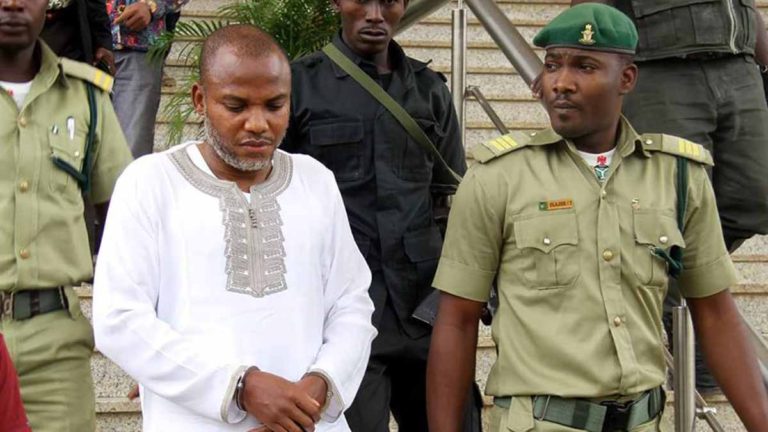
THE Federal High Court in Abuja has sentenced the leader of the proscribed Indigenous People of Biafra (IPOB), Nnamdi Kanu, to life sentence after finding him guilty of terrorism charges preferred against him.

The judge, James Omotosho, found Kanu guilty of all counts one to seven, including his sit-at-home order resulting in economic losses and death of innocent people in the South-East, being a member of a proscribed organisation and committing acts of terrorism, and threatening anyone who failed to obey his order.

The court also found him guilty of inciting the killings of Nigerian security personnel, and for making broadcasts to kill people.

Besides, he was found guilty of committing an act of terrorism against the Federal Republic of Nigeria by threatening that people would die and the world would be at a standstill during a live broadcast.

“The court is minded to send the convict to death given the atrocities he has committed,” he said, adding that he had not shown any remorse for his actions.

He quoted some Bibllical verses to “show mercy” on the convict, noting that death penalty was being frowned upon globally. He therefore sent Kanu to life sentence on count 1, 4, 5, 6 instead of death sentence.

With respect to count three, he was sentenced to 20 years without an option of fine. The same applied to count seven.

He said the sentences should run concurrently.

Omotosho noted that the tendency of violence had not left the convict, and he should be kept at any correctional facility in the country and must not be allowed to have access to any digital device.

The judge admitted that Kanu is a freedom fighter, who was fighting for the freedom of his people.

He, however, called the IPOB leader a terrorist who must be treated as such. According to him, Kanu did more harms to his Igbo people he was fighting for than good.

Omotosho said, “Mr Kanu knew what he was doing, he was bent on carrying out these threats without consideration to his own people.”
He said the prosecutor’s evidence was “credible, cogent, and uncontroverted,” which the accused failed to fault.
“His (Kanu’s) agitation (is) in the states of South-East, South-South and some Middle-Belt, and he is doing so using terrorism as a weapon. Terrorism has become a monster in the world today, and several groups have continued to use this as a form of weapon to form a separate government.
“Groups like Boko Haram, Lakurawa, IPOB, and in recent years troubled Nigeria with terrorism activities. These terror groups, by their activities, are denying innocent people the enjoyment of their fundamental rights.
“The action of the defendant and his terrorist organisation has led to the bloodshed of innocent citizens and security personnel who were going about their legitimate duties. His incitement through his Radio Biafra, as well as social media of the group, has led to the loss of innocent lives,” the judge reasoned.
He emphasised that the court gave the convict the opportunity to defend himself but refused.

The ICIR reported how the judge ordered Kanu out of the court shortly before the ruling over ‘unruly’ conduct.

Kanu was protesting that the judge could not rule on his case when he (the accused) had yet to file his final written address.

“‘Which law states that you can charge me on an unwritten law? Show me. Omotosho, where is the law? Any judgment declared in this Court is a complete rubbish,” the accused queried the judge.

Kanu had confronted the judge in a similar manner at the last hearing of the case, when the court admitted that he had forfeited his opportunity to file his final written address.

The ICIR reported that Kanu had sacked his lawyers and agreed to stand for himself in the court. He faced a seven-count charge bordering on terrorism, treasonable felony, and incitement.

Before he was sent out of the court today, amid heavy security, he had argued that the judge knew nothing about law and lacked the power to determine his case.

The ICIR reports that Kanu is championing the secession of the South-East region from Nigeria for the Biafra nation.

Omotosho proceeded on a recess at 2:40 pm and returned at for the sentence after 4pm to deliver a judgement that lasted less than ten minutes.

Prosecution counsel seeks death penalty for convict

Prosecution counsel, Adegboyega Awomolo, informed the court that some of the counts, including one, two, three and five, carried death sentence.

Responding to the charges read by the judge, Awomolo, who represented the State Security Services (SSS), said, “Those whose relatives were brutally killed will know that they did not die in vain. Many have been rendered poor because of his inciting statements.”
He stated that justice knew that the law was greater than any individual, and justice had been done to the convict. “His acts of terrorism are against innocent Nigerians, and the honourable court has to apply strict measures.
“He demonstrated no respect for justice administration, and his acts in this temple of justice have been marked out of arrogance,” the lawyer noted.

He added, “The action of the defendant and his terrorist organisation has led to the bloodshed of innocent citizens and security personnel who were going about their legitimate duties. His incitement through his Radio Biafra, as well as the social media of the group, has led to the loss of innocent lives.

“Nothing further remains but the imposition of sentences. The punishment prescribed for the offences in counts 1, 2, 4, 5, and 6 is the death penalty. The only sentence that my lordship will impose on counts 1, 2, 4, 5, and 6 is the death sentence. This court has the power to do so, and with respect, must do so.”
He said the court had the power to restrict further access to the digital media through which the act of terrorism was committed.
” We pray the court to order forfeiture of all the broadcasting equipment, in particular the radio transmitter and to be forfeited to the Federal government of Nigeria,” he stated.
Awomolo added that “We want the court to restrict his online access to digital devices to stop broadcasting. Someone in that position ought to show some penitence and not arrogance.
“We are urging that, for his safety and security, until your sentence is executed, I plead that he be kept in the safest correctional centre in Nigeria.
“We are asking that Your Lordship keep him in the safest Custodian centre. I am not sure that Kuje, with records of several jail breaks, will be the best place for him.”
The judge also asked for allocution from Nnamdi Kanu’s consultants.
A federal House of Representatives member, Obinna Aguocha, who represents Umuahia North and South, pleaded for clemency for the convict.
“Like the prosecutor said, Nigeria is bleeding, and we must find common ground on the issue of terrorism. I therefore plead my Lord to show clemency in your judgment.
Omotosho took notice of his pleas and said that the court would return by 3:50 pm for his verdict on the matter.

Background to the report

Kanu was first arrested in 2015 on charges including treasonable felony and incitement over his activities as the leader of IPOB, which seeks the secession of Nigeria’s South-East from Nigeria. He was granted bail in 2017 but fled the country after his home in Abia State was raided by the military.

He was re-arrested in Kenya in 2021 and extradited to Nigeria under controversial circumstances that violated international law, according to the Court of Appeal. The court discharged and acquitted him of all terrorism-related charges in October 2022, but the Federal Government appealed the decision at the Supreme Court.

In December 2023, the Supreme Court ruled that the trial could continue at the Federal High Court. Since then, Kanu has remained in the custody of the SSS, despite multiple court rulings ordering his release or improved detention conditions.

The ICIR reported that the seven-count terrorism charge against Kanu includes allegations of treason, incitement, defamation of Nigerian authorities, and unlawful broadcasting. His trial has been marked by repeated adjournments, legal disputes over fair hearing, and concerns raised by his lawyers and family members about his health.

The court relied on a report by the Nigerian Medical Association (NMA) declaring Kanu fit to stand trial, a report the defendant dismissed as forged.

On October 23, 2025, Kanu sacked his legal representatives and announced that he would defend himself in court.

The decision came after his lead counsel and former Attorney-General of the Federation, Godwin Kanu Agabi, a senior advocate, informed the court that the defendant had decided to take back his case from him and his team.

Agabi formally withdrew his appearance and those of other senior advocates in the team.

Kanu, who was brought to court by operatives of the State Security Services (SSS), informed his counsel in open court that he no longer required their services.

The development was formally communicated to the judge, who confirmed that Kanu had chosen to conduct his own defence.

Confirming the development, Kanu told the judge that he would represent himself, although he might later reconsider the decision.

Omotosho asked whether the court should assign a lawyer to assist him, but Kanu declined, insisting on handling his own defence in the seven-count terrorism charge filed against him by the Federal Government.

The judge later ordered Kanu to open his defence on Friday, October 24.

[BREAKING] Judge proceeds on recess, to resume at 3:50 pm for Kanu’s sentencing

0

THE judge handling the case of the proscribed Indigenous People of Biafra (IPOB) leader, Nnamdi Kanu, at Federal High Court in Abuja, James Omotosho, has proceeded on recess after hours of reading the seven-count charge and conviction of the accused on all the charges.

Omotosho said at 2:40 pm on Thursday, November 20, that he would resume to sentence the accused at 3:50 pm.

The found Kanu guilty of all counts one to seven, including his sit-at-home order resulting in economic losses and death of innocent people in the South-East, being a member of a proscribed organisation and committing acts of terrorism, and threatening anyone who failed to obey his order.

The court also found guilty of inciting the killings of Nigerian security personnel, and for making broadcasts to kill people.

The judge admitted that Kanu is a freedom fighter, who was fighting for the freedom of his people.

He, however, called Kanu a terrorist who must be treated as such. According to him, Kanu did more harms to his Igbo people he was fighting for than good.

The ICIR reported how the judge ordered Kanu out of the court shortly before the ruling over ‘unruly’ conduct.

Omotosho said he could rule on the case in Kanu’s absence.

Kanu was protesting that the judge could not rule on his case when he (the accused) had yet to file his final written address.

“‘Which law states that you can charge me on an unwritten law? Show me. Omotosho, where is the law? Any judgment declared in this Court is a complete rubbish,” the accused queried the judge.

Kanu had confronted the judge in a similar manner at the last hearing of the case, when the court admitted that he had forfeited his opportunity to file his final written address.

The ICIR reported that Kanu had sacked his lawyers and agreed to stand for himself in the court. He faced a seven-count charge bordering on terrorism, treasonable felony, and incitement.

Before he was sent out of the court today, amid heavy security, he had argued that the judge knew nothing about law and lacked the power to determine his case.

The ICIR reports that Kanu is championing the secession of the South-East region from Nigeria for the Biafra nation.

Prosecution counsel, Adegboyega Awomolo, informed the court that some of the counts, including one, two, three and five, carried death sentence as he appealed that the court keeps him in one of the best prison facilities in the country.

Details soon…

Court convicts IPOB leader Nnamdi Kanu on all seven counts

0

THE Federal High Court of Abuja has found the leader of the proscribed Indigenous People of Biafra (IPOB), Nnamdi Kanu, guilty of terrorism charges preferred against him.

The judge, James Omotosho, found Kanu guilty of all counts one to seven, including his sit-at-home order resulting in economic losses and death of innocent people in the South-East, being a member of a proscribed organisation and committing acts of terrorism, and threatening anyone who failed to obey his order.

The court also found guilty of inciting the killings of Nigerian security personnel, and for making broadcasts to kill people.

The judge admitted that Kanu is a freedom fighter, who is fighting for the freedom of his people.

The ICIR reported how the judge ordered Kanu out of the court shortly before the ruling over ‘unruly’ conduct.

Omotosho said he could rule on the case in Kanu’s absence.

Kanu was protesting that the judge could not rule on his case when he (the accused) had yet to file his final written address.

“‘Which law states that you can charge me on an unwritten law? Show me. Omotosho, where is the law? Any judgment declared in this Court is a complete rubbish,” the accused queried the judge.

Kanu had confronted the judge in a similar manner at the last hearing of the case, when the court admitted that he had forfeited his opportunity to file his final written address.

The ICIR reported that Kanu had sacked his lawyers and agreed to stand for himself in the court. He faced a seven-count charge bordering on terrorism, treasonable felony, and incitement.

Before he was sent out of the court today, amid heavy security, he had argued that the judge knew nothing about law and lacked the power to determine his case.

The ICIR reports that Kanu is championing the secession of the South-East region from Nigeria for the Biafra nation.

The judge is expected to proceed to reading the sentence.

Details soon…

Kwara shuts schools in four LGAs over insecurity

0

THE Kwara State Government has directed the closure of all schools across four local government areas following rising insecurity in parts of the state.

The Nigeria Union of Teachers (NUT) Chairman, Yusuf Agboola Kwara State chapter, announced the development in a statement issued on Wednesday.

Agboola announced the closure of schools in Isin, Irepodun, Ifelodun and Ekiti LGAs, stating that the union was acting strictly on directives from the Ministry of Education and Human Capital Development, following the government’s warning about new security threats in Kwara South.

‎” This decision was occasioned by the security challenges ravaging the area and the efforts of the government to control the situation. Treat this information as important and with the urgency it deserves, as it emanated from the ministry,” he said.

He assured school heads and teachers that additional instructions would be issued as more development emerged.

The ICIR reported that on November 18, two people were confirmed dead and an unspecified number of residents abducted after terrorists attacked Eruku town, in the Ekiti Local Government Area of the state.

The Kwara State Police Command in a statement on Tuesday, November 18, said the attack left two men fatally shot and several others missing.

According to the Police Public Relations Officer, Adetoun Ejire-Adeyemi, a superintendent of police, the Divisional Police Officer (DPO) of Eruku and his team, working alongside local vigilantes, swiftly mobilised after hearing gunshots from the outskirts of the town.

President Bola Ahmed Tinubu announced the postponement of his scheduled trips to South Africa and Angola on Wednesday to receive further security briefings following the abduction of 24 schoolgirls in Kebbi State and the deadly bandit attack on worshippers at the Christ Apostolic Church in Eruku.

The president also directed the police to go after the bandits who attacked worshippers in response to the request by the state Governor AbdulRahman AbdulRazaq.

Nigerians react to Governor Alia’s denial of Christian genocide in Benue

A wave of mixed reactions has trailed Benue State Governor Hyacinth Alia’s claim that there is “no religious, ethnic, racial, or national genocide” in his state.

Alia made the claim during a National Human Rights Commission (NHRC) forum on the rights of Internally Displaced Persons (IDPs) and Forcibly Displaced Persons (FDPs) in Abuja on Wednesday, November 19.

The Catholic priest-turned-governor acknowledged insecurity in predominantly Christian Benue but denied any jihad or genocide.

He emphasised clashes stemmed from herder-farmer disputes over land and resources affecting both Muslims and Christians.

“In my state of Benue, we don’t have any religious, any ethnic, any racial, any national or state genocide. We don’t have that.

“Do we have a number of insecurities in the state? Yes, we do. But it is not a genocide. Someone would need to… check the United Nations definitions for this,” the governor said.

He also insisted that no jihad was taking place anywhere in Nigeria, despite the fact that the two major terror groups have been active in the North-East namely Boko Haram and ISWAP.

Both groups have openly stated ambitions to impose their version of Islamic governance, a position scholar from the Faith have widely dismissed as a distorted interpretation of the Qur’an.

While Boko Haram aims to establish an Islamic State within Nigeria, ISWAP pursues a broader vision of a West African caliphate aligned with ISIS.

“We do not have any jihad in Nigeria. I am speaking to you as a reverend father in the church. I’m speaking to you as a governor of a state. If there were any, particularly in my state or any part of Nigeria, I would have been the very number one person to make a noise,” Alia said.

His comments come at a time when Nigeria is under international scrutiny over claims of Christians persecution.

The ICIR reported that US President Donald Trump had recently designated Nigeria as “a Country of Particular Concern” over alleged Christian genocide in the country.

Trump said the American military could deploy ground troops or launch air strikes in Nigeria to halt what he described as the widespread killing of Christians in the country.

The threat came days after he warned he would consider military action against Nigeria if the country failed to curb alleged killings of Christians.

Reacting to Alia’s comment, Human Rights Advocate and Lawyer, Malcolm Emokiniovo Omirhobo, expressed disappointment in the governor’s claims.

“It is shocking, disappointing and utterly irresponsible for Governor Hyacinth Alia to stand before the world and claim that “there is no ethnic or racial genocide in Benue State. Such a statement is not only false, it is an insult to the thousands of innocent men, women and children massacred across Benue over the years.

“Benue has witnessed some of the worst mass killings in Nigeria’s modern history, entire villages wiped out, communities displaced, farmlands destroyed, and families living in perpetual fear. These atrocities did not happen in the governor’s imagination; they happened on Benue soil, to Benue people,” Omirhobo wrote in a statement he released on Thursday.

He noted that for Alia, a leader who swore an oath to protect his citizens to now stand before the international community and deny their suffering showed that the governor was out of touch with reality, or deliberately choosing political convenience over truth and justice.

“Nigeria does not need leaders who sanitise atrocities to please foreign partners. Nigeria needs leaders who will stand with their people, acknowledge the truth, demand accountability, and confront the terror that has destroyed countless lives. To claim there is “no genocide” in Benue is not just a lie, it is a betrayal of the victims, a betrayal of history, and a betrayal of the Nigerian people. Governor Alia should retract this reckless statement and begin to speak the truth. Silence and denial only embolden the killers,” he added.

Some social media users have also expressed concern over the governor’s claim.

Brother Wale wrote on X “We need data, what are the numbers? As the Chief Security Officer of the state, you can’t be making bold claims like this without giving out verifiable figures to back them up. We won’t take you serious, the international press won’t take you serious. What does the stat say?”

Another user, Smartek2050 wrote, “Wearing the title “Reverend Father” doesn’t absolve you from acknowledging the religious dimension of the killings. Ignoring the religious aspect of these attacks undermines national and international efforts to address it. Denying genocide while claiming moral authority is dangerously misleading for the public.”

Queen Eve opined that “Benue needs a Governor who governs, not a priest who keeps explaining tragedy with grammar. If insecurity is not genocide, then what do we call the endless burials? A community outreach programme? Nobody cares about titles. Benue people want protection, not theological debates.”

Jerry Jacoral also shares his thought “Waiting for a Nigerian politician to defend the masses is like waiting for a goat to stop eating grass. Power changes their priorities and somehow, the people always fall to the bottom of the list.”

Meanwhile other users share opposite opinion as Fisayo Adewumagun wrote “There is no Christian genocide. We can call it insecurity, but let’s not twist things to make it seem like only Christians are being targeted by these terrorists.”

Bashir Bode on Facebook wrote “Thanks again for speaking the truth against all odds. Those wishing this country of destruction, inversion and destabilisation should live to see it in prosperity. Those calamities they are praying wouldn’t only fall on one sided they are thinking.”

“As General C.G Musa said. It’s an ethic issue, not religious, ethnic and political. Traditional leaders and the president himself can stop this in 24 hours, and whichever party transgresses shall face the consequences. Its that simple,” Shareef Badamasi wrote.

Alh Bunu Fantami his opinion on the matter thus: “Better truth…. What Peter Obi failed to say, Gov. Alia has clearly said it.”

In his comment on the debate, Salaha Musa Ayanda wrote “Thank God it is coming from a Rev father, when a Reasonable Christian speaks you will know.”

Attention intensified during the debate leading up to Nigeria’s designation as a Country of Particular Concern by the United States, a period marked by President Donald Trump’s threat to deploy troops to Nigeria to protect Christians.

The ICIR reported that the US House of Representatives Subcommittee on Africa scheduled for today, Thursday, November 20, 2025, to open its inquiry into Trump’s decision to redesignate Nigeria as a Country of Particular Concern over alleged surge in Christian killings.

The invitation sent to members of the Committee on Foreign Affairs shows that the hearing will be chaired by Representative Chris Smith at 11:00 a.m. in Room 2172 of the Rayburn House Office Building, with a live webcast available. 

The hearing will include two panels of witnesses, featuring senior US State Department officials as well as Nigerian religious leaders.

Judge sends IPOB leader, Nnamdi Kanu out of court

A JUDGE of the Federal High Court of Abuja, James Omotosho, has ordered the leader of the proscribed Indigenous People of Biafra (IPOB) of out of his courtroom following an outrage by the accused.

The judge, had scheduled today, Thursday, November 20, for ruling on the case against Kanu.

Kanu is facing a seven-count charge bordering on terrorism, treasonable felony, and incitement.

Omotosho said he could rule on the case in Kanu’s absence. The judge has continued with the ruling, in which he is likely to sentence the IPOB leader today.

Kanu was protesting that the judge could not rule on his case when he (the accused) had yet to file his final written address.

“‘Which law states that you can charge me on an unwritten law? Show me. Omotosho, where is the law? Any judgment declared in this Court is a complete rubbish,” the accused queried the judge.

Kanu had confronted the judge in a similar manner at the last hearing of the case, when the court admitted that he had forfeited his opportunity to file his final written address.

Kanu had sacked his lawyers and agreed to stand for himself in the court.

Before he was sent out of the court today, amid heavy security, he had argued that the judge knew nothing about law and lacked the power to determine his case.

Read update HERE

‘Why Nigeria’s integration in West African Power pool won’t solve electricity problems’

0

NIGERIANS may have to wait a little longer to reap the benefits of the integration of the West African Power Pool (WAPP), with a shaky national grid and other structural deficiencies still unsolved in the Nigerian electricity supply industry (NESI).

West African Power Pool integration serves as a centralised command centre for the mainland member countries of the Economic Community of West African States (ECOWAS).

The integration marks a significant step towards establishing a unified power market across the region, paving the way for more reliable, sustainable and affordable energy infrastructure for West Africa.

However, there are concerns that Nigeria may not harness the full benefits of the regional electricity market power pool, due to structural challenges in the power sector, resulting in grid collapse.

Former Chairman of the Nigerian Electricity Regulatory Commission(NERC), Sam Amadi, weighed in on this, noting that “Nigeria’s successful integration into the West African Power Pool (WAPP) strengthens investor confidence, expands regional electricity trading opportunities, but won’t offer electricity relief to Nigerian homes.”

“Structurally and managerially, we have to focus on solving our problems through structural thinking. Invest in making the grid reliable. It’s about managerially solving basic problems,” Amadi told The ICIR.

He warned that the problem would not be solved by outsourcing responsibilities, but by addressing project management with the right structure.

“Again, we know that many of our grid suppliers, some of our new Integrated Power Plants (IPPS), are finding it difficult to send loads. They have capacity more than the Nigerian market can receive for now, because of constraints of the transmission network, congestion, distribution failures, among others.

“It’s a public managerial problem which can only be solved by efficiency,” he said.

The ICIR reports that WAPP oversees the interconnected power grids of 14 nations, namely Benin, Burkina-Faso, Cote d’Ivoire, The Gambia, Ghana, Guinea, Guinea-Bissau, Liberia, Mali, Niger, Nigeria, Senegal, Sierra Leone and Togo.

Amadi also disclosed that with the inefficiencies and structural problems, small bilateral deals with the small Independent Power Plants (IPPs) in Nigeria and the Benin Republic were ongoing, with targeted industrial clusters already exploring the opportunities.

“With the integration, you can, in the short term, keep those companies financially buoyant because they’re selling power to the West African Power market,” he said.

Notably, Nigeria is still the region’s biggest generator—but the two neighbours-Benin and Niger, often record a steadier supply due largely to a prioritised power supply distribution to industrial clusters and homes.

Nigeria has been exporting a portioin of its grid output (roughly six  per cent of total generation) under bilateral deals with Benin, Niger and Togo.

Those contracts guarantee a baseline flow, and the receiving countries often supplement it with their own generation (e.g., Benin’s growing renewable projects) and with power traded through the West African Power Pool, which improves overall reliability.

The ICIR reports electricity sector remains fragile. About 85 million Nigerians (43 per cent of the population) lack access to grid electricity. This is one of the biggest energy access gaps in the world.

Research by a Power Sector Analyst, Taiwo Hassan Odugbemi, argued that Nigeria’s under-delivery in the power sector is largely due to systemic challenges in the grid, as he stressed that technical inefficiencies, vandalism and ageing infrastructure remain a major problem for the sector.

“Generation capacity is roughly 12,000 megawatts (MW)–13,500MW, but far less power is actually delivered. In 2023, Nigeria generated 4,500MW for a population of over 200 million. For comparison, Ethiopia, with a population of 132 million, recently added 6,000MW to its generation capacity. Before that, it generated 5,200MW,” Odugbemi noted in the research.


Full list : Morroco win big at 2025 CAF Awards

0

MOROCCAN football made a strong showing at the 2025 CAF Awards in Rabat, where defender Achraf Hakimi was named African Player of the Year, becoming the first defender to win the prize in 52 years.

His victory marked the highlight of Morocco’s overall dominance at the event. After finishing as runner-up in 2023 and 2024 behind Victor Osimhen and Ademola Lookman, the 27-year-old finally secured the continent’s top individual award.

Hakimi’s win ends Morocco’s long wait for the accolade. He is the country’s first recipient since Mustapha Hadji in 1998 and one of the few defenders to claim the honour in the modern era.

Morocco dominated the ceremony in Rabat, with Ghizlane Chebbak named Women’s Player of the Year and Yassine Bounou voted Men’s Goalkeeper of the Year.

Morocco’s football success in recent years is backed by solid performance on the global stage. The senior men’s national team became the first African and Arab country to reach the semi-finals of the FIFA World Cup, doing so in Qatar 2022. Their consistent qualifying record continued as they secured a spot in the 2026 World Cup well ahead of schedule.

At the youth level, Morocco has also broken new ground. The U-20 national team won the 2025 FIFA U-20 World Cup, defeating Argentina in the final — the first time an Arab nation has achieved this. Meanwhile, its domestic clubs have made major strides such as Wydad AC won the CAF Champions League in 2022, beating Egypt’s Al Ahly in Casablanca.

Moroccan club RS Berkane has also secured the CAF Confederation Cup recently. It is set to host the 2025 Africa Cup of Nations, marking its second time as host after a 36-year gap.

Nigeria also made its mark as Super Falcons and Brighton goalkeeper Chiamaka Nnadozie clinched the Women’s Goalkeeper of the Year award for the third consecutive time.

The event, held on Wednesday at the Mohammed VI Polytechnic University, also celebrated emerging stars. Othmane Maamma won Men’s Young Player of the Year, while Doha El Madani was named Women’s Young Player of the Year.

Cape Verde’s Bubista took home the Men’s Coach of the Year award, and Pyramids FC claimed Club of the Year.

CAF Awards 2025 – Full Winners List

Player of the Year (Men): Achraf Hakimi
Player of the Year (Women): Ghizlane Chebbak
Goalkeeper of the Year (Men): Yassine Bounou
Goalkeeper of the Year (Women): Chiamaka Nnadozie
Youth Player of the Year (Men): Othmane Maamma
Women’s Youth Player of the Year: Doha El Madani
Interclub Player of the Year: Ibrahim Mayele
Women’s Interclub Player of the Year: Shamirah Nabbadda
Coach of the Year (Men): Bubista
Club of the Year (Men): Pyramids FC
Team of the Year (Men): Morocco U-20
Team of the Year (Women): Nigeria Women’s National Team
Goal of the Year: Clement Mizize
Referee of the Year (Men): Omar Abdulkadir Artan
Referee of the Year (Women): Liban Abdulrazack
CAF Women’s Assistant Referee of the Year: Tabara Moodji
CAF Assistant Referee of the Year (Men): Liban Abdulrazack

CPJ demands release of Nigerian journalist jailed on terror charges in Benin

0

THE Committee to Protect Journalists (CPJ) has called on authorities in the Benin Republic to release Nigerian  travel journalist, Mathew Ojoduma, who has been detained on terrorism charges since January 29.

Ojoduma is the founder of the Africa Views channel, which focuses on covering African cities.

He has been in prison in Benin since he was detained on the Benin-Burkina Faso border after he was caught with a drone, camera, and laptop.

His family is also seeking the intervention of the Nigerian government for his release.

The ICIR reports that Beninese police arrested Ojoduma when he was crossing Benin’s northern border into Burkina Faso at the town of Porga, with a camera, drone, and laptop, according to Ojoduma’s wife, Priscilla Mathew, who spoke with CPJ, and court documents, reviewed by CPJ.

“Authorities in Benin must immediately release journalist Mathew Ojoduma, who has already wasted nine months of his life in jail on spurious terrorism charges,” said CPJ Africa Director, Angela Quintal.

“The Nigerian government must also step up and act to ensure fair treatment of its citizens, rather than keeping silent in the face of this heinous abuse of press freedom,” Quintal added.

On February 13, Ojoduma was charged with membership of a terrorist organisation, and his case was heard on May 19, according to a judgment issued that day by the Special Court for the Repression of Economic Offences and Terrorism (CRIET), reviewed by CPJ, and Ojoduma’s lawyer, who declined to be named, citing fear of reprisal.

The judgment said Ojoduma was “suspected of being in intelligence with terrorist groups” — a charge he denied — because of his “’insistence’ on travelling via Porga, “despite the prevailing climate of insecurity” there.

The court referred the case to the Public Prosecutor’s Office as its criminal nature was beyond its competence.

Notably, Northern Benin has been grappling with an increase in violent extremist attacks since 2021, as Islamic State-linked insurgents have taken control of swathes of neighbouring Burkina Faso and Niger and, beyond them, Mali. Mathew said her husband intended to travel through Burkina Faso to Mali and Senegal on a reporting trip.

On July 2, CRIET ordered Ojoduma to be held in pre-trial detention, according to a court order, reviewed by CPJ. Mathew told CPJ that her husband was being held at a prison in the southern city of Cotonou.

The lawyer told CPJ he appealed to CRIET, but the verdict confirmed its May 19 ruling that the court did not have jurisdiction over the case.

He said CRIET told him that authorities’ search of Ojoduma’s “phones and the hard drive revealed no information in this case relating to acts of terrorism,” but he was unable to share a copy of the court document for procedural reasons.

The lawyer informed that the court said its analysis of Ojoduma’s computer showed he was a media specialist focusing on travel and the environment, with an interest in regional politics.

The Secretary, of the Lagos State chapter of the Nigerian Bar Association (NBA), Ayodeji Olabiwonnu, said Ojoduma’s family asked for support on Ojoduma’s behalf, adding that “the association wrote to Nigeria’s Attorney General, Minister of Foreign Affairs, and Nigerians in Diaspora Commission requesting action, but received no replies.”

The CPJ’s requests for comment, via phone, messaging app, and email, to Nigeria’s Minister of Foreign Affairs and the office of Nigerians in the Diaspora Commission, and email to the Attorney General’s office, did not receive any replies.

Its emails and calls requesting comments from Benin’s Ministry of Justice, CRIET, Police spokesperson Éric Orou Yérima, and government spokesperson, Wilfried Léandre Houngbédji also went unanswered.

On several instances, Nigerian journalists have been under intense attacks while calling powers and leadership to account.

In April 2025, the International Press Institute (IPI) Executive Board, including Nobel Peace Prize laureate Maria Ressa, declared support for journalists around the world over what it described as an unprecedented global assault on press freedom.

Comprising leading editors, journalists, and publishers from 21 countries, the board said the role of the media in safeguarding democracy and holding the powerful accountable was more critical than ever, especially amid rising authoritarianism and global instability.

Tinubu sacks Ogbonnaya Orji as NEITI Executive Secretary

0

PRESIDENT Bola Tinubu has sacked Ogbonnaya Orji, who served as Executive Secretary of the Nigeria Extractive Industries Transparency Initiative (NEITI) since February 2021.

The president appointed Musa Sarkin Adar as his successor. 

The Office of the Secretary of the Federation (OSGF) confirmed this development in statement by Segun Imohiosen, Director of Information and Public Relations. on Tuesday, November 18.

The ICIR gathered that Orji was outside Nigeria on an official trip when he was replaced by Adar.

Adar, formerly the Chairman of the National Inland Waterways Authority (NIWA), was officially informed of his appointment in a letter dated November 14, 2025, from the Secretary to the Government of the Federation, George Akume. 

The letter stated that Adar’s tenure as NEITI Executive Secretary would run for a single term of five years, in accordance with the NEITI Act of 2007, and would take effect from November 12, 2025. 

The ICIR reported how Orji said his tenure at NEITI was marked by significant reforms and capacity building in Nigeria’s extractive sector. 

In an exclusive interview with The ICIR in September 2025, he highlighted achievements such as securing a permanent office for NEITI, increasing staff strength from 43 to 118, digitalising procedures, and advancing transparency in oil, gas, and mining contracts. 

“When I look back — and you can cross-check from my staff — I’ve done all except one: the review of the NEITI Act. NEITI now has a permanent office building. I recruited 70 more staff, raising the strength from 43 to 118 as we speak. I expanded training opportunities. I reviewed upwards the salaries and emoluments of staff to boost productivity and morale.

“I also expanded international partnerships. Currently, in the process of digitalisation, we are building a data centre. My simple policy is that every staff must have tools to work — laptops, phones, everything,” he said.

He also mentioned that he played a key role in supporting the implementation of the Petroleum Industry Act (PIA) and advancing contract transparency, revenue disclosure, and domestic resource mobilisation.

According to him, NEITI expanded international partnerships and advocacy initiatives, bringing previously opaque oil, gas, and solid minerals sector data into the public domain under his stewardship. 

Before, nobody had information on oil and gas — production data, export data, domestic consumption data, subsidy data. All that information is now in the public domain.

“For instance, I can tell you at the touch of a button how much Nigeria has earned from oil and gas since 1999 to date. We’re in the region of $831.15 billion between 1999 and today. In solid minerals, you have almost ₦1.5 trillion between 2007, when we began to collect data, and now,” he added.

The reshuffle also saw Mukhtar Shehu Shagari appointed as the new Chairman of National Inland Waterways Authority (NIWA)

Tinubu urged the new officials to leverage their experience to strengthen transparency, accountability, and effective service delivery in their respective agencies.