Home Blog Page 1788

Is another war for ‘Biafra’ inevitable?

AS Thomas Paine, the English-born American philosopher, once wrote, there are times that try men’s souls. Nigeria is in the throes of such debilitating times, more so for Ndigbo.

It has never been this bad since the end of the civil war in January 1970. What is needed to pull the country back from the brink is a leader with empathy, a leader who inspires and uplifts. Unfortunately, President Muhammadu Buhari does not fit that mould.

After reading his comment on the crisis in the Southeast on Tuesday, I simply came to the inexorable conclusion that he does not get it. Or worse, he is an inveterate sadist.

Buhari is not a social media aficionado. Granted, he has a verified Twitter handle – @MBuhari – but he is not a Donald Trump, the former U.S. President. Buhari rarely tweets. But when he does, it underscores the importance he attaches to an issue. And he did so on Tuesday.

“Many of those misbehaving today are too young to be aware of the destruction and loss of lives that occurred during the Nigerian Civil War. Those of us in the fields for 30 months, who went through the war, will treat them in the language they understand,” he tweeted after a meeting with the chairman of the Independent National Electoral Commission (INEC), Prof. Mahmood Yakubu.

So offended was Twitter that it deleted the tweet. What a shame. Our President has joined the infamous club of world leaders in Twitter’s Hall of Infamy, sanctioned for conducts that fan genocidal embers.

Buhari’s tweet was a triumphal act which he relishes anytime he is dealing with Ndigbo. He just reminded restive Igbo youths that he conquered their fathers in a civil war and is prepared to crush them once again if they dare him. But he is addressing the wrong crowd. Igbo youths under the age of 50 don’t count themselves as part of the crowd Buhari and his ilk conquered in a war half a century ago.  They are irrepressible.

Of course, the president is entitled to his fantasy, but he misses the point. Ordinarily, his age should afford him the ample opportunity to introspect. If Buhari was someone given to solipsism, he should be asking himself why Nigeria loses its soul anytime he is in power. Blaming others for his self-inflicted leadership woes is a sign of weakness.

Reacting to the president’s tweet, @DrOlufunmilayo said: “When Buhari speaks to bandits, he begs them. He appeals to them. But when Buhari speaks to citizens, he threatens us. He uses language that can be used to justify harm, violence and massacre against the same people he swore to protect.”


@UNCLE_AJALA said: “Civil war that killed plus or minus 3m Igbos 51yrs ago, and still hurting so many people is what President Buhari is using to threaten people in 2021, while Boko Haram members are getting rehabilitated … it’s so unbelievable.”

This is the crux of the matter. Reminding Igbo youths how over 3 million of their folks were slaughtered just a day after the remembrance of the holocaust smacks of lack of emotional intelligence. It is callous.

Why does Buhari loathe Ndigbo so much? His supporters accuse the Igbo of hating him. So, whatever crime he is committing against them is a well-deserved comeuppance. Those who propagate this harebrained notion hinge their ludicrous argument on the fact that Ndigbo have consistently rejected him at the polls even when he picked two of their sons – Dr Chuba Okadigbo and Chief Edwin Ume-Ezeoke – as running mates in the 2003 and 2007 presidential elections.

While it is true that Ndigbo are never enamoured of Buhari’s leadership qualities and, therefore, serially rejected him at the polls – and they have been vindicated by his woeful performance – it doesn’t translate to hatred.

After all, one of the most revered Igbo leaders, Dim Chukwuemaka Odumegwu Ojukwu, contested both elections on the platform of the All Progressives Grand Alliance (APGA) and his party also lost in the Southeast just as Buhari’s All Nigeria Peoples Party (ANPP) did. Does that mean Ndigbo hated Ojukwu?

Some others say Ndigbo hate Northerners. Some who want to be more mischievous narrow it to hatred for the Fulani. But they forget that Buhari is not the first Nigerian president of Fulani extraction.

In 1979, just nine years after the civil war, Shehu Shagari, scion of the Sokoto Caliphate, was elected president with Dr. Alex Ekwueme as his deputy. In that government, Ume-Ezeoke was Speaker of the House of Representatives and Dr. Joseph Wayas, was Senate President. Ndigbo worked well with Shagari. The same applies to President Umaru Yard’Adua, also a Fulani.

Those who accuse Ndigbo of hating the North are deliberately mischievous. I am writing this piece from my hotel room in Kano where I attended the 2021 biennial convention of the Nigerian Guild of Editors. I can say without equivocation that there are more Igbo entrepreneurs in Kano than the indigenous population. And Kano is not an exception. Ndigbo are in all the nooks and crannies of northern Nigeria, doing their legitimate businesses, contributing to the growth of the local economy. They build homes, not just houses, in their communities of residence. They pay their taxes and other development levies. Some are the reason why there is electricity in their adopted communities. It is on record that some Igbo people in the north have singlehandedly constructed roads in the communities where they live. These are not signposts of hatred.

So, Buhari should introspect. Rather than pointing fingers of blame at imaginary enemies, he should purge himself of animosity. It is abhorrent for a president to deploy state resources in inciting violence against an ethnic group. That gambit worked in 1966. It will fail in 2021.

Buhari’s recourse to chest-thumping, always waving the civil war flag to remind Ndigbo that he conquered them is ridiculous. The president is not the only Nigerian military officer who fought the war. He was only a Lieutenant then and there is no record of his outstanding exploits in that war of attrition. So, why is he behaving as if he single-handedly extinguished the Biafran flame?

As I noted recently, Ndigbo are not Nigeria’s problem. Declaring war against them at the drop of a hat is unconscionable. Today, soldiers have been deployed to the Southeast with a clear presidential mandate to kill. And what a great job they are doing. Innocent youths are mowed down on the streets. Young men are yanked off the embrace of their weeping mothers and taken away. Most of them are murdered in cold blood by what has become an army of occupation.

There is no accountability. Thousands have disappeared as soldiers carrying out the explicit orders of their Commander-in-Chief storm students’ hostels and churches to whisk away youths in the name of hunting down Indigenous People of Biafra (IPOB) activists.

Alaigbo is in turmoil. Sadly, this war is not inevitable. All that was needed is a leader with character, sobriety and an acute sense of justice. Unfortunately, Buhari is not such a leader. But genocidal leaders will always pay a steep price.

In the Southeast, we have a wimpy political class. The governors are not only mortally afraid of speaking truth to power but also willing to throw their own people under the bus if only to appease an unappeasable emperor.

Since nature abhors a vacuum, the yawning leadership void has been filled by an irascible non-state actor, Nnamdi Kanu, who has effectively stepped up to the plate and impressionable Igbo youths in search of a hero have found in him the superman they have been looking for.

As I noted recently, there is no Igbo leader today that has as much hold on Igbo youths as Kanu. Such enormous power should come with great responsibility. That seems not to be the case. Biafra or no Biafra, Ndigbo need to be alive. Brainwashing Igbo youths to confront soldiers that have no respect for any rules of engagement is suicidal.

Today, some Igbo are as afraid of Kanu as they are of Buhari. This my way or the highway philosophy of IPOB detracts from the struggle. Threats against those who do not necessarily disagree with the struggle but have a different idea of how things can be done without bloodshed smacks of a budding autocracy. Blood is sacred in Igboland and any strategy that will orchestrate the wanton spilling of precious Igbo blood should be reevaluated.

Mass self-immolation, which is what I am seeing in this “it is either Biafra or war” battle cry of IPOB is not a sign of bravery. It is a red flag of a society on the path of self-destruction.

You don’t wage a war against a bull in a China shop, because even if you win, you risk losing all. You deploy tact and wisdom in guiding the bull out of the shop. That is not cowardice. Ndigbo who are calling for restraint are neither fraidy-cats nor quislings.

Calling Nnamdi Kanu out if he errs is not an act of betrayal and, therefore, does not deserve a fatwa. With the way things are panning out, particularly the stratification of Alaigbo along the lines of those who are for and against Kanu, we risk Igbo on Igbo violence. It is a slippery slope.

Ndigbo don’t need to fight another war even for the sake of a territorial Biafra. Buhari is a rampaging bull who has no qualms replicating the tragedy of the late 1960s. Playing into his hands is foolhardy. This war is not inevitable.
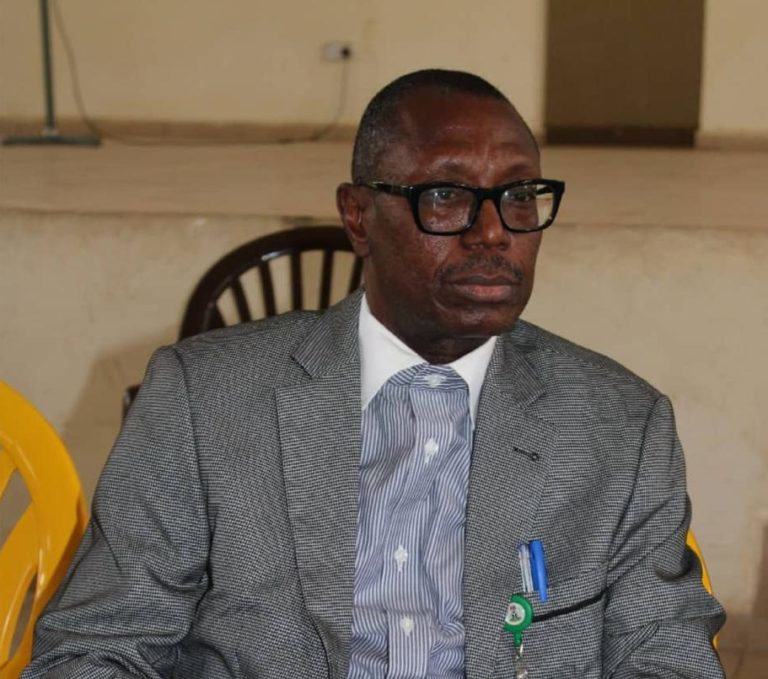
NECO appoints Ebikibina John Ogborodi as acting registrar

THE Governing Board of the National Examinations Council (NECO) has approved Ebikibina John Ogborodi as the acting registrar of the council.

This is contained in a statement signed by NECO Head Information and Public Relations Azeez Sani on Thursday in Abuja.

Ogborodi’s appointment followed the death of the former Registrar Godswill Obioma on Monday.

According to the statement, Ogborodi’s appointment was contained in a circular issued by the council’s Director of Human Resource Management Mustapha Abdul, who said he was ‘endorsed’ by the governing board at its emergency meeting held on Wednesday.

“The Circular explained that Mr. Ogborodi’s appointment was as a result of his being the most Senior Director in the Council. The Circular stated that all activities of the Council are to continue unabated as earlier planned,” the statement read.

Ogborodi, who hails from the Sagbama Local Government Area of Bayelsa State, was the director of special duties in the council before he was appointed the acting registrar.

The statement read that he obtained his first degree from the University of Jos in 1986 and a master’s degree in Learning Disability from the same university in 1999.

The acting registrar joined the service of NECO in 1999 and has served in different capacities.

He was a former acting director  of Examination Development Department; acting director, Office of the Registrar; director, General Services, and director of Human Resource Management.

The ICIR had reported that the former registrar Obioma died at the National Hospital in Abuja after a brief illness, according to his son. 

Kidnapped Taraba State University lecturer regains freedom

0

HEAD of Department of Forestry and Wildlife Management at Taraba State University Umar Buba, who  kidnapped by armed men, has regained after spending four nights in captivity.

Buba, who was kidnapped from the university’s staff quarters in the early hours of Sunday, was released on Thursday, according to Channels Television.

Spokesperson of the State Police Command David Misal, however, told The ICIR on the phone that he was yet to confirm the report of his release.

Buba’s abduction and subsequent release make it the third time that lecturers from the institution’s staff quarters would be kidnapped. 

Vice-Chancellor Vincent Ado-Tenebe,  while reacting to the incident on Sunday, had told newsmen that the armed men fired gunshots sporadically to displace the security officials attached to the staff quarters before going away with the lecturer.

He lamented that despite heavy presence of military and civil security operatives mounting surveillance around the school premises, Buba was still kidnapped.

The vice-chancellor, however, gave an assurance that more efforts would be put in place for more security operatives to be deployed, and stressed the need for more arms and ammunition to fight criminals.

He stated that staff and students living on campus would not be able to challenge armed men with bare hands, noting that the management would engage concerned authorities to grant licences for staff to have their guns for their protection and that of the students.

Taraba State has been riddled with kidnapping and other crimes. A local government chairman was kidnapped and subsequently killed recently.

Nigeria is now a failed state – Former US ambassador


A former United States Ambassador to Nigeria John Campbell and a former Director at Harvard University’s Kennedy School of Government Robert Rotberg have described Nigeria as a ‘failed state,’ even though the country still retains some attributes of viability, especially with respect to international affairs.

The duo said this in an article titled, ‘The Giant of Africa is Failing,’ against the backdrop of the multiple overlapping security crises which had transformed Nigeria from a weak state into a failed one. They noted that Buhari’s government had proved woefully unprepared to tackle these challenges.

“International partners, especially the United States, must acknowledge that Nigeria is now a failed state. In recognition of that fact, they should deepen their engagement with the country and seek to hold the current administration accountable for its failures while also working with it to provide security and right the economy.

“The Nigerian state has long failed to provide its citizens with social services, and Nigerian politics is largely an elite sport disassociated from governance. The government does not or cannot tax the real wealth of the country, remains too dependent on revenue from oil and gas, and lurches from one fiscal crisis to another,” part of the article said.

The article, however, said that Nigeria’s ‘collapse’ could be reversed and urged the United States to continue to publicly denounce the human rights abuses of President Buhari’s administration and cancel the visas of Nigerian officials and business people at the first whiff of criminality or human rights offenses.

“Washington should meet Nigeria’s requests for military assistance with caution and international financial institutions should support Nigeria’s liberalisation of its currency exchange rates and help strengthen the independence of its central bank.

“Through exchanges, conferences, technical advice, and other tools of ‘soft diplomacy,’ the United States should aid civil society and Nigerian nongovernmental organisations in their efforts to strengthen the country’s democracy,” the article said.

It further said  that Nigeria, with a population of about 214 million people, would not afford to fail as it could have profound consequences on the entire region and beyond.


How Twitter revved up Inter-ethnic crisis in Oyo amidst COVID-19 Pandemic

FEBRUARY 15, 2021. Ajani Olaide, a resident of Shasha community narrated how his uncle was killed during the ethnic crisis that ensued between Hausa traders and the Yoruba ethnic group, in Oyo State. It was hard to believe that the end had come for the deceased.

He had attempted settling a dispute between a pregnant Yoruba woman and a male trader of Hausa extraction, whose farm produce spilled to the entrance of the said woman’s outlet. But, suddenly the deceased was hit from behind by another northerner, and he died a peacemaker.

The incident began on 11th February, 2021 in Akinyele Local Government Area of Oyo State, South-West Nigeria. It later became an issue of national interest.

“He tried to resolve a misunderstanding between a Hausa trader and a pregnant Yoruba woman when he was hit from behind by another Hausaman. And he died,” Olaide stated on the verified Facebook handle of the Television Continental.

An aerial view of Shasha Market shortly after the crisis during the COVID-19 pandemic in Akinyele Local Government Area, Oyo State. (File Copy)

It was a time the country was grappling with COVID-19 pandemic. The Nigerian Centre for Disease Control (NCDC) had issued public health advisory to alert the public against the implication of non-adherence to the rolled out preventive measures.

But amidst the pandemic, inter-communal crisis between the Fulani livestock pastoralists and the Yoruba crop farmers intensified.

The crisis in Oyo State led to complete disregard for the public safety guidelines prescribed by the NCDC. Thus, the number of confirmed cases in Nigeria kept rising, despite inadequate health infrastructures.

Between December 2020 and 10th January, 2021, NCDC had recorded 1,000 confirmed cases milestone.

As of January, 2021, 1,358 deaths were already captured by the Centre with 100,087 confirmed cases.

Still, the anxiety for the COVID-19 cure exacerbated the spread of disinformation. Some health experts described this as ‘infodemic’. The social media became major tool for the spread of misinformation about the pandemic.

Twitter users precisely amplified false information on the Oyo crisis during the pandemic, a situation capable of creating division in the country.

When the crisis intensified, the public were more interested in personal safety than compliance with the COVID-19 public safety guide – an issue made worse by the spread of false information.

Non-compliance to the public safety guideline, according to the Centre, was worsening the public health response efforts targeted to limiting the continued spread of the disease.

As such, the ethnic crisis made compliance more problematic, implying that a civil war or communal unrest, could cause a wider spread of COVID-19.

Dr. Laz Ude, public health practitioner and development expert, shared similar position during an interview with The FactCheck Hub.

In his opinion, it was natural for humans to seek protection in whatever forms necessary during unrest, thus, compliance to the guidelines could be difficult.

“During a period of crisis or war, the human natural instinct is safety and survival, protection from being killed. So observing covid-19 protocols is not a realistic expectation,” he stated.


Twitter ignites misinformation, spiking ethnic crisis during COVID-19

The social media platform placed the ethnic groups at the cliff. Northern Nigerians took to social media to condemn the attacks, and even threatened to retaliate by attacking Southerners resident in the north. Findings later showed part of the video shared during the incident was false.

For instance, in the heat of the occurrence, on February 12, a video surfaced on Twitter showing an alleged gruesome killing of northerners. The gory video shows footage of the northerners being set ablaze. It was shared by @AM_Saleeem on February 13.

The 45-second video shows that few of the victims were still alive before they were subsequently lynched. The video, as of the time of filing this article, has garnered over 46, 000 views, shared by almost 3, 000 persons.

The same footage was also shared by @El_abdool and @SirTafawaBalewa. It has been viewed over 46,000 and shared 1,000 times via social media accounts. Still, it was an old video, not related to the Oyo crisis but meant to incite a violent clash in the country during the pandemic.

Contrary to the false claim, the incident occurred in Edo State, on February 8, a different state, some 189.02 kilometres away from Oyo state.

“The incident happened in Ogheghe Community, Ovia South-West, Edo State. Four persons were involved and they were alleged to have been caught with firearms which they could not give reasons why they bore arms. They were not with any government recognised security organisation,” Chidi Nwabuzor, the Police spokesperson told this reporter.

Meanwhile, analysis of the Twitter accounts showed the three handles which conveyed the misleading information have organic followers.

For instance, some of the real followers of @El_abdool include Motivated George @MotivatedGeorge, HamzatLawal@HamzyCODE, HafeezAkanni@TheReal_Hafeez, Zaynerbu Abu @ZanerbuAbu etc.

Google Earth Photograph shows the distance apart (189.02 km) from where the old footage was used by Twitter users to Amplify Oyo inter-ethnic crisis in the pandemic.
Photo: Olugbenga Adanikin, The ICIR

How it started

Sunday Adeyemo, otherwise called Sunday Igboho, a Yoruba activist has been at the centre of the crisis. On 23rd January, 2021, he was applauded by the Yoruba local farmers for intervening in the ethnic clashes that had claimed lives in the recent past. At the public outing, he was repeatedly captured on national television not complying with the pandemic safety guideline.

“The Fulani kidnappers cannot seize our lands from us. Our land rightly belongs to us…..,” Igboho, stated while addressing a massive crowd in Igangan, Ibarapa North Local Government Area (LGA), of the state.

Analysis of the video showed non-compliance with the safety protocols. The gathering defied the recommended two-metre social distancing, as well as other measures including the use of face masks to prevent community spread of the virus. The video has been viewed 73,330 as of May 28, 2021.

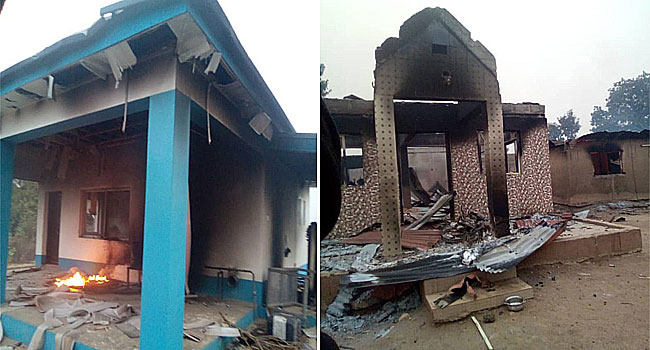
The activist warned the Fulani herders accused of kidnappings and asked them to vacate Igangan community in seven days. The notice did not exclude the Fulani clan head, also known as Seriki Salihu Abdulkadir. Shortly after, the clan head was attacked, his home, cars, and other properties set ablaze, allegedly at the instance of the activist.

As of date, there is no publicly verifiable evidence to establish that the activist was responsible for the attack. However, there was reprisal. Abdulakadir also left the abode forcefully.

Seriki Fulani, Salihu Abdulkadir’s House Set Ablaze in Igangan, Oyo State, South West Nigeria. Photo Credit: Readerslogue

Igboho fake Twitter account becomes misinformation tool to aggravate ethnic crisis during COVID-19

Similarly, findings showed that social media platforms – Twitter, Facebook and YouTube became the vehicles to amplify voice of the Yoruba activist. They also served as channels to indirectly achieve a predetermined objective of ethnic division.

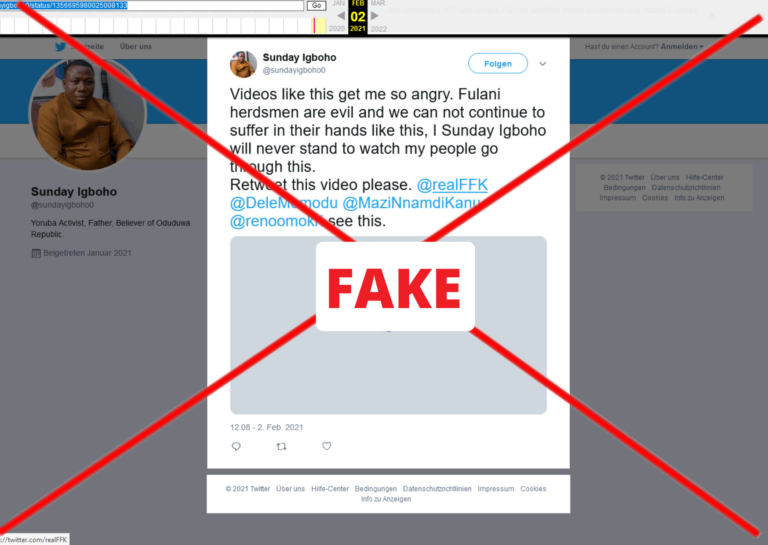
For instance, a major Twitter handle, now suspended @SundayIgboho0 was created in the name of Igboho. For about a month, the handle reeled out information as if it directly came from the activist. Besides unverified handles, the most popular of them posted photographs of reprisal attacks such as when the activist’s home was set ablaze and other misleading information.

A section of the media fell for the source as a reliable one until it was deleted following public disclaimer by the activist.

As of the period, the major handle was archived by this reporter having realised the danger it was capable of. The Yoruba activist later denied the Twitter handle when it became a cause for worry before it was eventually suspended.

Sunday Adeyemo’s (Sunday Igboho) Fake Twitter Account before it was suspended by Twitter

Meanwhile, while tweets were made via the handle, hashtags such as #Stopthekillings, #StopkillingNortherners #SundayIgboho were trending with some misleading videos and photographs shared to spike ethnic tension. The heat of the initial occurrence indirectly led to another communal clash in Shasha, Akinyele LGA of the state.

Igbo secessionist latch on crisis to promote secession

On January 27, NnamdiKanu, leader of the South Eastern secessionist group, Indigenous People of Biafra (IPOB) latched on the ethnic tension in a video posted on YouTube. It was to further promote his pending agenda of seeing the southeast region secede from Nigeria to create a new nation known as Biafra.

“Do you want, let’s say Ogbomoso to be renamed a Fulani name? Do you want Onitsha to also be renamed Fulani name? Forget all the nonsense about unity of Nigeria,” an 18- minute footage dominated by Nnamdi Kanu showed in part. “All they (Fulani) are uniting against is your common interest.”

“Unless you prefer epileptic power supply, or you chose to live your life without running water, abject poverty or deprivation, your only alternative is a revolution.”

Somehow, this message was posted five days after the Yoruba activist issued warning to the Fulani group, resident in the South West state to vacate the area.

Conclusively, Dr. Eze, submitted that the pandemic would potentially lead to further spread of the disease, and other communicable ailments, except the crisis is nipped in the bud.

This publication was produced as part of IWPR’s Africa Resilience Network (ARN) programme, administered in partnership with the Centre for Information Resilience (CIR), the International Centre for Investigative Reporting (ICIR), and Africa Uncensored. For more information on ARN, please visit the ARN site

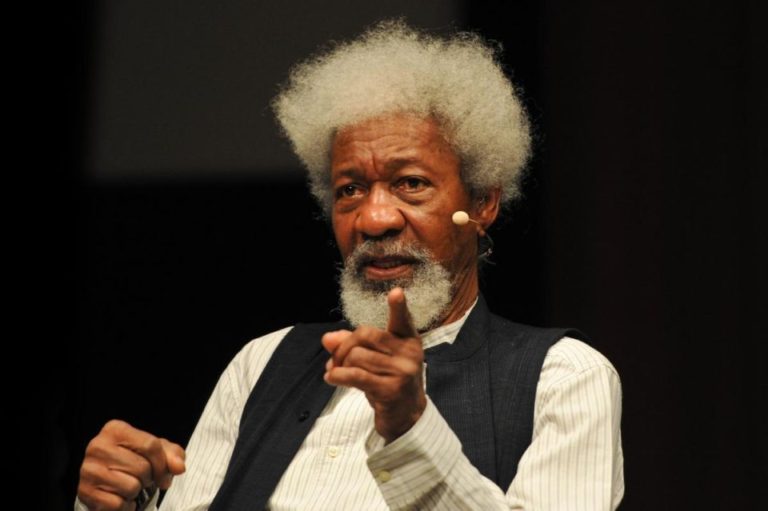
Soyinka distances self from Yoruba nation agitators

NOBEL Laureate Wole Soyinka has distanced himself from statements making the rounds on the social media including WhatsApp of his purported support for the agitation for the Yoruba nation.

A statement signed and issued by his spokesperson Abiola Owoaje, and seen by The ICIR on Tuesday urged the general public to ignore the utterances of those he described as “contemptible interlopers” who lack the courage of their conviction and thus take to Identity Theft for the furtherance of their views.

The statement added that the professor of literature does not express his opinion on national issues on social media except  through the print media.

“For a start, Wole Soyinka does not participate in Facebook, Tweet, Blog, WhatsApp or other offerings of Social Media. Any views that he wishes to express on national and other issues routinely go through the print media,” Owoaje said.

The Yoruba nation agitation is a political ideology driven by Sunday Igboho, a self-acclaimed activist and Ayo Adebanjo, one of the leaders of the Afenifere socio-political to realise the independent and sovereign country for the Yoruba race in Nigeria over what they called the marginalisation of the South-West region.

The agitators have held series of solidarity protest in Ogun, Osun, Ibadan and other parts of the South-West.

Several political leaders in the region have all rejected and kicked against the idea.

Former Governor of Lagos Bola Ahmed Tinubu alongside Speaker of the House of Representatives Femi Gbajabiamila, Bisi Akande and all leaders of the All Progressives Congress (APC) in the South-West, in a meeting in Lagos, last month, called for ethnic and religious unity instead of a divided nation.


Campaign financing: INEC should be unbundled – Omo-Agege

A FORMER Director of Political Parties and Liaison Office of the Independent Electoral Commission (INEC) Regina Omo-Agege has suggested that the Commission should be unbundled.

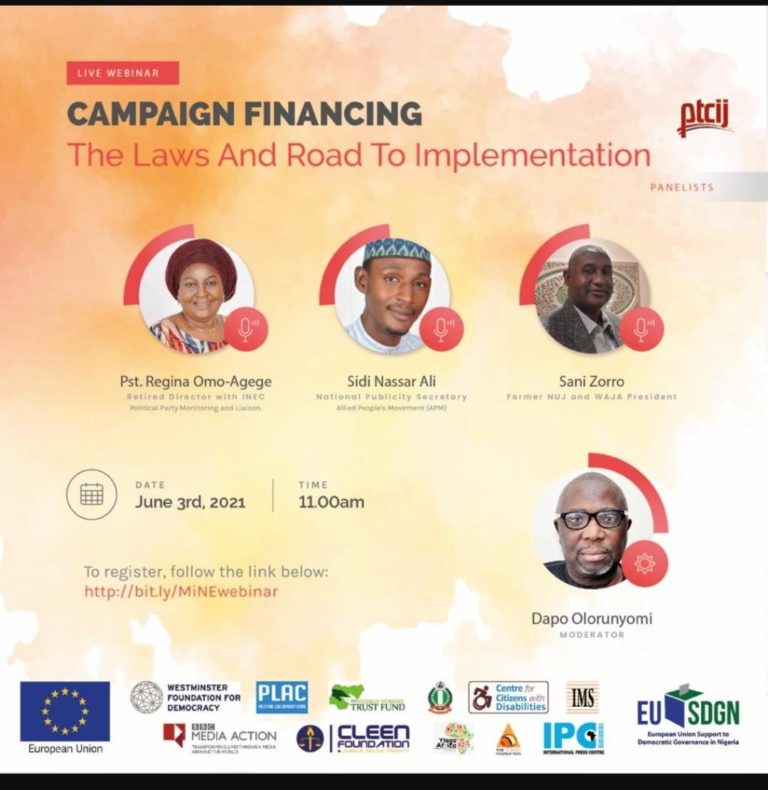
Omo-Agege who is the Executive Director of Women Education, Advocacy and Development Initiative, said this on Thursday when speaking as a panellist during a webinar organised by the Premium Times Centre for Investigative Journalism (PTCIJ) titled ‘Campaign Financing; The laws and road to implementation’.

She called for the unbundling of the Commission in response to a question by a participant who asked if the INEC could set up another arm to monitor affairs of political parties in Nigeria.

“First and foremost, I agree hundred percent that INEC should be unbundled, I am sure INEC themselves wants to be unbundled because the burden on them is too much, so I go for the unbundling of INEC,” Omo-Agege said.

She said, for more than 10 years, INEC has been talking about an agency that would be responsible for monitoring political parties.

Distinguishing between campaign financing and election expenses, she said  INEC has duty to monitor both the finance of political parties during campaign and election.

However, she noted that many political parties have been discreet about their finance.

A former member of Nigeria’s House of Representative, Sani Zorro, who was also a panellist at the webinar underscored the impotence of the  Nigerian parliament regarding election reform.

He said in 2015, the 8th Assembly came up with an amended electoral act, but the executive arm had other interest and did not sign it into law.

He recollected how leadership of the National assembly then wanted to reverse the order of the general elections so that the National Assembly elections would come first, then the Presidential elections later. Still, the Executive arm used all its powers, including threats to ensure it did not happen.

Zoro, who also former president of the Nigeria Union of Journalists (NUJ), questioned the rational of election expenses quota stipulated by the law, saying that it is unrealistic due to the changing economic condition and geographic factor.

According to him, it was impossible for senators from various states to spend the same amount of money considering difference in demographic and geographic factors.

For example, it is not possible for a senatorial candidate in Kano State with 44 local government areas to spend the same amount of money as his counterpart in Bayelsa State with eight local government areas, he explained.


READ ALSO:


On the role of INEC in monitoring the expenses of political parties and candidates, Zorro said since the process was started in 1999, no one has been identified for flouting the law in more than 22 years.

He noted that one of the major problems of INEC was that it was not independent because its members were appointees of the president, who is also a politician and member of a political party.

“I have no regret to say this; it is misnomer to hold the electoral body in Nigeria as Independent Electoral Commission because it is in the purview of the executive arms of the government.

“Its chairman as well as all its commissioners are appointed by the executive branch of government… We do not expect the electoral management in Nigeria as it is presently constituted to go against the interest of the ruling party,” Zorro stated.

Moderator of the session and publisher of Premium Times Dapo Olorunyomi asked the panellists if INEC lacked the power to enforce its regulations on political parties and campaign funding.

The National Publicity Secretary of the Allied People’s Movement (APM) Sidi Nassar Ali concurred, saying INEC lacks the capacity to hold the political parties in check.

He argued that the INEC could track the monies donated by party members and interest groups to political parties with the help of banking institutions if it so wants.

He added that the lawmakers who were supposed to serve as another layer of  regulation also belonged to political parties and would not make regulations that could go against their own interests.

Ali said if INEC had been doing its job, the source of excessive funding and overspending during campaigns and elections would have been identified, investigated and prosecuted.

UNILAG sacks lecturers fingered in sex-for-grades documentary

THE University of Lagos (UNILAG) has dismissed two of its lecturers for sexual misconduct.

The lecturers, Boniface Igbenegbu of the Department of European Languages and Integrated Studies and Samuel Oladipo of the Department of Economics, were fingered in a British Broadcasting Corporation (BBC) sex-for-grades documentary aired in October 2019.

In the documentary, Boniface, a pastor in the Foursquare Gospel Church, was seen making advances at the undercover journalist who pretended to be a 17-year-old girl seeking admission into the university.

“Do you know that I am a pastor, and I’m in my fifties? What will shock you is that even at my age now, if I want a girl of your age, all I need is to sweet-tongue her and put some money in her hand, and I’ll get her,” Boniface had said.

He revealed a place called ‘the Cold Room’ on the school premises where lecturers made love with students. He also continued to assure her that the only way for her was to do his bidding.

The university had responded by suspending the duo pending the conclusion of an investigative panel it set up to look into the allegations.

A statement seen by The ICIR on the university’s website on Tuesday said the institution Governing Council approved their immediate dismissal beginning from May 31, 2021, after the consideration of the findings and recommendations of the panel chaired by former Dean of Faculty of Law Ayodele Atsenuwa.

The statement noted that their dismissal was in accordance with Section 18 of the University of Lagos Act 1967.

The Council further directed that the institution’s management “should review Sexual Harassment Policy as may be necessary and institute effective strategies to prevent future recurrence.”

Six years in office, Buhari’s power reforms yet to ‘light up’ Nigeria

PRESIDENT Muhammadu Buhari tried to undertake some major reforms in the power sector, but his intervention is marred by inconsistencies, overwhelming subsidy payments and recurring grid collapse.

Nigeria’s power sector was unbundled and privatised in 2013 to establish a competitive market to improve management and efficiency, attract private investment, increase generation, and provide a reliable and cost-efficient power supply.

However, the dream to deliver a cost-efficient power supply to Nigerians remains a pipe dream, due to poor leadership and weak regulatory intervention.

For instance,  many public institutions default to pay for power, with debts surging in billions even as government pays subsidies for liquidity shortfall. Also, the pricing for power has been the bane of the sector.

Another key problem is operation deficiencies and non-alignment of various power sector value chains consisting of generation, transmission and distribution, with each constantly trading blames.

The sector, despite privatisation, is weak due largely to underpayment of power costs by consumers which makes subsidy in the power sector thrive despite privatisation.


READ ALSO:

Nigeria risks $400m fine over Mambilla power project as firm drags FG to Int’l court

Global shift to clean energy tests Nigeria’s over-reliance on oil, as Buhari drags feet to deliver PIB

How Twitter revved up Inter-ethnic crisis in Oyo amidst COVID-19 Pandemic

Buhari’s top three agenda in six years


“Many Nigerians bypass power lines to access power without payment. This is hugely affecting cost recovery. There is also low electricity pricing because people are yet to pay the appropriate price for power. Most often we get directive from the Nigerian Electricity Regulatory Commission, NERC not to effect the appropriate price, which contradicts the Electricity Power Sector Reform Act of 2005 on multi-year tariff Order. It also affects cost recovery efficiency.” President of the Association of Nigerian Electricity Distributors,(ANED) Sunday Oduntan told The ICIR.

President Buhari’s interventions to bridge various shortfalls:

Despite being privatised, the Buhari administration has continued closing various gaps in the power sector value chains, including paying over N50bn for subsidy for the sector.

Ahmed Zakari, the Presidential Adviser on Power and Infrastructure revealed that the President is keen and focused on using numerous avenues to close infrastructural gaps in the power sector. He said $3 to $5billion  have been committed to upscale various power infrastructure in the country.

” Through support from the World Bank, we now have $1.6 billion has been devoted for the Transmission expansion programme. We signed another 500 million dollars for the development of the distribution sector. The Central Bank of Nigeria has also put out. Emergency funds for the distribution sector as well as transmission sector in various phases to the tune of 500 million dollars.”

” We also have the SIEMENS presidential power initiative that we’ve signed the engineering agreement. We are also looking at the performance improvement plans of the Discos to enable us to hold them accountable as they receive these support funds. This performance agreement will enable them to align their projects with funds that are available.

“We also have the national mass metering programme which is helping us to improve the revenue and sustainability of the sector while addressing the liquidity concerns in the sector.”

“With this enhanced metering on the service-based tariff, we can see the Nigerian Electricity supply industry generating over N100 billion in the near to mid-term. This is very impressive. The hypothesis that we have is that if you enhance payment discipline through the metering population, revenue will go up. We have proven that, “the presidential adviser said.

Interventions in off-grid power by President Buhari

The federal government through the Rural Electrification Agency, REA has unveiled plans to provide access to power to about  85 million Nigerians not connected to the grid through various off-grid electricity solutions. The plans also extended to connecting targeted markets across the country, and several industrial clusters in other to expand access to power. It also targeted several higher institutions in the country for constant power through solar-powered electricity solutions. The REA drove these initiatives through its energising education, market and industry programmes via solar-powered off-grid connections.

To support the economic recovery in response to the COVID-19 pandemic, the Federal Government of Nigeria (FGN) has launched an initiative as part of the Economic Sustainability Plan (ESP) to achieve the rollout of 5 million new solar-based connections in communities that are not grid-connected. According to the federal government, this program is expected to generate an additional N7 billion increase in tax revenues per annum and $10 million in annual import substitution

The Solar Connection Intervention Facility is expected to complement the Federal government’s effort of providing affordable electricity to underserved rural communities through the provision of long term low-interest credit facilities to the Nigeria Electrification Project (NEP) pre-qualified home solar value chain players that include manufacturers and assemblers of solar components and off-grid energy retailers in the country.

The 5Million Solar Power Naija connection scheme is a Federal government initiative whose objectives are to: Expand energy access to 25 million individuals (5 million new connections) through the provision of solar home systems (SHS) or connection to a mini-grid; Increase local content in the off-grid solar value chain and facilitating the growth of the local manufacturing industry.

It would also incentivize the creation of 250,000 new jobs in the energy sector.

FG intervenes in mass metering to plug liquidity shortfalls

Zakari said the National Mass metering Programme replaced the Meter Asset provider programme to ensure a metering gap of over 6 million is closed.

“Arbitrary billing is one of the key challenges of the sector and we mandated that we transition to national mass metering programme ‘that is full! Funded, and the estimated six million meter gap would be eliminated by the end of the life of this administration. We’re currently in the zero phases now which the Central Bank has provided over N35 billion for.

“The phase zero targeted 1 million meters. We’ve mopped up all the available meters produced locally which is about 600 000 meters indigenously manufactured. The next phase brings in about 4 million meters.400 000 meters have been installed and we track the geolocation, names of every citizens and household that has been metered. Before the end of the life of this administration, we would eliminate the metering gap.” Zakari explained.

He pointed out that arbitrary billing and energy theft are issues that we’re also addressing currently, that is why we are tracking metering and ensuring regulations stop certain untoward practices, he stressed.

Unbundling of TCN updates by the Buhari’s administration

Ahmed Zakari noted that the Electricity  Power Sector Reform Act allows that at the maturing stage of the privatised market, there is a need for the separation of the management of the grid which will be a  new independent systems operator from the transmissions services which builds the infrastructure.

He said: “The Act requires for you to unbundle first before privatisation or commercialise. We’re currently doing both and determining how best to unbundle into the new parts. The National Council of privatisation and the Ministry of Power are currently evaluating that. The second step is to go back to the National council of privatisation, with approaches to unbundling and privatisation.

Zakari noted that the Central Bank of Nigeria has sustained interventions to the Transmission Company of Nigeria, TCN through the Transmission Expansion Programme to plug the gap in transmission infrastructure in the country and provide, Supervisory control and data acquisition, (SCADA) that helps to control grid collapse by enforcing efficient communication in the various power value chain.

“The issue of unbundling of the TCN is NERC’S responsibility as prescribed by the Act. We are currently losing a lot without unbundling the TCN. The day you open up the TCN for proper unbundling, you would solve the problem of dilapidated infrastructure as people would build their own independent transmission. Investors would come in and build their own transmission.” Said Power sector Governance Expert Chuks Nwani.

“This is not good for the system, as you could see the distribution companies trade blames with the TCN once there’s grid collapse issue. We must deliver the unbundling as quickly as possible for the advancement of the power sector.”Nwani stated.

Nigeria’s expectations still unmet

Nigerians waited to harvest the fruit of power sector privatisation embarked upon in 2013, however, the privatisation hasn’t delivered efficiency in Nigeria’s power sector, as calls for review of the privatisation heightened post-privatisation.

For instance, the Multi-Year Tarrif Order, as prescribed by the Electricity Power Sector Reform Act of 2005, stated that the tarrif ought to be reviewed every six months to factor in various variables such as exchange rate and inflation concerns.

These have not been adhered to as adjustment in tarrif clauses has met stiff opposition both from various labour unions in the country, and most recently the legislators who have opposed the adjustments leaving the government with huge payment gaps to bridge the shortfalls through ‘subsidy’ to the power sector.

Against this backdrop on non-adherence to the Electricity Power Sector Reform Act of 2005, and lack of implementation of the multi-year tarrif Order, the federal government has seen its financial support and interventions to the power sector hovering around N1.8 trillion in the past few years.

Despite these subsidy interventions, the current administration still struggles to keep the lights on.

Sale Mamman, the Minister of Power expressing concern on this development disclosed that about N50bn is being paid monthly by the government to assuage the plight of the sector. The monthly subsidy would push the interventions in the sector to N2.6 trillion in a year.

Privatised about seven years ago, the power sector has not been able to stand on its owner’s given historical challenges and deficit of critical infrastructure.

World Bank low ranking of  Nigeria’s power sector.

Nigeria has been enjoying lots of support from the World Bank and the African Development Bank to support efforts to improve power supply.

The World Bank in February approved $500 million to support the government of Nigeria in improving its electricity distribution sector. The project will help to boost electricity access by improving the performance of the Electricity Distribution Companies, Discos through a large-scale metering programme desired by Nigerians for a long time.

The Central Bank, the disbursement agent for the fund had confirmed disbursement of N35.9 billion on mass metering so far.

According to the World Bank,85 million Nigerians don’t have access to grid electricity. This represents 43 per cent of the country’s population makes Nigeria the country with the largest energy access deficit in the World. The lack of reliable power is a significant constraint for citizens and businesses, resulting in annual economic losses estimated at 26.2 billion(N10.1 trillion) which is equivalent to about 2 per cent of GDP.

According to the 2020 World Bank Doing Business report, Nigeria ranks 171 out of 190 countries in getting electricity and getting electricity access is seen as one of the major constraints of the private sector.

“Improving access and reliability of power is key to reduce poverty and unlocking economic growth in the aftermath of the global COVID-19 pandemic,” says Shubham Chaudhuri, World Bank Country Director in a recent press conference.

“The operation will help improve the financial viability of the DISCOS and increase revenues for the whole Nigeria power sector.

In its latest online meeting with the media people, the bank indicated that over 78 per cent of electricity consumers in Nigeria received less than 12 hours of electricity supply daily.

According to the global financial institutions, while 93 per cent of metered power users pains their bills regularly,78 per cent of the electricity consumers in Nigeria received less than 12 hours of supply daily. The bank confirmed that the results it harvested the results after a thorough survey.

Experts stance

PricewaterCooper’s Associate Director, Energy, Utilities, and Resources, Habeeb Jaiyeola noted that fund injection into the sector and mass metering arrangement remained the right way to go. He argued that the sector would have collapsed without the timely intervention of the government.

“It is necessary for the government to continue to keep the industry balanced. Because as of now, even though we have privatised the sector, the government will have to intervene. So that the industry does not collapse.

Mass metering programme stalls as local manufacturers can’t produce enough

“We expect more sensitisation for Nigerians to understand the issues. Nigerians are still not seeing power as a service that needs to be fully paid for. We have issues with cash collection, we have to keep improving on the collection by the Discos, who are constrained by security and other issues. Part of what is causing the poor collection is the absence of full metering, he stressed further.”

Missing N4.1bn: SERAP, stakeholders mount pressure on NASS for probe

Socio-Economic Rights and Accountability Project (SERAP) has restated the call for Senate President Ahmed Lawan and Speaker of House of Representatives Femi Gbajabiamila to launch an immediate investigation into allegations of missing N4.1 billion budgeted for the National Assembly.

About a fortnight ago, SERAP urged Lawan and Gbajabiamila to use their good offices to urgently probe fresh allegations that N4.1 billion of public money budgeted for the National Assembly was missing, misappropriated, diverted, or stolen.

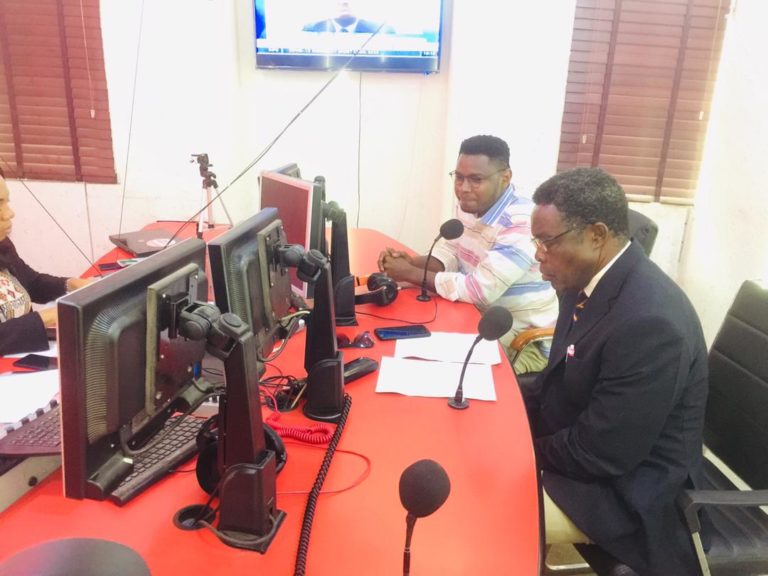
SERAP’s Deputy Director Kolawole Oluwadare urged heads of the legislative arm of government to probe the allegation during a radio program, ‘Public Conscience on Radio,’ produced by the Progressive Impact Organization for Community Development (PRIMORG) every Wednesday in Abuja.

Oluwadare, who frowned at the non-action of the two legislative arms of the government since the report was published by the Office of the Auditor-General of the Federation in 2016, maintained that the rights group was only demanding the National Assembly to come clean on the missing funds.

He noted that if the missing National Assembly fund was not resolved and explained, it would affect citizens’ perception of the legislature and widen the curve of distrust between citizens and the government.

“This report was published since 2016. This is more than five years, one would have expected the National Assembly to look at it and make a proper resolution because the law says they must, but in this instance, because the allegation is against the National Assembly.
“One can understand the unwillingness of the National Assembly, and that’s why we are calling on the National Assembly and Nigerians to support this advocacy to ensure that this is not swept under the carpet. You can just guess how much N4 billion would help to reduce the deficit that we have in the 2021 budget.”

Asked if there had been any reaction from the anti-corruption agencies, he said: “No, not at all, not from public officials, the ICPC, the EFCC, and not from the National Assembly and definitely not from the attorney general.”

But we do hope that EFCC will take this up as it has in the past.”

On his part, Community Engagement Officer at Connected Development (Code) Mukhtar Moddibo condemned the missing money at the National Assembly and commended SERAP’s efforts, decrying that transparency and accountability were seriously lacking in public sector management.

He added that one of the major issues hindering a lot of Nigerians from tracking corruption in the country was non-availability of data.

Moddibbo, however, said that there was nothing concrete done against corruption in Nigeria.

Political and Social Commentator Chidozie Eze attributed the cause of misappropriation of funds over the years at the National Assembly to greed, selfishness, responsiveness, religious and ethnic bias.

According to Eze, misappropriation of funds was widespread in Nigeria because round pegs were put in square holes. He called on Federal Government to strengthen the whistle-blowing policy in order to galvanise more citizens into its anti-corruption war.

Public Conscience is a syndicated weekly anti-corruption radio program used by PRIMORG to draw government’s and citizens’ attention to corruption and integrity issues in Nigeria.

The program is supported by the MacArthur Foundation.