Home Blog Page 1798

#MySARSStory: Framed into a Cultist

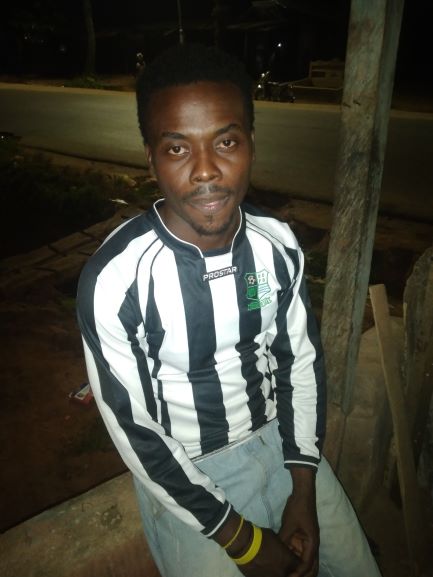
AFTER his arrest, Eze Ebuka insisted he was not a cultist, so SARS tortured him into admitting he was.

I’m Eze Ebuka, a welder, and the first in a family of three.

This is my SARS story.

Around 1 am on Saturday, May 23, 2020, my sleep was disturbed by loud knocking on the door of the main entrance of my home in Ekwulobia, a town in Anambra state.

Five officers of the now-defunct Special Anti-Robbery Squad (SARS) of the Nigeria police had come in over the fence, with guns and machetes, screaming my name.

My mother opened our door, asking why they were calling me at that hour. They said they had a message for me. My mother asked why they did not wait till daybreak. They did not answer, and instead forced their way past my mother, and into our house. They barged into my room – meeting me in my shorts. The officers asked me to throw on some clothes, then scattered my room, looking for something.

I did not know what they were looking for but it was clear they didn’t find it. They then handcuffed me, told my mother they had come from the Central Police Station (CPS) in Nnewi, 25 kilometers west of Ekwulobia. The officers said my mother would have to go to CPS if she wanted to know why I was being arrested.

On the way to the station, the officers asked me to provide names of five cult members if I wanted to be released. I told them I wasn’t a cultist and did not know any cult members. But they accused me of lying and said they would make me confess at the station.

Forced confession

We got to the station at 3 a.m. and I was taken into custody with five other boys they had arrested that morning. I was told I would be the first suspect to be tortured in order for me to confess my cult membership.

I was led somewhere within the station where I was asked to sit on the ground. They asked again if I was a cultist, and I continued to defend myself. I told them that I had a legitimate job that occupied me from the early hours of the day into late night. I told them I had nothing to do with cultists, and I knew of no other family member associated with cultism.

They didn’t believe me. They started to torture me. They bound my legs and hands behind my back, with my head facing the ground. Two of the officers then put rods between my hands and legs, which they used to lift me so I’d be suspended in the air.

Let me tell you, it was a nightmare.

The rod started to injure my hands and legs, so I started crying. It was unbearable, and I remember shouting for help. Some officers came in, and I told them, out of desperation, that I was a cult member. I had no choice. I just wanted the torture to end.

“Do you belong to Aromate (a notorious cult group that usually causes trouble around the Ekwulobia town)?” they asked.

“Yes,” I responded. I was at my breaking point.

“When did you join the cult?” they asked.

“January,” I replied.

“How many members were there when you got initiated?”

“Five,” I lied in response.

They then told me that I had my finger punctured for a blood covenant as part of my initiation process. This was not a question – they were establishing it and asking me to accept it as truth. They were telling me what to say to suit their agenda.

After they were satisfied that I was not resisting, they brought me down. They tortured the other five boys, most of whom were quick to admit to being cult members to escape being tortured.

We were then asked to write statements, which was further torture for me as my hands and fingers had become numb.

Inside the cell, we were beaten by the other inmates. At night, I could not sleep, not only because I was in pain, but also because there was no space for me to even lay my head.

The cell conditions were terrible. Inmates urinated and emptied their bowels at the same place they slept. The officers did not care whether we ate or not – I only drank water, as they didn’t allow my people to bring me food.

All the officers cared about was when our relatives would come to bail us, or if we wanted to make calls to our relatives at a fee they would charge us.

Most people I met in the cell seemed to have stories that suggested they had been wrongly arrested. Some of them told me they had been arrested in place of their sons, whom SARS officers had come in search of and hadn’t found.

I later learned that three of my uncles drove for one hour to the station on the evening of the day of my arrest, but the SARS officers had told them that the officer in charge (OC) was not around. My uncles had to leave and come back again, only to be told the same story. The officers said the OC was yet to return and that it was not possible to obtain bail on a Sunday. My uncles tried again on Monday, then Tuesday, all without success.

One of my uncles got annoyed and threatened to sue unless the officers provided evidence of my cult membership, to which the officers responded by revealing that their OC had miraculously returned.

They asked my family to pay 200,000 naira before they would let me go. My family raised half the money, but the officers claimed it was not enough, especially as it was a cult case.

After three days of detention, the officers accepted the 100,000 naira and let me go.

Back to a difficult life

My mother cried when I returned home.

Before my arrest, I had been saving up to buy my own tools to help me grow out of my apprenticeship, but my savings were pumped into negotiating my freedom.

Following my injuries from the torture, I was stuck at home for three weeks, unable to work.

In my neighbourhood, people really believed that I was a cultist, after hearing that I had confessed to being one. They said I was a sheep in wolf’s clothing, a cult member pretending to be a ‘holy boy’.

To clear my name, I had to go to the local government office to get a court affidavit rejecting cultism. But not even this could change what people thought of me.

I will never forget what I went through. I doubt if I am over it. SARS wounded my body and destroyed my reputation.

It was not a funny experience.


This story is part of a multimedia project by Tiger Eye Foundation and media partners across Nigeria, documenting police brutality in Nigeria, and advocating for police reform.
 

Kwara Poly students to write exams without tuition

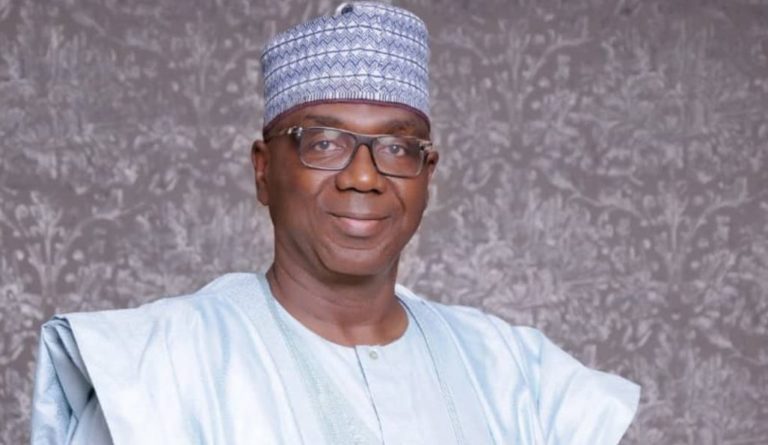
GOVERNOR of Kwara State Abdulrahman Abdulrazaq has directed authorities of  Kwara State Polytechnic to allow all students to sit for their examinations regardless of whether or not they have paid tuition fees.

Abdulrazaq took to his Twitter handle to make this announcement on Monday, May 24.

“I have looked into appeals by students of the Kwara State Polytechnic to be allowed to write their examinations while they pay up their tuition fees at a later date. I granted this request in full appreciation of the extant economic situation in the country.

“However, I appeal to the affected students to reciprocate this goodwill by ensuring prompt payment of their fees which are critical to the effective running of the institution,” he said.

READ ALSOBoat capsizes in Niger State, 100 passengers missing

The governor further wished the students good luck while assuring them of state government’s support for the polytechnic and other educational institutions in the state.

The authorities at the polytechnic had earlier issued a ‘no payment, no exams’ rule for students who were yet to pay their tuition fees.

Students were required to show up at the exam venues with original audited payment slips, in a statement issued by the school’s Registrar Olayemi Olatomi on Friday, May 7.

Mixed reactions trail House of Reps’ bill to scrap NYSC

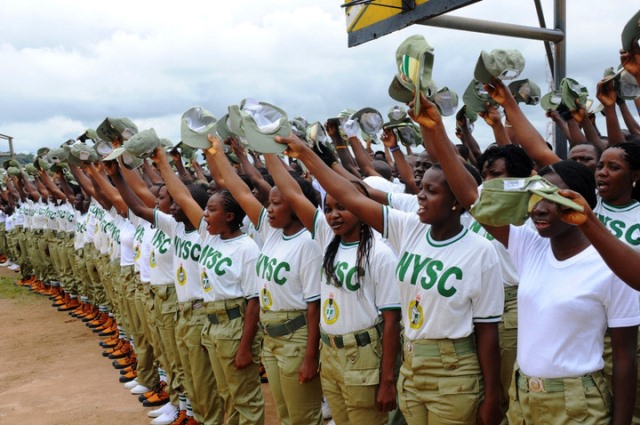
NIGERIANS have expressed mixed reactions over a bill sponsored at the House of Representative to scrap the National Youth Service Corps (NYSC) scheme.

The bill, which was sponsored by a House member representing Andoni/Opobo/Nkoro constituency Awaji-Inombek Abiante, is scheduled to go through second reading.

According to Abiante, the move to scrap the scheme was borne out of the state of insecurity in Nigeria and the rate of unemployment.

The bill argued that due to insecurity across the country, the NYSC management now gave considerations to posting corps members to their geopolitical zone, thereby defeating one of the objectives for setting up the scheme.

However, the bill has met divergent reactions from many Nigerians, some of whom disagreed with the provisions of the bill.  There were equally others who agreed that the scheme should be scrapped.

A Nigerian Twitter user, identified as The_bearded_Dr_Sina @the_beardedsina, supported the provisions of the bill due to the attitudes of some public and private establishments towards corps members.

“I’m so glad they are thinking about scraping NYSC. Just watch the way some wicked businesses, companies and establishments will collapse. Some of these inhumane people will only hire corps members because they don’t want to pay a sensible salary,” Sina said.

Another user,  identified as Docneto, said he also felt that the scheme should be discontinued due to waste of the country’s revenue.

“Ah! I will be so happy if NYSC is discontinued. It’s such a colossal waste of resources. Take all that money and put it into primary and secondary/ vocational education. Won’t hold my breath though. So many entrenched interests benefiting from the scheme,” Neto noted.

Taking the same position as many others, including the sponsor of the bill, a social media user Mr Promise @MisterPromise joined the call, arguing that the service year should be used to acquire skills.

“Going to NYSC is just wasting of a one full year from your life, it’s better you use that 1 year and learn a skill you can earn from #nysc,” Promise argued.

However, many other Nigerians disagreed with the contents of the bill, arguing that the NYSC was an instrument set up to aid national cohesion and provide skills for youths before employment.

TopBoy @blueetin noted that if it was not for the NYSC scheme, many Nigerians would never visit other parts of the country.

Like Topboy, Pelumi @C_Onyedinma, also said the scheme should not be scrapped but maintained that it should be reviewed and restructured.

“I think NYSC should be redeveloped into regional human development programme, where graduate will be trained and mentored for a year on developing solutions to their regions problems,” Pelumi noted.

T kay Oseleye @osee80 also supported the call for restructuring of the NYSC, adding that after the three-week camp, the remainder of the scheme should be spent on vocational training.

“I served in Akwa Ibom 2008 Batch B. I won’t really support scrapping NYSC but restructuring it. Let there be a compulsory 3wks orientation camp…for the remaining years to be sent for vocation training. The will help a corper (corps member) to stand on its own after a year NYSC program,” Oseleye noted.

According to the NYSC Act, the mandate of the scheme was to foster proper encouragement and development of common ties among the Nigerian youths, promotion of national unity and  development of the Nigerian youths and Nigeria into a great and dynamic economy.

The scheme was established on May 22, 1973, after the civil war broke out in Nigeria and threatened the unity of the country.

PROFILE: Life and times of 11 military officers killed in Kaduna crash

CHIEF of Army Staff (COAS) Ibrahim Attahiru and 10 other top military officers were laid to rest at the National Military Cemetery in Abuja on Saturday, a day after a military plane crash  claimed their lives.

The military officers who lost their lives along with the COAS were:   M. I. Abdulkadir, and Olayinka, Brigadiers General; Abdulrahman Umar Kuliya, another Brigadier General, and L.A. Hayat, a Major.

Others were: Hamzat, a Major;  Umar, a Sergeant; T.O. Asaniyi, a Flight Lieutenant; A.A. Olufade, a Flight Lieutenant; Adesina, a Sergeant, and Oyedepo, an Aircraft Man.

Ibrahim Attahiru was born on August 10, 1966 in Kaduna State. He hailed from Kaduna North in Kaduna State, where he completed his primary education in 1978. He was a graduate of the Nigerian Defence Academy (NDA), the Armed Forces Command and Staff College. He was also of the Nigerian Army Infantry Corps and was commissioned as a second lieutenant on December 20, 1986.

He held a master’s degree (M.Sc.) in Strategic Management and Policy Studies from the NDA. He also held a master’s degree in Human Resource Management and Development from Salford University in the United Kingdom.

Attahiru rose to the position of lieutenant brigadier on January 26, 2021.

He held appointments which included but  not limited to: commanding officer of 146 Battalion Nigeria Army in the Bakassi Peninsula; commander, 13 Brigade Nigeria Army;  general  officer commanding 82 Division Nigerian Army; one-time theatre commander of the Operation Lafiya Dole in North-Eastern Nigeria; director of staff duties, and deputy chief of policy and plans at the Army Headquarters.

He was honoured with several awards and medals, including the Forces Service Star, Meritorious Service Star, Distinguish Service Star, Corp Medal of Honour, Command Medal, among others.

He was married with children before his demise on Friday.

Brigadier General Abdulrahman Umar Kuliya, who was the acting chief of military intelligence, was born on February 2, 1968. He was from Kano State and got commissioned into the Nigerian Army on September 25, 1993, as a second lieutenant.

He held a B.Sc. in Mathematics and an M.Sc. in National Resource Strategy as well as Strategy and Security Administration.

Kuliya rose to Brigadier General on September 10 2017 and held appointments which included: platoon commander at the headquarters of the Nigerian Army Intelligence Corps; officer in charge 92 Intelligence Detachment; officer commanding 1 intelligence detachment; second in command, 1 Division Intelligence Group; directing staff at the Armed Forces Command and Staff College,  and theatre command for Operation Lafiya Dole, among others.

He was honoured with the Forces Service Star, Meritorious Service Star, Distinguished Service Star, Golden Jubilee Medal, Silver Jubilee Medal, and several other awards.

He was married with children before his demise.


Also aboard the ill-fated aircraft was Brigadier General Olatunji Lukman Olayinka, who hailed from Ikorodu, Lagos State, and was born on January 13, 1970.

He attended the Nigerian Military School where he completed his secondary education in 1987. He was commissioned into the Army on September 17, 1994, as a second lieutenant and he rose to the rank of brigadier general on September 10, 2017.

He was married and held appointments which included: platoon commander at Headquarters 7 Brigade; aide de camp to the general officer commanding 3 Division Nigerian Army; officer commanding, Ministry of Defence Provost Group; general staff officer Grade 2 Headquarters Corps of Military Police, among others.

Olayinka was honoured with the Distinguished Service Star, Meritorious Service Star, Forces Service Star, Golden Jubilee Medal, Silver Jubilee Medal, River Benue Star, among other awards.


Brigadier General Mohammed Idris Abdulkadir was born on April 19, 1971, in Kaduna and hailed from Niger State.

Abdulkadir was commissioned into the Nigerian Army on Sept 16, 1995, and was of the corps of military police. He rose to the position of brigadier general on August 17, 2017.

He held several appointments including: platoon commander, 82 Provost Company Enugu; officer commanding, 13 Brigade Provost Calabar; adjutant NDA, commander 82 Provost Group Enugu; deputy director, Training Army Headquarters Department of Training and Operations; chief of staff to the chief of Army staff, Army Headquarters.

He was married before his demise and was honoured with awards including: Distinguished Service Star, Meritorious Service Star, Forces Service Star, Golden Jubilee Medal, Silver Jubilee Medal, River Benue Star.


Major Nura Hamza was born on November 20, 1979 in Kano. He hailed from Gusau in Zamfara State and graduated from the Bayero University in 2003. He held a B.Sc. and an M.Sc. both in Economics.

Hamza also held an M.Sc in Business Administration and a Diploma in Computer Science. He was commissioned on the 2nd December 2006 as a lieutenant and became a captain on February 2, 2011.

He rose to the rank of major on Dec 2, 2015, and held several staff appointments including: military assistant, Office of the Chief of Army Staff Directorate of Audit; military assistant, Nigerian Army Post Housing Limited; administrative officer, Nigerian Army School of Finance and Accounts; acting staff officer, Grade 1 Finance Armed Forces Command and Staff College; and acting deputy director of Finance at the Office of the Chief of Army Staff.

He was married and was honoured with the Forces Service Star and the Golden Jubilee Medal in his lifetime.


Major Lawal Aliyu Hayat was born on April 11, 1985, in Kaduna. He hailed from Zaria, Kaduna, and was commissioned into the Army as a second lieutenant on October 4, 2008.

He held a B.Sc in Economics and Accounting and rose to the rank of major on September 27, 2017.

He held several appointments including: platoon commander at the Headquarters Infantry Corps Centre; company second in command at 5 Battalion; instructor, Nigerian Army School of Infantry; and aide de camp to the chief of Army staff at the Office of the Chief of Army Staff.

He was married before his demise.


Flight Lieutenant Alfred Ayodeji was born on February 19, 1992, in Suleja. He hailed from Kogi State.

He joined the Air Force through the Nigerian Defence Academy on August 15, 2009, and held B.Sc. in Accounting from the NDA

He was commissioned as pilot officer on Sept 13, 2014, and was promoted to flight lieutenant on August 15, 2019.

He was serving as a squadron pilot at 307 Executive Airlift Group, Abuja.


Flight Lieutenant Taiwo Olufemi Asaniyi was born on February 25, 1992, in Ibadan and hailed from Onuara in Oyo State.

He joined the Air Force through the NDA on August 14, 2010, and became a pilot officer on September 12, 2015.

Asaniyi held a B.Sc. in Biological Sciences from the NDA, and got promoted to flight lieutenant on August 14, 2020. He got married about two months before his demise.


Sergeant Umar Saidu was born on December 11, 1985, in Das, Bauchi State.

He joined the Nigerian Army on February 28, 2006, and was posted to the Nigerian Army Corps of Military Police.

Saidu was married before his death and became a Sergeant in 2017.

The sergeant served in the Defence Headquarters, Department of Defence Transformation and Innovation as an orderly to the chief of defence training and innovations. He also worked at the Headquarters Training and Doctrine Command as orderly to the chief of doctrine and combat development as well as Army Headquarters Office of the COAS as orderly to the COAS.


Sergeant Opeyemi Adesina Isaiah was born on April 9, 1989, in Kaduna.

Isaiah was recruited into the Air Force on November 2, 2012, and was granted the initial rank of a corporal.

He became a cabin crew member in the Air Force, and upon the completion of his basic military training at the Military Training Centre Kaduna, was posted to the 307 Executive Airlift group Abuja and later to 303 Medium Airlift Group, Ilorin, in 2017.

Isaiah was promoted to the rank of sergeant in September 2016.


Aircraftman Oyedepo Olamide Matthew was born on March 20, 1998, in Osun.

He was granted the initial rank of aircraft man as an aircraft technician and was single.

After completion of his basic military training at the Military Training Centre in Kaduna, he was posted to 203 Intelligence Surveillance and Recognizance Group, Yola, and later to 307 Executive Airlift Group, where he was serving before his death.

The COAS was on his way to Kaduna to attend the passing-out parade of Army recruits scheduled for Saturday, May 22, before the crash which threw the nation into mourning.

Niger State dismisses 20 teachers over certificate forgery, other offences

THE Niger State Universal Basic Education Board (NSUBEB) said it had dismissed 20 teachers in public primary schools for certificate forgery and absence from work.

This was contained in a statement by the Board Public Relations Officer Idris Kolo in Minna on Monday.

The statement read that Chairman of NSUBEB Isah Adamu had disclosed that four teachers were dismissed from Gbako, three each from Bida and two others from Lapai Agaie, Katcha and Lavun Local Government Areas.

Adamu noted that two teachers were also dismissed from Mashegu, Munya and Shiroro Local Government Areas respectively.

The chairman said one teacher was dismissed in Kontagora for dereliction of work.

“The decision was taken at the management meeting in furtherance to the board’s determination at ensuring that only those with requisite qualifications and zeal to work are allowed into the teaching profession. The basic level of education is important; we cannot mortgage it for any reason,” the statement read.

Adamu further stated that the board had resolved to flush out all unqualified teachers in public primary schools as part of its measures to restore sanity in teaching and learning at the basic level of education in the state.

He also said that the board was in its first phase of verification and would continue until all the bad eggs were flushed out.

In 2020, the Niger government said it had sacked 80 per cent of its workers in the State’s Ministry of Education.

This was disclosed by the chairman of a screening committee set up by the state government Ibrahim Panti. He stated that the syndicate behind the printing of the fake certificates of the State College of Education, Minna, was arrested by the police.

He also said that five members of staff of the institution had also been arrested by the police over the matter.

Insecurity: Get licence for dane guns, defend yourselves – Ortom charges Benue residents

BENUE State Governor Samuel Ortom has charged residents to get licences for dane guns and defend themselves against gun-wielding Fulani herdsmen.

Ortom, who spoke at an inter-denominational church service held at the government house in Makurdi on Sunday, said the licence to own a dane gun could be obtained at various local government secretariats in the state.

While stating that he would no longer announce the death of anyone killed by Fulani herdsmen in the state, he charged the people to defend themselves with weapons not prohibited by law.

“I will no longer announce the deaths of those killed by Fulani herdsmen, rise up and defend yourselves with weapons not prohibited by law, bows and arrows, spears and knives,” he said.

“Get a licence for dane guns from local government chairmen and use them to defend yourselves.

READ ALSOGunmen kidnap 200 Islamiyya students in Niger State

“God assured me some time back that as long as I lived within the circle of his presence, no weapon fashioned against me shall prosper.”

The governor’s statement is coming amidst the rising insecurity between farmers and herders in the state.

The clashes have continued unabated despite efforts by the state government to outlaw open grazing in the state.

In April, worried about the killings of seven persons by suspected herdsmen during an attack on an internally displaced persons (IDPs) camp in the Abagena community area of the state, Ortom had called on the Federal Government to declare a state of emergency on security in the state.

At least, 100 people were reportedly killed in four council wards of the Kastina-Ala Local Government Area of the state after gunmen unleashed terror on communities on Saturday.

A spokesman for the Kastina-Ala Council Chairman Tertsea Benga, who disclosed this in a statement on Monday, said over 100 dead bodies had been recovered from many villages in the four council wards.

According to him, most of the corpses were recovered from the bush. He noted that houses of residents in the affected areas were also burnt down by the gunmen.

Benga listed the initially affected villages to include Vingir, Tse Nyipila and Tse Guji all in Mbayongo ward, adding that the attackers proceeded to Kenvanger in Mbatyula council ward on Sunday afternoon.

Benga further recalled that half of the communities in one of the affected localities, Yooyo council ward in the same Katsina-Ala LGA, had earlier been sacked by the alleged armed invaders who killed many people then and in the latest invasion.

He blamed the attack on the collaboration between suspected armed herders and ‘Gana boys’ (loyalists of the slain Benue criminal kingpin Terwase Akwaza, popularly known as ‘Gana’), adding that security personnel, though doing their best, were, however, overwhelmed.

Protesters block Abuja-Kaduna Expressway over rising kidnapping, banditry  

SOME groups of protesters on Monday blocked the Abuja –Kaduna Expressway over the rising spate of kidnapping and banditry in Niger State.

This followed the recent abduction of six persons from the Angwan-Wazobia in the Gauraka area of Tafa Local Government in Niger state.

The protesters, who gathered in numbers to stop vehicular movement along the Abuja-Kaduna Road, lamented that residents in the state were being indiscriminately abducted by armed men.

The protesters, who barricaded the highway by burning tyres, charged the government to find a solution to the insecurity crisis in the state and nearby communities.

Over the weekend, ‘unknown gunmen’ had reportedly invaded the community and abducted 15 persons, killing three others.

The State Police Command also confirmed that some gunmen had on Monday invaded the community and abducted six persons.

This was contained in a statement by the State Police Public Relations Officer Wasiu Abiodun concerning the kidnapping and outrage by the residents of the communities.

Abiodun, who described the protesters as ‘miscreants,’ acknowledged that they had trooped out to protest the kidnappings in the community.

However, he claimed the protesters eventually extended the agitation to the Gauraka police outpost, vandalised and set it ablaze.

The police spokesperson noted that reinforcement had been dispatched from Minna, the state capital, to the Area Commander Suleja as well as a joint task force from Minna – Suleja Highway to restore normalcy on Abuja – Kaduna Expressway.

Hours later, Abiodun informed The ICIR that normalcy had finally been restored to the highway through the efforts of the police and the military.

“The protesters were dispersed at about 12.45hrs, through the combined efforts of the police and the military. Peace and free flow of traffic restored along Abuja – Kaduna Express road,” said Abiodun.

The command urged members of the public to caution their wards against any act of public disturbance, saying the police would continue the onslaught against criminal elements in the society.

However, the police command has been unable to secure lives and property in Niger State, as kidnapping and banditry reign in many parts of the state.

Earlier in April, Governor of Niger state Abubakar Bello had said that Boko Haram terrorists had taken over and hoisted their flags in Kaure village, Shiroro Local Government Area of the state.

Oyo Muslims stage protest in support of Palestinians

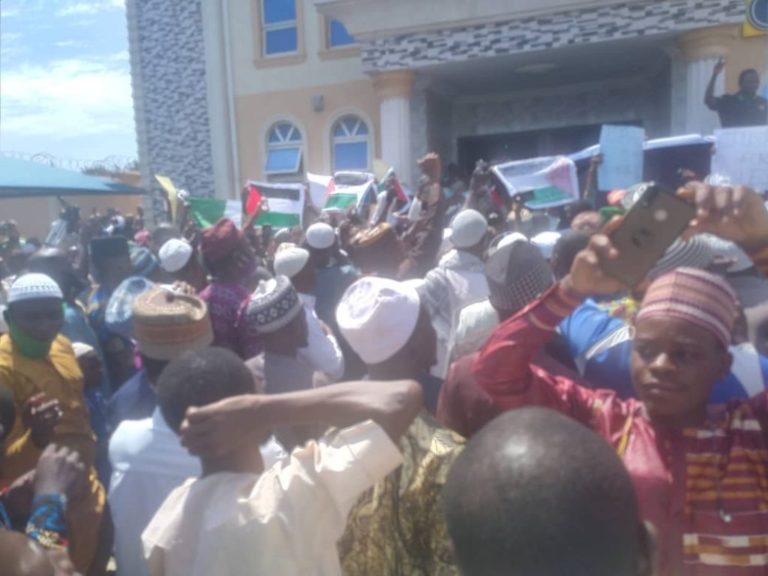
MUSLIMS in Oyo State have staged a protest to express their support for Palestine, condemning the Israeli government for the recent havoc wreaked on Palestinians.

The protesters were led by the Muslim Students Society of Nigeria (MSSN), National Council of Muslim Youths Organisations NACOMYO), the Muslim Congress (TMC), and Organisation of Tadhamunul Muslimeen (OTM) in Ibadan, the state capital, on Monday.

They were seen carrying various placards with inscriptions like “Israel is a terrorist state,” “Free Palestine, Stop the Killing,” “This is not conflict, it’s genocide,” and “Free Palestine, Resist Israel apartheid.”

Former Osun State House of Assembly Speaker Mojeed Alabi, who spoke during the event, called on governments worldwide to speak up and condemn what he called ‘injustices’ being perpetrated against the people of Palestine by Israel.

While noting that the current situation in Palestine was a grave injustice against humanity, Alabi called on nations worldwide to pressure Israel to stop attacking Palestine.

“The issue of crisis in Arab and Jews states in Palestine has become something that is troubling the whole world,” he said.

“Whatever happens in any part of the world has the tendency of affecting all other parts of the world, the people in the Middle-East who are facing the heat are human beings.”

”As a member of United Nations that subscribes to the idea of human rights, we should try as much as possible as a nation to uphold human rights for all manner of people,” Alabi stated.

He also said that the current crisis in Palestine was not a religious issue and added that Palestinian Christians were also facing the same inhumane treatment Palestinian Muslims faced from Israel.

Alabi called for Nigerians to boycott Israel and Israeli products to express displeasure at the current injustice being meted out to Palestinians.

President of the Palestine Community in Lagos Sheikh Ramsy Ibrahim said in his remarks that Israel had never accepted the existence of the Palestinians and had been oppressing them for 72 years.

He also commended President Buhari for always speaking in support of Palestine in the international community and appreciated Nigerians for their solidarity, calling on them to continue to show their support.

Other speakers who spoke at the event said that the world would not shut its eyes to the atrocities being committed by Israel in Palestine if peace was to reign. They called for prayers for the people of Palestine against their oppressors, the Israelis.

Tensions began in east Jerusalem earlier this month when Palestinian protested against the Sheikh Jarrah evictions and Israeli police measures at Al-Aqsa Mosque, a frequent flashpoint located on the mount in the Old City revered by Muslims and Jews.

It became a conflict of concern after Hamas terror groups fired hundreds of rockets into major cities in Israel, who responded with devastating military airstrikes that led to the death of several Palestinians and infrastructures in the Gaza strip.

Last week, the warring parties agreed to a ceasefire deal brokered by the Egyptian government.

FG priortises clean technology, trade agreements in new industrial plan

MINISTER of Industry, Trade and Investment Adeniyi Adebayo, on Monday, disclosed that the Nigerian Industrial Revolution Plan (NIRP) was being reviewed to accommodate new economic realities.

Adebayo noted that the government would prioritise current global economic realities by focusing on clean energy, the Fourth Industrial Revolution, Nigeria’s trade agreements with other nations and the burden of poverty in the new plan.

The minister, who spoke at the commissioning of a chemical solutions manufacturing plant in Lagos, listed the economic realities to include the African Continental Free Trade Agreement (AfCFTA), the imminence of the Fourth Industrial Revolution and climate change.

“The revision of the NIRP will provide a clear and definite path towards a new industrial aspiration, taking into cognisance our recent trade agreements and how we can take advantage of them; ensure a safer environment by adapting the policy to capture the global target of net zero emissions by 2050 and create job opportunities for Nigerians through increased production to leverage the wider market access provided by AfCFTA,” he said in a statement issued by his media adviser Ifedayo Sayo.

The Nigerian government launched its first Industrial Revolution Plan in 2014 during the administration of former President Goodluck Jonathan. The plan was the nation’s first comprehensive and integrated road map to industrialisation while encouraging backward integration.

The focus of the plan was to add about N5 trillion to annual manufacturing revenues within three to five years. This was meant to create jobs, generate wealth, diversify the economy, substitute imports, boost exports, and broaden the country’s tax base.

The Nigerian Industrial Revolution Plan is a five-year plan to rapidly build industrial capacity and improve competitiveness in Nigeria. The plan identifies industry groups where Nigeria has comparative advantage, including agro-allied and agromineral processing; oil- and gas-related industries and construction, as well as light manufacturing and services.

The plan further addresses the numerous issues that have held the Nigerian non-oil sector for years. It addresses the high cost of funding and lack of long-term finance in Nigeria. It also builds industrial infrastructure and power for industry; provides industrial skills, links innovation with industry, improves the country’s investment climate, strengthens products standards and promotes local patronage.

The Policy also linked trade policies with the country investments and industrial policy.

One of the outcomes of the plan was Nigeria becoming the net exporter of cement in Africa within one year.

READ ALSOFactory output expands as Nigerian economy records slight recovery

Adebayo, congratulating the board and management of Pacegate Energy & Resources Limited on the commissioning of the first local content fluids and chemical solutions manufacturing plant in Nigeria, said the new plant represented a significant landmark for the country’s industrialisation programme.

“Domestication of production and backward integration has been at the centre of this administration’s industrialisation programme to drive job intensive growth in the Nigerian economy. They will increase local production, create job opportunities and improve our foreign exchange reserve position. It is, therefore, my pleasure to commission this manufacturing plant which will contribute significantly to the areas I just mentioned,” Adebayo noted.

“I am reliably informed that the company has so far invested a sum of ₦1 billion to achieve an installed production capacity of 12,900MT, which will produce unique and standard oilfield chemicals for local industries in the oil & gas and transportation sectors. I believe this will help in taking us steps ahead in our effort to diversify the economy and increase the contribution of the manufacturing sector to the GDP.

“Most especially, the plant will provide jobs to Nigeria’s workforce. It will also promote local content and save the nation the extra cost of importing the now locally produced input.

“Despite the challenges of the COVID-19 pandemic, the completion of this manufacturing plant at this time demonstrates a deliberate effort by PEARL to support our determination to accelerate the growth of the manufacturing sector.”

FG declares 90 international travellers from Brazil, India, Turkey, UAE wanted

THE Federal Government has declared 90 international travellers from Brazil, India, United Arab Emirates and Turkey wanted, for violating the provisions of the COVID-19 Health Protection Regulations.

The travellers, who arrived in Nigeria through Murtala Muhammed International Airport (MMIA), Lagos, and Nnamdi Azikiwe International Airport (NAIA), Abuja, between May 8 and 15, comprised 63 Nigerians and 27 foreigners.

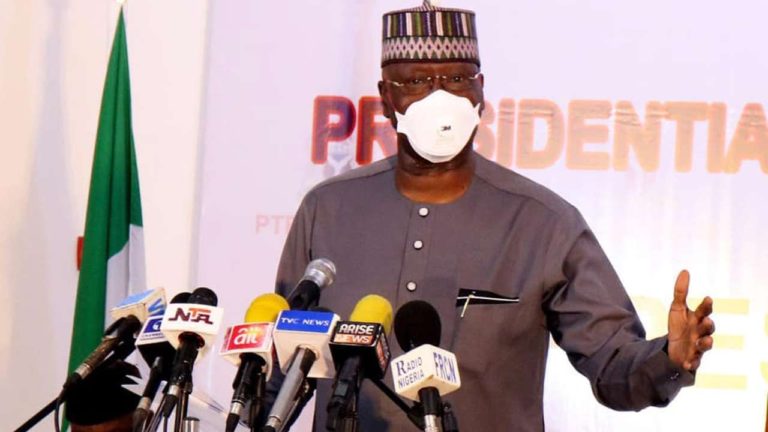
Chairman Presidential Steering Committee (PSC) on COVID-19 Boss Mustapha, on Sunday night, declared the 90 travellers Persons of Interest (PoI), explaining that they posed considerable danger to overall public health for violating the country’s COVID-19 travel protocol by evading the mandatory seven-day quarantine for persons arriving from restricted countries.

“They must therefore transport themselves safely, to the nearest state public health departments within 48hrs of this notice for immediate evaluation and call the Port Health Services, Federal Ministry of Health on 08036134672 or 08032461990 for further directions,” Mustapha said.

Failure to comply with this directive within 48 hours, the PSC said it would take further steps to sanction these violators, including disabling their travel passports for a period not less than one year, cancelation of visas/permits of foreigners that had abused Nigeria’s hospitality, and prosecution under the Covid-19 Health Protection Regulations 2021.

Earlier in the year, a six-month travel restriction from February 5 to July 30 had been imposed on 100 travellers for failing to comply with the Covid-19 protocol.

The PSC, on May 1, issued a travel advisory for passengers arriving in Nigeria from Brazil, India and Turkey. The advisory requires passengers arriving from/or that have visited any of these countries within 14 days prior to the visit to Nigeria to follow mandatory arrival quarantine and testing protocol in designated facilities.

See the full list of the 90 travellers below: