Home Blog Page 1805

Dubawa inducts 26 fact-checkers for 2021 West Africa-wide fellowship

TWENTY-SIX persons have been inducted by Dubawa, a verification and fact-checking platform, into its 2021 cohort of fact-checkers to combat misinformation in the West Africa sub-region.

The platform, which was founded by the Premium Times Centre for Investigative Journalism (PTCIJ), announced the commencement of the yearly fellowship in Abuja on Monday.

Now in its third year, the 2021 fellowship is christened Kwame Karikari Fact-Checking and Research Fellowship in honour of Ghanaian Professor, Kwame Karikari.

Twenty-six (26) successful applicants, drawn from over 200 applications in The Gambia, Ghana, Liberia, Nigeria and Sierra Leone, will, from Tuesday, 18th May undergo training that will equip them in combating the widespread regime of misinformation in the West African sub-region.

“Upon completion and evidence of competence after a ten-course module the participants will graduate into the six months in-country fellowship,” Dubawa Programme Manager Adedeji Adekunle, said in a statement sent to The ICIR on Monday.

READ ALSOSenate seeks 15-year jail term for Nigerians paying ransoms to kidnappers

Adekunle said the training faculty for the programme were drawn from a pool of the leading global experts in the field of fact-checking coming with individual and organisational talents which include: Peter Cunliffe-Jones, founder of Africa Check, and current course co-director/researcher at the University of Westminster in the United Kingdom; Youri van der Weide, researcher and trainer at the global investigative organisation, Bellingcat; and Craig Silverman, author, trainer, and the digital editor, at BuzzFeed.

Others are former Professor of School of Communications, University of Ghana, Legon and Chairman of the Board of the Daily Graphic newspaper in Accra Kwame Karikari; Coordinator of the African Centre for Information and Media Literacy (AFRICMIL) Chido Onumah; DUBAWA Editor Kemi Busari; DUBAWA Programme Manager Deji Adekunle; Ghana Programme Lead for DUBAWA Caroline Anipah; and Executive Director for the PTCIJ Dapo Olorunyomi.

Participants at the course will learn about the accountability journalism ecosystem in the sub-region; how to fix the current information disorder through legal, regulatory responses and through misinformation literacy.

They will also learn fact-checking methodology, the skills and steps involved in fact-checking, ethics of journalism and fact-checking; data presentation and analysis for fact-checking, media literacy, monitoring and analysis of social media content and accounts; investigating websites, as well as freedom of information/right to Information laws in West Africa and the verification of digital tools.

Named after Professor Kwame Karikari, redoubtable media freedom advocate and founder of the Media Foundation for West Africa (MFWA), the fellowship is inspired by the need to tackle the menace of mis- and dis-information within the sub-region and beyond.

DUBAWA is an independent, transparent and non-partisan verification and fact-checking platform, initiated by the Premium Times Centre for Investigative Journalism (PTCIJ) in 2018.

Dubawa aims at instituting a culture of truth and verification in public discourse and journalism through strategic partnerships between the media, government, civil society organisations, technology giants and the public.

Major sectors collapse, confusion reigns as labour shuts down Kaduna

THE five-day warning strike embarked upon by the Kaduna State Council of the Nigerian Labour Congress (NLC) on Monday has paralysed the state.

Socio-economic activities were brought to a halt on Monday, especially in the state capital, where the protesting workers converged.

Schools, banks, railway, airport, hospitals, among other critical facilities, were shut down by the workers.

Power and water supply to various parts of the state were also cut off by the workers.

Joined by its affiliate unions, the NLC embarked on the strike to compel Governor Nasir el-Rufai to reinstate 4,000 workers recently disengaged by the government and pay severance packages of others who had been sacked by the government.

Led by the NLC’s National President Ayuba Wabba, the workers stormed the state secretariat of the union before 8am, carrying different placards against the government, before proceeding to the State House of Assembly and other parts of the state capital.

Many people made panic withdrawals from banks’ Automated Teller Machines (ATMs), while others were seen in markets buying foodstuffs to stock in their homes, according to some residents of the state who spoke with our reporter.

The ICIR reports that many streets in Kaduna recorded very low vehicular movement because of the strike.

Some of the unions participating in the action are: The National Association of Nurses and Midwives; Nigerian Union of Railway Workers; Nigerian Union of Teachers and Non-Academic Staff Union of Educational and Associated Institutions; National Union of Electricity Employees (NUEE; National Union of Banks, Insurance & Financial Institutions Employees; and National Association of Aircraft Pilots and Engineers (NAAPE).

Others are: Association of Nigeria Aviation Professionals (ANAP); Nigeria Union of Petroleum and Natural Gas Workers (NUPENG); National Union of Road Transport Workers (NURTW); Radio, Television, Theatre and Art Workers Union of Nigeria (RATTAWA); National Union of Food Beverage and Tobacco Employees; and Amalgamated Union of Public Corporations Civil Service Technical and Recreational Services Employees (AUPCTRE)

The government has repeatedly said the workers would not be reinstated.

READ ALSOKaduna govt declares NLC president, others wanted

Sack comes after a similar action by government three years ago

Workers’ strike by Kaduna State government is coming exactly three years after the el-Rufai’s government sacked nearly 5,000 of about 16,000 teachers it newly engaged in 2018.

The action is also coming amidst ballooning security crisis in the state.

El-Rufai-led government had, in April this year, carried out  disengagement of workers, citing dwindling revenues and the need to invest in infrastructures and other critical sectors in the state.

The sacked workers were drawn from 23 local government areas of the state; the State Universal Basic Education Board (SUBEB) and the state Primary Health Care Agency.

Governor El-Rufai had said he was not elected to pay salaries, which he claimed was taking nearly 90 per cent of monthly federal allocation accruing to the state.

Efforts by the NLC to convince the government to reverse the downsizing failed, hence the decision by union’s National Executive Council Meeting on April 22 to call for a warning strike in the state.

The NLC had, on May 11, directed all workers’ unions in the state to embark on indefinite strike to compel the government to rescind the sack.

The workers, through their unions, promptly directed their members to comply with the order in letters seen by The ICIR.

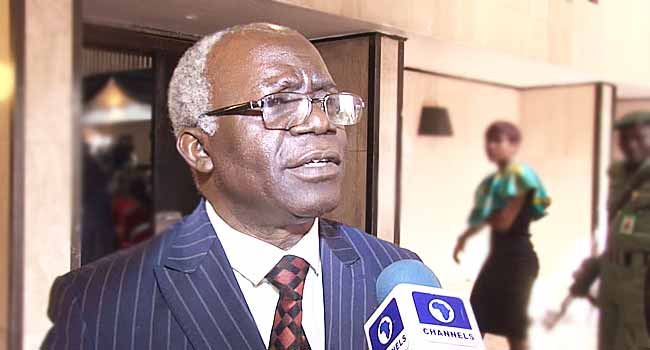
Human rights lawyers, Femi Falani, condemns sack

Femi Falana Alex Ogbu
Femi Falana (SAN)
File Photo for Illustration Purpose

The Interim National Chairman of the Alliance On Surviving COVID-19 And Beyond (ASCAB) Femi Falana has attributed insecurity in the state to unprecedented anti-workers policy of the state government.

Falana, a human rights lawyer and Senior Advocate of Nigeria, said in a statement on Sunday that rather than look for ways to address the economic challenges in the state, the state government had resorted to sacking its workforce.

“The level of insecurity in Kaduna State today is a function of unprecedented, cruel anti-workers policy of the Kaduna State Government, including repeated mass layoffs,” Falana said.

El-Rufai mocks workers, PDP

Responding to call by the opposition Peoples’ Democratic Party’s (PDP) that the government should reverse the sack, el-Rufai, on Saturday, described the party and the NLC’s strike as “Fathers of all hypocrites.”

He said, “Kaduna will wait for you all – the invisible PDP & affiliates like the hypocritical NLC that is yet to implement the National Minimum Wage Act, 2019, for its own employees.”

His claim was corroborated by series of tweets by the state government as reported by The ICIR on Sunday.

While reiterating its decision to ‘rightsize’ the state public service, the government said it was the first to pay the new minimum wage and minimum pension of N30,000 monthly, as well as fund its contributory pension scheme.

It also claimed to have paid over N13 billion inherited arrears of gratuity and death benefits over five years.

“Given the patchy level of compliance with the new minimum wage across the country, how come it is the same Kaduna State that blazed the trail in paying it and has continued paying it at both state and local government levels that some trade unionists are consistently traducing,?” the state queried.

Strike may further worsen insecurity in state

Suspected Bandits.

The ICIR reports that the strike may further worsen insecurity and other socio-economic challenges in the state.

Kaduna State has witnessed increasing banditry and kidnapping in the past months more than any state in Nigeria.

The ICIR had reported in March this year how deaths arising from insecurity were there times higher than what was recorded in the country’s North-East in 2020. Nigeria’s North-East has been the epicentre of insurgency facing the nation in the past decade.

Reports have also shown how bandits in Kaduna State killed 323 people and kidnapped 949 others within three months in the state.

Last month, the state government increased tuition for its tertiary institutions of learning by at least over 300 per cent, in a bid to increase its revenues. The decision received stiff opposition from the students and their parents, forcing the government to put the hike on hold.

Senate President, Lawan, may be impeached soon -Lawmaker

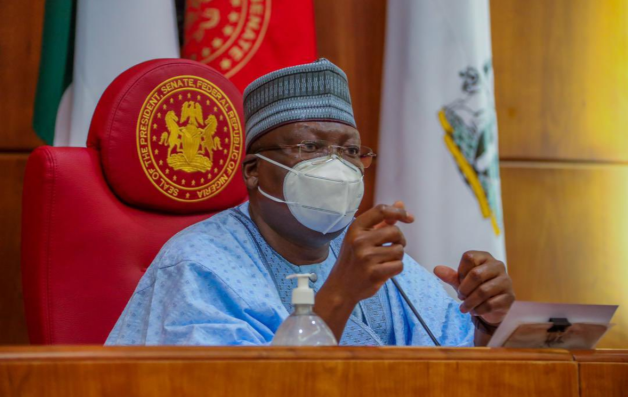
A member of the House of Representatives Sergius Ogun said  the impeachment of  Senate President Ahmad Lawan might be imminent, owing to his comments on the issue of restructuring in Nigeria.

Speaking in an Arise TV interview on Monday morning, Ogun decried the chastisement of 17 southern governors by the Senate President, describing it as disgraceful.

He stated that the National Assembly was in the process of a constitutional review and that the remarks by the Senate President exposed an underlying opposition towards the proposed review, rendering the entire process dead on arrival.

“For him to be talking to governors representing a section of the country like that, he’s not fit to be the Senate president, and I strongly believe that the senators from the south will do something about it this week. I think he should go, and I think the process has started,” he said.

Lawan had condemned the call by the southern governors for a restructuring of the nation, suggesting that it was wrong for elected leaders to champion such movement.

He said this last week at an interview with  State House correspondents after the Eid-Mubarak prayers held at the Presidential Villa.

“I believe that as leaders, especially those of us who are elected into office should not be at the forefront of calling for this kind of thing. Because even if you are a governor, you are supposed to be working hard in your state to ensure that this restructuring you are calling for at federal level, you have done it in your state as well,” he said.

Hisbah arrests 6, confiscates 453 bottles of beer

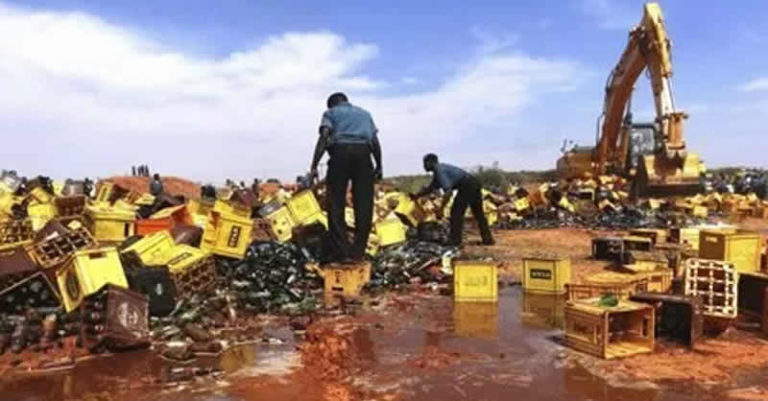
THE Jigawa State Hisbah board, a religious regional security outfit in Northern Nigeria, said it had arrested six persons and also confiscated 453 bottles of assorted beer.

The Hisbah Commander in Jigawa State Ibrahim Dahiru confirmed the arrests and confiscation to NAN on Monday, noting that three women were among the arrested persons.

Dahiru noted that seven litres of local gin were also confiscated from the arrested persons in the Birninkudu Local Government Area of the Jigawa State.

“Hisbah raided a drinking joint in Birninkudu town yesterday at about 9 p.m. where we successfully arrested six suspects, including three females. During the operation, we seized 454 bottles of assorted beer and seven-litre of local gin,” Dahiru said.

Explaining how the items were discovered and confiscated, Dahiru said the suspects were arrested after operatives of the command raided a bar in the area at about 9 p.m. on Sunday.

He noted that the suspects and items had been handed over to the state police command for further investigation.

Last Wednesday, the state Hisbah had also confiscated 308 bottles of assorted alcoholic drinks in the Gumel Local Government Area of the state.

In some states in Northern Nigeria, the consumption and sales of alcohol are prohibited for residents, most especially where the Sharia law is in practice. Some of the states include Borno, Kano, Jigawa, Kebbi, Yobe, Bauchi, Zamfara, Niger, Gombe, Kaduna, Sokoto states, among others.

The ICIR had reported the alcohol hypocrisy by some of the Northern states which had placed bans on alcohol sales and consumptions but receive federal revenue generated from alcohol sold in other parts of the country.

Nigeria’s Oshoala becomes first African woman to win UEFA Champions League

EUROPE’s football governing body UEFA has celebrated Asisat Oshoala as the first African woman to win the UEFA Champions League.

The 26-year-old Nigerian striker was substituted in the 71st minute of the finals with Barcelona defeating Chelsea 4–0 on Sunday night. She scored the fifth goal in last minutes of the game, but it was ruled offside.

Oshoala’s victory comes a day after two other Nigerians, Kelechi Iheanacho and Wilfred Ndidi, who play for Leicester City football club, made history by winning the FA Cup for the first time, breaking a 52-year old jinx.

Reacting to the win, UEFA wrote on its women’s Champions League verified Twitter handle: “@AsisatOshoala is the first African player to win the #UWCL!”

Before the game in Gothenburg, the four-time African Women’s Player of the Year claimed that Barca had learned from their final defeat to Lyon in 2019.

“Now, we have the experience of how European football is and also how a top game like this is played. I think we’re going to be better with our tactics this year, how we go out and play and everything,” she told the media.

In 2019, Oshoala scored Barcelona’s only goal in a 4–1 defeat to Lyon in the UEFA Women’s Champions League Final, becoming the first African and Nigerian to score in a Champions League Final.

Oshoala was the highest goal scorer at the 2014 FIFA U-20 Women’s World Cup and was named best player at the tournament. She was also named best player and second top goalscorer with the Super Falcons team that won the 2014 African Women’s Championship.

In September 2014, Oshoala became a member of the Order of the Niger by President of Nigeria Goodluck Jonathan. In March, she was named among Forbes 30 Under 30 inspirational women.

UN Security Council calls for immediate end to Israeli-Palestinian conflict

THE United Nations Security Council, on Sunday, called for an immediate end to hostilities and bloodshed between Israel and Palestine which have caused unconscionable deaths, immense suffering and damage to vital infrastructure.

In opening remarks, United Nations Secretary-General António Guterres said “the fighting has the potential to unleash an uncontainable security and humanitarian crisis” and to foster extremism, not only in the Occupied Palestinian Territory and Israel, but in the region as a whole.

He expressed deep concern over violent clashes between Israeli security forces and Palestinians across the occupied West Bank, including East Jerusalem, where Palestinian families were under threat of eviction.  In Israel, violence by vigilante-style groups and mobs has added another dimension to the crisis.

“This senseless cycle of bloodshed, terror and destruction must stop immediately,” Guterres said, calling on all parties to respect international humanitarian law and international human rights law.

The secretary general disclosed that the United Nations was actively engaging all sides towards an immediate ceasefire, but stressed that leaders on all sides had a responsibility to curb inflammatory rhetoric and calm the rising tensions.

Palestinian Islamic Jihad and other militants have launched more than 2,900 indiscriminate rockets from Gaza towards Israel. In response to Palestinian militant rocket attacks that began on May 10, Israeli defence forces have conducted 950 strikes against what they said were militant targets, including weapons factories and depots, tunnel networks, Hamas training facilities, intelligence and security headquarters and offices and the homes of senior Hamas and Palestinian Islamic Jihad operatives.

Thousands of Palestinians have been forced to leave their homes in Gaza to shelter in schools, mosques and other places with limited access to water, food, hygiene or health services. Israeli civilians, on the other hand, live in fear of rockets launched from Gaza.

The U.N. Special Coordinator for the Middle East Peace Process Tor Wennesland said that at least 181 Palestinians, including 52 children, had been killed and 1,200 injured in airstrikes. At least 34,000 have been left homeless. In Israel, nine Israelis, including two children, and one Indian national, were killed and over 250 injured.

Minister for Foreign Affairs and Expatriates of the State of Palestine Riad Malki said there were no words to describe the horrors his people were enduring, noting that “Israel is killing Palestinians in Gaza, one family at a time.”

He asked what Palestinians were entitled to do to defend themselves, questioning whether they would receive support for investigations by the International Criminal Court, or deprived of a venue for justice.

Palestinian Ambassador Riyad Mansour wondered how many Palestinian lives it would take for the international community to intervene. The conflict, he said, was not between quarrelling neighbors; it was colonialism.

“There are no people on earth that would tolerate this reality. Israel keeps saying, ‘Put yourselves in our shoes,’ but they aren’t wearing shoes, they are wearing military boots,” Mansour said.

“Why not put yourself in our shoes? What would you do if your country was occupied? What would you do to achieve independence? How many Palestinians killed is enough for condemnation? We know one Israeli is enough, but how many Palestinians?”

The representative of Israel displayed a photo of a 16-year-old Arab girl from Israel, who was murdered on May 12 by the radical terrorist group Hamas. Turning to council members, he asked:  “What would you do if thousands of terrorist rockets were being fired at your country?”

He said for years, Hamas had built a vast web of underground terror tunnels snaking beneath playgrounds, hospital maternity wards and mosques, all in an effort to drive up civilian casualties when clashes occurred.


READ ALSO:


Thanking the United States and all those countries that supported Israel’s right to defend itself from such acts of terrorism, he described Hamas’ attacks — which involved attacking some civilians by hiding behind other civilians — as a ‘double war crime.’

Speaking on Face the Nation on Sunday, Israeli Prime Minister Benjamin Netanyahu said that Israel would “do whatever it takes to restore order and quiet and the security of our people and deterrence.”

“We’re trying to degrade Hamas’ terrorist abilities and to degrade their will to do this again. So, it will take some time. I hope it will not take long, but it’s not immediate,” he said.

The United Nations says it remains deeply committed to working with Israelis and Palestinians and with its international and regional partners, including the Middle East Quartet, to realise a lasting and just peace.

Why labour shuts down Kaduna, plunges state into darkness

THE Nigeria Labour Congress (NLC) on Sunday plunged Kaduna state into total darkness to protest the sack of over 4,000 workers by the state government.

Air and rail transport services in the state were also suspended, as schools, banks and other critical institutions in the state were directed to shut down.

The action is coming amidst the security crisis in the state.

Some of the NLC-affiliated workers’ unions that are participating in the strike are the Nigerian Union of Railway Workers; Amalgamated Union of Public Corporations Civil Service Technical and Recreational Services Employees (AUPCTRE); Non-Academic Staff Union of Educational and Associated Institutions;  National Union of Banks, Insurance & Financial Institutions Employees; National Union of Electricity Employees; Radio, Television, Theatre and Art Workers Union of Nigeria (RATTAWA); National Union of Food Beverage and Tobacco Employees; Air Transport Employees (NUATE), Association of Nigeria Aviation Professionals (ANAP); and National Association of Aircraft Pilots and Engineers (NAAPE).

NLC’s letter to the workers

The Nigeria Labour Congress had on May 11 directed all government workers in the state to embark on an indefinite strike to compel the government to rescind the sack.

The workers, through their unions, promptly directed their members to comply with the order in letters seen by The ICIR.

READ ALSO: Cruel anti-workers policy fuels insecurity in Kaduna, says Falana

“This action is sequel to the industrial tyranny which has been institutionalized by the Kaduna State governor, Mr Nasir El-Rufai, especially as manifest in the recent mass sack and casualization of over 60 per cent of workers in the Kaduna State civil and public service.

“We write to communicate to all affiliate unions of the Nigeria Labour Congress to fully mobilize their members in Kaduna State for complete and indefinite withdrawal of services until a counter directive is issued by Congress leadership. We also direct all affiliate unions of Congress to mobilize their members in the contiguous state to Kaduna,” the state NLC stated.

Kaduna state government had earlier this year disengaged over 4,000 its workers, citing dwindling revenues and the need to invest in infrastructures and other critical sectors in the state.

The sacked workers were drawn from 23 local government areas of the state; the State Universal Basic Education Board (SUBEB) and the state Primary Health Care Agency.

Governor El-Rufai had said he was not elected to pay salaries, which he claimed was taking nearly 90 per cent of monthly federal allocation accruing to the state.

The ICIR reports that the strike may further worsen security and other socio-economic challenges in the state.

Bandits

Kaduna State has witnessed increasing banditry and kidnapping in the past months more than any state in Nigeria.

The ICIR had reported in March this year how deaths arising from insecurity were there times higher than what was recorded in the country’s North-East in 2020. Nigeria North-East has been the epicentre of insurgency facing the nation in the past decade.

Reports have also shown how bandits, who are the main causes of insecurity in Kaduna state, killed 323 people and kidnapped 949 others within three months in the state.

Last month, the state government increased tuition for its tertiary institutions of learning by at least over 300 per cent, in a bid to rev its revenues. The decision received stiff opposition from the students and their parents, forcing the government to put the hike on hold.


Cruel anti-workers policy fuels insecurity in Kaduna, says Falana

THE Interim National Chairman of the Alliance On Surviving COVID-19 And Beyond (ASCAB) Femi Falana has said the insecurity in Kaduna state was a result of the unprecedented anti-workers policy of the state government.

Falana said this in a statement seen by The ICIR on Sunday titled ‘Solidarity and Unity Against Retrenchments in Kaduna State’ over the proposed five-day strike in Kaduna State by the Nigeria Labour Congress (NLC).

According to Falana, the uncontrolled insecurity in the state was the ’harvest’ or product of the State’s anti-labour policies.

Falana, who is also a Human Rights Lawyer and Senior Advocate of Nigeria, said the governor of the state Nasir El-Rufai rather than seeking to address the economic decline in the state, chose to retrench about 60,000 public sector workers.

“The level of insecurity in Kaduna State today is a function of unprecedented, cruel anti-workers policy of the Kaduna State Government including repeated mass layoffs,” Falana said.

He further argued that loss of incomes and livelihood makes people desperate for survival.

Declaring the support of ASCAB on the strike action, Falana said firm action was needed to reverse the massive attacks on jobs and poverty-induced insecurity in Kaduna State.

He noted that even though the Kaduna State may be borrowing from China, the World Bank to fund urban renewal, it is also illegally ‘borrowing’ from its workers to fund almost all of its capital expenditure.

“The mass retrenchments and ‘borrowings’ from wages have almost certainly had a detrimental effect on security in the state.  It cannot be a coincidence that the state with the highest level of sackings also has one of the worst insecurity records,” the statement read.

The Human rights lawyer further said ASCAB welcomes the action of the trade unions while calling on all trade unionists in Kaduna and across the country to ensure the success of the strike actions.

The NLC is set to commence five-day strike action in the state which would cripple all economic activities in the state.

Responding to the declared strike action, the Kaduna State government via series of tweets on Saturday said the government would not subject its policy to veto of a ‘mob’.

The government argued that the state government promotes the welfare of public servants within the larger context of general public welfare adding that it would implement its decision to ‘rightsize’ the State’s public service.

The government boasted that it was the first to pay the minimum wage, and also pays minimum pension of N30,000 monthly, as well as fund its contributory pension scheme and has paid over N13bn inherited arrears of gratuity and death benefits over five years.

“Given the patchy level of compliance with the new minimum wage across the country, how come it is the same Kaduna State that blazed the trail in paying it and has continued paying it at both state and local government levels that some trade unionists are consistently traducing,?” the state government said.

The declared strike action is set to commence tomorrow across the state as workers would down tools in protest of the retrenchment.

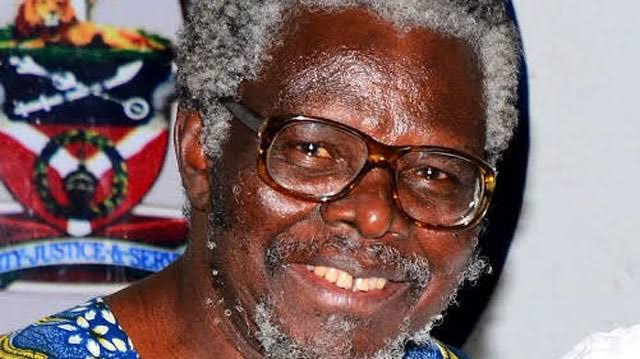
For Edwin Madunagu, a revolutionary icon, at 75 

By Chido ONUMAH 


EDWIN Ikechukwu Madunagu who turns 75 on May 15, 2021, has been a consistent voice for the radical transformation of Nigeria in the last five decades. For this reason, comrades, friends, associates, and students, will organise a conference on the theme: ‘Progressive Politics as the Answer to the National Question: Problems and Prospects,’ to celebrate this revolutionary icon, Marxist, mathematician, journalist and public intellectual.   

This tribute is a reflection on what Edwin Madunagu, popularly called Eddie by friends and comrades, means to me, to Nigeria and the international socialist movement. Eddie has been described by one of his contemporaries and closest comrades, Biodun Jeyifo, Emeritus Professor of African and African American Studies and Comparative Literature at Harvard University, as ‘the greatest materialist historian and archivist of socialism and the Left in Nigeria’s political history.’ 

Eddie was born May 15, 1946, in Okitipupa, in present-day Ondo State. He attended Okongwu Memorial Grammar School, Nnewi, in Anambra State, and Obokun High School, Ilesha, Osun State, for his secondary education, and later studied mathematics at the universities of Ibadan and Lagos. He taught mathematics at the universities of Lagos and Calabar before he and other radical lecturers were sacked in the late 70s by the egotistic military dictator, Gen. Olusegun Obasanjo, for “teaching what they were not paid to teach.” Eddie has published many works, including The Philosophy of Violence (1976), The Tragedy of the Nigerian Socialist Movement (1980), Human Progress and Its Enemies (1982), Problems of Socialism: The Nigerian Challenge (1983), The Political Economy of State Robbery (1984), The Making and Unmaking of Nigeria (2001), Contradictions of Progress: Critical Essays in Defence of Socialism (2002); Radical Politics (2002); Understanding Nigeria and the New Imperialism (2006); The Nigeria Left: Introduction to History (For Eskor Toyo and Biodun Jeyifo) (2016); and The Nigerian Left: Tributes and Criticisms (2016).

In The Nigerian Left: Introduction to History, Eddie says of himself: “I am a Marxist and a socialist and have been so since 1973. I am also strongly influenced by anti-sexism, humanism, and revolutionary internationalism. I have remained committed to what Karl Marx called the categorical imperative, that is the struggle to overcome all circumstances in which the human being is humiliated, enslaved, abandoned and despised…As I have said publicly on several occasions, this commitment comes before everything else, including family, ethnic group and nationality.”

Twenty-five years ago, in 1996, when Eddie turned 50, I wrote a tribute and journeyed to Calabar to join friends and comrades in celebrating this iconic newspaper columnist, mathematician, author and socialist internationalist. I first met Eddie on the pages of The Guardian newspaper where he maintained a must-read Thursday column for almost three decades before I met him in person. Eddie was among those – others were Profs Biodun Jeyifo, Chinweizu, Godwin Sogolo, Femi Osofisan, Kole Omotosho, G. G. Darah, Olatunji Dare and Onwuchekwa Jemie – whose essays in The Guardian shaped the thinking and writings of many of my generation. Humanist per excellence, Eddie brought panache and mathematical meticulousness in explaining even the most complex of historical, political, and ideological issues. I not only read Eddie religiously, I made sure I preserved all his writings, first in hard copies, and subsequently in soft copies when The Guardian joined the Internet revolution.  

Fifteen years ago when Eddie turned 60, I was away in the US. As his birthday approached, I contacted Comrade Bene, herself a radical socialist and feminist activist, founding member of Women In Nigeria (WIN), Girls’ Power Initiative (GPI) and now a retired professor of botany, on the possibility of putting together Eddie’s articles into a book to mark his birthday. Comrade Bene jumped at the idea. But there was the little problem, considering the shortness of time, of how to compile and type Eddie’s articles in The Guardian spanning 21 years. 

What I told Comrade Bene next was music to her ears. I informed her that I not only had copies of Eddie’s articles from when he joined The Guardian in 1985 but that I also kept soft copies from the moment The Guardian went online. That effort culminated in the publication of a 573-page book titled Understanding Nigeria and the New Imperialism: Essays 2000-2006, a collection of Eddie’s articles in The Guardian edited by Prof Biodun Jeyifo, Prof Bene Madunagu, Kayode Komolafe and me.  

Understanding Nigeria and the New Imperialism is a book I find myself referring to each time I want to understand the many problems confronting our country and our world. On page 338 of the book is what I consider one of Eddie’s most endearing reflections on the Nigerian crisis – a tribute to Peter Ayodele Curtis Joseph – which was an essay in The Guardian of June 27, 2002, under the title, “To Remember and to Honour.” Eddie wrote, “Of all the contemporary social developments that currently sadden me, one of the most painful is the disconnection of Nigerians, especially the younger ones, from their own history, including the history of their own immediate environments. I can put my finger on a number of interconnected factors responsible for this historical connection. Our educational system pays little attention to our history. Most of the current generation of teachers are products and carriers of this deficiency, so what do you expect from the new products? Our media, print and electronic, from time to time, put out historical materials and programmes. But many of them are disgustingly eclectic, distorted and full of errors of fact and sequence. Our post-independence history is short, just 42 years. But you are asking for a heart attack if you dare ask any final year undergraduate or young politician to name, in historical sequence, the regimes that this country has had since independence.”

Thanks to social media and the rise of religious fundamentalism, among other factors, the condition Eddie described above has worsened in the last decade. Young Nigerians are not only disconnected, they are also tragically disinterested in the history and future of the country as well as in socio-political events that shape their material conditions. And when they attempt to ‘confront’ these issues, what you get is what Prof Biodun Jeyifo describes in the foreword to the book, Understanding Nigeria and the New Imperialism, as ‘a dialogue of the deaf and the damned.’ Of course, this attitude is not limited to our youth. As Prof Jeyifo notes, it finds expression “within the community of Nigerian radicals and leftists and the broader community of the national intelligentsia – of all shades of ideological opinion.” 

Essentially, what Prof Jeyifo is saying in describing Eddie’s vast and complex body of work is that he (Eddie) shows us that “no meaningful conversation exists” among Nigerians about the future of the country. “What we have is a dialogue of the deaf and the damned. A dialogue of the “deaf” because interlocutors and disputants in our national conversation don’t take the time to listen at all to one another, let alone hear one another as the same issues, the same ideas are repeated and recycled again and again. And a dialogue of the “damned” because we seem headed for a catastrophe that we might not survive this time around as we survived – after a fashion, at least – our Civil War of 1967-70.” 

“The eloquence, clarity and force with which he advances (his) theses mark Eddie out as perhaps the revolutionary conscience of our generation,” notes Prof Jeyifo. In a country in crisis like ours, it is the likes of Eddie that we should turn to for guidance. Twenty-one years ago (May 4, 2000), in an essay in The Guardian on the Biafra agitation titled, “Settling accounts with Biafra,” Eddie wrote, “The young Nigerians now threatening to actualise Biafra should forget or shelve the plan. In place of ‘actualisation’ they should, through research and study, reconstruct the Biafran story in its fullness and complexity and try to answer the unanswered questions and supply the missing links in the story. This is a primary responsibility you owe yourselves: you should at least understand what you want to actualise. If 30 years after Biafra, you want to produce its second edition, you need to benefit from the criticism of the first. History teaches that a second edition of a tragic event could easily become a farce – in spite of the heroism of its human agencies. On the other hand, those who enjoy ridiculing Biafra – instead of studying it – are politically short-sighted. My own attitude to Biafra is neither ‘actualisation’ nor ridicule. I propose that accounts should be settled with Biafra.”

In another essay titled ‘Sovereign conference or civil war?’ (March 16, 2000), Eddie observed: “Nigeria has been reprieved from civil war several times in the past decade. The point is that this reprieve cannot continue indefinitely. Sooner or later history may give Nigeria what the powers-that-be have been reckoning.” 

There are many today, even amid mounting despair and alienation, grinding poverty, hopelessness, terrorism and violence inextricably linked to the renewed onslaught of capitalism, who still have doubts that a post-capitalist world is possible. To such people, I recommend this extract from a tribute to Eddie by Prof Biodun Jeyifo (The Nation, May 15, 2016): “Let us put away the fears, the worries of the faint-hearted among us that socialism is dead in our country and our world. Indeed, without being in the least complacent about the challenges ahead of us, let us rest assured that prospects for a post-capitalist era of political, economic and social justice for the vast majority of our people in Nigeria and the peoples of our planet are as good now as they were more than forty years ago when, in the Anti-Poverty Movement of Nigeria (APMON), we first became, instantly and forever, lifelong comrades in working class activism.”

Apart from my father, perhaps no other person has had as much influence on my life as Comrade Edwin Madunagu and I am proud not only to be associated with him for more than three decades but also to be his protégé. At 75, Eddie spends his ‘retirement’ running the Calabar International Institute for Research, Information and Documentation (CIINSTRID), a free research institution and public library, which he set up in 1994.

I conclude this homage to Eddie by returning to Prof Jeyifo’s tribute. “It so happens that the prospects for a post-capitalist future are indeed much brighter in many other parts of the world than in our country at the present time,” he wrote. “But we are part of the world at large, thanks in part to global capitalism. No comrade that I know understands and appreciates this contradiction better and keener than Edwin Madunagu.”

There is nothing more to add other than to say that the mission of the generation of Nigerians under 40 is to renew the progressive, radical, and popular-democratic traditions of struggle in Nigeria which Comrades Eddie and Biodun Jeyifo (who turned 75 on January 5, 2021) exemplify. You betray that mission at your own peril! 

Part of this tribute appeared in 2016 to celebrate Edwin Madunagu at 70. It has been updated to mark his 75th  birthday on May 15, 2021. Onumah can be reached through: conumah@hotmail.com; Twitter: @conumah

 

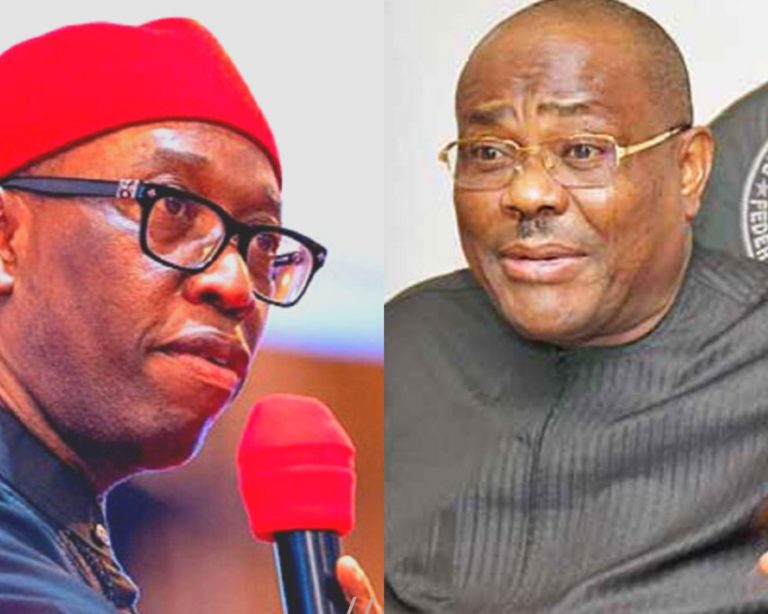
Restructuring: Okowa, Wike hit critics of southern governors

DELTA State governor Ifeanyi Okowa, on Saturday, disagreed with critics of southern governors, stressing that the call for restructuring was not a new thing.

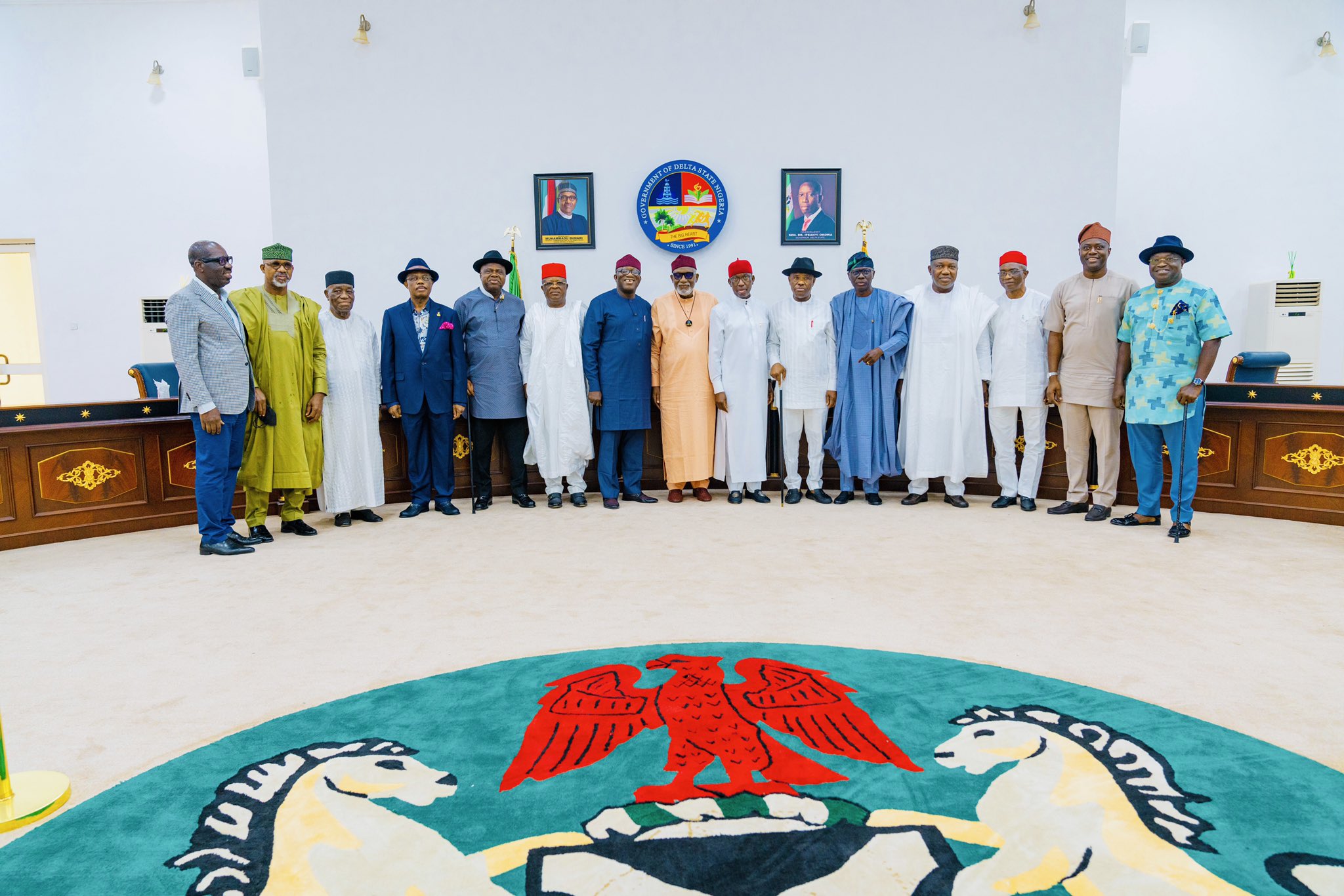
Southern governors of Nigeria at Asaba/ Credit: Twitter

Emphasising that southern governors were only echoing the voice of their people, Okowa maintained on his Twitter handle that it was the right thing to do as leaders of a people who had continuously and audibly made their demands known.

The Southern Governors’ Forum recently held a meeting in Asaba, Delta State, where they called for restructuring of the country and banned open grazing by Fulani herdsmen.

The resolutions did not sit well with some politicians, but Okowa said their resolutions were meant to bring peace to the region and the country.

“We reaffirmed that as a people, as elected governors, we believe in the unity of our country, but we also went forward to advance the need for certain things to be done in order to give strength to that unity,” Okowa said.

READ ALSORestructuring: Only the blind would say things are working well in Nigeria – Reps member, Ogun

On the matter of restructuring, which the governor recognised was what everybody in the country wanted but might differ in their approach, he spoke of the need to “sit and dialogue, in order to decide what is good for Nigeria.”

President of the Senate Ahmad Lawan had criticised southern governors for advocating the restructuring of the country, saying it was inappropriate for elected officials to lead such agitation.

Speaker of the House of Representatives Femi Gbajabiamila had also faulted the call, challenging the governors to replicate restructuring in their states.

There have also been criticisms, especially from politicians from the northern part of Nigeria.

Responding to the critics, Rivers State Governor Nyesom Wike, in a more brazen fashion, said he had “taken further steps to fulfill what the southern governors said in Asaba.”

“We have taken a position and there is no going back. Enough is enough; we are not second class citizens in this country. We also own this country and must partake in this country,” he noted.