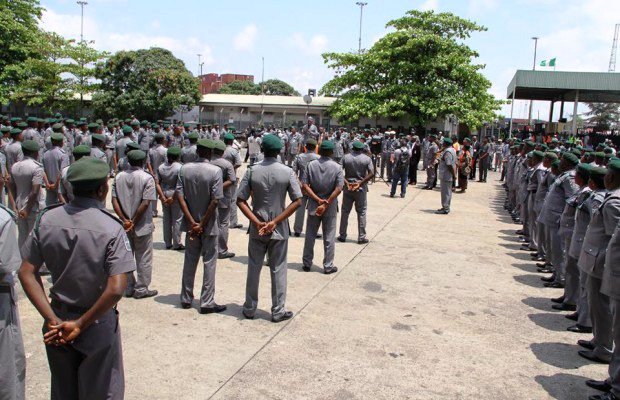
THE Oyo State Command of the Nigeria Police has refused to comment on the alleged killing of five persons by officers of the Nigeria Customs Service on Thursday in the state.
Five civilians were allegedly shot by the Customs officers while they were chasing a vehicle suspected to have smuggled bags of rice.
According to The PUNCH, some residents of Iseyin had revealed that five persons were shot by the Customs officers while chasing a smuggler in the community.
The residents said the five persons killed by the Customs officers were Eid-il-Fitr celebrants.
However, the NCS has said that only three persons were shot and they were killed by the officers in self-defence.
A statement issued by Theophilus Duniya on behalf of Acting Controller of Federal Operations Unit Zone ‘A’ Usman Yahya read that the persons who were shot were ‘hoodlums’ hired by ‘daredevil smugglers’ to attack Customs officers.
The statement said that one of the injured officers was abducted by the hoodlums with his rifle, and his colleagues in the process of rescuing him fired at the hoodlums and killed three of them.
“The assailants had taken the injured officer with his rifle before his team members who acted in self defence, shot at his suspected abductors leading to the death of three of them before he was rescued and taken for immediate medical attention,” the statement read.
It remains unclear how many persons died and the true circumstances that led to their death. Police Public Relations Officer for the Oyo State Command Adewale Osifeso refused to answer calls and text messages sent to him by the reporter.
THE completion of Nigeria’s multibillion naira Mambilla Hydro Project could hit the rocks after a Nigerian company that lost out in the contract bid filed a $400 million lawsuit against the Federal Government.
The lawsuit filed by Nigerian-owned Sunrise Power and Transmission Company Limited (SPTCL) at the International Chamber of Commerce (ICC) in Paris, France, requested the court to order President Muhammadu Buhari’s administration to honour its March 2020 agreement.
The company’s request for an award of $400 million with an interest of 10 per cent was initiated under the ICC’s expedited procedure rules, as specified in the agreements, and should be decided within six months.
The SPTCL claimed it was awarded the contract to build and operate the 3,050-megawatt hydropower facility in 2003, which was followed by the signing of a General Project Execution Agreement (GPEA) with the government in November 2012.
The project was scaled to a 1,525-megawatt hydropower facility at $4 billion, but SPTCL was sidelined in the project by the Ministry of Power, Works and Housing.
Former Minister of Power Babatunde Fashola had granted the same contract in 2017 to three Chinese companies, Sinohhydro Corporation of China, China Ghezouba Group Corporation of China and China Geo-Engineering Group Corporation, to form a joint venture for the execution of the project.
The China Exim Bank was expected to provide 85 per cent of the joint funding with the Federal Government for the Mambilla project, but the bank insisted it would not release the money until the legal standoff ended.
This prompted SPTCL to start court proceedings against Nigeria’s government at the ICC, demanding between $960 million and $2.4 billion in damages.
A settlement agreement was reached with SPTCL last year where $200 million was promised, in return for it dropping all claims relating to Mambilla.
It was also agreed that the Lagos-based firm would be entitled to an additional $200 million-plus interest if the government failed to transfer the agreed sum within 180 days.
President Buhari decided that his administration couldn’t pay the settlement sum, according to a memorandum in August 2020, because low oil prices were hitting the economy due to the outset of the coronavirus.
Initially, the project was conceived in 1982 as a 3,050-megawatt plant on the Donga River, Taraba State to cost $5.8 billion, but it got off to multiple false starts. When completed, the Mambilla project will increase the installed electricity-generating capacity of the country by 12 per cent.
However, findings by The ICIR show that SPTCL is co-owned by Laitan Adesanya, who also doubles as chief executive officer of Lenoil Nigeria Limited, and his wife Ibironke Adesanya, based on a Corporate Affairs Commission (CAC) company search.
In 2016, Adesanya was arrested by the Economic and Financial Crimes Commission (EFCC) for his alleged role in the disbursement of $115 million (N23bn) funds allegedly used to bribe some officials of the Independent National Electoral Commission (INEC) before the 2015 presidential election.
Adesanya was alleged to have handed $1.85 million to Fidelity Bank based on the instruction of a former Minister of Petroleum Resources, Diezani Alison-Madueke.
The mood at Tungan-Madaki, a large settlement around the Nnamdi Azikiwe International Airport and other neighbouring communities in Jiwa Chiefdom of Abuja Municipal Area Council, is that of confusion, fear and despair. The bridge linking the community and other communities in Abuja Municipal Area Council (AMAC) has become a harbinger of death, sorrow and untold hardship.Josephine Ejeh, who visited the community, reports.
FRIDAY, September 20, 2020, is a day villagers in Tungan Madaki District of the Federal Capital Territory, Abuja, will never forget. On that fateful day, the rain was heavy, but it was nothing unusual from the heavy downpours they had witnessed in the past.
School children were looking forward to resuming school activities the following week, but little did they know about the disaster that had just happened.
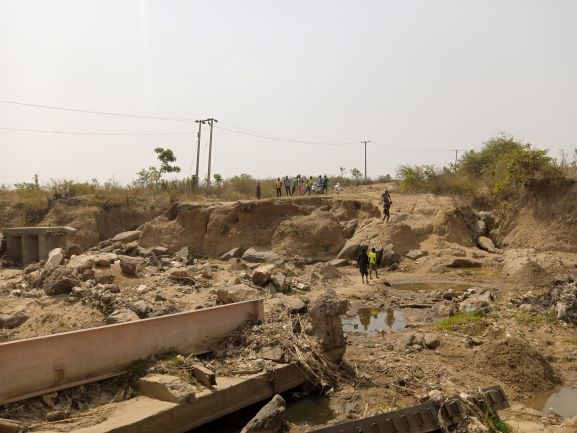
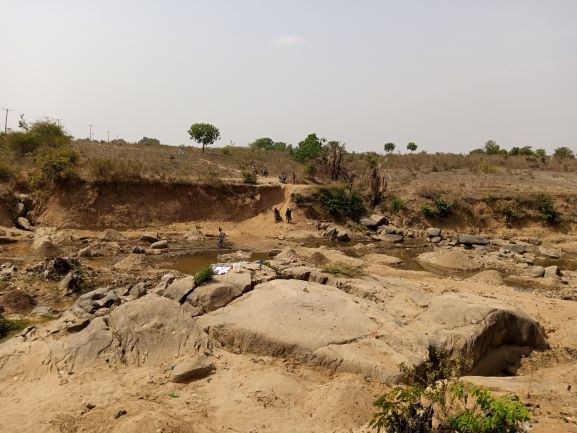
The 80 meter-long bridge, which was the only feeder road linking Tungan Madaki and other communities to the Abuja city centre, had collapsed as a result of heavy downpour, bringing social and economic activities to a halt and putting the education of children in the affected communities on hold.
Farmers heading to their farms were the first to behold the shocking and disturbing sight of the collapsed bridge. Amidst the shock and confusion, they returned to their villages to report the unfortunate incident to the other villagers, who rushed to the scene to catch a glimpse of what remained.
The bewildered crowd stood watching helplessly as they whispered to each other in low tones. Many left the scene wondering where would they start from, how would their children now go to school, how would they be able to continue with their farming business? It was the beginning of their suffering.
For over 50 years ago, the bridge had provided access within 18 communities, including Tunga Ashere, Tunga Wakili, Tunga Nasara, Tunga Kwaso, Angwa Bijimi and others.
Since the bridge collapse, children from surrounding villages no longer go to school in the community, especially during the rainy season because there is no longer an access road.
The river course was said to have gradually widened due to the annual rainfall to the point that the bridge became very small to accommodate the volume of water passing under it.
The damage has added to the problem of communities that also lack basic social amenities such as hospital, school, electricity and potable water supply.
The road has become a death trap, and children can no longer go to school, especially during the rainy season.
The ICIR visited the site of collapsed bridge and witnessed the hardship people of the villages experience. Men, women and children on foot and commercial motorcycle riders make frantic efforts to manoeuvre their ways from both ends of the collapsed bridge.
Far away from the other end, women and children are seen descending or ascending carefully on the steep, crooked road. It was a risky venture as each of them navigate their way.
“Come! Come! Come and video us as we are coming down from the road,” they beckoned to our video cameraman.”
Before he could be done with the coverage, another group struggling to climb from the other end would call on him to focus the camera on them “so that the government can see how we are suffering here.”
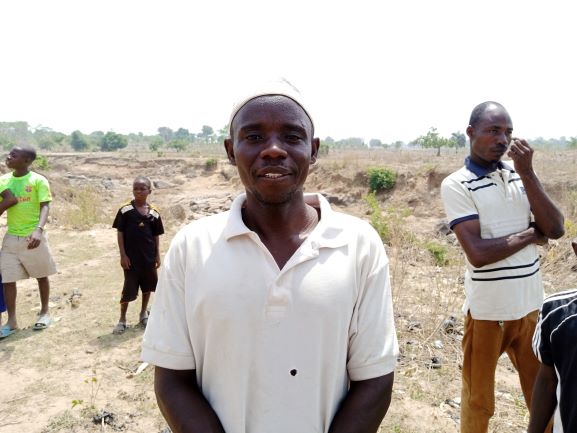
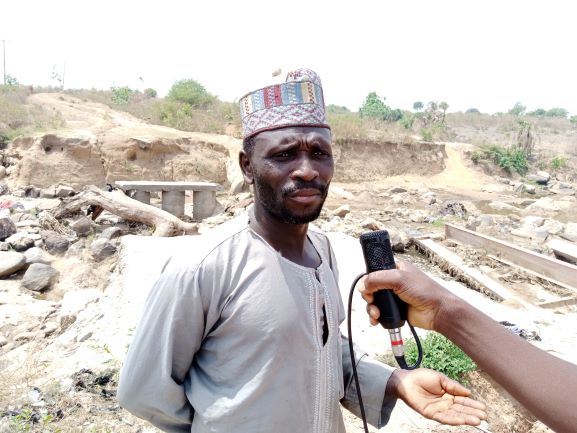
Pointing to the villagers crossing under the collapsed bridge, a representative of the District Head of Tungan- Madaki District, Dahiru Madaki, said: “We are not safe crossing under the bridge at all, especially during the rainy season.
“We are jus putting our lives at risk our lives by crossing under the damaged bridge. We cannot use the bridge anymore when going to the neighbouring communities until we pass under the bridge the way you see these people doing now.”
Dahiru, who spoke on behalf of Alhaji Haruna Mohammed, told The ICIR that since the bridge’s collapse, it has become practically impossible for villagers to pass.
In 2019, when the bridge began to cave in, 15 persons lost their lives while attempting to cross the river. Four were school children who drowned while swimming across the overflown river on their way to the only junior secondary school located at Tungan-Madaki District.
Dahiru confirmed the incident.
“They didn’t want to miss their exams, but unfortunately, they lost their lives while attempting to swim across the flooded river. The other two were crossing to their farms when they drowned,” he recounted their experience with sad feelings.
12-year-old Abdulfatau Madaki was one of the unlucky ones.
He was the kind of child every parent would wish for. Though he was young; he was brave.
When many older people could not muster the courage, the JSS2 student who was skilful in swimming would carry on his back other school children who could not.
At the end of the bridge, he would ease them off to safety and help others. But he later lost his life in the river.
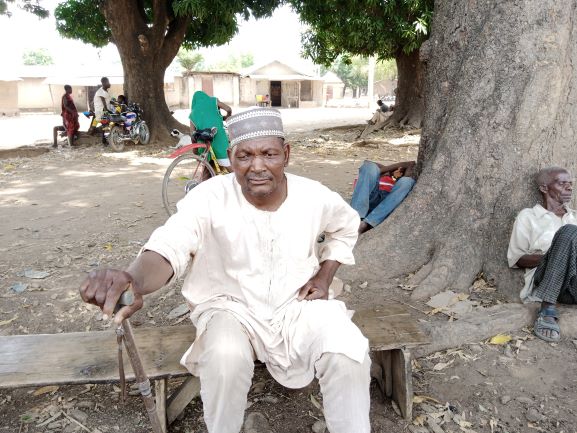
His grief-stricken aged father, Abubakar Madaki, who recounted the incident with bitter feelings, told The ICIR that Abdulfatau was the only one who takes care of him because of his children God-given caring nature.
Abubakar Madaki’s son Abdulfatau drowned while assisting other school children to swim across the river on their way home after school.
“Among all my children, he is the one that shows me more sympathy and takes care of me very much. He was the child I was looking up to really help me at this time that I am becoming very old and weak. Since I lost my child, I have no other person that is taking care of me in this condition I find myself,” he agonised.
On the ill-fated day, he dived into the river, thinking it was business as usual, but the flood overpowered him, and he lost control. The other student at the bank of the river watched helplessly as he disappeared from their sight.
His death left fear in the heart of many villagers, children especially. Abdulfatau is not the only child who has drowned in the river. There was the 8-year-old son of Tungan-Wakili’s head, Alhaji Nuhu Jagaba.
The day he met his untimely death, the river appeared calm and harmless. But that was when the seven-year-old Ibrahim Nuhu left home for school; on the way back home, he encountered a massive flood across the river resulting from a heavy downpour.
Ibrahim drowned while crossing the river with other students, leaving his aged father heartbroken.
“I didn’t know about the incident until about 4 pm that day. I was informed that my son had not returned from school at that time which was very unusual, so we headed for the TunganMadaki community. That was when we were told what happened,” he told our reporter.
While he struggled to put behind the ugly incident, watching the rest of his children idling away every day at home, has been a major source of concern to him.
The children no longer go to the school for fear of becoming a victim of flooding while other children of their age in the safer environment are pursuing their education unhindered.
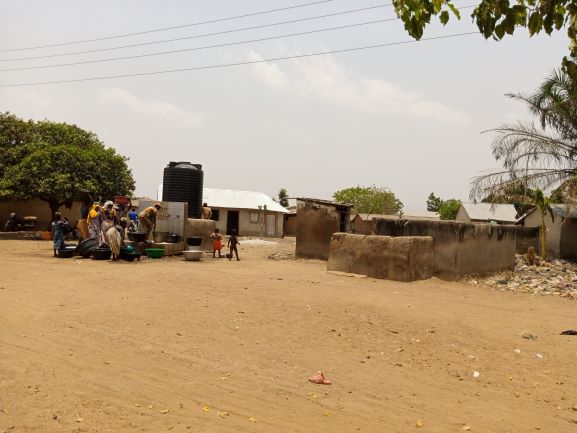
Residents of Tungan Madaki fetching water
“My appeal is for the government to come and rehabilitate this bridge without further delay,” Nuhu pleaded as he struggled to control his emotion.
Dauda Mohammed, a resident of Tsohon-Jiwa who also lost a son to the flooding on the collapsed bridge, said his son, Abdulsalam died on his way to the farm while crossing the river.
“My son was together with some children and some elderly ones. The elders crossed successfully, leaving the children behind. It was in the process that he jumped into the water to swim that the water overpowered him, and he drowned because he doesn’t know how to swim well,” he recanted.
Since the bridge collapsed, women cannot access community clinics and markets, just as the children cannot access schools and farms, especially during the rainy season, for fear of drowning.
Villagers washing dishes and doing their laundry in a section of the river
Impact on children’s education and healthcare
The LEA Primary School and Junior Secondary School in Tungan Madaki were deserted and under lock and key when The ICIR visited.
Most of the children who were candidates for the last Junior Secondary School Certificate Examination were unable to sit for the examinations because the rains were heavy during the examinations.
Not fewer than 20 students from Tungan-Ashere village attending the Junior Secondary School in Tungan-Madaki have withdrawn from the school due to persistent flooding of the river with no hope of returning to the school any time soon.
The revelation by the village Chief of Tungan Ashere, Sani Yakubu, emphasises the adverse impacts of the damaged bridge on the education of children across the affected communities.
He said parents have stopped their children from attending school to avoid risking their lives.
Though the community is mulling the idea of transferring the students to Zuba, Sani said, “our fear is the risks involved because they have to cross the road and the high cost of transportation fare involved. Also, kidnappers and thieves are attacking our people. We haven’t gotten any alternative school closer to our community.
“My appeal to the government is to assist us with this bridge because it is essential to us.”
Corroborating Sani, Yusuf Bin-Abdullahi, a resident of Tunga-Ashere, said the community attempted to get a transfer for the students, “but the school authority advised us to keep them at home that very soon the bridge will be constructed that is why until now the students are at home, but nothing has been done.”
Yusuf, whose two children go to the Junior Secondary School Tungan Madaki, said he always feels unfortunate and scared whenever they leave home for school.
“Once the rain falls, especially during the morning time and the level of the water increases, we usually stop them from going to school because we have been losing a lot of people at the bridge in the process of crossing the river to school and during their daily basis activities,” he said.
The development was a double blow on Yusuf because both children who were candidates missed the JSSC examination, which was conducted during the peak of the rains last year.
Zarau Aliyu missed writing the junior secondary school certificate examination, and may never complete her secondary school education.
The hardship she experienced on her way to school and back is enough discouragement.
During the rainy season, the 19-year-old resident from Tungan-Ashere stays away completely from school as she cannot swim like a few other students who are forced to take the risk.
Narrating her dilemma to The ICIR, she said: “Anytime it rains, and the volume of water is very much, we don’t go to school. The period they fixed our Junior WAEC exams was when it was raining very frequently and heavily, so I could not pass the river to school because I cannot swim. I couldn’t write the junior WAEC because the rains usually overflow the river bank.”
Like other children who could not complete junior school examination progress to senior secondary school, Zarau is depressed that she has to repeat JSS3 class.
Sefinat Adamu, a resident of Tungan Madaki schooling in Zuba, also said she pulled out of school during the rainy season to avoid losing his life.
“I have to go to school in Zuba because we don’t have a senior secondary school in Tungan Madaki where I live or any neighbouring communities. The collapsed bridge is a big risk to us, so we can no longer go to school in Zuba also,” the 15 years old SS2 student who missed the third term promotional examination told The ICIR.
Another student, Badamasi Usman from Tungan Wakili, shared a similar experience. ” Any day it rains, and the river is full. I will not go, but if the river is not full, I will go to school.”
Usman is one of the students who could not write his placement examinations last year due to the flooding.
“Because the river was full, there was no road for us to pass to school. I am not happy because I will repeat the class and now I can’t go to school. I am begging the government to please try and fix the bridge for us,” he pleaded.
Baratu Musa has also ruled out plan to continue school untill the bridge is reconstructed.
Another student who missed her JSSC examination expressed frustration that she has to start afresh.
“We beg the government to build the bridge for us because we cannot go to school to achieve more knowledge without the bridge. We need to achieve knowledge to have a good future.”
Food crisis loom, maternal mortality rises
Apart from the two children the community lost to drowning while attempting to cross over the river, the community has lost other members to the collapsed bridge.
Bemoaning the hardship his community is facing due to the collapsed bridge, the village head of Tungan Wakili, Alhaji Shuaibu Wakili, told The ICIR: “ Even parents are suffering a lot because of our economic affairs. We have lost our mothers when they are in labour on their way to the hospital because we don’t have any other hospital here except the one in Tungan Madaki.”
“ In times of labour, we won’t get it easy until we take somebody to Zuba or Suleja,” the village head who spoke through his secretary, Alhaji Usman Mohammed, said.
Secretary to the village head of Tungan Wakili, Alhaji Usman Mohammed, says pregnant women from his community and other neighbouring villages are dying due to the road’s poor condition.
“Three women in labour also lost their lives because they had to go a long distance through an alternative route from the airport, Ido and Giri axis to access health care in Zuba and Suleja on referral from the only primary health centre in the community.”
The above statement by Dahiru strengthens Usman’s comment earlier, which testifies that pregnant women bear the greater brunt of the abandoned bridge during an emergency.
School children and pregnant women are not the only people affected by the collapsed bridge. Adamu Ashere Idris from Tungan Wakili says farmers like him have also been facing many challenges crossing the collapsed bridge to their farmlands.
Households in the affected communities are suffering losses of income and food security as the hardship they encounter has forced them to cut down the quantity of farmland they cultivate and the quantity of crops they plant.
Sometimes the farmers had to swim to the other side of the bridge to go to their farms. Harvest time was another tougher period for them as they had to cross the river on foot with their farm produce on their head, sometimes losing some of the produce in the process.
While counting the losses suffered by farmers, Adamu told The ICIR: “If you had visited this place some three to four months ago, you would have seen a lot of damaged crops on this bridge in the course of crossing these goods to our homes. In the course of transporting our goods, we find it very difficult, and this is the closest proximity to our various homes.”
“As I am talking to you right now, I am not happy, and I know my parents here too are not happy about the collapse of this bridge. I’m pleading with the Federal government, state government, NGOs and individuals to join hands with the government to fix this bridge so that we can have an easy life,” he added.
Investigation revealed that some of the farmers who risked their lives by crossing under the damaged bridge lost their lives in the process.
Efforts by villagers to get government intervention
While the abandoned bridge has continued to wreak havoc on lives, the relevant government authorities expected to come to the aid of the suffering people have remained insensitive, the residents said.
Haruna Gaku, the education representative for the communities said efforts to get government attention remains futile, even as the collapsed bridge engenders “ backwardness to education” in the affected communities.
The only means of livelihood for farmers like Garba Jiwa in the predominantly farming community is being threatened with the deplorable state of the access road.
“I have been able to contact the College of Education Zuba; the Nigeria National Ecological Fund is about to divert the road linking the community from the new site, so I plead with the provost of the school to include everything together. But am yet to receive any positive outcome from the provost in writing,” he told The ICIR.
A representative of the District Head of Tungan- Madaki District, Dahiru Madaki, confirmed the statement of Mr. Gaku about the insensitivity of the government.
“We started with our counsellor, then the local government chairman, even to the FCDA, but we are yet to see the relevant authorities take visible action. We have been doing so many follow-ups, but there has been no positive action taken yet,” he said.
The ICIR learnt that letters were sent to the AMAC Chairman, Alhaji Abdullahi Adamu Candido, the FCT Minister, Mohammed Musa Bello, House of Reps member Representing the AMAC/Bwari Constituency, Hon Micah Jiba and to the Senator Representing the people of FCT, Senator Philip Tanimu Aduda, copies of which our reporter obtained, but there is no response yet.
“I personally wrote to the Honourable Chairman of AMAC, Alhaji Abdullahi Adamu Candido. I even went to our Royal Highness Alhaji Idris Musa, the Emir of Jiwa Chiefdom. We also went to the House of Reps member representing the Constituency, Hon Micah Jiba and to Senator Philip Tanimu Aduda, and we are still expecting their effort,” Sani Abubakar, the village head of Tungan Ashere, told The ICIR.
FCT Administration denies responsibility
Meanwhile, all the relevant authorities in the FCT approached by this reporter have denied responsibility for the bridge as they continued to shift responsibility to each other, as none openly admitting being responsible for rehabilitating the abandoned bridge.
Despite all entreaties, the Abuja Municipal Area Council (AMAC), the Federal Capital Territory Administration ( FCTA) have turned deaf ears to the people’s plights.
The Spokesman of the Federal Capital Development Authority (FCDA), Richard, said it is the responsibility of the AMAC to rehabilitate and reconstruct the bridge.
“Please be informed that the site visit to the Bridge at Zuba-Tunga Madaki Airport Roadshows that it is a road that existed before the creation of the FCT in 1976.
All such Tertiary roads which link communities are under the purview of the Area Councils, in this case, the Abuja Municipal Area Council(AMAC),” he said in a chat with our reporter.
However, when contacted, the Divisional Head, Building Construction, Work Department in AMAC, Architect Haruna Galadima, denied being responsible for the bridge, saying it is not under their jurisdiction.
Haruna, who shifted the responsibility to the Satellite Town Development Department (STDD)of the FCT said the bridge was constructed by the department. “We are not the appropriate office to speak on the collapsed bridge but the Satellite Town Development Department(STDD),” he said, adding that AMAC had written officially to the STDD to draw their attention to the issue for urgent intervention.
“They constructed the bridge initially, and when the erosion now cut off the bridge, we still reported back to them. Even an engineer came to us from the Federal Ministry of Works and Housing regarding the work. Equally, we told them the scope of the work is beyond the area council, and assure, we direct to the appropriate authorities where the problem can be taken care of in writing,” he said.
But STDD said it is not responsible for the rehabilitation of the bridge, insisting that since the bridge is within the city centre, it is the responsibility of the FCDA.
Explaining, the Coordinator, Engr Felix Obiora Nwankwo said Abuja is 8000 square kilometres, and while the FCDA is in charge of the City centre, which is 250 square kilometres, Satellite Town Development Department is in charge of the outskirts, 7750 square kilometres.
“The 250 square kilometres is bounded by the outer-northern expressway called Kubwa road, starting from Zuba into town to the Villa roundabout. Then we have the outer-southern expressway from the villa roundabout to Gwagwalada and then A2 road from Gwagwalada to Zuba. Anything inside there, including the airport road, is under the FCDA and that Tungan Madaki is at the back of the Airport, so it is the FCDA purview, not satellite town,” he stated.
Contrary to the claim by AMAC that the Satelite Town Department initially constructed the collapsed bridge, Felix said the bridge was constructed in the early 70s. At the same time, the STDD was only stabled in 2004, “so it was not done by Satellite town development department and it is not my area. I cannot go into the city centre and start doing any work because it is not within my jurisdiction.”
The ICIR learnt that aside from the official letters sent by the affected communities to the FCDA and the FCT minister’s office, following complaints received from the public about the faulty bridge, the FCT Call centre had sent a letter to the STDD, which it forwarded it to FCDA.
“The call Centre sent us a letter, and we forwarded it to FCDA that it is their responsibility, not ours. So my duty was to refer that letter from the call l centre to the Department of Engineering Services of the FCDA, so it is their duty to handle that. They may not have any contract there. Yes, it’s an old road that had that bridge.”
Several attempts by this reporter to ascertain the status of the letters sent to the department regarding the abandoned collapsed bridge were not successful as officials could not trace the letters.
At the Deputy Director’s office, City Infrastructure (Central), a staff member claimed the letter is with the regional office. Still, our reporter was denied access to further information on the status of the letter.
Similar efforts made by this reporter to confirm the status of the letter written to the FCT Minister Mohamed did not yield any positive result as the Special Assistant to the Minister on Media and Publicity, Alhaji Sani Abubakar who requested a copy of the letter from this reporter, which was provided, said he could not verify the status because the letters had no stamp of office of the FCT minister indicating receipt.
Further requests by this reporter directed to Sani on what the minister is doing to address the plight of the people were ignored.
Counsellor representing Tungan-Nasara, Tungan Ashere, Tungan Wakili and Tungan Giwa wards, Hon. Sunday Biko could not comment when contacted on the issue as he said he was at the Gwagwalada Specialist Hospital with his daughter, who was in a critical condition.
Asked what steps he had taken to ameliorate the people’s suffering, the House of Reps Member Representing AMAC/Bwari Federal Constituency, Hon. Micah Jiba said he has tabled the matter before the chamber but yet to get a favourable response.
He said he is very disturbed by the issue because the communities affected by the collapsed bridge are predominantly farming, and they are suffering seriously. “I’m not happy about that, he said, expressing hope that the FCT administration will do something about that.”
In a telephone interview with our reporter, the Senator Representing the FCT, Senator Philip Aduda, said it was inappropriate for the communities to have approached him for the issue when they had a local government chairman, the counsellor who was before him.
He, however, said he would put the matter into consideration under the constituency projects of the FCT in due course.
In 2016, 263 million school-aged children, one in five kids globally, remained out of school. The United Nations hopes that by 2030, as part of the Sustainable Development Goals, all children worldwide will complete primary and secondary school, but situations like this may make this harder to achieve.
Without this road, there is no other road for the affected villages to access school and other basic facilities in the district. The affected villagers who have no other place to relocate to from their ancestral home will continue to suffer economic hardship. Threat to their lives and property due to the perennial flooding ravaging the area except the relevant authorities accept responsibility for the bridge and rise to the task of alleviating the sufferings of the people whose interests they swore an oath to protect.
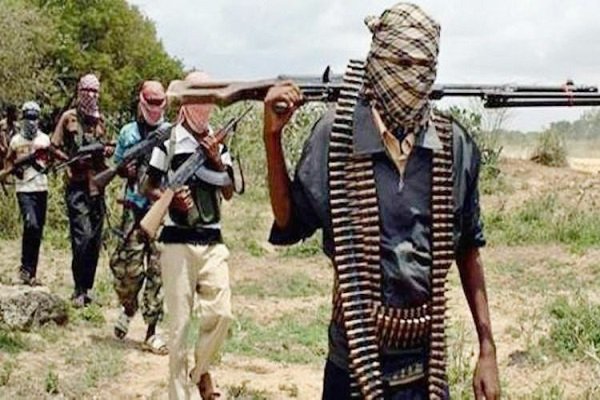
The arrest was, however, not confirmed by the Army, but sources said that Jack Bros Yellow was the leader of one of the three groups of bandits terrorising Shiroro, Rafi and Munya local government areas.
One source said he had contacts with bandits in Zamfara, Kaduna and several states in the north.
Another source said he kept victims who could not pay ransoms conformably with bandits in other states.
A woman at the Internally Displaced Persons (IDPs) in Zumba, Shiroro Local Government Area of Niger State, has been gang-raped by suspected bandits.
The woman, said to be a housewife, was reportedly kidnapped on Thursday when she left the camp to buy foodstuff.
The victim, who is receiving treatment at Minna General Hospital, said the suspected bandits took her to a nearby bush and took their turns in raping her, abandoning her after the incident.
The victim said she lost consciousness and recovered to find herself in the hospital.
Passers-by said she was helped by villagers who rushed her to the primary health care centre in Zumba from where she was taken to Minna General Hospital.
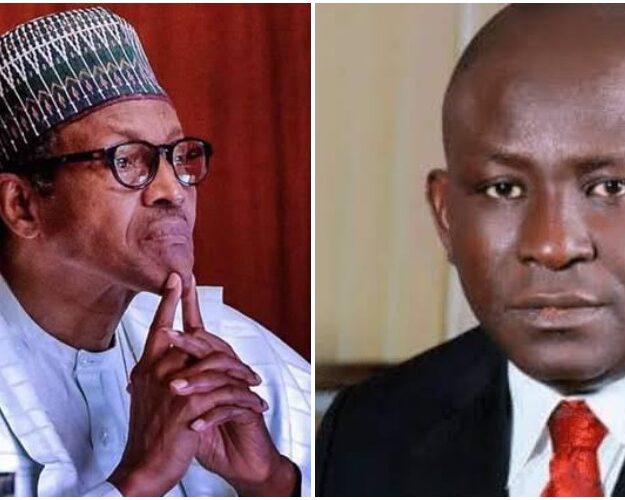
PRESIDENT Muhammadu Buhari’s former son-in-law Gimba Yau Kumo has been declared wanted by the Independent Corrupt Practices and Other Related Offences Commission (ICPC).
A notice signed by the ICPC Spokesperson Azuka Ogugua said Yau Kumo was connected to the misappropriation of the National Housing Fund and the diversion of $65 million.
“Anyone who has useful information on their whereabouts should report to ICPC Headquarters Abuja, any of the ICPC State Offices or the nearest police station,” the notice read.
Gimba Yau Kumo was born on November 5, 1959, in Gombe town, Gombe State.
Yau Kumo had his tertiary education at Ahmadu Bello University, Zaria, from where he obtained a Bachelor of Science in Business Administration in 1983, and went on to acquire a Masters degree in Business Administration and Management (MBA) from Abubakar Tafawa Balewa University in Bauchi in 1999.
He holds the national honour of the Office of the Order of the Niger(OON) and was the recipient of the award of Leadership newspapers in the year 2014.
Gimba Yau Kumo and Buhari’s daughter
Yau Kumo is a member of many professional bodies, including the Nigeria Institute of Management (NIM), a Fellow of the Chartered Institute of Taxation of Nigeria (CITN) and a Fellow of the African Business School (ABS).
In 2010, Yau Kumo was appointed by former Nigerian President Goodluck Jonathan as the managing director and chief executive officer of the Federal Mortgage Bank of Nigeria (FMBN) on December 4, 2010, and his tenure ended in August, 2014.
At the end of his tenure at the FMBN, he was reappointed but was sacked by Buhari in February, 2016, along with 25 other chief executive officers of some parastatals.
On October 28, 2016, he got married to Buhari’s second daughter Fatima Buhari, in Daura, Katsina State, a marriage reported to be his fourth at the time.
The ICPC has accused him of misappropriation of National Housing Funds and diversion of the sum $65,000,000.
The allegation of fraud by the ICPC against Gimba Yau Kumo would not be the first of alleged fraudulent activities linked to him, as he was summoned by the Senate Committee on Public Accounts a few weeks ago to explain an award of a N3 billion contract.
The award was issued in 2011 while he was still the managing director of the FMBN and was described by the Senate as irregular.
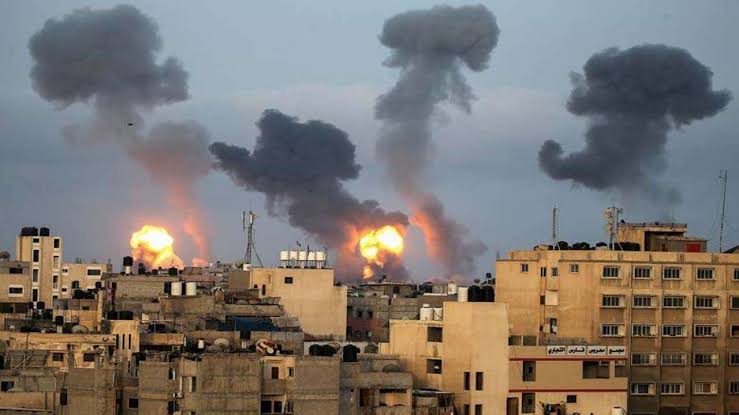
THE week-long war between Israel and Palestine has claimed at least 113 lives, including children. It may trigger a full-blown war and result in a fresh humanitarian crisis amidst the ongoing Covid-19 pandemic, experts have warned.
The United Nations human rights experts expressed grave concerns about Israel’s aggressive response to protests in East Jerusalem, and called on Israel, as an occupying power, to immediately lift its threat to evict hundreds of Palestinian households from their legally protected homes.
“Re-establishing calm in Jerusalem is important, but creating the conditions for justice and equality in the City are even more important,” the experts said in the statement.
Israel continued on Friday to bombard Gaza Strip with air strikes and artillery shells targeting police and security installations, ignoring international calls for calm. Artillery fired reportedly hit the homes of civilians east of Maghazi and in Deir al-Balah area.
On Monday evening through Tuesday, Hamas, the militant group that controls the Gaza Strip, fired hundreds of rockets at Isreal in retaliation of its attack on Muslim worshippers at Al Aqsa Mosque on May 7, after a two-hour ultimatum for Israeli troops to evacuate Al-Aqsa, lift the siege on worshippers and release all prisoners expired.
As at Tuesday afternoon, the Israeli military had conducted more than 150 strikes in Gaza, according to a military spokesman, who said Israel had also called up 5,000 reserve troops to active duty to ‘enhance’ its operation in Gaza.
Hamas leader Ismail Haniyeh urged Palestinian citizens on Friday to go out and demonstrate in protest against the continuing bombardment of Gaza.
A video posted on social media by New Press publication showed several Israeli settlers allegedly attacking Palestinian homes in the city of Hebron in the West Bank early on Friday.
As both sides continue to launch counter attacks, many civilians have been caught in the crossfire – hundreds injured and many rendered homeless in addition to the casualties.
The UN Security Council is expected to meet on Sunday to discuss the situation in Israel and Gaza.
The United States and the European Union have called for a de-escalation of violence while several countries in the Middle East, including Turkey, condemned the Israeli police response to tensions in Jerusalem.
Fresh hostility between Israel and Palestine is also capable of derailing the race towards the equitable distribution of the Covid-19 vaccines and cause global economic slowdown.
THE Taraba State Police Command has confirmed an attack by unidentified gunmen on Gazabu, a community in Bali Local Government Area of the state.
Taraba State Police Spokesperson David Misal, in a phone conversation with The ICIR, said that the attack which occurred on Thursday, resulted in the deaths of about three people.
“The reports we received is that there is an attack by yet-to-be-identified gunmen, which led to the death of three people. That is the number we are able to confirm at the moment,” he said.
He stated that the Police were making efforts to restore peace, as security personnel had been deployed to the area to restrict the spread of violence to other communities.
“The commissioner has ordered the immediate deployment of Police personnel to the area, and investigation has commenced immediately. Also, we are trying to ensure that the attacks do not spread to other communities,” he said.
Like many states in Nigeria, Taraba has been faced with security crises in recent years. The rising spate of insecurity has been the major cause of mass internal displacement in the state.
According to reports, thousands of indigenes have given up their homes and drawn closer to the state capital, Jalingo, for safety. Some fear that their forced migration may be permanent as the violence has claimed several lives, homes, farms and other sources of livelihood.
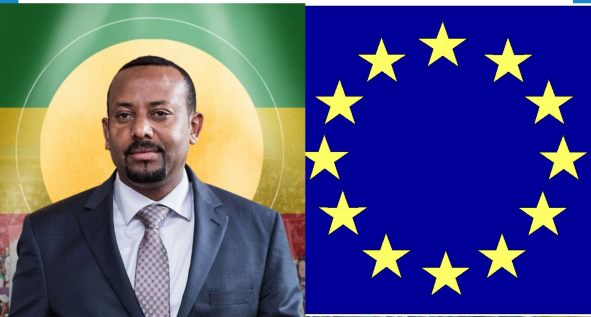
THE parliamentary elections in Ethiopia are set to hold on June 5 without international observers as happened during the presidential election in Uganda.
The European Union (EU), last week, announced its decision to pull out of the Ethiopian election following failure to reach an agreement with the country’s government.
According to the High Representative of the EU to Ethiopia Josep Borrell, the cancellation of the election mission was occasioned by the refusal of the Ethiopian government to fulfil standard requirements needed for the mission.
Borrell said the Ethiopian government refused to grant requirements that would ensure the independence of the mission as well as the importation of communication systems for the observers.
He stated that the import of the communication systems was imperative for the security of the observers, citing the current hostile environment in some parts of Ethiopia.
“It is disappointing that the EU has not received the assurances necessary to extend to the Ethiopian people one of its most visible signs of support for their quest for democracy. The EU encourages the Ethiopian authorities to increase efforts to guarantee all Ethiopians can exercise their legitimate political and civil rights,” Borell said in a statement.
The United States has also questioned the credibility, freeness and fairness of the proposed June 5 election, stating that if the election must hold, a conducive electoral environment must be achieved.
United States Department spokesperson Ned Price said during a briefing on Monday that for a credible election, “the government of Ethiopia must respect the freedom of assembly, the freedom of speech, political participation, and access to internet and information.”
However, as of the time of filing this report, there was still heavy military presence in the crisis-torn Tigray region of Ethiopia where over five million people are said to be in need of emergency care following clashes with the Ethiopian federal government led by Prime Minister Abiy Ahmed.
In September 2020, Tigray drew the battle line with the federal government after conducting a regional parliamentary election despite its postponement by the latter due to the COVID-19 pandemic.
Thousands have now been killed, millions displaced, following several violent attacks between the region and the federal government.
Another Uganda election in the making?
A few months ago, the EU had also pulled out of the Ugandan presidential elections that brought in Youveri Museveni into power for the sixth term on January 14.
The EU did not observe the election on grounds that the Ugandan government had failed to effect or adopt previous recommendations by the Union.
The Union said the Ugandan government had failed to improve on recommended reforms to make the electoral body more independent, eliminate excessive use of force by the armed forces and ensure transparency in result collation.
Before and during the election, there were recorded events of excessive use of force, violent attacks and intimidation by the Ugandan security agencies.
Also, on the eve of the election, the Ugandan government shut down the internet, stating that it was harmful to its people.
As it stands, without a strong observation from foreign missions, there could be a repeat of the events that occurred in Uganda in Ethiopia.
A political and public affairs analyst Lekan Oketokun told The ICIR that Ethiopia could also experience the events that played out in Uganda earlier in January.
On the refusal of the Ethiopian government to grant EU permission to bring in its equipment, Oketokun said the latter could bring in any communication system as long as it did not impede on the sovereignty of the former.
He said elections were international events, even though they appeared local, explaining that states were often subjected to international guidance and conventions, and the government should not dictate to the international union.
However, he noted that the Ethiopian government might have refused to allow the communication systems in order to keep international observers away from witnessing in full-scale some of the human rights abuses being perpetrated by the government in the Tigray region of the country.
“The truth of the matter is that when it comes to elections in Africa, incumbent governments do not like being observed, so they come up with lots of hurdles for election monitors to observe and that does not sit well with many international observers,” Oketokun said.
Human rights campaigner Frank Umeh explained that the EU might have given Ethiopia a reason to rejoice.
“That’s the challenge that Africa has to overcome. Can the right of citizens to vote be guaranteed when there is no one to really monitor the elections? Will there not be rigging by the powerful and party in power?” he asked.
Ethiopian government responds
In a response to questions from The ICIR, the Office of the Ethiopian Prime Minister said it was ‘surprised’ by the refusal of the EU to observe the election.
Making reference to an article, the Ethiopian government said it was ‘unfortunate’ that communications were cited as the deal-breaker.
The Ethiopian government said it had made it clear to the EU that the state-owned telecommunication Ethio-telecom would be the only service provider for the election while other tools could be imported.
The Ethiopian Foreign Affairs Minister said “questioning the effectiveness and efficiency of its services is not a convincing reason to take the hasty decision of cancelling the mission’s deployment.”
The ministry also said the major bone of contention between the parties was about who should be the first to issue public comments over the election’s preliminary findings.
“In the same vein, the EU has also rejected the proposal by the Ethiopian side to include in the Agreement that statements or public comments by the observer mission prior to the issuance of its preliminary findings and conclusions not be prejudicial to the election process or influence the perception of the public, on the result of the election to be announced only by NEBE,” the ministry said.
The Ethiopian government said that in the past, such pronouncements by other EU observer missions had serious repercussions on the country.
On EU refusal to observe the election, the Ethiopian government said “while external observers could add some value to strengthen the quality of electoral processes, they are neither essential nor necessary to certify the credibility of an election.”
As it stands, the Ugandan election could hold without observers from the EU.
TECHNOLOGY developed by United States and Israeli firms was acquired by Nigerian security agencies for forensic surveillance of mobile phones of journalists, according to a report by the Committee to Protect Journalists (CPJ).
The Universal Forensic Extraction Device (UFED) is sold by an Israeli firm, Cellebrite, while the Forensic Toolkit (FTK) is the product of a US company, AccessData.
CPJ said UFED and FTK were used to extract information from phones and computers.
They are also used in breaking into locked devices and decripting information.
Besides Nigeria, other countries where CPJ reported the use of the devices by security agencies to extract information from journalists’ phones were Ghana and Botswana.
CPJ reported that a forensic search was carried out on the mobile phones and computer of the Regional Editor of Daily Trust in the North-East Uthman Abubakar, after he was arrested by the Nigerian military in Maiduguri, Borno State, in 2019.
Abubakar’s phones and computer were seized while he was held for two days and interrogated about his sources concerning a report he wrote on a military operation. He was eventually released without charges.
However, during the period the journalist was held, a forensic search was conducted on his phones and computer.
Seizure of journalists’ phones, computers, a global phenomenon
CPJ noted that the seizure of journalists’ mobile phones and computers – some of their most important working tools – was a global phenomenon.
“CPJ has documented device seizures around the world, from the United States to Slovakia to Iraq,” the journalists’ rights protection organisation said.
The ICIR has observed that several Nigerian journalists have had their mobile phones and computers seized by security agencies.
The seizures are mostly reported in situations where journalists use their phones to record videos and pictures which indict or incriminate the security agencies or political office holders.
Several journalists in Nigeria have also had their phones and computers seized when being questioned about their sources by security agents.
A correspondent of Cable, an online newspaper, Chinedu Asadu, told The ICIR that security agents tried to collect his phone after he recorded a political office holder sharing money at a polling unit during an election in Kogi State.
The security agents, who were working for the politician, wanted the incriminating videos deleted.
CPJ further reported that in Benin Republic, Police copied data from the seized computer of Editor of Nouvelle Economie newspaper Casmir Kpedjo, in April 2019.
CPJ added that when two of its staff were detained in November 2018, intelligent officers collected their phones and computers and boasted about Israeli technology that could extract information from the devices.
UFED and FTK were used to ‘successfully extract and analyse’ thousands of messages, contacts, images, audio and video files, as well as social media accounts and applications, according to an affidavit submitted in court by the Police in Botswana during the prosecution of Digital Editor and Co-founder of Botswana People’s Daily News website, Oratile Dikologang
Dikologang and three others were arrested by the Police in the course of an investigation over Facebook posts. But the journalist, who was detained in April 2020, said he was tortured and questioned over his reports.
According to CPJ, forensic technology designed to extract information from phones and computers was marketed and sold to law enforcement agencies around the world, including those in Nigeria.
Nigerian government spends billions on procurement of surveillance devices
From 2014 to 2017, the Nigerian government spent at least N127 billion on ‘surveillance/security equipment,’ according to a 2018 calculation reported by Paradigm Initiative, a Nigeria-based digital rights group.
“Evidence showed that these purchases were made for political reasons, especially by the authorities in power to monitor their adversaries and political opponents,” the report by Paradigm Initiative said.
Also, checks by The ICIR showed that the Nigerian government budgeted a total of N72.5 billion for procurement of surveillance equipment in the 2021 budget.
The amount includes the sum of N139.4 million allocated to the State Security Service (SSS) for procurement of a surveillance equipment – MG Eyes.
Nigerian security agencies have sweeping powers to search and seize phones, computers and other devices
Although the right to privacy is enshrined in Nigeria’s constitution, and law enforcement agents are required to obtain a judicial warrant to search computer systems under Nigeria’s 2015 Cybercrime Law. The 1962 Official Secrets Act provides sweeping powers for security agencies to grant themselves warrants to search and seize all materials considered as evidence, as well as arrest those suspected of committing offenses under the act.
Nigerian security agencies use UFED and FTK to extract information from mobile phones and computers.
CPJ reported that a source in the Nigerian law enforcement sector admitted that security forces used UFED and FTK to retrieve information from devices.
UFED is sold by an Israel-based company Cellebrite, which is owned by the Japan-based SUNCORPORATION, while FTK is sold by US-based AccessData Group.
Cellebrite’s website says the UFED product can extract and decode every ounce of data within digital devices. It added that the equipment is deployed in 150 countries.
Company records stolen by hackers and reported by VICE News in 2017 suggested client relationships with Russia, Turkey, and the United Arab Emirates.
US federal law enforcement agencies have also invested in the Cellebrite technology, according to media information and procurement information listed online.
A case study published in Cellebrite’s website disclosed that in Nigeria, authorities seized a drug lord’s Samsung phone during his arrest and extracted and analysed data from it using UFED.
In the same vein, The Washington Post reported in May 2019 that Cellebrite’s UFED was used in Myanmar to pull documents from the phones of then jailed Reuters journalists Wa Lone and Kyaw Soe Oo.
Cellebrite said it required clients to uphold the standards of international human rights law or it might terminate their agreements, according to the Washington Post’s report.
Also, Cellebrite’s terms and conditions state that products, software, and services are to be used in a manner that does not violate the rights of any third party.
But the firm did not respond to CPJ’s observations that the use of the product by security agencies would always violate rights of journalists.
AccessData advertises FTK as a tool to identify information on any digital device or system producing, transmitting or storing data, including from web history, emails, instant messages, and social media.
It also boasts capacity to decrypt files, crack passwords, and build a report, all with a single solution.
In 2011, System Trust, a Nigeria-based digital security company, established a sales partnership through DRS, a South Africa-based cybersecurity company, to distribute AccessData technology.
Nigerian officials failed to respond in the CPJ report.
Also, spokesmen of various Nigerian security agencies refused to react to the report when contacted by The ICIR.
Those contacted included spokesman of the Nigerian Army Muhammed Yerima; Nigerian Police Force Public Relations Officer Frank Mba, and spokesman of the SSS Peter Afunanya.
Separate Whatsapp messages sent to the officials were not replied.
However, there have been instances where security agencies targeted mobile phones while looking for ‘incriminating’ materials to use against journalists who are hounded for doing their job.
In 2010 the SSS detained a journalist in Akwa Ibom State Kufre Carter for allegedly leaking a phone conversation that detailed the internal crisis in the management of the COVID-19 pandemic in the state.
Kufre’s lawyer Inibehe Effiong, in a statement, disclosed that a director of operations of the SSS demanded the journalist’s mobile phone to enable the security agency to ‘extract the record and details’ of a purported audio conversation they alleged he had with a medical doctor.
Also, on October 21, 2020, two journalists from The Punch Newspapers Segun Odunayo and Femi Dawodu were assaulted by the Police who also seized their phones while they were covering the #EndSARS protests at the Alausa area in Lagos State.