THE Nigerian Government has extended the work-from-home directives for civil servants on Grade 12 and below, as part of the preventive measures targeted against the spread of COVID-19 across the country.
The announcement was made on Monday in a press briefing by the National Incident Manager Mukhtar Mohammed, who also stated that a nation-wide curfew would be introduced by midnight of the same day, which would run from 12AM-4AM, daily.
“All government staff on GL. 12 and below are to continue to stay at home until 11th June, 2021,” he said.
Mohammed encouraged non-government workers to work from home where possible, and to avoid large meetings as well as ensure that offices were well ventilated.
He urged the mobile courts to enforce on-the-spot fines and to close off premises that repeatedly violate rules adding that there would be a mandatory use of face masks and other NPIs.
“Encourage the use of approved Ag-Rapid Diagnostic Tests as recommended in the guidance for the use of approved COVID-19 AG-RDTS in Nigeria (on NCDC website),” he said.
Mohammed hinted that security agents had been saddled with the onus of enforcing all the non-pharmaceutical measures which had been put in place by the government.
The first COVID-19 case was recorded in Nigeria on February 27, 2020, after an Italian citizen had arrived Lagos from Milan, Italy. He was confirmed positive by the virology laboratory of the Lagos University Teaching Hispital (LUTH)
The ICIR had reported that about 165,000 positive cases had been recorded in Nigeria, since then, and 156,000 persons have been discharged, while 2,065 persons have died of the virus.
The Nigerian government was also reported to have vaccinated over one million people out of about 200 million people living in Nigeria.
EIGHT years after power privatisation in Nigeria, electricity distribution companies (DisCos) have failed as private businesses, leaving millions of Nigerians without meters.
The DisCos have, however, preferred to charge outrageous estimated bills to customers, providing little guidance on households willing to get meters.
In a 2020 report, the Nigerian Electricity Regulatory Commission (NERC) said six million customers had not been metered. Only 3. 918 million households out of the total customer population of 10.374 million, representing merely 37.7 per cent, were metered.
Being a private business, nine DisCos are expected to provide pre-paid and post-paid meters to Nigerians who should now be seen as customers. But they have failed to do so as private businesses, estimating huge bills to struggling consumers.
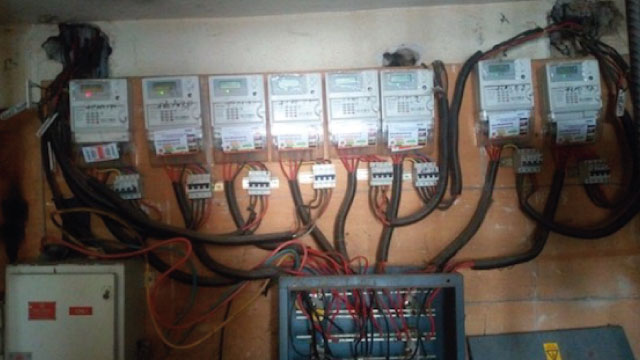
The impact of this is that many Nigerians, especially those living in middle- and low-brow locations, do not have electricity meters, but pay huge estimated bills monthly to the DisCos.
At Ilamose, Oke-Afa area of Lagos, Ikeja Distribution Company has failed to meter many households. The company has, however, raised its estimated bills at will.
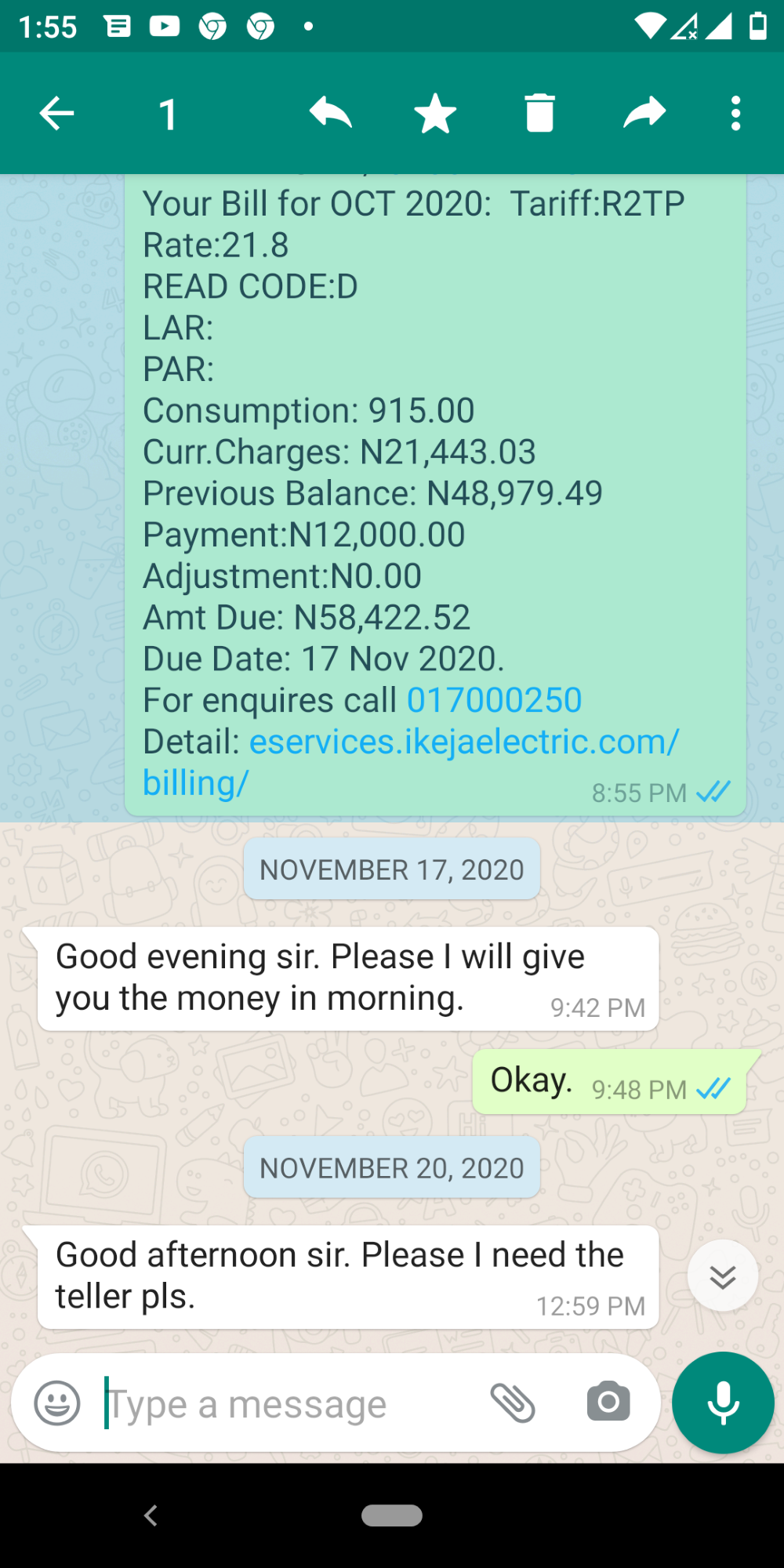
From N8,500 in May 2019 , Ikeja Disco raised its electricity bill to N10,300 in November 2019 at Ilamose, Oke-Afa area. The amount increased to N16,023 in December 2019 and further to N18,279 in May 2020 – in the middle of COVID-19 pandemic when several households were not allowed to run their businesses. It likewise increased to N20,927 in September 2020 and to N21, 443 in November 2020.
“The point is that nobody challenges them. And it does not matter whether you have one room or a flat, everybody pays the same thing. This is not how a private business should run,” one of the residents who preferred anonymity said.
Ikeja Disco bill for Ilamose, Oke-Afa, Lagos, November 2020
Another customer of Ikeja Disco in Surulere area of Lagos, Jimo Ibrahim, said he was surprised that DisCos were not too different from NEPA and PHCN.
“You have to know someone to get a meter in Lagos,” he said.
Joshua Wagboje, a micro business owner in Ajegunle, Lagos, said he received N80,000 as bill for a month in 2019, lamenting that it resulted in humongous bills of over N150,000 for him.
The case is not different in some parts of Abuja. A power consumer in Kubwa, a satellite town in Bwari Area Council of the Federal Capital Territory Chuka Akalugo, told The ICIR that he had been on estimated billing for so long despite making frantic efforts to access meter through the AEDC.
“I have been on estimated billing for over four years now. When the government spoke of the mass metering programmer, I keyed into it. Till now, I am still on estimated billing which is eating deep into my income,” Akalugo noted.
DisCos fail amid CBN’s billions
The Nigerian Central Bank has so far released over N33bn in a bid to close the millions of metering gap in the country. The apex bank also barred the importation of fully assembled meters and prohibited bringing infrastructure from outside the country already existing within.
The apex bank confirmed to The ICIR, through its spokesman Osita Nwanisobi, in April 2021, that a breakdown of its disbursement to Discos was as follows: Benin Disco, N27.22 million; Eko Disco, N4.69billion; Enugu Disco, N5.06billion; Ibadan Disco, N5.22billion; and Ikeja Disco, N2.41 billion.
Others were Jos Disco, N4.47billion; Kaduna Disco, N2.13billion; Kano Disco, N5.12billion; and Port Harcourt Disco, N4.18billion.
The apex bank also confirmed that there were four phases to the National Mass Metering Programme. Under the phase ‘0’ of the programme, only meters that were in the warehouses of the meter providers would be paid for.
The NERC has validated the quantities and certified the meters before disbursement of funds to the banks by the CBN. However, there are still concerns of meter makers’ capacity to meet with the stipulated meter needs under phase 0.
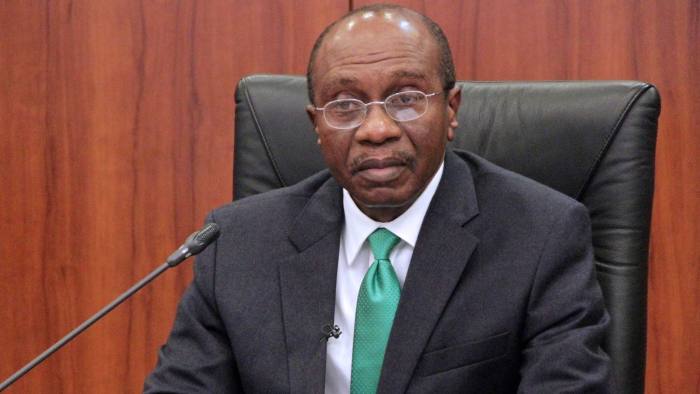
Godwin Emefiele, CBN Governor Credit: Financial Times
According to the apex bank, the objectives of the programme was to support Nigeria’s economic recovery by creating jobs in the local meter value chain, reducing collection losses and increasing financial flows to achieve 100 per cent market remittance obligations of the DisCos.
The CBN has since then disbursed more millions to DisCos, but the situation is still the same.
Is it capacity problem?
The Federal Government, as part of the Economic Sustainability Plan geared towards addressing post-Covid economic concerns, came up with the Mass Metering Programme in 2020.
The initiative was targeted at closing metering gap of about 6.5 million household as of then and empowering indigenous local metering manufacturers. However, findings have shown that the local meter manufacturers are grossly lacking in capacity for the daunting task, as some of them cite importation and logistic concerns in meeting up with the demand.
James Momoh. NERC Chairman
“Logistic reasons and port congestion are still limiting some of the final components that make the meter complete,” an indigenous meter manufacturer and the Chief Executive Officer of Momas Electricity Meter Manufacturing Company Limited (MEMMCOL) Kola Balogun told The ICIR in a telephone conversation.
He, however, advised that despite these concerns hindering the mass metering programme, the government should not explore opportunity of allowing more licences for local meter manufacturing, stressing that opening the door for importation would lead to loss of jobs.
Industry analysts differ
Industry analysts told The ICIR that the speed needed to close the metering gap and shore up liquidity concerns in the power sector was being slowed down by indigenous manufacturers due largely to importation logistics of some metering components which were not currently available in the country.
“With the urgency required to close the metering gap, I do not think it is a well-thought-out policy. We are still paying subsidy of over N50billion monthly by the government to close liquidity gap in the sector. Is it not better to allow importation of meters to address the urgency in liquidity issues and ensure we do not wait endlessly for local manufacturers ?” Energy Lawyer and Power Sector Governance Expert Chuks Nwani told The ICIR.
Findings have shown that there is a minimum target of meter installation of 50, 000 to 100, 000 monthly given by the government to the Discos on the mass metering programme.
At the launch of the National Mass Metering Programme in Gaduwa Estate, outskirts of the FCT in November 2020, the AEDC said it planned to install 101,000 new meters before December. However, The ICIR checks reveal that only 31,954 meters have been installed so far under the mass metering scheme by the company.
Spokesperson of the AEDC Oyebode Fadipe told The ICIR that all customers who had not been metered would get their meter in phases.
Analysts insist that the mass metering scheme has several loopholes in its strategy, a situation that should be revisited to address the lingering concerns of closing the metering gap.
“We tend to commercialise solutions to most of our problems without doing proper homework. This has been the bane of most interventions such as this. We have thrown in money rather than getting the governance structure right and the problems are still very much with us,” former Chairman of the NERC Sam Amadi told The ICIR.
Power is essential for economic development as it increases productivity and productive capacity of a nation, creating more jobs and boosting the gross domestic product (GDP). Nigeria generates around 12,522 megawatts (MW) of electricity but distributes about 4,000MW. This means one megawatt is to 50,000 population. On the other hand, Ghana generates 4,000MW and distributes 2,400MW, according to the USAID. This is one MW to 12,675 population.
Nigeria is world’s poverty capital with 105 million citizens extremely poor. Unemployment is 33.3 per cent, partly because of lack of power across the country.
Public Policy Expert Princewill Okorie told The ICIR that NERC must intensify efforts in its performance in terms of improving plans focusing on consumer enumeration report with the DisCos to properly guide the mass metering programme.
He expressed concern that Discos appeared comfortable with the estimated billing, raising issues on their less emphatic drive on mass metering programme.
Twenty-five-year-old Aisha Bandado was in labour, experiencing pains from her groin. She had been pregnant for nine months, and it was time to deliver the baby. But Aisha would have to take a 14-Kilometres ride to Gidan Madi, a community in Sokoto, where the nearest Health centre was located.
Sadly, she lost the foetus before she could get to the labour room.
“The health officers prescribed 13 injections for her. Yet, she is still sick since then,” 68-year-old Aisha’s father, Bandado Muhammad, told this reporter.
Aisha, 25. Photo Credit: Qosim Suleiman
Residents of Kalanjeni, a community in Tangaza LGA, where Aisha resides in Sokoto have for long lamented the lack of a Primary Health Centre in their community to take care of their basic health needs.
“It’s a stressful journey from here to Gidan Madi,” said Balkisu Zayyanu, a mother of two, describing how far they have to go in search of health care. “It’s better to have one hospital close to us here.”
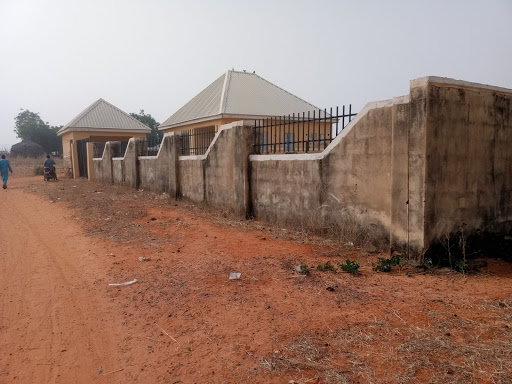
Abandoned Primary Health Centre at Kalanjeni, Tangaza LGA, Sokoto State. Photo Credit: Qosim Suleiman
THE LONGEST ROUTE TO HOSPITAL
On a cold morning, as dry harmattan dust swept through the place, Ummu Usman, 20, tried to lift herself from bed but her aching stomach and head did not allow her.
She reached out to her mother, who already predicted it to be labour time. Ummu, after all, has been pregnant for nine months. A doctor was called from Gidan Madi, 14 kilometres from Kalanjenin Basharu where she lived. He inspected her and placed her on a drip at the only dispensary in the village.
After 24 hours of several efforts of giving birth, the doctor referred her to general hospital in Sokoto, the capital of Sokoto state, for proper care, after he declared that there was a complication. Sokoto is 53 kilometres from Kalanjeni.
No sooner than a marathon of tests was run on the already exhausted Ummu, at the Usmanu Danfodiyo University Teaching Hospital (UDUTH), that the doctors say her only option of delivering the baby was through a caesarian section.
“I passed out before we got to the hospital. I just woke up on the bed. I already gave birth to the child through a caesarian section” an obviously traumatised Ummu recalls.
Good-for- nothing health centre
In 2016, residents of Kalanjeni were pleased to see Isa Bashir Salihu, member representing Tangaza/Gudu Federal Constituency in the House of Representatives in their midst. He had visited the villages in the community to announce that the Federal Government had approved the construction of a primary health centre there.
Hearing of the new development, the residents were excited and hopeful that they would have access to good primary health, after many years of longing for it. But the excitement soon faded when Primary Health Centre was finally built and was put under lock and key, several years after the construction was completed.
“We were told they will bring some equipment to the hospital, but we’ve not seen anything since then,” Magaji Shehu Kalanjeni, the village head, said.
On November 28, 2016, the National Primary Health Care Development Agency, (NPHCDA) awarded the construction of PHC in Kalanjeni, Tangaza Local Government Area of Sokoto, to ‘Bloomz Development Ltd’ for N22 million (22,337,438.80).
Documents obtained by this reporter revealed that the construction of the PHC was completed on 23rd January, 2017 — eight (8) weeks after the commencement of work as specified in the award letter, dated 28th November, 2016.
Babatunde Aboderin, the Managing Director of Bloomz Development, said the fund approved for the project was just for the construction of the hospital building and not for the provision of equipment. He noted that the project had been done and handed over to the government authorities.
Efforts to reach Hon Isah Bashir Salihu Kalanjeni, the former member representing the area in the House of Representatives were futile. Multiple phone calls on March 8th and 9th were not responded to. Also, a text message sent on Tuesday March 9th never elicited response.
Adamu Abdullahi Romo, the Executive Secretary of the Sokoto Primary Health Care Development Agency, said his agency is unaware of the project, until it is handed over to them for posting of staff and supervision –which has not been done.
Functioning Primary Health Centre at Bashire, Tambuwal LGA, Sokoto State. Photo Credit: Qosim Suleiman
“Whenever you see such hospitals, it must have been constructed as a constituency project. Now, except and unless they have been handed over, without doing so, they’re not ours and we cannot say anything about it. But whichever one is completed and handed over to us, then it has become our own”
He, however, promised to look into it. “We will definitely follow it and see what is happening” he said.
ONE VOLUNTEER DOCTOR FOR 20 BEDS COTTAGE HOSPITAL
Whenever a woman is in Labour in Bashire, a 35-kilometre journey to Tambuwal begins.
While some get there in a car, “others are conveyed on a donkey to Tambuwal”, said Hauwa’u Shehu, a resident.
Before the end of his tenure as the Speaker of the House of Representatives, Aminu Waziri Tambuwal, now Governor of Sokoto State, initiated the upgrading of the only dispensary at Bashire village in Tambuwal LGA, into a Primary Health Care centre.
So, in 2014, NPHCDA awarded the sum N179,900,326 to ‘Quaise Nig. Ltd’ for the construction of a 20-bed Cottage Hospital.
The hospital was completed without delay and commenced work immediately, said Abubakar Atiku, head of Bashire community.
Residents of the community said they had had to travel several kilometres to access basic health care services, sometimes as far as Kebbi state which is about 252 kilometers to Sokoto, before the construction of the health centre.
“We suffered a lot before the construction of this hospital. We always had to take our patients to the General Hospitals in Tambuwal, Aliero and even in Birnin Kebbi.”
Although the people are happy that they have the health facility in their community, there is still a lot to be done there to make it fully functional.
According to Abubakar Umar, an official of the health centre, there are many challenges hindering the effectiveness of the project in the community.
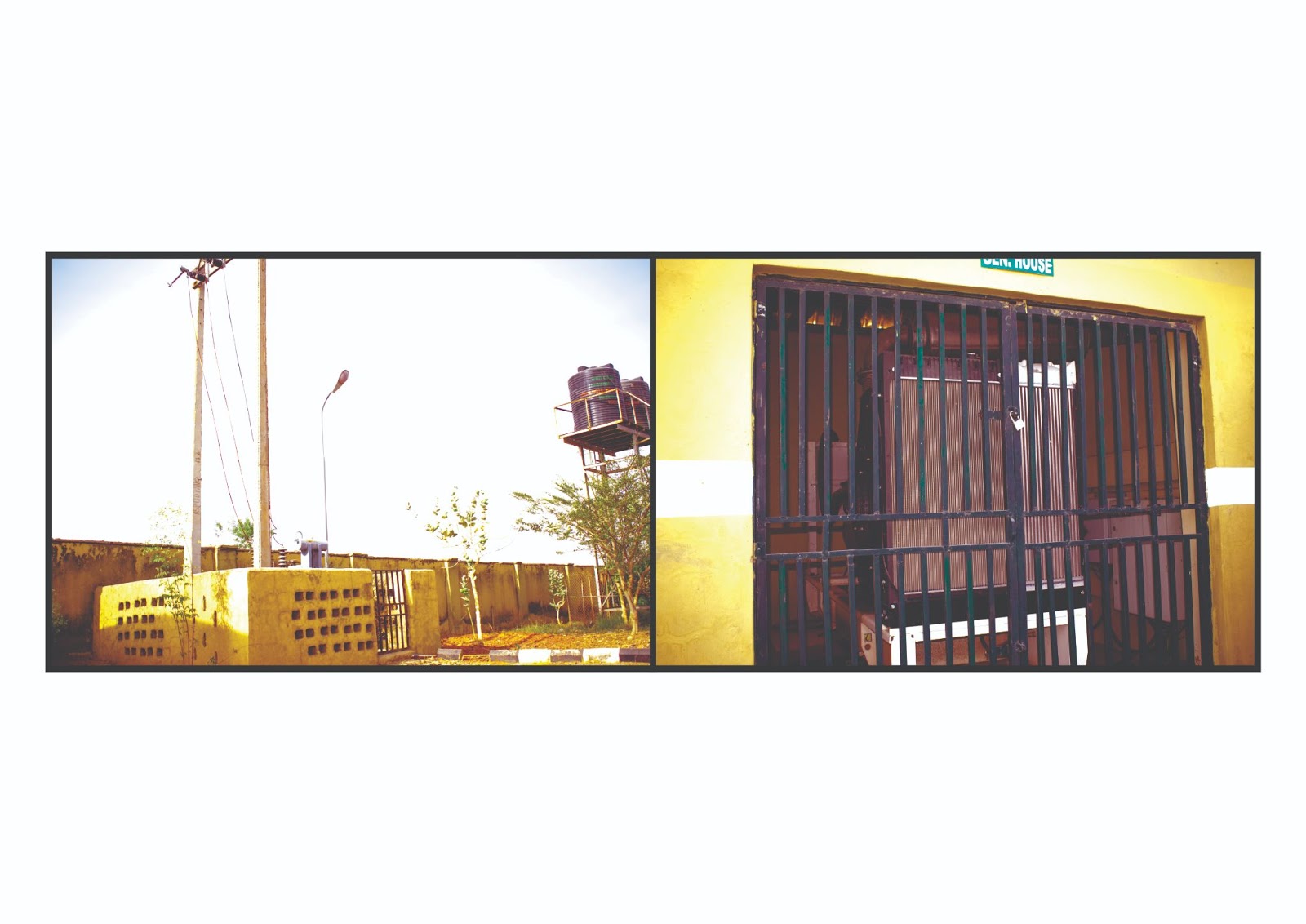
Umar said since the completion of the project, the electricity transformer purchased is yet to be connected to supply power . He noted that the hospital runs completely on a diesel generator.
Electricity Transformer yet to be connected to National Grid for Electricity and Diesel Generator at Primary Health Centre, Bashire, Tambuwal LGA, Sokoto State. Photo Credit: Qosim Suleiman
This reporter gathered that there is also a shortage of health workers at the hospital. Although there are a number of nurses and midwives, the only medical doctor is a volunteer staff who visits the health centre twice a week.
“We have only onevolunteer medical doctor. His name is Dr. Jibrin. Some people from the Village had met with him, considering his expertise and the good work he has done at General Hospital, Tambuwal, to come help the Bashire people,” the official added.
Romo, who agreed to the shortage of health workers at facilities across the state, informed this reporter that plans are underway to recruit more health workers to fill them up.
“Indeed, not just that of Bashire alone, but across the state. We are now in the plan. His excellency (Governor Aminu Waziri Tambuwal) has given the approval to recruit health personnel to fill in the gap we are having in terms of managing our health facilities. And I believe it is going to take place very soon Insha Allah” he said
ANOTHER NON-FUNCTIONAL PHC WASTING AWAY
Primary Health Centre at Jema, Gwadabawa LGA, Sokoto State. Photo Credit: Qosim Suleiman
In Jema, Gwadabawa, Ubaida Hasan, a mother of 10 has never experienced safe labour and child-birth. When in labour of what should’ve been her 11th child, she spent about 4 hours waiting to get a vehicle that will drive her down to Sokoto, a 2 hours journey, to safely deliver her baby. But the journey was so long and stressful that she lost the child.
“I waited in pain for about 4 hours before we could get a car, even then I lost the child before we got to the hospital,” she said.
According to Ubaida, several women have lost their lives due to the lack of hospital closeby. “Many lost their lives on the way to Sokoto or Gada”, she said.
So, when Ibrahim Magaji, the Jema village head in Gwadabawa LGA, Sokoto east, heard about the construction of a new hospital in his community, he thought the trouble of carrying sick and pregnant women to far distance hospitals would soon come to an end.
The 55-year-old recalled how pleased he was, hearing that a portable hospital would be constructed in the community. Abdullahi Balarabe Salame, the member representing, Illela/Gwadabawa Federal Constituency at the National Assembly, had sent his entourage to ask that the head of Jema give a piece of land where the hospital was to be sited.
“It’s been over two years since the completion of the construction of the hospital,” said Ibrahim Magaji. But the hospital was still not functional as of February 2021 when the reporter visited.
According to the 2016 Budget of Change, the Federal Government approved the ‘Construction Of Phc (type 1) at Jema In Gwadabawa Lga Of Sokoto State’ for the NPHCDA. The contract was awarded to ‘Billion Global Concepts Ltd’ at N8million (8,830,295.08).
When contacted on the phone, the representative of Billion Global Concept declined a request for the details of the project. He promised to call back but never did and never responded to subsequent phone calls.
The Face-Saving Measure
Few weeks after the reporter’s first visit to Jema on January 10th 2021, some government officials brought some materials to the hospital and cleared the hospital’s premises. The items include beds, generator set, fridge, shelves, chairs, and fans, among others. The reporter’s second visit was on February 14th, 2021.
Primary Health Centre at Jema, Gwadabawa, Sokoto State on our Reporter’s first visit and on the second visit. Photo Credit: Qosim SuleimanThe equipment was brought to the Primary Health Centre at Jema, Gwadabawa, Sokoto State after our Reporter’s first visit. Photo Credit: Qosim Suleiman
Findings revealed that Saidu Girkau, the Director of Health, Gwadabawa Local Government, promised to bring health personnels to this hospital in the month of March.
When contacted, Girkau said the project was completely handled by the NPHCDA. He noted that they were only waiting for the suppliers to fully commission the hospital.
“Recently, the hospital equipment has been brought to the hospital and it is going to be commissioned very soon,” he said.
Girkau, who said he met the hospital already constructed when he was posted, however, noted that the health centre is already functional and health officials have been posted to the hospital. He, however, said they await the official commissioning by the government.
“We already posted some people (to the health centre), because we have the manpower to take care of the hospital. The only thing remaining is that we are waiting for the highest authority to commission it.”
Abdullahi Balarabe, the lawmaker who moved for the construction of the health centre, said the lack of allocation of funds for the procurement of equipment stalled the commencement of activities at the health centre for two years.
“You know the budget is yearly. The year after the construction was awarded, I tried to include the procurement in the budget, but it was just recently approved” he said in a telephone conversation.
A resident of the village who holds the key to the hospital, Dahiru Mai Gadi, also confirmed that some officials came to the village and promised that the hospital would commence work on Monday, 8th March, 2021.
One week later, on Monday, March 15, 2021, Abdullahi Balarabe, Governor Aminu Waziri Tambuwal and Sultan Muhammad Sa’ad Abubakar were at the village for a handing over ceremony of the completed project to Governor Aminu Waziri Tambuwal.
Adamu Abdullahi Romo said his agency only got to have the record of the hospital after this handing over.
* This investigation is supported by the John D. and Catherine T. MacArthur Foundation and the International Centre for Investigative Reporting.”
ON one sunny day, SARS officers stormed a neighbourhood in Ajegunle, Lagos. They were on a mission to arrest a suspect. Somehow, Eric Okwaji, a resident in the neighbourhood got caught up in the operations. Seven years later, Eric is yet to be found.
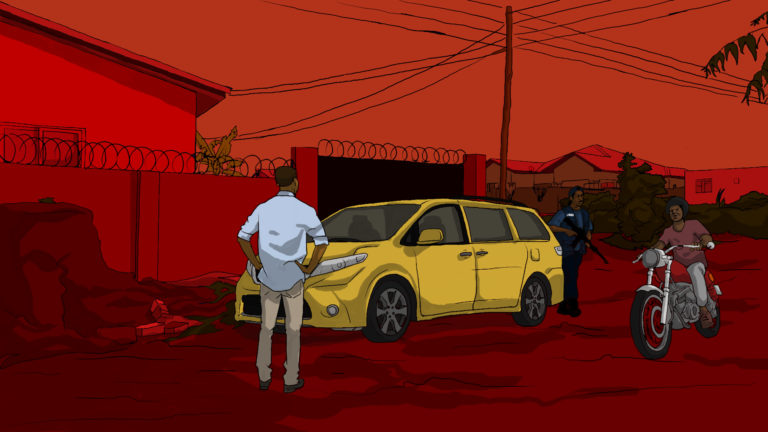
Eric Okwaji spotted a gold-painted Sienna car parked in front of his residence at Nosamu Street, Ajegunle Apapa, Lagos.
Eric, who shared his residence with some friends, asked for the car to be moved because it was blocking movement. Though the car was eventually moved, so was Eric’s – badly beaten and unconscious.
It was late morning on September 17, 2014.
The SARS operatives who parked the car were in Eric’s neighbourhood to make an arrest. Having ransacked the house at 39 Nosamu Street, which they believed was the family home of their target, known as ‘Popo’, they did not find Popo. He apparently did not even live there.
Frustrated by their failed arrest, hearing Eric ask about the car further annoyed them.
Eric Okwaji
“Their next action was to vehemently descend on Eric with serious anger,” Bosah Emeka, a community activist, said in a letter sent to the Onikan office of the Assistant Inspector-General of Police.
The aggression the SARS operatives had reserved for the Popo arrest was poured out on poor Eric, who they beat to the point of unconsciousness.
Pleas by community residents for the police officers to exercise restraint were ignored. Eric’s battered body was then thrown into the back of the Sienna car, which sped off.
It’s been six years since the car disappeared into the distance.
Family and friends of Eric Okwaji, as well as residents of Ajegunle Apapa in Lagos, have since not seen or heard from the young man.
The search
One of the officers who participated in the violent incident gave his name as Sergeant Samuel C.Y. He left a mobile number, asking for any enquiries about the condition and whereabouts of Eric to be directed to him.
But each time a family member or neighbour called, he asked for money to be paid before he could give out any information.
“When we called him for the release of Eric, he demanded N400,000,” Lawrence Macaulay, Eric’s father, said. “We begged him but he did not listen.”
Eric was an active footballer before his SARS officers took him away
Once Mr Macaulay, a retired civil servant, realised he could not raise the bribe demanded, he set out on his own, visiting different police stations in search of his son. The Ajeromi Ifelodun Community Movement also sent out dispatches to different police units and NGOs asking for help to find Eric.
In one of such letters, addressed to Amnesty International, the association revealed they had sent search parties to Abuja “to no avail”.
While insisting on his demand for the N400,000 bribe, Sergeant Samuel evaded Eric’s family, preferring to connect on phone and not in person. “Anytime we wanted to meet him, he would say, ‘Come, but you will not meet me’,” Mr Macaulay recalled. “Anytime we got to a station we had been directed to, they would claim they did not know him; or that there was no Sergeant Samuel in that station.”
In a plan to track down the dubious sergeant, Emmanuella, Eric’s sister, connected with Sergeant Samuel via WhatsApp. Her good looks seemed to have caught the attention of the sergeant, who invited her for an evening hangout at a local bar. In their WhatsApp chats, Sergeant Samuel gave his name to Emmanuella as Stephen Bayo.
The SARS Officers beat Eric till he became unconscious, then threw him into their car and sped off
Even though this scheduled meeting provided a rare opportunity to meet Sergeant Samuel in person, Mr Macaulay discouraged the idea. He said he did not want his daughter, whom he describes as “beautiful”, to come into contact with a man who had been involved in the abduction of his son.
Besides, Mr Macaulay thought Sergeant Samuel’s Whatsapp profile photo, as well as the name Stephen Bayo – which he suspected could be Sergeant Samuel’s real name – were enough leads to go on in terms of getting to the bottom of the issue. “I thought it would help our case,” Mr Macaulay said.
But it didn’t. The sergeant continued to evade the family, keeping his identity a secret while still demanding the N400, 000 ransom.
A quick search on Truecaller, a caller identification app, shows the name attached to the number given by Sergeant Samuel as “IPO Tayo Sars”.
Indicted for robbery
Abba Kyari, the celebrity cop who now leads the Inspector General of Police’s Intelligence Response Team (IGP-IRT), was the Officer-in-Charge of SARS when 34-year old Eric was arrested.
Mr Macaulay, in the company of one Mr Fatoki, a lawyer from the Nigerian Bar Association (NBA), made a complaint to Mr Kyari about the unlawful arrest of his son.
Mr Kyari admitted that Eric was in his custody, but claimed he had been arrested for highway robbery, as against the known fact of being beaten and abducted on Nosamu Street in Lagos.
Convinced that there had been a mix-up that could be resolved with some legal backing, Mr Macaulay and Mr Fatoki left hoping to return on a later date to secure Eric’s release.
But things didn’t quite work out that way. Mr Macaulay, whose pension earnings as a retired civil servant were irregular, could not meet the financial demands of his lawyer, Mr Fatoki. He had assumed that given the sensitive nature of the case, Mr Fatoki would consider helping him pro bono.
“We did not go back to Kyari because the NBA lawyer started asking for money,” Mr Macaulay recounted. “After I had given him N20,000, he took me to his chambers and asked that I pay more, but I did not have any money.”
On Thursday, November 6, 2014, The Nation newspaper published an article about two alleged armed robbers arrested by Abba Kayari’s SARS operatives. The men, identified as Olarenwaju Oladejo and Ibrahim Afolabi, both in their early 20s, confessed to armed robbery and indicted an “Eric Okowaji” and two others, who were reported “at large” at the time.
“My father died while he was working with the Ajeromi Local Government Area. I learnt panel beating but did not get enough money from it. Two of my friends, Eric (Okowaji) and Seyi, who is still at large, introduced me to the gang,” one of the suspects, Mr Oladejo, was quoted to have said in another publication by ThePunch newspaper.
The photo of the “Eric Okowaji” in question was not attached to the publications by either The Nation or The Punch newspaper.
Could this Eric be the same “Eric Okwaji” who had been whisked away in that gold-painted Sienna car a few weeks earlier?
Mr Macaulay insists that the “Eric Okowaji” referred to by armed robbers could never be his son, Eric Okwaji, who he said was a decent man.
“Eric was a footballer, and also worked at Bayelsa Motor Park Boundary before he was taken away,” Mr Macaulay said.
It has been exactly six years and seven months since Eric was inexplicably brutalized and plucked away on the streets of Lagos.
Last October, as years of SARS-related brutality reached its peak, provoking protests nationwide and garnering global attention for Nigeria, the anguish of aggrieved families hit close to home. One of such families, Mr Macaulay and his household continue to live in perpetual anxiety, not knowing where their beloved Eric is, or even whether he is alive or not.
Under the pressure of the #ENDSARS protests, the President Muhammadu Buhari led administration disbanded the controversial SARS unit, but the scars of their atrocities remain, with many questions unanswered, many mysteries unsolved.
Abba Kyari, the senior police officer who was responsible for SARS operations in Lagos when Eric was taken by the unit’s officers six years ago, is still being pursued for answers.
Multiple calls to Mr Kyari’s phone number only get his voice mail. He also has not responded to text messages sent to the same number.
Meanwhile, Mr Macaulay has approached the Lagos State Judicial Panel on Restitution for Victims of SARS Related Abuse and Other Matters to seek answers.
This is a developing story. Expect more revelations as we try to find Eric Okwaji.
This story is part of a multimedia project by Tiger Eye Foundation and media partners across Nigeria, documenting police brutality in Nigeria, and advocating for police reform.
EARLY Pentagon plans for a U.S. military command based in Africa were once firmly rejected by almost every country on the continent.
African governments were reluctant to associate themselves with America’s ‘war on terror’ and fearful of U.S. intervention.
Libya and Algeria both refused to host the combatant command. Even Morocco, considered Washington’s closest North African ally, rejected the idea, saying it would not welcome a permanent military presence on its soil.
“We’ve got a big image problem down there,” a State Department official admitted. “Public opinion is really against getting into bed with the US. They just don’t trust us.”
But things have dramatically changed since then. At a virtual meeting this month with the U.S. Secretary of State Antony Blinken, Nigerian president Muhammadu Buhari brought up the once-reviled Africom command center and urged that it be returned to Africa considering the fast deteriorating security situation across West Africa and Nigeria in particular.
Armed gangs now swarm through the northeast region, kidnapping young school students for hefty ransoms, while the Boko Haram insurgent movement has extended its range of operations to Niger, Cameroon and Chad. The ‘bandits’ have displaced thousands of residents and killed a large number of soldiers and civilians.
Three U.S. regional commands based in Stuttgart, Germany, currently share responsibility for American security issues in Africa. According to domestic policy advisor Susan Rice, “Africa was the poor stepchild in each of these different commands and did not get the full attention it deserves.”
Still, if opposition to Africom is now muted, it has not gone away. Former Nigerian Senator Shehu Sani, an outspoken critic of the United States, said Buhari’s request was “an open invitation for the recolonization of Africa.” In his view, Nigeria should seek only ‘technical assistance.’
Furthermore, should the AFRICOM headquarters move, it is unlikely—if not impossible—that it would be critical for Africa with its logistical challenges. Some in the U.S. Congress support moving Africom’s headquarters to the U.S. as a cost-effective alternative. South Carolina’s senators, both Republican, have advocated moving it to Charleston, the site of large U.S. military installations.
Also, in Nigeria, a coalition of over 120 civil society organisations and activists has announced a series of mass actions nationwide on May 26, and a boycott of Democracy Day on June 12 to register their frustration with the state of insecurity in the country.
The Catholic Bishops’ Conference has also issued a statement sounding alarm over the survival of the nation. Nigerians must rededicate themselves to the ‘Nigeria project’—building a multiethnic, democratic society, the Conference urged in their recent statement.
THE Nigerian government has ordered the closure of all bars and recreational centres, placing a limit on public gatherings across the 36 states and the Federal Capital Territory (FCT) due to COVID-19.
The National Incident Manager Mukhtar Mohammed, who is a member of the Presidential Steering Committee (PSC) on COVID-19, announced the new directive on Monday during a briefing in Abuja.
Mohammed said the new curfew would take effect by midnight of Tuesday, noting that public gatherings had been reduced to 50 persons.
On the basis of the new restriction, Mohammed said it was in connection with the delay in vaccinating a large proportion of the Nigerian population which held a risk of a large outbreak.
He also stated that there were strong concerns about the non-compliance to public health and social measures, which were contained in the Health Protection Regulation 2021.
He further noted that anyone without a facemask would not be allowed into government institutions across the country.
According to Mohammed, all official engagements, meetings and conferences were to be conducted through virtual channels while travels had also been limited.
Mohammed disclosed that the closure of bars and nightclubs across the nation would be in place until further notice.
Unlike the first phase of national lockdown in 2020, Mohammed stated that intra-states travels were not banned but only essential international travels would be encouraged with adherence to protective measures.
The committee directed security personnel across the 36 states and the FCT to enforce the adherence to the measures put in place.
Despite recorded cases of COVID-19 infections and deaths, a documentary by The ICIR had revealed how many Nigerians continued to show scepticism about the virus.
Since the index case was recorded in February 2020, Nigeria has recorded more than 165,000 positive cases of the virus, while 2,065 persons have died from it with 156,000 discharged.
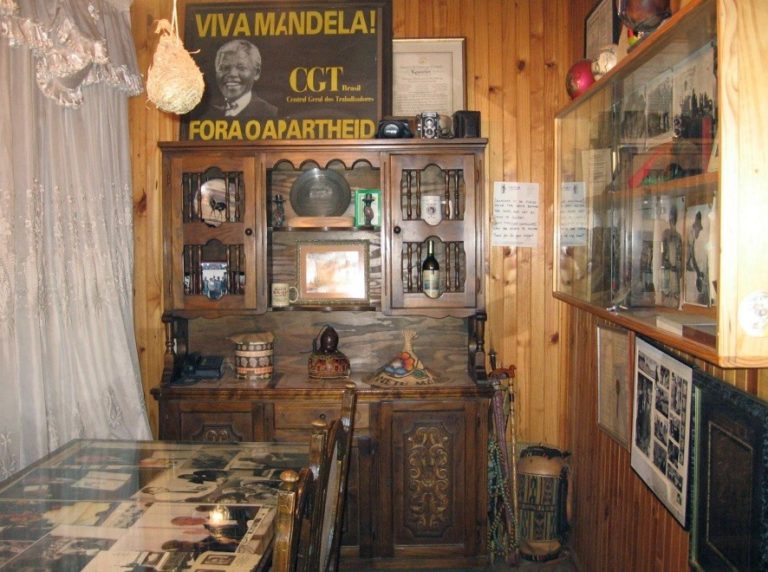
POPULAR exhibits at the Apartheid Museum in Johannesburg and other legacy museums are barely surviving and may close over funding shortfalls due to Covid-19.
A pair of boxing gloves worn by Nelson Mandela at the height of the anti-apartheid struggle in South Africa, one of the most popular exhibits, is now covered with dust in a darkened room, according to Mfuneko Toyana, writing for Reuters.
“We had to let go of all of the staff. About 30 people. There’s no one here to turn the lights on and off,” the museum’s Director Christopher Till said.
By March 2020, most cultural institutions across the world were indefinitely closed (or at least with their services radically curtailed), and in-person exhibitions, events, and performances were cancelled or postponed.
Among these were all museums in Morocco as of March 15 until further notice and cancellation of Mawazine – the world’s second-largest music festival – scheduled for mid-June.
In response, there were intensive efforts to provide alternative or additional services through digital platforms, to maintain essential activities with minimal resources, and to document the events themselves through new acquisitions, including new creative works inspired by the pandemic.
Hundreds of artworks and artefacts illustrating the history of the long struggle against white minority rule could become inaccessible to the public but “we can’t afford to lose this place,” Till said.
Over 1,000 visitors viewed the historic exhibits before the pandemic. Like other cultural institutions, it had to close its doors in March 2020 when South Africa imposed its first COVID-19 lockdown.
The museum reopened in January 2021, Toyana reported, but having sold no tickets for 10 months and with visitor numbers very low due to the ongoing outbreak, it was too cash-strapped to operate and shut down again in March.
The Fugard Theatre is also permanently closed as a result of the coronavirus in Cape Town. “We are not persuaded that the theatre will be Covid safe or financially viable to reopen as a theatre in the foreseeable future,” wrote theatre founder Eric Abraham.
“The theatre will be handed back to the owner of the freehold of the building as a working theatre and we hope they will be able to use it for the benefit of the Museum and the community.”
Other institutions facing permanent shutdown are the Johannesburg Art Gallery and Mandela’s house in the township of Soweto.
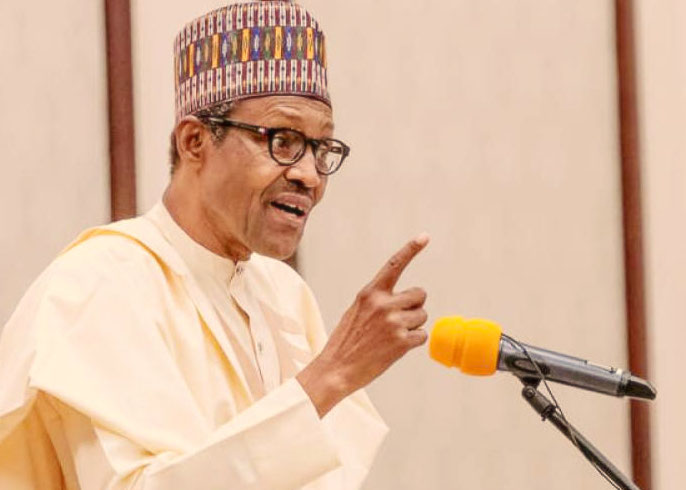
SPOKESMAN of the Northern Elders Forum (NEF) Hakeem Baba-Ahmed has told the National Assembly members that they are elected to serve the people, not President Muhammadu Buhari.
Baba Ahmed said this when he featured on AIT ‘Kakaaki Africa’ programme on Monday to discuss the state of insecurity in Nigeria.
Baba Ahmed said the National Assembly did not appear to have the levels of patriotism and concerns beyond partisan politics to take action on the rising state of insecurity across Nigeria.
He also asked that President Buhari be impeached by the National Assembly if he could not deliver because the nation would not wait two more years for him to address the nature of insecurity.
“One option we have is that the legislators will look at the record of the administration, understand the areas where the president has failed, understand areas where there is clearly no evidence that they’re going to do anything about it and refer to the constitution that says the whole purpose of government is to secure citizens and pursue their welfare,” Baba-Ahmed said.
The NEF spokesperson also urged Buhari to arrest anyone alleged to be sponsoring banditry or terrorism in the country.
“If there are people who are causing this insecurity, the government has evidence that they’re doing so, then in the name of God, let the president arrest these people, bring them up, show Nigerians what they’re doing, and then show evidence that the government is actually dealing with insecurity,” he further stated.
Earlier in February, the National Assembly had requested Buhari to appear before it over the state of insecurity. However, the president did not honour the request.
Section 143 of the 1999 Nigerian Constitution gives the National Assembly the power to remove the president if he is incapable of effectively discharging his duty.
GOVERNOR of Rivers State Nyesom Wike, on Monday, extended night curfew across 23 local government areas of the state from 7 p.m. to 6 a.m. The action was aimed at curtailing rising attacks on security establishments in the state.
Wike disclosed this in a state broadcast on Monday, saying that the decision was based on the multiple armed ambushes on Police checkpoints along the East-West Road, resulting in the murder of seven police officers last week.
“However, as a further step towards enhancing our collective safety, we have reviewed the existing nighttime curfew across the 23 Local Government Areas, which will now start from 7 p.m. and end at 6 a.m. until further notice from tomorrow 11th May 2021.
“The security agencies are hereby directed to note the new curfew time, ensure strict compliance and effectively deal with any person or group that violates or attempts to violate it,” he said.
He stated the state security council reviewed the methods of the recent attacks and realised that the perpetrators, who disguised themselves as security officers, had moved in unhindered from Oyigbo to launch attacks on the security posts.
“We have reviewed, and for the moment, declined the pressure on the state government to activate our youth to defend the state from these terrorists because we don’t want to complicate our very delicate security situation by creating opportunities for some other monsters to emerge.”
Governor Wike, who consoled the families of the dead officers and the state’s police command for the irreparable loss, declared that the government and security agencies were determined to deploy everything at their disposal to advance the safety and security of lives and property in the state.
“We wish to assure every resident that we are not intimidated by the sporadic and cowardly attacks on predetermined security targets by faceless criminals on our soil; neither will we be cowed into succumbing to a baseless and doomed secessionists agenda,” the governor added.
Gunmen are said to have attacked two checkpoints, one for the Nigeria Customs Service and another manned by officers of the Joint Task Force.
Seven police officers were killed, while the weapons of the security operatives were carted away by the gunmen during the attack.
The ICIR reached out to the Commissioner of Information Nsirim Princewill via phone calls and text messages to ascertain how long the curfew was likely to be extended and measures being taken by the Rivers State government to restore peace in the state.
However, he failed to respond to the text message and did not take calls at the time of filing the report.
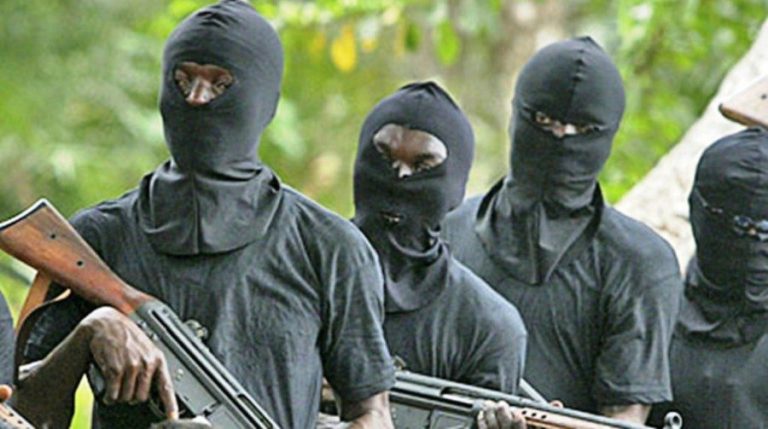
THE Katsina State Police Command has confirmed that 40 worshippers were kidnapped by unknown gunmen while observing prayers in a mosque located at the outskirts of Jibiya.
The worshippers were said to have gathered at the mosque to observe Tahajjud, a midnight prayer done by Muslims during Ramadan.
Speaking in a phone conversation with The ICIR, Spokesperson for Kaduna State Police Command Gambo Isa said that the gunmen had invaded the mosque at the early hours of Monday, abducting 40 worshippers in the process.
Isa hinted that there was a counter-attack by a combined team of Police and military officials, who engaged the gunmen, rescuing 30 of the kidnapped worshippers.
“We pursued them and we engaged them, and they were able to release those 30 because they couldn’t cope with the pressure,” he said.
According to Isa, 10 of the worshippers were still missing, and the gunmen had remained unidentified as investigations were still on-going.
“Right now, a combined team of police-military are conducting general operations and we’re waiting for the result of such operations. Investigation is on-going,” he said.
In recent times, several attacks have been carried by gunmen in Kastina State and the entire Northern Nigeria.
According to a report, more than 300 students were abducted in December from the Government Science Secondary School (GSSS), in the Kankara area of the state.