Home Blog Page 1818

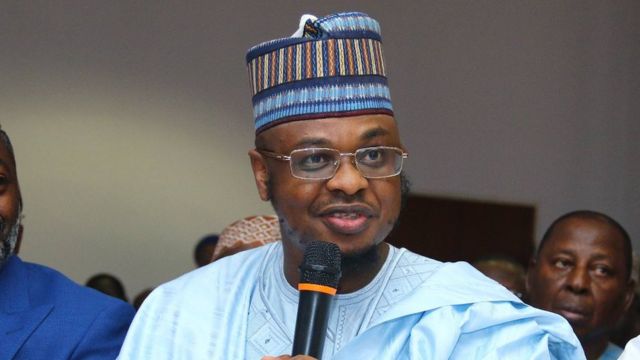
Again, Pantami extends NIN-SIM linkage till June 30

MINISTER of Communications and Digital Economy Isa Pantami has extended the deadline for the linkage of the National Identification Number (NIN) and Subscriber Identity Module integration (SIM) until June 30, 2021.

This was contained in a statement jointly signed by Director of Public Affairs of the Nigerian Communications Commission (NCC) Ikechukwu Adinde, and Head of Corporate Communications of the National Identity Management Commission (NIMC) Kayode Adegoke on Tuesday.

The decision was said to have been taken at a virtual meeting attended by Pantami; Chairman of the NCC Adeolu Akande; Executive Vice Chairman of NCC Umar Dambatta; and Director-General of NIMC Aliyu Azeez.

The statement read that the extension was sequel to requests by ‘stakeholders’ to allow more Nigerians and ‘legal residents’ to register.

According to Pantami, significant progress had been made in the linkage of SIM cards to NIN as more than 54 million persons had been registered.

He added that the 54 million registrants translated to about 190 million phone numbers in operation across Nigeria.

The statement also read that Sections 27 and 29 of the National Identity Management Commission Act 2007 provided for the ‘mandatory’ use of a national identification number to access government services.

Pantami has been asked by many Nigerians to resign his position as a minister due to his past extremist Islamic views that recently surfaced across social media.

The minister had slated the deadline for SIM linkage for February 9, before giving an extension of eight weeks, which was to lapse this week.

CBN damning verdict forces panic withdrawals at First Bank

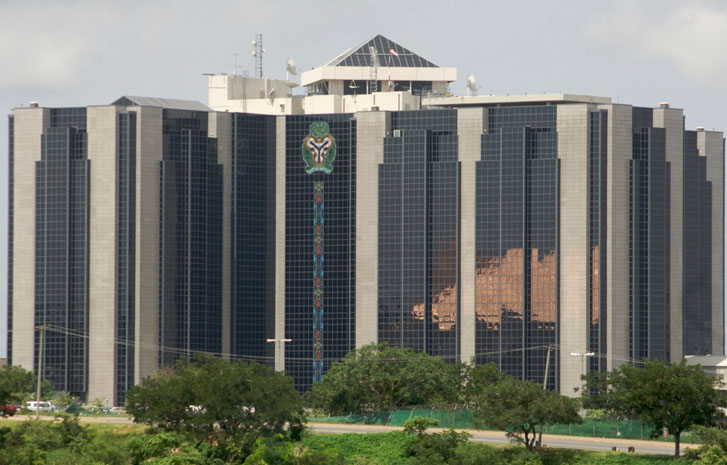
CUSTOMERS banking with the First Bank of Nigeria (FBN) were seen engaged in panic withdrawals, following the Central Bank of Nigeria (CBN)’s last-ditch effort to save the bank from poor corporate governance.

The FBN, one of Nigeria’s tier-one banks, surprised both depositors and admirers when the Central Bank issued the board of the bank with a query for the removal of its CEO Adesola Adeduntan, citing non-approval of the change of the CEO,  emphasising that the bank was not beyond regulatory supervision.

The situation was curious because Adeduntan had eight months to the end of his tenure.

The apex bank noted that the action of the board of the FBN sent a negative signal to the market on the leadership of the board and management, stressing that it queried the board because of the developments in the bank.

For instance, Central Bank of Nigeria raised concerns that FBN had not complied with regulatory directives on divesting its interest in Honeywell Flour Mills despite several reminders.

The CBN’s Director of Banking Supervision Haruna B Mustafa said after four years, the commercial bank was “yet to perfect its line on the shares of Mr. Oba Otudeko in FBN Holdco which collateralised the restructured credit facilities for Honeywell Flour Mills contrary to the conditions precedent for the restructuring of the company’s credit facility.”

The CBN stated that for failure to perfect the pledge and satisfy the condition for regulatory approval, such restructuring had been terminated and the credit facilities now payable immediately.

Related Stories

Explainer: Why CBN ousted board of First Bank

First Bank Settles Agitated Vendors

FBN customers in panic withdrawal after CBN shake-up

In the eyes of financial experts,  the insider dealing did not go down with the CBN and could reflect that things were not going down well with the bank.

Nigeria has witnessed several banking collapses in the past. For instance in 2009,the Nigerian economy faltered and the banking system experienced a crisis.

The stock market collapsed by 70 per cent in 2008-2009 and many Nigerian banks had to be rescued. This followed a consolidation exercise by the apex bank which saw to the merging of some banks to save customers from loss of deposits.

The same fears overwhelmed depositors with the First Bank Nigeria, as some of them engaged in panic withdrawal, findings by The ICIR have shown.

A depositor with the First Bank Nigeria who pleaded anonymity confirmed to The ICIR that she withdrew her N900,000 savings from the bank, citing concerns of recent development of the regulatory intervention on the bank.

“I have been in this country long enough to read the writing on the wall. With the Central Bank’s intervention in the leadership of the bank, I have a serious concern that there could be a corporate misdeameanor from the managers of the bank. I have utmost respect for the bank with its longstanding legacy, however, I have to be cautious at this time.” the depositor noted.

Usman Mohammed, also a depositor at FBN, raised concern that the banking network had been poor since last Thursday, as he laid a complaint that he had to wait in the bank for five hours before exercising his banking services. He noted that the banking services were still having some issues, stressing that the development might not be unconnected to the Central Bank’s intervention in the management of the bank as a regulator.

In Nigeria, failed banks are handed over to the Nigeria Deposit Insurance  and  depositors were initially paid N50,000 -although it was later increased to N200,000.

Most notably, poor corporate management and weak enforcement of banking supervision have resulted in bank collapse. Bank collapses in Nigeria have pushed millions of people into poverty. It is on record that thousands of people who have kept their life savings in the banks have lost them, including children’s school fees, savings for retirement, and medical bills, among others.

On Thursday, Godwin Emefiele, the governor of the Central Bank announced the reinstatement of Sola Adeduntan, after sacking all directors of the FBN Holding PLC.

The apex bank explained that it considered itself a key stakeholder in management changes involving FBN due to the forbearance and close monitoring by the bank over the last five years aimed at stemming the slide in the going concerns status of the bank.

“The action by the board of the FBN sends a negative signal to the market on the stability of leadership on the board and management and it is in the light of foregoing that the CBN queried the board of directors on the unfortunate development in the bank,” the apex bank said in a statement.

Analysts have said that the present corporate governance concerns raised by the apex bank were the same issues that resulted in the banking distress witnessed in 2009 by the nation.

Some of the factors that resulted in banking collapse included: macroeconomic stability caused by large and sudden capital inflows, major failures of corporate governance at banks, lack of investor and consumer sophistication, inadequate disclosure and transparency.

Basil Okafor, a depositor with the First Bank,  told The ICIR that he had been watching the turn of events recently in the country and had withdrawn a large chunk of his money from the bank as a precautionary measure in protecting his hard-earned savings.

“I was at the bank early as early as 8 am on Friday morning. I am a businessman and have been watching things closely.  I lived in Spain for years and had come back home to invest,” he said.

“However, with the turn of events unravelling in the country, I’m really sceptical about what is happening. Even the governance structure baffles me. which was why I had to quickly take that step. There are lots of apprehension even from my interaction with some depositors while we were in the bank. With this development in the bank and the recent turn of events in the country, I had to take this precautionary step on behalf of my family.”

Another depositor who spoke to The ICIR said concerns of poor corporate governance concerns raised by the had forced him to trade with caution regarding his relationship with the bank.

“I can keep my account at First Bank, but I will not lodge huge amount in the bank. The CBN’s report shows the bank has poor corporate governance. The CBN is also not completely neutral,” the bank customer, who is a journalist and financial expert, noted.

A financial analyst Tope Fasua told The ICIR that the First Bank still had all the status of a big bank status in place, stressing that he could still bank with the bank unless things escalated negatively in the coming days.

“If the First Bank should go down, it will be very cataclysmic to the industry. What this also shows is that there is no big bank that cannot have issues. The bigger the bank, the bigger the headache. It used to be the biggest bank, but later lost the status to other banks.”

Michael Ani, finance expert, while reacting to the concerns raised, told The ICIR that he would still confidently bank with FirstBank despite the concerns of the apex bank, since they had taken measures to ensure proper management of the bank.

“Yes I will, because it doesn’t affect depositors’ funds. I mean a bank like FB, the CBN will never allow such to happen. We saw it in the case of Skye Bank that is not even as strong as First Bank,” he noted.

Kidnappers threaten to kill 17 Kaduna Greenfield University students if ransom isn’t paid Tuesday


KIDNAPPERS have threatened to kill the remaining 17 students of a private university, Greenfield University in Kaduna State if ransom isn’t paid by Tuesday.

Recall that they had first killed three of the students, and later another two, while demanding N800 million ransom from their parents to secure the release of the students.

The students were kidnapped from their school on April 20, with the state governor Nasir El-rufai insisting he won’t negotiate with the bandits to secure their release.

Sani Idris Jalingo who had identified himself as the leader of the bandits in a telephone conversation with the Hausa service of the Voice of America (VOA), said 17 of the students are still in their custody.

The terrorist said that the families of the students had already paid N55 million which he claims was used to feed the abductees.

He added that a ransom of N100 million and 10 motorcycles must be made available before the students would be set free.

“We heard the utterances of the Kaduna State Governor that he will not pay ransom to bandits to purchase additional arms,” Jalingo said in the interview in Hausa.

“He also said he told his family that he will not pay ransom if any of them is kidnapped. So, we want to show that the Nigerian Government has failed that is why we killed the students.”

Jalingo said the victims in their custody include 17 girls and two boys one of which is the grandson of the late Emir of Zazzau, Shehu Idris.

Two of the abducted students who spoke to the VOA during the interview appealed to the government and their parents to take pay the ransom.

“They mean what they say because they have already killed some of us,” says Idris, one of the kidnapped students.

FG reacts to proposed mass deportation of Nigerians from Ghana

THE Nigerian government says it is working with its Ghanaian counterpart for the repatriation of citizens illegally residing in Ghana. 

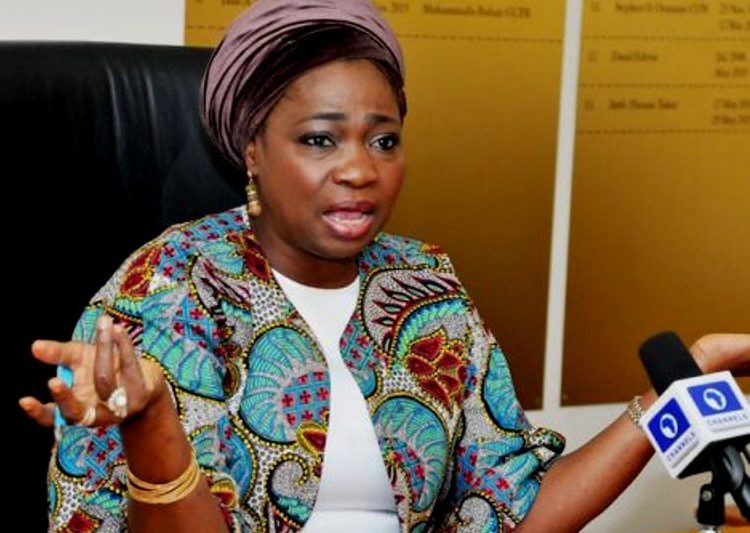
Chairman of the Nigerians in Diaspora Commission (NIDCOM) Abike Dabiri-Erewa said on Monday that there were reports of escapees from a jail break in Nigeria allegedly found trying to cross into Ghana through illegal means.

Dabiri-Erewa said that the Nigerian mission had been engaging the Ghanaian authorities to resolve the matter, while ensuring that innocent Nigerians did not suffer unjustly. 

“Those guilty will face the law as we await updates from the mission…They should be returned to their country,” she said. 

Ghanaian authorities had announced plans to deport a total of 507 illegal immigrants residing in the country, including 494 Nigerians and 13 Burkinabes. 

Assistant Superintendent of Police and spokesperson for the Regional Police Command David Fianko-Okyere said during an interview with Ghana News Agency that a new 24-hour patrol programme launched by the region had led to the arrest of the illegal immigrants. 

He said preliminary investigations by the Ghana Police Service indicated that those arrested stayed in the country without proper documents.

Seven hundred Nigerians alleged to have been involved in criminal activities such as fraud, prostitution and armed robbery were deported in 2019.

In 2020, the Minister of Information and Culture Lai Mohammed raised the alarm over what he described as the negative reportage of issues concerning Nigerians resident in Ghana by the Ghanaian media, which he said was brewing xenophobic attitude towards Nigerians. 

Mohammed had criticised Ghana over its “harsh and openly-biased judicial trial and pronouncement of discriminately-long jail terms for convicted Nigerians,” saying such maltreatment would no longer be tolerated.

Four Bauchi LGAs under Boko Haram threat – SSG

THE Bauchi State Government, on Monday, said four local governments in the state could be attacked and occupied by Boko Haram insurgents.

Secretary to the state government Sabiu Baba raised the alarmed while briefing journalists after an emergency Security Council Meeting chaired by Governor Bala Mohammed.

He said following attack on and occupation of Geidam, Yobe State by the terrorists recently, Zaki, Dambam, Darazo, and Gamawa local government areas in Bauchi might fall into the hands of the group.

The four local council areas share borders with Geidam.

Baba said there had been exodus of people, some of who carried weapons from Yobe to Bauchi.

Consequently, the state would continue to profile whoever came into the state and  efforts would help the government to curb importation of weapons and increased movement of people into the state, he stated.

According to him, Boko Haram had launched attack on a mast belonging to a leading communication network in the country and carted away its property.

Boko Haram insurgents have been engaged in a terror campaign in parts of Nigeria

“There was an emergency Security Council Meeting of Bauchi State this afternoon and the meeting was to look into the attack by Boko Haram in Geidam and the takeover of that town and the implications for Bauchi State.Bauchi state is sharing border with Yobe State in four local government areas of Zaki, Dambam, Darazo, and Gamawa. The implication of what has happened in Geidam is that there is a lot of influx of people moving into Bauchi State from Yobe.

“Of course, that will put a lot of strain on our facilities and resources, and considering the kind of movement out of Boko Haram activities, the security implications there are also very high. The meeting today was to discuss the implications of that, identify the security threats and how to contain them from the Bauchi side.”

He added that security was a collective duty of everyone in the country and the government would not leave the work for security agencies alone, adding that all hands must be on deck to tackle it.

Bauchi State government’s alarm came a week after Niger State Governor Sani Bello revealed that insurgents had sacked many communities in his state, making people to flee from about 50 communities in the state.

The ICIR reported on May 1 how residents in Niger State were paying ransom to bandits that had taken over many parts of the state with loans and monies contributed by residents to enable them to secure the release of their captured relatiions.

Samuel Ortom

Similarly, Benue State governor had, last week, lamented the rate worsening insecurity in the state, alleging that President Muhammadu Buhari was working for the Fulanis, people of his tribe, to take over the country.

There has been overwhelming insecurity threatening continued existence of the country.

While the North-East battles with insurgency, North-West and North-Central confront banditry and farmer-herder crisis. South-East recently joined the league with unprovoked attacks on security formations and innocent civilians in the region by gunmen.

The South-West is faced with herder-herder feud, with move for secession by aggrieved people in the region gaining momentum.

There have also been threats from various youth groups in the South-South to return to era of destruction of oil assets in the region.

Nigeria partners Microsoft to drive digital economy, train five million citizens on IT

THE Nigerian government is partnering with Microsoft Corporation to upskill five million citizens over the next three years, as part of initiatives to accelerate the country’s digital economy push.

Vice President Yemi Osinbajo announced on Twitter on Monday that the partnership was the outcome of discussions held in January 2021 with Microsoft Corporation President, Brad Smith.

After extensive consultations with the government, Microsoft identified connectivity, skilling and digital transformation as three key pillars that would help to build strong foundations for a digital economy in Nigeria

“Our government is committed to leveraging innovation and technology to bring better outcomes across a wide area of governance concerns,” Osinbajo said.

The vice president explained that Microsoft’s extensive experience in the utilisation of technology as an enabler for the delivery of public and social good made them an ideal partner.

On his part, Smith said the company believed in the future of Nigeria, noting that the partnership provided an enormous opportunity to put technology to work, create jobs and foster the technology ecosystem across Nigeria,

“Research points to internet penetration in Nigeria of around 50 percent and while the pandemic has increased the pace of digitisation, much needs to be done to empower all citizens to take advantage of the opportunities of a digital economy,” the Microsoft president said.

The six regions of the country have been earmarked for the development of Microsoft’s  Airband Initiative, which is a high-speed internet infrastructure that is cheaper and faster to deploy than fibre and has the added advantage of being able to travel long distances and through forested terrain.

Microsoft’s Airband team are expected to work closely with local partners to improve broadband connectivity in these communities while also assisting with the design and implementation of hyper-scale cloud services.

Smith said to help reach the goal of upskilling five million Nigerians, 1,700 trainers would provide blended online and in-person training courses to the country’s youth as well as government workers.

“Government will also be given the tools to digitally transform skilling, education, and employment methods to match job seekers with the right employers. In doing so, we hope to create over 27,000 new digital jobs in the next three years,” he said.

The final pillar, digital transformation, would initially be made up of two initiatives. The first would address corruption, a major global challenge with economic losses totalling $3.6 trillion each year, while the second would help protect Nigeria’s rich cultural heritage, the company said.

By collaborating with local partners like the Economic and Financial Crimes Commission, Microsoft will support the design and implementation of cloud-based tools like artificial intelligence and machine learning to help identify potential risk, highlight them, and reduce corruption.

Microsoft will also support government’s efforts to preserve and revive Nigeria’s three major indigenous languages: Hausa, Yoruba, and Igbo.

“This is one of my favourite projects that we pursue around the world. It uses the most advanced technology of the 21st century to nurture and keep alive the culture that has been so important for humanity from the centuries past,” Smith added.

A joint working committee will guide these investments, and will provide regular updates on the programmes.

Soldiers repel Boko Haram attacks in Borno

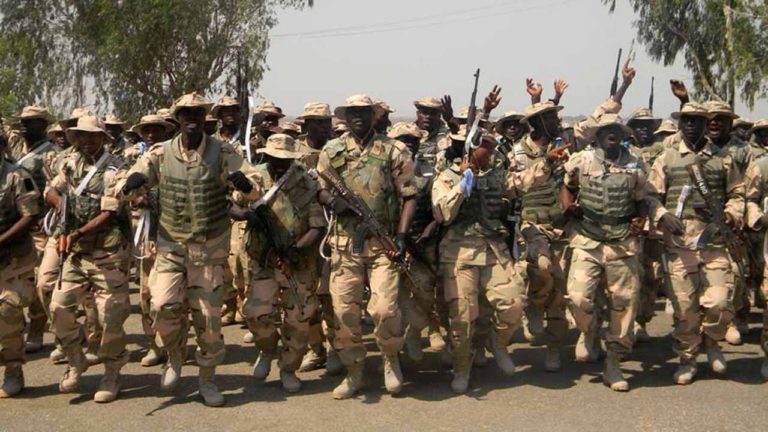
THE Nigerian Army said attempts by members of Boko Haram terrorist group to infiltrate some villages in Borno State were repelled by troops of the Operation Hadin Kai.

The Army said this in a press statement released on Monday by Director of Public Relations Mohammed Yerima.

“Nigerian Army Troops of the newly reinvigorated Operation Hadin Kai, successfully thwarted Boko Haram Terrorists’ attempt to infiltrate into Rann Town, the capital of Kala Balge Local Government Area of Borno State on 1 May 2021,” the statement read.

The terrorists also invaded Ajiri town of Konduga Local Government Area of the state on May 2,  after initially burning down nine houses and killing villagers before being resisted by troops deployed to the area.

In both incidents, the Nigerian Army reported that the terrorists sustained fatal injuries and left behind several weapons and ammunition, including anti-air craft gun barrel, AK 47 rifle, among others.

The Army, however, said that two soldiers  lost their lives in the process, while the rest of the troops remained in pursuit of the terrorists.

“The Chief of Army Staff Lieutenant General Ibrahim Attahiru has commended the troops for their resilience and determination to keep their areas free of terrorist activities. He further charged them to sustain the renewed vigour in discharging their duties,” the statement further read.

The Boko Haram terrorist group was first established in Maiduguri, the capital of Borno in 2009, and gained widespread exposure in July of the same year when they launched attacks on Police posts and other government facilities, killing scores of policemen in the process.

Their leader Mohammed Yusuf was killed by the military after which the group became inactive.

The group was revived the following year, however, under the leadership of Abubakar Shekau and has carried out countless assassinations, attacks and bombings across Northern Nigeria till date.

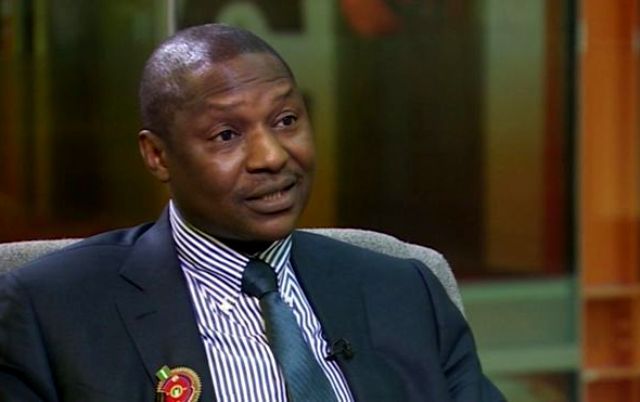
Bank documentation delaying return of £4.2m Ibori loot, says Malami

ATTORNEY-General of the Federation (AGF) Abubakar Malami says bank documentation has been the cause of the delay in transferring some of £4.2 million seized from associates of convicted former Governor of Delta State James Ibori to Nigeria.

Malami said this in a statement signed by the Special Assistant on Media and Public Relations in charge of Office of the Attorney-General of the Federation Umar Gwandu on Monday in Abuja.

The AGF said the transfer of funds between two countries (the UK and Nigeria, in this case) often took longer and the government would inform the public when the funds were received.

“Documentations with the banks in different countries often take longer than anticipated. We anticipated two weeks but we are not in control of the banks,” the statement read in part.

READ ALSOSenior lawyers divided over ownership of £4.2m Ibori loot

He said there was neither complacency nor delay on the part of the government as efforts were being made to ensure the success of the transfer.

Earlier in March, the Nigerian government had disclosed the ‘imminent return’ of part of the fund recovered from Ibori, former Delta State governor, from the United Kingdom.

While announcing the returning of the fund, Malami said about £2.2 million pounds would be spent on the Second Niger Bridge, Abuja-Kano Road, and Lagos-Ibadan Expressway, stressing that the funds would not be returned to Delta State government where the former governor stole them from.

The government’s decision raised concerns among Nigerians, including the Delta State government, who said that the fund ought to be returned to its original source where it was looted.

“We would try to take advantage of the legal system to make the Federal Government correct the injustice they are about to visit on us as a state,” said Delta State commissioner for information Ehiedu Aniagwu.

Malami insisted that the funds would not be returned to the Delta State government because the crime committed by Ibori was a national and not a sub-region one.

However, a Senior Advocate of Nigeria (SAN) and Human Rights Lawyer Femi Falana said, according to Article 35 of the United Nations Convention that is ratified by the United Kingdom and Nigeria respectively, any proceeds recovered from corruption should be expended on the victims.

Falana stated that in the Ibori loot case, the victim in the corrupt practice were the people of Delta State and the state government.

MRA urges Nigerian government to protect journalists

THE Media Rights Agenda (MRA) has urged the Nigerian government to protect journalists and make provision for easy access to information.

In a statement released by the MRA in commemoration of the 2021 World Press Freedom Day (WPFD) on Monday, the organisation requested that a commitment be made by the Federal Government towards creating a conducive environment for journalists and media workers to safely carry out their professional duties.

The MRA noted that such a commitment would signal government’s genuine belief in the theme of this year’s WPFD, ‘Information as a Public Good’ which, in the words of the Director-General of UNESCO Audrey Azoulay, “underlines the indisputable importance of verified and reliable information.”

Programme Director for the MRA Ayode Longe said that “although Nigeria has a Freedom of Information (FOI) Act, its implementation is far from satisfactory as compliance with the provisions of the Law across government has been poor.” He urged the government to put in place mechanisms for the implementation of the Act in Nigeria.

READ ALSO: Investigate alleged threat to life of Daily Nigerian publisher, MRA urges FG

Longe further noted that such mechanisms should aim at improving compliance with the provisions of the Act by public institutions, arguing that if the Act was to make any impact in bringing about transparent governance in the country, its implementation across different levels of government needed to be assured.

He called on all states in Nigeria to implement the Act at state level, adding that only two states –Ekiti and Imo- had passed the FOI laws.

Bemoaning the unimpressive level of implementation of the FOI law in the other 34 states, he said that the argument of non-applicability of the Act could be seen as a mere excuse to foster secrecy in governance.

He stressed the need for citizens to have reliable and timely information about the government, and a safe work environment for media workers to avoid what he described as ‘self-censorship’  which could promote the spread of harmful content.

Longe concluded by advising the government to sensitise the judiciary and law enforcement agencies on the importance of journalists to the society and to ensure the reign of justice in events of attacks against journalists.

The MRA was established in 1993 as a non-governmental nrganisation which exists for the purpose of promoting and protecting media freedom and freedom of expression in Nigeria. The organisation has been a prime mover for the enactment and implementation of the FOI Act in Nigeria.


Court remands suspect over murder of Olatunde Fadayomi in London

A magistrate court in Willesden, north-west London, remanded one Marcus Griffiths for the murder of a 40-year-old Nigerian football coach Michael Olatunde Fadayomi on Thursday, April 29.

Griffiths, 42, was arrested and charged with being in possession of a bladed object and for repeatedly stabbing Fadayomi to death during an argument.

Fadayomi, a single dad, had reportedly received a phone call from his unnamed teenage son who was heading for his football training ground, saying he had trouble with someone in the bus.

He rushed to the scene to intervene, but the altercation escalated and Griffiths brought out a knife and stabbed him repeatedly, as other passengers, including his son and bystanders, watched in horror.

The victim has been hailed as a ‘pillar of the community’ who was ‘in the wrong place at the wrong time.’

A neighbour, simply identified as Vanessa, told MyLondon that Fadayomi had singlehandedly cared for his son since he was born and that she was in shock at his death.

“I’m still in shock. A bad word never would come out of his mouth. He died saving his kid. He was a pillar of the community. It really breaks my heart,” she said.

Emergency services rushed to the scene shortly after 5pm, but despite the best efforts of paramedics, Fadayomi died.

Dental nurse Tracey Dolling, 43, who rushed across the road to help the victim, told The Sun: “I did CPR. It’s very, very sad, awful, absolutely devastating.”

Griffiths was remanded in custody to appear in court on a date yet to be determined.