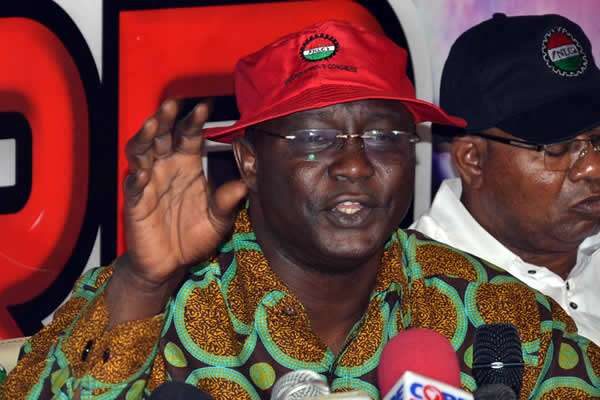
PRESIDENT of the Nigerian Labour Congress (NLC) Ayuba Wabba has said that lack of funds is not an excuse for not paying workers in the country.
Wabba said this on Monday when he featured on Channels TV programme, Sunrise Daily, to discuss non-payment of workers following the commemoration of Workers’ Day in Nigeria.
Wabba argued that political officers in Nigeria were not earning on the basis of the government’s ability to pay, saying that workers also should not be subjected to such conditions before getting their payments.
“Political officers, from the councillor to the highest office in the land, are not earning their pay on the basis of ability to pay. Yes, when it comes to workers, you will now say ability to pay,” Wabba said.
He noted that the primary purpose of any government was the security and welfare of the people, in which the welfare of workers was included.
The NLC president lamented that more than one-thirds of Nigerian states were currently not paying the N30,000 minimum wage approved by the Nigerian government in 2019.
Minister of Labour and Employment Chris Ngige had insisted that all employers in the country, including state governments, must obey the national minimum wage.
Ngige said this during an interview on Channels Television’s Sunday Politics, adding that governors not doing so were breaching the law.
“If you read the Act well, you will see the applicability of the Act. The applicability is that all parts of the federation (Section II); Section III also says N30,000 shall be paid, the operating word is ‘shall.’
“It does not give room for picking and choosing, it is a must. The state governors that are not paying are breaching the law of the land,” Ngige further said.
Some governors have refused to pay the national minimum wage since 2019 due to lack of funds.
A member of the House of Representatives representing Sabon Gari Federal constituency Garba Datti-Babawo has sponsored a bill to move the national minimum wage from the exclusive legislative list to the concurrent list.
If the bill is passed into law, state governors would be able to determine how much they would pay their workers as minimum wage.
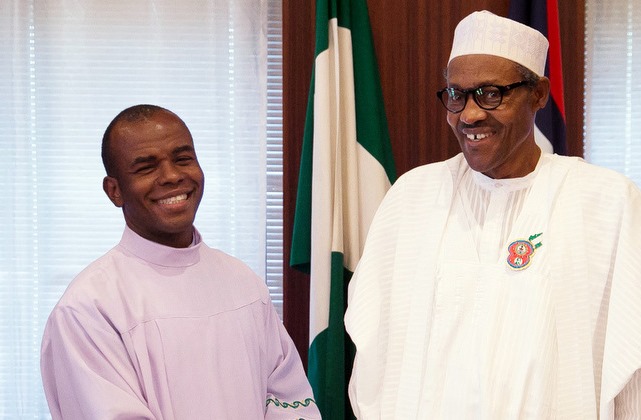
SPIRITUAL Director of Adoration Ministry Enugu Ejike Mbaka has said that the three ‘contractors’ he took to meet President Muhammadu Buhari at the Presidential Villa were people who wanted to resolve the high level of insecurity in Nigeria.
Mbaka recently called for Buhari’s resignation or impeachment due to the level of insecurity in Nigeria. The Presidency responded, accusing the cleric of being angry because the president refused to give him contracts in return for his support during the 2015 election.
“Father Mbaka asked for a meeting and to the shock of presidential aides, he came accompanied by three contractors. Mbaka asked for contracts as compensation for his support,” Senior Special Assistant to the President Media and Publicity Garba Shehu said in a statement, adding that the request was not granted “because it did not follow due process.”
Reacting to the Presidency’s allegation in a sermon at the Adoration Ground in Enugu on May 2, Mbaka described the claims as ‘laughable,’ noting that no fewer than 23,000 people were receiving monthly salaries from him.
But he explained that the contractors could have addressed the high level of insecurity in the country.
Mbaka said, “I am not here to defend any allegation, but the three men he (presidential spokesman Shehu) mentioned are people that could have handled the nation’s insecurity. This was during Buhari’s first term and these men told them they can help conquer insecurity.
“These men had the platform to end insecurity within one month.
“This was under Abba Kyari. I just handed them over to government. They only asked me to help them reach government and offered to help insecurity, revive the nation’s economy through putting an end to theft of crude oil and providing employment.”
Mbaka added that anyone who criticised Buhari was often blackmailed.
Mbaka was among Buhari’s strongest supporters in the 2015 and 2019 elections when he described the All Progressives Congress (APC) candidate as the country’s messiah. However, in a recent sermon, he said that God was angry with the president over his inability to address high level of insecurity in the country.
He called on Buhari to resign, or be impeached by the National Assembly.
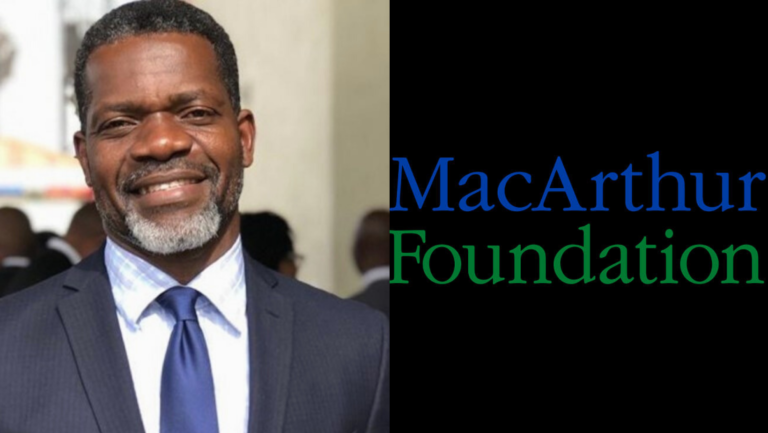
THE deputy director of the MacArthur Foundation, Africa office, Mr. Dayo Olaide has emphasized the crucial role of investigative journalism in the fight against corruption.
Speaking on a phone-in interview on PRIMORG news’ radio programme, Mr. Olaide highlighted the confidence of Mac Arthur Foundation in investigative journalism as a tool for fighting against corruption and creating social change.
The media as a constitutionally recognised watchdog monitors all institutions of the government and their processes, he said.
He added that the public also has roles to play in fighting graft and enforcing transparency and accountability.
The nature of corruption is that it is above all else, shrouded in secrecy, as it takes place behind the table, behind the room, in the darkness.
Hence the need for citizens to have access to information about the happenings in government, Mr. Olaide said.
MacArthur Foundation is in partnership with investigative journalism platforms in Nigeria to facilitate active citizenship and good governance, he said.
The MacArthur Foundation, however, recognises that fighting corruption is dangerous because it always pits the media against the government.
Also, investigative journalism is expensive and getting fund to produce it, is a huge challenge.
This is the reason MacArthur Foundation seeks out partnerships with organisations involved in fighting corruption, Mr. Olaide said.
According to him, the foundation’s aim is to create new business models that guarantee editorial independence that will help newsrooms remain committed in their service to the people.
The MacArthur Foundation, officially known as the John D. and Catherine T. MacArthur Foundation, is based in Chicago, Illinois USA.
The organisation has been supporting non-profit journalism and awarding grants in many countries, including Nigeria.
THE spate of attacks in Kogi State continued on Saturday with the killing of Pension Board Commissioner Adebayo Solomon and abduction of Chairman of Yagba East Local Government Pius Kolawole.
The officials were attacked alongside others in a vehicle conveying them from Ilorin, Kwara State capital, to Kabba in Kogi State.
Police Public Relations Officer in the state William Aya said they were shot at Eruku village near Egbe, the border town between Kwara and Kogi states by yet-to-be-identified gunmen.
Aya said the Police were briefed on the incident at about 4:30pm on Saturday and officers were immediately deployed to the scene.
According to him, driver of the vehicle in which the two officials were attacked survived the incident.
While Solomon’s remains were deposited at ECWA Hospital, Egbe, shortly after the incident, the whereabouts of Kolawole remained unknown at the time of filing this report.
The incident happened days after the senator representing Edo Central at the National Assembly Clifford Ordia was reportedly attacked twice on Okene-Lokoja and Lokoja-Abaji roads by gunmen on his way to Abuja.
Rising attacks in Kogi State have raised fears among residents of the state, according to findings by The ICIR on Sunday.
Residents who spoke with our reporter said it appeared the ‘bad days’ had returned.
A resident of Okenne John Audu said there had been relative peace in the state recently but for some hoodlums in communities in the state.
“Mr Governor has really tried in the past few years on security. You could see that there had been relative peace. But, it appears the bad days have returned with incidents in the past few days,” he stated.
Similarly, a resident of Idah Yusuf Aminat said, “People may not be sleeping well again at night again or conduct their businesses with peaceful minds as they have done in past months. The attacks may be a resurgence of what our state witnessed about two years ago, or spillover of ongoing unrest in northern part of the country to which Kogi belongs.”
Reports, however, indicate that the abduction of the council chairman may not be unconnected with his efforts to rid his council of bandits and herdsmen ‘terrorising’ communities in the council.
BETWEEN 2015 and 2021, two journalists were killed while three were imprisoned, according to data provided by the Committee to Protect Journalists (CPJ).
Analysis of the CPJ data uncovered that 34 attacks were launched on journalists in Nigeria from 1992 down to 2021.
Consequent on all the attacks, 12 journalists were killed, while 22 were imprisoned. Eight of them were murdered, with three dying on dangerous assignments and one killed in a crossfire.
There have been many casualties since 2015
In 2016, Jones Abiri, publisher of Weekly Source was imprisoned on the grounds of ‘anti-state and retaliatory,’ activities while Friday Ogungbemi of Policy and Lawmakers was imprisoned for ‘defamation.’
In 2019, Channel TV reporter, Precious Owolabi Channels TV was killed while undergoing a dangerous assignment, and Agba Jalingo of Cross River Watch was imprisoned on multiple charges of ‘anti-state,’ ‘defamation’ and ‘false news.’
While undergoing a dangerous assignment in 2020, Onifade Emmanuel Pelumi of Gboah TV lost his life when he was 20 years old.
A history of stifled voices (1995 – 1999)
The loss of lives and the incarceration of pressmen and women in Nigeria did not start today.
During the military regime, characterised by major human rights abuses, Olufisayo Alabi (Osun Voice), Chris Mamah (The Week) and Godwin Agbroko (The Week) were imprisoned without charges.
In late 1997, Akin Adesokan (Post Express) was also imprisoned on no grounds.
Rafiu Salau (TheNews/Tempo/PM News Group) and Babafemi Ojudu (TheNews/Tempo/PM News Group) were imprisoned without any actual charge. At the same time, Niran Malaolu (The Diet) was thrown into jail on the grounds of being ‘anti-state and retaliatory.’
NIGERIA’S Senate, last week, approved the sums of $1.5 billion and €995 million as external loans for the federal and state governments to fund critical infrastructure and boost agriculture across the country.
However, this recent loan acquisition adds to Nigeria’s growing burden of indebtedness as the nation’s spending in recent years continues to balloon, anchored by borrowing both from the domestic and international markets.
President Muhammadu Buhari at a virtual meeting with members of the Presidential Economic Advisory Council (PEAC) in 2020 said government’s borrowing through loans was in the interest of the country if it was to solve the dire shortfall in infrastructure.
“We have so many challenges with infrastructure. We just have to take loans to do roads, rail and power, so that investors will find us attractive and come here to put their money,’’ he said.
The amounts spent to service Nigeria’s debts are sometimes more than half of principal debts, leaving little to build the needed infrastructure to grow the economy.
In 2018, Nigeria spent N2.2 trillion on servicing outstanding loans compared to N1.68 trillion that was spent on infrastructure, according to data from the Central Bank of Nigeria, CBN. In the commercial category, debt service cost (external) was 52 per cent in 2020, according to the Debt Management Office (DMO). Debt service- to revenue in the first quarter of 2020 was 99 per cent, according to a Medium-Term Expenditure Framework and Fiscal Strategy (MTEF/FSP) report done by the Finance Ministry. Subsequent numbers were less than 99 per cent, but above 50 per cent.
Costly Debts
Data obtained from the DMO reveal that Nigeria’s total debt was N32.9 trillion at the end of December 2020, while debts owed to non-Nigerian lenders was pegged at N12.7 trillion.
A breakdown of Nigeria’s current debt history shows that the Federal Government owes N10.8 trillion as foreign debt and N10 trillion in domestic debt, while the states and the FCT owe N1.8 trillion as foreign debt and N4.1 trillion as domestic debt.
With the recent loan acquisitions, Nigeria’s total public debt is estimated at N33.9 trillion which puts more pressure on the nation’s revenue due to increased costs from servicing these new debts.
The total public debt incurred currently by Nigeria increased by 18 per cent when compared to the N27.4 trillion recorded as of 31 December 2019.
Despite exiting its second recession in four years, Nigeria’s plan to boost infrastructure investments to stimulate economic growth would cost $3 trillion over 30 years to close the deficit, according to a report by Moody’s Investors Service. But the country does not have the money at the moment.
Infographics
In the 2021 budget, debt service is projected to take N3.12 trillion, which is slightly less than the N3.58 trillion planned for infrastructure development.
The World Bank is Nigeria’s top creditor with $10.1 billion in loans, followed closely by Beijing-based Export-Import Bank of China with loans at $3.2 billion and Eurobonds account for $10.86 billion of loans to Nigeria.
Nigeria’s total debt in proportion to its Gross Domestic Product, GDP was 21 per cent at the end of 2020, which is a bit fair when compared to Africa’s second largest economy South Africa at 65 per cent at the same period.
The debt-to-GDP ratio compares what a country owes its lenders with what it produces in a given year, indicating a country’s ability to pay back its debt.
According to projections by the International Monetary Fund (IMF), Nigeria’s debt rate could rise to almost 36 per cent of its GDP by 2024 and interest payments could make up 74.6 per cent of its revenue without major reforms.
New Addiction to Money Printing
In February, Nigeria lifted the ceiling on the amount it was allowed to borrow as a proportion of its GDP to 40 per cent, from an initial 25 per cent as part of its new debt management strategy.
The higher limit was intended to facilitate borrowing to fund the budget deficit and other government obligations, which also included lending from the CBN.
Since 2015, the CBN’s financing of the fiscal budget has increased and led to copious money printing that has raised concerns about the health of the economy.
According to data obtained from the Budget Office, the CBN financed Nigeria’s budget with N1.2 trillion in 2015, N1.9 trillion in 2016, N1.3 trillion in 2017, N1.9 trillion in 2018, N3.3 trillion in 2019 and N2.9 trillion in 2020 respectively.
The CBN plans to convert those monies to loans which would increase debt service costs that already consume almost one – thirds of the nation’s actual revenue.
The International Monetary Fund (IMF) and the World Bank say such undermines the confidence of investors and hinders investment. High debt service contributed to hyperinflation across Africa in the 1980s and 1990s, analysts say, warning Nigeria not to continue on the path.
Nigeria is not earning enough revenue, according to the IMF, which insists that Africa’s most populous nation does not have a debt problem but revenue challenge.
The Federal Government printed N60 billion to augment federal allocation in March, according to Governor Godwin Obaseki of Edo State. Though oil price is nearly $70 per barrel, the Federal Government spends N120 billion monthly on subsidy, which has been exposed as a waste and scam.
Analysts say Nigeria will not reap the gains of rising oil price due to wastes in the oil industry, including losses incurred by unproductive refineries.
Poverty is rising in Nigeria, with over 87 million people in extreme poverty. Unemployment reached 33 per cent in the last quarter of 2020, as inflation continues to soar – signalling an economy in precarious situation.
The IMF warned Nigeria in July 2020 not to raise taxes as doing so would throw more citizens into poverty.
“We do not think it is the right time to raise taxes due to the impact of the pandemic,” IMF Mission Chief for Nigeria Jesmin Rahman said in a virtual fireside chat organised by Citi and American Business Council (ABC) in 2020.
A job applicant Iniobong Umoren, who went missing three days ago, has been found dead. She was murdered and buried in a shallow grave in Akwa Ibom State, The ICIR understands.
Umoren, a young graduate of the University of Uyo, was said to have left home on Thursday for a job interview at Airport Road in Uyo upon invitation by a young man who reached out to her via Twitter.
Umoren had put up a tweet on Tuesday seeking employment and highlighting the skills she possessed after which she got invited to the interview.
“#AkwaIbomTwitter please I’m really in need of a job, something to do to keep mind and soul together while contributing dutifully to the orgnisation. My location is Uyo, I’m creative, really good in thinking critically and most importantly a fast learner. CV available on request,” it read.
However, her screams in a phone conversation sparked fears among friends and family, which was further heightened by her mysterious disappearance.
In a statement sent to The ICIR, Akwa Ibom State Police Command confirmed her murder, and identified the suspected murderer as Uduak Frank Akpan. The Police also confirmed Akpan’s arrest for the kidnap, rape and murder of Umoren.
The Police alleged that the suspect was a serial rapist and would be charged to court upon the conclusion of investigations.
“Men of the Anti-Kidnapping Squad of the Command arrested the perpetrator, who confessed to have lured the victim to his house in the guise of giving her a job, but ended up sexually and physically assaulting her which led to her death. To cover his tracks, he dragged and buried her in a shallow grave in his father’s compound,” it read.
The corpse has, however, been exhumed and deposited at the University of Uyo Teaching Hospital (UUTH) for autopsy.
Akwa Ibom State Commissioner of Police Andrew Amiengheme, in the statement, warned all youths and job seekers to be wary of fake employers and men of the underworld. He condoled with the family of the deceased and commended the efforts of Nigerians on social media and other fighters of justice.
A hashtag #FindHinyUmoren was created on Twitter some days back by relations and Twitter users who were concerned with Umoren’s sudden disappearance.
The alarm over her disappearance was first raised on Twitter by a lady known as @Umohuduak1, after the victim had tried to reach out to her and was heard screaming in a subsequent phone call.
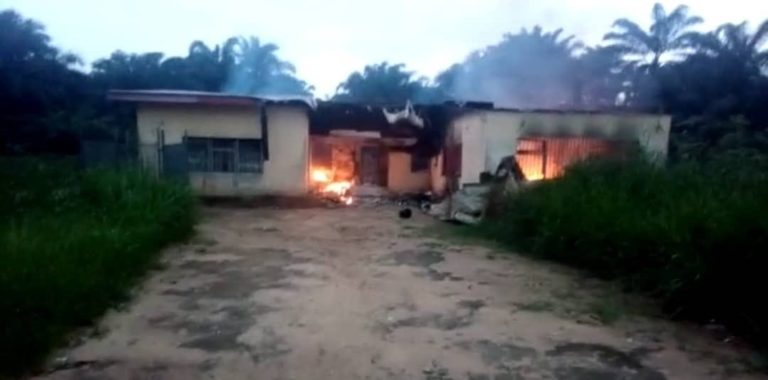
THE Akwa Ibom office of the Independent National Electoral Commission(INEC), located at Essien Udim Local Government Area, has been set ablaze.
This is contained in a statement signed by INEC Chairman of Information and Voter Education Festus Okoye on Sunday.
Okoye said the Resident Electoral Commissioner for Akwa Ibom State Mike Igini reported the incident to the headquarters, stating that electoral items were destroyed.
He said property of the commission was extensively destroyed by the fire.
“Items destroyed include 345 ballot boxes, 135 voting cubicles, megaphones, water tanks and office furniture,” the statement read.
The INEC stated that on the eve of the 2019 general elections, its newly constructed prototype LGA office in Ibesikpo Asutan was burnt down while two more offices in Mkpat Enin and Eastern Obolo LGAS were bombed.
The commission noted that the recent attack on its facility might affect its readiness for the 2023 general election and also constitute a setback on preparations, including on the ongoing conversion of voting points to polling units, the forthcoming continuous voter registration (CVR) exercise and the conduct of polls.
Okoye further noted that the incident had been reported to the Akwa-Ibom State Police Command and investigations had commenced into apprehending the perpetrators.
Recently, the INEC office in Orlu, Imo State was also set on fire by thugs in the community.
THE Federal Government has banned non-Nigerian passengers who visited Brazil, India, and Turkey in the last two weeks from entering the country.
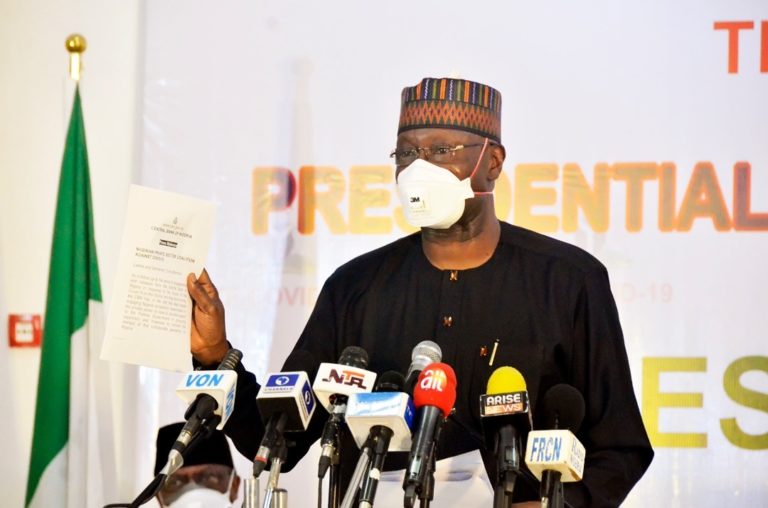
Chairman of the Presidential Steering Committee on COVID-19 and Secretary to the Government of the Federation Boss Mustapha made this known in a statement issued on Saturday.
Mustapha said the decision followed increasing cases of COVID-19 and fatalities in Brazil, India, Turkey and some other parts of the world.
Mustapha said this did not include passengers transiting through those countries, stressing that the travel advisory would take effect on Tuesday while it would be subjected to review after an initial period of four weeks.
“These precautionary measures are a necessary step to minimize the risk of a surge in COVID-19 cases introduced to Nigeria from other countries.
“Non-Nigerian passport holders and non-residents who visited Brazil, India or Turkey within days preceding travel to Nigeria, shall be denied entry into Nigeria,” the statement partly read.
He noted that defaulting airlines would be made to pay a mandatory penalty of $3,500 for each (defaulting) you passenger.
The SGF also said that Nigerians and permanent residents who had been in those countries in the last 14 days would be placed on mandatory quarantine for a week in a government-approved facility on arrival.
“If positive, the passenger shall be admitted within a government-approved treatment centre, in line with national treatment conventions.
“If negative, the passenger shall continue to remain in quarantine and made to undergo a repeat PCR test on day 7 of their quarantine,” Mustapha added.
In India, more than 200,000 people have died from COVID-19 after a third wave, a condition said to have risen from lack of oxygen in the country. Brazil has recorded over 400,000 deaths while Turkey has over 40,000 deaths from the disease.
MANAGEMENT of Kaduna State University may announce the ‘authentic’ tuition for students of the institution on Tuesday, May 4.
The ICIR gathered that the school management would meet with Students Union Government (SUG) of the university to clarify the amount payable by students in each department of the university.
Governor Nasir el-Rufai government had, last week, increased tuitions in all state-owned tertiary institutions in the state, leaving managements of some of the schools to decide what students in some faculties and departments should pay.
The decision led to ‘false’ figures going viral on social media as new fees decided by the government.
But the state government specifically directed KASU to raise its fees from about N26,000 to between N300,000 and N500,000, while polytechnics and colleges of education owned by the state were to have their fees raised to between N75,000 and N100,000.
While KASU, which is concluding its second semester examination and already giving admission to its new students, is battling with anger that the decision has raised among its students, current strike by Academic Staff Union of Polytechnic (ASUP) does not allow any collective action from students at the state’s polytechnic.
There have not been major actions from students of the state college of education; college of nursing and midwifery, and college of health sciences, according to findings by our reporter.
Kaduna State University.
State-run tertiary institutions in the state are Kaduna State University (KASU); Nuhu Bamali Polytechnic, Zaria; Kaduna State College of Education Gidan Waya; Kaduna State College of Nursing and Midwifery Kafanchan; and Shehu Idris College of Health Sciences, Makarfi.
Despite anger among the students, KASU’s SUG has been using different channels to appeal to the students for calm.
It has also been meeting with prominent people within and outside the state to urge the government to rescind its decision.
Appeal message seeking calm among the students by the SUG said leaders of thought within and outside the state had been contacted by the SUG leadership to prevail on the government to suspend the hike.
The statement, signed by its President Abdulrazaq Shuaibu Labbo and seen by our reporter, was titled, ‘Progress Report on the Increment of KASU Tuition Fee.’
It revealed that the SUG met with prominent persons like Sheik Muhammad Kabir Gombe, the governor’s wife and Dr. Tukur Adam Almanar.
“All the report we are getting from different angles are good news. and we thanking God Almighty for that. The university management promised to update us on the development on Tuesday,” part of the statement read.
The SUG’s efforts followed denial by the school management that it had increased the fees to about N500,000 for its students studying Medicine.
In a statement on the university’s website, the management said it met with students of the university on Thursday, April 22, and allayed their fears.
But, it admitted there would be upward review in the school fees.
“Management wishes to state that though tuition fees would be reviewed upward with specific fees on each course, it is yet to be announced. The figures being spread in the social media are false. The public will be informed on any new developments within the shortest possible time,” part of the statement read.
Shehu Muhammad Makarfi. Source: Twitter
Commissioner for Education Shehu Muhammad Makarfi, who announced the hike, told The ICIR on Friday that the decision “is one of the available options now among others.”
Makarfi had said while announcing the hike that it would help in repositioning the schools to deliver quality skills and training to meet the state contemporary knowledge and ICT needs.
Meanwhile, KASU chapter of the Academic Staff Union of Universities (ASUU) rejected the decision in a statement during the week.
It said in the statement signed by its Chairman Peter Adamu that 75 per cent of students in the school might drop out because of inability to pay the fees.
The teachers also accused the government, which recently sacked about 4,000 of its employees, of further making lives difficult for the people and putting education out of their reach.
Some of the students of the institution who spoke with our reporter condemned the hike and said it would be difficult for their parents to pay.
Hauwau Usman said, “I feel so bad because my parents can’t afford it.”
Aba Hanan Abdul Majeed told The ICIR: “We are two studying at KASU. If we are to pay 600,000 for a year, how much are we paying for six years? It’s too much.”
Rabilu Musa Salisu said, “We feel so bad because a lot of our mates cannot afford to pay the money. Truly, the money is too much.”
Another student, Amaka Jude, said: “The fee is much. Most of us are coming from very poor homes. Please help us beg the government to reduce it so that we can also study.”
Our reporter also found some of the students who had just been admitted into KASU saying they might reject the offer because of the hike.
File Photo; Kidnappers
Kaduna State has witnessed geometric leap in criminalities in recent months, resulting in unprecedented insecurity and deaths in the state.
Banditry, which appears to dominate the crimes, saw 949 kidnapped and 323 killed in the state in the last three months, according to report.
The ICIR had reported in March this year how deaths from insecurity in Kaduna state were three times higher than those of North-East states in 2020.
Two recent abductions of students in the state are still causing pains for many homes in the country.
Gunmen stormed Federal College of Forestry Mechanisation in Mando, Kaduna State, and abducted 39 students on March 11.
Similarly, The ICIR reported that five of the unspecified number of students kidnapped at Greenfield University, a private school in the state on April 20, had been killed.
Governor el-Rufai has repeatedly vowed he would not negotiate with the criminals but would support the military to eliminate them, even though there was report that he had secretly withdrawn his only child attending a public school in the state.