THE Cross River State government has refused to release information on the Yahe-Wanokom-Wanihem-Benue Border Road project, including the agreement of the contract awarded under a joint initiative of the state and the African Development Bank (AFDB) in 2010.
The ICIR, on March 15, 2021, through Freedom of Information Act (FOIA) request, asked for details of the road project, specifically name and address of the contractor approved for the construction of the road; the contract sum; duration and completion date; releases so far made to the contractor, including time and amount of each release and the contract document signed with the contractor.
The Yahe-Wanokom-Wanihem-Benue Border Road has been in a deplorable state since it was first awarded in 2010 despite several appeals made by the largely agrarian communities along the route.
Contrary to the provisions of the 2011 law that information requested should be made available promptly but not later than seven days from the receipt of the application, the state government is yet to respond to the request or give any reason for the denial weeks after acknowledging its receipt.
The ICIR reached out to Cross Rivers State commissioner for works Dane Osim-asu, but he did not respond to text messages and calls to his official line. In a frantic effort to get the required information, The ICIR reached out to the state project coordinator Charles Okongoh, an engineer. While acknowledging that he had the information, Okongoh said that he could not speak with our reporter because he did not have the authority to do so. He said that only the works commissioner could provide the information to the reporter.
It would seem there are vested interests involved in the project but the FOI Act, in unambiguous terms, clearly frowns at the willful withholding of information not injurious to public security and safety.
The access to information law was enacted in 2011 to make public records and information freely available to citizens and protect same to the extent consistent with the public interest, amongst others. However, many agencies of government at both state and federal levels continue to brazenly disobey the law by denying citizens access to publicly held information.
This was partly pointed out in a report by The ICIR in November 2020 that most government agencies brazenly ignore FOIA requests. For example, of 301 requests filed with federal agencies between 2018 and August 2020, as many as 187 – over 60 percent – were ignored by the affected agencies, while only 64 (20.65 percent) received a response. Also, 13 (4.19 percent) were referred to another agency while 46 (14.84 percent) were officially acknowledged but information denied by the agencies.
Although, enacted by the National Assembly, state governments have often argued over the legality of enforcing the FOIA in their states. However, this has been laid to rest in a judgement by Justice Oke-Lawal of Ikeja High Court in 2017, where he stressed that the FOI Act would apply to the government of the federation as well as to state governments and would not require ‘domestication’ by states to have effect.
CAN Nigeria ever be put back together? This question concentrated my mind many days ago as I watched the tragi-comedy of the deputy speaker of the House of Representatives Idris Wase, shutting down a petition by some Nigerians in the Diaspora during plenary.
There are die-hard optimists and it is good to be sanguine in life. In any case, given the circumstance we have found ourselves in, if you remove hope, what else is left? Optimism oils the wheels of everyday living in Nigeria.
As I noted in my New Year article, “2021: Beyond hope,”it helps when a people are having a rough patch, as Nigerians are right now, to look on the sunny side of life. That is where hope, which simply means being able to see that there is light despite all of the darkness around us, comes in.
But the utterances of some political leaders in Nigeria push most citizens into the dark hole of despair.
No matter how hard one tries to be buoyant in spirit, the truth is, whatever side of the political spectrum you pitch your tent right now, it is tough to be happy about the current state of the union where uppity and sense of entitlement have stymied national unity.
Every issue is viewed from the primordial prism of ethnicity. Each day the chasms of division become gorges of prejudice and, tragically, we all watch as the country spirals into hate-filled rhetoric.
Anyone who dares to complain is accused by those who claim to love Nigeria more than others of hating President Muhammadu Buhari. Yet, Nigeria has never been more divided than it is today. Political leaders have become angrier and more intolerant as political skins become thinner.
That was exactly what played out on the floor of the House of Representatives on March 11 when lawmaker Mark Gbillah (Gwer East-Gwer West Federal Constituency, Benue State) attempted to submit a petition on insecurity in Benue, Nasarawa, and Taraba filed by Tiv indigenes living in the United States under the umbrella of Mzough U Tiv Amerika (MUTA).
Wase, who presided at plenary, shot down the petition even before it was presented on the laughable grounds that Nigerians in the Diaspora had no right petitioning on issues happening in Nigeria.
In his desperation, Wase threw parliamentary caution to the winds asserting, without the backing of the Constitution, that Nigerians abroad were not eligible to file against the government at home petitions on insecurity. That was scandalous.
Gbillah had hardly finished explaining what the petition was all about when Wase brusquely cut him short, asking rather condescendingly: “Honourable Gbillah, did you say Tivs in America? What do they know about Nigeria? What is their business? They can’t sit in their comfort zones and know what is happening in Nigeria.” Then he self-importantly thundered, “I am not convinced that we have to take that petition,” and ordered a fellow lawmaker who represents his constituents to sit down.
Idris Wase
It was surreal. How can a lawmaker say that Nigerians automatically lose their citizenship when they live abroad? When the man who made this claim is the deputy speaker of the House of Representatives, it becomes even more tragic.
But make no mistake about this. Wase knew what he was saying. Implied in his submission was the subtle use of prejudice tropes to protect ethnic privilege.
Expectedly, Nigerians – at home and abroad – are outraged.
Former chairman of the National Human Rights Commission Chidi Odinkalu, a professor, captured the mood of the majority when he tweeted: “So, the House of Representatives can so blithely strip Nigerians outside the borders of the country of their citizenship and rights?”
Odinkalu wondered whether it was “ignorance or bias or biased ignorance that drives this presiding officer in this piece of inspired parliamentary silliness,” and concluded thus: “The same ninnies who pull this kind of nonsense habitually will show up tomorrow and tell you how Nigeria’s unity is not negotiable when they themselves have made it a tradable commodity.”
Nigerians in the Diaspora Organisation (NIDO) also protested. They wrote a petition to Speaker Femi Gbajabiamila demanding that Wase fully retract his statement and offer unconditional public apology to diasporans.
Signatories to the petition include Bashir Obasekola for Nigerians in Diaspora, Europe; Obed Monago (Nigerians in Diaspora, Americas); E. C. Ejiogu (Nigerians in Diaspora, Asia); Gary Linus Unamadu (Nigerians in Diaspora, Oceania); and Obinna Kingsman (Nigerians in Diaspora, Africa).
The group also insisted that Gbillah be allowed to represent the petition.
If this is not done within 14 days, they threatened further actions, which may include but not limited to calling out Nigerians in the Diaspora to withhold further home remittances with immediate effect.
Of course, they cannot do that because nobody living abroad will stop sending money to his aged parents at home for instance because of the indiscretions of the deputy speaker of the House of Representatives.
But Wase’s injudiciousness has exposed how wide the national fault lines of ethnicity and religion have become because of deliberate policies, particularly the Fulani supremacist agenda of the Buhari presidency.
Those who think that Wase just misspoke don’t get it. And it was not a question of ignorance of the law, either. He knew what he did. His body language on the video that went viral said it all. He was visibly angry at the audacity of the petitioners.
To appreciate what happened, we have to put certain things in context. Wase, who represents Wase Federal Constituency, Plateau State, is a Fulani and a member of the ruling All Progressives Congress (APC).
Gbillah, a member of the opposition Peoples Democratic Party (PDP), as well as the petitioners are Tiv. Those chased out of their ancestral homes in Benue, Taraba and Nasarawa and are living in poorly serviced IDP camps are Tiv. Those who attacked, maimed, killed and chased them out are Fulani.
Simply put, Wase is using his office paid for with tax payers’ money to protect ethnic privilege.
While those who own the ancestral lands, most of them farmers, are languishing in IDP camps, bandits – most, if not all of them, Fulani – have taken over their property and the government is looking the other way.
In order to be politically correct in the Buhari era, we often twist ourselves into “see no evil, hear no evil, speak no evil” pretzels to be called patriots and nationalists.
If that petition was written by the Fulani in the Diaspora, Wase wouldn’t have shot it down. He wouldn’t have bothered to know if the group was registered with the Corporate Affairs Commission (CAC).
Gbilla’s opening remarks that, “I have a petition from the Mutual Union of the Tiv in America against the Federal Government of Nigeria and the issue has to do with the ancestral land of the Tiv people that seems to have been possessed in recent times through various attacks and the fact that they are languishing in IDP camps till date without any intervention,” was what made Wase fly off the handle.
Of course, seeing the backlash, he has tried to walk back his comments, albeit unsuccessfully.
He claims that the trending video showing him preventing Gbillah from laying out the petition had been “doctored, slanted and bent to give political and ethnic colouration to an event that was otherwise strictly based on parliamentary procedures.” Lie!
When government officials claim that Nigeria is safe, they duplicitously fail to acknowledge that many Nigerians living in IDP camps have nowhere else to go because what used to be their ancestral homes have been taken over by bandits. They have become refugees in their own country.
The Nigerian State under Buhari’s watch knows that and is doing nothing about it. Instead, they are preaching peace and forgiveness.
Despite pockets of agitations for secession, the majority of Nigerians would love to live together in a united country. But that country must be one where equity, justice and equal rights trump bigotry, nepotism and ethnic supremacy. Peace will always be a mirage in a milieu where justice is an anathema.
Buhari has spent six years of his presidency to bring out the animal in us. There is every reason to believe that it will get worse in the remaining two years of his rule.
For Nigerians, stitching Nigeria back together again after the Buhari presidency will be the challenge of the millennium.
THE National Drug Law Enforcement Agency (NDLEA) says it has arrested a Chadian, Adama Uomar Issa, who allegedly supplies illicit drugs to Boko Haram insurgents.
NDLEA director of media & advocacy Femi Babafemi made this known in a statement issued in Abuja on Thursday.
Babafemi said the suspect was intercepted with assorted drugs in Jalingo, Taraba State, on Wednesday, and investigations had revealed that he supplied illicit drugs to Boko Haram terrorist group.
He said the suspect, a 35-year-old man, had bought the drugs in Onitsha, Anambra State, and concealed it in ladies’ bags before he was arrested by operatives of the NDLEA.
The statement, posted on the agency’s Twitter handle @ndlea_nigeria, was accompanied by video footage showing some operatives of the commission with bags containing drugs and a handcuffed suspect.
The NDLEA also noted that it confiscated 15.7kg of Exol.5; 100,050 France CAF and N61,000 from the Chadian.
“According to the commander, Taraba state command of the NDLEA, Suleiman Jadi, the suspect speaks only French and Arabic and claims he was taking the illicit substances to the Chad Republic before he was intercepted in Jalingo.
“Investigations have, however, shown that he is a major supplier of illicit drugs to Boko Haram… At the point of interdiction, the drugs, which he bought from Onitsha in Anambra state, were concealed inside new ladies’ handbags and shoes,” the statement read in part.
The arrest came days after the NDLEA had nabbed a 70-year-old Nigerien allegedly supplying illicit drugs to Boko Haram insurgents and bandits.
The drug prohibition agency also stated that it recently raided drug joints in Warri Street, Kaduna State. During the raid, NDLEA noted that it found 29.5 grammes of cocaine and heroin along with 456 grammes of Rohypnol tablets and two peddlers identified as Suleiman Yusuf and Abubakar Abdullahi were arrested in the ‘sting operation.’
THE minister of communication and digital economy Isa Pantami has revealed that Nigerians who fail to enroll for the National Identity Number (NIN) could risk 14 years in jail.
Pantami made the comment at the sixth edition of the ministerial briefing organised by the presidential media team at the State House in Abuja on Thursday.
While explaining that the action was in line with the amended 1999 Constitution, he stressed that no one should enjoy government services without the number.
Pantami emphasised that while obtaining a Subscriber Identity Module (SIM) card might be optional, NIN was mandatory, noting that a lot of transactions in the country should not be conducted without the NIN.
“For you to enjoy any government service without having a National Identity Number is an offence. Section 29 says, if you do any of these in Section 27 without obtaining national identity, you have committed a crime that will lead to fine or imprisonment or both of them and this is 14 years,” he said.
“For you to open a bank account without a National Identity Number is an offence. For you to pay tax, it is an offence. For you to collect pension, it is an offence.”
He noted that rather than the population census which could be manipulated, NIN would determine the accurate number of Nigerians because it was unique and tamper-proof.
According to the minister, no fewer than 51 million Nigerians had enrolled for NIN and it was important for transactions in the country to be conducted with the number.
Similarly, he announced that the aggregate registration for SIM across the country had hit 189 million.
He explained that out of the figure, 150 million were completed registration while the remaining had problems of improper registration.
The minister decried that improper registration of SIMs had posed a challenge and the government had begun to address them.
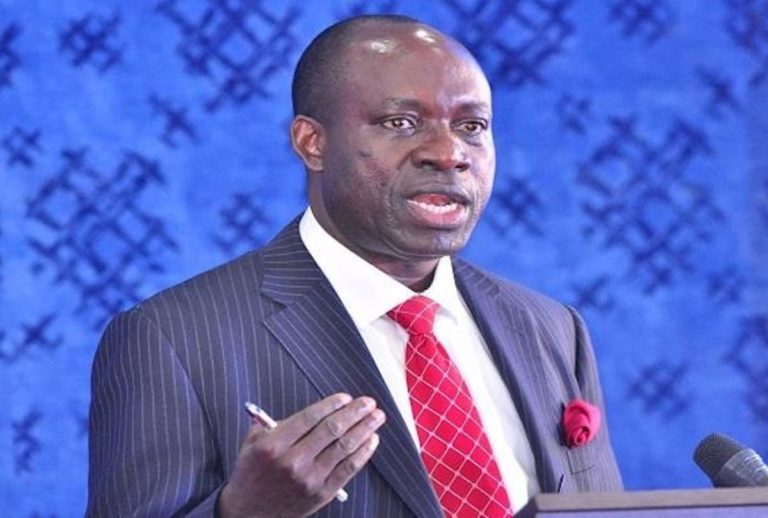
THE Anambra State Police Command has arrested a suspect connected with the attack on the former governor of the Central Bank of Nigeria(CBN) and a gubernatorial aspirant in the state, Chukwuka Soludo.
Anambra State police public relations officer Ikenganya Tochukwu disclosed this in a statement issued in Awka on Thursday.
Gunmen attacked Soludo on Wednesday during a political rally at Isuofia Civic Centre in Aguata LGA in the state.
The attack led to the killing of three police officers while the attackers also abducted the state commissioner for water resources and public utilities, Emeka Ezenwanne.
According to the police, the security operatives who sustained ‘severe gunshot injuries’ were confirmed dead in the state hospital.
Tochukwu said the state commissioner of police Monday, Bala Kuryas, had reinforced Soludo’s residence and community security operatives.
“To this end, the CP, while condemning the act, commiserates with the family and friends of the officers who paid the supreme price, ordered the immediate launch of a tacit investigation to unravel the mystery behind the incident, as well as to bring perpetrators of the barbaric act to book,” the statement read in part.
When asked about the omission of the suspect’s name in the statement, Tochukwu said the command deliberately withdrew it because it was an undercover investigation.
“Yes, we deliberately withdrew the name of the arrested suspect because it is an undercover operation, and we are currently on the trail of others,” Tochukwu said.
The attack came just about eight months to the gubernatorial election in Anambra State, when the second tenure of the incumbent Governor Willie Obiano will have been over.
Eight months to election in Anambra State
According to the Independent National Electoral Commission (INEC), the state’s gubernatorial election was scheduled to hold on Saturday, November 2021.
Soludo had declared his intention to contest for the seat under the All Progressives Grand Alliance (APGA) in February.
Political analysts say the attack could sow fear into the minds of intending voters in the upcoming election.
Head of Election Programs at YIAGA Africa Paul James said the attack raised a major concern.
According to James, whose civil society organisation focuses on promoting democratic governance, there were reasons to be concerned because it could hinder voter turnout during the election.
He said during the previous governorship election in 2017, only 21 percent voter turnout was recorded.
James further stated that another concern was that security operatives would not act on time to mitigate or curb electoral violence but rather do so a few weeks to the election.
“Another concern for me is the state of security in that region. You have the IPOB there, and you know Anambra State is known for having a good number of political big guns, so I feel we should be concerned that this is happening,” James said.
INEC chief press secretary Rotimi Oyekanmi did not respond to questions from The ICIR concerning the attack.
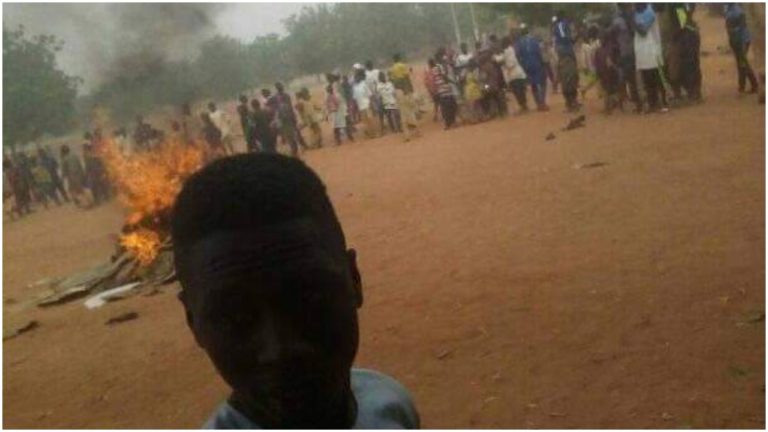
A WATER vendor identified as Talle Mai Ruwa has been burnt to death in Bauchi State for allegedly insulting Prophet Muhammad.
According to The Punch, the incident happened between Monday night and Tuesday morning.
A source was quoted as saying that Ruwa and his parents were all Muslims in Sade village, stressing that trouble had started when a certain lady went to fetch water from the deceased.
He was reportedly detained at a police station in Darazo Local Government Area of the state before he was seized the following day from the police cell by an irate mob who beat him to death and set his corpse ablaze using petrol and a disused car tyre.
“She fetched the water while he was not around and when he came back and saw her, he used his leg to kick the bucket and the water spilt.
“She pleaded with him in the prophet’s name to allow her fetch the water. He then abused her, her father, mother and the Prophet Mohammed. This infuriated the youth and the district head, who took him to a police station.
“The spiritual and traditional leaders met and brought him out. They were looking for a way out of the situation. They asked him if he was guilty of what he was being accused of, and he admitted to it. They asked him thrice, and he admitted to it. They then took him back to the police station.”
“In the morning, the whole town gathered and besieged the station. Because of the number of people that were there, they overwhelmed the police officers. The people brought him out and started pelting him with stones and shouting, ‘Allahu Akbar!’ They kept stoning him till he died. The youth brought car tyres and put it on him and set him ablaze.”
The ICIR tried to get the state police command’s reaction, but several calls to the state police public relations officer Ahmed Wakil on Wednesday were not answered.
THREE persons have been arraigned by Lagos State Police Command for allegedly forging COVID-19 test results in the state.
The suspects were Emmanuel Adelegan, Ibrahim Abubakar and Tope Shoaga. They were arrested by the police and brought before an Ikeja magistrate court on Thursday.
They were charged with conspiracy, obtaining money under false pretence and forgery.
The police prosecution counsel Lucky Ihiehie told the court that the defendants committed the offences on February 8 at Murtala Mohammed International Airport, Ikeja, Lagos.
He said the defendants fraudulently obtained N33,000 from one Chisom Emmanalon with a promise to get her a COVID-19 test certificate but when the certificate was presented at the airport, authorities discovered that it was fake.
He said the offences contravened sections 314, 365 and 411 of the Criminal Law of LagosState, 2015.
Following the defendants’ plea of “not guilty,” the magistrate O. A. Layinka released the suspects on bail in the sum of N100,000 each with two sureties each in like sum.
THE Independent Electoral Commission (INEC) has announced that continuous voter registration (CVR) would commence on Monday, June 28, 2021, across the country.
INEC chairman Mahmud Yakubu disclosed this on Thursday during a press conference held in Abuja.
He said the CVR exercise would commence nationwide and be carried out continuously for over a year until the third quarter of 2022.
According to Yakubu, the voter registration would be done online while biometric verifications would be conducted at designated centres with schedules for registrants.
According to the commission, the online portal registration would reduce crowding at registration centres in line with advice from health officials in the country.
Yakubu said voter registration could not commence earlier due to COVID-19 pandemic and other offset elections in Kogi and Bayelsa states in November 2019.
The INEC chairman added that the CVR registration could also not commence earlier due to the commission’s determination to expand voter access to polling units by increasing their number.
Yakubu noted that the existing polling units in Nigeria were inadequate because they were initially designed to cater for a projected 50 million voters but were presently serving over 84 million voters.
He also stated that many of the polling units were inaccessible to voters, especially persons with disability (PWDs), and were not conducive to the commission’s election regulations in the context of the COVID-19 pandemic.
He disclosed that the commission had begun the conversion of voting points and voting point settlements into full-fledged polling units, and relocating poorly situated polling units to better locations.
However, Yakubu said in the process of registration, emphasis would initially be on Anambra State where more centres would be established in view of the governorship election scheduled for Saturday 6th November 2021.
He stated that in order to complete preparations for the governorship election, the CVR exercise in the state would be temporarily suspended in August 2021.
The CVR was temporarily suspended on 31st August 2018 due to preparations for the conduct of the 2019 general elections.
During the last voter registration in Nigeria, a total of 84.004 million Nigerians registered while 72.755 million collected their permanent voters’ card (PVC), according to data obtained from the commission.
WITH the Arabian Travel Market, which was cancelled last year owing to the covid-19 pandemic just around the corner, the impasse on travel between Nigeria and the United Arab Emirates may be resolved soon. The UAE has also removed the controversial antigens rapid test requirement for passengers from Nigeria but gives new conditions to be met. Oghenekevwe Uchechukwu reports.
PASSENGER flights between Nigeria and the United Arab Emirates (UAE) may soon resume as both countries continue to work out measures for the safe resumption of travels after the UAE agreed to remove antigens’ rapid test requirements passengers from Nigeria.
In addition to the Covid-19 Reverse Transcription Polymerase Chain Reaction (RT-PCR), the UAE had imposed antigens rapid test on travellers from Nigeria and 57 other countries. Passengers transiting through Dubai from Nigeria, Afghanistan, Angola, Argentina, Bangladesh, Brazil, Cambodia, Chile, Croatia, Cyprus, Czech Republic, Djibouti, Egypt, Eritrea, Ethiopia, Georgia, Ghana, Guinea and Hungary, were required to present a negative COVID‑19 RT-PCR test certificate for a test taken no more than 72 hours before departure.
Other countries included on the list are India, Indonesia, Iran, Iraq, Israel, Ivory Coast, Jordan, Kenya, Lebanon, Malta, Moldova, Montenegro, Morocco, Myanmar, Nepal, Nigeria, Pakistan, Philippines, Romania, Rwanda, Russia, Senegal, Slovakia, Somaliland, Somalia, South Africa, South Sudan, Sudan, Syria, Tajikistan, Tanzania, Tunisia, Turkey, Turkmenistan, Uganda, Ukraine, Uzbekistan, Vietnam, Zambia, and Zimbabwe.
The UAE later barred travellers from Nigeria and South Africa, excluding UAE nationals returning to the UAE and members of diplomatic missions, after more transmissible variants of the SARS CoV-2 virus B.1.525/501Y.V2 were reported. The ban was to be lifted on 20th March.
However, the move to subject passengers to additional tests was not well received by the Nigerian government, and it announced an indefinite suspension of Emirates airline with effect from 17th March. Hadi Sirika, minister of aviation, the imposed antigen rapid tests was “devoid of any scientific reasons because the virus itself will incubate at least within or after 72 hours”.
The RT-PCR, which is a molecular test, can detect more than one variant of the Covid-19 virus, and experts say that it remains the best and most accurate way of testing the emerging variants. Still, the more recently-developed rapid antigen tests offer the advantage of producing results much more quickly. They are also cheaper, simple to use, and can be used on a huge scale, but the results are less reliable.
The UAE had agreed it will stop conducting antigens rapid test for passengers from Nigeria but will only allow 200 passengers with direct flights from Nigeria who have a negative PCR test certificate conducted 48 hours before boarding. It said that 200 passengers are the maximum it will allow from Nigeria over two weeks, as part of its new travel requirements.
Fernando Judel, Director, Nigerians in Diaspora Dubai-United Arab Emirates (NIDDUAE), told our reporter that flights could resume soon if the Nigerian government accepts these new requirements, adding that the selection will be based on priority – business, medical and vacation or leisure purposes.
“Before now, there has been a structural plan to reduce the inflow of Nigerians here, especially the job seekers. The new regulations’ bottom line is the new strain of covid-19 found in Nigeria late last year. If it is no accepted by Nigeria, the only option is to reduce the inflow of passengers. When the passengers reduce, they can manage it better even if it (the new variant of the covid-19 virus) emerges,” Judel explained.
Meanwhile, the UAE hopes to open for tourism from next month as the Arabian Trade Market (ATM), which was cancelled last year owing to the covid-19 pandemic, is expected to hold from 16th – 19th May. The ATM is an international travel and tourism event unlocking business potential within the Middle East for inbound and outbound tourism professionals.
This year’s ATM, the 28th version, is themed “A New Dawn for Travel and Tourism”. Tourists worldwide will showcase their brand and exhibit at the show along with the biggest names in accommodation and hospitality, renowned tourism attractions, innovative travel technology companies, and key airline routes.
Later in the year, the country will host the World Expo 2020, an event originally scheduled for 20th October 2020 – 10th April 2021 but which will now hold between 1st October and 31st March 2022.
Nigerian pilots are currently training on Super Tucano fighter jets at the Moody Air Force Base in Georgia, United States, checks by The ICIR have revealed.
The federal government recently announced that Nigeria would deliver six out of the 12 units of fighter aircraft it ordered in mid-July 2021. The aircraft are to be deployed in the war against terror in the country.
The United States Africa Command (AFRICOM) told The ICIR that the Nigerian pilots are training with the jets ahead of their delivery to Nigeria.
AFRICOM’s West Africa media chief, Nicole Kirschmann, disclosed in response to enquiries by The ICIR concerning steps taken by the US military command to tackle terrorism in Sub-Saharan African countries, including Nigeria.
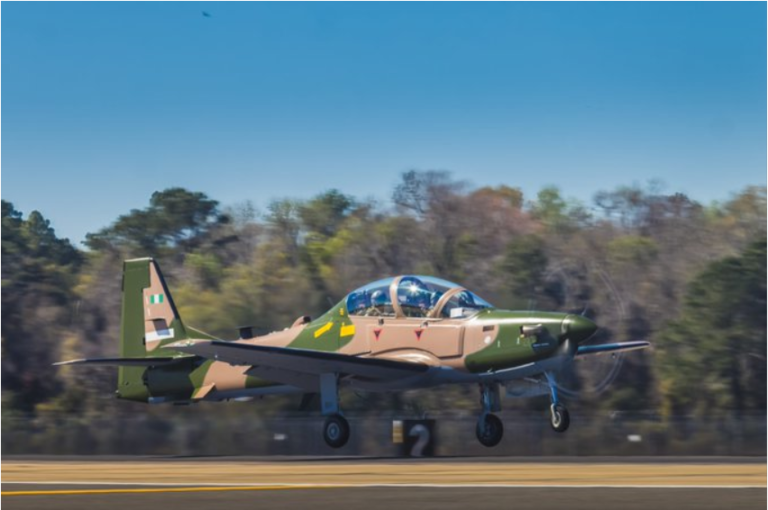
The Embraer EMB 314 Super Tucano, also named ALX or A-29, is a Brazilian turboprop light attack aircraft designed and built by Embraer to develop the Embraer EMB 312 Tucano. The A-29 Super Tucano carries a wide variety of weapons, including precision-guided munitions, and was designed to be a low-cost system operated in low-threat environments. In addition to its manufacture in Brazil, Embraer has set up a production line in the US in conjunction with Sierra Nevada Corporation to manufacture A-29s to many export customers.
Super Tucano fighter jet
“Currently, the US is working to deliver A-29 Super Tucanos to the Nigerian Armed Forces, and Nigerian pilots are currently training on that aircraft with US Air Force Pilots at Moody Air Force Base in Georgia, USA,” Kirschmann said in an email response to questions raised by The ICIR‘s correspondent.
Sierra Nevada Corporation (SNC), the prime contractor for the purchase of the Super Tucanos, had in a report published by Flight Global on March 9, 2021, said five Nigerian Super Tucanos, which have been painted in jungle camouflage, are at Moody AFB in Georgia for pilot and maintainer training.
“The painted jungle scheme NAF A-29 now moves on to mission modification at Moody Air Force Base. Following modification, before delivery, NAF pilots and maintenance personnel will further train in the aircraft,” SNC said in the report by Flight Global.
In November 2018, SNC was awarded a $329 million Foreign Military Sales contract from the US government to build 12 A-29 Super Tucanos for the Nigerian air force. The armed turboprops are intended for use against Boko Haram and Islamic State militants.
SNC reported produces the aircraft in Jacksonville, Florida.
The AFRICOM spokesperson’s response confirmed that Nigerian Air Force pilots are now training with the fighter jets following the modification stage’s completion.
Kirschmann told The ICIR that the US African Command partners with several nations in West Africa, including Nigeria, to increase peace and security across the region.
“Through multinational exercises and military-to-military engagements, US Africa Command strengthens relationships with African partner nations to help build the defence capability and capacity of their security forces. US Africa Command embraces a holistic approach to security challenges by working closely with US government inter-agency counterparts and partner nation militaries from around the world,” she said.
Kirschmann listed multinational security cooperation efforts initiated by AFRICOM in West Africa to include the G5 Sahel Joint Force, the Multinational Joint Task Force, Operation Barkhane, and Task Force Takuba.
AFRICOM and the US Department of Defense also host several military exercises in North and West Africa, including Flintlock, African Lion, and the recently completed annual Gulf of Guinea naval exercise, Obangame Express.
6000 US troops currently in Africa
Currently, about 6000 US soldiers are stationed in Africa.
Out of the number, 1,200 are on the ground in West Africa.
Kirschmann disclosed the figures in response to enquiries by The ICIR‘s correspondent concerning whether, beyond assisting regional governments and military units, AFRICOM engages in actual campaigns to neutralise terrorists in the continent.
A recent report by Jerusalem Center for Public Affairs had noted that Africa was becoming a ‘Jihadist playground for the resurgent Islamic State and al-Qaeda’s and warned that Sub-Saharan Africa could because an operational base for Jihadist groups if their current activities in the region are left unchecked. The report observed that, if that should happen, it will hurt US and Western interests.
“The Department of Defense typically has approximately 6,000 troops, DoD (Department of Defence) civilians, and DoD contractors stationed on the continent, including approximately 1,200 personnel in West Africa,” the AFRICOM spokesperson disclosed.
She added that, as part of the campaign against terrorism in the continent, the US government frequently sells or donates military equipment to militaries in West Africa, including the Nigerian Armed Forces. The sale of the Super Tucanos to Nigeria was in line with the military assistance to African governments.
Nigeria critical partner in the fight against terror
Kirschmann told The ICIR that “Nigeria is a critical partner for US Africa Command in the fight against terrorism and violent extremist organisations in Africa, specifically Boko Haram and ISIS-West Africa.”
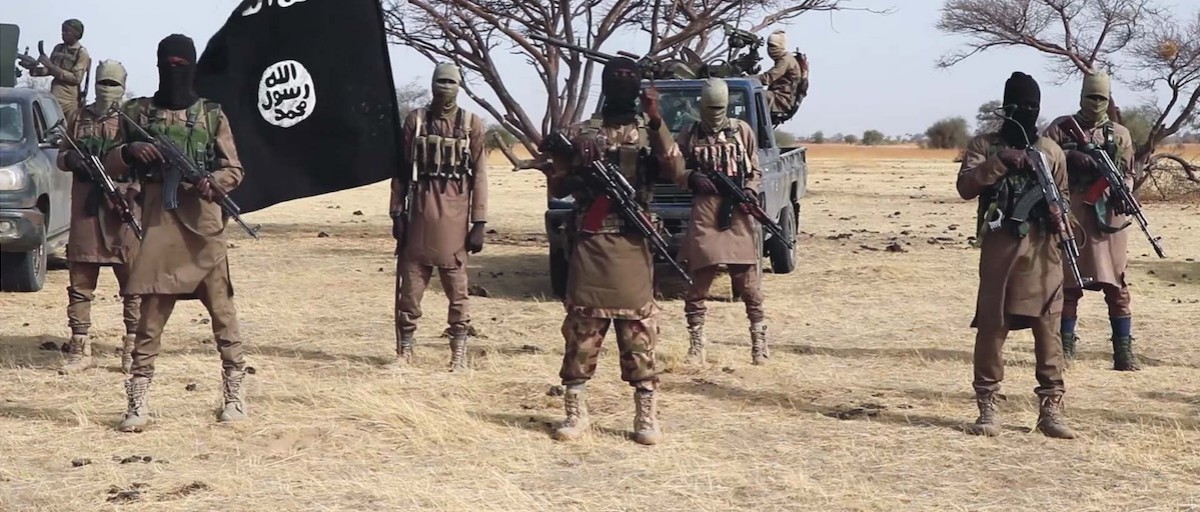
Boko Haram insurgents have been engaged in a terror campaign in parts of Nigeria. Image credits: ISS Africa
According to her, the command is looking forward to a continued and strengthened partnership with the Government of Nigeria to ensure greater stability in the region.
“US Africa Command’s security cooperation with Nigeria aims to enable the Nigerian government to protect its citizens better and defeat terrorist groups in the region while respecting human rights and the law of armed conflict,” she added.
Kirschmann further disclosed that Nigeria is a major focus of the US Africa Command’s Women, Peace, and Security (WPS) program.
She explained that Nigeria is a WPS priority country due to Boko Haram’s kidnapping and the use of female fighters and enablers through the conflict.
AFRICOM alarmed at kidnapping-for-ransom in Nigeria
In further response to The ICIR‘s enquiries, Kirschmann said AFRICOM was alarmed at the kidnapping rate for ransom going on in Nigeria.
In recent times, kidnapping-for-ransom has become the norm in Nigeria, with all classes of citizens, including affluent prominent individuals and petty traders and students, being abducted for ransom.
Commenting on the development, Kirschmann said, “One of US Africa Command’s concerns in the region is the kidnapping-for-ransom network. We are alarmed by the increase in kidnappings across the region.”
According to Kirschmann, while kidnapping is a concern for Americans living and working in West Africa, it is a much larger concern and threat for locals in the region.
“These abductions must stop, and those responsible must be held accountable to the full extent of the law,” she stressed.