Home Blog Page 1903

Bypassing of Procurement Act, Contract splitting, other illegalities in Fashola’s ministry that cost FG about N9.38bn

THE Federal Ministry of Works and Housing under leadership of Babatunde Fashola engaged in fraudulent procurement, contract splitting and non-remittance of statutory deductions to the tune of about N9.38 billion, report obtained by The ICIR has shown.

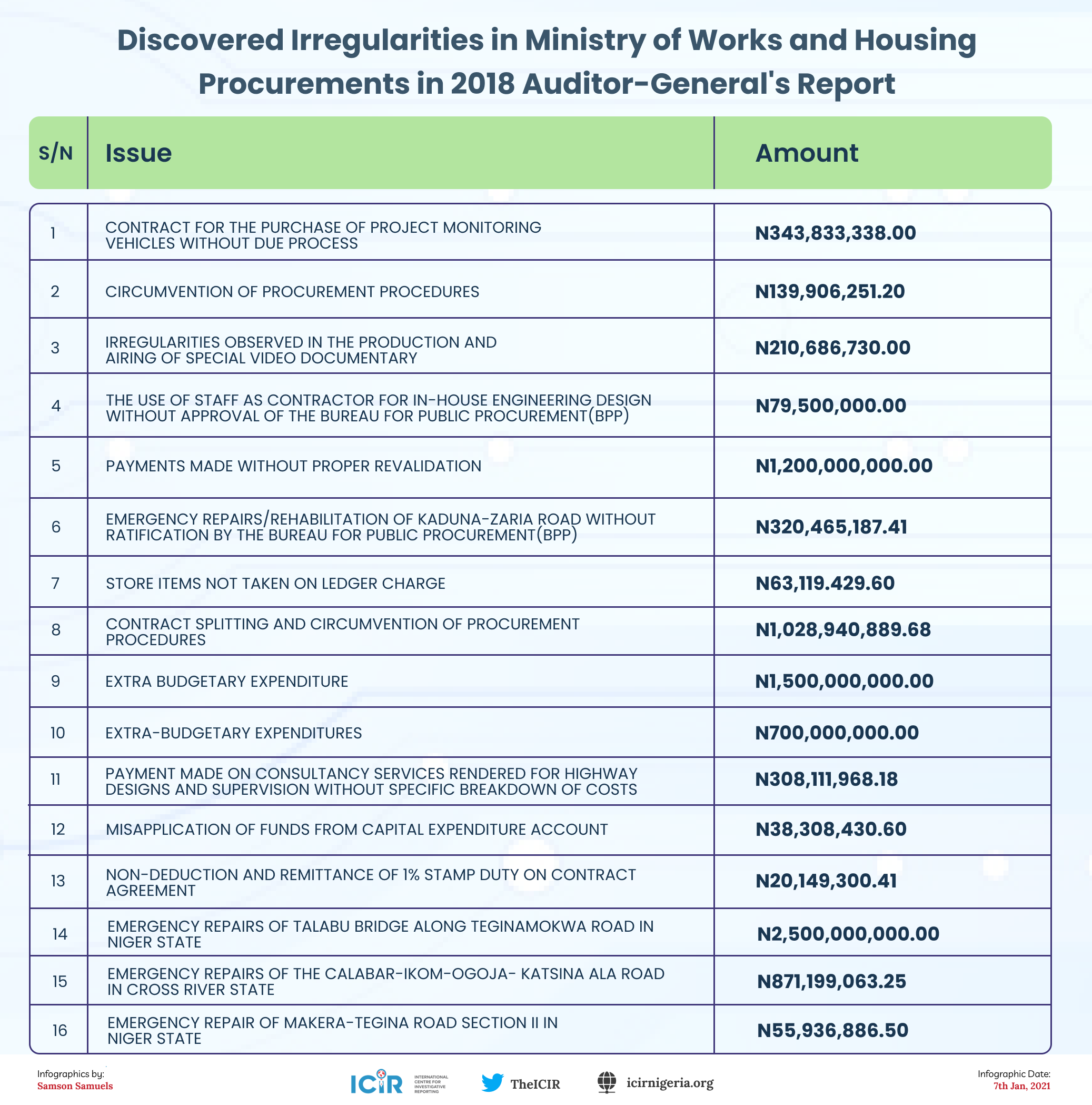
Latest audit report from the Office of the Auditor-General of the Federation (OAuGF) listed 16 infractions against officials of the Works Section of the ministry. The ICIR also discovered most of these offenses flout the Public Procurement Act (PPA), 2007 and the Financial Regulations Guideline.

The report, uploaded on the OAuGF website on December 23, 2020 shows huge infractions worth N105,760,058,919.43 within the Ministries, Departments and Agencies (MDAs).

Monetary values of the 16 irregularities listed against the ministry’s officials is summed at N9,380,157,474.83. Though, Fashola oversees the ministry, the Federal Government had in 2015 announced Permanent Secretaries as accounting officers of their respective ministries. So, as of the period the anomalies were committed, Alhaji Mohammed Bukar was PS of the Power, Works and Housing Ministry.

Alh Mohammed Bukar, former PS of the Ministry of Power, Works and Housing in 2018. Photo Credit: FMPWH

Some of the concerns raised in the audit report include under and non-remittance of revenues generated by the MDAs, irregular expenditures including what the OAuGf described as ‘high magnitude of unretired advances’, among others.

“Overall, our findings are indicative of significant weakness in expenditure control, and financial reporting,” it states, adding that accounting officers in the MDAs had developed thick-skin towards improving some of the audit observations raised by the OAuGF.

In a letter with reference number C/AR.2018/CONF/VOL.1/01, Anthony Ayine, the Auditor-General of the Federation had earlier submitted first part of the report on October 16, last year to Clerk of the National Assembly as mandated by Section 85 (2) and (5) of the Constitution, for necessary reviews and action.

“The Auditor-General shall have power to conduct checks of all government statutory corporations, commissions, authorities, agencies, including all persons and bodies established by an Act of the National Assembly,” Subsection 4 of the Act reads.

However, in relation to the works arm of the ministry, part of the infractions recorded by the OAuGF includes the procurement of 36 Project Monitoring Vehicles at the cost of N343.83 million (N353,833,338) without due process. This flouts Section 24 of the PPA which mandates public procurement to undergo competitive bidding, except approved otherwise by the Bureau of Public Procurement (BPP).

Further findings revealed the procured vehicles had no record because they “were not received into store as there was no document to show such delivery.”

Aside the questionable purchase, another N139.90 million (N139,906,251.20) flawed procurement of photocopying machines parts, computer accessories, and vehicle spare parts was discovered by the Office.

The ministry had no store record to validate the purchase.

Also, N2.5 billion emergency repair of Talabu Bridge along Tegina – Mokwa Road, Niger State is one of the notable contracts the OAuGF identified the ministry’s officials breached the PPA. The awarded contract surpassed threshold. It was awarded rather than seeking the Federal Executive Council (FEC) approval.

Findings by The ICIR also showed (ERGP 12106525) only N1.20 billion was approved for some ongoing projects and emergency works in the 2018 approved budget of the ministry.

“Failure to comply with procurement rules and laws could lead to poor performance, abandonment of works or loss of public funds,” the Office stated while highlighting the risk involved in non-compliance.

OAuGF is the supreme audit institution of the federal government headed by Ayine.

The Office is empowered to statutorily promote transparency and accountability across MDAs and ensure proper management of the nation’s resources independently.

Besides its responsibility, it also partners with relevant regional and international organisations such as the World Bank, African Organisation of English-Speaking Supreme Audit Institutions (AFROSAI-E) in delivering its mandate.

As such, Ayine has repeatedly criticised non-compliance of some MDAs and late submissions of audited accounts and financial statements of federal government parastatals by their chief executives.

He described the trend to be of great concerns.

For instance, as of 2016, previous report from the OAuGF showed 65 agencies of government has never submitted their audited accounts to the OAuGF.

Records from the OAuGF further revealed that between 1993 to 2010, about 12 agencies defaulted in submitting their reviewed accounts.

The number of defaulting agencies increased to 76 in 2011, 85 in 2012 and 109 in 2013. By 2014, it had increased to 148. 215 defaulting agencies was reported in 2015 while it further increased to 323 in 2016.

Incidentally, the most recent report of infractions came at a time the country is grappling with recession, increased unemployment and fluctuating oil fortune due to the global pandemic.

More so, despite the 16 infractions listed against the work ministry, OAuGF says there was no official response from the ministry to defend the accusations as of the time of the audit.

The audit report further identified irregularity in the production and broadcasting of a special video documentary awarded by the ministry for N210.68 million (N210,686,730.00).

The above sum was reportedly split into two and paid into a staff’s private account after a chunk of it was approved for release by an undisclosed former Director of Finance and Account (DFA) at the works ministry.

“N210,686,730.00 meant for a documentary was split into N130,080,730.96 and N80,606,000 and paid into a staff account…there was no evidence to show who the producer of the documentary was, or whether they were selected on a competitive basis.

“There was also no evidence to show the work was actually done.”

Again, it clearly contravenes Sections 713 of the Financial Regulations Act which states that, “personal money shall in no circumstances be paid into a government account, nor shall any public money be paid into private bank account. An officer who pays public money into a private account is deemed to have done so with fraudulent intention.

In its recommendation, the report, however, suggests the spent sum be returned to the Consolidated Revenue Fund and the DFA sanctioned for flouting the law.

Ministry allegedly paid N43m to staff as Contractor for In-House Engineering Design 

In clear violation of the public procurement act, the audit report also accused the ministry of paying N43 million from N79,500,000 to its staff for an in-house design of road networks. Aside from flouting Section 42 of the PPA, the ministry’s non-compliance was said to have also denied FG of its accrued revenue from Value Added Tax and other necessary deductions summed at N4.3 million if the procurement had passed through the due process.

The DFA, in the same audit year was accused of approving N1.2 billion for the construction of Panyam-Bokko-Wamba road project in Nasarawa state without authorisation.

Similar wrongdoing was recorded against the ministry when it approved N320,465,187.41 for emergency rehabilitation of Kaduna-Zaria road without approval from the BPP.
Federal Ministry of Works and Housing

N700 million extra-budgetary expenses, N1.02 billion Contract splitting  

Also, there was an extra-budgetary expenditure of N700 million. The audit report revealed N500 million was initially paid as part of a N736 million budgeted sum for a N1.23 billion Pankshin-Ballang-Nyellen-Sara-Gindiri road project, Pankshin, Plateau State.

In another N920 million project which N720 million was budgeted for payment, a N200 million extra-budgetary expenditure was also discovered. The project was for the construction of Agaie-Katcha-Baro road in Niger State. So, a total of N700 extra-budgetary sum was penciled out by the OAuGF.

Beyond these discoveries, contract splitting amounting to N1,028,940,889.68 was exposed in the same ministry. Despite that contract splitting also contravenes the PPA, the contracts were for the same supply of stationery and office materials.

“In particular, on September 5, 2017, (51) separate contracts each valued at between N4.5 million and N9.4 million and totaling N216,633,322 were awarded to various companies all for the supply of stationery.

“The award letters were all signed by the same individual and this was just one example of similar contract splitting activities amounting to N1,028,940,889.68.” These among others were series of anomalies unearthed by the OAuGF against Works arm of the Works and Housing Ministry.

Read Also: Non-existing office of Buhari’s Chief Economic Adviser gets approval for N573.45m in five years

Reactions

It is, however, unclear whether the anti-graft agencies have investigated MDAs that failed to submit their audited reports or violated Public Procurement Act and other regulations

Notwithstanding, the Economic and Financial Crimes Commission (EFCC) disclosed it was able to secure 865 convictions from a total of 1,305 cases it pushed to the court in 2020.

Though, no clear statement was made regarding cases bothering on the breach of procurement act and the likes, Mohammed Umar, Acting Chairman of the Commission revealed 7, 340 cases are still being investigated from 10, 152 petitions received by the Commission.

The ICIR contacted Wilson Uwujaren, the EFCC spokesperson but his line was unreachable.

On January 6, a text was sent to his line but was not replied. The next day, his line was tried but it was still out of coverage.

The Independent Corrupt Practices and Other Related Offences Commission (ICPC) was also contacted through Aruba Nwunye, the Spokesperson but she did not respond to phone calls.

“I am not aware of any actions for now,” she later replied in a text message. Efforts to get Bukar’s contact through website of the Office of Head of Service of the Federation failed.

Mrs. Oyeboade Akinola, Director of Media and Public Relations in the ministry did not respond to calls made to her line as well. Text message sent to her was also ignored.
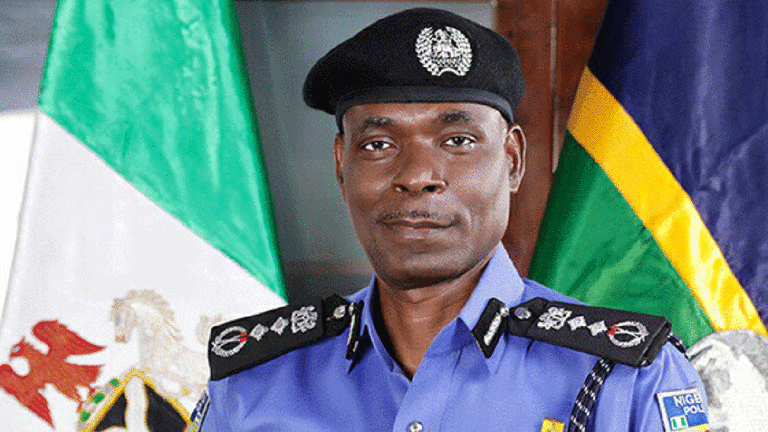
DPO settles accident case, but turns blind eye to fake documentation of vehicle

THE Divisional Police Officer (DPO) of Maitama Police Station, Abuja,  CSP Magawata, has questionably succeeded in mediating in a case of road accident involving a lawyer and a man alleged to have biological link with a lawmaker and a minister in Nigeria, but covered up a criminal use of fake plate number on one of the vehicles involved in the crash.

Apart from failing to probe the fake number plate and bring the culprit to justice, the DPO also did not sight the offender’s vehicle throughout the period he superintended over the mediation process.

Driving in a black Ford Edge along the Aminu Kano Crescent, Wuse 2 on 16th November  at about 3:20pm, Mr. Bashir Zuntu had crashed into Barrister Julius Atanawhemera’s Toyota Celina car from behind.

Zuntu was alleged to have immediately negotiated his way from the scene and zoomed off. But he was unlucky; one of his number plates fell off at the scene.

An occupant of his car however alighted to sympathize with the lawyer before the culprit sped off.

With the support of Atanawhemera, the police in Maitama, where the incident was reported, began to track the fleeing driver.

The number plate

There was however a major setback in the bid to apprehend him, as according to the lawyer, the number plate that fell from his vehicle, with which he was being tracked, proved to be fake when the Vehicles Inspection Officers (VIO) were engaged to conduct a check on it.

The ICIR independently investigated the number plate on Wednesday, December 23, 2020, at the Vehicle Inspection Office, Abuja; it was confirmed to be fake.

Atanawhemera argued that Zuntu was eventually arrested through the tracking of the number provided by the person who came down from his car at the scene of the accident.

The man who gave the number had allegedly fled as well, sensing the consequences of the impact of the crash, coupled with the fact that the principal offender had vanished with his vehicle.

He was, however, the first to be apprehended before Zuntu’s hideout was allegedly uncovered.

The lawyer noted that he began to suspect foul play after Zuntu was apprehended, as according to him, the accused was allowed to flee from detention and travel out of the country by the police, so he would evade punishment.

Though the lawyer claimed the fleeing driver was a son of a serving senator and a cousin to a serving minister, the DPO told the ICIR that “his parents are politicians,” and that “he is a core civil servant.”

Atanawhemera also said the DPO confided in him that some influential politicians had called him in respect of the case and that the suspect had travelled out of the country.

Peeved by the dimension his case was taking at the Maitama police station, Atanawhemera – a Principal Counsel –wrote the FCT Police Commissioner on 14th December 2020, demanding that the police furnish him with a certified true copy of the report of a preliminary investigation into the case, after four weeks of lodging a complaint about the matter. The receipt of his letter, seen by The ICIR, was acknowledged the same day by the FCT police.

He made the request through the Freedom of Information Act (2011).

The lawyer claimed that despite providing the police with financial support and other aids for him to get justice, the suspect remained at large.

Atanawherema said all citizens of the country are equal before the nation’s laws and that the “Nigeria Police Force is created under the enabling laws to fight and discourage crimes and not created to encourage crimes.”

The lawyer said he is more pained with the accused disappearance because he claimed to have supported the police to track the accused “at a huge financial cost and time expense.”

Speaking with The ICIR on the matter on Monday 21 December 2020, the DPO said the parties would be meeting him around noon that day to find an amicable way to resolve the rift.

He also denied the allegation by the complainant that the accused escaped from custody and the country.

He said the accused did not flee as alleged by the lawyer but travelled out of Abuja on official assignment.

Meanwhile, the lawyer told our reporter after the meeting that the meeting went very well.

He said a brother to the accused – a policeman – whom he had known before the accident occurred, offered to repair his car and he agreed.

The agreement resulted in amicable resolution of the case and he had withdrawn the matter from the police station, he stated.

But in a sudden twist of the event on Wednesday, December 2020, he alleged again that he was no longer hearing from the man who agreed to repair his car.

Though the lawyer had withdrawn the case from the police station at the time of filing this report, The ICIR sought to know what the police would do to the case of fake number plate on the accused’s vehicle.

This time, the police DPO in Maitama would not tolerate any question regarding that. He declined request from The ICIR on the matter. He said the matter had been settled and there was nothing more to discuss over it.

Zuntu was contacted by our reporter to state why he used fake number on his car.

He denied having any case at the station the first time he was sent a text message, after failing to pick calls. He said: “I really don’t know what you’re talking about, as I don’t have any case in any police station at the moment. Please, revert back to Julius, this must be a mistake. Thank you.”

Our reporter sent another message to him to confirm or deny if he is one Mr Bashir Buntu who had just concluded a case of accident at the Maitama police station.

He said: “Yes, but I don’t have any case, it has been withdrawn in written. The case is now officially closed.”

Then, our reporter sent his number plate, which was confirmed to be fake by the lawyer and the ICIR at different offices of Vehicle Inspection Officers, to him in a Whatsapp message to confirm if it is genuine or not.

Zuntu responded through a Whatsapp message that he didn’t know anything about it. He said the car was for sale and that he was no longer in possession of the car.

He directed our reporter to contact the Maitama police station for whatever information he needed on the matter.

“I have handed the car to the owner. I have no business to do with both parties. I have no case with anyone anymore, both barrister and the owner of the car have gotten their compensation for the damage caused. I’ll appreciate it, if you go to the station for more detail,” he stated.

Read also: Wastefulness, underfunding cripple key infrastructure in Abuja stadium complex

New account appears on Twitter using Trump’s pseudonym of 1980s

HOURS after Donald Trump’s Twitter ban, a new satire account has sprung up using the outgoing US president’s pseudonym of 1980s.

Trump used ‘John Barron’ as a pseudonym in the 1980s, according to Wikipedia.

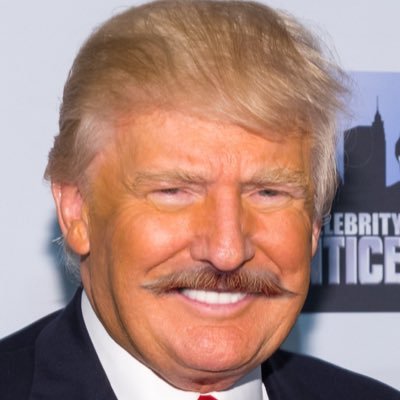
An unknown man created a ‘John Barron’ account on Twitter 17 hours ago using Trump’s profile picture and a fake moustache. The account garnered 349,400 followers within hours, with the first post amassing 262,100 re-tweets, 1.7 million likes and 36,100 quotes within six hours.

The account has only five followers: Trump’s wife, Melania; his daughter, Ivanka; his son, Eric; Donald Trump Jr; and Rudy Guiliani, former New York mayor and Trump’s die-hard associate.

When the account tweeted its first post, “Hello I am brand new to Twitter. What are you guys up to,” several users alluded that the account must have been created by the U.S. President.

“I think this is the real Trump,” a Twitter user @OgheneNerojr said.

A Twitter user with the handle @atlas2112 replied that “I will be surprised if he does not create a new account with Putin. At this point he is one step away fron just admitting it all.”

Another Twitter user @CaroleCarole012, wrote, “New to Twitter? How did you get over 30k followers? And why are the only people you follow named Trump? I think you need to go elsewhere.”

However, some Twitter users believed it was a fake account.

“This was by far the simplest, purest, honest, and genuine light of comedy in a dark time. Haha awesome job,” tweeted a Twitter user @SlaceofSpades.

Candice Wilson with the handle @RushBluOcVoBeat said, “You know what is funny? There are MAGAS retweeting this…I guess it is funny to them. Do they know that this is satire?”

The account holder had made seven posts as of 7.45pm, describing his location as “Not the White House.”

Trump has been permanently banned by Twitter, Facebook and Instagram for inciting violence and violating rules guiding social media posts. He incited his supporters to breach Capitol Hill on Wednesday—the day the Congress was to certify Joe Biden as winner of the November 2020 U.S. presidential election.

Read also: Criticisms as Trump says will not attend Biden’s inauguration

The CNBC said in November 2020 that John Barron was “Donald Trump’s go-to pseudonym when he needed to send a message without using his own name.”

The outgoing U.S. President will leave power on January 20, but he risks being impeached before the due date for inciting violence which led to the death of five persons in the United States.

‎Virologists, others urge caution over FG’s rush to acquire COVID-19 vaccines

PROMINENT virologists in the country say the federal government should exercise caution in its quest to acquire COVID-19 vaccines for Nigerians. 

Virologists, who spoke with The ICIR on plans by the federal government to purchase the vaccines, noted that there were still a lot of unanswered questions concerning the efficacy and possible side effects of the newly developed drugs.

The federal government had, on January 5, disclosed that it had commenced moves to get 42 million COVID-19 vaccines through the World Health Organisation’s COVAX scheme.

COVAX is a partnership involving governments, global health organisations, manufacturers, scientists, private sector, civil society and philanthropists aimed at ensuring equitable distribution of COVID-19 vaccines.

Going by government’s plan, the 42 million vaccines would cover one fifth of Nigeria’s population‎. The government intends to inoculate 40 percent of the country’s population in 2021, and another 30 percent in 2022.  However, scientists say an individual requires two doses of COVID-19 vaccine.

A shipment of 100,000 doses of Pfizer COVID-19 vaccine is due to arrive in Nigeria by the end of January.

  • FG doesn’t have enough information on vaccines

Executive director of the National Primary Health Care Development Agency (NPHCDA), Faisal Shuaib, who disclosed details of the Federal Government’s coronavirus vaccination plan at a press briefing of the Presidential Taskforce on COVID-19 in Abuja on January 5, said President Muhammadu Buhari, Vice-President Yemi Osinbajo and other top government officials would be the first to receive the vaccine.

The vaccination of the country’s top leaders would be televised live on national television in order to inspire public confidence in the vaccines, according to plans put in place by the government. ‎

But, while speaking at the press briefing, NPHCDA‎ boss, Shuaib‎, confirmed the fears held by many Nigerians when he admitted that the government did not have enough information about the vaccines.

Asked how long the protection offered by the vaccines would last, ‎Shuaib said, “One thing that we are aware of is that this vaccine is new. So we do not have absolute information about how long they will last because the vaccines are just a few months’ old. It is only a question of time before we know exactly how long their immunity will last.”

‎A professor of virology at the Lagos State University (LASU), Bola Oyefolu, told The ICIR that it was wrong for the federal government to move to acquire the vaccines without having adequate information about its efficacy and side effects.

Oyefolu said he was part of a team of researchers assembled by the ‎Nigerian Institute of Medical Research (NIMR) which sequenced the gene of a strain of the coronavirus found in Nigeria. In response to questions by our correspondent, Oyefolu suggested that the COVID-19 vaccine had not gone through all the processes that it should be subjected to before being administered on people.

“Those in government should ask themselves whether they are supposed to purchase these ‎vaccines at this time. Have the vaccines gone through the normal processes that they are supposed to go through? There are a lot of issues surrounding the vaccines that are controversial. So why should Nigeria be in the lead in buying such a vaccine? That is wrong,” he said.‎‎

“‎Normally, a vaccine should go through trial, lasting averagely between two and three years. How can we say we want to purchase a vaccine that we have not studied properly?”

  • Will the vaccine be effective against the new strain of coronavirus in Nigeria? 

Oyefolu wondered if the Federal Government had determined whether the vaccine it ordered would provide effective protection against the new coronavirus strain that was recently discovered in Nigeria. The highly contagious strain has also been discovered in the United Kingdom and South Africa.

“Now, we have a new mutant of the coronavirus. ‎The truth is, there is a lot of work that is yet to be done (on the vaccines) and there was a rush to produce the vaccine. What if we buy the vaccine and it does not cover the new strain of coronavirus in the country? It is not reasonable to go for the vaccine at this moment,” the university don said.

Visit ICIR COVID-19 Dashboard

“‎It will indict the ‎researchers in this country and make it appear as if we don’t know what we are doing. There is nothing like being sentimental or emotional about it. So far as work has not been concluded on the vaccines, for us to be going for it is wrong. It is wrong and unreasonable, and it means that we are compromising the health of the people.

“Now that we have a ‎new strain of the virus in Nigeria, we need to study this thing first and ensure that the vaccine is effective on this new strain. We are not saying that Nigeria should not get the vaccine at all but we have to be sure of a lot of things first.‎

‎”I was privileged to be one of the team from the NIMR that sequenced the genes from one of the strains that we have here in Nigeria. It should first be ascertained that the vaccine can take care of all the various strains available, so why the haste?” he added. ‎

Oyefolu noted with regrets ‎that “health issues in the world have been politicised” as a result of economic considerations.

“The people that produced these vaccines on a large scale want to recoup their money and they will engage in all kinds of politicking to push the product,” he observed, wondering why the Nigerian government refused to look into the herbal remedy developed by an African country, Madagascar, for the coronavirus disease.  ‎

Advising the federal government to halt plans to get the vaccine for the moment, Oyefolu said Nigeria should rather focus on preventive measures, until it had answers to all unanswered questions concerning the vaccines.

He said, “‎What the new strain found in Nigeria, UK and South Africa is signalling is that we have not understood the virus completely and until you have all the information on a particular virus or pathogen, you cannot effectively produce a vaccine against it. The small details that you don’t know may be very vital and when you don’t understand this and you go ahead to produce a vaccine, the vaccine might fail.

“So Nigeria should be careful, and I don’t think we should go for it. We don’t understand the virus at the moment so the government should concentrate on preventive measures, rather than curative measures.

“This is because we are yet to understand the virus completely. You cannot cure what you don’t understand, but you can prevent.”‎

  • FG should first determine level of herd immunity‎ in the country

Another virologist and professor, Rosemary Audu, ‎told The ICIR that there was a need to study the level of herd immunity in the country before going ahead to administer the vaccine on Nigerians.

Herd immunity is a form of indirect protection from infectious disease that occurs when a sufficient percentage of a population has become immune to an infection, especially through previous infections, thereby reducing the likelihood of infection for individuals who lack immunity. ‎

Audu said adequate knowledge of herd immunity would help the government to determine the distribution of the vaccine.‎

Audu said, “The federal government should prioritise the distribution of the vaccine. They need to know who to give first especially since the vaccine they are bringing will not be enough for the population.

“We need to do more studies to know which segments of the society are more at risk and in need of the vaccines and we can do that by measuring the herd immunity. If most of the people in the community have already come in contact with this virus and have developed immunity already, then the risk of those who have not been infected getting infected in that community is lower. So where the herd immunity is high in a community, the population that is not immunised is likely to have a lower risk. So we need to prioritise who we give this vaccine.”

  • Religious leaders say FG should first get credible information on vaccine safety

Besides virologists, religious leaders also called on the government to exercise caution with the vaccines. ‎

‎Khalid Abubakar Aliyu, secretary-general of the apex Muslim organisation in the country,  Jama’atu Nasril Islam (JNI), in a chat with The ICIR, noted that there were yet to be addressed misgivings and suspicions concerning the COVID-19 vaccines. ‎

He said, “I understand, from the culture of medical practice, that vaccines are developed over time. So the suspicion here is, how can this vaccine be developed in just a few months? Does it mean that it was a pre-arranged thing? There are a lot of doubts being cast on the effectiveness of the vaccine but, unfortunately, these doubts are not verifiable because they are just journalistic accounts and social media posts.”

Aliyu said the WHO should use ‘verifiable facts and figures’ to enlighten the world and allay fears surrounding the vaccines, particularly concerning potential side effects. ‎

“Then there is also the concern over whether the COVID-19 vaccine being deployed in other parts of the world is the same as the one that will be taken to Nigeria and other African countries. That is a concern,” he noted. ‎

Stressing that religion was not against vaccination, Aliyu observed, “It is religiously expedient to undergo therapy and get inoculated with vaccines, but that should be based on truth and not misinformation.

“So I think we should first get credible information about the vaccine before using it in Nigeria, and the Federal Ministry of Health and the Nigeria Centre for Disease Control (NCDC) should tell Nigerians the true nature of the vaccines to enable people to take a decision on whether to take the vaccine or not.”‎

Also speaking with The ICIR, a priest and director of communications, ‎Catholic Diocese of Enugu,  Benjamin Achi, said the federal government should tread with caution on matters concerning the vaccines. ‎

‎Although he noted that the emergence of the vaccine was a good development as it meant that there was now a medical response to the coronavirus pandemic, Achi added, “People are exercising caution on the use of the vaccine around the world and I think Nigeria shouldn’t be an exception.”

“The concern ‎should not be the amount of money involved in procuring the vaccines – the concern should be the safety of the vaccine because, basically, they are still at the trial stage at the moment,” he stressed.

Continuing, the clergyman said it would not be proper to rush into introducing the vaccines in Nigeria. ‎

“While it is not out of place to let people have the vaccine, I don’t think it is something we should rush into like that. Sometimes, the tragedy down here is that we don’t think things through before we get into it. Whatever is spent to secure life is not too much because life is priceless, but I think we need to exercise caution,” he said.

  • FG is doing the right thing in going for vaccines… Nigerian Academy of Science

However, the Nigerian Academy of Science (NAS) noted that the federal government was only being reasonable in rushing to acquire the vaccines for Nigerians.

President of the ‎NAS, Mosto Onuoha, a professor, ‎in a chat with The ICIR, said, “Every reasonable government is trying to protect its population and all the countries of the world will not be scrambling to protect its population and then we keep quiet. I think the Federal Government is simply being proactive.”‎

Onuoha ‎said it would be wrong to blame the government for rushing to acquire the vaccines, as it was not yet known when the drugs would eventually get to Nigeria.

“‎We have up to 200 million Nigerians. Even though we don’t know the accurate figure, we don’t expect that the vaccines will be enough to get to everybody,” ‎he said, adding that the high number of coronavirus cases being recorded in Nigeria in recent days was linked to the highly contagious new strain of the virus in the country.

“T‎he new variant in Nigeria is said to be more dangerous, and we are not testing enough,” he said, while justifying the rush to acquire the vaccines. ‎

  • Funds meant for vaccines should not be ‎misappropriated 

Rather than dwell on concerns over the safety of the vaccines, the Nigerian Academy of Science president stressed that ‎the major challenge was how to ensure a judicious use of funds meant for the purchase of the vaccines.

He also stressed the need to ensure that the access to the vaccines was not dependent on connections to people in government. ‎

Onuoha said, “I think the major issue is to ensure that the Nigerian factor is not brought into all of these, so that any amount appropriated for purchase of vaccines will be used judiciously, and getting the vaccine does not depend on your position in the society, or on who you know. We should follow the system as it is done in other nations.”‎

Read also: Second wave: How Nigeria’s COVID-19 cases surged to highest daily record


Sports projects awarded years ago in Southeast remain abandoned till date

Kenechukwu ANDEH

Drenched in rain and shivering from cold, young Ikechukwu Agu looked up in surprise as this reporter approached him from a small shed beside the uncompleted Arochukwu Stadium stand in Abia State.

He was angry that the stadium has been abandoned for many years, but shocked to realise later that funds for the construction of the stadium had been released.

“We are our problem in this country,” he mumbled, shaking his head.

Millions spent, yet no result

Stories of abandoned constituency projects are rife across Nigeria, especially in rural communities in the Southeast geo-political zone where funds budgeted for grassroots development rarely touch the lives of citizens.

In 2015, following his appointment as the Minister of Sports, Solomon Dalung, laid out a vision which included a short term sports development plan focused on infrastructure, athlete’s welfare, grassroots games and sports as a viable business. Like his predecessors, Dalung reaffirmed that grassroots sports development remains the only route to rebuilding the country’s sports and empowering talented youths to manifest their talents and compete at the global stage.

Read also: FG proposes N20bn for capital projects in Sports Ministry in 2024

True to his words, the ministry embarked on several projects targeted at providing adequate infrastructure at local levels and reviving secondary school sports by providing sporting materials to selected schools.

But most of the projects initiated by the Dalung-led administration, which should be due for completion by now, are yet to be executed while others are abandoned since  2017 and 2018 when they were awarded via Zonal Intervention Funds. This happened despite the policy of the Buhari administration to cash-back all awarded contracts.

According to procurement data from the Nigerian Open Contracting Portal (NOCOPO) on contracts awarded by the Federal Government through the Federal Ministry of Youths and Sports Development, about N120 billion was budgeted for Zonal Intervention Projects in the Southeast between 2017 and 2018. Figures from the Office of the Accountant General of the Federation, showed that N3,877,621,811 and N2,560,000,000 were released in 2017 and 2018 respectively to the Ministry exclusive of other agencies under it.

Infographics on Capital Releases to Federal Ministry of Youths and Sports Development in 2017 and 2018
Read more at: https://secretsreporter.com/young-talents-waste-in-the-southeast-as-fg-abandons-sports-projects/

From this amount, N5,925,061,227 was utilized, with over N1 billion supposedly spent on the construction of mini-stadiums/mini-sports centers and supply of sporting kits to schools in selected communities within that period in the Southeast Zone.

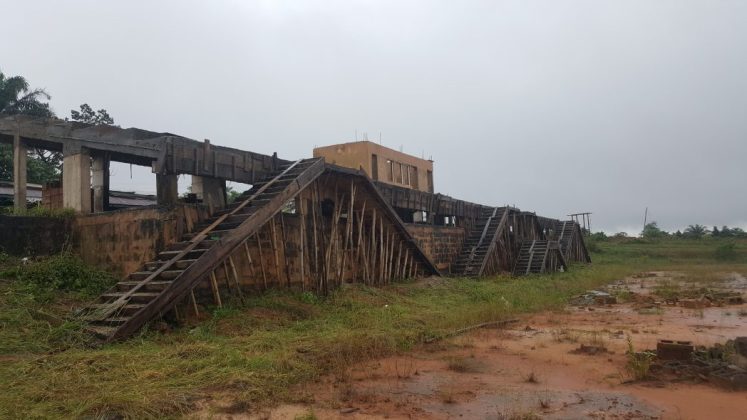
Out of these projects initiated in the Southeast, six locations for the construction of the mini-stadiums were mapped out and visited by this reporter to ascertain their status. But not one project has been completely executed. Three out of the six projects were non-existent, one is a shadow of a stadium, and the other is still at 30 percent completion level with just one out of the lot at 60 percent near completion.

Talents with no standard field

The mini-stadium project site at Obinkita in Arochukwu Local Government Area, Abia State, is a stone’s throw from the home of Nigeria’s football legend, Kanu Nwankwo, which is a bee-hive of talents as most youths who want to attain success like Papilo, as Nwankwo is popularly called, are usually seen training daily at various secondary school fields in the community.

The level of work done at the site was nothing to write home about since its foundation laying ceremony in 2018 by Mao Ohabunwa, senator representing Abia North Senatorial District. The only visible structure is the uncompleted stand. Freshly moulded blocks were seen at the site which indicated that work was still ongoing but at a very slow pace. The contract was awarded at the cost of N173,112,629 million to Bee-Harris Investment Limited, a company registered with CAC 20 years ago.

Molded blocks and equipment at the construction site of Mini-Stadium project at Obinkita in Arochukwu, Abia State.
Read more at: https://secretsreporter.com/young-talents-waste-in-the-southeast-as-fg-abandons-sports-projects/

“Please help us tell the world what these people are doing to us, December is around the corner and we can’t even play football on this ground. The little thing meant for the youths they will still pocket it,” Kalu Okolo, a 28-year-old motorcyclist said.

He expressed surprise when he learned that contrary to general knowledge in the community that the stadium was being built by Ohabunwa as his contribution to youth development in Obinkita, it was, in reality, a zonal intervention project by the federal government.

Another resident of the town, Emmanuel Ogbonnaya, a cab driver whose dream is to become a professional footballer, said Obinkita is not the only community crawling with talents, but the entire Arochukwu.

“Scouts usually come and most times they pick people, we have players in this town o,” he enthused. Ogbonanya’s major fear is simple; no mechanism is in place to harness these talents by the government apart from individual efforts.

The contractor for the project Uzochukwu Aliebo when contacted blamed the slow pace of work on the delay in the release of fund and bad road.

“The road to Arochukwu is a death trap, our trucks have broken down severally. We get chippings from Calabar and most times these people release the money in small amounts, so we are trying our best, but before the end of the year, the stadium will be ready for use,” Aliebo stated. A promise which sounded impossible and more like a political statement from a Real Estate investment company as the exact amount released so far for the project which could have justified the level of work done could not be confirmed from the Ministry.

Youths of Ikeduru, Imo requested for stadium, they got a volleyball and basketball courts instead

The Amaimo mini-stadium project in Ikeduru Local Government Area of Imo State was awarded to Naz Davision Ltd, a company with no presence on the CAC website, at the cost of N173,112,629. The project site is about five poles away from the home of Senator Samuel Anyanwu, senator representing Imo East, aka Sam Daddy. It is another project awarded to help develop grassroots sports but it has been abandoned like others.

Most villagers were surprised to learn that instead of a standard mini-stadium, all they got was a poorly constructed Lawn Tennis and basketball court alongside an empty hall overgrown with weeds erected at the community primary school by Sam Daddy as his constituency project.

Hall and Basketball court overgrown with bushes at supposed Amaimo Mini-Stadium.

Since there was no signpost to confirm that the site was indeed the location of the project, this reporter visited the palace of His Royal Majesty, Eze Godwin Ehirim Nwaebo, Duru II of Amaimo Ancient Kingdom. Though the traditional ruler was not at home, his wife Ugoeze Apolonia confirmed that the structure at the primary school is what they all know as the stadium in the community.

A signpost at the palace of HRM Eze Godwin Ehirim Nwaebo, Duru Imo II, Amaimo ancient Kingdom.

This was corroborated by one of the youth leaders in the village, Boniface Ugochukwu, who further confirmed that the project was complete and waiting to be commissioned.

When asked why the structures on the ground were no way close to a mini-stadium, he stated that it was a matter of choice. Unlike other states or regions, they had to make do with the land available to them, thus the reason why they decided to have volleyball and basketball courts instead.

“Football is one sports that bring youths in Amaimo together especially during festive periods, it creates unity among us. If such an amount was released and all we have is that structure in the school, then it’s really bad, there is no motivation for us the youth” Igwe Anyanwu a 19-year old student from Umueze village told this reporter.

Nkalagu, Ishielu, Ebonyi State

Two projects were awarded by the Federal Ministry of Youths and Sports Development to be executed at the limestone-rich town of Nkalagu. One was the supply of sporting materials to two community secondary schools located at Iyonu and Umuhuali at the cost of N9,985,750 awarded to Randburg Nigeria Limited and the latter a mini-sports stadium at Nkalagu awarded to De-Donex Integrated Global Ltd at N173, 112,629.

A visit to both schools confirmed that no single equipment or material was delivered to them. At Iyonu, the councillor, Ugah Polycarp, whom this reporter met at a burial ceremony during the visit since the school was closed due to the COVID-19 pandemic, revealed that apart from being a community leader, as a member of the school’s Parents Teachers Association, PTA, he alongside others were unaware of the fact that over N9 million was earmarked for the supply of sporting kits to the community-based schools.

“Our students are lacking sports facilities. If those things were here our students would have been using them, which is why we are lagging behind in sports,” said the Junior Principal, Igwe Uchechukwu, who has been in the school since 2016.

This was the same case in Umuhuali where then Principal, Mrs. Louisa Ajah, in a phone conversation stated that while she was in charge no such items were ever presented to the school despite their outstanding performance in state sporting events.

“The students cannot go for any competition outside Ebonyi, it is obvious they don’t have any standard facility to train with so they will definitely not perform well. You learn these skills from a young age so it’s best to start training them in time. Practice makes perfect but are they going to be kicking stones while practicing?” lamented Ifeanyi Aleke, a resident of the community, whose siblings attend the school.

However, the construction of the mini-sports center at Nkalagu is near completion as at the time of this investigation on October 2nd 2020. The contractor promised that by the end of the year, the stadium should be in full use. The pitch and the entrance were still under construction, workers were seen on site finishing the drainage around the pitch with the stands fully completed and painted. The two buildings at the far side of the large expanse of land housing the toilets were complete.

The project is the only one with evidence of N173 million approved for construction of several mini stadium in the state.

“The contractors are trying but they can do more, once they finish it will attract a lot of business that’s why they are also building a flyover at the highway. The town will be bubbling with activities by then” Nwaeze Jude who is anticipating to test his boots on the pitch someday during the community tournament said.

Non-existing Projects

Arriving in Anambra State, one notable thing was people’s love of sports, especially football, which is visible in every corner as a large number of youths were seen at most playgrounds scattered across the state capital, Awka.

Related StoryWastefulness, underfunding cripple key infrastructure in Abuja stadium complex

The one-hour journey to the proposed site for the construction of the mini-stadium at Nsugbe, approved by the federal government at N173,112,629 was a smooth one, unlike previous states, because of good internal roads.

At a motor park adjacent to the second gate of Nwafor Orizu College of Education, Nsugbe, this reporter sought to find out the location of the stadium from the locals.

“Stadium? Here in Nsugbe? By Federal Government? Do you mean the stadium inside the school?”

These questions came in torrents as answers to the reporter’s question because the stadium, which was to be sited at the pavilion inside the school, was non existent. After the foundation laying ceremony by Senator Stella Oduah in 2017, this reporter learned, no work was done at the site.

“Senator Stella came and they laid those stones, I thought they wanted to fence our pitch and I was wondering why; I didn’t know it was a stadium,” said Uche Okechukwu, one of the boys who usually come to train at the small field beside the school’s main pitch.

Nkalagu Stadium 13 scaled

The contractor for the project, Wilangy Nig. Ltd, however, disclosed that it was only given a certificate of award for the project and since then no money has been released for construction of the stadium.

The last in the lot for investigation was the construction of a mini-stadium at Ikwo, in Ebonyi Central Senatorial District awarded to Pro-Logistics International Limited for the sum of N173,076,661.75, which regrettably was also non-existent.

The immediate past local government chairman, Orogwu Joseph, disclosed in a telephone conversation with this reporter that the town boasts of a completed mini-stadium, which was commissioned by the state governor, David Umahi. However, the feat was solely a local government executed project. The present chairman, Stephen Orogwu, confirmed this.

Blocks laid beside the pavilion since 2017 during the foundation laying ceremony of the proposed Mini-Stadium at Nwafor Orizu College of Education, Nsugbe, Anambra State.

Nobody want to be accountable for failed projects

Since most of the projects were awarded when Solomon Dalung was Minister of Youths and Sports Development, this reporter decided to reach out to him for his response.

“You can only confirm this with the office of DFA (Director, Finance and Administration) in the ministry which is responsible for releases. They are constituency projects, so also check with members of the National Assembly from the areas. Thank you.” he replied via Sms.

When contacted on why the mini-stadium project in Ikwo has not been executed the senator representing Ebonyi Central Senatorial district, Ogba Joseph, revealed that no fund has been released by the ministry for the project.

“The truth is that they have not released one kobo, there was money there in 2018 but it was not funded. In 2019 it did not appear in the budget at all. Then in 2020 it appeared because I insisted but as I am talking to you now they have not released one kobo to the contractor,” the senator said.

He further disclosed that though the Minister of Sports told him that 50 percent of the funds had been received, it has not been released to the contractors.

Though the Minister of Youths and Sports Development, Sunday Dare, did not answer his calls when contacted by this reporter to confirm if funds were fully released for the projects and to also comment about the state of the abandoned mini-stadiums, his personal assistant Tunde Akpeji, after requesting for the questions to be sent via sms, directed this reporter to contact the Director of Press, Mrs Lere-Adams as she is the right person to handle the enquiry as it concerns the ministry.

Mrs Lere-Adams in turn, directed that a letter of request be sent to the email address on the official website of the Ministry. However, no response was received from the Ministry as at the time of filing this report.

It is undoubted that Nigerian sports now wallow in mediocre performances. For the past five years, Nigerian home-based athletes have not won any medals at the global stage. The country now depends on athletes in Diaspora to compete in global tournaments.

In the current rating of African clubs by the Confederation of African Football, CAF, no Nigerian football club side made it to the Top 20 ranking. Nigeria’s female and male football teams were all knocked out of the African qualifying series for the 2020 Japan Olympics, now shifted to 2021. And in the world Under 17 and Under 20 male football competitions where Nigeria excelled in the past, the national team did not qualify for the finals in the past two editions.

Odegbami laments the dearth of quality and poor commitment to Nigeria

“These are very dreary times for Nigerian sports. For those of us that have been a part of several generations, the pain is deep. I was an active participant at the highest level from the mid-1970s when Nigerian sports were on a global ascendancy when Nigeria started an authentic dominance of Africa in Track and Field, table tennis, (lawn) tennis, boxing, weightlifting, wrestling and joined the elite forces in African football at the African Cup of Nations. It is very painful to wake up every week these days to the reality of the horror that has become the present state of Nigerian sports…

“From 1976 to 2006, a period of some 30 years and eight different Olympics, Nigeria presented some athletes that were either winning medals or had the capability to do so. From 1984 Nigeria actually started to win Olympic medals. In 1996 it won an unprecedented number including its first two gold medals. Since then her fortune in medals has been dwindling. For those of us that have been a part of the history of Nigerian sports since 1976 the present times are undoubtedly worst in our country’s history with stories so ugly they benumb the mind,” Odegbami lamented.

*This investigative report was supported by McArthur Foundation and the International Centre for Investigative Reporting, ICIR.

Detention of Sowore, others shows pattern of repression by Nigerian authorities -Amnesty International

THE Amnesty International (AI) says the detention of Omoyele Sowore and four other persons has demonstrated the continued pattern of repression by the Nigerian government.

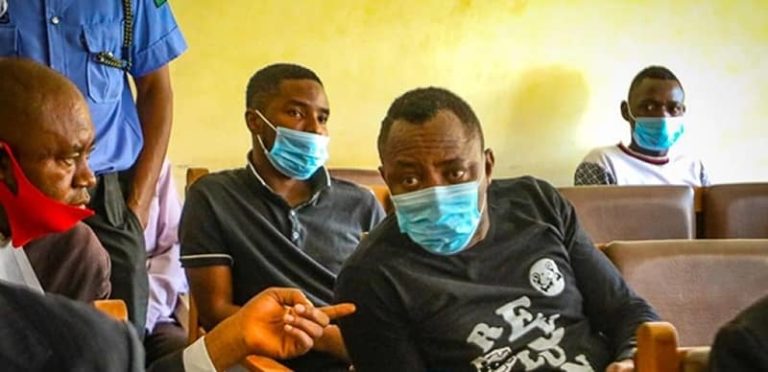
Sowore, together with Juwon Sanyaolu, Peter Williams, Emmanuel Bulus and Damilare Adenola, was arrested following a protest in the Federal Capital Territory (FCT), Abuja, on the eve of New Year.

They were first arraigned before Taye Maibel at the Magistrate Court in Wuse Zone 2, Abuja, on Monday, 4th January, by the police after spending four nights in detention on three counts of unlawful assembly, criminal conspiracy and inciting public disturbance.

The court, however, ordered them to be remanded in Kuje Correctional Centre pending the consideration of their bail applications on Tuesday, 5th January. They were later brought to Magistrates’ Court, Wuse, in handcuffs on Tuesday morning but were again ordered by the court to be transferred to the Force Criminal Investigation Department at Garki Area 10, Abuja, after the prosecuting counsel raised an objection to their bail applications.

Their bail applications, which were scheduled for Friday, were stalled following the failure of the prosecuting team to produce the accused persons in court.

Marshal Abubakar, lawyer to the accused persons, expressed frustrations in the court premises after he was informed by the court that the police had handed the case file to a deputy inspector-general (DIG) for further prosecution.

The lawyer said the DIG, who was called to produce the defendants, claimed to have handed the case file to the director of public prosecution on the instruction of the attorney general of the federation, Malami Abubakar.

However, in a series of tweets on Saturday, Amnesty International noted that it was appalled by the delay tactics the government was employing to frustrate their bail so as to perpetually keep them in detention.

Read also: Boko Haram: Amnesty International indicts Nigerian Army of crimes against older people in Northeast

It called for the immediate release of the activists and demanded that the charges against them be dropped.

This is not the first time Sowore would be arrested and arbitrarily detained for leading protests.

In 2019, he was illegally abducted and detained by operatives of the State Security Service (SSS) for planning to stage the RevolutionNow protest, which called for an end to bad governance in Nigeria.

After much pressure from within and from members of the international community, Muhammadu Buhari-led federal government released him from illegal detention.
He is currently being arraigned in court on ridiculous charges bordering on money laundering, treasonable felony and cyberstalking.

Indonesian plane with 59 passengers on board declared missing shortly after take-off

A Boeing 737-500 belonging to Sriwijaya Air, an Indonesia airline, has been declared missing, the nation’s transport ministry said in a statement on Saturday.

According to the flight tracker website FlightRadar24, the aircraft which descended more than 10,000 feet in less than a minute, lost contact with flight controllers shortly after it took off from Jakarta Airport.

“It lost more than 10,000 feet [3,000 meters] of altitude in less than one minute, about 4 minutes after departure from Jakarta,” Flightradar24 said on its Twitter handle.

Read also: Indonesia bans sex outside marriage for citizens, foreign visitors

Local newspapers reported that there were 59 passengers on board the plane to Pontianak.

Surachman, a local government official, told Kompas TV that fishermen found what appeared to be the wreckage of an aircraft in waters north of Jakarta and a search was underway. Other news channels showed images of suspected wreckage.

“We found some cables, a piece of jeans, and pieces of metal on the water,” Zulkifli, a security official, told CNNIndonesia.com.

“The missing plane is currently under investigation and under coordination with the National Search and Rescue Agency and the National Transportation Safety Committee,” Indonesian Transportation Ministry spokeswoman, Adita Irawati, said.

Indonesia, world’s largest archipelago nation with more than 260 million people, has been plagued by transportation accidents on land, sea, and air because of overcrowding on ferries, aging infrastructure, and poorly enforced safety standards.

Read also: Panic as plane-crash lands at Abuja airport

A Boeing 737 MAX operated by the Indonesian airline Lion Air crashed off Jakarta in late 2018, killing all 189 passengers and crew. The plane that lost contact on Saturday is a much older model.

Sriwijaya Air said that it was collecting more information regarding the flight before it could make any statement.

Read also: Abandoned secretariat building contributes to state workers’ frustration in Sokoto

Criticisms as Trump says will not attend Biden’s inauguration

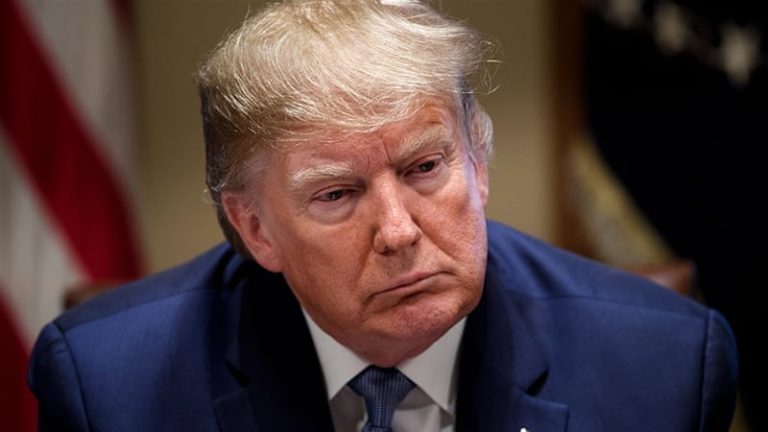
PRESIDENT Donald Trump said on Friday that he would not attend Joe Biden’s inauguration on January 20.

He posted this on his Twitter handle, attracting criticisms from detractors and Twitter users.

“To all those who have asked, I will not be going to the Inauguration on January 20th,” he tweeted.

The statement attracted 50,800 re-tweets, 267,700 likes and 59,800 quotes one hour and thirty minutes after it was tweeted, according to The ICIR checks.

For two days now, Trump has attracted severe criticisms from across the world for inciting violence in parts of the United States, especially Washington DC, on Wednesday.

Until Friday, Trump had refused to concede defeat, making unfounded statements about the November 2020 presidential elections which he lost to Biden, claiming without evidence that the election was rigged in Biden’s favour.

He had incited followers and supporters to breach Capitol Hill on Wednesday—the day the Congress were to certify Biden after his Electoral College victory.

After his incitement of supporters, he abandoned them mid-way following global condemnations, warning that those who perpetrated the insurrection would be brought to book.   Some of his global allies such as UK and Israeli prime ministers Boris Johnson and Benjamin Netanyahu condemned Trump’s behaviour and the attack on Capitol Hill. House and Senate members of Republican and Democratic parties are calling for his impeachment before his exit on January 20.

On Twitter, Chris Jacobus, executive producer of ‘America Reads The Mueller Report,’ asked jokingly, “Does this mean you’ve planned another attack on our Capitol on that day?” One Helen with a Twitter handle, @doerfler_helen, said, “He won’t be going because his mob on Parlor are planning a march in DC on Jan 19th & Jan 20 th.”

One Bettemidler tweeted, “Who cares? After what you have put us through, we all hope to never clap eyes on you again, you traitorous, seditious, appalling…loser.”  One Twitter user, Gwendolyn Hammond, wrote, “Hopefully, you’ll be removed from office before then. Wicked, immoral man. No one will miss you at the inauguration.”

However, his supporters backed him, expressing sadness at his imminent exit.
“Jay, Donald Trump was the best president since Ronald Reagan. America will pay a heavy price for electoral fraud,” one Krzysztof Bień, with a handle @reaktor57, replied. 

One of his supporters Goose Wayne Batman, with a Twitter handle @GoooseWayne TV. tweeted, “Proud of you, Mr President. Best 4four years of my life.”

Trump said earlier that his focus had shifted to ensuring a peaceful transfer of power.

Read also: Facebook, Instagram, Twitter sanction Trump for inciting violence in Washington


FACT CHECK: Can a woman post bail in Nigeria?

One of the issues that come up when discussing gender bias in Nigeria is that “a woman cannot post bail in Nigeria.”

This statement is understood to mean that a woman cannot stand as surety or provide any security for a defendant or a suspect.

This was further crystalised in a Nigerian web TV series entitled ‘Skinny Girl In Transit (SGIT)’ by Ndani TV.  SGIT is seen as a show that highlights societal issues dealing with themes of domestic violence, adoption, inter-faith and culture relationship, among others.

In the pre-credit opening scene of Season 6 Episode 7 (S6E7), a police officer stated authoritatively that a woman could not post bail.

By January 6, 2021, the episode posted on March 27, 2020, had garnered over 640,000 views.

THE CLAIM

A woman cannot post bail in Nigeria.

THE FINDINGS

Findings by the FactCheckHub show that the claim is false.

‘A woman cannot post bail’ is often listed among the litany of things women cannot do in Nigeria when having gender bias discussions

The web TV series, SGIT, in a hard-to-miss position – the first 40 seconds –also reiterated this narrative that a woman could not post bail in Nigeria.

Here is the dialogue that ensued in the first 40 seconds of the episode.

Woman: I don’t get it. Are you telling me that he is going to sleep here tonight?

Policeman: Madam, I never knew you are such a nice person. But you see, in the constitution of the Federal Republic of Nigeria (FRN), a woman does not post bail. So, you have to come back with a man tomorrow morning and that is how it is done.

Woman: Really?

Policeman: Yes.

The statement meant that a woman could not enter any recognisance or stand as surety or provide any security for a defendant because the woman in question attempted to get her son released on bail from detention.

Abimbola Craig, lead actress and a producer of SGIT, says the show tries to mirror society as well as shed light on societal ills.

Responding to a question around the show opening room for discussion on a lot of societal matters in Nigeria, she said “…Every time we come up with storylines, we try to make sure we come up with stories that are addressing everyone’s life”.

For instance, she pointed out that the show sought to highlight the ignorance around dating married men.  “[What] I really wanted people to take out was the married men situation. It has happened before, it will constantly keep happening. We need to stop being ignorant and letting girls think it is okay.”

The FactCheckHub reached out to the managing partner of Spectrum Legal Services, Saidu Muhammad Lawal, who noted that the claim was false.

Lawal said, “a woman can stand as a surety in Nigeria.”

He, however, clarified that ’to post bail’ means to pay a sum of money for bail.

Lawal also stated that a woman could stand as surety for any accused person or defendant standing trial in Nigeria.

He said this was backed by Section 42 of the 1999 Constitution of the Federal Republic of Nigeria.

Lawal stated that claim that a woman could not stand surety would be contrary to Section 42 of the Nigerian Constitution and that law would be void to the extent of its inconsistency with the Constitution.

Another lawyer, who is principally into litigation, John Okebe, concurred with Lawal, adding that the practice of not allowing women to stand as surety did exist.

Okebe told the FactCheckHub that “It is not the law that says a woman cannot post bail in Nigeria. I must, however, admit that it is a fact in some parts of Nigeria that women are disallowed from guaranteeing bail.”

Okebe said culture and the stereotype that women were incapable of owning personal properties, which was often a condition for guaranteeing bail, were likely reasons why this might happen.

He, however, maintained that “The law itself, in this instance, the Constitution prohibits discrimination on the basis of sex as such wherever and whenever a woman is not allowed. Such a woman can maintain action in fundamental rights from discrimination on the basis of sex.”

Nnenna Joy Eze, a partner at Ijenna LP, noted that the Constitution was silent on who was eligible to post bail, implying that the claim was false.

She said, “From the combined reading of Section 35(4) and Section 42 of the 1999 Constitution of the FRN as well as Section 30 of Administration of the Criminal Justice Act (ACJA), nothing stops a woman from posting bail.”

The sections read:

Section 35 (4) Any person who is arrested or detained in accordance with subsection (1) (c) of this section shall be brought before a court of law within a reasonable time, and if he is not tried within a period of –

(a) two months from the date of his arrest or detention in the case of a person who is in custody or is not entitled to bail; or

(b) three months from the date of his arrest or detention in the case of a person who has been released on bail, he shall (without prejudice to any further proceedings that may be brought against him) be released either unconditionally or upon such conditions as are reasonably necessary to ensure that he appears for trial at a later date.

Section 30 ACJA reads;  1) Where a suspect has been taken into police custody without a warrant for an offence other than an offence punishable with death, an officer in charge of a police station shall inquire into the case and release the suspect arrested on bail subject to subsection  (2) of this section, and where it will not be practicable to bring the suspect before a court having jurisdiction with respect to the offence alleged, within 24 hours after the arrest.

(2) The officer in charge of a police station shall release the suspect on bail on his entering into a recognisance with or without sureties for a reasonable amount of money to appear before the court or at the police station at the time and place named in the recognisance.

(3) Where a suspect is taken into custody and it appears to the police officer in charge of the station that the offence is of a capital nature, the arrested suspect shall be detained in custody, and the police officer may refer the matter to the Attorney- General of the Federation for legal advice and cause the suspect to be taken before a court having jurisdiction with respect to the offence within a reasonable time.

Now these two sections provide for bail and as you can see, nothing here suggests such, she noted.

Eze told the FactCheckHub that some argued that Section 122 of the Criminal Procedure Act created such a provision:

“An accused admitted to bail may be required to produce such surety or sureties as, in the opinion of the court admitting him to bail, will be sufficient to ensure his appearance as and when required and shall with him or them enter into a recognisance accordingly.”

However, this, Eze stated, was struck off by Section 14 of the Interpretation Act which clearly stated that “words importing the masculine gender include females.”

Furthermore, Eze stated that Section 42 of Nigeria’s 1999 Constitution precluded any law in force in Nigeria from subjecting anyone to any form of disability or restriction on grounds, inter alia, of sex.

Eze also noted that the Administration of Criminal Justice (Repeal and Re-enactment) Law of Lagos State, 2011, which was the criminal procedural law in place within Lagos, had dispelled every doubt as to the eligibility of a woman to post bail by its provision in Section 118 (3) of the law stating that “No person shall be denied or prevented or restricted from entering into any recognisance or standing as surety or providing any security on the ground that the person is a woman.”

She added that Section 167 (3) of the Administration of Criminal Justice Act 2015 regulating criminal procedure in the FCT had a similar provision.

Furthermore, all states that had domesticated this law equally had similar provisions too, she explained.

THE VERDICT

The claim that a woman cannot post bail in Nigeria is FALSE.

This is because the Constitution of the Federal Republic of Nigeria is silent on the gender of eligibility and it also does not allow for discrimination on the basis of sex.


Abandoned secretariat building contributes to state workers’ frustration in Sokoto

By Tunde OMOLEHIN


IN Sokoto State, many office messengers travel several kilometres between the state secretariat complex and the auxiliary secretariat in Giginya on a daily basis in an attempt to meet the demands of their jobs. Their frustration provides an insight into how the abandoned multibillion-naira secretariat project contributes to the workers’ plight.

At 7:45 am, on a Monday morning, this reporter arrived at one of the apartments in Giginya Secretariat on the outskirts Sokoto city. The buildings comprise blocks of residential houses originally built for civil servants in the 90s by the Second Republic governor of the state, late Shehu Kangiwa. At the main gate was a middle-aged man who had been waiting for a scheduled meeting with this reporter. Just before the meeting began, the man shook with fear.

“You know we are civil servants and we are not permitted to speak with the media,” he said, referring to other workers, “All of us have one or more stories to tell,” he added. To hide his identity, he agreed to be identified simply as Malam Kabiru.

Taking messages from one office to another is a journey

For Kabiru, life as a messenger, otherwise called dispatch-man within the civil service, has been stressful and laborious. Since he joined the state’s workforce many years ago, his daily routine has been shuttling between various offices within Sokoto capital city to deliver official documents.

Kabiru lives in Mebera and treks about 12 kilometres to work in Giginya and thereafter begins a daily routine of dispatching official letters, files and documents to the main secretariat complex in Sokoto city, covering no fewer than 10 kilometres. In the last two decades he has been dispatching government’s files, letters and memos,  and must have covered thousands of kilometres. But he has little or nothing to show for his hard labour.

“My responsibility is to deliver files and important documents of the ministry from here, (Giginya Office complex) to the Cabinet Office at Usman Faruk Secretariat,” he told our reporter.

The Cabinet Office complex is an old administrative building housing key government departments including the offices of the Deputy Governor, secretary to the state government and that of the Head of Service. Other key ministries domiciled in the complex are finance, justice, budget and economic planning, works and transport, local government and community development, among others. It has an empty vast land earmarked for the construction of permanent buildings to accommodate all the ministries temporarily operating at the old complex.

But the non-completion of the buildings eight years after the contract was awarded is causing untold hardship to many civil servants, especially junior staff like Kabiru, who have to carry files and other documents from the temporary secretariat to the permanent site.

Corroborating Kabiru’s narrative, Abdul Magaji, an administrative officer, said he uses his private car to convey some of the messengers in their routine trips to the main secretariat complex. “Sometimes, I spend personal money to convey them (messengers) to the main complex where they usually deliver their messages either at the Head of Service or SSG’s offices on a daily basis.

“Before the advent of this administration, each ministry got its monthly overhead cost from the government from where money was given to these messengers and some of us to fuel motorcycles and cars. But, now, it has stopped. There is no money to pay for daily overheads.

“That is why there are complaints of shuttling long distances by these dispatch riders. They now use their personal money to run around the two secretariats to either deliver one document or convey very important messages without any remuneration,” 51-year old Abdul lamented.

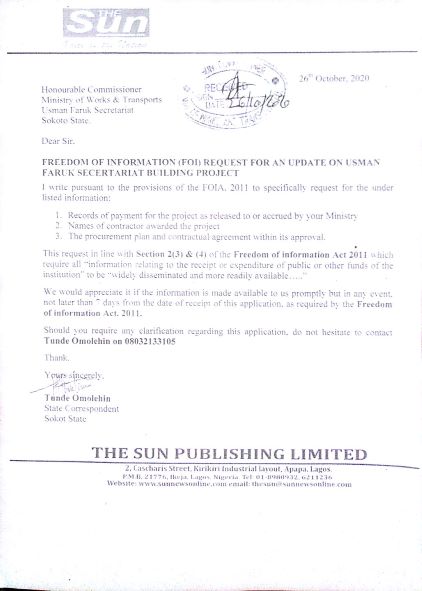
ledged letter of FOI sent to Sokoto State Government

Another government worker, Musa Lawal, recalled the excitement of workers when the then Aliyu Wamakko administration announced plans to relocate ministries to a permanent complex in Giginya in 2013. He said that the governor awarded a contract for the secretariat project to ease the suffering of civil servants traversing between the main complex in Sokoto City and Giginya.

But “it has been eight-year now; we are still listening to the same old story on the secretariat project. We want this present administration to fast-track its completion to ease our movement from one location to another.”

He believes that the completion of the project will bring to an end to decades of suffering for workers who travel several kilometres between the main and temporary secretariat.

The beginning

On June 3, 2013, the Sokoto state government signed a contract to construct the Head of Civil Service Office complex and additional office structures at the Usman Faruk Secretariat. The buildings were to accommodate ministries, departments and agencies (MDAs) that are, at present, located at the Shehu Kangiwa Secretariat.

According to the official documents sighted by this reporter, it was with a view to centralise the administration of the government by turning the Usman Faruk Secretariat into the main secretariat complex in Sokoto. After a procurement process, an indigenous construction firm, Messrs. Edile Construction Nigeria Limited won the bid for the job at the cost of N5.7 billion. The contractor moved to the site as soon as the government paid 30 percent mobilisation.

But a few months after the commencement of the job, a former Commissioner for Information, Danladi Bako, said the government revoked the contract, citing low pace of work by the contractor. While the contractor promptly refuted the claims, the government went ahead to award the contract to another indigenous firm, Messrs. Habmostar Construction & Engineering Company at the cost of N5, 284,206,081 with a mandate to complete it before the expiration of the administration’s tenure.

Main entrance of Usmanu Faruk Secretariat

The new contractor never showed up at the project site till the expiration of the Wamakko’s administration after allegedly pocketing the sum of N1.5 billion being the required 30 percent down payment in the contractual agreement. A visit to the project site showed a picture of a public structure left to rot away by two successive administrations in the state. Relevant officials at the state Ministry of Works and the office of the Head of Service declined to speak on why the project was abandoned when our correspondent visited them for interview.

A Freedom of Information Act (FOIA) request sent to the office of the Commissioner of Works, Salihu Maidaji, was declined on grounds that the matter was already before the court. The Acting Permanent Secretary, Ministry of Works, Smaila Wali, said the ministry knew nothing about the project, adding, “We are only given a supervisory role. I will want you to visit the office of the Head of Service. They are the clients for the project. There, you can be briefed on the details of the project. But bear in mind that the state Ministry of Justice is prosecuting a case against an aggrieved contractor. Maybe you can contact the commissioner in charge for the legal details also,” he said.

When contacted, the state Attorney General and Commissioner for Justice, Suleiman Usman, SAN, acknowledged a text message sent to his cell phone, but he refused to provide further details surrounding the project as requested by this reporter.

A building at Gingiya secretariat converted to ministeria offices
A building at Gingiya secretariat converted to ministerial offices

Legal intrigues

For four weeks, our reporter made several attempts to have an audience with the aggrieved contractor to no avail. But the company’s lawyer, Lagalo Dan Lagalo, in a telephone conversation said his client had dragged the Sokoto State Government to court to enforce his fundamental rights. He hinted that the case has been moved to the Supreme Court after the company secured landmark victories at both the High Court and the Court of Appeal. The lawyer, however, declined further comments on the matter. But court papers obtained by our reporter showed that a lawsuit was first filed before Justice Abubakar Muazu Lamido of Sokoto State High Court in 2014.

In the suit with Number: SS/ OS/1/2014 Between Edile Const. Nig.Ltd V Sokoto State Government & Anor, the applicant had challenged the decision of the state government to abort a valid contractual agreement without any wrongdoing on the part of the contractor.

Among reliefs sought by the aggrieved contractor is an order re- straining Sokoto State government, its agents, servants or representatives from enforcing, implementing and, or giving effect to the purported revocation, as well as unjustly interfering with the progress of work done. The plaintiff had insisted that the action taken by the government was malicious and done in bad faith, and not in accordance with Clause 42 of the contractual agreement.

Parts of the prayers before the court is to determine whether the agreement dated 3rd June 2013, freely entered into by the plaintiff and the Sokoto State Government was valid, subsisting and, or binding on the parties. The contractor also sought an order of court declaring as null and void, the revocation paper dated April 15, 2014, by which the 1st Defendant (Sokoto State Government) purported to revoke, determine and, or terminate the contract awarded to the plaintiff and a declaration that the said revocation was malicious and in bad faith.

Investigation by our correspondent revealed that both the lower and appellate courts, all sitting in Sokoto have since delivered their verdicts in favour of the contractor but the state government rejected the courts’ decisions.

Unkept promises

Checks by this reporter show that the former governor of the state, Aliyu Wamakko, had initiated several multibillion naira projects towards the end of his administration. These include the state Independent Power Project (IPP), the College of Agriculture situated in Wurno, and an International Conference Centre. Others are the 37.1 kilometres Rundi-Katami Road in Silame Local Government Area, the 45 kilometres Balle-Kurdulla-Niger Republic Road in Gudu Local Government Area, the Deputy Governor’s official residence, renovation of state High Court Complex and series of water projects.

Some of the equipment left behind by the contractor

Wamakko, now senator representing Sokoto Central Senatorial District, has come under serious criticism for his inability to complete many of the projects he initiated while he served as governor for eight years. While in office, he always boasted that every project embarked upon by his administration would be completed and handed over before May 29 handing over date. To achieve the goal, he had directed his works commissioner, Umar Nagwari, to provide strict supervision of all projects under the ministry and vowed to deal with contractors who were not serious about their jobs.

Despite the promises made by the former governor, our reporter found out that only a few projects initiated during the twilight of the administration were completed. For instance, the contracts for the construction of the state’s Independent Power Plant and the Usman Faruk Secretariat never saw the light of the day. Wamakko’s Special Adviser on Media and Publicity, Bashir Rabe Mani, would not offer any explanation on why the for- mer governor could not deliver on the projects he initiated. Mani, who had initially promised to contact Wamakko for a response, did not get back to our reporter and would not take further calls or respond to text messages sent to his phone.

Looking the other way

Despite promises at his inauguration to continue with all projects and policies of his predecessors, Governor Aminu Tambuwal has failed to complete the multi-billion naira projects left behind by both Wamakko and Attahiru Bafarawa. He reasoned that since large sums of money were spent on the projects abandoned by his predecessors, it could make sense for his administration to complete them.

However, six years after he took over from Wamakko, nothing has been done to complete abandoned projects that litter the state. The governor had shown an early commitment by completing the International Conference Centre situated at Kasarawa area of the state, one of the many left behind by his predecessor. But that interest has waned. Rather than complete abandoned and exist- ing projects, Tambuwal has recently signed fresh contracts worth over N20 billion and made a down payment of N6.2billion representing 30 percent of the contract sum to the new contractors.

Workers at the new N6.8bn state university teaching hospital currently ongoing in the state

The projects include the construction of two flyovers at Runjin Sambo and Rijiyar Dorowa areas within Sokoto metropolis, dualisation of Tashar Illela Road, and construction of the State University Teaching Hospital. Others include the dualisation of Maituta Road, Waziri Abbas Road as well as the construction of a Premier Hospital at Sabon Birni Local Government Area. He has also unveiled a plan to borrow N65.7 billion to embark on new infrastructure projects a The state Commissioner for Finance, Abdusamad Dasuki, told this reporter that the money will be spent on critical sectors of the economy, including agriculture, health, housing, urban renewal, infrastructure and education. He said that the move was to fast-track the economic transformation and “to position Sokoto as a leading economy in Nigeria and Africa.”

Why inherited projects were halted

The state government says it is aware of the plight of civil servants who have to trek several kilometres between the main secretariat complex in Sokoto City and the Giginya temporary secretariat. The Special Adviser on Media and Publicity to the Governor, Muhammad Bello, told our reporter in an interview that as part of measures to ameliorate their suffering, the government gave loans and provided mobility to the junior civil servants working between the two secretariats.

Giginya Temporary Secretariat entrance gate

“We are aware of this development as a result of moving a bit distance between Shehu Kangiwa and Usman Faruk Secretariats on a daily basis. This has been on for decades now,” he said. “But the present administration in its friendly approach to this situation has provided soft loans through owned microfinance banks to this category of civil servants to help leverage their plights. The Governor has also provided motorcycle loans to some of the messengers to enable them to solve the problem of mobility in the course of discharging their daily duties, pending the completion of the project in question,” Muhammad told our correspondent.

The governor’s aide, however, insisted that Tambuwal has not abandoned the secretariat project as being speculated in some quarters. “I want you to know that the government is an institution that must not be halted at the expiration of a particular administration,” he said. “We are reviewing the terms and conditions of all the projects inherited from the immediate past government. This is necessary to enable the present ad- ministration to have a clear picture of what is expected to be done or any improvement needed to have the project completed.

“For instance, the contract for the deputy governor’s official quarters has just been reviewed and awarded to a new contractor to ensure a standard job is carried out. I am sure other projects like the secretariat complex will follow suit. The government has not in any way abandoned any project initiated by his predecessor,” Muhammad said.

Abandoning projects is normal – civil society The National Coordinator, Coalition for Transparency, Accountability and Good Governance (COTAGG), Mike Opia, has insisted that Nigeria’s political elite have seriously abused the country’s procurement laws and processes. “The public procurement law in Nigeria has un- fortunately been used by government operators to perpetuate corruption rather than check corruption,” he observed.

“In the first place, the bureaucratic nature of the law has been used by the authorities to delay contractual obligations leading to abandonment and pocketing of the funds. So, the ills the law was meant to solve have been turned around to be the tool for their corrupt tendencies.”

Addressing the situation in Sokoto, Opia maintained that various governments in Nigeria are fond of abandoning old projects, so they could award new ones. “The reasons are obvious – if they award new contracts, they will collect kickbacks which they can’t collect from the old ones. Again, some of them are pursuing vain- glory,” he said. “They always seek to show that they started and finished the said projects irrespective of the costs to society.”

He, however, called not only for transparency in the award and execution of contracts but also in the leadership recruitment processes, adding that development will continue to elude the country until leaders are responsible to the electorate. He urged policymakers to review the current procurement law and make it less cumbersome so that the operators will no longer hide under the unnecessary bureaucracy to perpetrate corruption.

Opia appealed to the legislature and civil society actors to step up oversight functions on projects and whistle-blowing, respectively. He maintained that until all stakeholders become watchdogs over public projects, those in charge of contract awards and those in charge of execution would continue to frustrate implementation.

Read also: 10 key facts on African free trade which started on January 1

•This report is supported by the John D. And Catherine T. MacArthur Foundation and the International Centre for Investigative Reporting.