Home Blog Page 1924

ENDSARS: Anambra judicial panel summons alleged killer cop, James Nwafor, 2 others

0

THE Anambra State Judicial Panel of Inquiry has issued a summons on an alleged killer cop with the defunct Special Anti-Robbery Squad (SARS), James Nwafor, and two others to answer questions bordering on police brutality and illegal killing.

The panel issued the order on Thursday during the resumed hearing of cases of police brutality in Anambra state.

According to the panel, DSP Abbatunume Joe and Hyianceth Nwankwo are also summoned to respond to allegations levied against them by petitioners.

The order of the Judicial Panel Inquiry followed an application by Abdul Mahmud, counsel to Iloanya, Adimachukwu, Onyemelue, and Akabike families who are petitioners in the state.

Veronica Umeh, Chairman of the Anambra judicial panel and a retired judge of the State High Court said the summoned persons are to appear before it on 8th December 2020 to answer allegations against them.

The ICIR had reported that Willie Obiano, the incumbent governor of the state had sacked Nwafor as his Special Assistant on Security Affairs following allegations by residents that he supervised and orchestrated the killing of innocent civilians while he was the OC SARS unit in the state.

A victim of police brutality had told the panel that in 2014, the SARS unit headed by Nwafor collected N400,000 from him to feed his son who they had already killed in their custody.

Meanwhile, the Kastina state judicial panel has disclosed that it has received more than 30 petitions from victims of police brutality in the state.

Justice Abdullahi Bawale of the Katsina State High Court who is also the panel Chairman said this during the inaugural sitting of the panel on Thursday.

Bawale assured petitioners and accused that the panel will ensure justice and fairness to all parties in every case.

Kabore wins Burkina Faso’s presidential election for second term

0

BURKINA FASO’S President Roch Marc Christian Kabore has been declared the winner of Sunday’s presidential election with 57.9 per cent of the majority votes, the electoral commission announced on Thursday.

His main challengers, Eddie Komboigo and Zephirin Diabre got 15.5 per cent and 12.5 per cent respectively.

Kabore, 63, has been under fire for his response to a five-year-old jihadist insurgency that has rolled in from Mali.

He was predicted to win the first round of elections and by winning an overall majority in the first round Kabore avoids a run-off election in which he would have had to stand against a single candidate backed by a united opposition party.

The elections on Sunday were held for both legislature and presidency. The results declared by the commission, known as CENI, showed that Kabore led with more than 235,000 votes.

The paramount court, the Constitutional Council, has a week in which to confirm the outcome of the elections.

One of the poorest countries in the world, Burkina Faso is struggling with a jihadist campaign that has claimed at least 1,200 lives since 2015 and forced around a million people to flee their homes.

Opposition parties maintain the votes were marked by fraud and flawed procedures, threatening to reject “results stained by irregularities.

Their complaints range from polling stations that either did not open or opened late, insecure handling of ballot boxes and arbitrary changes to voting areas.

Because of the unrest, the election was not held across at least one-fifth of the territory, denying up to 350,000 people the right to vote, according to CENI’s figures.

Pro-Kabore parties on Tuesday argued that all candidates were equally affected by the problems and that in any case, these were not on a scale to have any major impact on the result.

I was disappointed…, Gowon reacts to UK lawmaker’s allegation of looting CBN

0

YAKUBU Gowon, former Nigeria military head of state said he was disappointed by allegations and remarks by Tom Tugendhat, a United Kingdom lawmaker, that he looted half of the Central Bank of Nigeria (CBN) before leaving office in 1975.

Tugendhat had during the UK Parliament’s debate to consider an E-petition signed by more than 200 thousand Nigerians requesting that officials of the Nigeria government who contributed to violation of human rights during the protest be sanctioned, alleged that Gowon committed the crime before moving to London where he was seeking asylum after he was ousted. 

The MP disclosed that some Nigerian politicians have stolen from the coffers of the government and moved to London to hide their loot. He, however, asked the UK government to call out the corruption in Nigeria and use its power to stop the looting happening in Africa’s most populous country.

He asked the British Prime Minister, Boris Johnson, and the UK parliament to stop corrupt Nigerian politicians from profiting from the wealth of Nigeria and hiding it in England. He also urged the UK government to stop funding some Nigerian security agencies which he described as corrupt.

“What we are seeing in Nigeria today is part of that story. It is a tragedy that we are all watching and witnessing. As we see things falling apart, the pressure this time is not foreign colonialism, but corruption, violence and attempts at control. I totally agree with my friend, the hon. Member for Edmonton, that we need to call out the corruption and use the powers we have in this country to stop those who are profiting from the wealth of that great nation, and hiding it here.

“Some people will remember when General Gowon left Nigeria with half the Central Bank of Nigeria, so it is said, and moved to London. We know that today, even now in this great city of ours, there are some people who have taken from the Nigerian people and hidden their ill-gotten gains here. Sadly, we know that our banks have been used for those profits and for that illegal transfer of assets. That means that the UK is in an almost unique position in being able to do something to exert pressure on those who have robbed the Nigerian people,” Tugendhat said.

Reacting, Gowon, during an interview with Channels Television, expressed his surprise that a British parliamentarian could make such an unfounded allegation against him.

“It is certainly surprising, and I am disappointed that a British parliamentarian could make such a statement without checking the facts of what he was saying.

“I honestly was disappointed that such a remark is made,” he said.

While stating that he heard the news on social media, Gowon called on the lawmaker to get his facts right. He added that since his exit as military dictator, no one has accused him of money laundering against him.

He called on the UK government to take the necessary step, and added that making such allegation was an insult to him and Nigeria.

Insecurity: Police confirm death of monarch killed by gunmen in Ondo

0

THE Ondo state police command has confirmed the death of Oba Israel Adeusi, the Olufon of Ifon in Ose Local Government Area (LGA) of Ondo State who was killed by gunmen aroud 4pm yesterday.

The royal father was killed at Elegbeka, a community along the Ifon-Benin highway, while returning from the monthly meeting of the state council of Obas in Akure.

His vehicle was said to have been rained with bullets while the driver was trying to escape from the gunmen. He was rushed to the Federal Medical Centre in Owo, where he died as a result of gunshots he sustained during the attack.

Tee Leo-Ikoro, the state Police Public Relations Officer in the state, who confirmed the incident to The ICIR on phone said security operatives have been deployed to the area to comb bushes around the area where the monarch was killed to fish out the killers.

He stated that the police personnel would work with other sister security agencies to apprehend the bandits and secure the release of the victims.

Meanwhile, the Commissioner for Information and Orientation, Donald Ojogo said  Governor Rotimi Akeredolu has expressed condolences with family of the late king, promising that the perpetrators will be brought to book.

“The security agencies, especially the Nigerian Police  have been directed to fish out the perpetrators of this heinous crime,” Ojogo said in a press statement.

The Ondo state government had in November expressed worry and condemned the spike of insecurity in the state. The government has called on all security agencies to confront the development with a promise to provide necessary support in terms of both human and logistics aid to ensure the safety of residents in the state.

It called on residents of the state to cooperate with security operatives by providing information about crimes in their immediate environment.

Fake journalism institute condemns CNN report on Lekki shooting

0

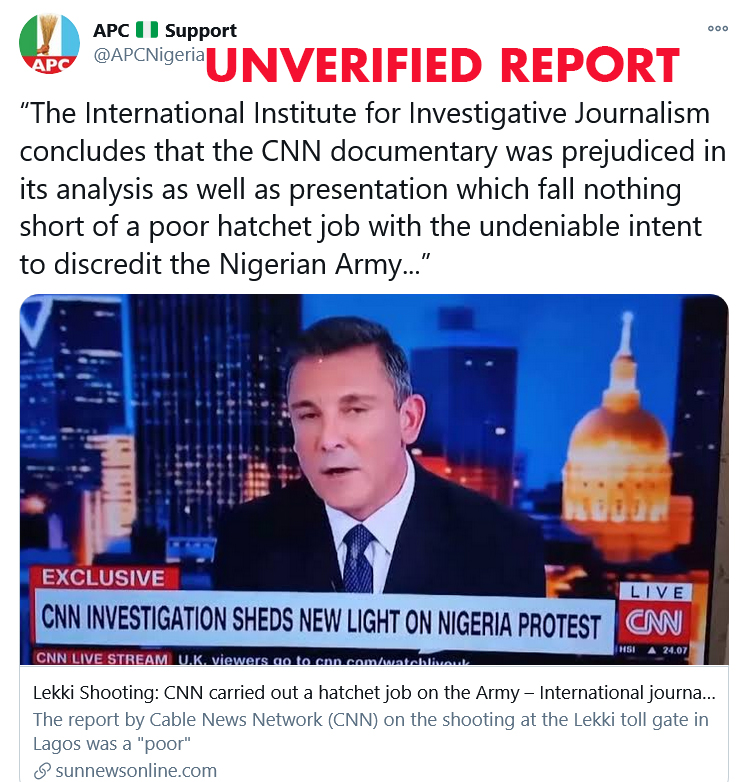
A NON-EXISTING  journalism institute, International Institute for Investigative Journalism (IIIJ), has faulted the investigative report done by the US-based news giant, Cable News Network (CNN) on the October 20 shooting at the Lekki Toll gate in Lagos.

A report that has been widely shared on social media claimed that IIIJ, which did not exist until 24 hours ago, issued a press statement saying CNN report was “poor” hatchet job targeted at the Nigerian Army.

In an electronic statement signed by, Francois Deburoiche, its special rapporteur on Wednesday, the IIIJ said it came to this conclusion following a careful investigation on the events that led to the escalation of violence at the toll gate.

Checks by The ICIR however, showed that Francois Deburoiche is a pseudonym and the only reference to that name on the internet is in the press statement issued.

Also, the body that is supposedly international has no digital footprint on the internet- it has no website, nor any social media accounts such as Twitter and Facebook to identify them with.

Further checks by The ICIR revealed that an account associated with the ruling party in Nigeria, the All Progressive Congress (APC), on Twitter shared the report published by The Daily Sun newspaper from the press statement issued by the non-existing journalism institute, a report that was later deleted on the website of the newspaper due to lack of verification.

In a phone conversation with an official of Daily Sun newspaper who declined to be named, it was confirmed to The ICIR that the report was pulled down due to lack of verification of source of the press statement.

“We pulled the story down because there were no fact and the reporter will receive a query for the report,” Daily Sun disclosed to The ICIR.

The report that has been widely shared on both Facebook and Twitter was also published by some bloggers and media outlets online.

Tribune Online, a Nigerian newspaper also published the unverified report condemning CNN’s report on Lekki shootings and as at the time of filling this report, the story is no  more on the website.

Meanwhile, Nigerians on social media have also doubted the existence of the group that faulted CNN’s report.

A Facebook user identified as Abdul Jimoh, ” Tuale to the International Institute for Investigative Journalism for rubbishing the CNN in the eyes of the international community.”

Abdul in the post, demanded for IIIJ’s office and the investigative reports they’ve done in the past.

A Twitter user identified as Leon Ikechukwu said in response to APC Support tweet on the IIIJ press statement, “Used Google, Bing, and Duck Duck Go, and I never saw anything relating to an International Institute of Investigative Journalism. This is quite shameful, that you guys would have to resort to fiction to drive your agenda.”

From the reports gathered by The ICIR and checks online, we can say authoritatively that the International Institute for Investigative Journalism (IIIJ), does not exist and the press statement issued is fake.

FG failed to take action against military officers involved in sex trafficking in ‎IDP camps, detention centres… US report

THE United States Department of State 2020 Trafficking in Persons Report ‎said the Nigerian government failed to take action against military officers who were involved in trafficking in Internally Displaced Persons camps and detention centres.

Military personnel and members of the Civil Joint Task Force, which is involved in the campaign against the Boko Haram insurgents in the North-East, were involved in sex trafficking of IDPs and female detainees, according to the report.

‎‎The Trafficking in Persons Report, or the TIP Report, is an annual report issued by the U.S. State Department’s Office to Monitor and Combat Trafficking in Persons. It ranks governments based on their perceived efforts to acknowledge and combat ‎human trafficking‎.

The 2020 report placed Nigeria on the Tier 2 Watch List. Countries on the Tier 2 Watch List are those whose governments do not fully comply with the minimum standards‎ outlined in the Trafficking Victims Protection Act (TVPA), 2000, but are making significant efforts to bring themselves into compliance.‎

‎The report stated that “widespread and pervasive corruption affected all levels of government, including the security forces, and undermined accountability for trafficking offences” in Nigeria.

‎Noting that “trafficking occurred in government-run detention centres and IDP camps”, the U.S. Department of State report said, “The government did not take adequate steps to investigate or prosecute military personnel or CJTF members complicit in trafficking – in particular sex trafficking of IDPs and female detainees – in the Northeast”. ‎

“During the reporting period, an NGO alleged 10 male soldiers in Giwa Barracks, including five who worked in the health clinic, coerced at least 15 female detainees into sex in exchange for food, soap, basic necessities, and the promise of freedom. ‎The government did not report investigating or holding officials accountable for sexual exploitation in Giwa Barracks,” the report added.

The U.S. Department of State added that a report by an international organisation in March 2020 documented that in more than 14 IDP camps, soldiers, CJTF, and police forced or coerced IDPs to have sex in exchange for food and freedom of movement in and outside of the camps.

“There were continued reports that camp officials and members of security forces, including some individual Nigerian military personnel, used fraudulent or forced marriages to exploit girls in sex trafficking and reports that the Nigerian military, CJTF, and other camp officials fraudulently recruited female IDPs for jobs outside of IDP camps and transported them to town for exploitation in sex trafficking.

“During the reporting period, an international organisation reported security officials transported IDPs to a hotel in Maiduguri allegedly for sex trafficking,” the report added. ‎

The National Agency for Prohibition of Trafficking in Persons (NAPTIP), a Federal Government agency set up to combat trafficking, did not initiate any investigations or prosecutions for sex trafficking of IDPs during the reporting period, according to the U.S. Department of State.

It added that the government did not publicly report any prosecutions or convictions for sexual exploitation or sex trafficking of IDPs, including children, and did not investigate, prosecute, or convict any government security officials, including military officials and CJTF members, alleged to have exploited IDPs.

The report further observed that the attitude of the Nigerian Army, which categorically denied that any of its personnel sexually exploited IDPs, impeded investigation of such reports.‎

  • Nigerian Army recruited and used minors in support roles

Besides sex trafficking of female IDPs and detainees, the Nigerian Army was also accused of recruiting and using minors in support roles.

The report said, “An international organisation verified the Nigerian military recruited and used at least two children under 15 years old in support roles during the reporting period. Between April and June 2019, the Nigerian military used six boys between 14 and 17 years old in Mafa, Borno state, in support roles fetching water, firewood, and cleaning. In October 2019, the same international organisation verified the government used five boys between 13 and 17 years old to fetch water at a checkpoint in Dikwa, Borno state. In the past, the CJTF also reportedly used some child trafficking victims recovered from Boko Haram to lead CJTF and army personnel to Boko Haram camps, putting the children at serious risk for retaliation and denying them trafficking victim care.”

It added that the government did not report any investigations, prosecutions, or convictions for child soldiering offences, including of government officials who committed such offences.

Also, the U.S. Department of State noted that there was no evidence to show that the Federal Government investigated reports that 49 Nigerian soldiers deployed as United Nations peacekeepers to Liberia sexually exploited 58 women and children, including deploying some of them in sex trafficking, from 2003-2017.

‎* Nigeria’s trafficking profile

Highlighting ‘Nigeria’s Trafficking Profile’, the U.S. Department of State report noted that “human traffickers exploit domestic and foreign victims in Nigeria, and traffickers exploit victims from Nigeria abroad”.

Internal trafficking is prevalent with Nigerian traffickers recruiting victims from rural areas, especially the country’s southern regions, for exploitation in commercial sex and forced labor in domestic work in urban cities. While women and girls are victims of forced labor in domestic service and sex trafficking, boys are victims of forced and bonded labor in street vending, domestic service, mining, stone quarrying, agriculture, textile manufacturing, and begging, according to the report.

The informal education sector, particularly the Almajiri system, was also identified as a vehicle for trafficking as some teachers often abuse their students and coerce them to beg.

“Traffickers operate ‘baby factories’ – often disguised as orphanages, maternity homes, or religious centers – where traffickers hold women against their will, rape them, and force them to carry and deliver a child. The traffickers sell the children, sometimes with the intent to exploit them in forced labor and sex trafficking. In southern Nigeria, especially Lagos, some women drug and ‘rent’ their infants out to street beggars to increase the beggars’ profits. Nigerian traffickers take women and children to other West and Central African countries – including Mali, Senegal, Cote d’Ivoire, and Cabo Verde – as well as to South Africa, where they are exploited in forced labor and sex trafficking. Gabonese authorities and NGOs reported Nigerian labor traffickers exploited Nigerian victims in mechanic shops in Gabon. Nigerian women and children are recruited and transported to destinations in North Africa, the Middle East – including Saudi Arabia, Oman, and United Arab Emirates – and Central Asia, and exploited in sex trafficking or forced labor. West African children are subjected to forced labor in Nigeria, including in granite and gold mines. An NGO reported traffickers coerce Togolese victims to work in palm wine production in rural Nigeria. North Koreans working in Nigeria may have been forced to work by the North Korean government. Women from West African countries transit Nigeria en route to Europe and the Middle East, where traffickers force them into commercial sex. Nigeria’s ports and waterways around Calabar are transit points for West African children subjected to forced labor in Cameroon, Equatorial Guinea, and Gabon,” the report stated.

The U.S. Department of State also noted that there are allegations that IDPs displaced by violence in the Middle Belt were fraudulently recruited and exploited in domestic service and sex trafficking.

The report added, “Authorities identified Nigerian trafficking victims – often exploited by Nigerian traffickers – in at least 36 countries in Africa, Europe, and the Middle East during the reporting period. Nigerian women and girls are subjected to sex trafficking within Nigeria and throughout Europe, including in France, Italy, Spain, Austria, and Russia; in 2017, an international organisation estimated 80 percent of all female Nigerian migrants in Italy are or will become sex trafficking victims. NGOs reported that while Italy was primarily the destination for Nigerian trafficking victims, trafficking networks are shifting to other destinations such as France and Spain; in 2018, 48 percent of trafficking victims identified in France were Nigerian. In 2015, a foreign government reported that with the exception of internal trafficking within the EU, Nigerian nationals are the most common trafficking victims in the EU. Following relaxed visa requirements for the 2018 World Cup in Russia, traffickers fraudulently recruited Nigerian women for jobs in Russia and later exploited them in sex trafficking.”

Noting that, historically, the majority of Nigerian trafficking victims in Europe have come from Edo State, via Libya, the report observed that in recent times, French authorities have reported an increasing number of Nigerian trafficking victims originating from northern states.

Following the curse laid on sex traffickers by the Oba of Benin and revocation of all juju administered on trafficked victims by Bini traditional priests in March 2018, the U.S. Department of State said there are reports that traffickers were now performing the juju ceremonies in neighbouring states such as Delta.

The report stated that Nigerians are exploited in Libya – by both Libyans and Nigerians – in forced labor in construction, agriculture, and commercial sex in Tripoli, Sabha, Benghazi, and Misrata.

“Lured by the promise of reaching Europe, traffickers keep victims in ‘control houses’ or ‘prostitution camps’ located on the outskirts of Tripoli and Misrata until they can repay travel debts; sometimes before victims repay the debt, traffickers sell them again. Some trafficking victims in Libya reported Nigerian embassy officials in Tripoli asked for payment before removing victims from Libyan detention camps,” the report said.

In recent years, thousands of Nigerian trafficking victims have been repatriated from Libya but the U.S. Department of State report noted that there were reports of “re-trafficking among the trafficking victims repatriated from Libya”.

It added that ISIS has captured Nigerian women and girls in Libya and exploited them in sexual slavery.

  • Government officials officials, security agents involved in sexual exploitation of IDPs

The U.S. Department of State report stated that “reports continue to indicate government officials and security forces commit widespread sexual exploitation, including sex trafficking”.

“Such exploitation is a major concern across the Northeast, including in informal IDP camps and all of the 13 formal, state-run IDP camps in and around Maiduguri, the Borno state capital, which hosts IDPs affected by the ongoing conflict with Boko Haram and ISIS-WA. ‘Gatekeepers’ in control of some IDP camps, at times in collusion with Nigerian policemen and soldiers, reportedly force women and girls to provide sex acts in exchange for food and services in the camps. In July 2016, a Nigerian research organisation surveyed 400 IDPs in Adamawa, Borno, and Yobe states, and 66 percent said camp officials sexually abused women and girls, some of which constitutes sex trafficking.”

Military personnel were alleged to have used fraudulent or forced marriages to exploit girls in sex trafficking. “Some Nigerian military personnel and CJTF members promised female IDPs jobs but instead took them to military barracks for sexual exploitation by Nigerian military personnel,” the report said.

  • Boko Haram forcibly recruiting child soldiers as combatants and suicide bombers

The activities of the Boko Haram was identified in the report as a major contributing factor to the high rate of trafficking in Nigeria. The terrorist organisation was accused of forcibly recruiting, abducting and using child soldiers as young as 12 as cooks, spies, messengers, bodyguards, armed combatants, and increasingly as suicide bombers in attacks in Nigeria, Cameroon, and Chad.

In 2018, Boko Haram used at least 48 children as human bombers, compared with 158 used in 2017 and the group continue to abduct women and girls in the northern region of Nigeria, some of whom they subject to domestic servitude and forced labor.

The US Department of State report said Boko Haram routinely forces girls to choose between forced marriages to its fighters – for the purpose of sexual slavery – or becoming suicide bombers.

“In some cases, Boko Haram forced child soldiers to marry one another,” the report said, adding that international organisations continue to express concerns about the arrest and detention of children by the Nigerian military for alleged association with Boko Haram.

The U.S. Department of State noted that an NGO reported that between January 2013 and March 2019, the Nigerian military unlawfully detained more than 3,600 children for alleged association with armed groups.

COVID-19 vaccine hopes boost global crude oil prices to 8-month high

0

CRUDE oil prices rose globally to an eight-month high since March, following anticipation for the launch of a  COVID-19 vaccine which brightened chances of increased fuel consumption.

Nigeria’s crude oil equivalent, Brent crude price increased by more than 3 per cent to climb $47.82 per barrel rising by 78 cents. Western Trade International, WTI, Crude, the US crude equivalent also rose by 72 cents per barrel to settle at $45.66 per barrel from $44.91 per barrel.

This is prompted by a flurry of tenders from Chinese and Indian refiners seeking crude oil for January, the latest sign of roaring strength in Asian markets.

The last time WTTIl Crude traded at $45 per barrel was eight months ago, in early March this year, before Saudi Arabia and Russia disagreed on how to manage oil supply in the pandemic and started a brief oil price war that contributed to the price collapse together with the demand destruction.

The global oil market now awaits the upcoming OPEC and non-OPEC Ministerial Meeting on Dec. 1, which is expected to provide clarity over the OPEC+ alliance’s production plan going into 2021.

Crude oil value has risen by more than a quarter this month as positive vaccine results. With the market’s prospects picking up, Brent crude could reach $60 a barrel by the summer of 2021, according to Bank of America Corporation.

The University of Oxford and AstraZeneca recently announced that interim trial data from their Phase III trials confirms their candidate vaccine is effective at preventing COVID-19 and offers a high level of protection.

Since the first announcement from Pfizer, the energy sector has been one of the biggest winners on the market, having been the worst hit when demand for crude oil initially crashed in the pandemic.

Nigeria’s economy is improving despite recession – Lai Mohammed

0

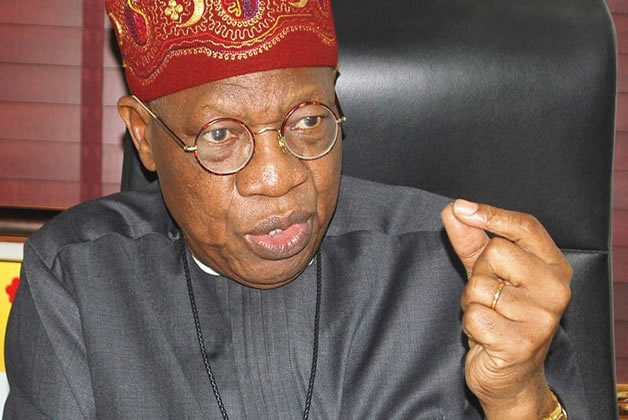
LAI Mohammed, the Minister of Information and Culture has said that the Nigerian economy is improving though the country is in recession.

Mohammed said this on Thursday when he featured on a breakfast programme, “Good Morning Nigeria” aired on the Nigeria Television Authority (NTA).

“By comparison, South Africa recorded a decline of -50 in 02 2020. The economic conditions are actually improving, with 17 activities recording positive real growth in the third quarter, compared to 13 in Q2. Also, 36 of 46 economic activities did better in Q3 2020 than Q2 2020, Mohammed said.

Mohammed stated that the decline of -3.62 percent in Q3 is much smaller than the -6.10 percent recorded in Q2.

According to the minister, the -3.62 percent contraction recorded in Q3 2020 was better than the -6.01 percent earlier forecast by the National Bureau of Statistics, adding that this outperformed several domestic and international forecasts.

He noted that before COVID-19, the Nigerian economy had been experiencing sustained growth that was improving every quarter until Q2 2020 when the impact of COVID-19 was felt.

Mohammed said the major reason for the economic downturn is the COVID-19 pandemic.

He argued that Nigeria is not alone as dozens of countries, including economic giants like the United States, United Kingdom, and Canada, had entered recession due to the global pandemic

The minister said other countries in recession include Austria, Belgium, Denmark, Estonia, Finland, Hungary, Ireland, Italy, Latvia, Lithuania, Mexico, Netherlands, Norway, Romania, Russia, and Spain.

He also said the oil sector was largely responsible for the slow-down in economic activity in Q3 2020.

The reason is the slow-down in global economic growth and oil demand due to COVID 19 pandemic as well as Nigeria’s obligations to meet OPEC cuts,” Mohammed stated.

The minister said although the non-oil sec also contracted in Q3 2020, the decline in the A sector by -2.51 percent year on year in Q3 was significantly better when compared to the contraction of -6.05 percent year on year recorded in Q2 2020.

He, however, said the latest recession would be short-lived and the country would return to positive growth “soon unlike the 2016 recession which lasted five quarters.”

Mohammed explained that the recession would be short-lived because of several complementary fiscals, real sector, and monetary interventions proactively introduced by the government

However, Mohammed did not specifically state how the country would exit the economic recession.

The ICIR had reported that Nigeria is officially in recession following a data report released by the National Bureau of Statistics (NBS).

According to the NBS, Nigeria’s economic growth contracted by -3.62 percent in the third quarter of 2020 recording a second consecutive quarterly Gross Development Product, GDP decline since the recession of 2016. The cumulative GDP for the first nine months of 2020 stood at -2.48 percent.

A civil society organization, the Socio-Economic Rights and Accountability Project (SERAP) in an open letter to President Muhammadu Buhari had demanded a cut in the cost of governance in order to exit the economic recession.

SERAP charged the government to implement bold transparency and accountability policy as a way of responding to the economic recession.

“This economic crisis provides an opportunity to prioritise access of poor and vulnerable Nigerians to basic socio-economic rights, and to genuinely re-commit to the fight against corruption. The country cannot afford to get back to business as usual,” the letter read in part.

Public outcry over N4.6billion payment into private accounts in Fashola’s Ministry

0

THE chairman of the Abuja council of the Nigeria Union of Journalists, Emmanuel Ogbeche on Wednesday urged   government to recover over N4.6 billion paid into private accounts of individuals in a federal ministry in 2019.

Participants and callers to a radio program, Public Conscience in Abuja lamented the inaction of government since Premium Times reported the unwholesome practice in the federal ministry.

Ogbeche and other stakeholders made the call during a radio program, Public Conscience produced by the Progressive Impact Organization for Community Development, PRIMORG.

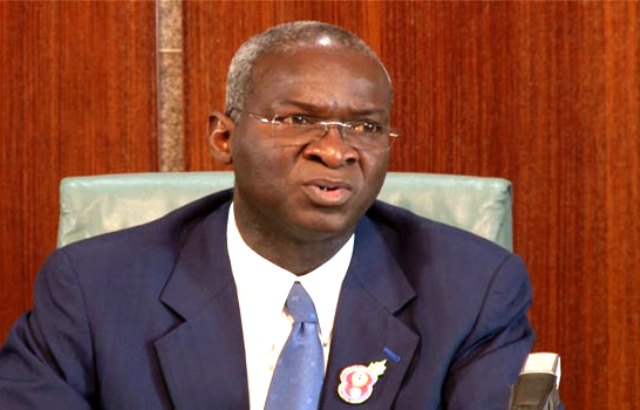
Ogbeche was reacting to an investigative report exposing illegal payment of ₦4.6 billion into private accounts of directors and employees of the then Federal Ministry of Power, Works and Housing, under Babatunde Raji Fashola.

He said it was worrisome that extant laws of the nation were violated by MDAs, decrying that Nigeria is building a legacy of corruption.

He emphasised that successive administrations have paid lip service instead of genuinely tackling issues of accountability, transparency and corruption in the public sector.

Ogbeche identified lack of political will as a major impediment of the fight against corruption, as well as bemoaned President Muhammadu Buhari’s lackluster attitude against corruption.

“For a government that came to power on the basis of anti-corruption stance, one would have imagined that we would have seen a more robust engagement on the fight against graft and other financial vices, but we haven’t seen it.”

He lauded the efforts of PRIMORG in bringing corruption stories to public notice, adding that public advocacy remains the best way to get anti-graft agencies to be alive to their duties.

Similarly, the Program Officer at BudgIT, a civic tech organisation, Chinwe Umeh-Ujubuonu stated that the dangers of misappropriation of public funds and flagrant abuse of extant laws is the reason for a general lack of trust by the citizens.

According to her, corruption in the MDAs is largely responsible for high rates of child mortality, out of school children, unemployment, robbery, kidnapping and so on. She revealed that mismanagement of public funds occasioned by lack of transparency and accountability is now the order of the day in all government MDAs.

She made these startling revelations: “We noticed between January and July, 2019, over two thousand, nine hundred individual payments were made into private accounts which cut across all the MDAs and came up to N51 billion paid into individual accounts without description.

“We found one that was paid into an individual account and the description says, “for transfer to NCDC for emergency Lassa Fever response”. The question is, why pay it into an individual account? Why not pay to NCDC directly? She queried.

“We found out that five thousand individual payments were made without description which cut across all the MDAs and came up to about N278 billion. Also, we discovered about two hundred and seventy-five payment records that didn’t have beneficiary name, ministry name, organization name and they were among the payments that didn’t have description,” Umeh-Ujubuonu disclosed.

Public Conscience, the syndicated radio program is produced by PRIMORG with the support from the McArthur Foundation.

South-South leaders engage FG, demand restructuring, true federalism

0

LEADERS of the South-South have made a strong case for restructuring of the country and the practice of true federalism that includes the devolution of powers to all the federating units.

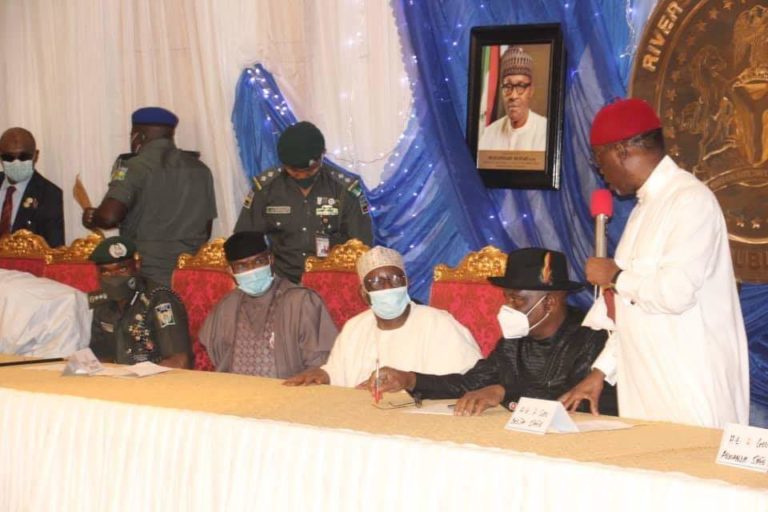
The leaders made these demands on Tuesday during a consultative meeting with the delegation of the federal government led by Ibrahim Gambari and with governors, ministers and other stakeholders from the region at Government House, Port Harcourt.

Ifeanyi Okowa, Chairman of the South-South Governors’ Forum and Governor of Delta, who presented the region’s demand, said that the nation was not at peace because the country had failed to practice true federalism.

Okowa said that it was time to restore the country back to a true federation with all the attributes and nuances of a federal state.

“For us in the South-South, the #ENDSARS protest is a metaphor of almost all that is wrong with us, our refusal to properly understand issues, and imbibe and entrench the virtues of justice, fairness and equity,” he said.

“The previous system of true federalism was jettisoned and it created a powerful center controlling and distributing all the resources unevenly.

“There was now a strong desire to restructure the country in order to guarantee peace, security, stability and progress of the nation.

“The region demands true federalism and devolution of powers to the states, including creating and managing their own police and security architecture, true fiscal federalism guided by the principle of derivation, revenue sharing and control of resources by each state.”

He decried the deliberate lack of understanding, empathy and uncompromising attitudes of some Nigerians, who refused to understand the peculiar challenges of the South-South region, especially the degradation of the environment and the pollution of our waters.

“All we demand and ask for is fairness and equity and as we await actions to restructure the country, we hereby renew our demands for: ‘The relocation of the headquarters of major oil companies in Nigeria to the region; relocation of several NNPC subsidiaries from Lagos and Abuja to the region.

“The region further requested the completion without delay of the East-West Road and all federal roads in the region; Construction of the Lagos-Calabar railway, reconstruction and rehabilitation of the region’s major seaports notably the Port Harcourt, Calabar and Warri”.

The leaders also demanded the privatisation of the Port Harcourt and Warri refineries after several failed turn-around maintenance attempts.

The region called for the release of all funds owed Niger Delta Development Commission (NDDC) and for the amendment of the NDDC Act to place the commission on a first-line charge.

The stakeholders decried annual flooding challenges in the region and called for the establishment of buffer dams to control flood waters in the region.

They also called for the completion of the abandoned Gas Revolution Industrial Park at Ogidigben and the stepping down of electricity at the Okpai and Utorogu gas plants.

Ibrahim Gambari, thanked the people of the South-South for their cooperation, and assured that all issues raised at the meeting would be communicated to the President.

Gambari apologised for the failure of the meeting to hold on Nov. 17 earlier slated, and said “we are here on behalf of the President as part of the ongoing and continuing conversation on how to make our nation better and I must thank the Governor of Delta, Senator Ifeanyi Okowa, for his tireless effort in ensuring that this meeting held.

“Our youths took to the streets to express their bitterness on ill-treatment meted out to them by the police and the President, recognising the importance of the demands made by the protesters agreed to implement the five demands.

“All over the world, people have the right to protest but in doing so, the respect for law and order must be adhered to and they must also respect the rights of others.

“The President commends governors, traditional rulers and other stakeholders for their role in handling the protesters,” he said.