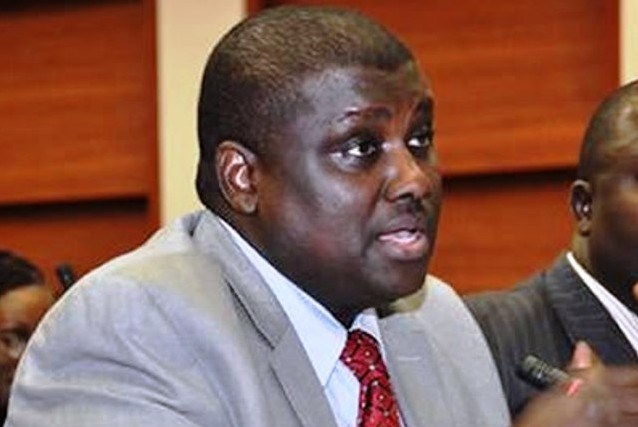
Abdulrasheed Maina, the wanted former chairman of the Pension Reform Task Team (PRTT) was on Monday evening arrested in Niger Republic by the operatives of Niger Republic intelligence service in collaboration with Nigeria’s anti-corruption agency, the Economic and Financial Crimes Commission, EFCC.
According to PR Nigeria, the arrest was made possible due to an existing mutual relationship and security agreement between the two neighbouring countries. According to sources in the EFCC, its operatives learnt of Maina’s escape to Niger about two weeks ago and have been working with that country’s security forces to effect his arrest.
Maina is facing a 12-count money laundering charge levelled against him and a company by the prosecuting EFCC.
The agency alleged that Maina, as chairman of the defunct Pension Reform Task Team, used the account of the firm for money laundering to the tune of about N2 billion, part of which he used to acquire landed properties in Abuja and elsewhere
He, however, has not been attending trial since the September 29, 2020 proceedings, a development that Monday prompted Justice Okon Abang of the Federal High Court to order the arrest of Senator Ali Ndume’swho stood surety for Maina.
But the Federal High Court in Abuja on Friday granted bail to the Borno South Senator, over his suretyship for Maina, believed to have jumped bail.
Justice Abang, in a ruling, said he chose to grant the senator bail based on his record of good behaviour before the court, notwithstanding that the other grounds of his bail application failed.
AS part of its mandate, the Independent Corrupt Practices and Other Related Offences Commission (ICPC), on Monday says it has secured an interim order to forfeit a sum of $919,202.07 fraudulently kept in a bank by some officials of the Federal High Court, Port Harcourt.
The sum which is about 450 million Naira was discovered after the Commission received a petition against the suspected officials.
According to the ICPC, its investigators at the Rivers State Office traced the money to an interest yielding account kept secretly since 2014.
Upon discovery, the Commission stated that its lawyer, Dr. Agada Akogwu filed an Ex-parte Motion for an Interim Order of Forfeiture of the money.
The presiding judge, Justice Mohammed Sani of the FHC in Port Harcourt, however, granted the Commission’s prayers for interim forfeiture of the disclosed sum pending the final hearing on the matter.
Part of the ruling by judge says “the interim forfeiture shall be published in any daily newspaper within 14 working days for any person interested in the said property sought to be forfeited to appear before the court.”
Whoever claims responsibility, according to the ruling should be willing to prove to the court why the final forfeiture orders should not be made in favour of the Federal Government.
The matter was adjourned to December 14, 2020 for reports and final forfeiture hearing.
Meanwhile, the above incident is one of similar discoveries made by the anti-graft agency.
The most recent was the case of the Acting Director-General (DG) of the National Biotechnology Development Agency (NABDA), accused of allegedly defrauding the federal government of N400 million.
ICPC intelligence-led investigation revealed the money, which the Acting DG claimed to be an intervention fund for the biotechnology agency was diverted into private pockets.
The unnamed professor of Microbiology and Biotechnology was alleged to have shared the huge sum with some other top management staff of the agency.
He was therefore arrested by operatives of the Commission to answer questions on how the said amount belonging to the government could disappear under his watch. The Acting DG is also facing questions bordering on conspiracy and abuse of office.
The commission says the Prof’s actions are contrary to and punishable under sections 19 and 26 of the ICPC Act, 2000.
“Further investigations into the Acting DG’s alleged fraudulent activities are still ongoing and the Commission will take appropriate action once they are concluded.”
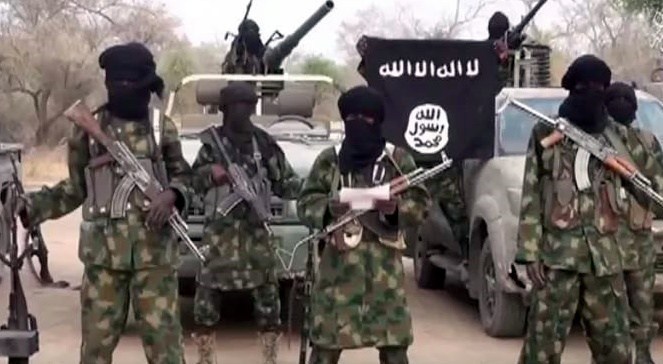
THE Federal Government has blamed international partners for the reason it is yet to successfully prosecute the war against Boko Haram insurgency in the northeastern region.
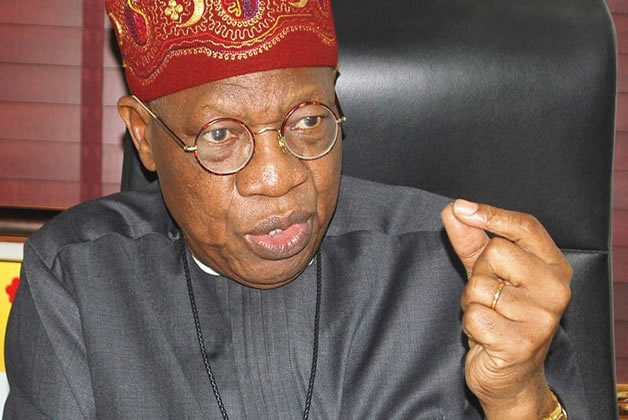
Lai Mohammed, the Minister of Information, Culture and Tourism, said this on Monday in Makurdi while reacting to issues of insecurity and the killing of 110 rice farmers in Borno State during the weekend.
Mohammed said the Buhari administration has made an attempt to acquire a better platform to prosecute the war but it has been denied this support for some unknown reasons.
While stressing that there is a need for more global support to tackle terrorism, he stated that without adequate weapons, the nation will remain at the mercy of terrorists.
“But you must also note that we are dealing with terrorists who are financed globally and we also need more support from global partners. For instance, Nigeria has made an attempt to acquire a better and more effective platform to deal with terrorists but for one reason or the other we have been denied this platform, these weapons and without adequate weapons or platform we remain at the mercy of terrorists,” he said.
“You see fighting terrorists is not a joke because what actually happened in Borno State is unfortunate but you must also look at the strategy of the terrorists.
“Terrorists use media and publicity as oxygen, so when they go on this kind of mindless killing of people. It is not that the government is not doing enough. Terrorism whether in Afghanistan or anywhere in the world has the same concept, a group of people who are extremist in their thoughts who don’t think that you and I should be alive.
“When we talk about terrorism, people don’t seem to appreciate that terrorism is not a local issue, it is a global issue and there is no part of the world that doesn’t experience its own pocket of terrorism.”
Mohammed’s statement failed to acknowledge repeated and renewed calls by Nigerians and socio-political organizations that the president should create room for fresh ideas in the fight against terrorism and ravaging insecurity in the country by sacking his service chiefs who he appointed in 2015.
In July, the Nigeria Senate asked President Buhari to ask the service chiefs to step aside in a resolution moved by Ali Ndume who was ambushed by suspected bandits in Katsina State, leading to the death of 16 soldiers and 28 others, wounded.
But in a swift response, Femi Adesina, Special Adviser, Media and Publicity, then said the presidency noted the “resolution and the president as Commander-in-Chief of the Armed Forces, will do what is in the best interest of the country at all times.”
Adesina reminded the senate how it is only in the prerogative of the president to appoint and sack his service chiefs.
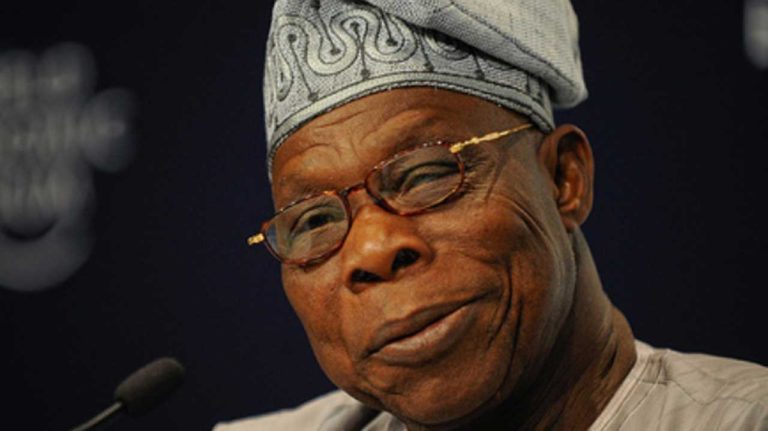
OLUSEGUN Obasanjo, Nigeria’s former President, says the action exhibited by leaderships of Ghana’s New Patriotic Party (NPP) and National Democratic Congress (NDC) will determine the fate of the country’s general election.
In a letter personally signed by Nigeria’s former Head of State, he told the political actors to do everything possible to ensure the election scheduled to hold on December 7 is peaceful and credible.
Nana Akufo-Addo, the incumbent President is the flag bearer of the NPP while John Mahama, former Ghanaian president is contesting under the NDC.
“I write to you, leaders of the two main political parties in Ghana, to urge you to do all you can to ensure a peaceful conduct of the general elections,” Obasanjo said.
“My concern about the elections in Ghana is not only as an African but also because of our shared colonial history, our anthropological background…”
“…the success or failure of the elections, a key aspect of democratic consolidation in Ghana will largely depend on the posture of the NPP and NDC leadership and how that is manifested by the actions of their supporters.”
Olusegun Obasanjo Letter on Ghana Election: Source BBC
Chief Olusegun Obasanjo’s Letter on Ghana General Election Page 2
Chief Olusegun Obasanjo’s Letter on Ghana General Election Page 3
He acknowledged the ‘significant’ contributions of both parties to developing the socio-economic and political growth of Ghana. The legacy, he noted, should be sustained irrespective of the political differences.
Other major candidates in the presidential election are Nana Konadu Agyeman-Rawlings, wife of the late president John Rawlings, Christian Andres of Ghana Union Movement, Ivor Greenstreet (Convention People’s Party), Akua Donkor Ghana Freedom Party), Henry Lartey (Great Consolidated Popular Party) and Hassan Ayariga (All Peoples’ Congress).
There is also an independent candidate, Asiedu Walker who is contesting in the poll.
33, 367 polling units have so far been approved by the Ghana Electoral Commission for the 17, 027,655 registered voters in the country.
Obasanjo, however, campaigned for the unity, peaceful conduct of the poll. He charged the electorate to respect democratic values and preserve democratic gains the country had witnessed since the advent of democracy in Ghana.
“The NPP and NDC must constructively engage with all national institutions to identify, address or mitigate any potential threats to the smooth organisation of the electoral process,” the letter reads in part.
Both Frederick Blay, NPP Chairperson and Samuel Ofosu-Amofo, NDC Chairperson and their members of executive committees were copied in the letter.
IN response to reports by the United Nations that no fewer than 110, were killed by Boko Haram terrorists in Maiduguri, Borno State as against 43 persons earlier reported, the Nigerian Defence Headquarters has said that military operatives are still searching for more bodies.
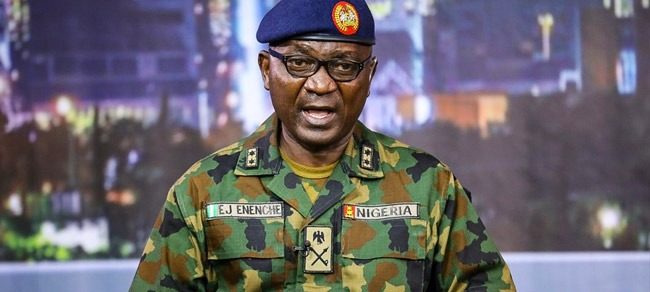
The Defence Headquarters said this on Monday when the military spokesperson, John Enenche featured on Sunrise Daily programme on Channels television to discuss the rate of insecurity in the country.
“I had to contact the people in the theatre, right from the commander, the UC and then the media operation officer and then they gave me a synopsis of what happened. When the governor was to go and after they had recovered the dead, the troops had to move in there and they counted 43.
“Of course, some people ran into the bush and they started coming back and trickling in.
“As at 2 pm yesterday (Sunday), I called them and they got back to me at about 7 pm yesterday, still counting, looking if they will recover (more corpses). We call it Exploitation After Action Review,” said Enenche.
He added that the military may eventually count up to the figure quoted by the United Nations but only 43 has been counted so far.
“Probably we may count up to the figure he (UN officer, Kallon) gave in the future but as it is now, what we have counted with the locals is still 43 and we are hoping that we don’t get beyond that.
“This is the real situation. I did not sleep, we had to follow it because this is very relevant coming from the United Nations,” he stated.
According to reports, Edward Kallon, the United Nations Resident and Humanitarian Coordinator had said the at least 110 were killed in the attack by Boko Haram.
However, in a telephone conversation with The ICIR, Eve Sabbagh, the Head of Public Information, United Nations Office of Coordination of Humanitarian Affairs (OCHA) Nigeria said the 110 figures have been retracted.
“We got initial numbers that there were more bodies being recovered on Sunday and it could be up to 110 people killed but we can’t confirm these numbers. So on the official statement, we are saying 110 because all we can confirm so far are the 43 recovered bodies.
“However, there was an initial version that had gone with the initial numbers, so that is why the press is reporting that (110) but we have retracted it and the official statement that we published online says tens of civilians,” Sabbagh told The ICIR.
NORTH-EAST Nigeria has recorded at least 612 deaths from the month of June to November 27, data gathered by the Nigeria Security Tracker, NST, has shown.
The deaths from the affected states – Borno, Adamawa, Yobe, Bauchi, Gombe and Taraba were as a result of banditry, kidnapping, communal clashes and Boko Haram insurgency in the region.
While 233 state actors such as security operatives and government officials were killed within the six months period, 379 civilians from the region lost their lives to insecurity.
Based on data gathered from the Nigeria Security Tracker (NST), an initiative of the Council on Foreign Relations (cfr), Borno state recorded the highest mortality with 534 total deaths (231 state actors and 303 civilians).
From the figure, Boko Haram insurgency was responsible for more than 50 percent of the casualties put at 534 deaths.
In Bauchi, only 13 deaths were recorded. Though none of the killings was attributed to the insurgency, they were a result of the communal crisis and political clash.
Gombe recorded no deaths within the period.
Data on Deaths in the North East
However, Yobe, Adamawa and Taraba recorded multiple deaths due to insurgency, banditry and kidnapping.
In Adamawa for instance, a total of 27 people were killed in six months due to insecurity.
One of such killings in Adamawa occurred in June. On June 9, about 23 bodies were recovered after a communal clash between the Lunguda and Waja tribes in Zakawon community, Lamurde Local Government Area of the state. Houses were burnt and domestic animals and foodstuffs were also destroyed.
Suleiman Nguroje, former spokesperson of the state police command later confirmed the arrest of 32 persons accused of the crime.
While death was recorded in Yobe state within the period, Taraba had a much higher casualty figure of 37 civilian deaths.
One of the Taraba killings involved the attack on Emmanuel Bileya, a clergy at Christian Reformed Church-Nigeria (CRC-N) and his wife, Juliana while the two were working on their farmland in Mararaba, Donga LGA.
“killings of this nature have happened too often recently in Southern Taraba communities…,” Bala Dan Abu, Media aide to Darius Ishaku, the state governor, stated while reacting to the incident.
Killings too many
The series of reported killings in the country has sadly become a source of worry to Nigerians and the international community. However, the above casualty data excludes the slaughtering of over 40 farmers in Jere Local Government Area of Borno State, as widely reported last Saturday. The United Nations Humanitarian Coordinator in Nigeria, Edward Kallon later pegged the casualty figure to 110 victims.
Despite the public reactions the incident generated, no official statement has been issued by the security authorities.
The ICIR earlier reported the silence of the Nigerian Army and the Police over the incident. But hours after the incident, President Muhammadu Buhari reacted, describing the killings as insane and senseless.
“I condemn the killing of our hardworking farmers by terrorists in Borno State. The entire country is hurt by these senseless killings. My thoughts are with their families in this time of grief. May their souls Rest In Peace,” Buhari stated in a statement released by Garba Shehu, his spokesperson.
Meanwhile, beyond attacks on civilian populations in the country, the military is not excluded in the seemingly continued attacks that have led to the deaths of several military personnel.
The Federal Government has continued to insist it is winning the battle over the insurgents but the current reality cast doubts on this claim.
Beyond the North-East area, other regions in the country have witnessed one form of insecurity or the other.
The most recent in the South-West, for instance, is the killing of Oba Gbadebo Ogunsakin, the traditional ruler of Odo-Oro in Ikole Local Government of Ekiti State.
GARBA Shehu, the spokesperson to the Nigerian President, Muhammadu Buhari has said that the slain farmers in Zabarmari, a community in Jere Local Government Area were not cleared by the military to resume operations.
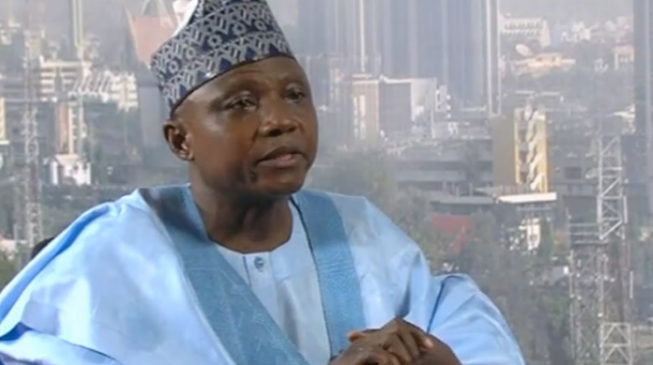
Shehu said this in an interview with BBC on Monday while answering questions over the killing of about 43 farmers in Borno State.
“Much of those areas have been liberated from Boko Haram terrorists but there are a number of spaces that have not been cleared for the return of villagers who have been displaced. So, ideally, all of these places ought to pass the test of military clearances before farmers or settlers resume activities on those fields,” Shehu said.
Following his comment, the BBC interviewer asked if he is blaming the deceased farmers for getting killed, Garba said ‘not exactly but the truth has to be said’.
“Not exactly but the truth has to be said. Was there any clearance by the military which is in total control of those areas? Did anybody ask to resume activity? I have been told by the military leaders that they had not been so advised and certainly, therefore, it was a window that the terrorists exploited,” Shehu responded.
Although in March 2015, during the administration of Goodluck Jonathan, the Nigerian Army had claimed that all but three local governments had been recovered from Boko Haram, Shehu said on Monday that the military is not present in all of that area where the attack took place.
Also in December 2015, President Buhari said Nigeria has “technically won the war” against Boko Haram militants.
He told the BBC that the militant group could no longer mount “conventional attacks” against security forces or population centres.
Five years later, the Buhari administration is now doing a 360-degree turnaround with the new claim.
“The military is not present in every inch of space in that area. Even if the people are willing to go back, a lot of those areas have been mined and mine clearance needs to be carried out and those areas must be cast as being ok for human habitation or agricultural activity,” Shehu said.
As at the time of filing this report, there has not been a definitive number of the casualties beheaded by Boko Haram terrorist, while the Nigerian Army said 43 bodies have been counted, the United Nations said apart from the 43, some bodies were reported to have been recovered on Sunday.
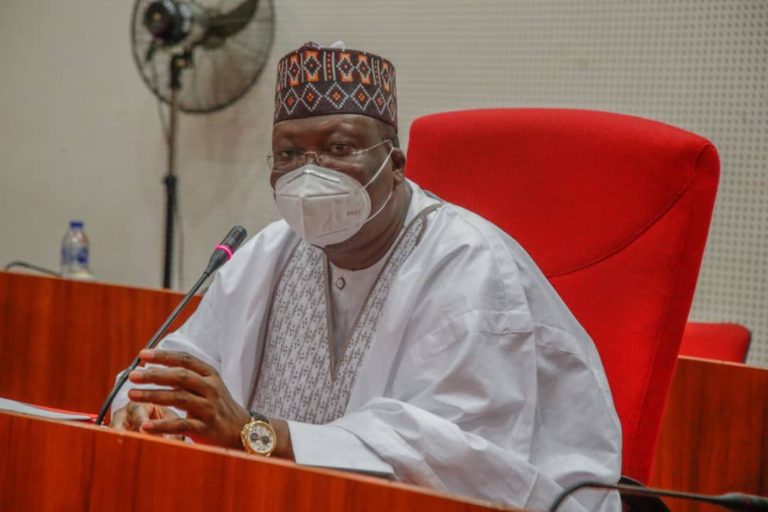
AHMAD Lawan, Nigerian Senate President, on Monday, led a delegation of the Federal Government on a condolence visit to Borno state over the killing of rice farmers by Boko Haram at the weekend.
According to Ola Awoniyi, Special Adviser to the Senate president on media, the delegation is in Borno, on behalf of President Muhammadu Buhari and the Federal Government, to commiserate and identify with the family of the victims, the government and the people of Borno State over the incident.
Members of the delegation include the chief of staff to the president, Ibrahim Gambari, Ministers of Federal Capital Territory, Mohammed Bello, Communications and Digital Economy, Ali Pantami and the Minister of State for Agriculture, Mustapha Baba Shehuri.
Other members are the National Security Adviser, Major General Babagana Monguno(rtd) and Senior Special Assistant(Media and Publicity) to the President, Mallam Garba Shehu.
The ICIR had reported on Saturday how about 43 rice farmers were brutally murdered in Kwashebe Zamarmari axis of Jere Local Government Area of Borno State.
A BBC report says the deceased were attacked, tied and beheaded by the Boko Haram insurgents while they were harvesting rice on their farms.
However, the United Nations’ humanitarian coordinator in Nigeria, Edward Kallon, said in a statement on Sunday that the numbers of people that were killed were 110. He also added that many others were wounded with several women being kidnapped by the insurgents.
While describing that the incident was the most “violent direct attack against innocent civilians this year, he called that the perpetrators be brought to book.
President Muhammadu Buhari, in a statement issued by Garba Shehu, his Senior Special Assistant on Media and Publicity on Sunday, described the incident as senseless and insane.
He said the government has given all the needed support to the armed forces “to take all necessary steps to protect the country’s population and its territory.
THE Niger Delta Power Holding Company, NDPHC is set to conduct a comprehensiveaudit of all existing National Integrated Power Projects, NIPPS littered across the country.
The audit is aimed to ensure that all idle gas turbines abandoned in the country were restored and put to use so as to improve electricity generation and supply.
This was disclosed by Abdullahi Kassim, Executive Director, Generation, NDPHC, during a tour of three power plants namely Omotosho, Ogorode, and Ihovbor generation companies.
He said the move to audit the plants was spearheaded by the Vice President, Prof. Yemi Osinbajo, who had ordered the management of NDPHC to revive all gas turbines that were not in good condition.
“We are going to commence an audit of all the power plants. The audit will give us an overview of critical issues.
“Also, the security audit will expose the challenges around security, the mapping of all those security personnel around the power plants and the manpower gap, which was an issue raised by some of the chief operating officers,” he said.
A 2019 investigation carried out by The ICIR, revealed that Omotosho, Benin, Ogorode and Egbema gas plants which were managed by the NDPHC had been shut down due to power rejection to the national grid.
In September 2019, President Muhammadu Buhari had instructed the Economic and Financial Crimes Commission, EFCC to prosecute two officers of NDPHC involved in an alleged $16 billion failed gas plant project.
The combined electricity generated from the eight NIPPS across the country was pegged at 468.7MW as of October 2019 but about 300MW gets to the consumers.
However, the Federal Government announced on Sunday the inauguration of the Gagarawa 2x60MVA, 132/33KV substation in Jigawa State after the facility had been abandoned for 20 years.
Sale Mamman, Minister of Power who inaugurated the substation, said the project was designed to upgrade the power supply to the industrial hub of the area in order to promote economic activities and increase revenue generation in Jigawa.
IN A bid to give listening ears to the protesters demanding an end to police brutality in Nigeria and address their concern, the federal government after the National Economic Council (NEC) meeting on Thursday October 16, ordered the establishment of Judicial panels of inquiry across the 36 states of the federation.
Since the establishment of the Judicial Panels of Inquiry across states, it has been an endless story of agony and pain as victims and families recount experience of police brutality and extrajudicial killings.
The ICIR though had earlier reported stories from hearings at some of the panel, last week, there were more gory tales than before as petitioners recounted their grief-stricken ordeal before the panels.
Lamentations at Lagos panel
One of the petitioners that spoke before the panel this week was Hannah Olugbodi, a middle-age hairstylist, who was crippled by the police stray bullet.
Hannah Olugbodi, a petitioner at the Lagos panel
Olugbodi, who appeared before the panel on crutches on Saturday, said the awful incident happened on June 6, 2018, when she was going to buy spices for her family dinner at the Ijesha market.
She alleged that the SARS officers were after the boys, who were watching football at the Ogun City hotel, adding that she got hit by the bullet when the officers started shooting sporadically as the boys refused to settle them.
“On one of those days, some boys were watching a football game when SARS arrived and accosted one of the boys who had tattoos.
“When the SARS men couldn’t extort the boys, they started shooting at them as they ran into the Ijesha market and that’s how I was hit,” she narrated.
She later spent six months at the Lagos State University Teaching Hospital (LUTH), without any of the police officers coming to visit her.
Olugbodi, who appeared before the panel with a large pack of files full of hospital bills said she wants justice, noting that she had spent all she had to pay for surgery, ye she still can’t walk.
Another petitioner, who spoke at the Lagos panel, Adeyemo Rotimi, completely broke down in tears before the panel, as she narrated how her husband lost his life in the hands of police officers.
Adeyemo Rotimi
Rotimi said her husband was a LASTMA official who was shot on November 28, 2018, exactly two years ago.
She said she received a call at exactly 10pm on that day, that her husband had been shot dead by a SARS officer, Olonode Olukunle.
The panel admitted as evidence the photograph the husband soaked in his own blood.
On Tuesday, the panel hearing continued.
SARS bullet killed my 3-day old daughter, man tells Rivers panel
At the panel in Rivers State, one man, Nyordeh Sylvanus has narrated how his 3-day old daughter was allegedly killed by stray bullets from operatives of the disbanded Special Anti-Robbery Squad (SARS), on the eve of August 14, 2014.
“We woke up in the morning of August 15, 2014, to observe that one of the bullets from SARS operatives who were shooting from the night of August 14, 2014, penetrated my roof and killed my only daughter, a three-day-old baby.
“I picked the bullet on August 15 morning and went to SARS office and but was stopped at the entrance of the office by operatives who ordered me to turn back or join my dead daughter,” Sylvanus narrated.
Another petitioner, Lucky Eze, demanded a compensation of N20million and footing of his medical bills from the Nigeria Police for causing damages to his right ear.
Eze, who was a supervisor in a Filling Station in Ahoada Town, said he started having hearing problem with a hole in his inner ear after he was slapped by policemen who invaded his place of work on January 28, 2018.
He said: “I came here to seek for justice for brutality and wickedness did to me by the Police on January 28, 2018. I have been having hearing problem since then. I have five medical reports from five medical doctors of the University of Port Harcourt Teaching Hospital (UPTH) confirming that the slap created a hole in my right ear.
“I am here to seek justice for two reasons; one is to be able to continue with my treatment which I abandoned due to lack of funds. I didn’t deliberately abandon my treatment; I did so because there was no money. Secondly, I am seeking justice for the brutality they meted on me. I ask this panel that I be compensated with the sum of N20milliion.”
The panel headed by Hon. Justice Chukwunenye Uriri (Rtd), however, promised to conclude hearing on all the 171 petitions before it on December 30.
Anambra panel summons notorious James Nwafor
The Anambra State Judicial Panel of Inquiry on Thursday issued a summons on an alleged killer cop with the defunct Special Anti-Robbery Squad (SARS), James Nwafor, and two others to answer questions bordering on police brutality and illegal killing.
James Nwafor was alleged to have perpetrated several brutalities and extra-judicial killings of some innocent people in the state.
The ICIR had earlier reported about a man, Emmanuel Iloanya, who sold N27 million landed properties, including her daughter’s graveyard to secure the release of his 20-year-old son, Chijioke, who was arrested on November 29, 2012.
Iloanya said his son was allegedly killed by the killer cop, James Nwafor, whom he claimed also harassed his wife.
Meanwhile, Veronica Umeh, Chairman of the Anambra judicial panel and a retired judge of the State High Court said the summoned James Nwafor and the two other persons must appear before it on 8th December 2020 to answer allegations against them.
Ekiti panel sets deadline for submission of petitions, recommends N150,000 compensation for complainant
This week, the Ekiti State Judicial Panel of Inquiry announced 30th November, 2020 as deadline for submission of petitions to the panel.
The Chairman of the panel, Justice Cornelius Akintayo (retd) who made the announcement during the panel’s sitting on Wednesday stated that the panel shall not receive any petition beyond the stipulated date.
Justice Cornelius Akintayo (retd)
He added that the deadline would enable the panel to efficiently handle the petitions submitted before it.
Meanwhile, the panel, on Thursday recommended N150,000 as compensation for injustice done to Mr Adaramola Abiodun Olusola.
Olusola had alleged had alleged that his car, a Peugeot 505 Salon car, Reg. No YEE 310 AA was vandalized by hoodlums at about 5:30pm at Dalimore area of the state capital during the EndSARS protest on October 19.
After going through the evidence submitted by Olusola, the panel, however, asked the government to compensate the complainant with a sum of N150,000 to put his car back on the road.
Police demanding N1m bail to release my husband, woman tells Delta panel
Delta panel
A wife and petitioner, Mrs Ese Abugewa, has called on the Delta State government to effect the release of her husband who is being remanded in Ogwashi-Ukwu Prison over alleged trumped up charges.
Abugewa said his husband was arrested by the Anti-Kidnapping Squad of the Inspector General of Police in August 14, 2020.
Counsel to the petitioner, Albert Agbense told the panel that the police refused to allow the woman see her husband, while detaining him illegally.
Agbense said, “The petitioner’s husband was arrested on the 14th of August and they kept moving him from one police station to the other and nobody knew where he was until after a month when we heard that he was kept at the anti kidnapping office by one Azuka Egede, a member of the IG’s team.
“We discovered that they were using his phone to transfer money from her husband’s account. They also shot his ears and they kept him in police cell.
“We actually got a court order from the Magistrate Court to bring him to court at Asaba, but they refused to obey the order until we took the matter to this panel on Monday and adjourned our case to today Wednesday.”
Meanwhile, the panel adjourned the case till December 8 for hearing
Kastina panel receives 30 petitions as inaugural sitting holds
While some states have started hearing the petitions from the victims of police brutality, the Kastina state is just about to set the ball rolling.
Justice Abdullahi Bawale of the Katsina State High Court who is also the panel Chairman said the panel has received not less than 30 petitions submitted before it.
Bawale, however, assured petitioners and the accused that the panel would ensure justice and fairness to all parties in every case.






 At the panel in Rivers State, one man, Nyordeh Sylvanus has narrated how his 3-day old daughter was allegedly killed by stray bullets from operatives of the disbanded Special Anti-Robbery Squad (SARS), on the eve of August 14, 2014.
 The Anambra State Judicial Panel of Inquiry on Thursday issued a summons on an alleged killer cop with the defunct Special Anti-Robbery Squad (SARS), James Nwafor, and two others to answer questions bordering on police brutality and illegal killing.
