Home Blog Page 1935

INVESTIGATION: Abandoned, poorly executed NDDC road projects in Abia remain source of worry to communities (PART 1)

0

There were feelings of excitement among the people of Ohuru-Ndoki Community when three contractors were prequalified to bid for their road project in 2008. They were happy that after a long wait, their prayers were about to be answered. But years later, their dream is yet to materialise. The people are disillusioned. In the first of this two-part series, Arinze CHIJIOKE, who just returned from a tour of the area, reports that the project initiated by the Niger Delta Development Commission (NDDC), has not commenced.


IF there was anything the people of Ohuru-Ndoki Community ever longed for, it was the re-construction of the Obohia-Ohuru-Aba/ Ohambele-Obeaku road.  Before it finally failed in the early 2000s, exactly two decades after it was constructed in 1980 by the then governor of Imo State, Samuel Mbakwe, the road boosted the economic activities of Ohuru and Obeaku communities known for palm oil operations and shipping businesses.

It served as the major gateway linking Abia, Akwa Ibom and Rivers states with parts of Ngwa land.  But after it became unmotorable, economic activities for the people who are predominantly farmers were grounded, making life difficult for most of them. It became hard for them to go out and sell their products just as it was difficult for people to come into the community. The road became a death trap for travelers too.
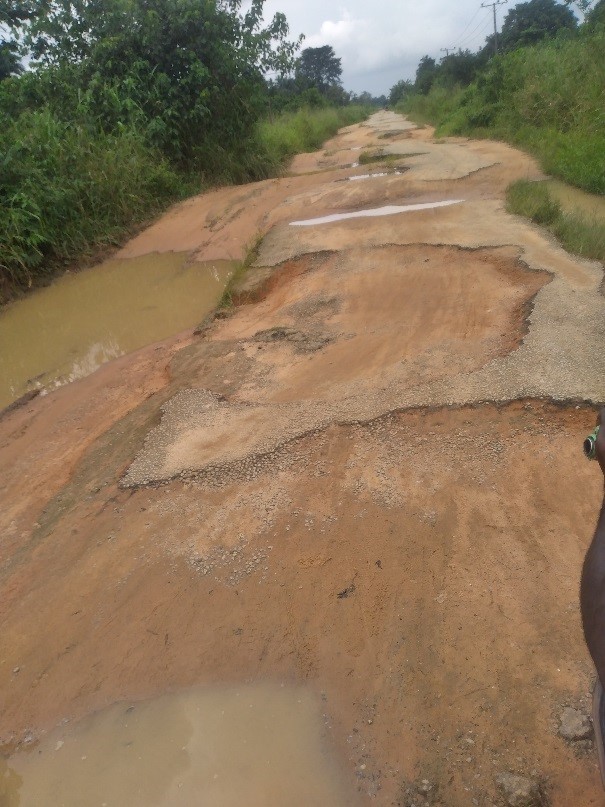
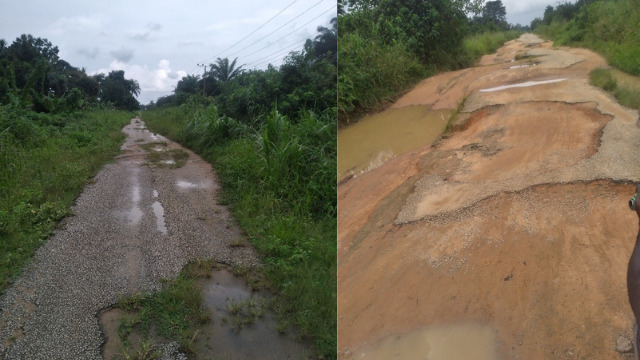
A section of the none-executed obohia-Ohuru-Aba road

According to Eze Obinna Nwagbara, the traditional ruler of Ohuru-Ndoki Autonomous Community in Ukwa East Local Government, “to use motorcycles, you would have to pay huge sums since cars can’t pass through the road. And so, after harvests, we can’t sell.”

In 2007, Nwagbara invited a contractor, Benjamin Nwosu, owner of Akomec Nigeria Limited, along with a Shell Engineer, identified simply as Idowu, and both of them took the measurement of the road. He said the decision was taken with the hope that something would be done about the state of the road, considering its huge economic importance and coupled with the fact that Obohia is one of the major oil-producing communities in Ukwa East.
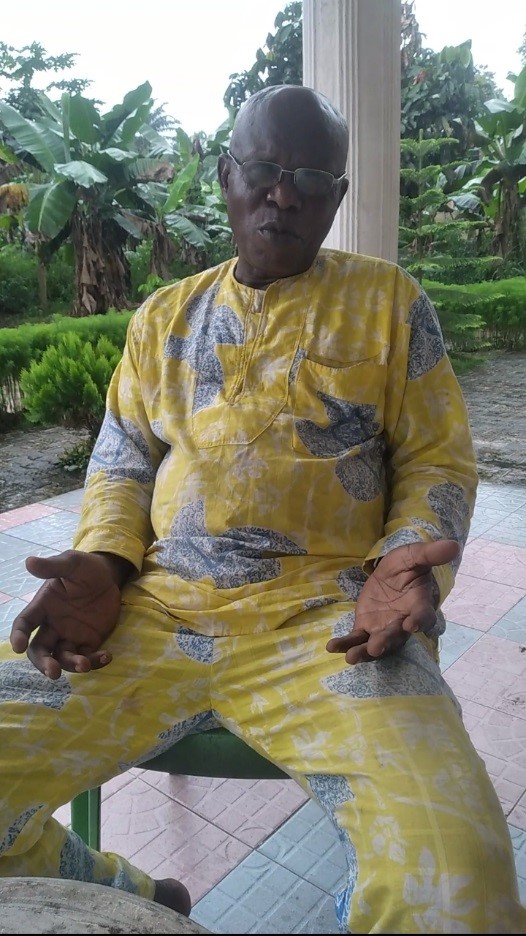
Igwe Obinna Nwagbara
Igwe Obinna Nwagbara explains how long they have had to wait

A document made available to this reporter shows that after the visit, a proposal was submitted to the office of the former Managing Director of the Niger Delta Development Commission (NDDC), Timi Alaibe. The proposal paid off when in 2008, a total of 48 mega projects for the oil-producing states of the Niger Delta were advertised for tender by the Presidency on September 18, 2008, and in Vanguard newspaper edition of Friday, October 10, 2008.

Out of a total of five megaprojects approved for Abia State, the Obohia-Ohuru-Aba Road project was shortlisted for bid and subsequent award. The project was captured as Obohia-Ohuru-Aba Road with spur to Ohambele Obeaku Road, with further details provided thus: “Construction of 16km of rural road with 1 no.3 span bridge, 10 culverts, drains along populated areas and crushed stone base course at marshy areas.”

A total of three contractors were prequalified to bid for the project in 2008, including Akomec Nigeria Limited, Herbertech Nigeria Limited and Atai Nigeria Limited. With feelings of excitement, members of the community waited for the contractor who won the contract to commence work on the road. But that was never to be.

“We were happy that after a long wait, our prayer was answered. Little did we know that that was the beginning of another unending wait,” said Nwagbara.


Hopes dashed

As days ran into weeks and weeks into months and years, no contractor showed up for the job. It has now been 12 years but the project that was duly advertised in line with procurement processes has not commenced. When Nwagbara and the people of Ohuru could not wait any longer, they invited Nwosu, who had measured the road and subsequently won the contract to explain reasons for the delay

Nwabara said: “Nwosu told us he was not mobilised to commence work on the road. But, how would they ask him to come and commence a project without giving him money?”

The traditional ruler has been working with youths and other monarchs to ensure that the project is started, regardless of the contractor. He said there is a need to find out what happened to the money for the project.

“We are not demanding anything from the government apart from this road. It is very important to us. If NDDC has any problem with Akomec that won the contract, they can get another contractor to continue with the job,” he explained.

When contacted for his reaction, Nwosu confirmed that the contract for the construction of the Obohia-Ohuru-Aba Road was awarded to his firm for N2.3 billion (two billion, three hundred million naira only).

He said that he attracted and won the contract in 2009, with the influence of his in-law, former President Goodluck Jonathan, who was at that time, the Vice President of Nigeria. He, however, said that he was not given the letter of award for the contract and the money to execute the project.

He said: “The former MD of the NDDC when the contract was awarded, Timi Alaibe, told me that I won the contract. But I did not get the award letter till his administration was dissolved and since then, no one is saying anything.”

A board member representing Abia State in the NDDC at the time of the contract award between 2007 and 2009, Aloysius Nwagboso, confirmed that the contract for Obohia-Ohuru Road was indeed awarded by the NDDC. He nonetheless refused to comment on the controversy surrounding the award of the contract and why work has not started on the road. He insisted that he would not want to be drawn into unnecessary controversy.

According to him, “Akomec cannot claim to have won the contract when he does not have an award letter from the commission. The project was awarded in 2009, and by that year, in April, our tenure terminated. I know that the project was part of the budget. I defended it. But who won the project is what I don’t know. It is a very controversial issue.”

Deluge of petitions 

Comrade Henry Nwaigwe, who doubles as the youth leader of Ohuru-Ndoki Community and Zonal Coordinator, Ndoki Youth Federation, told our reporter that between 2010 and 2015, his community and Akomec, the supposed winner of the contract, wrote series of petitions demanding the mobilisation of contractor to site. He said they also wrote to the Presidential Probe Committee on NDDC, the Executive Directorate Department of the Commission, the Bureau of Public Procurement and the Independent Corrupt Practices and Other Related Offences Commission (ICPC).

The Obohia-Ohuru road was advertised in Vanguard

“We want the NDDC to allow us access to the award letter and also explain to us the reason behind the non-execution of the project since 2008 because the continued delay in its execution does not encourage us to trust the intervention policy of the commission,” he said.

He maintained that the Obohia-Ohuru-Aba Road is an authentic project under NDDC’s project execution list and that documentary record with the National Assembly Committee on NDDC, BPP, and the Due process office of the Commission in Port Harcourt are there to verify the fact.

Allegations of re-alignment

However, there are suspicions in Ohuru – Ndoki that the contract for the construction of the Obahi-Ohuru-Aba Road may somehow have been awarded to another contractor, but for another road, This is because HERBERTECH NIG Ltd, one of the prequalified contractors for the Obohia-Ohuru-Aba Road project resumed work on a nearby project, the Obohia-Ohanku Aba Road. There have been allegations that he changed the alignment of the original road to fit the new one.

In fact, Nwosu, owner of Akomec who said he won the contract, alleged that the Obohia-Ohuru Road was doctored along the bidding process in November 2008, for the Obohia-Ohanku-Aba Road in favour of one of the bidder contractors in the contract sum of N2,0,80,000,000 (two billion and eighty million Naira only).

Nwaigwe, the youth leader of Ohuru-Ndoki, also alleged that funds released for the execution of the Ohuru Road project from the presidency were being appropriated by the NDDC staff and Herbert who used it to work on a road project that was not legally procured.

He said: “While we were making efforts to ensure that the contractor was mobilised to site, we noticed that one of the contractors who lost out in the bidding of the Obohia-Ohuru-Aba Road project, had started working on a farm road between Obohia-Ndoki Roundabout, with the inscription, Obohia-Ohanku Aba Road.”

The project was part of the Mega projects in Abia State

He, however, revealed that the funding of the Obohia-Ohanku Aba Road has since been suspended after the petitions. Following allegations that he changed the alignment of the Obohia-Ohuru Road, Herbert said that what he was given by the NDDC was the construction of the Obohia-Ohanku Aba Road and that all the contract details and agreements signed are available.

“If the NDDC advertised that they were going to do a particular project and later, failed to follow it up, you cannot slap them. You did not give them money to do any road for you,” he said.

Herbert said he went, picked and filled the tender when it was published after which the bid analysis was done and they went straight to the BPP for no objection certification after which agreements were signed.

He told this reporter that as a contractor, he does not have the capacity to change the alignment of a road and have the NDDC to access it, do bid analysis, obtain a certificate of no objection, write award letter, mobilise and pay the interim payment certificate, one, two, three and four.

When asked whether the contract for the road was published in line with the procurement processes, he said: “As a registered contractor, I was asked to come and collect a tender; I have the original copy of the tender that said Obohia-Ohanku. I took what I saw and went away.”

Herbert said he had two options, to collect the project or reject it, adding that the project was tendered in 2008, awarded in 2009, and the site handed over to him in 2010.

“I could not have asked them why it is Ohanku and not Ohuru. The extent I have gone on the project, I can’t go back,” he said.

He said that the NDDC has not paid him since 2017 when he finished about 20km of the Obohia-Ohanku Road out of 32.30km in the contract, adding that the development has slowed the pace of work on the road.

“If the payment were coming as at when due, I would have finished the project. I can’t begin to talk about all of that because there will be a penalty for anything I say. Our agreement says that contractors are the employees while the NDDC is the employer and that means we are to act on the instructions of the employer,” he added.

In its database, the NDDC admitted that the contract for the construction of Obohia – Ohanku – Aba Road with Spur to Ohambele- Obeaku (32.30km) Ukwa East has since been abandoned.

However, NNDC’s budget document seen by this reporter showed that between 2012 and 2016, over N1.5 billion has so far been committed to the construction of the road project, which has now been combined with the Obohia-Ohanku Road and captured as Obohia-Ohanku-Ohuru-Aba Road with spur to Ohambele-Obeaku Road.
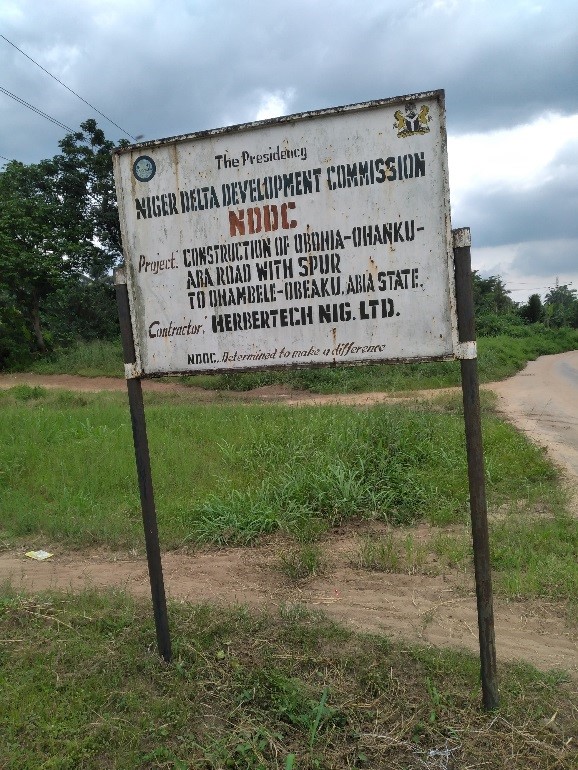
Signboard for the Obohia-Ohanku road

A budget sum of N6,580,262,907.19 (six billion five hundred and eighty million, two hundred and sixty-two thousand nine hundred and seven thousand nineteen kobo) has been allocated for the two projects since they were brought together in 2012. The Obohia-Ohuru-Aba/ Ohambele Obeaku road, which was advertised by the NDDC had N3,980,626,907.19, while the Obohia-Ohanku- Aba Road had a budget of N2.6 billion.

But while the Obohia-Ohanku- Aba/Ohambele Obeaku Road has since commenced, with the contractor, Herbertech Nigeria Ltd constructing 20km, no contractor has been mobilised to the Obohia-Ohuru-Aba/Ohambele Obeaku road.

And the people of Ohuru-Ndoki continue to question the rationale behind the non-mobilisation of a contractor to the road after all available documents ranging from proposal, budget, approval stage and tender advertisement show that the road followed the due process.

No proper record keeping

One of the problems of the NDDC, which has often resulted in the non-execution and abandonment of projects across the oil-producing states, is poor record-keeping by the commission.

The Chief Technical Assistant to the Executive Director, Projects of the NDDC in 2015, Engineer Jerry Oritsejolone, said that he was asked to look into the controversy surrounding the Obohia-Ohuru Road project but added that the board was soon dissolved and he was transferred from the headquarters.

Oritsejolone, who is currently the Assistant Director, Projects, Delta State office of the commission, said that since 2015 after he left, the matter died down and successive boards have failed to look into it. He blamed it on the failure of the NDDC to always keep records of contracts. He said that once a board leaves, another board comes in and they usually don’t know what happened in the previous administration.

“Even if there are any records, politicians, who often are in charge of these projects, do not have the patience to check and projects die natural deaths,” he explained.

He, however, said that it is possible that the Obohia-Ohuru Road contract was not awarded even after it was advertised by the commission.

“The people cannot protest against what we have advertised because a lot of projects were awarded because of the problems in the NDDC,” he said.

Oritsejolone further explained that the commission may have used most funds for the execution of what it described as emergency awards instead of paying for projects that already exist.

A section of the 20km road constructed out of 32.30km

According to him, “most of what we have now are emergency awards as the government has said no new contracts should be awarded. You will find that in our budgets and most of these emergency awards are fictitious (and) used to steal money in the commission.”

Politics of contract award and execution

Oritsejolone spoke of how contractors were usually asked to pay 10 percent of contract sums before they were given contracts after winning bids. He said: “If you cannot pay the 10 percent once they collect some percentage and when you work and get paid, you pay them because most of the projects belong to politicians who require you to pay.”

He explained that contractors were required to sign agreements and pay part of the agreement first including three percent to the facilitator and that any contractor who failed to provide the money would lose the job.

He said it was possible that Akomec, the supposed winner of the contract for Obohia-Ohuru Road, failed to provide the percentage required for him to get the award letter and was denied the contract.

“If the former MD told Akomec that he won the award, how do we believe that? There has to be an award letter and other necessary documents like the non-rejection letter from the due process office for us to believe. However, I believe the contract was awarded to him and that was why the commission paid him three times for the job. He was not doing the road on his own. If they don’t pay him again, he can’t go back to the site,” he said.

Oritsejolone asked the people of Ohuru-Nkoki to write a protest letter to the MD of the commission as anyone they wrote before now may have expired and that once transferred, all members of a particular board leave, and nobody would know anything about the matter.

“Nobody has time to go back to past documents. They need to write again and keep writing till something is done about the project. Since the last letter they wrote, about four boards have come and gone and they are still depending on that,” how, he asked.

Read Part II here: INVESTIGATION: Abandoned, poorly executed NDDC road projects in Abia remain source of worry to communities (Part II)

This investigative report is supported by McArthur Foundation and the International Centre for Investigative Reporting (ICIR).
Lekki Shooting: I saw soldiers picking at least seven dead, limp bodies hit by bullet into their vans – Petitioner tells Lagos panel

0

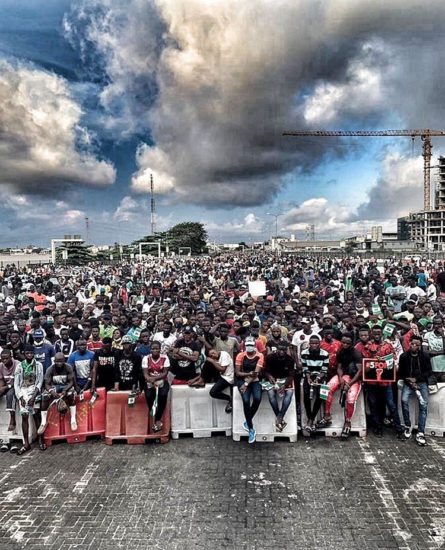
KAMISIYOCHUKWU Perpetual, an eye-witness at the Lekki tollgate where protesters were shot, has disclosed that she saw soldiers carrying no fewer than seven human bodies hit by bullets and dumped them in a waiting van.

Kamsiyochukwu, who was a petitioner before the Lagos State Panel of Judicial Inquiry on police brutality, also said she and two other protesters saw another dead body with a bullet-torn head at Reddington Hospital at Lekki the following morning when they went to collect the data of injured protesters.

And before she left the hospital, dead and injured bodies were still being brought in.  But when she returned to the hospital in the evening the same day, she was told by a nurse at the hospital that the casualties have been evacuated from the hospital to an undisclosed location based on an order from above.

“I saw soldiers picking at least seven dead, limp bodies hit by bullets into their vans,” she said.

“We also requested to see the dead protesters who were brought in. The doctors refused us access to see the dead bodies. The media man intervened again and we could only see one of the dead bodies whose head was torn by a bullet. He laid at the emergency unit. The doctor called the corpse ‘John Doe’.

“While at Reddington Hospital, dead and injured bodies were still being brought in. By evening when I returned to Reddington Hospital, one of the nurses informed me that the dead and the injured had been transferred from Reddington Hospital to an unknown hospital based on orders from above.

She told the panel that she and her colleagues have the names of the injured bodies and that of the dead body.

“We have the record of the names of 22 injured persons and one of the dead persons we were allowed to see.”

She gave their names as Abiola Esther, RFK, Lekan Williams, Felix Nandip, Adams Moses, Akinyele Damilola, Samuela Iordyom, Emmanuel John, Isaac Amede, and Charles Uzoma.

Others are; Raymond Simon Abah, Samuel Anthony, Andrew Ugochuckwu, Bobby Maduka, Moses Oyi, Emmanuel George, Nelson Andrew, Sheriff Akande, Chigozie Chukwujekwu, Damilola Adedayo, and 12-year-old Bakare Michael.

Lying military

When the media reported about the shooting at Lekki tollgate which happened on October 20, the Nigerian military feigned ignorance and denied the allegation, saying its men were not involved.

In subsequent press releases, Osoba Olaniyi, the Acting Deputy Director, 81 Division Army Public Relations, admitted that soldiers were deployed to Lekki but were only there to carry a request of the state government to enforce an earlier curfew imposed by the state government.

He however denied that the soldiers did not shoot any civilian and that there is glaring and convincing evidence to attest to this fact. He maintained that the allegations of shootings are the “handiwork of mischief-makers who will stop at nothing to tarnish the image of the Nigerian Army.”

In a bid to further discredit the media reports on the Lekki incident, John Enenche, the coordinator, Defence Media Operations, citing some military analysts, told newsmen in Abuja that videos of the incident circulating around the social media were fake or photoshops.

However, on Saturday, during his appearance before the Lagos State Judicial Panel of Enquiry, Ahmed Taiwo, Commander of the 81 Military Intelligence Brigade, said soldiers deployed to the scene did not shoot the protesters with live bullets but fired blank bullets into the air.

While explaining that the blank bullets used could not have caused any damage to the flesh, Taiwo said if real bullets were indeed fired, one bullet had the potency to kill three persons.

Inflation hits new record of 14.23 percent in October, highest in 32 months

By Isah Abdul-Azeez


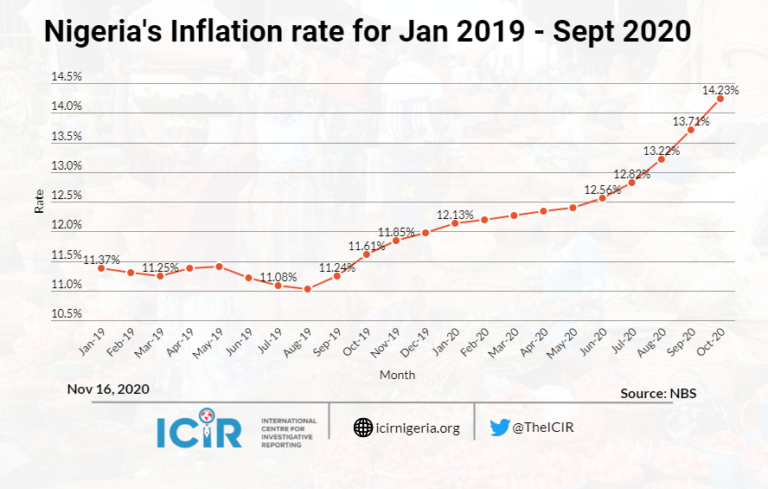
NIGERIA’s inflation rate for October 2020 hits a new record of 14.23 percent since its steady increase in 32 months, data from the National Bureau of Statistics (NBS) revealed on Monday.

The Consumer Price Index (CPI) data released by the NBS measures the average change over time in the prices of goods and services consumed by people for day-to-day living.

The new inflation rate is about 0.52 percent points higher than the rate recorded in September 2020 (13.71) percent.

In September, inflation had hit an all-time high of 13.71 percent for 31 months, according to the previous CPI report by NBS.

In the latest report, the urban inflation rate increased by 14.81 percent (year-on-year) in October 2020 from 14.31 percent recorded in September 2020, while the rural inflation rate increased by 13.68 percent in October 2020 from 13.14 percent in September 2020.

The urban inflation rate increased by 14.81 percent in October 2020 from 14.31 percent recorded in September 2020, while the rural inflation rate increased by 13.68 percent in October 2020 when compared to the 13.14 percent rate in September 2020.

On a month-on-month basis, the urban index rose by 1.60 percent in October 2020, up by 0.04 from 1.56 percent recorded in September 2020, while the rural index also rose by 1.48 percent in October 2020, up by 0.08 from the rate recorded in September 2020 (1.40 percent)

Food inflation

The composite food index rose by 17.38 percent in October 2020 compared to 16.66 percent in September 2020.

This rise in the food index was caused by increases in prices of Bread and cereals, Potatoes, yam, and other tubers, Meat, Fish, Fruits, vegetables, alcoholic and food beverages, and Oils and Fats.

On a month-on-month basis, the food sub-index increased by 1.96 percent in October 2020, up by 0.08 percent points from 1.88 percent recorded in September 2020.

Core inflation

The Core inflation or ”All items less farm produce”, which excludes the prices of volatile agricultural produce stood at 11.14 percent in October 2020, up by 0.56 percent when compared with 10.58 percent recorded in September 2020.

On a month-on-month basis, the core sub-index increased by 1.25 percent in October 2020. This was up by 0.31 percent when compared with 0.94 percent recorded in September 2020.

The highest increases were recorded in prices of passenger transport by air, hospital and medical services, passenger transport by road, pharmaceutical products, motor cars, vehicle spare parts, maintenance and repair of personal transport equipment. Others are hairdressing salons and personal grooming establishments, miscellaneous services relating to the dwelling, paramedical services and shoes and other footwear.

State profiles for food inflation

In October 2020, food inflation on a year on year basis was highest in Edo (21.65 percent), Zamfara-20.88 percent and Kogi-20.5 percent, while Lagos-14.57 percent, Ogun-14.47 percent, and Ondo 14.23-percent recorded the slowest rise.

On a month-on-month basis, October 2020 food inflation was highest in Kwara-3.88 percent, Edo-3.81 percent and Sokoto-3.65 percent, while Oyo-0.57 percent and Jigawa-0.54 percent and Taraba-0.29 percent recorded the slowest rise on month-on-month inflation.


Government agencies block access to information, frustrate open governance

SOME agencies of government are frustrating Nigerians’ access to public information by denying requests made under the Freedom for Information Act (FOIA), 2011.

The Act not only requires agencies of government to make proactive disclosures of public information but also to provide access to citizens whenever they request for them within seven days.

However, several agencies of the federal and some state governments have blocked access to important public information to the International Centre for Investigative Reporting (ICIR), thus frustrating a key project meant to promote accountability in procurement processes, the Open Contract Reporting, OCR Project.

This project brings together over a hundred journalists in newsrooms across the country to scrutinise government contracts.

However, none of the FOIA requests sent to government agencies have received even an acknowledgment, let alone a response.

These agencies are the Niger Delta Development Commission (NDDC), National Primary Health Care Development Agency (NPHCDA), Ecological Fund Office (EFO), Association of Local Governments of Nigeria (ALGON), Federal Road Safety Corps (FRSC), Federal Ministry of Finance, Budget and National Planning and the Federal Ministry of Works and Housing.

Between August and October, The ICIR has filed 11 different FOIA requests to these agencies with no response from any of them.

The purpose of the request was to obtain procurement details of contracts approved by these agencies.

On August 18, The ICIR had requested that the NPHCDA should provide details of capital releases on the construction of primary health care centres (PHCs) in the FCT between 2016 and 2020.

It is over two months since filing this request but the newspaper is yet to either get a letter acknowledging the receipt of the request or the actual response to the request.

Again, on September 10, The ICIR filed another FOI request to the NPHCDA for the details of contractors who had gotten the contract to renovate existing primary health centres and construct new primary health centres in Anambra state. Of the several requests sent to the NPHCDA, this particular request was only responded to on November 11, a month after the request was made.

Section 4 of the FOI Act provides that public institutions shall within seven days of receiving applications make the information available to the applicant. The ICIR is yet to get any response from the agency despite sending a reminder of the earlier application to the agency on September 21.

On October 2 and October 5, The ICIR requested for the details of contracts and contractors approved for road construction/rehabilitation in Edo and Abia states respectively,  NDDC also is yet to respond.

On October 7, an FOIA request was also sent to the Ecological Funds Office, EFO, requesting for details of its funded projects in South Eastern Nigeria between 2015 and 2020. More than a month after the filing, the request is still pending as the EFO has refused to respond.

Another FOIA request was submitted to the NPHCDA on October 14 to produce details of primary healthcare projects in Kunchi and Lamba areas of Kano state, but the NPHCDA, a serial defaulter, has refused to respond to the request.

October 28, The ICIR sent another FOIA request to the Association of Local Governments of Nigeria, ALGON, to provide details of primary healthcare projects in Kunchi area of Kano state.

Further, The ICIR sent requests to the FRSC, Federal Ministry of Finance, Budget and National Planning, and the Federal Ministry of Works and Housing.

Only the FRSC has sent an acknowledgment copy confirming the receipt of the request, while others are have not responded as of the time fillingthis repor for publication.

In compliance with the FOI Act, most of these agencies are notorious for denying the public information at their disposal. The FOIA compliance ranking carried out by the Public and Private Development Centre (PPDC), Right To Know (R2K), International Centre for Investigative  Reporting (ICIR), Media Rights  Agenda (MRA),  Basic  Rights Watch (BRW) and Budgit also confirm this.

In the latest 2020 FOIA compliance ranking, the NPHCDA ranked 200th, one of the worst offenders. In 2019, the agency ranked 29th out of 141. In 2018, the agency came last as it ranked 82nd and in 2017, it ranked 52nd with no proactive disclosure of information. For the Ecological Fund Office, it ranked 71st in 2020 and came last in 2019, 2018, and 2017 rankings.

What the FOI Act says

Nigeria’s access to information law was signed to law in 2011 by former President Goodluck Jonathan and, since then, all requests for information received by a public institution.

Sections 1 and 2 of the FOIA establish the right of any person to apply for information or records in the possession of a public institution. Generally, these rights are:

  • The right to access or request any information or record that is in the custody or possession of any public institution or private bodies providing public services, performing public functions or utilising public funds.
  • The right to be told whether the information or record exists.
  • The right to have the requested information or record released if the information or record is in the custody or possession of a public institution.
  • The right not to demonstrate any specific interest or purpose in the requested information or record.
  • The right to receive information that public institutions are obliged to proactively disclose under the Act.
  • The right to take legal action in Court to compel any public institution to comply with the provisions of the Act, including discharging their proactive disclosure obligations under the Act.

Section 29 of the FOI Act obligates every public institution must submit its annual report on or before February 1 of each year to the AGF on all applications of FOI request they received.


FG to sell Geregu, Omotosho, Calabar power plants for N434 billion in 2021

0

THE Federal Government, FG has concluded plans to sell Geregu, Omotosho and Calabar power plants for N434 billion in 2021, according to a report.

The arrangements by the FG were contained in a document submitted by the Bureau of Public Enterprises, BPE to the Senate during the 2021 budget defence in Abuja.

According to the breakdown, Geregu power plant, which was constructed at the cost $10 billion, would be sold at N140.7 billion, Omotosho Power Plant will go for N151.4 billion and Calabar will be sold for N143.4 billion respectively.

The FG explained in the document that the proceeds from the three power plants will be paid to the Niger Delta Power Holding Company (NDPHC).

Other assets considered for concession include the National Stadium, Lagos, Moshood Abiola Stadium, Abuja, Jos International Stadium and Adokiye Amiesimaka Stadium in Port Harcourt valued at N100 million next year.

Also, the government will in 2021, a concession the National Art Theatre, Tafawa Balewa Square and all the River Basin Development Authorities to the tune of N836 million.

The breakdown further showed that the National Art Theatre will be concessioned for N200 million, Tafawa Balewa Square will be concessioned for N436 million and all the River Basin Development Authorities will go for N200 million.

While the BPE has been summoned to appear before the Senate Committee on  Privatization and Commercialisation chaired by Senator Theodore Orji, Peoples Democratic Party, PDP, Abia Central to shed light on its revenue projection in 2021, which consists of sales of Power Plants and concession of government-owned properties.

The Committee has also demanded an investigation into the sale of some of the FG’s shares in the Afam and Geregu Power plants to ensure that the country is not short-changed in the transaction.

Falana asks judges, magistrates to visit detention facilities

0

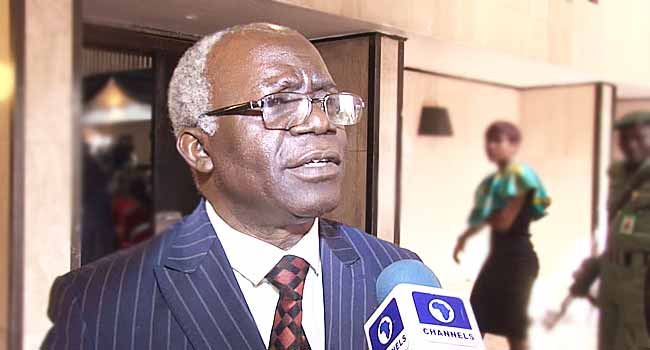
8, a human rights lawyer on Sunday urged judges and chief magistrates to obey the law by visiting detention facilities regularly in a bid to decongest the facilities.

He revealed this in a statement titled, “Special Appeal to Judges and Chief Magistrates to Conduct Monthly Inspection of All Police Stations and Other Detention Facilities in Nigeria,”.

Referring to section 34 of the Administration of Criminal Justice Act, 2015 which requires Chief Judges of the Federal High Court, Federal Capital Territory High Court and State High Courts to assign judges and chief magistrates to conduct monthly visitation and inspection of all police stations and other detention facilities in all the states of the federation and the FCT.

The senior advocate said the directive of the National Judicial Council, is not adhered \by many judicial authorities hence, the incessant arrest, detention, and torture of citizens by the police and other security agencies.

“However, the newly enacted Nigeria Police Act, 2020 has imposed a duty on all chief magistrates and judges to conduct monthly visitation and inspection of all police stations and other detention facilities within their territorial jurisdiction other than correctional centres.

“Section 70 (1) also says the Chief Magistrate, or where there is no chief magistrate within the police division, any magistrate designated by the Chief Judge for that purpose, shall at least every month, conduct an inspection of police stations or other places of detention within his territorial jurisdiction other than the prison,” a section of the statement read.

According to Falana, the law holds that during a visit, the magistrate may call for and inspect, the record of arrests, direct the arraignment of the suspect and where bail has been refused, grant bail to any suspect, where appropriate, if the offence for which the suspect is held is within the jurisdiction of the magistrate.

He said it is left for the judiciary to activate and implement the provisions of the law in order to end the incessant arrest and prolonged detention of the Nigerian people without any further delay.

“We are of the strong view that if all detention facilities in the country are henceforth regularly inspected by judges and chief magistrates as stipulated by the law, the people of Nigeria will no longer be subjected to illegal arrest and detention by the police and other security agencies.

“In particular, there will be no basis for #EndSARS and any similar campaign either now or in future. We are therefore compelled to call on judges and chief magistrates to carry out their duties under section 70 of the Police Act,” he said.

Falana called on civil rights organisations as well as the Nigerian Bar Association to assign their accredited representatives to accompany the judges and chief magistrates during the monthly inspection of detention facilities.

How Zamfara gold mining resurrected clamour for resource control by oil producing states

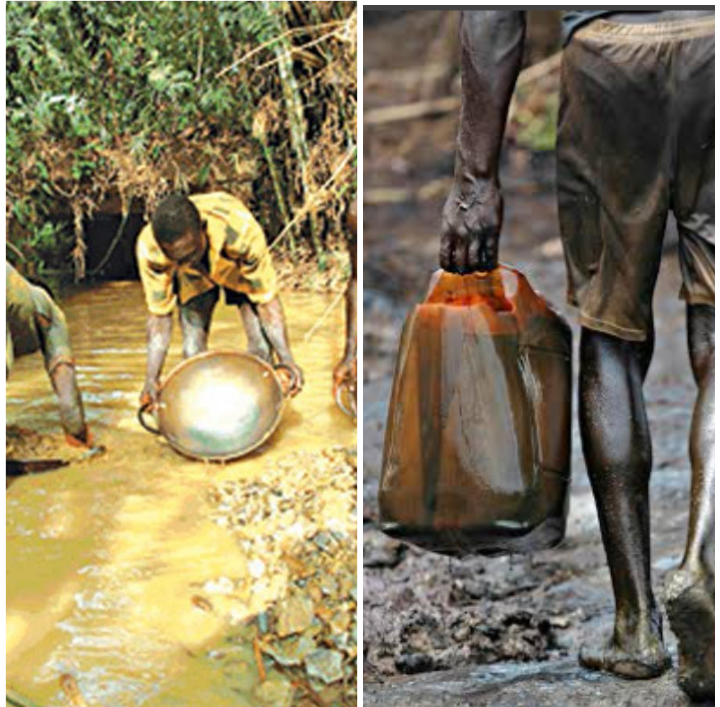
THE Presidential Artisanal Gold Mining Development Initiative (PAGMI) was conceived by the Federal Government as a means of transforming the country’s abundant, largely untapped gold deposits into a major source of revenue for the country.

But controversy surrounding the establishment of a gold reserve by the Zamfara State government, and reports of the purchase of gold from the state by the Central Bank of Nigeria under the PAGMI arrangement, has resurrected the age-long clamour for resource control by oil producing states of the Niger Delta.

PAGMI is a comprehensive artisanal and small-scale gold mining development programme, launched in 2019 to foster the formalisation and integration of artisanal, or illegal, gold mining activities into Nigeria’s legal, economic, and institutional framework. It w‎as ‎designed as a broader strategy to address the structural and institutional factors such as rural poverty, lack of alternative livelihoods, and difficulties in meeting legal and regulatory requirements that tend to push artisanal gold mining operators deeper into the informal economy.‎

‎The provision of access to markets for the artisanal miners through a National Gold Purchase Program and the deployment of enhanced mining methods at artisanal and small-scale mining sites are to serve as ‎catalysts for the planned integration.

‎In line with the National Gold Purchase Program, the ‎Central Bank of Nigeria will be purchasing gold that has been mined, processed and refined under the Presidential Artisanal Gold Mining Development Initiative for use as part of Nigeria’s external reserves.‎

Offering more insight on PAGMI, the Federal Ministry of Information and Culture, on its website, explained, “‎PAGMI will deploy safer and more efficient mining and processing technologies across artisanal mining locations across the country, starting with Kebbi and Osun States as the Pilot States with intervention in Kaduna, Zamfara and Niger States to commence immediately after the Pilot.

“Using a Centralised Off-take and Supply System supported by a Decentralised Aggregation and Production Network, PAGMI will buy all the gold produced by artisanal and small-scale miners and aggregated by licensed buying centers and aggregators for supply to the Central Bank of Nigeria.”

A major feature of PAGMI, the biometric data capture and enrolment exercise for artisanal miners, kicked-off in Yauri Local Government Area of Kebbi State in February.

However, controversy is trailing the implementation of PAGMI after the announcement by the Zamfara State government that it had established a gold reserve was followed by reports that the CBN is to purchase N5 billion worth of gold from the state government.

‎Under the PAGMI arrangement, the CBN had, earlier in July 2020, paid the sum of N268m for 12.5kg of locally mined gold bars.

Also, in August, 2020, Zamfara State governor, Dr. Bello Matawalle, visited the Presidential Villa, Abuja, to present gold bars mined in the state to President Muhammadu Buhari.

‎Then, in October 2020, Matawalle announced, at a press briefing in Gusau, that Zamfara has established a ‘gold reserve’ with gold that was, reportedly, entirely mined and refined by artisanal miners in the state. The gold reserve, the first of its kind in Nigeria, was launched with 31kg of processed gold that is to be deposited in a bank.

The governor explained that the establishment of the gold reserve would boost the economy of the state.

“My administration will subsequently continue to buy gold from our local miners so as to gradually improve the reserve. ‎Even though our state, like other states of the Federation, is grappling with competing demands from the public, the resources at our disposal are meagre. We feel it is of utmost significance to invest in the future of our people.

“The establishment of the gold reserve, therefore, is part of the relentless efforts by my administration to diversify the state’s economy by exploring all potentials of the state, and maximally utilising them for the benefit of the present and future generations,” Matawalle said.

Going by the PAGMI arrangement, it is expected that the CBN will purchase gold from the ‘gold reserve’ of the Zamfara State government.

The Federal Government had banned mining activities in Zamfara after illegal mining by artisanal miners was linked to the banditry in the state. But Zamfara State Commissioner for Finance, Rabiu Garba, while shedding further light on the ‘gold reserve’, noted that “When the ban is lifted and mining activities resume fully, we (Zamfara State government) are hopeful that we will be receiving royalties from miners while the Federal Government will also be giving us something”.

Governor Bello Matawalle of Zamfara State and President Muhammadu Buhari at the State House, Abuja.

However, the entire arrangement, which appeared to have given Zamfara State ‎the powers to control the gold resources in its territory, has become a cause for concern among the oil producing states of the Niger Delta, whose oil and gas resources have been the mainstay of the Nigerian economy for years.

Wondering why the PAGMI programme would allow Zamfara to control its gold deposits while the oil in the Niger Delta is shared by the entire nation, leaders of the oil producing states were quick to point out that the situation concerning Zamfara gold was unconstitutional, as it violated provisions of the Nigerian Minerals and Mining Act, 2007.

The Nigerian Minerals and Mining Act, 2007, stated that “All mineral resources in, under or upon any land in Nigeria, its contiguous continental shelf and all rivers, streams and watercourses throughout Nigeria, any area covered by its territorial waters or constituency and the Exclusive Economic Zone is and shall be vested in the Government of the Federation for and on behalf of the people of Nigeria”.

Also, mining and mineral resources, just as oil, was listed in the Exclusive List, under the exclusive control of the Federal Government, in the 1999 Constitution.

The Niger Delta region is crying foul over the PAGMI arrangement which appeared to have given Zamfara State control of gold deposits in its territory.

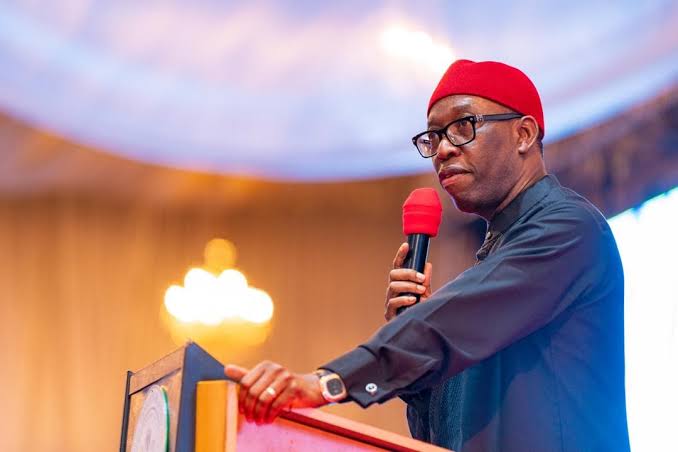
Addressing journalists in Asaba on November 11, Delta State governor, Ifeanyi Okowa, stressed that no law in the country gave Zamfara State the powers to manage and control gold deposits in its territory.

Delta State governor, Ifeanyi Okowa

Insisting that the establishment of the gold reserve by Zamfara State was illegal, Okowa warned that if the matter was not addressed, governors of the South-South‎ states would follow suit by assuming control of oil and gas resources in their states.

Resource control‎ will be top on the agenda of a meeting of South-South political leaders, include governors, ministers, lawmakers and other stakeholders, which is to hold in Port Harcourt, according to Okowa.

The Delta State governor observed that the actions taken by Zamfara State suggests that the country’s laws are being applied in a discriminatory manner, with Zamfara’s gold being for the state why the oil in the Niger Delta belongs to the entire country. ‎

Okowa said, “South-South governors have been talking about the need for restructuring and need for resource co‎ntrol. Obviously we are on that because we feel there is the need to restructure not only the country, but the management of resources. ‎

“As at today, there are Acts in the National Assembly that guide the issue of oil production and with the solid minerals, those are not covered in these Acts and this is already a sore point in our nation’s governance system and we hope to express this very strongly during the meeting taking place in Port Harcourt.

“We cannot apply laws in our nation to the point that it becomes discriminatory because if people are allowed to process for their solid minerals, others should also be allowed to do same for their oil. So we are going to be very hard and make our voice as strong as possible during the meeting. I believe that these discriminatory tendencies will have to be revisited in our na‎tion at some point in time.”

Earlier, in October, two youth groups in the Niger Delta – South-South Youth Assembly and Young Democratic Movement – had issued an ultimatum to the Federal Government, demanding that the proceeds from the gold bought by the CBN from the Zamfara State government should be shared among all the states, as is the case with oil and gas.

The groups, while addressing journalists in Uyo, Akwa Ibom State, insisted that the gold found in any state belongs to the Federal Government. “The revenue generated from such mineral resources ‎like gold is to be shared among all the 36 states and the Federal Capital Territory,” they said.

“The (Zamfara) state governor‎ has no such audacity to sell the gold bars to the apex bank worth close to about N5bn. In the Niger Delta states we don’t sell oil. We are surprised that a governor of a state should be selling gold bars from Zamfara State to the CBN. Let it be known that whatever revenue that ought to come from that transaction belongs to the entire country and not the state government,” the Niger Delta youths said.

The Niger Delta youth groups warned that the action of the Zamfara State government, if not addressed, could jeopardise ‘the relative peace in the region and the achievement of 1.86 million barrels per day in oil production’.

The Niger Delta youths also demanded an upwards review of the 13 percent derivation from the Federation Account for oil and other minerals producing ‎states, stressing that failing to do that, “the Federal Government must allow the Niger Delta to directly sell her oil just as the recent case of Zamfara gold”.

In addition to the issues raised by the oil producing Niger Delta states, a lawyer, Silas Onu, had petitioned the CBN to point out the illegality of the purported purchase of N5 billion worth of gold from the Zamfara State government by the apex bank.

In the petition, Onu described the transaction as “the highest insult on the sensitivities of Nigerians”, adding that “The Zamfara State government has no gold to sell, the gold is for the Federal Government, and CBN is not permitted by its enabling Act to engage in the business of buying solely commercial goods”. Citing section 1(4) of the CBN Act, 2007, the lawyer said the law that permits the apex bank to acquire, hold and dispose of movable and immovable property does not extend to engaging in a business venture such as the purchase of gold.

Onu also stressed that management and control of gold deposits in Zamfara by the state government was contrary to the provisions of the Nigerian Minerals and Mining Act, 2007.

Reacting to the controversy trailing the establishment of the gold reserves by the Zamfara State government, the Ministry of Mines and Steel Development said the state government should ‘get their narrative right to the public’ and desist from giving the impression that the gold in its territory belongs to the state.

Minister of Mines and Steel Development, Olamilekan Adegbite, who said he discussed the matter with the Zamfara State government, said, “We have what we call private mineral buying centres, we issue licences; in fact, anybody that is interested should come to us and once you meet the criteria, we give you a licence to purchase the mineral and that is the angle the Zamfara government is exploiting.

“From their own fund, they are buying gold from their people and I spoke with the governor, you need to explain these to the people properly. It is not as if they are cornering the resources that belong to the Federal Government. All mineral resources in the country is vested in the Federal Government and that is in the exclusive list and that stays. And the right royalty should be paid to the Federal Government.

“People feel that some parts of the nation are cornering the wealth of the nation. Everybody has partaken in the lunch of the Niger Delta, we have taken from the oil and gas and it has been used to develop this country and the mineral wealth of this country will also be used collectively to develop this country and not exclusively by one region.”

On its part, the Zamfara State government said there was no trade deal on gold between it and the CBN. The state government also explained that it does not directly mine the gold for itself, but purchases the commodity from Federal Government-registered mining companies in the state. But the explanation appeared to contradict initial reports that the gold in the state’s reserve was purchased from artisanal miners.

“The state government is not directly mining the gold for itself. It will rather purchase the gold from the Federal Government-registered mining companies in the state,” Zailani Baffa, spokesman to Zamfara State governor, said in a statement.

However, for Onu, the lawyer that petitioned the CBN over the ‘gold deal’, the explanations given by the Zamfara State government and the Ministry of Solid Minerals Development hold no water.

Speaking with The ICIR on Saturday, November 14, Onu said he would go to court over the matter. ‎

He said, “There has not been any response from the CBN to the petition. I am thinking of sending them a reminder before I do any other thing. I am thinking of taking the matter to court because the action of the Zamfara State government is in breach of the 1999 Constitution and the Nigerian Minerals and Mining Act, 2007. I want to get a declaration from the court that the action taken by the state and the CBN is illegal. A state cannot be dealing with solid minerals as if it belongs to them and the CBN is encouraging that. The money (for the purchase of the gold) is apparently going into the coffers of the state government.”

Picking holes in the explanations given by the Zamfara State government and the Ministry of Mines and Steel Development, Onu added, “What they claim is that the artisanal miners will mine this gold locally and the state government will buy the gold from them so as to prevent bandits from getting hold of the gold, then the CBN will buy it from the state government. This will totally remove any role or presence of the Federal Government in the whole process. So how does the Federal Government now benefit from the gold that is in Zamfara State? This therefore means that it is only the artisanal miners and the Zamfara State government that will benefit. They tried to give explanations but to me it did not fly.”

The lawyer stressed that what is good for a gold producing state like Zamfara in the North should also be good for the oil‎ producing states in the South.

Onu said, “They are allowing artisanal miners, which is another word for illegal miners, to mine gold in Zamfara State. Are they also going to approve exploration of oil by illegal oil bunkerers in the South? What is good for the North should also be good for the South.”‎

Meanwhile, issues surrounding the mining of gold in Zamfara would be the focus of a meeting of six governors of the South-South region, under the aegis of the Forum of South-South Governors, in Port Harcourt, Rivers State, Monday November 16.

Bakare warns against clampdown on #ENDSARS campaigners by government

0

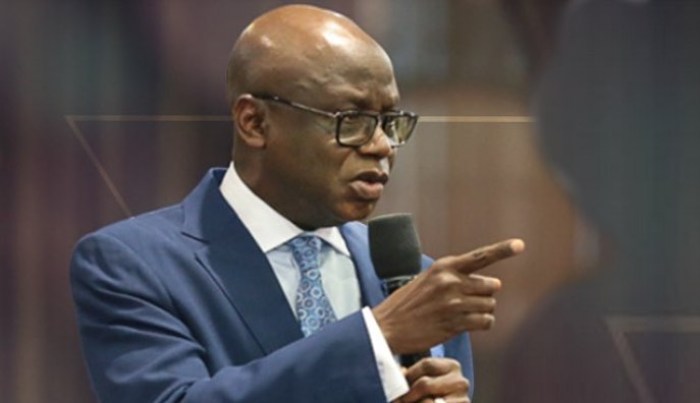
TUNDE Bakare, the founder of the Citadel Global Community Church which was formerly known as Latter Rain Assembly, has warned against recent moves by agents of the federal government to clampdown on campaigners of the just concluded #ENDSARS protest in the country.

According to Punch, the cleric who gave the warning during the church’s Sunday service in Lagos, called on the government to ensure its plans and policies are well thought out before they are implemented to forestall the occurrence of another civil disobedience in the country.

While condemning the recent action of the Central Bank of Nigeria (CBN) in freezing bank accounts owned by some of the protesters through a court order, Bakare said the laws of the nation should not be employed to repress citizens who were merely exercising their constitutional rights to protest against the inactions of government.

“This season of our national life requires deep humility, sobriety, and deliberate thinking through, both by the government and the governed, to ensure that our plans, policies, and actions are weighed before they are implemented to avert the re-occurrence of our most recent crisis,” he said.

“Some of the actions recently taken by the government on the heels of the #EndSARS protests may need to be reversed sooner rather than later in our collective best interest so that they do not trigger further protests.

“Among such policy actions is the freezing of the accounts of young Nigerians who reportedly sponsored the protests. While I admit that, under our extant laws, banks may freeze an account upon an ex parte order granted to a law enforcement agency by a court of competent jurisdiction for the purpose of an investigation, these provisions of our Law should not be used to intimidate Nigerian youth simply because they engaged in and promoted protests against the inactions of government.

“Targeting and arresting citizens on trumped-up charges, deploying court probes as a tool of intimidation, and generally eroding our fragile peace, are deeply worrisome signs of regression.”

He noted that to extend the olive branch to the youths in one breath, and to deprive the youths of the right to freedom of movement and property as enshrined in the constitution in another breath, will send confusing signals and cast doubts in their minds regarding the sincerity of the government.

He, therefore, called for “the immediate reversal of these actions, therefore, will calm raw nerves and fast-track peace in our land. And if there are serious or fundamental security breaches that necessitated the freezing of bank accounts and the confiscation of a passport, these should be made known. In the absence of any security breaches, citizens’ rights should never be trampled upon.”

Garba Shehu, the Senior Special Assistant on Media and Publicity to the President, had said in a recent television appearance on Channels television that those who allowed the recent #EndSARS protests to degenerate into riots and violence leading to the destruction of properties in the country and loss of lives must be made to account for their actions.

He also asked politicians in the opposition party who endorsed and supported the protest should publicly denounce the violence that erupted the protest.

ICIR-funded report, others emerge winner at WAMECA 2020 Awards

AN investigative report commissioned by the International Centre for Investigative Reporting, ICIR, has emerged winner at the 2020 West Africa Media Excellence Awards (WAMECA), held on Saturday in Accra, Ghana.

The award, “Social Media, Fake News and Elections in Africa” recognises exceptional reporters in the diverse field of journalism and celebrates and promotes media excellence in West Africa.

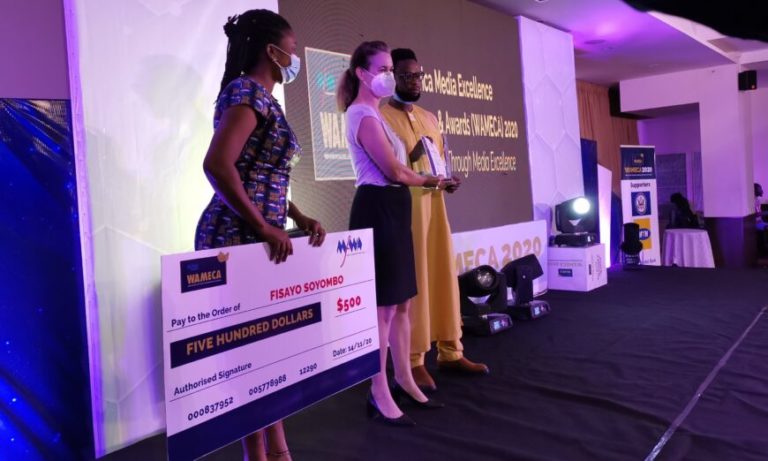
Kelechukwu Iruoma, a freelance journalist, won the overall best reporting in Business and SMEs reporting for his investigation on How Thugs Rule in Rivers Markets, Force Multiple Illegal Taxes on Petty Traders which was funded and published by The ICIR.

Iruoma’s report exposed how thugs forced traders in various markets across Rivers State to pay multiple illegal taxes and how this affected their businesses.

His investigation showed that, in most markets in Rivers State, traders usually create space on the main road to sell their goods because shops and stalls provided by the government inside the markets are too pricey.

Other winners from Nigeria include former editor of The ICIR,  Fisayo Soyombo who won best reporter for investigative reporting, Innocent Duru and Olatunji Ololade of The Nation Newspaper won best reporter on Telecommunications and ICTs and Environmental Reporting Category respectively.

Funke Busari of Premium Times was the winner in the Human Rights category.


NAS condemns clampdown on #EndSARS protesters by govt, calls on CBN to unfreeze bank accounts

0

THE National Association of Seadogs, Pyrates Confraternity, has called on the Nigerian government to halt its attempts to muzzle #EndSARS protesters, who have been demanding for an end to police brutality and bad governance in the country.

In a statement signed by Abiola Owoaje, the national president of the Seadogs, the group called on the Central Bank of Nigeria to unfreeze the bank accounts of champion of the #EndSARS movement, urging the government to deal in good faith and stop stifling the citizens for speaking against ills in the country.

In the past weeks, the government, through key agencies including the CBN and the Nigeria Immigration Service (NIS) have clampdown on citizens who actively participated in the #EndSARS protests that carried on for 12 consecutive days.

In its most recent attack, the CBN illegally restricted the bank accounts of 20 champion of the protests, violating extant regulatory procedure to do so. After breaking the law, the CBN sought a court order to freeze the bank account, portraying the protesters as terrorists to the court.

In another instance, Modupe Odele, one of the lawyers who organised legal aid for the protesters had her international passport seized by the Nigerian Immigration Service (NIS) while she tried leaving the country for the Maldives.

NAS also expressed worry over the looming famine that might overtake the country, given the hike in food and fuel prices, while the nation still gapples with the effect of the COVID-19 pandemic.

“At a time when the economy of Nigeria is tottering, food prices beyond the reach of the masses and famine looms over the country, in part due to the unrestrained attacks on farmers by terrorists and bandits, the Central Bank Governor found it more salient to approach the Court to freeze the accounts of peaceful protesters,” the statement read in part.

Condemning the actions of the government against protesters, the Pyrates Confraternity highlighted three demand necessary to ensure the progress of the country.

“We call on principal officers of different government institutions to resist being party to the harassment and intimidation of innocent Nigerians.

“We call on the Federal Government to direct its agencies and institutions to stop forthwith the harassment of partakers in the #EndSARS protests.

“Flowing from the above, we also call on the CBN to immediately unfreeze the accounts of the #EndSARS supporters,” the demands itemized in the statement reads.

The National Association of Seadogs, popularly known as Pyrates Confraternity is a confraternity organisation in Nigeria founded in 1952 by the “Magnificent Seven” to support for human rights and social justice in Nigeria.