Home Blog Page 1979

Reps back down, move to regazette controversial Water Resources Bill

0

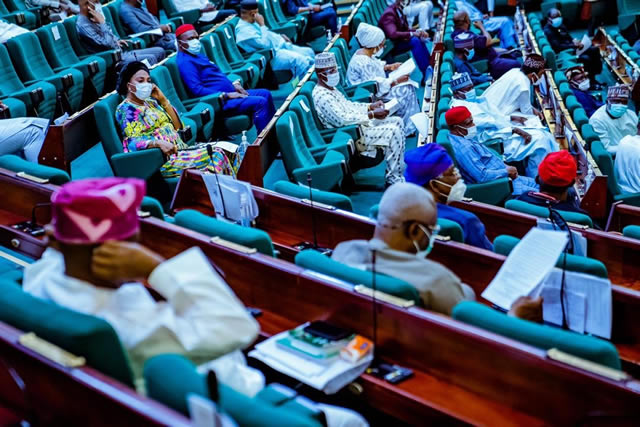
 THE House of Representatives on Tuesday backed down further legislative action on the passage of the controversial Water Resources Bill.

The lawmakers after a motion moved by Benjamin Mzondu (Benue/PDP), unanimously resolved that the Bill should be regazetted for fresh consideration in line with the House Rules.

Mzondu in his motion complained that his privilege as contained in the House rules was breached as he was denied the opportunity to make inputs to the bill because the legislation wasn’t gazetted and copies distributed to House members in line with normal House rules and procedures.

He alleged that the House rules were breached in the consideration and passage of the bill which was recommitted and reconsidered by the House on July 23.

According tohim, when the Bill was considered by the House, he was denied the opportunity of contributing to its debate because the bill wasn’t gazetted and distributed to House members as required by Orders 12, 16, 17, and 18 of the House rules.

” I wish to refer to Order 6, Rule 1(1), 2 and 3 and Order 12, Rule 18 to state that I was deprived of my legislative privilege of sighting gazetted copy of the National Water Resources BillHB 921, and such could not participate in the consideration of the report by the Committee of the Whole, which also deprived me of my rights and privilege of representation to my people.

“Mr. Speaker, Hon. Colleagues, it is in the effort to eliminate the “Element of Surprise”, that the House in its wisdom, included in its Standing Rule, that every Bill, must be gazetted or clean copies circulated. It is important to note that the word emphasized here, is “gazette”, which means appearing in the Bills Journal of the House.

“The words used are clear and unambiguous, they ought to be given their ordinary meaning, as stated.

“Mr. Speaker, Hon. Colleagues, I was misled by the use of order 12, Rule 18 of our Standing Orders. Mr. Speaker, Hon. Colleagues, it is an issue of law and procedure, and Hon. Speaker, the onus of interpretation, lies with you. Where the Bill was labeled as Bill 2020, it was not considered as such.

“The laws lay, on your shoulder to interpret these rules as stated in Order 7 Rule 1(7). It is important to emphasize that I have painstakingly searched through all the journals of the House, and cannot find where the Bill is gazetted and I stand to be challenged or corrected.

“The next question for your consideration, Hon. Speaker, deals with jurisdiction, whether the House such powers to entertain a bill, such proceedings become a nullity, ab initio no matter how conducted and decided”.

“So having not met this condition, I wish to move, relying on Order8 Rule 8 and the above-stated rules, that “The House do rescind/expunge its decision of 23rd July 2020, which adopted the National Water Resources Bill, 2020 HB921 to have been read the Third time from our records,” he stated.

The Speaker, Femi Gbajabiamila in his ruling on Mzondu’s point of order, directed that the Bill be regazetted and reintroduced for consideration and passage or otherwise of the bill since it failed normal House legislative procedures.

Gbajabiamila stated that fundamental issues have been raised regarding the manner in which the Bill was passed, declaring that ordinarily “a matter of privilege is not debated, but l allowed contributions by members because of the importance of the matter.”
ICPC responds to Farouq, Humanitarian Minister, says N2.7b diverted school feeding fund not under her ministry

0

THE Independent Corrupt Practices and Other Related Offences Commission (ICPC) has responded to request by Sadiya Umar Farouq, Minister of Humanitarian Affairs, Disaster Management and Social Development to clarify the statement attributed to Bolaji Owasanoye, its Chairman that a total of N2.7 billion school feeding fund was diverted into private accounts.

The Commission in a statement Tuesday evening stated that the school feeding being referred to by the ICPC chairman was the feeding of boarding students in Federal Government Colleges also known as Unity Schools, who were all at home during the COVID-19 lockdown.

“The Commission wishes to clarify that the “school feeding” referred to by the Chairman of ICPC was the feeding of boarding students in Federal Government Colleges, who were all at home during the COVID-19 lockdown,” the statement on the official website of the Commission read.

“This is not the Home-Grown School Feeding Programme being managed by the Federal Ministry of Humanitarian Affairs, Disaster Management and Social Development,” the ICPC added.

According to the statement, Owasanoye had stated that the discovered payments were made to some federal colleges but ended up in personal accounts.

‘’We discovered payments to some federal colleges (secondary schools) for school feeding in the sum of N2.67b during the lockdown when the children were not in school, and some of the money ended up in personal accounts. We have commenced investigations into these findings,’’ the Commission quoted the Chairman’s speech earlier made on Monday.

The anti-graft commission said it issued the statement for the purpose of clarifying the statement of the Chairman and to advise the general public to disregard the said reports suggesting a reference to the school feeding programme going on in primary schools under the Ministry of Humanitarian Affairs.

Following reports on Monday quoting the ICPC Chairman as saying that his commission discovered how money meant for school feeding went into private accounts, Sadiya Farouk, the Minister of Humanitarian Affairs and Disaster Management asked the ICPC to name the Federal Colleges and individual involved insisting that such did not take place under her Ministry.

She had also maintained that Owasanoye was misquoted, citing mischief in the reportage of what the ICPC chairman said at the 2nd National Summit on Diminishing Corruption presided over by President Muhammadu Buhari, at the Council Chambers of the Presidential Villa, Abuja.


P & ID: CBN confirms receipt of $200m deposit to Nigeria after UK court ordered release

0

A commercial court in London has ordered the release of $200 million to the Nigerian Government as a deposit in the case against Process & Industrial Development (P&ID).

Godwin Emefiele, Governor of Central Bank of Nigeria (CBN) who confirmed the development on Tuesday, said the ruling followed the establishment of prima facie fraud against P&ID before the court.

“We are also pleased that the Court has rejected P&ID’s application to increase the guarantee, which was clearly intended to be a diversionary tactic and entirely misconceived,” Emefiele said.

He stated that the release which is accumulated into the reserves would further enhance the nation’s management of the exchange rate of its domestic currency, the Naira while ensuring monetary and price stability.

“This is a further and significant victory for Nigeria in our ongoing fight to overturn the US$10 billion award procured through fraud and corruption by P&ID and former government officials.”

The legal battle between the Nigerian Government and P&ID over the failed 2010 gas supply deal to develop a gas-processing plant is coming to a halt.

Nigeria had requested a stay on any asset seizures by the court while the legal challenge was being awaited, but Nigeria was ordered to pay $200 million to the court within 60 days to ensure the stay of judgement.

“P&ID and its backers, Lismore Capital and VR Advisory, are increasingly seeing their case slip between their fingers. They continue to resort to employing delay tactics, disseminating misleading claims, and taking every step to obstruct our investigations across multiple jurisdictions,” Emefiele said.

The court also rejected P&ID’s application to increase the guarantee.

Court jails man, 25 for illegal possession of Indian hemp, illicit drugs

0

A Kano Magistrates’ Court on Tuesday sentenced a 25-year-old man, Bashir Ibrahim to seven-month imprisonment over illegal possession of Indian hemp and other illicit drugs.

The convict who is a resident of  Fagge Quarters in Kano metropolis was convicted after he pleaded guilty to being in possession of 29 tablets of Diazepam and dried leaves suspected to be Indian hemp.

Mubarak Mukhtar, the Prosecution Counsel, told the court that the convict committed the offence on September 23 at about 6:20 pm at Kwari Market, Kano.

According to Mukhtar, the convict was arrested by a team of policemen attached to Fagge Police Division Kano, while on patrol at Yan-Tebura Mall, Kwari Market Kano.

“The convict was found in possession of hard drugs suspected to be Indian hemp, 29 Diazepam tablets and 17 wraps of dried leaves,” Mukhtar told the court.

He stated that the offence contravenes section 403 of the Penal Code of the Federal Republic of Nigeria.

Following his plead, Farouk Ibrahim, the Magistrate of the  court sentenced him to seven months in incarceration with no option of fine.

However, the judge ruled that Ibrahim has 30 days to appeal the judgment in a competent court of law.

Court dismisses El-Zakzaky’s no-case application, orders continuation of trial

0

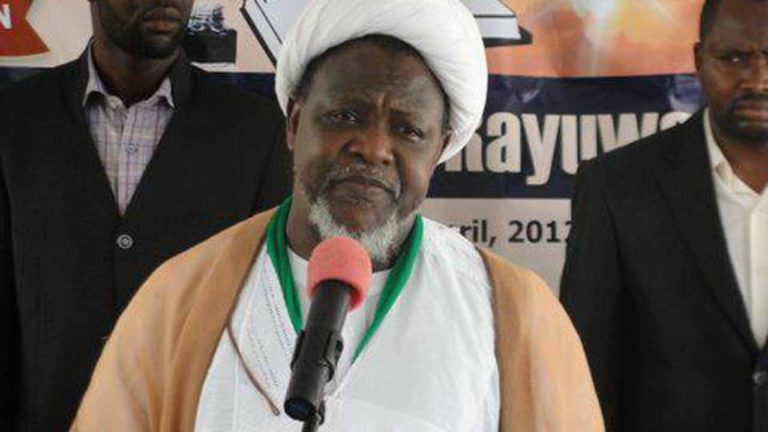
THE Kaduna State High Court on Tuesday dismissed a no-case-submission application filed by Ibrahim El-Zakzaky, the detained leader of the Islamic Movement in Nigeria (IMN), also known as ‘Shi’ite’,  and his wife, Zeenat.

The IMN leader pleaded not guilty to the charge levelled against him before the High Court in Kaduna.

The presiding judge, Justice Gideon Kurada had on August 7, scheduled October 29, for a final presentation of evidence on the matter after counsel to the defendants, Abubakar Marshall asked that the charges be dropped against the IMN leader.

El-Zakzaky and his wife, Zeenat, had been detained by the Nigerian Government since December 2015 after the Nigerian Army clashed with the IMN members in Zaria which claimed the lives of several the IMN members.

They are being prosecuted by the Kaduna State Government on eight counts of culpable homicide, unlawful assembly, and disruption of the public peace, among other allegations.

On August 7, the defendants through their lawyer, Marshall Abubakar who represented Femi Falana, the lead counsel, asked the court to quash the case against them.

Abubakar submitted that the Kaduna State Government has failed to “disclose an offence known to law contrary to Section 36 (8) and (12) of the 1999 constitution as amended” against his clients.

At the hearing on Tuesday, the prosecution counsel, Dari Bayero, adopted his final arguments in the matter.

Justice  Kurada, dismissed the no-case submission, remarking that it was premature to rule on the application to quash the charges against the defendants.

He stated that the ruling was in view of the clear provisions of the Kaduna State Administration of Criminal Justice.

According to him, such an application should be ruled on after the defendants might have taken their plea and after hearing on the whole matter has been concluded.

The case was adjourned till November 18 and 19, 2020 for the prosecuting counsel to present his evidence before the court and continuation of the trial.

Buhari commissions 326 km Itakpe-Ajaokuta-Warri rail line

0

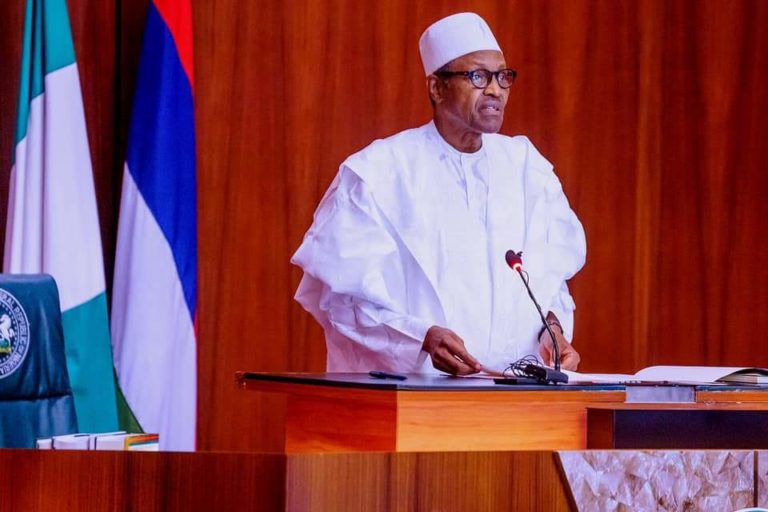
PRESIDENT Muhammadu Buhari on Tuesday commissioned the 326 KM Itakpe-Ajaokuta-Warri rail line.

The President also commissioned the ancillary facilities yard, at the recently named Goodluck Jonathan Railway Complex in Agbor (Owa-Oyibu), Delta State.

While performing the commissioning ceremony which was done virtually at the State House, Buhari directed the Federal Ministry of Transportation to link all the nation’s ports of origin and destination – Apapa, Tin Can, Warri, Onne, Calabar Ports- to the Itakpe to Warri rail network in order to significantly improve overall transportation and economic capacities.

He stated that his administration recognised the importance of the railway mode of transportation as a vital backbone to support industrialisation and economic development.

”Accordingly, I have approved the prioritisation of viable railway routes for either new rail lines or the reconstruction and rehabilitation of some, to achieve effective and efficient train services supporting the country’s trade and commerce,” the President said.

”The Railway Infrastructure that I have the honour to commission today is the rail line from Itakpe via the steel town complex of Ajaokuta to Warri, and is an important link for the country’s economy as the central rail line.

”This Government has also approved to link this line further from Itakpe to Abuja, thereby, connecting the Northern Zone of the country and also extending southwards to link the Warri Ports,” he added.

The President expressed confidence that the project, which serves as a vital link of South-South geopolitical zones of the country to the Northern zones, would be completed during the tenure of this administration.

”It will link people across the cultural divides and expand the frontier of trade and commerce, which will lead to better standards of living for our citizens,” he said.

President Buhari recalled that to further give recognition to Nigerian sons and daughters who have distinguished themselves at nation-building and development, 11 railway stations and railway village were named after some deserving citizens.

He listed them as follows:  Adamu Attah Station, Itakpe;  Abubakar Olusola Saraki Station, Ajaokuta; Augustus Aikhomu Station, Itogbo; George Innih Station, Agenebode; Anthony Enahoro Station, Uromi; Tom Ikimi Station, Ekehen and Samuel Ogbemudia Station, Igbanke.

Others are Goodluck Jonathan Railway Complex, Agbor, Owa-Oyibu; David Ejoor Station, Abraka; Michael Ibru Station, Opara; Alfred Rewane Station, Ujevwu; and Michael Akhigbe Railway Village, Agbor

The President enjoined all Nigerians in the transportation industry, especially the railway sub-sector, to continue to support the Government in its stride to achieve other railway infrastructure projects.

He also enlisted the support of all at realizing this milestone of a functional and full-fledged central railway, after more than 30 years during which the project has suffered several setbacks and false starts.

”I implore those who work on this line to uphold maintenance and safety culture necessary for long-lasting service in this difficult terrain.

”By the same token, I urge other sectors who will be primary beneficiaries of this transportation backbone, including, the iron and steel sector, stakeholders in agricultural and mining sectors on this corridor, as well as the host communities to protect and sustain this infrastructure and maximize the benefits that could be derived from it and which is readily available at their doorsteps.

”This project will increase the volume of their trade and kickstart and resuscitate the iron and steel complexes.

”All these, I hope will improve our industrial potentials and capacities as well as boost employment,’’ he said.

President Buhari said projections indicate that the commencement of operation of the Itakpe-Ajaokuta-Warri Rail line will account for close to one million passengers annually and also unleash approximately 3.5 million tonnes capacity of freight annually that will service all off-takers on the corridor and beyond.

Congratulating  Rotimi Chibuike Amaechi, the Minister of Transportation, and his team on successfully completing the project, the President recognized the host communities on this corridor for their patience during the long wait of over 30 years for the realization of the project.

While assuring Nigerians that his administration would continue, within available resources, to judiciously connect commercial and industrial hubs to boost trade, generate wealth and create employment, he also commended the host communities for their cooperation during the completion of works by the Federal Government.

In his remarks, Ifeanyi Okowa, Governor of Delta State commended President Buhari’s bi-partisan approach to governance, saying ‘‘it is a thing of pride and joy that this rail line was completed under your watch.’’ 

”Deltans are excited that this day has come,’’ he said, adding that the Ika nation is glad of the recognition accorded former President Goodluck Jonathan, in naming the railway complex in Agbor after him.

Okowa urged the private sector to take advantage of the historic corridor by establishing investments that will create jobs for locals, curb youth restiveness and stem the tide of criminality.

”It is imperative that the Federal Government in collaboration with the States provide adequate security cover for this rail line corridor,” he said.

Speaking during the event, Godwin Obaseki, Governor of Edo State, congratulated the President on the feat of completing the project, saying it was quite fortuitous that few days to the country’s 60th independence celebration,  the President has achieved the completion of this critical infrastructure.  

”For us in Edo State, we are excited that we have a few stops that have been completed and we are going to be working with you to utilise this infrastructure,” Obaseki said. 

He appealed to the minister of transportation to extend the rail line to the industrial park in Benin City to facilitate the movement of goods to the northern part of the country.

While speaking, Rotimi Amaechi, Minister of Transportatiob said the project was fully funded by the Nigerian government, adding that eight of the 10 stations are in the Niger-Delta/ South South region of the country.

”There is no loan on this project, it was funded from the budget and I had the directive of the President to go and revive it and complete it as soon as possible,’’ he said. 

According to the Transportation Minister, the project started under the military era in 1987 but ‘‘underwent protracted hiccups, prolonged abandonment and massive vandalisation,’’ before it was resuscitated by the Buhari administration.

Ogun Govt to set up special court for sexual-related offences

0

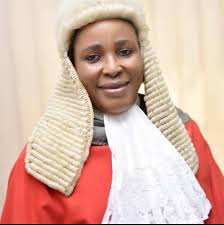
OGUN State Government is set to establish a special court to handle cases of sexual and gender-based violence (SGBV), Mosunmola Dipeolu, chief judge of the state has disclosed.

The court, which will be the first of its kind in the state, is to handle cases of rape, defilement, and other forms of sexual offences.

According to a Premium Times report, Dipeolu revealed this at the conferment of merit award on the most outstanding judicial staff, as part of activities marking the 2020/2021 Legal Year celebration, at the Judiciary Complex, Kobape, Abeokuta, the Ogun State capital.

The chief judge also said that the establishment of the special court would aid to fast-track SGBV cases in order to avoid delay of judgement.

“More judges shall be appointed to man these courts. We appeal for further cooperation and support from the government in this regard,” Dipeolu said.

This is coming weeks after Ogun State Police, Sango division, apprehended a private school teacher identified as Mathew Adebayo for reportedly raping a 15-year-old female student, sitting for the West African Senior School Certificate Examination.

On the orders of Edward Ajogun, Ogun State Commissioner of Police, Adebayo would be transferred to the anti-human trafficking and child labour unit of the State Criminal Investigation and Intelligence Department for further investigation and prosecution.

On Monday, the Federal High Court in Abuja on Monday ordered Elisha Abbo, a senator representing Adamawa North Senatorial District in the National Assembly to pay N50 million to Osimibibra Warmate, a lady he assaulted at an adult toy shop in May 2019.

The judgment was delivered by Justice Samira Bature in the case file with reference number – Suit No. FCT/CV/2393/19 – Osimibibra Warmate v Senator Elisha Abbo. Justice Bature also ordered him to tender a public apology.

Lagos carpets BudgIT over ‘misrepresentations’ in 2020 State of the States report

0

LAGOS State government has carpeted a civic advocacy group, BudgIT, for ‘incorrectly’ listing it among states whose revenue was not enough to fund their recurrent expenditure.

BudgIT’s recently released 2020 State of States report‎ had included Lagos among 13 states that are not fiscally sustainable and lacked the revenue capacity to fund their recurrent revenue in 2019.

The 13 states were Lagos, Oyo, Kogi, Osun, Ekiti, Plateau, Adamawa, Bauchi, Gombe, Cross River, Benue, Taraba and Abia.

However, although BudgIT had since reportedly apologised for ‘misrepresentations’ in its report, which led to the inclusion of Lagos in the list, the state government issued a statement where it appeared to reprimand the civic advocacy group over the development.

In a statement by Rabiu Olowo, the Commissioner for Finance, Lagos State Government noted that going by its financial statements, BudgIT should have correctly reported that the state recorded a surplus of N89 billion not a deficit of N39 billion.

“Lagos State continues to meet all its recurrent and loan service obligations and the information that was published is incorrect, inaccurate and a gross distortion of the actual facts,” Olowo said.

“As indicated in Lagos State’s published Financial Statements, the information in the table published by BudgIT should have correctly indicated a surplus of N89 billion not a deficit of N39 billion.”

He added that the State Government continues to explore options in both the financial and capital markets, to extract optimal funding solutions, which will enhance the administration’s ability to deliver on the construction, renewal, and improvement of the deficit in social and physical infrastructure for the benefit of Lagosians; who represent 10 per cent of Nigeria’s population.

Olowo further clarified that in the year under review (2019), Lagos restructured all existing internal loan facilities to 14 per cent per annum, from between 18 per cent and 20 per cent per annum, noting that these rates have even more recently been re-negotiated to 12 per cent per annum.

“Lagos is the only state that is not reliant on the allocation from Federal Account Allocation Committee, with Internally Generated Revenues representing 72 per cent of the state’s aggregate revenues to enable it to address challenges faced by megacities world over.

“As of August 2020, Lagos Internal Revenue Service is doing 103 per cent above budget, and well above 2019 figures, despite the COVID-19 pandemic,” parts of the statement issued by the Commissioner for Finance said.

In an earlier statement which retracted details of the State of the States Report, 2020, BudgIT, through Damilola Ogundipe, its  Media and Communication Lead, said it never declared any state insolvent, even though the report said some states’ revenue was not enough to meet recurrent expenditure, such as salaries, overhead and debt service obligations.

In an effort to clarify the report, BudgIT noted that the 2020 State of States report is a snapshot of the fiscal health of all 36 States and the Fiscal Sustainability Index uses four key metrics or stress tests to provide a fair overall fiscal sustainability ranking of the states.

The statement quoted Gabriel Okeowo, BudgIT’s Chief Executive Officer and Principal Lead as explaining that “no single metric, when isolated, provides a fair assessment of any state and none of the tests used evaluates states’ fiscal status for insolvency”.

Further clarifying its report on Lagos, the statement said, “For instance, Lagos State has its total recurrent expenditure and ‘accelerated’ loan repayment amounting to about N555bn; but this is not an indicator of insolvency as BudgIT’s 2020 methodology for calculating state’s total revenue only used net FAAC allocation for all 36 States and their Internally Generated Revenue (IGR) – sourced from National Bureau of Statistics –  which brought Lagos State’s total revenue to N516.62bn as opposed to N644bn if other sources of revenues were added.

“We believe that the fair approach was to stick with the net FAAC payments and IGR due to the disparate nature of the public finance framework among Nigerian states.

“Other revenues such as capital receipts, grants and investment income were not added due to their volatility.

“We believe that states must position their finances in a way that their recurrent expenditure can be serviced solely by their central and internal revenue sources which was the basis for one of our metrics.”

BudgIT went ahead to explain that the goal of the 2020 report was to encourage states to reduce their overhead costs and debt burdens while improving their IGR and capital expenditures.

The statement further quoted Okeowo as noting that many ‘forward thinking governors’ who ranked top 10 in the 2020 Fiscal Sustainability Ranking are already doing improving their IGR and capital expenditures.

He added that Rivers State improved the most in its IGR between 2018 and 2019 with a year-on-year growth of N27.62bn followed by Lagos and Kaduna states with IGR growths of N16.55bn and N15.51bn respectively.

BudgIT, in the statement, added that it has always cautioned states on the risk of exposure of exchange rate volatility inherent in foreign loans taken by their governments.

“We are also of the opinion that states should trim their overhead costs by applying rigorous efficiency measures – an instance in point – Bayelsa State with the smallest population in Nigeria mounting up recurrent spend and loan repayment obligations of N147.16bn, well above what Kano State incurs given its large population,” it added.

However, BudgIT added that, notwithstanding the issues that warranted the clarification, from the 2020 State of States analysis, it believes that a high number of all 36 states show varying degrees of distress.

“BudgIT is committed to working with all state governments and other stakeholders in identifying early warning signs that compromise the fiscal sustainability of Nigeria’s subnational economies through our annual State of States Fiscal Sustainability Ranking,” it added.


Police arrest 43 youths over attack on station, immigration post in Katsina

0

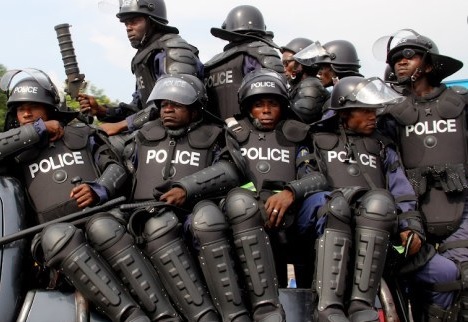
ABOUT 43 youths have been arrested by the Police in Katsina, following a reported protest which resulted in the destruction of a police post, patrol vehicles and blockage of road linking the Jibia- Katsina highway on Monday.

Isah Gambo, the Police Public Relations officer (PPRO) of the Katsina Command who confirmed the arrests to The ICIR, said contrary to reports of protest, the youths from Daddara village in Jibia Local Government Area of the state were rioting and burnt the Police and Immigration posts in the border town.

“They were rioting, they burnt down our police station; many vehicles including our patrol vehicles and an armoury where we stored our arms and ammunitions were burnt down to ashes,” Gambo said.

In response, the state  Commissioner of Police deployed a combined team of Police Mobile Force (PMF) and conventional units to contain the situation and make arrests.

According to Gambo, during the course of the riot, many police officers were injured and four were taken to the hospital.

He further disclosed that their investigations showed that some smugglers were behind the attack because of their illegal activities.

“Investigation is ongoing and those who sponsored the riot, we are going after them,” Gambo told The ICIR. 

He further said that a semblance of normalcy has been restored in the area but the investigation is still being carried out to determine the origin of the attack.

It could be recalled that in June, hundreds of youth across Katsina Stateconverged on Katsina town to protest the killings and wanton destruction by gunmen in their respective localities.

In response, President Muhammadu Buhari warned that the waves of protest in Katsina State against rising insecurity in the state can distract the military operations mounted to flush out bandits terrorising the state.

“President Buhari admonishes that taking to the streets for protest could distract the military operations, urging” Katsina indigenes not to give up on the military who over the years have a strong track record of quelling crises once given enough time,” Buhari had said.

NNPC would not be scrapped but commercialised says Sylva, Petroleum Minister

0

TIMIPRE Sylva, Nigeria’s Minister of State for Petroleum says the new draft of the Petroleum Industry Bill (PIB) sent to the National Assembly would not scrap the Nigerian National Petroleum Corporation (NNPC) rather, the corporation would be commercialised.

Sylva said this when answering questions from journalists at the National Assembly after an interactive session with the leadership of the National Assembly.

“We have heard so much noise about NNPC being scrapped but that is not being envisaged by the bill at all, NNPC will not be scrapped but commercialised in line with deregulation move being made across all the streams in the sector comprising of upstream, downstream and midstream,” the Minister stated.

According to him, the new PIB would create competition in the petroleum sector while it would also be beneficial to the host communities.

He added that the industry would be transformed and the Petroleum Equalisation Fund (PEF) and the Petroleum Products Pricing Regulatory Agency (PPPRA) would not exist in the same form that they currently exist.

Sylva stated that the only new thing in the bill is the development of the pipeline sector for the midstream industry that would manage pipelines.

“We have said that NNPC will be commercialised. “But if you are talking about transforming the industry, the only new thing that we are introducing is the development of the midstream, that is the pipeline sector.

“So we have provided robustly for the growth of the midstream sector but I don’t want to go into the details of the bill until it is read on the floor of the Senate,” he noted.