Home Blog Page 2055

Independence is at the heart of the African Development Bank’s ability to be effective

By Kalu Ojah, University of the Witwatersrand

INDEPENDENCE is a cardinal pillar for organisations that are set up to deliver a public good. Their success depends on it.

This is particularly true of development banks such as African Development Bank, AfDB and Inter-American Development Bank. Independence is even more important in these instances because these institutions are owned by – and are meant to cater for – numerous regional member states.

In my view their ability to deliver on the objective of assisting member states attain economic growth and sustainable development is inexorably dependent on their independence. By this I mean their capacity to focus productively on their goals and missions without external sway.

There are two aspects to this independence. The first is objective independence. This talks to how the institution is set up, who has shares in it and the like. Regional development banks typically get shareholder contributions of capital (which determines country shareholdings). They then go to capital markets to borrow multiples of their capital base (money from shareholders). Objective independence depends on shareholder contributions.

The second aspect of independence is implicit independence. This talks to the ability of the bank to borrow from capital markets. The reputation of the bank is key to its ability to mobilise capital to pursue bold development plans.

The AfDB is one of four main regional banks of the world. The other three are the Asia Development Bank, Inter-American Development Bank and European Bank for Construction and Development.

Objective indepedence

Objective independence is conventionally reflected in the distribution of capital contribution (ownership share subscription) of member states. This speaks to voting rights and associated board of governors’ and directors’ compositions.

This aspect of the bank independence gives details of the governance architecture around decision making and the day-to-day running of the bank. The bank president and board of directors – appointed by a board of governors – are mandated to implement decisions and run the daily affairs of the bank.

It is in this aspect of bank independence that non-regional member states are typically invited to foster transparency of governance, inject diversity, and enrich board decisions with global best practice. These are often governments or organisations invited from developed, well-performing or geographically representative countries.
Screen Shot at AM.

All four of the world’s biggest regional development banks have explored the benefit of non-regional member states.

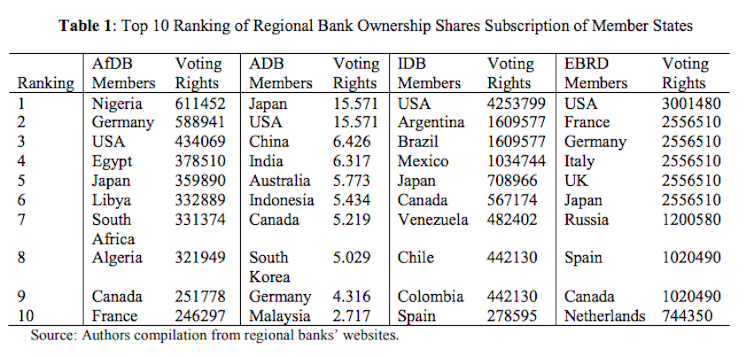
But the AfDB falls short on this score. This is because non-regional members dominate the top capital contributors of the bank’s capital base. This “league table” ranking typically reflects the voting rights accorded member states. And unlike the other regional banks, three of the top five capital contributors in AfDB are non-African states. And 50% or more of the top 10 contributors are also non-African states.

One, therefore, has to ask where are Kenya, Ghana, Morocco, Ethiopia, Cote-d’Ivoire, Tunisia, Senegal, Angola – and others – in response to the vital imperative of ensuring their regional bank’s independence? This list is of countries that could be, but are not, among the top capital contributors to AfDB’s ownership and capital base.

These kinds of skewed voting rights put a dangerously destabilising power in the hands of a non-regional member who at any time may get the itch for autocracy. This was demonstrated recently when the US brashly attempted to veto a corporate governance guided decision of the bank’s board, mainly by virtue of its relative voting right.

This kind of possibility clearly compromises the independence of the bank.

Sensibly, this should have been anticipated. A carefully nuanced structuring of board powers should have been put in place, with checks against such a likelihood. Such a balancing act would also have endeavoured to imbue regional member states with some “power of insistence” on determining their collective goals and mission.

That said, regional member states’ contribution heft, still remains the best path to ensuring robustness of this aspect of bank independence.

Implicit independence

Implicit independence is reflected in the capacity (reputation) of the bank to mobilise substantial capital, usually in multiples of its capital base, for prosecuting grand development agendas of the region that need huge capital outlay.

Until recently, this had evidently not been explored by the African Development Bank.

This capacity is usually flagged by two factors. Firstly, conceiving and articulating a well-thought out development agenda. Secondly, the extent of the bonding role provided by non-regional developed country member states, whose capital markets or partnering development organisations may be sources of this primary capital raising.

The record on this source of bank independence has been significantly brightened under the current leadership of the bank headed by Dr Akinwunmi Adesina. Starting in 2018, the bank set itself the ambitious goal of mobilising substantial capital to support development projects of its regional member states.

The bank embarked on a host of roadshows, securing for the first time, commitments of between $30 billion – $60 billion.

This kind of substantial capital mobilisation is vital for the effectiveness of any development bank. Particularly, in light of the fledgling nature of Africa’s organised capital markets – with the exception of South Africa – it is an enormously important capacity for AfDB to build.

For instance, as Africa’s only premier development bank, AfDB was the first and only African development organisation to offer any meaningful support to regional member countries’ effort at managing the devastating consequences of Covid-19.

Under Adesina’s leadership, a coherent and clearly articulated (and encouragingly ambitious) continental development agenda has been set down. Under the rubric of “High Fives” it covers power, food, industrialisation, integration and improving the quality of life in and for Africa.

Vital role

The upside potentials of these projects are evidently great and promising.

But, for this promise to become a reality, the AfDB needs to be effective at its mission, via robust bank independence.

The bank’s leadership needs its hands strengthened by the cooperation and support of African countries. For a start, African countries must increase their ownership subscriptions in their only regional bank.The Conversation

Kalu Ojah, Professor of Finance & Deputy Head of School, Wits Business School, University of the Witwatersrand

This article is republished from The Conversation under a Creative Commons license. Read the original article.
Nigeria requests UK court to overturn $10b arbitration award over botched gas deal

NIGERIA is seeking more time to appeal the judgement by a United Kingdom Court in favour of Irish owned firm, Process and Industrial Developments Ltd, P & ID, to recover $9.6 billion worth of assets from the country for breaching a contractual agreement

According to Reuters, Nigeria  is hoping to persuade the court after applying to US courts in March requesting documents from 10 banks, including Citigroup Inc. and JPMorgan Chase & Co., in a move to prove its corruption allegations.

This is despite missing the 28-day appeal deadline.

Mark Howard, the lawyer representing Nigeria  had during the online English court hearing on Monday, said he had evidence of payments from companies related to P&ID to Vera Taiga, a lawyer for the Petroleum Ministry at the time 11 days before the deal was signed.

“It is very unusual in a fraud case to discover a single smoking gun, by its very nature, fraud is conducted in secret,” which makes it hard to detect and justifies an extension,” Howard was quoted as said.

Nigeria’s lawyers are seeking another hearing for the judge to decide whether misconduct has taken place and whether it justifies overturning the contract.

Evidence of P&ID’s “highly orchestrated scam” had only recently come to light, Abubakar Malami,  Nigeria’s Attorney-General and Minister of Justice affirmed in a statement.

The country’ legal team told the court they have discovered alleged bribes to government officials and their family members dating back to 2009.

“There is good reason to believe that ministers at the highest level were involved in a corrupt scheme to steal money from Nigeria,” Malami said in court filings submitted on March 24.

P&ID has said Nigeria was engaged in a “manufactured fraud investigation” that has denied its subjects due process, during the legal argument, its lawyers said the payments were legitimate and for medical expenses.

The engineering and project management company was awarded damages worth $6.6 billion in 2017 by the English Commercial Court sitting in London after a 2010 business deal failed.

The award has been accruing interest since 2013 and currently worth nearly $10 billion after another UK court upheld the arbitration award P&ID won in 2017.

The hearing is set to continue on Tuesday, and the judge’s ruling will determine if the government can continue its appeal and present its full case of alleged fraud in the English courts.

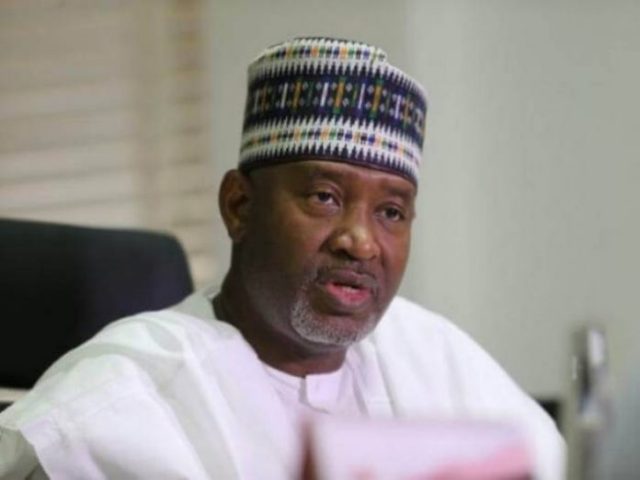
Passengers now to arrive airports one hour thirty minutes before flights- Sirika

HADI Sirika, Nigeria’s Aviation Minister has revealed that arrival time for  domestic air travelers to the airport has been reduced to one hour thirty minutes before departure.

The Minister disclosed this on his official Twitter page on Monday, stating that the decision was reached after a careful review of passengers facilitation at the various airports with his colleagues in the aviation sector.

“My colleagues and I have reviewed passenger facilitation at our airports, consequently I am happy to announce that, henceforth travelers are to arrive one hour and a half before their departure time for domestic flights. Travelers are advised to check in online, please,” Sirika said.

As part of the guidelines for resumption of flights operations in the country, domestic  air passengers were initially asked to arrive the airports three hours before departure time in order to observe the safety protocols  at the airports before boarding their flights.

International air passengers were given five hours period to arrive the airport once international flights resume.

However, the Minister said that the date for resumption of international flights will be announced in due course.

Speaking earlier  at the Presidential Task Force (PTF) on COVID-19 press briefing, Sirika said the Federal Government will not rush the restart of international flights in and out of Nigeria.

According to him, the PTF and relevant agencies in the aviation industry are still brainstorming on the best time to allow for resumption of international flights, adding that when the situation is right international flights will resume without further delay.

The ICIR reports that activities were yet to fully pick up at the Nnamdi Azikwe International Airport, Abuja following the re-opening of the airport on July 8 after about three months close down due to COVID-19 pandemic.

All government physical meetings to be conducted virtually until further notice – FG

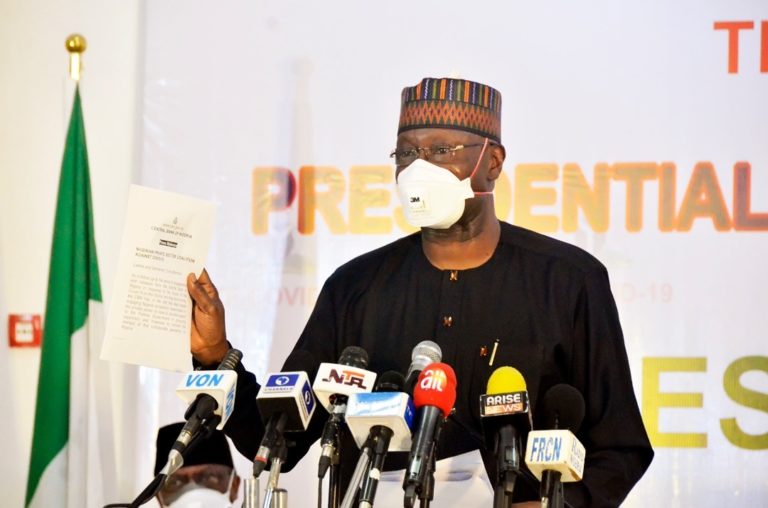
BOSS Mustapha, Secretary to the Government of the Federation and Chairman of the Presidential Task Force (PTF) on COVID-19 on Monday directed that all government physical meetings should henceforth be conducted virtually until further notice.

Mustapha who issued the directive during the daily press briefing of the PTF in Abuja, stated that the directive became necessary, following a mid-term Review of the National Response Strategy, which unfortunately revealed rising cases of the Coronavirus on daily basis, nationwide.

The SGF stated that all unnecessary physical meetings of government officials should be suspended most especially where participants exceed four persons.

“Government meetings/Board meetings should be conducted virtually until further notice, all unnecessary travels for meetings by government officials suspended till further notice,” he said.

“All government offices shall continue to hold virtual meetings in their offices especially where participants exceed four persons and suspend all unnecessary travels for meetings.”

He also warned corporate entities not to take undue advantage of resumption of flights to travel for physical meetings.

“For corporate organisations, board members, the reopening of the domestic flights should not be misconstrued. The PTF strongly encourages virtual meetings as well,” he added.

Mustapha reiterated government’s guidelines on religious and political gatherings stating that guidelines should be followed as there has not been a cure to the virus yet.

The PTF Chairman also urged persons above 60 years with underlying illness to stay at home and desist from public gatherings of any sort.

“Henceforth, anyone above 60 years or persons with morbidities (such as hypertension, diabetes, autoimmune disorders, cancers), should stay at home and avoid social events as they are at highest risk of infection and mortality,” he stated.

He revealed that Nigeria has received $ 8 million United States Dollar worth of Personal Protective Equipment from German Government and the ECOWAS Commission.

According to him,  President Muhammadu Buhari would provide warehouse space support with the logistics for delivering the materials to other ECOWAS member countries.

“The PTF would like to use this opportunity to thank the Government and people of the Federal Republic of Germany and the Economic Commission of West African States,” Mustapha said.

We could have deadlier pandemic if COVID-19 vaccines go to the highest bidders- Bill Gates

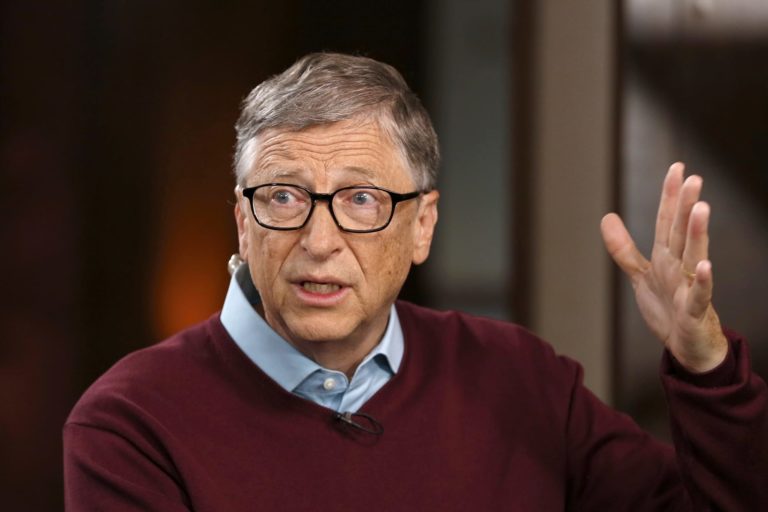
BILL Gates, co-founder of Gates and Melinda Foundation has warned that there could be more unjust deadlier pandemic if COVID-19 drugs and vaccines go to the highest bidders.

‘’If we just let drugs and vaccines go to highest bidders instead of the people and places where they are most needed, we will have a longer and more unjust deadlier pandemic,’’ said Gates in a video shared by the APF news.

The Microsoft founder however called on leaders to be tactical in the distribution of vaccines and pharmaceuticals that would be produced in the nearest future against the COVID-19 pandemic.

‘’We need leaders to make this hard decision about distributing based on equity not just on market driven factors,’’ he said.

In June, GILEAD Sciences Inc, drug maker of Remdesivir, touted as COVID-19 drugannounced that the United States, US, and other developed countries would pay a stipulated $2,340 for a short course treatment for a regular patient.

Its shortest treatment course which is expected to last for five days would cost $2,340 per patient equivalent of N906,750 in Nigeria.

The drug manufacturer anticipates that a longer treatment course for 14 days would cost $4,290 which is about N1,662,375, expecting to have more than one million treatment courses available by the end of the year.

Daniel O’Day, Chief Executive Officer (CEO) of Gilead Inc said the intention of the drug company was to enable governments to negotiate prices directly.

“The logic is that we wanted a single government price around the developed world. This medicine is priced far below the value it brings to health-care systems and that’s true for private payers and government payers,” he said.

However, the company did not indicate its charge for governments in less advanced countries like Nigeria for the drug which has won acclaim from health officials but is yet to gain final approval for commercial sale.


Celebrating Wole Soyinka at 86

By Kayode Fayemi


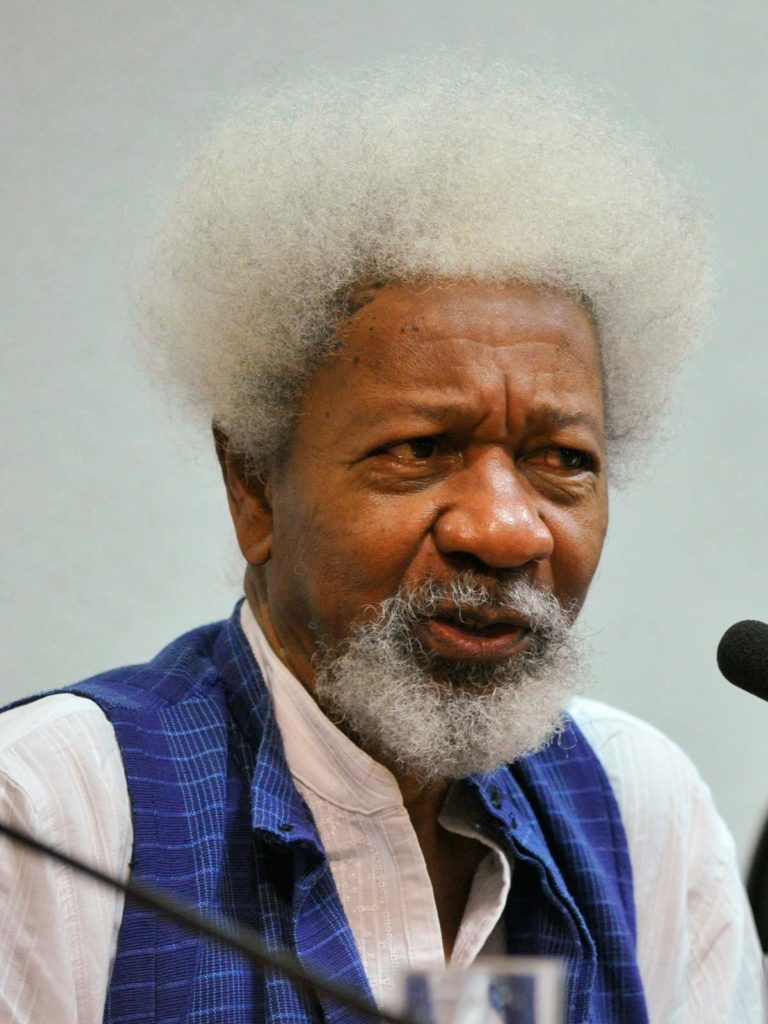
AFRICA’s most iconic literary maestro and one of the world’s most influential citizens is 86 today. With his ageless physique, it is almost difficult to acknowledge that our own Oluwole Akinwande Soyinka, affectionately called KONGI by his numerous admirers, is 86! Even though 86 might not be a remarkable milestone, it was in 1986 that the Nobel Prize came, hence the reason for this remarkable reckoning and why it’s worthy of celebration.

For me, WS is not the unfathomable mystery that many perceive from a distance and he is not the mythological pantheon that exists in the realm of the gods in the imagination of many. He is a mentor, a role model and a thought-leader with whom I have had the rare privilege of sharing a great moment of significant historic importance in my life.

Even though I had known Prof. Wole Soyinka since my days in Nigeria as a young man before I left for the UK, our path crossed in 1994 while I was living in the UK, shortly after the completion of my doctorate degree. My familiarity with WS however preceded our opportune encounter. My first interaction with him was in his memoir, The Man Died which I first struggled to grasp in 1975. While the motif of the book was a seductive topic of interest, the inscrutably elevated language and discursive point of view of the book made it a hard nut for me as a ten year old.

Since then, I have not only read all his other writings I have come across, I have gobbled them with obsessive enthusiasm. His writings and public advocacy for good governance, social justice, democracy and freedom had always made him a distant godfather and constant mentor whose association I had deeply coveted.

An opportunity happily came my way in 1994, when Prof. Soyinka who had become familiar with my work as a democracy activist in the UK through the New Nigeria Forum and its journal, Nigeria Now which I edited, and through my friendship with his son, Dr. Olaokun Soyinka, invited me to be part of the newly established National Liberation Council of Nigeria (NALICON) as Director of Communications.

Even though my initial attitude to the NALICON was mixed, I jumped at the rare opportunity to work closely with Africa’s only Nobel Laureate in literature. I had reasoned that his international reputation, connection and clout would greatly enhance our struggle for the return of democratic order in Nigeria. And I reasoned right!

As I indicated in my memoir of the exile years, “I came close to being labelled a passionate enthusiast and defender of the Soyinka mystique, especially having shared his worldview of the Nigerian struggle as one between authoritarianism and democracy, and not purely an ideological fixation between socialism and capitalism” (Fayemi, 2005:210). Throughout his living in exile in the 1990s, I worked closely with him on numerous projects – the most popular of which was the Radio Freedom and Radio Kudirat initiative.

There is no doubt that I have always shared an ecumenical ideology and kindred spirit with Kongi. His natural spur to resist oppression, instinctive spontaneity to defy authoritarianism and his impregnable commitment to civil liberty makes him my natural ideological mentor. In both the youthful and sagely Soyinka, has been a consistent resurgence against brutality and inordinate absolutism. As he often opines, “justice is the first condition of humanity”. His resentment against state terror and abuse of power burns like the inferno of the mythical hade.

For WS, humanity and its happiness are the tunnels through which he travels his mind in the visualisation of social problems. Anything that denies man his inalienable rights, is for Soyinka, an abhorrent act that must be condemned in the strongest terms. He is predictably obdurate and conscientiously unapologetic for his repetitive fidelity to the triumph of human freedom, primacy of his liberty and elevation of his essence as the sole creed that all gods must serve.

His temperament rejects every iota of practices that suborn human happiness. Even in his old age, he continues to prick the conscience of the nation with penetrating homilies that poke a revelatory finger in the nose of public decadence. WS is that bitter remedy that purges a poisoned belly of its troubling constipation. His corrective words are like the surgical knife that cuts out the malignance of a petulant lesion.

He is classical in all aspects of his artistry. For some and for his obscurantism, he is the African Homer; some others say he is the ultimate Aristophanes; some even think he is the rebirth of Socrates and not just for the accident of initials, WS is our own William Shakespeare and John Milton rolled together. He is the agglutination of literary reincarnation of the best that history can recall. He is WS and he is incomparable with any other.

Like his ancestral forebears, WS untiringly rages against the foibles of governmental chieftains and their foreboding delinquencies. He has spoken vehemently against the cowardice of intellectual ambiguity that continues to indulge veneer characters in public places. For him, no space must be yielded to the debauchers who gorge the nation’s wealth and fritter its assets in the realisation of their gluttonous hedonism.

Soyinka is impatient with the loud silence that punctuates clear cases that should strike a thunder of a mass anger. For him, until the obscurity of silence gives way to visibility of voices, any unexplained configuration about the existence of Nigeria will remain an empty indoctrination that serves the hypocritical cowardice of the nation’s power barons.

Soyinka is a patriot who has used his innate talent to serve humanity at every opportunity. His radical posture has come handy in dangerous times when only men of sterner stuff could stand. In 1967, he was imprisoned because of his audacious antagonism to the genocidal assault that the civil-war represented. Before then, he had intruded a radio station in Ibadan in 1965 to frustrate the broadcast of an electoral heist that was meant to entrench an unpopular government. The “Man” lives in Soyinka like the ageless Olumo Rock. His stout courage, broad repository and undeniable conviction radiates his writing in plays, fictions, poetry, essays and public interventions.

He uses the power of words to carry out corrective surgery and as a righting atonement for the transgressed.
When he chooses his object for critical scrutiny, he deploys the elegance of humour and the pettiness of satire to disrobe the social psychopaths wherever they might be.

Soyinka is spiritual but not religious, ideological but not bigoted; for, he could not submit his intellect to the whimsical machinations of another being. He acknowledges, as he found out through his teacher, Bonany Dombree, that all spirituality sprouts from the relationship between nature and man and that the quest to create a meaning for its inscrutable foundation gave expression to the concept of deity.

Thus, Soyinka’s spirituality is in the primacy of humanity and the pursuit of universal egalitarianism; this, I think, is the basis upon which his ideas of the ideal is anchored. No wonder he remains a respectable voice for human advancement in the global arena.

Even though Prof. has been an unsuccessful politician in the narrow manner success in politics is defined, his contribution to the political development of Nigeria is undeniable and inspiring. Apart from constantly being in the trenches for the enthronement of democracy and rule of law, he has floated a political party in the past to advocate a set of political ideas that he believed could provide an alternative answer.

More importantly, Soyinka has been one of the public moral giants who continue to point the nation to the path of rectitude in politics, constitutionalism, justice, equality and good governance. His life has been a watershed and a blessing in every aspect.

On behalf of my wife – Bisi who adores him, the Government and the good people of Ekiti State, this is wishing the iconic Nobel Laureate, an esteemed mentor and a humanist extraordinaire, a happy 86th birthday. Long live, Eniogun. Long live Prof!

Dr. Kayode Fayemi, CON
Governor, Ekiti State.
July 2020

Fire outbreak at $1b World Trade Centre building in Abuja

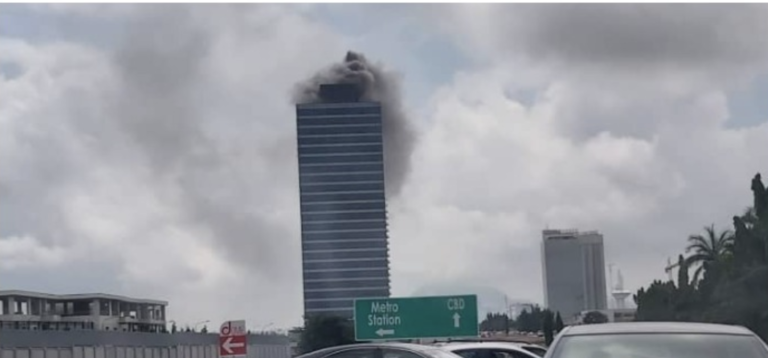
A section of the World Trade Centre in Abuja was on Monday morning gutted by fire.

Reports say the fire started during the early hours of the morning from the top of the skyscraper, emitting thick, dark smoke.

At the time of filing this report, the cause of the fire was not known. But, the Federal Fire Service in a tweet announced that its men were on ground to address the situation.

The $1 billion Abuja World Trade Centre with 37 storeys undertaken by the ChurchGate Group is expected to be the tallest building in Nigeria.

In 2011, Vinay Mahtani, Managing Director of ChurchGate Group, said the first phase of the project would be completed in June 2013.

Sitting on a  6.102 hectares of land in the Central Business District of Abuja, on the Constitution Avenue along the city’s main airport road, and adjacent to the main railway station, the multibillion naira project  is being executed through the Public Private Partnership (PPP) arrangement between First Continental Properties Limited, a subsidiary of the Churchgate Group and the Abuja Investments Company Limited, an agency under the Federal Capital Territory Administration.

According to Ibukun Adeogun, the Chief Marketing Manager of the construction group, “construction will be done in four phases.

“Phase 1 will comprise of a 22-floor Commercial Tower , a 22-floor service apartment tower and a 30,000-40,000 sqm Retail Mall. Phase II will be the twin WTC Towers (35 and 37 floors high). Phases III and IV will depend on demand.”

I slapped Akpabio, he tried to harass me, says Nunieh, ex-NDDC MD

JOY Nunieh, former acting Managing Director of the Niger Delta Development Commission (NDDC), on Monday, recalled how she slapped Godswill Akpabio, Minister of Niger Delta affairs, for sexually harassing her.

Speaking during an interview on Arise News Morning Show, Nunieh disclosed that the incident happened at the minister’s guest house in Apo, Abuja.

In a video clip of the interview, the former NDDC managing director stressed that she was the only woman that slapped the minister because he thought he could come upon her.

“Why did he not tell Nigerians that I slapped him in his guest house at Apo? I am the only woman that slapped Akpabio. He thought he could come up on me. He tried to harass me sexually,” Nunieh said.

“I slapped him. He tried to come on me. I am an Ogoni woman and nobody jokes with us. I showed Akpabio that Rivers women do not tolerate nonsense.”

She also accused Akpabio of trying to inflate the NDDC budget by instructing her to include some projects from the refugee commission in the budget of the NDDC.

“Akpabio wrote me to put a list of projects from the refugee commission in the budget of NDDC. Refugee commission is another federal government commission for IDPs,” she said.

“How do you tell me to put some of their projects in the NDDC budget when we have so many things to do in the Niger Delta? How do you explain that?”

Following the investigating on the alleged mismanagement of N40 billion by the Interim Management Committee (IMC) of the NDDC, Nunieh and Akpabio have made series allegations against each other sequel to the activities of the senate ad hoc panel.

Akpabio had previously told the panel that he had no knowledge about the expenditure of the NDDC under Nunieh because she refused to brief him.

But while refuting the allegations, Nunieh stated that the minister facilitated her removal for refusing to obey his illegal instructions.

“When we first came to the NDDC, on the day of going for the inauguration, he told me in the car that Madam MD, If you don’t do what I say, the same pen which I use to sign your letter, it will be the same pen I will use to remove you,” she had said.

Nunieh also alleged that Akpabio asked her to implicate Peter Nwaoboshi, chairman of the Senate Committee on NDDC, remove all directors who refused to follow his instructions, sack the head of the legal team who is from the north and also change the dollars in the NDDC account.


Group condemns forceful detention, forced labour of 126 workers for three months by employer in Kano

THE Nigerian wing of the International Lawyers Assisting Workers (ILAW) has condemned the forceful detention of 126 workers for three months by a rice mill company, Popular Farm in Kano State.

The ILAW made this known through a statement sent to The ICIR and signed by Benson Upah, the group’s Head of Information on Sunday.

According to the group, holding workers against their will, false imprisonment, forced labour, threats, and intimidation at the workplace, harassment, and starvation rations constitute not only unwholesome labour practices but also an infringement of individual’s right to liberty.

“The fact that these workers were held in an overcrowded facility/factory during the COVID-19 pandemic, contrary to Section 8 of the Factories Act, 1987 makes this act more reprehensible,” the group said.

“The conduct of the rice mill company is not only barbaric and nihilistic, but it also goes against the grain of Decent Work Agenda to which we all subscribe.”

It charged the Nigeria Police, Ministry of Labour and Productivity and the Nigerian Immigration Service to ensure that justice is served in the case.

‘We call upon the police, the Ministry of Labour, Immigration (the company is alleged to be Indian) and other appropriate authorities not to relent in their efforts in ensuring that the full weight of the law is visited upon the culprits,” ILAW wrote.

The ILAW stated that the company was not first-time offender as it is currently on suspension from membership Rice Processors Association of Nigeria.

The organisation said it would in collaboration with the Nigeria Labour Congress (NLC) and Trade Union Congress (TUC) in Kano State employ all legal means to ensure that justice is served.

The ICIR had reported cases where employees were unlawfully detained and forced to work by their employers most especially foreign employers during the COVID-19 lockdown.

Magu’s removal may bring setback to fight against corruption in Nigeria, coalition tells Buhari

A coalition of International and National Civil Society Organisations has written to President Muhammadu Buhari that the suspension of Ibrahim Magu as the acting chairman of the Economic Financial Crimes Commission (EFCC), may bring setback to the fight against corruption in Nigeria.

In a letter sent to the President by Re:Common, Globalwitness and The Corner House based in Europe, the coalition said Nigeria has regained unprecedented gains under Magu‘s leadership of EFCC and that his removal under the current circumstances may roll back the momentous gains already recorded under his tenure.

Lucas Manes, Corner House Nicholas Hildyard and Simon Taylor of Globalwitness  expressed deep concern over the travails of Magu, saying that the former EFCC boss may be a pawn in the desperate attempts by corrupt officials to kill the EFCC or turn the agency into a willing tool of corrupt politicians.

The letter was signed by Manes, Hildyard, Taylor and their Nigerian counterpart, Human and Environmental Development Agenda, (HEDA Resource Centre) Chairman, Olanrewaju Suraju.

“What is going on in Nigeria is of concern to the international community. Magu has proved himself to be up to the task. His determination to fight corruption is evident by the recovery of stolen funds and properties plus his own high moral ground earned at the cost of diligence and hard work never before seen.

“His political removal questions the will of Nigeria to deal with a major cause of the country’s underdevelopment which is corruption,” the groups said in a letter delivered to the Nigerian President,” the coalition posited.

The group further stated that as international organisations they are alarmed that Magu was detained and suspended over allegations made by  Abubakar Malami, the Attorney-General.

“We are therefore greatly alarmed – as are others in the international anti-corruption movement – by reports that Magu has been detained and/or suspended following allegations against him that were reportedly made by Attorney General Malami directly to you.

However, the coalition said it was not opposed to Magu being investigated but the disciplinary process has not been followed on the allegations levied on him.

“The procedures are clearly being hijacked by detractors of Magu in the political space and this is eroding the potential credibility of the outcome of the panel constituted to probe these allegations,” the letter read.

According to the letter, Magu had made giant strides in exposing corruption a current prosecution in Italy that emanated from a complaint by EFCC under his watch.

The letter further read that Magu’s dedication to fighting against corruption led to him being honored with an award of excellence by the US Federal Bureau of Investigation.

“We note that many of the allegations reportedly made by the Attorney General have already been investigated by same Attorney General under your instruction in 2017 and that Magu was exonerated in respect of the corruption allegations,” the group said.

“Only those related to insubordination were freshly leveled. We are concerned that accusations of “insubordination” risk crossing the line that ensures the independence of prosecutors from political interference.”

The group further noted that despite bearing false witness being illegal, no-one has been investigated or charged in relation to bringing the false allegations against Magu in 2017.

While stating that it realised that President Buhari has been placed in a difficult position by the Attorney General, it expressed hope that  the president would look for a way to protect the achievements of the EFCC under Magu’s watch.

“We realize that you have been placed in an invidious position by the Attorney General. However, we very much hope that you will find a way forward that protects the huge strides made by the EFCC under Magu’s acting chairmanship,”  the coalition said.

“We very much doubt if the Italian case would have reached the stage that it has without his committed and diligent response to Mutual Legal Assistance requests. At this critical stage in the trial, his replacement for political reasons would be wholly regrettable and would only give succor to those being prosecuted.”