Home Blog Page 2096

Erosion wrecks homes, livelihoods in Anambra as Ecological Fund Office fritters intervention fund

NKISI Aroli Street located in Onitsha North Local Government of Anambra State is close to becoming a forgotten ruin due to unstoppable erosion that has continued to devastate the entire community.

Entrance into Nkisi Aroli street looks like a disaster zone, crumbled buildings lined up the sides of the street, house roofs were gone, walls had caved in and previous occupants were nowhere in sight.

The ruins are what is left of people’s homes after a drainage channelling water from different parts of  Onitsha city which run across Nkisi Aroli street collapsed, creating a gully that eventually transformed into a huge valley that destroyed homes, and put human lives at risk.

Residents whose homes have crumbled now live with relatives, while others have embarked on a forced migration away from the town.

Arthur Mazeli, 54, is one of the affected residents whose bungalow was swallowed up by the devastating gully erosion in September 2019, forcing him and his family to migrate from his ancestral home to Enugu State.

Before his house collapsed, Arthur had hoped it would accommodate his entire extended family but the rooms once filled with laughter now are hollowed with emptiness.

His main source of concern wasn’t the loss of the building in which he had spent his childhood, but the graves of his parents about to be completely erased by the landslide.

“Since I lost my house in Onitsha, I haven’t recovered from that experience because it hasn’t been easy for me but I am hoping on God to go past it,” he said.

Arthur and his family had quietly deserted the building when the erosion was advancing towards the house, which ultimately left a section of the building partly collapsed but the gravesite of his parents was spared.

However, with the rainy season approaching, the landslide is likely to swallow the entire building and the graves.

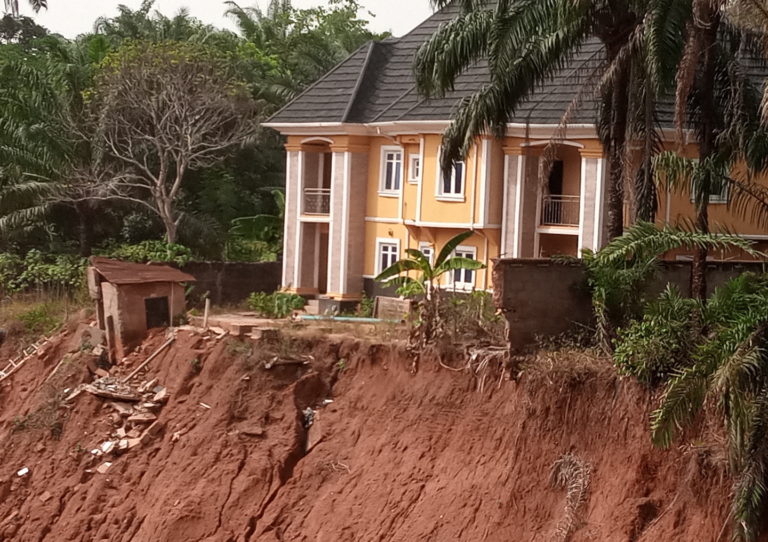
Some of the collapsed buildings in Nkisi Aroli, Onitsha. Credit: The ICIR

Finally, he decided to move the bones of his parents to a different location to preserve the memory of the dead before the rainy season starts.

“Though I lost my ancestral home in Onitsha, the graves of my parents were lying at the precipice of the gully and I didn’t have to wait for the rains to fall and wash away their graves so we had to relocate their graves,” he said.

Speaking to The ICIR, he said the cost of the traditional rites required to relocate the graves was exorbitant and had taken a toll on him since he moved to Enugu. He described the experience as traumatic.

“We spent a lot of money paying people who were involved in moving the graves because there were several traditional rites involved and they were demanding huge sums of money, the experience has really been traumatic for me,” he said.

From Mazeli’s wrecked house, a few steps away are several buildings that have also suffered the same fate. With the rainy season approaching, residents of Nkisi Aroli whose houses are not yet affected live in fear as they can’t sleep at night whenever it rains, hoping that their houses would not fall on them in their sleep.

10 houses collapsed in 3 months

On September 27th, 2019, thirteen families from Nkisi Aroli/Obeleagu communities who were displaced by erosion had written to the Ecological Fund Office, EFO, to urgently intervene to curtail the spread of the erosion and prevent further devastation.

Three months after that letter was sent to the Ecological office, the gully engulfed a total of ten buildings before the start of the dry season which started in December 2019. Whenever it rains, a landslide ensues from the gully destroying farmlands and homes.

The buildings swallowed up by the gully include a thriving primary and secondary school, several residential story buildings, bungalows and a church.

Yet not fewer than 100 homes are threatened by the expanding gully. 

With an estimated depth of 30 metres, and the gully spanning a distance of more than 500 metres, residents have started making plans to leave the area as the rains set to hit full hilt in April.

The increasing rainfall has made erosion and landslides become more frequent in Nkisi Aroli.

For Nwankwo Chuka,29, after completing his first degree in parasitology at Nnamdi Azikiwe University, Awka five years ago, it only seemed natural to follow the footsteps of his deceased father in managing the school his father established while he was alive.

He had high hopes to sustain the legacies of his father who had also been a resident pastor and founder of All Christian Resurrection Redeemed Ministry located in Nkisi Aroli, church where Chuka had spent a good part of his life.

The Redeemed Christian School, an educational arm of All Christian Resurrection Redeemed Ministry, was also located in the same premises and surrounded by a single perimeter fence.

In October 2019, he arrived at the school one morning and met rubbles. After an intense rainfall that night, a landslide from the gully had sunk both church and the school.

Speaking to The ICIR, Chuka described the experience as traumatic as he had to relocate the school to a makeshift structure built within one week to accommodate the students but the current location is also threatened by the gully.
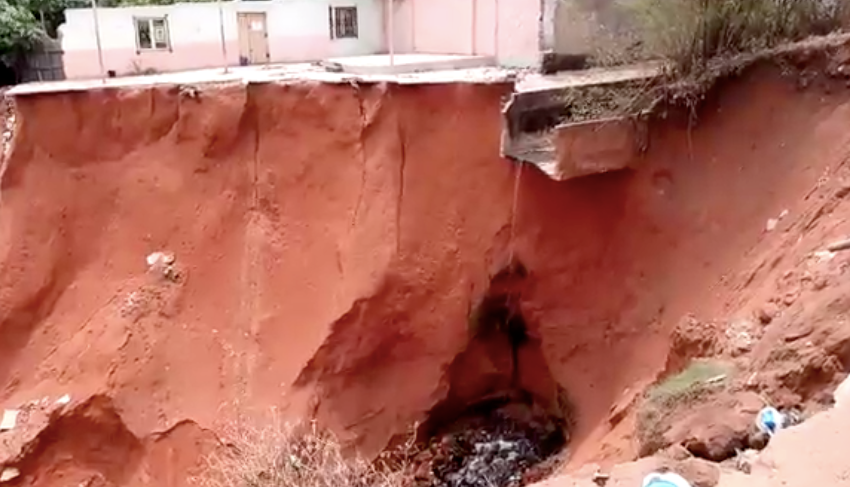
Ruins of the church and school building that Chuka met in 2019. Credit: The ICIR

“My mother and I had faced psychological trauma from the incident when it happened but we had to get used to it. We built a makeshift structure within one week to accommodate our students but some parents took their children to other schools for fear that our school might collapse and things have not been the same,” he sighed. 

According to a 2018 Global Report on Internal Displacement 17.2 million people were driven from their homes by shocks like landslides, hurricanes and droughts which accounts for an estimated 50,000 people who were forcefully displaced by natural or man-made disasters daily in 2018.

Chuka is still counting his losses, he is yet to recover from the economic fix the erosion disaster had put him in.

“The school had over 600 students in both the primary and secondary before the landslide but it currently has about 180 students which have affected our income. It’s a matter of time before the gully gets to this temporary site which means we have to leave as soon as possible,” Chuka said.

Chuka while narrating his ordeal to the reporter.
Credit: The ICIR

Amaechi Osemeke, a resident of Nkisi Aroli said that the degradation of land by erosion in Nkisi Aroli was worrisome because ancestral lands they inherited from their parents would disappear in a few years if the problem was not solved.

“All these buildings are ancestral homes. It’s not that we came here to build commercial buildings for tenants but with our homes getting destroyed by erosion there’s nowhere to go. I can’t imagine the emotion because some people who lost their ancestral homes are squatting with their relations or tenants,” he said.

Another affected resident, Lawrence Edozie who spoke to The ICIR said he couldn’t talk about the erosion problem because at the time he was mourning his wife who died in March.

“I can’t talk about the pains caused by the erosion in Nkisi Aroli right now, because I no longer stay there anymore. I am living in Nwanwa and I just lost my wife which is enough tragedy for my family. I am still mourning my loss,” he explained.

According to data obtained from the Internal Displacement Monitoring Center, IDMC, 514,000 people in Nigeria were displaced from their homes in 2019 from natural disasters like erosion and flooding.

However, for climate migrants like Lawrence, life will no longer be as it used to be until the erosion is stopped.

EFO spends 3 per cent of its budget on erosion

Established in 1981, the EFO is tasked with addressing environmental concerns such as erosion, flooding, landslides amongst other natural or man-made disasters that put human lives and properties at risk across the country.

The Ecological Office receives 2 per cent of Nigeria’s total fiscal budget yearly and does not disclose its annual budget publicly despite the provision of the Fiscal Responsibility Act, FRA, of 2007, that mandates government agencies to make their budget public.

Nigeria is a signatory to the Bonn Challenge Initiative and had pledged to reinstate more than 4 million hectares of deforested and degraded land by 2030 to contribute to the United Nations Sustainable Development Goal to support life on land.

Anambra, Imo, Ebonyi, Abia, and Enugu States have the highest number of active erosion sites in the country, according to a 2017 study published by the European Centre for Research Training and Development.

From May 2015 to September 2019, the Ecological Office had carried out only four erosion projects in each of the SouthEast states over a four year period. 

A review of available records by The ICIR obtained from the Nigeria Extractive Industries Transparency Initiative, NEITI, after a request reveals that states hit severely by erosion have received little intervention support from the Ecological Office to curtail their erosion crises.

Between 2007 to 2015, the EFO had received a total of N433 billion as its allocation from the Federal government.

NEITI’s record of erosion interventions to southeastern states between 2007 to 2016, was pegged at N12.7 billion which accounts for a paltry 3 per cent of the total fund that the Ecological Office received to address ecological challenges in the country.

In Anambra State, from 2007 to 2011, the EFO had budgeted an estimated N4.23 billion to address erosion concerns in the state but the actual payment made for the projects to the contractors was N2.16 billion, just a little above 50 per cent.

The other states also share a similar fate. Abia State was expected to receive N2.86 billion from the EFO but the actual payment received was N1.34 billion, Imo State received N1.29 billion from a projected N2.15 billion, Ebonyi State received N496 million from N1.83 billion and Enugu State received N1.39 billion from N2.88 billion allocated by the EFO.

Erosion/Flood control project worth over N900 million in disarray

For residents of Nnobi, Alor and Umudiaokka communities in Idemili/Dunukofia Local Government Areas of Anambra State, their expected dividends of democracy have been turned into a forgotten dream.

With more than eleven families displaced by the gully, the rural agrarian communities are faced with a shrinking landmass.

The erosion project contract whose cost was not publicly disclosed was awarded by the Ecological Office to Utendala Nigeria Limited in March 2019, with Engineering Consult Limited acting as a consultant while the duration of the project was slated for one year.

One year after the project was awarded, there is no notable progress to reflect that work had taken place at the erosion site in Alor, apart from the rehabilitation of street roads and drainages in the communities.

The project was intended to provide road rehabilitation, erosion and flooding control in the affected communities.
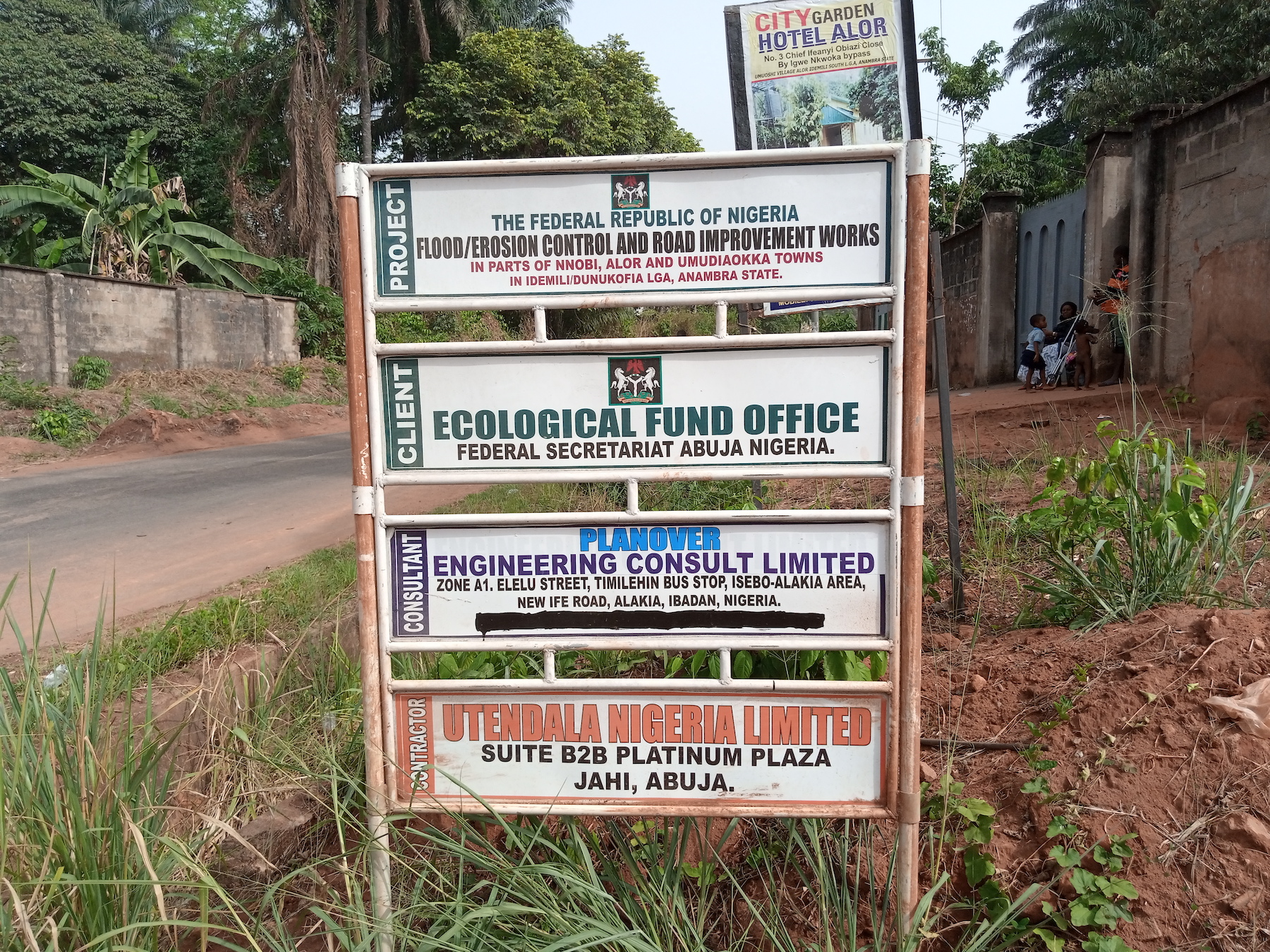
A signpost showing the firms involved in the erosion project.      Credit: The ICIR


The ICIR sent a Freedom of Information, FOI letter to EFO on February 12, requesting for the details of contracts and specific projects carried out by the Ecological Office in Anambra State between 2014 to 2019.

The receipt of the FOI request was acknowledged by the ecological agency and a reply was received on March 6, three weeks later, stating that the request was still being processed. This action breaches the FOI Act that compels government agencies to respond to an FOI request within seven working days.

 A former staff of Utendala Nigeria Limited who had worked with the firm on contractual terms and privy to details of the contract told The ICIR under the condition of anonymity that over 80 per cent of the total contract sum had been paid to the contractor.

“The contractor received 30 per cent initially to kick start the project and subsequently was paid 50 per cent,  but as it stands now it looks like the current state of work does not commensurate with the amount spent so far,” he said.

When The ICIR reporter visited the communities in March to ascertain the level of progress at the erosion site, it was clear that the reality on the ground was a contrast of what the project intended to achieve.

There was no machinery or equipment indicating the presence of the contractor at the erosion site, even as the gully threatens residential buildings, and distort the landscape of the communities.

Uzoma Igbonwa, President General of Alor community told The ICIR that he was dissatisfied with the pace oat which  the contractor was handling the project because the damage by the erosion had worsened under his watch compared to when he started the project.

“I have had my reservations about the contractor with his handling of the erosion project, for one year now it’s been one week of work and then they would abscond for another week. This has allowed the rains to create more damage if you go and take a look at the site. The gully is worse than before,” he said.

He said the community would be writing a petition to the Ecological Office to make complaints.

He said the erosion damage would require four times the amount spent initially to fix the problem.

“It’s very disturbing that there has been no change since the contractor started work on that site since 2018. My house is very close to the gully, it’s just a matter of a few showers of rain before it will encroach my house if it is not addressed. We are petitioning the Ecological Office and attaching pictures to compare the state of the gully two years ago and there is no difference,” he said.

Construction firm with a fake address

The ICIR reporter could not contact the management of Utendala Nigeria Limited, as the company had no website or digital presence online, apart from a few news reports that hinted at some government contracts the firm had handled in the past.

However, on a billboard at the project site, the recorded address of the contractor was given as  “Platinum Plaza, suite B2B, Jahi, Abuja,”  and when the reporter visited the supposed office at exactly 11:24 am on Monday, 4 May, the inscription on the doorpost was different. 

The office was occupied by a charity organisation named “Emmanuel Ayaba Foundation”, upon enquiry from the reporter Emmanuel Ayaba, who runs the foundation told The ICIR that he had never heard the name of the engineering firm before and his charity organisation was not affiliated with the engineering firm. 

“Well, I have not heard the name of that company before, what we do at Emmanuel Ayaba Foundation does not involve engineering or construction work,” he said.

On May 27, the EFO’s deputy spokesperson Joel Oruche brokered a meeting with The ICIR after the reporter shared his findings with him. Present at the meeting includes the project manager of the erosion project, Hycienth Godwin, Director of soil erosion and flood control at the EFO, Felix Okeke, and an engineer introduced as Nwachukwu.

At the meeting, they jointly presented a document that provided a progress report at the site which they said was at 85 per completion stage and due diligence was carried out in the award of the contract which was supervised by the staff of the EFO alongside a consultant to monitor the progress of work.

When The ICIR reporter confronted them with the findings of the fake address given by the contractor, and a video showing the poor state of the erosion site when he visited Alor community.

Oruche said the non-existence of the contractor’s office was not the problem of the Ecological Office but the contractor because the EFO’s main concern was to execute the project.

However, they declined to reveal the cost of the project saying as civil servants they were not obliged to reveal the details of the contract unless they were authorised by the permanent secretary, saying the scope of the contract did not make the erosion site a priority in the project.
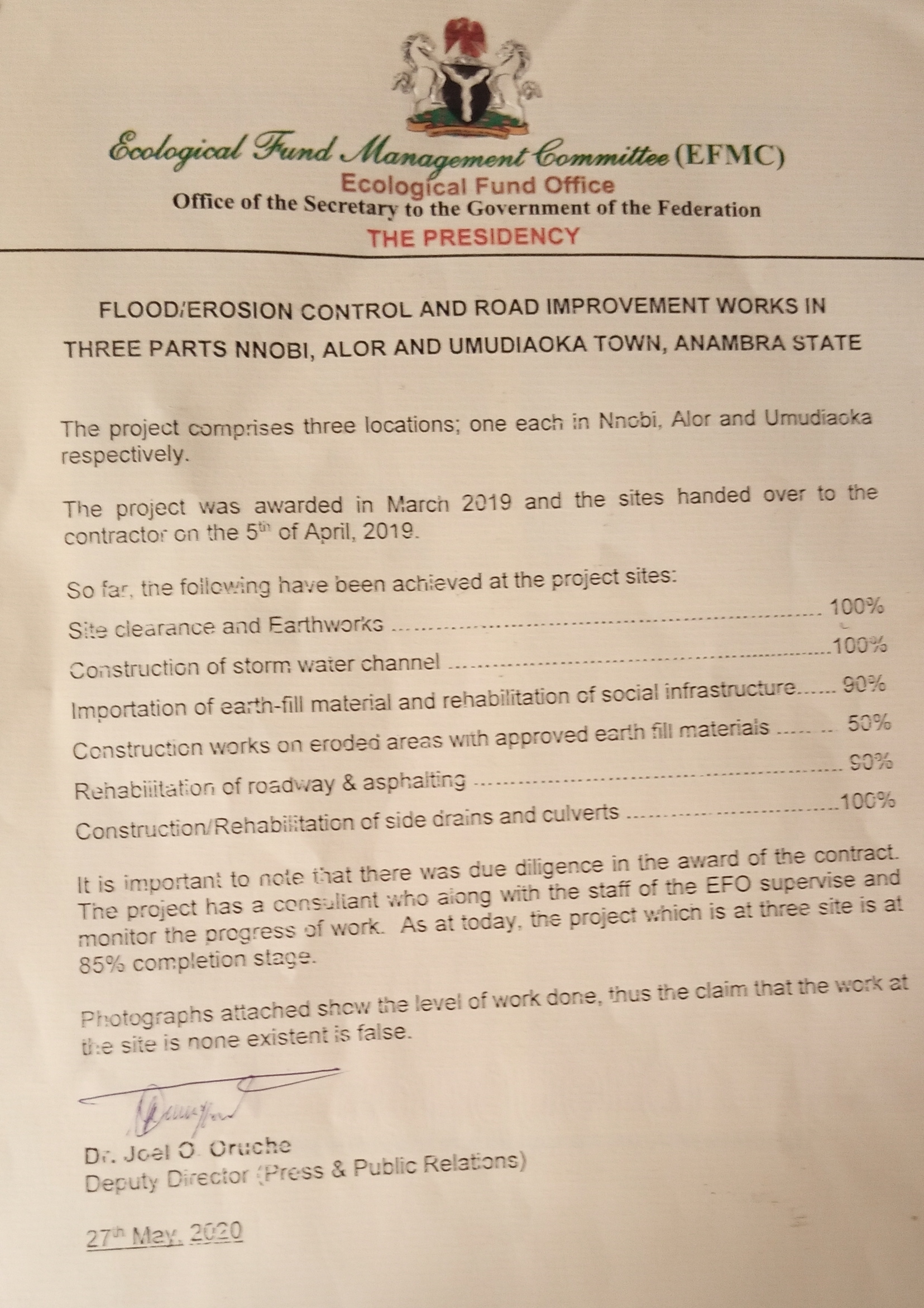
The document issued by the Ecological Fund Office concerning the contract. Credit: The ICIR

At the meeting, Hycienth affirmed that the focus of his firm was to address roads and drainages which he confirmed to be 3 km in total, stating that the gully control was a palliative measure by the firm to fill the eroded area with earth fill materials and not its priority.

Worried about the poor work done by the contractor at the erosion site, Chris Oyeka, a resident said the gully was endangering the livelihoods of residents on a daily basis with the rainy season.

“There is a major problem in Alor as we are in the rainy season houses, more homes are likely to go down if the contractor doesn’t get on with work at the erosion site when the rains come,” he said.

Worried about the poor work done by the contractor at the erosion site, Chris Oyeka, a resident said the gully was endangering the livelihoods of residents on a daily basis with the rainy season. 

“There is a major problem in Alor as we are in the rainy season houses, more homes are likely to go down if the contractor doesn’t get on with work at the erosion site when the rains come,” he said.

Financial records enmeshed in ecological fraud

On March 6, 2017, the Ecological Office awarded a contract worth N1.257 billion for the canalisation and desilting of Okoko and Ogbagba rivers in Osogbo, Osun State, with a completion period expected to last for 10 months.

The contract details showed that N30 million was earmarked as compensation to owners of marked-to-demolish buildings and economic trees that would be affected by the project. 

An audit report of the accounts of the Ecological Office conducted by the Auditor General of the Federation, AuGF revealed that there were no records to show that the payments were made. There were no receipts, invoices or approvals to show proof of the expenditure.

In a letter to the Permanent Secretary of the Ecological Office, Habila Lawal, the AuGF directed her to recover the monies and remit to the national treasury but that request was never honoured and the money was not accounted for, the audited records show.

It is not unusual for misappropriation of ecological intervention funds to take place at the Ecological Office without questions being asked going by reports from previous audits of its financial records.

Some of the contracts from the Ecological Office are assigned to companies that seem to exist only on paper according to the audit report from the office of the AuGF.

Between 2012 to 2014, the audit team from the AuGF’s office discovered that there was a compulsory 2.5 per cent deduction made by the Ecological Office from several contracts awarded to engineering firms for ecological projects that were shared on a 60 to 40 per cent basis with the executing agency. 

The monies were traced and found to be stashed in two major banks in Abuja, namely Fidelity Bank branch located at Plot 267, Tafa Balewa Road, Central Business District bearing the account number, 5030033322 and United Bank of Africa, UBA, located in Garki with the account number 1013600986. 

Investigations by The ICIR revealed that the name of the UBA account currently is ECOLOGICAL FUND OFFICE/OSGF(PROJECT ADMIN) which is also linked directly to the Office of the Secretary to the Government of the Federation, OSGF, currently headed by Boss Mustapha while the Fidelity Bank account was inoperative at the time.

The criteria for the 2.5 per cent deduction adopted by the Ecological Office was a flagrant breach of Nigeria’s public service financial regulations and extant circulars but the ultimate beneficiaries of the monies still remain sketchy as the expenditure was classified as recurrent expenses which are not within the purview of the audit team.                                               

Audits of the Ecological Office financial records from 2007 to 2015 show that $2.5 billion allocated for environmental remediation projects had been misappropriated by civil servants at the Ecological Office in connivance with contractors while Nigerians grapple with the horrors of climate change.

The watchdogs are quiet

On March 14, 2018, Senator Mohammed Hassan representing Yobe South Senatorial district described the ecological fund as a “slush fund” due to illegal withdrawals from the Ecological Fund Office account for reasons not consistent with the objectives of the ecological fund during a bill presentation on the misuse of intervention funds by the EFO at the house.

 The fund has over the years been operated like a slush fund deployed for varying purposes according to the whims and caprices of the incumbent,” he said at the hearing.

The Economic and Financial Crimes Commission, EFCC, is Nigeria’s leading anti-graft agency responsible for investigation of economic and financial crimes in the country.

The ICIR showed the spokesperson of the EFCC, Dele Oyewale its findings on the failed projects by the EFO to contractors who abscond without completing the job after collecting more than 50 per cent of payments and also the reports from the office of the AuGF.

The wuestion was asked to ascertain if the EFCC had carried out investigations into the misappropriation of funds at the EFO and if it had, what was the outcome of their investigations. 

“The way we operate is if there are such issues as you have said and a petition is not placed before the commission to that effect then we cannot go out of our way and act on it. Without a formal petition since these cases have to go through the courts then we don’t have substantial allegations that we can work upon and there is practically nothing we can do. 

“If you are able to find out if a petition has been raised to these allegations you have mentioned then I can go and look for it and check if we have carried out an investigation on that matter or not,” he said. 

His statement that a petition has to be written to the commission before an investigation into economic and financial crimes can commence contradicts Section 7(a) of the Economic and Financial Crimes Commission Establishment Act 2003.

The Act confers special powers on the EFCC, “ to cause investigations to be conducted as to whether any person, corporate body or organization has committed any offence under this Act or other law relating to economic and financial crimes.          

Okoduwa Rashidat, spokesperson of the Independent and Corrupt and Related Practices Commission, ICPC, when contacted by The ICIR to know if the agency had carried out investigations on the financial misappropriation, but she could not be reached as she failed to respond to calls, text and WhatsApp messages.

Nigeria may not slide into recession despite impacts of COVID-19—CBN

IN spite of the impacts of the pandemic COVID-19 on the economy, Nigeria’s economy may not slide into recession, the Central Bank of Nigeria (CBN) has said.

At the end of its Monetary Policy Committee (MPC) meeting held Thursday, the apex bank held that the economy would reverse to positive growth by the fourth quarter of 2020 if the current stimulus initiatives are properly implemented.

In a communique signed and issued at the end of the meeting by Godwin Emefiele, the CBN governor, the bank noted that a sharp decline in output growth was expected in Q2 of 2020 which may extend to the third quarter, it expressed optimism that the economy may not slide into recession.

During the meeting, the MPC noted that the imperative for monetary policy at the May 2020 meeting was to strike a balance between supporting the recovery of output growth while maintaining stable price development across inflation, the exchange rate and market interest rates.

The Committee noted that the Cash Reserve Requirement (CRR) was recently adjusted upwards as a means of tightening the stance of policy.

In its response to the COVID-19 pandemic, however, the Bank reduced interest rates associated with all CBN interventions from 9 to 5 per cent.

Members of the committee agreed that increasing Monetary Policy Rate (MPR) at “this stage will thus be counter-intuitive and will result in upward pressure on retail market rates.”

While ending the meeting, the Committee decided by a unanimous vote to reduce the Monetary Policy Rate (MPR) and to hold all other policy parameters constant.

At the end of the meeting, the MPC voted to reduce the MPR to12.5per cent; retain the Asymmetric Corridor of +200/-500 basis points around the MPR; retain the CRR at 27.5 per cent, and retain the Liquidity Ratio at 30 per cent.


International Fact-Checking Network launches $1m grant program to support Fact-Checkers

THE Poynter Institute for Media Studies is receiving  applications for its newest grant program.

With the support of YouTube via the Google News Initiative, the The International Fact-Checking Network (IFCN), has $1 million in grant funding available for established fact-checking units that are pursuing projects around video production, tools development, audience building, and new formats testing.

The eligibility of the application is based on Fact-checking organizations that are verified signatories of the IFCN’s Code of Principles and/or organizations that have been regularly publishing nonpartisan fact checks over the last three months.

All applicants will be first evaluated by their eligibility and then judged by an independent selection committee.

In addition to grant funding, accepted applicants will get exposure at Global Fact 8 in June 2021.

Fact-checking units may submit only one application for up to $50,000.

Applications close June 17, 2020, and the IFCN will announce recipients August 4, 2020.

For more information and how to apply here, click here

Democracy Day: Buhari fights corruption, though surrounds himself with dodgy politicians, says CDD

THE Centre for Democracy and Development (CDD) has scored President Muhammadu Buhari low in the fight against corruption, despite his campaign promise of change.

According to CDD, many Nigerians had high hopes that President Buhari would work tirelessly to disrupt the country’s kleptocratic status quo, but he has nevertheless fallen short of his promise to “demonstrate zero tolerance for corrupt practices.”

The report titled, “Assessment of President Buhari’s Corruption Fight in the last 5 Years”, was presented by the CDD executive director, Idayat Hassan at a press conference organized via Zoom on Friday, May 29 between 12 noon and 1 pm.

The report underscores both the shortcomings and achievements of the Buhari administration in the last five years. The president assumed office on May 29, 2015.

For the shortcoming, the pro-democracy think-tank criticised some of the Buhari appointments, which it described as “questionable”.

According to CDD, several members of the Buhari cabinet in the second term were former governors accused of corruption and officials with close ties to former head of state, late Sani Abacha.

The report also condemned the Buhari government for reinstating a top pension official even though he was facing prosecution by the EFCC on corruption charges.

The president also dithered in suspending the former Secretary to the Government of the Federation, David Babachir Lawal from office, despite indictment by the Senate over alleged breaches in the handling of contracts awarded by the Presidential Initiative for the North East.

The failure to timely suspend erring appointees pending investigations have been replicated in several instances, the report stated.

CDD also condemned the president of turning blind eye to political corruption, and frolicking with corrupt politicians especially during the 2019 campaign ahead of the general elections.

“The President has asked a few questions about how the APC funds itself, even though it is common knowledge that candidates depend on stolen public funds provided by political godfathers to fuel election campaigns.”

As minister of petroleum, President Buhari has failed to achieve reform in the sector despite his pledge, the CDD noted. Citing the example of the NNPC, the Centre blamed the president for sustaining a corrupt system at NNPC that has enriched briefcase companies than his predecessors.

Though Buhari has condemned the sleaze in the security sector under the former President Goodluck Jonathan, his own administration has also failed to rein in security votes—opaque slush funds that remain one of the most glaring examples of security sector corruption in Nigeria.

In fact, a report by Transparency International published in May 2018 shows that the amount earmarked for security votes in the federal budget has increased during Buhari’s tenure from N9.3 billion ($46.2 million in total) to N18.4 billion ($51 million in total) in 2018.

The Centre also criticised some of the economic policies of Buhari, especially the border policy which did a little to deter smugglers, yet trigger bribery and corruption at border posts.

Hassan during her presentation wondered why a government that promised so much transparency could become notorious for declining Fiscal Transparency.

Hear words: “Under President Buhari, the Central Bank of Nigeria has become less transparent and more vulnerable to political influence on fiscal and monetary policy. The bank’s oversight role has diminished and the relationship between it and the nation’s commercial banks has become too cozy. Since 2015, sales of discounted foreign exchange to privileged recipients have become more opaque than ever before. In December 2017, the government announced the withdrawal of $1 billion from the Excess Crude Account—nearly half of Nigeria’s now nearly-empty rainy day fund—for ad hoc security expenditures. The government has yet to reveal exactly how this money was spent, suggesting that it was likely used to energise ruling party political structures ahead of the 2019 general election.”

Notwithstanding, the Buhari administration also got some commendations from CDD, especially for its consistent anti-corruption messaging and for its effort to Improve financial centralisation.

Examples are the Treasury Single Account policy that allows for government transaction through a single account, and the Integrated Payroll and Personnel Information System (IPPIS) that helps prevent payment to ghost or absentee workers.

The CDD also praised the government of Buhari for strong anti-corruption appointments such as that of the EFCC Chairman, Ibrahim Magu, ICPC Chairman Bolaji Owasanoye and the Executive Secretary of Nigeria Extractive Industries Transparency Initiative (NEITI), Waziri Adio.

The Centre’s director, in fact, rated Buhari higher for recording more corruption conviction than any of his predecessors, though she noted that over half of these convictions were from cybercrime prosecutions.

In the area of asset recovery, Buhari also got a pass mark.

“The government has increasingly used innovative legal tools to seize suspected proceeds of corruption from former officials who would be difficult and time-consuming to convict,” Hassan said.

The presidency though is yet to respond to the CDD’s report, but Garba Shehu, the president’s spokesperson  has tweeted earlier that the last five years (of Buhari administration) have been full of historic achievements.

“Please go to the Presidential handles and read how the decades-long wishes of the Nigerian people are being met,” he posted.

COVID-19: CBN introduces regulatory forbearance for financial institutions

THE Central Bank of Nigeria (CBN) says it has approved a regulatory forbearance for the restructuring of credit facilities in the Other Financial Institutions (OFI) in order to further mitigate the impact of the COVID-19 pandemic on households, businesses and regulated institutions.

According to a circular by the apex bank to all Other Financial Institutions,dated May 27 sighted by The ICIR, the CBN intervention facilities availed through participating OFIs are granted a further one-year moratorium on all principal repayment effective from March 1, 2020.

The circular was signed by Kevin Amugo, Director, Financial Policy and Regulation Department.

Also, interest rates on the CBN intervention facility through participating financial institutions is reduced from 9 per cent to 5 per cent per annum effective March 1, 2020.

The apex bank said other financial institutions are granted leave to consider temporary and time-limited restructuring of the tenure and loan terms of households and businesses affected by the pandemic.

According to the apex bank, developments would be monitored and implementation of appropriate measures to safeguard financial stability and support stakeholders impacted by  COVID-19 pandemic.

It would be recalled that the CBN in March announced six initial policy measures to contain the impacts of COVID-19 on the Nigerian economy.

Notorious Boko Haram fighter who was part of Metele attack surrenders to Nigerian troops


ADAMU Yahaya,  a prominent Boko Haram fighter, who has taken part in major attacks against troops of the Nigerian Army in the North East has surrendered himself to the troops, John Enenche, the Coordinator of Defence Media Operations at the Defence Headquarters said.

According to Enenche, a Major General, Yahaya who is also known as Saad Karami led the last attack on Nigerian Army troops in Baga town and also participated in attacks on Metele, Mairari, Bindiram, Kangarwa and Shetimari (Niger Republic).

The Coordinator of Defence Media Operations said the Boko Haram warlord voluntarily surrendered to troops of 242 Battalion in Monguno.

“This was as a result of the aggressive posture of the troops and artillery bombardments of terrorists’ suspected locations around the general area,” Enenche said.

It could be recalled that in November 2018, Boko Haram fighters killed over 70 Soldiers of 157 Task Force Battalion in a single attack in Metele, Guzamala Local Government Area, at about 6:00 p.m.

Large cache of arms, ammunition, and military equipment were carted away by the terrorists during the attack on 157 Task Force Battalion in Metele.

Meanwhile, troops of Army Super Camp 11 Gambouru under Sector 1 of Operation Lafiya Dole, May 24 at Mudu Town in Borno State neutralised 12 Boko Haram terrorists, Enenche said.

He added that troops also rescued 241 persons in captivity of the terrorists comprising 105 women and 136 children.

Items recovered, according to him were four Boko Haram terrorists’ flags, a motorcycle, two bicycles, an amplifier and two sewing machines.


SSS illegally detains victim for 14 months without trial, allegedly defies AGF’s order

FOR nearly 14 months, the State Security Service allegedly detained citizen Austin Ighodaro, illegally without recourse for the due judicial process.

Ighodaro’s wife, Mrs Helen Ighodaro told The ICIR that her husband was wrongly accused of committing an offence contrary to the Anti-Money Laundering Act.

But all through last year, and almost end the first quarter of 2020, Ighodaro, according to his wife, was neither transferred to the Special Control Unit Against Money Laundry (SCUML) for further investigation and prosecution nor to the Economic and Financial Crimes Commission (EFCC) – the statutory governmental body responsible for investigating financial corruption in Nigeria.

Rather he was kept in detention and allegedly tortured without a chance for trial.

Torture of detainees by law enforcement agents is a clear violation of Section 36 of the Constitution which guarantees an individual’s right to a fair hearing, as spelt out by the Administration of Criminal Justice Act (ACJA) signed into law in 2015.

The 2017 Anti-torture Act also forbids security forces from obtaining information by force.

Not only that, the suspect was also denied the right to celebrate the birth of his daughter – Eloghosa Esther Ighodaro, who was delivered on 6th February 2019, the wife told The ICIR.

He was only privileged to see the baby three weeks after she was brought to him while in detention.

Lawyers, however, have argued that no section of the Nigerian constitution permits the State Security Service to arrest and detain suspects on issues that exclude internal national security matters, as detailed in the National Security Acts 1986.

How it began

Ighodaro wife who visited The ICIR‘s office in February narrated how her husband’s ordeal began.

Last year, on Wednesday 30th January, Ighodaro, the Executive Director of Universal Agricultural Empowerment and Development Initiative (UNAEDI) was reportedly arrested by the SSS operatives for a reason yet unknown as of the time of his arrest.

Though he has a pending case before the EFCC for allegedly defrauding investors to the tune of $328,974.37, the incident occurred between March and November 2015 but he was granted N10 million bail.

He had visited Liberia and just returned to the country, lodged at White House Hotel, Ikeja in Lagos when the SSS operatives stormed his hotel room.

In the usual brigandage approach of the secrete service, no warrant of arrest was presented or issued, before the accused was detained, according to court documents.

At a point, the accused mistook the operatives for kidnappers. “…they abducted him, handcuffed, leg-cuffed and blindfolded him…,” an amended affidavit in support of a court Suit N0: FHC/ABJ/CS/1153/2019 read.

Ighodaro was eventually taken to the SSS State Command at Benin City, Edo State.

But while in Benin, his wife explained to The ICIR that the accused was driven around parts of the city to identify his supposed properties, since he is an indigene of the state. While this was ongoing, he was reportedly handcuffed.

Mrs. Ighodaro said the SSS assumed her husband had spent the alleged looted money on fixed assets such as landed properties, but he was eventually returned back to detention after the operatives reportedly found nothing against him.

However, on Tuesday, 5th February, 2019 Ighodaro was transferred to Abuja where he was purportedly detained until his wife sought legal action against the continuous abuse of her husband’s basic human rights.

Incidentally, Ighodaro’s case in the hands of the SSS is not peculiar. Omoyele Sowore, Publisher of Sahara Reporters was abducted in the same manner among other persons that have reportedly suffered undue arrest in a Gestapo style and prosecuted, yet the operatives, the court document says refused to honour the judge’s verdict after repeated judgements.

Alleged N1.7 billion fraud – Is Ighodaro really guilty?

After several days of suspected torture, Ighodaro eventually got to know his offence. He was accused of being a member of a ‘cabal’ that allegedly ‘attacked’ Sterling Bank and carted away huge sum to the tune of about N1.7 billion.

Ighodaro said he was shocked when he heard about the allegation, according to court document prepared by his lawyer.

But before he could utter a word of defence, Ighodalo claimed he got kicked in the mouth and was beaten while in handcuffs.

Meanwhile, prior to his arrest, in December 2018, a man identified as Osa-Tare Imaziqueze had walked into his NGO’s office located at the NCWS Complex, Garki in Abuja. The man claimed to be a humanitarian from Germany and was much interested in UNAEDI’s activities, particularly as it supports the Internally Displaced Persons (IDPs) in Benue and North-Eastern part of the country.

As a result, Imaziqueze promised to make ‘huge donation’ in support of the NGO.

Shortly after, Ighodaro’s NGO received N60 million donations into its Stanbic IBTC Bank Account No: 0016798848. The payment came from a Sterling Bank account.

“Somebody walked into his office in area 11 that he likes the work they are doing and he will like to donate to them. So he responded that they run an NGO and they are open to donations,” Mrs Ighodaro said in an interview with The ICIR.

“A week later, N60 million was donated but after a while, the same person returned to the office, pleaded they should not be angry and asked if it was possible to give him back part of the money. So he responded that NGOs don’t do that.”

“The man responded there was no problem and he left,” she added.

According to her, the accused was allegedly unaware that the transferred sum was fraud proceed meant for her husband to withdraw and pay part in return to the false philanthropist.

Moreover, she said the bank fraud involved a woman, who was later arrested by the secret agents but exonerated her husband. According to her, the unidentified woman reportedly cloned a particular account, withdrew the money and deposited the sums in tranches into different accounts including that of the NGO.

“Like my husband, they paid N60 million, another person got N100 million and so on…,” she added. “Even the lady in their custody told them (SSS) that she has never met my husband before but she was the one who credited his (NGO’s) account.”

But, prior to the findings and arrests, the NGO had withdrawn N59,919,43.00, and reportedly spent it on humanitarian projects at the Kutara IDP Camp, Nasarawa State and an Talitha Cumi Orhanage Home, Nyanya, Abuja.

“…to enable UNAEDI to finance its intervention programmes that took its staff and other support services to Kutara IDP Camp in Nasarawa State on 31st December, 2018, where it donated relief materials and also undertook to pay 1-year salary arrears of teachers,” the court document revealed.

“On the 1st January, 2019, UNAEDI visited Talitha Cumi Orphanage home in Nyanya, Abuja and Treasure Orphanage Foundation in Karu, Nasarawa State and donated relief materials and sums of money.”

It is, however, uncertain if Ighodaro’s NGO was registered with SCUML but his wife claimed he has all necessary documents which formalises the NGO.

DSS refused to honour court order to pay N500m damages

In the course of filing this report, The ICIR gathered that the SSS prosecution officer handling the case had reportedly recommended to the DG SSS, severally the need for Ighodaro’s release on bail, based on legal provisions and the previous judgement.

The accused was earlier granted bail on 3rd May, 2019 in suit N0: MHC/ABJ/CS/279/2019 but still dishonoured.

“A declaration that the arrest, continuous detention and refusal of access to lawyers and family members of the applicant since Wednesday, January 30, 2019, without charging him to a court of competent jurisdiction or releasing him either unconditionally or on bail is unlawful, unconstitutional, and amounts to a violation of the applicant’s right to personal liberty, fair hearing and freedom of movement as enshrined in sections 35, 36, and 41 of the 1999 constitution (As amended.)” the judgement by Justice N.E Maha, the presiding judge read.

But recommendations from the SSS lawyer repeatedly failed. The court ruling that ordered the SSS to pay N500 million as damages to the victim for, ‘unlawful arrest, detention, humiliation and psychological trauma occasioned by the illegal acts of the respondent,’ was also said to be discarded.

“There was a time they even gave him an administrative bail, they called us to come but before we got to the entrance of the SSS Headquarters, they said no, we should go back,” Mrs Ighodaro noted.

However, a different suit was filed against the SSS for refusing to honour earlier judgement made by the lower court. But, when the SSS lawyer appeared in court, he reportedly lied that the accused was already released.

“At first they said he has been released. When we got to the court, the SSS lawyer came and said they have released him to EFCC. We were happy. So, that same day, they called that I should come and file a discontinuous of the court case against them. Immediately I got there, I was shocked to still see my husband in their custody.

“So it was a deception.”

DSS allegedly disobeyed Attorney General’s office

Again, the SSS raised a caveat insisting that the accused would only be released if Mrs Ighodaro retrieves the fresh suit against it from the court.

Meanwhile, the Office of the Attorney-General of the Federation, it was gathered had earlier written to the SSS instructing it to refer the case to the EFCC but as at 10th March, the directive has not been honoured.

The Investigative Police Office (IPO) in charge of the case and the Director of Operations also agreed based on intelligent information that the case was outside the jurisdiction of the secret agents.

Moreover, the Bureau de Change who was allegedly involved in the allegation was the first to be arrested by the DSS. But he was reportedly released three months after his arrest when the DSS reportedly realised the said Alhaji was diabetic and HIV positive.

“The man had so many sicknesses, so they had to release him,” the source added.

However, after the long illegal detention, on 11th March, the DSS finally handed Ighodaro over to the EFCC for prosecution. This is more than a year after he was being held unduly. He is currently under EFCC supervision.

“They took him to EFCC last week Wednesday, he was moved to Lagos Tuesday morning….so the investigation is ongoing in Lagos. I’m just leaving his place. They will charge him to court next week,” his wife later told The ICIR.

What the law says and experts opinion

Does the SSS have right to wade into affairs outside national security? Do they have the mandate to investigate civil matters? Does the constitution empower the SSS to detain accused persons? These among others are questions begging for answers on the case.

But, Abdul Mahmud, a lawyer in his reaction said beyond the ACJA, it is illegal and unconstitutional for the SSS to arrest the accused person or anyone alleged to have committed financial crime, so far it away from national security matters.

He said it is only the EFCC and Police that has the power to arrest offenders but this should also be done within provisions of the law such that no accused person should be detained beyond 48 hours, and at most 72 hours.

“Two schools of thoughts have emerged on the limit of power the SSS can exercise. I belong to that school that the power it has was gifted to it by the National Security Acts 1986 which specifically empowered it to prevent and detect, protect and preserve all military non-classified matters on the internal security of Nigeria, and other power assigned to it by the National Assembly and the President,”

“The law does not specifically mention arrest. The crime is not a national security issue but a financial offence.”

“For the situation on ground, it is only EFCC and the Police that can arrest, detain and even try this individual. There is even a more fundamental constitutional issue involved by section (3) (3) 34, 36 of the constitution.

“It talks about the length of time a citizen can be detained by a detaining agency. No more than 24 hours or at worse 72 hours. But this guy has been detained for over a year without bringing him up for trial. So what the DSS is doing is in flagrant violation of section 36 of the constitution. That’s why I said forget ACJA, the constitution is superior to ACJA.”

Also, according to ACJA which also promotes effective management of criminal justice institutions.

“A suspect arrested for an offence which a magistrate court has no jurisdiction to try shall, within a reasonable time of arrest, be brought before a magistrate court for remand,” Section 293 of the Act says.

A lawyer who spoke on the condition of anonymity simply described the accused person’s detention as illegal, citing section 36 of the Nigerian constitution.

“The answer to your question is that it is illegal and this can be found in the constitution,” she said citing Section 36. She added that ‘it is basically not legal’.   

Barrister Inihebe Effiong, human rights lawyer also shared a similar view as above. He described the action of the SSS as outrightly illegal, as the right to personal liberty is guaranteed under the constitution.

“By virtue of that, nobody in Nigeria irrespective of the reason for the arrest should be detained by any security agency or authority of persons beyond 24 hours. So, if the SSS is convinced that the person committed a criminal offence, the only option available under section 35 of the constitution is to arraign the person,” Effiong said.

“If they say the crime is so grievous and because of that they can not arraign the person to court, it means that from the beginning, they don’t have a case with the person, so what they have is illegal. And if there is a court order, and the order has not been honoured, that has gone beyond the issue of illegal detention. that has gone to clear lawlessness and impunity.”

The lawyer noted that action by the DSS could also be labelled as contempt of court for refusing court order.

“They don’t have any power outside the national security agency Act which is the enabling law that establishes the agency. They don’t have any power under any law in Nigeria to detain anyone beyond 24 hours.”

DSS silent over matter

Peter Afunanya, the DSS Spokesperson was contacted via phone but he terminated the call and then requested The ICIR to send a text message.

Hours after the text message was sent, it was not replied. As at the time of filing this report, no response has also been given.

Defence Headquarters releases scorecard of operations, says 600 terrorists, bandits killed in May 2020


THE Nigerian Defence Headquarters says its operations across the North East, North Central and South South between May 6 and May 28 resulted into the deaths of 600 terrorists and bandits while a total of 236 civilians including women and children were rescued.

John Enenche, a Major General and Coordinator of Defence Media Operations who gave an update on the operations of the Nigerian troops explained that the joint operations by the Nigerian Army, Nigerian Navy, Nigerian Air Force and other security agencies have considerably degraded the common enemies of Nigeria and reduced economic sabotage.

“In summary, the Armed Forces of Nigeria from 6 to 28 May 2020 neutralized 188 BHT/ISWAP criminals in the North East, killed 392 bandits in the North West and 20 bandits/armed militia in the North Central parts of the Country amongst other successes recorded. Suffice it to say that human and technical intelligence confirmed that between 6 to 28 May several Boko Haram Terrorists/ISWAP criminals as well as bandits/armed militia were killed due to our ground and air offensives,” Enenche said in a statement issued on Thursday.

He explained that while the Boko Haram fighters and those of ISWAP were killed, their logistics facilities, gun trucks and other structures were also destroyed as well as recovery of weapons.

This, Enenche was accomplished by the troops of Operation Lafiya Dole in the North East which according to him led to the death of the 188 terrorists, rescue of abducted women and children.

He added that those rescued have undergone medical checkups and treatments at the military health facilities.

Similarly, he disclosed that troops of Operation HADARIN DAJI in various clearance operations neutralized 392 armed bandits and destroyed some of their dwellings and logistics warehouses at Dunya, Abu Radde’s Camp and Ibrahim Mai Bai’s Camp in Jibia and Danmusa Local Government Areas of Katsina State as well as Maikomi and Kurmin Kurain Birnin Magaji and Zurmi Local Government Areas of Zamfara State.

In Benue and Taraba states, he explained that under Operation WHIRL PUNCH 19 armed bandits were killed.

“The gallant troops also carried out a raid operation on a criminal hideout off Zaki Biam and Katsina-Ala highway where a notorious armed robber Terugwa Igbagwa alias Orjondu was killed. Troops also recovered large cache of arms and ammunition within the period under review.”

The killing of Orjondu, according to him has brought a great relief to the  people of Benue State and some parts of Taraba State.

Enenche said the late bandit leader was the mastermind of various civilian deaths including kidnapping and assassinations, adding however, that notorious militia leader Gana narrowly escaped with injuries when his hideout was raided.

Speaking on Maritime operations, he stated that the Nigerian Navy Ship PATHFINDER Patrol Team, on  May 26 20, conducted Anti-Crude oil theft/anti-illegal bunkering operations around Briakiri off Onne and Abise community off Abonema Akukutoru Local Government Area of Rivers state.

During the operations,he said  the team located two illegal refining sites with four storage tanks laden with estimated 400,000 litres of products suspected to be illegally refined AGO.

“The products were impounded while two pumping machines were recovered to the base. No arrest was made as the perpetrators fled on sighting the patrol team,” he said.

In the same vein, he said the Nigerian Navy Ship DELTA, on May 25, intercepted a wooden boat and a speed boat around Ilaopashe, Bennett island and Lokpobri communities in Warri and Burutu South Local Government Areas of Delta State.

According to him, the team located four illegal refining sites with 14 dug-out pits, 32 surface metal storage tanks and 43 ovens laden with about 628.98 barrels of suspected stolen crude oil as well as 72,000.00 litres of product suspected to be illegally refined AGO.

He added that the team also located a 3-inch pipe and associated fittings close to NPDC pipeline around Bennett Island, suspected to have been laid by crude oil thieves. Subsequently, the team disconnected the pipes and fittings.

“The storage facilities were dismantled while the speed boat was recovered to the base.”

Enenche also stated that the Forward Operating Base IBAKA while on routine patrol on May 26 around Ewang Creek intercepted and arrested a medium size wooden boat laden with drums of products suspected to be stolen PMS with two suspects.

“Suspects and items recovered from the arrest include 49,000.00 litres of products suspected to be stolen PMS.”

The suspects, he added are currently undergoing investigation and will soon be handed over to the relevant prosecuting agency.

This was as the Nigerian Navy in furtherance of its quest to secure our Exclusive Economic Zone, and the Gulf of Guinea rescued a Chinese fishing trawler HAILUFENG 11, rescued 18 crewed and arrested 10 sea pirates.


Exclusive: Inside multi-billion naira ‘fraud’, contract racketeering in PTI

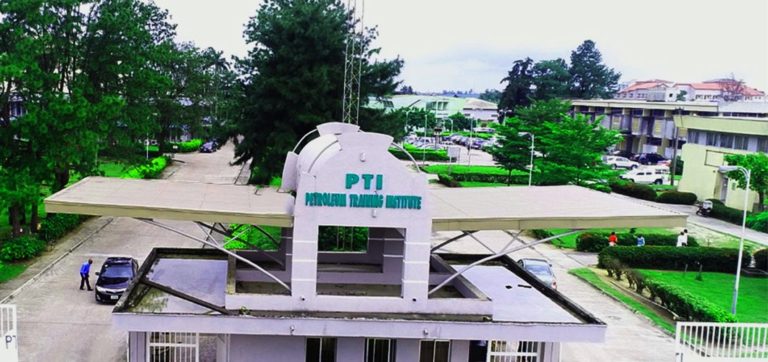
AUDU Oshiokhamele, Chairman of the Petroleum and Natural Gas Senior Staff Association Nigeria (PENGASSAN), Effurun branch, has accused Professor Sunny Iyuke, the Chief Executive of the Petroleum Training Institute (PTI) of a N5.8 billion fraud.

According to him, the sum was allegedly withdrawn from the institute’s coffer for three years without due process under Iyuke’s leadership.

This includes other allegations such as contract racketeering and salary payments into about 500 accounts of ghost workers in the organisation.

In a petition signed by Audu Oshiokhamele on 14th February, and acknowledged by the office of the Minister of Petroleum Resources, Timipre Sylva, in Abuja, the Union claimed that Iyuke arbitrarily moved the money as virement from the PTI’s personnel cost with supports of Aliyu Mafindi, PTI’s Director of Finance and Account.

“We wish to bring to the attention of the Honourable Minister of Petroleum Resources on the uncanny prevailing atmosphere at the Petroleum Training Institute arising from recent petitions from our Association and many other petitioners bothering on gross mismanagement and mal-administration by prof. Sunny Iyuke led management,” the document reads.

According to the 41 pages document obtained by this centre, Mafindi allegedly used his accounts to launder the funds from the institute’s accounts through transfer from the Government Integrated Financial Management Information System (GIFMIS) – to Remita which allowed the funds to be easily manipulated.

However, findings by The ICIR revealed that three hundred and thirty-seven million Naira (N337M) was discovered to have been removed from institute’s personnel cost from 2017 to 2019, using over 500 names of staff in a pay voucher number (PV no.) 78313 of which the fund was claimed to have been credited to dead, retired and existing staff.

The ICIR reached out to Mafindi to have his side on the allegation. Unfortunately, he declined on the provision that he is a public servant and can not talk to the press.

In fact, in a letter dated 12th March 2020 and in response to Oshiokhamele’s petition, the Human Resources Management Department of the Ministry of Petroleum Resources directed Iyuke to make formal representation at the office of the Permanent Secretary of the ministry within 72 hours of the receipt of the letter on the allegations bothering around financial fraud/ Contract racketeering.

Before Audu’s petition, one Oladapo Adeyemi had already forwarded a petition to Mamman-Ahmadu, the Director-General of Bureau of Public Procurement (BPP) and  Ahmad Rufai Shakur who is the acting Director of Petroleum Resources and Chairman governing council of PTI,  Calling for “Probe into Mal-administration, Mis-management and Contract racketeering by Professor Sunny Esayegbemu Iyuke”, dated October 14, 2019.

In the petition, the accuser alleged Sunny Iyuke’s led administration of several financial manipulations, recruitment racketeering, and crass violation of public procurement laws.

During the institution’s 2018 junior staff employment exercise, Olayemi alleged that Sunny unilaterally employed Idibie Andrew and Ayomanor Ogheneyerovwo into the services of the institutes without the prerequisite entry qualifications.

This alleged recruitment racketeering is faulted in provisions of the Public Service Rule ( PSR) sections 020205 and 1603011

Adeyemi’s petition also accused Sunny of unparalleled mismanagement of the volume of funds appropriated to the institute for capital projects from 2016 till 2019 October which he alleged that the procurement practices of goods and services have fallen short of criteria established by BPP.

The petition also poised a similar claim made by PENGASSAN in her petition over financial misappropriation. He explained that additional works of 81.8 million Naira was “approved anticipatorily for an anticipatorily approved contract of over 125million naira for the renovation of Guest chalet at the Conference Center Complex awarded to One Creations limited”.

The approved 81.8million naira is an excess and in violation of 10 per cent allowable as defined by BPP laws. By percentile increase, 81.8 million naira is 654.4per cent increment to 12.5million.

However, The ICIR‘s check through the Corporate Affairs Commission (CAC)’s portal revealed that One Creation Limited is not a registered company nor has any online presence. Further investigation then showed the company’s correct name as Due Creations Limited, against the misleading name written in the petition.

Adeyemi Also added that Additional works of 21million naira approved for a contract worth 41.6million naira for the renovation of the Administrative block extension awarded to Kajet limited. By percentile increase, 21 million Naira is over 500% increment to 4.106 million Naira if following the law of 10% allowable.

His allegations also contained the review of the initial contract sum from 50 Million Naira to 75 Million Naira for the maintenance of the PTI’s library awarded to Sunny Iyuke’s inlaw – Eucalyptus Nig. Ltd.

Section 64 of the procurement act states that the award of all contracts should be notified to the Bureau of Public Procurement and published in two national dailies.

Adeyemi disclosed that the violation has been a rife order in PTI under Sunny’s administration, adding that the institute does not have a procurement journal nor did it publish contract awards in the national dailies as provided by the law.

The ICIR contacted Etanabene Benedict, the procurement development director of the institute over the contract racketeering allegations. He refuted all the claims poised by the accusers over the contracts under his watch

“You see those PENGASSAN people, they lack knowledge, and they have been alleging the principal/ Chief executive before now. The 10 per cent allowable is for capital projects. These projects we spent over the 10 per cent are from our internally generated revenue (IGR)”, Benedict argued.

However, on December 13th, 2019, the Bureau of Public Procurement (BPP) acted upon the recipient of Adeyemi’s call for probe into Sunny’s financial misappropriation of the PTI’s treasury.

The bureau asked PTI to forward copies of advertisement that carries all publications, copies of the signed attendance register for both technical and financial bids, copies of the technical bids submitted by all bidders( both qualified and disqualified).

The bureau also asked Iyuke to submit financial and technical evaluation reports duly signed by the Evaluation Committee ( hard and soft copies), minutes of the meeting of the Tenders  Board approving the awards of the contracts (editable soft and hard copies) and the letters of contracts awarded by PTI from 2016 till 2019.

In her response to Adeyemi’s call for a probe, the Senate Committee on Ethics, Privileges and Petitions called for a full investigation into the activities of the institute, invited Sunny Iyuke and the key management staff of PTI to a closed-door meeting on 2nd of March 2020 to discuss the modalities of improving significantly the revenue of the Federal Government of Nigeria

However, further independent investigation by The ICIR unveiled the petitioner with the name ‘Oladapo Adeyemi’ does not exist in the institute’s staff list. It might be a pseudonym to draw public attention to the alleged financial misappropriation rocking the institute.

The ICIR also contacted the embattled principal, Sunny Iyuke on the 20th of May, 2020 to have his side of the story. He first told this reporter to call back that he was with a staff at a police checkpoint somewhere in Lagos.

Two hours later, this reporter tried to call Iyuke again, his line responded “busy”. For over 4 days with at least 5 trials a day, the response from line remains the same. On an alternative route, this reporter used another number to reach him, the number went through and he picked. 

Iyuke told this reporter to “Kindly reach out to my public affairs? Please reach out to Mr Brown. I don’t want to comment on this issue”

The ICIR reached out to Brown Ukanifimoni, the public relations officer of PTI. He also declined to comment on the ground that “the issue is still with EFCC and ICPC, why not let us cross our hands and wait for their response and know who is exactly corrupt?”

“They have been writing petitions against now. We have attended several meetings with EFCC and ICPC before now, let’s just wait for their response”

This reporter also reached put to Idibie Andrew and Ayomanor Ogheneyerovwo. While the former did not hear this reporter as claimed for 4 different phone call attempts and SMS, the latter did not pick up to even talk to the journalist.

All efforts also sought by The ICIR to get the comment of the Economic and Financial Crimes Commission (EFCC) and the Independent Corrupt Practices Commission (ICPC) proved abortive as phone calls, Whatsapp messages and SMS sent to Rasheedat Okoduwa, ICPC spokesperson, proved abortive.

COVID-19: Abiodun eases Ogun lockdown on weekdays, imposes curfew as cases hit 242

DAPO Abiodun, Governor of Ogun State has eased the internal lockdown imposed in the state to contain the spread of the pandemic Coronavirus (COVID-19) disease.

While speaking during his update on the pandemic, Abiodun stated that from Monday June 1, Ogun State residents would be free to go about their businesses from Mondays to Fridays.

He explained that residents are allowed to go out from 5 am to 8pm during those periods while all non essential movements are prohibited on Saturdays and Sundays.

According to him, the decision to ease the lockdown was in line with the directive of the Federal Government and advice by health experts in the state.

The governor noted that extant restrictions and advisories would remain in place on interstate travels, wearing of facemasks, public transport, markets, religious centres, restaurants and other relaxation spots.

He reiterated that all forms of gatherings either social or religious of more than 20 people remain banned in the state.

AS of Thursday, May 28, Ogun State has recorded a total of 242 cases of COVID-19.

It would recalled that President Muhammadu Buhari imposed a 14-day  lockdown on Lagos and Ogun states as well as the Federal Capital Territory (FCT), Abuja on March 29 as part of measures to contain the spread of the disease.

The president extended  the lockdown imposed on Lagos,  Ogun s Abuja by another 14 days from Monday April 13.