MORE than 110 countries have backed Australia’s push for an independent coronavirus inquiry that may put China in the eye of the storm.
The African Group’s 54 member states will co-sponsor the motion, joining 62 other countries including Russia, Indonesia, India, Japan, Britain and Canada.
The European Union’s 27 members are all on board, along with Brazil, South Korea, Mexico, Turkey and New Zealand.
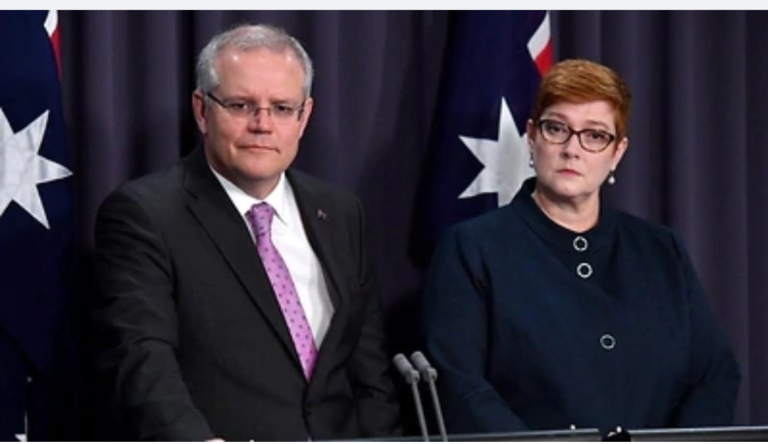
According to SBSnews, the Foreign Minister of Australia, Marise Payne, said on Monday that it was encouraging to see so many countries backing the inquiry.
He was quoted to have said “I think what it illustrates is a broad view that given the experience of COVID-19 – over 300,000 deaths, millions of people around the world losing their jobs, the impact on economies from one corner of the globe to the other – that there is a strong view that it is appropriate to engage in a review of what has happened.
“I don’t want to preempt speculate about the outcome, those discussions will be underway later this evening. I think it’s a win for the international community.”
The draft resolution calls for impartial, independent and comprehensive evaluation of the international response to the pandemic.
It doesn’t mention China, but Australia’s push for the inquiry has angered Beijing, which has threatened a huge tariff on barley and blocked some beef imports.
In relation to the motion pushing, federal Deputy Chief Medical Officer Paul Kelly said on Monday it was important to “get to the bottom” of what had happened.
“I think the most important thing, rather than apportioning blame to one particular country or another country, is that we get to the bottom of what’s happened. And part of that is about the origin, where this virus came from,” he told reporters.
Agriculture Minister David Littleproud said the inquiry was about investigating what the world could learn from the devastating pandemic.
“That’s the responsible thing to do when 300,000 souls have lost their lives around the world,” he told the ABC on Monday.
Mr Littleproud said his Chinese counterpart had indicated he would not discuss trade issues in the near future.
Australia’s push for the inquiry into the origin of the virus sparked fury from Beijing with diplomatic ties between the two nations under intense pressure.
Meanwhile, China has lashed out at claims that Australia’s push for an international probe into the coronavirus has been vindicated, labelling it a “joke”.
After an early morning vote on Tuesday,China agreed to support an investigation after more than 110 countries co-sponsored a motion at the World Health Assembly on Monday night.
The World Health Organization has also agreed to an international probe into the coronavirus pandemic after an Australian-led push for an independent investigation.
Senior government figures claim the inquiry vindicates the government’s stance, prompting a scathing response from China’s embassy in Australia.
“The draft resolution on COVID-19 to be adopted by the World Health Assembly is totally different from Australia’s proposal of an independent international review,” a spokesman told AAP on Tuesday.
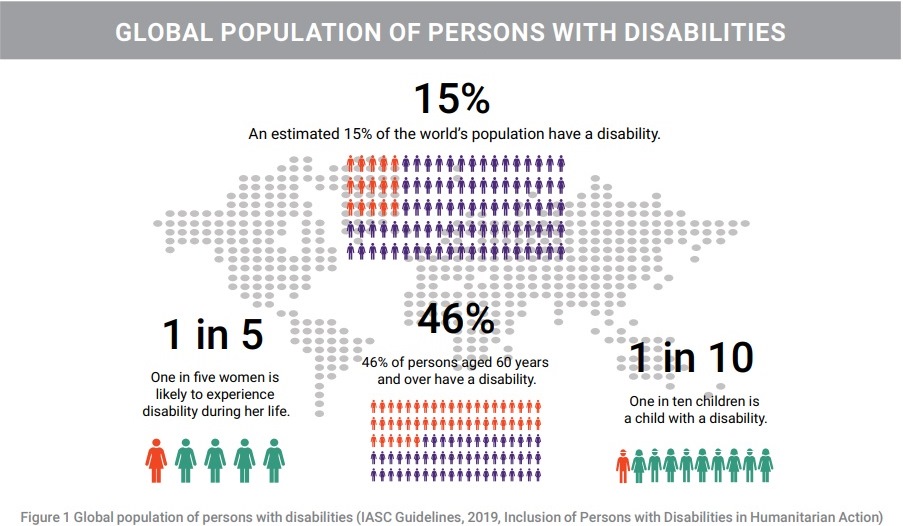
One in 10 children is a child with disability and according to UNICEF, COVID-19 will likely “disproportionally affect those children with pre-existing vulnerabilities.” Adie Vanessa OFFIONG looks at what it has been like for families and caregivers of such children, since the beginning of pandemic and the lockdown that followed.
Adie Vanessa Offiong
RAFAT Salami (50) went into a panic when she noticed countries locking down and industries shutting down in Europe due to the COVID-19 pandemic. Her immediate concern was how she would get enough supplies of medication and dietary requirements for her 15-year-old son, Ahmed.
Ahmed has attention deficit hyperactivity disorder (ADHD), mild cerebral palsy and also intellectual disability. This is all resulting from poorly managed neonatal jaundice.
Rafat, a journalist, said, “because we want to maximise everything to help his brain develop, he is on a special diet. He does physiotherapy to help with the cerebral palsy so that he can have better use of his muscle tone, his spine and gross motor skills.
“He attends a special needs educational centre because inclusive schools are virtually non-existent and do not cater to his type of needs. The daily challenge is navigating among all three to make him a better person.”
In caring for him, the mother of three sons, said everything is challenging on a good day; from school runs to Ahmed’s learning, meals, physiotherapy and buying his medications.
Ahmed brags about being taller than his mum Source- Rafat Salami
Her voice is elevated in excitement as she counts her blessings that most of his developmental milestones have been achieved, like his speech, which is now perfect and he no longer has need for that therapy.
Almost immediately, as if remembering her current reality, her voice dropped, as she said, “but we still have a very long away to go and there is no support, whatsoever. It is all on us.”
Before the pandemic, Ahmed’s medicines alone cost no less than N55, 000 monthly. There was also his school, dietary requirements and a paid live-in caregiver, among other necessities.
With the pandemic and lockdown, his caregiver opted to return to her family, some of his medicines are unavailable because they are imported. For the ones available, his mother now buys at an additional cost.
Ahmed sometimes has seizures which only one particular medicine has been able to address. Rafat said, “I usually buy the 300mg pack of the medicine for N10, 000. He uses two and a half packs every month. I paid N10, 200 for it just before the lockdown.”
Rafat is not alone in this. There are siblings of children with special needs like, Ify Okenyi, who also double as their caregivers.
When Okenyi (31) learnt about the closure of schools due to the COVID-19 pandemic, she was worried about how it would affect learning for persons with special needs like her younger sister, Sandra who is autistic.
This is especially as learning is already limited in terms of proper processing, resources and standards for them and how they would further cope.
She said, “I wondered what level of access, to the already very limited therapeutic options, would be available to them.” She also worried over the kind of access their teachers, counsellors and other professionals, would have.”
Okenyi, a PhD candidate in Medical Law and founder of the nongovernmental organisation, Siblings of Special Needs Foundation, worries that disrupting the routine Sandra is already used to, would further complicate her already difficult situation.
Parents and caregivers of children with special needs are dealing with a challenge made even more chronic, in recent times due to the COVID-19.
Medications are more scarce to come by, learning centres are closed, just as routine therapy sessions have been disrupted to maintain social distancing and to curb the spread of the virus.
According to data by the Nigeria Centre for Disease Control (NCDC) about 200 of the 5,162 confirmed cases in Nigeria as of May 14, are children.
The data shows that those between the ages of 0 and 20 are less affected by the disease than adults. However, children with special needs fall under the category of people at high risk of contracting the disease for a number of reasons.
Describing these children in a publication as being, “among the world’s most vulnerable, marginalized and stigmatized populations,” UNICEF said, COVID-19, “will likely disproportionally affect those children with pre-existing vulnerabilities.”
According to the April 26 piece on UNICEF’s website, “Some underlying health conditions place children living with disabilities at higher risk for [sic] becoming infected with and developing severe illness as a result of COVID-19.”
Dr. Doris Izuwah (43) said, some of the reasons for this could range from lack of access to therapy, dietary requirements and increased cost of care and medication all due to the lockdown.
Izuwah, an autism specialist who also coordinates neurodevelopmental and special needs clinics in Abuja, explained that, “Some of the devices and special equipment they need like hearing aid, braille for reading, feeding tubes, dietary needs and regular dialysis for those with renal failure, may no longer be available or too expensive for parents to afford at the moment.
She added that, “Some of the children with cerebral palsy and down syndrome may need frequent hospital visits, which could further make them vulnerable to COVID-19.”
Number of confirmed cases according to age group as at May 14 Source – ncdc.gov.ng
The most vulnerable in this category, according to UNICEF, are those with hearing difficulties, seeing and cognitive functioning, as they also face important barriers in the access to inclusive public health information and communication strategies that are crucial as preventative measures during pandemic periods.
Matters arising
With only two weeks supply of Ahmed’s medicine left, and Rafat toiling with the idea of rationing, which immediately forces out of her head, because of the risks, there are more concerns arising for others like her.
“I was not sure how to handle it,” said Dan (not real name), whose son is autistic and preferred to speak anonymously to avoid stigmatisation.
Dan (52) said, “These children have a pattern in life, especially my child. I was worried about how changing that pattern abruptly, would affect my child.”
For Dan’s son, there is also the concern of controlling his dietary and medical needs, which he is still trying to figure out, because they are mostly imported.
The lockdown has made the father of three more reliant on the internet, because, “there are a lot of things we have to do online, including his lessons. We didn’t have a computer, so we had to get one.” Some of the trainings his son is interested in, are on hold for now due to the lockdown.
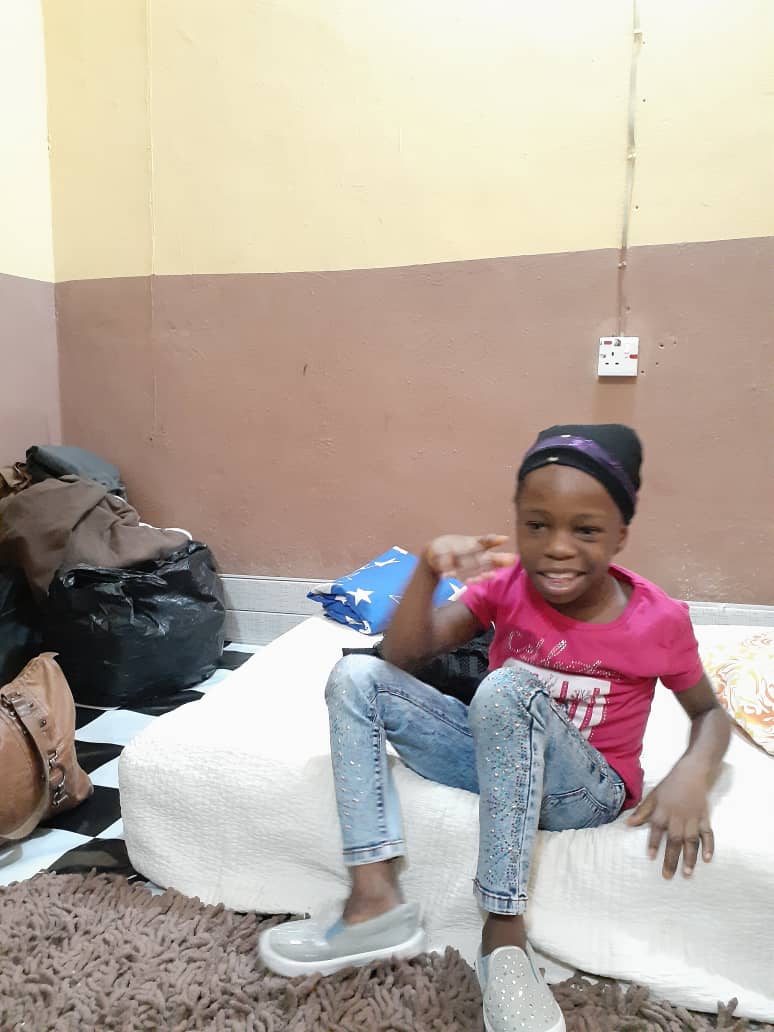
Atika is 9-years-old and suffered cerebral palsy at birth. She cannot walk, talk or feed herself and is 100 percent dependent on others.
‘Atika brings me joy, I love her so much,’ says her father Abdu Source-Abdu Abulkadri
For her father, Abdu Abdulkadri (43), the most difficult challenge during the pandemic is getting her medication due to a lack of income and finances to purchase them. Abdulkadri, has sustained his family doing odd jobs since he has been unable to secure a permanent job.
With the pandemic and no income, Atika’s physiotherapy sessions have been suspended. He worries that without them, her seizures will return.
“She has been sick for the past three days, but it is only malaria. Thank God,” he heaves a sigh of relief.
The father of two fears that her seizures will return because he is unable to afford her medication which on a normal day cost him N30, 000 to buy only the essential ones monthly.
Atika in pink with her mum and sister Source-Abdu Abulkadri
On the other end of the line, our reporter could hear the cheerful babble of an impatient Atika, who was eager to get on the phone like her father, to also have her voice heard. This was a pressure her father gladly succumbed to, to let her have her full minute of gleeful say of repeated, “fine” between heart-warming chortles.
Currently being without an income, even as an Economics graduate, means there is very little Abdulkadri can do for Atika whom he repeatedly referred to as “my lovely child, my beautiful daughter.”
Abdu’s relief was however short-lived. Three days after speaking with our reporter, Atika went into seizure which her parents are now treating traditionally with a combination herb.
Communication and non-communication
The United Nations Secretary-General, António Guterres, in his April 16 statement on the effect of the COVID-19 pandemic on children, urged governments, donors and the world at large to “prioritise the most vulnerable – children in conflict situations; child refugees and displaced persons; children living with disabilities.”
The United Nations says, one in 10 children is a child with disability Source – un.org
This call seems to have fallen on deaf ears.
Around the country, mainstream and social media as well as other outlets, are awash with public education pieces about the virus and what people need to know about COVID-19 and how to protect themselves. They include adverts, drama skits, syndicated messages by the NCDC, radio jingles and bill boards, among others.
But in all this, there is none targeting children with disabilities, beyond the sign language interpreter stationed in the background, during the Presidential Task Force briefings.
An April 17, YouTube video, anchored by Lois Auta, Chairperson and CEO of the Network of Disabled Women, calls for the inclusion of relief materials for persons with disabilities. In the 10-minute video, Auta said, “we want to see persons with disabilities have access to information, communication and technology, relief materials and humanitarian materials as organisations of persons with disabilities are funded to fight this pandemic, and persons with disabilities being part of the Presidential Task Force.”
While the video is worded to advocate for persons with disabilities, it seems to only focus on persons with albinism, the blind, deaf and those on wheelchairs.
Constance Onyemaechi, who suffers with albinism, ends the video calling on the government to help, “People with disability like me, and those on wheelchair” to access healthcare. For some reason, the likes of Ahmed, Atika, Sandra and Dan’s son, are not covered in the advocacy.
Boss Mustapha, Secretary to the Government of the Federation and Chairman of the Presidential Task Force on COVID-19 spared a thought for the disabled, at a briefing on Monday, May 11.
While confirming that states have been encouraged to set up isolation centres, wards and ICUs, each with at least 300 beds for levels one and two cases, Mustapha said, the rise in cases was causing bed shortages in isolation centres, especially in the high burden areas.
He said, “We are conscious of the need to take care of different categories of persons e.g. People living with disabilities, terminal conditions and other underlying factors / co-morbidities.”
A convention and the Child’s Right Act
On March 30, 2007, Nigeria signed the United Nations Convention on the Rights of Persons with Disabilities. On September 24, 2010, Nigeria gave a formal confirmation, ratification and assented to the Convention.
Article 7 Sections 1 and 3 of the Convention enjoin States Parties to, “ensure the full enjoyment by children with disabilities of all human rights and fundamental freedoms on an equal basis with other children” and that, “their views being given due weight in accordance with their age and maturity, on an equal basis with other children, and to be provided with disability and age-appropriate assistance to realize that right.”
Although Nigeria is one the 161 signatories to the Convention and its Optional Protocol, Bar Kola Ogunbiyi, Programs Manager at the Centre for Citizens with Disabilities, said, Nigeria has not lived up to the expectation of this Convention and has not complied with international best practices.
He said, “Nigeria has ratified the Convention but is yet to domesticate it. If you ratify without domestication, the enforcement of that convention is in variation with the provision of Section 12 of the 1999 Constitution which provides that, ‘any international agreement needs to be domesticated for its enforcement in Nigeria.’
Section 13 Subsection 1 of the Child Rights Act, provides that every child is entitled to enjoy the best state of physical, mental and spiritual health. According to Subsection 2, every government, parent, guardian, institution, agency, organization or body responsible for the care of a child shall endeavour to provide for the child the best attainable state of health.
On how Nigeria is doing regarding children with special needs during the pandemic, Ogunbiyi said, “the Right to health includes prevention and awareness campaign, access to health services.
“From the awareness creation, there is no particular awareness campaign that is targeted at persons with disabilities. Secondly, if you are looking at children, one would have expected that you look at a campaign that is attractive to children and interesting to watch. Things like animations and cartoons that will draw the attention of children so that they can be carried along with the campaign.”
When social service et al, are not so social and serviceable
There is also the question of the state of social services and social workers in Nigeria.
Samuel Omoi is a trained social worker and Head of Programs at Christoffel Blindenmission (CBM), a leading organisation in disability-inclusive development. He said, there is not much being done regarding social service for children with special needs during the pandemic, for two reasons.
Omoi said, “Many of them in institutions are back home with their families. The challenge would be following up on their wellbeing to ensure they are doing well. For those in institutions like orphanages, the response would be to find out what such homes are doing regarding children with disabilities.
While he says social workers are doing their best at the moment, he however, admits that “the preparation to respond to the pandemic was not there. There is a huge gap. A lot of this has to do with funding and if there is no funding nothing much can be done.
“Our preparation was not what it should be. The major challenge was that there was no fund to do what we should have been doing. And when there is no fund, you can at least provide information.”
Omoi said, this information is being disseminated via social media platforms. For families like the Adbukadris, this is beyond their reach as their current financial status makes purchasing internet data an absolute luxury.
Regardless, Auta’s call seems to have had some impact in the Federal Capital Territory (FCT). She is now one of the members of the FCT Persons with Disabilities Committee on COVID-19 Palliative inaugurated on 27 April 2020 by the FCT Minister of State, Hajia (Dr) Ramatu Tijjani Aliyu.
The committee also received 3,000 packs of food items including a 5kg bag of rice and a bag of condiment which contains 3kg of beans, 3kg of garri, a sachet of semovita, a sachet of salt, 10 sachets of tomato paste, five sachets of Power oil, 10 cubes of Maggi, and a sachet of sugar. These were distributed to people living with disabilities across the six area councils of the FCT with tens of thousands of disabled people.
Auta admits that, “we still have so many PWDs we could not reach.”
The Minister of Ministry of Humanitarian Affairs, Disaster Management and Social Development, Hajiya Sadiya Umar Farooq on May 9, supported disabled people in Karmajiji with 1,000 palliatives and has promised to reach out to 3.1 million of them, nationwide.
The forces are not with them
Rafat has done all in her power to ensure Ahmed has the best during the lockdown, but there is a lot not in her control.
She says, “We are missing out nearly completely in learning. He needs online materials. I need a system, electricity and internet. We both know the state of electricity in the country. This was worsened with my system crashing. We are unable to go online to access the resources we need. What we are doing at the moment is to revise some of the paper lessons we have so that he doesn’t get bored.
With social distancing now a recommended lifestyle, Rafat is glad that she has over the years learned to help Ahmed with physiotherapy but admits that, even though she can manage for now, there is still need for expert care.
In all of this, Rafat’s greatest worry is his medication.
She said, “We are already running low and we need to stock up. We are trying to raise funds for this. I am hoping that the pandemic is put under control so that production lines can open again. So, we can have our medications available. If production lines don’t open and the medicines are not produced, it means we won’t have them. If they are able to produce the medicines, but we are unable to import them, that would be a problem. I am already buying them at a higher cost. I see that even if it will be available, the price will increase. That wouldn’t be my major worry. My worry would be how I will get it.”
At as at May 15, Rafat said the medicine is no longer available in Abuja and she is trying to source it from Dubai where it was originally prescribed.
What is government doing?
Our reporter contacted an official at the Ministry of Health for comments about what the Ministry is doing regarding intervention for children with special needs during the pandemic and lockdown.
She responded to our reporter’s text message, asking for a physical meeting with our reporter at her office. Our reporter responded to this, letting her know that due to health reasons she would be unable to make it to her office and suggested a phone interview. The official neither responded to this message nor took subsequent calls from our reporter.
However, insiders told our reporter there was no plan for these children with special needs at this period of the COVID-19 pandemic.
Nigeria’s ‘Saving One Million Lives Programme for Results’ (SOML-PforR), is one that the WHO describes as “an elaborate scheme to expand access to essential primary health care services for women and children.”
Dr. Ibrahim Kana, the National Programme Manager said, “The Programme works in such a way that funds are provided to states as grants, and have been provided to cater for the poor and needy, including women and children with disabilities.”
Speaking on what specific funds are available for children with special needs and how they are accessed, Kana said, “the funds basically cover their basic Medicare, such as malaria, pneumonia, diarrhoeal diseases, ante natal, delivery and all immunization packages.”
He added that, “The funds are domiciled in the state ministries of health and [are] very easy to access. For states that have their contributory health schemes in place, that creates an easy entry for such categories of people.”
Responding to a question about any special arrangement under SOML-PforR for children with special needs during this pandemic, Kana said, “Remember that every citizen in Nigeria belongs to a state, the Federal Government doesn’t have any citizen. What the Federal Government does through its ministries, like mine, Health, is to develop policies and provide access to funds and funding to the states. Each state is to develop programmes that will address the needs of its people, which includes people with special needs.”
Rafat, who covered the health beat and also the launch of this programme, said as far as she knows, the project targets maternal and child health.
She explained that, “Your entry point as a mother is through antenatal. The project covers you and your child for basic health needs until the child is about two years. It is not a project that covers the child forever because you exit it at some point. What then happens to a child with special needs he/she exits the program?”
A challenge beyond Nigeria
This is not a problem that is unique to Nigeria. A report by the Canadian Broadcasting Corporation said, families supporting children with disabilities, feel forgotten.
In the report, Robin Acton, who lives with her adult daughter, who has Down syndrome, and her husband, who uses a wheelchair, complained about Alberta’s COVID-19 response.
She said, “As families who are supporting our sons and daughters with disabilities, who live with us in the community — we feel forgotten. We’re not even on the radar.”
Trish Bowman, CEO of Alberta Inclusion which advocates on behalf of children and adults with developmental disabilities and their families, said, it has become clear that people with disabilities are not being well-considered in the response to COVID-19 and that it needs to change.
Also, the March 16, update of the Australia and New Zealand’s Intensive Care Society (ANZICS) guidelines for doctors, admits that there may be difficult decisions made as the pandemic peaks.
Professors Helen Dickinson and Anne Kavanagh observe that, the guideline which recommends for doctors to make decisions based on the probable outcome, whether people have underlying health conditions, and the “burden of treatment” for the patient and their family does not, at any point, mention people with disabilities.
They pointed out that, “Evidence for previous pandemics shows that health inequities worsen during epidemics as more marginalised communities have fewer resources (financial and social) and struggle to access necessary supplies and services.
“On top of this, health information is rarely presented in an accessible format for children and adults with intellectual disabilities, such as Easy English (a style of writing that’s simple and concise) and/or pictorial formats.
While addressing support for vulnerable populations in the third chapter, it encouraged, “Work with social service systems to ensure continuity of critical services that may take place in schools such as health screenings, feeding programs or therapies for children with special needs.”
UNICEF also said, “Consider the specific needs of children with disabilities, and how marginalized populations may be more acutely impacted by the illness or its secondary effects.”
But under current provincial rules, AISH recipients who lost part-time wages due to COVID-19 are not entitled to a federal top-up.
Following calls by the Self Advocacy Federation and by Marie Renaud, a legislator and the Opposition critic for Community and Social Services, there is now an ongoing review in Canada on decisions the government made regarding the treatment of the Canada Emergency Response Benefit for those receiving AISH and Income Support. The government is also working closely with the disability community to address concerns and assist in understanding and following directives.
Dickinson and Kavanagh stress that, “people with disabilities must not be de-prioritised. At a time when there is unprecedented demand for health services, we need to ensure people with disability don’t miss out.”
As a way of resolving the ‘oversight,’ Bowman said, “We’re having to actually walk things back and try and fix them rather than being included in the upfront planning. We feel pretty invisible.
Against this backdrop, it is very important that at all levels, all arms of government must do more than the nominal acknowledgement of the conditions of people with disabilities especially parents and their children.
Faith-based organisations, NGOs and civil society groups must continue to put pressure on government to pay greater attention to this situation.
If, as we say, it takes a village to raise a child, it will have to take a whole country to raise a child with disabilities and to reverse this sad situation.
This report was facilitated by the Wole Soyinka Centre for Investigative Journalism (WSCIJ) under its COVID-19 Reality Check project.
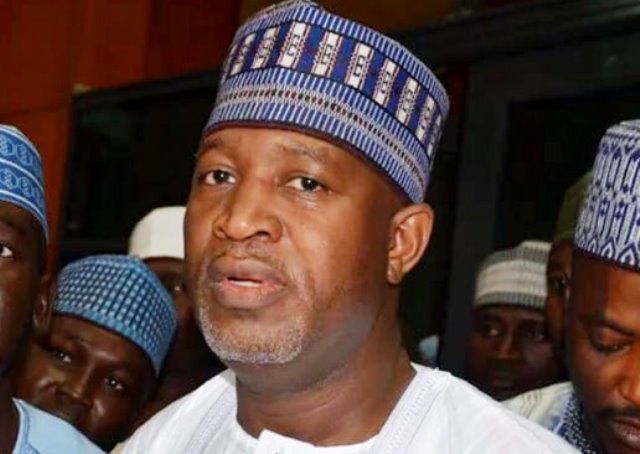
HADI Sirika, the Aviation Minister on Monday apologised to Nigerians about a wrong claim he disseminated via his social media handle on an impounded United Kingdom (UK)-based airline, barely 24 hours after a fact check by the International Centre for Investigative Reporting (ICIR).
The minister corrected himself saying contrary to his earlier statement about the identity of the operator which he mentioned as Flair Aviation, the impounded aircraft was actually Flairjet.
He attributed the error to the on-going Ramadan fast.
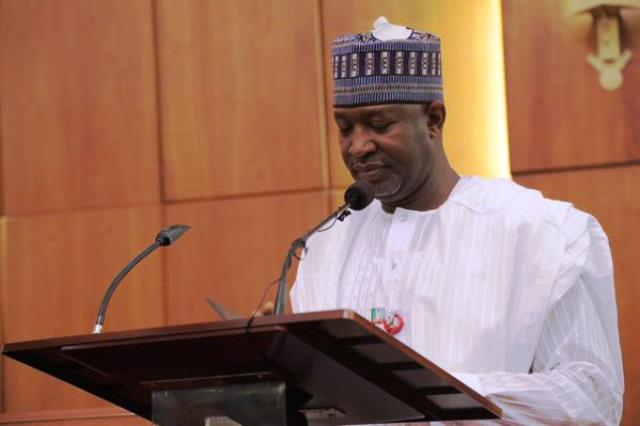
“There is a company called Flairjet. I want to apologise that I tweeted in the afternoon (on Sunday) when the fasting was biting harder and we verified this as Flair Aviation. The correct name is Flairjet and it is UK registered company,” Sirika said at a briefing by the Presidential Task Force on Coronavirus Disease (COVID-19), Monday in Abuja.
He explained further that the airline has an aircraft, Legacy 600 with registration number GPRFX.
The Minister gave the operator’s business address as Business Aviation Centre, Terminal Road, Birmingham International Airport, West Midlands. The code was listed as B26QN.
The ICIR had earlier fact-checked Sirika’s claim regarding the purported base, identity of the aircraft and realised the information was inaccurate.
Further findings through the UK Civil Aviation Authority database of licensed airline operators did not also reflect the airline (Flair Aviation) listed by the Minister but Flairjet – the newly corrected airline.
He further criticised the operator for defying its contractual agreement with the Federal Government to embark on commercial flight operation, thus charging passengers and flying people in and out of the country.
“This company applied severally as to operate humanitarian flight and we did approve. It is very clear at the beginning of this exercise that we defined what those flights should be: essential flights basically – cargo, medical evacuation, medical supplies, and so on and so forth,” Sirika added.
He said the crew who are British nationals have been subjected to 14 days quarantine while the investigation continues.
THE World Bank lead economist for Nigeria Marco Hernandez has said in a Quartz Africa report that Nigeria’s problem isn’t debt, it’s about servicing the debt.
According to the World Bank, Nigeria’s debt-to-Gross Domestic Product (GDP) ratio has been a relatively healthy 17.4 per cent, below the sub-Saharan Africa average of 28.7 per cent.
The quartz report showed that oil is the only significant revenue source when gauging Nigeria’s ability to make debt repayments and it goes beyond just the oil industry.
Recently the federal government considered using an old idea to fix a new problem by reducing the sizes of government agencies by scrapping merging agencies that have duplicate functions.
For ordinary Nigerians and business people, one of the earliest signs of an economy going south is the travails of Nigeria’s currency, the naira, the report has revealed.
According to the report, the Central Bank of Nigeria (CBN) has managed the naira with multiple values versus the dollar, depending on who’s buying foreign exchange which has not truly revealed the value of the currency.
Also, Nigeria’s economy needs the private sector to grow to be as big as the public sector for us to lift people out of poverty and create jobs, the report revealed.
Makinde Ashade a Senior Investment Analyst at Magnartis Capital who spoke to The ICIR said “Cutting our spending is very crucial at this point of debt servicing, all the sophisticated lifestyle we can no more afford again.”
The report showed that the need for an economic course correction, through broad and consistent investment in other sectors, is necessary as Nigeria faces a global crisis that is eating up its oil-dependent economic model.
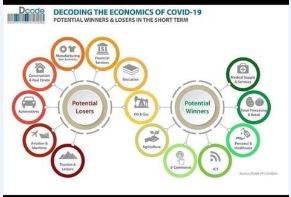
THE COVID-19 pandemic has shown a lot of positive and negative impact on different sectors of the economy, throwing up potential winners and losers in the period of the pandemic.
Different sectors have been on standstill since the outbreak of the pandemic for example schools have been shut down for more than eight weeks.
The aviation sector has also been grounded for more than eight weeks, this is part of the short term losers of the pandemic.
According to financial analysis represented through the infographics below, some of the potential winners include medical supply and services, food processing, health care, information communication technology, e-commerce and agriculture.
Medical supply and services
The Central Bank of Nigeria (CBN) has earlier released funds for this sector provided additional N100billion intervention in healthcare loans to pharmaceutical companies, healthcare practitioners intending to expand/build capacity.
New health care facilities have emerged and benefited from the intervention funds released by the CBN, health sector continued business because they are the lifesaver during the pandemic and adequated funds have been released to them to expand.
Food processing
Funds have also been released to the general manufacturing sector providing N1 trillion in loans to boost local manufacturing and production across critical sectors over the country.
The federal government has also introduced FarmerMoni loans to assist farmers with soft loans to help them stay in the business and provide for the demands.
Information communication technology (ICT)
It’s no news that offices and most organisations have been on shut down to reduce the impact of the pandemic so meetings have gone virtual which involves constant buying of data through service providers.
Microsoft is an obvious beneficiary here, it announced that the number of daily active users for its teams’ collaboration suite increased by 12 million, though there are many others who are financially better off also.
Zoom video communications, a remote conferencing services company headquartered in San Jose, has seen share price increase 130 per cent since the beginning of the year.
E-commerce
Online shopping has been reported to have speedily risen during the period of the pandemic, people ordering for items rather than physically shopping.
According to a new “Global Shopping Index” report published by Salesforce, the number of unique digital shoppers rose 40 per cent year-over-year (YoY).
Digital shoppers drove 20 per cent revenue growth compared to 12 per cent in Q1 2019.
Agriculture
The CBN has also released part of the palliatives to cushion the effect on the agricultural sector, it also placed a moratorium on all government-funded loans issued by the Bank of Industry, Bank of Agriculture and the Nigeria Export-Import Bank.
President Buhari has directed the minister of agriculture and rural development, the national security adviser, the vice-chairman, national food security council.
The chairman, presidential fertiliser initiative to work with the Presidential Task Force on COVID-19 to ensure the impact of this pandemic on our 2020 farming season is minimized.
The infographics pointed out the potential losers which included tourism and leisure, aviation, construction and real estates, financial services and education.
Tourism and leisure
The COVID-19 pandemic has had a significant impact on the tourism industry due to resulting restrictions as well as a slump in demand among travellers.
The United Nations World Tourism Organization estimated that global international tourist arrivals might decrease by 20–30 per cent in 2020, leading to a potential loss of US$30–50 billion.
Aviation
Even with the global drop in the price of oil which is supposed to be very beneficial to the aviation sector, due to the closure of borders all over the world and grounding of flight movement, the aviation sector has recorded a massive loss in the business due to the pandemic.
According to the International Air Transport Association (IATA), the region’s airlines could lose $6 billion of passenger revenue compared to 2019. That is $2billion more than was expected at the beginning of the month.
Job losses in aviation and related industries could grow to 3.1 million.
Full-year 2020 traffic is expected to plummet by 51 per cent compared to 2019 with the previous estimate was a fall of 32 per cent.
Gross Domestic Product (GDP) supported by aviation in the region could fall by $28 billion from $56 billion with the previous estimate was $17.8 billion.
Construction and real estate
The construction industry in Nigeria and the world over is currently in a trying time no thanks to COVID-19 pandemic which has crippled all human activities including building and construction, Kunle Awobudu, President, Nigerian Institute of Building (NIOB), has said.
This, indeed, is not the best of time for an industry where, Awobudu noted, work is determined by man-hours.
“The lockdown and sit-at-home order by the government means everybody is idle.”
Many projects have been suspended and that means we are wasting man-hours; when you are wasting man-hours, you will feel uncomfortable,” he said.
The NIOB president noted that both the industry and economy are losing much as a result of the lockdown.
Financial services
According to TATA consultancy services, a financial institution, the COVID-19 pandemic could be one of the most serious challenges faced by the financial services industry in nearly a century.
The COVID-19 impact on banking will be severe fall in demand, lower incomes, production shutdowns and will adversely affect the business of banks.
The situation is exacerbated by staff shortages, inadequate digital maturity, and pressure on the existing infrastructure as firms scramble to deal with the impact of COVID-19 on financial services.
Education
According to the United Nations Educational, Scientific and Cultural Organization (UNESCO), most governments around the world have temporarily closed educational institutions in an attempt to contain the spread of the COVID-19 pandemic.
These nationwide closures are impacting almost 70 per cent of the world’s student population.
Several other countries have implemented localized closures impacting millions of additional learners.
UNESCO is supporting countries in their efforts to mitigate the immediate impact of school closures, particularly for more vulnerable and disadvantaged communities,
And to facilitate the continuity of education for all through remote learning.
Inbetween winning and losing
Volatility has always been a challenging element of the oil and gas market but has rarely been more extreme than it is today.
COVID 19-led disruptions to demand, combined with its dramatic impact on financial markets, have led to rapid price swings.
Nigerian consumers have benefited from the drop in the global oil price which has translated to buying petrol at a cheaper rate from N145 to N125.
Petroleum Products Pricing Regulatory Agency’s (PPPRA) is officially empowered to regulate the price of petroleum prices in the Nigerian National Petroleum Corporation (NNPC) which would be beneficial to citizens.
TROOPS of the Nigerian army have reported killing twenty Boko Haram terrorists on Sunday in a fierce encounter at the northwest of Baga town of Borno State.
In a press release by the Nigerian Army headquarters, nine soldiers were said to have been wounded in the operation carried out by the troops of Operation Lafiya Dole in a decisive intercept offensive operation. The troops of the 130 Battalion had support from the Army Super Camp in Baga.
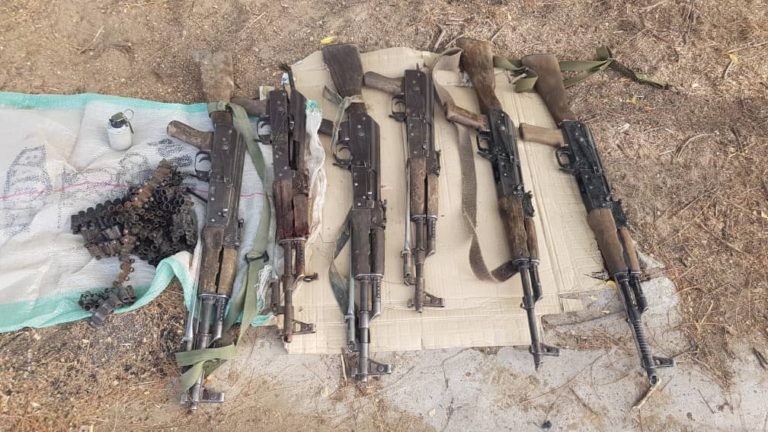
The criminals said to have been armed with mortars, rocket-propelled grenades and small arms were heading to attack villages surrounding Baga, when the troops attacked their convoy with overwhelming firepower killing 20 BHT/ISWAP criminals and captured 6 AK 47 Rifles, 520 rounds of 7.62mm special ammunition and five 36 hand grenades.
However, the statement signed by John Enenche, Major General Coordinator Defence Media Operations revealed that the wounded men were evacuated to Sector 3 hospital for treatment.
The Chief of Army Staff also commended the gallant troops for their professionalism and directed them to remain resolute towards eradicating the criminals from the North East.
THE National Youths Service Corps (NYSC) has said that it has no intention to mobilise prospective corps members anytime soon, especially as the country is still grappling with the coronavirus pandemic.
The Director-General of the Scheme, Brig. Gen. Ibrahim Shuaibu, who made this known in an interview with the Economic Confidential, said they don’t know when they will mobilise corps members again.
Gen. Shuaibu, said the management will only organize fresh orientation exercise the moment the coast becomes clear, and they receive the green light from relevant authorities.
The DG, noted that the Batch A, Stream 1 corps members who were already camping, but had to be hurriedly dismissed due to the outbreak of COVID-19 in the country, will be recalled back to their various orientation camps to complete the remaining part of the training.
Hear him: “We don’t know when we are going to start mobilizing our corps members. You know our training is also structured like that of the military and paramilitary. You can see that the Nigerian Navy recently suspended its training for its freshly recruited cadets.
“So, the moment the coast is clear, we are going to key into the way others will conduct their exercise so that our corps members can be called back soonest.”
General Shuaibu expressed delight over the success story of the Scheme’s Skills Acquisition and Entrepreneurship Development (SAED) programme and the plan to generate revenue from the creative ingenuity and productivity of corps members.
He said: “The SAED programme has recorded tremendous successes, which can even be seen from the activities of our corps members in the fight against the COVID-19 pandemic. Our corps members, nationwide, produced face masks, sanitizers, disinfectant tools, and automatic sanitizing machines. They are also involved in the sensitization and distribution of palliatives of some of these items to communities.
On the plan to commercialise some activities in the scheme for internally generated, NYSC boss disclosed that when he realised that many people saw NYSC as a burden, the management rejigged the scheme’s ventures to find ways to generate and bring ‘something’ to the table.
“We now have NYSC bread and Table Water Company in Kubwa. We want to see how we can replicate the same in the States. So that during orientation exercises we can get these items from our production plants, and feed our corps members in camps.
“Some of our Corpers are into fish and snail farming in NYSC farms. We want to embark in commercial farming of rice. We want to key into the Federal Government’s policy on local content on agric business. This is because we don’t want to be a burden on the government. Therefore, we must continue to look for ways to internally generate our revenue.”
Read the full interview here: https://economicconfidential.com/2020/05/nysc-youth-revenue-shuaib-dg/
CONTRARY to claim by Hadi Sirika, the Minister of Aviation that the “impoundedFlair Aviation” is a United Kingdom (UK) -based chartered aircraft, findings by The ICIR has shown that the airline’s operation base is in Germany.
The ICIR can also authoritatively report that the erring airline is not Flair Aviation as announced by the minister, but Flair Jet Limited, an airline company headquartered in the United Kingdom.
Flair Jet Limited, founded in 2008, offers private jet charter, pilot training, aircraft acceptance, and management services. Flairjet serves customers in Europe.
“Flair Aviation, a UK company, was given approval for humanitarian operations but regrettably, we caught them conducting commercial flights…,” the Minister had stated.
The ICIR checked through the list of licensed airline operators by the UK Civil Aviation Authorities (CAA) but Flair Aviation was missing in the three categories of license holders. The only airline operator that appeared close is Flairjet limited but again, it has a different corporate logo and also based in Oxford, UK.
But, several media organisations have reported Flair Aviation as a UK airline operator.
However, the Aviation Minister had earlier expressed disappointment at the airline for flouting the special flight arrangement it had with the federal government.
He said the airline was given approval by the federal government for humanitarian operations but was caught conducting commercial flights.
He thereafter threatened that a maximum penalty would apply.
“…This is callous! The aircraft is impounded, the crew being interrogated. There shall be the maximum penalty. Wrong time to try our resolve, “Sirika tweeted via his official handle on Sunday.
Moreover, it was gathered that the aircraft was chartered to evacuate foreign nationals out of Nigeria, but rather than stick with the agreement, it flew more passengers for commercial purposes.
As a result, the aircraft was impounded while its crew members are currently being interrogated.
The airline operates a fleet of Boeing 737-400 aircraft that is capable of conveying up to 156 passengers. Aside, it also operates on behalf of other Canadian airlines.
Meanwhile, the Nigerian Civil Aviation Authority (NCAA) on 23rd March 2020 placed a restriction on flights into Nigeria for an initial one month as measures to curb the Coronavirus disease spread(COVID-19).
Following the one month completion, the airport closure was extended by two weeks.
On 6th May, Boss Mustapha, Chairman of the Presidential Task Force on Coronavirus Disease (COVID-19), announced an extension by another four weeks.
OUR ERROR: The ICIR had previously reported that Flair Aviation is based in the United Kingdom. Our subsequent check has shown that this information is incorrect. Flair Aviation is based in Germany. We have also noted that the erring airline is not Flair Aviation, but Flair Jet, a UK-based airline. We have corrected these errors and updated the report. We regret the errors and apologise to our readers.
FOR Steven, 28, and Chinonso, 26, both sons of late Eze Solomon, Sunday, May 10 will forever remain a dark, haunting day in their memories.
It was the day life was snuffed out of their 68-year-old father by a police officer at Ereke junction in Karimo area of Abuja.
Nothing is more surreal to them now than the sudden end of their father, because there was no inkling early in the day that the man who just concluded a three-day dry fasting and requested for food was about to die.
Before the tragedy struck, the late father of six had in the morning held a house fellowship with members of his church, The Overcoming World Assembly, in his apartment.
He waited till the evening for his first son, Steven, to bring him food to end the three-day dry fasting.
Solomon never lived to eat the food.
Monday Chukwu’s arrest, Solomon’s death
In the evening of that fateful Sunday, a group of six police officers – some dressed in mufti, others in police bullet proof vests and an informant – had arrived at Karimo to arrest some traders.
The officers were believed to be operatives of Special Anti-Robbery Squad (SARS), though it later turned out that they were from the FCT Anti-One Chance Squad who were carrying out random arrests of some criminals. They came in the company of an informant who goes by the name Lucky but is popularly known as Confusion.
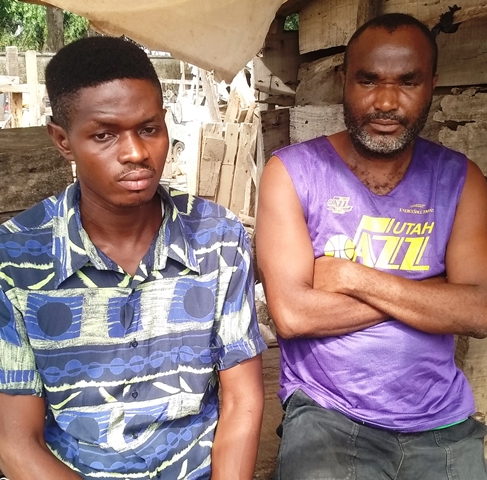
It was the arrest of Monday Chukwu, a fashion boutique owner by the operatives that led to Solomon’s death. Chukwu says he was pinpointed by Confusion before the operatives came to his shop to arrest him.
“I was at the shop on Sunday at about 17:30, that’s 5:30, when some cars parked in front of the shop. I was thinking that they were customers,” he said.
“Three men came down from the car with sticks in their hands. I was asking them to come and check from me but when they got to my place, they held me by the waist, holding my trousers and asked me to close my shop.”
Then, Chukwu said, three policemen with guns, wearing bullet proof vests emerged from another car.
“They said I should pack my stuff. There and then, they started hitting me with their sticks that I should pack.”
While he was being forced into the car, Chukwu insisted that he wouldn’t go into the car and that he should be taken to a police station instead.
Chukwu said he asked Confusion why he implicated him. This was when a crowd had gathered to intervene, asking the police operatives to take him to the station.
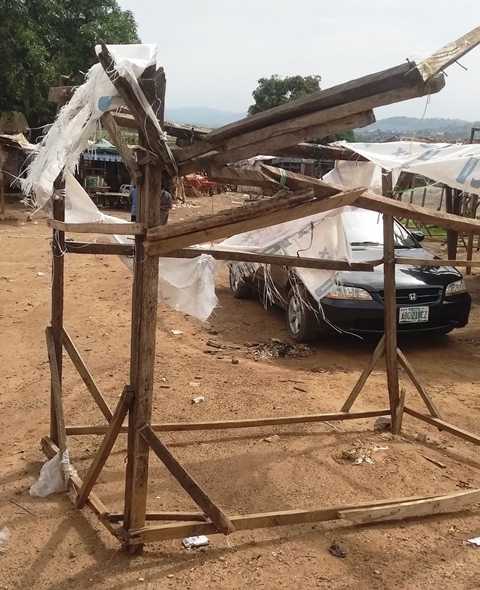
Amid the crowd was late Solomon who was returning from where he had gone to check his shop which had been brought down by a rain storm the previous night.
The late Solomon’s stall that he went to check before his untimely death
He intervened as an elderly family friend of Chukwu’s, asking that he be taken to the nearby police station instead of SARS headquarters, but he paid the supreme price when the leader of the squad ordered one of his boys to do ‘his work’.
The late Solomon, who sold fairly used clothes and bags at the Ereke junction, was shot straight in the head and died instantly.
“During the process, one of the officers, that’s their boss, came down from the car and said, “ don’t they know their work, they should take action now,” Chukwu told our reporter.
“He brought out his gun and faced the direction of people arguing that they should take me to the station and shoot at one man there. He shot him directly into his eye.”
After the shooting, the leader of the squad, eyewitnesses told The ICIR, zoomed off in his car while his boys forced Chukwu into the second car.
He was not taken to any police station. Rather, Chukwu says he was dropped off along Airport Road after the operatives took N15,500 from him and without telling him his offence.
“At the Airport road, the boss said that they should release me because the guy ‘Confusion said I don’t have anything to do with him.”
“They returned my phone but went away with my money, a sum of N15, 500, and left me in the middle of the road.”
Distraught sons call for justice
Steven Eze and his uncle, Chukwu, want justice after the death of Solomon. Photo Credit: YEKEEN Akinwale
Steven and Chinonso are heart broken. So is their mother, who lives in the village in Anambra State, and the rest of the family.
“I’m totally confused,” Steven told The ICIR looking downcast, .
“I’m still in shock because the whole thing happened like a film to me. I only saw my father and the next ten minutes, they called me that my father was shot.”
Chinonso said he was at home when he got a call that his father was shot dead.
“I was at home when someone rushed in to inform me that SARS shot my father to death.”
“When I got there I saw my dad lying lifeless in the pool of his blood. I rushed to Karimo Station and made a complaint there. The police came with a Hilux and took him to the mortuary.”
After the incident, a group of elders in Karimo, including leaders of Igbo community as well as its AMAC Vice Chairman, Lawrence , Maxwell Okpara , who is also a human rights lawyer, came around to see the family of the deceased.
According to Steven and Chinonso, the elders assured them that justice would be done. But they have fears that their father may die in vain in spite of the assurances given to them by Bala Ciroma, FCT Commissioner of Police.
“On Tuesday, we went to the Commissioner of Police office at Garki 2. We met him and he assured us that justice would be done. He told us that the man who shot my dad has been arrested and is in police custody,” Chinonso said.
How ‘Confusion’ has been implicating innocent traders
Traders at the market say the police informant, whom they know as ‘Confusion’, has over the years been implicating innocent traders with the police.
A trader who once fell victim of his act narrated his experience to The ICIR.
“ Confusion comes around Karimo and Dape. His real name is Lucky.” said the boutique owner who did not want to be named for security reasons.
He was arrested right inside his shop by operatives of SARS after he was pointed by ‘Confusion’, alleging that he had bought a stolen phone from him.
The trader said he “paid through his nose” to bail himself after he was taken to the detention facility of SARS at Abattoir area of Abuja.
“ This is not the first time they are doing something like this. Last two years, they came to my shop and arrested me for no reason,” he said.
“I spent N110,500 to bail myself for what I did not do. I was taken to Abattoir. They alleged that I bought a handset from him while I did not buy anything from him. They found nothing on me. I bailed myself that very day. They took my home theatre and never returned.”
We are investigating the matter, police will be transparent— Manza
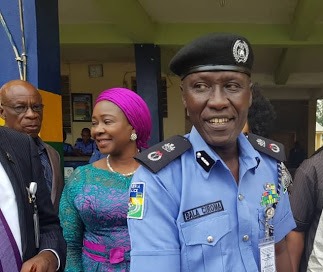
Bala Ciroma, Commissioner of Police, FCT Command. He promises justice would be done
Anjuguri Manza, FCT Police Public Relations Officer, said the the matter was being investigated.
“Investigation is ongoing on the matter, the command commiserates with the family of the deceased and promises to make its findings public. The command also promises to be transparent in its investigation of the issue,” Manza says.
He confirmed to The ICIR that the officer who shot the deceased has been identified and arrested, noting that the command issued a statement to that effect.
The police spokesperson declined comments on the identities of the officers involved and what punishments await them if found guilty.
Maxwell Okpara, a human rights lawyer who has been following up on the case, also confirmed that the principal suspect has been arrested, alongside the leader of the operation.
“They are now in police detention now,” Okpara said.
“Police are doing investigation. They open two separate investigations for the matter. One is for the operation they went for; whether the operation was authorised or not was being investigated and the other is the investigation into the actual killing. On Friday when I went there they even brought them out. That is the stage we are now,” the human rights lawyer added.
The family of the deceased is concluding plans to apply for autopsy to be carried out after which the body can be released for burial while police investigation continues.
A police source confided in The ICIR that the police would conclude investigation next week and submit a report so that the officers can go for guard room trial.
After the trial, if found guilty, hey will dismiss them and hand them over for prosecution, the source said.
Okpara said he was convinced that the family of the deceased would get justice, saying “ they are doing what they are supposed to do.”
“If the family likes they can now sue the police because the officer did not come on his own, he did not commit the offence as a person, he committed the offence as a police officer. The police cannot run away from the liability.”
The lawyer said he and others would continue to follow up with the case noting, however, that the police would not want to mess up because the case is a straightforward matter.
“It is not as if they were looking for who shot the deceased. The officer never denied that he shot and the purpose of the autopsy is if the matter is going to court,” he said.
“He shot the man, the man was not fighting him, the man was not an armed robber. He came when they wanted to arrest the young man,” Okpara explained.
Police in Nigeria commit extrajudicial killings, torture, rape, and extortion with relative impunity, says Open Society Justice Initiative.
In a report, Criminal Force: Torture, Abuse, and Extrajudicial Killings by the Nigeria Police Force, the civil society group noted that Nigeria Police Force personnel routinely carry out summary executions of persons accused or suspected of crime; rely on torture as a principal means of investigation; commit rape of both sexes, with a particular focus on sex workers; and engage in extortion at nearly every opportunity.
The Nigerian government has acknowledged these problems and promised to address them in the past, but to date, abuses have continued with no real accountability.
It says Nigeria’s leadership must pay serious attention to police reform if it hopes to succeed in restoring public safety.
The outbreak of COVID-19 has brought drastic changes to the lives of peoples and nations across the world as they are forced to adapt, creating various forms of safety nets for the poor and vulnerable.
This is because while many can try to navigate through current realities, the poor and vulnerable groups, especially those living with disabilities, or affected by natural disasters, armed conflicts, among others, are the worst hit by the global pandemic.
In this category are Internally Displaced Persons (IDPs) whose lives were already torn apart as a result of the ravaging Boko Haram terror campaign in the North-East of Nigeria.
Over the years, thousands of families and households have been forced out of their communities and fled to find succour in other peaceful parts of the country.
For months and years, they have been managing their lives and adapting to a sad situation they did not cause or had any control over. They huddled in dingy camps and struggled with government neglect and insufficient care by the authorities.
The able-bodied ones and breadwinners daily eke a living to provide food while everyone battled with inadequate supply of water, sanitation and health services, among others. But coronavirus has come to make things worse.
Presidential pronouncement of hope…
With the unprecedented outbreak of the novel coronavirus and the various lockdown measures introduced by authorities to curtail the spread, little life support hangers IDPs clung unto, have become severed. Like it is for millions of citizens, sources of daily livelihoods were cut off and hunger, stress and distress stalked mercilessly. A previous report by this newspaper revealed how IDPs were trying to cope during the lockdown.
However, with President Muhammadu Buhari’s broadcast on March 29, 2020, came some hope as he announced that help would be coming the way of the displaced persons through distribution of relief items and palliatives to cushion the dire effects of the pandemic on them.
“For the most vulnerable in our society, I have directed that conditional cash transfers for the next two months be paid immediately. Our internally displaced persons will also receive two months of food rations in the coming weeks”, Buhari said.
Hope deferred…
But over one month after the President’s broadcast, our reporters visited four IDP camps in the Federal Capital Territory (FCT), Abuja, to find out if their conditions is better. These camps shelter Nigerians from the north-eastern states of Borno, Yobe, and Adamawa, among others that have been badly hit by the terror reign of Boko Haram.
The findings are revealing as well as disturbing.
The government has not distributed any palliative as promised and directed by Mr. President.
According to people interviewed around the camps, provisions of relief items from the government stopped since 2019, months before the pandemic perched its piercing claws in Nigeria.
Case scenarios of the abandoned lots…
Apo camps: IDPs living in Wasa, a village at the outskirts of Apo, a major satellite town in the Abuja Municipal Area Council (AMAC), are a population of 5219 persons, according to the chairman of the camp, Usman Ibrahim.
The people in this camp are currently occupying some buildings owned by the Federal Capital Territory Administration (FCTA) meant for resettlement of Abuja indigenes displaced by urbanization.
Some Section of Wada IDP camp
Instructively, these IDPs had been told to quit the buildings with no alternative provided, a fact that already complicated their precarious conditions of survival. It was bad enough that the buildings are almost at the brink of collapse. But for these displaced citizens, it is better than nothing.
For the over 5000 people living in this camp, they are yet to receive any help from the government per pandemic palliatives. They only received help from two non-governmental organizations – Goodluck Jonathan and T.Y Danjuma Foundations – which on several occasions have brought food items. Two days before the visit, T.Y Danjuma Foundation gave 600 bags of rice to the IDPs in this camp, Ibrahim told OrderPaperNG.
The chairman of Wasa IDP camp said the last time they felt the presence of the government was in 2018 when Hajiya Sadiya Farouq, the current Minister of Humanitarian Affairs, Disaster Management and Social Development, was the Chairman of the National Commission For Refugees Migrants and Internally Displaced Persons (NCFRMI).
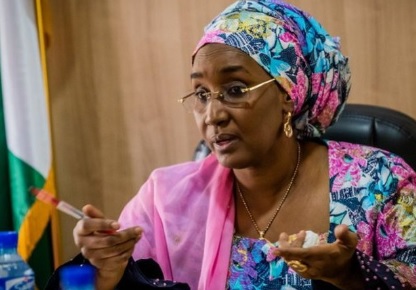
Minister of Humanitarian Affairs, Disaster Management and Social Development, Hajiya Sadiya Farouq.
According to him, the Commission under her brought 137 grinding machines, a truck of food items, spraying machines, and 142 chemicals for their farms.
Mr. Ibrahim also informed that the National Emergency Management Agency (NEMA) and its counterpart in the FCT, (FEMA) have never provided palliatives to them either before or during the pandemic.
“NEMA and FEMA have never brought anything to us. Since the lockdown began, we have been calling government agencies. Nobody is responding to us. NEMA came to us and collected our list a month ago and up till now, we have not seen them. I called the deputy director of the refugee commission too, there was no response”, he said.
Within the Apo environs, which by the way is located to the south of Abuja city center, there are several other settlements occupied by IDPs. These clusters of IDPs live communally such that when a settlement gets donations from NGOs, the items are shared to others in the adjoining mini-camps.
Women in New Kuchingoro IDP camp
Panteka is a settlement in Apo. According to the chairman of this cluster, Dauda Tra, it hosts about 1000 IDPs who have been living there since 2014.
He gave a similar narrative, lamenting that most residents rely on donations from people as nothing came from the government.
“We complain because nobody knows us. We live basically on whatever they give to us. Sometimes for four months, we don’t get anything. We have not seen anything from the government,” he lamented.
200 meters away from Panteka is Waru. This particular settlement houses 4732 displaced persons who have integrated into the community after they were evicted from abandoned buildings they used to stay.
This settlement has extensions in Panteka and Zinda, another IDPs hood.
Elisha Haruna, who lives in this settlement disclosed that so far, they only get donations from religious institutions and they have not received any form of palliatives from the government. They survive with proceeds from their personal businesses.
A slightly different story…
It was however a slightly different story at the New Kuchingoro, a camp also under AMAC. Settlers here told OrderPaperNG that the Federal Capital Territory Emergency Management Agency (FEMA), two days before the initial lockdown which spanned for 14 days, brought two buckets of liquid soaps for hand washing to be shared among 1573 persons and 282 households but not food.
Philemon Emmanuel, who is the camp leader said: “The government has not given us palliatives.
Although, two days to the first lockdown, FEMA brought two buckets of liquid soap to wash our hands. The buckets are broken. They have not come back here since then. Goodluck Jonathan Foundation brought hand sanitizers two weeks ago.
“On Friday, we saw some people from Victims Support Fund, an NGO who came with food items- rice, beans, and maize. Before they brought this thing, some of our people did not have anything to eat in this place.”
Crippled businesses and bribe-for-passage…
Forgotten by the government, IDPs survive with proceeds from their menial businesses to make ends meet, especially since the government partially lifted the lockdown in the FCT on May 4, 2020. But they are faced with low or outright non-patronage of their daily hustles, a prevalent story among the general citizenry of the country.
In Waru settlement, most men are farmers in Nasarawa state which is currently under lockdown. Thus, they are either stay back in their settlements without food or endure harassment from the law enforcement agents who seek bribe before allowing them to pass through.
To avoid meeting the security agents, they have to leave their houses as early as 4:00am to be able to get proceeds from the farm to sell in their settlements. But to their dismay, sales have terribly dwindled. The prices of goods when available have also gone up.
Sarah Philemon, a beans cake seller in the settlement, decried expensive food items and low patronage.
“I fry akara here normally. Now, as I fry, people don’t have money to buy. Things are now expensive and I don’t have money to buy more beans and groundnut oil so I manage the little I have.”
Cab drivers and self-imposed quarantines…
The men living in Panteka settlement are mostly taxi drivers or bike riders. Although the lockdown has been eased, patronage is not as it used to be.
“Some of us can’t go anywhere. Those who are taxi drivers or bike riders are here, they don’t have work. There are about 500 people now sleeping inside and they are not doing anything. When they eased the lockdown, we go out to look for work but we can’t find work to do. People are not patronizing us”, the chairman, Tra said.
Chairman of New Kuchingoro IDP camp, Philemon Emmanuel
Both men and women in New Kuchingoro IDP camp work as labourers on construction sites but with the directive to halt non-essential businesses, they are out of jobs.
“Truly, it has been difficult for us. We used to go before now to look for labourer work before we get something to eat. Then we heard that we are going for lockdown and since that time, we heard Mr. President promised he is going to feed especially the IDPs but we have not seen them”, the chairman, Emmanuel said.
While most of the IDPs got to know about the novel coronavirus from sensitization messages on radio and television, they have little or no means to protect themselves from the virus due to their numbers cramped up in small spaces.
Luckily, some residents in Waru settlement are educated. Elisha, for instance, is a 500 level medical student of the University of Benin, who returned to unite with his family due to the closure of academic institutions.
From his knowledge and exposure, he is able to teach camp members on how to maintain personal hygiene and social distancing, use of face masks and hand sanitisers. Sadly, just a few of the persons can purchase these items while most of them live in squalor which makes it nearly impossible to observe the safety guidelines.
In the settlement, they tell the taxi drivers for instance, not to mix with others to help curb the spread of the virus. This became necessary because the cab drivers usually come in contact with passengers who may have the virus.
“We were also not briefed about coronavirus. Since some of us are educated, we check the internet to get information that is how we know. Those among us who are taxi drivers, we identify them and make sure they don’t mix with us because we don’t know the people they have been in contact with. But they sanitize their hands”, the undergraduate said.
In the other IDP camps visited for this story, no protective measures were seen in place to safeguard lives.
Frustrated back to ravaged bases…
A combination of several frustrations have made some of the IDPs return to their communities during the pandemic not minding the consequences of the ongoing insurgency in Borno state.
“Some men have carried their wives to the village, back to Gwosa. There’s nothing they can do. They went back despite the attacks because there’s hunger here”, the Chairman said.
For him, it is better his people return to their communities they had initially fled from, to feed properly not regarding the killings by Boko Haram insurgents, than die in the nation’s capital as a result of hunger.
The sick are left to die as the pregnant deliver in shanties…
From most of the IDP camps visited, health services remain a major challenge. It was learnt that when they initially migrated to the nation’s capital, the authorities made arrangements for free healthcare services for them.
Women and Children Wasa IDP camp
They were given ‘authorization letters’, as they call it, that allowed them to access free treatment in Maitama and Asokoro general hospitals. But this service was discontinued in 2019 when Farouq assumed her ministerial position.
Since then, those who can afford it either go to nearby primary health care centres or seek local remedies among themselves. In some instances, some critically ailing IDPs were left to die.
OrderPaperNG witnessed this unfortunate scene in New Kuchingoro camp where a man in his 40s was seen lying frail on the floor close to one of the make-shift shelters.
“The major challenge here is health because if someone falls sick, if you don’t have money, you will just die. Our people don’t like to go to the National Hospital because if you go there, they will keep referring to different places. Nobody will attend to you.
“People are not thinking of how to protect themselves from coronavirus. We are thinking of how to get food to eat. That is the fact”, the chairman of the camp, Emmanuel said.
In Panteka and Waru settlements, they contribute monies to pay for the hospital bills for any sick person.
Pregnant women who are on the verge of labour also encounter these trials.
“When women want to deliver babies, if they have money they go to Kuchingoro Primary Healthcare center, if they don’t have money, they stay back and give birth at home”, Elizabeth Sunday, a woman in Kuchingoro camp said. A child was lost in the Durumi camp during the lockdown period as a result of the withdrawal of the ‘authorization letters’.
“During the lockdown, we helped deliver a baby but it was premature- 8 months. We took her to the National Hospital and they kept referring us up and about until the baby died.
“At the National Hospital, the CMD was receiving IDPs but now they have suspended authorization letters for us for four months”, Liyatu Ayuba, woman leader of Durunmi camp told this newspaper.
Dodgy reaction from officials…
Several attempts were made to get reactions on the various findings from the Ministry of Humanitarian Affairs, Disaster Management and Social Development; as well as the authorities of the FCT. Most of the officials contacted demurred while the few who responded could not adequately account for the neglect of the IDPs.
The Spokesman for the Ministry, Salisu Na’inna Danbatta, simply directed all enquiries elsewhere: “The camps are under the management of the FCT”, he said via text. Recall that OrderPaperNG had also received a similar reaction on a previous report about the Durumi IDP.
When the spokesperson of FEMA, Florence Wenegieme, was contacted, she previously replied some weeks ago that the agency’s officials were attacked when they visited a camp. But she did not answer subsequent calls and text messages seeking details on this report.
It is however, worth stating that the FCT Minister of state, Ramatu Aliyu, in an interview with a national television station on the 19th of April, 2020, made suggestions as to why the government is unable to provide palliatives to vulnerable groups.
According to her, the government’s record and social register for displaced persons is incomplete because they (IDPs) are usually not permanently resident in a place.
She had said: “Well, practically now, we should have about 3,000. If we capture the IDPs and PLWDs or destitute, most of them are also transient kind of people, so if we have them today and tomorrow they are relocated to their villages or one way or the other, they decide to move, I don’t think we will consider that as a complete headcount that will be very valid. This time around, we are going into actual residents and indigenes of the city to ensure that the real people that need palliatives or government support are captured.
“We have a social-register at the Social Development secretariat that has been saddled with the responsibility of taking care of the less privileged, IDPs and people living with disabilities but most of the people targeted are in the villages and are not captured in the register. So, this goes a bit further into villages and trenches and this time around after the distribution, we will ensure that FCT does have updated social register.”
In what may be regarded as a puncture of the minister’s claim, executives in the camps visited told our reporters that their details have been received by NEMA and displayed a piece of evidence below to buttress their claims.
EDITOR’S NOTE: This report was made possible with support from the International Centre For Investigative Reporting (ICIR).