Home Blog Page 2129

COVID-19: Contradictions surround source of conditional cash transfer to poor citizens in Nigeria

DESPITE claim by Sadiya Umar-Farouk, Minister of Humanitarian Affairs, Disaster Management and Social Development, that the money being disbursed by the Federal Government for the conditional cash transfer to poor households so far were all from World Bank loans, a civil society organisation,  AFRICA Network for Environment & Economic Justice (ANEEJ) says the programme was partly funded by $322.5million returned from Abacha loot.

In December 2017, Nigeria signed a Memorandum of Understanding MOU with Switzerland on the return and monitoring of the $322million Abacha loot.

The fund was to be used for the National Social Investment Programme (NSIP) Conditional Cash Transfer (CCT) that began in December 2016.

The Federal Government also obtained a $500 million credit from the World Bank to run the initiative for six years from 2016 to 2022. Another source of fund was the N500 billion National Social Investment Programmes (NSIP), captured in the Federal Government budgets since 2016.

The NSIP was last year moved away from the office of the vice-president, Yemi Osinbajo, to the newly-established Ministry of Humanitarian Affairs, Disaster Management, and Social Development, headed by Umar-Farouq.

But ANEEJ, a Non-Profit Organisation (NGO) that was funded by the Department for International Development (DFID) to monitor the conditional cash transfer process insists that the Minister was misquoted when she said  the conditional cash transfer was being funded by loans from the World Bank.

During a meeting with leadership of National Assembly on the disbursement of the money, she admitted that there was a need to widen the National Social Register to reach more poor and vulnerable people in the society and added that her ministry was presently in talks with the World Bank about this.

David Ugolor, the Executive Director of ANEEJ in an interview with The ICIR , argued that the minister might have been quoted out of context for saying the palliatives disbursed were fully World Bank loan.

According to Ugolor, his NGO was out to monitor the use of the returned $322.5million Abacha loot which from the MoU signed between the Nigerian and Swiss Government at the Global Forum on Asset Recovery (GFAR) summit in Washington DC in 2017, was agreed to be spent on Conditional Cash Transfer Programme.

He disclosed that data obtained from the National Cash Transfer Office (NCTO) and the World Bank,  the Cash Transfer Programme of the Federal Government is composed of 80 per cent returned $322.5million Abacha loot and 20 per cent World Bank loan.

Ugolor went further to say that the payment of N5,000 monthly to poor Nigerians under the scheme commenced August 2018 and was paused in December 2019.

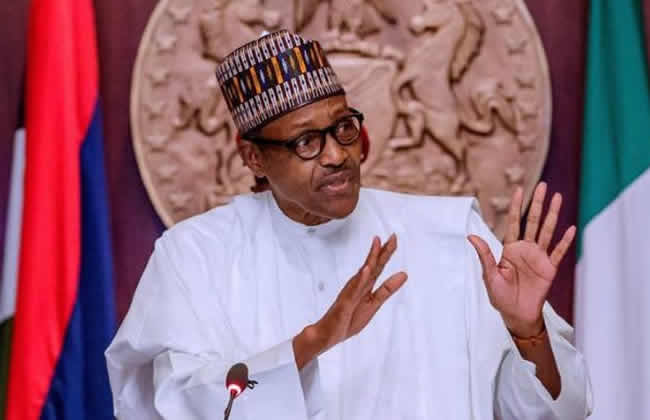
Given the outbreak of COVID 19 in Nigeria, President Muhammadu Buhari, in a nationwide broadcast directed the minister to continue the payment to all those in the National Social Register enrolled in the Cash Transfer Programme as beneficiaries, Ugolor said.

He also said in the phone conversation with The ICIR that the poor citizens are being paid N20,000 each representing four months, January to April 2020.

Ugolor explained that the cash transfer programme in Nigeria uses a global model known as the community-based targeting.

He said it is a model where members of an indigent community identify what poverty means to them and who the community considers the poorest households among them.

The NCTO works in collaboration with the World Bank in the use of this model, he said further.

It is from this National Social Register of poor and vulnerable households that the NCTO makes payments to the poorest households in the country, Ugolor explained

Coronavirus pandemic: Emotional, hilarious songs of lockdown

SINCE the outbreak of coronavirus,  several countries around the world have gone into total lockdown as a way of combating the spread of the disease.

As a way of sensitising the people around the world, governments, organisations and groups have campaigned to promote social distancing, self-isolation, complete hygiene among others.

As part of prevention mechanism,  musicians across the continent are releasing songs to educate the masses.

Numerous studies have shown that music can lift moods, combat depression and improve blood flow.

Many of those songs have been shared on social media by professionals and amateurs with the sole aim of keeping the world together during this battle.

The ICIR listed some of those emotional and hilarious songs that have been trending on the internet in the past few days.

Cobhams Asuquo – We go win (Corona)

Award winning Nigerian musician, Cobhams Asuquo, releases this heartfelt original song in the fight against COVID-19.

The message was passed to the people with the support of UNICEF Nigeria to enlighten and to keep hope alive of curbing the virus.

He shared on his Instagram page with the caption, “We go win Stay safe, wash your hands, love each other; we’ll win this.”

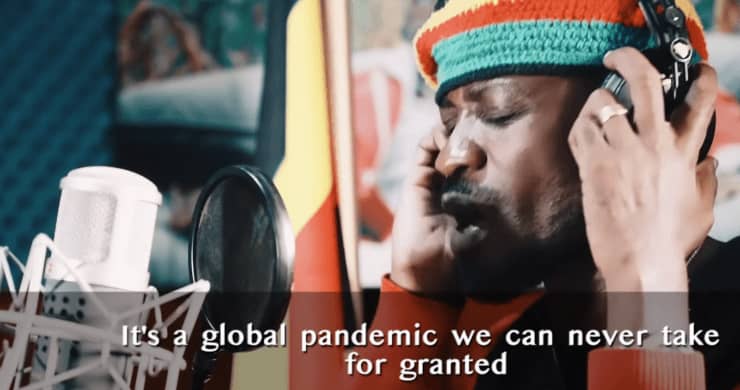
Ugandan artist Bobi Wine feat Nubian Li (Coronavirus alert)

Ugandan artist and political activist Bobi Wine starts with cautionary advice. “The bad news is that everyone is a potential victim,” he sings. “But the good news is that everyone is a potential solution.”

In the video shared on his Instagram page, he featured vocalist Nubian Li for the song “Coronavirus Alert.” It has a simple and uplifting message: “Sensitive the masses to sanitize. Keep a social distance to quarantine. The coronavirus is sweeping over mankind. Everybody must be alert! It’s a global pandemic we can never take for granted.”

Liberia’s President George Weah song on Coronavirus (“We are project”)

The Liberia president picked up the microphone warning people that it could take away their loved ones.

He said in the song, “It could be your momma, it could be your pappa, your brother or your sister, let’s stand together to fight this deadly disease.”

The song sparks a lot of reactions from people on the internet heaping praises on him for taking time to sensitise the public on the pandemic.

S/Africa Ndlovu Youth Choir “Don’t panic, we’ve got this.”

The country on the African continent with more than 700 cases is South Africa,  the Ndlovu Youth Choir used music to get message across to people with their song “Don’t panic, we got this.”

The young people from the village of Moutse know that their friends and families are particularly at risk.

In the song, the choir has a simple message for the community: “Don’t panic, we’ve got this.”

Juan Gonzalez and Camilo Pulgarin (“Cuarentena”)

The song “Cuarentena” (“Quarantine”),was posted five days ago on the social media, it is burning up Latin American Instagram, racking up close to a million views. On Tuesday, it was re-posted to social media by actress Drew Barrymore.

Vietnamese Health Dept (“Jealous Corona virus”)

The original song which was sang in Vietnamese language was translated in English and shared on Youtube with over million views informed people about the virus, how it spread and the necessary precautions one could take to stay safe from being infected.

Eason Chan and Jolin Tsai “Fight as ONE”

The duo teamed up to present a song, ‘Fight as ONE’ to encourage people all over the world to fight together in the battle against the pandemic.

The lyrics of the song said, “With all the playgrounds I hear no laughter, everyone has left in tears. Will there be hope when we wake up tomorrow, if you believe that love is what we need.”

Lord Sky – CoronaVirus ft. Cardi B, Peruzzi & Yemi Alade

This is an hilarious song mixed with numerous clips to amuse people and inform them to always sanitise during this trying period.

The award winning rapper was seen in the video talking about the how the coronavirus has become a pandemic saying “shit is getting real” to expressed her shock with the amount of cases worldwide before popular DJ Lorrd Sky added a beat featuring Nigerian singer, Peruzzi and Yemi Alade.

Talented producer, Lord Sky known for his many funny mash-ups and production, returns with a brand new mashup titled “Coronavirus” with the key word as “Everybody sanitise.”


REPORT: Untold deaths, tears trail the closure of Abuja’s Arts and Craft village

Kunle ADEBAJO


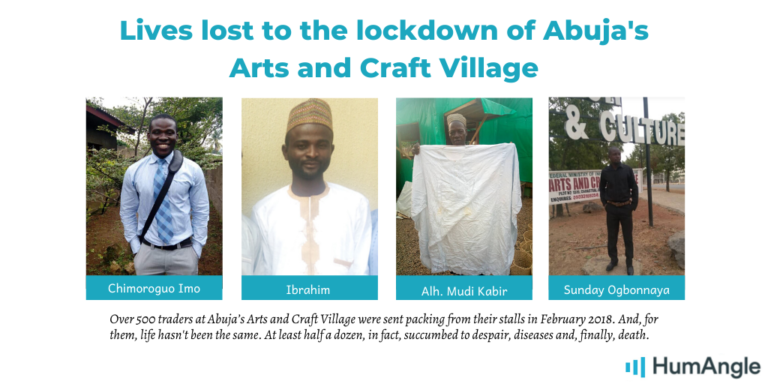
OVER 500 traders at Abuja’s Arts and Craft Village were sent packing from their stalls in February 2018, with their goods locked up and no alternatives provided. Having lost their livelihood, at least half a dozen of them soon succumbed to despair, diseases and, finally, death. 

Sunday Boniface Ogbonnaya, 31, had a reputation as a cheerful, easy-going young man. He got along well with other traders regardless of ethnicity at the famous Arts and Craft Village, where he managed two stalls alongside his cousin. Even while he studied Computer Science at Ebonyi State University, he often spent his holidays selling craft and cultural items at the market.

After he completed the National Youth Service Corps programme in November 2017, he resumed at the market to support the family business and earn a living pending the time he got a corporate job offer. About a year later, after the National Council on Art and Culture’s decision to close down the marketplace, he started growing increasingly depressed. He lost a lot of money, some of which were from loans, lost access to the shops, lost hope, and then sadly lost his life.

It started with a mysterious fire incident in December 2017 that razed the bigger of his two shops to the ground, with everything in it. Thinking the situation could not get any worse, he quickly sought help from other traders in cash and kind and concentrated efforts on the second shop. But three months later, all of Arts and Craft Village was placed on lockdown under controversial circumstances and following instructions from the NCAC Director-General, Otunba Olusegun Runsewe.

“We thought it could be resolved in a matter of days,” recalls Festus Nwafor, Ogbonna’s cousin.

“We all went home. There was no alternative anywhere. No business. No money. No white-collar job. People were just living from hand-to-mouth, trying to survive. At a point, we all went to the market at Jabi, Airport Junction market. We pitched a makeshift tent but because we were new, we didn’t have customers. We were back to the same ordeal of no money, no business.” 

Because of those challenges and the traumatising effect they had on him, Ogbonna started developing severe symptoms of High Blood Pressure. 

Tossed from hospital to hospital

Sometime in May 2018, Nwafor discovered that Ogbonna’s phone was not reachable throughout the day. Out of concern, he made his way to his house as soon as he closed from work. Getting there, he met Ogbonna laying on the floor, almost unconscious. As fast as he could, he invited his younger brother to the scene so together they could get him to the hospital. The time was 7 pm.

First, they went to Wuse General Hospital but were turned back because there were no available bed spaces. From there, they proceeded to the Federal Medical Centre, Jabi. There, they were instructed to buy certain drugs. But then, the staff soon realised the department that could treat the illness was part of ongoing strike action and said there was nothing they could do.

Immediately, they took him to Nisa Premier, a private hospital also at Jabi. But they weren’t even allowed to take in the indisposed man. They simply inspected him while he was in the car and dismissed them because they “could not handle such situations”. Certainly, time was running out. Ogbonna was barely conscious during the chaos. His blood pressure around the time read 200 plus/150 plus, classified as hypertensive crisis.

When they got to Nizamiye, another private hospital a little over 6 km away, the staff there told them they had to first deposit N300,000 before Ogbonna could be admitted. Nwafor did not have up to that. The next stop was Limi Hospital but they weren’t lucky there either. They were told that branch, at Central Business District, does not administer treatment for heart-related problems, and the branch that does, which is located at Garki, did not have workers on a night shift.

“We moved from there to Asokoro District Hospital,” Nwafor narrates. At this time, it was already 5 the following morning. They had spent eight hours drifting from one hospital to the other.

“They also told us the whole hospital was filled up and they didn’t have any bed space. But after we pleaded and told them we were desperate for any option at all, they discussed among themselves and permitted us to manage a bed space by the reception.”

But it was too early to heave a sigh of relief.

Nwafor paid for a list of prescribed drugs. Soon after, a test was conducted on Ogbonna and the result placed in a CD. There was only one problem: The expert who could interpret the disc’s content had gone home. They waited for hours on end. The drugs and test result were useless and all the medical care Ogbonna actually received came from a drip.

From 5 am, all through the day, no treatment was administered. And then sometime around 9 pm, Ogbonna started breathing heavily. The nurses gathered and, “feigning seriousness”, brought all manner of items, manually compressed his chest, and supplied him with artificial ventilation. It was too late though as the young man nevertheless breathed his last.

Ogbonna was the only son among his mother’s three children. His death shook her vigorously and Nwafor thinks it was even miraculous she survived the phase because she was known to have underlying health conditions.

“They must’ve told you about one guy they called Imoh,” Nwafor continues. “He was an artist in the market. It was just last year somebody uploaded his picture and said he had died. There was one other guy called Muhammed. He recently died too. These guys mostly all died out of frustration and depression.”

Kanayo Chukwumezie, who has been President of the African Arts and Cultural Heritage Association (AACHA), the sellers’ trade union, since 2011, explained that the problem started in 2010, with the National Council for Arts and Culture (NCAC) claiming ownership of the property has been transferred to it from the Federal Capital Development Authority (FCDA). Eventually, the disagreement between the two government agencies was resolved and NCAC emerged as the new sheriff in town.

Then came Olusegun Runsewe. He was appointed as the Council’s Director-General in 2017 and, under his administration, the Arts and Craft Village has faced unprecedented levels of unrest. In February 2018, despite a court injunction restraining such action, Runsewe ordered for the market to be locked down and alleged that firearms, drugs, and stolen vehicles were found in the premises. Chukwumezie denied the allegations.

“I called a press conference challenging him to bring the proof,” he said. 

“You say you saw 24 stolen vehicles, tell us where they are. You say you saw guns, tell us where they are and in what shops you saw them. Who have you prosecuted? Who were the vehicles traced to? Even from the chassis numbers, we can tell who owns them. You don’t just try to give a dog a bad name to hang it.” 

The closure, AACHA’s President said, affected over 150 shops, over 500 traders, and investment estimated to be worth hundreds of millions of naira. Having been uprooted from their vocation, many traders returned to their villages and the few who remained have shops scattered across Abuja.

“At the end of the day, whatever comes out of our struggle, we will know that we have exhausted all that is within our powers without fighting,” he said with contentment. 

“Whether we win or lose in the matter is irrelevant, the record will show that there is a group that once fought to have this place to be what it is. Even if they remove it, they would say some people fought but did not succeed.” 

When this reporter reached out to Chas Nwam, Special Assistant to Runsewe, he said the agency would not comment on the matter as some of the issues were in court. He also said an interview could not grant an interview until the lockdown in Abuja, due to the COVID-19 pandemic, is lifted.

‘Have they opened the market yet?’

Alhaji Mudi Kabir’s death was slow and distressing. Long before he eventually gave up the ghost, he was already detached from the world ― no thanks to the shutdown of Art and Craft village shutdown. 

Eighty-something-year-old Baba Oja (the market’s father), as he was fondly called, moved to Abuja in 2000. Before then, he sold cultural items at the famous Kurmi market in Kano. Auwal Sulaiman, his close associate for over 30 years, recalls they both set up shops at the Airport Junction market before moving to the craft market in 2007 as part of the first set of vendors.

“When he heard that the market had been closed, the news shook his really mind, more than any other person,” Suleiman says. “He had become accustomed to that market as if it was his own home.”

The effect it had on him could have also been partly because of the number of people depending on him for sustenance: including at least two wives and 19 children who stayed back in Kano.

Baba Oja was disoriented. He suddenly started acting irrationally and no amount of consolation from his colleagues seemed to help. “Have they reopened the market yet?” he would ask at odd moments of silence or when unrelated matters were being discussed. He was losing his mind. He would, for instance, sell products at less than half the price he bought them and his memory became impaired.

His health worsened with time and he had to retire to a hospital in Kano with the help of his family.

“When I went there to visit him, he could not recognise me even though I was standing right in front of him and we were the closest of friends,” Sulaiman recalls with grief. “He could not even mention my name due to how much he was traumatised because of all that happened. From there, things got worse and worse until we heard that he passed away in the hospital.”

Sulaiman himself nearly lost everything but his life. He was distressed. Some of his children had to quit schooling because he could no longer afford the fees. His belongings, those of his wife, and various household objects were sold to get enough money to feed.

By the time he was later granted access to his old shop after the lockdown, he was able to recover only some of the materials. Others had been damaged due to rainfall and disuse and he had to abandon them.

“When some of my kids were asked to bring school fees, I told them I had nothing honestly, so they had to remain [at home] till I was able to sell some of my things,” he says. “I could not even pay at once; I had to pay in part and I had to explain to their teachers what the situation was so they could give me time to give them the balance. It is very terrible!”

Now that he has returned to the Airport Junction market, he describes the experience as incomparable. It could take up to a week before he makes over N1000, he says, whereas this was at least a daily occurrence at the Arts and Craft Village. His only source of joy is that he still works closely with some traders who are in the same business.

Nwafor said about the unfortunate chain of events, “The story has not been told and everybody is behaving as if nothing happened. It shows we are living in a country where the lives of the people do not matter. It is so sad that a market, a place where people earn their living, could be treated in such a manner and nobody is talking about it. It is so unfortunate.” 

 

Nigeria’s unhealthy healthcare in the eye of Coronavirus 

By Runcie C.W. CHIDEBE 


CORONAVIRUS (COVID-19) is here to teach us a lesson; I hope we learn. Nigeria’s healthcare is unhealthy. But instead of fixing it our rulers have been busy flying up and down to benefit from other country’s productive health system. With Coronavirus, reality is upon us. No more running overseas for medical vacation. Our rulers cannot travel to the United Kingdom, United States of America or India anymore for medical care. These countries are also hanging on their last breath, battling to survive the COVID-19 pandemic. 

In 2017, President Muhammadu Buhari spent 103 days in London receiving medical treatment for an undisclosed illness, spending taxpayers’ money instead of investing in the country’s healthcare. Thousands of Nigerians died in the same period from different illnesses. More than 3,000 women died of breast cancer, more than 2,000 women died of cervical cancer and more than 1,500 men died of prostate cancer, according to World Health Organization (WHO) figures on annual cancer mortality.  

I had hoped that on his return to Nigeria, President Buhari would declare a state of emergency in the country’s health sector. Painfully, nothing of such happened. Nigeria’s budget allocation to healthcare has remained less than 5 per cent of the entire budget for the past five years. Simply put, in 2020 the federal government budgeted N2,000 (£4.2) for each Nigerian with a total of N427.3 billion as budget allocation to the health sector while the United Kingdom budgeted £2,159.6 for each citizen with a total health budget of £143.4billion. It is the same dismal story in the states across Nigeria. Healthcare is not a priority. In some states in Nigeria, a hospital is a 20-minute boat ride and an hour-long car ride. Because many poor Nigerians do not own boats, a woman in labour could bleed to death before she reaches the hospital.

On March 22, 2018, Bill Gates, founder of Microsoft and the Bill & Melinda Gates Foundation, criticized Nigerian government’s poor funding of healthcare in the country. In his words, “One in three children is chronically malnourished.” This tragedy has huge implications for the economy. According to the World Bank, addressing the stunting crisis in Nigeria would add almost $30 billion to Nigeria’s GDP. It is painful that despite Mr. Gates assertion, nothing has changed. Nigeria has remained one of the countries in the world with the worst healthcare system with over 60 deaths per 1000 live births. Nigeria has one of the worst cancer survival rates in the world, with only 2 to 3 cancer radiotherapy machines working at any particular time and less than 70 oncologists for a population of over 200 million. 

COVID-19 is exposing the insensitivity of our leaders to things that matter most to us. That Nigerians are disobeying the government’s safety advice on COVID-19 is a clear reflection of citizens’ mistrust for their leaders. Many Nigerians trust their religious leaders more than they trust our political leaders. Successive governments have failed the country, and it doesn’t look like thing will change anytime soon. 

Nigeria is a country where our rulers make laws today and break the same laws tomorrow. The Nigeria Centre for Diseases Control (NCDC) followed the World Health Organization (WHO) guideline and strongly encouraged all Nigerians coming from certain countries to self-isolate and monitor themselves, as a strategy to contain or to delay the spread of COVID-19. The president’s Chief of Staff, Abba Kyari, returned from Germany and instead of isolating himself he was jumping from one state to another, attending events and meetings with different people, breaching the government’s own recommendation and placing the lives of other Nigerians at risk! 

Now that COVID-19 is in Nigeria we need to face it with all that we have. But can we? The Nigeria Centre for Disease Control (NCDC) is now the country’s only perceived hope. Many Nigerians have been calling NCDC hot lines, criticizing NCDC for not testing enough people. But we should face the music and not the dancer. NCDC is crippled and not well equipped to protect Nigerians from the disease. 

In 2016, NCDC had N3.7m for her recurrent and N248m for capital allocations, that’s budgeted a total N252m. Out of this, only N155m was released to the centre. In the same year, 1,166 Nigerians died of Cerebrospinal Meningitis. In 2017, the NCDC had a budget of N1.5b. Only N782m was released. In the same year, more than 120 Nigerians contracted Monkeypox and seven people died from the disease. That same year, the Presidency budgeted N77m for Aso Rock rent, N1b for trips and sitting allowances, and N94m for meals. In 2018, the NCDC had a budget of N1.9b. Only N654m was released. In the same year, N7.2b was proposed for Presidential Air Fleet. N440m was proposed for mandatory upgrade and installation of live TV and internet service in the presidential aircrafts, N375m for new cabin management, N418m for the landing gears. In total, over N1b was budgeted for the presidential aircrafts which is used for medical tourism and frequent trips abroad. 

On November 12, 2018, the NCDC establishment bill was signed by President Muhammadu Buhari, thanks to the efforts of Senator Mao Ohuabunwa, the then Chair, Senate Committee on Primary Healthcare and Communicable Diseases. On this premise, the NCDC was empowered with a legislation for its work in preventing and preparing for outbreaks of infectious diseases. Interestingly, the NCDC got the worst budget in 2019, the year following the passage of the NCDC Act. The Centre had a budget of N1.4b, but only N224m was released. In the same year, over 472 Nigerians were diagnosed with Lassa fever and over 110 people died from this viral hemorrhagic fever. Clearly, NCDC cannot perform magic. They need help. Nigeria is grossly under-testing for COVID-19, the laboratories are not enough, and NCDC and its affiliate agencies do not have enough manpower and resources. 

Months ago, being unwell evoked empathy; today being unwell evokes fear. The fear of COVID-19? No! It is the fear of not having access to the care that you need, the fear of absence of ventilators, the fear of a broken health system. It is the fear of death. Our political leaders have stolen from the sick through corruption. Many Nigerian governors build non-functional hospitals in their states. Usually, after the commissioning of these hospitals, all the CT Scan, Magnetic Resonance Imaging (MRI) and other medical machines—some of them fake—are returned to where they were purchased or left to rot. 

Hospitals in Nigeria are some of the worst in the world. Our teaching hospitals are now museums where less than 5% of clinical trial and research is going on because of poor laboratory. Medical tourism has therefore become the norm. Dubai hospitals, Saudi Arabian hospitals, etc., are advertising in Abuja and Lagos for Nigerian patients. They are recruiting Nigerian doctors, including consultants. Nigeria is not only facing “brain drain,” we are also facing “patient drain.” Our doctors and nurses work in the worst conditions. Hazard allowance for health workers is about N5,000 while wardrobe allowance for members of the National Assembly runs into millions. 

Now is the time for Nigeria to confront its healthcare crisis. The Nigerian government must accept its failure. Our political leaders must brace up to their responsibility and seriously reflect on the problem their greed has brought to Nigeria. This is the time to invest in a result-oriented healthcare system. Health is wealth as the saying goes. A good healthcare system is the foundation of any nation. 

If we survive COVID-19, we need to consider a law to restrict all public officials from seeking medical care abroad. It may be perceived as strict, but it will save future generations since we don’t know which pandemic would come next and when. 

Let’s give every Nigerian a space to live and a not chance to die. 

Runcie C.W. Chidebe is Executive Director, Project PINK BLUE. He is currently a Commonwealth Scholar on Transforming and Leading in Health Care at Birmingham City University, United Kingdom. He tweets @runciecwc 

[My Covid-19 Diary] Day 6: Fuel price jerked up as more than 500 Africans die

By Theophilus ABBAH


As I started my car engine this evening to ride out of boredom into the locked down world, I noticed that my fuel had drained. The red sign on the gauge jeered at me as if to say it would certainly draw some cash from my drained pocket. Even if I had no intention of driving out of my premises, I would have to filled the tank from a petrol station. My car must have enough fuel at all times so that in the event of an emergency I’m not caught napping.

I moved out of my estate on my way to the expressway only to discovered that determined and fierce-looking security operatives had tightened their grip on Abuja, restricting movement on major highways. They had mounted more roadblocks, holding down motorists for not less than fifteen minutes, as they extracted reasons why such motorists did not stay safe in their homes. On radio and social media, the scaled-up restriction received commendations from Nigerians, but the lack of tests had remained a nagging and unanswered question. Why should the people be restricted to their homes but not tested for coronavirus? Where are test kits?

We would not pose these questions to the police and other security agencies whose assignment was only to enforce government’s lockdown policy. I drove on in search of petrol, but the first fuel station I saw had its entrance locked up. I was shaken, took a look at my gauge to know if the fuel would still fire me to the next petrol station. At the next one, I found a short queue, and turned to the pump.

By intuition, I took furtive look at the fuel price. It said N135/litre. Certainly, that was a joke, I thought. As a result of the fall in the international prices of crude oil, government had reduced the price, initially to N125/litre and later further downward to N123/litre. Where did this petrol get its own price?
“How much do you sell petrol here?” I asked the attendant at the pump.

“It’s now N135/litre,” he replied.

“How?” I demanded. “It’s reduced to N123/litre.”

The attendant looked away. In anger, I drove off. Why should I be exploited even when the price of crude oil had fallen to a state of lamentation?

Two kilometers away, I located another petrol station and drove in. The attendant was dispensing fuel into a motorcycle. As I parked, I glanced at the price on display. It said N130/litre.

I gave up and bought N3,000 worth of petrol from that fuel station. Definitely government had increased the pump price of petrol. I recollected, at that point, that the Group Managing Director of the Nigerian National Petroleum Corporation (NNPC), Mr Mele Kyari was reported to have announced that the era of fuel subsidy in Nigeria had come to an end. We knew that fuel subsidy bred corruption, but putting motorists at the mercy of petrol merchants in Nigeria at this period of coronavirus would deepen the people’s pains.

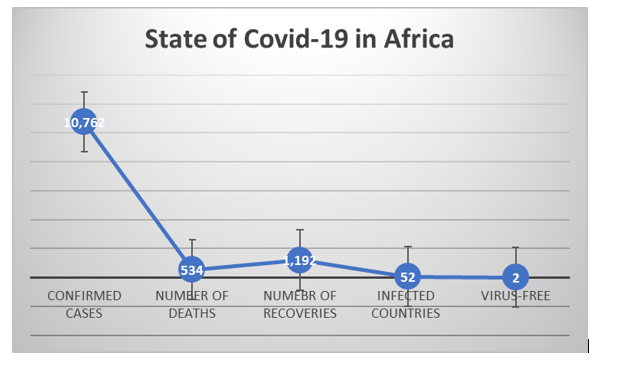
I returned to my laptop with the question, “what is the state of coronavirus in Africa?’ Apparently, without multiples or inexplicable deaths, in Nigeria the myth that coronavirus is more prevalent in the West was still trending. I was shocked at what I discovered. Data from all over Africa, as published by the World Health Organisation (WHO) showed that many Africans have died from the virus, some of them really prominent in their countries. There were already 534 deaths in 52 African countries where coronavirus has penetrated. The rate of infection is very high, with a total of 10,762 so far, and a snail speed rate of recovery, put at 1,192, a mere 10%, in a continent where the myth of immunity from coronavirus had ruled the airwaves.

The country with the highest infections on the continent is South Africa with 1,749 infections, followed by Algeria with 1,468 infections. Egypt closely follows with 1,450. Among the 18 countries with more than 100 persons infected with coronavirus, Nigeria ranked 12th with 245 infections as at April 8, 2020.

Most of those who have died travelled outside the continent for medical treatment, and were believed to have contracted the virus there. For instance, the first person to die in Nigeria, Suleiman Achimugu, 67-year-old, had just returned from the United Kingdom where he received treatments for other underlying ailments. A statement tweeted by the Nigerian Centre for Disease Control (NCDC) after his death said, “The 1st #COVID19 death in Nigeria has been recorded. The case was a 67-year-old male who returned home following medical treatment in UK. He had underlying medical conditions- multiple myeloma & diabetes and was undergoing chemotherapy.”

In other parts of the country, several prominent persons with underlying ailments have died. Mr Aurlus Mabele, who was considered as Congolese King of Soukous, a high tempo dance music which was popular across Africa had also died. Originally from Congo-Brazzavile, Mabele had moved to France in the 1980s, and died from coronavirus infection in a Parisian hospital at the age of 67. Also, an ex-Congolese President Yhombi Opango died in a hospital in Paris at the age of 81, due covid-19 infection.

From Somali, Ahmad Ismail Hussein Hudeydi, who is the famous father of modern Somali music and touted as ‘King of Oudi”, died after coronavirus infection in a London hospital at the age of 92. Also, a former Libyan Prime Minister who served after Ghaddafi’s ouster, Mahmud Jibril, died in an Egyptian hospital on April 5, 2020 at the age of 68 after receiving treatment due to coronavirus for two weeks.

Another important African victim of coronavirus was Nur Adde, a former Prime Minister of Somali. He was prime minister from 2007 to 2009. He died at the age of 82 in a London hospital after contacting the Covid-19 at the hospital. Also, Pape Diouf, a Senegalese journalist and sports administrator, was first to die of coronavirus in the French-speaking West African country. He was famous for being the President of a French Soccer club Marseille for several years. He died at the age of 68, after two weeks in the intensive care of a Dakar hospital.

In Cameroon, a jazz icon, Mgun Di Bango died as a result of coronavirus at the ago of 86. He was known as the soul of Makossa. A top legal aid to the president of the Democratic Republic of Congo (DRC), Makendi wa Mulumba, died in France where he went for medical check-up. He lost his life in the fight against coronavirus. Then, in the West African country of Burkina Faso, a top lawmaker, Ms Rose Marie Campoare, was the first casualty of Covid-19, as she died of the ailment on March 17 at the age of 62.

With these deaths and high rising cases of coronavirus infections, I fear that for Africa, the worst is yet to come. I fear that in the coming weeks, as more test kit arrive as foreign aid, mainly from China, the numbers of positive cases could quadruple, and deaths could mount at an astonishing rate. I fear to say that the state of coronavirus in Italy, Spain, UK, or even America today may be the picture of the future story of Africa, unless preventive measures are adhered to, or curative drugs are discovered and quickly dispatched to the African continent.

A question that mocks me is, “what efforts are African scientists making to tackle the challenge?” Would there be local preventive or curative measures? Professor Maurice Iwu, a former Chairman of the Independent National Electoral Commission (INEC) had announced that he had a cure for coronavirus, but it is not known if the authorities in the health sector have taken him seriously. Wouldn’t we give him the benefit of doubt, so that his efforts do not enter into the garbage, like those of prophets who are not acknowledged in their own communities.

If the Chinese didn’t go to the world cup in hand pleading for help, African countries should proudly seek local solutions to the pandemic, even if we would later need support from multinational and international organisations.

NMA rejects Chinese doctors despite arrival

THE Nigerian Medical Association (NMA) has criticised the arrival of  Chinese medical doctors into the country to fight against the new Coronavirus. 

In a two pages release obtained by TheICIR, the professional body stated it is not against the visit, but expresses concerns about the contradiction between the explanation of the Minister of Health, Osagie Ehanire and the Managing Director of China Civil Engineering Construction Corporation (CCECC), Micheal Jiang, whi said the medical personnel will be treating Chinese workers in their facilities in China Civil Engineering Construction Corporation (CCECC) with critical and necessary healthcare assistance.

“We are taken aback at this statement as this is at variance with the information supplied by the Honourable Minister of Health. We wish also to ask when Medical expatriates started coming to Sovereign States to treat her nationals? What happens to the Nigerians working in those facilities”

NMA maintained that Nigerian government is not transparent about the role the Chinese doctors are expected to play in the country.

The body insists that the government should come out clear on the invitation of the Chinese doctors as they are aware of the Chinese’ plan to construct two isolation centres in Abuja.

NMA added that the facilities cannot better compare to world-class isolation centre constructed and donated by Guaranty Trust Bank to the Lagos State government without the help of Chinese experts.

“We are aware of the “Stride with Nigeria” mantra of the CCECC and their willingness to participate in the construction of two isolation centres in Abuja.

This gesture is no different from that of Corporate Nigeria so far, including the world-class isolation centre constructed and donated by Guaranty Trust Bank to the Lagos State government without the help of Chinese experts. Unless there is something else, we don’t know.”

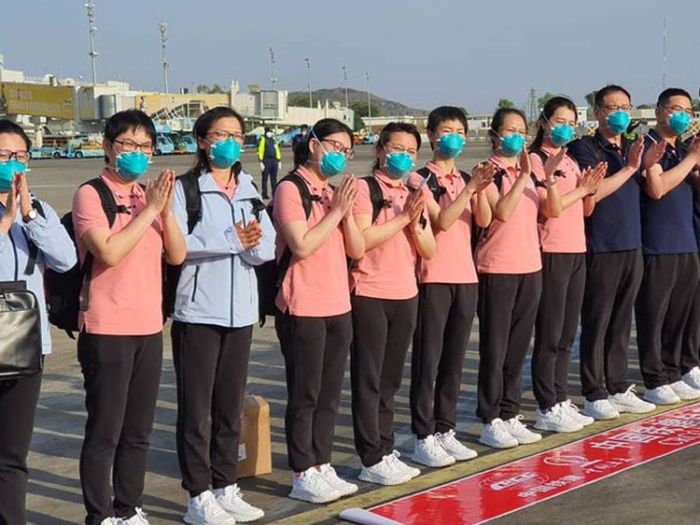
The 15 Chinese doctors arrived Nigeria on Wednessday 8th of April  with equipment to assist the government tackle the COVID-19 pandemic, despite criticism by NMA.

The Nigerian minister of health, Osagie Ehanire, had earlier announced that the medical experts would be coming into the country to support the government’s fight against COVID-19.

According to The Guardian, Wednesday’s delivery is the second batch of medical supplies from China.

Nigerian flag carrier, Air Peace airlines, delivered the supplies after a historical flight to Chinese capital, Beijing.

The flight was operated by the airline’s Boeing B777-200 ER, which arrived at the Nnamdi Azikiwe International Airport, Abuja, at 4:25 p.m. after 15 hours flight.

Among the materials brought in by the flight are 16-tonnes of test kits, ventilators, disinfectant machines, disposable medical masks, medicines, rubber gloves, protective gowns, goggles, face shields and infra-red thermometers

 Jiang, in a statement on Wednesday, said  all members of the working team have tested negative to COVID-19 and shall commence their stay in Nigeria by undertaking 14 days in quarantine.

He added that their primary purpose is to escort the medical supply, provide guidance for their usage and distribution.


Eight men, five women—Diaspora Commission releases list of Nigerians in Diaspora who died of Covid-19

THE Nigerians in Diaspora Commission (NIDCOM) on Thursday released names and pictures of 13 Nigerians who have died of the Covid-19 in United Kingdom and United States of America (USA).

Abike Dabiri-Erewa, Chairman of NIDCOM who released a video showing the victims and where they based before their demise, prayed for the souls of the departed.

“May the souls of our brothers and sisters in Diaspora , who lost their lives to Covid 19, RIP. May the Lord heal the world,” Dabiri-Erewa wrote on Twitter.

According to the 55second video clip, eight persons died in the UK while five others died in the US.

They comprise eight males and five females, including a medical doctor, Senior Advocate of Nigeria, and a clergyman among others.

Among them were Kole Abayomi, Senior Advocate of Nigeria (SAN), a former Director General of the Nigeria Law School died in a London Hospital after contracting coronavirus at the age of 80.

Also, Alfa Saadu, 68, a medical doctor of 40 years practice died on Tuesday March 31 at the Whittington Hospital in north London. Others were Bassey Offiong, a 25-year-old Nigerian student,  in Western Michigan University, Detroit, United States. He was a Chemical Engineering student and died few days to his graduation after contracting the virus.

Laila Abubakar Ali of Kano descent, was the first Nigerian to died of Covid-19 in US. She died on March 25, while receiving treatment at the Lincoln Hospital in the Bronx, New York.


Easter celebration: Social restriction order still in force — IG warns

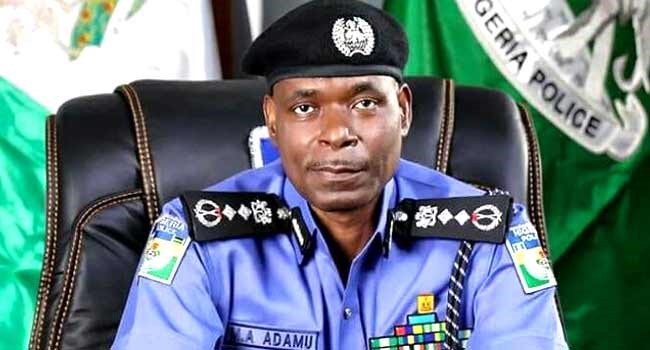
MOHAMMED Adamu, the Inspector General of Police (IGP)  has warned Nigerians ahead of the 2020 Easter celebration that the social restriction order is still in force.

Adamu made this known in a press release issued on Thursday by the Police Public Relations department.

While felicitating with the Nigerian Christian community, the IGP called on religious leaders across the country to continue to cooperate with relevant government agencies and use their leadership positions to encourage worshipers to observe prayers and worship programs in the confines of their homes.

He noted that the call has become necessary in order to curtail the community spread of the Covid-19 pandemic which has immensely challenged humanity across all spheres of life.

“For the first time in the annals of our history, circumstances have compelled us to impose restrictions on social gatherings, which inevitably is also affecting religious programs of all faiths,” he expressed deep concerns.

He therefore enjoined Nigerians to see the restrictions in the light of the symbolism of Easter which connotes sacrifice, tolerance, perseverance, love and ultimate triumph.


Coronavirus pandemic could push half a billion more people into poverty —Oxfam warns

OXFAM, aid charity focused on alleviation of global poverty, has called on world leaders to contain the economic fallout caused by coronavirus pandemic, warning that the grave effect could push half a billion people into poverty.

The charity organisation in a statement called on world leaders to agree on an ‘Economic Rescue Package for All’ which is targeted at helping poor countries and poor communities afloat.

Oxfam’s raised its concerns ahead of key meetings of the World Bank, International Monetary Fund (IMF) and G20 Finance Ministers’ next week.

According to a new report, Dignity Not Destitution released by Oxfam; six and eight per cent of the global population could be forced into poverty as governments shut down entire economies to manage the spread of the virus.

In addition, findings made by researchers at King’s College London and the Australian National University and published by the United Nations University World Institute for Development Economics  highlighted that the coronavirus pandemic could leave half of the global population in poverty.

It could also set back the fight against poverty by three decades in some regions such as sub-Saharan Africa and the Middle East and North Africa, the analysis showed.

In proffering a solution, Oxfam submitted that an ‘Emergency Rescue Package for All’ would enable poor countries to provide cash grants to those who have lost their income and to bail out vulnerable small businesses.

The rescue package, it noted, could be augmented by the immediate cancellation of US$1 trillion worth of developing country debt payments in 2020.

It called on world leaders to provide US$1 trillion in new international reserves, known as Special Drawing Rights, submitting that it would increase the funds available to countries.

“The devastating economic fallout of the pandemic is being felt across the globe. But for poor people in poor countries who are already struggling to survive there are almost no safety nets to stop them falling into poverty.

“G20 Finance Ministers, the IMF and World Bank must give developing countries an immediate cash injection to help them bail out poor and vulnerable communities. They must cancel all developing country debt payments for 2020 and encourage other creditors to do the same, and issue at least US$1 trillion of Special Drawing Rights,” Jose Maria Vera, Oxfam International Interim Executive Director said.

“Governments must learn the lessons of the 2008 financial crisis where bailouts for banks and corporations were paid for by ordinary people as jobs were lost, wages flatlined and essential services such as healthcare cut to the bone. Economic stimulus packages must support ordinary workers and small businesses, and bail outs for big corporations must be conditional on action to build fairer, more sustainable economies,” added Vera.

Buhari grants amnesty to 2,600 inmates

PRESIDENT Muhammadu Buhari has granted amnesty to 2,600 inmates across the Nigerian Correctional Service (NCS).

Rauf Aregbesola, the Interior Minister disclosed this on Thursday during a World Press Conference held in Abuja.

But those to be considered must satisfy certain considerations which include old age from 60 years above, those with life-threatening ailments, convicts on three years jail term but only have less than six months to go among others.

“Presidency has graciously approved this request among others. That is why we are here. In our granting of amnesty, graciously, we have looked into and several options were considered but most certainly, and accordingly affected are: old age, If you are 60 years and above; those suffering from ill-health that might likely lead to death; convicts serving three years and above and have less than six months to serve; inmates with mental health defect; inmates government had fined with a fine not exceeding N50, 000 and have no pending case,” Aregbesola said.

The Minister was also emphatic that those to be pardoned would be state offenders.

It could be recalled that The ICIR had earlier reported on the need for prison decongestion amidst the COVID-19 pandemic.

The report detailed the vulnerability of inmates as to contracting contagious disease such as the new Coronavirus.

“Using these criteria, we shall be pardoning 2,600 inmates spread across the correctional centres qualified to benefit from the amnesty.

“Let it be clear, these numbers I have given are not federal offenders but state offenders. We must mention these people to let Nigerians know that after doing an assessment of people in the correctional centres and using the criteria I have enumerated, these are those who are qualified to be granted amnesty by the various national authorities in the states.”

Since the COVID-19 virus broke out in China, it has spread across the globe with Nigeria recording 276 confirmed cases, six deaths while 44 persons have been discharged.

More than 1,438,993 confirmed cases have been reported globally, 85, 586 deaths in 214 countries.