Home Blog Page 2133

How to keep your smartphone Corona-free, Security firm shares tips

THE lockdown that countries all over the world are currently experiencing is putting a renewed focus on personal hygiene. But despite people being advised to wash their hands often, how many apply the same rigour to their smartphones? Kaspersky (www.Kaspersky.co.za) provides a few tips on keeping mobile devices ‘virus-free’.

“Even before the COVID-19 pandemic, it is frightening to think how much bacteria lives on our personal mobile devices. And with the Coronavirus able to survive at room temperature and remain infectious on metal, glass, ceramic, and plastic for several days, it becomes essential to follow effective disinfection protocol,” says Maher Yamout, Senior Security Researcher for the Global Research and Analysis Team at Kaspersky.

The virus can get onto a phone or tablet in two ways: either in tiny droplets when an infected person coughs nearby, or from your own hands after touching door handles, ATM buttons, and the like.

Fortunately, unless a person hands their mobile device to someone who is infected to cough and splutter all over it, the probability of infection by airborne route is low. Transmission by hand depends on the duration of contact and varies for different microorganisms. But with no reliable data for COVID-19 available yet, it is always best to be extra cautious.

“If you must go to the shop for essential goods, it is imperative to disinfect your phone when you return home. There are several common household products that can deal with the Coronavirus effectively – ethanol (C2H5OH), isopropyl alcohol (C3H7OH), hydrogen peroxide (H2O2), and sodium hypochlorite (NaClO),” adds Yamout.

Isopropyl alcohol is considered the least harmful to the oleophobic coating that allows fingers to slide over the screen without covering it in fingerprints. So, use it if you can (as spray or wet wipes).

Ethanol and hydrogen peroxide should be considered a backup if nothing else is available. With frequent use, these products can easily ruin the oleophobic coating. Even once might be enough, it depends on the coating.

As for concentration, the optimal to go for is approximately 70-80%. Purer alcohol evaporates too quickly for best results. The disinfecting solution must sit on the surface for about a minute. A lower concentration is less efficient in killing viruses.

People should therefore not rely on vodka for example instead of ethyl alcohol. Even glass cleaner is not as effective as isopropyl alcohol given it has a considerably lower alcohol content. It is also critical to not pour the disinfectant into the connectors, speakers, and other openings in the smartphone, even if it is waterproof. Rather, take a cotton pad, soak it in the liquid, and apply it to all sides of the device. There is no need to press hard, just carefully and thoroughly wipe the whole surface.

People should apply the same disinfection regiment to any other gadgets they use in public places. These can include tablets, laptops, smartwatches, bracelets, headphones, and so on. However, always check the product Website whether the manufacturer has any recommendations as to which substances are best suited for the device cleaning and how to apply them.

Nigeria’s debt stock stands at N27.4 trillion trillion – NBS

THE National Bureau of Statistics (NBS) has reported that Nigeria’s total public debts, consisting of external and domestic debts, stands at N27.4 trillion as at 31st December 2019.

The debt portfolio comprising state and federal debt stocks were N9.02 trillion or 31.55 per cent of the debt was external while N18.37 trillion or 67.07 per cent of the debt was domestic. 

Data is supplied administratively by the Debt Management Office (DMO), and verified and validated by
the National Bureau of Statistics (NBS)

In economics, debt stock refers to a debt instrument, such as a government bond, corporate bond, or preferred stock, that can be bought or sold between two parties and has basic terms defined.

Lagos state accounted for 10.82 per cent of the total domestic debt stock, the highest while Yobe State has the least debt stock in this category with a contribution of 0.71 per cent to the total domestic debt stock.

According to the report, Nigeria’s total public debt portfolio as of December 31, 2019, total external debt was  N9.02 trillion ($27.67 billion) with a percentage of 32.93.

Break down showed that federal government debt instrument accounted for N7.53 trillion ($23.11 billion) with a percentage of 27.50, states and Federal Capital Territory (FCT) accounted for  N1.48 trillion ($12.59 billion) with a percentage of 5.43.

A further breakdown of the NBS report showed that total domestic debt stood at $56.37 billion at N18.37 trillion with a percentage of 67.07.

Federal government domestic debt stood atN14.27 trillion ( $43.78 billion) with a percentage of 52.09, with states and FCT contributing N4.10 trillion ( $12.59 billion) with a percentage of 14.99.

The report showed that the total public debt is the addition of external and domestic debt instruments for the year 2019 which was N27.40 trillion ($84.05 billion).

This accounted for 100 per cent of both domestic and external debt instruments for the entire 2019.

Lockdown without palliatives puts disabled persons at risk in Lagos, group cries out

By benga Ogundare


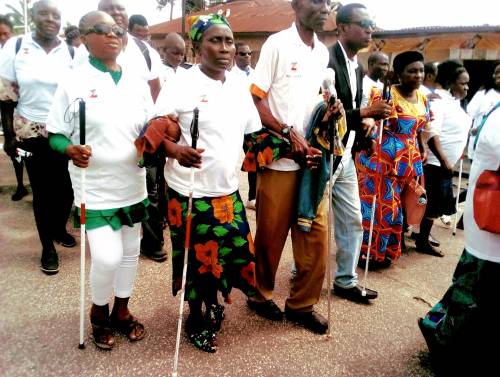
THE Nigeria Association of the Blind (NAB), Lagos State Chapter, has raised alarm that more than 500,000 persons living with disabilities (PWLD) in the state are at risk of avoidable health crises and needless deaths as the lockdown occasioned by the coronavirus pandemic worsens the livelihoods and survival of PLWDs.

The group expressed concern that a large number of persons living with disabilities may never benefit from the free food stimulus program introduced by the Lagos State Government if Governor Sanwo-Olu fails to co-opt disabled person clusters and Civil Society Organizations as monitors in the palliative distribution process.

According to a press statement signed by Mr. Babatunde Mohammed, Chairman of the Nigeria Association of the Blind in Lagos, “we are deeply worried about recent revelation by Governor Sanwo-Olu that some elements have hijacked the free food program initiated by the state, and the severe consequences this sabotage will bring to persons with special needs in the state.”

While the group lauded efforts by the Lagos State Residents Registration Agency (LASRRA) for reaching out to PLWDs and the old in the state via text messages, it, however, raised concerns that a lot of persons with disabilities are yet to receive the food package promised them in the SMS one week after the promise was made.

“As a matter of fact, the majority of PLWDs who received the LASRRA SMS have become frustrated by the failed delivery notices they get each time they tried to respond to the text message,” the statement read.

“Others who have relocated from their earlier addresses captured in the LASRRA register are also left with no option to supply information about their current location, neither do they have the opportunity to call specific mobile lines for that purpose.”
In reviewing its response strategy henceforth, the group urged the state government to provide each cluster of persons with special needs with the logistics to distribute the stimulus package to their members in collaboration with the Lagos State Office for Disability Affairs, since each of the clusters (Blind, Deaf, Albinos, Physical, etc) has a register of their bonafide members.

“This response strategy, if considered by His Excellency, will have a far-reaching positive impact on disabled persons in the state in the long run, compared to the initial strategy where the Joint National Association of Persons With Disabilities (JONAPWDs) in the state was given 100 food package to share among a disabled person community numbering over 500,000,” the statement read.

MRA issues Nigerian Police ultimatum to prosecute SARS operatives’ attack on journalists

THE Media Rights Agenda (MRA) has on Monday issued a 14-day ultimatum to the Nigeria Police Force to investigate the attack and detention of journalists by men of the Special Anti-Robbery Squad (SARS).

MRA through an official statement gave the ultimatum to the police authorities condemning the invasion of the SARS operatives on the Nigeria Union of Journalists (NUJ) secretariat in Adamawa state on Tuesday, April 2.

Ayode Longe, MRA’s programme director, explained that the attack occurred at about 6.28 pm on April 2, the Officer in Charge of SARS in Adamawa State reportedly went to the state secretariat of the NUJ where he met reporters in the process of filing news reports to their different media organizations, using the internet services at the press centre due to the closure of business centres around the city.


READ ALSO:

Longe added that a while after the journalists got to the press centre, the SARS officers made phone calls after which six Toyota Hilux vans filled with heavily armed police operatives invaded the press centre and beat up journalists, forcing journalists all 12 of them into the vehicles including the state chairman of the NUJ, Mr. Ishaku Dedan.

According to Longe, the journalists were released after two hours in custody on the orders of the State Commissioner of Police, Mr. Audu Adamu Madaki, who also directed the police officers involved in the arrest to apologize to the NUJ within three days.

“By failing to take any punitive or disciplinary action against the police officers involved in the outrage, the Police authorities have ensured impunity for crimes against journalists in breach of Nigeria’s international commitments and obligations, a situation which is bound to encourage similar action in future as it sends a message to policemen everywhere that there will never be consequences for them for such unacceptable behaviou,” Longe said.

On the ultimatum, MRA said if it elapses and the Nigeria Police fail to arrest and prosecute the SARS operatives, the organisation would issue a formal.report to the United Nations Secretary General and request him to bring the matter to the attention of the UN General Assembly so that appropriate action can be taken against Nigeria for crimes against journalists in violation of several UN instruments.

However, he called on the Inspector General of Police, Mohammed Adamu, to restore discipline within the Force, saying the constant brutalization of journalists and other innocent citizens with impunity by the police was no longer acceptable.

UPDATED: Wife of index case asymptomatic after testing positive, contact tracing begins in Kwara as UITH suspends Prof. Salami

THE wife of the man, a UK returnee who died as a result of contracting coronavirus at the University of Ilorin Teaching Hospital (UITH) last Thursday, is asymptomatic after testing positive.

The ICIR source from Kwara State Ministry of Health, said the wife of the deceased man, Kwara Covid-19 index case, is still alive and well, also asymptomatic at the moment.

According to the source, “the wife is alive and well, asymptomatic at the moment. She was picked up last night to the isolation centre by members of Kwara COVID-19 team and the State Department of Public Health.

As at now, the team has about 300+ contacts it is already tracing, among those who attended the burial and those who had contact with the index case before his demise, the source said.


READ ALSO:

It will be recall that medical personnel, including doctors and nurses also came in contact with the index case have been placed on self-isolation.

Other possible contacts include Professor A.K Salami, a Senior Consultant at UITH, who bathed the deceased and those who followed them for the burial in Offa last Friday.

Considering the exposure of the deceased to many people, more suspected cases of COVID-19 are expected to be identified in Ilorin.

The state capital neither has a COVID- 19 isolation centre nor a testing centre.

According to a source who pleaded for anonymity, Offa has in a few days witnessed influx of UK returnees, but the town, about 30 minutes’ drive from Ilorin, has only one isolation centre in Sobi Specialist Hospital and does not have any testing centre.

Meanwhile, the Management of the University of Ilorin Teaching Hospital has approved the suspension of Professor A.K Salami as a Senior Consultant in the hospital.

According to a release signed by the Director of Administration , David Odaibo, on behalf of the Chief Medical Director, the professor was suspended due to what it describe as “unethical conduct in the admission, management and eventual release of the corpse of a suspected Covid-19 patient who died in the hospital on the 3rd of April, 2020.”

The state government has disclosed plan to address a press briefing at 11am on the update.

NNPC announces subsidy removal on petroleum products

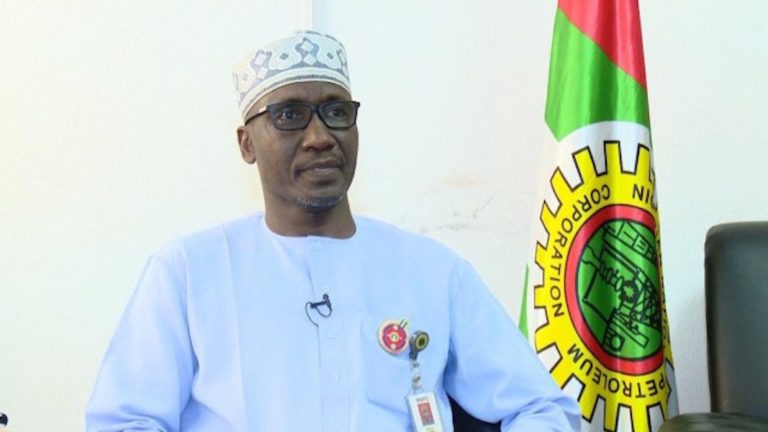
ON Monday, Group Managing Director of the Nigerian National Petroleum Corporation, NNPC, Mele Kyari, revealed that Nigeria would no longer pay subsidy on petrol following the fall in global oil price.

This development was announced in a statement by NNPC’s spokesperson Kennie Obateru, who spoke on behalf of Kyari at a television programme in Abuja.

“There is no subsidy and it is zero forever, going forward there will be no resort to either subsidy or under-recovery of any nature.

“NNPC will play in the marketplace, it will just be another marketer in the space. But we will be there for the country to sustain the security of supply at market price,” he said.

He said that NNPC was a transparent organisation, saying the National Oil Company was probably the only company in the world that published its monthly financial and operations reports.

During the interview, he said as of  April 5, Nigeria produced 2.3 million barrels of crude oil, including condensates stating the plan was for the country to ramp up production to 3 million barrels per day in the nearest future.

He admitted that though the COVID-19 pandemic had ground demand and supply fundamentals, all Nigeria’s export terminals were still in operations.

“The key issue in the crude oil business is market fundamentals of demand and supply. I believe COVID-19 will subside and countries will come back to life.

“I don’t see the oil price going below the $20 we witnessed last week. I’m certain, all things being equal, the oil price will bounce back,” he added. The NNPC’s helmsman assured Nigerians of ample supply and distribution of petroleum products.

He said the corporation had in stock about 2.6 billion litres of petroleum products that could serve the country’s energy needs for the next two months, stating that the NNPC was collaborating with all relevant stakeholders to ensure that the supply and distribution value chain was not disrupted to guarantee energy security for the country.

Covid-19: UK Prime Minister health worsens, moved to ICU

BORIS Johnson, UK Prime Minister has been moved to an intensive care unit in a London hospital after his health conditions took turn for worse ten days after he tested positive for Coronavirus.

According to Downing Street,  the Prime Minister was moved on the advice of his medical team and is receiving care at St Thomas’ Hospital, in London.

Downing added that the United kingdom’s Foreign Secretary, Dominic Raab will deputise Johnson where neccessary

The 55-year old Prime Minister was admitted to hospital in London with “persistent symptoms” on Sunday evening.

According to BBC, Guto Harri, Boris Johnson’s Communications Director when he was mayor of London, explained why he was taken to the hospital.

“There has tragically been quite clearly a deterioration that is quite significant for him to now have to succumb to intensive care and to have to deputise formally to the foreign secretary,” he said.

Harri said in the four years he worked for  Johnson, “I don’t think he was ill once” and said the PM would be “hugely frustrated” that he cannot now take the lead.

“I think what’s clearly happened over the last few weeks, there have been enormous decisions about lives and livelihoods… and he’d have felt that the important thing was he was out there, he was seen to lead from the front and he probably wouldn’t have slept well and would have been working too hard.”

Borris Johnson was initially taken to hospital for routine tests after testing positive for coronavirus 10 days ago. His symptoms included a high temperature and a cough.


FG approves employment of 774,000 Nigerians in new special public works programme

THE Federal Government on Monday announced plans to employ 774,000 Nigerians from the 774 Local Government Areas  in the country.

One thousand persons would be employed from each of the 774 Local Government Areas under the scheme  described as Federal Government’s special public works programme.

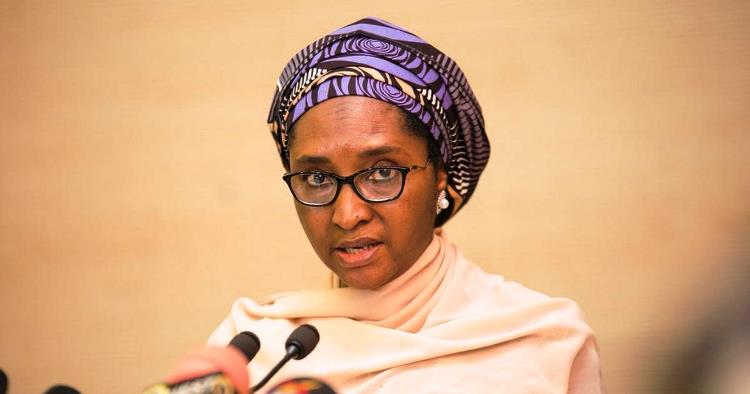
Zainab Ahmed, the Minister of Finance, Budget and National Planning disclosed this during a briefing held in Abuja on fiscal measures among other interventions the current administration intends to deploy to reduce the burden of the COVID-19 pandemic.

According to the minister, about N60 billion was already set aside from the COVID-19 crisis intervention fund for the project, basically for allowances and operational cost.

She noted that the programme had earlier commenced in eight states across the federation and being implemented by the National Directorate of Employment (NDE), as a pilot special public works programme after presidential approval by President Muhammadu Buhari.

Ahmed added that the president had now approved it’s extention to the 36 states of the federation and the FCT from October to December 2020.

“The Federal Ministry of Finance, Budget and National Planning are also evaluating how best to extend the Special Public Works Programme, to provide modest stipends for itinerant workers to undertake Roads Rehabilitation and Social Housing Construction,” the Minister said.

“And also Urban and Rural Sanitation, Health Extension and other critical services. This intervention will be undertaken in conjunction with the key federal ministries responsible for Agriculture, Environment, Health and Infrastructure, as well as the states, to financially empower individuals who lose their jobs due to the economic crisis.”

“Mr President has approved the establishment of a-N500 billion COVID-19 Crisis Intervention Fund. The establishment of the Fund will involve drawing much-needed cash resources from various Special Funds and Accounts, in consultation with and with the approval of the National Assembly.

“The N500 billion is proposed to be utilized to upgrade healthcare facilities as earlier identified by the Presidential Task Force on COVID-19 and approved by Mr President.

“This will help to finance the Federal Government’s Interventions to support states in improving healthcare facilities, finance the creation of a Special Public Works programme and Fund any additional interventions that may be approved by Mr President,” she added.

Abuja markets now to open three days a week for eight hours— FCT Minister

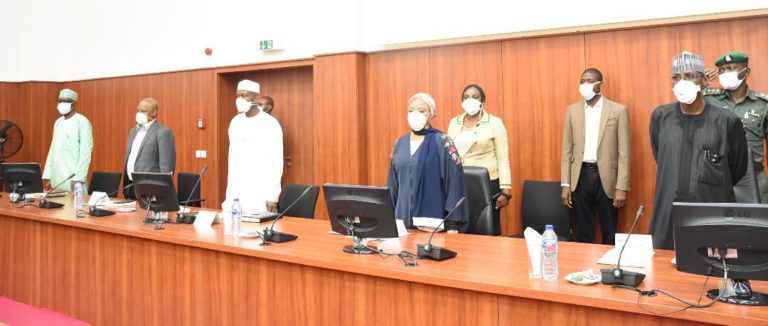
MUHAMMAD Bello, Minister of the Federal Capital Territory (FCT), Abuja on Monday directed that markets in the territory will now only operate three times weekly on Mondays, Wednesdays and Saturdays, from 7.000 am to 2:00pm.

A statement issued by Anthony Ogunleye, the Chief Press Secretary to the Minister explained that this was part of measures to limit the spread of the deadly COVID-19 pandemic in the FCT.

He stated that Bello issued this directive in Abuja on Monday, April 6 during a meeting with FCT Market Managers and the top hierarchy of the FCT Police Command, led by the FCT Police Commissioner, Bala Ciroma.

Ogunleye disclosed that Bello who was represented at the meeting by the Director of Security Services Department, Adamu Gwary, noted that that only retailers would be allowed to operate within the markets as wholesale services would not be permitted.

The Minister, according to him, however directed market managers and the FCT Police Command to ensure compliance with the directive by monitoring all entry and exit points of the various markets as well as activities of the traders.

He also advised FCT residents to patronize markets within their neighbourhoods rather than going to the major markets in the city centre, in order to limit the spread of the virus between communities in the FCT.

In his remarks, Bala Ciroma, the FCT Police Commissioner,  assured that the FCT Police Command would enforce the directive, even as he advised residents against flouting this regulation.


COVID-19: China records rise in asymptomatic cases, moves to tighten land borders

THE National Health Commission of China said on Monday that 78 new asymptomatic cases had been identified as of the end of Sunday, compared with 47 the day before.

According to the Reuters, Hubei Province, the original epicentre, accounted for almost half the new asymptomatic cases.

It reported that 705 people with asymptomatic cases were under medical observation around mainland China.

The surge in asymptomatic cases, which China only began, reporting last week, poses a worry as Hubei’s capital, Wuhan prepares to allow people to leave the city on April 8 for the first time since it was locked down in late January.

Wuhan officials revoked the “epidemic-free” status of 45 residential compounds due to the emergence of asymptomatic cases and other unspecified reasons, according to a report on Monday by the official Xinhua news agency.

“Epidemic-free” status allows people living in Wuhan compounds to leave their homes for two hours at a time.

China has now reported a total of 81,708 cases, with 3,331 deaths. One new locally transmitted infection was reported in the latest data, in the Southern Province of Guangdong, down from five a day earlier in the same province.

China has closed its borders to foreigners as the virus spreads globally, though most imported cases have involved Chinese nationals returning from overseas.

The country began testing all international arrivals for the coronavirus from April 1, customs official, Song Yueqian said.