Home Blog Page 2359

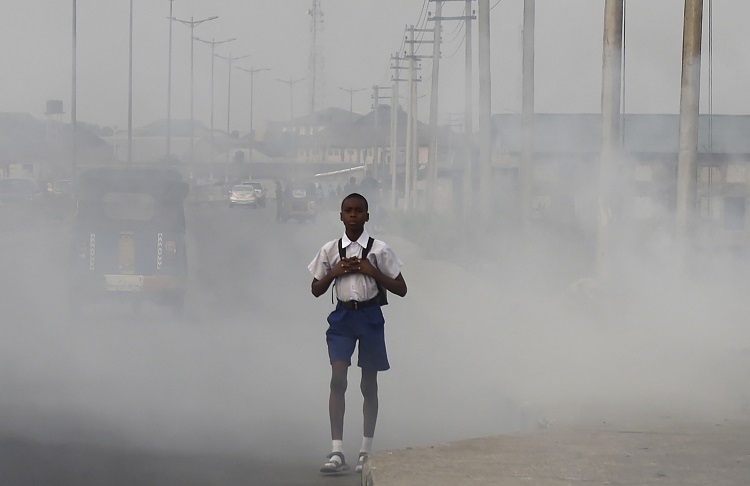
94 percent of  African children live where air quality is not measured – UNICEF report

ABOUT 94 percent of children in Africa live in areas with no reliable means of measuring air quality, according to a new UNICEF report released on 2019 World Environment Day.

The report titled “Silent Suffocation in Africa” measures the population of children living near reliable ground-level air quality monitoring stations. It notes that air pollution is a growing challenge in the continent, affecting the poorest children the most.

Only six percent of these African children live in areas where air pollution is reliably measured at ground-level that provide real-time data on the quality of air they are breathing. But in Europe and North America, 72 percent of children live where air pollution is fully measured, 43 percent in Asia and 25 percent in South America.

Since air pollution is not monitored in Africa to the same extent as other parts of the world, UNICEF notes that African countries are not only potentially underestimating the severity of the impact but might also be underestimating its scope.

According to the State of global air report published by the Health Effects Institute in August 2018, Nigeria is among the countries with deadly air quality. This is as a result of the environmental hazards combined with extreme pollution sources like crop burning generator and vehicle fumes.

And a World Health Organisation report of 2016 noted that Onitsha, Kaduna, Aba, Umuahia were among four of the 20 African cities with the worst air quality in the world.


Air pollution is a major killer of children. For babies and young children, breathing particulate air pollution is extremely harmful to their health and development. As this can cause permanent damage to brain tissue and lungs.

The UNICEF report analysed that deaths from outdoor air pollution in Africa have increased 57 percent over 27 years, from 164,000 in 1990 to 258,000 in 2017. A recent study that was included in the report estimates the economic cost of premature deaths from outdoor air pollution across Africa to be $215bn

“without ground-level monitoring stations that reliably measure air quality, Africa’s children are increasingly at risk of unwittingly breathing air that is toxic for their health and brain development, and the ability to devise effective responses is greatly compromised,” the report read partly.

For instance, it said that “ultrafine pollution particles can enter the bloodstream, travel to the brain, and damage the blood-brain barrier, which can cause neuro-inflammation.”

Other types of pollution particles, such as polycyclic aromatic hydrocarbons, can damage areas in the brain that are critical in helping neurons communicate, the foundation for children’s learning and development.

“Air pollution is a silent killer of children. And in Africa especially, we know the problem is severe, we just don’t know how severe,” said Henrietta Fore, UNICEF Executive Director.

“Reducing children’s exposure to pollutants – and therefore reducing the damage to children’s health and early brain development – begins with a reliable understanding of the quality of air they are breathing in the first place.”

Apart from human being dying, air pollution also impacts ecosystems that are vital to livelihoods and health, as well as food crops.

UNICEF urges African governments, including Nigeria, to put in place permanent and high-quality ground-level monitoring stations as public goods. When combined with satellite imagery, such stations would form the backbone of a system that would help improve the reliability of less precise monitoring stations that capture variations across cities”.

It includes that reliable ground level data helps to better capture the daily or hourly fluctuations in air quality. “Monitoring also helps to identify sources of pollution, shaping public health policy, and informing action and interventions that target the most affected,” UNICEF notes.

The Agency also tasked the governments to invest in renewable sources of energy to replace fossil fuel combustion and provide affordable access to public transport. It also calls more green spaces in urban areas and creates better waste management options to prevent the open burning of harmful chemicals.

To prevent children’s exposure to air pollution, the report identifies that countries should plan the urban cities to make sure major sources of pollution are not located near schools, clinics or hospitals.

“If toxic air is stunting our children’s development, it is stunting our societies’ development as well. All governments should take the necessary steps to make sure we know exactly what we are putting into the air and what it is doing to our children’s health and well-being,” said Fore.

NSCDC arrests suspected Boko Haram bomb materials supplier

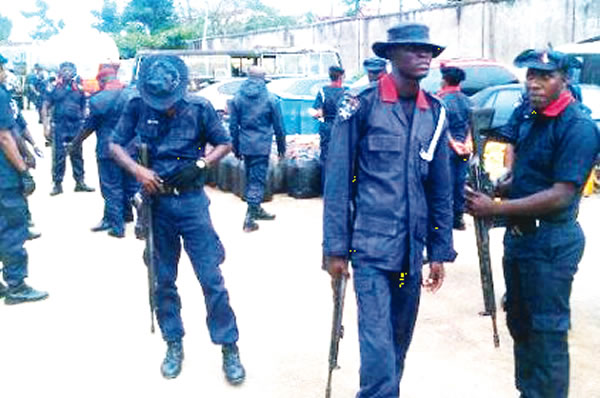
OPERATIVES of the Nigerian Security and Civil Defence Corps(NSCDC) in Borno on Wednesday, confirmed the arrest of one Aliyu Muhammed, a 24-year-old suspected Boko Haram Improvised Explosive Device(IED) logistics supplier in Maiduguri.
The Commandant of the corps, Ibrahim Abdullahi, disclosed this in an interview with the News Agency of Nigeria, NAN, in Maiduguri.
Abdullahi said that the suspect was nabbed by men of the command on April 25, following intelligence report while he was on his way to supply bomb materials for Boko Haram terrorists.
He said that preliminary investigation conducted by the command revealed that the suspect supplied mobile phones battery, wrist watches as well as laptop computers used for setting off IEDs designed to inflict massive casualties.
” The suspect who pretends to be a tricycle operator in the town has executed many missions for the insurgents.
“He also operates several bank accounts, where he receives funds for Boko Haram in the last six months.
“He usually receives large sums of money from the Republic of Chad, through a third party account number to avoid being detected.
“We have so far tracked dozens of his transactions especially at commercial money transfer centres within Maiduguri,” he said.
The NSCDC commandant said Mohammed and his colleagues have played different roles in masterminding various attacks, in worship centres, market places in Maiduguri and environs.
Abdullahi reiterated the commitment of the command toward complimenting efforts of the army, police and other sister agencies in the counter-terrorism campaign in the Northeast.
“The command had within the past two years arrest more than 25 Boko Haram insurgents, comprising of female suicide bombers, commanders and collaborators in Maiduguri.
“The command had, through the dispute resolution department encouraged more than 40 terrorists to lay down their arms and accepted meaningful rehabilitation and reintegration through the Operation Safe Corridor window opportunity provided by the government,” he said.
He added that the suspect would be handed over to the 7 Division Garrison of the army for further interrogation and profiling.
(NAN)

FACTCHECK: Bayelsa govt claims it is least indebted in South-South, but that is false

THE Bayelsa government on Saturday said it remains the least indebted among the states of the South-South region, but The ICIR has found the claim to be inaccurate. The available fact indeed shows that Edo holds the record.

Mr Daniel Iworiso-Markson, Commissioner for Information in Bayelsa who made the statement in Yenagoa did not, however, disclose the debt profile of the state.

He said the state’s debt profile as released by the Debt Management Office was moderate because of the frugality and judicious management of state resources by Gov. Seriake Dickson.

And several media reports have circulated the false claim.

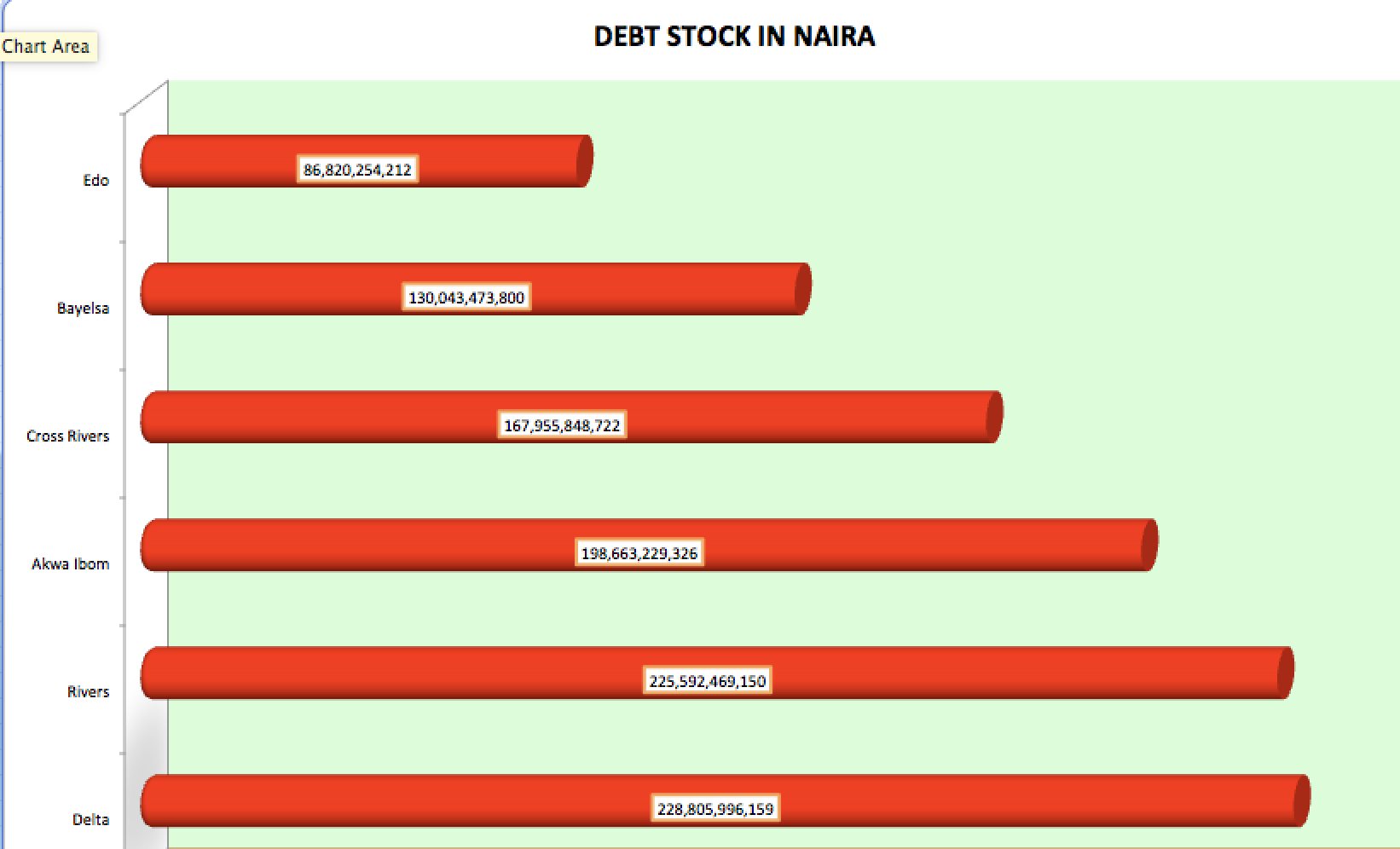
The ICIR’s fact-check has however shown that Bayelsa domestic debt stock as at Dec.31, 2018 stood at N130.04 bn and ranks the 7th among the most indebted, according to figures on the Debt Management Office (DMO) website.

According to the DMO, for states in the South-South region, Delta was 2nd in the country with debt of N228,80 bn, Rivers 3rd with N225.59 bn debt, Akwa Ibom followed on the 4th position with N198.66 bn.

Source: DMO

Also, Cross River ranked 5th  on the list of the most highly indebted states in Nigeria with N167.955 while Bayelsa was ranked 7th with N130.04 bn while Edo was 8th on the list with N86.82 bn, the least indebted in the Niger Delta region.

Among all the 36 states including FCT, Yobe state is the least indebted state with a total debt of N27.7 billion followed by Katsina, N30.8 billion.

The commissioner said the government inherited a bond of N120 billion from the Chief Timipre Sylva-led Administration at inception in 2012 and would complete repayment in June.

The commissioner noted that Dickson should be commended for keeping the debt status of the state low in spite of the various big-ticket projects in the critical sectors that were successfully executed and ongoing in the state.

He recalled that the state government recently completed the Bayelsa International Cargo/Passenger Airport at a cost of N65 billion aside the multi-billion projects in education, health, agricultural sectors.

The commissioner said that Sylva and members of the APC who have been making false claims about the debt profile of the state had a responsibility to tell Bayelsa people what they did with the N120 bn loan they left behind.

“It is worthy of note that the Bayelsa still remains the least indebted state in the whole of the South-South region.

“This is in spite of the massive projection execution that has taken place since 2012 when the Restoration Government took over.

“The debt status of the state is modest because of the prudent and judicious management of state resources by the Governor in spite of the several completed development projects in the state.

“By this month, we will finish paying Chief Timipre Sylva’s bonds which is about N120 billion which of course, he didn’t use for anything.

“When such people make claims, they should be reminded that they have a duty to tell Bayelsans what they did with N120 billion they foisted on the state,” Iworiso-Markson said.

Nigerian state remains highly secretive under Buhari despite commitment to open government

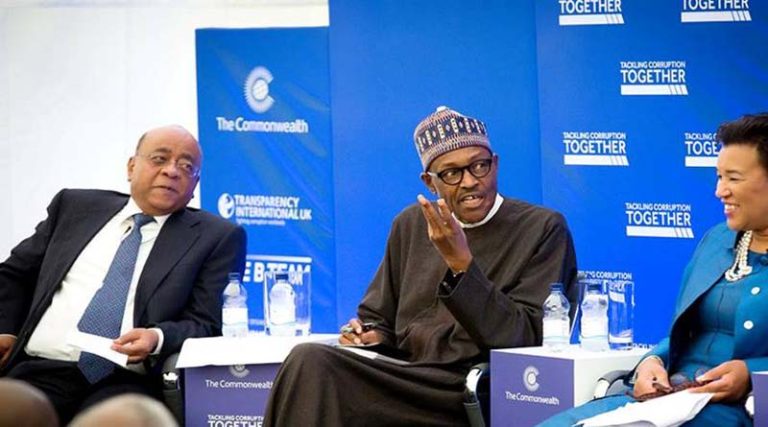
IN May 2016, barely a year after the commencement of his first term in office, President Muhammadu Buhari in London committed Nigeria to joining Open Government Partnership initiative.

Two months after the promise, Nigeria formally became a member by signing the OGP agreement. But since then, there has been no significant improvement in the transparency and accountability level of public institutions under Buhari.

The majority of government agencies instead operate well under the radar, making deals worth billions of dollars away from public scrutiny, as the media have reported.

And even when the Freedom of Information Act is invoked to obtain access to public records, many Ministries, Departments and Agencies (MDAs) do not comply.

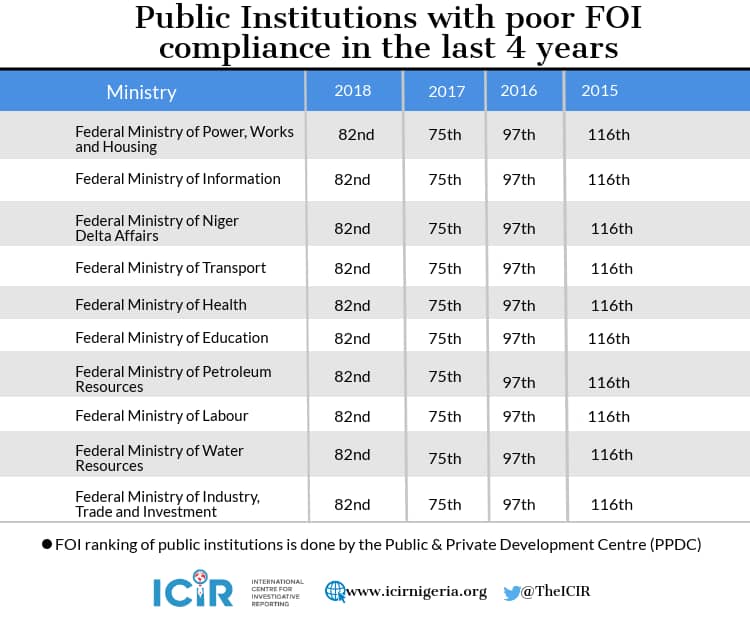
According to the FOI ranking carried out by Public and Private Development Centre among 187 public institutions, over a hundred agencies of government neither disclosed information proactively nor responded to FOI requests in 2018. In fact, only 12 agencies had a good record of FOIA compliance, the rest were either poor or worse.

In the previous years, the records were as woeful.

It is no surprise though. According to the Bureau of Public Service Reforms (BPSR), less than 30 per cent of the MDAs have functional websites to publish public records and less than 25 per cent have functional telephone numbers and e-mail. And those that have websites hardly upload useful public records on their platforms.

This situation explains the dismal scorecards of public institutions in Nigeria concerning FOIA compliance.

Section 29 of the FOI Act mandates every public institution to submit its annual report on or before February 1 of each year to the Attorney General of the Federation (AGF) on all applications of FOI request they received.

But only 73 out of 900 public institutions submitted the report in 2017, representing only 8.1 per cent compliance with the provision of the act.

In 2016, over 90 per cent of the MDAs violated Section 29 that mandates submission of the report on every February 1.

That year, The Guardian sent FoI requests to 50 agencies asking for documents/records that show that submission of the report on February 1 had been complied with in addition to the trend of compliance since May 28, 2011, when the FOI Act was promulgated.

Within seven days of the receipt of The Guardian’s application (as required by the Act), only four agencies replied, while two others called to ask for re-routing the application to ‘appropriate units’.

Similarly, between June 2018  and May 2019, The ICIR has filed 53 FOI requests, but only 17 were responded to.

Secrecy around public bookkeeping in Nigeria

In July 2018, The ICIR on behalf of LeaksNG sent FOI requests to a number of government agencies, asking for detail of stamp duty remittances by Deposit Money Banks and other financial institutions.

Banks and other financial institutions since January 2016 have been mandated to charge their customers N50 on every transaction from N1000 and above in accordance with the provision of the Stamp Duty Act of 2009.

This remittance, according to unverified reports, has reached N20 trillion, but the details of the collected fund are shrouded in secrecy.

The LeaksNG, a coalition of Nigerian newsrooms, acting on a tip-off that some powerful individuals may have been siphoning the fund for personal use, wanted to know where the money is kept and thus started to ask questions.

Letters were sent to the Central Bank of Nigeria (CBN), Office of the Secretary to the Government of the Federation (OSGF), Nigerian Postal Service (NIPOST), and the Nigeria Inter-Bank Settlement System (NIBSS) PLC.

But none of the agencies provided the information requested.

The OSGF denied having information about the fund despite that it was fingered as one of the agencies that formulated the policy. It rather advised that the FOI application be directed to the Federal Inland Revenue Service (FIRS).

“The Office is of the view that the Federal Inland Revenue Service (FIRS) has a greater interest and is the custodian of the information sought and therefore would be in a better position to provide same,” the acting legal adviser at OSGF, J.O Obule, wrote in a letter dated 9th August 2018.

But FIRS, in its response, would later shift responsibility to Nigerian Postal Service, NIPOST.

“We regret to inform you that FIRS does not collect Stamp Duties from NIPOST. Therefore we ask that the above request be directed to NIPOST,” Ike Odume, the FIRS Director of Legal Services, the FIRS wrote in a letter dated 5th November 2018.

Also, when NIPOST eventually responded on the 19th November 2018, nearly four months after the request was sent, it wrote “…There was never a stamp duty revenue collection account by NIPOST between 2010 and 2016…

“However, in January 2016, pursuant to the directives of Central Bank of Nigeria directing Deposit Money Banks to start deducting N50.00 stamp duties from the eligible transaction, a dedicated account was opened and domiciled with the Central Bank of Nigeria. The Nigerian Postal Service has no authority to disburse the fund as it is meant for the three tiers of Government. Thus, the appropriate office to direct your enquiry to is the Central Bank of Nigeria (CBN) who is the custodian of the account.”

And the CBN, in a letter dated 6th November 2018 and signed by Mrs R.J Monguno, put paid to the FOI request.

“The information you requested is a subject matter of a suit before Supreme Court of Nigeria and is therefore subjudice,” she wrote.

Till date, none of these government agencies has further provided information about the stamp duty contributed by millions of Nigerians, even after their disregard was made public.
Notorious violators of FOI

One of the agencies that have little or no regards for the freedom of information law is the Code of Conduct Bureau. The agency keeps a written declaration of all public officers concerning their properties, assets and liabilities, and those of their spouse (if not a public officer. In 2018 the agency is ranked among the worst in FOIA compliance by PPDC.

The ICIR on January 16, requested the Bureau to provide details of assets declared by all cabinet members in the Buhari administration. But it wrote back after a month declining to grant the request because, according to the letter, the term and conditions for such request have not been yet prescribed by the National Assembly. The letter further states that FOI law has exempted the assets declaration of public officers.

A week later, Saturday PUNCH newspaper made a similar request and was turned down for the same reason.

The Bureau gave a similar insipid response in October 2015 when a civil society group,  the Advocate for Peoples Rights and Justice, filed an FOI request demanding the assets declaration forms of the heads of both the CCB; the Code of Conduct Tribunal; and Nasir El-Rufai, the governor of Kaduna State (while he was the FCT minister)

Though The ICIR has instituted a court action against the Bureau, it is yet uncertain how long the process will last.

Another notorious violator of FOI is the Nigerian National Petroleum Corporation (NNPC). Human rights activist lawyer, Femi Falana, SAN in March 2018 requested the corporation to provide information on the amount of money spent on petrol subsidy and turnaround maintenance of refineries.
But the NNPC, despite that the federal government has a controlling interest in it and it is utilising public funds to provide public services, declined to make the information public.

The response goes thus, “We regret to inform you that the NNPC is not in a position to provide any information or document as your request is incongruous with, unsupported by or outside the scope and purview of the Freedom of Information Act. Be informed that the FOI Act is not applicable to the NNPC because it is not a public institution within the meaning of Section 31 of FOIA.”

A pro-democratic civil organization, Anti-Corruption and Integrity Forum had also unsuccessfully requested the NPPC to provide information on crude oil swap and offshore processing agreement (OPA). The case has been in court since 2017.

Other notorious ministries include the Ministry of Information, Federal Ministry of Power, Ministry of Health and so on.

The Deputy Director FOI Unit Federal Ministry of Justice, Benjamin Okolo, whose office coordinates the implementation of FOIA, has at public function described the situation as “unfortunate”. But he also confessed that there was nothing his office could do to make the agencies show greater transparency since the law does not prescribe how defaulting institutions should be sanctioned.

Ironically, the Ministry of Justice, mandated to monitor FOIA compliance, has also denied response to FOIA request made by The Cable Newspaper Journalism Foundation (CNJF). The online paper requested information on the engagement of lawyers for the recovery of stolen funds by Sani Abacha, a former military ruler.

The Cable Foundation had written to the office of the AGF in respect of a report on the repatriation of $321 million stolen by Abacha, asking to know why the office of the AGF hired another set of lawyers to do a job that had already been completed by Erico Mofreni, a Swiss lawyer engaged by Nigeria since 2000. It also requested a copy of the 2014 agreement that led to the withdrawal of the prosecution of Abacha’s son, Mohammed.

But the ministry stonewalled until the matter is taken to the court on 10th January 2018.

Former President Goodluck Jonathan signed FOIA bill into law on 28th May 2011  with the expectation that law would promote transparency and accountability in government, giving citizens access to public records and government. But the law has since then remained a paper tiger. And with the signing of OGP by President Buhari, Nigerians were optimistic that the initiative would encourage the implementation of FOIA; that change is yet to happen. Rather the government continues to operate in secrecy that makes it difficult for the Nigerians and the press to join anti-corruption fighting machine of Buhari administration.

The Acting Director-General, Bureau of Public Service Reforms (BPSR), Mr Dasuki Arabi said: “The denial of access to information and attendant widespread ignorance in the society does more harm than any harm that could possibly arise from granting access of information to members of the public.”

But the message is yet to gain the attention of public servants working in Buhari government, therefore making the operation of the present administration yet opaque, despite the public pledge of the president three years ago in London.

 

Abacha Loot: UK withholds £211 million stashed in late Nigerian dictator’s account

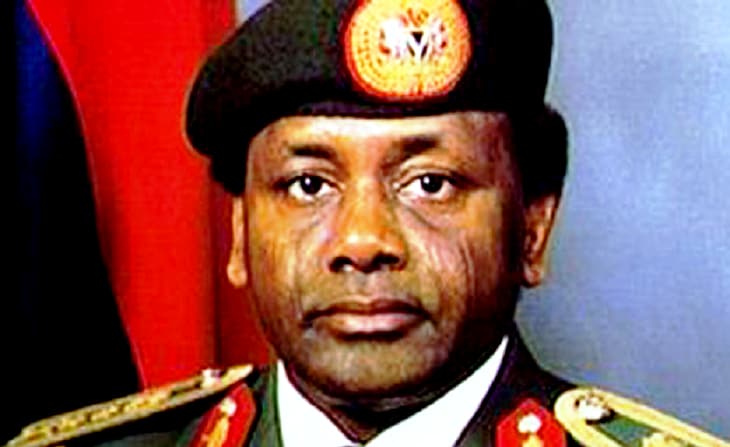
ON, Tuesday the United Kingdom, UK, Government announced the seizure of over £211 million from a Jersey bank account belonging to the late Nigerian Head of State, Sani Abacha.

In a UK Metro report, the money which was initially intended to be laundered into the United States, US, was recovered and put in accounts held in Jersey by Doraville Properties Corporation, a British Virgin Islands company.

Abacha had ruled the country for about five years as Nigerian military head of state before he died on June 8, 1998, from an alleged “sudden heart attack”.

The report also stated that the money is now being held by the government until authorities in Jersey, the US and Nigeria agree on how it should be distributed.

“Any money that Jersey does keep will be put into the Criminal Confiscation Fund, which is used to pay for a variety of projects. In the past, the fund has been used for the new police station and developments at La Moye Prison.

It also hinted that the “money held by Doraville is likely to be seized and paid into the Civil Asset Recovery Fund in the future”, the report stated.

The latest discovery is among a string of public funds allegedly stashed in international banks by the late military head of state who had ruled between 1993 and 1998.

In 2014, at the request of the US authorities, the Island’s Attorney General applied for, and the Royal Court granted, a restraining order over the Jersey bank account balance of Doraville.

“The purpose of the restraining order was to preserve the money until a final civil asset recovery order could be registered in the Royal Court.”

Doraville applied to the Royal Court for the restraint order to be discharged, but the Royal Court dismissed the application in 2016.

Then in 2017, Doraville challenged the Royal Court’s decision, taking the case to Jersey’s Court of Appeal.

“That challenge was again rejected. Finally, following the decision of Jersey’s Court of Appeal, Doraville made an application to appeal against the restraint order before the Privy Council – Jersey’s ultimate appellate court.”

However, Jersey’s Attorney General, Robert MacRae, confirmed Jersey’s judicial system was displaying transparency in its operations.

“In restraining the funds at the request of the United States of America, through whose banking system the funds were laundered prior to arriving here, and in achieving the payment of the bulk of the funds into the Civil Asset Recovery Fund.

“Jersey has once again demonstrated its commitment to tackling international financial crime and money laundering,” he said.

Operation Puff Adder: Police arrests suspected kidnappers with 6,000 live ammunition, 20 AK47 rifles

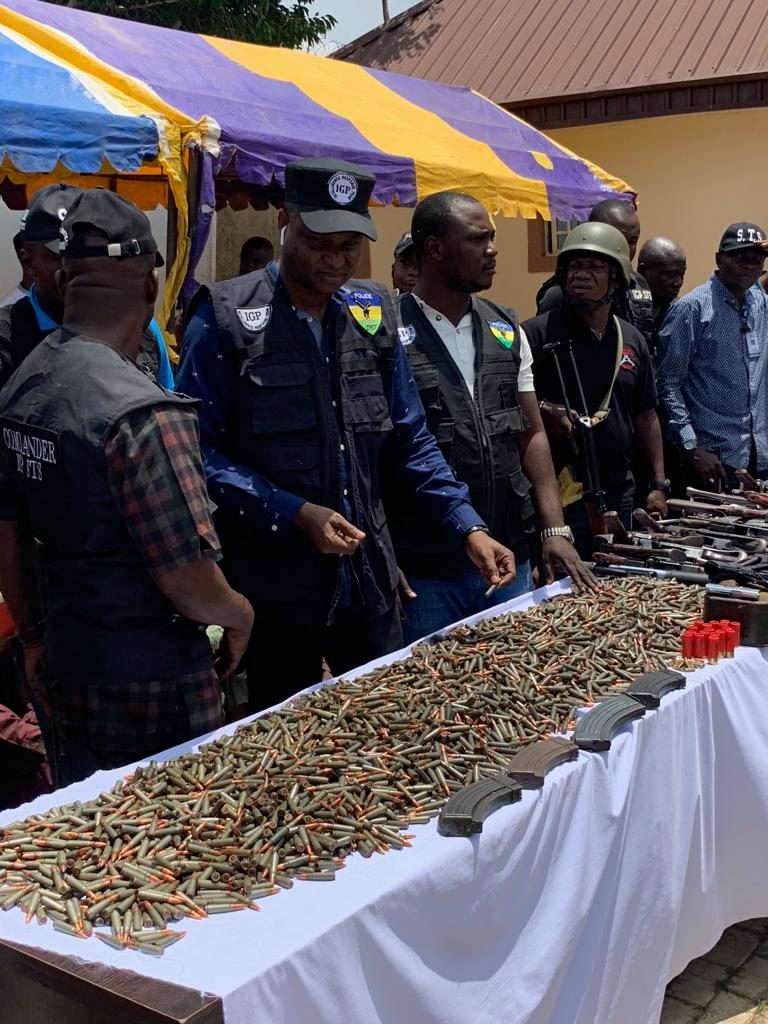
THE Nigerian Police on Monday says it has arrested arms syndicate who are notorious for smuggling weapons into the country from North Africa, Burkina Faso and Benin Republic. 
Police spokesperson, Deputy Commissioner of Police (DSP) Frank Mba, disclosed this in Abuja after parading 38 suspected persons accused of kidnapping, armed robbery and gun racketeering.
“They conceal the weapons inside hide and skin, second-hand clothing and yam flour,“ says Mba.
The Police launched Operation Puff Adder in April followings incessant attack along the Abuja-Kaduna express road
He told the newsmen that the suspects were arrested by police operatives attached to the Special Tactical Squad (STS) and Intelligence Response Team (IRT).
According to him, 20 AK47 rifles, 11 dane guns, four pump action rifles, 10 automatic pistols, 6, 000 live ammunition and two vehicles were recovered.
The Police noted that the arrest was in continuation of the Operation Puff Adder recently launched to tackle the security challenges on the Abuja-Kaduna highway.
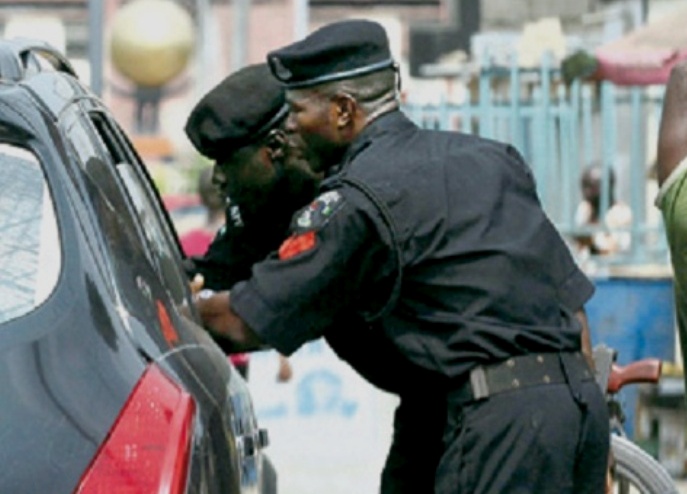
He further narrated how the criminals devised new means of concealing weapons inside toys, stressing the need for members of the public to bear with the police when carrying thorough checks on vehicles.
“When you see policemen checking items like that please don’t blame them,” says Mba.
However, one one of the suspects who spoke to newsmen during the briefing said he had killed several kidnap victims who failed to pay ransoms.
The Police eventually said that the suspects would be charged to court after investigation.

AFRICMIL urges ICPC to investigate alleged corruption in YABATECH

THE African Centre for Media and Information Literacy (AFRICMIL) has called on the Independent Corrupt Practices and other related Offences Commission (ICPC) to probe the allegations of financial crimes and other acts of corruption at Yaba College of Technology, Lagos State.
A statement signed by Chido Onumah, Coordinator of AFRICMIL, said the allegations of massive financial malpractices were contained in a petition dated May 5, 2019, sent to the anti-graft agency by one Joseph Akeju, a victimized whistleblower and former bursar at the institution.
Onumah said the sum of N1,682,085,539  was allegedly stolen by some staff of the College between 2008 and 2014.
“The petitioner,” Onumah said, “discovered that such a huge sum of money had disappeared when he served as the chairman of a seven-man committee on the review of audit report on students’ accounts set up in 2016 by the College management.”
Besides, there were numerous dubious transactions in which the College’s Zenith Bank account No: 1010243958 was used as the conduit, as well as the persistent sale of College certificates by a syndicate in the College registry, according to the petition.
Onumah noted that all efforts by the whistleblower to make the current governing council headed by Prince Lateef Fagbemi SAN address the issue of fraud and other malpractices in the institution were rebuffed.
“Instead of listening to Mr. Akeju and commending him for doing a good job, the governing council turned the heat on him.
He suffered all kinds of abuses which culminated in his illegal dismissal in March 2018, just a few days to his official retirement from the public service,” Onumah said.
He said the ICPC has a duty to not only begin an immediate investigation into the whistleblower’s petition, but also to ensure that those who report wrongdoings, as  Akeju has patriotically demonstrated, deserve safety and full protection from high-handed government officials whose only interest is to cover and perpetuate corruption.
“That is the only way government can encourage citizens to adopt whistleblowing as a viable tool for fighting corruption,” Onumah noted.
According to him, the whistleblower’s dismissal should be reversed, and he should be allowed to retire honourably, while all those found culpable in the large-scale fraud and financial violations at YabaTech should be identified and punished accordingly.

Police reform: Buhari Panel recommends creation of state police, dismissal of 37 officers

THE Panel on the reform of the Special Anti-Robbery Squad of the Nigerian Police has recommended the dismissal of 37 police officers, and also directed the Inspector General of Police, Adamu Mohammed to unravel the identity of twenty-two officers involved in the violation of the human rights of innocent citizens.

The panel has also recommended the establishment of the state and local government police, as well as strengthening information and communication technology of the force.

Anthony Ojukwu, executive secretary of National Human Rights Commission who headed the panel set up by President Muhammadu Buhari in August 2018 submitted its report on Monday in Abuja to the president. 

The panel, whose membership was constituted by the National Human Rights Commission, was empowered to make recommendations on how to hold police officers found wanting accountable, and also, on how SARS and the larger Nigeria Police Force could be properly reformed.

The report noted that it received  113 complaints across Nigeria. After the complaints were investigated, the panel arrived at the conclusions and recommendations.

“The panel called for and received 113 complaints on alleged human rights violations from across the country and 22 memoranda on suggestions on how to reform and restructure SARS and the Nigeria Police in general,” Ojukwu said.

“At the end of its public hearing and having listened to complaints as well as defendants and their counsel, the Panel recommended thirty-seven 37 Police officers for dismissal from the force.”

The panel also recommended 24 officials for prosecution.

It also directed the Inspector General of Police to unravel the identity of twenty-two officers involved in the violation of the human rights of innocent citizens.

The report added that the 22 officers were to pay compensation for various sums and tender public apologies, as well as to obey court orders due to their abused of the citizens’ right.

The panel also directed the police to immediately arrest and prosecute two retired senior police officers found to have violated the rights of citizens (one for extra-judicial killing and the other for the illegal takeover of the property of a suspect). The Panel also recovered two vehicles illegally auctioned by SARS officers and returned them to their owners.”

Responding to the panel’s report, Buhari directed the IGP and Solicitor General of the federation to implement the recommendations within three months.

He told the police at all times to act within the ambit of the law and not to violate the fundamental human rights of Nigerians whom they had sworn to protect.

“…Police while also ensuring that we keep them in check, protect the human rights of Nigerians, and ensure that offending officers are held fully accountable,” Buhari tweeted.

Nigerian police have usually been alleged of human rights violation. On March 31, a young man named Kolade Johnson was shot dead by some police officers when he had gone to watch a football match.

Also on April 12, a trending video displayed sars operatives beating a young man to a pulp for “refusing to unlock his mobile phone”.

Oando,SEC disagree as police seals Oando’s headquaters

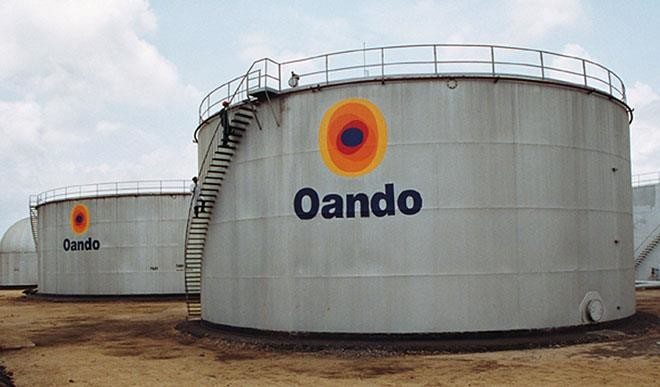
FOLLOWING the Securities and Exchange Commission’s conclusion of its investigation into the financial irregularities by Oando PLC, it announced an interim management team led by Mutiu  Sunmonu to take over the helm of affairs that would subsequently appoint a substantive management team. 

In its announcement via its Twitter handle on Monday, the commission implemented its earlier directive by appointing Mutiu  Sunmonu to take over the management of the oil firm after over – deducting withholding tax from dividends paid to shareholders amongst other tax infractions.

Withholding tax is an informal tax that is usually deducted from fees to be paid by a company that engages the service of another company.

SEC had announced the conclusion of the investigation on Oando PLC and ordered the Group Chief Executive Officer of the company, Wale Tinubu, and other affected board members to resign.

It also barred Tinubu and the Deputy Group Chief Executive Officer of the company, Omamofe Boyo, from being directors of public companies in the country for a period of five years.

In a statement issued by the commission, it stated that an extraordinary meeting to announce the appointment of new directors into the board of the company should take place on or before July 1, 2019.

In response to SEC’s decision, Ayotola Jagun, on Monday in a tweet on behalf of the company conveyed its stand on the issue urging the public to disregard the decisions of apex capital market regulator.

It affirmed that SEC was embarking on a smear campaign to damage the reputation of the company  saying “the alleged infractions and penalties are unsubstantiated, ultra lies, invalid and calculated to prejudice the business of the company.”

However, on Monday policemen had stormed Oando’s Wing Office Complex located at Ozumba Mbadiwe Avenue, Victoria Island, Lagos State denying the staff access to their offices at the directive of SEC.

The share price of Oando Plc also experienced a decline by 9.52 per cent in early trading on the Nigerian Stock Exchange, NSE, after the Securities and Exchange Commission, SEC, published its findings on Friday.

Labour, groups urge Lalong to discard bill seeking to privatise water sector

THE Amalgamated Union of Public Corporations Civil Service Technical and Recreational Services Employees (AUPCTRE) and the Environmental Rights Action/Friends of the Earth Nigeria (ERA/FoEN), on Monday urged Simon Lalong, the Plateau State Governor, to discard the Plateau State water sector law passed by the State Assembly.

The coalition argued that Plateau State residents had repeatedly rejected attempts to privatise the water sector in the state, stressing that such law would prohibit democratic control of water resources.

Members of the State Assembly, last week approved the bill after a report of the House Standing Committee on Parastatals was read by Hon. Godfrey Langdip, to the House. He claimed that the bill would foster adequate water provision to the people despite public agitations.

In a statement issued by Philip Jakpor, Head, Media and Campaign, ERA, in Abuja the groups frowned at how the lawmakers hurriedly passed the law in spite of popular aversion to its Public-Private Partnership (PPP) provisions.

According to the statement, Article three sub-section 1 (p) of the bill seeks to promote PPP principles in the development and management of water resources in Plateau.

But AUPCTRE and ERA/FoEN countered this in a joint statement, describing the passage as a betrayal of trust that Plateau citizens reposed on the lawmakers to defend them against ‘oppressive forces’. They urged Governor Lalong not to append his signature to the bill.

“We are not only dismayed with this news; we feel the Plateau State House of Assembly just gifted the citizens of the state a bad law that will mortgage their future and tie them to the loins of for-profit only entities. We reject the PPP in its entirety,” says Comrade Benjamin Anthony, AUPCTRE National President.

“The PPP privatization model in the water sector has failed in virtually all countries of the globe where it was introduced…..what we want the state government to do is to avoid worsening the already tensed security situation in the state through a denial of their fundamental right to a free gift of nature.”

Anthony insisted that the solution to the Plateau State water crisis, just like that of other states of the federation, requires the prioritizing of the rights of the people far above private interests.

Akinbode Oluwafemi, ERA/FoEN Deputy Executive Director, described the development as the height of insensitivity. He also tagged the enacted law as ‘anti-people’.

“The PPP experiment that the Plateau State government is planning to embark on will only lead to poor water quality, job losses, hike in water prices and poor service. It has happened elsewhere and will not be different here,” says Oluwafemi.

“The Governor must side with the people by not appending his signature.”

Meanwhile, on April 16, a public hearing was held on the bill where the proposed bill was reportedly rejected by the Civil Society Coalition for Good Governance and a host of the grassroots group. Rather, they canvassed support for public control and sustainable budgetary allocation to the water sector.

The groups appealed to the Plateau government to fully uphold human rights to water as an obligation of the government, representing the people and integrate broad public participation in developing plans to achieve universal access to clean water.

“The Plateau State government must build the political will to prioritize water for the people by investing in the water infrastructure necessary to provide universal water access. This will create jobs, improve public health, and invigorate the Plateau economy”.