Home Blog Page 2505

Confusion at state house as special advisers disagree on Buhari’s economic adviser

SPOKESPERSONS at the State House are in disagreement about who is president Buhari’s economic adviser.

This conflict emerged as a result of a report by The ICIR establishing that money has been allocated and released to the Office of the Chief Economic Assistant to the President (OCEAP) for research studies in 2017, and the studies remain unavailable in the public domain.

While Laolu Akande, senior special assistant to the vice president on media and publicity has maintained that the administration only appointed a special adviser on economic matters for the vice president, in the person of Adeyemi Dipeolu, Garba Shehu, senior special adviser to the president on media,  instead has said Dipeolu is the president’s economic adviser.

Based on Shehu’s confirmation, The ICIR on Wednesday reported Dipeolu as the head of the OCEAP, which according to records,  has been paid N33.7 million to conduct “evidence-based research studies on all aspects of the Nigerian economy that will help the President in formulating sound strategies and policies”.

Following a text sent to Shehu on Wednesday asking him to confirm “the person presently acting in the capacity as Chief Economic Adviser”, the senior spokesperson gave the answer as “Dr Adeyemi Dipeolu”.

On Thursday, when he was again called for clarification, he said the Chief Economic Adviser works in the office of the Vice President and directed the reporter to “talk to Laolu”.

Laolu Akande has however insisted that Dipeolu has only served as a ‘special adviser’ to the president on economic matters, an office domiciled in the office of the vice president.

“….You are saying because Mr Shehu told you that Dr Dipeolu is the ‘chief economic adviser’ when his title says he is a ‘special adviser’…,” he said. “So, if somebody told you too that I’m the minister for information, you’ll just believe it because he said it.”

He explained further: “The office of the ‘chief economic adviser’ is in the office of the president. It is different from the office of the ‘special adviser on economics’. It [OCEAP] is domiciled in the office of president, but because … the vice president is the head of the Economic Management Team and since he has been given the responsibility to handle the economy, the president now appointed a special adviser in the office. That is not to say he is the chief economic adviser to the president.”

The vice president’s spokesperson also said those who can provide information on how  OCEAP receives budgetary allocation are directors and civil servants at the office of the president.

“The control of those resources, if there is anything coming in or going out, will have to be in the office of the president,” he explained.

“The man [Dipeolu] doesn’t know anything about the money. He doesn’t have control over the money. Since there is no chief economic adviser, the people that manage the resources of the office of the president are the ones that can tell you what happened to the funds.”
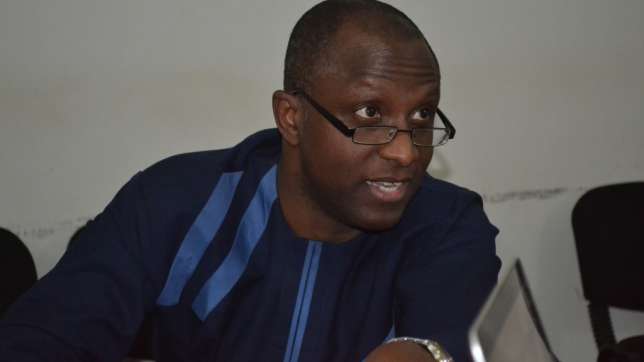
File photo: Spokesperson to the VP says Dr. Dipeolu does not have budgetary control over the spending of OCEAP.

N326m budgeted, N86.2m released for capital projects: Who is in charge?

In spite of the explanation by the  VP’s spokesperson,  it remains unclear who has drafted and submitted budgets for the Office of the Chief Economic Adviser and authorised withdrawals from allocations released from the nation’s treasury.

Between 2015 and 2017, a total of N326 million has been budgeted for the office’s use — nearly half of this (N162.3 million) going into capital expenses.
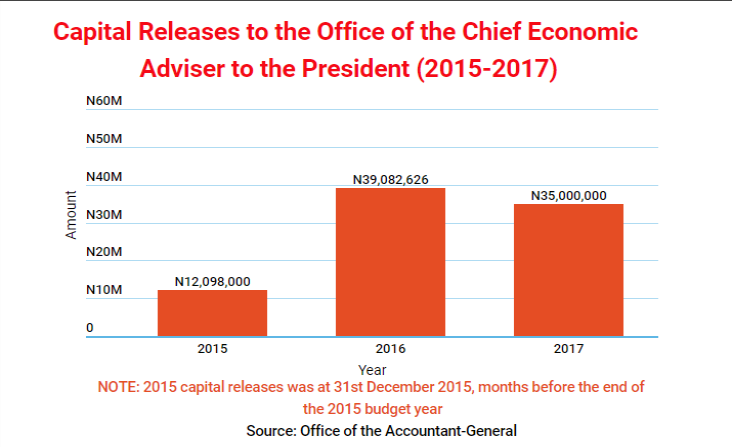
Of this amount, documents from the office of the Accountant-General reveal that a total of N86.2 million has been cash-backed for capital costs in the three years of the incumbent administration.

In response to a text message requesting information about who is responsible for OCEAP’s budget and expenditure,  Shehu directed The ICIR to the special adviser on economic matters whom again he identified as Dr Dipeolu.

“Dr Dipeolu, the Economic Adviser to the President should be able to answer your questions,” Sheu replied.


Note: In an earlier report by The ICIR, the meta description read: “Dipeolu received the sum of N34 million in 2017 to fund research studies on the economy but has failed to make it available for scrutiny.” It has however been corrected to appropriately read: “The office received the sum of N34 million in 2017 to fund research studies on the economy …”

Yari on minimum wage increase: States can’t even pay N18,000

STATE governors are not comfortable with the ongoing negotiations between the federal government and the organised labour for a possible increase in minimum wage.

They are concerned about how to raise revenue to pay additional wage demanded by the workers union.

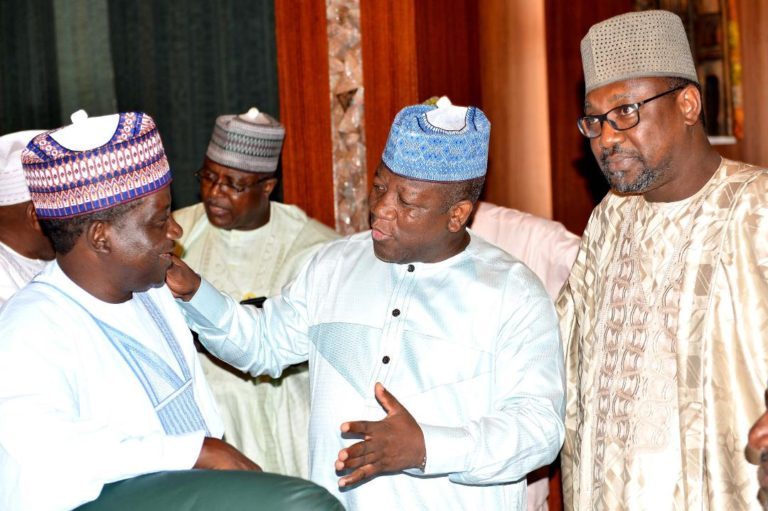
While addressing newsmen on the outcome of the NGF meeting on Thursday, governor of Zamfara State and the Chairman of the Nigerian Governor’s Forum, Abdulaziz Yari, said the issue is not about increasing the minimum wage, but how to raise the required revenue to pay.

“The problem of states is the capacity to pay what is agreed. As we are talking today we are struggling with N18,000. Some of the states are paying 35 per cent, some 50 per cent and still some states have salary arrears. So it is not about only reviewing it but how we are going to get the resources to cater for it,” he said.

Many states across the federation are owing workers several months of salary arrears despite interventions by the federal government to help them clear the backlogs.

President Muhammadu Buhari, through the Ministry of Finance, had given indebted states a financial bailout, with strict instructions that the funds were to be used to clear salary and pension arrears. Also, states have received two tranches of monies from the Paris Club refund, yet, many remain indebted, or have been paying workers only a percentage of the salaries.

On the issue of increasing the national minimum wage, a tripartite committee — made up of members of the organised labour, the organised private sector, and representatives of the federal government — has been brainstorming on the matter for some time now with little or no success.

While Labour is asking for an upward of N50,000 as the new minimum wage, the federal government, represented by the Minister of Labour and Employment, Chris Ngige, says it can only pay N24,000.

Nigeria ranks 115 among world’s competitive economies – Report

0

The World Economic Forum (WEF) released a Global Competitiveness Report on Wednesday ranking Nigeria in 115th place out of 140 countries that were examined.

According to the report, the national competitiveness of a country is measured by the strength of its institutions, policies and other indices that determine the level of productivity of the country under study.

Nigeria scored 47.6 out of a total score of 100, moving up 10 places to its current position. Nigeria is ranked 13th in Africa behind Seychelles, Cote de Ivoire, and Ghana amongst others.

Mauritius is Africa’s highest ranked country at 49 with an overall score of 63.7, followed sluggishly by South Africa in 67th place and Seychelles in 74th place make up Africa’s top three nations.

The categories are health, skills, financial system, infrastructure, institutions, ICT adoption, macroeconomic stability, product market, labour market, market size, business dynamism and innovation capacity.

Nigeria scored 42 in the institution indicator, 42 in infrastructure, 26 in ICT adoption, 56 in macroeconomic stability, 51 in health and 40 in skills.

It also scored 52, 59, 44, 71, 55 and 31 in the product market, labour market, financial system, market size, business dynamism and innovation capacity respectively.

The report stated that “Nigeria, Yemen, South Africa, Pakistan and the Philippines are other countries with notable problems related to violence, crime or terrorism, and where the police are considered unreliable.”

Saadia Zahihi, member of the Managing Board and Head of the Centre for New Economy and Society emphasized the reasons for assessing nations based on the indicators used in the Global 4.0 index.

“Competitiveness is neither a competition nor a zero-sum game – all countries can become more prosperous,” he said.

“With opportunities for economic leapfrogging, diffusion of innovative ideas across borders and new forms of value creation, the Fourth Industrial Revolution can level the playing field for all economies. But technology is not a silver bullet on its own. Countries must invest in people and institutions to deliver on the promise of technology,” he asserted.

“To date, Sub-Saharan Africa, with an average score of 46.2, has the lowest GCI score among all regions and demonstrates the weakest average regional performance on 10 out of the 12 pillars,” the report concluded.

LAUTECH management seeks speedy resolution to fee hike crisis

0

By Yusuf AKINPELU

THE management of the Ladoke Akintola University of Technology (LAUTECH) says it is seeking “amicable and speedy” ways of resolving the recent crisis caused by the increment in the University’s tuition fees.

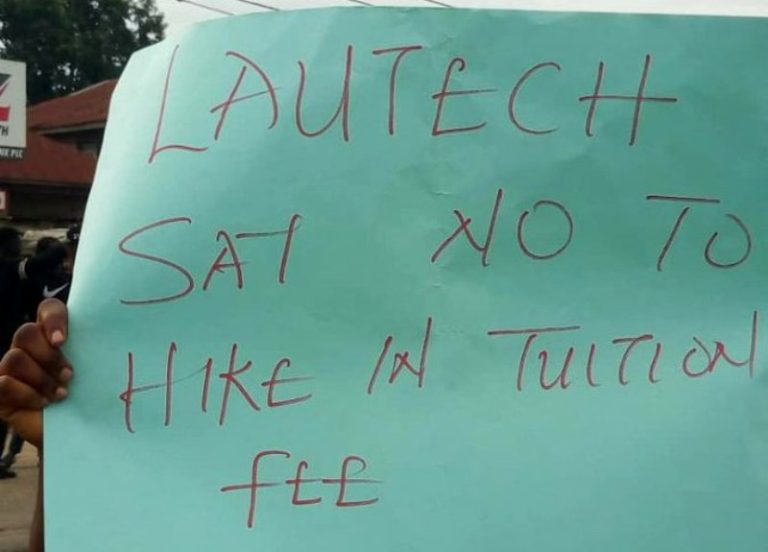
Students of the University went on a rampage on Monday to protest what they described as a humongous increment in school fees.

Following the protests, LAUTECH’s Registrar, Jacob Agboola issued a statement stating that the University management was seeking amicable solutions to the problem.

“At an emergency meeting held today, the Expanded Management Committee decided that all staff and students be intimated with the efforts being made to ensure that the students’ protest, which arose from the announcement of the new tuition fee regime, does not impair the peace and work of the University any further,” Agboola stated.

“To this end, necessary consultations with stakeholders, including the Students Union, are being held. The hope of an amicable and speedy resolution of the matter is very high.”

On Monday, Agboola had issued a statement in which he conveyed to the students that there has been an increment in the University’s fees.

The statement noted that both fresh and older students who are citizens of Oyo and Osun States (joint owners of the institution) will now pay the sum of N200,000, and no longer N120,000 for freshmen and N72,500 for older students.

Also, fresh and older students from other states, who hitherto paid the sum of N150,000 and N63,500 respectively, will now pay N250,000.

The rioting students burnt tires in front of the University gate, bore placards, and sang solidarity songs on Monday as they protested the fee hike. Eventually, men of the Nigeria Police were deployed to disperse the protesters.

One of the students of LAUTECH tweeted: “This is pure wickedness. 200k and 250k hike overnight? Education should be affordable for the populace! If you can’t make it easier, why make it much more difficult?”

Another, whose Twitter username read Ojoogun Fasilat, also wrote: “LAUTECH’s decision to increase its fees by 200 percent lacks any moral justification and logical explanation, taking into consideration the present economic woes most parents currently experience in their respective states.”

Mama Taraba removes property from APC secretariat

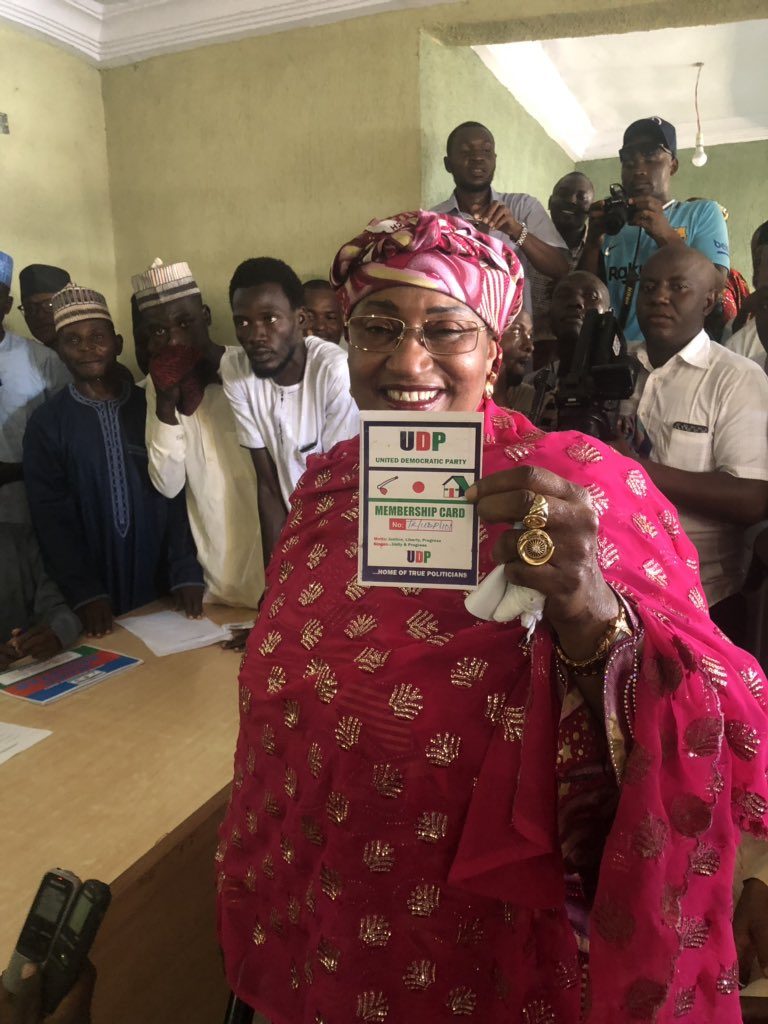
FORMER Minister of Women Affairs, Aisha Al-Hassan, has stripped the Taraba State secretariat of the All Progressives Congress (APC) of all the furniture which she had donated for the party when she was a member.

Al-Hassan dumped the APC after the party’s National Working Committee disqualified her from contesting for the governorship post of the state on its platform. She moved to the United Democratic Party (UDP) where she was given the governorship ticket.

The APC Publicity Secretary in Taraba State, Aaron Artimas, told the News Agency of Nigeria that the party’s leadership was amazed at the development, especially given that Al-Hassan benefitted more from the APC than any other individual in the State.

“We find this development shameful (but) unfortunately, it is true. The former minister has emptied the office she furnished when she was a member of the APC,” Artimas said.

“It is amazing to us because Aisha Alhassan was the highest beneficiary of the party in the state. It is a very shameful action, but we shall leave her to conscience,” he added.

When contacted, Al-Hassan said she did not order the removal of the furniture from the APC secretariat in Jalingo, but that she was in support of it. Alhassan said the party does not deserve anything of hers given the way she was booted out.

“I bought the items with my money; when my boys told me they were removing them from the party secretariat, I gave them the go ahead because the APC does not deserve anything of mine,” NAN quoted her as saying.

“I could not have moved the items to Abuja. I merely gave my boys the nod to move them out because the APC was wicked to me. If I had left the party on my own, I would not have bothered about the items, but you know the circumstances that pushed me out.

“I bought the items to furnish the party secretariat, but since I have moved to the UDP, I did not see anything wrong with moving with all my belongings. They should buy their own furniture for the offices.”

FACT CHECK: Has Buhari appointed a ‘Chief Economic Adviser’? Yes and no

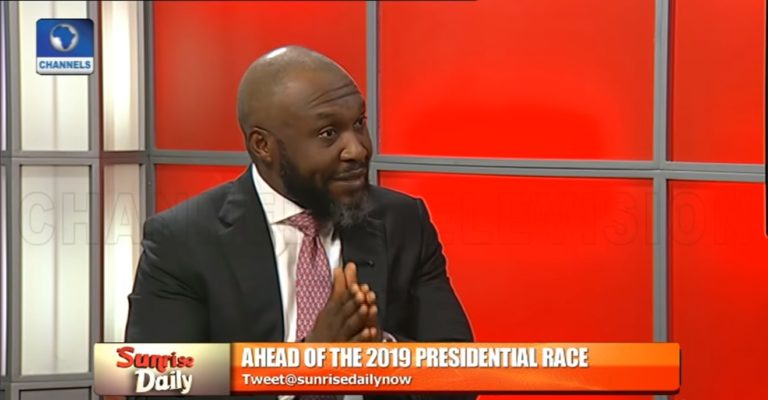
WITH the 2019 presidential election gradually drawing closer, claims are more frequently made in attempts to discredit one political party, candidate or the other. One of such claims was aired on Wednesday during an interview session with Osita Chidoka on Channels TV. 

In criticising President Muhammadu Buhari’s economic policies, the former aviation minister and one of the People’s Democratic Party (PDP) founding members said on Sunrise Daily that the federal government has no chief economic adviser.

“The fact remains that as we go to the 2019 election,” he said towards the end of the interview, “what we are going to be confronting is the reality that a government has taken over from the PDP … and today we have more crises than we’ve ever had in the country before.”

“We have a situation in the economy where the government has no economic adviser,” he continued. “We do not know what the philosophy of the economy that this government has … The president doesn’t have an economic adviser, a chief economic adviser.”

When the host observed that the government does have an economic team, Chidoka insisted there is a difference in functions.

“Economic team is the individual ministers,” he explained. “It was started by the PDP to generate key ministers and bring them together into a team. But the president needs an adviser. He has media advisers, almost four of them. He has political advisers. He needs an economic adviser.”

“He needs somebody to articulate: Is this going to be a state-run economy or is it going to be a private sector economy? If this is going to be a private sector economy, what are we going to do to enable the private sector to thrive in Nigeria?”

Shortly after the programme, Chidoka again took to Twitter to stand by his earlier assertion, receiving support from a number of other users. He said the federal government has not appointed a “Chief Economic Adviser”. What we rather have is a “Special Adviser to the President on Economic Matters in the Office of the Vice-President”.

The Special Adviser on Economic Matters himself, Adeyemi Dipeolu, has appeared to suggest the same line of argument. When The ICIR recently queried him as to how he spent money allocated, in 2017, for evident-based research studies on the economy, he replied that the project (for the Office of the Chief Economic Adviser) is not under his office.

But is there a substantial difference between these two offices, and has President Buhari appointed a Chief Economic Adviser?

What the official release says

Before Buhari’s ascent to the presidency, it was customary for presidents to appoint a Chief Economic Adviser. The Office of the Chief Economic Adviser to the President (OCEAP) has been in existence since the return to democratic rule in 1999 when former president Olusegun Obasanjo appointed Philip Asiodu in the capacity.

But under the present administration, the closest appointment to this is that of Dipeolu as “Special Adviser to the President (Economic Matters), Office of the Vice President” — as written on the official release by the Secretary to the Government of the Federation. He was as appointed to this role on November 9, 2015, and was officially sworn in in the August, 2016.

The administration also appointed 11 Special Assistants and Senior Special Assistants (note: not advisers) on various economically related issues such as on the Economic Recovery and Growth Plan (ERGP).

However, of all appointees, only Dipeolu has been noted as a member of the Economic Management Team alongside Vice President Yemi Osinbajo, Minister of Budget and Planning, Minister of Finance, Governor of the Central Bank of Nigeria among others. This was a role previously played by the “Chief Economic Adviser”.

What the budgets say

Under previous administrations, a portion of the national budget has always been dedicated to the “Office of the Chief Economic Adviser to the President”, with the budget code “OCEAP” followed by seven figures.

When President Buhari took over, this tradition was maintained. The budgets from 2015 to 2018 have the same section under the “Presidency” with the same office name — though in 2018 the budget code was changed to ERGP as with all other departments, agencies and offices.

Also noteworthy is the fact that records show that not only has money been constantly allocated to this office, money has also been released and withdrawn in the name of Chief Economic Adviser.

For instance, in 2017, N60 million was allocated to OCEAP for capital projects, and records from the office of the Accountant-General reveal that, of this amount, N35 million was cashbacked in the first quarter.

Presidential spokesperson confirms Dipeolu as CEA

Garba Shehu, Senior Special Assistant to the President on Media and Publicity, has also confirmed to The ICIR that indeed Adeyemi Dipeolu is serving as the nation’s Chief Economic Adviser.

“…We would like to confirm the person presently acting in the capacity as Chief Economic Adviser,” The ICIR asked Shehu in a text message.

“Dr Adeyemi Dipeolu,” he responded.

Conclusion

While President Buhari has appointed  Dipeolu to act in the capacity of Special Adviser to the President on Economic Matters, it is also true that the president has not conferred the title of “Chief Economic Adviser” on any individual who should have authority over the  OCEAP budget.


REPORT: After receiving N34m, Buhari’s economic adviser fails to provide research study

THE Office of the Chief Economic Adviser to the President (OCEAP), headed by Adeyemi Dipeolu, received a sum of N34 million in 2017 to fund research studies on the economy but fails to make this research available, The ICIR has learnt.

In 2016, the office requested for a capital allocation of N78 million, out of which N47.8 million was budgeted for research and allocation. In 2018, the office’s capital allocation is N60 million, from which N19.9 million is budgeted for research while the rest goes to the purchase of vehicles, computers, office furniture and so on.

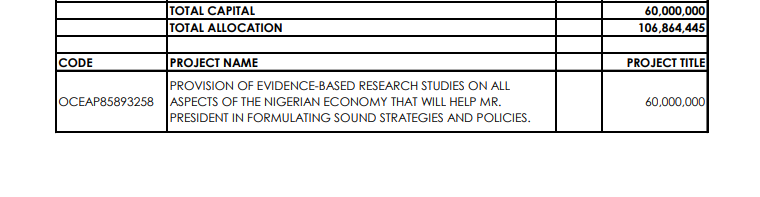
Conversely, in the 2017 budget, the total capital cost for the office was N60 million, with every penny going into research and development. The budget went on to specifically state the project title as: “Provision of evidence-based research studies on all aspects of the Nigerian economy that will help Mr. President in formulating sound strategies and policies.”

According to a document obtained from the office of the Accountant-General of the Federation stating cash releases to all government bodies, out of the entire sum, N35 million was given to OCEAP as part of the first batch of releases.

Out of this sum, N33.7 million was utilised at the end of the fiscal year, leaving a balance of N1.29 million.

OCEAP requests for N60 million to conduct “evidence-based research studies”

The studies are, however, nowhere to be found — over four months since the 2017 budget implementation period ended and over a year since money was released for the research project.

The website of the State House under which the economic adviser’s office is subsumed has no traces of any documentary uploads, let alone one from the economic adviser’s office.

What happened to OCEAP’s website?

The Office of the Chief Economic Adviser has been existing since the return to democratic rule in 1999 when former president Olusegun Obasanjo appointed Philip Asiodu in this capacity. Since then, eight other Nigerians have served in the same capacity.

The office, at the moment, does not make use of any official website to upload its reports and through which its activities can be monitored. But this has not always been the case.

In 2011, under the leadership of Nwanze Okidegbe, a website was created for the office with the address: www.oceap.gov.ng. The platform, however, became unavailable soon after Dipeolu succeeded Okidegbe as the economic adviser.

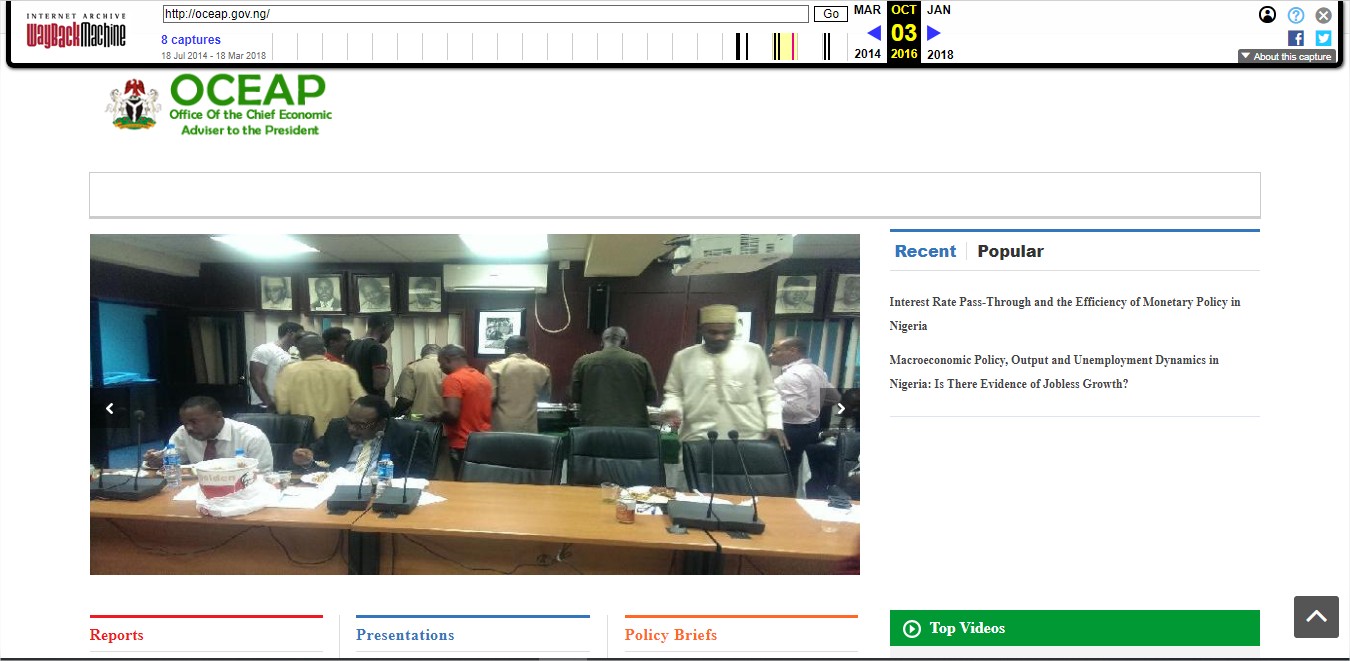
Snapshots from Wayback Machine, a digital archive of contents on the internet, reveal that the website was still accessible on October 3, 2016. Also, in the past, it contained various reports, policy briefs and downloads related to the nation’s economy.

October 3, 2016: Snapshot of old OCEAP website

Uploaded documents included: Transforming Nigeria: The Reforms and Results of President Goodluck Ebele Jonathan (2010 – 2013) produced by the Office of the Secretary to the Government; the Transformation Agenda (2011 – 2015): Summary of Federal Government’s Key Priority Policies, Programmes and Projects; and a Midterm Report of the Transformation Agenda: Taking Stock and Moving Forward.

The third report was written by a committee, which included the Chief Economic Adviser to the President.

‘Not under my office’ — Dipeolu denies responsibility

Dipeolu has told The ICIR the research project named in the budget is not related to his functions, suggesting he is not in charge of the Office of the Chief Economic Adviser.

In reaction to a Freedom of Information request for the research studies, he wrote in a letter dated October 9: “This is … to inform that the Budget Item ‘OCEAP85893258’ is not under the Special Adviser to the President on Economic Matters in the Office of the Vice President. Thank you.”

Dipeolu denies responsibility for budget item

But who is the Chief Economic Adviser?

On August 10, 2016, NTA, a Nigerian government-owned TV station, reported that President Buhari appointed Dr. Adeyemi Dipelou as Economic Adviser.

But the letter from the State House implied that Dr. Dipeolu is not the nation’s Chief Economic Adviser, and a recent disclosure by former Minister of Aviation,Osita Chidoka noted that the Muhammadu Buhari administration has in fact not appointed anyone as the economic adviser.

The former minister made this allegation on Wednesday during an interview session on Channels TV.

“We have a situation in the economy where the government has no economic adviser,” he said. “We do not know what the philosophy of the economy that this government has.”

To support his claim, Chidoka later tweeted that the federal government has only appointed a “Special Adviser to the President on Economic Matters in the Office of the Vice-President”. But is there a substantial difference between the two offices?

Before Buhari’s ascent to the presidency, it was customary for presidents to appoint a Chief Economic Adviser. But under the present administration, the closest appointment to this is that of Dipeolu as “Special Adviser to the President (Economic Matters), Office of the Vice President” — as written on the official release. He was appointed to this role on November 9, 2015, and was officially sworn in in August 2016.

The administration also appointed 11 Special Assistants and Senior Special Assistants (note: not advisers) on various economically related issues such as on Economic Recovery and Growth Plan (ERGP).

However, of all appointees, only Dipeolu has been noted as a member of the Economic Management Team alongside Vice President Yemi Osinbajo, Minister of Budget and Planning, Minister of Finance, Governor of the Central Bank of Nigeria among others.

This was a role previously played by the “Chief Economic Adviser”.

Also noteworthy is the fact that money has always been budgeted for the Office of the Chief Economic Adviser to the President (OCEAP) since the Buhari took office in 2015. Not only that, some of these budgeted amounts have been cash-backed and withdrawn from the national treasury.

Presidential spokesperson confirms Dipeolu as CEA

Laolu Akande, the spokesperson to the Vice President, was not available when he was contacted for clarification. Texts sent to him at 02:57 and 02:59 pm on Wednesday have also not been replied.

Garba Shehu, Senior Special Assistant to the President on Media and Publicity, has however confirmed to The ICIR that indeed Adeyemi Dipeolu is serving as the nation’s Chief Economic Adviser.

“…We would like to confirm the person presently acting in the capacity as Chief Economic Adviser,” The ICIR asked Mr. Shehu in a text message.

“Dr Adeyemi Dipeolu,” he responded.

Senate clears new CCB Chairman, rejects three members

THE Nigerian Senate has confirmed the nomination of Muhammed Isah as the chairman of the Code of Conduct Bureau (CCB), alongside six other members of the bureau, but rejected three of the nominees.

The confirmation and rejection followed the adoption of the report by the Senate Committee on Ethics, Privileges and Public Petitions, headed by Sam Anyawu.

The nominees whose membership of the CCB was approved include Ubolo Okpanachi, from the North Central; Ken Madaki Alkali, North Central;  Murtala Kankia, North East; Saad Abubakar, North East;  S.F Ogundare, South West; and Emmanuel Attah, South-South.

However, Danjuma Sado, South-South; Ganiyu Hamzat, South West; and Vincent Nwanne, South East had their nominations declined by the lawmakers.

Anyanwu said that out of the ten candidates nominated as members of the CCB by President Muhamadu Buhari, only eight turned up for the screening exercise.

One of the rejected candidates, Sado, has not reached 50 years, the age requirement by the CCB Act. Anyanwu explained that Sado was only 39, and therefore could not be confirmed.

The two others, Ganiyu Hazmat and Vincent Nwanli, failed to attend the screening exercise and were consequently screened out.

The Senate urged President Buhari to forward an additional three names to make up for the disqualified candidates.

The nomination of new members of the CCB was first done in June 2017 by Vice President Yemi Osinbajo, then acting on behalf of the President who was away on medical leave, but on his return, President Buhari himself also forwarded the same set of names to the Senate in November 2017, pleading with the lawmakers to expedite action on their confirmation.

There had been a controversy as to the legality or otherwise of the dissolution of the former board of the CCB which was headed by one Sam Baba, from Niger State. The matter was later laid to rest by Justice Binta Nyako of the Federal High Court, Abuja, who ruled that the tenure of the CCB board was for five years, adding that Baba’s tenure expired since April 2015 as he and his board members were appointed in 2010.

Senate urges CBN to suspend ATM charges, and others

THE Senate has urged the Central Bank of Nigeria to suspend the automated teller machine (ATM) maintenance charges of N65  being deducted from customers account and to prevail on commercial banks to configure their machines to dispense N40,000 per withdrawal.

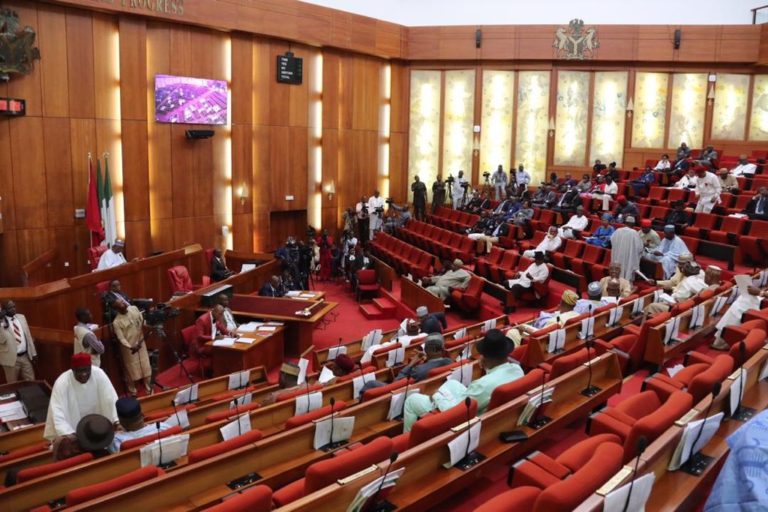
The resolutions were made at the Senate plenary session on Wednesday after a motion on the illicit and excessive bank charges on customers’ accounts, was introduced by Olugbenga Ashafa, Senator representing the Lagos East.

The motion titled “Illicit and excessive charges by Nigerian banks in customers accounts with particular focus on Automated Teller Machine (ATM) maintenance and withdrawal charges” was discussed broadly at the upper legislative chambers.

Deputy Speaker Ike Ekweremadu who seconded the motion indicated that the ATM charge is not the only charge people get from the commercial banks, but also some VAT charges which he said were unacceptable. He added that Customer Protection Agency in Nigeria was not living up to expectations.

While addressing the motion, Senate President Bukola Saraki said that the motion affects the lives of Nigerians. “After 25-years, we should have grown out of these excessive charges and moved on. So, I believe this is something that we must address to create an environment that protects all Nigerians,” Saraki said.

“We need to look at ways to ensure that our resolutions go beyond just the debates,” he said.

Emmanuel Bwacha, a member of the Senate, in his contribution, said that Senate should come up with a law that would put Nigerian banks on their toes. Similarly, Adeola Solomon said the banks should stop ripping Nigerians off their hard earned money.

Ibrahim Gobir, also a member, however, said Nigerians do not understand that the cost of technology is high. He said the banks have to invest in equipmentnt to manage the ATMs.

“If there is a problem with the ATM, you have to pay for someone to fix it. We cannot force it on the banks to reduce costs,” said Gobir.

To curb the illicit charges of the commercial banks on customers, the Senate has thereby urged the Central Bank of Nigeria to suspend the ATM card maintenance charges being deducted from customers account.

The Senate has resolved on the below:

  1. Direct the Committees on Banking Insurance and other Financial Institutions to conduct an investigation into the propriety of ATM card maintenance charges in comparison with international best practices and report back to the Senate.
  2. Mandate the Committees on Banking, Insurance and other Financial Institutions and Finance to invite the governor of Central Bank of Nigeria to appear before the Committee in order to explain why the official charges as approved by the CBN are skewed in favour of the banking institutions as against the ordinary customers of the banks;
  3. Urge the Central Bank of Nigeria to suspend the ATM card maintenance charges being deducted from customers account as well as instructing the commercial banks to configure their machines to extend to N40,000 per withdrawal pending the outcome of the investigation by the committees.
  4. Urge the Consumer Protection Council to be up and doing in taking up the plight of ordinary Nigerians by looking into the various complaints of excess and unnecessary charges by Nigerian Banks.

Buhari’s Executive Order 06 is not political witch-hunt, says Lai Mohammed

MINISTER of Information and Culture, Lai Mohammed, has defended President Muhammadu Buhari’s Executive Order number six, saying that it was not an act of political witch-hunt as is being alleged by some people, including members of the opposition Peoples Democratic Party (PDP).

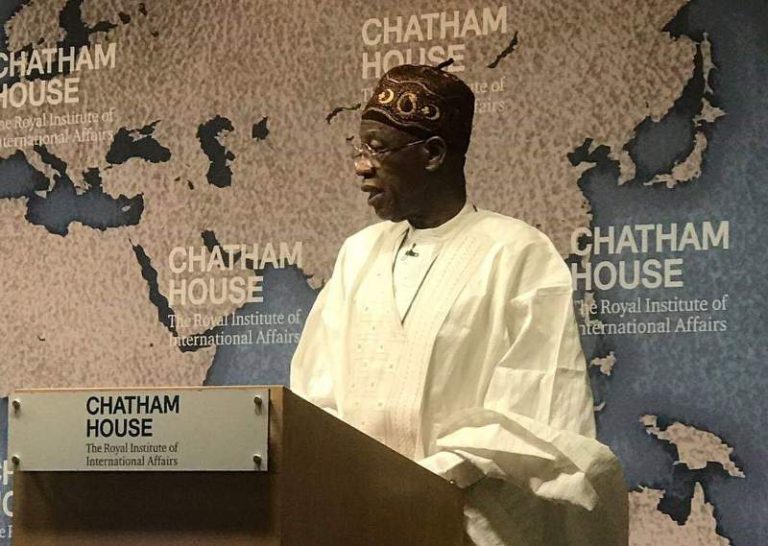
Speaking on the topic: “Nigeria’s National Unity: Towards Participation and Shared Values”, at the Chatham House in London, Mohammed reiterated that the order was in line with the anti-corruption campaign of the present administration.

“The facts are very simple,” Mohammed said. “Sometimes in July, the President, in the exercise of his constitutional powers, signed the Executive Order 6 to strengthen the anti-corruption fight. In that order, the various corruption cases being investigated were listed and appendix.

“As soon as the Order was proclaimed, some people went to court to challenge it. Because of the pending case, the government suspended its implementation.

“But last week, the court ruled in favour of the government and the government said that it is time to start its implementation,” he said.

As part of the implementation of the executive order, presidential spokesman, Garba Shehu, announced that Buhari had directed relevant government agencies to ensure that 50 “high profile” Nigerians facing corruption charges are not allowed to travel outside the country.

Also any property worth N50 million and above, that is subject to investigation of prosecution, should be temporarily forfeited to the government pending the determination of the investigations.

Many social commentators, public affairs analysts, and legal practitioners said the president, by placing some people on a travel ban, over-reached his powers, and had usurped the powers of the judiciary, by denying the 50 affected citizens their fundamental human right to freedom of movement.

However, the British High Commissioner to Nigeria, Paul Arkwright, in an interview on Tuesday, agreed with the federal government that the executive order was necessary in the fight against corruption.

“I’ve heard that this is an anti-corruption measure, it’s not for me to say who should or should not be on the list. But what I would say is that it’s very important in continuing this fight against corruption and rooting out corruption where it is happening,” Arkwright said.

Meanwhile, two legal practitioners, Ikenga Ugochinyere and Keneth Udeze, have approached the Court of Appeal, seeking to set aside the judgement that upheld Buhari’s executive order.

The lawyers described the order and the travel ban that accompanied it, as “obnoxious, barbaric, capricious, arbitrary and the greatest assaults to the sacred institutions of constitutional governance”.