THE United Nations Educational, Scientific and Cultural Organisation (UNESCO), in collaboration with the Government of Brazil and the United Nations, is seeking proposals to strengthen information integrity on climate change.
The call for partnerships from the Global Initiative on Information Integrity on Climate Change focuses on gathering and producing evidence on how climate change is impacted by information disorders; developing evidence-based communication strategies to counter these threats; and supporting investigative journalism initiatives that expose misleading narratives and promote public understanding.
The first call for proposals is open until July 6, 2025, for not-for-profit organisations, active and registered for at least two years. Budget per project will range from USD 30,000 to USD 150,000.
Applications can be submitted in English, French and Spanish.
The organiser says, beyond funding, selected entities will form a first-of-its-kind global and interdisciplinary network to foster information integrity on climate change and produce actionable recommendations for innovative policies worldwide.
The application deadline is July 6, 2025. Interested applicants can apply here.
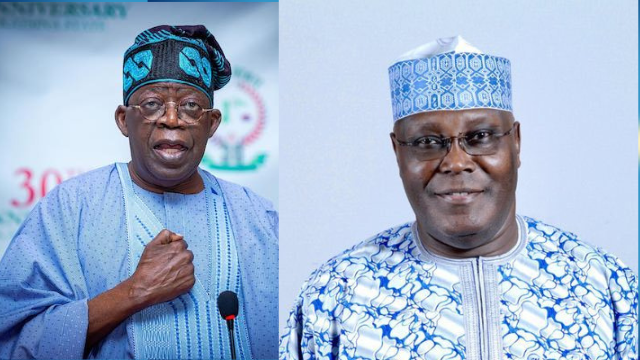
FORMER Vice President Atiku Abubakar has been stripped of his traditional title of Waziri Adamawa, following a new directive by the Adamawa State government.
The directive mandates that only indigenes can serve as kingmakers or council members in traditional institutions.
Abubakar, who hails from Jada in the Ganye Emirate, was turbaned the seventh Waziri of the Adamawa Emirate in 2018 by the Lamido of Adamawa, Muhammadu Barkindo. The position placed him next in hierarchy to the Lamido within the emirate council.
However, in a circular dated June 19 and signed by the Permanent Secretary of the Department of Chieftaincy Affairs, Adama Felicity Mamman, the government ordered that all traditional council members must be indigenes of the emirates or chiefdoms they represent.
This policy effectively disqualifies Abubakar from continuing in his role, as he is not considered an indigene of the Adamawa Emirate.
The circular states: “All kingmakers and council members in the state must be indigene of their chiefdoms… With the content of this circular, all kingmakers and council members who are not indigenes of the chiefdoms have been relieved of their appointments.”
The directive, which takes immediate effect, follows the creation of seven new emirates and chiefdoms by Governor Ahmadu Umaru Fintiri in December 2024, raising the number of traditional councils in the state to 14.
Fintiri’s spokesperson, Humwashi Wonosikou, emphasised that the policy was not new but was only being enforced through the recent circular.
He added that concerns about loyalty influenced the decision, as non-indigenes might not fully align with the interests of the emirates they serve.
Responding to questions about how the directive affects Abubakar, Wonosikou said the final say rested with the Lamido of Adamawa.
“Alhaji Atiku Abubakar lives in Yola and is a registered voter there, so only the Lamido can determine his indigeneship status,” he noted.
He also denied any political motivations or rift between the governor and the former vice president, calling such speculation ‘unfounded.’
Abubakar’s media adviser, Paul Ibe, said Tuesday night that he was unaware of the new development or any directive affecting the former vice president’s traditional title.
The ICIR reports that there have been feelers that the governor is unhappy with Abubakar’s recent political alignment with the Labour Party presidential candidate, Peter Obi, former Kaduna State Governor, Nasir El-Rufai, and others, preparatory to the 2027 general election.
Fintiri and Abubakar belonged to the People’s Democratic Party (PDP) until recently that it appeared that the latter had abandoned the party for a new coalition.
THE Nigerian Army Headquarters has announced that bandits launched coordinated triple attack on military bases in Niger and Kaduna states on Tuesday, June 24, resulting in the deaths of soldiers.
Scores of bandits were also eliminated by the military during the attacks, according to the Army.
The Army revealed these in a statement on its social media handle on Wednesday, June 25.
“On 24 June 2025, forward operating bases in the general areas of Kwanar Dutse Mairiga and Boka Niger State, and Aungwan Turai Chikun LGA of Kaduna State, were attacked by bandits in a 3 pronged attack” it said.
“In response, land and air component troops launched several counter-attacks that eliminated scores of bandits in the encounters. Sadly, some gallant warriors paid the supreme price in the day-long battles, while four wounded in action troops are currently receiving treatment for their gunshot wounds,” it said.
Meanwhile, the Nigerian Defence Academy in a post said a lieutenant and 20 soldiers died in the Niger state attack.
Just last week, the ICIRreported that the Defence Headquarters (DHQ) said Nigerian armed forces eliminated 6,260 terrorists and arrested 14,138 terrorists and other criminals within the past two years across the country.
It added that the troops rescued 5,365 kidnapped victims and recovered a large cache of arms and ammunition in various operations within the period.
The troops also killed 103 criminals and apprehended 2,760 others within the period.
IN this investigation, The ICIR unravels how recurrent spills from the Ogboinbiri/Tebidaba pipeline, operated by Oando Energy Resources, devastate communities in the Southern Ijaw Local Government Area of Bayelsa State.
On August 22, 2024, Oando Energy Resources, one of Africa’s leading energy solutions providers, announced the successful acquisition of Italian company Eni’s Nigerian subsidiary, Nigerian Agip Oil Company (NAOC), for $783 million. Oando described the takeover (on its website) as a significant milestone in its long-term strategy to “expand upstream operations and strengthen its position in the Nigerian oil and gas sector.
Commenting on the acquisition, Group Chief Executive of Oando, Wale Tinubu, said that the company’s immediate focus was on “optimising the assets’ immense potential, advancing production and contributing to our strategic objectives.” He added, however, that this would be done while also “prioritising responsible practices and sustainable development in ensuring a balanced approach to host communities and environmental stewardship.”
Wale is the nephew of Nigeria’s president, Bola Tinubu, whose administration has repeatedly reaffirmed its commitment to a just energy transition. At the Abu Dhabi Sustainability Week (ADSW), the President claimed that Nigeria was working hard to align with the Energy Transition and Climate Change.
The management of Oando told leaders of Ogboibiri, host community of four flow stations under the Oil Mining Lease (OML) 63 now being operated by the company and other nearby communities that they remain committed to operating with regard to the environment and well-being of the people. OML 63 is the second-largest License in Oando Energy Resources portfolio in terms of both production and reserves.
A community of spillage
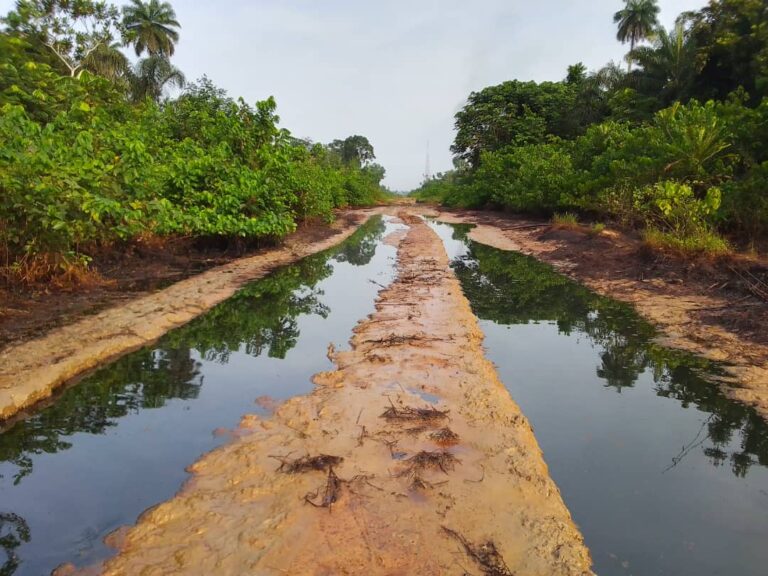
However, on September 5, 2024, a month after the takeover, the Ogboinbiri/Tebidaba pipeline operated by Oando burst open, spewing crude into swamps, forests and water bodies in Ogboinbiri, a community in the Southern Ijaw Local Government Area of Bayelsa State.
A copy of the September Field Joint Investigation Report
Findings from the Field Joint Investigation Report, with incident reference 2024/SAR/216 showed that the September 5 spill, which spewed about 217 barrels of crude oil into the environment, was caused by a rupture directly under the pipe. The JIV had a combined team of Oando, the National Oil Spill Detection and Response Agency (NOSDRA) and the Bayelsa State Ministry of Environment.
More spills
The September spill was only the first of many to come. Between August, when Oando took over operations of the OML 63 from Agip, and May 2025, locals say that there have been four spill incidents from different points along the Ogboinbiri/Tebidaba pipeline, all of them caused by equipment failures.
While one of them occurred on October 4, another spill was reported on November 15, 2004. The most recent was reported on May 3, 2025.
However, New Style Ogiori, Chiefs Council Chairman of Keme Ebiama, a neighbouring community, said that the November incident was far-reaching in its impact and spread because it occurred during the flooding season.
“The spill flowed from the Ogiori stream into the Apoi Creek, spreading beyond Ogboibiri and Keme Ebiama to at least 10 communities up to the Atlantic Ocean, which is about a two-hour drive,” he said.
Ogiori claimed that the company had shut down operations immediately to avoid further spread upon notice of the spill but before then, a vast area of land had been impacted.
The impact of oil spills across host communities in the Niger Delta region, where production began in 1956 are glaring. Approximately 240,000 barrels of crude oil are spilled in the Niger Delta every year. Data from NOSDRA shows that between 2011 and 2022, there were 10,463 spill incidents in the Niger Delta, releasing a combined 507,135 barrels of oil into the environment.
“Human health, livelihood and environment of host communities have been impacted as a result,” said Deputy Director of the Environmental Defenders Network (EDEN), environmental rights groups, Morris Alagoa, adding: “It is the residents of these communities who are paying the price, and nobody cares.
One of the areas devastated by the spillage close to Ogboinbiri community. Photo source: Environmental Defenders Network (EDEN).
“Farmers, fishermen count losses in Ogboibiri, Keme-Ebiama and other affected communities, almost every family is into farming and fishing, their major source of survival. These communities contribute significantly to the agricultural economy through the abundant waterways, including creeks, lagoons, rivers, and swamps.”
After the first spill in September, many residents did not bother to harvest their crops because it was harvesting season yet, and the impact of the spill at the time was minimal.
They hoped that there would not be a repeat, then came the second spill in October and then a third and a fourth. Approximately 10,000 farmers and fishermen have lost their sources of livelihood as a result.
A community resident watches helplessly during one of the spillages. Photo credit: Gideon Arinze
Ikainka Genenis, a resident of Keme Ebiama is one of them. He had gone to check on his farm when he discovered that all his fishing nets and traps were soaked in crude oil. That was during the November spill.
“As it rained, the spill spread further into the swamps, my mother’s fishponds were affected too,” Genesis, who was also part of the team that embarked on a JIV, said, adding: “I lost hundreds of fish.”
He said that fishes in the community had been chased away by the consistent spills, and this has affected livelihoods and the local economy. He, however, suggested that Oando should prepare a barrier wall to prevent crude oil from flowing into the swamps and causing damage whenever there is a spill.
“Except a proper remediation is done by Oando, the ponds will not have fish running into them for at least ten years, even when they do, they will be unfit for consumption,” he said.
The recurrent spillage also damaged plantain, cassava and rice plantations, according to victims.
Benson Emmanuel said he had not fully recovered from the spill, which destroyed his 10 hectares of rice farm in Ogboibiri. He had massively invested in rice farming, hoping for a bountiful yield during the harvest season.
“I was out with my friends when I was informed about the spill and that it had impacted my farmland. I planted over 300 bags of rice and was expecting 400 before the farm was submerged with crude. I only got three bags and that is what I have been surviving on since then,” he said.
Apart from planting, Emmanuel and his family also engage in fish farming at the same location. They travel to different markets in Yenagoa and Rivers State to sell after harvest. But even that was affected by the spill.
“At least 20 fishponds were damaged by the spill. All had fish in them, and they were floating on the water. From the 20 ponds, we were expecting 10 bags of 20kg; each of them cost N40,000.”
Emmanuel says his family’s food security had been affected. He can no longer feed his two wives and five children, adding that it was particularly worrying because Oando had not shown concern ever since. Now, he depends on friends to survive.
Like Emmanuel, Sarah Ogiori, a woman leader in Ogboibiri, said she lost over N1 million as the spill damaged her Cassava and plantain farms, many fishponds, which often gave her at least 100 buckets filled with fishes and over 200 crayfish traps.
“Before the spill, I would harvest 10 bags of Cassava daily, 10 painter buckets of crayfish each of which costs N10,000,” she said, adding: “I made N100,000 from the sale of 12 bunches of plantain. Now, I travel to Yenagoa to buy Cassava and plantain at very high prices.”
No efforts to clean up
According to residents of communities spoken with, what is particularly worrying is that there appears to be no commitment to properly clean up the environment by Oando.
The National Oil Spill and Detection Agency (NOSDRA) is responsible for the detection and response to all oil spillages in Nigeria. It provides that all oil spills must (by law) be closed off/stopped by the oil company within 24 hours of being notified of an oil spill in their jurisdiction, after which a Joint Investigative Visit (JIV) is carried out.
This reporter called and sent text messages to the Head of NOSDRA’s field Office in Yenagoa, Solomon Ukponevi to get the agency’s reaction on the recurrent spills.
The WhatsApp message reads: “I am reaching out regarding the recurrent oil spills from Oando pipeline in Bayelsa State. Community members are accusing the company of failing to clean up the spills. Are you aware of this and what is NOSDRA doing about that; what efforts are in place to address the recurring spills in Ogboinbiri?”
He responded by saying that he was “the wrong person to contact on this subject.”
Genesis lost his fish farm during one of the spills during the spill that spread to Keme Ebiama community. Photo Source: Gideon Arinze
Alagoa said that oil companies ought to have contingency plans so that as soon as JIVs are conducted, they mobilise contractors to the site for clean-up. “Sadly, we have not seen that ever since, and it has almost become a culture because oil companies often get away with their actions.”
In October 2024, the House of Representatives committee on environment issued a seven-day ultimatum to Wale Tinubu and the management team at Oando to appear before it over perennial oil spillage in Ogboinbiri and other oil-producing communities in the region. The company had failed to appear before the committee after several letters of invitation were sent.
The Bayelsa State government had also threatened to sue oil companies for decades of oil pollution across communities in the state. This followed the findings of a report, ‘An Environmental Genocide: The Human and Environmental Cost of Big Oil in Bayelsa, Nigeria’.
The Petroleum Industry Act (PIA) 2021 provides for payment of fair and adequate compensation to anybody whose property is injuriously affected by oil exploration and production, using the term “fair and adequate” to define the level of compensation.
Often, companies provide relief materials like water and food items to provide succour to families whose livelihoods are often affected whenever spills caused by equipment failure occur. But since the spills started, residents claim that there have been no relief materials.
Alagoa said that Oando’s actions violate provisions of Article 24 of the African Charter on Human and Peoples’ Rights, which holds that the pursuit of profit must not overshadow environmental human rights.
“Neither the oil company nor regulators are even disposed to letting the public get information about such polluting incidents, let alone making efforts to address the sufferings of affected families.”
In Ogboibiri, Keme Ebiama and other affected communities, mangroves and wetlands have been significantly threatened. The spill still covers the surfaces of roots and stems, blocking pores that allow trees to breathe.
Mangroves serve as natural buffers against storms, erosion and rising sea levels. They combat climate change by acting as powerful carbon sinks, effectively absorbing and storing large amounts of carbon dioxide from the atmosphere.
Compelled to consume contaminated water?
Prosper Ogiori, Development Chairman of Keme Ebiama, said that the community does not have boreholes, hence some locals who cannot afford to buy water are forced to drink from the contaminated sources. He said that they sieve out the crude from the water and use it to cook, drink and wash or wait for it to rain so they can fetch water.
A resident narrates his experience on the impact of the spills in one of the affected communities. PC: Gideon Arinze
Several studies have linked the consumption of water contaminated by crude oil to respiratory issues, nervous system complications. Crude oil contains a mixture of different hydrocarbons, including alkanes, cycloalkanes, aromatic hydrocarbons, and alkenes known as Total Petroleum Hydrocarbons (TPH).
In a study conducted by a lecturer at the University of Benin, Lucy Uju and other experts on the environmental and health influences of crude oil spills in Niger Delta, it was found that one TPH compound (benzene) causes breast and urinary tract cancer and reduces red and white blood cell production in bone marrow.
Apart from drinking contaminated water, locals are exposed through skin contact or by breathing contaminated air. Children are also exposed by playing in contaminated soil. This can negatively impact future health by causing a range of issues, including neurological problems, reproductive issues, and potential carcinogenicity.
“Long-term exposure causes permanent damage to the central nervous system. If exposures are high enough, death can occur,” according to a report by the Agency for Toxic Substances and Disease Registry.
Our hands are tied-Bayelsa govt
Enai Reuben, the Director of Petroleum and Pollution at the Bayelsa State Ministry of Environment said that while the state government frowns at the disregard of the wellbeing of community members by oil companies like Oando, its powers are limited because issues like the regulation of pipeline operations are in the exclusive list and that limits the powers of the state.
Since the 1990s when the pipes were laid across the communities, they have not been changed till Oando took over operations. Many pipelines like that have existed for decades, some of them for over sixty years, without maintenance. And because they are bad and weak, they constantly burst open when there is heavy pressure during the transportation of crude oil to the export terminals.
An exposed pipeline in one of the affected communities. Photo source: Environmental Defenders Network (EDEN).
The Petroleum Pipeline Regulations, under the PIA, require pipelines to be thoroughly inspected and deemed safe before operations can begin. This is crucial for ensuring the safety of workers, preventing environmental damage, and upholding legal compliance. However, there is no implementation.
“We appealed to Agip to change the pipes to minimise spill, now we are also appealing to Oando, and nobody is listening to us,” said Donmoh Jonathan, a youth leader in Ogboibiri, adding: “They don’t even make efforts to maintain it if they cannot change; they only come to repair after a spill occurs.”
Locals say that what the company does at best, each time there is a spill, is to clamp the pipeline whenever it ruptures, and that does not solve the problem.
Equipment failure caused spills – Oando
The head of Safety and Compliance (HSC) at Oando, Robert Omekwe, admitted that the spills were a result of equipment failure. He, however, claimed that it is the affected community that recommends a contractor for clean-up, while the company checks if it has a DPR permit (license required for companies operating in the Nigerian oil and gas industry). Once that is confirmed, the contract will be awarded.
He also said that the company was aware of the need to change the pipelines, adding, however, that because it only took over from Agip, it will need time to stabilise and fix the pipeline.
Alagoa said that more equipment failures leading to spills will be recorded, especially as divestment is going on, where multinational oil companies are handing over facilities to indigenous companies who lack the technological capacity and finances to maintain them.
Unresolved controversy over impacted hectares of land
Months after the initial spills, there is still no agreement between the affected communities and Oando regarding the area impacted by the spill. While the company claims that 9.5 hectares of land were impacted (as contained in the JIV), Ogboibiri disagrees, claiming that it surveyed the areas impacted with an independent private surveyor and found that the spill impacted more than 45.6 hectares of land.
On February 5, 2025, the paramount ruler of Ogboinbiri community, Chief Okosughe Eseimokumo, petitioned the commissioner for environment in Bayelsa state seeking an intervention to harmonise the disparity.
In the petition, Eseimokumo said that the area impacted was far bigger than what was contained in the JIV because the spill occurred during the continuous rise of the 2024 flooding, adding that the spill continued to spread even after the JIV. He said that the difference in the area is the reason why they have yet to sign the JIV report.
Following the petition, all parties were invited by the Bayelsa State Commissioner for Environment, Ebi Ben-Ololo. The aim was to see how the communities and Oando could shift ground and reach a middle ground so that they could begin to pay compensation.
“But the company insisted on its findings, claimed the CDC chairman, Ogiori, adding that it was finally agreed that the site be revisited,”.
On April 12, the spill sites were revisited, with surveyors and other representatives from both the Ministry of Environment, the communities (represented by their surveyor and claim agent) and the Oando team. After the tour of the site, it was confirmed that the spill covered more than 40 hectares. Reuben confirmed this.
Dead fishes floating on an effected area following the September 2024 spillage. Photo source: Environmental Defenders Network (EDEN).
After the field revisit, community members continued to wait for a proper cleanup, relief materials and compensation from Oando. Reuben says it requires some documentation which have not been done so far.
“We cannot move ahead till the documentation is done, we were supposed to meet to harmonise the figures so that all parties can agree and sign, but that took time because our surveyor worked on the map of the impacted areas and we are also waiting for Oando drivers to call off their strike so we can meet.”
Omekwe also said that what is holding back the compensation is the fact that both parties have not agreed on the area impacted by the spills.
“Oando is willing to work together with the community to address the situation. They only need to work in alignment and sign the JIVs so that everything that should come to the community will be provided,” he said.
Although the floods have gone away, locals say crude oil has seeped into the ground and continues to render farmlands unproductive. Those who own land in other locations are turning back to them for the new planting season; those who do not own land get them on lease. But their fears remain with the frequency of the spills.
“We are hungry, we are dying, and no one cares,” said Sarah. “We have the resources, but we don’t enjoy the gains.”
LABOUR Party presidential candidate in the 2023 general elections, Peter Obi, has expressed concern over widespread human rights abuses in Nigeria.
He shared this feeling in a post on his Facebook page on Wednesday, June 25, following an alleged demolition of his brother’s property in Ikeja, Lagos State.
He said any society where lawlessness overrode the rule of law would not be a haven for investors.
He said recent reports showing that Nigeria’s human rights indicators had worsened merely highlighted severe shortfalls in government protection for civil liberties, personal security, and basic living standards.
He said he was among the victims of human rights abuses in the country.
“I know what I have been going through as a person in abuse of my human rights just because I contested a presidential election, which I have legitimate rights to do.
“So I imagine what small business owners, regular citizens, and vulnerable communities face every day,” he stated.
Reacting to how his brother’s property was being pulled down in the heart of Lagos without legal justification, he wondered, “If this level of lawlessness could happen to someone with a registered company and legitimate means, what hope would the ordinary Nigerian have?”
Narrating his brother’s ordeal, Obi said he got a call from him Tuesday morning that a group of people had invaded his property in Ikeja and were demolishing the building.
The younger brother flew to the state from Port-Harcourt but was denied entry to the property by security men who told him they had authorisation to demolish the premises.
“They even informed him that this demolition had started over the weekend. As a peace-loving Nigerian, he quickly started processing to go to court immediately, not knowing what must have resulted in this, as they moved fast to destroy his home without any restraint,” Obi alleged.
He explained further that he had to rush to Lagos from Abuja after receiving the call from his brother and headed straight to the property site.
He said on arrival, he was met by security people who tried to bar him from accessing the property, but he pleaded with them that the property belonged to his brother’s company.
According to Obi, from the records, his brother’s company had owned the property for over a decade.
“They told me they had a court judgment, and I immediately requested it. You would not believe that the court judgment they claim was issued against an unknown person, and squatters. I went further to ask about a demolition order or permit, and there was none.
“How do you sue an unknown person? How does a court issue a judgment in such a farce of a case? No one was served. No name was written. Yet they showed up with excavators and began destroying a structure that had stood for over 15 years,” he wondered.
He said he requested from the excavators the person who sent them, but they said they didn’t know anyone and were only informed to pull down the property.
“I immediately told them to tell whoever it is that I would like to speak with them, if they can call my number, which I shared with the excavators, so that I can speak with whoever gave them the order to demolish the property.
“I stood there from 10 am to 2 pm, waiting to get a call at least, and nobody called or came. The contractor even said he didn’t know who sent him. Two men later came and said they would like us to go to a police station. I asked if they even had a demolition order, but they had nothing,” he further alleged.
He submitted that the whole situation screamed of coordinated lawlessness and impunity, stressing, “our country has become lawless.”
Further wondering how the nation got to that level of lawlessness, he added, “What kind of country are we trying to build when the rights of citizens, their lives, their properties, and their voices are trampled upon daily?”
THE Inspector General of Police (IGP), Kayode Egbetokun, has announced the arrest of 26 suspects in connection with the recent killings in Yelwata, Benue State.
Egbetokun disclosed this while addressing a news conference in Abuja on Tuesday, June 24.
According to the IGP, the police were on the trail of other persons believed to have been involved in the killings, which led to the death of many residents of the town.
The IGP said the suspects would soon be arraigned in court, including the 22 suspects who were arrested in Jos over the murder of nine persons travelling to a part of the state for a wedding.
The IGP stated that 28 suspects were initially arrested in Yelwata, but two were cleared, as they were merely decoys used to apprehend the 26 suspected masterminds behind the killings.
Recall that President Bola Tinubu visited Benue after the killings and ordered service chiefs and the IGP to arrest those behind the attack.
“Police, I hope your men are on alert to listen to information. How come no arrest has been made? I expect there should be an arrest of those criminals,” Tinubu had charged the IGP during his visit to Benue last Wednesday.
He then faced the Chief of Defence Staff, Christopher Musa, and other defence chiefs: “Christopher, you have given much. I watch your comments; you can’t be tired of staying in the bush. Oloyede (Chief of Army Staff) and the Air Marshal, we thank all of you, but we need to keep our ears to the ground. Let’s get those criminals; let’s get them out. DG NIA, DG SSS, retool your information channels and let’s have tangible intelligence so that this will not occur again.”
Following the president’s order, the joint security services in Benue State announced the arrest of suspects linked to the Yelwata attack, which was just one of several attacks in the state.
The Commissioner of Police in Benue State, Emenari Ifeanyi, announced the arrest at a press briefing on Sunday, June 22, butdid not disclose the number and identity of the suspects.
The ICIR reports that killings in the state have spanned several years, and more than 200 residents have reportedly died in the onslaughts since the beginning of this month.
While some blame cropper-herders’ conflict for the carnage, others label the assailants as foreign terrorists.
Addressing the state’s present and past leaders, as well as other residents during his visit, Tinubu said that if the state accommodated non-indigenes seeking to live and conduct their businesses, there would be less conflict in the land.
The Tor Tiv, James Ayatse, a professor, who spoke during the visit, dismissed claims that the killings were the products of clashes between herders and farmers.
Ayatse said they were “a calculated, well-planned, full-scale genocidal invasion and land-grabbing campaign.
“We do have grave concerns about the misinformation and misrepresentation of the security crisis in Benue State. Your Excellency, it’s not herder-farmers clashes, it’s not communal clashes; it’s not reprisal attacks or skirmishes.
“What we are dealing with here in Benue is a calculated, well-planned, full-scale genocidal invasion and land-grabbing campaign by herder terrorists and bandits, which has been going on for decades and is worsening every year,” he stated.
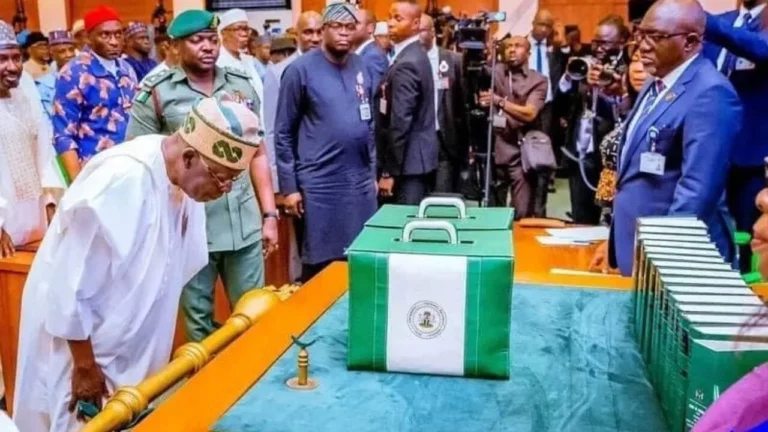
THE Nigerian Senate has extended the implementation of the capital component of the 2024 budget to December 31, 2025.
The Upper Chamber passed the resolution during plenary on Tuesday, June 24, marking the second time the 2024 budget has been extended.
In December 2024, the upper and lower legislative chambers approved the extension of the 2024 budget to run till June 30, 2025, following a request by President Bola Tinubu.
The approval halted the January-December budget cycle introduced in 2020 by the ninth National Assembly as a strategy to enhance budget performance, The ICIRreported.
Tinubu had said at the time that the request was to enable the executive arm to complete ongoing capital projects and optimise budgetary allocations.
At Tuesday’s plenary, the Deputy Senate President, Barau Jibrin, who presided over the plenary, announced the extension following the expedition passage of its first, second, and third readings.
While leading the debate during the plenary, the chairman of the Senate Committee on Appropriation, Olamilekan Adeola, explained that the extension was required to allow the federal government to complete ongoing projects captured in the budgets.
He expressed that the federal government does not have enough resources to capture the expenditures proposed in the budget, urging his colleagues to support the extension of the 2024 budget to avoid abandoning projects in different parts of the country.
With this extension, Nigeria is now operating two budgets, the 2024 and 2025 appropriations, within a single fiscal year, the first time ever.
Similarly, the House of Representatives passed for the second reading a bill to extend the capital component implementation of the 2024 budget from June 30 to December 31.
The bill was presented by the deputy Majority Leader, Ibrahim Halims, during Tuesday’s plenary.
According to the Speaker, Tajudeen Abbas, the extension was necessary because the 2024 budget has not been fully implemented.
The bill was passed through voice vote and referred to the Committee on Supply for further action.
The ICIR reports that both chambers have approved a budget size of N54.99 trillion for 2025, compared to the 2024 budget size of N27.5 trillion.
FORMER Vice President Atiku Abubakar has urged President Bola Tinubu to clarify his alleged relationship with Alex Zingman, a Belarusian businessman reportedly involved in multiple criminal activities.
Tinubu on Monday claimed that ‘Alex’ was his classmate at Chicago State University (CSU) in the United States.
Speaking at the launch of the Renewed Hope Mechanisation Programme in Abuja on Monday, the president said he attended CSU together with Zingman.
In a statement released on Tuesday, June 24, Atiku’s Media Office questioned the validity of Tinubu’s claim, citing inconsistencies in his public records and demanding more explanation on the issue.
Abubakar, who contested against Tinubu in the 2023 presidential poll on the Peoples’ Democratic Party (PDP) platform, expressed concern over Tinubu’s connection with an individual whose global reputation is marred by controversies.
He said a basic review of publicly available information immediately called the president’s claim into question.
He noted that Zingman had been linked to controversial deals in Africa, including arms trafficking and financial impropriety.
He added that various reports listed Zingman as being born in 1966.
“By the year 1979, when President Tinubu claims to have graduated from CSU, Mr. Zingman would have been only 13 years old.
“Are we now to believe that the Guinness Book of Records missed the story of a 13-year-old Belarusian prodigy graduating from an American university alongside Bola Ahmed Tinubu?” the former vice president queried.
He added, “Were you taught in the same classroom or different decades? Mr. President, Nigerians deserve to know if the Alex Zingman of global infamy — the arms-linked tycoon — shares the same seat in your memories or only in a script of fiction,” the Adamawa-born politician submitted.
He added that Nigerians deserved clarity on Tinubu’s academic background, as, according to him, each attempt to explain it only seems to create more confusion and raise additional questions.
He demanded answers from Tinubu, questioning why none of the president’s classmates from Government College, Lagos, had come forward to confirm he attended the school.
He also highlighted the inconsistency of a school founded in 1972 issuing a certificate dated 1970 to the president. Furthermore, he said the president had not produced any known classmates from his supposed alma mater.
He also emphasised that Tinubu’s oath of office required him to uphold truth and integrity and that the presidency is a platform for transparency, not secrecy.
“And as such, Nigerians await not tales of Alexes from distant lands but proof, clarity, and the simple dignity of facts,” he said.
The ICIR reports that controversy surrounding Tinubu’s academic records resurfaced shortly before and after the 2023 general election. It sparked a global debate and was a major point of contention during the presidential election disputes in the courts.
CRUDE oil price tumbled to $67.66 per barrel on Tuesday, June 24, after Israel and Iran reportedly agreed to a proposed ceasefire.
It hit its lowest in two weeks on Tuesday after it had risen to $77.79 per barrel on Monday, June 23, now reversing below Nigeria’s budgeted $75 per barrel benchmark.
The price of crude oil in the international market, which determines the up and down movement of the cost of refined petroleum products, has been inching higher recently following the geopolitical tensions in the Middle East.
On Tuesday, Brent crude futures were down 13 per cent at $67.66 a barrel at 06:45 GMT from $77.79 a barrel on Monday, June 23 at about 10:00 GMT.
Similarly, the United States West Texas Intermediate (WTI) crude fell to $64.76 per barrel on Tuesday from $74.60 Monday.
The US President Donald Trump has on his Truth Social channel announced a ceasefire between Israel and Iran in a war that started on June 13 and seems to have lasted for 12 days.
“The ceasefire is now in effect. Please do not violate it!” Trump had stated.
Global crude oil prices had jumped over seven per cent to $74.85 for the first time in over four months on Friday, June 13, after an Israeli attack on Iran.
It was the first time since January this year that crude oil prices have risen significantly to that amount.
But the proposed ceasefire is expected to alleviate worries of supply disruptions in the Middle East, a major oil-producing region.
Following a consistent drop in crude oil price below the budgetary benchmark, analysts have said it could portend a setback for the Nigerian government in implementing its 2025 budget.
This is because Nigeria relies largely on the proceeds from oil revenue to fund a large chunk of its national budget.
With $75 per barrel set as the oil price benchmark in the 2025 budget, dropping below this figure could cause possible upset, while increasing the chances of further borrowing by the government, The ICIR earlier reported.
The Federal Government is running on a budget size of N54.99 trillion, setting its crude oil price benchmark at $75 per barrel, oil production at 2.06 million barrels per day (bpd), which is far from meeting the target, and exchange rate at N1,500 per dollar.
However, after Trump announced the Israel-Iran ceasefire, oil prices immediately tumbled.
It happened just two days after the Nigerian National Petroleum Company Limited (NNPCL) and other oil marketers adjusted their pump prices of petrol to nearly N1,000 per litre.
This upward reversal sees the NNPCL increase its pump price of petrol to N915 per litre in Lagos and to N945 per litre in Abuja from N870 and N910, respectively.
SMALL and medium-scale enterprises (SMEs) will have a longer lifespan if key decisions about such businesses are based on data and guided by experienced business mentors.
The Chief Executive Officer (CEO) of Lagos State Trust Fund, Feyisayo Alayande, made this submission on Tuesday, June 24, on the sidelines of the African Union Micro Small and Medium Enterprise (MSME) Forum in Abuja.
Alayande, who spoke on boosting micro and small business growth in the country, said data helped entrepreneurs and businesses to monitor areas of need and make informed decisions.
She disclosed that Lagos State had set up a central data pool that could assist decisions from small businesses in identifying skill gaps and addressing them with the requisite skills.
“At the Lagos Trust Fund, we have a repository of data that guides businesses. This guides decisions on the demand and supply side of labour. The data pool further assists a central decisions in the market, education, and industries. It also helps business owners to know the skill set that is in demand and how to fill the necessary gaps.
“As an SME stakeholder, what sets me up for success beyond access to finance is data-driven market intelligence. Data that helps you make informed decisions. Data should consist of what skill set you should look out for in a particular business setting. For SMEs, don’t underestimate data and mentorship in your business decisions,” she added.
Feyisayo Alayande-CEO, Lagos Trust Fund
She stressed the importance of employers adapting to a culture shift, adding that growing demands for innovation and digital skills had seen many employees transition to entrepreneurship within a short period.
“Demand for innovation skills is growing, and people need to plug in the right way with requisite data and matching of skills, for instance, in online soft skills, which could make people employable.
While stressing the importance of data to those seeking access to loans from Lagos Trust Fund, she said, “If you intend to secure funding from our outfit, it’s important you have your house in order. Make sure you have up to six months worth of data information to confirm what you have done in the past.”
She stressed that the fund seeker must have a clean credit bill from loan apps since everyone is connected to a central data source for easier confirmation of creditworthiness.
Noting that the Lagos Trust Fund offered business support services, she stressed that support also involved creating and linking market access for the advancement of such small-scale businesses.
She emphasised the importance of data structuring for businesses, adding that only businesses with such an orientation could qualify for her organisation’s business support programmes.
The business support services, she said,” support new businesses with mentors and structuring of businesses in terms of financial readiness for wealth creation.”
The ICIR reports that accessing loans is one of the pressing challenges that small and medium-sized enterprises (SMEs) face in Nigeria.
The challenge adds to the reasons many SMEs fail just a few years after startup.
According to a 2023 report by the Nigerian Bureau of Statistics (NBS), 80 per cent of small businesses do not survive beyond five years.
The report further identifies poor financial management for businesses, lack of market research, and inadequate government support as major contributors to business failure.