Home Blog Page 2512

New report by 91 scientists warns of immediate impact of climate change

A new climate change report by 91 scientists from 40 countries has warned that hundreds of millions of people around the world will face the immediate risks of worsening drought, floods, extreme heat and poverty if global warming is not kept to a maximum of 1.5 degrees Celsius.

The report, released on Monday by the Intergovernmental Panel on Climate Change, a group of scientists convened by the United Nations to advise world leaders on climate change, says policy changes and accelerated actions are required to limit global warming to 1.5 degrees and avoid the devastating impact of climate change.

The scientists found that if greenhouse gas emissions continue at the current level, the Earth will warm up by as much as 1.5 degrees Celsius above preindustrial levels by 2040. The world is currently 1 degrees warmer than preindustrial levels.

“One of the key messages that comes out very strongly from this report is that we are already seeing the consequences of 1°C of global warming through more extreme weather, rising sea levels and diminishing Arctic sea ice, among other changes,” said Panmao Zhai, Co-Chair of Working Group dealing with the physical science basis of climate change.

The report which analysed more than 6,000 scientific studies draws attention to the nearer consequences of climate change than previous work which had estimated the impact of climate change if average temperatures were to rise beyond 2 degrees Celsius. World leaders had agreed in Paris in 2015 to limit global warming to between 1.5 and 2 degrees.

Reacting to the report, Apollos Nwafor, Pan Africa Director of Oxfam International, said if urgent climate action is not taken, Africa will be worse off.

“Climate change has set our planet on fire, millions are already feeling the impacts, and the IPCC just showed that things can get much worse,” Nwafor said. “Settling for 2 degrees would be a death sentence for people in many parts of Africa. The faster governments embrace the renewable energy revolution and move to protect communities at risk, the more lives and livelihoods that will be spared.

“A hotter Africa is a hungrier Africa. Today at only 1.1 degrees of warming globally, crops and livestock across the region are being hit and hunger is rising, with poor small scale women farmers, living in rural areas suffering the most. It only gets worse from here.

“To do nothing more and simply follow the commitments made in the Paris Agreement condemns the world to 3 degrees of warming. The damage to our planet and humanity would be exponentially worse and irreparable.

“None of this is inevitable. What gives us hope is that some of the poorest and lowest emitting countries are now leading the climate fight. We’ve moved from an era of ‘you first’ to ‘follow me’ – it’s time for the rich world to do just that.

“Oxfam calls for increased, responsible and accountable climate finance from rich countries that supports small scale farmers, especially women to realize their right to food security and climate justice.

“While time is short, there is still a chance of keeping to 1.5 degrees of warming. We must reject any false solution like Large Scale Land Based Investments that means kicking small scale farmers off their land to make way for carbon farming and focus instead on stopping our use of fossil fuels, starting with an end to building new coal power stations worldwide.”
PHOTOS: Renovation begins on Abuja bridges five months after ICIR report

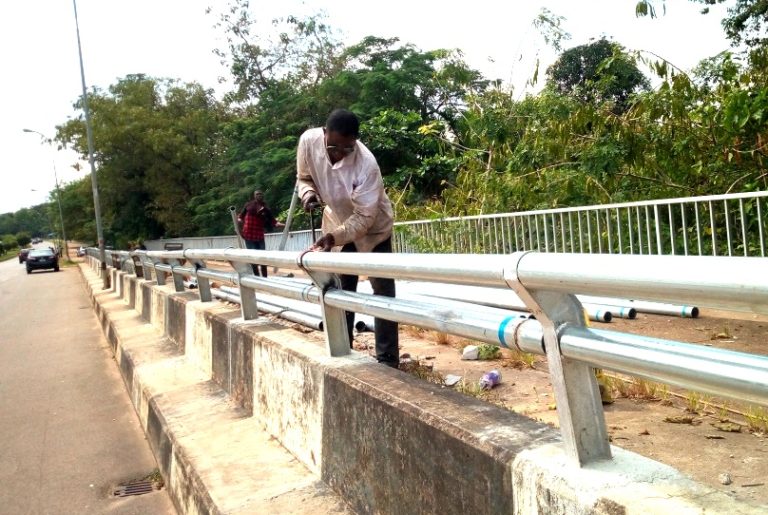
THE Federal Capital Territory Administration (FCTA) has started renovating bridges in Abuja whose railings and steel barriers got damaged as a result of theft, The ICIR has observed.

This development is coming a little over five months after The ICIR reported how the damaging and stealing of the bridge components located close to water bodies and high grounds has rendered the bridges unsafe for Abuja residents, especially schoolkids.

With three workers on site, repairs are ongoing at a section of the Olusegun Obasanjo Way, close to the famous GSM Village at Wuse Zone One.

They have painted the supporting steel dowels, replaced some of the cut steel barriers and are working to weld others in place, with the help of a generator vibrating in the background.

The May report featured “armless bridges” in different parts of Wuse and established that those who engaged in vandalising the public properties often operated at night.

According to witnesses, in 2017, the government embarked on partial replacement of the stolen railings and barriers. While the rails damaged along the Michael Okpara Street were repaired, the ones on Obasanjo Way were left unattended to, observed Micheal Ojobo.

A similar pattern was seen in respect of a similar bridge close to Wuse Market. While one side of the bridge was repaired, the second was abandoned.

Anjuguri Manzah, Police Public Relations Officer (PPRO) for the FCT Command, had said some of the vandals had been arrested and charged to court. He also said, after cutting, the metal scraps were sold at giveaway prices or melted and reused for other purposes.

The ICIR was informed by the Head of Public Relations, Abuja Metropolitan Management Council (AMMC), that the agency in charge of maintaining and repairing bridges and manholes is the Facilities Maintenance and Management Department.

The Department’s Public Relations Officer had, however, declined to comment, after consulting with the Director, and said they do not grant interviews “like that”.

The menace, it was noted, has been worsened by the ineffectiveness of streetlights and closed-circuit television (CCTV) cameras in the capital territory.

The ICIR reported in 2017 that CCTV cameras planted on major roads in Abuja had never worked since their installation and failed to detect criminal activities — despite government spending the sum of N76 billion on the project.

One of the workers as he measures the length of rod needed

Ike Keke former US serviceman promises to fight corruption if elected Nigerian President

IKE Keke, a retired United States serviceman was elected the presidential flag bearer of the New Nigeria Peoples Party (NNPP), in the party’s national convention in Abuja on Sunday.

The presidential candidate promised that his administration would fight corruption, strengthen weak institutions and ensure transparency and accountability in governance.

He also promised to ensure true federalism, telling party delegates to look forward to a system that is focused towards strengthening the nation’s unity through restructuring and ensuring that Nigeria returned “to what it was originally intended to be”.

“We plan to bring the best advancements and technologies in modern agriculture to help Nigeria become self-sufficient and a globally acknowledged agricultural nation.

“Our culture and tourism plan will develop the rich culture of the more than 500 ethnic groups in the country to meet global best practices.

“Our plan will further unite the country, while modelling her unity in diversity as an example for the world to know that humans can live in harmony regardless of colour, gender, ethnicity, religion or creed.”

Keke said his proposed plans would lead to economic transformation and stability. “Our vision on education, health, environment, infrastructure, foreign policy, entertainment and other critical sectors of the economy would guarantee the transformation Nigeria desires.”

The ex-serviceman, who is in the race with President Muhammadu Buhari, Atiku Abubakar, Donald Duke and other presidential flag bearers, promised that his regime would set the road map for healing, unity and prosperity of the nation.

Dipo Olayoku, the Chairman of the party’s convention committee said the peaceful aspirants and party members was an evidence that NNPP was the best party for Nigeria.

“If you compare this with the violence and records of death across the country, in the primaries of other political parties, you will agree with me that with the NNPP, the dawn of a new Nigeria is here.

“The party’s choice of candidate who will fly the party’s flag in the 2019 general elections is in tandem with the mood of the country for a generational shift.

“The choice before Nigerians in 2019 is very simple, either to continue with the old order which has made Nigeria a laughing stock or change our course,” he said.


Atiku’s last chance saloon to be president

By ‘Fisayo SOYOMBO


THIS is the 26th year since Atiku Abubakar first tried to be President. In those all those years, he has already tried four times. Only once, in 2007, did he ever get his party’s ticket. In February 2019, he will be a party’s presidential candidate for only the second time ever. By election date, Atiku would have clocked 72. Were he to contest and lose again, he would be 76 by the peak of the next election cycle. No Nigerian that old can ever be freshly elected into the country’s highest ever office. So, this is his last chance. This is also his best chance. But on the flip side, this will be the most difficult battle of his political life.

President Muhammadu Buhari’s aides have been quick to dismiss Atiku with a wave of the hand. In some sense, there is a reason to. Atiku has never beaten Buhari in an electoral contest. When he contested for the All Progressives Congress (APC) presidential ticket in December 2014, he was floored by Buhari. And he didn’t even place second; instead, it was Rabiu Kwankwaso, former Kano Governor, who did. While Buhari polled 3,430 votes, Kwankwaso polled 974 votes and Atiiku 954. As presidential candidate of the Action Congress (AC) in 2007, Atiku’s 2.6million votes were a whopping 4million short of second-place Buhari’s. The normal argument should be that Atiku stands no chance in 2019. Only that the times are different.

Atiku’s haul of 1,532 votes to Kwankwaso’s 158 proves just how much his intra-party sellability has improved in the last four years. Of higher significance, a number of factors over which he has no control have swung in his favour.

The Buhari of 2015 is a much weaker opponent today. Pre-2015, Buhari was seen as the opposite of every reason for which Goodluck Jonathan should be ejected from office. Corruption in the Jonathan years was so nauseating that Buhari, courtesy of his largely clean public-service record, was seen as the Messiah. But after four years of fighting corruption only in the opposition camp, Buhari’s anti-corruption evangelists have greatly diminished. Marry this with a weaker economy, Buhari’s general aloofness from the public, his lopsided, ethnocentric appointments, his failing health and consequent absenteeism from office, and Atiku gets perhaps an unmerited look-in from a section of electorate who ordinarily wouldn’t have. As Buhari himself will find out at the polls in 2019, he has lost a huge number of his foot soldiers, and this can only be to the benefit of his opponents.

But who exactly is poised to reap that benefit? There are 91 registered political parties, each reserving the rights to field a candidate. A few eye-catching presidential candidates have emerged already: Omoyele Sowore of the African Action Congress (AAC), Tope Fasua of the Abundant Nigeria Renewal Party (ANRP), Oby Ezekwesili of the Allied Congress Party of Nigeria (ACPN). There is nothing an Atiku presidency can achieve that each of these candidates cannot, but the average Nigerian electorate is notoriously conservative. Nigerian voters are not risk-takers, far from ready for the ballot-box revolution that can enthrone any of the outside parties. So Atiku will harvest the benefits of the raging anti-Buhari sentiment, not necessarily because he is the most qualified candidate but simply because he now has the ticket of the major opposition party.

When Atiku ran in 2007, there was hardly any heavyweight whose political survival depended on his victory. He has that going for him this time. Senate President Bukola Saraki was one of the first to congratulate him at the PDP convention ground on Sunday; did he really have a choice? After his ongoing battle with the APC hierarchy, Saraki the cunning politician understands that an Atiku presidency is now his ultimate political lifeline. As disappointed to lose as he is, Aminu Tambuwal — even his political ‘young father’ Nyesom Wike — understands he cannot afford to sell his soul to the APC. Unlike in the past, Atiku’s 2019 presidential contest is a community project. Although this year’s pre-election defections weren’t as massive as the pre-2015 scenario, there is real chance the PDP could copy the APC template to attempt snatching power from the current holders.

I have previously written about the merits and demerits of an Atiku presidency. He has the experience and the blueprint of how he wants to run Nigeria, but from the Buhari experience we have learnt that sheer intention doesn’t always arrive at the destination. Unlike Buhari, Atiku can clearly articulate his thoughts and he has robust understanding of the complexities of running a complex society such as ours.

But, as things currently stand, his anti-corruption baggage means his ascent to power will be victory for politics but defeat for governance — unless, of course, he wants to properly take advantage of the following four months to convince us: for starters, embark on a three or four-day trip to the US to dispel the myth that he cannot step on American soil because he is wanted for corruption. Many of those who will vote for anyone but Buhari are probably eyeing Atiku already, but many others abstaining because of his corruption tag can still be won over by a trip to and from the US.

Whether Atiku visits the US or not, it is clear he has never had a better chance to be President than now; and that, if the 2019 presidential election manages to be anything close to free and fair, he may or may not win but Buhari is in for the fight of his life. What is unclear as yet is if the outcome will be victory for politics at the expense of governance, or the other way. To say it the other way — in layman’s terms — what is unclear is whether, or how, such victory would benefit the people or just the winner.


Soyombo, former Editor of the TheCable and the International Centre for Investigative Reporting (ICIR), tweets @fisayosoyombo

Top 10 promises made by Atiku

By Theophilus ABBAH


FORMER Vice President Atiku Abubakar made many promises to Nigerians during his campaign for this ticket. Last weekend, he got the ticket of the People’s Democratic Party (PDP) to contest the 2019 presidential election. Below are 10 of those promises.

1. To End Boko Haram

He made this promise while on a campaign visit to Maiduguri, Borno State on July 17, 2018. Boko Haram battle which enters its 10th year in 2019 has been the albatross of several Nigerian leaders, including governors, ministers, and presidents. Before the 2015 election the terrorist group was seen as a contraption of northern political forces to frustrate President Goodluck Jonathan’s second term bid.

2. To End  Religious Violence in Nigeria

Atiku Abubakar made this promise in Jos, Plateau State on September 19, 2018 when he visited the Peoples Democratic Party (PDP) secretariat to lobby delegates to the presidential primaries. He said, “I know I have come home. Plateau State is my own home. We all know that Nigeria at the moment is being dominated by religious and ethnic differences,” and went ahead to promise to deal with the situation. Atiku was speaking to the besetting problem of religious violence in Plateau State which has claimed thousands of lives since 2003. Read more:.

3. He Promises to Run a ‘Lean Government’

It is not clear how he would run a ‘lean government’ but he situated it as part of his restructuring strategy. He made this promise on May 15, 2018 in Cross River State when he paid a courtesy visit to Governor Ayade. Restructuring has been the elephant in the political parlance. As one of the numerous recommendations, some advocates have called for the country to be divided into as regions, instead of states, based on the current [unconstitutional] six political zones. Atiku did not state clearly how he would restructure Nigeria but many Nigerians believe that the civil service is monstrous and ruined by corruption and inefficiency.

4. To Make Nigeria work again

Atiku made this promise on August 31, 2018 while picking his presidential nomination form. This promise is too broad, but most importantly, it is too implicating because many things are not working in the country, from infrastructure to the economy. It would have been better if he were specific.

5. Atiku  End to End Pro-Biafra agitation

While on a visit to Umuahia, Abia State on July 16, 2018, Atiku promised to end the pro-Biafra agitation by the Indigenous People of Biafra (IPOB). He was quoted as saying the complaints and agitations from the various sections of the country arose in the first place because of the lopsided nature of the federation Nigeria practices and the way the people currently in charge manage things to favour one part against the other.

6. I will Rule for Only One Term – Atiku

This is a very ‘dangerous’ promise because almost every presidential aspirant who made this promise back-tracked. He had told ThisDay newspaper thus: “I would! I have said this before on my own initiative. I believe in it. If I am elected as the President in 2019, I give an undertaking that I would only do one term. Having said that, let me remind Nigerians that Buhari also gave such an undertaking in 2011, but he is not living up to it today. My own case will be different. I am prepared to sign an undertaking to do only one term.”

7. Atiku Promises 40 Per cent Cabinet Seats for Youths:

At the inauguration of the Intellectual Think-Tank for Atiku, the now presidential candidate of the PDP promised to allocate 40 per cent of cabinet seats for youths. That means, he would appoint at least 15 youths into ministerial positions! It’s a tough promise, but luckily it was by Oladimeji Fabiyi, chairman of All Atiku Support Group (AASUG). Fabiyi was quoted as saying: “Having identified the critical role of youths in the emergence of any leader, I pledge to give youths 40 percent of appointments in my cabinet if elected as the president of Nigeria in 2019,” he said.

8. He Promises  ‘Fresh Initiatives to Tackle Unemployment’

On several occasions Atiku has flaunted his credential as an employer of labour, hence it was not shocking when he promised to generated initiatives to tackle unemployment. Mr Segun Osuwunmi, who is the Director of Communication of Atiku Campaign Organisation made the promise on behalf of Atiku.

9. Atiku Promises to Revamp the Economy:

The economy has been in dire strait, so a promise to revamp it is very apt in a power-grabbing campaign. He made the promise on July 31, 2018 in Yola when he declared his intention to run for the presidency. He was quoted as saying: ”APC government has destroyed our economy, taking over Nigeria’s economy with the economic growth measured at 7℅ and brought it down to less than 2℅”.

10. Atiku Promises to Restructure Nigeria:

He promised to restructure the country but it is not clear how it would be carried out. He emphasized it at every campaign venue. Atiku reiterated it to the point that it became as source of ideological clash between him and Vice President Osibanjo. In a tweet, Atiku said: “The president and his vice-president have asymmetrical views on restructuring. Thus, explains the lack of forthrightness on the matter by this government. This is a failed promise that I intend on redeeming.” To restructure the country would demand a huge constitutional amendment and confidence-building among the people of the country.

Theophilus Abbah is a journalist, writer, researcher and trainer.


UPDATED: Former Vice President Atiku Abubakar emerges PDP presidential candidate

ATIKU Abubakar, former Vice President, has emerged the presidential candidate of the Peoples Democratic Party (PDP) after he defeated eleven other aspirants at the party’s presidential primary election in Port Harcourt, Rivers State. 

He defeated his closest rival, Aminu Tambuwal, the current governor of Sokoto State, who was believed to have been supported by the governor of Rivers State, Nyesom Wike.

A total number of 3,274 accredited delegates from the 36 states and FCT  voted in the election .

Here are the results of the poll.

BUKOLA SARAKI 317
ATIKU ABUBAKAR 1,532
AMINU TAMBUWAL 693
IBRAHIM DANKWAMBO 111
AHMED MAKARFI 74
SULE LAMIDO 96
DAVID MARK 35
RABI KWANKWASO 158
DATTI BABA-AHMED 05
ATTAHIRU BAFAWARA 48
JONAH JANG 19
KABIRU TURAKI 65


In the presidential election next February, Atiku will face President Muhammadu Buhari, who was earlier today announced the candidate of the ruling party.

After parting ways with the ruling All Progressives Congress (APC), Atiku promised to restructure Nigeria within six months if he is elected Nigeria’s president in the 2019 elections.

Arguably the only veteran for the presidential election in Nigeria among other aspirants for the 2019 general elections, Atiku, 72, made his first attempt at becoming Nigerian president in 1993 under the then Social Democratic Party (SDP).

He placed third in the party’s primaries behind late MKO Abiola and Babagana Kingibe.

In 2007,  he contested the presidential election as the candidate of Action Congress (AC). He ran against the eventual winner, late Umaru Musa Yar’Adua and came third behind Muhammadu Buhari of the All Nigeria Peoples Party (ANPP).

Before then, after leaving the Nigeria Customs Service as a Deputy Director, Atiku first ran for the office of governor in the old Gongola State (now Adamawa and Taraba States) in 1991 but did not win.

In 1998, he was elected the Governor of Adamawa State.

But he was picked by Olusegun Obasanjo, the PDP presidential candidate in 1999 as his running mate.

On Saturday, July 21, 2018, the Turaki Adamawa as he is fondly called stood before a cheering crowd in his home state of Adamawa, announcing he will seek the PDP ticket for president in 2019.

For his education, Atiku had his primary education at Jada Primary School and in 1960 was admitted to Adamawa Provincial Secondary School in Yola.  He graduated with a Grade Three WASC/GCE Certificate in 1965.

Following secondary school, he also studied a short while at the Nigeria Police College in Kaduna . He left the College when he was unable to present an O-Level Mathematics result. He worked briefly as a Tax Officer in the regional Ministry of Finance, from where he gained admission to the school of Hygiene in Kano in 1966.

He graduated with a Diploma in 1967, having served as Interim Student Union President at the school. In 1967 he enrolled for a Law Diploma at the Ahmadu Bello University Institute of Administration, on a scholarship from the regional government. After graduation in 1969, during the Nigerian Civil War, he was employed by the Nigeria Customs Service.

History of defections

Seeing largely by many Nigerians as a ‘serial political defector’, the former Vice President has left the PDP twice and also returned twice to the party after failed attempts to actualize his presidential ambition.

Before the end of his second term in office as the Vice President to Olusegun Obasanjo, Atiku left the PDP for the first time in 2006 and joined the defunct Action Congress (AC) after years of internal battle with Obasanjo.

Atiku was in AC between 2006 and 2009 when he returned to the PDP, following a rumour of disagreements with one of the leaders of the AC and former governor of Lagos State, Bola Tinubu.

In 2010, he ran for the PDP presidential ticket prior to the 2011 election and lost to the then incumbent President Goodluck Jonathan.

In August 2013 during the party’s national convention, he alongside seven governors staged a walkout, accusing the leadership of the party and then President Jonathan of impunity and formed a faction of the party called the ‘new PDP’.

He and five disgruntled governors of the PDP moved to the APC where he again, contested the party’s primaries and lost the ticket to President Muhammadu Buhari.

Atiku would later quit the party on November 24, 2017, arguing that the party has failed the people.

For his desire to rule the nation which has taken him in and out of PDP, ACN and APC, the former Vice President is seen largely as a ‘political prostitute’ who crosses from party to party for selfish ambition.

He recently told Nigerians that he was not desperate to become Nigerian president. “I am not desperate and if I were desperate, I would have taken the Presidency in 2003. If I were desperate, I would not have stepped down for (late Moshood) Abiola. I am not desperate,” Atiku said.

Aisha Buhari slams APC of impunity after her brother lost governorship bid

THE First Lady, Aisha Buhari, has slammed the All Progressives Congress (APC) for not providing fair and neutral arrangement for its primary elections.

The President’s wife expressed her disappointment on Twitter on Sunday, pointing out that the APC conducted sham primaries.

Her criticism of the ruling party comes after her brother, Halilu Ahmed, lost the controversial APC governorship primaries in Adamawa State to the incumbent governor, Muhammadu Bindow.

She said. “It is disheartening to note that some aspirants used their hard earned money to purchase nomination forms, got screened, cleared and campaigned vigorously yet found their names omitted on Election Day, these forms were bought at exorbitant prices,” she wrote.

“All Progressives Congress being a party whose cardinal principle is change and headed by a comrade/activist whose main concern is for the common man, yet, such impunity could take place under his watch.

“Given this development one will not hesitate than DISSOCIATE from such unfairness, be neutral and speak for the voiceless.

“It is important for the populace to rise against impunity and for voters to demand from aspirants to be committed to the provision of basic amenities.”

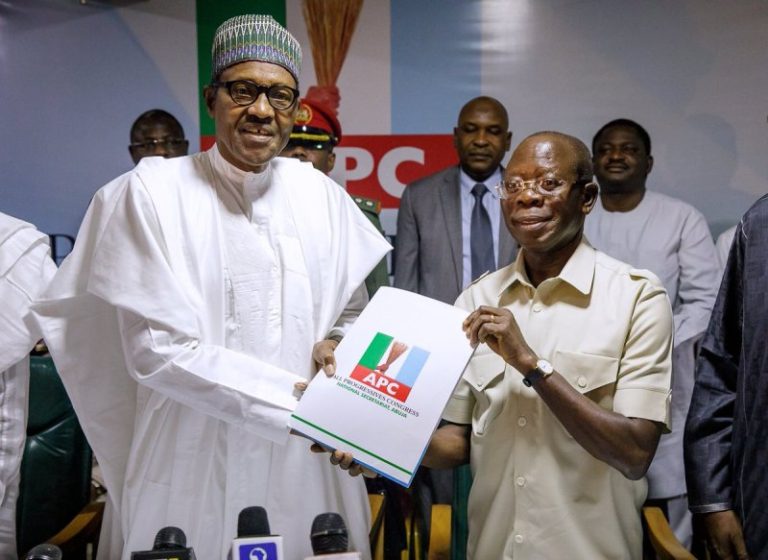
Buhari picks APC ticket, asks PDP to present 16 years score card

AFTER his endorsement by 14,842,072 members of the All Progressives Congress across the 36 states and the Federal Capital Territory (FCT) as the party’s presidential candidate for 2019 election, President Muhammadu Buhari has asked the opposition party, Peoples Democratic Parry (PDP) to present its score card of 16 years in power.

“Fellow Nigerians, think how much PDP governments earned from 1999 to 2015. Think what they did with it,” Buhari said in his acceptance speech in Abuja during the APC national convention where he was endorsed for his second term bid.

“Infrastructure down, security down, 18 local governments of Nigeria under control of a hostile army of insurgent, reserves depleted, bankruptcy around the corner. What did they do with your money,” he asked.

While thanking members of the party who dropped their presidential ambition to enable him seek a second term, the President assured that he would not disappoint Nigerians.

“I thank you all for your encouragement and support, and I will not disappoint the people of Nigeria,” he said.

The President who noted that the ruling party was proud of its achievements said his government has been rebuilding Nigeria’s economy as well as developing infrastructure.

“Our currency has stabilised. Our reserves are now $44 billion, a lot higher than we had in 2015,” he said.

He maintained that the federal government was tackling corruption head-on, adding that his recent interactions with the international community have been very encouraging, as world leaders were giving the Nigerian government the necessary support.

“We are attacking corruption head-on. With international support we are recovering Nigerian stolen assets and applying them to infrastructural developments,” he said

Adams Oshiomhole, the APC National Chairman, formally presented President Buhari to the convention as the party’s 2019 presidential candidate, amidst cheers from delegates and other party members.

“I hereby formally present President Muhammadu Buhari as the candidate of our party for the 2019 presidential election to everyone here and to Nigerians, and by the grace of God, victory shall be ours,” he said.

PDP Primaries: Dankwambo wins by landslide against Atiku, Saraki, Kwankwaso in online poll

GARNERING a total of 68 per cent of all votes cast in a just-concluded online poll, Ibrahim Dankwambo has defeated other members of the People’s Democratic Party slugging it out for the party’s presidential ticket.

The poll, which was conducted on Twitter by DailyTrust, a national newspaper headquartered Abuja, also featured Atiku Abubakar, Bukola Saraki, and Rabiu Kwankwaso, who were received most votes in various previously conducted polls.

The poll had asked, “Who is the best candidate for @OfficialPDPNig [PDP]?” Atiku and Saraki, coming second place, had a total of 11 per cent,  while Kwankwaso staggered behind with a slightly lower percentage of 10 per cent.

Dankwambo is a two-time governor of Gombe State, first winning by a landslide in the governorship election of April 26, 2011.

Earlier in August, the 56-year-old declared an intention to contest in the 2019 presidential election under the umbrella of the People’s Democratic Party (PDP). This, he said, is to enable him “consolidate on the gains of democracy and save the country from hunger and starvation”.

Other members of the PDP also in the race include Aminu Tambuwwal,  Sule Lamido, Kabiru Turaki, Attahiru Bafarawa, Datti Baba-Ahmed, Ahmed Makarfi, Jonah Jang and David Mark.

A total number 17,925 Twitter users participated in the poll which lasted about seven hours.

Some Nigerians have however criticised the choice of candidates by saying none of those mentioned deserves to fly the party’s flag at the presidential race.

“There should be an option for ‘none’,” Adabenege Peter suggested.

Likewise, Jerry Jay (@chimajerryjay30) said the winner ought to be Aminu Tambuwal whose name was not on the list.

Meanwhile, members of the PDP have presently gathered at Adokiye Amiesiekema Stadium, Port Harcourt, for the party’s convention. They will be deciding who shall represent the party ahead of the presidential election in February 2019.

Kwankwaso says he’s popular than Buhari in North and will beat him if he gets PDP ticket

RABI’U Musa Kwankwaso says he is more popular than President Muhammadu Buhari in the northern part of the country which has been the stronghold of the president.

Kwankwaso told Premium Times in an interview that he would easily defeat Buhari in the 2019 presidential election if he secures the People’s Democratic Party (PDP) ticket in the tomorrow’s primaries in Port Harcourt, Rivers State.

He said Buhari’s huge fellowship has waned in the North because of widespread hunger and poverty. “Now they have opened their eyes. The blind people, because they are hungry, have to open their eyes to look for food. So nobody is blind now.”

He said even Buhari knows that if he emerges the PDP candidate, the president cannot defeat him in the election “Everybody knows it, including the president himself. He knows if I get the ticket, I will defeat them.”

Kwankwaso who is one of the 12 aspirants for the main opposition party presidential ticket said he as the capacity to solve the insecurity in the country.  “The issue of Muslims and Christians, herders and farmers, 419, all sorts of things we have today will be by the grace of God, things of the past. This is because we have the experience, we have the capacity to do it.”

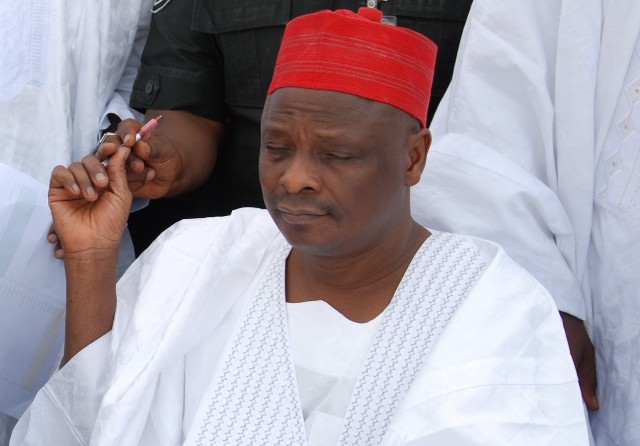
He hinges his hope on Kwankwasiya, a red cap wearing movement that he started when he was the governor of Kano State.

“Today, in every house, especially here in Northern Nigeria, you get at least one person who is a member of the Kwankwasiya Movement. Whether he or she is putting our colour, the red cap or not, you have one, maybe the driver or the cook, the cleaner, or the son, or the wife or the man the leader of the house himself.

“So, we are very strong and I think I am the only person with that strength. If I get the ticket, I will come with millions of people into the contest for the support of my candidature as members of Kwankwasiya.”

On tomorrow’s primaries,  Kwankwaso said has a brighter chance of securing the PDP ticket than other aspirants because of his experience and capacity.

“You see, everybody knows that I have a lot of advantage over and above other aspirants in the race now in our party, the PDP. I am sure you know my antecedents. I was a civil servant, an engineer in the Kano State Civil Service for about 17 years. I joined politics in 1992 when I left service in 1991. I contested and became the Deputy Speaker of the House of Representatives during the SDP and NRC days.

“When the Third Republic was truncated, I went back and contested election again to come for the Constitutional Conference of 1994/1995 and became governor from 1999 to 2003, minister of defence, during the Obasanjo administration.

“I was in Darfur and Somalia presidential envoy and in 2007, I was appointed a member representing North West in the NDDC. After that, I went and contested an election in 2011 and became governor for the second time, in Kano.

“And in 2015, I contested the APC primary election with the incumbent president and came second. I am now a senator of the Federal Republic of Nigeria. You can see from what I told you about my experiences as a civil servant and politician. It is very difficult to get anybody with this sort of experience.

“Not only that. As a politician, we have done so much, especially the mobilisation under the Kwankwasiya Movement.”

He explained that the Kwankwasiya Movement is based on the ideology of Amino Kano who was popular for his pro-poor orientation.

Meanwhile, the PDP in Lagos has elected Jimi Agbaje as the flagbearer in the state primary that just ended.

He polled 1,100 votes to defeat his rival Adedeji Doherty who scored 742 votes in the party’s primary election, reports Channels Television.

Agbaje was the PDP candidate in the 2015 governorship election but lost to incumbent governor Akinwunmi Ambode.

He would be contesting against the APC candidate, Babajide Sanwo-Olu,  in the February 2019 election.