Home Blog Page 2513

World Teachers Day:  Osun, Borno, Kogi … 10 states still holding on to teachers’ salaries

AS the world celebrates Teachers Day, the Nigerian teachers are aggrieved over the non-payment of their salaries.

October 5 of every year has been set aside by the United Nations Educational, Scientific and Cultural Organisation (UNESCO), to celebrate and remind the global community the importance of teachers to nation’s development.

Despite the disbursement of Paris Club loan repayment by the Federal Government, some states governments in Nigeria still owe teachers’ salaries for months.

A document made available to The ICIR by the Public Relations Officer of National Union of Teachers (NUT), Hwande Emmanuel, shows that seven of the 36 states in Nigeria have cut down the teachers’ salary ranging from 20 to 80 per cent cut in salaries.  According to NUT,  some state governments have stopped paying salaries for as long as 11 months.

The teachers who are referred to as the catalysts for the intellectual, socio-economic, scientific, technological growth and development of the society have mostly been receiving half or quarter salaries in Nigeria.

The last time the Benue State government paid the teachers was in November 2017. Approximately 11 months’ salaries have not been given to both primary and secondary teachers in the state.

Similarly, Abia teachers were last paid in March 2018. They have been owed 6 months’ salary.

In Borno, the primary school teachers receive 20 per cent of their monthly salaries, while secondary receive 60 per cent.

The Kogi teachers are being paid 54 per cent of their salaries every month.

In Osun State, payment is based on the grade level. Both primary and secondary teachers of grade level 12 to 17 receive half-salaries (50 per cent), while those in grade level 8 to 10 gets 75 per cent of their salaries.  This mode of paying salaries has existed for more than two years in the state, according to NUT.

Likewise, Plateau State pays teachers 55 per cent of their salaries. Others are Imo and Kwara States which pay 80% while Nasarawa State government have been inconsistent with the percentage of salaries being paid.

The Zamfara State teachers are not exempted from the delayed payment. Since February 2011 that the N18,000 national minimum wage was approved, teachers in the state have never benefitted from the change because the government has not implemented the minimum wage policy in the state.

The Universal Declaration of Human Rights in 1948 recognised education as a key fundamental right. A right that cannot be fulfilled without qualified teachers. Not only qualified teachers but also motivated teachers who are rightly paid.

Alamu Motunrayo, a primary school teacher in Osun State, told the ICIR that teachers in the state have suffered untold hardship since the government started tampering with their salaries.

Motunrayo said teachers were not happy with the payment of half salaries and it had resulted in sicknesses to many, adding that many who borrowed from commercial banks for years could not pay the debt and had resulted in compound interests.

“Most teachers are sick with no money to treat themselves,” she said.  “Teachers that are not happy, how will they get to school and teach?”

She noted that the majority of the teachers vent their frustrations on the students. “In a situation where a teacher supposed to take four subjects a day since there is no strength to teach, just two will be taken,” Motunrayo said.

She added that the situation has caused most parents to withdraw their children from public schools to private ones.

Evidence shows that delay in payment of salaries contributes to lack of motivation. Most teachers lack the motivation for teaching which has created an adverse effect on the teaching and learning in the country.

The President of NUT, Muhammed Idris, in a news conference to mark 2018 World Teachers Day in Abuja, said: “The right to education will be vain, vague, a mirage and elusive, without the presence of an optimum number of qualified, well-remunerated and motivated teachers in the nations’ schools.”

He added that “young graduates of education discipline and prospective teachers have ignored teaching profession because of the kind of salary teachers were receiving.”

The Permanent Secretary, Federal Ministry of Education, Sonny Echono, in his comment, noted that one key factor in ensuring quality teaching and learning was the availability of adequate welfare for teachers to attract the best brains for the profession.

Osun Elections:Saraki,Tambuwal lead protests to INEC headquaters

0

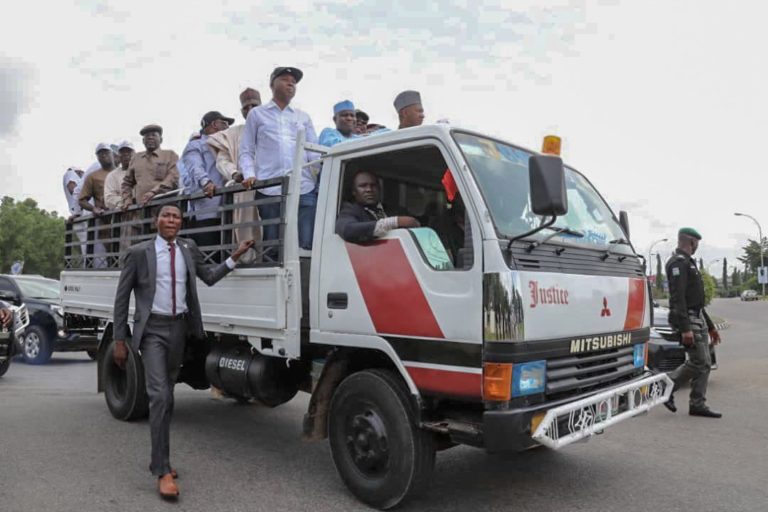
PROTESTERS led by frontline leaders of the People’s Democratic Party including Senate President Bukola Saraki, Speaker of the House of Representatives, Yakubu Dogara, and the national chairman of the party, Uche Secondus demonstrating their dissatisfaction with the Independent National Electoral Commission (INEC) over their perceived mishandling of the 2018 Osun gubernatorial elections.

This was after they had earlier converged at the national headquarters of the PDP in Abuja. The protesters are demanding that INEC declare the PDP candidate Ademola Adeleke as the winner of the Osun election. The protesters said that the Nigeria Police and INEC are arms of the ruling All Progressives Congress (APC) to perpetuate electoral fraud.

Other protesters include the former Niger State Governor and presidential aspirant Sule Lamido; Senator Dino Melaye.

The Independent National Electoral Commission (INEC) on Sept 23, announced the winner of the gubernatorial election conducted in Osun State. And by the evening of the same day, the electoral body declared the election inconclusive and would conduct a re-run election, a declaration which sparked outrage from the opposition party, PDP.


READ ALSO:

At the end of the collation of votes, the PDP candidate, Ademola Adeleke, won majority votes of 254,698 votes while Gboyega Oyetola of the APC came a close second with 254,345 votes, with a difference of about 353 votes.

In some of the local governments where the re-run election held, there were records of violence and vote buying. Journalists and election observers were also arrested and barred from monitoring the voting process.

At the end of the re-run, INEC declared Gboyega Oyetola of the APC as the winner of the 2018 Osun re-run governorship election. He was returned as governor-elect at the end of a supplementary election which held in seven polling units across four local governments – a declaration which the PDP candidate described as a charade, and was therefore rejected.

JUST IN: Despite forgery scandal, Isiguzo beats odds to emerge NUJ president

CHRISTOPHER Isiguzo, ThisDay journalist and two-time vice president of the Nigerian Union of Journalists (NUJ), has defeated six other aspirants to emerge as the union’s president-elect, despite damning allegations of certificate forgery.

The ICIR gathered that the election took place on Thursday night at the ongoing sixth triennial delegates’ conference held in Abeokuta, Ogun State, which hosts over 900 journalists.

Other contenders for the top seat included AbdulWaheed Odusile, the incumbent national president, Jacob Edi, Dele Atunbi, U.S.A. Urzaka, Abiodun Olalere, and Mike Aladenika.

Announcing the results, Benson Upah, the returning officer, said Isiguzo polled a total of 346 votes, while Odusile trails closely behind with 329 votes. Also, Atunbi had a total of 101 votes, Olalere 56, Edi 16, and Aladenika 8.

On Tuesday, The ICIR had confirmed allegations that he forged some of his certificates, including an HND from The Federal Polytechnic, Oko, and a diploma in public administration from Hyles-Anderson College, United States.

When Isiguzo was contacted, he had alleged that Odusile paid for the online reports against him so as to ensure he loses at the election. He also said, based on consultations with his lawyers, he had decided not to comment further on the allegation until the NUJ had conducted the election.

Following the allegations, ThisDay Newspapers, where he works as South East Bureau chief, terminated his appointment as they found out he was “very economical with the truth” in his application.

However, hours later, the media organisation reversed the decision to sack him following a directive from Nduka Obaigbena, founder and chairman of paper.

Attempts to get a statement from Dahiru Garba Muhammed, chairman of the NUJ Credentials Committee, were unsuccessful as calls placed to his phone were unanswered.

Congolese doctor, Yazidi activist win Nobel Peace Prize for combating sexual violence

DENIS Mukwege, a doctor who helps victims of sexual violence in the Democratic Republic of Congo, and Nadia Murad, a Yazidi rights activist and survivor of sexual slavery by Islamic State, won the 2018 Nobel Peace Prize on Friday.

They were awarded the prize for their efforts to end the use of sexual violence as a weapon of war, the Norwegian Nobel Committee said.

“Denis Mukwege is the helper who has devoted his life to defending these victims. Nadia Murad is the witness who tells of the abuses perpetrated against herself and others,” it said in its citation.

“Each of them in their own way has helped to give greater visibility to war-time sexual violence, so that the perpetrators can be held accountable for their actions.”

Mukwege heads the Panzi Hospital in the eastern Congolese city of Bukavu. Opened in 1999, the clinic receives thousands of women each year, many of them requiring surgery from sexual violence.

Murad is an advocate for the Yazidi minority in Iraq and for refugee and women’s rights in general. She was enslaved and raped by Islamic State fighters in Mosul, Iraq, in 2014.

“Rape in war has been a crime for centuries. But it was a crime in the shadows. The two laureates have both shone a light on it,” said Dan Smith, Director of the Stockholm International Peace Research Institute (SIPRI).

“Their achievements are really extraordinary in bringing international attention to the crime,” he told Reuters.

Mukwege, a past winner of the United Nations Human Rights Prize and the European Parliament’s Sakharov Prize, performed surgery on scores of women after they had been raped by armed men, and he campaigned to highlight their plight. He also provides HIV/AIDS treatment as well as free maternal care.

Although the Second Congo War, which killed more than five million people, formally ended in 2003, violence remains rampant, with militias frequently targeting civilians.

The hospital has also been the subject of threats, and in 2012 Mukwege’s home was invaded by armed men who held his daughters at gunpoint, shot at him and killed his bodyguard.

Shortly before that attack, he had denounced mass rape in the Democratic Republic of Congo and the impunity for it in a speech at the United Nations.

“He has risked his life to help women survive atrocity,” said SIPRI’s Smith.

Mukwege was in the operation room when he was told the news, Belgian broadcaster RTBF reported on Friday.

Wivine Moleka, a member of Congo’s ruling PPRD party, said Mukwege was more than just a doctor.

“He is a humanist who has taken the pain of women into consideration, pain in their flesh and in their soul. The prize sends a strong signal to everyone about these women who are raped every day,” she said.

SURVIVAL

“She’s crying right now. She’s crying, she can’t talk,” Nadia Murad’s brother told Norwegian public broadcaster NRK after the award was announced.

Murad was 21-years-old in 2014 when Islamic State militants attacked the village where she had grown up in northern Iraq. The militants killed those who refused to convert to Islam, including six of her brothers and her mother.

Along with many of the other young women in her village, she was taken into captivity by the militants, and sold repeatedly for sex as part of Islamic State’s slave trade.

She eventually escaped captivity with the help of a Sunni Muslim family in Mosul, the de facto IS capital in Iraq, and became an advocate for the rights of her community around the world.

In 2017, Murad published a memoir of her ordeal, “The Last Girl”. She recounted in harrowing detail her months in captivity, her escape and her journey to activism.

“At some point, there was rape and nothing else. This becomes your normal day,” wrote

The militants’ attack on Yazidi communities in northern Iraq was part of what the United Nations has called a genocidal campaign launched by the Sunni militants against the religious minority.

Iraqi Prime Minister Haider al-Abadi congratulated her on the award, and Vian Dakhil, a Yazidi member of Iraq’s parliament, said: “It is the victory of good and peace over the forces of darkness.”

Murad, who is also a Sakharov Prize winner, is the second youngest Nobel Prize laureate after Malala Yusafzai.

SPEAK UP

The award of the prize follows a year in which the abuse and mistreatment of women in all walks of life across the globe have been a focus of attention.

Asked whether the #metoo movement, a prominent women’s rights activist forum, was an inspiration for this year’s prize, Nobel Committee Chairwoman Berit Reiss-Andersen said: “Metoo and war crimes are not quite the same. But they have in common that they see the suffering of women, the abuse of women and that it is important that women leave the concept of shame behind and speak up.”

Norwegian Nobel Committee secretary Olav Njoelstad said this year’s prize linked the effort to help war victims with those to rid the world of “evil, inhumane” arms by such organizations as anti-nuclear arms campaigner ICAN, last year’s laureate.

“This is one of the goals, hopes that this prize, and the efforts of those two people, as well as thousands of others, will eventually lead to the abolishment of this practice of sexual violence against girls, women and sometimes men as a weapon in a military conflict, which is really, really inhumane,” he told Reuters.

The prize will be presented in Oslo on Dec. 10, the anniversary of the death of Swedish industrialist Alfred Nobel, who founded the awards in his 1895 will.

This story was first published by Reuters

APC names Sanwo-Olu, El-Rufai, 22 others as governorship candidates

 The All Progressive Congress (APC) has released the names of 24 cleared candidates for the forthcoming 2019 governorship elections.

The list was included in a statement signed by the Ag. National Publicity Secretary of the party, Yekini Nabe, on Thursday.

According to the statement, the party’s National Working Committee (NWC), meeting which held on Thursday ratified the reports of the various Electoral Committees and cleared 24 candidates as governorship candidates for the APC.

The party which conducted its governorship primaries across the country has not resolved governorship candidates for all the 36 states.

Some states’ primaries were postponed due to some irregularities. In Imo and Zamfara states, the APC said new electoral panels would be set up to conduct governorship primaries.

Read the full list of approved candidates below:

  1. ABDULLAHI UMAR GANDUJE – KANO STATE
  2. MOHAMMED ABUBAKAR – BAUCHI STATE
  3. SIMON LALONG – PLATEAU STATE
  4. NASIR EL-RUFAI – KADUNA STATE
  5. MOHAMMED BADARU ABUBAKAR – JIGAWA STATE
  6. AHMED ALIYU – SOKOTO STATE
  7. ABUBAKAR ATIKU BAGUDU – KEBBI STATE
  8. AMINU BELLO MASARI – KATSINA STATE
  9. ABUBAKAR SANI BELLO – NIGER STATE
  10. BABAGANA UMARA-ZULUM – BORNO STATE
  11. MAI MALA BUNI – YOBE STATE
  12. ABUBAKAR A. SULE – NASARAWA STATE
  13. EMMANUEL JIMME – BENUE STATE
  14. BABAJIDE SANWO–OLU – LAGOS STATE
  15. TONYE COLE – RIVERS STATE
  16. UCHE OGAH – ABIA STATE
  17. NSIMA EKERE – AKWA-IBOM STATE
  18. ADEBAYO ADELABU – OYO STATE
  19. DAPO ABIODUN – OGUN STATE
  20. GREAT OGBORU – DELTA STATE
  21. OWAN ENOH – CROSS-RIVER
  22. INUWA YAHAYA – GOMBE STATE
  23. SUNNY OGBOJI – EBONYI STATE
  24. SANI ABUBAKAR DANLADI – TARABA STATE


EFCC to pay N600m damages for investigating Rivers State officials

THE Economic and Financial Crimes Commission (EFCC) has been ordered to pay the sum of N300 million in damages to each of the two officials of the Rivers State Government, for declaring them wanted in contravention of a subsisting court judgement.

Justice George Omereji of the Rivers State High Court, Port Harcourt gave the ruling on  Thursday, insisting that the EFCC violated the fundamental human rights of the affected persons.

Frederick Dagogo-Abere, the Rivers State Accountant General, and Lekia Bukpo, a former Permanent Secretary in the State’s Ministry of Local Government, were declared wanted by the EFCC following allegations that they withdrew the sum of N117 billion from the state’s treasury.

But in his ruling on Thursday, Justice Omereji expressed his dissatisfaction with the EFCC for going against a subsisting court order restraining it from investigating the state government’s account.

He noted that the Commission could have appealed the judgment if it was not satisfied with it, rather than resorting to self-help and going ahead to invite the officials. Omereji insists that the EFCC should first obtain a valid court order setting aside the ruling by Justice Ibrahim Buba of the Federal High Court, before taking further action on the Rivers State accounts.

According to the judgement which was handed down in March 2007, only the State House of Assembly has the right to investigate the financial activities of the state government. Justice Buba also granted “a perpetual injunction restraining the EFCC from arresting, detaining and arraigning Odili on the basis of his tenure as governor based on the purported investigation.”

Though the EFCC, then led by Nuhu Ribadu, took the matter to the court of Appeal in 2007, the case remains pending almost 11 years after. Another Appeal filed by the EFCC in 2008, also remains pending.

Peter Odili’s wife, Mary, is currently a Justice of the Supreme Court of Nigeria.

UNJUST JUPEB: Seeking admission to OAU? Whom you know may count above what you know

SINCE she was in junior secondary school, 17-year-old Feranmi* has always had a soft spot for legal practice. Her mind was simply made up: It was either law or nothing. And so she worked hard to make this dream come true. After hearing about the success rate of the annual Joint Universities Preliminary Examinations Board (JUPEB) examination, her dad, Mr Adeleke, paid well above N200,000 to enrol her at an approved study centre.

For ten gruelling months in 2016, Feranmi studied day and night. Thankfully when the examination was finally over, her hard work paid off as she had the second highest score possible: 15 out of 16. Her dream was closer than she imagined, she thought. But she was wrong. Obafemi Awolowo University offered her admission into the Department of History instead. This not only applied brakes to her dream, it shattered her spirit.

“I don’t feel happy in general,” she told her mom months into her second year at the university, “because of this course I’m doing right now, which I know I don’t deserve but there’s nothing I can do.”

She added: “Most times, I force myself to read just to pass the examinations. There’s no interest and there’s no joy in doing it.”

Mrs Adeleke learnt from Feranmi’s close friends in school that she has been skipping lectures because of her lack of interest in the course.

According to OAU’s Centre for Distance Learning, “JUPEB is a National Examination body saddled with the responsibility of conducting examinations for students, who have undergone approved subject combinations and are seeking Direct Entry admissions into Nigerian and partnering foreign tertiary institutions.”

The programme was approved by the federal government in December 2013 and officially kicked off the following year with a merger of ten universities, including OAU.

An unjust system… a mother’s distress

Feranmi’s mother, not only her daughter, has had to bear a great deal of the heartache. She tried her best to understand why her child did not get her preferred course, but her findings only caused her more emotional pain.

When she met the JUPEB Coordinator at the university, she was told she was denied admission into the law faculty because they did not have a perfect score of 16 out of 16 — only for her to discover many other candidates who scored as low as 10 are now studying their dream course, law.

She took her grievance to the Admissions Officer but nothing came out of it. Aluko, who chairs the Admission Committee, told her point blank she could not change her course back to law upon resumption, though successful transfer candidates abound on campus.

He also gave the excuse that the university considers catchment areas and states of origin in offering admission. When he was told Feranmi in fact has that to their advantage, he could not put up any more defence.

“An admission list was never released,” Mrs Adeleke told The ICIR. “Even a few days before the matriculation, many candidates with lower scores were given admission into the same course for which others who scored higher were rejected.”

“How do we encourage our youth to imbibe hard work when there is no incentive?” she questioned rhetorically.

“I’d initially resigned to fate by encouraging my child to accept the course eventually offered and telling her it could be the will of God. But each time I visit her in school, my daughter complains about her lack of interest and protests why, after her hard work, her spot was given to others.”

Mrs Adeleke also said the unfair system of admission is not exclusive to the faculty of law or the direct entry process. It happens under the Unified Tertiary Matriculation Examination (UTME) scheme, in other departments that are in high demand, and has been in place at the university for years.

She believes the admission list ought to be made transparent, with each student’s score on display for verification.

The ICIR gathered that, for instance, Orimogunje Iyanu had an aggregate score of 10 in the JUPEB examination, Bamisaye Peace had 12, and Ayela Rebbeca is also reported to have scored less than 14 — all students of the faculty of law where the cut-off mark was 16/16.

“It is not fair”, other affected students speak out

Sophia Adenola, a 200L student of the Department of English, confirmed to The ICIR that certain candidates with lower scores more often than not get rewarded with their desired courses of study while those who perform better are given unsought departments.

She said the JUPEB programme was “very stressful” for her as she had to read a lot for three different examinations. Eventually, she scored 13 in the final examination. One was added to everyone’s score, to make hers 14 out of 16. She said she knows approximately 15 of her colleagues who successfully “upgraded” their courses, but she is not sure of what all their scores were.

“When we got to OAU, some people were doing change of course,” she narrated. “But that is if you know someone there. Someone that even had nine (9) did a change of course successfully because she knows someone, and she was given the law course she wanted.”

“It is not fair,” she added. “We all worked hard, into the night, burning candles for almost a year. It’s unfair.”

Another student of the university who gained admission through the JUPEB examination, and scored 13/15, had a similar story. She said it is not surprising because “there is no university in Nigeria where there isn’t favouritism.”

“But that doesn’t make it right,” she added.

She thinks what mostly happens is the university has a quota for the number of people they want to admit for a course, and then they consider the next best scorers for admission after all the slots are filled.

“But then we still have cases of people who have 12 or 11 getting admitted for Law. I know someone who had 13 points like me and also had Law.”

“If it’s possible for the system to change, I would want it to because it’s quite painful,” she concluded.

Another student of the Faculty of Arts, who is in his penultimate year, revealed to The ICIR that admission racketeering takes place at the university, as in most other Nigerian tertiary institutions.

“In 2015, when the cut off for the Faculty of Law was 297,” he narrated, “many could not meet up. While a candidate with just two marks less than the cut-off was not offered admission, some were offered courses far from Law such as Dramatic Arts. Meanwhile, there are people with just 201 who were admitted to the faculty.”

The same trend of incidents occurred at the College of Health Sciences, he said. According to him, because of the perceived injustice, many students have opted to drop out after seeing their mates who only scored 200 in the examination remain at the college. Others end up not attending lectures because of disinterest. Some of these students were offered Agriculture though their marks only fell short of the cut-off with five or points.

“In fact, there was a boy, Timi, who secured his admission because of his father’s influence as a lecturer,” the source said.

“Even when you are qualified for admission with better scores above some people’s own, you need to know those in authority to secure the admission.”

Admission for sale

Information found online appear to suggest that it is common practice for students to also pay for admission slots at the Obafemi Awolowo University  a practice known as slot-trading.

According to Wuyi Peter, owner of Wuyi’s Edu. Consultancy who says he has been assisting aspiring students with their admission since 2007, the earlier a candidate submits his application to a staff member or “runs man” the better. These slots may either be bought or given out of goodwill.

“I must let you know that even if you have anyone to whom you have submitted your admission request and they are using a slot they have or have bought for you,” he writes, “please don’t leave them alone, don’t let them rest.”

“Let them feel your urge for the admission because without that, believe me, no matter how much they have collected from you for the slot they are using for you, there will be people who will be willing to pay more after the cut-offs are released.

“And trust me, most ‘runsmen’ don’t have enough strength to rebuke any better offer considering what the new candidate is paying more than you. They will just return your money to you after the admission lists are released and your name is not there, and even at that it’ll still mean they gained while you lose.”

Confirm your source, replies OAU JUPEB Programme Officer

When Kunle Alagbe, the university’s JUPEB Programme Officer, was contacted by The ICIR, he insisted he wanted to know how his phone number was obtained. When our reporter questioned the relevance of that information, he said: “That means your question as well is not relevant.”

“Excuse me,” he continued after it was pointed out that he works for a public institution. “If you can’t tell me where you got my number, whatever you’re telling me is not relevant to me please.”

He added that The ICIR needs to confirm its source and recommended that all complaints be directed to “the main university in form of a letter”.

When he was asked which official of the institution the letter should be directed to, he simply said: “Well you have to it get from your source, please.”

When a call was placed to Mabayoje Aluko, Chairman of OAU’s Admission Committee and Dean of Social Sciences, he excused himself as he was at a meeting and asked to be called later. Calls to his phone after this time were however not answered and text messages sent to him have not been replied.

In a texted response to The ICIR, however, Kehinde Awofisayo, the university’s admission officer, said the claims are false “to the best of my knowledge”.


*Pseudonyms are used in this report in place of the actual names of the students to protect their identities and studentship.

Osinbajo’s visit to Kaduna State stalls El-Zakzaky’s trial

THE trial of Ibrahim El-Zakzaky, leader of the Islamic Movement in Nigeria (IMN) also known as Shiite Islamic sect, has been stalled because of the visit of Vice President Yemi Osinbajo to Kaduna State on Thursday.

Osinbajo was in the State to attend the Micro, Small and Medium Enterprise (MSME) clinic put together by the State Government.

Vice President Yemi Osinbajo and Governor Nasir El-Rufai inspecting goods displayed by one of the participants at the MSME clinic on Thursday.

The trial judge, Gideon Kurada, had fixed Thursday to hear the bail application filed by El-Zakzaky’s lawyer, but as the case was brought up, the prosecution counsel, Dari Bayero, asked the court to adjourn sitting because of lack of adequate security in Kaduna town.

Bayero explained that the security agencies had deployed their operatives personnel to provide security for the visit of the Vice President, hence their inability to provide adequate security for the trial to go on as planned.

Justice Kurada granted the request and adjourned the case to November 7, to rule on the bail application.

The Kaduna State government had brought an eight-count charge against El-Zakzaky and his wife, accusing him of leading an outlawed organisation, illegal possession of firearms and being a leader of an outlawed organisation.

El-Zakzaky and his wife have remained in the custody of the Department of State Services (DSS) since December 2015 following a clash between the IMN and soldiers of the Nigerian Army.

The clash had lead to the death of over 300 Shitte members and one soldier, according to a panel of inquiry set up by the Kaduna State government to look into the case.

Justice Nnamdi Dimgba of the Abuja high court had ordered that El-Zakzaky should be granted bail and also be provided with a decent accommodation in any Northern State of his choice. Justice Dimgba also ordered the government to pay El-Zakzaky the sum of N25 million in damages for violating his fundamental human rights. But almost two years after the judgement was given, the federal government is yet to comply.

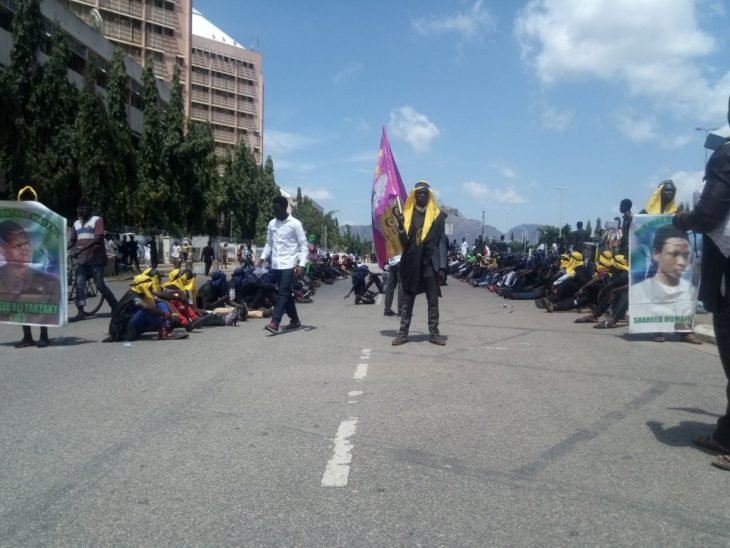
Shiite protesters in Abuja calling for the release of their leader, Ibrahim El-Zakzaky. The protesters carried banners El-Zakzaky’s sons whom they said were killed by Nigerian soldiers.

Members of the IMN have continued to hold peaceful protests in Abuja, Kaduna and some other Northern States, demanding that their leader be released in accordance with the rule of law.

Nigeria out-of-school children population increases to 13.2m- UBEC

THE population of out-of-school children in Nigeria has increased from 10.5million to 13.2million, the Universal Basic Education Commission (UBEC) has said.

With 10.5million children roaming the streets, Nigeria was ranked as a country with the highest number of out of school children in the world.

UBEC which overseas provision of infrastructure to basic education in the country had in April this year claimed that the 10.5million figure was no longer reliable as it flagged off the national education personnel audit.

The result of the audit, which was expected to give the accurate number of pupils in school and children that are out of school is yet to be released by the Commission.

But the Executive Secretary of the Commission, Ahmed Boboyi said that the 2015 Demographic Health Survey shows that the figure has since increased to 13.2million.

He said this in Abuja on Thursday at the Northern Nigerian Traditional Rulers Conference on Out-Of-School Children.

Speaking through Bello Kaigara, Director Social Mobilisation at UBEC, Boboyi lamented that the increase has affected the socioeconomic progress of the country.

” Over the past few years, Nigeria has been besieged by Boko Haram and a lot of children have been out of school,” he said.

“If you add the number of children that have been displaced and with the increasing number of birth, you find out that our source in DHS conduct by UNICEF and published in 2015 reveals the number of out of school children to have been increased to 13.2million.”

This, according to him, is equally affecting the implementation of all education treaties to which Nigeria is a signatory.

He remarked that traditional rulers who are the custodians of the culture have a significant role to play in addressing the problem of the Nigerian children roaming the street, and reduce the figure.

While speaking at the event, Chief Education of UNICEF, Terry Durnier said the world would not help Nigeria solve the problem if it did not solve it by itself.

“The number of out-of-school of over 10.5million calls for serious concern.” He said Nigeria should take on the challenge of reducing the number.

According to UNICEF, Nigeria accounts for more than one-in-five out-of-school children, and 45 per cent of out of school in West Africa.

Of the total out-of-school children, girls are in the majority, especially in Northern Nigeria, UNICEF said.

Fresh killings in Jos

0

HOODLUMS suspected to be Fulani herdsmen attacked Ariri community of Bassa local government area of Plateau State on Wednesday night.

The latest attack which claimed the lives of at least 18 people, leaving four persons injured, is one of the recent outbreaks of violence in Jos, the capital of Plateau and some other parts of the state since last week.  It occurred around 11:30 pm, according to reports.

Witnesses said the attackers wore black uniforms and shot their victims while most of them were asleep, but the identity of the attackers could not be verified at the time of this report.

This attack is coming three days after President Muhammadu Buhari condemned the recent spate of violence that rocked Jos, leading to deaths of several locals. At least 14 people were killed by gunmen in a Tuesday night attack in Jol Village of Riyom Local Government, despite calls for peace from the various civil society groups.

On September 30, attempts were made by suspected herders to attack a major hostel at the University of Jos,  one person eventually died and three others critically injured,  according to a statement released by the Students Union body.

Shedrach Kums, a 300-level law student who lost his life in the attack, was amongst the students trying to prevent the attackers from gaining entrance through the gate of one of the hostels, according to reports.

On September 28, Governor Simon Lalong , imposed a dusk to dawn curfew across the state’s capital following repeated clashes that authorities feared had taken sectarian dimension. The invasion of the university campus on Sunday was in spite of the security restrictions.

Plateau is one of the states in the North Central, Nigeria that have witnessed deadly attacks by suspected herdsmen. Over 2,000 deaths linked to suspected herdsmen have been recorded across the region this year alone.

While residents have reported relative peace in Benue and Taraba in recent weeks, following multiple deployments of security forces by the Nigerian government, attacks on villages in Plateau continue.

Some of the deaths have come through reprisal attacks between traditional dwellers and herdsmen seeking to graze their cattle in the state’s lush vegetation.

The minister of interior, Abdulrahman Dambazau, a retired Major General, in a statement by his Press Secretary, Ehisienwen Osaigbovo, in Abuja on Wednesday, directed the Police and the Nigeria Security and Civil Defence Corps (NSCDC) to take proactive measures to curtail the escalating violence in Plateau.

In the statement, Dambazzau urged security operatives to double their intelligence gathering mechanism by working closely with their host communities to ensure that prompt actions are taken to nip such crises in the bud.

He commiserated with the people and assured them of President Buhari’s administration’s effort to put an end to violent crises in Plateau and other parts of the country.