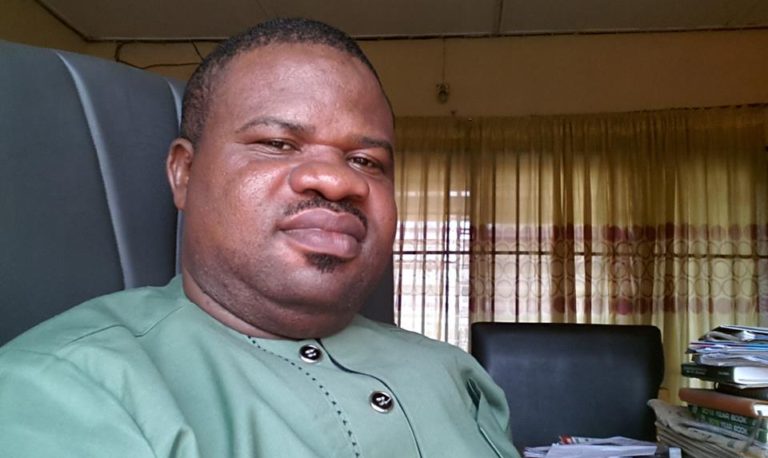
EVENTS at ThisDay newspapers have taken a dramatic turn as the sack of Christopher Isiguzo, one of the presidential aspirants at the Nigeria Union of Journalists (NUJ) caught up in a forgery scandal, has been reversed.
The ICIR gathered the reversal took place on the night of Tuesday, hours after news broke of Isiguzo’s dismissal.
In an email sent to Isiguzo by Joseph Ushigiale, the paper’s Managing Editor, at 10:37pm, the former was notified that the decision to terminate his appointment was rescinded “for now” based on “Chairman’s directive” — referring to Nduka Obaigbena, founder and chairman of ThisDay newspaper.
“Dear Mr. Isinguzo,” it read. “I refer to my earlier email to you on the above subject matter and wish to convey to you Chairman’s directive rescinding the decision terminating your appointment and to maintain the status quo ante for now. Thanks.”
ThisDay originally decided to sack Isiguzo after a review of his credentials revealed irreconcilable discrepancies, Ushigiale had told The ICIR.
He said, according to his 2006 application to the organisation, he has an an OND and HND from the Federal Polytechnic, Oko, and a diploma from Hyles-Anderson College, all in 1998, “which is not possible”.
The ICIRhas reported other irregularities in the forged documents, including that another institution’s stamp was used on his Nigerian HND statement of result and “2nd class” was written on his American diploma even though the United States instead uses Latin honours.
The Chancellor of Hyles-Anderson College, John Wilkerson, confirmed that the document was not issued by them and “neither do the names upon it represent any officiants or graduates of our college.”
Meanwhile, efforts to reach Ushigiale for an explanation on why the earlier decision was swiftly upturned proved unsuccessful as his phone number was not available.
CHRISTOPHER Isiguzo, presidential aspirant and two-time vice president at the Nigeria Union of Journalists (NUJ) has been sacked by ThisDay Newspapers, The ICIR has gathered.
Joseph Ushigiale, Managing Editor at ThisDay Newspapers, confirmed this development in a phone interview.
He said the decision was made following various enquiries from media practitioners who sought clarification on his qualifications. The paper thereafter discovered discrepancies in his documents after conducting a review.
“He was asked to explain and then he said he didn’t own those papers,” Ushigiale said. “He denied that the papers belong to him.”
From the management’s findings, when Isiguzo submitted a handwritten application in 2006 when he sought employment at the organisation, he wrote in it that he is an HND holder.
“And we decided that he has been very economical with the truth, because he has misled us in presenting documents that are not substantiated.”
Ushigiale also confirmed Isiguzo submitted documents which claimed he has an HND from the Federal Polytechnic, Oko, and a diploma from Hyles-Anderson College, United States, “and all of them were acquired the same year, which is not possible”.
When he was asked if the case would influence how the paper conducts recruitment exercises in the future and whether it would scrutinise the credentials of current employees, the Managing Editor replied affirmatively.
“We will have to review the entire employment process because it is possible there could be people who still parade fake documents,” he said.
“And, going forward, we will have to engage in maybe verification, or we have to be more strict in reviewing all the documents that are in our possession.”
Prior to his dismissal, Isiguzo worked at the newspaper as South East Bureau Chief.
Meanwhile, in a report published earlier on Tuesday, The ICIR had confirmed allegations that he forged some of his certificates, and stated that ThisDay newspaper issued him a query based on the allegations against him.
When Isiguzo was contacted on Monday, he alleged that Waheed Odusile, president of the NUJ, had paid for online reports against him in order to undermine his campaign.
“What is the interest that all of you have in me?” he had asked. “Waheed paid all of you to come and run me down, right? No, no, no, I know. Listen, listen. Of course, you acknowledged… you are a Yoruba-speaking [man] like him. He paid all of you because he knows he is going to be defeated on Thursday.”
He added that if he does not have a certificate, he will not be bold enough to stand for election.
REMINISCING the words of Owei Lakemfa, which echoes succinctly my growing up phase, He said: “My first awareness about elections was during my growing up as a kid, I was told the story of how the Jews were asked to vote between setting Jesus Christ free or Barabbas, a robber and murderer; Barabbas won that election by a landslide.”
As an electoral observer who had undergone several pieces of training and has been exposed to some measure of journalistic rigours, it was indeed a worthwhile experience observing the local terrains and assessing the level of INEC readiness towards the 2019 elections.
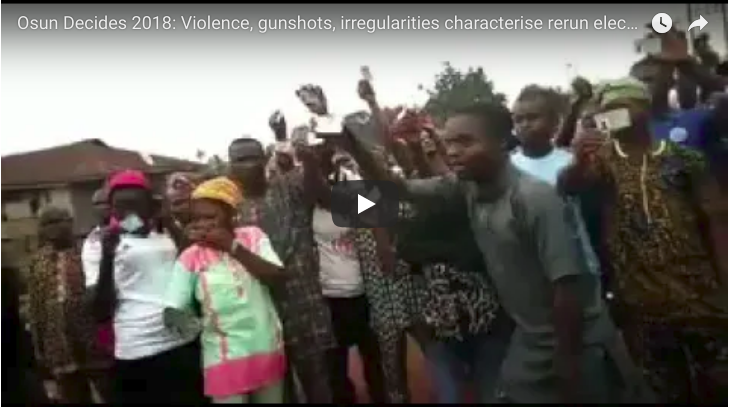
As one of the accredited Electoral observers for Premium Times Centre for Investigative Journalism (PTCIJ), in collaboration with the Centre for Democracy and Development (CDD) who witnessed the Ekiti state Guber Elections held on the 14th of July 2018 and also the recent Osun State 2018 governorship elections held on Saturday 22nd of September 2018 but was declared “inconclusive” by the almighty INEC, it’s not totally out of place to opine that the 2019 election may be one of the toughest polls across various states going by the emerging indicators.
After a three-day intensive session on the principles guiding election observation amongst other variant subject matter, we were charged with the all-important role of promoting open electoral data principles and practices as a means of increasing public confidence in genuinely democratic elections in Nigeria.
Upon my arrival to Osun state, as part of my pre-election assessment, the tension in the air was palpable alongside a lot of frenzy activities – the political gladiators were busy jostling for advantage, relevance and domination over one another. Interestingly, the epochal Osun State gubernatorial Elections was marked with series of campaigns, mega rallies and tour-like familiarization adorned with Carnival like settings from various parties round the 30 Local Government Areas in the state. After proper training on election observation at the hotel (undisclosed), it was basically a centre for we (observers) to freely exchange ideas and share the information, disinformation and misinformation flying all over and most importantly learning the theoretical aspect of election observation. Few of us also decided to make a detour round Ife, one of the notable flashpoints in the state.
The streets of Odo Otin Local Government Area, Okuku, Osun State where I observed, served as the home base of a quondam Governor of Osun State, Prince Olagunsoye Oyinlola. However, despite the ramshackleness in the area, the people were in high spirit ahead of the elections, the INEC office which is located at the entrance leading into the LGA was a beehive of activities prior to the election day proper, electoral officers, corps members, security operatives trooped in and out of the office and interestingly I had my own fair share of witnessing what it felt like to sleep overnight at the office alongside others.
Election observation is an integral part of the electoral process, the significance of this process in determining the credibility of elections cannot be overstated, so therefore alongside other colleagues we strategically observing the electioneering process in various PUs across the local government areas in the state due to the quest for transparency of electoral practices and processes during the election.
I must, however, stress that the presence of “electoral observers” during electioneering process has continued to create ambiance of confidence in a section of the electorate who would have shunned voting for the doubt and palpable fear that their votes may not count due to their preemptive notions on elections in Nigeria. For the sake of clarity, due to different perceived insinuations and puerile notions, as electoral observers, we are silent watchdogs and as such do not interfere with the electoral process because we are not election monitors but some people do not understand the difference. We observe, take note and report to improve the process in future.
Electoral observers are process watchers, and as such, it is necessary to assess the prevalent conditions and other activities connected towards electoral process; observing the distribution of electoral materials, opening of polls, accreditation process, voting and the process of announcing the results. However, the overriding responsibility of the observers is to basically verify whether all the competing political parties, individuals and groups enjoy complete freedom of organisation, movement, assembly and expression without hindrance or intimidation, violence or coercion or any other such acts capable of thwarting the will of the people. Therefore, as an evaluator of the process, I was accredited to do so by INEC. The accreditation process conferred the official recognition and also gave me and colleagues (observers) access to various locations where voting, counting, collation and the announcement of results took place.
INEC’s readiness: prepared or work-in-progress?
Based on the foregoing, it is imperative to begin a narrative on the changes in the electoral process to help voters understand what to expect when they go to the polls ahead of the 2019 elections.
Osun, Ekiti and host of other state gubernatorial elections is symbolic in view of the fact that the elections held this year or prior to is an off-season/cycle election, it therefore serves as a veritable platform to test the preparedness of the Independent National Electoral Commission (INEC) ahead of the 2019 general elections.
Just like I observed in the Ekiti and Osun Elections respectively, there was timely distribution of electoral materials across various PUs, the tracking of electoral materials was quite commendable unlike in the pasts where politicians would connive with electoral officers to divert these materials especially ballot papers. It’s however not totally out of place to commend INEC for challenging the dilemma of delay in early voting during electoral process but as a matter of candid recommendation, INEC as a body must improve on its face-look especially in terms of cleansing its negative image acquired over time, and most importantly deal with persistent, prevalent aspects of electoral fraud, including ballot paper and results sheet snatching, ballot stuffing, Vote buying; and making pre-election and the election day logistics and procedures transparent, accountable and efficient.
Roadmap to 2019 elections
The tensed electioneering campaign between the two major parties across the state among others has heightened the propensity for a tumultuous election in 2019. For those following the political polity of the nation daily, it’s no longer spectacular that each day are breaking news reports about emerging and developing political trends at the state level and even at the centerpiece – federal sphere, each of these political moves indicates some of the dynamics that could ultimately characterize next year’s crucial national elections.
The off-cycle election held in some states is just a presage what we should expect in the 2019 Elections. Even as the electioneering signs rage silently, it’s advisable to buy a ringside ticket and await the signalling for the much-envisaged contests in 2019.
The electorate: vote sellers or conscientious voters?
According to reports, the elections in Edo, Ondo and Anambra states were largely monetised, but it was noticeable in Ekiti state elections where there was crass involvement in the trend of “see and buy”. Political parties wooed votes with the meagre sum of “5,000”.
While in Osun State, there was a reformed/repackaged devise as developed by these parties, they collated names of people prior to the election day and made them to swear to an oath just for a meagre sum N2,000 in respect to the vote selling stock exchange.
At Ekiti, party agents had huge cash and were close to voting points but sadly, security agents were indifferent to inducement of voters. The unwholesome practices of voting buying, a trend in Ekiti tagged ‘see and buy’ in local parlance, where voters surreptitiously showed which party they voted to party agents who went behind to settle them however transformed into “Vote and take” in Osun State, where people collected their share upon swearing to an oath to vote for such party. One would begin to wonder why there were at least five policemen and one civil defence personnel in each polling unit and they were unable to prevent or event curb this criminal offense.
The fluctuating dynamics of elections in Nigeria is evolving, the role of money has never been this pronounced in any election in recent history, the efficacy of money underscores the consequences of poverty in moulding democratic values. As Nigerians, we must go beyond the pursuit of just armchair analysis, we need proactive engagement in pre-election, election and post-election issues.
Alao Abiodun is a Journalist, He writes from Lagos, He can be reached via Alaojoshua200@gmail.com
THE All Progressives Congress’ National Working Committee (NWC) committee on the Lagos governorship primary election, says the voting exercise which had held in over 300 wards of the state was null and void.
According to TheCable, Babajide Sanwo-Olu, supported by former Governor of Lagos State, Bola Tinubu — and by extension almost all Lagos State’s federal and state lawmakers — was leading the incumbent governor, Akinwumi Ambode, in all the local council areas that had been announced, before Clement Ebiri, chairman of the APC NWC committee announced that the exercise would start all over.
“We have to be careful because of the political tension in the state… we have to do things right. Lagos state is so important to us,” Ebiri said.
“We want a victory that will be credible, and will be in line with the guidelines and rules… We are ready to go to the field now so that at the end of the day, we won’t be accused of being partisan. We are now ready to hit the ground running.
“We have the electoral materials here but considering the Lagos situation, traffic and all, we will wait on the national office for action. The stage is set and the election will begin anytime from now. We will let you know as soon as officials come to get materials.”
Prior to Ebiri’s announcement, Sanwo-Olu was almost going to be announced the Lagos APC governorship candidate. Even Ambode’s deputy, Idiat Adebule, ditched him and voted for Sanwo-Olu
“The party has chosen a man and it is that man that I will support and follow,” Adebule told newsmen after casting her vote at ward A and D in Iba local council development area on Tuesday.
It is not clear why Tinubu abandoned Ambode whose praises he had sung in several public events in the past. On Monday, both Tinubu and Ambode were at the Aso Rock presidential villa, as President Muhammadu Buhari tried to mediate between the two men, but the intervention did not yield any different result.
As the direct primaries kicked off across all the wards and local council areas of Lagos State on Tuesday, unconfirmed videos and images shared on the social media suggest that Sanwo-Olu could be cruising to a landslide victory.
According to TheCable whose reporters are monitoring the direct primaries across several of the voting centers, events are looking quite bleak for Ambode.
For instance, in Amuwo-Odofin Ward A, Ambode polled just five votes while Sanwo-Olu garnered 2001 votes. The scenario is the same at AlimishoLGA, Ward E2, where Sanwo-Olu had 9,860 to Ambode’s 20.
THE Nigeria Bar Association (NBA) has released its report of the just concluded Osun State governorship election, providing a detailed narrative of how the supplementary poll which held on Thursday, September 27, was “rigged”.
The NBA, which comprises all legal practitioners in Nigeria, had sent a team of observers to Osun State during the election and the team reported that the rerun exercise “fell far short of a free and fair election”.
Polling units in the bush
Polling unit located in the bush during Osun state governorship rerun election.
According to the NBA report, some of the polling units where the rerun election was held was located inside “deep forests”, several hours drive from town, and there was barely anybody living close to the locations.
“Election in Ife North was conducted in a village called Oyere. It was deep in a forest barely accessible by vehicle and was about two and a half hours from Ile-Ife. There was a strong security presence (The Nigerian Police Force) in and around the polling unit,” the report read in part.
Another polling unit “at Ifon Orolu Kajola was in a farmhouse inside a thick bush and there was only one unoccupied residence with a distance of about 80meters from the said polling unit.”
Sahara reporters had on the day of the rerun polls tweeted a picture of a polling unit located inside a bush, with no voter in sight except for men of the Nigerian Security and Civil Defence Corps (NSCDC).
The NBA team reported that some of its members were harassed and subsequently arrested by policemen at Orolu, Ward 8, polling units 1 and 4 and ward 9, polling unit 3.
Even when one of them, a former NBA Chairman in Kogi State, showed his identity card, the police commissioner in charged of the area, Ali Janga, still ordered that they should be taken away.
“It took one of our own, Festus Okoye Esq. who is currently the INEC Commissioner representing South-East Geopolitical Zone, to secure their release; he also facilitated the team’s movement to Orolu.”
Voter Harassment while security agents watched
While security agents arrested and harassed accredited election observers and journalists, they looked the other way and allowed thugs to operate unhindered.
The report read: “At about 10:00 am, while figuring out how to get to Idiya Polling Unit in Orolu, four (4) Toyota Hiace buses packed with about fifty (50) fierce-looking men, drove in and the men alighted and walked towards the polling unit without any PVC in their hands.
“In spite of the heavy security presence of the Nigerian Police, these men were not stopped nor asked if they were going to vote neither were they asked for their PVCs. This however aroused our suspicion.
A member of the NBA Ad-hoc EWG who attempted a recording of the happenings (a few seconds was recorded though) was almost attacked by about six (6) of these men. Surprisingly the Police officials stood aloof and did nothing to stop the invasion by this group of men.
“The reason given by the security men (Police officials) for their inaction was that they could not act without formal complaints from us.”
Only identified voters were allowed to vote
The NBA also observed that most of the voters at Orolu had identification bands on their left arms and ring bands on their thumbs.
“Those with the said identification bands were allowed access into Orolu while those without the bands were not allowed access and so could not vote,” the report noted.
“Although these voters without the bands displayed their PVCs to the Policemen on the ground as evidence that they had been registered to vote at that particular polling unit, the Police personnel adamantly turned them back and as such, they could not exercise their right to vote.
“Voters that were allowed to vote without the bands were those who had arrived earlier before the commencement of voting.”
A Twitter user had made the same claim on the day of the rerun election, alleging that some voters had white handkerchiefs held to their left wrists to identify them as supporters of a particular political party.
A supplementary election became necessary after the main election on Saturday, September 22, could not produce a clear winner between the candidates of the People Democratic Party (PDP) and the All Progressives Congress (APC), Ademola Adeleke and Adegboyega Oyetola, respectively.
The supplementary election held in seven polling units across four local government areas in the state and at the end, APC’s Oyetola, who had been trailing behind Adeleke after the first election, was announced the winner of the overall contest.
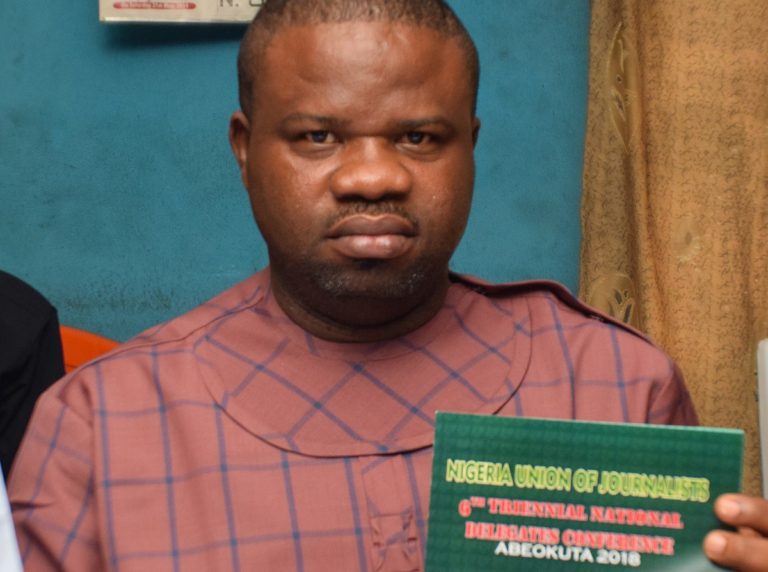
AS the sixth triennial conference of the Nigeria Union of Journalists, NUJ, draws closer, The ICIR can confirm that Christopher Isiguzo, one of the seven presidential hopefuls and two-time union vice president, forged at least two of his certificates.
Isiguzo, whose campaign is one of the most prominent, has been for weeks enmeshed in a certificate forgery scandal. In a petition to the NUJ Credentials Committee obtained by TheCable, Ngozi Agbo, an Enugu-based journalist, accused him of not possessing any higher educational qualifications.
“Contrary to what was published by the committee, the said Mr Isiguzo does not possess any educational qualification,” Agbo wrote.
She also said the candidate’s qualifications and eligibility for national office are presently contested at the National Industrial Court, Enugu. According to her, rather than tender his certificate, Isiguzo has instead been attempting to frustrate the case with delay.
In its reply to the petition, dated August 28, the committee had said it found no substance in the allegations and upheld the clearance issued to the candidate. It also said Isiguzo’s candidacy was approved on the basis of a “National Diploma Certificate in Mass Communication obtained from the Federal Polytechnic, Oko, dated 31st December 1998.”
Speaking to Sahara Reporters, Garba Dahiru, chairman of the committee, said Isiguzo did not tender an HND for clearance, and added that the burden of proof is on the petitioner to provide evidence that his national diploma is not authentic.
Isiguzo disowns published certificates, but…
Isiguzo also has insisted that he is not the owner of the certificates published in TheCable.
“I wonder where they got the certificate they published. Those certificates are not mine,” Isiguzo has said about the two contested certificates: a Higher National Diploma from Federal Polytechnic, Oko, issued in 1998, and a diploma in public administration from Hyles-Anderson College obtained in the same year.
TheCable had identified certain irregularities in the documents, including the impossibility of getting two diplomas and a higher national diploma in the August, November and December of the same year. But according to Isiguzo, the only certificate he presented to the NUJ is a National Diploma in Mass Communication.
“I didn’t present any HND certificate,” he said. “If you go to the clearance committee, there is no place in my document that they wrote HND. Those that feel that we are gaining ground in this election are determined to smear us.”
He also denied any relationship with the published certificates “because my name is ‘Christopher Isiguzo’ and the name written on the certificate is ‘Christopher Isiguzoro.'”
The ICIR has however been able to confirm that Isiguzo’s claim is false. Though he may not have not submitted the certificates to the NUJ Credentials Committee, an investigation has revealed that the forged documents were among those he submitted to ThisDay newspaper, where he is presently the South East Bureau Chief.
A copy of Isiguzo’s HND diploma from Hyles-Anderson College
Forgery gone wrong
The revelation concerning Isiguzo’s diploma from Hyles-Anderson College, a Bible college located in Indiana, United States (U.S.), raises several questions. Perhaps the most obvious is that the college does not offer a course in Public Administration which Isiguzo claimed to have studied.
While there are Bible Diploma, Missionary Wife Diploma, General Studies Diploma, Associate of Science Diploma in Education and Associate of Science Diploma in Marriage and Motherhood, there is no diploma in public administration or anything related to the course listed on the college website.
Also, while the certificate claims to have been signed by the Rector and Registrar, a look at the college’s administration team shows that none of those designations exists in the institution. Rather the offices operated by the college include Chancellor, President, Academic Dean and Director of Admissions.
In addition, colleges in the United States do not write a graduate’s grade as “2nd class” on certificates as Isiguzo’s shows. This is because the U.S. is one of few countries in the world where Latin honours are used. According to the American Public University System (APUS) student handbook, awarding Latin honour designations is standard practice across universities in the country. It also says: “Latin Honors are not posted on official transcripts but will be displayed on your diploma.”
Under this classification system, Summa Cum Laude, not First Class, is used for the grade point of 3.9 and above. Magna Cum Laude is used for points between 3.7 and 3.8, and Cum Laude for points between 3.5 and 3.6. These terms are considered as high honours and are written on certificates. Anyone with a grade point average lower than 3.5 will not have anything written on their certificate to indicate the point.
A copy of Isiguzo’s HND in Mass Communication from Federal Polytechnic, Oko
The HND certificate, which supposedly originates from the Federal Polytechnic Oko, also is a suspect. Compared with another notification of result from the institution issued in 2002 for a 1999 graduate, there are clear contradictions in the font, style, heading, recipient address underline, and page border thickness.
The most striking contrast, however, is in the stamps used. In the latter document, we find that the words “Federal Polytechnic Oko, Anambra state…” are written in a cursive font, and the stamp has no border lines. But in Isikugo’s certificate, not only are there two border lines, the font is different and in upper case and the stamp belongs to another university entirely: Anambra State Polytechnic, located in the same state as Federal Polytechnic, Oko.
Clearly different is another HND from the same institution: Federal Polytechnic, Oko
The certificate is fraudulent, replies Hyles-Anderson
The management of Hyles-Anderson college has confirmed to The ICIR that indeed the diploma in public administration is not authentic.
Replying to an emailed enquiry, John Wilkerson, Pastor and Chancellor of the college, said while the document contains the institution’s name, address, and crest, it was not issued by them.
“Neither do the names upon it represent any officiants or graduates of our college,” he added. “We do not issue degrees in public administration and we do not utilize the term, ‘rector.’ Thank you.”
In a second mail, David Stubblefield, the college’s Academic Dean, also confirmed that “Christopher Isiguro is not a graduate of any program” from the school.
Hyles-Anderson: “The document was not issued from our college.”
Who is Ikechukwu Isiguzoro?
One of Isiguzo’s most convincing defences is that the published certificates could not have been his because while his name is Christopher Isiguzo, “the name written on the certificate is ‘Christopher Isiguzoro'” — though what is truly on the documents is “Isinguzoro”.
But checks have revealed that, though not common usage, these names have been attributed to the ThisDay journalist in the past, long before the scandal broke out.
In this news report of August 3 by Steve Oko, where the Abia State Council of the NUJ was said to have secured nomination form for Isiguzo, his name was stated in four places as “Isiguzoro”.
Another story by The Tide, published in November 2014, announcing John Emejor as the NUJ Abia State Council Chairman, reported Isiguzo’s name as “Ikechukwu Isinguzoro”.
Commander of the Order of the Federal Republic?
The ICIR‘s investigation also revealed that Isiguzo has identified himself as someone he is not in other domains. A visit to his Facebook account shows that he also inaccurately refers to himself as “Isiguzo Christopher Cfr” — in other words, Commander of the Order of the Federal Republic. This is not only very unlikely, but it is also punishable under the law if inaccurate.
Though all citizens of Nigeria are eligible to be appointed, past awardees mostly include traditional ruler and security chiefs; and no more than twenty persons may be conferred the rank each year.
According to section 2 of the National Honours Act, if a person is not entitled to a particular rank or honour and then “uses a designation or abbreviation specified by the warrant in respect of the honour or rank or a description so nearly resembling such a designation or abbreviation as to be likely to deceive …”, he shall be sentenced to imprisonment for six months or ordered to pay a fine, or both.
Isiguzo Christopher Cfr
“We will do a thorough job” — Credentials Committee
During a phone interview with The ICIR, Abimbola Oyetunde, secretary to the 2018 NUJ Credentials Committee emphasised that Isiguzo was cleared because his OND certificate in Mass Communication satisfied minimum standards of the union.
“That’s the prerequisite for being a journalist in the union and to qualify for any position,” she said.
“So, I wouldn’t say if he had other certificates, but that was what he presented. And it is not even our own duty to go and find out whether it is fake or original. So I wouldn’t like to talk about that. What he presented was an OND from the Federal Polytechnic, Oko, dated December 31, 1998.”
Asked if the committee will simply look the other way if findings reveal that one of the candidates has questionable records, she replied in the negative. “If it’s backed up with evidence from those schools and they wrote that they are not original or they are forged,” she added, “then the committee will know what to do. But if it is not backed by evidence, there’s nothing we can do.”
When The ICIR asked what the likely outcome will be if that confirmation is made, she simply said the committee will do a thorough job. “I wouldn’t say for now because I am not the only one in the committee.”
ThisDay issues a query
Sources at ThisDay told The ICIR that the paper has issued Isiguzo a query and is expecting a response, following the forgery allegations against him. It was also gathered, however, that no independent investigation has yet been conducted to confirm the merits of those allegations.
However, when Kayode Komolafe, ThisDay Managing Editor, was contacted to confirm what steps the news organisation is taking and whether they are familiar with the diploma certificates, his number could not be reached. Texts sent to him have also not been replied.
You all have been paid to run me down, Isiguzo alleges
When Isiguzo was contacted by The ICIR, he alleged that Waheed Odusile, president of the NUJ, is blackmailing him and had paid for online reports against him in order to undermine his campaign. He did not, however, specify when he was asked how much. He also said he will not be responding to questions unless allegations of corruption against Odusile have been investigated.
“What is the interest that all of you have in me?” he asked. “Waheed paid all of you to come and run me down, right? No, no, no, I know. Listen, listen. Of course, you acknowledged… you are a Yoruba-speaking [man] like him. He paid all of you because he knows he is going to be defeated on Thursday.
“He is going to be defeated in a manner that he has never seen before. He has been rejected by journalists across Nigeria. Why is he buying you people to run me down? He is buying all of you. I have been informed … I’ve been told how much you were given… He has paid the journalists in Nigeria.
“Did you also see other petitions that were reported in other online platforms where the president of NUJ is accused of planning to steal NUJ car worth of 11 million? Did you also see it? Did you also see the online report where he was said to have stolen 9 million in Plateau state, 3 million in Borno, stealing 2 in Adamawa, and most other states? Did you also see them? … Please go and check for them. When you have investigated them, you can call me.
“It is not about the certificate. Let him come out and let two of us stand up and address journalists. It is really unfortunate. It is unfortunate.”
When he was probed further, he maintained his position, while adding that he has consulted his lawyer and has decided to respond after the NUJ election on Thursday.
“I have asked you to go and investigate your brother,” Isiguzo said. “Investigate him and right now. Go to Disco companies, where he bought the car from…. Go and investigate your own brother. When you are done, you can come. I will give you everything you want. I can assure you.”
He added that if he does not have a certificate, he will not be bold enough to stand for election. He also explained, about the CFR abbreviation on his Facebook account, that it means “Comrade of the Federal Republic” and not “Commander of the Order of the Federal Republic”.
“People also put all those things,” he said. “I have an award where I was called [that]. You know [inaudible], they call them comrades of the federal republic. They give awards.
“NANS [National Association of Nigerian Students] too, they give awards. You know, all these groups, they give awards. We need to put all of them there. You know, people honour you here and there.”
AS Nigeria is celebrating the 58 years of independence today, some Nigerians are dreaming of emigrating, not to the United States of America or Europe, or any other country where the grass is greener, but to a country in the space – Asgardia.
Currently, nearly 600 Nigerians have signed up for the citizenship of Asgardia. And they are all from different parts of Nigeria.
The ICIR found that people aspiring to dump Nigerian citizenship for Asgardia are mostly youths from Lagos (284), Ibadan (273) and Abuja (80). There are also applicants from Aba, Edo, Calabar, Ekiti, Gombe and others.
Asgardia is a space nation founded by a Russian-Azerbaijani scientist and businessman, Igor Ashurbeyli. He named his dream country after a city in ancient Norse mythology, Asgard, known as the country of the gods.
The philosophy shaping the idea of Asgardia is to ‘digitalise’ the Noosphere, the mirror image of humanity in space, but without the Earthly division into states, religions and nations.
“In Asgardia, we are all – Earthlings!,” said Ashurbeyli.
Since the creation of the country, over 272,000 people from more 200 countries across the world including Nigerians have signed up to live in the space nation.
More than 100,000 people applied in the 40 hours following the announcement of Asgardia’s creation on October 12, 2016, and more than 500,000 applied in the first 20 days.
Special preference was however given to the first hundred thousand people who applied prior to the launch of the first satellite, Asgardia-1, in November 2017.
The satellite delivered half a terabyte of data to space including information about Asgardia and its citizens, as well as key information such as its national symbols (coat of arms, flag, anthem) and the nation’s constitution.
Notwithstanding, the citizenship of the space kingdom will be available to all people on Earth, regardless of their earthly jurisdiction, according to a statement on the Asgardia’s website.
Upon registration on the nation’s website, new Asgardian receives a certificate with a unique ID number. This ID number, authorities of Asgardia say, will be used for receiving an ID card and passport, as well as various government services, including social and banking services.
On June 25, 2018, Ashurbeyli was inaugurated as the first Head of Nation of Asgardia at the Hofburg Palace in Vienna, marking the first commission of leadership of the space nation.
The Asgardian president has pledged that the new nation would ensure the peaceful use of space, create a demilitarised and free scientific base of knowledge in space, as well as provide free access for all, “especially for those in developing countries who do not currently have access to space access.”
I received a phone call on September 16, 2015, from someone who turned out to be Joe Ayonmike. He was commenting on my article of that day titled “Britain at Sunset” He said he usually picked a thing or two from my columns, but on this day, I used a word he had never heard before: “morganatic” He jokingly said he prides himself as attending the best schools, including one of the best universities in the world; the London School of Economics and Political Science (LSE) and lived in England, so was surprised to come across an English word he never knew existed. He asked the school I attended. I replied: “Araromi Baptist School, Lagos and Methodist Boys’ High School, Lagos” “University?” “Ife” He joked: “So you never schooled abroad and are teaching those of us who did” We laughed.
The family is one of the most prominent and I asked him if he was Chief Ayonmike, the Itsekiri leader and noted writer. I was referring to the popular JOS (Johnson Oritsegbubemi Sunday) author of books like “A History of Warri” and “Warri: A Focus On The Itsekiri” a hardcover book I had read. That he said, was his elder brother. I researched into my caller. He was then 77, had worked in the industrial and oil sectors before moving to the new city of Abuja where he built the first Five-Star hotel which was opened in 1986. He was also Managing Director of the hotel when he decided to run as mayor of the city, which at that time, was the equivalence of a state governor. Years later, he told me about his experience. He was well connected, popular and amongst the fourteen aspirants, was the front-runner. Then, a close friend told him that the government of the day, did not want a minority from the Niger Delta to be the first mayor of Abuja, and he would be asked to step down. Shortly afterwards, his party chairman called and asked him to step down explaining that “the powers from above” did not want him as mayor. He said he called the bluff. Went to the Gwawalada Area of the city. By the time he returned, his bedroom had been machine gunned.
He abandoned both his ambition and his dream of settling down in Abuja, and took refuge in his Warri home city. Therein 1992, he founded the Warri Choral Society(WCS)
I accepted his invitation to be his guest and also meet with his elder brother. But Chief JOS Ayonmike passed on at 90 on October 4, 2017. This year, Pa Ayonmike threw a jab; would I attend his eightieth birthday or wait until he also passes away before visiting? I promised I would, but could not make it. He then invited me for his 61st Concert holding at the MUSON Centre, Lagos on September 22 with the theme: “Handel Is An African”
The theme startled me. George Friederic Handel was as European as any could be. The famous symbol of the Opera was born German on February 23, 1685, naturalized as a Briton in 1772 and passed away on April 14, 1759. He was so revered that he was buried in Westminster Abbey where the noblest of the English are interred. Handel with 50 operas and 28 oratorios (a story in music performed without action, costume or scenery) is considered by many, as simply the best. Wolfgang Amadeus Mozart (1756-1791) prolific composer and a symbol of classical music said: “Handel understands effect better than any of us — when he chooses, he strikes like a thunderbolt.” Ludwig van Beethoven (1770-1827) one of the best composers in human history said of Handel: “He is the greatest composer that ever lived. I would uncover my head and kneel before his tomb.” So how could Handel be an African?
Ayonmike admitted as much at the Lagos Concert when he said in making such claim: “ Some English people will tell you, you need to have your head examined” But he said in the process of performing 18 of Handel’s 28 oratorios: “ I discovered that a thread runs through all of these which is typically African…I discovered there is a thread that runs through Handel’s works, and this thread is African…I have had this empirically verified through two concerts in Warri, and reported same to the Handel Society and British Council, both in London. The Society has not agreed with us wholly, but from this our performance, you may agree that he is an African”
With that, the two-hour concert conducted by his wife, Chi-Chi Ayonmike, PhD and Senior Lecturer at the Delta State University, commenced. It was a memorable one performed by a 60-member orchestra. The women were beautifully attired in colourful Nigerian attire, and the men, in a traditional top and black trousers. All wore black shoes.
There were three traditional dancers including a lady who in slow, sometimes fast, dance steps of the Niger Delta, accompanied by twists and turns in the air, and acrobatic displays held the audience spellbound as the Agip Recital Hall exploded in angelic voices.
As continuous applause rented the air, the chairperson of the occasion, Dr. Dere Awosika, a retired Permanent Secretary said: “ we need to promote what our history, what our culture stands for. The dancers have demonstrated angelic dancing from heaven to earth” Professor Josephine Mokwunye, Coordinator, Music Programme and Head of Theatre Arts Department, the University of Benin, in assessing the concert said: “What he (Ayonmike) did was to merge the Western World with the African World. He has come to blend two different cultures so seamlessly. He has shown that Handel is not just an African, but a Nigerian. See how the dancers merge into the melody; dancers merge into the sequences. Africans look at classical music as alien, and they alienate themselves from it. This is a new beginning for African music and a new beginning for African musicology”
Odia Ofeimun, international poet, thinker, dance drama expert and former President of the Association of Nigerian Authors (ANA) said he had never experienced classical music performed as an African dance drama: “I am truly convinced that Handel is an African” I have read some of the origins of Handel’s compositions and found many authorities who revealed that he borrowed much from many compositions. Researcher, Richard Taruskin in 2005 concurred. In 1985, John H. Roberts agreed to Handel’s: “basic lack of facility in inventing original ideas” but added that this does not “diminish Handel’s stature” My conclusion is that Ayonmike is right on the African influences of Handel’s works. It will not hurt if the Warri Choral Society is assisted to reveal this in London before an English audience.
Owei Lakemfa, former secretary general of African workers is a human rights activist, journalist and author.
FROM fewer than 50 million people in 1960 to an estimated 198 million people now, population is the unparalleled and unrivalled growth that Nigeria has recorded since Independence. With this superlative growth, Nigeria is the seventh most populous country in the world. Based on this unmatched growth, Nigeria will have over 400 million people by 2050, lesser than only India and China.
Nigeria’s population keeps rising every day. On New Year’s Day alone, more than 20,000 babies were born in the country, the third highest in the world on that particular day and just behind India and China, according to Unicef, the UN children’s agency. Both India and China have over one billion people each. The United States of America which has a current population of about 329 million and third largest in the world had only 11,280 babies on that day. By 2050, Nigeria will overtake the US in population.
More than seven million babies, about the population of Sierra Leone, are born in Nigeria every year. One in five births in Africa takes place in Nigeria and the country accounts for 5 per cent of all global births. Unicef estimates that from 2015 to 2030, 136 million births will take place in Nigeria — making up 19 per cent of all African babies and 6 per cent of the global total. Unicef also projects that by 2050, Nigeria alone will account for almost one-tenth of all births in the world.
While Nigeria records unprecedented population, it comes with unintended consequences. This year is the turning point in Nigeria’s matchless population as the country overtook India with the largest number of people living in extreme poverty.
Earlier in June, a report by Brookings Institute pointed out that Nigeria has overtaken India as a country that has the highest number of extremely poor people. The report was written by Homi Kharas, Kristofer Hamel and Martin Hofer from the World Data Lab which keeps the World Poverty Clock. The authors suggested that based on data from the World Poverty Clock that measures the progress of eradicating extreme poverty in all its forms by 2030, Nigeria has about 87 million people living in poverty as against 73 million of India. The population of India is more than six times that of Nigeria.
Based on the World Poverty Clock, six Nigerians are pushed into extreme poverty every minute while Indian’s poverty rate continues to decrease. To achieve the global goal of eradicating extreme poverty in all its forms by 2030, Nigeria will have to bring 13 persons out of poverty every minute, rather than pushing six persons into poverty.
Theresa May, Prime Minister of United Kingdom, summarised this new status of Nigeria when she visited three countries in Africa in August, including Nigeria. She said, “Much of Nigeria is thriving, with many individuals enjoying the fruits of a resurgent economy, yet 87 million Nigerians live below $1 and 90 cents a day, making it home to more very poor people than any other nation in the world.”
Just as Nigeria is projected to become the third biggest country by 2050, it will be home to more than 20 per cent of world’s poorest people, according to estimates by Goal Keepers, a report by Bill and Melinda Gates Foundation. That is to say that much of the estimated 136 million children to be born in Nigeria between 2015 and 2030 will be growing in extreme poverty.
As much as rapidly growing population portends a danger to Nigeria’s future, population control has not really featured in mainstream political discussion or top policy measure. President Muhammadu Buhari in all his Independence Day address and all other major addresses has never mentioned population control.
PRESIDENT Muhammadu Buhari, on Monday, delivered the tradition presidential independence speech to commemorate Nigeria’s 58th independence anniversary.
As usual, the President used the opportunity to highlight the progress and successes so far recorded by his administration, as well as the hiccups and challenges facing it.
We’re winning Boko Haram
This is a constant feature in every speech or address by President Buhari, but what would cheer the hearts of many Nigerians in Monday’s independence day speech is the President’s acknowledgment that the welfare of soldiers remains an issue, and his promise to address it.
“I am looking into all reported cases of inadequacies in relation to their (soldiers’) entitlements, their welfare and those of their families,” Buhari said. “I assure these our gallant men and women that I will continue to empower them by deepening their professionalism and providing all the necessary force multipliers and enablers required for them to prevail on the field.”
President Buhari also spared a thought for “the victims of the Boko Haram’s atrocities and their families”, but he mentioned none of them by name, not even Leah Sharibu, the only Dapchi schoolgirl that remains in Boko Haram captivity, nor did he make any concrete statement about his administration’s commitment to secure their release.
We’re cleaning up the Niger Delta
“Efforts are on course in the Niger Delta to clean up polluted lands, restore hopes of the youths in the region and re-establish livelihoods, and strengthen their capacity to guarantee for themselves and for our country a brighter future,” Buhari stated.
However, as far as events on the ground are concerned, this is a mere rhetoric by the president. Asides the official flag-off of the Ogoni cleanup exercise in Rivers State, no other concrete action has been taken towards cleaning up polluted areas in the oil-rich Niger Delta region.
Besides, Ogoni is just one out of the many oil-spill sites in the Niger Delta, polluted by crude methods of oil exploration, and rendering both land and water bodiesin the region useless. No action has been taken by the federal government to compel the international oil companies responsible for the pollutions to clean up the areas.
We’re tackling farmers/herders crisis
This is yet another rhetoric by the federal government. 2018 has been one of the deadliest years in Nigeria in terms of deaths caused by herdsmen attacks. Hundreds of people have lost their lives in several states across the country as a result of these attacks, notably in Benue, Nasarawa, Taraba and other parts of Northern, and smetimes, Southern Nigeria.
President Buhari, in his speech, said the issue was “being addressed decisively”. “We will sustain and continue to support the commendable efforts by all including civil society organisations, local and states governments and our traditional and religious leaders in finding durable solution to this problem,” he said.
Others…
On the issue of climate change, President Buhari said Nigeria is a signatory “to almost all conventions and agreements aimed at slowing down the effect of climate change and mitigating its now evident consequences”, adding that “we will continue to mobilise international support for our efforts in this regard”.
But that as far as it goes. There is no concrete effort by the federal government at addressing the menace of climate change.
On corruption, Buhari said: “We are making progress in the fight against corruption and recovery of stolen public funds and assets despite vicious and stiff resistance. The shameful past practice, of the brazen theft of billions of Naira is no more.” Not many would agree with him on this, at least not when former Secretary to the Government of the Federation Babachir Lawal, is still waling free. Lawal was found guilty by a panel headed by Vice President Yemi Osinbajo of wrongdoing in the award of contracts for some projects in the north east. He is yet to be prosecuted.
On the rise of technology and its attendant challenges, Buhari urged citizens, when they read anything on the social media, to “to question and question until we are satisfied we have the facts… otherwise, all the progress we have made as a democracy since 1999 is at stake”.
On the 2019 general election, Buhari said: “I have committed myself many times to ensure that elections are fully participatory, free and fair and that the Independent National Electoral Commission will be exactly INDEPENDENT and properly staffed and resourced. The ballot box is how we make our choice for the governments that rule in our name.”
“I want to assure you that as President, I will continue to work tirelessly to promote, protect and preserve what really matters: a united, peaceful, prosperous and secure Nigeria, where all, irrespective of background, can aspire to succeed,” he concluded.

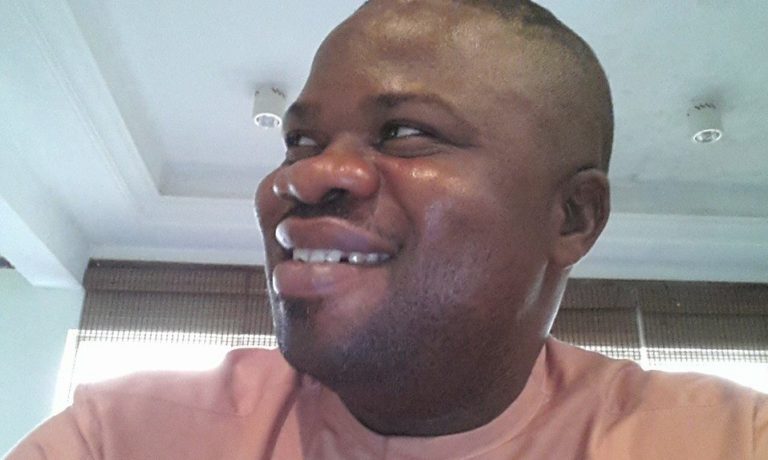
 ThisDay originally decided to sack Isiguzo after a review of his credentials revealed irreconcilable discrepancies, Ushigiale had told The ICIR.