Home Blog Page 2515

Older Persons Day: Eight months after law’s passage, Nigeria’s Senior Citizens Centre still out of sight

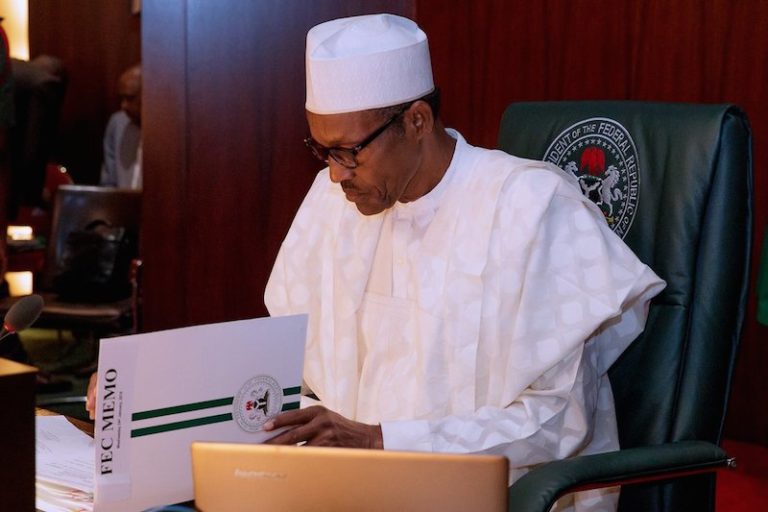
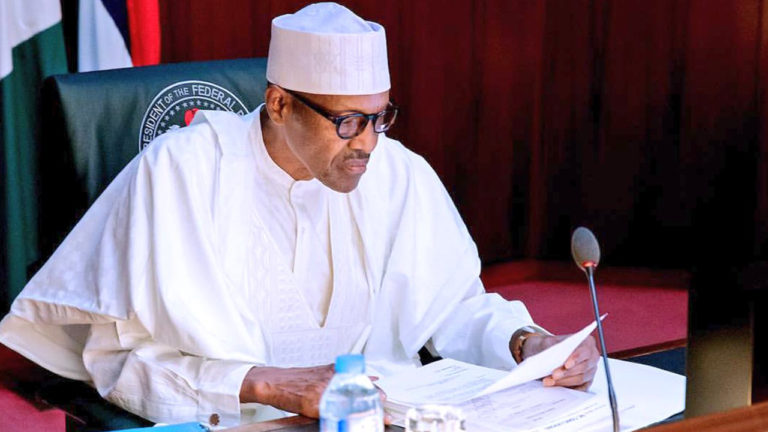
ON a Friday, the 26th of January 2018, President Muhammadu Buhari signed eight bills into law. But of all, one stood out prominently: the Senior Citizens Centre Bill, finally signed two years after it was first introduced into the House of Representatives. 

It came with the promise of a new dawn for Nigeria’s 9.6 million elderly citizens, who are aged 60 and above. “Mr. Buhari has shown that he is indeed a senior citizen. He knows where the shoe has been pinching us,” Carls Ozoemena, member of the Nigeria Union of Pensioners, had told DailyTrust, describing it as the administration’s best achievement.

Yet another pensioner, Rosemary Ajaki, enthused she was excited about the development and said she expected the centre to find a solution to the challenge of delayed pension among other issues.

But it is not only the old who will potentially benefit from this initiative. It’s in fact been estimated that the centre has the capacity to generate over 720,000 jobs, once established across all states of the federation.

However, since its signing into law, nothing has been heard from the federal government about this promising legislation or plans regarding its implementation. Board members of the centre have not been announced.

On the occasion of the International Day of Older Persons, therefore, it is important to ask: Where is Nigeria’s Senior Citizens Centre? What plans does the government have in making it materialise beyond words on paper?

A check through the 2018 budget revealed that no amount has been budgeted yet for the centre’s establishment. This is perhaps because, though it was passed by the Senate in July 2017, the bill did not get to the President until December of the same year. It is thus expected that the government will do the needful in the next appropriation bill making provision for the initiative in the budget.

“We are tired of unfulfilled promises”: Lagos pensioners protesting non-payment of gratuity

What does the law provide?

Essentially, the intention of the National Senior Citizens Centre Act is to facilitate Section 16 of the 1999 Constitution, which provides that the state shall direct its policy towards ensuring “that … old age care and pensions, and unemployment, sick benefits and welfare of the disabled are provided for all citizens”.

Section 2 of the Act provides for the establishment of a Senior Citizens Centre headed by a Director-General, headquartered in the Federal Capital Territory, Abuja, and for “any state that desires it”.

Its functions include identifying the needs of senior citizens and taking responsibility for creating recreational, sports, health, educational, counselling and social programmes for their benefit. It shall develop and implement schemes to provide income or supplementary earnings for aged citizens.

It shall also keep records and statistics concerning senior citizens in the country, and partner with sub-national, national, and international bodies in achieving its objectives.

One odd provision in the Act, however, is section 20 which defines “senior citizen” as a person above the age of seventy (70) years. This is ten years more than the United Nations definition, and twenty years above the World Health Organisation (WHO) working definition for Africa. It also conflicts with the country’s general retirement age of sixty and life expectancy of 55 years.

A terrible place to age

Nigeria, according to the Global Agewatch 2014 Rankings, is the twelfth worst country in the world to be an old person. The ranking arrived at that conclusion using four major indices: income security, on which the country is the seventh worst performing; health status; capability; and enabling environment.

60-year-old pensioner slumped at a 2013 protest in Obalende Lagos

The problems facing senior citizens in Nigeria are numerous, but chief among them is the difficulty in getting their entitlements, after years of service, at a time they are no longer able to fend adequately for themselves. Not only does the pension scheme cover a small percentage (7.4 million) of Nigeria’s labour force — a far cry from the Pension Commission’s vision of having 20 million contributors by 2019 — it is riddled with defects despite legal reforms.

In August, retirees of the Nigerian Television Authority (NTA) cried to the federal government to pay them 15 months worth of gratuity and pension arrears. They are dying of hunger, unable to pay medical bills and have literally turned to beggars, they lamented at a press conference in Abeokuta, Ogun State.

They had tried lobbying, written series of letters, and had no option left but to resort to placards. But their story is not unique. Across the country are similar stories of old men and women travelling numerous kilometres for verification, lining up under the sun, and dying on the same line, all in a hope to get what is rightfully theirs.

No fewer than 900 pensioners of the defunct Nigerian Airways have died while awaiting their terminal benefits, according to Sam Ezene, chairman of Nigerian Airways’ branch of the Nigerian Union of Pensioners (NUP).

The Contributory Pension Scheme introduced in 2004 to increase efficiency in the national pension scheme has fallen short of expectations, as the Pension Commission (Pencom), Pension Fund Administrators (PFAs) and the federal government have been discovered to breach their ends of the bargain.

A retiree, who left the service in 2017 as a deputy director at the River Basin Development Authorities, told NAN in May that the delay in paying her gratuity and pensions has brought her great hardship.

“We are hoping against hope that our PFA will soon invite us to come and collect our money,” she said.

“It has been extremely difficult to make ends meet with some of the children still in school, feeding and other expenses. The contributory pension scheme is to ensure that a month after disengagement or retirement, a staff should be paid like in the private sector, but it is not so.

“It appears that we are back to the old pension scheme where people who have retired died without getting their money after 35 years in active service.

Older citizens in Nigeria also have very little specialist care needed in their later years. Homes for the elderly are a scarce sight, and there are only a handful specialist geriatric centres in the country. The National Hospital in Abuja, in fact, has only one geriatrician: Ogugua Osi-Ogbu.

Hopefully, when the National Senior Citizens Centre Act is fully implemented by the federal government, the bulk of these problems will be a thing of the past as challenges facing older citizens finally take centre-stage in policy-making.
We will make North East safe for all…seven keypoints of Buhari’s independence day speech

PRESIDENT Muhammadu Muhammadu Buhari in his nationwide broadcast on Monday to celebrate the nation’s 58 independence anniversary urged Nigerians to be forward-looking with confidence and optimism about the country.

He emphasised that there has been a steady improvement in the security situation in the North East.

“We remain committed to ending the crisis and make the North East safe for all,” he assured.

The President  said his government would not allow the Boko Haram terrorists to succeed in their plans to “capturing territories, destroying our democracy and denying our children the right to education.”

“We will not allow them to succeed.”

He commiserated with the victims of Boko Haram atrocities and their families, saying that “our prayers are with them”

I’m looking into cases of inadequacies about the military welfare

He also paid tribute to the men and women of our armed forces, the Police and other security and law enforcement agencies, who have been working under the most difficult conditions to keep the country safe. In the process, many have made the supreme sacrifice.

The President assured security operatives he would continue to empower them by deepening their professionalism and providing all the necessary force multipliers and enablers required for them to prevail on the field.

“I am looking into all reported cases of inadequacies in relation to their entitlements, their welfare and those of their families,” he said

We will restore hopes of Niger Delta youths

President Buhari noted that his administration would finish the cleaning up of the polluted Niger Delta land as well as restore hopes of the youths in the region and re-establish livelihoods, and strengthen their capacity to guarantee for themselves and for the country a brighter future.

Those behind herders, farmers clash will face full wrath of law

He said the age-long conflict between herders and farmers that was being exploited by those seeking to plant the seeds of discord and disunity amongst our people, is being addressed decisively.

“We will sustain and continue to support the commendable efforts by all including civil society organisations, local and states governments and our traditional and religious leaders in finding durable solution to this problem.”

He warned that the perpetrators of murder and general mayhem in the name of defending or protecting herders or farmers will face the full wrath of the law

The ballot box is how we make our choice

Buhari reiterated that he has committed himself to ensure that elections are fully participatory, free and fair and that the Independent National Electoral Commission would be truly independent  and properly staffed and resourced.

“The ballot box is how we make our choice for the governments that rule in our name,” he said

He called on Nigerians to rise against those he said are behind the social media to disrupt the country.

“Now we have in our hands technology that is a powerful tool that we can and should use for knowledge and understanding. As with other countries, we must also learn how to manage those tendencies that, instead, look to abuse new technologies to provoke passions and stir tensions.

“Never before have we faced such a challenge. We must all rise to the responsibility of shutting out those disruptive and corrosive forces that hide in today’s world of social media. We need critical minds and independent thinking, to question and question until we are satisfied we have the facts. Otherwise, all the progress we have made as a democracy since 1999 is at stake.”

Developing a thriving democracy is not an easy task

After 58 years of nationhood, President Buhari remarked that developing a thriving democracy is not an easy task.

He said those years have revealed that there can “be no quick fixes or short cuts.”

The President stressed that Nigeria remains a responsible and respected member of the international community, playing active positive roles within ECOWAS, the African Union and the United Nations as well as all other regional and international organisations and institutions of which we are members.

“We will continue to support initiatives aimed at addressing the challenges of our times: global and regional crises and conflicts, terrorism, trans-border crime, climate change, human rights, gender equality, development, poverty and inequality within and between nations, etc.

“In this context, we are working hard to achieve both the AU 2063 Agenda for socio-economic transformation of our continent; and the UN 2030 Agenda for sustainable development, which together aim at addressing these challenges,” he said.

Our journey is not finished but we have come a long way

President Buhari concluded the address by assuring Nigerians that he would continue to work to “promote, protect and preserve what really matters: a united, peaceful, prosperous and secure Nigeria, where all, irrespective of background, can aspire to succeed.” He maintained that the nation is on the right path.

He noted that Nigeria as a nation has so much for “for which we should be grateful, and in which we should rightly take pride.”

“Our journey is not finished but we have come a long way.”

Thank you. I wish you a memorable independence celebration.

NIGERIA AT 58: “I am committed to ensuring free, fair elections” — Buhari, four days after disrupted Osun rerun

FOUR days after the alleged state-sponsored violence, gunshots and irregularities were reported to have characterised the rerun governorship election in Osun State, President Muhammadu Buhari has assured of his continued commitment to free and fair elections.

He made this remark on Monday while delivering the annual Independence Day speech.

I have committed myself many times to ensure that elections are fully participatory, free and fair,” the President said during the broadcast,” and that the Independent National Electoral Commission would be exactly independent and properly staffed and resourced.”

“The ballot box is how we make our choice for the governments that rule in our name,” he added.

In contrast, however, journalists at the rerun held in four local government areas in Osun State confirmed that accredited observers were denied access to some polling units, voters were prevented from exercising their right and turned back home, and thugs occupied some polling units under the watch of security personnel.

“Despite the presence of scores of security personnel at Polling Unit one, Ward eight in Orolu Local Government Area, thugs are in control of the unit,” Premium Times reported.

Kemi Busari, a reporter working with Premium Times, was briefly arrested and detained for daring to take photographs of a polling unit, while thugs confiscated a phone belonging to Taiwo Adebulu, a journalist with TheCable, as policemen watched. Others were reportedly attacked by hoodlums.

In reaction to happenings during the election, Daily Trust tweeted: “We report to the whole world that in Osun today no supplementary poll took place. It was all violence and undisguised breaching of all electoral rules. The APC is pushing violently to steal people’s mandate freely given by the oppressed people of Osun state.”

The All Progressives Congress, APC, has since not reacted officially to the damning allegations, except for a slip by Adams Oshiomhole, the party chairman who mistakenly said: “Only people who can accept the pain of rigging … should participate in an election.”

In his speech, Buhari also dedicated many lines to the fight against corruption, economic growth, insecurity in the country, climate change, and youth empowerment.

He cautioned against the abuse of technology and the use of social media to “provoke passions and stir tensions”.

“We must all rise to the responsibility of shutting out those disruptive and corrosive forces that hide in today’s world of social media,” he appealed.

“We need critical minds and independent thinking, to question and question until we are satisfied we have the facts. Otherwise, all the progress we have made as a democracy since 1999 is at stake.”

In his concluding remarks, the President assured Nigerians his administration is on the right path and called for unity. He also said he will continue to strive for a country where there is peace, prosperity, security and non-discrimination.

“We have so much for which we should be grateful, and in which we should rightly take pride,” he said.

“Our journey is not finished but we have come a long way. I want to assure you that as President, I will continue to work tirelessly to promote, protect and preserve what really matters: a united, peaceful, prosperous and secure Nigeria, where all, irrespective of background, can aspire to succeed.”

FOCUS: In two years, Buhari budgets N340m to celebrate ‘low key’ independence, democracy days


AS President Muhammadu Buhari is wrapping up his final year in office, his administration has budgeted a total of N340million in two years on the celebration of Independence and Democracy days, The ICIR can report.

In contrast, his predecessor, Goodluck Jonathan spent N152.6million in two years to celebrate the same anniversary – 2012, N107.6million and N45million in 2013.

The current government in its 2017 and 2018 national budgets earmarked N170million each for the celebration of democracy and Independence Day’s celebration.

President Buhari took over the reign of power on May 29, 2015, and has celebrated four independence and democracy day anniversaries in office− 2015, 2016, 2017 and 2018.

This year celebration is the last in the life of this administration as it is only 139 days to the general elections.

In 2015 that the President was sworn-in, N70million was reportedly spent on the nation’s 55th independent anniversary celebration−the year budget was prepared by the outgone administration.

There was no budgetary allocation to celebrate the independence anniversary in 2016− the Federal Government and state governments observed a low-key celebration.

In August 2016, the Federal Government announced that the country’s economy had slipped into recession following the crash of oil prices at the international market.

This explains why the government observed a low-key independence celebration that year.

But N170million was still budgeted for the celebration in 2017 which was still observed in a low-key as government cited paucity of funds, poor economic condition and other challenges as reasons.

The 2018 anniversary kicked-off with displays by the Nigerian Air Force jets and helicopters in Abuja, suggesting that the government was not observing a low-key celebration this year.  The Government has not given reasons why it decided to observe an elaborate celebration in 2018 in which the country is celebrating the 58th anniversary of its nationhood.

A total of 27 air-craft were assembled from various NAF units for the Air Force jet simulations. Two of the jets collided on Friday leading to the death of one of the pilots.

The jets hovered around Abuja between September 14 and 30, 2018. There was also a photo exhibition organized to mark the anniversary.

Since October 1st, 2010 when the golden jubilee anniversary celebration witnessed bomb blasts at the Eagle Square, Abuja, the administration of former President Goodluck Jonathan marked all subsequent anniversaries in Aso Rock.

President Buhari has also followed this tradition by witnessing the special presidential change of guard, cutting of cake and release of pigeons of peace to mark the nation’s independence.

His predecessor, Goodluck Jonathan spent a total of spent N332.6 million on three independence anniversaries (2012-2014).

The breakdown of the spending shows that about N107.6 million was spent in 2012, N45million in 2013 and N180 million in 2014 for the celebration.

There are no records of how much the same government expended on democracy day.

Governor of Kaduna State, Nasir El-Rufai in November 2015 stirred controversy when he alleged that the government of former President Goodluck Jonathan  wasted N64 billion on the same event in five years

The government then countered El-Rufai’s claim that Jonathan spent N64bn on independence anniversaries

The governor had given a breakdown of the purported outrageous expenditures on his Facebook page as follows: N13 billion spent in 2011; N15 billion in 2012; N14 billion in 2013, and N22 billion in 2014.

But official government records revealed that Jonathan administration spent N332.6 on three independence anniversary.

A total of N1.7 billion was spent on the country’s Golden Jubilee celebrations in 2010, while no money was released for the celebration in 2011.


NLC suspends strike to continue negotiation with govt

0

AFTER a five-day indefinite strike, the Nigerian Labour Congress(NLC)  has suspended strike and asked all its members across the country to resume work.

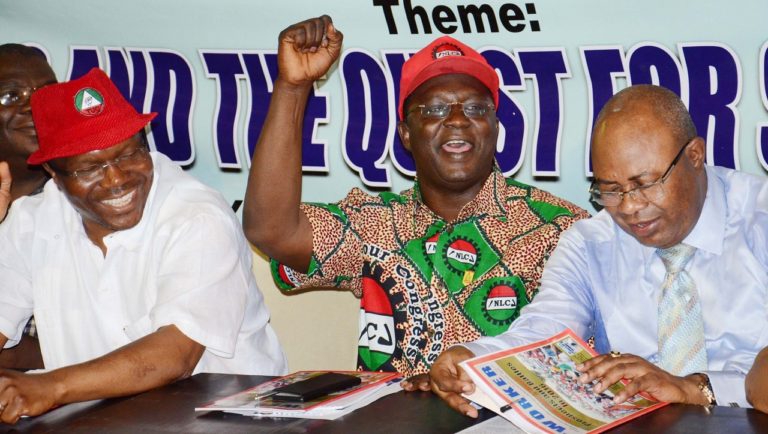
The President of the Congress, Ayuba Wabba who announced the suspension of the strike on Sunday at a press conference, said the suspension followed promises by the Federal Government to reconvene the tripartite committee on national minimum wage on October 4.

The strike paralized government and commercial activities within the affected days.

“The suspension takes effect from today Sunday,” he said.

Wabba explained that the strike was called off to enable the tripartite committee to hold its crucial meeting and conclude its work.

NLC directed its members nationwide to embark on strike which commenced on September 26 to demand the implementation of new minimum wage for workers..

The workers are demanding a new minimum wage of about N50,000 instead of the current national minimum wage of N18,000.

Most state governors, as well as proponents of true federalism, have, however, argued that states should be allowed to set their own minimum wage especially as many states are barely able to pay the current N18,000 current minimum wage.

Wabba had on Wednesday said the  Congress was open to dialogue on the strike.

“Our demand is that the tripartite negotiating council should be called back to conclude its assignment on minimum wage,”  Wabba said.

The Minister of Labour and Employment, Chris Ngige, then assured the unions that the tripartite committee would reconvene to complete its negotiation.

“Before the meeting on October 4, all necessary demands by organised labour would have been factored in,” Ngige said.

After I’ve been governor, I will go for NYSC, says Adebayo Shittu

THE Minister of Communications, Adebayo Shittu, says he will be willing to embark on the one-year mandatory national service, but that would be after he has become the governor of Oyo State.

It was recently revealed that Shittu did not take part in the National Youth Service scheme after he graduated from the University of Ife (now Obafemi Awolowo University, Ile-Ife) at the age of 22.

The National Youth Service Act stipulates that any Nigerian who graduated from the University before the age of 30, shall embark on a one-year mandatory national service, without which such a person would not be employed by any government or private organisation.

But Shittu claims that since he won election into the Oyo State House of Assembly immediately after graduating from law school, the years he served as a state legislator makes up for the one year he would have spent in the NYSC.

Following the revelation, the All Progressives Congress (APC) disqualified Shittu from contesting the Oyo State governorship seat on its platform, with the party’s National Chairman, Adams Oshiomhole, saying that the party was not convinced by Shittu’s explanation.


READ ALSO:

During an interview in Ibadan, the Oyo State capital, on Saturday, the minister was asked whether he was willing to undergo his one-year mandatory national service and he said, “Of course I will go; it will be a pleasant thing to go after I have been governor by the grace of God. Yes, why not?  I will serve in any place if it becomes necessary for me to go.”

Shittu, added that it would be a matter for the courts to decide “whether serving in the house of assembly and being a minister is not superior and does not replace service in the NYSC.”

He maintained that his case was different from that of the former Minister of Finance, Kemi Adeosun, who had to resign after she was exposed as parading a fake NYSC exemption certificate, adding, however, that Adeosun was a victim of circumstance.

The APC had disqualified two serving ministers during its governorship screening process, Shittu and the Minister for Women Affairs, Aisha Alhassan.

But while the latter had resigned her ministerial position and left the APC and joined the UDP, it is unclear what is next for Shittu, who as at the time of this report is still a member of President Buhari’s cabinet.

The scariest thing about Nigeria

0

By Simon KOLAWOLE

WE see different things even when we are looking at the same picture. When CBN asked MTN to return the $8.1 billion dividends it “illegally” repatriated between 2007 and 2015, I was not thinking about MTN or CBN. Rather, my mind was on Econet, the ancestor of Airtel. Econet and MTN launched operations in Nigeria in 2001. Three Nigerian states — Lagos, Delta and Akwa Ibom — invested heavily in Econet, owned by a Zimbabwean. Suddenly, the states sold their shares for no intelligent reason. The only thing we knew was that the buyers of those shares happened to be fronts for politicians. Individuals, rather than the states, became the ultimate beneficiaries.

Imagine how much the three states would have been receiving in dividends today. If MTN’s foreign investors could net an annual average of $1 billion in eight years, we can guess, at the minimum, that the Nigerian states would have earned around $3 billion from their Econet investments during the period (warning: I’m just guessing based on mental calculations). Clearly, the sale of the shares was not for any economically sound reason; that I can say for free. The way things go in Nigeria, there must be a fraud component to every single transaction. There is hardly anything straightforward in Nigeria. Even to put a dead body in the mortuary has a fraud component.

One of the biggest lies you have ever been told is that some states in Nigeria are not viable. Those who make the argument build their thinking on one pillar: the oil revenue-fuelled federation allocation. Their calculation is that if there is no (or low) federation allocation, most states would collapse. And we know, and everyone knows, that the federation allocation is nothing without the oil revenue. Take away the oil money from the central pot and most states would not be able to pay salaries, much less fund the utilities or embark on a single project. Based on this oil-propelled calculation, many analysts have suggested that some states need to merge.


READ ALSO:

Indeed, it has been suggested that Nigeria should be re-arranged into six regions so that the federating units can be economically stronger. We seem to have concluded that the viability of states is proportionately related to the size of their federation allocations. It makes sense to a large extent. Many states are unable to pay salaries the moment allocations drop, either because of low oil prices or low oil production or both. The monthly meeting of the Federation Accounts Allocation Committee (FAAC), which shares the money, is one of the most important gatherings on earth. Our happiness is tied to the price of oil. When it is high, we are high. When it is low, we are low.

But verily I say unto you: there is no single Nigerian state that is not viable. No, I am not talking about solid minerals. Let’s not even go there. Anytime I argue that all Nigerian states are viable, I am told, “Yes, every state has solid minerals.” For once, let’s get over our obsession with mineral resources. This obsession has done enough damage to the progress of Nigeria and psyche of Nigerians. It is at the root of every poisoned discussion about Nigeria. When crude oil price fell below $30 in 2016, I noticed that the clamour for “resource control” and “fiscal federalism” died down a bit. Take away the oil money from the debate and there is nothing to fight over again.

The argument that some states are not viable can be easily defeated. My principal witness this morning will be Luxembourg, a tiny European country. With a landmass of 2,586.4 square kilometres, Luxembourg is half the size of Toro LGA, Bauchi state. And with a population of 602,005, Luxembourg is less populous than Oshodi-Isolo LGA in Lagos state. But its GDP, built around industry, agriculture and banking services, is $72 billion — more than the combined GDP of Lagos, Rivers and Delta states, Nigeria’s top three states by GDP ranking. Countries are developed by brains, not landmass, population or allocation. We must let that sink into our heads appropriately.

If viability is determined by population, Luxembourg is not viable to be a state much less a country. Even a local government in Borno would be more viable than the European country based on the population factor. If viability is determined by population, Luxembourg is not more qualified than any state in Nigeria. If viability is determined by natural resources, Luxembourg would have perished since. Banking services form the largest sector of the economy; it is, in fact, rated as one of the most competitive financial centres in the world. The country also manufactures steel. And, if this would interest us, its farmers are good producers and exporters of meat, dairy products and wine.

In Nigeria, we have reduced our thinking capacity to federation allocation. We blow up population figures in order to collect more money from the central pot because our brains have been saturated with oil money. Every discussion starts and ends with “sharing” the national cake. If our revenue distribution formula is such that the more your population is, the more you have to contribute to the federation account, states would start reducing their population figures in order to contribute less to the central purse. It is this obsession with “sharing” that has stunted our capacity to think. Take away the oil and we are as naked as fried chicken.

As we mark our 58th Independence Anniversary, my desire is that we would refocus the development debate. Rather than grumbling and moaning about our arrested development, we should be putting on our thinking caps. Until the component units of Nigeria are economically fortified, we will continue to have a misguided, misdirected and fruitless debate about national peace and development. The prosperity of Nigeria will never be determined by FAAC. It will never be determined by federal appointments and federal projects. All these are about “sharing national cake”. The focus should be on how to “bake” the national cake in the first place.

A Zimbabwean farmer who worked in Shonga, Kwara state, some years ago told a colleague of mine: “With what I can see in this community alone, Nigeria’s potential is scary.” Others see prospects, we see problems. Nevertheless, I have three proposals on how states can become viable so that the government can become smaller in our lives. One, states can set up and run companies. Two, states can invest in companies. Three, states can create the environment to attract companies that will boost economic activities and push up internally generated revenue. These three proposals are not mutually exclusive — you can have the three together. I will explain these options in brief.

One, any state could have floated a telecoms company to bid for a GSM licence in 2001. It would be making the billions. Any state or group of states could have set up a mobile phone assembly plant or oil company and be making the billions. Any state or group of states could have set up a massive cattle ranch, comparable to the ones in Denmark, and be making billions from export of beef and dairy. However, I will not favour this option. Publicly owned companies in Nigeria are a sham, built around collecting subventions and perpetrating fraud. I don’t know of any government-run company in Nigeria that functions optimally. In other countries, such as China, they are profitably run.

Two, states can actually invest in companies offering these services, the same way Lagos, Delta and Akwa Ibom invested in Econet before the heist. This is pure investment. The management of the companies will NOT be run by government appointees. We have a similar model with the NLNG company in which the Federal Government of Nigeria has a 49% stake but the oil majors own 51% and manage the entity. We are reaping billions of dollars in dividends every year. There is no law that bans Bayelsa or Benue from investing in a productive company in a similar manner. I have read the “useless” 1999 constitution again and again and I can’t find any hindrance.

Three — and the one that is, to me, the most desirable but the most unlikely — is for the states to create the right environment and encouragement for investors. With productive and booming local economies, states will start to generate enormous revenue from various tax handles at their disposal. Enormous revenue from industries, enormous revenue from jobs created, enormous revenue from the entire value chain. Nothing in the constitution forbids this. But I must admit this is the most difficult option for us — it requires using the brain. But who wants to use any brain when there is a FAAC meeting holding in Abuja next week?

Space will not allow me to elaborate on how Plateau state could be exporting wine, or how Jigawa could be producing thousands of ICT experts, or how Ondo could be home to chocolate-exporting companies.  As Nigeria clocks 58, the biggest unaddressed challenge remains the notion that our lives are tied to petrodollars and federation allocation. I will argue, and keep arguing until somebody finally listens to me, that every state has the capacity to survive, thrive and flourish — without a single kobo from oil revenue. Our brains need to be restructured to start thinking and acting intelligently. The scariest thing about Nigeria is our amazing potential. Happy anniversary!

AND FOUR OTHER THINGS…

OSUN TEST-RUN

I have a few questions to ask about the Osun governorship election, which ended in favour of APC. Why were Osogbo results on Saturday the last to be announced even though Osogbo was the collation centre? Was INEC waiting to see how other results would go? Was the re-run a way of manipulating the outcome when results didn’t favour the favoured? Why was there so much peace and security in polling units won by APC in the re-run while PDP-dominated areas were controlled by thugs, who chased away voters, observers and reporters, in the face of minimal police presence? Is this re-run a test-run of the 2019 general election? Worrisome.

ON AMBODE

As APC elects its governorship candidates today and tomorrow through direct and indirect primaries, all eyes will be on Lagos, where the incumbent, Mr. Akinwunmi Ambode, is fighting for his political life. The news in town is that Asiwaju Bola Tinubu is planning to unseat him. Since 1999, Lagos has always represented, to me, the progress that is possible in the pathetically underperforming Nigerian federation. Tinubu started the race and Ambode has stayed in the lane, minus a few expected hiccups. Many are asking: why ditch Ambode? But then you are only as good as your political backbone. If Ambode survives the blitzkrieg, it will be a major miracle. Tough.

D’TIGRESSES PURR

Nigeria’s female national team, D’Tigress, stunned the world by making it to the quarter-finals of the FIBA Women’s World Cup in Tenerife, Spain. It was a first for us. I was in no way disappointed that we eventually lost to the US team on Friday — leading the defending champions by 17-9 in the first quarter was as good as winning the World Cup in my books. We should be proud of the progress of our ladies. In 2015, their male colleagues, D’Tigers, became African champions for the first time, crushing the traditional favourites, Senegal and Angola, in their wake. What this tells me, essentially, is that it is high time the government took basketball as a priority. Promising.

AND FINALLY…

Dr. Olusegun Mimiko, former Ondo state governor, is a few steps from strolling into the Guinness World Records. Having started off as a member of the Alliance of Democracy (AD) in 1999, he joined the Peoples Democratic Party (PDP) in 2003 and left for the Labour Party (LP) in 2017 to run for governorship. Towards the end of his eight-year tenure, he moved back to PDP. Three months ago, he returned to LP for “personal reasons”. Finally, he has left LP for — I didn’t make up this name — the  Zenith Labour Party, accusing APC national chairman, Comrade Adams Oshiomhole, of using labour unions to hijack the party. Where next? GTB Labour Party? Comical.

Simon Kolawole is the founder and CEO of TheCable. He tweets @simonkolawole.

People across Africa have to travel far to get to a hospital. We worked out how far

 and 

NEARLY  half of all deaths and about a third of disabilities in low and middle-income countries could be avoided if people had access to emergency care. In Africa, the main causes of emergencies are road accidents, obstetric complications, severe illnesses and non-communicable diseases.

Over the past 18 years the African Federation for Emergency Medicine, an advocacy group, has been encouraging the development of emergency care systems on the continent. The gaps it has identified include decent transport and hospital services.

But to address these challenges data is needed on the number of hospitals, their locations as well as the population marginalised. Most countries in Africa don’t have this information. They lack basic inventories of health care service providers, including the number of hospitals.

Our study set out to address this problem by producing the first ever assessment of hospital services in sub-Saharan Africa, and used it to work out peoples’ access to care.

The results – including how long it takes to get to a hospital – show where investment is needed in improving access. Various interventions are necessary. These should include building new hospitals, improving ambulatory care, building new roads and fixing existing ones.

But the most urgent action is that countries must update their hospital lists, including assessment of capacity and capability to provide emergency care and updating of the private sector. Our research goes someway to helping them start this process. We have built a database which can be accessed for free and used for assessing service availability at national levels.

Building the database

The hospital list covers 48 countries and islands of sub-Saharan Africa.

To develop the list we used numerous sources for the data, including ministries of health, health information systems, national and international organisations from all the countries and islands. In most cases, the sources were available online but we also relied on personal contacts to obtain hospital data in some countries.

Close to 50% of the hospitals on the list didn’t have GPS coordinates that could aid in precisely locating them. To overcome the problem we assigned them unique location attributes using online mapping tools such as Google earth and OpenStreetMaps.

This audit located 4908 public sector hospitals which were precisely assigned location attributes (Figure 1).

Map of public hospitals in Africa. Author supplied

Nigeria, which accounts for close to a fifth of sub-Saharan Africa’s population had the highest number of hospitals at 879. Other countries with significantly high numbers of public hospitals were the Democratic Republic of Congo (435), Kenya (399) and South Africa (337).

The least were in smaller countries such as Cape Verde, Zanzibar, and São Tomé and Príncipe. This information was used as a starting point to calculate the geographic access to the hospital services.

Timely access

We measured geographic accessibility by travel time to the nearest public hospital. We did this by calculating how long it would take to travel by road based on the major means of transport in the region.

We assembled road networks from Google earth and OpenStreetMaps, and assigned travel speeds along the roads. We then developed a model that calculates the time it would take for a patient to travel from any 100m by 100m square grid of location to the nearest hospital.

More specifically, a significant proportion of women need access to hospital care when in labour and we additionally determined how long they would take to get to the nearest hospital.

Results reveal that, less than a third (29%) of the total population and 28% of the women of childbearing age, lived more than two hours from the nearest hospitals. The two-hour threshold is a widely used recommendation by the WHO and the Lancet Commission for global surgery for defining access to emergency obstetric and surgical care respectively. In addition, international benchmarks by the Lancet commission for global surgery recommends having 80% of any given population within two hours as critical in ensuring universal health coverage by 2030.

The most surprising outcome was the huge differences between countries. For example, more than 75% of the population in South Sudan lived outside the two-hour threshold. Other poorly served countries included the Central African Republic, Chad and Eritrea. More than half of their populations lived outside the two-hour threshold.

The best served countries were mostly islands like Zanzibar, Comoros and São Tomé and Príncipe. More than 95% of their populations were within two hours of a hospital. Large countries such as Kenya, South Africa and Nigeria also had good access indices, with more than 90% within the two-hour band.

All 48 countries in our survey have signed up to the sustainable development goal of delivering universal health care by 2030, part of which involves access to hospitals. Our research can help countries work out what they need to do to make this a reality when it comes to emergency care. There’s still a long way to go. Only 16 countries in our survey achieved 80% coverage in access to a hospital within two hours.


This article was first published in THE CONVERSATION. 

Abuja’s zebra crossings as mere road decoration

0

WUSE, a central district in Abuja that is home to various government offices and parastatals was quiet on a Tuesday morning. The commercial vehicle carrying The ICIR reporter sped past various landmarks in the city, and his pulse quickened immediately as the driver drove past a traffic red light.

Worried, the reporter looked inquiringly at the other passengers whom he thought would react to the driver’s disregard for the traffic rule, but they were silent. The only time of respite was when the car slowed down in traffic. But when the driver drove past a zebra crossing while pedestrians standing on the marked pavement were trying to cross the busy road, the reporter was again overtaken by worry.

Then he asked him, “Why don’t you obey the zebra crossing?” And the driver responded in pidgin, “If everybody dey obey zebra crossing,  the kind holdup (traffic jam) for this Abuja go dey too much. No driver for this Abuja dey obey am, na waste of time.”

The driver’s response reflects the typical attitude of Abuja’s motorists, including pedestrians who have little regard for road traffic rule.

Francis Ikechukwu, a trader in Apo Fish market described a pedestrian walking slowly on the zebra crossing as someone with a death wish.

“If you want to be hit by an incoming car faster, then walk slowly on the Zebra crossing and say, you are covered by the traffic law. Nobody cares if you are standing there, you will be personally digging your grave,” he said.

Data from the National Bureau of Statistics (NBS) and the Federal Road Safety Corps website shows that from 2010 to 2018 there were no records of violations of Zebra crossings in Abuja, despite the daily violation of the road rules. This means that for the past eight years the Federal Road Safety Corp had not penalized, apprehended or booked anyone for disregarding the markings on the Abuja highways, especially Zebra crossings.

Yet Abuja tops the list of states in Nigeria with the highest number of casualties in road accidents in the last ten years estimated at 7,773 according to the NBS. But the accidents are attributed to various traffic violations, except the zebra crossing violations. The ICIR reporter was at several locations within Abuja metropolis to observe whether motorists give right of way to pedestrians or not.

On a fact-finding mission

On a Friday, The ICIR’s reporter took a cab on a tour of  Abuja city to observe how motorists and pedestrians behave on Zebra crossing. At the Zebra crossing around NNPC towers in Central Area district, pedestrians and motorists were observed passing the road markings with reckless abandon.  One of the hired security guards told The ICIR that road users hardly obey the zebra crossing in the area. “No matter what you do they don’t care about it,” he said.

Though the traffic wardens are empowered to enforce traffic rule, they hardly exercise this power to enforce compliance on the road.

The situation is the same at zebra crossing in Bannex a popular connecting route in Wuse 2, along Ahmadu Bello Road. Pedestrians could be seen trying to negotiate their way in-between cars stuck in traffic on the Zebra crossing. This violation continued for about 30 minutes while the reporter was present.

At Julius Berger roundabout, a traffic warden was at the spot directing motorists but cared less that drivers did not give pedestrians the right of way.

What does the law say about traffic violation?

Sections 10(4), 28(2) of the FRSC Act 2007 stipulates a fine of N5, 000 for road markings violation by motorists and also a 5-point penalty for failure to yield right of way of pedestrians at a zebra crossing. A minimum of six meters is the recommended distance between a motorist and a pedestrian on the zebra crossing. This makes it inappropriate to park a vehicle on a zebra crossing, overtake a vehicle that stopped to allow pedestrians to cross or drive through a zebra crossing while pedestrians are on the marked pavement.

A driver’s license holder who flouts this rule may be issued a warning, his/her license could be suspended, or outrightly revoked upon conviction or by having cumulative penalty points allotted to traffic offences accumulated in his/her record.

Miss Okachi Ebute, a safety inspector with the United Kingdom Health, Safety and Environmental Management affiliate’s office in Abuja spoke to The ICIR in a telephone interview on the need to obey traffic rules.

“Violating a zebra crossing is dangerous to the lives of the road users, especially pedestrians because it is a basic highway code that is more helpful to children, disabled and the aged. Most Nigerians like to take shortcuts on our roads to get to their destinations even if it puts everyone at risk. But a simple refusal to obey a zebra crossing could lead to accidents,” she said.

She said Nigeria should have moved beyond the level of having to put markings on the road alone. “In developed countries, there are beacon traffic lights at Zebra crossings indicating when it is time for pedestrians to cross or motorists to move. At night there are amber coloured globes placed atop zebra striped poles to caution motorists and bikers,” she explained.

The FRSC speaks

The Sector Commander, Gobir Wobin who heads the Federal Road Safety Commission, Sector Command 7, Wuse Zone 7 Abuja in an interview with The ICIR  stated that the FRSC is doing its best to ensure that roads are safe. “My officers are doing a lot to ensure that Nigerians obey traffic laws. Before you met me I’ve been to two motor parks today to sensitize drivers. As for the zebra crossing, it is not in all cases we make arrests or give tickets. I can tell you that about 90 per cent of offences committed we don’t give tickets, we caution the offenders by warning them unless otherwise,” he said.

“These are tickets I have to go through to see if any of these traffic offenders will be referred to a psychologist for psychological evaluation,” he said, brandishing a sheaf of papers. “To say we are not doing anything to ensure that zebra crossing is obeyed is not true,” he concluded.

However, statistics from the National Bureau of Statistics (NBS) and the Federal Road Safety Commission websites contradicts his assertion as there is no record that there have been arrests or tickets being issued for violations of traffic code on zebra crossings in Abuja from 2010 – 2018.

World Heart Day: Thousands continue to die of heart disease, despite government’s increasing budget

0

HEART diseases, or cardiovascular diseases (CVDs), are the number one cause of death globally, according to a recent WHO global status report on non-communicable diseases (NCDs).

The WHO report has shown consistently that cardiovascular diseases are the leading cause of death, amidst all other non-communicable diseases. The 2018  WHO fact sheet on this disease shows that about 17.9 million people died from CVDs in 2016, representing 31 per cent of all global deaths.

It added that more than three-quarters of CVD deaths take place in low and middle -income countries, where Nigeria is grouped for the latter.

The case of heart diseases in Nigeria is captured in the global report. Not fewer than 150, 000 Nigerians die annually as a result of heart disease, according to the Minister of Health, Isaac Adewole in his speech during the 2017 World Heart Day. He said the number is expected to increase to 23 million by the year 2030 if adequate measures are not taken.

Since 2015, about 1.1 billion Naira was provided in the budget to support the treatment of heart diseases. The purchase of open heart surgery equipment and medical consumables have been constant. The 2018 budget only is more than the other three years budget when added together.

In 2018, nearly N700 million is budgeted to support heart diseases, while a total of N157 million, was budgeted for NCD research. Therefore, a total of N857 million is made available by the federal ministry of health to support heart-related diseases. A total of  N54 million, 21million, and 220 million was the budget for 2015, 2016 and 2017 respectively.

Nevertheless, with the resources spent by the Federal government every year, heart diseases are said to be on the rise in Nigeria as stated by the health minister.

The  national strategic plan  of action on prevention and control of non-communicable diseases, heart disease inclusive, was adopted in September, 2015. Three years after, there is no report or evidence that the plans if active are yielding results.  The national strategic plan has nine essential NCDs targets, addressing heart diseases. The targets which were adopted in 2015 are to be achieved in the year 2025.

  1. Premature mortality from NCDs is 25 per cent relative reduction in overall mortality from cardiovascular diseases, cancer, diabetes, or chronic respiratory diseases.
  2. Tobacco: 30 per cent relative reduction in the prevalence of current tobacco use
  3. Alcohol: 10 per cent relative reduction in overall alcohol consumption (including hazardous and harmful drinking).
  4. Physical inactivity: 10 per cent relative reduction in the prevalence of insufficient physical activity.
  5. Dietary salt intake: 30 per cent relative reduction in mean adult (aged ≥18) population intake of salt, with aim of achieving the recommended level of <5g per day.
  6. Raised Blood Pressure: 25% relative reduction in Raised blood pressure prevalence of raised blood pressure.
  7. Diabetes, Obesity and Sickle Cell Disease: Halt the rise in the prevalence of diabetes, obesity and sickle cell disease.
  8. Drug therapy to prevent heart attacks and strokes: 50% of eligible people receive drug therapy to prevent heart attacks and strokes, and counselling.
  9. Essential NCD medicines and basic technologies to detect and treat major NCDs: 80% availability of basic technologies and generic essential medicines required to treat major NCDs in both public and private facilities.