Home Blog Page 2636

INVESTIGATION: Delta Steel Company is dead, its former staff are dying

Two years after the Federal Government handed over Delta Steel Company (DSC) to Premium Steel and Mines Company Limited — a consortium of private investors — to revive it and start production of steel for local and export purposes, the multibillion-naira outfit is yet to take off. YEKEEN AKINWALE, who visited the company situated at Owvian, Aladja town, Delta State, finds out that the company is still grappling with a financial crisis that looks intractable.


Warri no dey carry last, na wetin we dey always talk, but for this Delta Steel Company matter, we don carry last,” quips Justice Iyasere, who looks towards the massive structure of the steel company with disappointment clearly etched on his face.

Although Iyasere, a community leader and local government chairman aspirant in Udu Local Government, is not one to give in to pessimism, he admits that it will take more actions than precepts to get the company running again — especially in the face of unending crises ranging from war by ex-workers, to huge debts to suppliers and threats from other interest groups.

Years of politicking, mismanagement and lack of interest by the Federal Government, he says, led to the collapse of what was once the pride of Delta State. If it were alive and running, Nigeria’s reliance on imported steel and aluminum products ought to have significantly reduced.

Its sales to Premium Steel and Mines Limited under the Federal Government’s privatisation programme, besides being opaque, is already a subject of litigation — communities hosting the company in Udu have instituted a law suit against Federal Government and Premium Steel and Mines Limited, to contest the sale.

At the moment, Nigeria spends N887 billion (about $4.5 billion) annually to import 25million tons of steel and aluminum products. This is not going to end soon except steel plants such as DSC start producing steel locally.

In 1980, when the plant was established and commissioned under the leadership of Fred Aghogho Brume, pioneer General Manager, it was designed to produce 1 million tons of liquid steel per year. It never attained this maximum production output. Its best performance was in 1983, when it produced 500,000 tons. Since then, the plant has been aground.

“In 1985, the highest steel production a day was 23 heat in the whole of Africa and in that year, Delta Steel was producing 21,” says Sam Agberhiere, one of its pioneer staff.

“If government is actually serious about steel making, by now we should have been one of the leading countries in the business. But the reverse is the case.”

From conception, DSC was designed to place Nigeria in the comity of manufacturing countries, particularly giving it an edge in the automobile sector. The foundery section, which earlier manufactured brake discs, drums and other parts for Peugeot Automobile Nigeria (PAN), Kaduna, has long been shut down.

“PAN in Kaduna was making order in 2002, 2003 and 2004 from here. we made brakes drums, engine blocks, and other accessories in good quality,” said a former staff of the company who did not want to be named because of a running battle with the new management over unpaid entitlements.

The Phase II of the plant, designed to manufacture flat sheets for production of car bodies such as bonnets, car doors, roofs and booths, never took off. The natives who donated the land to government for the company to build the Phase II have reclaimed it.

“In one word, I’d say what killed DSCL is politics. They played politics with the plant. That’s why we have found ourselves where we are today. Warri don carry last here.” Iyasere says.

Robinson Akpodovhan, retired Manager, Shipping and Logistics at the plant, would also not spare government of blame. He says government did not effectively monitor the company.

“You cannot rule out the hands of government from the failure of the company,” he says. “Ajaokuta is over 40 years now and still grappling with construction, and it is also owned by the government.”

Truly, a desolate edifice of the company sandwiched by bush says much about its years of misfortune. Before now, the company supplied billets to Jos Steel Rolling Mill, Katsina Rolling and Oshogbo Rolling Mill. All three rolling mills are also dead.


HAUNTED BY EX-WORKERS, HEAVY DEBTS, UNSEEN FORCES…THE FACE OF A DESERTED PLANT
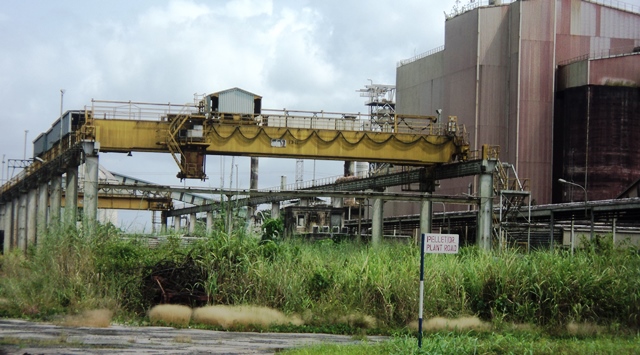
Grasses have taken over almost all the components within the plant- still waiting for the promised facelift by the new investors

With a gun-wielding soldier and other private security guards manning the gate, a visitor without prior appointment will not have his way in. “Gaining access to the plant is not an easy task; you have to come back in two weeks’ time,” a security guard tells this journalist.

An insider says, the new management of the company is haunted by aggrieved ex-workers who have vowed never to allow operation in the plant except their entitlements are paid. So, the main gate is under tight security against any unforeseen invasion by ex-workers. But its former owners, Global Infrastructure Holding Limited, is also laying claim to the company and indeed pressing to take it over.

Save for a few employees working on an excavation across the main gate of the company, there is actually no movement of heavy duty trucks that could suggest any activity going on in the company. No deafening sounds of iron casting coming from the plant or the razzmatazz that characterize a steel company.

It wears an old look, all the welcome signposts along the dual carriageway erected by the new management notwithstanding. Keen visitors get the impression of a company not working right from the corridor of the same express road.

The express road was constructed purposely to connect the steel plant to the Warri Port, in order to enhance easy evacuation of finished iron products. But the road is not only deserted but also dilapidated.

A trailer park some kilometers away from the main entrance of the company that once served as the assembly point for heavy duty trucks taking finished products is long gone; it has been taken over by bushes; no ancillary business along the road is visible. Business life of the area apparently died with the steel plant.

“As an A–level student of Federal Government Warri, we were taken to DSCL on excursion; the noise there was deafening — noise of steel production and heavy presence of heavy-duty trucks waiting to evacuate iron products such as iron rods, billets and other products were sights to behold,” recounts Onwuka John, a resident of Owvian.

“In those days, oil workers, were resigning. I saw them join the steel sector. Many resigned from Shell to join Delta Steel because everything about the company was too attractive for anyone not to eye its workforce; housing estate, schools, football team and even hospital were owned by the company.

“No company impacted the lives of the Deltans than the steel company, but all that is history now,” he adds.

“It was operating three shifts and you need to see staff buses conveying workers from Steel Town for their shifts to the company. But now, the plant is just like a ghost town.”

The units within — harbour, Direct Reduction (DR) plant and the pellet plant, Lime Plant, Rolling Mill, Electric Air Furnace, and the Continuous Caster — are littered with wreckage and waste, while other auxiliary units of the plant such as the foundery, electrical and mechanical maintenance workshops and water supply system, have all been overtaken by elephant grasses.
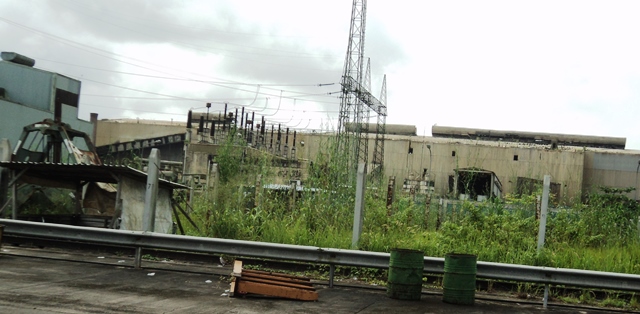
Electricity supply to the plant was disconnected by Benin Electricity Distribution Company (BEDC) due to huge unpaid bills

Creating an impression of work in progress, however, are a few workers here and there strapping their safety helmets and putting on dusty factory boots. But there’s arguably no steel processing going on in the company.

Waiting for the promised facelift by the new owners, Premium Steel and Mines Limited, the brownish rusty bodies of the equipment and the broken-down or abandoned machines all over the place are relics of a dead giant.

In March 2017, a group of investors from the United States of America and Morocco were reported to have visited the plant, proposing N600 billion investment to help revamp it — an indication that the new owners too might be in need of financial muscle to run the plant, like their predecessor, Global Infrastructure, which failed to turn it around.

But Victor German, General Manager, Government and Community Affairs at the company, denies any such proposal from any investor. He says the Indian investors have both financial and technical abilities to operate the company.

This claim is already being contested. Ebhaleme Pius, a former staff of the company who worked there when it was sold to Global Infrastructure Holding Limited, says the Management of Premium Steel and Mines, under the leadership of Prasanta Mishra, lacks not only the technical knowhow and financial muscle to run it successfully but also has no record of steel making.

“Those are not steel makers,” says Pius. “That’s why they are yet to manufacture a pin for the past two years. They cannot manufacture anything there because they don’t have experience in steel making.?

When it’s new owners took over in 2015, they promised to revive the comatose steel plant with N370 billion. Back then, with an established elaborate plan for the company’s revival with N70 billion in new investments in the first phase and N300 billion in the further phases, it looked like the company was going to have a new lease of life.

German, he says the new management is trying to re-engage the former workers of the plant

German admits that Delta Steel Company, as it is still called by the locals despite change of ownership and nomenclature, is still haunted by many known fears from disenchanted ex-workers who have vowed never to allow new investors take over the company until the N3.2 billion due to them is paid.

The workers are insisting that all industrial issues be settled, especially backlog of salaries and allowances, before the company can operate. German also confirms that the plant has been bogged down by demands of the ex-workers. “We met some rigid situations,” he says.

He says the basic reason the company has not resumed operations is the delay in bringing the ex-workers on board.

“These ex-workers are waiting, but these issues of liabilities are also there. We have about 100 of them working with us now,” he says.

“What we have been doing is trying to meet the demands of the ex-workers; those who worked with Global Infrastructure. You don’t just come and start work. They are demanding for the payment of debts owed the workers.”

According to German, who is also a gas engineer, the management of the company is almost done with the resuscitation of its rolling mill, after which other sectors such as Steel Melting Shop (SMS) would be revamped. But there are arguably no signs that the mill will start work anytime soon.

“We are resuscitating the rolling mill, we are going to buy billets or get them from outside the country,” he adds.

Pius says the steel plant management will not succeed by revamping the rolling mill first because “Delta Steel Company is an integrated plant”.

“You can’t revive the rolling mill that ought to come last in the line production first. It must be the last stage after they might have revived units like SMS and others. They can’t operate that plant; it is not a rolling mill.”

He alleges that the Indian investors have different plans for the plant. “They want to convert the building to a rice depot or a hotel,” he says. “You know they are Vaswani Brothers and we know their history in this country. They converted Volkwagen to rice depot.”

The payments of some debts by the Asset Management Corporation of Nigeria (AMCON) in April was needed for the management of Premium Steel to gain access to the plant and commence its resuscitation.

“We started that this year April and we have gone far. We are almost through with the rolling mill. One hundred and sixty workers are going to be employed for the rolling mills when it is operational.”

Despite all these commitments, the management of the company still has a lot of bridges to cover. A case before a Federal High Court, Warri Judicial Division, by Udu community, might be a major huddle to cross.

The host community says the details of the transaction between PSML and Bureau of Public Enterprise (BPE), which gave the company to the new investors, was not made open.

“We do not know the extent of purchase; we do not know what AMCON sold and what they didn’t,” says Sam Odibo, (Otota), Prime Minister of Udu Kingdom.

The communities claim they are stakeholders, having been allotted 22 million ordinary shares in the company, representing 10 percent of its total shares at its privatisation.

Part of their complaint, according to Odibe, is that the Federal Government has continued to shut them out in the privatisation process while dealing with the assets of Delta Steel.

“When BPE concessioned the company some years back, the community did not even know that they had some percentage to be paid because the Indian company, Global, ran the place solo,” he says.

“We say no; we want to know what they sold to you because AMCON sold what was used to borrow money from the bank. Did they reserve anything for the community or is it that they sold everything in spite of huge expanse of land the Federal Government took from us in the name of national interest. But we believe that the Federal Government would not be stupid to sell everything off.”

Before heading for court, the host communities said their efforts to get both the BPE and the AGF to account for the privatisation process were shrugged off. Now, they want the court to declare that they are entitled to 22,000,000 ordinary shares, representing 10 percent of the total shares of Delta Steel Company, and that both the BPE and the AGF have no right, power or authority whatsoever to sell or transfer to Premium Steel either directly or through any of the agents of the Federal Government of Nigeria, more than 80 percent of the shares of Delta Steel.

The court, they argue, should also declare any purported sale and/or transfer of more than 80 percent of the shares of Delta Steel to Premium Steel by the Federal Government, null and void.

“AMCON is done on the matter; they are not talking to us, same way nobody talked to us in the previous deal that allowed those Indians to run the place aground,” says Odibe.

“When that place was flourishing, they said it was federal character; northerners were there, southerners were there, but when it was ran aground, people accused us of folding our arms and being naive. We say no, before people accuse us again.”

The case is still ongoing. The communities want the court to issue an order restraining Premium Steel from continuing to take over the assets of Delta Steel without a valid sale and/or transfer of the company.

SHORTCHANGED BY AMCON AND PREMIUM STEEL AND MINES MANAGEMENT

Oputu, labour leader at the plant insists AMCON has questions to answer on the amount of money paid to former workers as entitlement after sale to Premium Steel and Mines Company

Former workers who worked at the plant between 2005 and 2012 when Global Infrastructures Company unsuccessfully managed it are demanding the payment of their entitlements. The new investors will know no peace, they have vowed, until their debts are defrayed.

At the time the new investors took over from AMCON in April 2015, the company had a backlog of seven-year unpaid salaries, which the workers say was calculated to be N3.2billion — but AMCON says the amount is far less: N2.1billion.

Other liabilities, according to findings, are indebtedness to contractors put at N2.5billion, indebtedness to foreign suppliers placed at $4.4billion and liabilities to statutory bodies and corporate creditors such as Federal Inland Revenue Service (FIRS), which alone make up N12billion.

AMCON, it was gathered, has settled some of these liabilities, particularly debts owed the Benin Electricity Distribution Company (BEDC), which recently restored electricity to the plant after seven years of darkness.

The workers argue that the difference of N1.1billion was due to the omission of some names and figures in the report submitted by the consultant hired to compute their entitlements. They accuse AMCON of shortchanging them despite their years of sacrifice at the company.

Peace Oputu, Chairman of Iron and Steel Senior Staff Association of Nigeria, (ISSSAN), reveals that efforts to make AMCON adjust the figure to N3.2billion were fruitless.

“We [the workers] gathered ourselves and met with AMCON. We talked but the meeting was fruitless because they didn’t agree to our terms,” says Oputu, disappointed in how workers have been treated by the Federal Government after the collapse of the steel company.

“They calculated certain amount, N2.1billlion as what is owed DSC workers, but we have EDP that takes care of all expenditure and all the money that comes in for the company.

“When we met with the committee set up by Delta State government, we made it very clear to them that our money is much more than that.

“Then we calculated the money with the EDP, and came out with N3.2billion. This was what we took to AMCON in Lagos. AMCON said their own was just to acquire; they had paid the debts owed by the company and as a result, they did’t have any other thing to give us.

“They were just going to part with N600million, representing 22.5 percent of the N3.2billion. So, the meeting was deadlocked because we were not happy.”

While waiting for their entitlement, ICIR gathered that about 500 retired staff of the steel company died in the 13 years that followed, that is 2005 till date. This explains why, when AMCON came to disburse the N600million in March 2017, those still alive ignored the directive of Oputu-led ISSSAN and Steel and Engineering Workers Union of Nigeria (SEWUN) not to collect the money.

Though it was obvious that they had been underpaid, the workers, who were dying of hunger and sundry illnesses, could not resist the temptation of the AMCON payment.

“Hunger is there, you cannot tell anybody not to collect the money. We the union came out and instructed them that nobody should go out to receive it but the next day people went out. You can imagine the level of poverty among our people,” laments Oputu.

But ISSSAN and SEWUN are insisting on the payment of 100 percent allegedly agreed by the unions and AMCON, through its Receiver/Manager. They allege that AMCON acted without consulting them in the calculation and payment of “25 percent of their total entitlements”.

Adewale Okeshola, General Secretary of ISSSAN, laments that AMCON reneged on the agreements reached at the meeting with its receiver/manager.

“We later gathered that AMCON through the receiver/manager was holding meetings with some disgruntled elements within the workforce in DSC who paraded themselves as seeking the interest of the workers who have suffered delay in the payment of their salaries for over five years now,” he says.

“These groups, we gathered, entered into an unholy alliance with the management to short-change the workers in the payment of their terminal benefits. After a protracted wait, we were shocked that the workers had been paid 25 percent of their entitlements as final payment.

“This is not only a far cry from the agreement reached between the two unions and the receiver/manager appointed by AMCOM, but also unacceptable. We want to say that SEWUN and ISSSAN were not carried along in this decision. We have made several entreaties through correspondences to the concerned authorities to rescind this dehumanizing decision and honour every agreement both parties reached for the interest of peace and harmony. Up till now, our efforts have fallen on deaf ears, thereby creating tension and restiveness by workers.”

Efforts by the state government to intervene have yielded only little result, at least not in assuaging the worries of the aggrieved ex-workers.

A committee on Delta Steel Company Affairs set up by Ifeanyi Okowa, the Governor, and headed by Moses Odibo, wrote to President Muhammadu Buhari requesting a N5billion bailout for AMCON to offset the salaries and other indebtedness so that the company’s new owners could resume production in November 2016.

The amount requested was not released. Rather, the President, it was learnt, referred the letter to AMCON to defray the debt since that is its statutory responsibility.

A breakdown of the sought N5billion is as follows: N3.2billion for staff salaries, N1billion as part payment of N7.5billion indebtedness to PHCN/BEDC, N198.7million owed Nigerian Gas, N500million for general supplies and N58million to offset scrap supplies.

Despite these calculations, particularly the debt to workers, AMCON paid only 25 percent of N2.1billion that it said was the workers’ entitlement.  The workers argue that from the time when the Federal Government took over the company from Global Infrastructure Company till date, no letter was given to any staff regarding disengagement, retirement or any related matter.

“Invariably, the government is not coming closer to us and we don’t know what is happening with this company for now,” laments Oputu.

“My members are working there because what gets to your mouth gets to your stomach. My people are dying in the township there. We lost minimum of three people every day.  When the new investors came in, they made several publications that they were going to turn Delta Steel Company around, promising to spend billions of dollars.

“But today, that is not what we are seeing. If they don’t live on the account of the school they don’t survive. The proceeds from the schools are what they use to run the plant and one of the schools, school II, is grounded.

“We were over 5,000 when the company was working well, but we were reduced to almost 2,000 when Global Steel came in. Several people have died, more than 700 since 2011.”

Jude Nwauzor, Manager Corporate Affairs of AMCON, did not respond to questions on the allegation of short-changing the ex-workers. While he promised to get back, he referred the journalist to Joseph Nwobike, AMCON  Receiver/Manager for the company.

In an SMS, Nwobike, a Senior Advocate of Nigeria (SAN), said he would not respond to gossips and unfounded allegations.

“Thank you for contacting me. I really do not respond to gossips and unfounded allegations. The records are there for all to see,” he simply said.

But when he was further asked to make the record available by this journalist, he went mum.

AMCON, though, says it ensured that all verified ex-workers who were eligible and also participated in the agency’s verification exercise were fully paid directly.

Following their inability to liquidate the debts they owed several banks, AMCON took over the assets and undertakings of Delta Steel Company Plc (DSC)/Global Infrastructure Nigeria Limited (GINL) and appointed a Senior Advocate of Nigeria (SAN), Ajibola Aribisala as the Receiver/Manager of the company.

However, in 2015, AMCON replaced Aribisala with Nwobike, who subsequently engaged the services of an audit firm to carry out a verification of the ex-staff.

“At the exercise, only those who were staff of DSC/GINL at the time of the take-over by AMCON were audited,” AMCOn said in the report. “At the conclusion of the exercise, Nwobike engaged the representatives of the staff — an engagement that led to an agreement to accept as full and final settlement of their outstanding salaries and gratuity, a percentage of the verified sums.”

It was however gathered that although the percentage agreed to be paid was below the staff’s expectation, AMCON said the arrangement was the best in the circumstance, seeing that DSC/GINL was insolvent.

According to AMCON, over 1,600 staff were screened and paid in the exercise, which lasted between March 13 and 31, 2017.

HUNGER, SICKNESS, DEATHS…THE PLIGHTS OF EX-WORKERS

After 25 years as a plumber at Delta Steel Company, Agbonkaro lives in abject poverty

My wife dey house now, to eat dey hard us; na so so quarrel. I don’t know where to start from and I get seven children.”

That is the lamentation of Francis Agbonkaro, who worked at the plant as a plumber for 25 years.

With three university graduates and four undergraduates and a wife to cater to, life has not been easy for him since his retirement in 2005 from the company without the payment of his benefits.

The whole family, he reveals, lives on the petty trade run by his wife in the Steel Camp — the residential quarters constructed for staff of the company.

Na my wife just dey do small small thing wey we take dey survive. I get seven children. Three graduate, four no graduate, dem don already finish secondary school because no money to sponsor them.  I no fit calculate how much dem owe me,” he says.

But he is happy despite his poor condition of living because several of his colleagues who worked at the plant have died of hunger and treatable ailments.

Population wey don die, dem no dey fit talk that one. I even fit say the population wey die dem plenty pass people wey dey alive. Some house dey here, the husband die, the wife die,” Agbonkaro continues in Pidgin, apparent signs of poverty all over him.

Still, he can be said to be lucky. His colleagues, Salami Omokha and Osifo Mathew, are already cursing the day they joined the steel company — they have lost their sights due to years of exposure to high temperature without protective gears as con-casters at the plant.
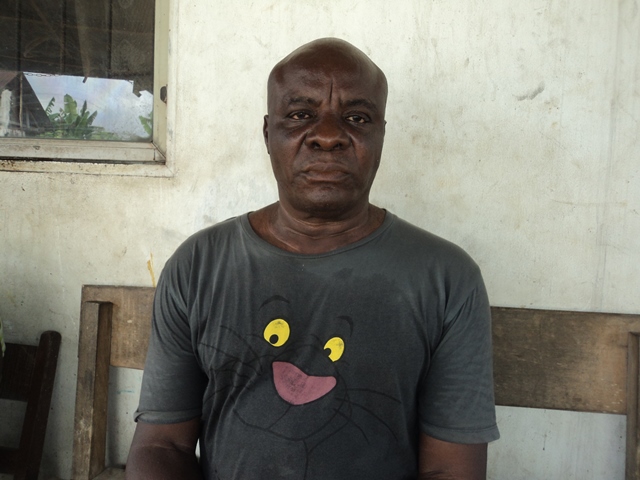
Omokha, a Germany trained melter at the plant says ‘the situation after retirement is hopeless’

Omokha, who also retired from the company in 2005, was a melter of iron ore.  “Melting has to do with converting iron ore, which has been reduced to direct iron, and then you convert them to liquid steel, you convert them to any grade of steel you want,” he explains.

Before iron ore can be converted, the melter must attain the temperature of about 1740 degree centigrade. That, Omokha says, was usually done by him and others in that section “and not that you have the safety devices to look at those things”.

“Those are the things we looked at and today now we are having the adverse effects; we cannot see.”

Trained in Germany and Italy for iron ore melting, he says 90 percent of those that worked there “have this problem I’m having now; the problem of sight”.

“I went to Germany and Italy in 1980 and 1981 where I was trained as an electro handler, melter, and caster. I trained many people on the job when I returned, and many of them today are happy to identify with us now that we gave them good training.”

Life after retirement has not been rosy, as according to him, “the situation after retirement is hopeless”.

“We are surviving through charity, particularly from friends who are better placed. My children are not grown up yet; even the ones that have graduated have no jobs. Our wives are the ones jumping from places to stones converting whatever they have to money. We are also hoping for a better tomorrow whether the Federal Government will remember us.

“We are not getting our retirement benefits. I’m in my condition now, the plant is also in its own condition; we don’t know who to speak for who.  Whether the plant is to speak for me, because the plant is also in the same condition in which I am now; the plant is sick.

“I wish the Federal Government can have a little rethink and come back to that place to see exactly what they have there. They should not allow it go fallow the way it is now. People are there now but nothing meaningful is coming out of there. It is like the government is not taking the issue of Delta Steel Company serious.”

When reminded that the plant had been handed over to a private investor, he said: “How can you give the company to a private investor without following up, without knowing its profile and without know what they are doing there.

“The government is weak in this area. There are so many of their projects that are abandoned. Come to where we are residing in Township, schools have been abandoned, taken over by weeds. It is a nonchalant attitude by the government.”

On whether the Premium Steel and Mines Limited has the capacity to transform the moribund plant, Salami retorts: “Those are not steel makers, they are not steel makers. If they are steel makers we will know.  The same government that allowed them in is the same government that owes us.

“My health challenges are numerous; one, I cannot see far objects. Doctors told me that there are cataracts in my eyes and these are the manifestations of areas where we worked. Again, the pains are there all over. Many of the people that worked with us have long died.

“Government should live up to its responsibility and pay us our money, our entitlements, so that we can also straighten our heads and maybe we can live longer. With better treatment, nobody will know that you are sick. Meaning that there is a solution to your problem. We have problems and the solution is there; only that we cannot afford it.

Of the trio, Osifo Mathew is the worst hit; he has been suffering from stroke and has lost his sight.


I want government to pay my money so that I can treat myself, pleads, Osifo who has lost his sights after retirement

With his eyes wide opened though laced with mucous to suggest there are problems with them, Mathew could not recognize his friends. Twenty-five years of exposure to high temperature as a con-caster at the steel company is responsible for his battle with glaucoma.

With such debilitating health condition, he is also not paid his entitlement after retirement from the company.

Looking straight at this reporter as if he could actually see him, he says, “I worked at con-cast. We started the steel company and I was retired in 2005. But up till now, I have not collected my entitlement. I have problem with my eyes. In fact, when the eye problem started, I was first affected by stroke.

“The eyes have been bad for the past four years. They said they cannot operate it because it is glaucoma.

“They recommended drugs and eye drop. I can see just faintly. The last eye drop I bought was N9,000 and used it for two weeks.”

Osifo makes one final plea to the journalist: “I want government to pay my money so that I can treat myself. As you are talking to me now, I’m just looking at you like a film. I’m not seeing you; I can’t describe the shirt you are wearing.”
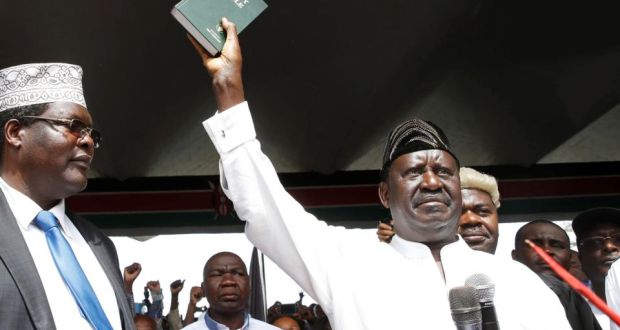


One ship, two captains… Odinga declares self president of Kenya


Raila Odinga, Kenya’s opposition candidate in the last year presidential election, says he is answering a higher call to assume the office of the people’s President of the Republic of Kenya.

Odinga stated this in front of a mammoth crowd of supporters on Tuesday, as he was sworn in as a parallel President of the country with a copy of Holy Bible in his hand at Uhuru Park, Nairobi.

Donning a white caftan and black cap at the event, which has been released to Youtube after Kenyan authorities banned the transmission on state television channels, Odinga spoke local dialect.

“I wish to thank the people of Kenya for the mandate they have given us and for their steadfast confidence in us. You came from all corners of the republic to witness my inauguration and it was good to see you out in millions,” he said.

“Most of all I thank the good Lord, my family and all those who have undertaken this journey with us. We have arrived in Canaan; thank you for staying the course with us. Asanteni sana.”

He told crowd that the people had had enough of election rigging and the event was a step towards establishing a proper democracy in the East African state.

He was part of the August 2017 disputed and later cancelled election, which gave victory to Uhuru Kenyatta.

Kenya’s Supreme Court described the election as neither transparent nor verifiable before annulling it.

Kenyatta was officially re-elected with 98 percent of the vote on October 26, but just under 39 percent of voters turned out. He was inaugurated in November.

Odinga argued that Kenyatta was elected by a small section of the country, maintaining that he did not recognize his opponent’s victory.

He urged his supporters to shun the re-election, because “no reforms had been made to the electoral commission”.

President Kenyatta, who was sworn in for a second term last November, warned the media not to cover the swearing-in ceremony, while the country’s Attorney General said holding such a ceremony amounted to treason.

Let the restructuring debate continue

0


By Ihembe Martin

Unarguably, the burgeoning conversation in the Republic revolves around who occupies Aso Rock in 2019, and the need to resolve the lingering ‘national question’, loosely referred to as true federalism or restructuring. The latter issue, which predates the subsisting Republic, will be the focus of this piece.

While the President dismissed the agitations for restructuring in his New Year speech, his party appears to be saying another thing in line with the agitation from the political society. The report of the Nasir el-Rufai Committee on restructuring says it all.

On this note, it is safe to conclude that the inconsistency between the party and the presidency is a clear case of working at cross purposes. Before we delve into the crux of the matter, historicizing how we got here would not be out of place.

THE FEDERAL ARRANGEMENT AS IT WERE IN NIGERIA

Federalism is an institutional mechanism adopted in governing societies that are culturally plural. Since Nigeria fell into this category, the introduction of federal system became necessary when the Richard Constitution of 1946 was drafted by the British. Experts on federalism, such as Simeon and Conway, posit that federally-structured polities “seek to maintain the unity of the larger state, while giving recognition and empowerment to the minorities”.

Also, “it is predicated on devolving autonomy to the minorities, and on recognizing and protecting them in the large society and polity”. As against the El Dorado that is being painted today of the First Republic, unity was a rarity as a result of majoritarian hegemony that brought about cultural exclusion.

Nnoli and Coleman have extensively elaborated on this in their works – Ethnic Politics in Nigeria and Background to Nationalism. Recognition and empowerment to the minorities was also lacking. For this reason, the demand for separate political entity from the marginalized groups assumed centre stage. However, in the area of fiscal autonomy, the situation was better both in colonial Nigeria and the First Republic. Preponderance of the centre over the regions was not witnessed.

This engendered healthy economic competition as each region focused on what it had comparative advantage on. The North focused on groundnut, tin, and columbite. The West did well with cocoa, while the East produced palm kernel. Given the degree of autonomy, inter-governmental relations between the centre and the regions was horizontal, not vertical and contentious as we have it today.

Revenue allocation during this period was based on the principle of derivation, which was introduced by the colonial government – Philips Commission of 1951 – and was maintained by the independent government. Fifty percent of revenue from sale of natural resources went to the regions of origin. If 50% was going to the regions at some point, why is it now 13% to the oil-producing states? Nothing explains this better than “military federalism”.

MILITARY FEDERALISM

Military interregnum and the Civil War badly affected the practice of federalism in Nigeria. First, it started with Ironsi’s unification Decree No 34, which abolished the autonomy of the regions in a misguided attempt to forge a greater national unity. While Gowon returned the country to the old order of federalism, he introduced the command structure of military in governing the federation.

He introduced Decree No 27 of 1967, which limited the legislative and executive powers of the newly created states during the Civil War to residual matters. Decree No 51 and 38 of 1969 and 1971 vested the monopoly of oil wealth and distribution in the federal military government. This move effectively introduced centrist federalism, which has been variously described by experts as unitary, command, quasi, or militarist federalism. Instead of reviewing the centrist clauses, which would have given full autonomy to the federating units, subsequent institutional designs – 1979, 1989, 1995, and 1999 – all maintained the status quo such that the 68 items have been placed in the exclusive legislative list.

In the absence of a mutually acceptable constitutional arrangement that would have engendered a workable political society, the resultant effect has been protracted armed conflict in the Delta region and agitations for political inclusion from both the hegemons who felt excluded and the minority groups. All of this make up the national question.

THE WAY FORWARD

The President feels that the problem is more with the process than the structure. This position of his, which is common with the oligarchs, has created some disquiet and dissonance in the polity; and rightly so.

Protagonists of restructuring feel the current structure of governance is essentially faulty. In his view, Ahmed Joda suggested that the 109 senatorial districts be converted to federating units. According to him, this would contain agitations and reduce the incurable cost of governance.

He’s right in the area of reducing the cost of governance. But as brilliant as his view is, implementing it without giving the newly created federating units autonomy will still not solve the problem. It’s like the current order where the central government exercises too tight a control on the states. Again, how this would solve the problem of local hegemons lording over the minorities is still missing.

Emeka Anyaoku’s prescription insists on a return to the regional order of the First Republic, because the current structure of governance cannot advance economic development. He feels the 36 states should be collapsed, and turned into six geopolitical zones. While the economics of his argument is sound like Joda’s, how this will solve the problem of ethnic rivalry experienced in the First Republic is also missing.

The issue of majoritarian hegemony, which led to agitation for separate political entity by the minority groups, is likely to become an issue. On his part, the literary icon, Professor Wole Soyinka came up with the concept of “reconfiguring”. What that means, as far as I understand it, is best known to him. Former Vice President Atiku Abubakar, who suddenly became a federalist, has also called for stronger state governments.

Most Nigerians perceive his call for restructuring as a political strategy ahead of 2019 since the demand from the political society is in that direction. If not, why did he not push for restructuring as Vice President?

No matter what side of the divide one belongs to, it’s an incontrovertible fact that the current order of federalism, which the President has defended, cannot guarantee political stability, which is essential for economic development. Given our pluralistic nature, addressing the lingering national question with the aim of bringing about an enduring governance structure is a sine qua non. Responsibilities have to be devolved to the federating units in line with the principle of federalism.

The el-Rufai Committee on restructuring has made the right move. But considering how the APC government has failed Nigerians who trusted it with their lives, can it be trusted?

Aside Boko Haram where the government appears to have recorded piece meal success, which seems to be eroding with the Haramists launching offensive attacks, the government has not delivered on the campaign promises that endeared it to most Nigerians. How sure are we that it will implement the outcome of the el-Rufai Committee report if voted back to power in 2019; especially when the President thinks restructuring is not the issue – a view shared by most oligarchs? This makes it hard to deny that the report of the committee is only targeted at winning the 2019 general election, after which it would be abandoned like the Ken Nnamani Electoral Committee report.

It is also important to note that while some have applauded the el-Rufai Committee report, some of its recommendations are just not feasible given the current economic situation. Take for instance the issue of state police. While that would help in dealing with crimes at the sub-national levels, the economic reality is that most state governors cannot afford it. The issue of non-payment of civil servant salaries explains it all.

Another thing is, we must not continue to rely on the demanding process of constitutional review to make the practice of federalism work. At some point, we can also utilize the power of judicial review as Lagos State did last year in a matter with the Federal Government over who controls inland waterways, which it won.

Lastly, while we restructure either through constitutional engineering or judicial review, we also need to take seriously the important issue of state building. This is so because federalism does not work on its own. It has to be grafted to the institution of the state. That is why no matter how good the structure of federalism, it needs a strong state to function effectively.

Therefore, if the state is weak the possibility of the architecture of federalism functioning effectively can hardly be reconciled. My prescription for building a strong state is in line with the one provided by Francis Fukuyama, which focuses on creating new government institutions and strengthening existing ones. Nigeria needs this for its federal democracy to work. Let the restructuring debate continue.

Ihembe is a political scientist with research interest in political development. He can be reached on 08023688848

We have scientific evidence that APC will win 2019 election, says el-Rufai


Nasir el-Rufai, Governor of Kaduna State, says the All Progressives Congress (APC) has scientific evidence to show that it will win the 2019 general election.

Speaking on Channels television’s Sunday politics, el-Rufai expressed confidence that his party would not only win the presidential poll but will also add to the 24 states currently in its grip.

This is coming amid scathing criticism, from several quarters, of the President Muhammadu Buhari’s performance in office.

“I do not have any doubt in my mind that we are going to win the next elections; not only in the centre but we are going to retain our present 24 states, and even more,” el-rufai said.

“We are not saying this foolishly; this is scientific. We are monitoring the pulse of Nigerians — not the pulse of a section of Nigerians — and I am confident that we are going to win the 2019 elections.

“We know the pulse of the nation, we know where we are losing support, we know where we are gaining support; I have no doubt in my mind that we are going to win the 2019 elections.

“There are two pulses of Nigerians – there is the pulse of the Nigerian elites which is the noise that you hear in the media, the social media and so on. Then there is the pulse of the people.

“If you remember how many people came out to welcome President Buhari in Kano, then you will know that there are two Nigerias.”

The most recent, and perhaps the most significant jab that has been aimed at the Buhari presidency, came from former President, Olusegun Obasanjo, who accused the President of nepotism, insensitivity and buck passing. But el-Rufai waved Obasanjo’s statement aside, saying “it is too long and I am very busy”.

“You know President Obasanjo is a Nigerian, he’s a patriot and he is entitled to his opinion just like every other Nigerian,” el-Rufai said.

“We are moving on, we are planning to deliver on our promises and when the time comes we will be ready for the 2019 elections with whoever and whatever party that exists. There are 73 parties in Nigeria; we are going to face them and I’m confident as I said.”

Describing himself as a Buhari loyalist “till death do us part”, el-Rufai said his support for the President was not for any personal gain but in the overall interest of the country.

“I believe that it is in the overall interest of our party and the stability of Nigeria [for Buhari to seek re-election],” he said.

“It is not because I stand to gain or lose anything. But it is because in everything I’ve done since I got into public service, for me the interest of Nigeria comes first.

“God has given me everything through the instrumentality of this country — I don’t need anything as a person but what I need is to see a country that is making progress, that is stable, and leave a legacy for our children to build on it.”

Obasanjo, Ezekwesili’s ‘Third Force’ a political farce

0


By Frederick Nwabufo

I agree with former President Olusegun Obasanjo that Nigeria needs to be rescued from the “misgovernance guillotine” of the APC and the PDP. 

Obasanjo expressed his desire for the deracination of these bands of misfortune in his latest missive.

He said: “We need a Coalition for Nigeria, CN. Such a movement at this juncture needs not be a political party but one to which all well-meaning Nigerians can belong. That movement must be a coalition for democracy, good governance, social and economic well-being and progress. Coalition to salvage and redeem our country. You can count me with such a movement.”

A few weeks ago, Oby Ezekwesili launched the Red-Card Movement, a group or “Third Force” forged with the bounden aim of shoving the APC out of the dais of power and keeping the PDP in the abyss of oblivion. It is clear that Obasanjo is in spirit with Ezekwesili’s movement.

I agree with Ezekwesili that the APC and the PDP deserve the red card, but I do not believe that a “movement of big egos” will solve Nigeria’s leadership problem.

As a matter of fact, all the key figures of the movement once held political office in the country; Nigeria’s problems 18 years ago are still alive today. If the sponsors of this group had possessed the Midas touch to turn the country into a terrain of gold, citizens would not have been in a state of loss and confusion today. The country and its leadership is the way it is because of the past mistakes and failures of members of this elitist movement. What tonic can these people administer to anaemic Nigeria?

As of now, the ‘Obasanjo-Ezekwesili’ movement does not have an alternative to the status quo. And since the group has elected to be a pressure group and not a political party, it is safe to say it may support a candidate from any political party other than the APC and the PDP.

I will not to go into the charade that a few other political parties are, but a young candidate of a party in the Osun local government election could not participate in the exercise because his party tactlessly failed to submit his name to INEC. How do you define incompetence?

For me, I do not think the Red-Card Movement is a people’s movement. It is self-serving and peopled by big egos on a relevance chase. If not, why is it so concerned about the presidency? Nigeria’s problem is structural. It needs “de-cluttering”. Until the present structure is re-worked, every president is doomed to fail. And the answer to Nigeria’s structural problem is in the recommendations of the APC restructuring committee.

I believe this movement will do Nigerians a great favour if it puts pressure on the government to have the recommendations implemented.

 Fredrick is a journalist. You can reach him on Twitter: @Fredrick Nwabufo, Facebook: Fredrick Nwabufo.

SURE-P vehicles, UBEC funds, uncompleted buildings… the N30bn assets recovered from public officials by ICPC


The Independent Corrupt Practices and Other Related Offences Commission (ICPC) says it has recovered a total of N29.77billion stolen by Nigerian civil servants across different Ministries, Departments and Agencies (MDAs) between 2006 and 2017.

According to a record of recoveries made available by the commission on its official website, these recoveries include farmland, plots of land, uncompleted and completed buildings and cash.

Out of the total amount, N3.08 billion was recovered in cash while N3 billion has been returned to the MDAs from where they were embezzled.

According to the document, one recovered farmland, a 10-hectare of land located in Kuje Area Council of Abuja was valued at N50million, while N415 million worth of plots of land, N1.4billion worth of uncompleted and N1.3billion worth of completed buildings were also recovered.

In all, the ICPC recovered 62 plots of land within the years in review — located in Abuja, Nasarawa, Osun and Rivers states — six completed buildings in Abuja, Lagos and Akwa Ibom states, and five uncompleted buildings in Abuja, Kaduna and Akwa Ibom states.

Nineteen vehicles were also recovered – 14 of these were for the Subsidy Re-investment and Employment Programme (SURE-P), which government officials went away with after the dissolution of SURE-P.

Government agencies and ministries from where monies were stolen and recovered include the Federal Revenue Inland Service (FIRS), Ministry of Niger Delta Affairs, Nigeria Security and Civil Defence Corps (NSCDC) and the Federal Ministry of Interior.

The document also shows the gross abuse of the Universal Basic Education fund by officials of state governments and the Federal Capital Territory Administration (FCTA), as well as those at the Headquarters of the fund, UBEC, Abuja.

The Federal Government established UBEC in 2004 as an interventionist agency to provide funds and infrastructure for the basic education development in the country. But despite Nigeria having the highest number of out of school children in the world — 10.5million as of 2017 — ICPC recovery revealed how, between 2006 and 2011, a total of N296.4million was stolen by officials of the states’ UBE.

The states are Niger, Lagos, Borno, Abia, Nasarawa, Jigawa, Bauchi, Imo, Ogun, Kogi and Taraba.

Others are Plateau, Kano, Delta, Enugu, Osun and Ebonyi. Out of all these states, 23 officials of Borno State Universal Basic Education were involved, while seven officials of UBEC headquarters were also involved in separate stealing of the public fund.

The commission made its biggest recovery in 2015 with the recovery of N1.03billion, followed by 2015 during which it recovered N869.5milllion.

A total of 92 cases are still ongoing at different stages and at different courts across the country.

However, one curious aspect of the ICPC’s document is that no ‘high-profile’ name in the Nigerian public sector featured on the list.

‘Open grazing is our culture’ — Miyetti Allah rejects cattle colony


The North East Zonal chapter of the Miyetti Allah Cattle Breeders Association of Nigeria (MACBAN) says it will not accept the idea of cattle colony being proposed by the Federal Government as an alternative to open grazing, which has led to several violent clashes in the country.

Mafindi Danburam, Chairman of north-east zone of MACBAN, made this known during an interview with The Punch.

Danburam condemned the anti-open grazing law that had just been introduced in Taraba State, after Benue State passed a similar law, adding that MACBAN had challenged the new Act in court and the case was being handled by Justice Josephine Tuktur of the Taraba State High Court.

“As the Chairman of the Miyetti Allah Cattle Breeders Association of Nigeria in the North-East, who is also the immediate past Chairman of the group in Taraba State, I want to tell you that we do not accept the open grazing prohibition law being implemented in Taraba State,” Danburam said.

“We don’t need it, we don’t want it and that is why we are challenging the law in a court of competent jurisdiction — the state High Court.

“The case is before her lordship, the Chief Judge of Taraba State, Justice Josephine Tuktur. So, we won’t do anything before the outcome of the case in court.”

Danburam accused the Taraba State Government of insincerity in the formulation, articulation and the proposed enforcement of the new anti-open grazing law.

The new law states that the state government will establish model ranches, which would serve as an example for the herders to copy in setting up their own ranches. But Danbarum pointed out that the same government had tightened land acquisition procedures in the state, wondering how herders were expected to acquire land to be used for ranches.

“Another aspect of concern in the law is that it prohibits selling of land to a typical herder until the Governor gives approval. Okay, how many of us have Certificate of Occupancy in Taraba State?” Danbarum queried.

“We are practising traditional method of land ownership in Taraba State and if my wife or parent is sick and I need to sell my land to take them to the hospital, does that mean that I have to get the Governor’s approval?

“Okay, the Governor is the custodian of all lands in the state. We have over 20 grazing reserves in the state. Let him establish the pilot ranches in these grazing reserves and allocate them to typical herders in the bush, so that those of us in the town, who have the money, can buy land and establish our ranches.

“Until government recognises that this sector is also contributing to the economy of the state and they begin to give us subsidy, ranching will not work.”

Danbarum said that although MACBAN boycotted the public hearing that was held before the Act was passed, the Muslim Council of Taraba State presented the association’s position.

He noted that Miyetti Allah supported the anti-open grazing law in Benue State, but “the only area where there are issues is the implementation, because they started implementation like a decree”.

“They woke up one day and announced that ‘by tomorrow, nobody should rear cattle’. That was not the best approach, and that was why the Fulani in Benue reacted by fighting back,” Danbarum said.

On whether the Miyetti Allah will accept the idea of cattle colony as an alternative to open grazing, Danbarum said nobody could force the herdsmen to change their culture.

“You see, we know the plan of the Federal Government and I tell you that anything that infringes on our rights, we will go to court,” he said. “Open grazing is our culture and you cannot wake up one day and stop me from practising my culture. Cattle colony is not our culture. We have our culture and tradition and we want to maintain it.”

Federal University Oye Ekiti cleared to begin postgraduate studies


The Federal University, Oye Ekiti, has been accredited to offer post-graduate studies, barely seven years after the institution was established.

According to Oyeyimika Koyejo-Fasakin, Acting Registrar of the University, interested candidates can now apply for Masters and Doctorate programmes into eight different programmes in Agriculture, Social Science and Arts.

The courses are Agricultural Economics, Animal Science, Crop Science and Soil science in the department of Agriculture.

Others are English Language and English Literature, Theatre Arts, Sociology, and Demographics and Social Statistics.

Kayode Soremekun, Vice Chancellor of the university, said that with the introduction of postgraduate studies, the schoool had realised of one of the goals he set for himself when he was appointed in 2016.

He promised that the University will ensure that students in the postgraduate school are not delayed unnecessarily beyond the time they ought to complete their programmes.

“We intend to take the sting out of the postgraduate school. By this, I mean we will not delay students unduly beyond the stipulated time for the programmes and we will not compromise on quality,” Soremekun said.

Soremekun, VC, Federal University, Oye Ekiti

“The introduction of this programme is a fulfillment of the pledge of the Federal Government, which is to provide access to education to all those who seek it so that Nigeria will be a better place.

“The cost in time and resources are not prohibitive, as we are determined to provide access to quality postgraduate education for our students.”

Soremekun commended Rasaki Bakare, Dean of the Postgraduate School of the University, for the “energy and drive” with which he runs the affairs of the college.

“Now, since we have opened our doors to postgraduate students, we will ensure that they receive the best teaching and research support to excel,” Soremekun said.

INVESTIGATION: Fraud, failed projects, idle staff at Nigeria’s abandoned nuclear centre (II)

Awarded at over N400 million in 2009, what was supposed to be a radioactive waste management facility at Nigeria’s Nuclear Technology Centre never came to life.

Instead, a building overgrown with scrubs lies east of the gamma irradiation facility. Waste management plants and equipment comprise various devices and machines used for treating, converting, disposing and processing wastes from various sources.

The construction of low/medium radioactive waste management facility was awarded at the contract sum of N401.4 million to Commerce General Limited and so far, N312 million has been paid to the contractor, the Nigeria Atomic Energy Commission (NAEC) said in response to a Freedom of Information request made over a month ago.

The project, according to NAEC, was 78 percent complete and has “only suffered delays.”

“The project was not abandoned. It only suffered delays due to factors outside the control of the commission,” the agency said.

The delays, NAEC said, include; “inadequate funding of capital projects generally, over the years, modification of the original design, as recommended by IAEA experts, which has resulted into changes in the BOQ figures and this development is being discussed with the contractor,” and also, “no outstanding Interim Payment Certificate on the project.”

A staff of the NTC, who was privy to the contract and execution since 2009, said the project had been used to embezzle money from government since the time of award.

“It is true that they changed the plan of the plant but they’ve never done anything meaningful there since they mounted these blocks,” he said.

“The contractor is not qualified and along the line, he got stuck in the project and we’ve not seen or heard about him for many years now.”

Efforts to reach the management of Commerce Nigeria Limited were unsuccessful as the company has no website or any visible record.

Its recorded address at Plot 3, Railway Avenue, Kachia Road, Kakuri, Kaduna South, Kaduna, does not exist, this paper found out during a visit there.

“We’ve never heard of that place,” several residents of Kachia told this reporter after attempts were made to locate the company.

In Nigeria, it is not uncommon for ‘brief case’ contractors, most times in connivance with the awarding entity, to register a company for the sole purpose of bidding for contracts and making quick money.

As alleged by staff of the centre, this may be the case as even the figures quoted in FOI response by NAEC are contradictory.

Supposed waste management plant overgrown by bushes

While the commission said the project was 78 percent complete, a visit to the facility told a different story: an expanse of land overgrown with weeds and a construction no way near half-way complete which, in no way, justified the commission’s claim of paying almost 80 percent of the total contract sum to the contractor.

If the contract was awarded at N401. 4 million and N312 million had been paid so far, the balance should be about N89 million. But NAEC quoted N329 million.

‘Abandoned’ nuclear instrumentation laboratory

One of the components of the masterplan of the centre is the nuclear instrumentation laboratory which is supposed to serve as workshop for students, researchers and others in the nuclear field.

The project was awarded at the cost of N829.6 million to Trois Associate Limited in 2012 and it is 68% complete, NAEC’s response to an FOI stated.

The nuclear instrumentation laboratory overgrown with weeds

Again, NAEC claimed that the project was not abandoned and was delayed due to paucity of funds.

“For instance, there was no provision for the project in year 2016 and only about 11% of the capital has been released so far in the current year (2017),” the response noted.

When this paper first visited the centre in September, there was no contractor on site. In fact, there was no way a contractor would have reached the building as anyone who dared would have to clear about 100 metres of weeds and trees surrounding the laboratory building.

“The contract has been on hold due to non-payment of funds,” the contractor handling the project, Gbenga Ogunsola, told this paper when contacted in October.

“We demobilised in 2015 March because our outstanding valuation was not honoured by the commission. It was due payment that was just paid last month.”

He said the project is about 75 percent complete as against the 68 percent quoted by NAEC and that he is already on site after a recent release of fund.

Mr. Ogunsola would not state the amount recently released but there seems to be more to worry about.

Although the project was awarded at an agreed amount of N829.6 million, the N265.2 million balance would not be enough to conclude the construction.

“Definitely no,” Mr. Ogunsola said when asked if the balance would be enough to complete the project.

“We intend to present a case for review to the commission. We are still working on that. We are not going to review the whole thing, we’ll just review the outstanding work. I’m looking at between 25 to 30% review but I’m not sure yet.”

However, apart from clearing of the surrounding bushes, there were no further works on the site when this reporter visited in December, four weeks after receiving the FOI response from NAEC.

A FAILED VISION

Emmanuel Emovon, a professor and the then Minister of Science and Technology, while receiving former military leader, Ibrahim Babangida, at the foundation ceremony of the nuclear facility in 1988, envisaged that the centre should be a “sanctuary to the scientific and technological community where members can retire to occasionally for more positive thinking about the physical.”

To make that vision a reality, the Goodluck Jonathan government in 2012 made budgetary provision for the construction of a recreational and educational facility.

The sports facility now used by farmers

The contract was awarded to Silhouttes AB + Turnkey at N274.5 million and an initial payment of N214.2 million was made, leaving a balance of N60.3 million.

Like others, construction of the sports facility was done halfway and like in other cases, NAEC said it was delayed due to paucity of funds.

“The project was not abandoned,” in response to an inquiry.

“It only suffered delays due to inadequate funding of capital projects generally over the years. For instance, there was no provision for the project in year 2016 and only about 11% of the capital has been released so far in the current year (2017). The contractor has just been mobilised back to the site and further works on the project have commenced,” it stated.

Meanwhile, staff of the NTC said they were familiar with the management’s “deceptive” move of mobilising contractors back to site whenever they sniff a probe.

“It’s a game and they understand the game very well. They mobilised the same contractors back to site immediately the present administration came on board in anticipation of what may come up but since there were no signs of probe everything ended that way,” a staff said.

The staff added that the “fire brigade approach” of mobilising contractors back to site was only to douse tension raised by this reporter’s probe. “They will soon abandon the project again when everything dies down,” she said.

The contractor handling the project, Munachi Okorocha, declined to speak with PREMIUM TIMES without permission from NAEC.

“Speak to NAEC and let them tell me to speak to you,” Mr. Okorocha said in a phone conversation.

Okorocha became agitated when reminded him that the project was being funded by public funds and, as such, he had a duty to answer questions relating to it.

“I’m a private man, I’m not a public man,” he said angrily and hung up.

Okorocha’s reluctance to speak about the project may not be unconnected to the current state of the sports centre which, in recent times, has been turned into a farm and grazing field for farmers and cattle herders respectively. Contrary to the claim that contractors have been mobilised, in December when this reporter visited, the site was still abandoned just as it was in previous visits.

The only visible change were two heaps of sand delivered at the site. There was no one working there.

Herders grazing within the centre

COMPLETED – BUT LOCKED – WAREHOUSE

One of the completed projects at the centre, the warehouse, has been under lock since 2009 when it was completed, PREMIUM TIMES learnt.

According to findings, the facility was supposed to be a warehouse for people to bring in their produce for irradiation and store same before transporting it out of the centre.

However, none of these lines of activity has ever happened at the centre.

“There was a time, it was thought that the Gamma Irradiation Facility could be commercialised,” said Sunday Thomas, Director-General of SHETSCO.

One of the things that was required was a warehouse whereby people who needed to bring their goods for irradiation will have a warehouse for storage.

“Just before they (NAEC) left the Ministry of Science and Technology to the Presidency, there was one man who went to the President and said the Gamma facility could be commercialised. The President asked the then Minister of Science and Tech to look into the possibility.

“The Minister then set up a committee and part of the recommendation of that committee is that it could be commercialised but one of the first things to do is to build a warehouse. Before the report of that committee could be fully implemented, the management of the centre had gone to NAEC and NAEC had left the Ministry. I wouldn’t know why they didn’t follow up.”

However, despite the availability of the Gamma facility and the warehouse, the Chairman of NAEC, Simon Mallam, said the non-availability of funds has delayed the commercialisation of the facility.

“That is why we have the warehouse,” he said.

Built and locked up, NTC’s warehouse

“We bring products in, irradiate them and take them out from the other side. But funds have not been forthcoming for us to do that the way we wanted. Since 2015, we have not seen any capital expenditure. So, this is the hard reality.”

Mr. Mallam said the facility cannot irradiate up to a tonne of produce in its present condition.

A nuclear technology expert and former director of SHETSCO, Charles Adesanmi, noted that the Gamma facility can still be used for commercial purposes but needs to be upgraded for maximum output.

“The Gamma facility there is already old,” he said.

“The cobalt-60 that is being used there has a half-life of about five (years). So, every five years, it deteriorates by half. It means that by 2015, it had gone down to a quarter of what it used to be.”

BREACH OF STANDARD

If the fundamental safety principles instituted by the International Atomic Energy Agency, IAEA, is anything to go by, the NTC will exist as many entities but a standard nuclear centre.

Nigeria joined IAEA, an international body for cooperation in the nuclear field in promoting safe, secure and peaceful use of nuclear technologies, in 1964.

The IAEA safety standards, was enshrined to ensure protection of people and the environment against radiation risks, safety of facilities and activities that give rise to radiation risks. The world body recognised this to include, safety of nuclear installations, radiation safety, the safety of radioactive waste management and safety in the transport of radioactive material.

The world body listed some fundamentals which must be observed by member states in section 3.30 of the safety standard.

“The most harmful consequences arising from facilities and activities have come from the loss of control over a nuclear reactor core, nuclear chain reaction, radioactive source or other source of radiation. Consequently, to ensure that the likelihood of an accident having harmful consequences is extremely low, measures have to be taken; to prevent the occurrence of failures or abnormal conditions (including breaches of security) that could lead to such a loss of control; To prevent the escalation of any such failures or abnormal conditions that do occur; to prevent the loss of, or the loss of control over, a radioactive source or other source of radiation.”

As presented in the first part of this story, PREMIUM TIMES investigation has revealed that the centre has violated the core of safety principles expected at the centre and thus, risk withdrawal of its license.

Investigations also revealed that most of these breaches would have been avoided had contracts awarded been fully implemented.

For instance, the management of the centre has failed in providing adequate security for the centre even as the country is going through a tumultuous time in security.

Also worrisome is the mismanagement of the Gamma Irradiation Facility, the non-existence of a waste management facility to properly dispose nuclear wastes and others abandoned within the centre.

The IAEA could not provide a report of Nigeria’s performance in nuclear safety upon inquiry by this reporter.

However, the regulatory body in an email response by its Press and Public Information Officer, Jeffrey Donovan, noted that the sole responsibility of decommissioning a nuclear centre lies with the national authorities responsible for nuclear safety and nuclear security, in this case, the Nigeria Nuclear Regulatory Agency, NNRA.

The response states, “The IAEA’s role is to assist its Member States in fulfilling their responsibilities on nuclear safety and nuclear security. The IAEA does this in a number of ways, including through its safety standards. In addition, upon the request of a Member State, the IAEA conducts peer-review missions to review Member State activities against IAEA safety standards in a number of areas, including the nuclear regulatory framework, operational safety, or nuclear security. At the end of these missions, the IAEA-led team typically issues a report to the host Government that includes recommendations and suggestions for improvements.”

The IAEA did not also state if it had recommended decommissioning to the country due to the poor state of the facility.

WHO RUNS THE NTC

As evident in this investigation, one of the major problems which accounts for the sorry state of the centre is the dichotomy of management.

While the full budget of the centre goes to NAEC, the initiator, SHETSCO, shares in the burden of maintaining the centre, thus, the NTC stands hanging in terms of management. Mr. Mallam traced this problem to improper handover.

“The NTC was formerly under SHETSCO but when NAEC was activated, the Minister made a memo to the president on the transfer of some nuclear related establishments under the supervision of NAEC which President Obasanjo approved. The NTC was one of them. The staff in SHETSCO working at the NTC were supposed to automatically transfer to NAEC.

“However, the implementation of that decision has had some challenges because there were attempts to do a full handover by the Ministry of Science and Technology which was by then supervising the two agencies but there were some difficulties in fully implementing that decision. So, some parts of it remain under SHETSCO, the Gamma Irradiation Facility came under NAEC others like the power house, security, and others are been run by SHETSCO. So, that has created difficulty in having some synergy and we have a committee to solve that.”

He assured this reporter that the dichotomy would soon be a thing of the past.

“Under President Jonathan, a Presidential Technical Committee was set up chaired by the Head of Service to look at the management framework of the atomic energy sector completely in the country and submit a report,” Mr Mallam continued.

“Unfortunately, that committee worked and for whatever reason, the report has not been finalised. But we are working with the Present Head of Service to see how the report can be finalised. So, most of the issues as to the implementation of that decision were supposed to be addressed by the committee.”

MORE HARDSHIP FOR STAFF

Amidst the non-availability of tools to work with, staff of the centre have expressed their grievances over their redundancy.

Some of them who confided in this reporter said they come to work to do nothing daily as the machines are no longer working.

Don’t be deceived, most of these machines are not working

Bisi (not real name) said the situation was better when the centre was solely run by SHETSCO.

“It’s not only about salary but I also have to think about my career,” Ms. Bisi said.

“Even though my salary is being paid regularly but I’ve not been doing anything for years now. Nothing is working here and we can’t continue to keep quiet. We come here every day just to talk and while away time. Nothing is functioning here.”

Another staff, Emeka (not real name) said he was unhappy at being idle and urged the government to merge the nuclear centres into one entity.

“It’s better that the place is left to be managed by one entity. If there is any fault now, you will see that there will be shift of blame. So, let everything that happens here be on one person. We don’t want SHETSO, NAEC joint management again. We want just one. We want to work.”

But the situation is outside NAEC’s control, according to Mr. Mallam.

“If you’ve not been able to secure funds, irrespective of who is managing it, you will not be able to do anything,” he said.

“For instance, if a facility develops some fault and to fix that somebody gives you about 800 Euros bill, you have to plan that in the budget before you could get it repaired. But what we have challenged our staff to do is that there are some of those things they can work on themselves. So, it’s not a question of people go there and no work but the challenges of fund and we are working to get appropriate funding. With the support we are gradually getting from the government, we are likely going to solve some of those problems within the next one year.”

Speaking at the South-west Sensitization Programme on National Science, Technology and Innovation Roadmap, the Minister of Science & Technology, Ogbonnaya Onu, said the Federal Government’s National Science, Technology and Innovation Roadmap will save the country about $11 billion in five years.

The federal government in August approved the 13-year National Science, Technology and Innovation Road Map starting from 2017 to 2030.

Mr. Onu said the roadmap would enhance the nation’s emerging post-crude oil economy, catalyse economic growth and boost competitiveness of the nation’s raw material endowment.

“This is the Road Map of all Road Maps. Other road maps have the life span of 3-5 years, but this road map of 13 years would outlive this present government and would also outlive my stay as the minister.

“If China with over one billion population could do it, Nigeria will. Our problem is not the population but to correct the mistakes our fathers made.

How well can we correct these mistakes? For experts in the field, the correction lies mainly with adequate funding of the sector.

“It is unfortunate that we keep talking about nuclear programme but the government is not spending on this,” Mr. Adesanmi Charles, a former DG of the nuclear centre said.

“Any programme that will gulp money, the government can propagate it but later turn their eye to it and nuclear technology is always expensive to run. They need to put more money. For example, nuclear technology can be used in power generation.

“We can ask our friends in other parts of the world to come and invest in nuclear technology but first, we must put our money down. It is business. We can get up to 5,000 megawatts from nuclear source in the next five years if we take deliberate steps. We can target.”

While experts continue to hope for better funding of the sector and the Minister continues to reel out the government’s plan, the centre lies abandoned by contractors and its own management.

This investigation is supported by the John D. and Catherine T. MacArthur Foundation and the International Centre for Investigative Reporting, ICIR.

Buhari: It’s disgraceful that no refinery performs up to 50% capacity


President Muhammadu Buhari has recalled how Nigeria used to export 100,000 barrels of refined crude oil every day during his regime as a military Head of State.

But Buhari also said it is a “disgraceful thing” that no refinery currently performs up to 50 percent capacity.

Femi Adesina, a presidential spokesman, quoted Buhari as saying this on Friday when he received a delegation of Eni, an international oil company, at the Aso Rock Villa.

“In my first coming, all our refineries were working. Port Harcourt used to refine 60,000 barrels per day, and it was later upgraded to 100,000 barrels. Kaduna and Warri were also working optimally, and we used to satisfy the demand of the local market.

“We equally exported 100,000 barrels of refined petrol. Now, no refinery is performing up to 50%. It is a disgraceful thing.”

Antonio Vella, Chief Upstream Officer of Eni, had earlier said that the oil company presented a technical proposal to the NNPC to rehabilitate the Port Harcourt refinery.

Vella also said that a feasibility study has been completed on the construction of a new refinery with the capacity of producing up to 150,000 barrels of petrol per day.

“Site selection has been completed, and 50 new graduates have already arrived in Italy for a training that will last seven months,” Vella told Buhari.

“There are other upstream initiatives, and a deep water project, with estimated expenditure of $13 billion.”

Vella also informed the President of Eni’s plans to increase the power generation capacity of its plant in Delta State from 500 MW to 1,000 MW, a project that is expected to cost about $750 million.